
EPCH Registration Benefits for Terracotta and Ceramic Handicraft Exporters
By Saurabh Mittal, Founder, Altus Exports
A complete guide to EPCH registration for terracotta and ceramic handicraft exporters from India — what the Export Promotion Council for Handicrafts is, why RCMC matters for Khurja industrial pottery, Jaipur blue pottery, Molela terracotta plaques, Bankura terracotta figurines, and Delhi-NCR merchant consolidators, who should register, the step-by-step application process, documents, fees, RCMC continuity, and how membership unlocks IHGF Delhi Fair booth eligibility and builds buyer confidence in the USA, Germany, the UK, the UAE, France, the Netherlands, Australia, Canada, and Japan. Includes ceramic market context, HS 6913 / 6912 / 6914 framing, pricing, MOQ, fragile pottery packing overview, and country-wise opportunity tables — separate from the destination × clay body × glaze demand matrix owned by the most-demanded-by-country pottery guide and the full shipment document pack owned by the terracotta and ceramic export documentation checklist.
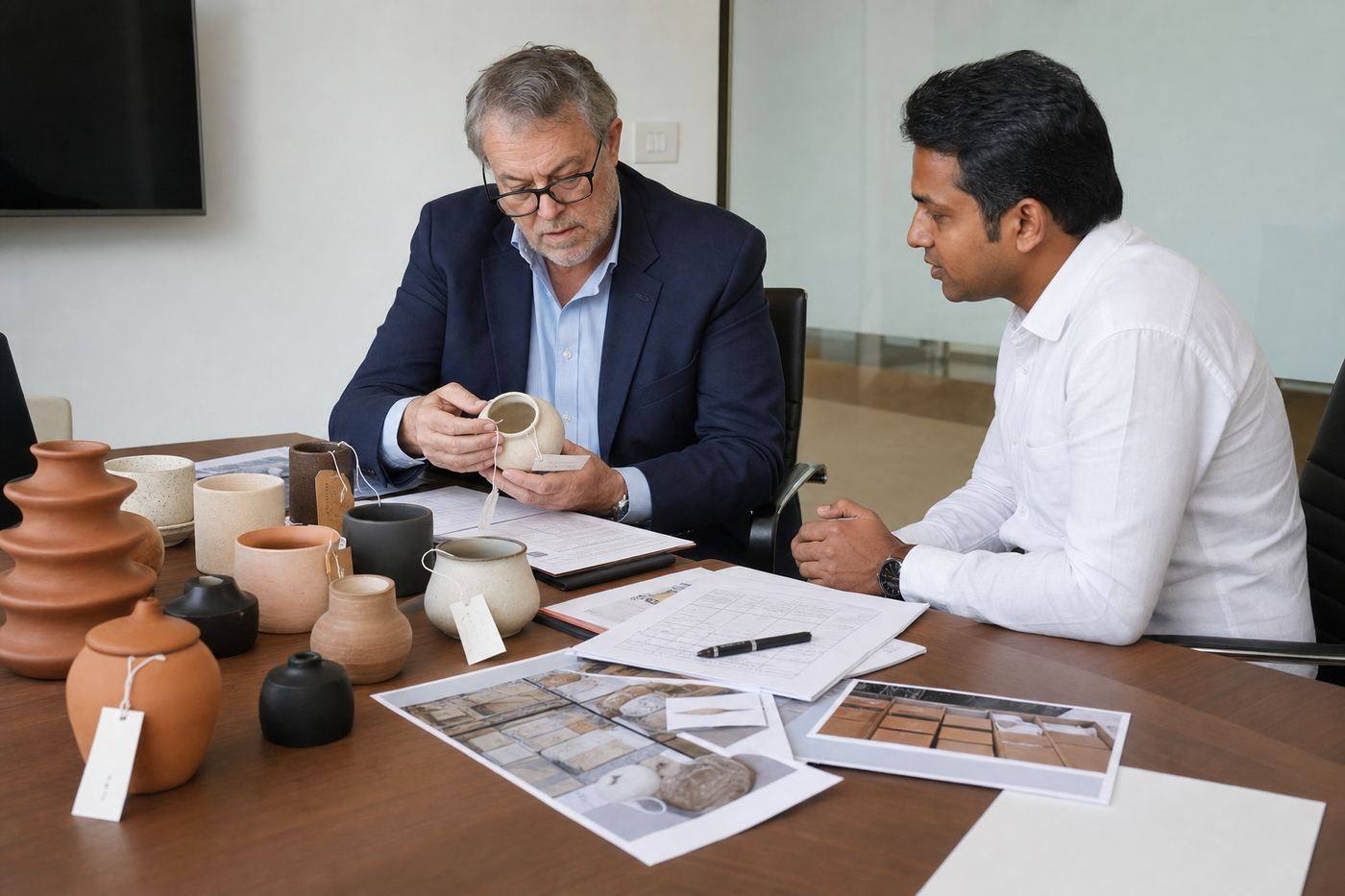
India's terracotta and ceramic handicraft export sector is distinctive in kiln craft and fragile in logistics: hand-thrown, mold-formed, and slab-built clayware from Khurja (Uttar Pradesh) industrial pottery, Jaipur blue pottery quartz-frit workshops, Molela terracotta plaque relief studios, Bankura and Bishnupur terracotta figurine belts, Asharikandi terracotta clusters, Longpi black pottery (Manipur), and Tamil Nadu, Pondicherry, and Gujarat gardenware belts — consolidated and export-packed through Delhi-NCR merchant programmes before sailing from Nhava Sheva, Mundra, or ICD Delhi/Dadri corridors. Trade is tracked primarily under HS 6913 (ornamental ceramic articles) with EPCH examples 69131000 (of porcelain or china) and 69139000 (other), HS 6912 (ceramic tableware / kitchenware other than porcelain or china), HS 6911 when porcelain SKUs are classified as tableware, and HS 6914 for other ceramic articles where planters, flowerpots, and utility ceramics classify outside 6913. Demand is anchored by the USA, Germany, the UK, the UAE, the Netherlands, France, Australia, Canada, and Japan, where garden centers, gift specialty retail, home-décor chains, hospitality amenity buyers, and department-store buyers stock Khurja glazed vases, Jaipur blue pottery bowls, Molela terracotta relief panels, and Bankura terracotta figurines alongside private-label ceramic tabletop and planter programmes.
For terracotta and ceramic handicraft exporters, EPCH registration is the foundational institutional credential. EPCH — the Export Promotion Council for Handicrafts — is the government-recognised apex body mandated to promote and facilitate export of Indian handicrafts, and ornamental ceramic articles, glazed decorative bowls and vases, terracotta planters, blue pottery bowls, and craft-cluster figurines fall squarely within that scope under HS 6913, 6912, and 6914. Registration issues the Registration-cum-Membership Certificate (RCMC), unlocks IHGF Delhi Fair booth eligibility, opens market development assistance for overseas fairs such as Ambiente in Frankfurt and NY NOW in New York, and — most importantly for a cluster-based category where breakage risk, glaze chemistry, and frost-resistance claims dominate buyer diligence — signals institutional identity that international buyers rely on when separating serious pottery exporters from casual traders.
This guide explains what EPCH is, why registration matters specifically for terracotta and ceramic handicraft exporters, who should register, the step-by-step application process, documents and fees, and how membership translates into IHGF Delhi Fair access and buyer trust across the anchor destination markets. It is not a full shipment documentation walkthrough or a destination-by-destination clay-body demand matrix — for the demand matrix by country, clay body, glaze, finish, and certification depth, see most demanded Indian terracotta and ceramic handicrafts by country; for the document-by-document operational checklist including glaze composition certificates and food-contact COAs, see the terracotta and ceramic export documentation checklist; for lead-safe glaze, food-contact tableware, and blue-pottery specialty depth, see lead-safe glaze, blue pottery, and food-contact ceramic export opportunities. Pair this guide with how to export terracotta and ceramic handicrafts from India for the full operational picture, and always verify current fees, portal workflows, and IHGF booking dates on epch.in and dgft.gov.in before you file.
Key Takeaways
Summary Box
Executive Summary
Summary Box
Terracotta and ceramic handicrafts are one of India's most heritage-rich and structurally kiln-dependent export categories, built around Khurja's industrial pottery cluster in Uttar Pradesh, Jaipur's quartz-frit blue pottery tradition in Rajasthan, Molela's terracotta plaque relief craft, Bankura and Bishnupur's terracotta horse and figurine tradition in West Bengal, Asharikandi's terracotta clusters in Assam, Longpi black pottery in Manipur, Tamil Nadu / Pondicherry / Gujarat gardenware belts, and Delhi-NCR merchant consolidation for mixed pottery programmes. Broader EPCH handicrafts (excluding carpets) reached Rs 33,122.79 crore / US$3,917.89 million in FY 2024–25 — cite that figure only for sector context; ceramic-specific trade should be framed via HS 6913, 6912, and 6914 through DGCI&S or TradeStat, never as if total handicrafts equals ceramic volume. That kiln depth converts into export revenue only when institutional credentials, glaze consistency, frost-rating discipline where claimed, and fragile-clayware packing are all in place before the first buyer conversation.
EPCH registration sits at the centre of that institutional layer for the ceramic cluster. It is the gateway to RCMC issuance, IHGF Delhi Fair booth eligibility, market development assistance for overseas fairs like Ambiente Frankfurt and Maison & Objet Paris, and — commercially most important — the credibility signal that shortens buyer due diligence when a US garden-center buyer is comparing several Indian planter suppliers or a German tabletop specialist is evaluating Khurja stoneware against Portuguese or Vietnamese alternatives. This guide combines the EPCH registration playbook with the market context a pottery exporter needs: size and industry overview, export and import statistics framing, product categories by clay body, manufacturing overview across the kiln stages, export process overview, pricing, MOQ, fragile packaging, container loading, shipping methods, certifications, buyer requirements, country-wise opportunities, and full buyer / exporter / compliance checklist sets — without duplicating the document field-by-field checklist or the country × clay body × glaze demand matrix owned by peer cluster posts.
Market Size & Industry Overview
Key Statistics
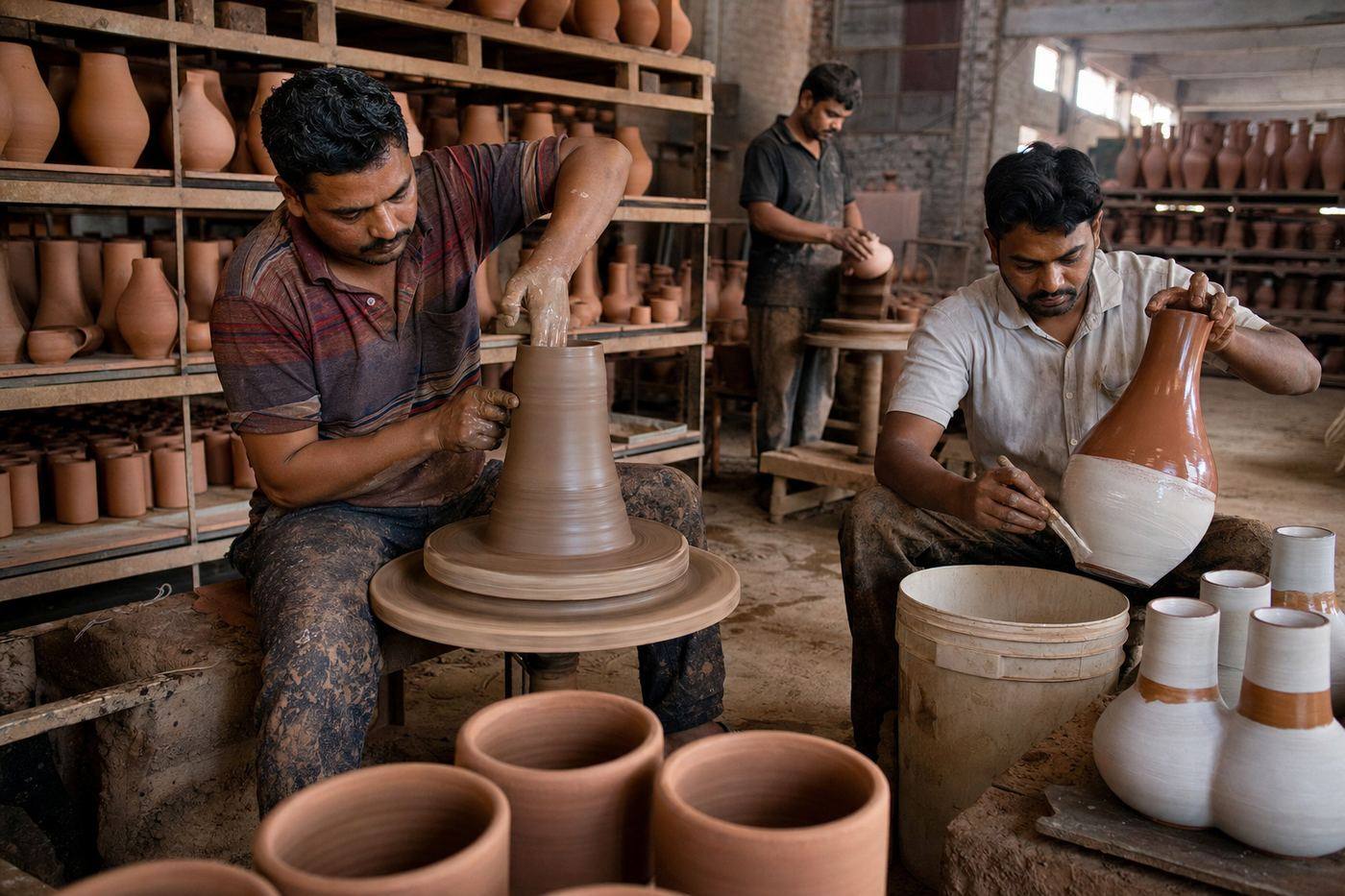
Global demand for Indian terracotta and ceramic handicrafts spans ornamental ceramic vases, glazed bowls, blue pottery jars and coasters, ornamental figurines, Molela terracotta relief plaques, Bankura terracotta horses, ceramic planters and gardenware, ceramic candle holders, ceramic wall décor, decorative platters, and curated ceramic gift assortments. Production is concentrated in specialist clusters: Khurja (Uttar Pradesh) for industrial-scale glazed pottery, stoneware, and decorative ceramic programmes; Jaipur (Rajasthan) for blue pottery on quartz / glass-frit bodies with turquoise, cobalt, and floral motifs; Molela (Rajasthan) for terracotta plaque and relief mural work; Bankura and Bishnupur (West Bengal) for terracotta horses and figurines rooted in temple craft traditions; Asharikandi (Assam) for terracotta toys and utility artware; Longpi (Manipur) for premium hand-carved black pottery; Tamil Nadu, Pondicherry, and Gujarat artisan belts for terracotta gardenware and studio pottery; and Delhi-NCR for merchant consolidation, export-grade fragile packing, and mixed pottery gift programmes. Each cluster brings a distinct clay body, glaze tradition, kiln profile, and finish vocabulary — which matters directly for how buyers should structure sourcing relationships and how exporters should sequence EPCH registration alongside kiln capacity planning.
Category value for ceramic and terracotta handicrafts should be tracked via HS 6913 (ornamental ceramic articles), HS 6912 (ceramic tableware / kitchenware other than porcelain or china), HS 6911 (porcelain / china tableware where SKUs classify there), and HS 6914 (other ceramic articles — commonly the correct heading for many planters and flowerpots) using directional trade data via DGCI&S / TradeStat and ITC Trade Map. Compared with the wider EPCH handicrafts basket the ceramic line is a substantial specialty slice, and growth is disproportionately driven by garden-center demand for terracotta planters in the USA, Germany, and the UK; blue pottery discovery in boutique and design gift retail across Europe and Japan; and hospitality amenity ceramic sourcing across the UAE and Southeast Asia. Note that HS 6913, 6912, and 6914 include foreign origins as well — do not present a chapter-level import figure as India's export figure.
What Is EPCH and Why It Matters for Terracotta and Ceramic Exporters
EPCH stands for the Export Promotion Council for Handicrafts, an apex body recognised by India's Ministry of Textiles and Ministry of Commerce and Industry to promote and facilitate export of Indian handicrafts across categories including ornamental ceramic artware, decorative terracotta, blue pottery, glazed tableware where marketed as handicraft, and ceramic gardenware. It supports exporters through registration services, market development assistance (MDA), trade fair organisation — most notably the IHGF Delhi Fair, India's largest organised handicraft buyer-access event — and market intelligence relevant to handicraft-specific export cycles, including spring gardenware programmes and Q4 gifting ceramics.
For terracotta and ceramic exporters specifically, EPCH plays a dual role. It is the registration authority that issues the Registration-cum-Membership Certificate (RCMC) that scheduled handicraft exporters need for export documentation and scheme eligibility under handicraft product lists, and it is a commercial facilitator that connects registered members to IHGF Delhi Fair booths in the ceramic and gardenware zones, overseas buyer-seller meets, and international home-décor exhibitions. Because ornamental ceramic articles under HS 6913, ceramic tableware artware under HS 6912, and other ceramic articles including many planters under HS 6914 fall within EPCH's scheduled scope, registration functions as a genuine institutional requirement for organised export — not a discretionary add-on. Buyers in developed markets increasingly request RCMC evidence during vendor onboarding precisely because the ceramic category is populated by many small Khurja units, a smaller number of large Khurja industrial producers, heritage Jaipur blue pottery ateliers, cluster-based Molela and Bankura studios, and organised Delhi-NCR merchant exporters — and buyers use registration status as a first-order filter against informal traders who cannot support glaze consistency or export packing across multi-container programmes.
Export Statistics
Key Statistics
Indian terracotta and ceramic handicraft exports are tracked across a small family of HS headings, and correct classification is the single most common trip point for pottery exporters filing shipping bills. Ornamental ceramic articles sit under HS 6913, with EPCH-referenced examples 69131000 (of porcelain or china) and 69139000 (other) — most Khurja, Jaipur blue pottery, and craft-cluster ornamental SKUs classify here. Ceramic tableware and kitchenware other than porcelain or china sit under HS 6912; porcelain / china tableware and kitchenware sit under HS 6911 when the SKU commercial identity is tableware rather than ornament; and other ceramic articles including many terracotta planters and flowerpots sit under HS 6914 where they fall outside 6913. Exporters shipping mixed containers of ornamental vases, tableware-adjacent bowls, and terracotta planters must confirm correct classification per SKU with their customs broker (CHA), since duty treatment and destination compliance requirements — particularly food-contact heavy-metal migration limits — differ meaningfully across these headings even for visually similar clayware. Do not force papier-mache 4823, wooden 4420, or metal 8306 lines onto ceramic SKUs, and do not present an ornamental line as tableware or vice versa.
Directional trade context: use DGCI&S / TradeStat under HS 6913, 6912, 6911, and 6914 as the ceramic proxies — never present EPCH total handicrafts (Rs 33,122.79 crore / US$3,917.89 million, excl. carpets, FY 2024–25) as the ceramic number. By destination, the USA, Germany, the UK, the UAE, the Netherlands, France, Australia, Canada, and Japan anchor commercial demand for Indian ornamental ceramics, blue pottery, and terracotta gardenware. Exporters should verify current figures via EPCH trade statistics releases, DGFT export dashboards, and ITC Trade Map before making sourcing or kiln-capacity commitments.
Comparison table
Swipe →
Data table — swipe horizontally on small screens
| Metric | Directional Trend | EPCH / IHGF Relevance |
|---|---|---|
| Ceramic proxy HS lines | 6913 (ornamental); 6912 (ceramic tableware non-porcelain); 6911 (porcelain tableware); 6914 (other ceramic articles incl. many planters) — verify per SKU with CHA | RCMC product-category declaration must reflect the correct ornamental / tableware / other-articles mix |
| Broader EPCH handicrafts context (excl. carpets) | Rs 33,122.79 crore / US$3,917.89 million, FY 2024–25 | Sector context only — not a ceramic-specific volume claim |
| Primary industrial cluster | Khurja (UP) — largest ceramic pottery / glazed artware concentration for export programmes | IHGF Delhi draws garden-center and décor buyers evaluating Khurja glaze samples on-site |
| Heritage and studio clusters | Jaipur blue pottery; Molela terracotta plaques; Bankura / Bishnupur terracotta figurines; Asharikandi; Longpi black pottery (selective); TN / Pondicherry / Gujarat gardenware | EPCH exporter directory helps buyers separate heritage clusters from generic pottery listings |
| Top destination markets | USA, Germany, UK, UAE, Netherlands, France, Australia, Canada, Japan | IHGF buyer delegations from most of these markets every edition |
| Registration base | Fragmented across Khurja industrial units, Jaipur blue pottery ateliers, craft-cluster studios, and Delhi-NCR merchant consolidators | EPCH exporter directory separates registered pottery suppliers from unregistered intermediaries |
Import Statistics
Key Statistics
On the import side, the USA leads demand for Indian terracotta planters through garden-center chains, ornamental ceramic vases through home-décor specialty retail, and blue pottery accents through boutique gift channels — with Prop 65 posture and lead-safe glaze documentation increasingly expected on decorative ceramics as well as tableware. Germany anchors European demand for glazed ornamental ceramics, blue pottery bowls, and quality-focused stoneware, with LFGB-conscious tableware programmes and REACH SVHC documentation on decorative glazes. The Netherlands operates as both a direct market and a European distribution hub for ceramic décor and gardenware. The UK mirrors US patterns with added weighting toward heritage cluster craft (Jaipur blue pottery, Molela plaques). France concentrates in boutique ceramic gift and design retail. The UAE combines bulk hospitality amenity procurement — ceramic ashtrays, hotel amenity bowls, décor accents — with premium blue pottery and figurine gifting for corporate programmes. Australia's demand grows through garden centers and gift retail with strict frost-rating and breakage QC expectations. Canada tracks US patterns at smaller scale. Japan applies a tight bar on glaze neatness, dimensional accuracy, and lead-safe evidence, and rewards refined blue pottery and Longpi black pottery at premium price points through design retail and museum shops.
Comparison table
Swipe →
Data table — swipe horizontally on small screens
| Country | Import Driver | Typical Format Imported |
|---|---|---|
| USA | Garden centers, home-décor specialty, gift retail, private label | Terracotta planters (HS 6914); ornamental ceramic vases (HS 6913); blue pottery accents |
| Germany | Gift specialty, tabletop, garden décor | Glazed ornamental ceramics; blue pottery bowls; stoneware artware; frost-rated planters |
| Netherlands | European distribution hub, gift and garden retail | Contemporary ceramic vases; gardenware; blue pottery; nested décor sets |
| France | Boutique gift and home-décor retail | Fine glazed vases; blue pottery statement pieces; Molela relief plaques |
| UK | Gift retail, home-décor specialty, garden centers | Terracotta planters; glazed ornamental ceramics; blue pottery; Bankura figurines for design retail |
| UAE | Hospitality amenities, retail, corporate gifting | Bulk ceramic amenity; premium blue pottery gift sets; ornamental vases |
| Australia | Gift and home-décor retail, garden centers | Terracotta planters (frost/breakage-conscious); glazed vases; coasters |
| Canada | Gift retail, garden centers, diaspora and mainstream | Similar to USA at smaller scale — planters, vases, blue pottery |
| Japan | Design gift retail, museum shops, ceramics specialty | Small blue pottery; Longpi black pottery; refined stoneware ornamentals |
Product Categories
Summary Box
- Ornamental ceramic vases and jars (HS 6913 — 69131000 porcelain / 69139000 other) — Khurja glazed and Jaipur blue pottery hero SKUs across Germany, UK, and USA décor programmes
- Ceramic bowls and platters marketed as artware (HS 6913) or tableware (HS 6912 / 6911) — clarify commercial identity per invoice line
- Terracotta planters, flowerpots, and gardenware (often HS 6914) — USA, Germany, UK garden centers and outdoor-living buyers
- Blue pottery bowls, coasters, plates, tiles (HS 6913, some tableware lines under 6912) — Jaipur heritage craft with quartz-frit body
- Molela terracotta relief plaques and wall panels (HS 6913) — France, Japan boutique and design retail
- Bankura terracotta horses and figurines (HS 6913) — heritage gift and museum-shop channels
- Longpi black pottery (Manipur, HS 6913) — selective premium programmes
- Ornamental ceramic figurines, candle holders, and gift accessories (HS 6913) — hospitality amenity and gift retail
- Curated ceramic gift assortments and private-label sets — Delhi-NCR consolidation strength for mixed pottery programmes
Terracotta and ceramic exports span ornamental vases, decorative bowls, blue pottery jars and coasters, ornamental ceramic figurines, Molela terracotta relief plaques, Bankura terracotta horses and figurines, Longpi black pottery accents, ceramic planters and gardenware (from small tabletop pots to statement outdoor terracotta), ceramic candle holders and diffusers, ceramic wall plates and panels, decorative platters, and curated ceramic gift assortments. Exporters should understand where EPCH registration and buyer expectations differ across categories, even though a full SKU breakdown belongs in top terracotta and ceramic handicraft products exported from India.
Manufacturing Overview
Export Tip
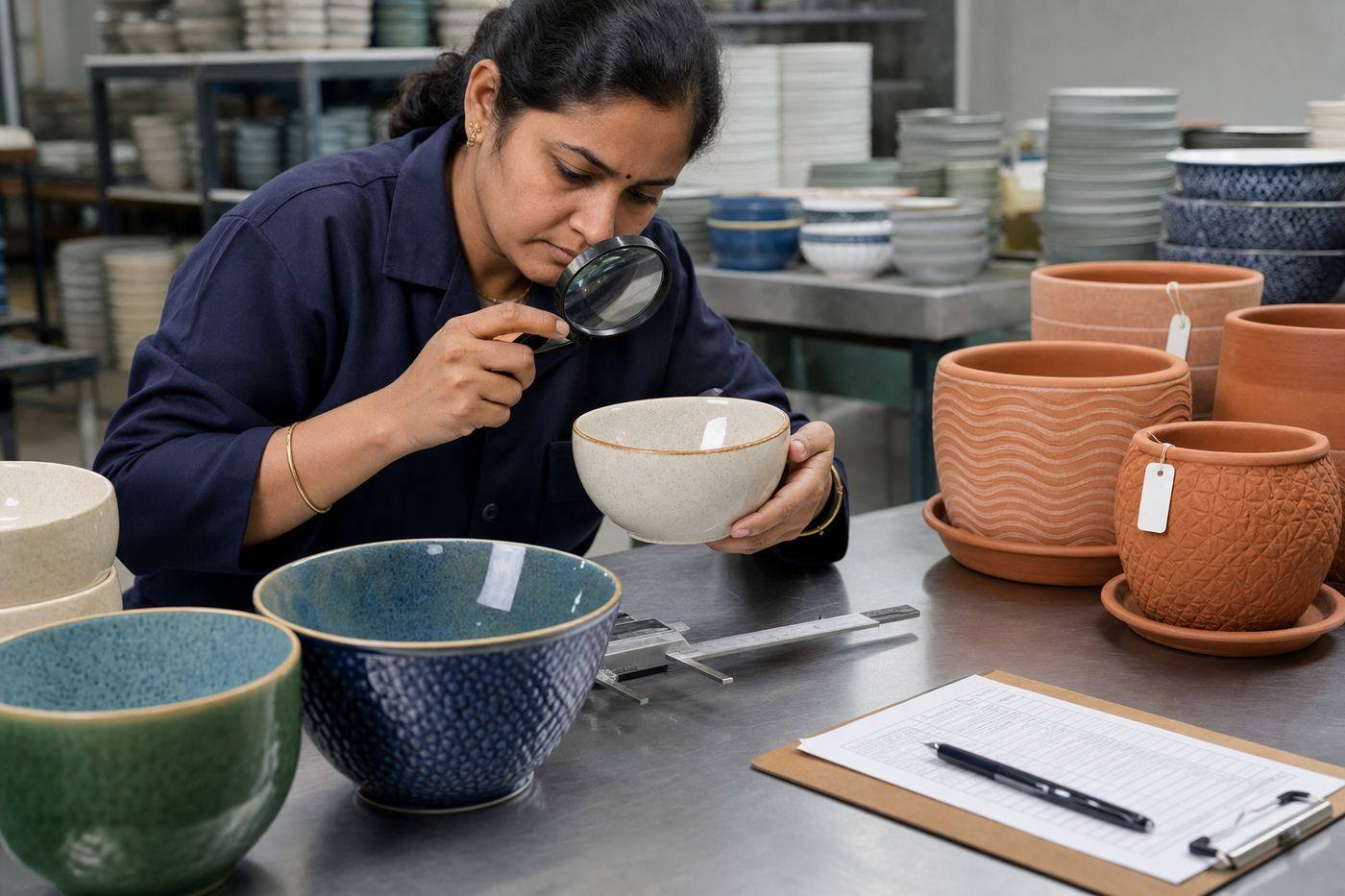
Terracotta and ceramic production in India follows a consistent kiln sequence even when clay bodies and glazes differ sharply by cluster: clay preparation → forming (wheel throwing, mold casting, hand building, or slab building) → drying → bisque firing → optional glazing (dip, spray, brush, or hand painting) → glaze firing → cooling → QC → export packing. Khurja units run industrial-scale kilns with standardised stoneware and earthenware bodies suited to décor-and-tableware-adjacent programmes at export volumes. Jaipur blue pottery uses a distinctive quartz / glass-frit body — not conventional clay — that is single-fired at lower temperatures with turquoise, cobalt, and floral hand-painted motifs before glaze fire. Molela artisans hand-build terracotta relief plaques with narrative and iconographic panels. Bankura and Bishnupur workshops mold terracotta horses and figurines in the region's characteristic terracotta tradition. Longpi black pottery from Manipur is hand-carved from a serpentine-and-clay mix and open-fired for premium studio pieces. Tamil Nadu, Pondicherry, and Gujarat artisan belts contribute terracotta gardenware and studio pottery capacity for planter programmes and boutique décor lines.
Export-oriented ceramic workshops increasingly invest in fully vitrified glaze fire discipline (crazing, pinholing, and glaze crawl are the operational killers, not phytosanitary paperwork), lead / cadmium migration testing where tableware or food-contact claims are made, frost-rating evidence for outdoor terracotta programmes where frost resistance is claimed, and stack-limited double-wall carton packing with cell dividers for nested ceramic sets. Kiln capacity remains fragmented across many small and mid-sized cluster units, with a smaller number of larger Khurja producers, which makes EPCH's institutional facilitation — and merchant exporters who can aggregate multi-workshop lots into stable programme supply — particularly valuable for buyers seeking consistent glaze and dimensional lot-to-lot behaviour at commercial volumes.
Why EPCH Registration Matters for Terracotta and Ceramic Exporters
Beyond the institutional-facilitation role, EPCH membership delivers practical commercial value for ceramic and terracotta exporters: RCMC issuance for export documentation, IHGF Delhi Fair booth eligibility in the ceramic / gardenware / gift zones, market development fund assistance for participating in overseas exhibitions like Ambiente Frankfurt, NY NOW, and Maison & Objet Paris, and visibility in EPCH's exporter directory used by international sourcing teams building supplier shortlists ahead of each fair season. For cluster-scale segments like Jaipur blue pottery, Molela terracotta plaques, and Bankura figurines, a registered merchant exporter with a live RCMC is often the only credible bridge between artisan studios and a US garden-center chain, a German gift-tabletop specialist, or a UAE hospitality distributor with a mid-six-figure PO — buyers do not want to onboard the workshop directly, and the workshop cannot handle export documentation, glaze compliance paperwork, and fragile-clayware container stuffing alone.
Buyer trust is the immediate commercial payoff. When a buyer onboarding pack includes IEC, GSTIN, EPCH RCMC, and — where relevant — glaze composition certificates for lead-safe programmes, food-contact COAs for tableware, frost-rating evidence for outdoor terracotta, and honest cluster-origin labelling (Khurja vs Jaipur blue pottery vs Molela vs Bankura vs Delhi-consolidated), the perceived risk for a German tabletop buyer or a US garden-center importer drops sharply. Missing EPCH documentation causes serious buyers to pause, request workarounds, or move to an already-registered competitor — a meaningful risk in a category where buyers frequently discover new suppliers at IHGF Delhi and expect institutional registration as table stakes for any follow-up conversation about spring gardenware or Q4 gift programmes.
Who Should Register with EPCH for Terracotta and Ceramic Exports
- Khurja (UP) industrial pottery units producing glazed stoneware, earthenware, decorative vases, and tableware-adjacent artware for export programmes
- Jaipur (Rajasthan) blue pottery ateliers producing quartz-frit hand-painted bowls, jars, coasters, and tiles
- Molela (Rajasthan) terracotta plaque and relief mural studios
- Bankura / Bishnupur (West Bengal) terracotta horse and figurine workshops
- Asharikandi (Assam) terracotta toy and utility artware clusters
- Longpi (Manipur) black pottery hand-carving units producing premium studio pieces
- Tamil Nadu, Pondicherry, and Gujarat terracotta gardenware and studio pottery units
- Delhi-NCR merchant exporters consolidating multi-cluster ceramic programmes with export packing and mixed gift or garden assortments
- Private-label ceramic gift and hospitality amenity exporters serving UAE, US, and EU corporate and hotel programmes
- MSMEs and startups with IEC and GST readiness entering ceramic or terracotta handicraft export
EPCH registration is relevant to any entity engaged in commercial export of terracotta or ceramic handicrafts, including Khurja industrial pottery units, Jaipur blue pottery workshops and ateliers, Molela terracotta studios, Bankura and Bishnupur terracotta figurine workshops, Asharikandi terracotta clusters, Longpi black pottery producers, Tamil Nadu / Pondicherry / Gujarat gardenware units, Delhi-NCR merchant exporters consolidating multi-workshop pottery lots, MSMEs entering ceramic décor or planter export with a valid IEC, and startups building private-label ceramic gift, hospitality, or garden programmes.
Eligibility generally requires a valid IEC, GST registration, and entity constitution documents matching the applicant's business structure — proprietorship, partnership, company, cooperative, or LLP. Manufacturer-exporter classification typically requires workshop or kiln-unit evidence such as a rent agreement, utility bill, or ownership proof for the Khurja plant or Jaipur atelier; merchant-exporter classification requires procurement-and-export documentation across the supplied clusters. If your role is unclear or you operate across both models (common for Delhi-NCR merchants supporting Khurja industrial output plus Jaipur / Molela / Bankura heritage lines), state it explicitly during application, since default classification affects RCMC scope and IHGF participation category.
Benefits of EPCH Membership for Terracotta and Ceramic Exporters
Treat EPCH membership as a commercial toolkit rather than a certificate to file away — the RCMC and IHGF access open institutional doors, but kiln consistency, glaze compliance, and fragile-clayware packing close orders.
Comparison table
Swipe →
Data table — swipe horizontally on small screens
| Benefit | What You Gain | How to Use It for Terracotta and Ceramic |
|---|---|---|
| RCMC issuance | Export documentation credential for scheduled handicraft products under HS 6913 / 6912 / 6911 / 6914 | Include in every buyer onboarding pack alongside IEC and GST; cite on quotations and proforma invoices |
| IHGF Delhi Fair access | Eligibility to book booths in ceramic, gardenware, and gift zones at India's largest handicraft trade fair | Bring graded glaze samples across clay bodies (terracotta, earthenware, stoneware, porcelain, blue pottery quartz-frit) and a clear pricing sheet |
| Market development assistance (MDA) | Partial reimbursement for overseas fair participation and promotion | Apply before booking booths at Ambiente Frankfurt, NY NOW, or Maison & Objet Paris |
| Buyer-seller meets | Structured introductions to vetted international importers | Prepare cluster origin (Khurja / Jaipur / Molela / Bankura / Delhi-consolidated), glaze grade, and MOQ specifics for each meeting |
| Exporter directory listing | Visibility to buyers searching for registered Indian pottery suppliers | Keep product categories, clusters, and glaze / firing capabilities current |
| Market intelligence | Destination-specific ceramic demand and compliance updates including lead-safe / food-contact regulatory shifts | Prioritise one or two markets based on current EPCH intelligence rather than chasing every geography |
| Craft cluster linkage | Institutional pathway to state handicraft boards and GI authorised-user pathways (e.g., Blue Pottery of Jaipur GI, where applicable) | Use for workshop capacity development alongside export scale-up |
| Buyer credibility | Institutional signal reducing onboarding friction for fragile-clayware programmes | Attach RCMC to every inquiry response and every IHGF booth conversation |
EPCH Registration for Terracotta and Ceramic Exporters: Step-by-Step Process
Export Tip
The sequence below reflects the current organised application pathway through the EPCH portal, which is linked to DGFT login infrastructure for IEC-holding exporters. Confirm live screen flows and document checklists on epch.in before filing, as workflows are periodically updated.
Step 1: Obtain IEC
Apply for an Import Export Code on the DGFT portal if you do not already hold one. IEC is the foundation of all commercial export from India, and EPCH registration cannot proceed without it. Keep PAN, bank details, and address consistent with your GST registration to avoid mismatches later — a common source of delay for Khurja and Jaipur applicants whose banking address does not match the kiln site or atelier address on file.
Step 2: Confirm Product Category Fit
Confirm that your ornamental ceramic vases, glazed bowls, blue pottery pieces, terracotta plaques, figurines, and planters fall within the scheduled handicraft categories EPCH recognises. Most ornamental clayware under HS 6913 qualifies comfortably; blue pottery bowls sit under HS 6913 as ornamental artware in most commercial contexts, while tableware-marketed ceramics may classify under HS 6912 (non-porcelain) or HS 6911 (porcelain), and terracotta planters commonly classify under HS 6914. Verify classification against current EPCH product-category lists and your CHA before applying, since ornamental vs tableware vs other-articles wording on invoices needs to reconcile with your RCMC scope declaration.
Step 3: Prepare Documentation
Assemble IEC copy, GST certificate, PAN, cancelled cheque, bank financial soundness certificate where required, and entity constitution proofs (partnership deed, incorporation certificate, MoA/AoA, cooperative registration, or LLP agreement as applicable). Manufacturer-exporter classification may require MSME Udyam registration and workshop evidence such as a rent agreement, utility bill, or ownership proof for the Khurja plant, Jaipur atelier, or craft-cluster studio. Incomplete document packs are the leading cause of processing delays for pottery applicants.
Step 4: Register on the EPCH Portal
Create an applicant account on the EPCH online registration portal using your IEC and business email. This is the primary interface for new registration; DGFT portal linkages may form part of the workflow depending on the application type. Use a monitored business email address rather than a personal one, since deficiency communications land there and delayed responses stall the application.
Step 5: Complete the Application and Select Product Categories
Fill in entity details, IEC, and product categories — select ornamental ceramic / terracotta / blue pottery / gardenware handicraft categories as applicable. Declare export destination interests and exporter type (manufacturer, merchant, or both). Accurate category selection matters because RCMC scope, IHGF participation eligibility, and scheme access often tie back to declared products, and a Khurja industrial exporter declaring only ornamental HS 6913 will run into friction if they later ship tableware-classified bowls under HS 6912 without updating their scope.
Step 6: Pay Registration Fees
Pay the prescribed fee online via the portal's payment gateway. First-year fees typically comprise a one-time registration fee plus annual subscription plus GST. Retain receipts and acknowledgement numbers in your compliance file, and always verify live amounts before remitting since fee schedules are revised periodically. Do not rely on figures quoted in older articles or forum posts — check the live EPCH schedule.
Step 7: Upload Documents and Submit
Upload clear, self-attested scans of all required documents. Names, addresses, and signatory details must match precisely across IEC, GST, and the application form — even minor spelling discrepancies generate deficiency notices. Submit only once every required field and upload is confirmed complete, and keep local copies of the submission acknowledgement.
Step 8: Verification and RCMC Issuance
EPCH officials verify completeness and document authenticity. Respond to any deficiency communication within 24–48 hours to avoid application dormancy. On approval, EPCH issues the RCMC — download and store it alongside IEC and GSTIN in a master compliance folder, and diary the annual renewal date so continuity is never broken, since a lapsed RCMC can jeopardise IHGF booth eligibility ahead of the fair season and disrupt buyer onboarding packs that referenced active membership for a Q4 gift or spring gardenware programme.
Documents and Fees for EPCH Registration
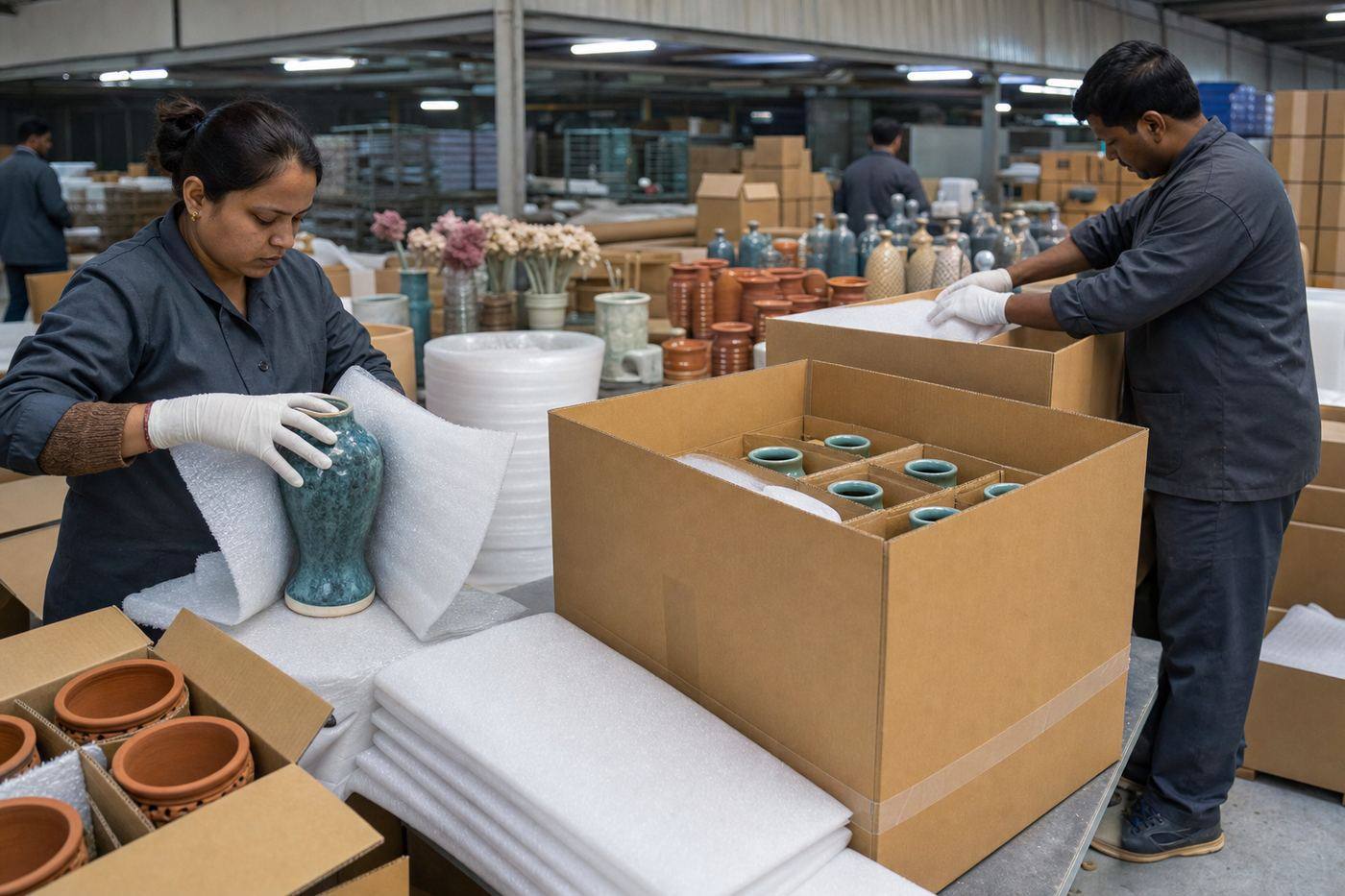
Use this snapshot as a preparation gate. Exact requirements vary slightly by entity type and by manufacturer- versus merchant-exporter category, and always verify the live fee schedule on the EPCH portal before remitting payment. Ceramic and terracotta applicants should be especially careful that workshop-address evidence corresponds to the actual kiln site or atelier and not a merely nominal registered office.
Comparison table
Swipe →
Data table — swipe horizontally on small screens
| Item | Requirement / Typical Cost | Practical Note for Pottery Exporters |
|---|---|---|
| IEC certificate | Mandatory prerequisite | Self-attest; ensure name matches all other documents |
| GST registration certificate | Mandatory | Legal name and address must align with IEC; principal place of business ideally matches kiln address for manufacturer-exporter category |
| Entity constitution proof | Deed / incorporation / MoA-AoA / cooperative registration / LLP agreement as applicable | Ensure notarisation where required; artisan cooperatives should submit registration certificates |
| Kiln / workshop evidence (manufacturer category) | Rent agreement, utility bill, or ownership proof for Khurja plant, Jaipur atelier, or craft-cluster studio | Required for manufacturer-exporter classification; a Delhi office is not enough if you claim to be the producer |
| Bank financial soundness certificate | Often required | Use the bank account reflected in your IEC |
| Cancelled cheque and PAN | Mandatory | Cross-check name and account number consistency |
| First-year registration + membership + GST | Fee benchmark varies by exporter turnover slab | Verify live fee schedule on the EPCH portal; do not rely on outdated numbers |
| Annual renewal fee | Lower than first-year enrolment | Diary renewal before the financial-year deadline to avoid IHGF disruption |
RCMC for Terracotta and Ceramic Exporters: What It Means and How to Use It
Compliance Notes
The Registration-cum-Membership Certificate (RCMC) confirms an exporter's registration and membership under EPCH's institutional framework. For ceramic and terracotta exporters, RCMC is referenced during buyer vendor onboarding, in applications for government export incentives, in IHGF Delhi Fair booth allocation for the ceramic and gardenware zones, and in documentary credit transactions where institutional membership proof is a documentary condition. Validity is typically multi-year but subject to annual fee payment — lapsing disrupts continuity even within the nominal validity window. Keep RCMC alongside IEC in a master compliance file accessible to your export desk and shipping agent, and reference the RCMC number on quotations, proforma invoices, and buyer-onboarding cover letters as a matter of routine so buyers do not have to ask for it separately.
IHGF Delhi Fair Access for Terracotta and Ceramic Exporters
The India Handicrafts and Gifts Fair (IHGF) Delhi, organised by EPCH twice yearly (spring and autumn editions), is the single largest organised buyer-access channel for Indian handicraft exporters, drawing thousands of international buyers from garden-center chains, gift specialty retail, home-décor programmes, and design retail across the USA, Europe, the UAE, Japan, and beyond. EPCH membership is the prerequisite for booth booking, and ceramic and terracotta exhibitors form visible zones organised around glazed décor, gardenware, blue pottery, tableware-adjacent artware, and heritage cluster craft — buyers can inspect glaze surface, colour match, dimensional accuracy, and carton-ready fragile samples on the spot, which shortens the sample-approval cycle considerably compared with remote sourcing where breakage on courier can obscure real quality.
For ceramic exporters, IHGF delivers value well beyond the booth itself: buyers physically inspect glaze pinholing, crazing, colour lot consistency, base-foot finish, and crush-resistant sample packing before committing to gardenware or gift programmes. Exhibitors who arrive with a well-organised catalogue segmented by clay body (terracotta, earthenware, stoneware, porcelain, blue pottery quartz-frit), cluster origin (Khurja industrial vs Jaipur blue pottery vs Molela vs Bankura vs Delhi-consolidated), glaze family (matte, gloss, crackle, reactive, underglaze, overglaze), and finish grade, plus clear FOB pricing tiers and MOQ / lead-time sheets keyed to spring gardenware and Q4 gift cut-offs, convert significantly more booth visits into follow-up purchase orders than those relying on ad hoc conversation. Booking typically opens months ahead of each edition — plan booth applications, product-catalogue readiness, glaze sample logistics (which itself is fragile), and travel logistics well in advance of fair dates published on epch.in.
Export Process
Export Tip
EPCH registration is one step in a broader export sequence. A typical terracotta and ceramic export process runs: IEC and EPCH registration; buyer discovery via IHGF Delhi, Ambiente Frankfurt, direct outreach, or B2B platforms; sample dispatch with clay body, glaze grade, dimension, and firing schedule specifications; price negotiation and purchase order; procurement or production scheduling with Khurja / Jaipur / Molela / Bankura / Longpi / gardenware workshops synced to kiln capacity; pre-shipment quality control (glaze adhesion, crazing check, pinholes, warpage, colour match, base-foot smoothness, dimensional tolerance, and lead / cadmium migration where tableware or food-contact claims are made); export packing with foam wrap, cell dividers, double-wall cartons, stack-height limits, and FRAGILE marking; customs documentation and clearance; booking and loading at Nhava Sheva, Mundra, or ICD Delhi / Dadri corridor; shipment tracking; and final documentation handover against payment terms.
For the complete operational walkthrough — including full documentation specifics such as glaze composition certificates, food-contact COAs, and broker handoff — see how to export terracotta and ceramic handicrafts from India and the terracotta and ceramic export documentation checklist.
Pricing Analysis
Buyer Tip
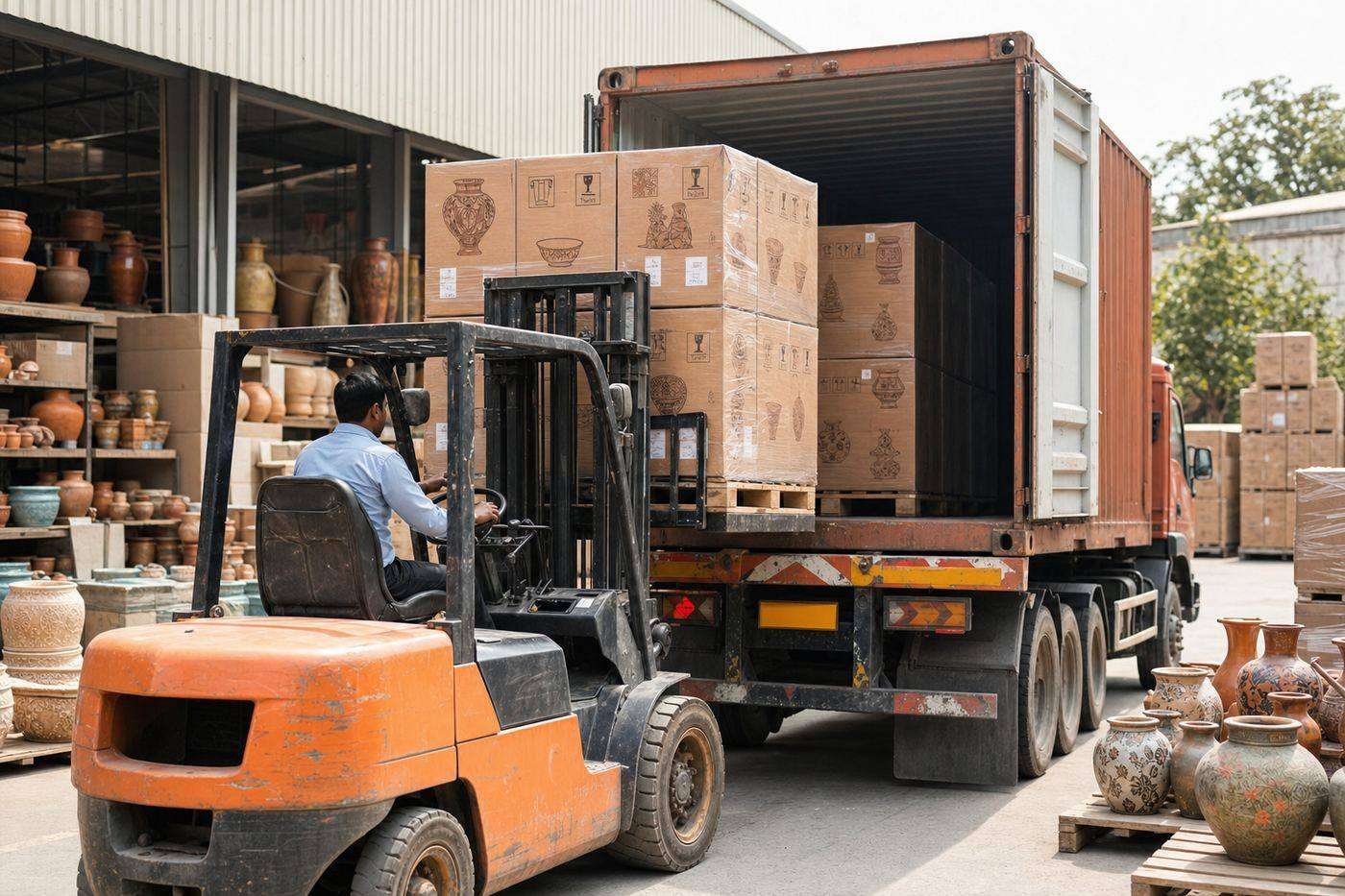
Ceramic and terracotta pricing is driven primarily by clay body, size, glaze complexity, decoration hours, firing schedule, cluster origin, and lead-safe / food-contact / frost-rating testing where required. FOB pricing for small terracotta accents and ornaments commonly runs USD 1–8 per piece; mid glazed ceramic vases, bowls, and small planters run USD 4–28 per piece; statement blue pottery pieces and large terracotta garden pots sit at USD 15–75+ per piece or set; certified lead-safe or food-contact tableware programmes command evidence-dependent premiums. None of that pricing power matters if a buyer stalls at vendor qualification — for the full country-by-country clay body / glaze / finish preference context, see most demanded Indian terracotta and ceramic handicrafts by country.
Comparison table
Swipe →
Data table — swipe horizontally on small screens
| Product / Format | Typical FOB Price (USD) | Price Driver |
|---|---|---|
| Small terracotta accents and figurines | 1–8 | Cluster origin (Bankura, Molela small pieces), size, hand-decoration |
| Mid glazed ceramic vases and bowls | 4–28 | Clay body (stoneware vs earthenware), glaze layers, dimensions, firing schedule |
| Terracotta planters (small to medium) | 3–20 | Size, wall thickness, frost-rating evidence where claimed |
| Statement blue pottery / large terracotta garden pots | 15–75+ | Hand painting hours, quartz-frit body cost, kiln capacity, scale |
| Molela relief plaques and Bankura figurine statement pieces | 10–60+ | Iconography detail, size, cluster provenance |
| Lead-safe / food-contact certified tableware programmes | Premium to standard glazed | Evidence-bound migration testing, private-label testing amortisation |
MOQ Analysis
Buyer Tip
From an EPCH perspective, MOQ is a membership-story mismatch problem more than a packing formula. Fair buyers met in the IHGF ceramic or gardenware zone frequently expect trial-size pottery programmes; RCMC-backed exporters who only quote FCL minimums lose those leads before a sample ships. Present your ladder as credentials plus commercial flexibility: sealed samples for glaze approval, a small LCL trial that proves kiln consistency, then seasonal FCL for gardenware or gift ceramic programmes. Exact piece counts and CBM packing rules belong in the export documentation checklist and how-to-export guide — here the point is that membership credibility without a credible trial MOQ wastes IHGF ROI.
Comparison table
Swipe →
Data table — swipe horizontally on small screens
| Buyer Stage | EPCH-Linked Expectation | Membership Use |
|---|---|---|
| IHGF sample request | Ship glaze-true samples quickly after fair lead capture | Show live RCMC on catalogue / booth card |
| First commercial trial | Accept LCL or size-laddered planter trials | RCMC on proforma and vendor pack |
| Repeat mid-size buyer | Standing reorder with kiln calendar clarity | Renew RCMC before buyer re-audit |
| Spring gardenware programme | Book capacity early; fair conversations convert months ahead | MDA / fair planning under membership cycle |
| Q4 gift / blue pottery programme | SKU cards + heritage honesty at booth | RCMC + cluster-origin narrative together |
Packaging Standards
Export Tip
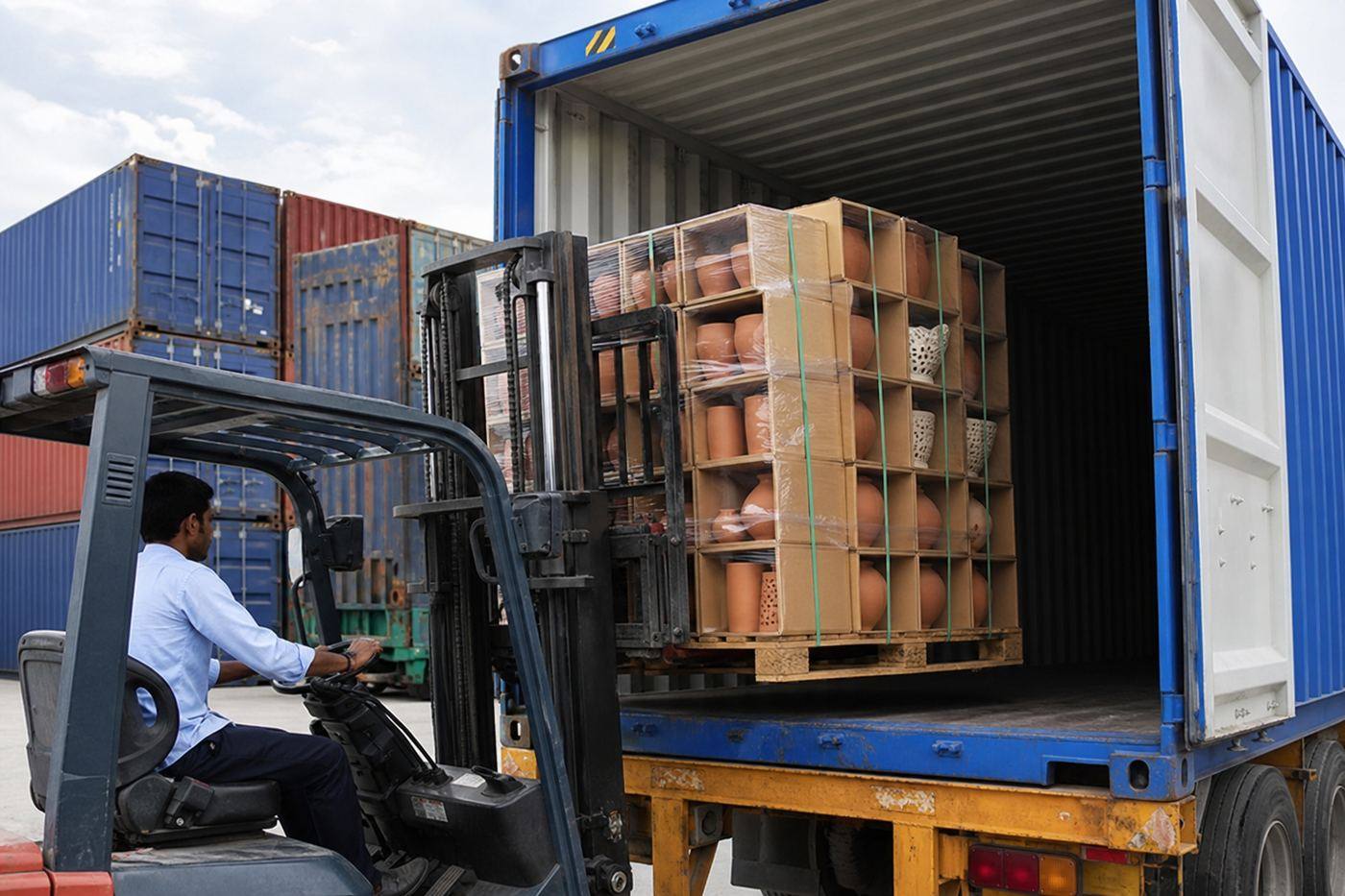
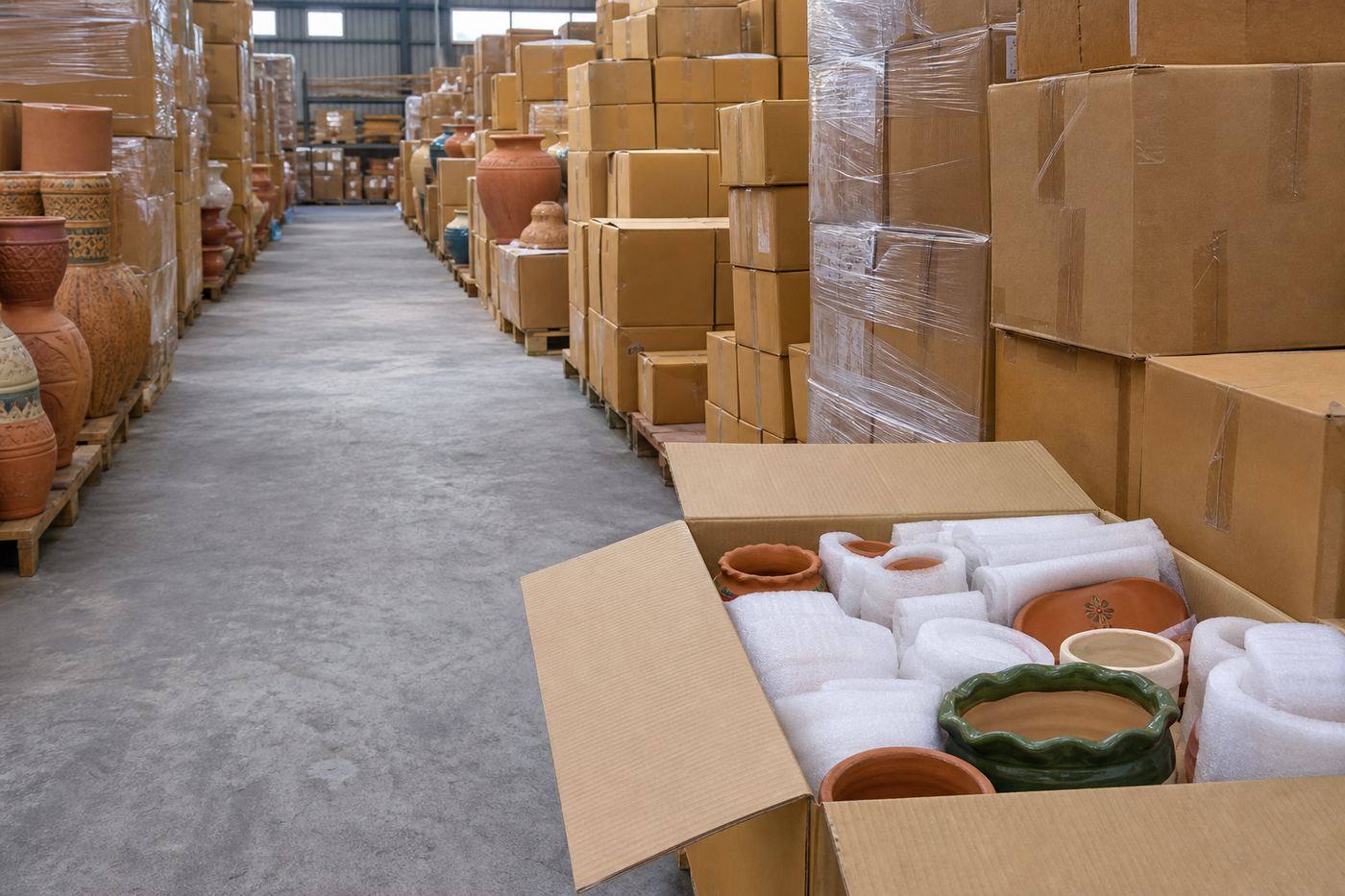
EPCH registration does not specify foam density or carton ECT — but buyer onboarding packs that include RCMC rarely clear without a packing story that protects fragile clayware. Use membership conversations to pre-answer breakage risk: show photographic packing standards, stack-height rules for tall terracotta, and honest gift-box CBM for blue pottery. Operational packing BOMs, cell-divider specs, and label templates are owned by the documentation checklist; this section only maps packing readiness to the questions IHGF and overseas buyers ask when they see your RCMC.
Comparison table
Swipe →
Data table — swipe horizontally on small screens
| Buyer Question at Fair / Audit | What RCMC Alone Does Not Prove | What to Attach Beside Membership |
|---|---|---|
| Will planters survive ocean transit? | Council membership | Pack photos, stack-height policy, FRAGILE mark example |
| Is blue pottery retail-ready? | Council membership | Gift-box sample + CBM note |
| Can you ship mixed Khurja + Jaipur lots? | Council membership | Consolidation pack protocol + origin honesty |
| Who owns breakage claims? | Council membership | Written packing responsibility on PO / Incoterm |
| Are decorative glazes food-safe? | Council membership | Lot-linked lab evidence — not the RCMC |
Container Loading Details
Export Tip
Container stuffing is a forwarder and CHA workflow, not an EPCH workflow — yet RCMC and IEC identifiers must match every shipping bill that leaves the ICD or load port. Membership value here is documentary identity: the same IE code and RCMC number the buyer saw at IHGF should appear on the stuffed-lot paperwork without edits that look like a different legal entity. For CBM planning, planter bracing, and ornamental-versus-tableware HS splits inside the container, use the documentation checklist rather than treating RCMC as a stuffing method.
Comparison table
Swipe →
Data table — swipe horizontally on small screens
| Stuffing Checkpoint | EPCH / Membership Angle | Hand Off To |
|---|---|---|
| Identity match on shipping bill | IEC + RCMC identical to vendor pack shown at fair | Export desk / CHA |
| HS mix vs catalogue pitch | Do not declare one blanket line after selling mixed pottery at IHGF | CHA + SKU cards |
| Gardenware FCL seasons | Membership calendar aligned to spring booking cycles | Kiln planner + forwarder |
| LCL trial after fair sample | RCMC still referenced even on small first lots | Documentation checklist |
| Premium blue pottery CBM | Fair narrative vs actual gift-box cube must match quote | Packing team |
Shipping Methods
Export Tip
Sea FCL / LCL via Nhava Sheva or Mundra, ICD Delhi / Dadri consolidation from Khurja and Jaipur, and courier samples are all compatible with EPCH membership — the council does not choose your mode. What membership does require is consistency: IEC and RCMC on commercial and logistics documents, and a fair-to-shipment trail that does not invent a new company name mid-route. Lead times, Incoterms, and port mechanics are covered in how to export terracotta and ceramic handicrafts from India; pair that operating guide with a current RCMC when you convert IHGF conversations into sailings.
Certifications
Compliance Notes
Think of ceramic credentials as three layers. Layer one is legal export identity: IEC and GST. Layer two is organised handicraft facilitation: EPCH RCMC (this guide’s focus) for IHGF access and buyer due diligence on HS 6913 / 6912 / 6914 programmes. Layer three is glaze and claim evidence — lead/cadmium migration, FDA / LFGB / REACH / Prop 65 posture, frost tests, GI authorised-user status — which RCMC never replaces. Buyers who request your EPCH certificate still reject lots without kiln-lot lab evidence. Keep layer-three document inventory in the documentation checklist and lead-safe specialty guide; use this table to position RCMC inside the stack.
Comparison table
Swipe →
Data table — swipe horizontally on small screens
| Credential Layer | Instrument | What It Unlocks for Pottery Exporters |
|---|---|---|
| Legal baseline | IEC + GST | File commercial ceramic / terracotta shipments |
| Organised handicraft layer | EPCH RCMC | IHGF ceramic/gardenware zones, MDA pathways, vendor-pack credibility |
| Glaze / food-contact evidence | Lot-linked migration COAs, FDA/LFGB posture | Tableware and lead-safe claims — not granted by RCMC |
| Market substance warnings | Prop 65 / REACH statements | USA and EU decorative glaze programmes |
| Heritage claim layer | Blue Pottery of Jaipur GI authorised-user evidence | GI hangtags — separate from EPCH membership |
| Outdoor claim layer | Frost-cycle evidence | Garden terracotta frost claims — separate from EPCH membership |
Buyer Requirements
Buyer Requirements
International terracotta and ceramic buyers typically request: glaze and dimensional samples with clear clay body and firing schedule specifications; consistent lot-to-lot glaze colour, gloss, and dimensional matching; flexible MOQ for first orders on new clay bodies or glazes; customisable packaging (private label, retail gift boxes for blue pottery, cell dividers for nested sets); lead-safe posture where decorative coatings interact with skin or where tableware claims are made; frost-resistance evidence for outdoor terracotta; honest cluster-origin labelling (Khurja vs Jaipur blue pottery vs Molela vs Bankura vs Delhi-consolidated); and a clean institutional credential set (IEC, EPCH RCMC, GST) presented upfront rather than after multiple follow-up requests. Buyers who have previously received cracked planters, crazed glazes, or under-documented tableware shipments apply stricter scrutiny to new Indian pottery suppliers regardless of quoted price.
Country-wise Opportunities
Market Snapshot
EPCH registration is a universal prerequisite, but the commercial opportunity differs meaningfully by destination. For the full clay body × glaze × finish × seasonal demand matrix by country, see most demanded Indian terracotta and ceramic handicrafts by country; the snapshot below focuses on how EPCH credentials and IHGF access interact with each market's buyer expectations for ceramic and terracotta programmes.
Comparison table
Swipe →
Data table — swipe horizontally on small screens
| Country | Opportunity Driver | EPCH-Linked Buyer Expectation |
|---|---|---|
| USA | Garden centers, home-décor, gift retail, private label planters and blue pottery | RCMC + Prop 65 posture on decorative coatings expected at first inquiry |
| Germany | Glazed ornamental ceramics, blue pottery, LFGB tableware | RCMC + LFGB / REACH readiness for tableware; frost documentation for outdoor terracotta |
| Netherlands | European distribution hub, gift and garden retail | RCMC + EU REACH readiness for glaze compliance |
| France | Boutique gift and design retail, Molela plaques, blue pottery statement pieces | RCMC + narrative craft-origin documentation and REACH compliance |
| UK | Gift retail, home-décor specialty, garden centers | RCMC + UK REACH; post-Brexit import care |
| UAE | Hospitality amenities, corporate gifting, ornamental ceramics | RCMC + dual bulk-and-premium capability; festive timing readiness |
| Australia | Gardenware, gift and home-décor retail | RCMC + frost/breakage QC for planters and glaze cure documentation |
| Canada | Gift retail, garden centers, seasonal | RCMC; similar posture to USA on decorative-coating compliance |
| Japan | Design gift retail, museum shops, small blue pottery and Longpi | RCMC + Japanese-grade glaze finish and lead-safe evidence |
EPCH vs Other Export Bodies for Ceramic and Terracotta Exporters
Ceramic and terracotta exporters sometimes ask whether other bodies are more relevant. For ceramic and terracotta handicrafts as the primary export product, EPCH is the correct primary registration and facilitation body. FIEO offers broader cross-sector federation benefits; state-level handicraft development corporations and craft boards support cluster-specific training; the Development Commissioner (Handicrafts) runs schemes relevant to artisan-cluster development; and DGFT governs IEC issuance and broader export policy. CAPEXIL sits closer to industrial construction ceramics and sanitaryware than handicraft artware, and is generally not the primary body for ornamental ceramic and terracotta handicraft exporters. These bodies complement EPCH rather than compete with it for the handicraft ceramic and terracotta cluster.
Comparison table
Swipe →
Data table — swipe horizontally on small screens
| Body | Primary Role for Ceramic and Terracotta Exporters | When to Engage |
|---|---|---|
| EPCH | Scheduled handicraft registration, RCMC, IHGF fair, MDA, ceramic and gardenware market development | Primary registration for all commercial ceramic and terracotta handicraft exporters |
| FIEO | Broad exporter federation, cross-sector networking | Supplementary for wider export community benefits |
| State handicraft boards / craft bodies (Rajasthan, WB, Assam, Manipur, TN) | Cluster-specific artisan training and infrastructure support for Jaipur blue pottery, Molela, Bankura, Asharikandi, Longpi, TN gardenware | Useful for cluster capacity development alongside export scale-up |
| Development Commissioner (Handicrafts) | Artisan cluster schemes, design intervention, cluster infrastructure | For artisan-cluster capacity and cluster-development initiatives |
| DGFT | IEC issuance, RCMC portal infrastructure, export policy | IEC first; portal credentials used throughout |
| CAPEXIL | Chemical and construction ceramics / sanitaryware (industrial) | Not the primary body for handicraft ornamental ceramic / terracotta programmes |
| GI registry (Blue Pottery of Jaipur and other cluster GIs) | Authorised-user pathway for GI claims | When marketing GI-tagged premium blue pottery or other GI cluster lines |
Sourcing Checklist for Buyers and Exporters
Checklist
Use this two-sided checklist when EPCH membership is the decision variable — before fair booking, first advance payment, or vendor onboarding for a pottery programme.
Buyer Checklist
- Ask for a current EPCH RCMC PDF (membership number + expiry) plus matching IEC — reject fair-only catalogues with no council identity
- Confirm the RCMC entity name matches the proforma and bank beneficiary for any Khurja, Jaipur blue pottery, Molela, or Bankura supplier
- Prefer suppliers who can show last IHGF ceramic/gardenware participation or booked booth proof when claiming organised export readiness
- Treat RCMC as onboarding evidence only — still demand glaze samples, kiln fire notes, and claim-bound lab reports before deposit
- For frost-rated outdoor terracotta or food-contact tableware, require evidence packs separate from the membership certificate
- Flag origin honesty: RCMC does not prove Jaipur blue pottery GI authorised-user status or Bankura cluster authenticity
Exporter Checklist
- Complete IEC first, then EPCH RCMC, before IHGF ceramic-zone booking or paid overseas fair MDA applications
- Put membership number and renewal date on every booth card, PDF catalogue footer, and first-inquiry reply template
- Align declared product categories on the RCMC application with the pottery SKUs you will actually sell (ornamental vs tableware vs planters)
- Renew RCMC before financial-year gaps that would embarrass you mid-buyer audit or mid-fair cycle
- Pair membership with one clear clay-body specialisation story — do not use EPCH as cover for an unfocused multi-cluster dump
- Hand layer-three compliance documents (glaze COAs, Prop 65/REACH, frost) via the documentation checklist, not as a substitute for RCMC
Compliance Checklist
Checklist
Compliance Notes
Comparison table
Swipe →
Data table — swipe horizontally on small screens
| Compliance Item | Status Check | Owner |
|---|---|---|
| IEC | Valid and matches GST / PAN details | Export desk |
| GST registration | Active and address-consistent with kiln or atelier | Accounts / compliance |
| EPCH RCMC | Current and renewed annually before financial-year deadline | Export desk |
| HS classification per SKU | Ornamental 6913 vs tableware 6912 / 6911 vs other-articles 6914 confirmed with CHA | Export desk / CHA |
| Pre-shipment QC | Glaze adhesion, crazing, pinholes, warpage, colour match, base-foot finish, dimensional tolerance documented | QC team |
| Packaging compliance | Destination labelling, cluster-origin claims, fragile marking, stack-height compliance | Packaging team |
| Lead / cadmium migration (glazes, tableware) | Testing current per programme; food-contact COAs where claimed | Quality / compliance |
| REACH SVHC / Prop 65 posture | EU / California listed-substance documentation current | Quality / compliance |
| Frost-rating evidence (outdoor terracotta) | Frost-cycle test evidence available where claimed | Quality / compliance |
| GI claims (Blue Pottery of Jaipur, other cluster GIs) | Authorised-user evidence current | Marketing / compliance |
Common Buyer Mistakes
Common Mistakes Box
- Assuming all Indian pottery is Khurja glazed stoneware — Jaipur blue pottery (quartz-frit body), Molela relief plaques, Bankura terracotta figurines, and Longpi black pottery are distinct traditions with different bodies, kilns, price points, and documentation.
- Skipping sample evaluation before a bulk order, then finding glaze crazing, pinholes, base-foot roughness, or hairline cracks only once the container has landed at destination.
- Not verifying EPCH / IEC credentials before wiring an advance payment to an unregistered trader met at a fair or online — informal Khurja intermediaries without RCMC frequently misrepresent their kiln capacity.
- Choosing the lowest FOB quote without checking whether it reflects thin walls, under-fired glaze, missing lead-safe testing, or absent frost-rating evidence on outdoor planters.
- Marketing decorative ceramic figurines as child-safe without CPSC / EN71 / ASTM F963 lab evidence — a compliance failure, not a marketing claim.
- Confusing EPCH registration with a complete shipment document pack — RCMC is institutional credibility, not a substitute for glaze composition certificates, food-contact COAs, or commercial invoice reconciliation.
- Accepting 'Blue Pottery of Jaipur' or other cluster GI claims without asking for authorised-user evidence — GI is a legal claim, not a marketing tag.
Challenges & Solutions
Comparison table
Swipe →
Data table — swipe horizontally on small screens
| Challenge | Impact | Solution |
|---|---|---|
| Fragmented ceramic supply base across Khurja, Jaipur, Molela, Bankura, Longpi, and gardenware belts | Inconsistent glaze and dimensional lot behaviour across small producers | Work with EPCH-registered merchant exporters who standardise QC and firing schedules across clusters |
| Glaze defects (crazing, pinholes, colour drift) | Retail-lot rejection, buyer confidence loss | Documented firing schedules, kiln monitoring, per-lot glaze samples, agreed AQL |
| High breakage risk in ocean freight for fragile clayware | Margin loss from damaged planters, vases, and blue pottery | Foam wrap, cell dividers, double-wall cartons, stack-height limits, FRAGILE marking, anti-shift bracing |
| Lead-safe / food-contact compliance burden by destination | Buyer onboarding delays for tableware and decorative programmes | Build lead / cadmium migration testing rhythms per programme — see documentation checklist and lead-safe specialty post |
| Frost-resistance claims on outdoor terracotta without evidence | Buyer disputes, market bans, retailer chargebacks | Frost-cycle test evidence attached to every frost-rated planter programme |
| New, undocumented entrants met at fairs | Buyer scepticism during vendor diligence for pottery programmes | Lead with EPCH RCMC and IEC in every first response and IHGF ceramic-zone conversation |
| Long kiln capacity and gardenware lead times | Missed spring gardenware seasons | Book Khurja and gardenware kiln capacity 4–8 months ahead; publish cut-off dates in buyer communications |
How Altus Exports Helps Terracotta and Ceramic Exporters
Altus Exports operates as a merchant exporter from India, global sourcing partner, and export consulting expert for ceramic and terracotta handicraft programmes. We help Khurja industrial pottery units, Jaipur blue pottery workshops, Molela terracotta studios, Bankura figurine belts, Longpi black pottery producers, gardenware clusters, and Delhi-NCR merchant exporters align IEC and EPCH registration with kiln QC, glaze compliance readiness, cluster-origin honesty, and fragile-clayware packing for buyer outreach across the USA, Germany, the UK, the UAE, France, the Netherlands, Australia, Canada, and Japan.
Whether you need RCMC application support, IHGF ceramic-zone fair preparation, or a buyer-ready credential pack paired with merchant exporter services, export products from India, global sourcing partner, or product sourcing company engagement, Altus connects institutional registration to commercial pottery outcomes rather than treating EPCH as a standalone certificate. For lead-safe glaze and food-contact programme depth, see lead-safe glaze, blue pottery, and food-contact ceramic export opportunities.
Future Market Trends
Key Statistics
Through 2030, four trends will shape ceramic and terracotta export registration and buyer expectations: continued growth in spring gardenware programmes across USA, UK, Germany, and Australia requiring early EPCH-credible supplier onboarding and frost-rating documentation for outdoor terracotta; rising lead / cadmium migration expectations across EU / UK / Japan for decorative and tableware ceramics as retailers pre-empt regulatory tightening; IHGF-driven discovery of Jaipur blue pottery, Molela relief plaques, and Longpi black pottery by boutique retailers in France, Japan, and specialty US gift channels; and steady expansion of ornamental ceramic private-label programmes across e-commerce and DTC brands. EPCH's digital registration processes are also expected to streamline further, reducing administrative friction for smaller Khurja units and craft-cluster workshops entering export for the first time.
Exporters who treat EPCH registration as living infrastructure — renewed annually, paired with consistent glaze and firing documentation, and used actively for IHGF and MDA-supported fair participation across Ambiente, NY NOW, and Maison & Objet — will be best positioned to capture disproportionate share as international demand keeps expanding across the anchor destination markets for ceramic and terracotta handicrafts.
Expert Insights
Expert Insight Box
Ceramic exporters preparing for their first EPCH registration or IHGF ceramic-zone booth often underestimate how much documentation discipline shortens the path from fair conversation to signed purchase order. Buyers who visit an IHGF booth and receive a complete clay-body / glaze-family catalogue, transparent pricing tiers, kiln-schedule sheets, and a valid RCMC on the spot move to sample requests far faster than exporters who promise to send details later. A second recurring insight from Khurja and Jaipur cluster visits: workshops that specialise deeply in one clay body and glaze family — Khurja glazed stoneware décor, Jaipur blue pottery bowls, Molela relief plaques, or frost-rated garden terracotta — generally out-compete workshops attempting to offer every clay body simultaneously without matching glaze consistency across each.
Conclusion
- Do next: Verify live EPCH registration fees and process on epch.in, then file with a complete document pack before buyer outreach or IHGF ceramic-zone booking begins.
- Read how to export terracotta and ceramic handicrafts from India, most demanded Indian terracotta and ceramic handicrafts by country, top terracotta and ceramic handicraft products exported from India, best countries for Indian terracotta and ceramic handicraft exports, source terracotta and ceramic handicrafts directly from India, find international buyers for terracotta and ceramic handicrafts, lead-safe glaze, blue pottery, and food-contact ceramic export opportunities, the terracotta and ceramic export documentation checklist, and trade shows and B2B marketplaces for terracotta and ceramic exporters.
- Connect membership to commercial execution via handicrafts & lifestyle products, then engage merchant exporter, export products from India, global sourcing partner, or product sourcing company support when you need RCMC-ready pottery programmes shipped.
EPCH registration for terracotta and ceramic handicraft exporters is the foundational institutional credential behind India's Khurja industrial pottery, Jaipur blue pottery heritage, Molela terracotta plaques, Bankura terracotta figurines, and Delhi-consolidated ceramic supply: RCMC continuity, IHGF Delhi Fair ceramic-zone access, market development support for Ambiente, NY NOW, and Maison & Objet, and the buyer credibility that shortens the path from first inquiry to first fragile-clayware container. The steps are clear — obtain IEC first, complete EPCH registration with a clean document pack referencing your correct kiln address, diary annual renewals, and pair the credential with disciplined glaze / firing documentation and honest cluster-origin labelling.
Actionable next steps: verify IEC and GST consistency this week; assemble the documents from this guide; complete EPCH registration; and plan an IHGF or direct buyer-outreach cycle with graded glaze and dimensional samples plus a complete credential pack. Contact Altus Exports for a readiness review connecting EPCH registration to real commercial outcomes for your terracotta and ceramic handicraft export programme.