
Source Terracotta and Ceramic Handicrafts Directly from India: Importer Playbook
By Saurabh Mittal, Founder, Altus Exports
A practical buyer playbook for sourcing terracotta and ceramic handicrafts directly from India — RFQ specification, Khurja kiln and Jaipur blue pottery workshop audits, glaze finish sampling, MOQ discipline, payment structuring, lead/cadmium migration QC, frost-resistance verification, fragile-clayware packing checks, and landed-cost calculation for importers in the USA, Germany, UK, Netherlands, France, UAE, Australia, Canada, and Japan, with expert insight from Altus Exports.
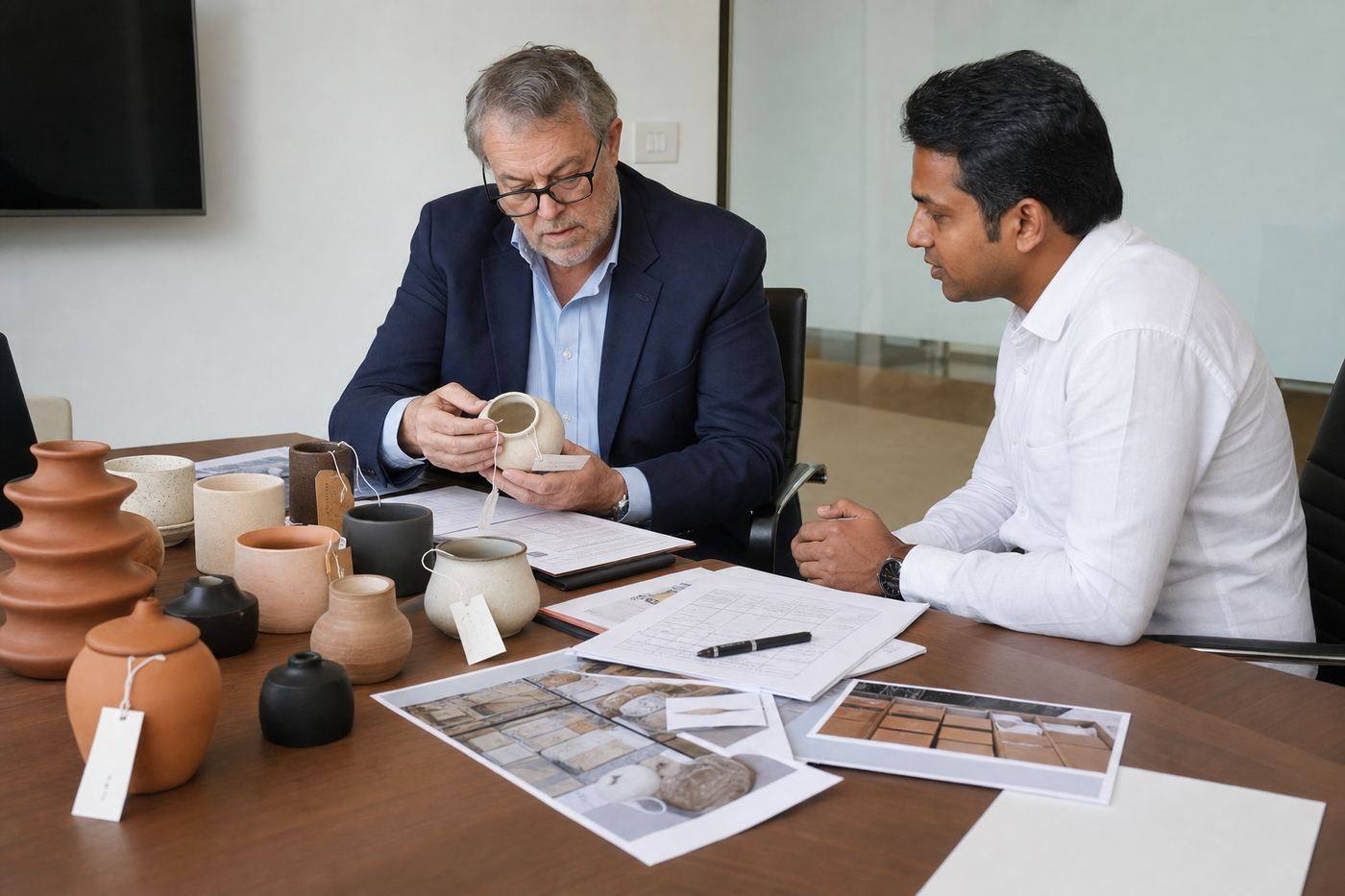
India's terracotta and ceramic handicraft sector — unglazed terracotta gardenware, glazed earthenware and stoneware artware, porcelain décor, Jaipur blue pottery, Molela terracotta plaques, Bankura terracotta figurines, Asharikandi utility artware, selective Longpi black pottery, and Khurja-fired ornamental and tabletop ceramics — gives international buyers a distinctive sourcing proposition: industrial kiln depth at Khurja in Uttar Pradesh, heritage craft belts in Rajasthan, West Bengal, Assam, and Manipur, supporting gardenware capacity across Tamil Nadu, Pondicherry, and Gujarat, and merchant consolidation through Delhi-NCR export houses. Directionally, trade analysis runs across ITC-HS 6913 for ornamental ceramic articles (EPCH examples 69131000 and 69139000), 6912 for ceramic tableware other than porcelain or china, 6911 when porcelain or china pieces are classified as tableware, and 6914 for other ceramic articles including many terracotta planters — never conflate these lines with aggregate EPCH handicraft totals.
Buyers who try to source terracotta and ceramic handicrafts directly from India without a structured process hit predictable problems: beautiful glazed samples followed by bulk-lot glaze crazing or pinholes, planter breakage rates that erase margin on the first FCL, missing or unverifiable IEC and EPCH RCMC documentation, generic 'handmade Indian pottery' claims without cluster provenance evidence, food-contact positioning without lead and cadmium migration test reports, frost-resistance labels on outdoor terracotta without freeze-thaw evidence, and packing engineering that fails under stack load at Nhava Sheva or Mundra. None of these failures are inherent to Indian ceramic manufacturing — they are the result of skipping verification steps under launch-date pressure.
This guide is written for importers, garden centre buyers, home décor procurement teams, tabletop specialty buyers, hospitality amenity buyers, gift specialty retail buyers, and private-label founders in the USA, Germany, UK, Netherlands, France, UAE, Australia, Canada, and Japan who want to source terracotta and ceramic handicrafts directly from India with a repeatable, lower-risk process. It owns the buyer-side operational playbook — how to write an RFQ, how to audit Khurja kilns and Jaipur blue pottery studios, how to sample and evaluate glaze finishes, how to size MOQ and structure payment, and how to run pre-shipment QC on a fragile, kiln-fired category. Market-selection questions (which country to enter first, duties, freight corridors) live in Best Countries for Indian Terracotta and Ceramic Handicraft Exports; export-process and SKU depth live in How to Export Terracotta and Ceramic Handicrafts from India and Top Terracotta and Ceramic Handicraft Products Exported from India; glaze specialty depth lives in Lead-Safe Glaze, Blue Pottery & Food-Contact Ceramic Export Opportunities.
Key Takeaways
Summary Box
Executive Summary
Summary Box
This guide sets out a structured buyer playbook for sourcing terracotta and ceramic handicrafts directly from India: define specifications, identify and audit Khurja kilns and Jaipur blue pottery studios, request glaze samples with kiln lot references and coating documentation, evaluate finish and compliance readiness (lead/cadmium migration, frost-resistance, REACH/Prop 65), negotiate on a landed-cost basis, place a trial order with written terms, run pre-shipment inspection on glaze adhesion and packing integrity, and manage logistics through Nhava Sheva, Mundra, or ICD Delhi/Dadri to arrival at destination.
Because India's ceramic supply chain runs from village artisan units through mid-sized Khurja kilns, heritage blue pottery studios, terracotta craft belts, and Delhi-NCR merchant exporters at highly variable formalisation levels, the highest-leverage buyer action is independent verification — of IEC and EPCH RCMC status, of glaze recipe and firing discipline, of food-contact and frost-resistance evidence, of honest cluster labelling, and of export packing engineering for a category where breakage in ocean transit is the operational killer, not phytosanitary paperwork. Buyers who build this discipline into their first order convert faster into stable repeat-programme relationships than buyers who source on sample photos and FOB price alone.
Market Size & Industry Overview
Key Statistics
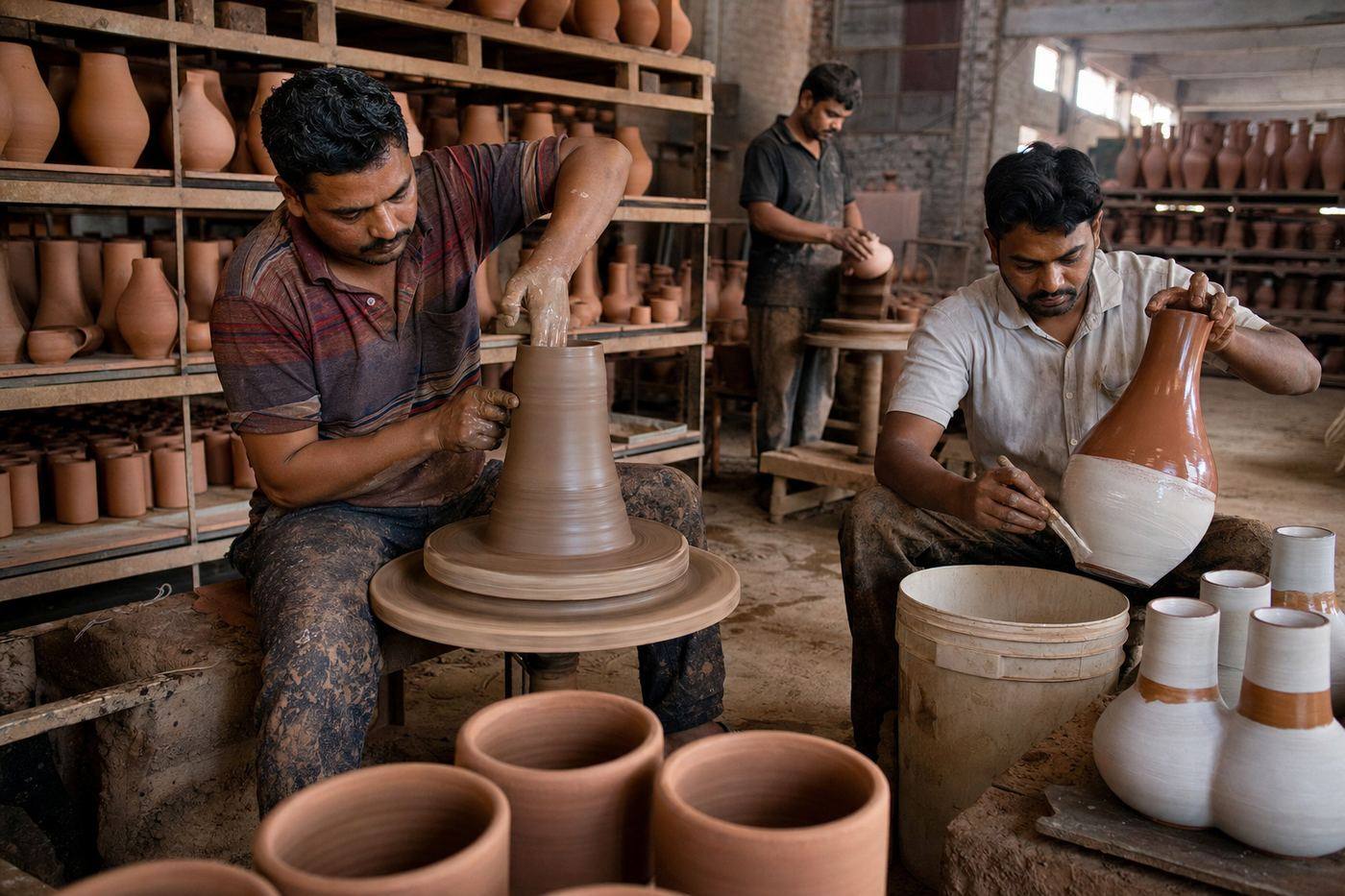
India's terracotta and ceramic export economy is regulated at the export level by IEC from DGFT and, in practice, EPCH RCMC registration for most organised exporters. Manufacturing depth sits at Khurja (Uttar Pradesh) for industrial glazed pottery and artware, Jaipur for blue pottery on a quartz-frit body, Molela for terracotta plaques, Bankura and Bishnupur for terracotta figurines, Asharikandi for Assam terracotta, Longpi for selective black pottery, and Tamil Nadu, Pondicherry, and Gujarat for gardenware capacity. Delhi-NCR provides merchant consolidation, export packing, pre-shipment QC tables, and coordination with CHA partners on HS 6913 versus 6912 versus 6911 versus 6914 triage. Directionally, cite Chapter 69 lines via these headings for trade planning — not total EPCH handicraft figures (Rs 33,122.79 crore / US$3,917.89 million for handicrafts excl. carpets in FY 2024–25 is sector context only).
Khurja kilns range from family units firing dozens of pieces per cycle to mid-sized factories running continuous glaze programmes; Jaipur blue pottery studios operate artisan-scale with distinctive heritage finishing; terracotta gardenware belts produce large planters with longer drying and kiln cycles. Buyers who understand this structure make better counterparty decisions: a Khurja glazer with extraordinary finish skill but no direct IEC is not disqualifying — but it means you are contractually buying through a merchant exporter or aggregator, and you should verify who holds export registration before paying a deposit.
Terracotta and ceramic supply chain structure and buyer implications
Swipe →
Data table — swipe horizontally on small screens
| Supply Chain Node | Role | Buyer Implication |
|---|---|---|
| Khurja kilns (UP) | Clay preparation, forming, bisque fire, glaze fire, finishing | Best fit for glazed vases, planters, bowls, gift ceramics at programme scale — audit kiln temperature and cool discipline |
| Jaipur blue pottery studios | Quartz-frit body forming, hand decoration, low-fire glaze | Premium heritage programmes — verify provenance geography and food-contact claims separately |
| Molela terracotta workshops | Plaque and relief molding, open or kiln firing | Museum and design-retail specialties — inspect cracking and thickness consistency |
| Bankura / Bishnupur terracotta | Folk figurines and horses | Specialty gift channels — do not market as toys without CPSC/EN71 evidence |
| Gardenware belts (TN / Gujarat / Pondicherry) | Large terracotta planters and outdoor forms | Demand frost-resistance evidence before cold-climate garden centre placement |
| Delhi-NCR merchant exporters | Consolidation, export packing, documentation | Strong fit for multi-cluster and mixed ceramic programmes |
| EPCH-registered export houses | Direct export under own IEC/RCMC | Verify registration independently on EPCH portal |
| CHA / customs brokers | HS classification, shipping bill filing | Confirm 6913 vs 6912 vs 6911 vs 6914 before production starts |
| Merchant exporters (e.g. Altus Exports) | Accountable multi-kiln programmes | Reduces fragmentation risk for international buyers |
Export Statistics
Key Statistics
For a buyer programme, export statistics matter as a supply-base reality check: India has commercial depth in terracotta gardenware, Khurja glazed artware, Jaipur blue pottery, and ornamental figurines, but production is fragmented across kilns and craft belts rather than a handful of factory SKUs. Practically, start your first PO on proven forms — mid-size glazed vases, standard planter size ladders, compact ornamental bowls — before scaling into statement blue pottery sets or oversized terracotta urns. Full exporter-side statistics framing lives in How to Export Terracotta and Ceramic Handicrafts from India.
Directional export snapshot relevant to buyer sourcing decisions
Swipe →
Data table — swipe horizontally on small screens
| Metric | 2026 Indicative Position | Buyer Relevance |
|---|---|---|
| Ornamental ceramics HS | 6913 — EPCH examples 69131000 / 69139000 | Confirm with destination broker before locking RFQ |
| Non-porcelain tableware HS | 6912 | Tableware programmes — require migration test evidence early |
| Porcelain tableware HS | 6911 | Premium tabletop — confirm porcelain vs earthenware identity |
| Other ceramic articles HS | 6914 | Common for terracotta planters — triage before production |
| Dominant export forms | Terracotta planters, glazed vases, blue pottery, bowls, figurines | Safest starting categories for first orders |
| Industrial cluster | Khurja (UP) | Glazed programme scale — audit kiln and glaze recipe |
| Heritage clusters | Jaipur blue pottery, Molela, Bankura, Longpi (selective) | Provenance honesty matters for premium retail |
| Consolidation hub | Delhi-NCR | Export packing and mixed assortments often finished here |
| Supply base formalisation | Highly variable | IEC/EPCH verification is essential, not optional |
| Top buyer destinations | USA, Germany, UK, UAE, France, Netherlands | Ask supplier for destination-specific shipment experience |
Import Statistics
Key Statistics
For an importer, destination concentration matters as a supplier-vetting filter: ask whether the kiln or export house has already cleared your market's glaze-compliance path (FDA CPG Sec. 545.450/7117.07 (lead) and Sec. 545.400/7117.06 (cadmium) and Prop 65 for USA retail, LFGB and REACH for Germany/Netherlands/France, UK REACH, ACCC if children's claims, Health Canada for Canada, Japan Food Sanitation Act for tableware) and shipped intact clayware without systematic breakage — rather than memorising aggregate import volumes. Match supplier experience to your clearance reality, then use Best Countries for Indian Terracotta and Ceramic Handicraft Exports for market sequencing and Most Demanded Indian Terracotta and Ceramic Handicrafts by Country for SKU preference depth.
Supplier experience signals by destination (buyer-vetting view)
Swipe →
Data table — swipe horizontally on small screens
| Your Destination | Ask the Supplier First | Why It Matters on a First PO |
|---|---|---|
| USA | FDA migration tests for tableware; Prop 65 glaze declarations; planter packing photos from prior FCL | Retail delists on glaze gaps; breakage kills garden programmes |
| Germany / Netherlands / France | LFGB migration reports; REACH-aligned glaze supplier records; EU arrival photos | Gift wholesale and tabletop expect documentation, not verbal assurance |
| United Kingdom | UK REACH familiarity; frost-resistance evidence for outdoor terracotta; garden centre shipment examples | Garden and gift channels have different packing and claim needs |
| UAE | Short-transit packing specs; hospitality assortment references | Presentation damage visible fast — good proof-of-concept market |
| Australia / Canada / Japan | Prior intact arrival track record; finish consistency references; food-contact evidence | Premium niches punish glaze shortcuts on first container |
Product Categories & Variants (Brief Overview)
Summary Box
Specify exact product form, clay body, glaze type, and finish in your RFQ rather than asking generically for 'ceramic handicrafts' or 'terracotta pottery' — kilns price, fire, glaze, and pack differently across categories, and vague requests produce quotations that cannot be fairly compared. Full SKU taxonomy lives in Top Terracotta and Ceramic Handicraft Products Exported from India.
Product category snapshot for buyer RFQ specification
Swipe →
Data table — swipe horizontally on small screens
| Category | Typical HS | Sourcing Note |
|---|---|---|
| Terracotta gardenware planters and urns | 6914 (verify) | Confirm HS with CHA; demand frost-resistance evidence for outdoor claims; plan 4–8 months for spring programmes |
| Glazed ceramic vases and ornamental bowls (Khurja) | 6913 | Audit glaze adhesion, crazing, and colour match against signed reference |
| Jaipur blue pottery statement décor | 6913 | Quartz-frit body — evaluate food-contact claims separately; demand provenance evidence |
| Molela terracotta plaques and relief panels | 6913 | Inspect thickness consistency and edge protection packing |
| Bankura terracotta horses and figurines | 6913 | Do not market as toys without CPSC/ASTM F963/EN71 evidence |
| Ceramic tableware (glazed earthenware / stoneware) | 6912 | Require lead and cadmium migration tests before production |
| Porcelain artware and tableware | 6911 / 6913 | Confirm porcelain identity and food-contact pathway |
| Curated hospitality ceramic gift sets | 6913 / 6912 | Specify component-level QC and retail inner pack |
| Private-label garden / décor assortments | 6913 / 6914 | Align glaze art, hang-tag, and compliance docs early |
Manufacturing Overview (Brief)
Export Tip
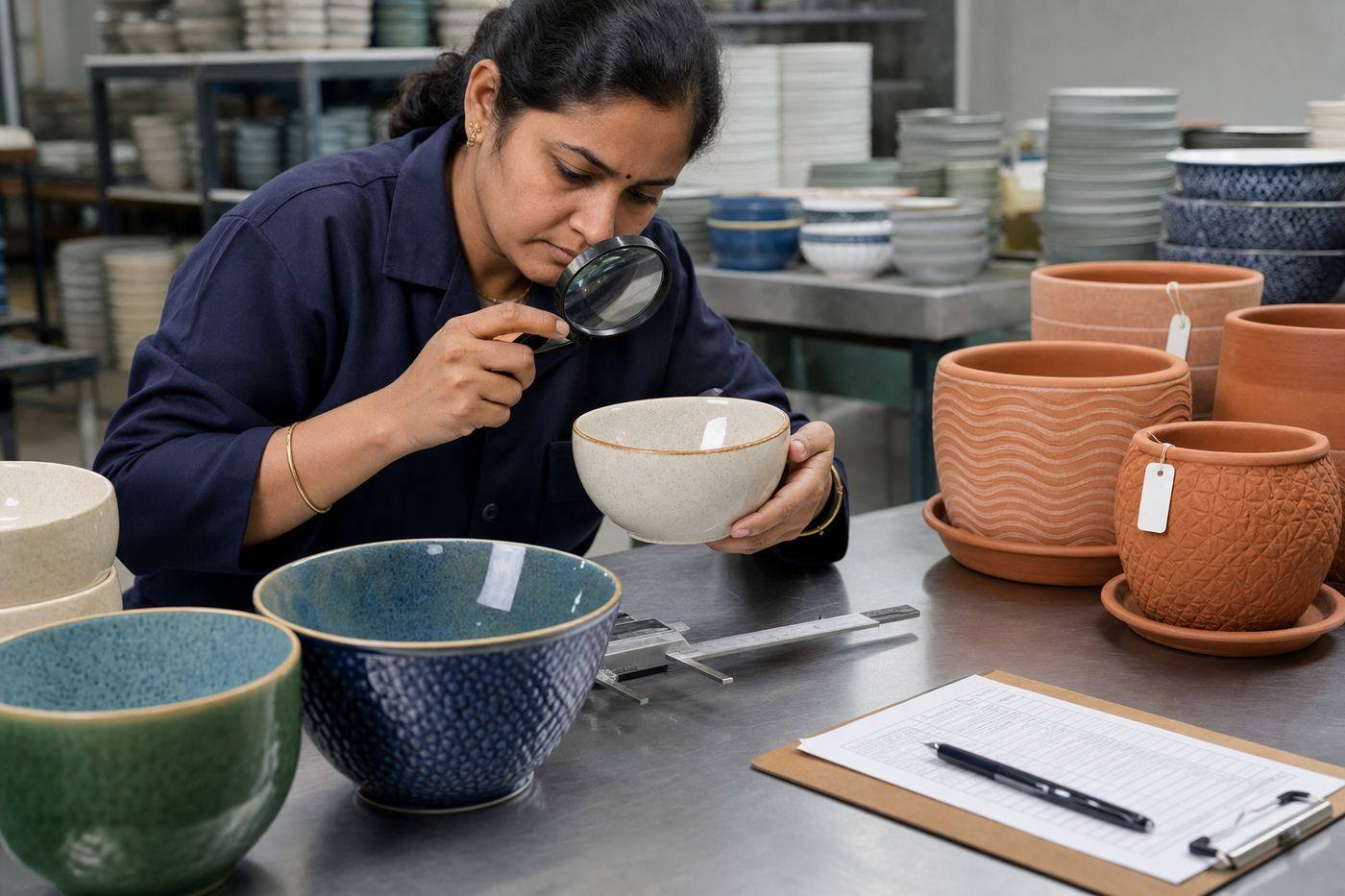
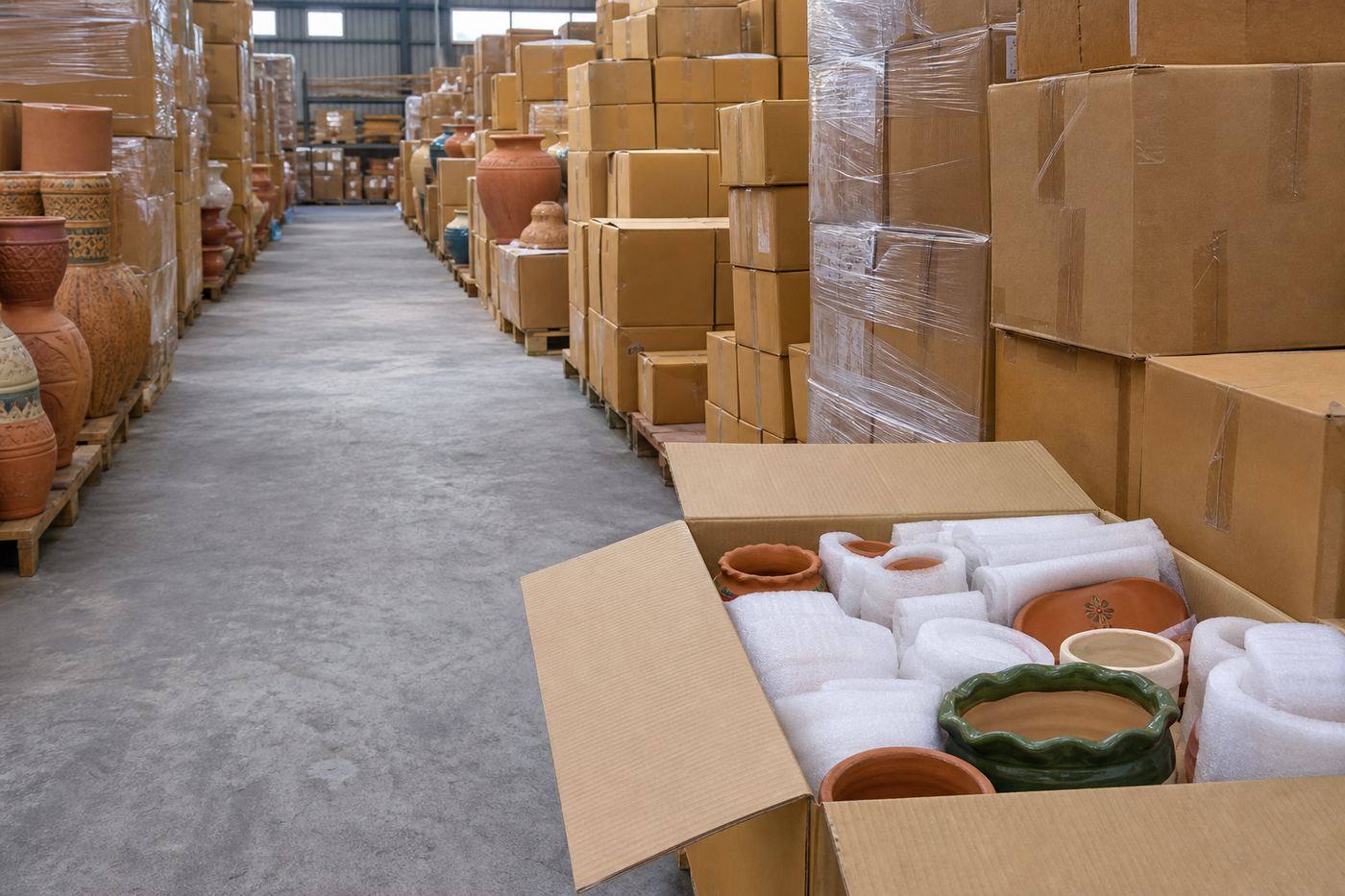
Buyers get more from a kiln audit by walking the floor against a glaze defect checklist than by viewing finished samples alone. At clay preparation, observe particle size control and moisture consistency. At forming (wheel, mold, or hand-build), compare wall thickness and dimensional tolerance to your approved reference. At drying and bisque fire, ask temperature profiles and cooling discipline. At glaze application, confirm glaze recipe identification, thickness control, and contamination prevention. At glaze fire and cool, insist on cool-hold before QC. At packing, open a staged export carton — confirm foam wrap, cell dividers where nested, corner protectors, FRAGILE markings, and stack-height limits. Full manufacturing detail from the exporter side is in How to Export Terracotta and Ceramic Handicrafts from India; glaze and food-contact depth is in Lead-Safe Glaze, Blue Pottery & Food-Contact Ceramic Export Opportunities.
The Buyer's RFQ-to-Landed-Cost Playbook: Auditing Khurja Kilns & Jaipur Blue Pottery Studios
Export Tip
This is the core operational sequence of this guide — the concrete steps a buyer follows from a standing start to a confident, documented first wholesale order. Follow the steps in order; skipping glaze migration verification or packing sign-off to save a week typically costs far more when a trial shipment arrives with crazed bowls or shattered planters.
Step 1: Write a Complete RFQ
Document: product category (planter, vase, bowl, blue pottery piece, plaque, figurine, tableware, assortment), clay body (terracotta, earthenware, stoneware, porcelain, blue pottery quartz-frit), dimensions and tolerance, glaze specification (gloss, matte, reactive, engobe, underglaze, colour with Pantone or reference sample), food-contact requirement (yes/no — if yes, destination migration framework: FDA CPG Sec. 545.450/7117.07 and Sec. 545.400/7117.06, LFGB, EU Directive 84/500/EEC), frost-resistance requirement for outdoor terracotta, coating compliance needs (REACH supplier declaration, Prop 65 inquiry readiness, CPSC/EN71 only if toy claim), HS intent (6913 vs 6912 vs 6911 vs 6914), origin requirement (Khurja glazed, Jaipur blue pottery, Molela, Bankura, Delhi-finished acceptable), packing format (foam wrap, dividers, corner protectors, retail gift box, pallet stack limits), target Incoterm (EXW, FOB Nhava Sheva/Mundra, CFR/CIF), MOQ tier, payment structure, and delivery window. A vague RFQ — 'Indian ceramic planters, best price' — produces incomparable quotes.
Step 2: Shortlist Khurja Kilns and Jaipur / Craft-Cluster Exporters
Use EPCH registered-exporter directories, IHGF Delhi Fair exhibitor lists, FIEO/EPCH referrals, and verified B2B platforms — then filter for terracotta- and ceramic-specific experience, not general handicraft traders who also ship unrelated categories. Prefer candidates who can show photos of their own packing table, kiln yards, glaze rooms, and recent ocean shipments to your destination region. Cross-reference How to Find International Buyers for Terracotta and Ceramic Handicrafts from the seller side to understand how serious exporters present themselves — mirror those proof points in your supplier vetting.
Step 3: Audit Khurja Kilns
On site or via structured video audit, verify: clay preparation consistency and forming method; drying rack ventilation; bisque and glaze kiln temperature logging; glaze recipe identification and heavy-metal awareness; cool-hold discipline before QC; whether production is kiln-direct or subcontracted across finishing units; and who holds IEC if the unit is artisan-scale. Request in-progress inspection of a firing lot — a finished sample alone hides batch variance in glaze colour, crazing, and warpage. For food-contact programmes, ask whether third-party migration tests exist for the exact glaze recipe on the quoted SKU.
Step 4: Audit Jaipur Blue Pottery Studios and Other Heritage Belts
Blue pottery uses a non-clay quartz-frit body with distinctive turquoise-and-white decoration — audit forming consistency, decoration alignment to reference, low-fire glaze behaviour, and packaging for impact-sensitive statement pieces. For Molela plaques and Bankura figurines, inspect thickness consistency, firing cracks, and honest cluster labelling. Verify production geography when heritage provenance is part of your retail story. Food-contact claims on blue pottery require separate migration evaluation — do not assume earthenware test reports apply to quartz-frit bodies.
Step 5: Audit Delhi-NCR Consolidation and Export Packing
Many international programmes finish packing in Delhi-NCR even when Khurja or Jaipur produce the ware. Audit the export packer separately: carton burst strength, foam wrap and cell divider layouts, corner protection for tall planters, anti-shift bracing, palletisation with stack-height limits, and pre-shipment QC table process (glaze adhesion, crazing inspection, pinholes, warpage, colour match to signed reference). Honest labelling matters — confirm whether 'Khurja made' or 'Jaipur blue pottery' claims apply to production, finishing, or packing only.
Step 6: Request Glaze Samples with Kiln Lot Documentation
Require physical samples with written kiln lot reference, glaze product identification where available, and comparison to your signed reference sample for adhesion, gloss or matte, colour match, crazing, and pinholes. For USA and EU retail tableware programmes, ask whether the exporter maintains third-party lead and cadmium migration test reports before you pay sample fees. A sample hand-selected from the shelf is a marketing prop, not quality evidence of bulk-lot firing behaviour.
Step 7: Evaluate Finish, Compliance Readiness, and Export Readiness
Inspect glaze adhesion (tape test where appropriate), crazing under magnification, dimensional fit for sets, planter base stability, and blue pottery decoration accuracy. Cross-check IEC and EPCH RCMC on official portals. For outdoor terracotta, demand freeze-thaw evidence before approving frost-resistance labels. Commercial acceptability requires satisfactory physical samples and satisfactory export documentation readiness — one without the other is insufficient for a trial PO.
Step 8: Calculate and Negotiate on a Landed-Cost Basis
Model: FOB price + ocean freight (volume- and stack-constrained for gardenware cartons) + insurance + destination duty (confirm 6913 / 6912 / 6911 / 6914 with broker) + glaze migration or frost-test cost + expected breakage allowance. A lower FOB from a supplier with weak packing or uncontrolled kiln cool often produces higher effective landed cost once claims and unsellable stock are counted. Negotiate volume breaks only after trial-lot quality is validated. Directional FOB bands: small accents ~US$1–8/pc; mid glazed ~US$4–28/pc; statement blue pottery / large terracotta ~US$15–75+/pc.
Step 9: Structure Payment in Milestones
For new relationships, use 30% advance against signed pro-forma and approved reference sample, 70% against shipping documents (bill of lading, invoice, packing list, COO). Letter of Credit for larger first orders where bank security is preferred. Open account only after repeat successful shipments. Never remit 100% advance to an unverified Khurja kiln or artisan workshop — the most common structural mistake first-time buyers make in fragile clayware categories.
Step 10: Place a Trial Order with Written Terms
Start with 100–400 pieces or mixed LCL rather than a full spring garden FCL on an unproven kiln. Lock in writing: approved sample reference, kiln lot and glaze standard, packing spec with photos, Incoterms, payment milestones, pre-shipment inspection rights, and remedy path (rework, replacement, credit) for glaze defects or breakage exceeding agreed AQL. Spring garden programmes book 4–8 months ahead — do not compress trial and FCL into the same calendar window on a new supplier.
Step 11: Run Pre-Shipment QC and Confirm Documentation
Before vessel departure, verify glaze adhesion, crazing, colour match, and warpage on random picks from staged cartons, drop-test a packed carton where practical, confirm foam, dividers, corner protectors, and stack limits match approved spec, and reconcile invoice HS code and description with CHA filing. Document pack: commercial invoice, packing list, bill of lading, certificate of origin, glaze migration test reports if tableware, frost-resistance evidence if outdoor claims, glaze supplier declarations if retail requires, cluster provenance supporting documents if heritage tags are used. Full field-by-field checklist: Terracotta and Ceramic Handicraft Export Documentation Checklist. Do not let sailing cut-off pressure skip inspection on a first order.
Pricing Analysis
Buyer Tip
FOB is a starting point for landed-cost analysis, not a face-value comparison across suppliers. Ask each candidate to itemise clay and forming cost, glaze material and kiln fuel, labour, packing, and inland haul separately. Use bands below to sanity-check quotes against specification — not as targets to negotiate without reference to glaze grade, kiln discipline, and compliance test overhead.
Directional FOB ranges and what to interrogate before accepting a quote
Swipe →
Data table — swipe horizontally on small screens
| Product Category | Directional FOB Range | What to Ask Before You Accept the Quote |
|---|---|---|
| Small terracotta accents and ornaments | $1–8/pc | Confirm kiln lot reference and packing cost included |
| Mid glazed ceramic vases, bowls, planters (Khurja) | $4–28/pc | Request glaze adhesion and colour match at quoted tier; migration tests if food-contact |
| Statement blue pottery and large terracotta gardenware | $15–75+/pc | Verify wall thickness, packing cost itemised, frost evidence for outdoor claims |
| Lead-safe certified tableware programmes | Evidence-dependent premium | Demand FDA/LFGB/EU 84/500/EEC migration reports for exact glaze recipe |
| Private-label garden / décor assortments | Programme-priced | Confirm hang-tag, glaze art approval, and compliance docs included |
| Curated hospitality ceramic gift sets | Assortment-priced | Component-level QC and retail inner pack spec in writing |
| Molela and Bankura specialty pieces | Motif- and size-dependent | Heritage provenance evidence — premium without proof is just higher price |
MOQ Analysis
Buyer Tip
MOQ is where first-time buyers often over-commit — treating sample pricing as bulk economics or jumping to spring garden FCL before a trial proves kiln discipline and packing integrity. Each stage below should change your supplier assessment, not just order size.
What each MOQ stage should prove before you move to the next
Swipe →
Data table — swipe horizontally on small screens
| Stage | Typical Quantity | What This Stage Needs to Prove |
|---|---|---|
| Evaluation sample | 5–20 pcs/SKU | Glaze finish, dimensional fit, and heritage authenticity match written spec |
| Trial order | 100–400 pcs or mixed LCL | Kiln consistency and packing survive ocean transit — not one hand-picked sample |
| Wholesale programme | By carton / CBM / colour-glaze way | Repeat-lot colour and glaze stability across firing batches |
| Programme FCL (20GP / 40HC) | Seasonal gardenware or décor volume | Breakage rate and on-time sailing for fixed retail cut-offs — book 4–8 months ahead for spring |
Packaging Standards
Export Tip
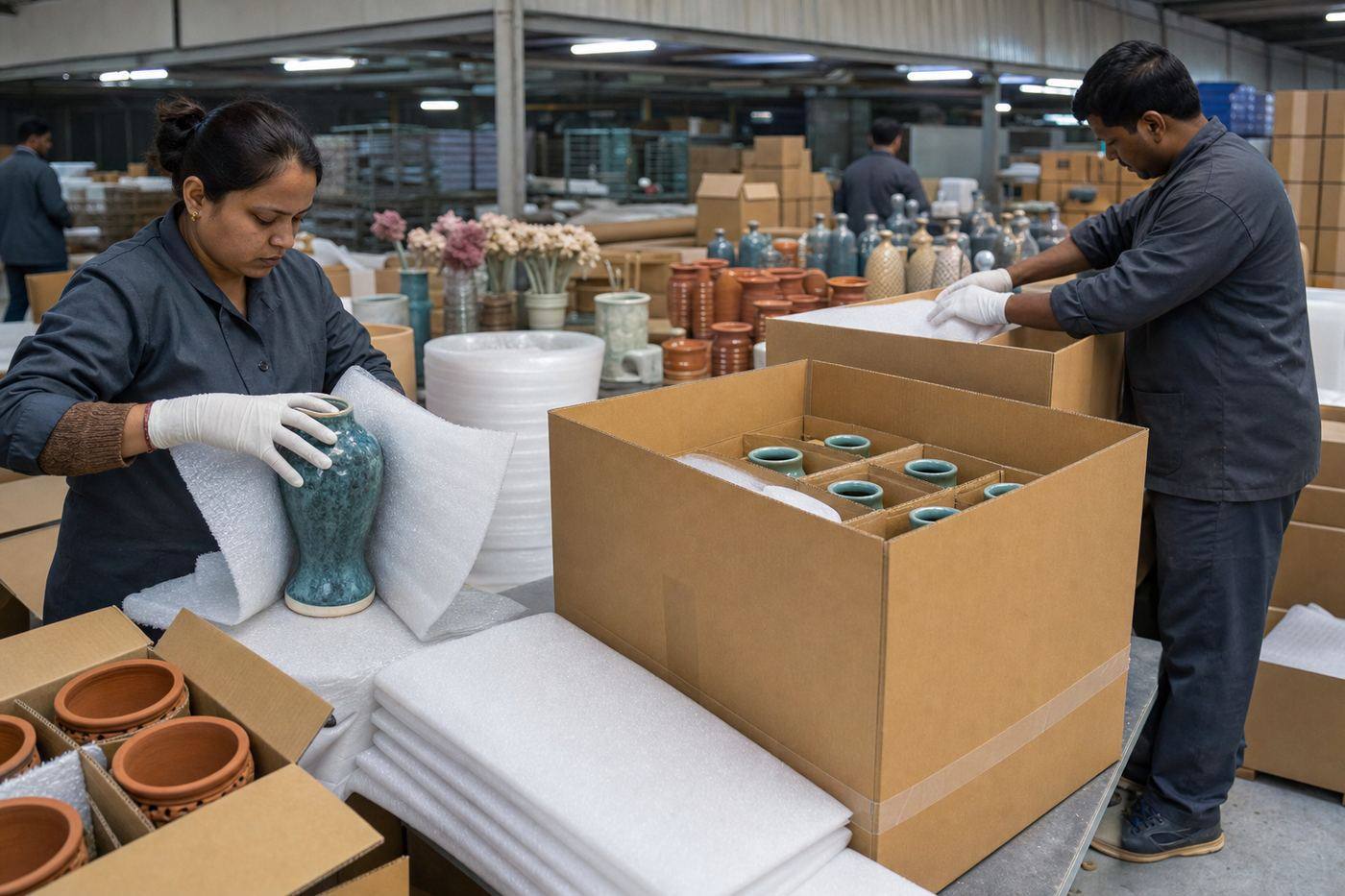
Packaging failures are the most common reason a buyer's first ceramic container disappoints — often visible only at destination unpacking after payment. Treat packing sign-off as a production approval condition. For glazed clayware, packing is also a finish-quality decision: inadequate cushioning chips glaze, and unsafe stack heights crack planters before the ocean leg begins.
What to confirm before approving production, by packaging format
Swipe →
Data table — swipe horizontally on small screens
| Format | Use Case | Confirm This Before Approving Production |
|---|---|---|
| Individual foam / bubble wrap | Vases, bowls, planters | Photo of wrapped piece — not only unwrapped sample |
| Cell dividers in rigid cartons | Nested sets designed for nesting; ornament assortments | Divider layout matches actual piece count — never assume nesting |
| Double-wall export cartons | All ocean-bound ceramics | Burst strength matches piece weight and stack plan |
| Corner / edge protectors | Statement décor, tall planters, plaques | Edge protection on all corner-impact SKUs |
| Anti-shift bracing for tall forms | Terracotta gardenware urns and tall vases | Written bracing method and stack-height limit |
| Retail gift boxes (premium blue pottery) | Department-store programmes | Inner retail pack spec inside export master carton |
| FRAGILE / THIS SIDE UP markings | All export cartons | Visible on every face that handlers see |
Container Loading Details
Export Tip
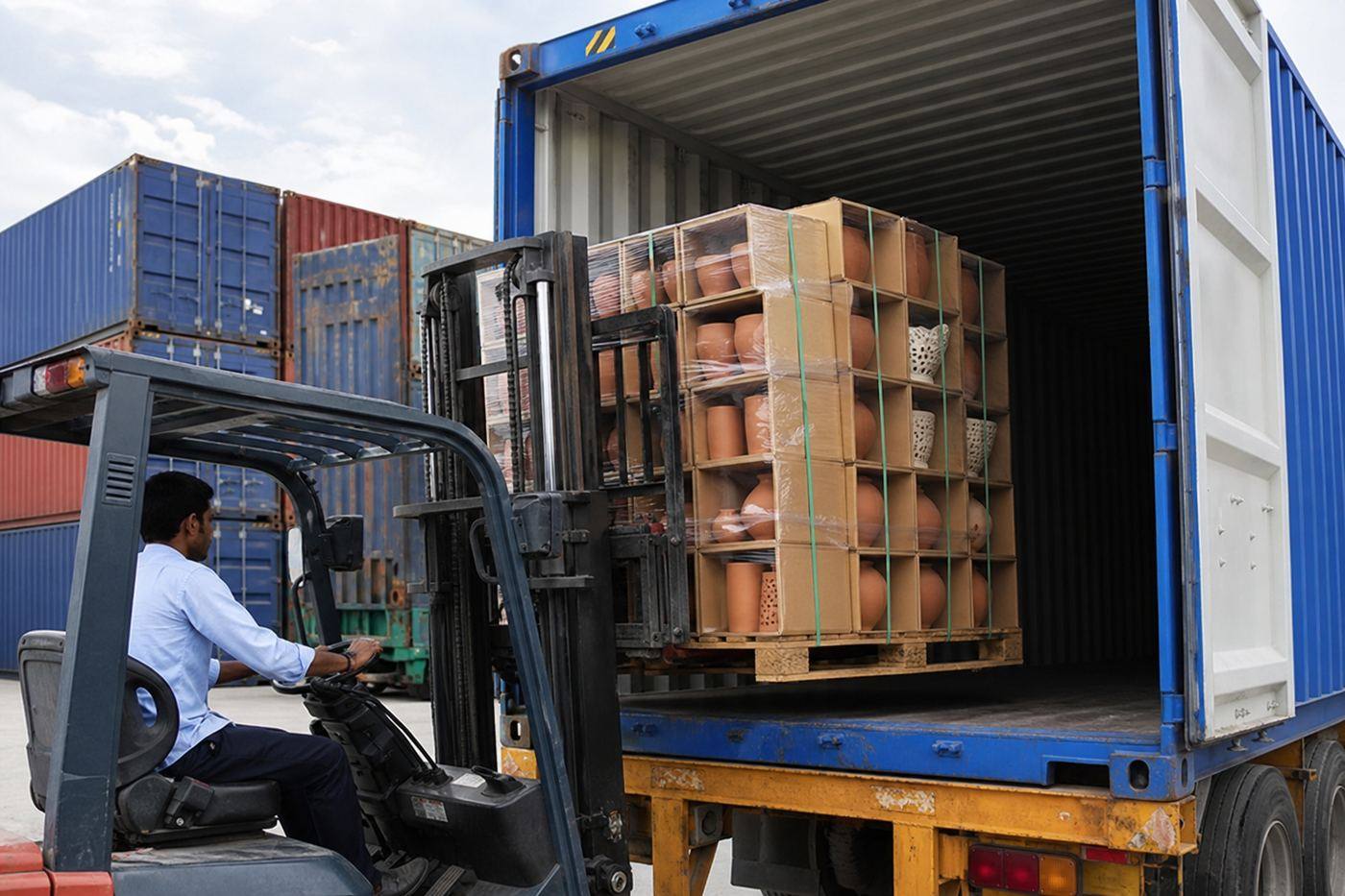
Ceramic cartons cube- and stack-out before they weigh-out — especially gardenware and décor assortments. Ask suppliers for estimated CBM per SKU and planned carton stacking diagram before accepting FCL pricing. Breakage risk dominates: never accept top-loading of heavy planter cartons on thin-walled décor or ornament cartons.
Container loading realities and landed-cost implications for buyers
Swipe →
Data table — swipe horizontally on small screens
| Container Type | Typical Loadability | Landed-Cost Implication |
|---|---|---|
| 20ft FCL | Cube- and stack-limited for gardenware and décor | Get per-CBM economics, not container price alone |
| 40ft HC | Extra height for tall vases and large planters | Confirm top-carton crush rules and stack limits in writing |
| LCL | Trial orders and mixed-cluster starts; blue pottery premium lots | Higher per-unit freight — budget explicitly |
| ICD Delhi / Dadri consolidation | Khurja and Jaipur inland haul | Confirm inland cost included or itemised |
| Nhava Sheva / Mundra stuffing | Western port sailings to USA, EU, UAE | Align stuffing date with kiln cool and QC hold |
Shipping Methods
Export Tip
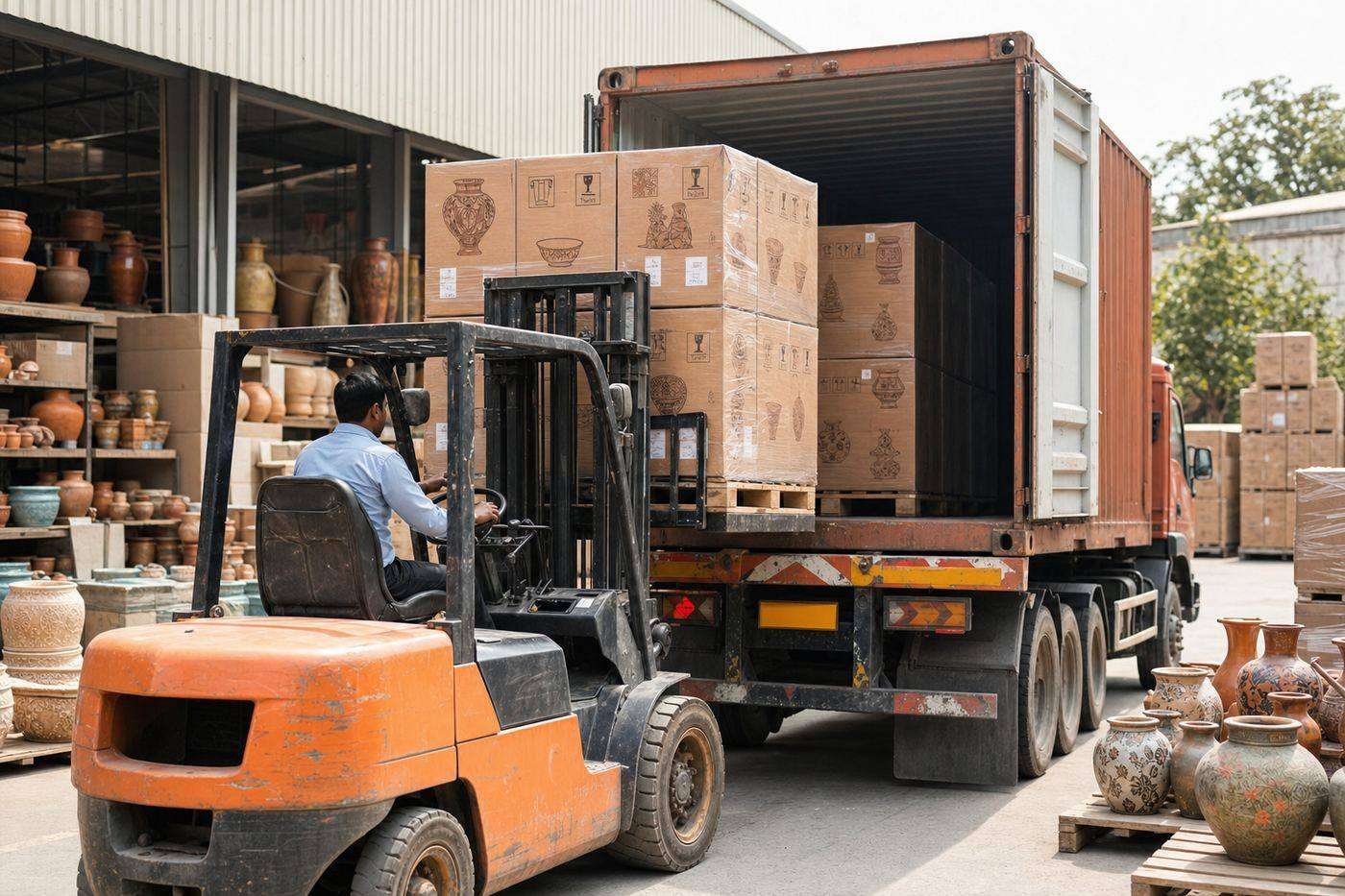
Commercial volumes move ocean FCL or LCL ex Nhava Sheva, Mundra, or ICD Delhi/Dadri consolidation corridors. Ask planned port, sailing frequency, and Incoterms explicitly — answers reveal export maturity. Air suits urgent Ambiente, NY NOW, or Maison & Objet sample kits, not gardenware bulk. Lead times: samples 10–21 days; stock glazed décor 4–7 weeks; custom glaze/private label 6–12 weeks; spring garden programmes 4–8 months ahead.
Typical routes and transit times for buyer planning
Swipe →
Data table — swipe horizontally on small screens
| Route | Typical Transit Time | Common Incoterms |
|---|---|---|
| India → USA (East/West Coast) | 22–35 days | FOB, CFR, CIF |
| India → Germany / Netherlands / France | 22–30 days | FOB, CIF |
| India → UK | 22–30 days | FOB, CIF |
| India → UAE (Jebel Ali) | 7–12 days | FOB, CIF |
| India → Australia | 18–26 days | FOB, CFR |
| India → Canada | 28–35 days | FOB, CIF |
| India → Japan | 20–28 days | FOB, CIF |
Certifications
Compliance Notes
Verify registrations and glaze claims independently — portal lookups for IEC and EPCH RCMC, certificate numbers for third-party migration labs, freeze-thaw reports for outdoor claims, and glaze supplier documentation for REACH/Prop 65 retail programmes. See also EPCH Registration Benefits for Terracotta and Ceramic Exporters.
Certifications and how buyers should verify them
Swipe →
Data table — swipe horizontally on small screens
| Certification / Document | What It Confirms | How to Verify |
|---|---|---|
| IEC | Legal export entity | DGFT portal lookup by IEC number |
| EPCH RCMC | Handicraft export registration | EPCH portal or direct written confirmation |
| Lead / cadmium migration test reports | Food-contact ceramic safety (FDA CPG Sec. 545.450/7117.07 and Sec. 545.400/7117.06, LFGB, EU 84/500/EEC) | Request lab reports for exact glaze recipe and SKU form |
| Frost-resistance / freeze-thaw reports | Outdoor terracotta gardenware claims | Third-party freeze-thaw evidence — reject brochure assertion |
| REACH / SVHC / glaze supplier declarations | EU substance limits in glazes | Request glaze supplier SDS or declaration letter |
| Prop 65 evidence (glaze substances) | California listed-substance readiness | Supplier declaration or test evidence for California-facing retail |
| CPSC / ASTM F963 / EN71 | Toy safety if children's product claim | Only required when SKU is marketed as toy — not default décor |
| Certificate of Origin | Origin for duty and retail | Cross-check with invoice and cluster provenance claims |
| Heritage / cluster provenance evidence | Blue pottery, Molela, Bankura, Longpi positioning | Verify production geography matches hang-tag story |
Buyer Requirements
Buyer Requirements
Provide and request reciprocal proof before PO: signed reference sample or glaze art, destination market and intended HS line, food-contact expectations (FDA, LFGB, EU 84/500/EEC), frost-resistance expectations for outdoor terracotta, Prop 65 and REACH packaging of declarations, retail pack spec if applicable, target landed cost or FOB band, MOQ stage, Incoterms, and inspection rights. USA garden centre buyers should specify planter packing drop-test expectation and frost-claim evidence. EU tabletop buyers should specify LFGB migration evidence in RFQ. UAE hospitality buyers should specify presentation inner pack and assortment carding. Japan specialty buyers should specify finish QC acceptance criteria lot to lot.
Country-wise Opportunities for Direct Sourcing
Market Snapshot
Direct sourcing experience differs by home market — glaze documentation depth, outdoor versus indoor channel mix, and acceptable breakage rates vary materially. Use Best Countries for Indian Terracotta and Ceramic Handicraft Exports for destination ranking methodology; this section focuses on supplier-vetting implications only.
USA and Canada
Largest pool of India ceramic exporters with USA experience — quality variance is high. Prioritise suppliers with FDA migration documentation habit for any tableware, Prop 65 glaze declarations, planter FCL packing photos, and honest 6913 vs 6914 classification. Canada often mirrors USA expectations at smaller trial scale with bilingual labelling where retail-packed.
Germany, Netherlands, France, and UK
Prioritise exporters with LFGB or EU 84/500/EEC migration reports and REACH-aligned glaze supplier records. Gift wholesale and tabletop buyers reject glaze crazing aggressively. Frost-resistance evidence matters for UK and Northern EU garden centres. Heritage honesty matters for premium French specialty — verify Jaipur blue pottery and Molela provenance early.
UAE and Gulf
Fastest trial cycle (7–12 days to Jebel Ali) with lighter formal documentation for many wholesale buyers — ideal to validate glaze consistency and packing before USA/EU scaling. Presentation integrity and lot-to-lot glaze match matter more than lengthy compliance packets for many hospitality décor programmes.
Australia and Japan
Premium finish niches — suppliers must demonstrate lot-to-lot glaze consistency and intact arrival on prior shipments. Japan buyers treat finish defects as operational disqualifiers and expect Food Sanitation Act-aligned migration evidence on tableware; Australia specialty retail and garden centres increasingly ask frost and food-contact questions on repeat programmes.
Sourcing Checklist
Checklist
Buyer Checklist
Exporter Checklist
Compliance Checklist
Checklist
Compliance Notes
Common Buyer Mistakes
Common Mistakes Box
First-time terracotta and ceramic buyers repeat predictable errors — below are the patterns that most often destroy first-container economics.
Common sourcing mistakes and how to avoid them
Swipe →
Data table — swipe horizontally on small screens
| Mistake | Consequence | How to Avoid It |
|---|---|---|
| Approving samples without kiln lot documentation | Glaze crazing and colour variance claims at destination | Require kiln lot reference and cool-hold standard in PO |
| Paying 100% advance to Khurja kiln without IEC verification | Recovery difficult if shipment fails QC | Milestone payment tied to documents |
| Accepting frost-resistant labels without freeze-thaw evidence | UK/EU garden centre delisting; consumer exposure | Third-party freeze-thaw reports before outdoor claims |
| Positioning glazed bowls as tableware without migration tests | LFGB or FDA rejection; retail claims | Lead and cadmium migration testing before food-contact positioning |
| Comparing FOB only across suppliers | Hidden breakage and compliance cost erodes margin | Model full landed cost with duty, freight, and test overhead |
| Skipping trial order for spring garden FCL | Planter breakage destroys seasonal programme | Prove packing on 100–400 pc trial before FCL |
| Ignoring glaze compliance in RFQ | Prop 65 / LFGB / REACH retail block after goods arrive | Specify declaration and test requirements upfront |
| Assuming Delhi exporter equals Khurja or Jaipur production | Origin misrepresentation damages brand | Audit production geography explicitly |
Future Market Trends
Key Statistics
Buyers should expect tighter retail scrutiny on food-contact ceramic migration in the EU (LFGB and Directive 84/500/EEC enforcement) and California-facing USA chains (Prop 65 and FDA action levels) — suppliers who maintain glaze migration files and kiln-lot traceability now will win repeat programmes; those who treat glaze compliance as a destination-side surprise will lose listings. Private-label Khurja glazed programmes and frost-rated terracotta gardenware from India are directionally growing as importers seek hand-fired authenticity — but only suppliers with proven FCL packing engineering and freeze-thaw evidence capture that demand sustainably.
Year-round gift specialty programmes for mid glazed décor and blue pottery statement pieces offer counter-seasonal volume for buyers who do not want single-channel spring garden exposure. Heritage-authentic Jaipur blue pottery and Molela terracotta lines will increasingly differentiate premium assortments — buyers who verify provenance early build defensible margin; those who accept generic origin labels inherit delisting risk. Multi-cluster programmes managed through one accountable merchant exporter will outcompete fragmented kiln-by-kiln coordination as assortments broaden.
Challenges & Solutions
Direct sourcing of terracotta and ceramic handicrafts involves challenges distinct from timber or plant-fibre handicrafts — kiln capacity, glaze compliance, breakage, and frost claims dominate the buyer risk register.
Sourcing challenges and buyer-side mitigation
Swipe →
Data table — swipe horizontally on small screens
| Challenge | Typical Impact | Mitigation Strategy |
|---|---|---|
| Uncontrolled kiln cool or glaze variance | Crazing, pinholes, retail rejection | Kiln lot and cool-hold clause in PO; pre-shipment glaze QC |
| Planter and statement-piece breakage in transit | Seasonal programme failure | Foam wrap; corner protectors; written stack limits; drop-test |
| Food-contact migration gaps | USA/EU tableware retail block | Require FDA/LFGB/EU 84/500/EEC reports before production |
| Frost-resistance claim misuse | Garden centre delisting | Freeze-thaw evidence before outdoor labelling |
| Heritage claim misuse (blue pottery, Molela, Bankura) | Premium programme collapse | Production geography verification only |
| Fragmented kiln and artisan base | Batch inconsistency | Merchant exporter with consolidated QC |
| HS misclassification across 6913/6912/6911/6914 | Customs delay, duty surprise | Broker confirmation before production |
| Spring garden lead-time compression | Missed retail cut-offs | Start 4–8 months ahead for FCL programmes |
How Altus Exports Helps
Altus Exports supports international buyers as a product sourcing company in India and global sourcing partner — coordinating Khurja kilns, Jaipur blue pottery studios, Molela and Bankura workshops, Delhi-NCR export packing, glaze QC, lead and cadmium migration test coordination, frost-resistance evidence collection, HS triage across 6913/6912/6911/6914, and ocean logistics through Nhava Sheva, Mundra, and ICD Delhi/Dadri under one accountable merchant-export relationship.
Whether you are a USA garden centre buyer planning a private-label terracotta planter ladder, a German tabletop wholesaler evaluating Khurja glazed lines, a French specialty buyer sourcing Jaipur blue pottery, or a UAE hospitality buyer curating ceramic amenity sets, Altus structures RFQ-to-landed-cost decisions against real kiln, glaze, packing, and compliance standards. Explore export products from India and find manufacturers in India capabilities, or contact Altus Exports to begin supplier verification and sampling. Related industry: Handicrafts & Lifestyle Products.
Expert Insights
Expert Insight Box
Successful terracotta and ceramic sourcing is less about finding the lowest FOB and more about finding the counterparty who treats kiln cool, glaze recipe discipline, and carton engineering as non-negotiable production steps — then proving it on a trial lot before you scale to spring garden FCL or multi-country wholesale.
Conclusion
- Action: Complete RFQ and verify IEC/EPCH before paying any sample fee or deposit.
- Read Best Countries for Indian Terracotta and Ceramic Handicraft Exports to align sourcing with destination compliance tier.
- Review Top Terracotta and Ceramic Handicraft Products Exported from India for SKU specification language.
- See Most Demanded Indian Terracotta and Ceramic Handicrafts by Country for destination SKU preferences.
- Prepare documents with Terracotta and Ceramic Handicraft Export Documentation Checklist.
- Explore glaze specialty depth in Lead-Safe Glaze, Blue Pottery & Food-Contact Ceramic Export Opportunities.
- Find suppliers at Trade Shows and B2B Marketplaces for Terracotta and Ceramic Exporters.
- Confirm EPCH credentials via EPCH Registration Benefits for Terracotta and Ceramic Exporters.
- Exporter process reference: How to Export Terracotta and Ceramic Handicrafts from India.
- Engage product sourcing company India, merchant exporter India, or contact Altus Exports to run verification and trial orders.
Sourcing terracotta and ceramic handicrafts directly from India rewards buyers who treat verification as part of procurement: complete RFQs, Khurja kiln and Jaipur studio audits, glaze samples with kiln lot proof, milestone payments, trial orders before seasonal FCL, pre-shipment QC on glaze and packing, and landed-cost models that include duty, freight, glaze migration and frost-test overhead, and breakage allowance.
The suppliers worth a multi-year programme are those who answer glaze, frost, and packing questions confidently on the first call, back heritage claims with production geography evidence, and ship trial cartons that arrive intact. Start there — market selection and SKU depth can scale once container one proves the relationship.