
Terracotta and Ceramic Handicraft Export Documentation Checklist
By Saurabh Mittal, Founder, Altus Exports
A document-by-document export checklist for Indian terracotta and ceramic handicraft exporters — commercial invoice, packing list, glaze composition certificate, lead / cadmium migration report, food-contact COA for ceramic tableware, California Prop 65 statement, REACH SVHC declaration, certificate of origin (preferential and non-preferential), fumigation and ISPM-15 for wooden pallets or crates, insurance, bill of lading, shipping bill, e-BRC, GI authorised-user evidence for Blue Pottery of Jaipur, frost-rating evidence for outdoor terracotta, and clean broker handoff to your CHA for HS 6913 (ornamental), 6912 (ceramic tableware non-porcelain), 6911 (porcelain tableware), and 6914 (other ceramic articles including many planters). Ceramic-only playbook covering Khurja industrial pottery, Jaipur blue pottery, Molela terracotta plaques, Bankura terracotta figurines, Longpi black pottery, Tamil Nadu and Gujarat gardenware, and Delhi-NCR consolidation — separate from the EPCH registration guide and the country demand matrix owned by peer cluster posts.
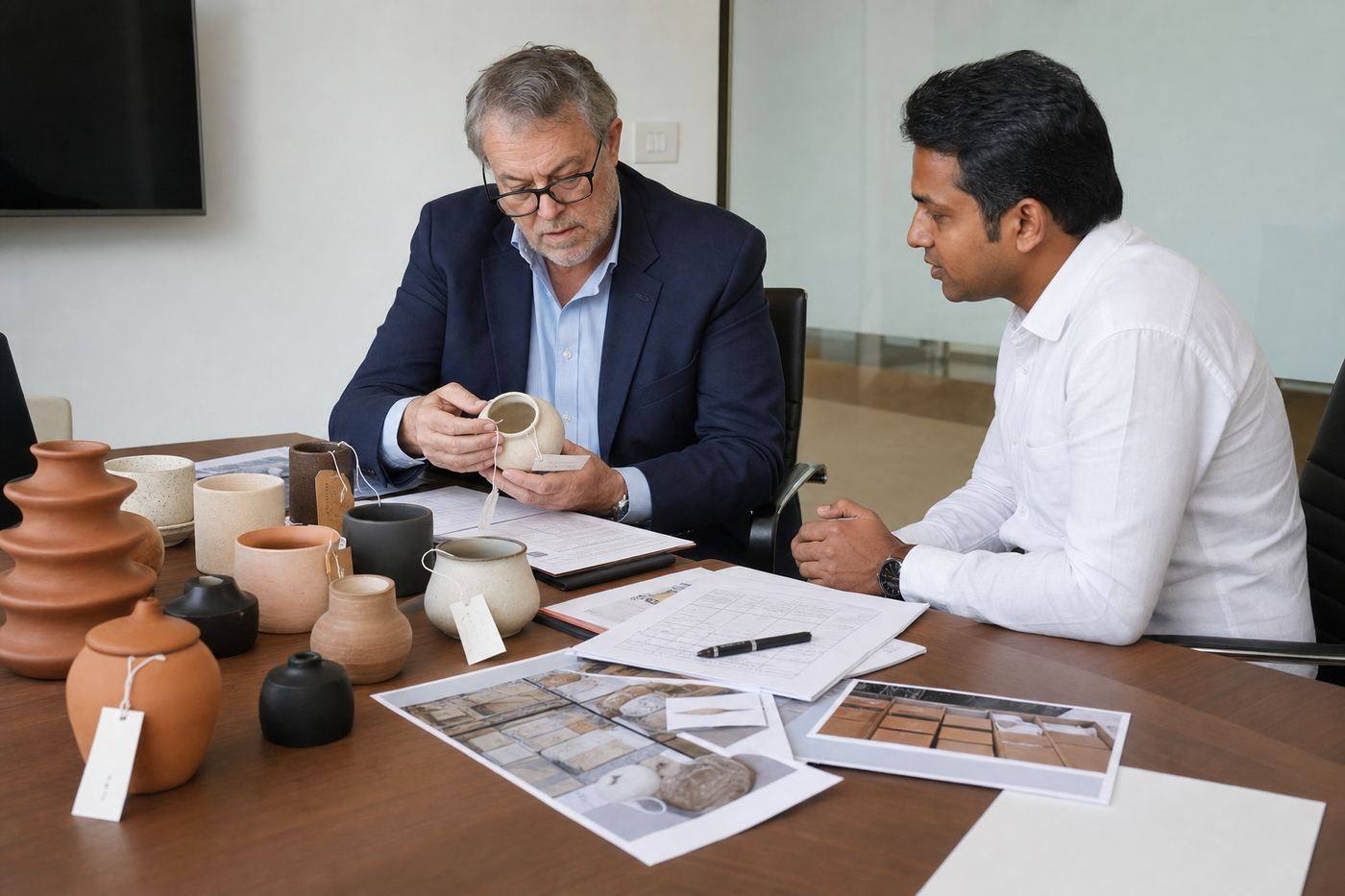
Exporting terracotta and ceramic handicrafts from India — Khurja industrial pottery, Jaipur blue pottery, Molela terracotta plaques, Bankura and Bishnupur terracotta figurines, Asharikandi terracotta, Longpi black pottery, Tamil Nadu / Pondicherry / Gujarat gardenware, and Delhi-NCR merchant-consolidated ceramic programmes — is not held together by one master document. It is held together by a stack of interlocking documents that must reconcile line by line: commercial invoice, packing list, HS classification per SKU (HS 6913 ornamental, HS 6912 ceramic tableware non-porcelain, HS 6911 porcelain tableware, HS 6914 other ceramic articles including many planters), glaze composition certificate, lead / cadmium migration report, food-contact COA where tableware claims are made, California Prop 65 statement for US decorative and tableware programmes, REACH SVHC declaration for the EU / UK, certificate of origin (preferential where FTAs apply and non-preferential otherwise), fumigation certificate where wooden pallets or crates are used (ISPM-15), marine insurance, bill of lading, shipping bill, e-BRC realisation, GI authorised-user evidence for Blue Pottery of Jaipur or other cluster GIs where claims are made, frost-rating evidence for outdoor terracotta where frost claims are printed, and a clean broker handoff pack for your Customs House Agent (CHA).
When any one of these documents is missing, inconsistent with the others, or reads as marketing rather than evidence, three predictable failures follow: customs delays at Nhava Sheva, Mundra, or ICD Delhi / Dadri for pottery consignments; buyer disputes at destination for Khurja, Jaipur blue pottery, Molela, or Bankura lines where glaze or dimensional claims cannot be substantiated; and — worst — retailer rejection of an entire retail lot of planters, vases, or tableware because the Prop 65, LFGB, or REACH posture on the paperwork does not match the actual glaze chemistry inside the carton. This checklist is written for that operational reality. It is not a substitute for your CHA and it does not replace your EPCH registration — it is the document-by-document reconciliation layer that turns institutional credentials and a good glaze recipe into a container that clears customs both ways and closes payment cleanly on an e-BRC.
This guide owns the terracotta and ceramic documentation checklist for the cluster. It is not the EPCH registration guide — see EPCH registration benefits for terracotta and ceramic exporters for RCMC scope, IHGF Delhi Fair access, and market development assistance. It is not the country × clay body × glaze demand matrix — see most demanded Indian terracotta and ceramic handicrafts by country for that. It is not the lead-safe glaze, blue pottery, and food-contact specialty deep dive — see lead-safe glaze, blue pottery, and food-contact ceramic export opportunities for glaze chemistry, migration testing rhythms, and blue pottery quartz-frit body specifics. Pair this checklist with how to export terracotta and ceramic handicrafts from India for the full end-to-end process, and always verify live fee schedules, form numbers, and portal workflows on dgft.gov.in, epch.in, and your CHA's DGFT ICEGATE workspace before you file.
Key Takeaways
Summary Box
Executive Summary
Summary Box
Terracotta and ceramic handicrafts from India are a fragile-clayware category where documentation discipline is at least as commercially decisive as glaze artistry. Khurja industrial pottery, Jaipur blue pottery, Molela terracotta relief plaques, Bankura and Bishnupur terracotta figurines, Longpi black pottery, and Tamil Nadu / Pondicherry / Gujarat gardenware belts all flow through the same broad document architecture — legal identity, commercial identity, technical identity, transport documents, destination compliance, and broker handoff — even though the specific glaze chemistry, kiln profile, and cluster GI story differs sharply by belt. Broader EPCH handicrafts (excluding carpets) reached Rs 33,122.79 crore / US$3,917.89 million in FY 2024–25 — cite that only for sector context. Ceramic-specific volume should be framed via DGCI&S / TradeStat under HS 6913, 6912, 6911, and 6914 as the ceramic proxies, never as if total handicrafts equal ceramic export volume.
The commercial payoff for treating documentation as a controlled asset is not administrative — it is margin. Buyers in the USA, Germany, the UK, the UAE, France, the Netherlands, Australia, Canada, and Japan increasingly onboard pottery vendors using a documentation-first filter: IEC, GST, EPCH RCMC, glaze composition certificate, lead / cadmium migration report keyed to the destination limit, Prop 65 or REACH posture, HS split declared per SKU, and honest cluster-origin labelling (Khurja industrial vs Jaipur blue pottery vs Molela vs Bankura vs Delhi-consolidated). Exporters who present that pack in the first inquiry response — not after three rounds of follow-up — convert IHGF Delhi Fair ceramic-zone booth visits and Ambiente Frankfurt introductions into purchase orders significantly more often than exporters who treat documentation as a shipping-day task.
This guide organises that architecture into a document-by-document checklist tuned for ceramic and terracotta specifics. It walks through the commercial invoice line-item discipline, the packing list stack-and-CBM discipline, glaze composition certificates and lead / cadmium migration reports, food-contact COAs for tableware, California Prop 65 statements, REACH SVHC declarations, certificate of origin (preferential and non-preferential), fumigation / ISPM-15 for wooden pallets and crates, marine insurance, bill of lading, shipping bill, e-BRC realisation, GI authorised-user evidence for Blue Pottery of Jaipur, frost-rating evidence for outdoor terracotta, and the broker handoff pack format your CHA actually wants — without duplicating the EPCH registration walkthrough, the country demand matrix, or the glaze chemistry deep dive owned by peer cluster posts.
Market Size & Industry Overview
Key Statistics
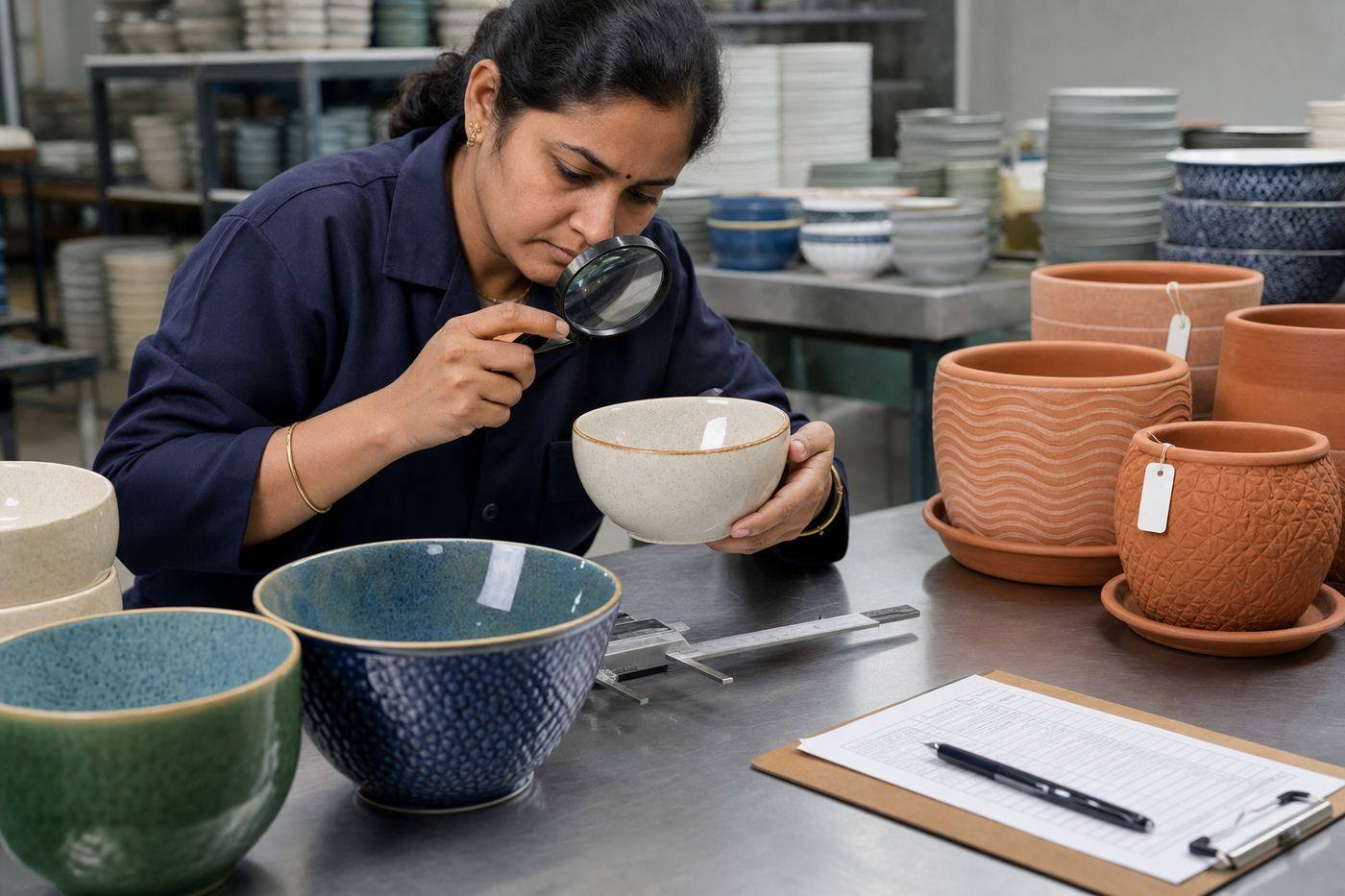
Global demand for Indian terracotta and ceramic handicrafts spans ornamental ceramic vases, glazed bowls, blue pottery jars and coasters, Molela terracotta relief plaques, Bankura terracotta horses and figurines, Longpi black pottery accents, ceramic planters and gardenware, ceramic candle holders, decorative platters, and curated ceramic gift assortments. Production is concentrated in specialist clusters: Khurja (Uttar Pradesh) for industrial-scale glazed stoneware and earthenware; Jaipur (Rajasthan) for blue pottery on quartz / glass-frit bodies with cobalt and turquoise hand-painted motifs; Molela (Rajasthan) for terracotta relief plaques; Bankura and Bishnupur (West Bengal) for terracotta horses and figurines; Asharikandi (Assam) for terracotta toys and utility artware; Longpi (Manipur) for premium hand-carved black pottery; Tamil Nadu, Pondicherry, and Gujarat artisan belts for terracotta gardenware; and Delhi-NCR for merchant consolidation and mixed pottery gift or garden programmes.
For documentation purposes, cluster diversity translates directly into document-pack variation. A Khurja industrial container of glazed stoneware décor for a US garden-center programme carries a different Prop 65 posture than a container of blue pottery gift boxes for a French boutique; a Molela relief plaque programme for a Japanese museum shop requires narrative craft-origin documentation that a Delhi-consolidated mixed ornamental pack does not. The same commercial invoice / packing list / COO / RCMC skeleton applies to all of them, but the glaze compliance layer and cluster-origin evidence flex per programme. That is why a generic ceramic checklist copied from another commodity category will fail — the ceramic pack has to speak clay body, glaze family, kiln schedule, and cluster GI honestly on every line.
What This Documentation Checklist Owns
Checklist
Compliance Notes
This post is the documentation-owner for the ceramic and terracotta cluster. It covers the specific documents an exporter must assemble, in what order, keyed to which authority or buyer expectation, with the reconciliation checks that actually matter when a container is being stuffed. It is deliberately narrow: it does not walk you through EPCH registration (see EPCH registration benefits for terracotta and ceramic exporters); it does not walk you through the country × clay body × glaze demand matrix (see most demanded Indian terracotta and ceramic handicrafts by country); it does not walk you through lead-safe glaze chemistry, blue pottery quartz-frit body details, or food-contact migration test design (see lead-safe glaze, blue pottery, and food-contact ceramic export opportunities); it does not walk you through the entire export process (see how to export terracotta and ceramic handicrafts from India).
What it does own: which document to produce, who is responsible for each, when to produce it in the shipment timeline, what specific ceramic content each document must carry to survive customs and buyer diligence, and how to hand off the whole pack to your Customs House Agent without last-minute glaze certificate scrambles.
Export Statistics
Key Statistics
For ceramic and terracotta HS discipline: ornamental ceramic articles classify under HS 6913 with EPCH-referenced examples 69131000 (of porcelain or china) and 69139000 (other) — most Khurja, Jaipur blue pottery, Molela, Bankura, and Longpi ornamental SKUs classify here. Ceramic tableware and kitchenware other than porcelain or china classify under HS 6912; porcelain and china tableware under HS 6911 when the SKU commercial identity is tableware rather than ornament; and other ceramic articles including many terracotta planters and flowerpots classify under HS 6914 where they fall outside 6913. Cite DGCI&S / TradeStat under 6913, 6912, 6911, and 6914 as the ceramic proxies; never present the broader EPCH handicrafts total of Rs 33,122.79 crore / US$3,917.89 million (excl. carpets, FY 2024–25) as if it were the ceramic-only figure.
Comparison table
Swipe →
Data table — swipe horizontally on small screens
| Metric | Directional Trend | Documentation Relevance |
|---|---|---|
| Ceramic proxy HS lines | HS 6913 (ornamental); HS 6912 (ceramic tableware non-porcelain); HS 6911 (porcelain tableware); HS 6914 (other ceramic articles including many planters) — verify per SKU with CHA | Commercial invoice and shipping bill must reflect per-SKU classification; RCMC scope declaration must match |
| Broader EPCH handicrafts context (excl. carpets) | Rs 33,122.79 crore / US$3,917.89 million, FY 2024–25 | Cite as sector context only — never on the commercial invoice as a ceramic-specific claim |
| Primary industrial cluster | Khurja (UP) for glazed stoneware / earthenware décor and tableware-adjacent artware | Manufacturer-exporter workshop-address evidence in the compliance file must match Khurja plant location |
| Heritage clusters | Jaipur blue pottery; Molela terracotta plaques; Bankura / Bishnupur figurines; Asharikandi; Longpi black pottery; TN / Pondicherry / Gujarat gardenware | Cluster-origin labelling on invoice and packing list must be honest and defensible in buyer diligence |
| Top destination markets | USA, Germany, UK, UAE, Netherlands, France, Australia, Canada, Japan | Prop 65 (US), REACH (EU / UK), LFGB (DE tableware), FDA (US tableware) postures must be pre-built into the pack |
| Merchant consolidation | Delhi-NCR consolidators aggregating multi-cluster pottery lots | Procurement traceability from each supplied workshop must be documented for buyer diligence |
Import Statistics
Key Statistics
On the import side, the USA anchors demand for Indian terracotta planters through garden-center chains, ornamental ceramic vases through home-décor specialty retail, and blue pottery accents through boutique gift channels — with Prop 65 posture and lead-safe glaze evidence increasingly expected on decorative ceramics as well as tableware. Germany anchors European demand for glazed ornamental ceramics, blue pottery bowls, and quality-focused stoneware, with LFGB tableware programmes and REACH SVHC documentation on decorative glazes. The Netherlands operates as both a direct market and a European distribution hub. The UK mirrors US demand patterns with added weight on heritage cluster craft. France concentrates in boutique ceramic gift and design retail. The UAE combines bulk hospitality amenity procurement with premium blue pottery gifting. Australia adds strict frost-rating and breakage QC expectations. Canada tracks US patterns at smaller scale. Japan applies a tight bar on glaze neatness and lead-safe evidence. Documentation posture per destination is not optional — it is baked into vendor onboarding.
Comparison table
Swipe →
Data table — swipe horizontally on small screens
| Country | Documentation Sensitivity | Typical Documents Requested Alongside Commercial Pack |
|---|---|---|
| USA | High — Prop 65 posture on decorative coatings; FDA food-contact if tableware | IEC / EPCH RCMC, glaze composition, lead-cadmium migration, Prop 65 statement, COO |
| Germany | High — LFGB for tableware; REACH SVHC on glazes | Glaze composition, migration test, LFGB report if tableware, REACH declaration, COO |
| Netherlands | Medium-high — EU REACH and consumer-safety posture | REACH SVHC declaration, migration test where relevant, COO |
| France | Medium-high — boutique-retail traceability and REACH | REACH declaration, cluster-origin narrative documentation, COO |
| UK | High — UK REACH post-Brexit; consumer-safety scrutiny | UK REACH declaration, migration test, COO |
| UAE | Medium — hospitality amenity volume; premium gifting evidence | Commercial pack, glaze compliance for food-contact amenity, COO |
| Australia | Medium-high — frost / breakage claims on outdoor terracotta | Frost-cycle test evidence, glaze composition, COO |
| Canada | Medium — mirrors US posture at smaller scale | Similar to USA — Prop 65 posture, migration test where tableware |
| Japan | High — glaze neatness and lead-safe evidence | Lead-cadmium migration report, glaze composition, COO |
Product Categories & Documentation Split
Summary Box
- Ornamental ceramic vases and jars (HS 6913 — 69131000 porcelain / 69139000 other) — Khurja glazed and Jaipur blue pottery hero SKUs; glaze composition + migration test + Prop 65 / REACH posture
- Ceramic bowls and platters marketed as artware (HS 6913) vs tableware (HS 6912 / 6911) — commercial identity per invoice line drives whether food-contact COA is required
- Terracotta planters, flowerpots, and gardenware (often HS 6914) — glaze composition where glazed; frost-rating evidence where frost claims printed; USDA compliance if labelled for edible crops
- Blue pottery bowls, coasters, plates, tiles (HS 6913, some tableware lines under 6912) — Jaipur heritage; GI authorised-user evidence if 'Blue Pottery of Jaipur' claim used
- Molela terracotta relief plaques and wall panels (HS 6913) — narrative cluster documentation for France / Japan boutique retail
- Bankura terracotta horses and figurines (HS 6913) — heritage cluster documentation for gift and museum-shop channels
- Longpi black pottery (HS 6913) — premium studio documentation; CPSC / EN71 / ASTM F963 only if child-product claims are made (rare)
- Ornamental ceramic figurines, candle holders, and gift accessories (HS 6913) — Prop 65 posture on any decorative coating for US retail
- Curated ceramic gift assortments and private-label sets — assortment packing list must reconcile every SKU's HS and glaze compliance status, not blanket-declare
Terracotta and ceramic exports span ornamental vases, decorative bowls, blue pottery jars and coasters, ceramic figurines, Molela terracotta relief plaques, Bankura terracotta horses, Longpi black pottery accents, ceramic planters and gardenware, ceramic candle holders and diffusers, decorative platters, and curated ceramic gift assortments. Documentation splits primarily along ornamental vs tableware vs other-articles and along decorative-only vs food-contact — not along cluster origin. A Khurja ornamental vase and a Jaipur blue pottery ornamental bowl share the same HS 6913 documentation architecture even though their glaze recipes differ. But a Khurja ceramic dinner plate sold as tableware crosses into HS 6912 documentation architecture including a food-contact COA, LFGB or FDA posture, and stricter migration testing rhythms.
Manufacturing Overview (Documentation Anchor Points)
Export Tip
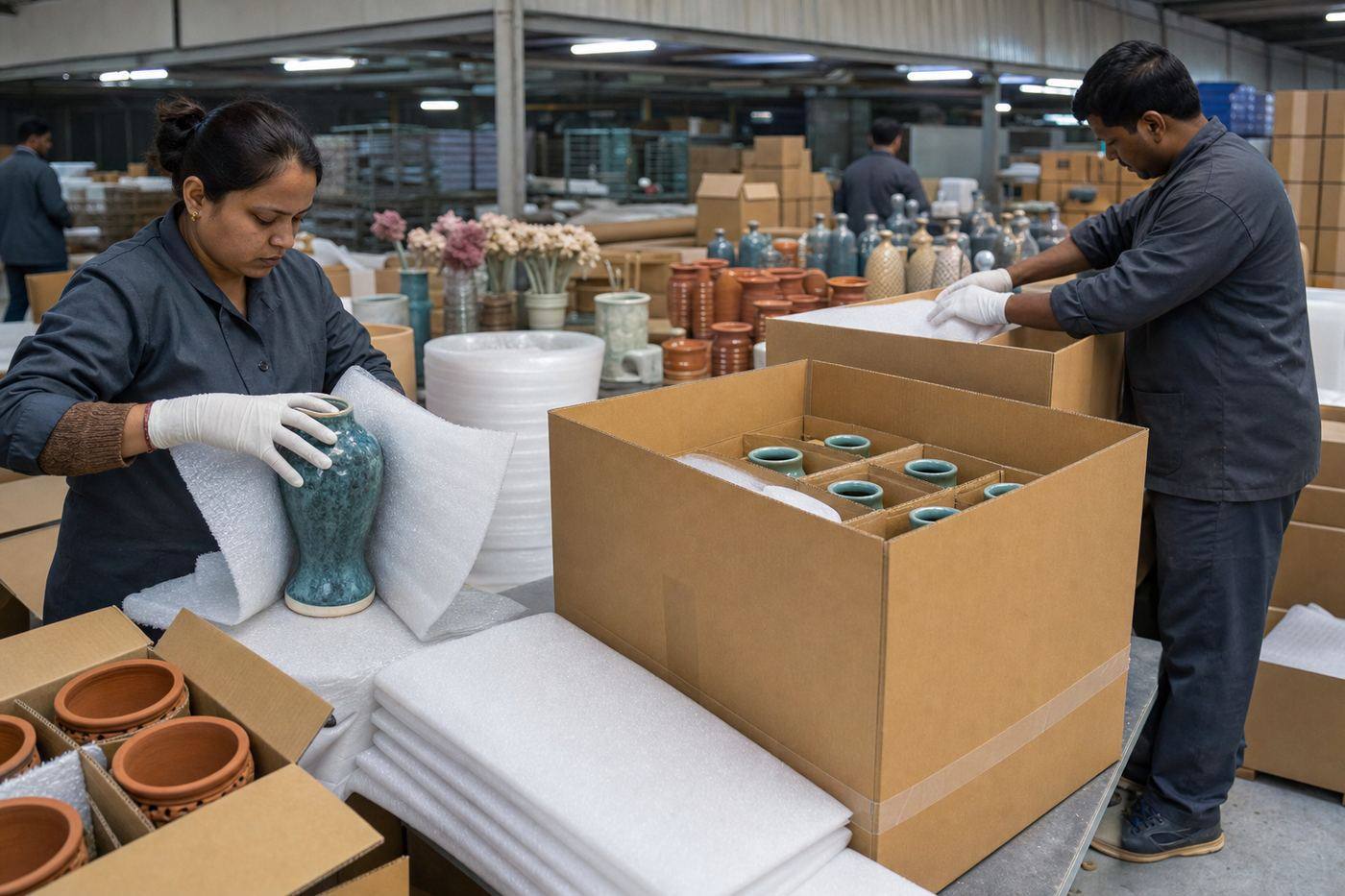
Ceramic and terracotta production in India follows a consistent kiln sequence — clay preparation → forming (wheel throwing, mold casting, hand building, or slab building) → drying → bisque firing → optional glazing (dip, spray, brush, or hand painting) → glaze firing → cooling → QC → export packing — even when clay bodies and glazes differ sharply by cluster. Each stage produces documentation anchor points that flow into the export pack: clay body specification (terracotta, earthenware, stoneware, porcelain, or Jaipur blue pottery quartz-frit) documented on the glaze composition certificate; firing schedule and peak temperature documented on the firing schedule sheet; glaze recipe documented on the glaze composition certificate; lead / cadmium migration testing keyed to the actual glaze recipe on file; and pre-shipment QC recorded on a lot-specific inspection report tagged to the packing list carton IDs.
For documentation purposes, the operational risk is not the kiln — it is a glaze recipe change, colour system swap, or firing schedule tweak that goes into production without a fresh migration test being scheduled. Buyers assume the documented recipe matches the container inside, and destination customs assume the same. Any material change should trigger a new migration test and a fresh glaze composition certificate before the next commercial sailing.
Export Process (Documentation-Anchored)
Export Tip
A typical ceramic and terracotta export process runs: IEC and EPCH registration in place (compliance file); buyer discovery and negotiation (proforma invoice); purchase order confirmation (PO on file); production scheduling with Khurja / Jaipur / Molela / Bankura / Longpi / gardenware workshops (production schedule); pre-shipment QC (inspection report keyed to lot IDs); glaze composition, migration testing, and destination compliance posture assembled per programme (glaze composition certificate, migration test report, Prop 65 / REACH / LFGB / FDA statements as applicable); export packing (packing list); commercial invoice generation with per-SKU HS split; certificate of origin (preferential where FTA rules-of-origin met, non-preferential otherwise); fumigation / ISPM-15 for wooden pallets or crating; marine insurance certificate; shipping bill filed through CHA on ICEGATE; bill of lading issued on loading; e-BRC on payment realisation.
For the complete operational walkthrough (as opposed to this document-by-document owner), see how to export terracotta and ceramic handicrafts from India.
The Ceramic Export Document Stack: Master Inventory
Use this master inventory as the top-level checklist for every ceramic and terracotta sailing. Not every document applies to every shipment — for example, a preferential COO is only needed where an FTA is being invoked, a food-contact COA is only needed where tableware claims are made, and GI authorised-user evidence is only needed where a cluster GI is claimed. But every applicable document must be reconciled against the commercial invoice and packing list before the container leaves the workshop.
Comparison table
Swipe →
Data table — swipe horizontally on small screens
| # | Document | Owner | When Produced | Cross-Check Against |
|---|---|---|---|---|
| 1 | Purchase Order (PO) | Buyer | Before production | Proforma invoice, commercial invoice |
| 2 | Proforma Invoice | Exporter | At quotation stage | PO, later commercial invoice |
| 3 | Commercial Invoice | Exporter | At shipment readiness | PO, packing list, shipping bill, COO |
| 4 | Packing List | Exporter / packing team | During carton sealing | Commercial invoice, container stuffing report |
| 5 | HS Classification Per SKU | Exporter with CHA | Before shipping bill | Commercial invoice line items, RCMC scope |
| 6 | Glaze Composition Certificate | Exporter / lab | Per programme + recipe change | Migration test report, food-contact COA |
| 7 | Lead / Cadmium Migration Report | Accredited lab | Per programme + recipe change | Glaze composition, destination limit |
| 8 | Food-Contact COA (tableware only) | Accredited lab | Per tableware programme | Migration test, glaze composition, LFGB / FDA posture |
| 9 | California Prop 65 Statement | Exporter | Per US-bound programme | Glaze composition, migration test, retailer template |
| 10 | REACH SVHC Declaration | Exporter | Per EU / UK programme | Glaze composition, SVHC candidate list version cited |
| 11 | LFGB Report (German tableware) | Accredited lab | Per DE tableware programme | Migration test, glaze composition |
| 12 | FDA Food-Contact Posture (US tableware) | Exporter statement + supporting tests | Per US tableware programme | Migration test, glaze composition, 21 CFR references |
| 13 | Certificate of Origin (COO) | EPCH / Chamber / DGFT eCoO | Before shipping bill or destination clearance | Commercial invoice, packing list, HS classification |
| 14 | GI Authorised-User Evidence | GI registry / cluster body | Only if GI claim used | Marketing material, invoice line description |
| 15 | Frost-Rating Evidence | Accredited lab / workshop test | Only if frost claim printed | Carton labelling, marketing material |
| 16 | Fumigation Certificate / ISPM-15 | Fumigator / pallet supplier | Only if wooden pallets / crates used | Packing list, carton labelling |
| 17 | Marine Insurance Certificate | Insurer (or buyer under CIF) | Before loading | Commercial invoice value, Incoterm |
| 18 | Shipping Bill (ICEGATE) | CHA on ICEGATE | At export clearance | Commercial invoice, packing list, IEC, RCMC |
| 19 | Bill of Lading (B/L) | Shipping line / forwarder | At loading | Shipping bill, commercial invoice, packing list |
| 20 | e-BRC (Bank Realisation) | Bank via DGFT eBRC | On payment realisation | Commercial invoice value, shipping bill |
| 21 | Broker Handoff Pack | Exporter to CHA | Before shipping bill filing | All above documents indexed |
Commercial Invoice: Line-Item Discipline for Ceramics
The commercial invoice is the single most-read document in the ceramic export pack — customs on both sides, the buyer's finance team, the buyer's compliance team, the shipping line, and the CHA all reference it. For ceramic and terracotta consignments, the line-item discipline is stricter than for most non-fragile categories because ornamental / tableware / other-articles classification, glaze character, and cluster-origin honesty all have to be reconcilable to per-line SKU descriptions rather than a blanket container-level description.
Every line must carry: SKU code (matched to your PO and packing list), plain-language description that honestly reflects ornamental vs tableware vs planter identity and cluster origin (Khurja glazed stoneware vase vs Jaipur blue pottery bowl vs Molela relief plaque vs Bankura terracotta figurine vs Delhi-consolidated mixed ornamental), clay body (terracotta / earthenware / stoneware / porcelain / blue pottery quartz-frit), HS classification (6913 / 6912 / 6911 / 6914 verified with CHA), unit of measure (usually pieces or sets), quantity, unit price in the invoice currency, extended line value, and any lot or batch ID tying back to the pre-shipment QC report. The invoice header carries buyer and seller details, IEC number, GSTIN, EPCH RCMC number, PO reference, Incoterm and named place, currency, payment terms, port of loading, port of discharge, country of origin, and carton range covered.
Comparison table
Swipe →
Data table — swipe horizontally on small screens
| Invoice Element | Ceramic-Specific Requirement | Common Failure Mode |
|---|---|---|
| Exporter details | Legal name matching IEC, GST, EPCH RCMC exactly | Trading name on invoice, legal name on IEC — buyer diligence fails |
| Buyer details | Legal importer name matching COO consignee | Retail brand on invoice, distributor on COO — customs holds |
| IEC / GSTIN / RCMC numbers | All three printed on invoice header | RCMC number missing — Prop 65 / REACH buyer chases separately |
| Line description | Ornamental vs tableware vs planter identity + honest cluster origin + clay body | Blanket 'ceramic decorative items' — HS challenge risk at destination |
| HS classification per line | 6913 / 6912 / 6911 / 6914 verified with CHA per SKU | Container-level HS declared — mixed pack rejected at scrutiny |
| Unit price and extended value | Consistent with PO and payment terms | Round-number adjustments to hit target FOB — misdeclaration flag |
| Currency and Incoterm | Named place attached to Incoterm; currency matches contract | FOB without named port; CIF without insured value — B/L mismatch |
| Lot / batch ID reference | Tied to pre-shipment QC report and packing list carton IDs | No lot tag — traceability breaks on buyer complaint |
| Country of origin | India — matches COO | Sub-region printed as country of origin — COO rejection |
Packing List: CBM, Stack Height, and Fragile Discipline
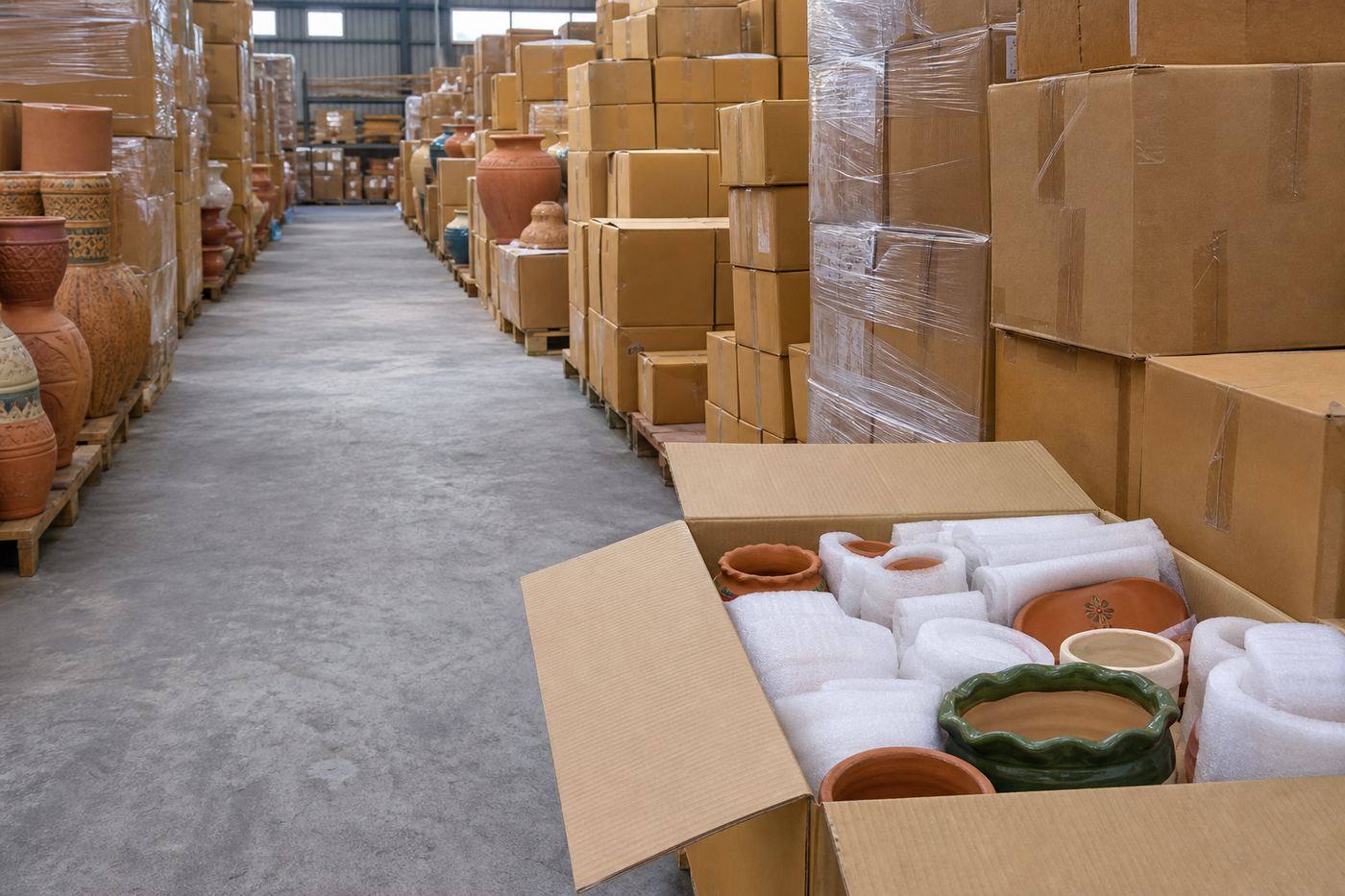
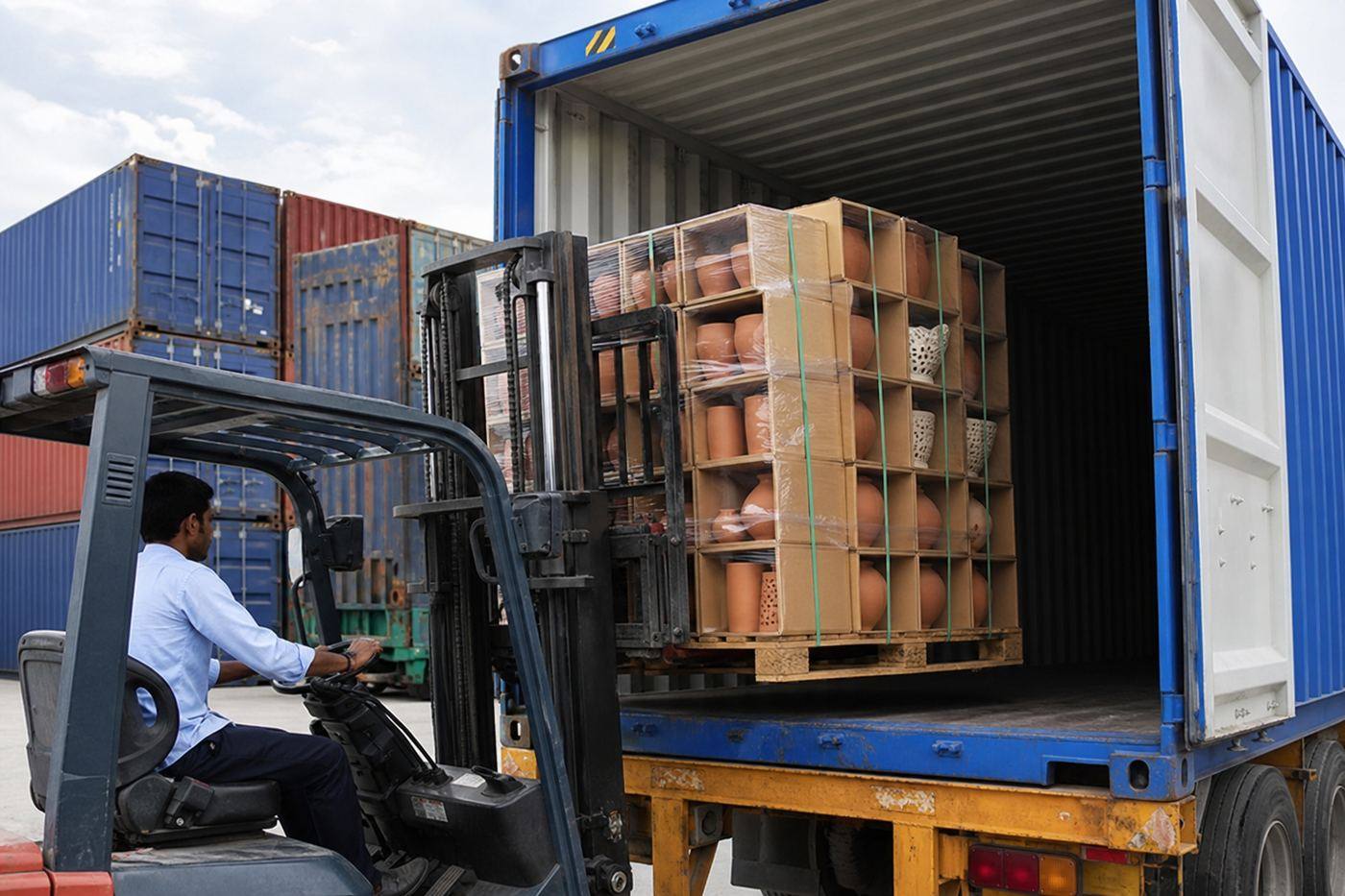
The ceramic packing list is more than a carton count — it is the stack-and-CBM discipline document that determines whether a container of Khurja stoneware, Jaipur blue pottery, or Molela plaques survives the ocean sailing without breakage. Every carton line must carry: carton ID, SKU(s) inside and quantity per SKU, gross and net weight, external carton dimensions, CBM, stack-height limit (critical for thin-walled terracotta planters), FRAGILE marking flag, and any special handling notes (this-side-up for Molela plaques, no-nesting for hand-thrown pieces not engineered for nesting, desiccant present for long ocean transit).
Blue pottery and premium gift SKUs typically carry higher CBM per unit due to retail gift-box format — the packing list should surface this so the container stuffing plan does not accidentally treat gift-boxed blue pottery cartons like bulk-wrapped Khurja stoneware cartons. Reconcile the packing list against the commercial invoice at the SKU-quantity level before sealing the container, and against the container stuffing report as the container is stuffed.
Comparison table
Swipe →
Data table — swipe horizontally on small screens
| Packing List Field | Ceramic-Specific Requirement | Why It Matters |
|---|---|---|
| Carton ID | Sequential and printed on carton | Traceability to lot ID and QC report |
| SKU + quantity per carton | Matches commercial invoice line quantities in aggregate | Prevents over-declaration or missing SKUs at destination scan |
| Gross / net weight per carton | Per carton, in kg | Freight quotation and container axle-load compliance |
| Carton dimensions and CBM | External dimensions in cm; CBM calculated | Container fill planning; freight cost basis for LCL |
| Stack-height limit | Per carton (critical for thin-walled terracotta) | Prevents crush damage in ocean stowage |
| FRAGILE marking | Flag per carton | Aligns physical carton labelling with paperwork |
| Special handling notes | This-side-up for plaques, no-nesting, desiccants | Reduces breakage in transit; supports buyer disputes |
| Cluster / lot / batch traceability | Cluster origin (Khurja / Jaipur / Molela / Bankura / Longpi / gardenware / Delhi-consolidated) per carton where mixed | Buyer diligence on cluster-origin honesty |
HS Classification Per SKU (Not Per Container)
Compliance Notes
HS classification for ceramic and terracotta consignments is per SKU, not per container. A mixed FCL carrying Khurja glazed ornamental vases (HS 6913), Jaipur blue pottery ornamental bowls (HS 6913), Khurja ceramic dinner plates sold as tableware (HS 6912), and terracotta garden planters (HS 6914) needs all four classifications on the shipping bill and commercial invoice. Blanket-declaring the entire container under HS 6913 because 'most of it is ornamental' is a misdeclaration risk that customs at destination (especially in the EU, UK, and USA) will flag on scrutiny, and it may attract retrospective duty adjustments and buyer chargebacks.
Do not force ceramic SKUs onto non-ceramic HS chapters. Papier-mache 4823, wooden 4420, and metal 8306 are separate chapters with separate compliance postures — using them for ceramic articles because they were the default in a prior category export is a documentation failure that also breaks EPCH RCMC scope consistency for the ceramic programme.
Comparison table
Swipe →
Data table — swipe horizontally on small screens
| Ceramic SKU Type | Typical HS Heading | Documentation Implication |
|---|---|---|
| Ornamental ceramic vase / jar / figurine (porcelain) | 6913 (EPCH ref 69131000) | Ornamental — no food-contact COA needed unless dual-use claim made |
| Ornamental ceramic vase / jar / figurine (non-porcelain) | 6913 (EPCH ref 69139000) | Ornamental — Prop 65 / REACH still apply to decorative coatings |
| Ceramic tableware / kitchenware (non-porcelain) | 6912 | Food-contact COA + LFGB / FDA posture required for tableware programmes |
| Porcelain tableware / kitchenware | 6911 | Food-contact COA + LFGB / FDA posture required |
| Terracotta planter / flowerpot (unglazed) | 6914 (verify per CHA) | Frost-rating evidence if outdoor / frost claim; USDA if edible-crop labelling |
| Terracotta planter / flowerpot (glazed) | 6914 (verify per CHA) | Glaze composition + migration test if food-contact or child-safety claim made |
| Blue pottery bowl (ornamental) | 6913 | GI authorised-user evidence if 'Blue Pottery of Jaipur' claim used |
| Blue pottery tableware (rare) | 6912 or 6911 per body | Food-contact COA + heightened migration testing given traditional glaze chemistry |
| Molela relief plaque (terracotta wall panel) | 6913 | Narrative cluster documentation for boutique / museum buyers |
| Bankura terracotta figurine | 6913 | Heritage cluster documentation for museum-shop channels |
Glaze Composition Certificate & Lead / Cadmium Migration Report
The glaze composition certificate is the technical identity document for the actual glaze recipe applied to your ceramic SKUs. It should list the primary oxides and pigments in the glaze (silica, alumina, alkaline earths, colouring oxides such as cobalt for blue pottery), the presence or absence of lead and cadmium compounds, the firing schedule (peak temperature and hold time), and a traceable recipe code that ties into your workshop's batch records. It is generated per glaze recipe, not per shipment — but it must be re-issued whenever the recipe, colour system, or firing schedule materially changes.
The lead / cadmium migration report is the destination-facing evidence document. It is issued by an accredited laboratory (in India, typically NABL-accredited for the relevant test method; globally aligned with ISO 17025) and tests the actual finished ceramic surface against the migration limits of the intended destination. For food-contact and tableware programmes, the report must reference the destination limit explicitly (US FDA compliance policy guides; EU 84/500/EEC as amended and national implementations; German LFGB § 30 / § 31 references; Japanese Food Sanitation Act limits) and must be dated within the retention window each destination expects. For decorative-only ceramics, the same migration test is increasingly requested even without a tableware claim — especially for California Prop 65 posture on decorative coatings — because rim, lip, and hand-contact surfaces still trigger consumer-safety scrutiny.
Comparison table
Swipe →
Data table — swipe horizontally on small screens
| Document | Purpose | Ceramic-Specific Content |
|---|---|---|
| Glaze composition certificate | Recipe-level technical identity | Oxide list, pigments, lead / cadmium presence, firing schedule, recipe code |
| Lead / cadmium migration report (tableware) | Destination food-contact compliance | Test method, extraction solvent (typically 4% acetic acid), destination limit reference, PASS / FAIL |
| Lead / cadmium migration report (decorative) | US Prop 65 and EU REACH posture on decorative glazes | Same test methodology; posture statement referencing decorative-only use |
| Firing schedule sheet | Kiln discipline evidence | Peak temperature, hold time, cooling curve, kiln ID |
| Colour system / pigment list | Traceability for blue pottery cobalt, Khurja pigment mixes | Pigment identity, source, batch reference |
| Recipe change log | Version control for glaze recipes | Recipe code, revision date, migration test re-issue reference |
Food-Contact COA for Ceramic Tableware
When a ceramic SKU is sold as tableware — dinner plates, bowls, mugs, serving platters — the food-contact Certificate of Analysis (COA) is the specific document that ties the migration test to the tableware programme and to the destination's food-contact framework. For the USA, that framework references FDA compliance policy guides (notably Sec. 545.450 / CPG 7117.07 for lead and Sec. 545.400 / CPG 7117.06 for cadmium in ceramics) and 21 CFR references where applicable; for Germany, LFGB food-contact provisions with laboratory migration methods used by notified/third-party labs; for the wider EU, Regulation (EC) No 1935/2004 as the umbrella food-contact framework with Directive 84/500/EEC (as amended, including Directive 2005/31/EC on declarations of compliance) as the ceramic-specific lead/cadmium measure; for the UK, the retained EU ceramic food-contact framework as adapted post-Brexit; for Japan, the Food Sanitation Act migration limits.
The food-contact COA should identify the tested SKU (matched to your commercial invoice line), the glaze recipe on file, the migration test method and extraction conditions, the destination limit being met, and the PASS result with numerical margin. Do not confuse a general glaze composition certificate with a food-contact COA — the former is recipe-facing and the latter is destination-facing. Both are typically required for tableware programmes to Germany, the USA, Japan, France, and the Netherlands.
California Prop 65 Statement
California Proposition 65 requires warnings on products sold into California that expose consumers to listed substances above safe harbor thresholds — and lead and cadmium (both potential glaze contaminants) sit squarely on the Prop 65 list. For US-bound ceramic and terracotta programmes, especially those landing at California ports or being distributed through US-wide retail with California exposure, retailers routinely require a Prop 65 statement from the exporter that references the actual glaze composition and migration test data on file, and that either (a) confirms migration levels are below Prop 65 no-significant-risk thresholds so no warning label is required, or (b) confirms warning labels are being applied per Prop 65 short-form or long-form warning requirements.
The Prop 65 statement is a supplier-issued document, but it must be traceable back to the accredited migration test report. Blanket statements that 'the product complies with Prop 65' without supporting migration test data will not survive a retailer audit and can trigger private-enforcement lawsuits at the retailer level. Treat this as a legally binding statement, not marketing language on a footer.
REACH SVHC Declaration (EU / UK)
For ceramic and terracotta shipments to the European Union and the United Kingdom, REACH (Registration, Evaluation, Authorisation and Restriction of Chemicals) applies through the SVHC (Substances of Very High Concern) candidate list. The candidate list is updated periodically by ECHA (EU) and mirrored by HSE (UK) post-Brexit — the exporter's REACH declaration must cite the specific candidate list version being referenced (with date) and confirm either non-presence of listed substances above the 0.1% weight/weight threshold or presence with the associated communication obligations.
For decorative ceramics with glazes, the substances typically of interest are lead compounds, cadmium compounds, and certain pigment-related SVHCs. For tableware, the migration test evidence generally supports the REACH declaration; for decorative-only ceramics, glaze composition evidence and migration test posture on decorative surfaces typically support it. Post-Brexit, UK REACH runs parallel to EU REACH — a single declaration should confirm posture under both regimes if the shipment is destined for either or both markets.
Certificate of Origin: Preferential vs Non-Preferential
The Certificate of Origin (COO) confirms that the ceramic or terracotta goods originate in India. It splits into two families: preferential COO, issued under a specific Free Trade Agreement or Preferential Trade Agreement to claim reduced destination duty (where rules-of-origin are met for the specific HS heading), and non-preferential COO, issued for general customs declaration purposes at destinations without an FTA claim.
For ceramic and terracotta exporters, the relevant preferential COO is available under India's active FTAs and PTAs at destinations where those FTAs cover HS 6913, 6912, 6911, or 6914 — verify the current FTA landscape and applicable rules-of-origin for the specific destination and HS heading with your CHA and on the DGFT eCoO portal before invoking preferential treatment, as the FTA landscape evolves. Non-preferential COO is generally issued by EPCH or a recognised chamber of commerce and is the fallback for destinations without an FTA claim. The COO must match the commercial invoice consignee, HS classification, and country of origin (India) exactly — mismatches trigger destination customs holds.
Comparison table
Swipe →
Data table — swipe horizontally on small screens
| COO Type | When Used | Issuing Authority (Directional) | Ceramic-Specific Note |
|---|---|---|---|
| Preferential COO under active FTA / PTA | Where FTA covers 6913 / 6912 / 6911 / 6914 and rules-of-origin met | DGFT eCoO / notified agencies | Verify FTA coverage per HS heading and destination with CHA |
| Non-preferential COO | General customs at non-FTA destinations | EPCH / recognised chambers of commerce | Default for many US, UAE ceramic programmes |
| GSP / DFTP schemes (where still applicable) | Legacy preference schemes at certain destinations | DGFT-notified agencies | Confirm live status; some schemes have expired for certain markets |
| Cluster / GI authorised-user evidence | When cluster GI (e.g., Blue Pottery of Jaipur) claim made | GI registry / authorised-user body | Not a COO substitute — attached alongside COO |
Fumigation & ISPM-15 for Wooden Pallets and Crates
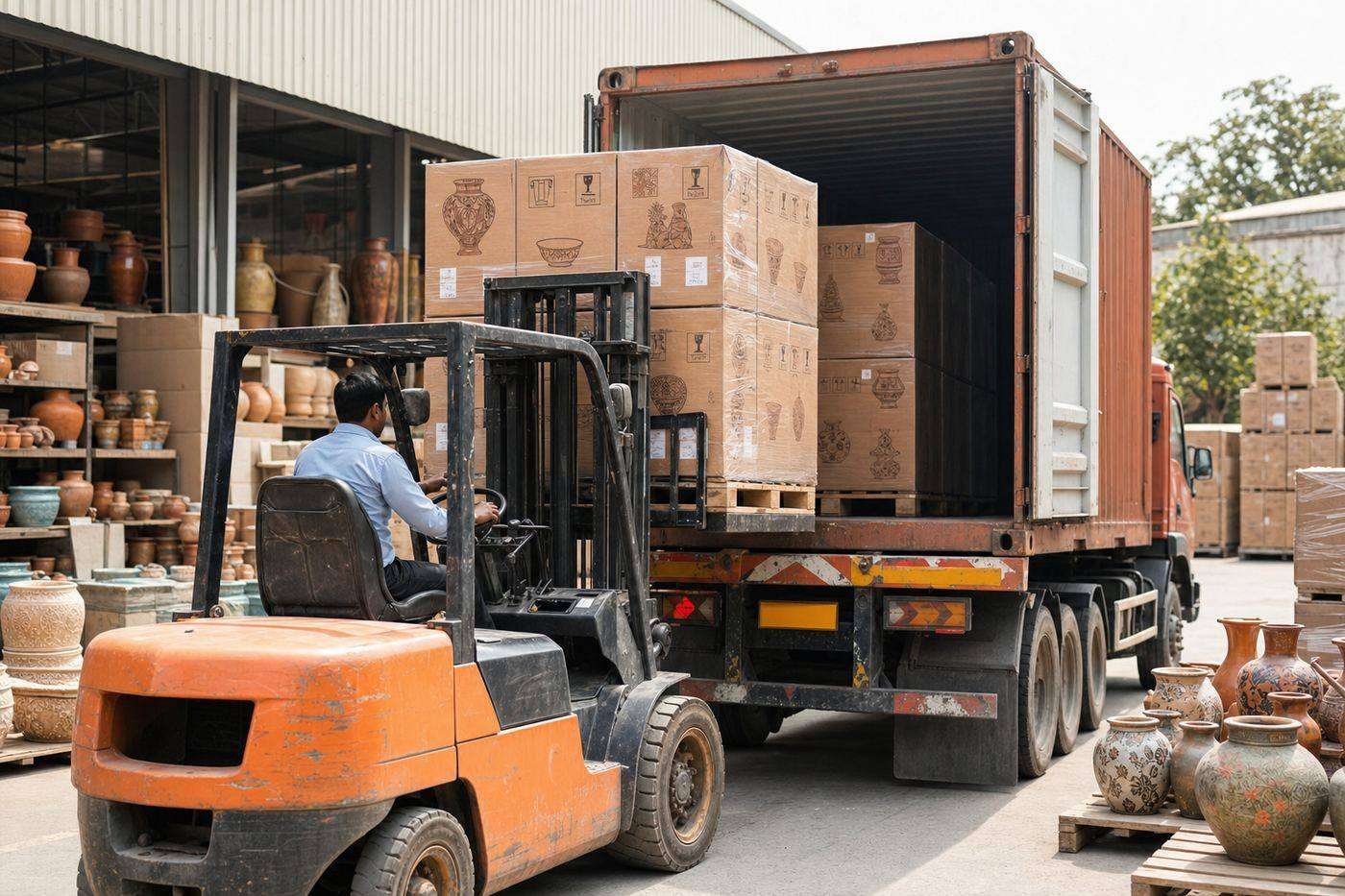
Ceramic and terracotta pieces themselves are not plant products and do not require phytosanitary certification — do not confuse ceramic export posture with spices, agri, or bamboo phytosanitary requirements. But when wooden pallets, wooden dunnage, or wooden crating is used to ship ceramics — common for large Molela plaques, heavy Khurja stoneware statement pieces, and stacked terracotta gardenware — the wood packaging material falls under ISPM-15 (International Standards for Phytosanitary Measures No. 15). ISPM-15 requires wooden packaging material to be heat-treated (HT) or fumigated with methyl bromide (MB) and stamped with the IPPC mark that includes the country code, treatment provider identifier, and treatment method.
For ceramic exporters, the operational requirement is simple: source only IPPC-marked pallets and crates for outbound shipments to countries that enforce ISPM-15 (most major destinations), and retain the fumigation / heat-treatment certificate from the pallet or crating supplier in the compliance file. Some destinations may still request a separate fumigation certificate at the entry point in addition to the IPPC mark — verify per destination with your CHA. Do not fumigate the ceramic itself.
Marine Insurance, Bill of Lading, and Shipping Bill
The transport document layer completes the pack. Marine insurance is issued either by the exporter (under CIF or DDP Incoterms where risk transfers at destination) or by the buyer (under FOB, CFR, and similar terms where risk transfers at load port) — for ceramic and terracotta shipments, the insurance must cover breakage as well as standard perils, since fragile clayware breakage in transit is the operational killer for the category and standard commercial cargo policies may exclude or sub-limit breakage without specific endorsement.
The shipping bill is filed by the CHA on ICEGATE against your IEC and RCMC, referencing the commercial invoice, packing list, HS classification per SKU, and Incoterm. It is the primary customs-facing document at the load port and drives export benefits (where applicable) and e-BRC reconciliation later. The bill of lading (B/L) is issued by the shipping line or forwarder on loading and confirms the cargo is on board — it references the shipping bill number, container ID, seal number, and consignee. All three must reconcile against the commercial invoice and packing list; any discrepancy between the B/L consignee and the COO consignee will hold the shipment at destination.
e-BRC Realisation and Payment Documentation
The Electronic Bank Realisation Certificate (e-BRC) is generated by your authorised dealer bank on receipt of export payment and uploaded to the DGFT portal, tying the payment realisation back to the shipping bill number. For ceramic and terracotta exporters, timely e-BRC reconciliation matters for export scheme eligibility (where applicable), for RBI reporting compliance, and for maintaining a clean export track record that supports future buyer diligence — a Khurja industrial exporter or Delhi-NCR merchant consolidator with clean e-BRC continuity is materially easier to onboard for German LFGB tableware programmes or US garden-center planter programmes than one with unreconciled shipping bills.
Diary a monthly reconciliation check between filed shipping bills and generated e-BRCs, and follow up with your bank on any shipping bill that is more than the RBI-notified realisation window old without an associated e-BRC. Do not let this slide for multiple months — reconciliation gets progressively harder as records age.
Pricing Analysis (Documentation Cost Anchor Points)
Buyer Tip
Ceramic and terracotta FOB pricing is driven by clay body, size, glaze complexity, decoration hours, firing schedule, cluster origin, and — critically for documentation cost planning — lead-safe / food-contact / frost-rating testing where required. Directional indicative FOB bands (confirm quote date): small terracotta accents and ornaments about USD 1–8 per piece; mid glazed ceramic vases, bowls, and small planters about USD 4–28 per piece; statement blue pottery pieces and large terracotta garden pots about USD 15–75+ per piece or set; certified lead-safe or food-contact tableware programmes command evidence-dependent premiums that amortise migration testing and food-contact COA costs across the programme volume.
For the full country-by-country clay body / glaze / finish preference context, see most demanded Indian terracotta and ceramic handicrafts by country; the pricing table below focuses on documentation-cost overlay per SKU tier.
Comparison table
Swipe →
Data table — swipe horizontally on small screens
| Product / Format | Directional FOB (USD, indicative) | Documentation Cost Overlay |
|---|---|---|
| Small terracotta accents and figurines | 1–8 | Baseline pack; Prop 65 posture if US decorative |
| Mid glazed ceramic vases and bowls | 4–28 | Glaze composition + migration test amortised per programme |
| Terracotta planters (small to medium) | 3–20 | Frost-rating test cost where frost claim printed |
| Statement blue pottery / large terracotta garden pots | 15–75+ | GI authorised-user pathway cost for blue pottery; frost test for garden pots |
| Molela relief plaques / Bankura figurine statement pieces | 10–60+ | Cluster-origin narrative documentation cost |
| Lead-safe / food-contact certified tableware programmes | Premium to standard glazed | Migration test + food-contact COA + LFGB / FDA posture cost per programme |
MOQ Analysis (Documentation Efficiency Notes)
Buyer Tip
MOQ for terracotta and ceramic handicrafts scales from small sample batches to full container loads. Retail and private-label buyers typically start with 5–20 unit samples per SKU for glaze and dimensional evaluation, move to trial orders of 100–400 units or mixed LCL lots (planters often quoted by size ladder rather than a single MOQ number), and scale to FCL commitments once glaze consistency, packing, and firing schedules are finalised. Spring gardenware programmes for USA, UK, and German garden centers often require 20GP / 40HC FCL planning 4–8 months ahead of season. Documentation cost per unit is highest at sample and LCL stages and lowest at FCL — a full glaze composition certificate, migration test report, and Prop 65 / REACH pack amortises much better across a 40HC container than a 400-unit trial LCL.
Comparison table
Swipe →
Data table — swipe horizontally on small screens
| Buyer Stage | Typical MOQ | Documentation Package |
|---|---|---|
| Sample evaluation | 5–20 pcs per SKU (extra cushioned for fragile air-freight) | Proforma; glaze spec sheet; existing test extract if available |
| Trial order | 100–400 pcs (planters often size-laddered) or mixed LCL | Full commercial pack + programme-specific glaze / migration evidence |
| Standing reorder (mid-size buyer) | 400–2,000 pcs per SKU or by carton / CBM | Full commercial pack; migration test refreshed per programme cycle |
| Spring gardenware programme | 1 x 20GP or 40HC by planter size mix | Full pack + frost-rating evidence if claim printed |
| Q4 gift ceramic programme | 1 x 20GP or 40HC ornamental / blue pottery mix | Full pack + GI evidence if blue pottery GI claimed |
Packaging Standards & Labelling Documentation
Export Tip
Bulk export packaging for ceramic and terracotta typically uses individual foam / bubble wrap per piece, cell dividers for nested sets only when the set is engineered for nesting, rigid double-wall export cartons with corner protection, void fill, and desiccants where humidity can affect labels or glaze stickers on long ocean transit — no force-nesting unrelated shapes. Retail-ready formats increasingly include branded gift boxes for premium blue pottery, Molela plaques, and Longpi black pottery lines. Labelling documentation must reflect destination-market requirements: country of origin (India), honest cluster origin claims (Khurja vs Jaipur blue pottery vs Molela vs Bankura vs Delhi-consolidated), glaze-safe references only with lab evidence, frost-rated claims only when substantiated for outdoor terracotta, Prop 65 warning labelling per California requirements where applicable, and CE marking where the specific product falls under a CE directive (rare for pure ceramics but relevant for certain electrical ceramic novelty items).
Comparison table
Swipe →
Data table — swipe horizontally on small screens
| Format | Packing Approach | Labelling Documentation Note |
|---|---|---|
| Individual ceramic vases and bowls | Foam / bubble sleeve, then rigid double-wall carton with corner protection | Country of origin + cluster + fragile marking; desiccant note if long ocean transit |
| Nested ceramic sets (designed to nest) | Stacked with interleaving foam and cell dividers | Only when nesting engineered by potter; note on packing list |
| Terracotta planters | Individual wrap; stack-height limits; corner protection on tall pots | Frost-rating label only with test evidence; USDA compliance if edible-crop |
| Blue pottery and premium giftware | Branded gift box per unit inside export carton | GI authorised-user evidence required if 'Blue Pottery of Jaipur' printed |
| Molela plaques and wall panels | Foam-lined rigid crate; flat-orientation shipping; edge protection | This-side-up marking; ISPM-15 IPPC mark on wooden crate |
| Ornamental figurines and small accents | Compartment trays or cell dividers with foam | Prop 65 warning labelling per California requirements if applicable |
Container Loading Details (Documentation Reconciliation Point)
Export Tip
Container loading is a freight-forwarder decision, not an exporter's paperwork task — but the paperwork must reconcile against the actual stuffing. Container stuffing report should confirm carton count, seal number, container ID, gross weight, and total CBM against the packing list. Any mid-stuffing substitution (a carton removed for damage, a substitute carton added) must be reflected in the packing list and commercial invoice before the container is sealed. Ceramic and terracotta cargo is cube-sensitive and crush-sensitive: breakage risk dominates weight limits, tall planters and wall plates require anti-shift bracing and dunnage documented on the stuffing report, and heavy stoneware cartons must never sit on thin-walled terracotta planter cartons.
Comparison table
Swipe →
Data table — swipe horizontally on small screens
| Container | Approximate Fill (Ceramic / Terracotta) | Documentation Reconciliation Checkpoint |
|---|---|---|
| 20ft FCL | Directional — CBM-dependent; commonly mixed ornamental + planter trial programmes | RCMC / IEC identical on shipping bill; per-SKU HS split confirmed |
| 40ft FCL / 40HC | Directional — higher CBM for gardenware seasons and stackable Khurja programmes | Cross-check HS 6913 / 6912 / 6914 mix across invoice, packing list, shipping bill |
| Mixed clay-body containers | Terracotta planters + glazed décor + blue pottery accents | Per-SKU HS confirmed with CHA; blue pottery GI evidence attached if claimed |
| Large terracotta garden programmes | Fewer units per container given wall thickness / stack limits | Frost-rating evidence attached; anti-shift bracing noted on stuffing report |
| Blue pottery / premium gift FCL | Lowest units per container given retail gift-box bulk | GI authorised-user evidence in pack; retail packaging weight noted |
| LCL trial shipments | Smaller carton counts; higher per-unit freight | Full commercial pack still required; per-SKU HS still applies |
Shipping Methods (Documentation Constant Regardless of Mode)
Export Tip
Shipping mode is independent of the documentation pack — the same commercial invoice, packing list, HS classification per SKU, glaze composition certificate, migration test report, Prop 65 / REACH posture, COO, and RCMC reference must appear correctly whether cargo moves by sea FCL / LCL through Nhava Sheva or Mundra, via ICD Delhi / Dadri consolidation from Khurja and Jaipur inland routing, or by air for urgent samples (rarely economical for dense ceramic pieces beyond critical fill-ins). Lead times: samples 10–21 days; stock glazed décor 4–7 weeks; custom glaze / private label 6–12 weeks; large terracotta and kiln-capacity gardenware programmes longer; spring gardenware programmes often booked 4–8 months ahead of season. Incoterms commonly used: EXW, FOB (named Indian port), CFR / CIF; DDP is selective and rare for first fragile pottery trials. For full port, lead-time, and Incoterm guidance, see how to export terracotta and ceramic handicrafts from India.
Certifications Referenced in the Documentation Pack
Compliance Notes
Baseline registrations for ceramic and terracotta export are IEC, GST registration, and EPCH RCMC — together these form the credibility floor referenced across the pack. Beyond that floor, certification and testing layers are documented per programme rather than issued once and reused: lead / cadmium migration testing per destination limits for glazes (especially on any tableware or food-contact claim); FDA food-contact posture for US tableware programmes; LFGB for German tableware programmes; REACH SVHC / restricted substances for EU decorative and tableware glazes; California Prop 65 where listed substances (notably lead and cadmium in coatings) apply; CPSC and EN71 / ASTM F963 only where toy / children's product claims are made; frost-resistance evidence for outdoor terracotta planter programmes where frost claims are used; and GI authorised-user pathway where Blue Pottery of Jaipur GI or other cluster GI tags are asserted.
Comparison table
Swipe →
Data table — swipe horizontally on small screens
| Certification / Registration | Purpose in the Pack | Document Included |
|---|---|---|
| IEC | Legal export identity | IEC certificate copy; number on invoice header |
| GST registration | Tax and commercial identity | GST certificate copy; GSTIN on invoice header |
| EPCH RCMC | Scheduled handicraft registration; buyer credibility | RCMC certificate copy; number on invoice header |
| Lead / cadmium migration test | Destination heavy-metal limit compliance | Accredited lab report keyed to glaze recipe |
| FDA food-contact posture (USA tableware) | US tableware compliance | Exporter statement + supporting migration test data |
| LFGB (Germany tableware) | German food-contact compliance | Accredited lab LFGB report per SKU / recipe |
| REACH SVHC (EU / UK) | Restricted substances declaration | Exporter declaration citing candidate list version |
| California Prop 65 | Listed-substance warning posture (US) | Supplier statement referencing migration data |
| CPSC / EN71 / ASTM F963 | Only if toy / children's product claim | Accredited lab report for toy safety limits |
| Frost-resistance evidence | Outdoor terracotta claims | Frost-cycle test report from lab or workshop |
| GI authorised-user evidence | Blue Pottery of Jaipur or other cluster GI claims | Authorised-user certificate from GI registry |
| ISPM-15 (wooden pallets / crates) | Wood packaging phytosanitary compliance | IPPC mark + fumigation / heat-treatment certificate |
Buyer Requirements (What Ends Up in the Vendor Pack)
Buyer Requirements
International terracotta and ceramic buyers assemble a vendor onboarding pack from many of the documents above. Typical buyer requests: IEC and GST copies; EPCH RCMC copy; commercial invoice sample and packing list sample from prior sailings; glaze composition certificates for the specific glaze recipes being quoted; lead / cadmium migration test reports keyed to destination limits; food-contact COAs for tableware programmes; Prop 65 statement for US programmes; REACH SVHC declaration for EU / UK programmes; frost-rating evidence for outdoor terracotta claims; GI authorised-user evidence for Blue Pottery of Jaipur or other cluster GI claims; and honest cluster-origin labelling (Khurja industrial vs Jaipur blue pottery heritage vs Molela vs Bankura vs Delhi-consolidated). Buyers who have previously received cracked planters, crazed glazes, or under-documented tableware shipments apply stricter scrutiny to new Indian pottery suppliers regardless of quoted price — treat the first inquiry response as your vendor-qualification exhibit rather than a sales pitch.
Country-wise Opportunities & Documentation Posture
Market Snapshot
The commercial opportunity for ceramic and terracotta differs meaningfully by destination — and so does the documentation posture buyers expect in the vendor pack. For the full clay body × glaze × finish × seasonal demand matrix by country, see most demanded Indian terracotta and ceramic handicrafts by country; the snapshot below focuses on how documentation posture interacts with each market's expectations for ceramic and terracotta programmes.
Comparison table
Swipe →
Data table — swipe horizontally on small screens
| Country | Opportunity Driver | Documentation Posture Expected |
|---|---|---|
| USA | Garden centers, décor, gift retail, private label | IEC + RCMC + glaze composition + migration test + Prop 65 statement + COO |
| Germany | Glazed ornamental, blue pottery, LFGB tableware | IEC + RCMC + LFGB report if tableware + REACH SVHC + migration test + COO |
| Netherlands | European distribution hub, gift and garden retail | IEC + RCMC + REACH SVHC + migration test where relevant + COO |
| France | Boutique gift, Molela plaques, blue pottery statement pieces | IEC + RCMC + REACH SVHC + cluster-origin narrative + GI evidence if claimed |
| UK | Gift retail, home-décor, garden centers | IEC + RCMC + UK REACH declaration + migration test + COO |
| UAE | Hospitality amenities, corporate gifting, ornamental ceramics | IEC + RCMC + food-contact posture where amenity + COO |
| Australia | Gardenware, gift retail, home-décor | IEC + RCMC + frost-rating evidence for outdoor terracotta + glaze composition |
| Canada | Gift retail, garden centers, seasonal | IEC + RCMC + Prop 65-adjacent posture on decorative coatings + COO |
| Japan | Design gift retail, museum shops, small blue pottery / Longpi | IEC + RCMC + Japanese Food Sanitation posture on tableware + glaze composition |
Sourcing Checklist for Buyers and Exporters
Checklist
Use this two-sided checklist to align documentation expectations before the first purchase order for a ceramic or terracotta programme.
Buyer Checklist
- Request IEC, EPCH RCMC, and GST evidence upfront in the first inquiry response for any Khurja, Jaipur blue pottery, Molela, or Bankura supplier
- Ask for a sample commercial invoice and packing list from a prior sailing — see whether HS classification is per SKU and whether cluster origin is honest
- Confirm glaze composition certificate exists for the specific glaze recipe being quoted; confirm the migration test report is keyed to that recipe and the destination limit
- For tableware programmes, request the food-contact COA and confirm LFGB (Germany) or FDA posture (USA) is documented, not asserted verbally
- For US programmes, request the California Prop 65 statement and confirm it references the migration test data on file
- For EU / UK programmes, request the REACH SVHC declaration citing the candidate list version and date
- For outdoor terracotta planter claims, request frost-cycle test evidence — do not accept marketing language
- For 'Blue Pottery of Jaipur' or other cluster GI claims on invoices or cartons, request GI authorised-user evidence
- Confirm cluster-origin labelling is honest across invoice, packing list, and carton markings
Exporter Checklist
- Build a standing compliance file with IEC, GST, EPCH RCMC, entity constitution, and workshop / kiln evidence for manufacturer classification
- For each glaze recipe, maintain a glaze composition certificate and a keyed lead / cadmium migration test report — refresh migration testing per recipe or firing schedule change
- Pre-build Prop 65 and REACH SVHC declaration templates linked to your migration test data — do not draft from scratch per inquiry
- Confirm HS classification per SKU with your CHA before the shipping bill — never blanket-declare a mixed container
- Reconcile commercial invoice, packing list, and container stuffing report at the SKU-quantity level before sealing the container
- Attach frost-rating evidence to every outdoor terracotta planter programme that carries a frost claim on the carton
- Attach GI authorised-user evidence to every Blue Pottery of Jaipur programme where the GI tag is used
- Diary annual EPCH RCMC renewal well before the fiscal-year deadline
- Diary monthly e-BRC reconciliation against filed shipping bills
Compliance Checklist
Checklist
Compliance Notes
Comparison table
Swipe →
Data table — swipe horizontally on small screens
| Compliance Item | Status Check | Owner |
|---|---|---|
| IEC | Valid and matches GST / PAN / RCMC details | Export desk |
| GST registration | Active and address-consistent with kiln or atelier for manufacturer category | Accounts / compliance |
| EPCH RCMC | Current and renewed annually before FY deadline | Export desk |
| HS classification per SKU | 6913 / 6912 / 6911 / 6914 confirmed with CHA per SKU | Export desk / CHA |
| Glaze composition certificate | Current per glaze recipe; version-controlled | Quality / R&D |
| Lead / cadmium migration test | Current per programme; keyed to destination limit | Quality / compliance |
| Food-contact COA (tableware) | Current per tableware programme; LFGB / FDA references cited | Quality / compliance |
| California Prop 65 statement | Traceable to migration test; current per US programme | Compliance / legal |
| REACH SVHC declaration | Current candidate list version cited; per EU / UK programme | Compliance / legal |
| COO (preferential or non-preferential) | Consignee, HS, and origin match commercial invoice | Export desk |
| ISPM-15 (wooden pallets / crates) | IPPC mark present; fumigation certificate retained | Packing team |
| Frost-rating evidence | Test data available for every frost-rated outdoor terracotta programme | Quality / compliance |
| GI authorised-user evidence | Available for Blue Pottery of Jaipur / other GI claims | Marketing / compliance |
| Marine insurance | Breakage endorsement in place under CIF / DDP | Export desk |
| e-BRC reconciliation | Diarised monthly against filed shipping bills | Accounts |
Common Buyer and Exporter Mistakes
- Assuming a single glaze composition certificate covers every glaze recipe in the catalogue — Khurja glazed stoneware, Jaipur blue pottery quartz-frit, Molela terracotta relief, and Bankura terracotta figurines each need their own recipe-specific documentation.
- Blanket-declaring a mixed FCL under HS 6913 because most cartons are ornamental — customs at destination flags mixed pack misdeclaration on scrutiny.
- Treating California Prop 65 as a marketing footer — retailer audits and private-enforcement suits treat it as legally binding.
- Confusing ceramic phytosanitary posture with plant-product phytosanitary from spices, agri, or bamboo — ceramics themselves need no phytosanitary certificate; only wooden pallets / crates trigger ISPM-15.
- Printing 'Blue Pottery of Jaipur' on invoices without authorised-user evidence — this is a legal GI claim, not a marketing decoration.
- Marketing outdoor terracotta as frost-rated without frost-cycle test evidence — a chargeback waiting to happen.
- Filing the shipping bill before reconciling packing list against container stuffing report — mid-stuffing substitutions must reflect in the paperwork.
- Letting e-BRC reconciliation slide for multiple months — reconciliation gets progressively harder as records age and may block scheme eligibility.
- Assuming a REACH declaration issued two years ago still cites the current SVHC candidate list — the list is updated periodically and the declaration must cite a current version.
- Skipping food-contact COA on tableware because the ornamental version already had a glaze composition certificate — food-contact posture is destination-facing evidence, not a repackaged recipe sheet.
Challenges & Solutions
Comparison table
Swipe →
Data table — swipe horizontally on small screens
| Challenge | Impact | Solution |
|---|---|---|
| Glaze recipe drift between quoted sample and production lot | Migration test on file no longer keyed to actual production glaze | Version-controlled glaze recipes; migration test refresh per recipe change |
| Mixed FCL with ornamental + tableware + planters under single HS | Destination customs misdeclaration flag; retrospective duty adjustment risk | Per-SKU HS confirmed with CHA before shipping bill; container-level HS split declared |
| Prop 65 statement written without migration test backing | Retailer audit failure; private-enforcement suit exposure | Prop 65 statement template linked to migration test data; refreshed per recipe change |
| Frost claim printed on outdoor planter cartons without test evidence | Buyer chargebacks; retailer delisting | Frost-cycle test evidence attached to every frost-rated programme |
| Blue Pottery of Jaipur GI claim without authorised-user status | Legal claim risk; buyer legal-review rejection | GI authorised-user certification obtained before claim used |
| Wooden pallets without IPPC mark on ISPM-15 destination | Destination customs hold; entire container quarantine | Source only IPPC-marked pallets and crates; retain fumigation certificate |
| e-BRC unreconciled for months post-sailing | Scheme eligibility loss; RBI reporting compliance risk | Diarised monthly reconciliation; bank follow-up on aged shipping bills |
| COO consignee does not match B/L consignee | Destination customs hold pending correction | Cross-check consignee across COO, B/L, commercial invoice before loading |
How Altus Exports Helps with Ceramic Documentation
Altus Exports operates as a merchant exporter from India, global sourcing partner, and export consulting expert for ceramic and terracotta handicraft programmes. We help Khurja industrial pottery units, Jaipur blue pottery workshops, Molela terracotta studios, Bankura figurine belts, Longpi black pottery producers, gardenware clusters, and Delhi-NCR merchant exporters assemble a document-by-document export pack that reconciles across legal, commercial, and technical identity — so the container that leaves Khurja or Jaipur clears customs both ways, meets buyer diligence on Prop 65, REACH, LFGB, or FDA posture, and closes payment cleanly on an e-BRC across the USA, Germany, the UK, the UAE, France, the Netherlands, Australia, Canada, and Japan.
Whether you need a first-time documentation architecture review, a per-programme migration testing and Prop 65 / REACH pack build-out, or a Delhi-consolidated CHA handoff process alongside merchant exporter services, export products from India, global sourcing partner, or product sourcing company engagement, Altus wires the documentation checklist into the commercial operating cadence rather than treating it as a shipping-day scramble. For EPCH registration groundwork, see EPCH registration benefits for terracotta and ceramic exporters; for glaze chemistry and food-contact deep dive, see lead-safe glaze, blue pottery, and food-contact ceramic export opportunities.
Future Market Trends (Documentation Implications)
Key Statistics
Through 2030, four documentation-relevant trends will shape ceramic and terracotta exports: continued tightening of lead / cadmium migration expectations across the EU, UK, and Japan for decorative and tableware ceramics as retailers pre-empt regulatory tightening; expansion of Prop 65 enforcement across US retail with private-enforcement suits driving retailer-side documentation demand; growing buyer insistence on cluster-origin honesty as premium blue pottery, Molela plaques, and Longpi black pottery discovery spreads through boutique and museum-shop channels in France, Japan, and specialty US retail; and steady digitisation of DGFT and EPCH portal workflows (eCoO, eBRC, ICEGATE) that reduces administrative friction for exporters who maintain clean digital compliance files.
Exporters who treat documentation as a living, version-controlled asset — refreshed per glaze recipe change, keyed to current SVHC candidate lists, diarised for annual RCMC renewal and monthly e-BRC reconciliation, and pre-built into first-inquiry responses — will be best positioned to capture disproportionate share as international demand keeps expanding across the anchor destination markets for ceramic and terracotta handicrafts.
Expert Insights
Expert Insight Box
Ceramic exporters who convert IHGF Delhi Fair ceramic-zone booth visits and Ambiente Frankfurt introductions into purchase orders consistently share one operational pattern: their documentation pack is pre-built, version-controlled, and attached to the first inquiry response — not assembled reactively after the buyer requests it. A Khurja industrial unit that emails a US garden-center buyer with a commercial pack skeleton, current glaze composition certificate, keyed migration test report, Prop 65 statement, and honest cluster-origin invoice sample in the first response converts materially better than one that promises to send those documents 'once the buyer confirms interest'. A second recurring insight from Jaipur blue pottery and Molela cluster visits: workshops and merchant exporters who maintain a single indexed compliance folder (physical or digital) that mirrors the master document inventory above spend a fraction of the time on shipping-day documentation scrambles compared to those working from ad hoc folders per shipment.

Conclusion
- Do next: Assemble the master document inventory into a single indexed folder before your next ceramic sailing, and pre-check every applicable document against the commercial invoice.
- Read EPCH registration benefits for terracotta and ceramic exporters, how to export terracotta and ceramic handicrafts from India, most demanded Indian terracotta and ceramic handicrafts by country, top terracotta and ceramic handicraft products exported from India, best countries for Indian terracotta and ceramic handicraft exports, source terracotta and ceramic handicrafts directly from India, find international buyers for terracotta and ceramic handicrafts, lead-safe glaze, blue pottery, and food-contact ceramic export opportunities, and trade shows and B2B marketplaces for terracotta and ceramic exporters.
- For related partnership models, see handicrafts & lifestyle products, merchant exporter services, export products from India, global sourcing partner, and product sourcing company.
The terracotta and ceramic handicraft export documentation checklist is a reconciliation architecture, not a paper trail. Commercial invoice, packing list, HS classification per SKU, glaze composition certificate, lead / cadmium migration report, food-contact COA where tableware, California Prop 65 statement, REACH SVHC declaration, LFGB or FDA posture where applicable, certificate of origin (preferential where FTA applies, non-preferential otherwise), fumigation / ISPM-15 for wooden pallets or crates, marine insurance with breakage endorsement, shipping bill through CHA on ICEGATE, bill of lading, e-BRC realisation, GI authorised-user evidence for Blue Pottery of Jaipur or other cluster GI claims, frost-rating evidence for outdoor terracotta, and a clean indexed broker handoff pack — all of these must reconcile across legal, commercial, and technical identity for every Khurja, Jaipur blue pottery, Molela, Bankura, Longpi, gardenware, or Delhi-consolidated pottery container that leaves India.
Actionable next steps: build a master compliance folder mirroring the master document inventory in this guide; version-control your glaze composition certificates and migration test reports per recipe; pre-build Prop 65 and REACH SVHC declaration templates linked to your migration test data; confirm per-SKU HS classification with your CHA for every mixed FCL; diary annual EPCH RCMC renewal and monthly e-BRC reconciliation. Contact Altus Exports for a documentation readiness review connecting the checklist above to real commercial outcomes for your terracotta and ceramic handicraft export programme.