
Most Demanded Indian Terracotta and Ceramic Handicrafts by Country
By Saurabh Mittal, Founder, Altus Exports
A market intelligence guide mapping the most demanded Indian terracotta and ceramic handicrafts by country — comparing clay body (terracotta, earthenware, stoneware, porcelain artware, blue pottery quartz-frit), glaze and finish (matte, gloss, crackle, reactive, underglaze, turquoise blue pottery), SKU format (planters, vases, bowls, figurines, plaques, wall décor), pack format (bulk wrap vs retail gift box vs curated set), seasonal windows (USA/UK/Germany spring gardenware, UAE festive gifting), and compliance depth (lead-safe glaze, FDA/LFGB food-contact, Prop 65, REACH/SVHC, frost-rating) across the USA, Germany, the UK, the UAE, France, the Netherlands, Australia, Canada, and Japan. Understand exactly what buyers in each market want from Khurja, Jaipur blue pottery, Molela, Bankura, Longpi, and Delhi-NCR supply — a demand matrix separate from EPCH application guidance and macro market ranking owned by peer cluster posts.
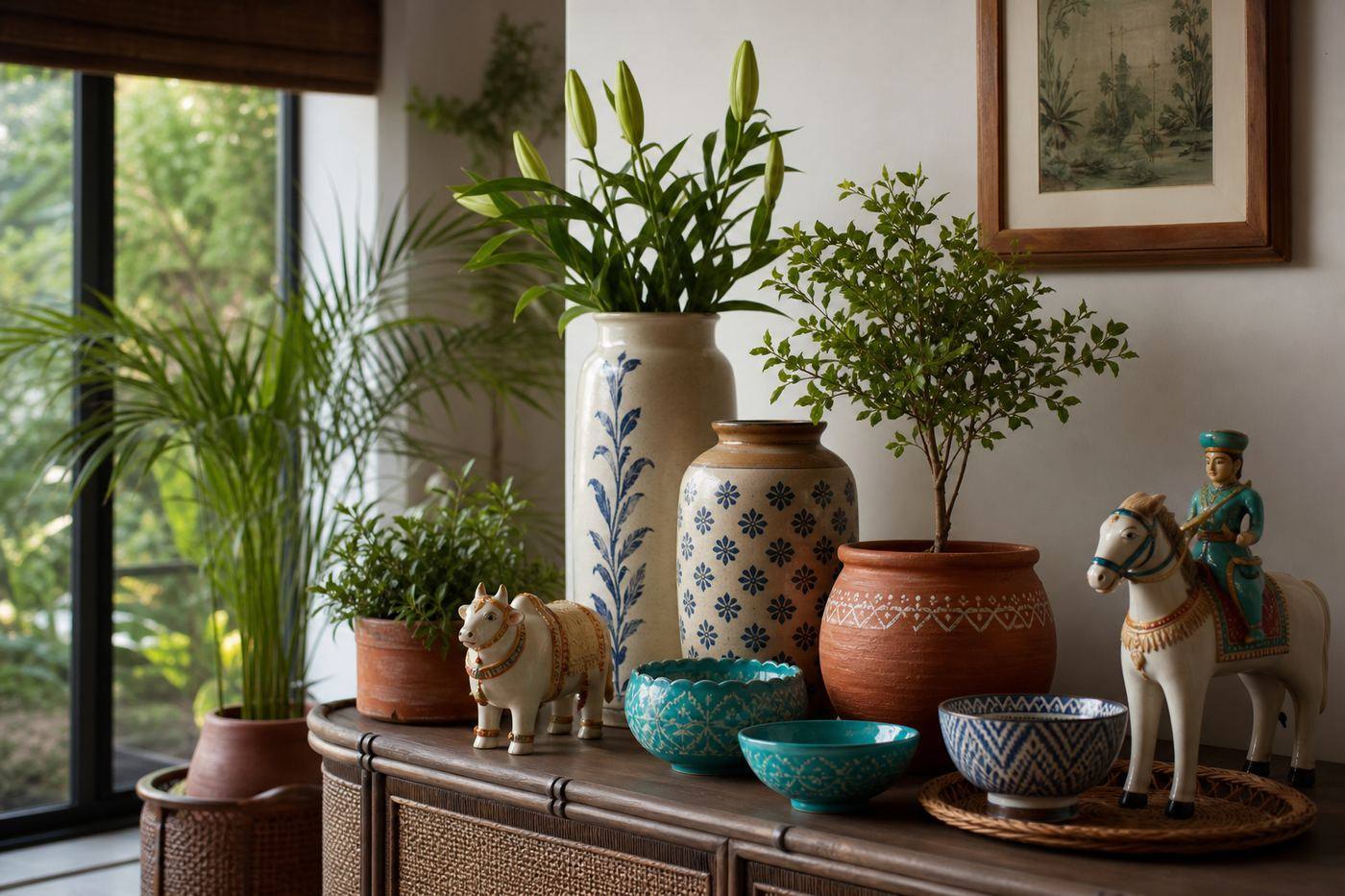
Not every international ceramic or terracotta buyer wants the same clay body, glaze, or SKU. A US garden-center buyer sourcing unglazed terracotta planters in a size ladder for a spring outdoor-living programme has entirely different requirements from a German tabletop specialist seeking lead-safe glazed stoneware bowls with LFGB migration evidence, a UAE hospitality distributor buying bulk ceramic amenity ashtrays and décor accents, or a Japanese museum shop seeking refined Jaipur blue pottery coasters and small bowls with obsessive glaze neatness. India's structural advantage — Khurja industrial pottery, Jaipur blue pottery, Molela terracotta plaques, Bankura terracotta figurines, Longpi black pottery, and Tamil Nadu / Gujarat gardenware, consolidated through Delhi-NCR export packing — only converts into repeat export orders when exporters understand exactly which clay body, glaze, finish, pack format, and compliance depth each destination rewards.
India's terracotta and ceramic production is concentrated across specialist clusters. Khurja (Uttar Pradesh) dominates industrial glazed pottery, stoneware, and decorative ceramic programmes. Jaipur (Rajasthan) supplies blue pottery on quartz / glass-frit bodies with turquoise, cobalt, and floral hand-painted motifs. Molela (Rajasthan) produces terracotta relief plaques and mural panels. Bankura and Bishnupur (West Bengal) produce terracotta horses and figurines. Asharikandi (Assam) supplies terracotta toys and utility artware. Longpi (Manipur) delivers selective premium black pottery. Tamil Nadu, Pondicherry, and Gujarat artisan belts contribute terracotta gardenware capacity. Delhi-NCR supplies merchant consolidation, mixed gift assortments, private-label programmes, and export-grade fragile packing. Export classification runs primarily under HS 6913 (ornamental ceramic articles — EPCH examples 69131000 porcelain/china ornamentals and 69139000 other), HS 6912 (ceramic tableware other than porcelain/china), HS 6911 (porcelain tableware where applicable), and HS 6914 (other ceramic articles, commonly including many planters) — confirm per SKU with your CHA.
This guide maps the most demanded Indian terracotta and ceramic handicrafts by country, translating clay body, glaze, finish, seasonal timing, and compliance preferences into practical guidance for exporters and international buyers across the USA, Germany, the UK, the UAE, France, the Netherlands, Australia, Canada, and Japan. Use it alongside top terracotta and ceramic handicraft products exported from India and how to export terracotta and ceramic handicrafts from India. For macro market selection and duty comparison methodology, see best countries for Indian terracotta and ceramic handicraft exports — this guide focuses on what buyers actually want by destination, not how to rank markets. For lead-safe glaze and food-contact specialty depth, see lead-safe glaze, blue pottery, and food-contact ceramic export opportunities.
Key Takeaways
Summary Box
Executive Summary
Summary Box
Terracotta and ceramic handicrafts have grown from cluster craft heritage into an internationally traded clayware category serving garden centers, home-décor specialty, gift retail, hospitality amenity programmes, department stores, e-commerce private label, and design / museum shops across North America, Europe, the Gulf, and Japan. But 'demand' for Indian ceramic and terracotta is not a single number — it splits sharply by clay body (terracotta, earthenware, stoneware, porcelain artware, blue pottery quartz-frit), glaze and finish (matte, gloss, crackle, reactive, underglaze, turquoise blue pottery), SKU format (planter vs vase vs bowl vs plaque vs figurine), pack format (bulk wrap vs retail gift box vs curated set), seasonal timing (spring gardenware FCL programmes 4–8 months ahead), and compliance depth (baseline EPCH/IEC vs lead-safe glaze vs FDA/LFGB food-contact vs Prop 65 vs REACH/SVHC vs frost-rating) — and each destination market weights these variables differently.
This guide builds a practical country × clay body × glaze × finish × SKU × compliance demand matrix across the USA, Germany, the UK, the UAE, France, the Netherlands, Australia, Canada, and Japan, alongside the market context exporters need to act on it: statistics framing, product categories, manufacturing, export process overview, pricing, MOQ, packaging, container loading, shipping methods, certifications, buyer requirements, sourcing checklists, common buyer mistakes, and future trends. For the institutional side — EPCH application, IHGF booth eligibility, RCMC continuity — see EPCH registration benefits for terracotta and ceramic exporters; this guide focuses on what buyers actually want, not how to register.
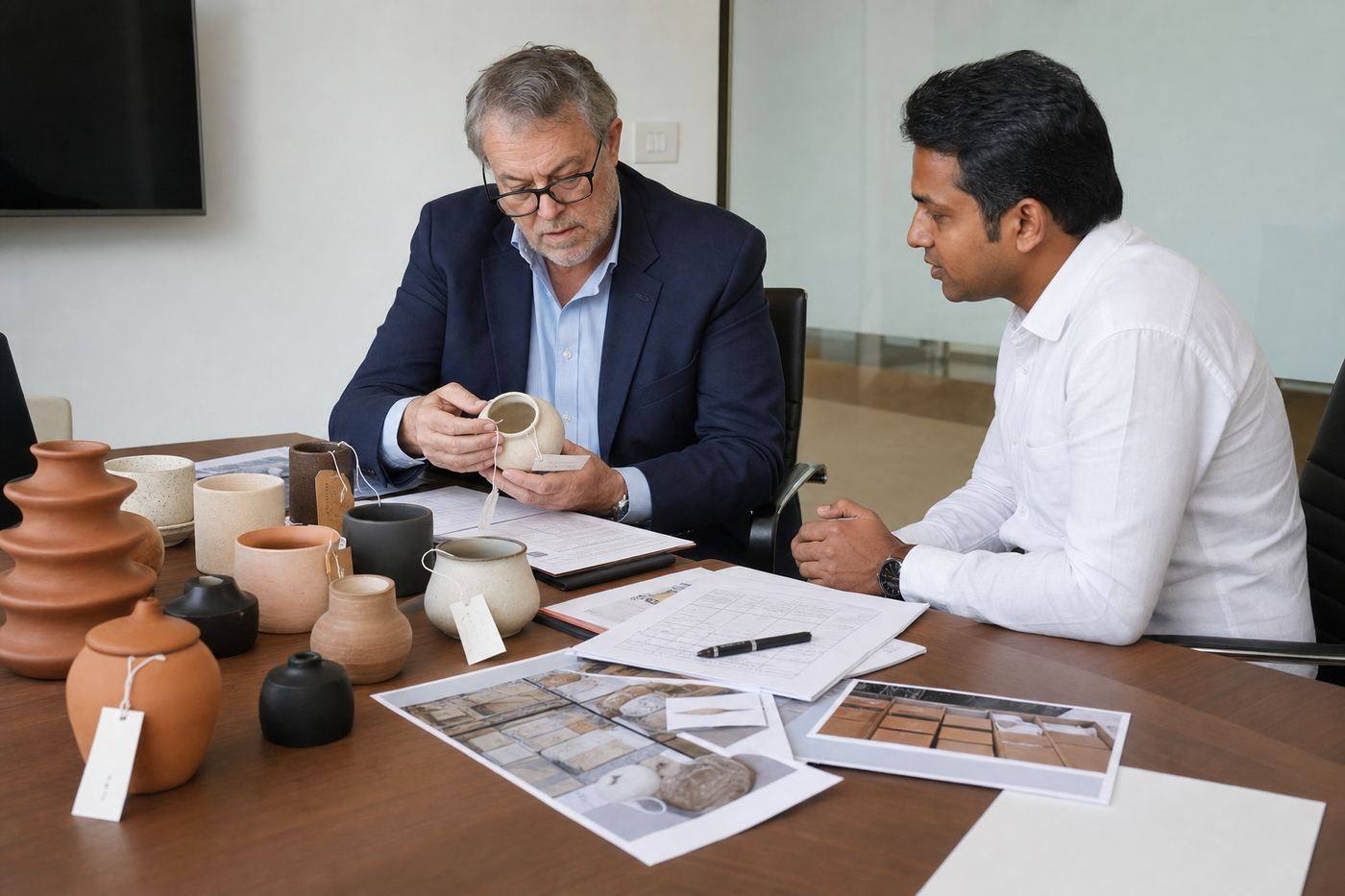
Market Size & Industry Overview
Key Statistics
Global demand for Indian terracotta and ceramic handicrafts has grown as garden centers, home-décor specialty, gift retail, department stores, e-commerce private label, hospitality amenity programmes, and design / museum shops added terracotta planters, glazed ceramic vases, blue pottery bowls, Molela plaques, Bankura figurines, ornamental ceramic wall décor, and curated ceramic assortments to core and seasonal programmes. Trade should be framed via HS 6913, 6912, 6911, and 6914 through DGCI&S or TradeStat as the ceramic proxies — never present EPCH total handicrafts (Rs 33,122.79 crore / US$3,917.89 million in FY 2024–25, excl. carpets) as the ceramic number. Broader sector context only.
Each cluster's craft specialisation directly shapes which markets it serves best: Khurja industrial pottery suits USA/UK/Germany ornamental vase and mid-tier décor programmes; Jaipur blue pottery suits France, Japan, Germany boutique, and UAE premium gifting; Molela terracotta plaques suit France and Japan design channels; Bankura terracotta figurines suit UK and USA gift and museum-shop niches; Longpi black pottery suits Japan and specialty design retail; Tamil Nadu / Gujarat gardenware and Khurja large terracotta suit USA, UK, Germany, and Australia garden-center planting programmes; Delhi-NCR consolidation suits mixed private-label sets where export packing and multi-SKU assortment discipline matter as much as kiln skill.
Why Demand Varies So Much by Country
Five variables explain almost all of the difference in what ceramic and terracotta buyers want across markets. First, clay body selection: unglazed terracotta dominates USA/UK/Germany garden-center planter programmes; glazed earthenware and stoneware dominate ornamental vase and bowl programmes; porcelain artware appears in higher-end décor; blue pottery quartz-frit bodies dominate boutique gift channels in France, Japan, Germany, and UAE premium gifting. Second, glaze and finish vocabulary: matte and earth-tone finishes suit USA outdoor terracotta and garden décor; high-gloss and reactive glazes suit German and Dutch mid-to-premium décor; turquoise and cobalt floral hand painting define Jaipur blue pottery for boutique markets; crackle and underglaze finishes appear selectively in design retail. Third, SKU format: planters and outdoor pots dominate US and Australian garden seasons; mid vases and bowls dominate UK and Netherlands gift retail; wall plaques and statement pieces dominate France and Japan. Fourth, pack format: retail gift boxes dominate specialty blue pottery and figurine retail; bulk foam-wrapped cartons serve UAE hospitality and wholesale gardenware; curated multi-SKU sets suit museum shops and Japanese gift channels. Fifth, compliance depth: lead / cadmium migration for food-contact and decorative coatings; FDA / LFGB for tableware; Prop 65 for US retail; REACH / SVHC for EU; frost-rating evidence for outdoor terracotta — each market weights these differently.
Buyers who have previously received crazed glazes, cracked planters, misclassified ornamental-as-tableware invoices, or overstated frost-resistance claims apply much stricter scrutiny to new Indian pottery suppliers, regardless of quoted FOB price. Matching your current Khurja kiln strength, Jaipur blue pottery capacity, Molela or Bankura craft depth, and compliance readiness to the market that actually rewards it — rather than chasing every inquiry with the same catalogue — is the single highest-leverage decision a ceramic exporter can make.
Export Statistics
Key Statistics
India's terracotta and ceramic handicraft exports are classified primarily under HS 6913 (ornamental ceramic articles), with EPCH-referenced examples 69131000 and 69139000; ceramic tableware other than porcelain under HS 6912; porcelain tableware under HS 6911 where applicable; and other ceramic articles including many planters under HS 6914. Directional top import destinations for Indian ornamental ceramics, blue pottery, and terracotta gardenware include the USA, Germany, the UK, the UAE, the Netherlands, France, Australia, Canada, and Japan — validate per HS line via ITC Trade Map / DGCI&S before locking country rankings. Exporters should verify current figures via EPCH trade statistics, DGFT export dashboards, and ITC Trade Map before committing kiln capacity.
Comparison table
Swipe →
Data table — swipe horizontally on small screens
| Metric | Country / SKU Pattern | Notes |
|---|---|---|
| Primary HS proxies | 6913 ornamental; 6912 ceramic tableware; 6911 porcelain tableware; 6914 other ceramic (many planters) | Confirm ornamental vs tableware vs other-articles with CHA per SKU |
| SKU concentration by clay body | Terracotta planters skew USA/UK/AU garden seasons; glazed stoneware décor skews Germany/NL; blue pottery skews FR/JP/DE boutique | Validate current split via DGCI&S before capacity planning |
| Fastest-growing demand pattern | Spring gardenware private-label (USA); lead-safe glazed stoneware (Germany); blue pottery boutique (Japan/France) | See country × clay body × glaze matrix below |
| Finish spread by destination | Matte earth terracotta (USA garden); gloss/reactive (Germany décor); turquoise floral blue pottery (FR/JP/DE boutique); amenity ceramic (UAE bulk) | Directional only; validate per buyer channel |
Import Statistics
Key Statistics
Import patterns diverge clearly by channel and season. The USA shows the largest terracotta planter and mid glazed ornamental vase volume through garden centers, home-décor specialty, and e-commerce private label. Germany and the Netherlands form Europe's quality-focused glazed décor and tableware-adjacent tier, with growing demand for lead-safe migration documentation. The UK blends gardenware with heritage blue pottery and Bankura figurine niches. The UAE combines large bulk hospitality ceramic amenity procurement with premium blue pottery and figurine gifting around festive seasons. France concentrates in boutique design retail for blue pottery and Molela plaques. Australia is breakage- and frost-conscious but growing through garden and gift retail. Canada broadly mirrors US planter and décor demand at a smaller scale. Japan applies the tightest glaze finish bar and pays premiums for refined blue pottery and Longpi black pottery on small curated sets.
Comparison table
Swipe →
Data table — swipe horizontally on small screens
| Country | Import Growth Driver | Typical Clay Body / SKU Imported |
|---|---|---|
| USA | Garden centers, home décor, e-commerce private label | Terracotta planters (6914); mid glazed vases (6913); blue pottery accents |
| Germany | Gift specialty, tabletop, garden décor | Lead-safe stoneware décor; blue pottery bowls; frost-rated planters |
| Netherlands | European distribution hub, gift and garden retail | Contemporary glazed vases; gardenware; blue pottery; nested décor sets |
| France | Boutique gift and design retail | Blue pottery statement pieces; Molela plaques; fine glazed ornamentals |
| UK | Gift retail, home décor, garden centers | Terracotta planters; glazed ornamentals; blue pottery; Bankura figurines |
| UAE | Hospitality amenities, retail, corporate gifting | Bulk ceramic amenity; premium blue pottery gift sets; ornamental vases |
| Australia | Gift and home-décor retail, garden centers | Terracotta planters (frost/breakage-conscious); glazed vases; coasters |
| Canada | Gift retail, garden centers | Similar to USA at smaller scale — planters, vases, blue pottery |
| Japan | Design gift retail, museum shops, ceramics specialty | Small blue pottery; Longpi black pottery; refined stoneware ornamentals |
Product Categories
Summary Box
- Terracotta planters and gardenware (often HS 6914) — USA, Germany, UK, Australia garden centers
- Ornamental glazed ceramic vases and jars (HS 6913) — Khurja stoneware and earthenware décor across USA, UK, Netherlands, Germany
- Ceramic bowls and platters as artware (HS 6913) or tableware (HS 6912 / 6911) — Germany LFGB programmes when food-contact claimed
- Jaipur blue pottery bowls, coasters, jars, tiles (HS 6913) — France, Japan, Germany boutique, UAE premium gift
- Molela terracotta relief plaques (HS 6913) — France, Japan design retail
- Bankura terracotta horses and figurines (HS 6913) — UK, USA gift and museum-shop niches
- Longpi black pottery accents (HS 6913) — Japan and specialty design retail
- Ornamental figurines, candle holders, hospitality amenity ceramics (HS 6913) — UAE hospitality bulk
- Curated ceramic gift assortments — Delhi-NCR consolidation for mixed-SKU private label
Clay body, glaze, and SKU format are the three variables buyers care about most, and each differs meaningfully by market — a full product breakdown lives in top terracotta and ceramic handicraft products exported from India.
Manufacturing Overview
Export Tip
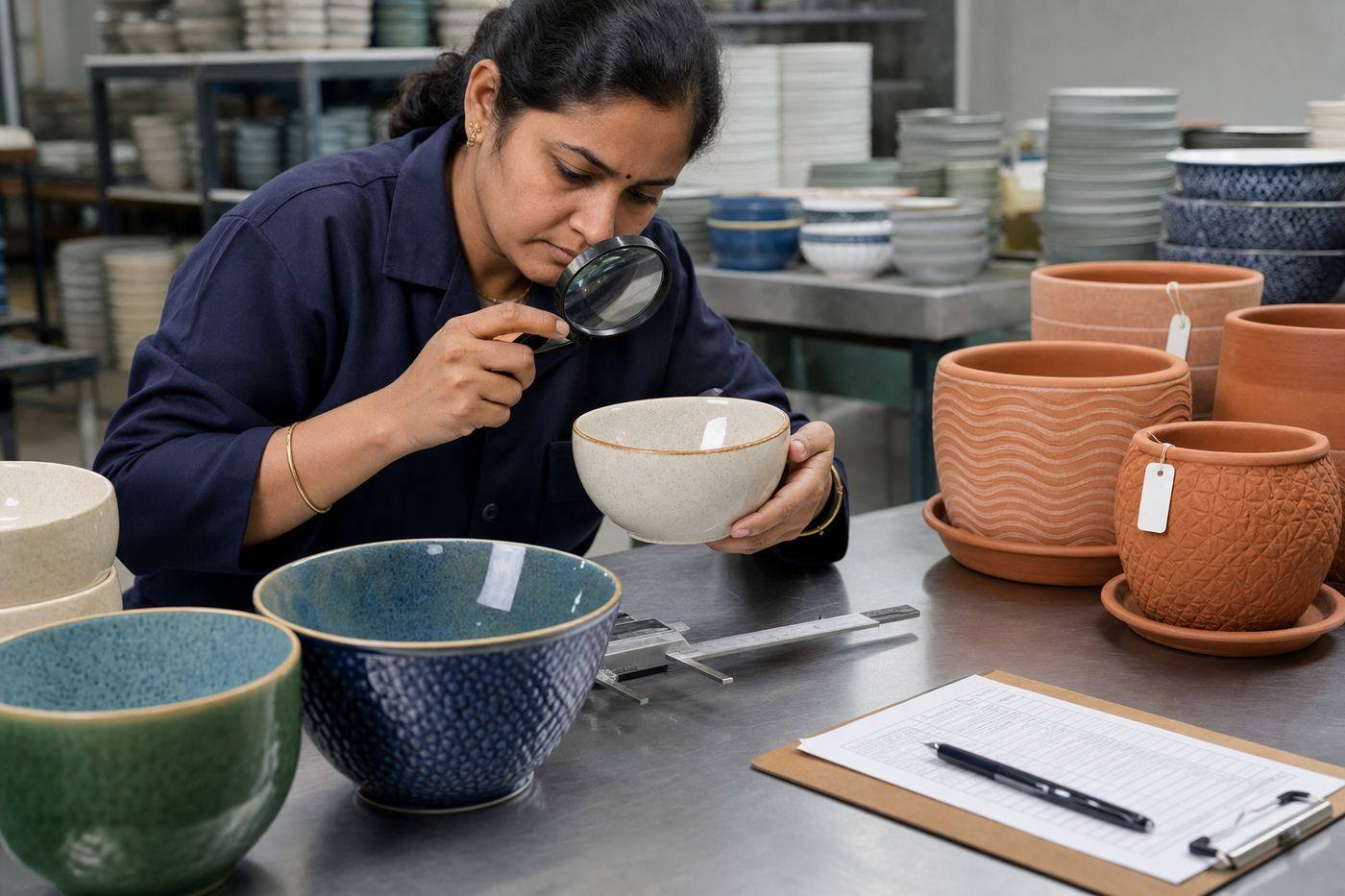
Ceramic and terracotta manufacturing capability varies meaningfully by cluster, and that variation is the biggest driver of which export markets a given kiln can realistically serve. Khurja industrial pottery can serve USA ornamental vase programmes, UK mid décor retail, and German glazed stoneware volumes with controlled glaze lots — but frost-rated outdoor terracotta and blue pottery are separate craft pathways. Jaipur blue pottery ateliers can serve France, Japan, Germany boutique, and UAE premium gifting given quartz-frit hand-painting depth — but production volumes per SKU are smaller and lead times longer than Khurja industrial programmes. Molela and Bankura studios serve France, Japan, and UK heritage gift niches. Longpi black pottery serves Japan premium. Gardenware belts in Tamil Nadu / Gujarat and large terracotta capacity linked to Khurja and North Indian supply serve USA / UK / Germany / Australia planting programmes where wall thickness, drainage, and frost rating matter.
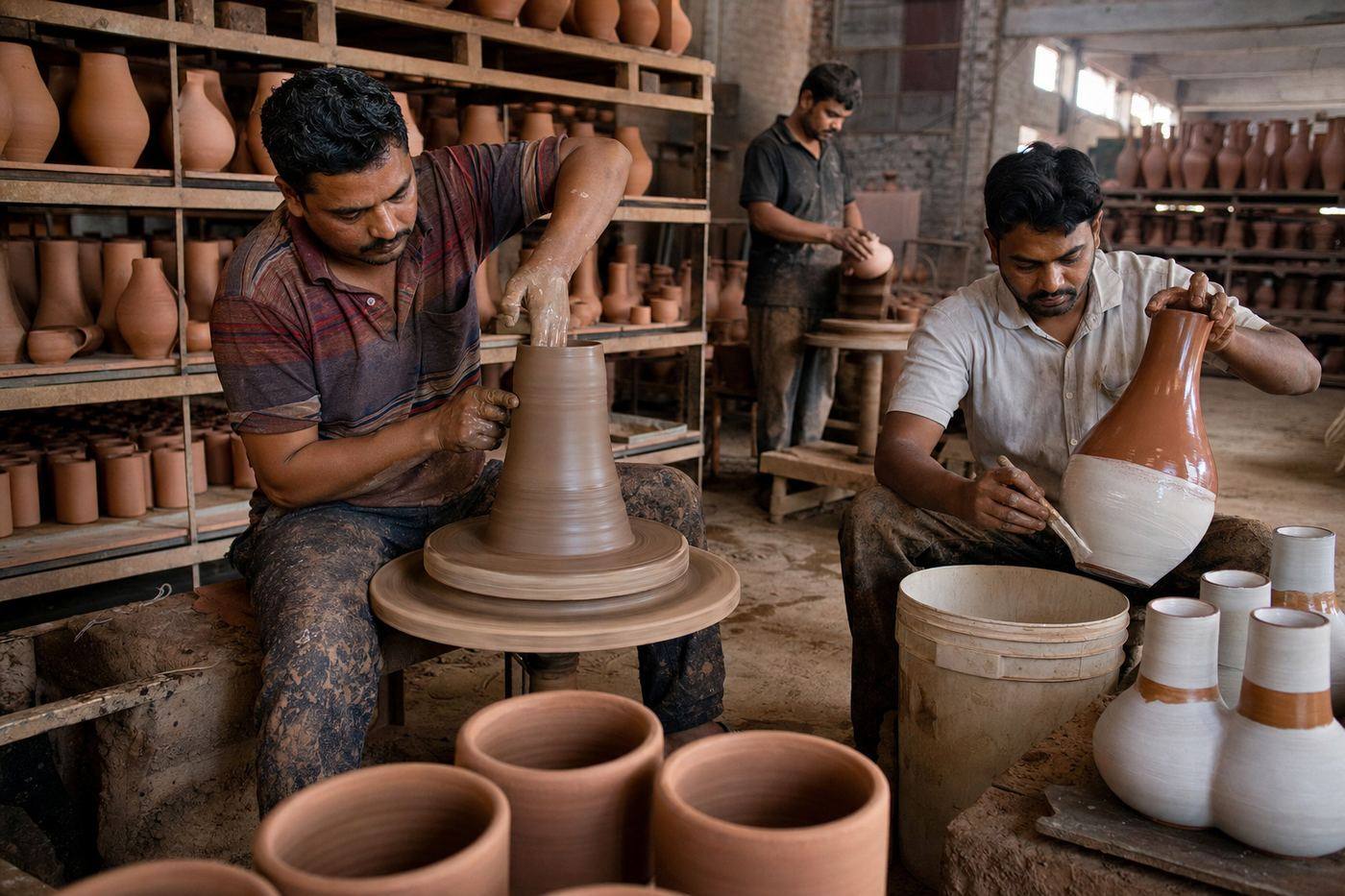
Process stages remain consistent: clay preparation → forming (wheel / mold / hand-build) → drying → bisque fire → glaze (optional) → glaze fire → cooling → QC → export packing. Fully fired glaze surfaces (no pinholes, no crazing, no crawl), base-foot smoothness, dimensional lot consistency, and stack-limited fragile packing are non-negotiable across every market in this guide.
Most Demanded Indian Terracotta and Ceramic Handicrafts in the USA
Market Snapshot
- Preferred clay bodies: Unglazed terracotta for planters; glazed earthenware / stoneware for vases; selective blue pottery accents for boutique gift
- Preferred SKUs: Planter size ladders; mid ornamental vases; small blue pottery bowls and coasters; ceramic candle holders for gift retail
- Preferred finish: Matte and earth-tone planters; mid-gloss decorative glazes; turquoise blue pottery for specialty gift
- Seasonal window: Spring gardenware POs often finalised 4–8 months before season — sample approval by late summer / autumn for winter–spring sailings
- Certifications expected: EPCH RCMC, IEC, Prop 65 posture for decorative coatings; frost evidence if frost-rated claims; CPSC only if toy/child claims on figurines
- Channel tip: Private-label e-commerce rewards consistent planter size ladders and vase assortments with retail-ready individual protection
The USA is the largest destination for Indian terracotta gardenware and a major market for mid glazed ornamental ceramics and boutique blue pottery accents. US buyers overwhelmingly prefer terracotta planters in size ladders (small tabletop pots through medium outdoor pots) with honest frost-rating where claimed, alongside mid glazed ceramic vases in matte and earth-tone finishes for home-décor specialty and private-label e-commerce. Spring garden programmes typically plan FCL shipments 4–8 months ahead, often under HS 6914 for planters and HS 6913 for ornamental vases. Prop 65 considerations apply to decorative coatings and glazes where listed substances (notably lead and cadmium) are present — do not invent universal duty or compliance rates; confirm HTSUS 10-digit broker quotes and glaze testing posture per programme.
Most Demanded Indian Terracotta and Ceramic Handicrafts in Germany
Market Snapshot
- Preferred clay bodies: Stoneware and glazed earthenware décor; blue pottery quartz-frit; frost-rated terracotta for outdoor
- Preferred SKUs: Mid glazed bowls and vases; blue pottery bowls and coasters; outdoor planters with frost evidence
- Preferred finish: Mid-to-high gloss, reactive glazes with controlled colour; turquoise floral blue pottery; matte outdoor terracotta
- Certifications expected: EPCH RCMC, IEC, REACH SVHC, LFGB if food-contact, frost-cycle evidence for outdoor claims
- Watch-out: Unsubstantiated GI, lead-free, or frost claims without evidence destroy buyer trust permanently
Germany is the most quality- and compliance-focused market in this comparison and rewards exporters who can substantiate lead-safe glaze migration for tableware-adjacent programmes, REACH SVHC documentation for decorative glazes, LFGB where food-contact is claimed, frost-rating evidence for outdoor terracotta, and honest cluster-origin labelling. German gift specialty and tabletop buyers seek glazed stoneware bowls and ornamental vases, blue pottery bowls with clean floral hand painting, and outdoor terracotta with frost documentation — unsubstantiated eco, lead-free, or frost claims are penalised with immediate sourcing suspension.
Most Demanded Indian Terracotta and Ceramic Handicrafts in the Netherlands
Market Snapshot
- Preferred clay bodies: Glazed earthenware and stoneware; selective blue pottery; terracotta gardenware for distribution
- Preferred SKUs: Contemporary vases; nestable décor bowls; planter assortments for EU distribution
- Preferred finish: Matte, satin, and contemporary reactive glazes; restrained blue pottery for specialty
- Certifications expected: EPCH RCMC, IEC, REACH for EU distribution
- Channel tip: Dutch distribution partners are a practical entry point for wider EU ceramic and gardenware assortments
The Netherlands functions both as a direct retail market and as a European distribution hub, importing contemporary glazed ceramic vases, gardenware, and blue pottery for onward EU distribution as well as domestic design-forward gift retail. Dutch buyers are pragmatic on documentation — REACH readiness is expected for EU-bound glazes — and contemporary matte and satin glaze lines often outperform heavy traditional florals in mainstream Dutch gift channels, while blue pottery remains a boutique tier.
Most Demanded Indian Terracotta and Ceramic Handicrafts in France
Market Snapshot
- Preferred clay bodies: Blue pottery quartz-frit; Molela terracotta plaque; fine glazed ceramics
- Preferred SKUs: Blue pottery statement bowls and jars; Molela wall plaques; curated micro-sets
- Preferred finish: Turquoise and cobalt floral blue pottery; terracotta relief with natural clay character; mid-gloss fine ceramics
- Certifications expected: REACH for EU, EPCH RCMC, honest cluster-origin labelling; GI evidence when Blue Pottery of Jaipur is claimed
- Channel tip: Curated, story-driven ranges outperform broad industrial catalogues with French boutique buyers
French demand concentrates in boutique gift and design retail, where craft provenance and glaze storytelling matter as much as price. French buyers respond exceptionally well to Jaipur blue pottery statement bowls and jars, Molela terracotta relief plaques with narrative iconography, and curated small ceramic sets with clear artisan-origin stories. Boutique retailers often prefer smaller, curated product ranges over large undifferentiated Khurja catalogues.
Most Demanded Indian Terracotta and Ceramic Handicrafts in the UK
Market Snapshot
- Preferred clay bodies: Terracotta planters; glazed stoneware / earthenware décor; blue pottery; Bankura terracotta figurines
- Preferred SKUs: Planter ladders; mid vases; blue pottery bowls and coasters; terracotta horses / figurines for design gift
- Preferred finish: Matte outdoor terracotta; mid-gloss décor glazes; turquoise blue pottery for specialty
- Certifications expected: EPCH RCMC, IEC, UK REACH for glazes; frost evidence for outdoor claims; post-Brexit import care
- Channel tip: UK online gift retail and garden-center chains are accessible entry points for planter ladders and curated ceramic gift sets
UK demand blends terracotta gardenware with mid glazed ornamental ceramics, a boutique Jaipur blue pottery tier, and a niche Bankura terracotta figurine channel for gift and design retail. UK buyers generally want consistent glaze finish, frost-conscious outdoor terracotta for garden centers, retail-ready gift boxing for blue pottery, and post-Brexit import documentation handled separately from EU-bound shipments.
Most Demanded Indian Terracotta and Ceramic Handicrafts in the UAE and Gulf
Market Snapshot
- Preferred SKUs (bulk): Hospitality amenity bowls, ashtrays, small trays, décor accents
- Preferred SKUs (premium): Blue pottery nested gift sets; ornamental vases; curated figurine assortments
- Preferred clay bodies: Durable glazed earthenware for amenity; blue pottery quartz-frit for premium; selective Khurja glazed décor
- Preferred finish: Durable mid-gloss for bulk amenity; turquoise floral and metallic-accent premium finishes for gifting
- Seasonal tip: Festive and corporate gifting procurement begins well ahead of Ramadan, Eid, and year-end seasons
The UAE runs a distinct dual demand pattern: bulk ceramic amenity formats — ashtrays, décor bowls, small trays, and hospitality accents in durable mid-gloss glaze at competitive FOB — and a premium blue pottery and figurine tier for corporate and festive gifting with nested gift sets and metallic-accent or turquoise floral finishes. Exporters who can serve both tiers with clearly differentiated product lines capture more of the UAE's total opportunity than those offering a single undifferentiated ceramic range.
Most Demanded Indian Terracotta and Ceramic Handicrafts in Australia
Market Snapshot
- Preferred clay bodies: Terracotta planters; mid glazed earthenware / stoneware; selective blue pottery
- Preferred SKUs: Planter ladders; mid vases; coasters; small décor bowls
- Preferred finish: Matte outdoor terracotta; mid-gloss décor; low-defect glaze surfaces
- Certifications expected: EPCH RCMC, IEC, retail QC for glaze and breakage; frost evidence where claimed
- Channel tip: Position as quality gardenware and boutique ceramic gift with impeccable packing rather than competing purely on price
Australia shows steady garden-center and gift-retail demand for terracotta planters, mid glazed vases, and ceramic coasters with credible frost / breakage discipline. Import volumes are smaller than the USA or UK, but buyers favour plain-to-earth-tone finishes in retail-ready formats and apply strict retail QC on glaze adhesion and planter wall strength — documentation discipline matters alongside competitive pricing.
Most Demanded Indian Terracotta and Ceramic Handicrafts in Canada
Market Snapshot
- Preferred clay bodies: Terracotta planters; glazed décor ceramics; selective blue pottery
- Preferred SKUs: Planter ladders; mid vases; small gift sets; blue pottery accents
- Preferred finish: Matte outdoor terracotta; mid-gloss décor glazes
- Certifications expected: EPCH RCMC, IEC; similar Prop 65 / decorative-coating posture to USA; frost evidence where claimed
- Channel tip: Diaspora gift retail is an accessible entry point before mainstream garden-center and décor listings
Canadian demand closely mirrors the USA, with terracotta planter programmes and mid glazed ceramic gift retail both driving steady import growth. Canadian buyers request planter and vase formats similar to the US catalogue, often sourcing through established US or direct-import channels. Bilingual labelling awareness is a practical differentiator for exporters targeting Canadian retail directly, and frost-rated outdoor terracotta claims face the same evidence expectation as in US northern garden-center programmes.
Most Demanded Indian Terracotta and Ceramic Handicrafts in Japan
Market Snapshot
- Preferred clay bodies: Blue pottery quartz-frit; Longpi black pottery; refined stoneware ornamentals
- Preferred SKUs: Small blue pottery bowls, coasters, jars; Longpi accents; curated 2–3 piece micro-sets
- Preferred finish: High neatness turquoise floral blue pottery; matte-to-satin Longpi; no visible pinholes or glaze crawl
- Certifications expected: EPCH RCMC, IEC, Japanese import compliance documentation, lead-safe evidence for food-adjacent pieces
- Channel tip: Prepare for small trials and multiple review cycles; never shortcut glaze fire or QC for cost
Japan applies the tightest glaze finish bar of any market in this guide and rewards precision on small Jaipur blue pottery bowls and coasters, Longpi black pottery accents, and curated micro-sets of refined stoneware ornamentals at a premium price point. Japanese design gift retailers and museum shops seek refined motifs, even glaze surfaces, low pinholing and crazing, and accurate dimensional matching. Japanese buyers typically start with small trial orders, review at obsessive detail, and only scale after multiple review cycles — but scaled orders come with strong repeat loyalty and premium pricing.
Country × Clay Body × Glaze × Finish × SKU Demand Matrix
Use this directional comparison to prioritise Khurja kiln investment, Jaipur blue pottery hand-painting capacity, Molela / Bankura craft depth, gardenware production, pack format, and compliance depth by target market. Validate with EPCH intelligence, DGCI&S HS 6913 / 6912 / 6914 trade data, and direct buyer conversations — demand levels reflect commercial intensity for typical Indian ceramic and terracotta exporters in 2026, not a guarantee that every clay body / glaze / finish combination will find buyers in every listed country.
Comparison table
Swipe →
Data table — swipe horizontally on small screens
| Country | Top Clay Bodies | Top SKUs | Key Glaze / Finish | Key Compliance | Seasonal Peak |
|---|---|---|---|---|---|
| USA | Terracotta; glazed earthenware / stoneware; boutique blue pottery | Planter ladders; mid vases; small blue pottery | Matte earth planters; mid-gloss décor; turquoise accents | Prop 65 coatings; frost evidence if claimed | Spring garden Q3–Q1 sailings ahead |
| Germany | Stoneware; blue pottery; frost-rated terracotta | Glazed bowls / vases; blue pottery; outdoor planters | Gloss / reactive; turquoise floral; matte outdoor | REACH; LFGB if tableware; frost evidence | Year-round; Q4 gift uplift; spring garden |
| Netherlands | Glazed stoneware / earthenware; terracotta gardenware | Contemporary vases; planter assortments; blue pottery specialty | Matte / satin / contemporary reactive | REACH for EU distribution | Year-round |
| France | Blue pottery; Molela terracotta; fine ceramics | Blue pottery statement pieces; Molela plaques; micro-sets | Turquoise floral; natural terracotta relief | REACH; GI evidence when claimed; origin storytelling | Boutique seasonal peaks |
| UK | Terracotta; glazed décor; blue pottery; Bankura terracotta | Planters; mid vases; blue pottery; figurines | Matte outdoor; mid-gloss décor; turquoise specialty | UK REACH; frost evidence; post-Brexit docs | Spring garden + year-round gift |
| UAE | Durable glazed amenity; blue pottery premium | Amenity bulk; premium nested blue pottery sets | Durable mid-gloss bulk; turquoise / metallic premium | Baseline EPCH/IEC; hospitality specs | Ramadan, Eid, year-end gifting |
| Australia | Terracotta; mid glazed décor | Planters; mid vases; coasters | Matte outdoor; mid-gloss décor | Retail QC glaze/breakage; frost if claimed | Year-round garden + gift |
| Canada | Terracotta; glazed décor; blue pottery accents | Planters; mid vases; gift sets | Matte outdoor; mid-gloss décor | USA-similar coating posture; frost if claimed | Spring garden programmes |
| Japan | Blue pottery; Longpi; refined stoneware | Small bowls / coasters; Longpi accents; micro-sets | Precision turquoise floral; matte-satin Longpi | JP import docs; lead-safe if food-adjacent | Gift seasons; museum cycles |
Export Process
Export Tip
Regardless of destination, the export sequence stays consistent while specification details change by market: IEC and EPCH registration; buyer discovery matched to your clay body / glaze specialisation; sample dispatch with clay body, glaze grade, dimension, and firing schedule specifications; price negotiation and purchase order; procurement / production scheduling with Khurja / Jaipur / Molela / Bankura / Longpi / gardenware workshops synced to kiln capacity; pre-shipment QC against destination-specific glaze and packaging requirements; export packing with foam wrap, cell dividers, double-wall cartons, stack-height limits, and FRAGILE marking; customs documentation; port booking at Nhava Sheva, Mundra, or ICD Delhi / Dadri corridor; and final documentation handover. See how to export terracotta and ceramic handicrafts from India for the full operational walkthrough and source terracotta and ceramic handicrafts directly from India for the importer sampling playbook.
Pricing Analysis
Buyer Tip
Pricing follows clay body, size, glaze complexity, decoration hours, firing schedule, pack format, and compliance testing costs across all markets. Directional indicative FOB bands (confirm quote date): small terracotta accents and ornaments about USD 1–8; mid glazed ceramic vases, bowls, and small planters about USD 4–28; statement blue pottery pieces and large terracotta garden pots about USD 15–75+; lead-safe / food-contact / certified private-label programmes command evidence-dependent premiums.
Comparison table
Swipe →
Data table — swipe horizontally on small screens
| Product / Format | Directional FOB (USD, indicative) | Markets Where This Wins |
|---|---|---|
| Terracotta planter ladders (small–medium) | 3–20 | USA, UK, Australia, Canada garden centers |
| Mid glazed ceramic vases and bowls | 4–28 | USA, UK, Netherlands, Germany décor retail |
| Large / statement terracotta garden pots | 15–75+ | USA, Germany, UK spring garden programmes |
| Jaipur blue pottery bowls / coasters / jars | 8–45+ | France, Japan, Germany boutique; UAE premium gift |
| Molela plaques and Bankura figurines | 10–60+ | France, Japan, UK design and museum channels |
| Hospitality amenity ceramics (bulk) | 1–6 per piece | UAE hospitality bulk |
| Lead-safe / food-contact certified programmes | Premium to standard glazed | Germany LFGB; USA/Japan food-adjacent retail |
MOQ Analysis
Buyer Tip
MOQ expectations differ by market and seasonal programme. US garden-center importers often require FCL-scale planter MOQs with sample gates of 5–20 pcs per SKU and size ladder; German glazed-décor buyers may trial 100–400 pcs per hero SKU; UAE hospitality buyers with reorder cycles may move faster toward bulk amenity MOQs; Japanese buyers typically start with the smallest trials in this guide.
Comparison table
Swipe →
Data table — swipe horizontally on small screens
| Buyer Stage | Typical MOQ | Common in Markets |
|---|---|---|
| Sample evaluation | 5–20 pcs per SKU (extra cushioned) | All markets; Japan often smaller |
| Trial order | 100–400 pcs or mixed LCL (planters size-laddered) | Germany décor; UK gift sets; France boutique |
| Standing reorder | 400–2,000 pcs or by carton / CBM | UAE amenity; USA private label |
| Spring gardenware FCL | 20GP / 40HC by planter size mix | USA, UK, Germany, Australia, Canada |
| Premium blue pottery / Longpi programme | Small curated lots; may stay LCL longer | France, Japan, Germany boutique |
Packaging Standards
Export Tip
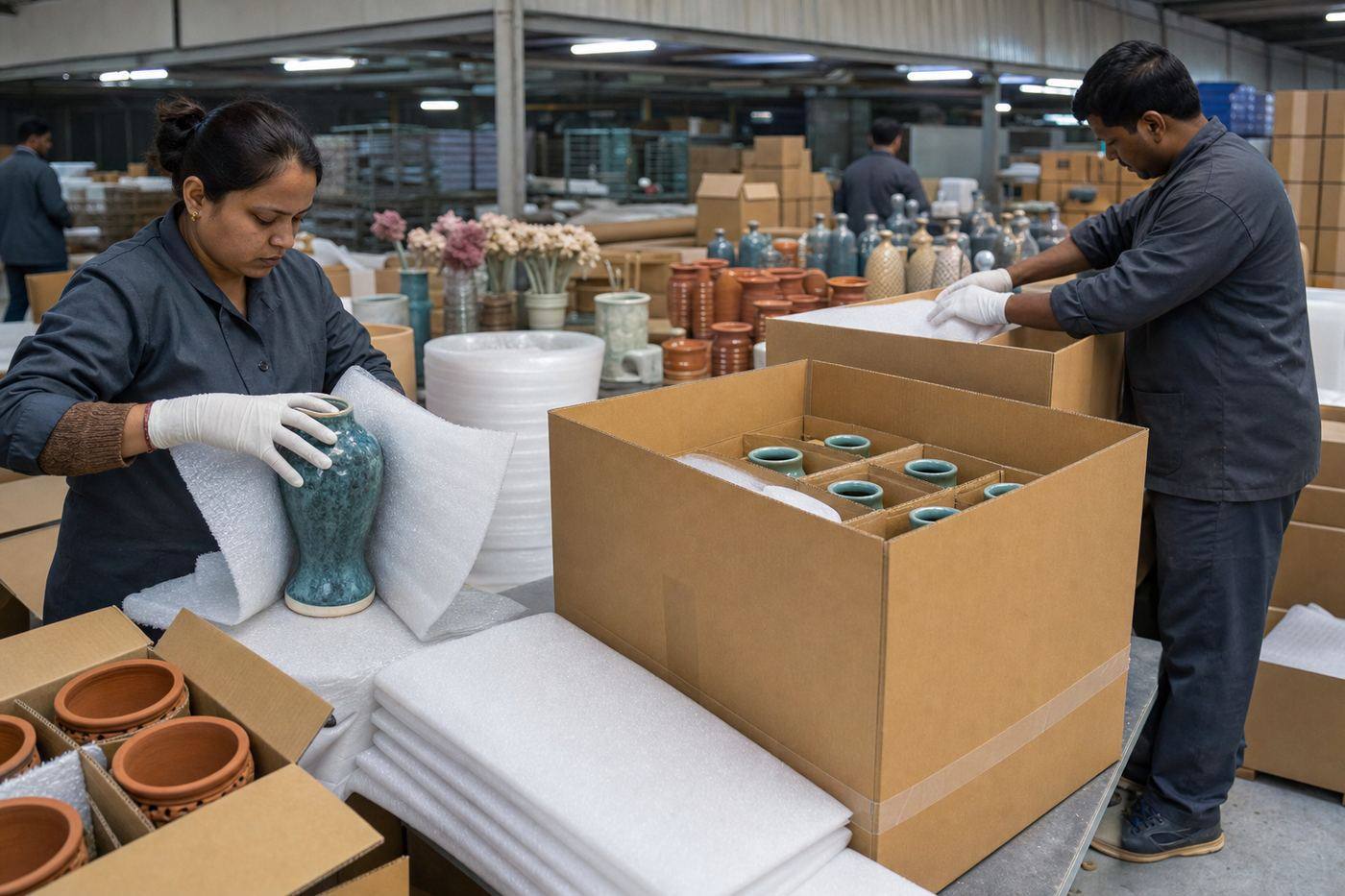
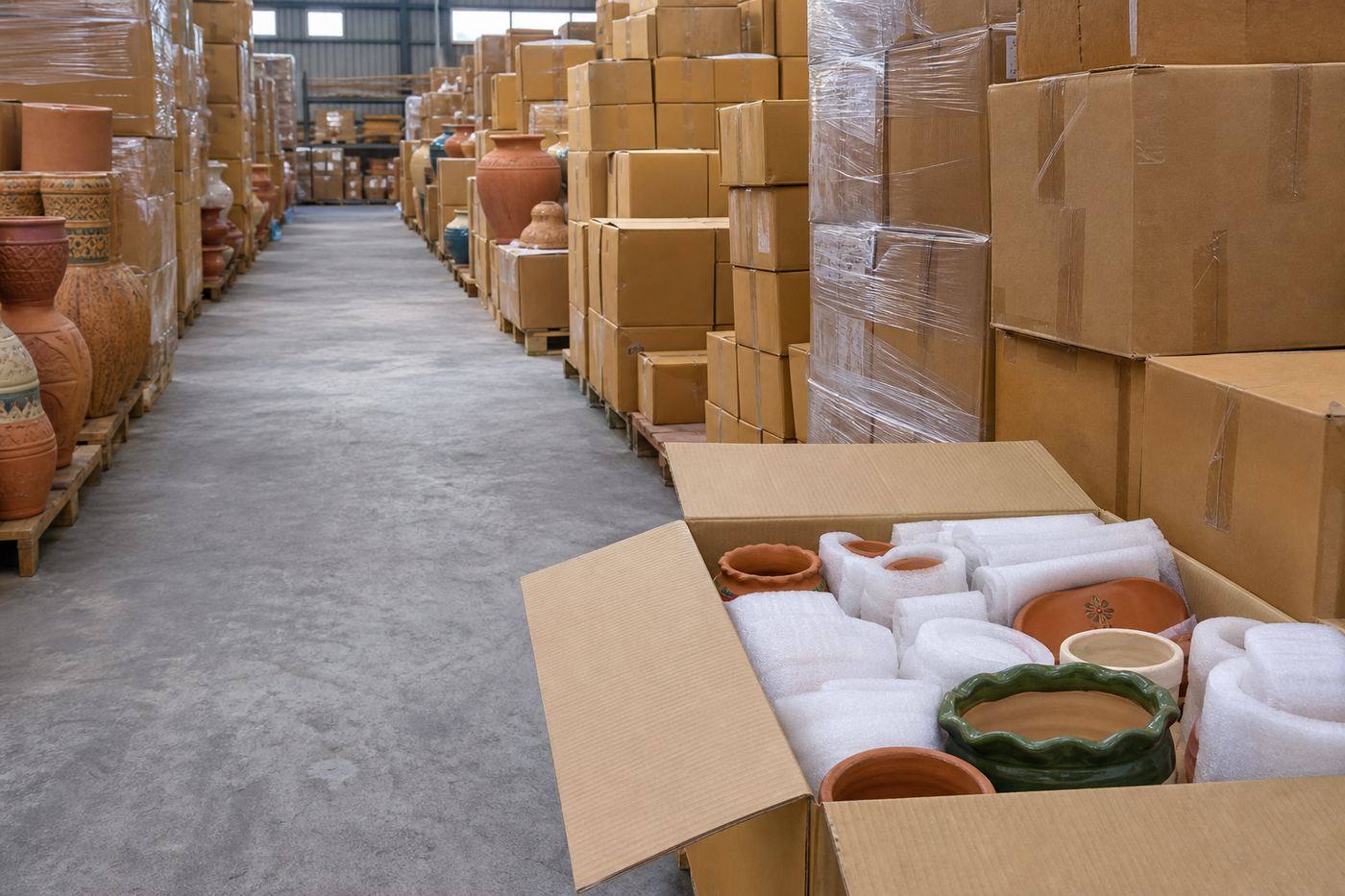
Packaging format is one of the clearest market differentiators. Bulk foam-wrapped cartons with stack-height limits serve UAE hospitality procurement and wholesale gardenware. Retail-ready individual gift boxes dominate France, Japan, Germany, and UK specialty blue pottery and figurine retail. Double-wall cartons with cell dividers and corner protection matter for mid glazed programmes across all markets. Tall terracotta planters need anti-shift bracing and never-overstack packing discipline. Breakage in transit is the operational killer for ceramic and terracotta cargo — packing discipline is as commercially important as clay body selection.
Comparison table
Swipe →
Data table — swipe horizontally on small screens
| Format | Typical Packing Approach | Primary Markets |
|---|---|---|
| Bulk foam-wrapped cartons | Foam / bubble per piece, double-wall cartons, stack-height limits | UAE hospitality, wholesale gardenware |
| Retail-ready gift boxes | Individual branded box per unit inside export carton | France, Japan, Germany, UK specialty blue pottery |
| Planter programmes | Individual wrap; stack limits by wall thickness; corner protection on tall pots | USA, UK, Germany, Australia, Canada garden |
| Premium nested gift sets | Rigid boxes with foam lining, corner protection | UAE premium gifting, Japan museum shops |
| Molela plaques / wall panels | Foam-lined rigid crates; flat-orientation shipping | France, Japan design retail |
| Figurine and accent trays | Compartment trays with foam dividers | UK Gift, USA boutique, UAE amenity accents |
Container Loading Details
Export Tip
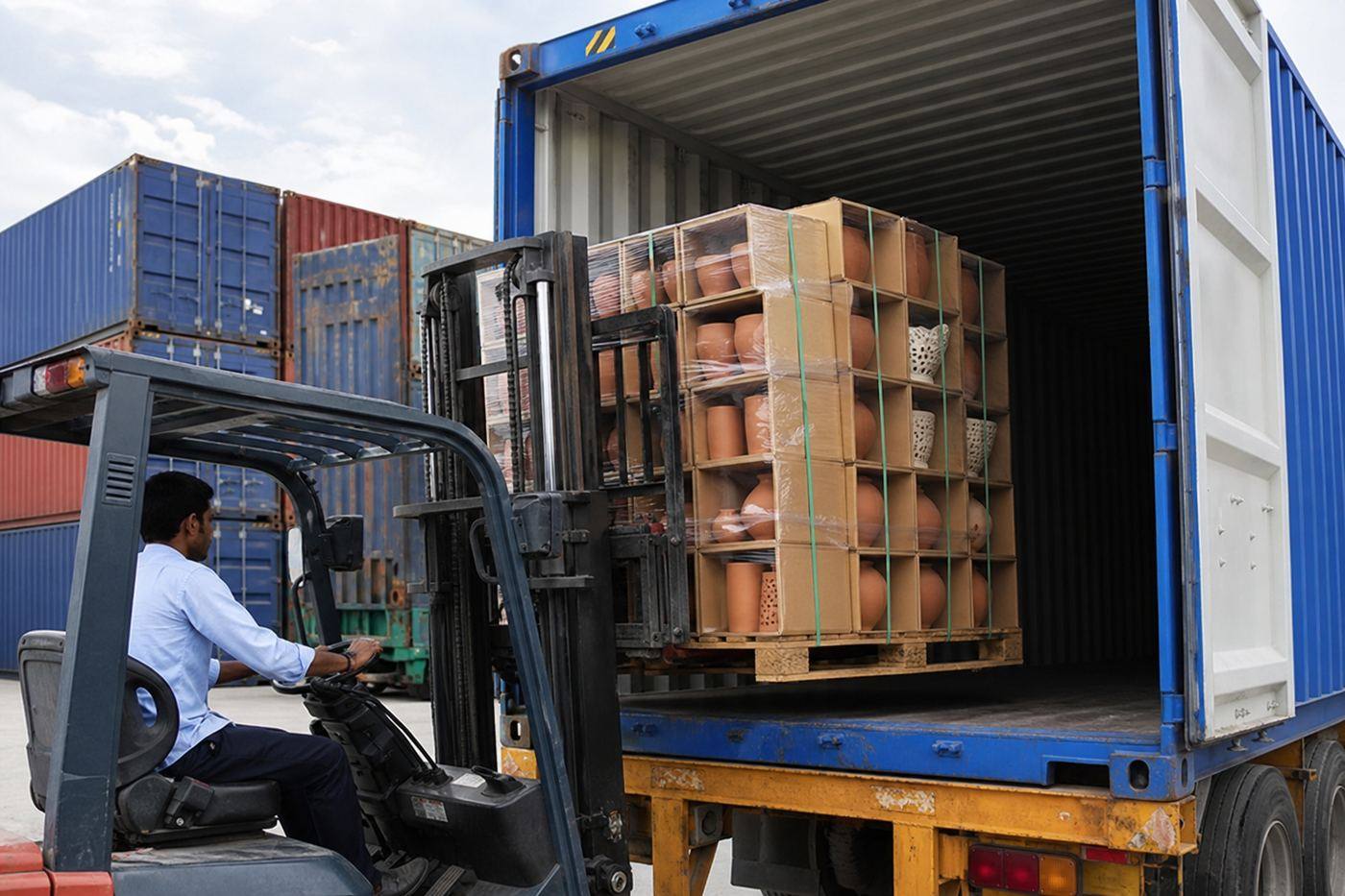
Pack format and clay body drive container economics: retail-ready blue pottery gift boxes load fewer units per container than bulk-wrapped glazed vases, and large terracotta planters load fewer still because of wall thickness and stack limits. Match production and carton plans to the format your target country actually buys, then confirm stuffing plans with your freight forwarder. Ceramic cargo is cube-sensitive and crush-sensitive — never stack heavy stoneware cartons atop thin-walled planter programmes without engineered dunnage.
Container yield by demand format and destination
Swipe →
Data table — swipe horizontally on small screens
| Pack Format | Countries Where This Format Dominates | Loading Consideration |
|---|---|---|
| Bulk-wrapped glazed décor | UAE amenity, some UK/AU décor retail | Higher CBM efficiency; glaze surface protection still critical |
| Planter FCL programmes | USA, UK, Germany, Australia, Canada spring garden | Stack-height limited; anti-shift bracing for tall pots; fewer pcs per container |
| Retail-ready blue pottery gift boxes | France, Japan, Germany boutique; UAE premium | Lowest units per container; highest margin per CBM |
| Mixed Delhi-consolidated assortments | USA gift sets, UK multi-SKU programmes | Plan stuffing by SKU cube mix and clay-body crush risk, not average piece size |
| Molela / plaque crates | France, Japan | Flat orientation; edge protection; do not overstack |
Shipping Methods
Export Tip
Sea freight (FCL / LCL) serves all nine markets under FOB, CFR, or CIF terms. Khurja and Jaipur inland routing commonly consolidates via ICD Delhi / Dadri into Nhava Sheva or Mundra western gateways. Lead times: samples 10–21 days; stock glazed décor 4–7 weeks; custom glaze / private label 6–12 weeks; large terracotta and kiln-capacity gardenware programmes longer; spring garden programmes 4–8 months ahead. Air freight stays reserved for urgent premium samples or Japanese quality-review resends — rarely economical for dense ceramic pieces.
Certifications
Compliance Notes
Compliance depth is the clearest signal of market sophistication in this comparison. EPCH RCMC and IEC form the baseline every market expects. Lead / cadmium migration testing serves Germany LFGB, Japan food-adjacent, and any food-contact claim; REACH / UK REACH serves EU / UK decorative and tableware glazes; Prop 65 serves US retail; frost-rating evidence serves outdoor planter programmes in USA, Germany, UK, Canada, and Australia; Blue Pottery of Jaipur GI authorised-user evidence applies only where GI tags are used; CPSC / EN71 / ASTM F963 applies only if toy / child claims are made on figurines.
Comparison table
Swipe →
Data table — swipe horizontally on small screens
| Certification / Registration | Baseline or Premium | Markets Where It Matters Most |
|---|---|---|
| IEC + GST | Baseline | All markets |
| EPCH RCMC | Baseline | All markets |
| Lead / cadmium migration (glazes) | Baseline for food-contact or lead-safe claims | Germany, Japan, USA tableware-adjacent, EU REACH programmes |
| LFGB (Germany) | Baseline for tableware claims | Germany and adjacent EU tableware programmes |
| REACH / UK REACH | Baseline for EU/UK glaze programmes | Germany, Netherlands, France, UK |
| Prop 65 (decorative coatings) | Baseline for US retail chains | USA, California-heavy programmes |
| Frost-resistance evidence | Premium / claim-bound for outdoor terracotta | USA, Germany, UK, Canada, Australia garden |
| Blue Pottery of Jaipur GI | Premium when claimed | France, Japan, Germany, UK heritage / boutique retail |
| CPSC / toy safety | If toy / child claims | USA figurine programmes with child marketing |
Buyer Requirements
Buyer Requirements
Across every market, buyers expect clay body, glaze, and dimensional samples with clear firing schedule specifications, lot-to-lot glaze colour and dimensional consistency, crush-resistant packing with stack-height discipline, and institutional credentials upfront. What changes by market is the depth beyond that baseline: US / Canadian buyers add spring gardenware seasonal timing, Prop 65 posture, and frost evidence for outdoor planters; German / Dutch / French buyers add REACH and (for Germany) LFGB; UAE buyers add dual bulk-and-premium format flexibility; Japanese buyers add the tightest glaze neatness bar; Australian buyers add breakage QC and frost-conscious planter evaluation.
Country-wise Opportunities
Market Snapshot
The demand matrix above is the primary country-wise intelligence for this guide — it maps clay body, glaze, finish, SKU, and seasonal preferences rather than macro market ranking scores. For destination ranking methodology, duties, and freight corridor comparison, see best countries for Indian terracotta and ceramic handicraft exports. For EPCH registration and IHGF access, see EPCH registration benefits for terracotta and ceramic exporters. For lead generation tactics, see find international buyers for terracotta and ceramic handicrafts.
Comparison table
Swipe →
Data table — swipe horizontally on small screens
| Country | Hero SKU to Lead With | Clay Body / Glaze Priority | First Compliance Layer |
|---|---|---|---|
| USA | Terracotta planter ladder + mid glazed vase | Matte outdoor terracotta; mid-gloss décor | Prop 65 coatings; frost if claimed |
| Germany | Lead-safe glazed stoneware + blue pottery bowls | Gloss / reactive stoneware; turquoise floral | REACH + LFGB if tableware; frost for outdoor |
| Netherlands | Contemporary glazed vases + planter assortments | Matte / satin contemporary glazes | REACH for EU distribution |
| France | Blue pottery statement + Molela plaques | Quartz-frit turquoise; natural terracotta relief | REACH + origin storytelling + GI if claimed |
| UK | Planter ladders + mid décor + blue pottery accents | Matte outdoor; mid-gloss décor; turquoise specialty | UK REACH; frost evidence; post-Brexit docs |
| UAE | Amenity ceramics + premium nested blue pottery | Durable mid-gloss bulk; turquoise premium | Hospitality specs + festive timing |
| Australia | Planter ladders + mid vase sets | Matte outdoor; mid-gloss décor | Retail QC glaze / breakage |
| Canada | Planters + mid vase gift sets | Matte outdoor; mid-gloss décor | USA-similar coating posture |
| Japan | Small blue pottery + Longpi accents | Precision turquoise floral; matte-satin Longpi | Finish neatness + JP import docs + lead-safe if food-adjacent |
Sourcing Checklist for Buyers and Exporters
Checklist
Buyer Checklist
- Specify clay body, glaze family, finish grade, dimensions, and ornamental vs tableware commercial identity in every RFQ
- Confirm pack format (bulk vs retail gift box vs planter stack-limited) and seasonal window for spring gardenware or UAE gifting
- Ask for EPCH RCMC and IEC evidence before sending a sample-evaluation fee or deposit
- For EU / UK shipments, confirm REACH glaze documentation; for Germany tableware claims, confirm LFGB; for USA, confirm Prop 65 and frost evidence where outdoor claims are made
- Align MOQ and lead time with kiln reality — custom glaze programmes run 6–12 weeks; spring gardenware often needs 4–8 months
- Confirm honest cluster origin — Khurja industrial vs Jaipur blue pottery vs Molela vs Bankura vs Longpi vs Delhi-consolidated
Exporter Checklist
- Map your Khurja / Jaipur / Molela / Bankura / Longpi / gardenware specialisation honestly against the country matrix before quoting a new market
- Maintain separate specification sheets for planter, glazed décor, blue pottery, and plaque / figurine tiers
- Invest in lead-safe / LFGB / frost-rating evidence before targeting Germany outdoor or tableware-adjacent tiers
- Prepare tiered pricing by clay body, glaze complexity, size ladder, and pack format so buyers can self-select budget tiers
- Respond to specification and sample requests within 24–48 hours with honest cluster-origin statements and HS classification suggestions
Compliance Checklist
Checklist
Compliance Notes
Comparison table
Swipe →
Data table — swipe horizontally on small screens
| Compliance Item | Status Check | Owner |
|---|---|---|
| IEC + GST | Valid and consistent across documents | Export desk |
| EPCH RCMC | Current and renewed annually | Export desk |
| HS classification per SKU | 6913 vs 6912 / 6911 vs 6914 confirmed with CHA | Export desk / CHA |
| Pre-shipment QC | Glaze adhesion, crazing, pinholes, warpage, colour match, base-foot finish documented per lot | QC team |
| Destination labelling | Country of origin; honest Khurja vs Jaipur vs Molela vs Bankura vs Delhi-consolidated claims | Packaging team |
| Lead / cadmium migration | Testing current for lead-safe or food-contact programmes | Quality / compliance |
| REACH / UK REACH / LFGB | EU / UK glaze documentation and German tableware posture current | Quality / compliance |
| Prop 65 (US programmes) | Decorative coating posture documented where applicable | Quality / compliance |
| Frost-rating evidence | Frost-cycle tests attached where outdoor claims are made | Quality / compliance |
| GI claims (if used) | Blue Pottery of Jaipur authorised-user evidence current | Marketing / compliance |
Common Buyer Mistakes
Common Mistakes Box
- Assuming the clay body / glaze combination that works in UAE bulk amenity will satisfy a German LFGB tabletop buyer without adaptation.
- Requesting frost-rated outdoor terracotta specifications while only budgeting for untested commodity planter pricing.
- Not confirming whether a 'Blue Pottery of Jaipur' or Khurja 'lead-free' claim has GI authorised-user evidence or migration test reports behind it.
- Underestimating USA / UK / Germany spring gardenware seasonal timing — POs and sailings close months before retail garden seasons.
- Ignoring festive and corporate gifting timing when sourcing premium nested blue pottery sets for UAE programmes.
- Skipping sample evaluation before a bulk order and discovering glaze crazing, pinholes, or planter cracks only on arrival.
- Treating ornamental ceramics (HS 6913) and tableware (HS 6912 / 6911) as interchangeable on invoices — a classification and compliance failure.
- Marketing terracotta figurines as child-safe without CPSC / EN71 / ASTM F963 lab evidence when US retail requires it.
Challenges & Solutions
Comparison table
Swipe →
Data table — swipe horizontally on small screens
| Challenge | Impact | Solution |
|---|---|---|
| Clay body / glaze requirements differ sharply by market | Wasted quotes and mismatched inquiries | Map Khurja / Jaipur / Molela / Bankura / Longpi specialisation to the country matrix before outreach |
| Compliance-intensive markets (Germany, Japan, USA retail) | Slower market entry, higher documentation cost | Sequence lead-safe / LFGB / Prop 65 / frost capability build toward those markets deliberately |
| High breakage risk in ocean freight | Margin loss from damaged planters, vases, and blue pottery | Foam wrap, cell dividers, double-wall cartons, stack-height limits, anti-shift bracing |
| Seasonal demand spikes (USA/UK spring garden, UAE gifting) | Short procurement windows | Confirm kiln capacity and pricing 4–8 months ahead for gardenware; early for UAE festive cycles |
| Honest origin labelling pressure | Buyer trust loss if Jaipur or Bankura claims are overstated | Separate cluster lines with clear documentation and pricing |
| Japanese glaze neatness bar | Cannot meet large JP orders on short notice | Book premium glaze fire and QC capacity in advance; educate buyers on lead times |
| Planter HS classification confusion (6913 vs 6914) | Duty and compliance misalignment | Confirm planter classification with CHA before quoting; never blanket-declare |
How Altus Exports Helps Buyers and Exporters
Altus Exports operates as a merchant exporter from India, global sourcing partner, and export consulting expert for terracotta and ceramic handicraft programmes. We help international buyers source through verified Khurja, Jaipur blue pottery, Molela, Bankura, Longpi, and gardenware supply chains with clay-body-specific QC, glaze compliance readiness, and destination-matched documentation.
On the exporter side, Altus helps pottery workshops and Delhi-NCR merchants map clay body and glaze capability to the destination markets most likely to reward them — a demand-fit conversation rather than a generic catalogue push. Explore merchant exporter services, global sourcing partner, product sourcing company, and contact Altus Exports for a programme review.
Future Market Trends
Key Statistics
Through 2030, demand differentiation by country is likely to deepen rather than converge. The USA, UK, Germany, Australia, and Canada will keep expanding spring gardenware private-label planter programmes requiring earlier supplier onboarding and frost-rating evidence. Germany and the Netherlands will continue rewarding lead-safe and REACH-documented glazes as a competitive prerequisite. France and Japan will sustain premium blue pottery and Longpi / Molela craft niches. The UAE will likely sustain its dual bulk-amenity and premium-gifting pattern.
Exporters who invest now in clay-body-specific catalogue discipline, lead-safe and frost-rating compliance rhythms by destination, fragile packing routines, and honest cluster-origin labelling will be positioned to serve the full spread of this matrix by 2030, rather than being confined to the lowest-margin, undifferentiated ceramic giftware segment.
Expert Insights
Expert Insight Box
A pattern that shows up repeatedly across buyer conversations: exporters who lead with 'we make every clay body in every glaze' struggle to close premium orders, while exporters who lead with a specific, well-documented specialisation — Khurja glazed stoneware décor, Jaipur blue pottery bowls, frost-rated garden terracotta, or Molela plaques — close faster even at a higher price point because buyers trust depth over breadth when glaze consistency and breakage risk are the primary concerns.
The second pattern worth noting is how quickly seasonal timing separates winners from losers in USA / UK / Germany spring gardenware and UAE gifting programmes. Buyers who need winter–spring sailings for US garden retail often finalize specs in mid-year the prior season — exporters without planter-size-ladder capacity reserved early lose the season entirely, regardless of how competitive their FOB quote looks in January.
Conclusion
- Action: Share your current clay body / glaze range and target markets with Altus Exports for a demand-fit ceramic sourcing review.
- Explore handicrafts & lifestyle products, merchant exporter, export products from India, global sourcing partner, and product sourcing company partnership models.
- Continue with how to export terracotta and ceramic handicrafts from India, top terracotta and ceramic handicraft products exported from India, best countries for Indian terracotta and ceramic handicraft exports, EPCH registration benefits for terracotta and ceramic exporters, find international buyers for terracotta and ceramic handicrafts, source terracotta and ceramic handicrafts directly from India, lead-safe glaze, blue pottery, and food-contact ceramic export opportunities, the terracotta and ceramic export documentation checklist, and trade shows and B2B marketplaces for terracotta and ceramic exporters.
The most demanded Indian terracotta and ceramic handicrafts by country depend on clay body, glaze, finish, SKU format, pack format, seasonal timing, and compliance depth as much as on price: the USA and Canada reward terracotta planter ladders and mid glazed vase programmes with Prop 65–conscious coatings; Germany rewards lead-safe glazed stoneware and frost-rated outdoor terracotta with LFGB / REACH documentation; the UAE rewards a dual bulk-amenity and premium blue pottery strategy; Japan rewards precision blue pottery and Longpi on small curated sets; and the UK, France, Netherlands, and Australia each weight gardenware, craft storytelling, and finish grade differently.
Exporters should prioritise three actions: (1) map current Khurja / Jaipur / Molela / Bankura / Longpi / gardenware range honestly against the country matrix in this guide; (2) choose one or two markets that match that capability rather than pursuing every destination simultaneously; (3) sequence compliance investment (lead-safe, LFGB, Prop 65, frost evidence, GI) toward the specific premium market it unlocks. Contact Altus Exports for a demand-fit sourcing review aligned to your target destinations.