
Top Terracotta and Ceramic Handicraft Products Exported from India
By Saurabh Mittal, Founder, Altus Exports
A commercial investigation guide to the top terracotta and ceramic handicraft products exported from India — terracotta planters, glazed ceramic vases, Jaipur blue pottery, figurines, Molela plaques, and tabletop artware — with SKU taxonomy, clay bodies and glazes, Khurja vs Jaipur vs heritage cluster mapping, directional FOB pricing, MOQ tiers, packaging standards, and buyer-channel fit from Altus Exports.
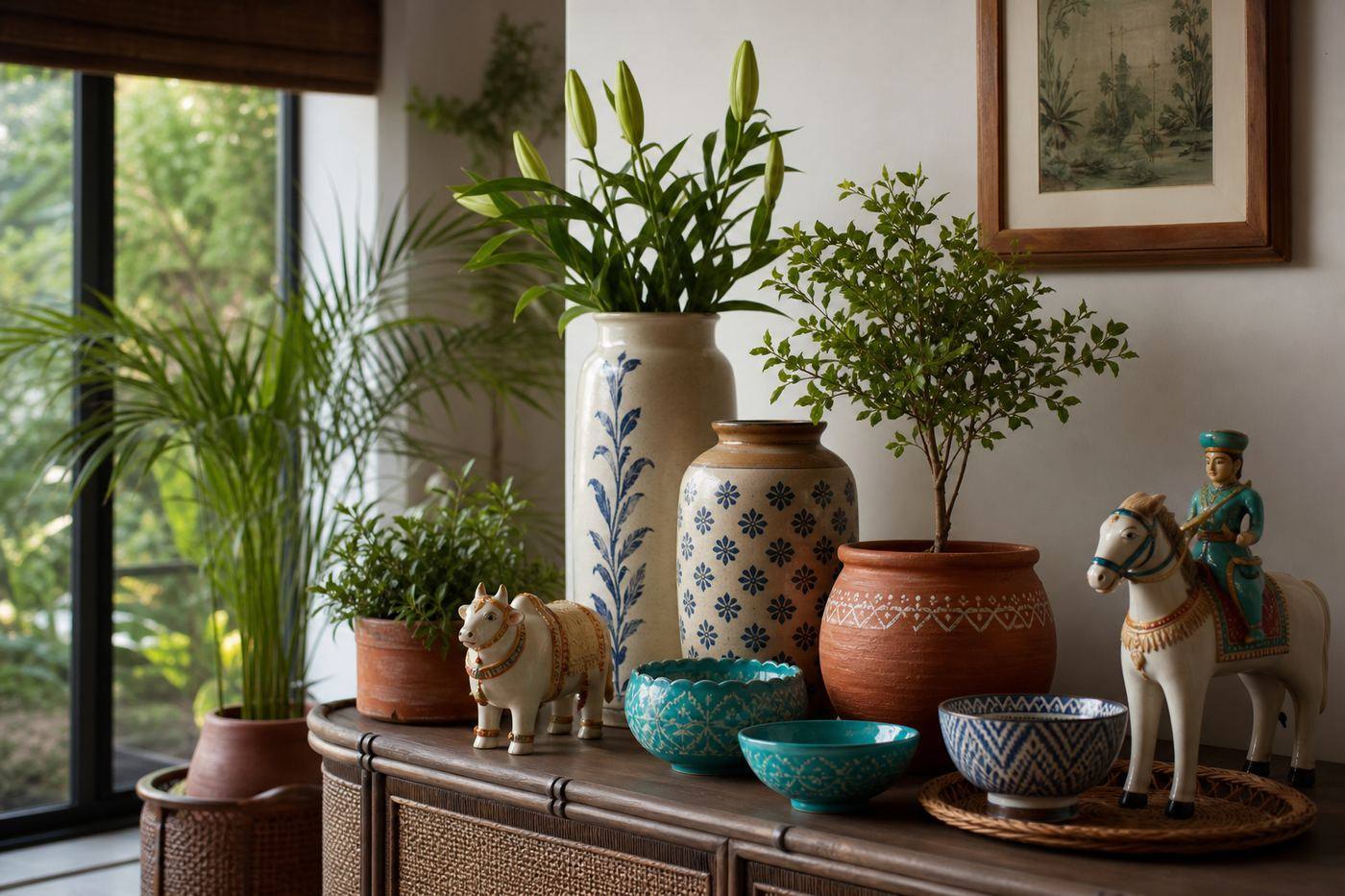
Indian terracotta and ceramic handicraft products — unglazed terracotta gardenware, glazed earthenware and stoneware artware, porcelain décor, Jaipur blue pottery, Molela terracotta plaques, Bankura figurines, Asharikandi utility artware, ornamental ceramic accents, and ceramic tabletop pieces — form one of the most commercially flexible clayware export baskets from India. Top export SKUs include terracotta planters and garden pots, glazed ceramic vases and bowls, blue pottery bowls and decorative plates, ceramic figurines and gift accents, wall plaques and mural tiles, and curated ceramic tabletop artware. Directionally, these lines ship under ITC-HS Chapter 69: 6913 for ornamental ceramics (EPCH examples 69131000 and 69139000), 6912 for non-porcelain tableware, 6911 for porcelain tableware when classified as such, and 6914 for other ceramic articles including many planters — always confirm with your CHA per SKU.
This guide is the product pillar for the terracotta and ceramic export cluster: it maps SKU taxonomy, clay bodies, glazes and finishes, cluster×product fit, directional FOB pricing, MOQ by product family, packaging standards for breakable pottery, and buyer-channel alignment. It is written for international buyers, importers, distributors, wholesalers, retail chains, and procurement teams selecting Indian clayware lines for garden centres, home décor specialty, gift shops, hospitality amenities, and private-label programmes.
The end-to-end export process — IEC, EPCH RCMC, HS triage, kiln QC, packing, and first shipment — is owned by the companion process guide, How to Export Terracotta and Ceramic Handicrafts from India. Destination ranking lives in Best Countries for Indian Terracotta and Ceramic Handicraft Exports; per-country SKU demand in Most Demanded Indian Terracotta and Ceramic Handicrafts by Country; the importer playbook in Source Terracotta and Ceramic Handicrafts Directly from India; lead-safe glaze and blue pottery depth in Lead-Safe Glaze, Blue Pottery & Food-Contact Ceramic Export Opportunities; documentation in Terracotta and Ceramic Handicraft Export Documentation Checklist; buyer prospecting in How to Find International Buyers for Terracotta and Ceramic Handicrafts; EPCH mechanics in EPCH Registration Benefits for Terracotta and Ceramic Exporters; and trade fairs in Trade Shows and B2B Marketplaces for Terracotta and Ceramic Exporters.
Key Takeaways
Summary Box
Executive Summary
Summary Box
Terracotta and ceramic handicrafts — kiln-fired clay gardenware, glazed pottery artware, porcelain décor, blue pottery, and heritage terracotta plaques and figurines — are India's signature clay export category for outdoor living and indoor décor programmes. The commercial SKU map spans gardenware (planters, pots, urns), glazed structural décor (vases, bowls, jars), heritage artware (blue pottery, Molela plaques, Bankura figurines), gift accents (figurines, ornaments, small trays), and ceramic tabletop artware (when intentionally classified and certified as tableware). Each family differs in clay body, glaze chemistry, kiln cycle, fragility profile, HS description, and buyer channel — which is why SKU selection should precede market entry, not follow it.
This article provides the product intelligence importers need: what clay bodies and finishes India exports at scale, which Khurja, Jaipur, Molela, Bankura, Asharikandi, or Delhi cluster produces each family best, directional FOB bands, MOQ logic, packaging requirements, and channel fit. For registration, shipping, and first-container execution, cross-reference How to Export Terracotta and Ceramic Handicrafts from India.
Market Size & Industry Overview
Key Statistics
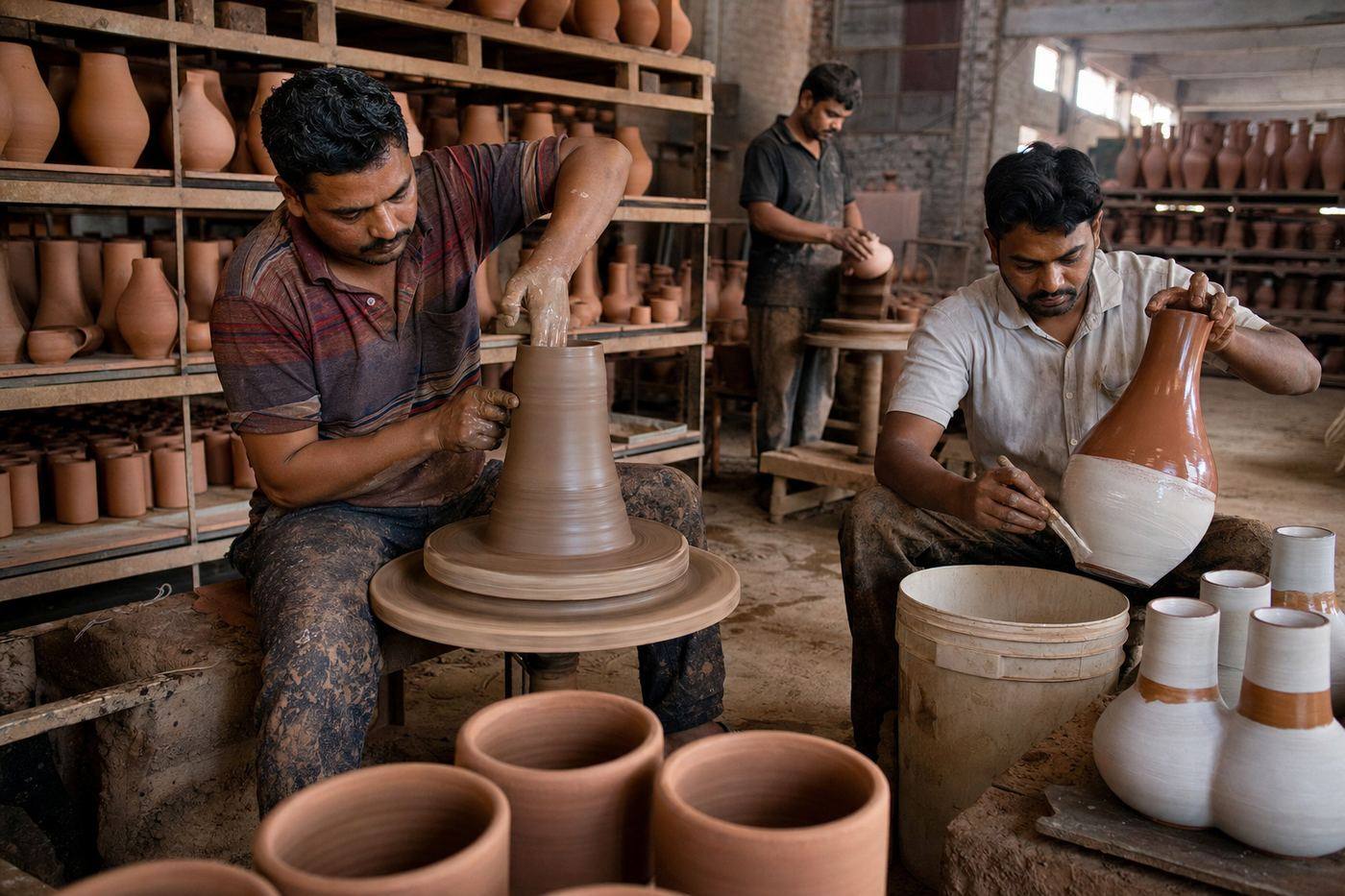
India's terracotta and ceramic export base is concentrated in Khurja (Uttar Pradesh) for industrial glaze-fire artware, with heritage strength in Jaipur blue pottery, Molela terracotta plaques, Bankura and Bishnupur figurines, Asharikandi Eastern terracotta, and selective Longpi black pottery. Supporting gardenware capacity runs across Tamil Nadu, Pondicherry, and Gujarat. Delhi-NCR merchant exporters consolidate mixed programmes, engineer retail cartons, and stage cargo for Nhava Sheva, Mundra, and ICD Delhi / Dadri sailings. Broader EPCH handicraft exports (excluding carpets) directionally reached roughly Rs 33,122.79 crore (US$3,917.89 million) in FY 2024–25 — sector context only. Ceramic-specific planning should reference Chapter 69 lines such as 6913, 6912, and 6914 via DGCI&S / TradeStat, not total handicrafts volume.
Channels driving SKU demand include garden centres and outdoor living buyers, home décor specialty, department-store gift tables, gift shops, e-commerce private label, hospitality amenity and guest-gift programmes, museum and gallery gift shops, and wholesale showrooms. USA, Germany, UK, UAE, Netherlands, France, Australia, Canada, and Japan directionally lead import interest — validate per HS line before locking country rankings in assortment planning.
Terracotta and ceramic export cluster × capability map
Swipe →
Data table — swipe horizontally on small screens
| Cluster | Core SKUs | Finish Strength | Typical Buyer Channel |
|---|---|---|---|
| Khurja (UP) | Glazed vases, planters, bowls, figurines, gift ceramics | Programme-scale glaze fire, colour assortments | Home décor specialty, private label, wholesale |
| Jaipur blue pottery | Bowls, vases, decorative plates, tiles | Turquoise/floral quartz-frit heritage finish | Design retail, museum shops, premium gifts |
| Molela (Rajasthan) | Terracotta plaques, mural reliefs | Hand-molded folk relief tradition | Wall décor, heritage design retail |
| Bankura / Bishnupur | Terracotta horses and figurines | Folk sculptural terracotta | Gift specialty, cultural retail |
| Asharikandi (Assam) | Terracotta toys and utility artware | Eastern craft terracotta | Craft retail, curated gift assortments |
| Delhi-NCR consolidation | Mixed sets, private-label ceramic programmes | Barcode labelling, export carton engineering | Retail chains, e-commerce private label |
Export Statistics
Key Statistics
Directionally, terracotta planters, glazed ornamental ceramics under HS 6913, and mid glazed vases represent the highest combined export interest among Indian clayware SKUs — with blue pottery and Molela plaques as margin anchors for design retail and figurines as strong gift-specialty fillers. Treat all trade values as directional until confirmed against current DGCI&S / TradeStat releases for 6913, 6912, and 6914. Never invent a single terracotta-only EPCH export total from the broader handicraft aggregate.
Directional export profile by terracotta and ceramic SKU family
Swipe →
Data table — swipe horizontally on small screens
| SKU Family | Directional Export Interest | Typical HS Proxy |
|---|---|---|
| Terracotta planters / gardenware | Highest outdoor-living volume | 6914 (confirm) / sometimes 6913 |
| Glazed ceramic vases & bowls | Highest home-décor specialty volume | 6913 (69139000 common) |
| Jaipur blue pottery | Strong premium design retail | 6913 (verify) |
| Ceramic figurines & accents | Strong gift specialty / e-commerce | 6913 (69131000 / 69139000) |
| Molela plaques / wall décor | Design retail / mural programmes | 6913 (verify) |
| Ceramic tabletop artware | Growing when food-contact ready | 6912 / 6911 when tableware identity |
Import Statistics
Key Statistics
Import demand patterns vary by destination: USA buyers drive terracotta planter and glazed décor volume; German and French buyers emphasise lead-safe glaze on bowls and tabletop identity SKUs; UAE buyers favour fast-turn hospitality ceramic gifts and décor planters; UK and Australian buyers mix garden centres with home-décor vases. For destination×SKU detail, see Most Demanded Indian Terracotta and Ceramic Handicrafts by Country.
Directional import demand by destination and top SKUs
Swipe →
Data table — swipe horizontally on small screens
| Destination | Top Imported SKU Families | Finish / Compliance Note |
|---|---|---|
| USA | Terracotta planters, glazed vases, figurines | Prop 65 glaze readiness; frost evidence for outdoor lines |
| Germany | Glazed bowls, vases, tabletop identity SKUs | LFGB / lead-cadmium migration when tableware claimed |
| UK | Planters, gift ceramics, blue pottery accents | UK REACH; honest origin labelling |
| UAE | Hospitality décor, small planters, gift bowls | Fast freight; breakage packing still critical |
| France | Blue pottery, Molela plaques, statement vases | Design-led finishes; glaze quality critical |
| Netherlands | Mixed ceramic assortments for EU distribution | REACH; retail glaze QC at hub |
| Australia | Gardenware, vases, figurine sets | Breakage-sensitive packing; frost claims |
| Canada | Planters and glazed décor — USA-adjacent assortment | Glaze compliance aligned with North America |
| Japan | Fine glazed bowls, blue pottery, small vases | Dimensional precision; packing standards |
Product Categories & Variants
Summary Box
Indian terracotta and ceramic export SKUs organise into gardenware, glazed structural décor, heritage artware, gift accents, wall décor, and ceramic tabletop. Within each family, variants differ by clay body (terracotta, earthenware, stoneware, porcelain, blue pottery frit), forming method (wheel, mold, hand-build), glaze family (unglazed, engobe, gloss, matte, reactive, crackle, turquoise blue pottery), and size ladder. The tables below are the core taxonomy importers use for RFQs and assortment planning.
Primary terracotta and ceramic export product categories
Swipe →
Data table — swipe horizontally on small screens
| Category | Common Shapes | Typical Size Range | Primary Cluster |
|---|---|---|---|
| Terracotta planters | Cylinder, bowl, urn, tapered, square | 15 cm – 80 cm height | Khurja; Tamil Nadu / Gujarat gardenware belts |
| Glazed ceramic vases | Necked, bulbous, cylindrical, bottle | 15 cm – 60 cm height | Khurja |
| Glazed bowls / jars | Round, footed, lidded | 10 cm – 35 cm diameter | Khurja |
| Jaipur blue pottery | Bowls, vases, plates, tiles | 8 cm – 40 cm | Jaipur |
| Ceramic figurines | Animals, deities (secular décor), abstract | 8 cm – 45 cm | Khurja; Bankura for terracotta folk forms |
| Molela plaques | Rectangular / panel relief | 15 cm – 60 cm | Molela |
| Wall tiles / mural units | Square, rectangular relief | 10 cm – 30 cm modules | Molela; Jaipur decorative tiles |
| Tabletop artware | Serving bowls, mugs, platters (when tableware) | Programme-specific | Khurja — only with food-contact evidence |
| Gift accent sets | Small bowls, figurines, mini planters | 5 cm – 20 cm | Khurja; Delhi-NCR assortments |
| Asharikandi terracotta | Toys, small utility pieces | 5 cm – 25 cm | Asharikandi |
Clay Bodies Used in Export Programmes
Clay body options for Indian ceramic export SKUs
Swipe →
Data table — swipe horizontally on small screens
| Clay Body | Characteristics | Best SKU Fit | Export Caution |
|---|---|---|---|
| Terracotta (low-fire earthenware) | Porous, warm red-brown, often unglazed or slip-decorated | Planters, garden urns, folk figurines, plaques | Frost claims need freeze-thaw evidence |
| Glazed earthenware | Bisque + glaze fire; wide colour range | Vases, bowls, gift décor | Crazing risk if cooling uncontrolled |
| Stoneware | Denser body, higher fire, durable finish | Premium planters, tabletop, statement vases | Longer kiln cycles; higher MOQ pressure |
| Porcelain artware | White translucent body when thin | Fine décor, some tableware programmes | May classify under 69131000 or 6911 |
| Blue pottery (quartz-frit) | Non-clay quartz/glass-frit body; turquoise motifs | Bowls, vases, plates, tiles | Still merchandise as ceramic artware; confirm HS with CHA |
Clay body choice drives glaze fit, frost performance, weight, colour, and HS narrative. Do not treat "terracotta" and "ceramic" as interchangeable RFQ labels — specify body type in every inquiry.
Glazes & Surface Finishes
Glaze and finish tiers for ceramic export SKUs
Swipe →
Data table — swipe horizontally on small screens
| Finish Tier | Description | Typical SKUs | Compliance Note |
|---|---|---|---|
| Unglazed / slip | Natural terracotta or engobe decoration | Planters, plaques, folk figurines | Frost and porosity messaging must be honest |
| Standard gloss glaze | Single or two-fire gloss colour | Volume Khurja vases and bowls | Document lead/cadmium when food-contact claimed |
| Matte / satin | Soft sheen contemporary palette | Modern décor programmes | Watch rub and fingerprint visibility in packing |
| Reactive / specialty | Multi-oxide colour movement | Statement vases and gift sets | Higher lot-to-lot variance — lock reference sample |
| Blue pottery turquoise | Heritage cobalt/turquoise floral | Jaipur bowls, vases, plates | Premium packing; fragile rim protection |
| Food-contact glaze systems | Tested migration-compliant glazes | Tableware bowls, mugs, platters | Lab COA required — see specialty lead-safe guide |
Finish tier changes price, lead time, and compliance burden. Reactive and crackle glazes look premium but demand tighter lot colour control; matte and satin finishes photograph well for e-commerce; high-gloss remains the Khurja volume default for many gift programmes.
Manufacturing Overview
Export Tip
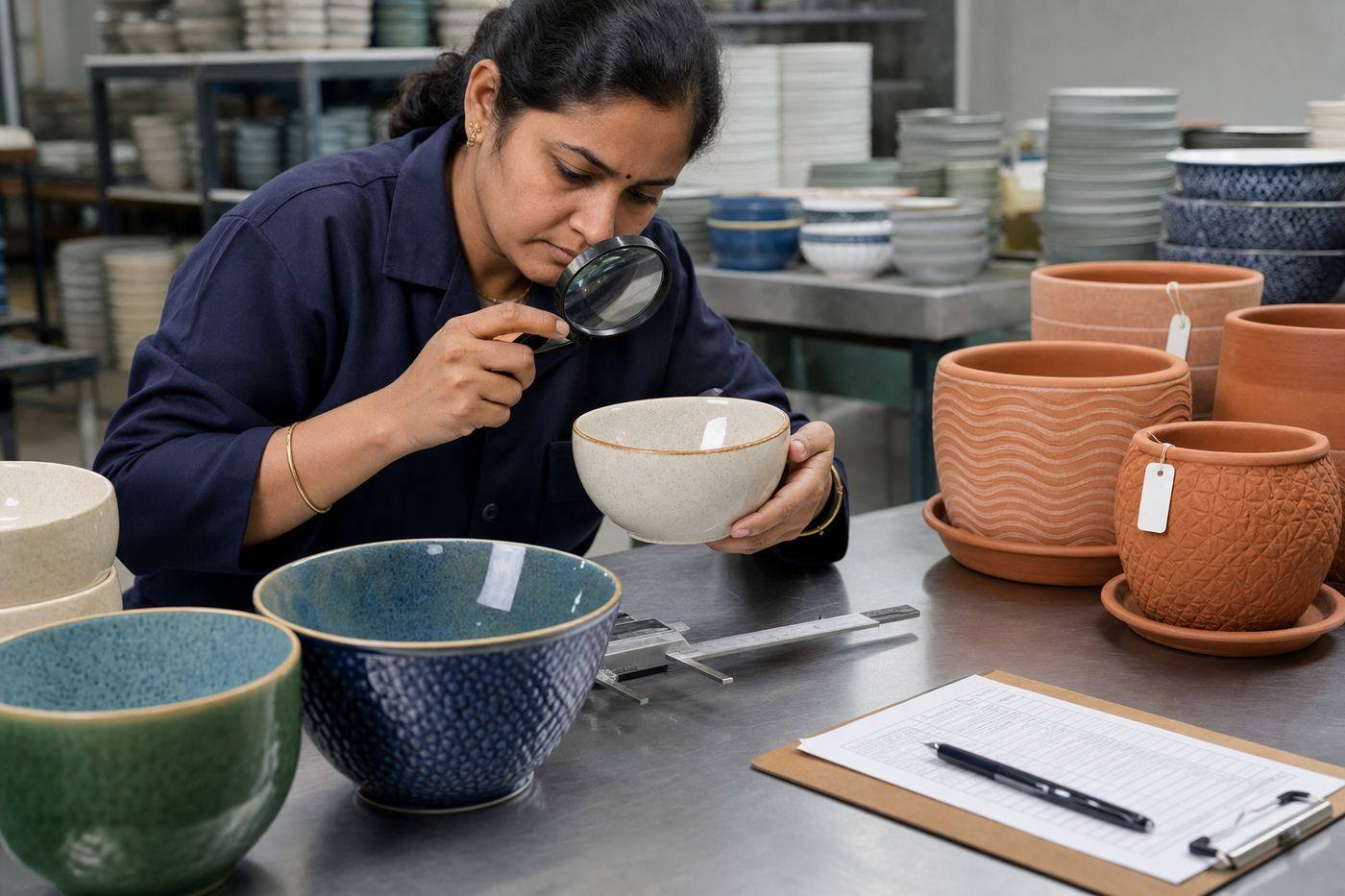
Every terracotta and ceramic SKU follows the same production spine: clay preparation → forming (wheel, mold, slip cast, hand-build) → controlled drying → bisque fire → optional glaze → glaze fire → cooling → QC → export packing. Structural SKUs (necked vases, tall planters) demand tighter dimensional tolerance at forming; flat SKUs (plaques, tiles) stress warp control and even glaze; blue pottery stresses frit-body handling and rim integrity; figurines stress mold definition and undercut packing.
Finish tiers materially affect cycle time and price. An unglazed terracotta planter may move through a simpler fire schedule than a multi-glaze statement vase or a food-contact bowl requiring migration testing. Buyers should specify clay body, glaze tier, and claim status in the RFQ — not assume all "ceramic pots" share the same production calendar.
Export Process (SKU Selection Implications)
Export Tip
- Select SKU family and clay body before issuing IEC/EPCH timeline assumptions to buyers
- Map each hero SKU to a primary cluster (Khurja, Jaipur, Molela, Bankura, Asharikandi, Delhi packing)
- Approve reference samples by glaze lot and size ladder, not by photography alone
- Engineer carton cells for the tallest and most fragile SKU in the assortment first
- Confirm HS heading per SKU (6913 / 6912 / 6911 / 6914) before printing hangtags
This product guide does not restate the full registration-to-shipment sequence — that is owned by How to Export Terracotta and Ceramic Handicrafts from India. What matters here is how SKU choice changes process load: planters emphasise frost evidence and stack-height packing; food-contact bowls emphasise migration labs; blue pottery emphasises rim protection and heritage finish control; mixed assortments emphasise HS line-splitting on invoices.
Pricing Analysis
Buyer Tip
Ceramic pricing is driven by size, clay body, glaze complexity, kiln cycles, hand finishing, packing intensity, and freight CBM. Quote by SKU family and finish tier. Broader EPCH handicraft totals are not a pricing proxy — use Chapter 69 TradeStat context only for demand direction.
Directional FOB pricing by terracotta and ceramic SKU family (USD; verify quote date)
Swipe →
Data table — swipe horizontally on small screens
| SKU Family | Directional FOB | Key Price Driver |
|---|---|---|
| Small accents / ornaments / mini planters | $1–8/pc | Size, hand detail, packing cells |
| Mid glazed vases / bowls / planters | $4–28/pc | Glaze tier, dimensional tolerance, kiln grade |
| Statement blue pottery / large garden terracotta | $15–75+/pc or set | Size, heritage finish, frost-rated body, packing |
| Molela plaques / mural sets | Set-level quote | Relief complexity, panel count, wall-safe packing |
| Food-contact / lead-safe private label | Evidence-dependent premium | Lab testing, documentation, retail packaging |
MOQ Analysis
Buyer Tip
MOQ logic differs by SKU family. Planters often quote by size ladder rather than a single piece MOQ; blue pottery may run lower piece counts at higher unit value; Khurja glaze programmes favour carton or colour-way MOQs; garden FCL programmes consolidate many SKUs into 20GP or 40HC loads.
Directional MOQ tiers by terracotta and ceramic product family
Swipe →
Data table — swipe horizontally on small screens
| SKU Family | Sample MOQ | Trial MOQ | Wholesale Pattern |
|---|---|---|---|
| Terracotta planters | 5–10 pcs/size | Mixed LCL or 100–300 pcs/hero size | Size ladder by carton; seasonal FCL |
| Glazed vases / bowls | 5–20 pcs/SKU | 100–400 pcs or colour-way trial | By carton / CBM / colour way |
| Blue pottery | 5–15 pcs/SKU | 80–250 pcs typical trial | Lower piece MOQ; higher unit value |
| Figurines / accents | 10–20 pcs/SKU | 200–400 pcs mixed | Assortment cartons common |
| Molela plaques | 5–12 pcs/design | 50–200 pcs depending on size | Panel sets and mural kits |
| Tabletop food-contact lines | 5–20 pcs + lab retain | Higher trial due to testing cost | Programme contract after COA |
Packaging Standards
Export Tip
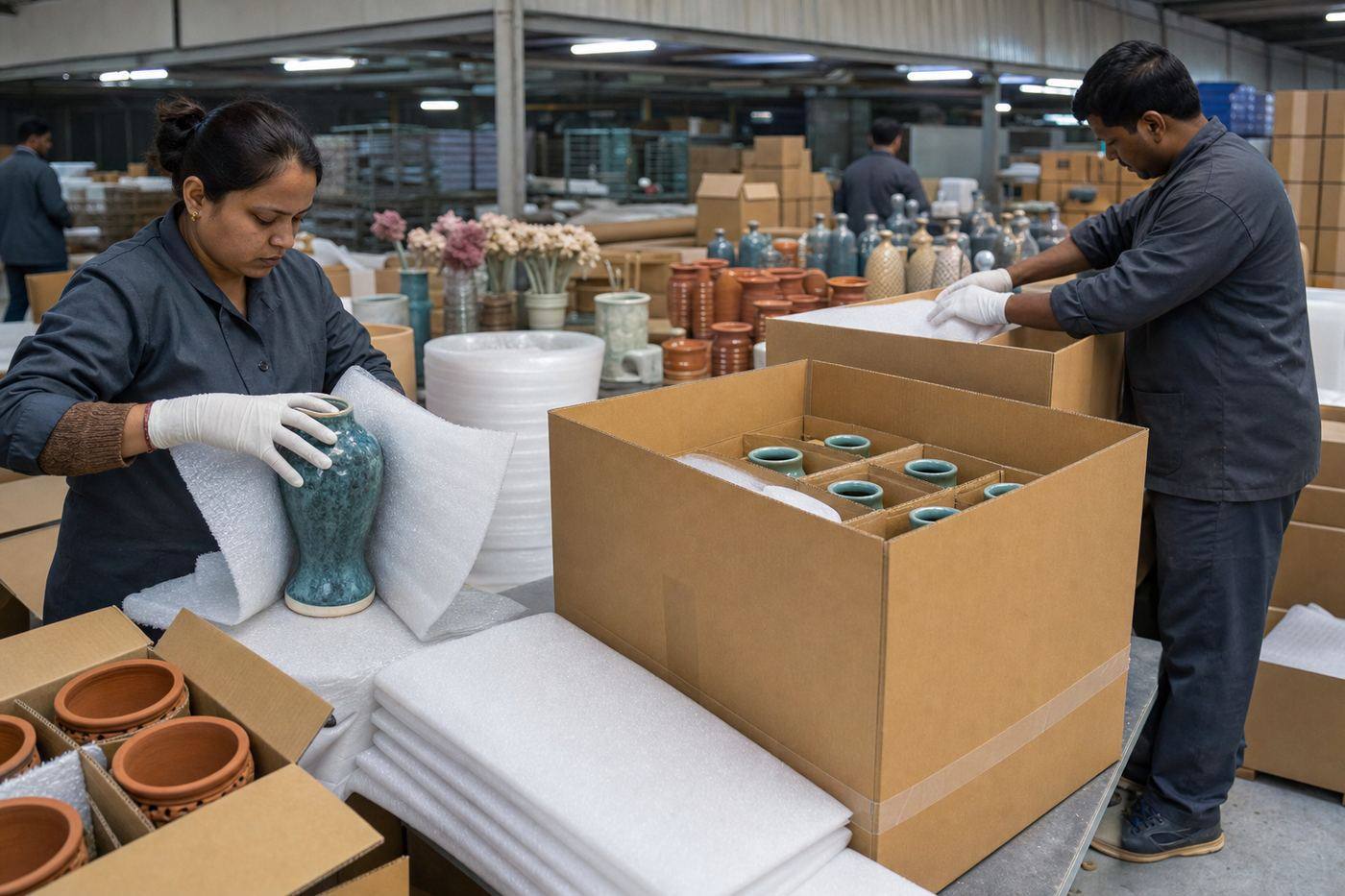
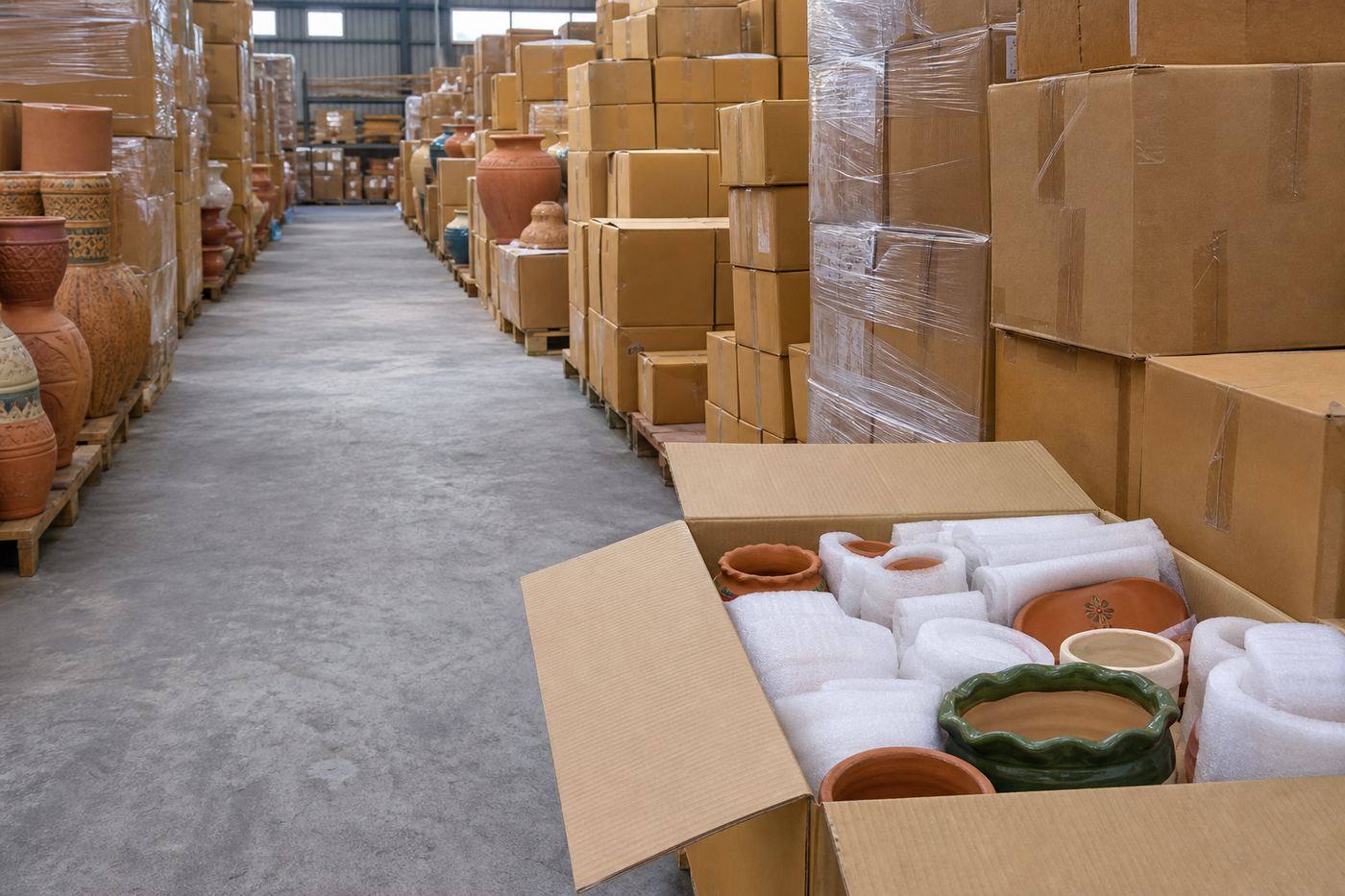
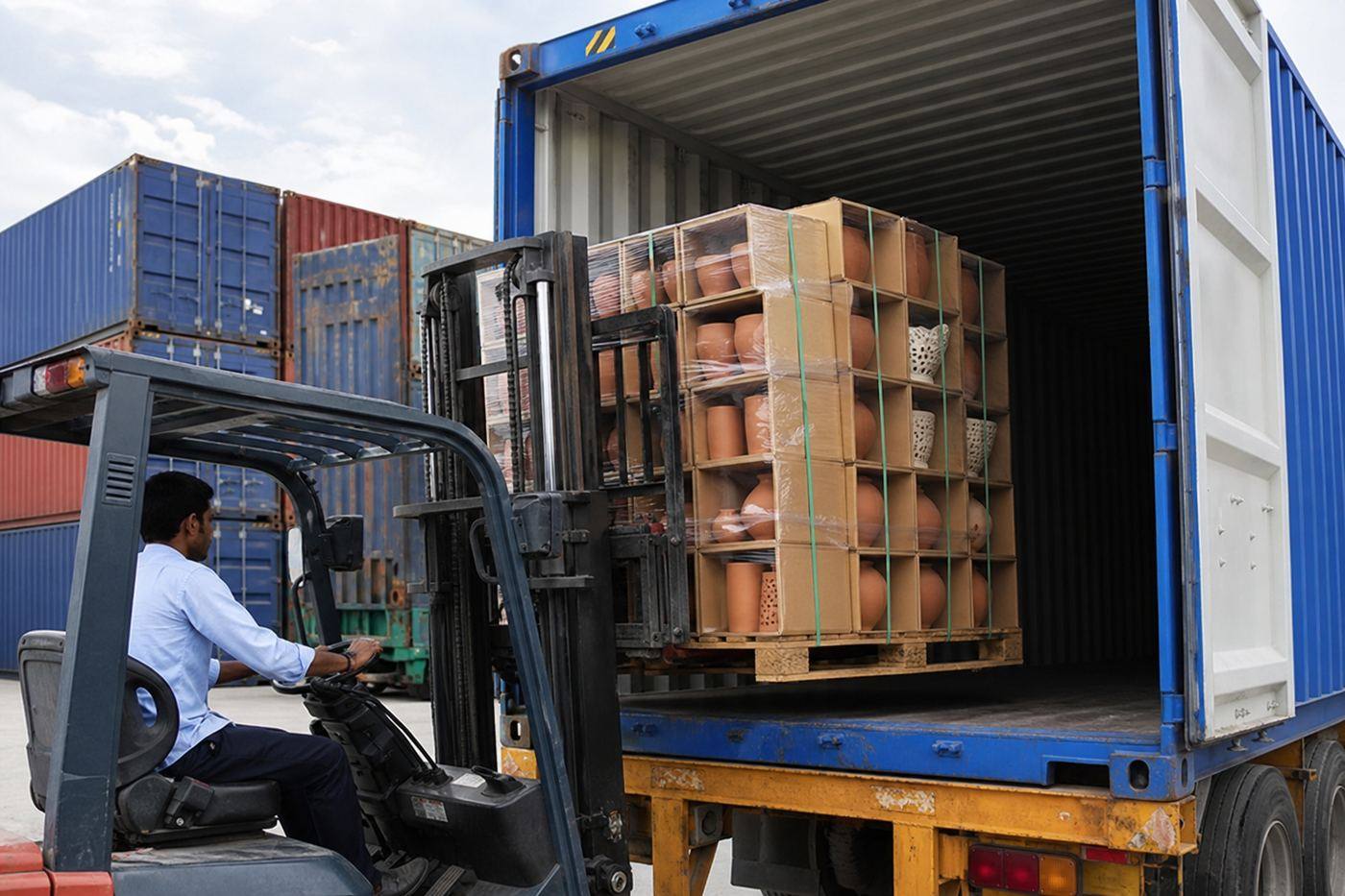
Breakable pottery packaging is SKU-specific. Tall planters need stack-height limits and rim protectors; blue pottery needs individual foam and rigid gift or export cartons; plaques need edge protection and flat packing orientation; nested bowls nest only when designed for nesting.
Packaging standards by terracotta and ceramic SKU family
Swipe →
Data table — swipe horizontally on small screens
| SKU Family | Primary Pack Method | Critical Control |
|---|---|---|
| Tall terracotta planters | Foam wrap + double-wall carton + stack limit label | Never over-stack thin walls |
| Glazed vases | Individual foam + cell or sleeve + rigid carton | Neck and rim chip prevention |
| Blue pottery bowls / plates | Foam wrap + retail gift box + export outer | Rim abrasion and finish rub |
| Figurines | Molded pulp or foam cavities + dividers | Undercut and protruding limb protection |
| Molela plaques | Edge protectors + flat orientation + rigid board | Corner crush and relief damage |
| Mixed assortments | SKU-labelled cartons + reconciled packing list | HS line-split discipline on docs |
Container Loading Details
Export Tip
Garden planter FCLs are almost always cube- and stack-limited. A 40HC stuffed with large terracotta will hit safe stack height long before weight. Mixed décor programmes need explicit stuffing diagrams showing which SKUs sit at base versus upper tiers.
Container loading notes by product mix
Swipe →
Data table — swipe horizontally on small screens
| Load Profile | Preferred Equipment | Planning Note |
|---|---|---|
| Large planter FCL | 40HC preferred | Stack-height limited; dunnage for tall pieces |
| Glazed décor mixed | 20GP or 40HC | Palletise where possible; void-fill gaps |
| Blue pottery premium | LCL trial then 20GP | Extra handling care; avoid LCL crush transfers when scaling |
| Figurine assortments | LCL or 20GP | High piece count; carton engineering dominates |
| North India consolidation | ICD Delhi / Dadri → Nhava Sheva / Mundra | Standard for Khurja and Jaipur cargo |
Shipping Methods
Export Tip
- Samples: air / courier, 10–21 days inclusive of production
- Stock glazed décor: ocean, 4–7 weeks production plus transit
- Custom glaze / private label: 6–12 weeks typical
- Garden planter programmes: book 4–8 months ahead of spring windows
- Primary ports: Nhava Sheva, Mundra; ICD Delhi / Dadri consolidation
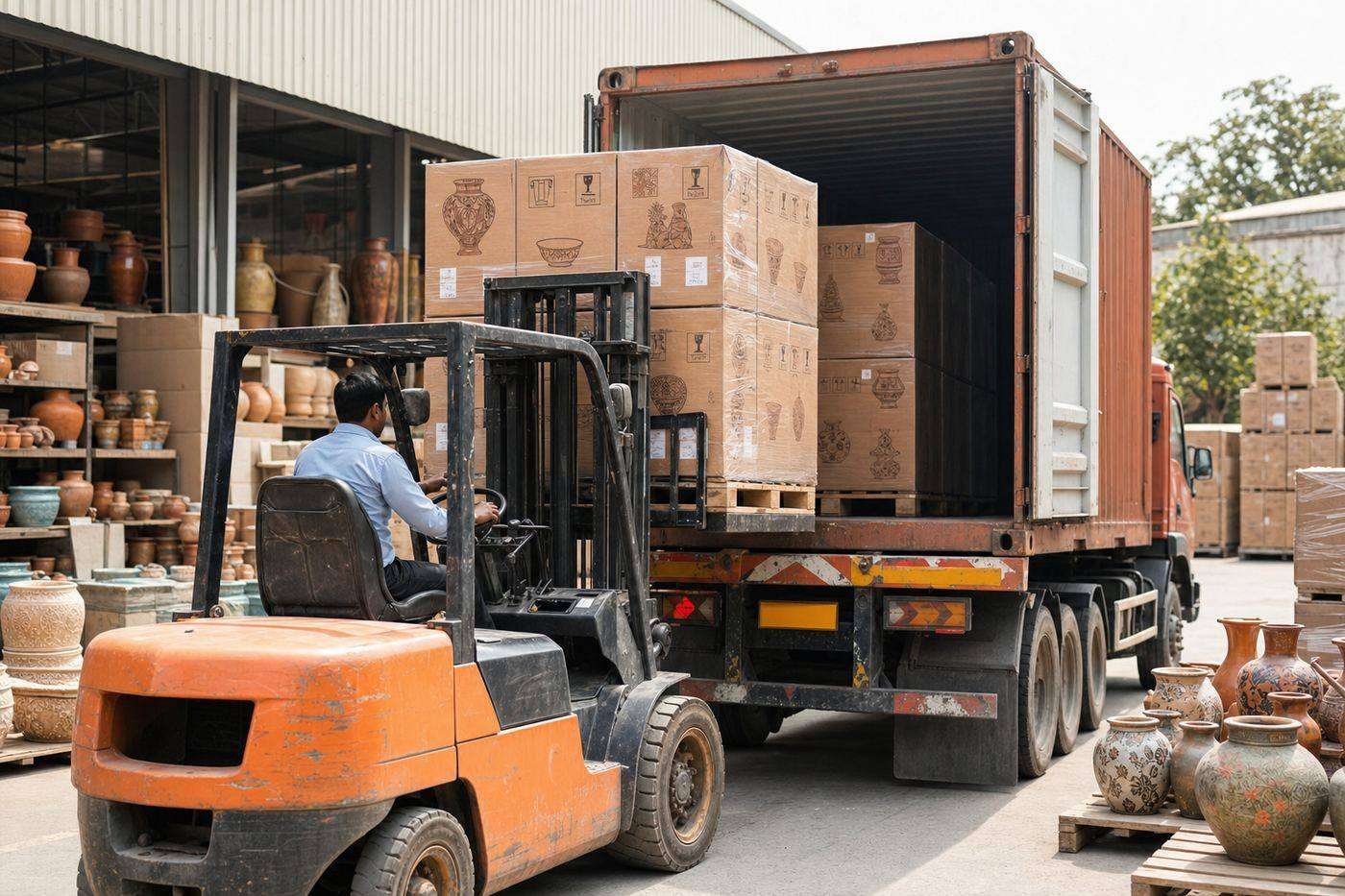
Commercial volumes move by ocean FCL or LCL. Air is reserved for samples and late-season fill-ins because dense ceramics make air freight expensive relative to FOB. Incoterms follow the process pillar defaults: EXW, FOB, CFR/CIF; DDP rare on first fragile trials.
Certifications
Compliance Notes
SKU choice drives certification load. Ornamental glazed décor may need REACH/Prop 65 awareness without full food-contact COAs; tableware identity under 6912/6911 triggers FDA/LFGB pathways; outdoor terracotta with frost marketing needs freeze-thaw evidence; children's figurines with toy claims trigger CPSC/ASTM pathways. For the specialty deep-dive, see Lead-Safe Glaze, Blue Pottery & Food-Contact Ceramic Export Opportunities.
Certification intensity by SKU family
Swipe →
Data table — swipe horizontally on small screens
| SKU Family | Baseline Docs | Elevated Docs When Claimed |
|---|---|---|
| Ornamental glazed décor | IEC, EPCH, commercial pack, PSI | Prop 65 / REACH glaze statements |
| Outdoor terracotta planters | IEC, EPCH, packing photos | Frost / freeze-thaw test evidence |
| Blue pottery artware | IEC, EPCH, heritage finish notes | Premium packing + glaze composition notes |
| Tabletop food-contact | IEC, EPCH | Lead/cadmium migration COA; LFGB/FDA pathway docs |
| Children's figurines / toys | IEC, EPCH | CPSC / ASTM F963 / EN71 with lab evidence |
Buyer Requirements
Buyer Requirements
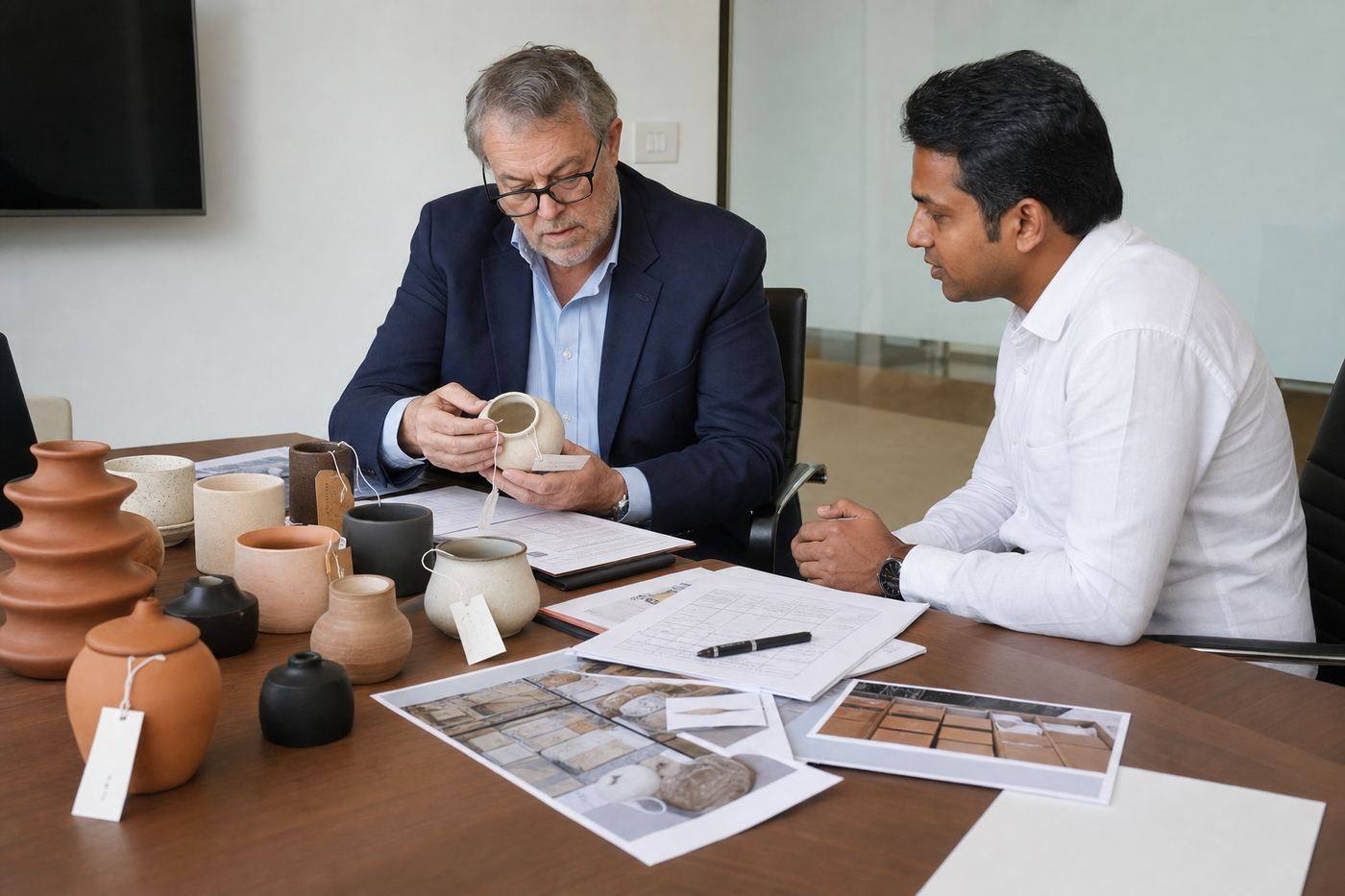
Buyers typically request a SKU matrix with clay body, glaze, dimensions, FOB by volume tier, pack method, HS suggestion, sample lead time, and claim status (frost / food-contact / children's). Preparing that matrix before the first call accelerates shortlisting. For RFQ-to-landed-cost execution, see Source Terracotta and Ceramic Handicrafts Directly from India.
Country-wise Opportunities
Market Snapshot
SKU fit varies by market: USA garden centres favour terracotta planters; Germany and France reward lead-safe bowls and heritage finishes; UAE favours fast hospitality décor; Japan favours precise small glazed pieces. Full destination ranking is in Best Countries for Indian Terracotta and Ceramic Handicraft Exports; SKU×country demand depth is in Most Demanded Indian Terracotta and Ceramic Handicrafts by Country.
SKU opportunity snapshot by destination
Swipe →
Data table — swipe horizontally on small screens
| Destination | Priority SKUs | Assortment Tip |
|---|---|---|
| USA | Planters, glazed vases, figurines | Lead with outdoor + décor ladder |
| Germany | Glazed bowls, tabletop identity | Prioritise lead-safe glaze evidence |
| France | Blue pottery, Molela plaques | Lead with heritage design story |
| UK | Planters, gift ceramics | Garden + indoor mix works well |
| UAE | Hospitality décor, small planters | Fast turns; strong packing |
| Australia | Gardenware, vases | Frost honesty + breakage control |
| Japan | Fine bowls, blue pottery | Dimensional and finish precision |
| Canada | Planters, glazed décor | Mirror USA assortment at smaller scale |
| Netherlands | Mixed EU hub assortments | Ready REACH/glaze pack for redistribution |
Sourcing Checklist
Checklist
Buyer Checklist
Exporter Checklist
Common Buyer Mistakes
Common Mistakes Box
Assortment mistakes are usually SKU-definition mistakes — vague "ceramic pots" RFQs produce uncomparable quotes and packing failures.
Common SKU-selection mistakes for Indian ceramic programmes
Swipe →
Data table — swipe horizontally on small screens
| Mistake | Consequence | How to Avoid It |
|---|---|---|
| RFQ says 'ceramic pots' without clay body or glaze | Incomparable quotes; wrong cluster matched | Specify body, glaze, size ladder, claim status |
| Mixing food-contact and pure décor without HS/claim split | Customs and retail audit friction | Separate 6912/6911 tableware from 6913 ornaments |
| Ordering frost-proof terracotta with no test file | Chargebacks after winter retail failure | Require freeze-thaw evidence or drop the claim |
| Underpacking blue pottery as if it were thick terracotta | Rim chips and finish rub on arrival | Premium individual wrap + rigid outers |
| Skipping trial on planter size ladders | FCL cube waste and stack crush | Trial each hero size before seasonal FCL |
| Assuming Khurja can replicate Jaipur blue pottery | Identity mismatch and buyer rejection | Source blue pottery from verified Jaipur capacity |
Future Market Trends
Key Statistics
Assortment trends favour frost-credible outdoor terracotta, matte and reactive glaze families for contemporary décor, lead-safe food-contact private label, and honestly framed blue pottery / Molela heritage lines. E-commerce buyers want consistent photography packs and carton labels that survive last-mile handling. Exporters who publish SKU-level clay body, glaze, and claim status will win RFQs faster than those offering only blended catalogues.
For compliance-led premium opportunities, read Lead-Safe Glaze, Blue Pottery & Food-Contact Ceramic Export Opportunities. For market sequencing after assortment choice, use Best Countries for Indian Terracotta and Ceramic Handicraft Exports.
Challenges & Solutions
SKU-scale challenges differ from process-registration challenges: lot colour drift on reactive glazes, planter stack crush, blue pottery rim fragility, and mis-matched HS lines in mixed cartons are the recurring product-side failures.
Product-side challenges and solutions
Swipe →
Data table — swipe horizontally on small screens
| Challenge | Root Cause | Solution |
|---|---|---|
| Colour drift across glazed lots | Reactive glaze variance without locked reference | Approve physical reference; limit reactive SKUs early |
| Planter breakage in FCL | Over-stacking tall thin walls | Print and enforce stack-height limits |
| Blue pottery rim chips | Insufficient individual wrap / rigid outers | Double-box premium lines; foam every piece |
| HS confusion in mixed assortments | Ornaments, planters, tableware in one invoice line | Split 6913 / 6914 / 6912 / 6911 rows |
| Food-contact claim without lab readiness | Marketing ahead of testing | Keep as ornamental until COA exists |
Compliance Checklist
Checklist
Compliance Notes
Expert Insights
Expert Insight Box
Altus Exports helps international buyers and Indian manufacturers build terracotta and ceramic assortments that are commercially coherent — matching SKUs to clusters, glaze readiness, and packing reality rather than to catalogue wish lists alone.
How Altus Exports Helps
As a merchant exporter in India and product sourcing company in India, Altus Exports maps buyer assortments to Khurja, Jaipur blue pottery, Molela, Bankura, Asharikandi, and Delhi-NCR packing capacity. We help define clay body and glaze tiers, engineer fragile packing for planters and blue pottery, and keep HS and claim documentation aligned with the SKUs actually ordered.
Explore export products from India, global sourcing partner India, and find manufacturers in India, or contact Altus Exports with your target SKUs, destination market, and volume band. Category context sits under handicrafts and lifestyle products.
Conclusion
- Next step: Share your target SKUs, clay/glaze preferences, and destination with Altus Exports for an assortment map.
- Execute process steps via How to Export Terracotta and Ceramic Handicrafts from India.
- Rank markets with Best Countries for Indian Terracotta and Ceramic Handicraft Exports.
- Deepen compliance specialty with Lead-Safe Glaze, Blue Pottery & Food-Contact Ceramic Export Opportunities.
- Map demand by country with Most Demanded Indian Terracotta and Ceramic Handicrafts by Country.
- If you are buying, follow Source Terracotta and Ceramic Handicrafts Directly from India.
- Explore merchant exporter services, global sourcing partner, and contact Altus Exports.
Top terracotta and ceramic handicraft products exported from India span terracotta planters, glazed Khurja vases and bowls, Jaipur blue pottery, figurines, Molela plaques, and — when certified — ceramic tabletop artware. Choose SKU family and clay body first, match the cluster second, then lock glaze claims, packing, MOQ, and HS heading before you scale to FCL.
Use this product taxonomy with the process pillar How to Export Terracotta and Ceramic Handicrafts from India and the market ranking in Best Countries for Indian Terracotta and Ceramic Handicraft Exports to turn assortment ideas into shippable programmes.