
How to Find International Buyers for Coir Mats
By Saurabh Mittal, Founder, Altus Exports
A lead-generation playbook for Indian coir mat exporters — HS 570220 trade-data prospecting, garden-centre and DIY retail lists, LinkedIn outreach to home and garden buyers, and a verification protocol that separates genuine doormat importers from time-wasters.
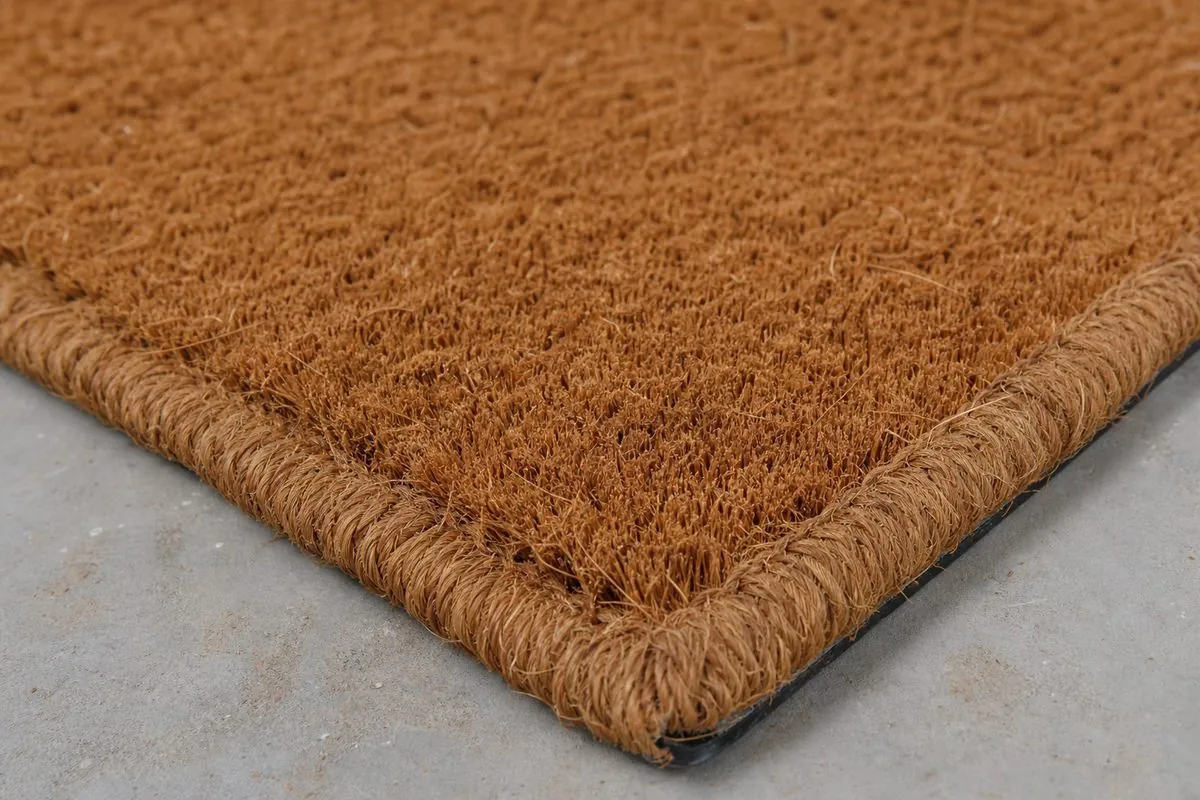
Finding international buyers for coir mats is a discovery-and-verification problem, not a catalogue problem. The exporters who fill pipelines fastest treat HS 5702.20 (floor coverings of coconut fibres / coir — India examples 57022010, 57022020 / 57022090) as a prospecting filter — not as an afterthought on a shipping bill. Finished coir doormats, mattings, and tufted entrance mats from Alappuzha (Alleppey) / coastal Kerala coir belt and Pollachi and western Tamil Nadu reach importers in United States, United Kingdom, Germany, Netherlands, South Korea, Australia, Canada, France, Italy, United Arab Emirates every season, but the shipments that become repeat programmes are the ones where the first outreach named the right HS line, size mix, backing type, and moisture-aware packing story.
Broader India coir & coir products exports: IBEF (citing DGCIS) reports about US$455 million in FY25 (vs about US$360 million in FY24). The same IBEF page also states FY25 shipments of 1,342,843 MT worth about US$434 million to 121 countries — treat both figures as IBEF-reported sector context (all coir categories: pith, fibre, mats, etc.), not mats-only, and re-verify against Coir Board / DGCIS extracts before contracts. FY25 value-share mix (IBEF): coir pith ~59.63%, coir fibre ~12.06%, tufted mats ~16.73%. Separately, HS 570220 (woven coir floor coverings) world-trade aggregates (OEC-style, 2024) show India as a leading exporter (~US$44.6M directional) with top importers including USA, South Korea, and UK — do not conflate that woven-line total with tufted/PVC programmes that often classify under HS 5703.90. This guide is a buyer discovery and outreach playbook built exclusively for finished coir mats under HS 5702.20 — not a product-spec deep-dive, not a documentation-template pack, not a coir pith or coir yarn essay, and not a rubberized mattress-block primer. Separate HS chapters — do not file finished doormats as coir fibre, yarn, or pith. Confirm every 8-digit ITC-HS line with your CHA before filing; confusing finished doormats with fibre or pith is the fastest way to lose a garden-centre or home-retail buyer who already imports under 570220.
For the end-to-end export process, read How to Export Coir Mats from India. For SKU range, see Top Coir Mat Products Exported from India. For destination ranking, see Best Countries for Indian Coir Mat Exports. For country × construction × size × backing demand, see Most Demanded Indian Coir Mats by Country. For buyer-side sourcing mechanics, see Source Coir Mats Directly from India. For Coir Board credibility, see Coir Board Registration Benefits for Coir Mat Exporters. For PVC-backed custom-logo and eco natural premium pathways, see PVC-Backed Custom Logo and Eco Coir Doormat Export Opportunities. For booth and marketplace ROI, that lives in Trade Shows and B2B Marketplaces for Coir Mat Exporters, not here. Documentation field templates live in Coir Mat Export Documentation Checklist.
Altus Exports operates as a merchant exporter in India and global sourcing partner, running structured buyer-discovery programmes for coir mat exporters consolidating Alappuzha and Pollachi capacity toward Cochin (Kochi), Tuticorin (V.O. Chidambaranar), Chennai, Nhava Sheva (JNPT), Mundra (westbound consolidations). This guide is written for exporters allocating outreach bandwidth — and for procurement teams who want to understand how credible Indian coir mat suppliers actually get found.
Key Takeaways
Summary Box
Executive Summary
Summary Box
Coir mat buyer discovery breaks into two halves that must run in parallel. Inbound channels — a discoverable website with HS-accurate category pages for natural, PVC-backed, rubber-backed, and custom-logo doormats; LinkedIn presence aimed at garden and home retail category managers; and visible Kerala/Tamil Nadu cluster credibility — pull buyers who already decided they want Indian coir entrance mats. Outbound channels — HS 570220 trade-data mining, garden-centre and DIY retail lists, structured cold email that names the buyer's own shipment history, and targeted follow-up on qualified prospects — reach buyers who are rotating suppliers or expanding seasonal assortments and have not started an active search.
The buyer universe is not homogeneous. A UK garden-centre chain specifying PVC-backed 40×60 cm natural fibre mats with moisture-barrier packing has almost nothing in common with a US e-commerce private-label buyer running custom-logo programmes, or a Gulf hospitality distributor buying rubber-backed entrance mats for hotel lobbies. Matching outreach language, sample kit, size mix, and backing framing to the correct archetype is what separates a low reply rate from a conversation that reaches a written RFQ within two weeks.
This guide walks through market context anchored on directional HS 570220 trade scale, trade-data-led prospecting, LinkedIn garden/home outreach, garden-centre and DIY list qualification, buyer verification, and destination-specific opportunity — closing with sourcing and compliance checklists. Process depth lives in the pillar guide; premium PVC/logo and eco-claim pathways live in the specialty companion.
Market Size & Industry Overview
Key Statistics
Broader India coir & coir products exports: IBEF (citing DGCIS) reports about US$455 million in FY25 (vs about US$360 million in FY24). The same IBEF page also states FY25 shipments of 1,342,843 MT worth about US$434 million to 121 countries — treat both figures as IBEF-reported sector context (all coir categories: pith, fibre, mats, etc.), not mats-only, and re-verify against Coir Board / DGCIS extracts before contracts. FY25 value-share mix (IBEF): coir pith ~59.63%, coir fibre ~12.06%, tufted mats ~16.73%. Separately, HS 570220 (woven coir floor coverings) world-trade aggregates (OEC-style, 2024) show India as a leading exporter (~US$44.6M directional) with top importers including USA, South Korea, and UK — do not conflate that woven-line total with tufted/PVC programmes that often classify under HS 5703.90. Use DGCI&S / TradeStat / ITC Trade Map / OEC screens on HS 5702.20 / 57022010 as the finished-mat proxy. Do not invent a blended “coir sector total” that mixes pith, fibre, yarn, and mats, and do not present geotextile or rubberized mattress figures as doormat demand.
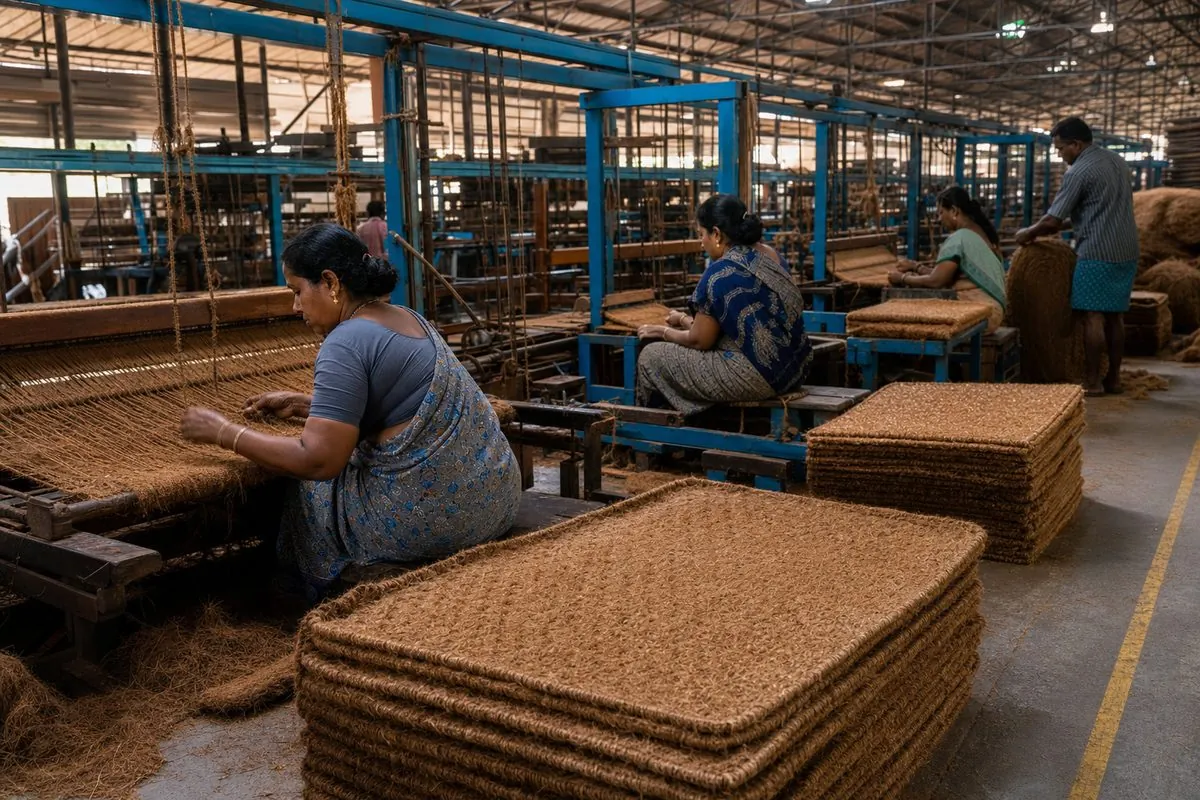
India's finished coir mat base concentrates in Alappuzha (Alleppey) / coastal Kerala coir belt, Pollachi and western Tamil Nadu, with Merchant consolidation via Kochi, Chennai, Tuticorin, Delhi-NCR export houses moving programmes to south- and west-coast load ports. For a buyer, that geography means asking whether “Indian coir mat” claims are backed by cluster manufacturing visibility, size and pile consistency, backing adhesion evidence, and honest merchant-exporter disclosure when the exporter is consolidating rather than weaving.
Coir Mat Buyer Archetype Map for Outreach
Swipe →
Data table — swipe horizontally on small screens
| Buyer Archetype | Typical Volume Pattern | Best Discovery Channel |
|---|---|---|
| Garden-centre chains | Seasonal FCL / programme reorders | Trade data (57022010), garden retail directories, LinkedIn |
| DIY / home improvement retail | Assortment resets + private label | Trade data + retail buyer lists + LinkedIn |
| Home specialty / department stores | Seasonal + décor calendar | Trade data + merchandiser LinkedIn |
| Hospitality entrance-mat programmes | Spec-tight smaller–medium lots | Distributor lists + referral + trade data |
| E-commerce private label | SKU rotation + logo programmes | LinkedIn + marketplace follow-up + trade data |
| Wholesale distributors / importers | Opportunistic + programme FCLs | Trade data (5702.20), distributor directories |
Export Statistics
Key Statistics
Trade-data screens are the highest-leverage tool for coir mat buyer discovery. Filtering Indian export shipping-bill data under HS 57022010 by destination surfaces consignees already importing finished coir floor coverings — companies with documented, repeatable import habit under the correct mats line, not prospects who “might need natural fibre someday.” When a buyer's history shows repeat entries under 570220 with rising piece or value cadence, that is a live signal for a programme pitch; when the same buyer spikes under fibre or pith chapters, do not force a doormat story.
Read directional aggregates as floors for planning, not ceilings for contracts. When you write a first-contact email, quote the correct HS line for the finished mat you are pitching, name the buyer's own shipment history under that line, and never lump your offer into coir pith, yarn, or geotextiles. A retail-literate importer will read the wrong HS as a signal you have never shipped the category.
Trade-Data Screens for Coir Mat Buyer Discovery
Swipe →
Data table — swipe horizontally on small screens
| Screen | Discovery Use |
|---|---|
| HS 57022010 filter | Isolate finished mats and matting programmes |
| HS 5702.20 destination import filter | Confirm who already imports coir floor coverings |
| Fibre / yarn / pith chapter contrast | Exclude non-mat buyers unless you intentionally sell those goods |
| Destination country filter | Focus outreach on USA, UK, EU, Korea, Australia corridors |
| Consignee / importer name analysis | Build a named garden/home retail target list |
| Shipment frequency (12-month view) | Separate programme buyers from one-off traders |
| Port-of-discharge pattern | Map regional distribution and re-export hubs |
| Origin mix analysis | Spot buyers switching from other coir-mat origins |
| Value / piece band | Segment commodity natural mats from PVC/logo programmes |
| Seasonal spike detection | Time outreach before spring garden and festive retail resets |
Import Statistics
Key Statistics
Destination-side import data adds the confirmation layer origin data alone cannot provide: competing origins, landed-cost patterns, and which buyers are growing coir-mat intake versus shrinking it. Priority watchlist markets: United States, United Kingdom, Germany, Netherlands, South Korea, Australia, Canada, France, Italy, United Arab Emirates. US HTS 5702.20.10 (floor coverings of coconut fibres, with pile) Column 1-General is typically Free (MFN) per USITC HTS — confirm live schedule and any Chapter 99 overlays before landed-cost quotes. Tufted coir under HTS 5703 may carry different rates — classify first, then price duty. EU CN 5702 20 (woven coir) and CN 5703 90 (tufted) — confirm TARIC duty and preferential origin claims before CFR/CIF programmes. UK tariff for coir floor coverings — verify live schedule by exact HS (5702.20 vs 5703.90) and preferential claim rules.
A buyer showing rising quarter-over-quarter HS 570220 import volume from any origin is a stronger discovery target than one with a single historical shipment. Watch for origin switches — those often represent size inconsistency, mould-in-transit failures, or backing-adhesion complaints you can solve with tighter QC and packing discipline. Watch also for distributors whose records show Netherlands or UAE discharge with onward EU/GCC distribution — those hubs often mask garden-centre and hospitality end-buyers you can approach later with cluster evidence.
Import Statistics — Coir Mat Buyer Prioritisation Signals
Swipe →
Data table — swipe horizontally on small screens
| Signal | Buyer Prioritisation Action |
|---|---|
| Repeat quarterly imports under HS 5702.20 | High priority — steady garden/home demand |
| Rising value under HS 5702.20 | High priority — assortment expansion or supplier rotation |
| Spring / pre-festive seasonal spikes | Time outreach 3–6 months ahead of retail reset |
| Importer + garden-centre brand match | High — end-user retail programme potential |
| Importer + DIY chain brand match | High — private-label / assortment RFQ path |
| One-off trader spike with no repeat | Low–medium — verify before allocating capacity |
| Fibre/pith importer with no 570220 history | Do not pitch finished mats unless they expand category |
| Origin switch after quality complaints | High — lead with QC photos and moisture packing |
Product Categories / Variants
Summary Box
At discovery stage you do not own deep product-spec architecture — but you must name the variant family correctly so the buyer's merchandiser knows you speak coir-mat English. Outreach that says only “coir products” converts poorly compared with messages that name natural handloom, PVC-backed plain, rubber-backed entrance, brush/scraper, or custom-logo programmes.
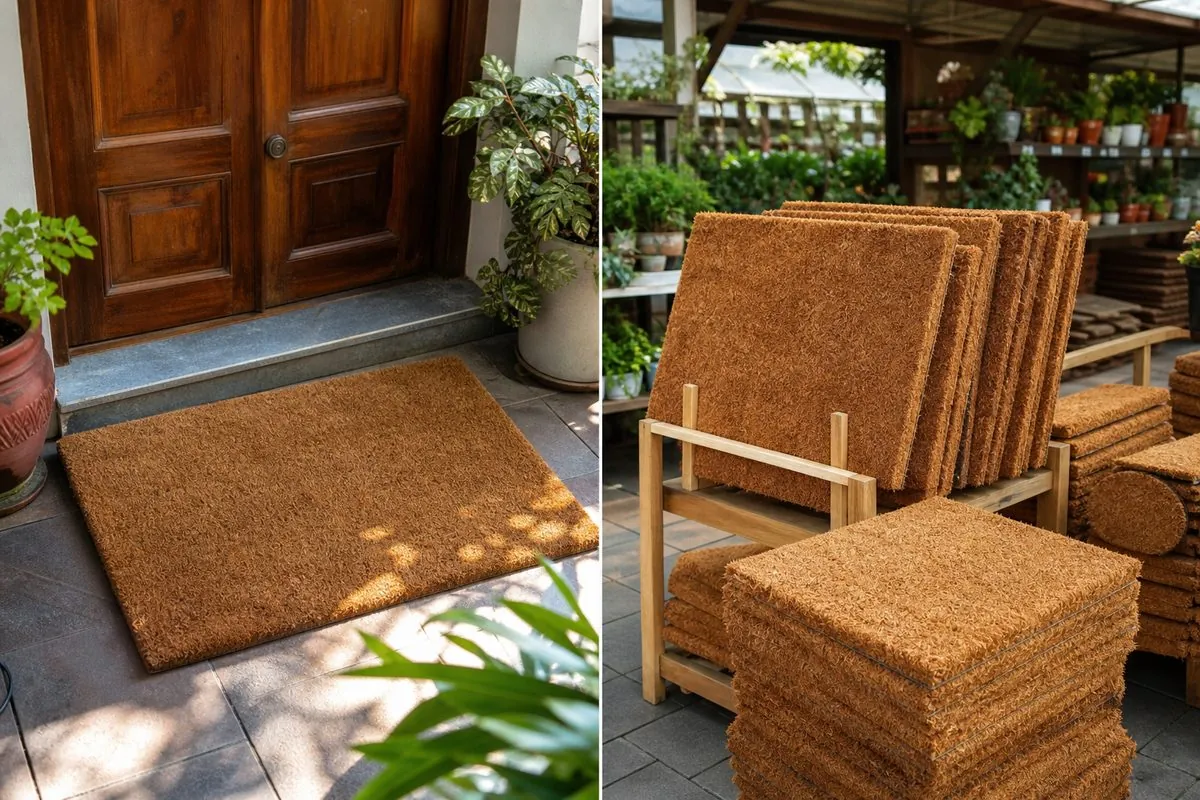
Common export families you will reference in outreach (full SKU depth lives in Top Coir Mat Products): Handloom coir mats; Power-loom coir mats; Tufted coir mats; Coir matting (roll / cut piece); PVC-backed coir doormats; Rubber-backed / rubberized coir entrance mats; Brush and scraper mats; Printed / custom-logo coir mats; Bleached vs natural fibre colourways. Typical size cards buyers recognise: 40×60 cm, 45×75 cm, 50×80 cm, 60×90 cm, 75×120 cm, Buyer-specific / roll matting by metre.
Variant Families to Name in First-Contact Outreach
Swipe →
Data table — swipe horizontally on small screens
| Variant Family | Typical Buyer Archetype | Outreach Framing |
|---|---|---|
| Natural / handloom coir mats | Garden centres, eco home retail | Fibre colourway + pile + size mix |
| Power-loom / tufted mats | Wholesale distributors, DIY | Consistency + cube + MOQ stage |
| PVC-backed plain doormats | DIY / garden chains | Backing adhesion + moisture packing |
| Rubber-backed entrance mats | Hospitality, commercial | Grip + edge finish + size card |
| Brush / scraper mats | Garden + DIY assortments | Function + size + durability note |
| Custom-logo / printed mats | Private label, promo, retail | Artwork lead time + setup MOQ |
| Coir matting (roll / cut) | Contract flooring, specialty | Metre pricing + crease avoidance |
| Bleached vs natural colourways | Design-led home retail | Colour honesty + lot consistency |
Manufacturing Overview
Export Tip
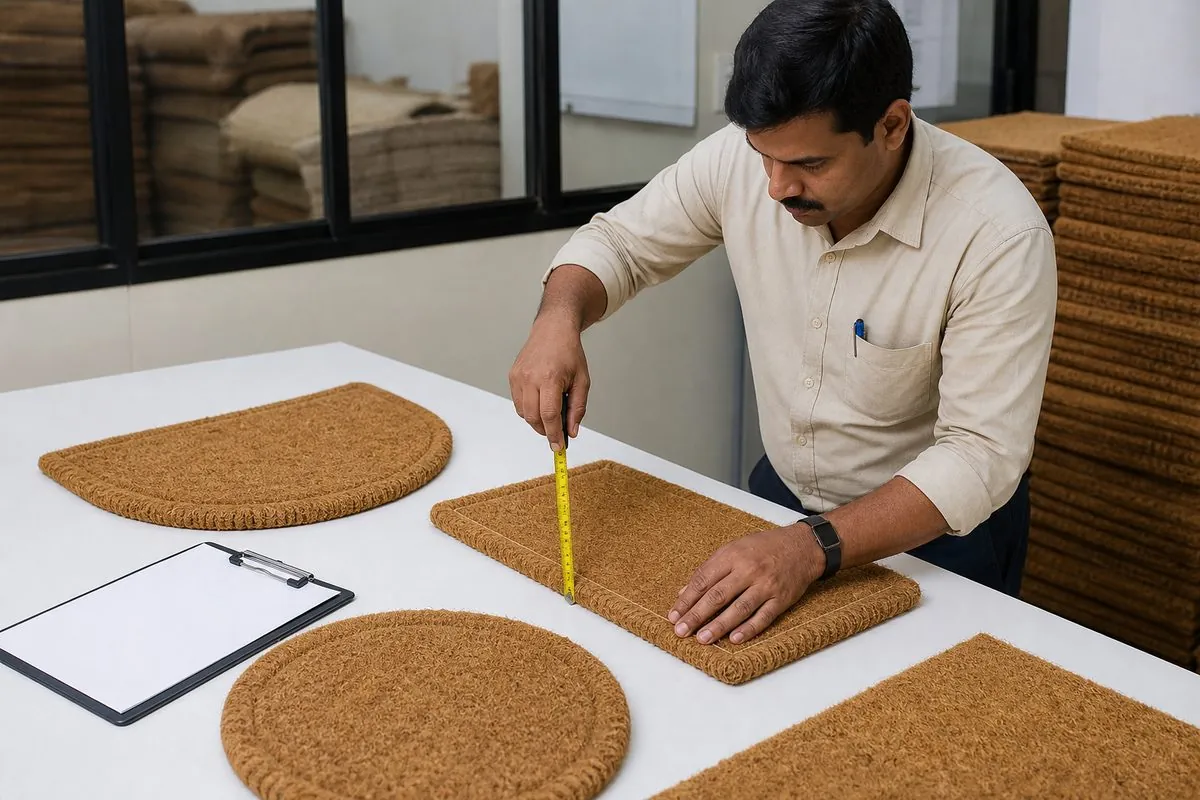
Buyer conversion depends on manufacturing credibility you can demonstrate — not just claim. Buyers who have imported Indian coir mats before will ask whether you control weaving and finishing visibility from Alappuzha (Alleppey) / coastal Kerala coir belt or Pollachi and western Tamil Nadu, or whether you are a port-city trader with a photo library and no line-of-sight to pile density and backing adhesion. Merchant-exporter programmes are legitimate when disclosed honestly; pretending to be the weaving unit when you are consolidating lots destroys trust at the first factory reference check.
Be ready to demonstrate: size tolerance practice, pile density checks, edge binding finish, backing type and adhesion evidence (for PVC/rubber programmes), moisture packing discipline, and named load ports. A short warehouse video showing carton packing, desiccant posture, and lot identity does more for first-contact confidence than two paragraphs of company history.
Exporter Credibility Package for First Contact
- 2–4 page company profile with named cluster narrative (Alappuzha (Alleppey) / coastal Kerala coir belt / Pollachi and western Tamil Nadu) and merchant-exporter role disclosure
- Catalogue extract with size card, backing type, and FOB named-port band — not stale absolute USD/pc
- Registration copies: IEC, Coir Board evidence
- Sample QC table: size, pile, edge, backing adhesion where applicable
- Moisture-barrier packing note for coconut-fibre goods
- Prior shipment references — redacted bills under HS 57022010 preferred
- Named commercial contact with garden/home-literate response commitment
Pricing Analysis
Buyer Tip
Pricing in outreach is a credibility signal. Quote FOB named Indian port (Kochi / Tuticorin / Chennai / Nhava Sheva). Indicative commercial FOB planning bands only (not official published prices): natural/handloom ~US$2–12/pc; PVC-backed plain ~US$3–15/pc; custom logo ~US$4–20+/pc; rubber-backed premium ~US$5–25+/pc by size — verify on quote date Indicative merchant-trade planning bands only; confirm size, pile density, backing, print, and packing on quote date. Do not cite as government price series.
Never lead with a round number ripped from last season's catalogue and labelled “current.” Garden-centre and DIY buyers build landed-cost models; they expect size, pile, backing, print setup, and packing to move the FOB. For custom-logo programmes, separate print-setup and artwork-approval lead time from unit FOB so the buyer does not confuse a one-time setup with piece price.
Directional FOB Framing for Outreach (Planning Only)
Swipe →
Data table — swipe horizontally on small screens
| Programme Type | Directional FOB Band | Outreach Note |
|---|---|---|
| Natural / handloom pcs | ~US$2–12/pc by size | State size + pile + colourway |
| PVC-backed plain | ~US$3–15/pc by size | State backing + adhesion QC |
| Custom logo / printed | ~US$4–20+/pc by size | Separate setup + artwork weeks |
| Rubber-backed premium | ~US$5–25+/pc by size | State grip + edge + hospitality use |
| Roll matting | Quote per metre | Crease + moisture discipline |
| Mixed assortment FCL | Cube-based blended FOB | Lock size mix before booking |
MOQ Analysis
Buyer Tip
Staged MOQs convert better than “full FCL or nothing.” Reference: samples 5–20 pcs; trial 200–1,000 pcs; wholesale PVC/logo 1,000–5,000+ pcs typical; handloom specialty Lower MOQ often possible after sample approval. MOQ figures are indicative commercial practice by construction and channel — not statutory minima. Lock MOQ in writing before production.
Buyers willing to start at sample or trial stage with paid courier costs are usually more reliable long-term accounts than accounts demanding multi-FCL commitments before any size or backing check. For private-label logo programmes, expect higher setup MOQs — detail lives in the specialty companion.
MOQ Stages to Offer in First-Contact Conversations
Swipe →
Data table — swipe horizontally on small screens
| Stage | Typical Quantity | Purpose |
|---|---|---|
| Paid samples | 5–20 pcs | Size, pile, edge, backing, print check |
| Trial / assortment | 200–1,000 pcs | Lot consistency + packing + moisture |
| Wholesale PVC / logo | 1,000–5,000+ pcs typical | Programme production + print setup |
| Handloom specialty | Lower MOQ often possible after sample approval | Lower MOQ after sample approval |
| Programme FCL | Size-mix planned 20GP/40HC | Retail reset / seasonal reorder |
Packaging Standards
Export Tip
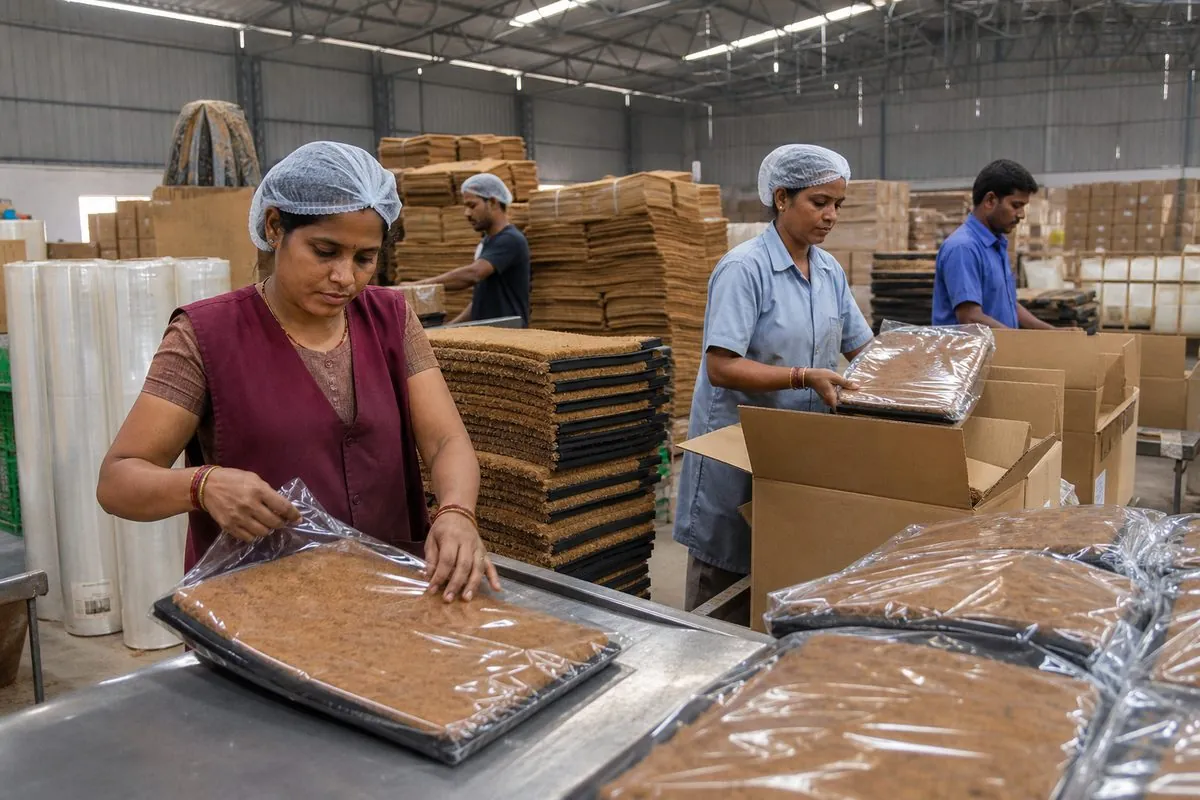
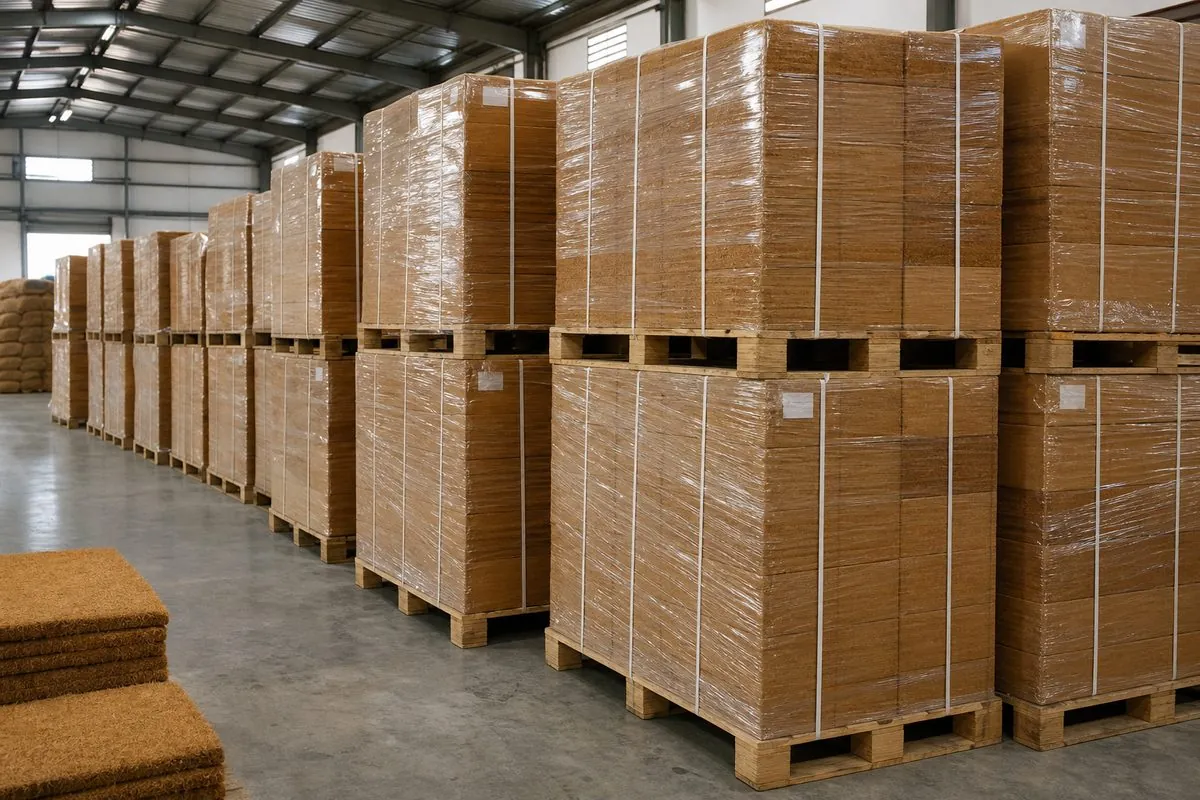
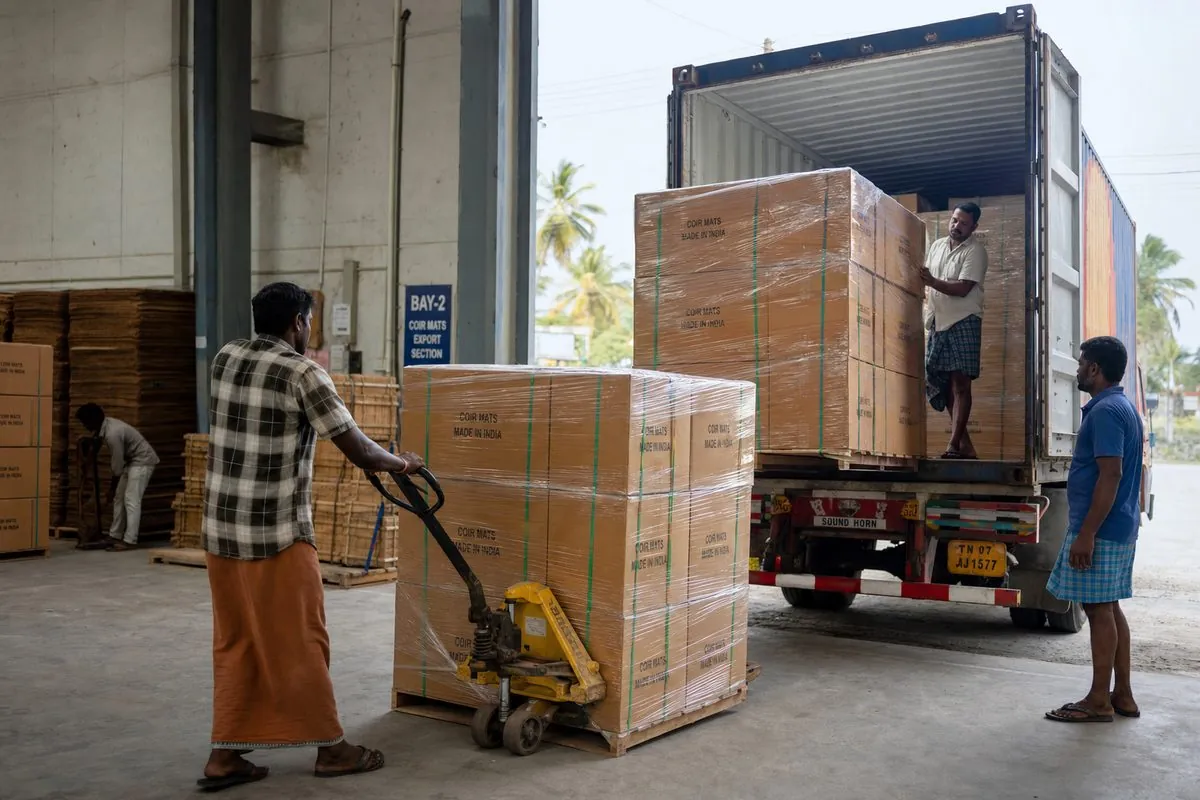
At discovery stage, buyers mainly need confidence you will not ship mouldy fibre. Reference packaging posture without turning this post into a packing-SOP manual: unit Individual poly bag or kraft wrap; edge protection for PVC-backed mats; master Master cartons or bales by size; palletize for FCL where specified; rolls Roll matting with crease avoidance and moisture barrier; moisture Desiccant / moisture-barrier discipline for coconut-fibre goods.
Mentioning desiccant and moisture-barrier discipline in the first or second email immediately distinguishes you from exporters who treat coir mats like dry hardware. Garden centres that have received mouldy lots will recognise the language and mark you as prepared.
Packaging Signals Buyers Expect at Discovery Stage
Swipe →
Data table — swipe horizontally on small screens
| Packing Element | Why Buyers Ask |
|---|---|
| Individual poly / kraft wrap | Edge and pile protection |
| Edge protection (PVC-backed) | Corner crush prevention |
| Master cartons or bales by size | Receiving DC scanability |
| Palletization for FCL | Warehouse handling |
| Desiccant / moisture barrier | Mould prevention on ocean transit |
| Lot identity on carton marks | QC traceability |
| Roll crease avoidance | Matting presentation quality |
Container Loading Details
Export Tip
Outreach should reference realistic cube thinking so buyers trust your FCL math. Coir mats are cube-sensitive by size mix; a 40×60 cm PVC-backed programme loads differently from 75×120 cm rubber-backed hospitality mats. Confirm piece count by size mix with your forwarder before promising a container yield in a cold email.
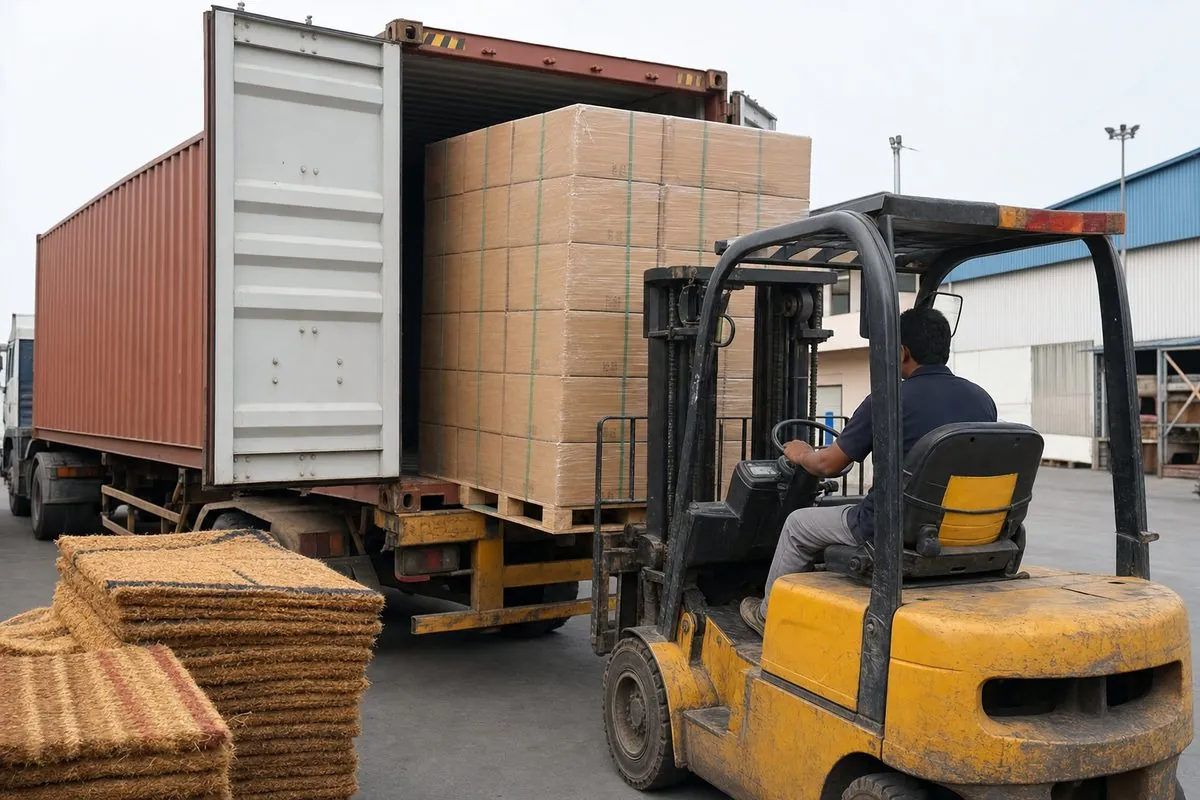
Common load ports for programmes you will name: Cochin (Kochi); Tuticorin (V.O. Chidambaranar); Chennai; Nhava Sheva (JNPT); Mundra (westbound consolidations). Prefer FCL for programme buyers; offer LCL or mixed consolidation for genuine trial-stage accounts rather than forcing premature full containers.
Container Options to Mention in Outreach
Swipe →
Data table — swipe horizontally on small screens
| Mode | Typical Use | Discovery Caution |
|---|---|---|
| 20ft FCL | Standard size-mix programmes | Lock size card before quoting piece yield |
| 40ft / 40HC | Larger retail or mixed décor | Cube often binds before weight |
| LCL / consolidation | Trial-stage or mixed SKU | Honest lead time + moisture risk |
| Air freight samples | Critical sample / late fill-ins | Price honestly; not for full programmes |
Shipping Methods
Export Tip
Name ports and Incoterms explicitly on early offers: ports Cochin (Kochi); Tuticorin (V.O. Chidambaranar); Chennai; Nhava Sheva (JNPT); Mundra (westbound consolidations); Incoterms EXW unit / warehouse; FOB Kochi / Tuticorin / Chennai / Nhava Sheva; CFR / CIF named destination port; DDP (selected large retail programmes only). Lead times buyers recognise: stock sizes 2–4 weeks for stock sizes after confirmation; custom logo 4–8+ weeks including artwork approval for logo/private-label programmes; samples 7–21 days typical for samples depending on construction.
Buyers appreciate a realistic timeline far more than an optimistic one that slips into their garden or festive season. Do not invent DDP capability in outreach if you cannot execute it.
Lead Time Reference for Coir Mat Outreach
Swipe →
Data table — swipe horizontally on small screens
| Stage | Typical Lead Time |
|---|---|
| Sample dispatch | 7–21 days typical for samples depending on construction |
| Stock sizes after confirmation | 2–4 weeks for stock sizes after confirmation |
| Custom logo / private label | 4–8+ weeks including artwork approval for logo/private-label programmes |
Certifications
Compliance Notes
Certification and compliance signals accelerate buyer trust at discovery stage without requiring a full technical deep dive up front. Lead with Coir Board registration as a baseline sector-credibility signal. Mention fibre composition declaration (coconut coir), third-party inspection willingness, Certificate of Origin readiness, and — for PVC/rubber programmes — REACH/SVHC awareness where required. Never claim “100% biodegradable coir mat” on PVC-backed goods without construction honesty.
Signals to keep ready (detail and claim architecture for PVC/eco premium live in the specialty post): Coir Board registration / RCMC evidence; Fibre composition declaration (coconut coir); ISO plant quality systems where available; Third-party inspection (SGS / Bureau Veritas / Intertek) on request; Certificate of Origin; REACH / SVHC declarations for PVC or rubber backings where required; Phytosanitary certificate where destination plant-health rules require it for plant-fibre goods; Honest eco / biodegradable claim controls (no overclaim on polymer-backed mats).
Certification & Compliance Signals by Buyer Type
Swipe →
Data table — swipe horizontally on small screens
| Buyer Type | Signal to Lead With |
|---|---|
| Garden-centre chain (UK/EU) | Coir Board + fibre composition + REACH backing awareness |
| DIY retail (USA) | Coir Board + fibre composition + honest eco language |
| Home specialty (EU) | Coir Board + size/pile QC + moisture packing |
| Hospitality distributor | Coir Board + rubber-back grip evidence + size card |
| Private-label e-commerce | Coir Board + artwork SLA + cert evidence where claimed |
| PVC/logo programme buyer | Coir Board + REACH/SVHC backing posture + print method |
Buyer Requirements
Buyer Requirements
First-contact buyer requirements are simpler than commercial-negotiation requirements. At discovery stage, buyers mainly want evidence you exist as a legitimate exporter, can meet a stated size/backing/print family, and can communicate reliably across time zones. Save detailed artwork approval workflows, private-label hangtag copy, and full PVC chemistry dossiers for after the buyer has qualified you — and for the specialty companion when the programme is premium logo/eco.
Discovery-Stage Buyer Requirement Matrix
Swipe →
Data table — swipe horizontally on small screens
| Requirement | Exporter Delivery |
|---|---|
| Company legitimacy | IEC + Coir Board referenced in profile |
| Coir-mat literacy | HS line, size card, backing type, moisture packing |
| SKU capability match | Catalogue extract with FOB band and construction notes |
| Quality evidence | Size/pile/edge photos, sample offer, QC table |
| Export history | Redacted shipping bill under HS 57022010 preferred |
| Compliance posture | One-line fibre/backing/eco-claim posture per destination |
| Communication reliability | Named contact with stated response SLA |
HS 570220 Trade-Data Prospecting
Pull destination import or India export extracts under HS 570220 / 57022010. Rank consignees by frequency and value. Prioritise buyers with three or more shipments in twelve months. In the first email line, reference the destination, approximate cadence, and the mat family you can supply — never a vague “coir products” opener.
Garden-Centre and DIY Retail Lists
Trade data finds importers; garden-centre and DIY directories find merchandisers. Cross-check chain names in the USA, UK, Germany, Netherlands, Australia, and Canada against import records. Garden centres care about seasonal natural and PVC-backed assortments; DIY chains often run private-label size cards with tighter barcode and carton-mark discipline. Lead with size consistency and moisture packing, not a discount race against a trader already on the dock.
LinkedIn Outreach Sequences
Target category managers, garden buyers, home merchandisers, and private-label managers with Sales Navigator filters by country. Sequence: (1) connection note naming HS 570220 and one size/backing family; (2) value note with FOB named-port band and sample MOQ; (3) proof note with redacted shipment or QC photo; (4) close ask for a 15-minute call or paid sample kit. Cap at four touches per unresponsive lead.
Buyer Verification Red Flags
Verify registered business identity and prior import history under HS 570220. Prefer buyers whose public catalogue already includes coir or natural-fibre doormats. Red flags: refusal to pay for samples; pressure for full-container commitment before sampling; shifting payment terms after a written quote; silence on moisture packing; requests to mis-declare fibre or pith as finished mats; and “100% biodegradable PVC-backed” marketing demands without construction honesty.
Country-wise Opportunities
Market Snapshot
Discovery-channel priority shifts by destination. Matching the right channel to the right market saves outreach hours. Use HS 5702.20 destination flow as your starting priority stack, then overlay garden/DIY channel fit and moisture packing posture per market.
Discovery-Channel Priority by Destination
Swipe →
Data table — swipe horizontally on small screens
| Destination | Primary Discovery Channels |
|---|---|
| USA | Trade data (570220) + LinkedIn DIY/garden + honest eco framing |
| UK | Trade data + garden-centre LinkedIn + moisture packing |
| Germany | Trade data + REACH backing awareness + QC evidence |
| Netherlands | Trade data + garden retail + construction honesty |
| France | Trade data + design-led colourway narrative |
| South Korea | Trade data + formal cadence + tight size cards |
| Australia / Canada | LinkedIn + mould-prevention packing messaging |
| UAE | Referral + direct RFQ + trade-fair follow-up |
| Italy | Trade data + home specialty merchandiser outreach |
United States
The USA responds well to trade-data-led outreach combined with LinkedIn prospecting to DIY chains, garden centres, home specialty merchandisers, and e-commerce private-label buyers. Honest eco language and fibre-composition labelling should appear early — a US importer who has been through a retail audit on green claims will recognise the discipline. Boutique and DTC brands often run smaller MOQs but higher SKU rotation on logo mats.
United Kingdom
UK buyer discovery blends trade-data targeting with LinkedIn outreach to garden-centre chains, home retailers, and online lifestyle brands. Many UK buyers run staged sample-to-trial cadences and care deeply about moisture packing after Atlantic transit. PVC-backed plain and natural brush mats are frequent assortment staples.
Germany, Netherlands, and France
Western European discovery favours REACH/SVHC-aware messaging for PVC/rubber backings alongside trade-data targeting under HS 570220. Netherlands garden and home buyers value construction honesty; Germany runs compliance-literate retail audits; France favours design-led colourways and finish honesty.
South Korea
South Korea is a high-signal HS 570220 importer in directional aggregates. Buyer cycles can be specification-tight on size and finish. Prefer formal email cadence, clear size cards, and disciplined sample follow-up over aggressive cold blasts.
Australia and Canada
Australian and Canadian discovery responds well to LinkedIn outreach targeting garden and home retailers, with mould-prevention packing messaging upfront. Australia may add biosecurity attention on packing materials — reference clean, dry export packing for plant-fibre consignments.
United Arab Emirates
UAE discovery centres on redistribution-focused importers serving the wider Gulf and hospitality procurement for hotel entrance mats. Referral networks and trade-fair follow-up (see the trade-shows post) often outperform purely cold prospecting, though trade data still identifies who imports coir mats at volume.
Export Process
Export Tip
This post does not replace the process pillar. For outreach sequencing only: (1) build HS-accurate credibility assets; (2) mine HS 570220 lists and garden/DIY directories; (3) run LinkedIn and email sequences; (4) verify buyer legitimacy; (5) ship paid samples; (6) convert to trial MOQ; (7) hand off to commercial production and documentation workflows covered in companion posts.
Full IEC, Coir Board, shipping-bill, packing-list, and COO field guidance lives in How to Export Coir Mats from India and Coir Mat Export Documentation Checklist — not here.
Buyer-Discovery Process Stages (Outreach Scope Only)
Swipe →
Data table — swipe horizontally on small screens
| Stage | Owner Action | Exit Criteria |
|---|---|---|
| List build | HS 570220 + garden/DIY directories | Named, ranked target list |
| First touch | SKU-specific email / LinkedIn | Reply or soft interest |
| Verification | Registration + import history check | Cleared or rejected |
| Sample | Paid sample kit + QC sheet | Written size/backing approval |
| Trial | 200–1,000 pcs or mixed LCL | Receiving QC pass |
| Programme | FCL size-mix contract | Reorder calendar locked |
Sourcing Checklist
Checklist
- Confirm HS 570220 / 57022010 framing before any deep commercial thread
- Lock size mix, backing type, and colourway in writing before production talk
- Require paid samples with lot identity before trial FCL commitments
- Verify moisture-barrier packing bill of materials against destination humidity
- Separate commodity natural programmes from PVC/logo premium threads early
- Log every outreach touch and review channel ROI quarterly against garden seasons
Buyer discovery works best when both sides follow a disciplined checklist rather than an ad-hoc conversation. Coir mats make this discipline critical because size, moisture, and backing misalignment surfaces at the receiving dock — and the receiving-dock discovery costs the buyer a seasonal assortment reset, not just a returned carton.
Common Buyer Mistakes
Common Mistakes Box
The most common mistakes in coir mat buyer discovery are structural: sending generic “coir exporter” messages to buyers who import specifically under HS 5702.20, skipping moisture packing on outreach to UK/EU/Australia buyers, chasing garden retail resets without 3–6 months of lead-time honesty, and accepting “100% biodegradable” claims on PVC-backed mats without construction disclosure.
Future Market Trends
Key Statistics
Buyer discovery for coir mats will keep shifting toward digital-first verification: buyers increasingly expect to check Coir Board registration signals, review size and backing evidence, and confirm moisture packing posture online before a first call. AI-assisted lead scoring on trade-data platforms is making HS 570220 segmentation faster, but does not replace SKU-specific message writing that names size, backing, and cube.
Honest eco-claim framing and PVC/REACH awareness are moving from late-stage negotiation topics to first-contact expectations for premium USA, EU, UK, Australian, and Canadian buyers. Garden retail private-label interest continues to rise — exporters who lead with substantiated size consistency and packing discipline will convert faster than those who wait to be asked. For PVC/logo and eco-claim architecture, see the specialty companion.
Buyer Discovery Trend Signals
Swipe →
Data table — swipe horizontally on small screens
| Trend | Exporter Response |
|---|---|
| Digital-first verification | Publish Coir Board status, size/backing photos, packing notes |
| AI-assisted trade-data scoring | Adopt for HS segmentation; keep messaging human and mat-literate |
| Eco-claim framing earlier in funnel | Lead with construction honesty on PVC vs natural |
| Garden private-label growth | Prepare barcode, hangtag, and artwork SLA workflows |
| Origin-switching after mould failures | Lead outreach with moisture-barrier evidence |
| Custom-logo premium share rising | Separate logo MOQ and artwork weeks in first quotes |
Challenges & Solutions
Coir mat buyer discovery carries recurring challenges beyond generic export-sales friction — especially distinguishing genuine Alappuzha/Pollachi manufacturing from port traders, and preventing mould-related first-shipment disasters that destroy garden-season trust.
Buyer Discovery Challenges and Solutions
Swipe →
Data table — swipe horizontally on small screens
| Challenge | Practical Solution |
|---|---|
| Buyers can't distinguish cluster units from port traders | Lead with cluster-named unit video and QC table photo |
| Trade-data lists mix mats with fibre/pith | Segment by HS 57022010 before outreach |
| Cold email response rates are low | Reference buyer's own HS 570220 shipment signal in the first line |
| Buyers demand FCL before any sample | Redirect to staged sample-to-trial with size-card quote |
| Mould in transit destroys landed margin | Explain moisture-control packing proactively at quote stage |
| Garden retail lead-times slip | Communicate 3–6 month planning windows honestly |
| Eco claim fails retail audit | Disclose PVC/rubber backing at sample stage, not post-shipment |
| Size inconsistency across lots | Reference size-tolerance QC table in first proof note |
| LinkedIn messages ignored | Use four-touch sequence with sample ask, then pause |
Buyer Checklist
Checklist
Exporter Checklist
Checklist
Compliance Checklist
Checklist
Compliance Notes
Sources & References
- Coir Board of India
- Coir Board — Statistics
- Coir Board — Forms & Guidelines (Exporter Registration / RCMC)
- IBEF — Coir Industry in India (DGCIS-sourced export figures)
- Ministry of MSME — Coir product-wise export dashboard
- OEC — Floor coverings of coconut fibres (HS 570220)
- ITC Trade Map
- DGFT (India) — IEC / trade portal
- ICEGATE — Indian Customs EDI
- India CBIC / Customs Tariff
- USITC Harmonized Tariff Schedule — search 5702.20
- European Commission TARIC
- TaxGuru — GST classification note on coir mats with PVC/rubber/latex backing (HS 5703 90 90 practice)
- Altus Exports — Handicrafts & Lifestyle Products
- Altus Exports — Merchant Exporter India
All sources accessed 2026-07-26 (factual audit refresh). Prefer Coir Board, DGCIS/IBEF, CBIC tariff, USITC HTS, and TARIC when citing figures in contracts or buyer presentations. Label sector-wide coir totals separately from HS 5702.20 (woven) and HS 5703.90 (tufted / many backed programmes). Confirm every 8-digit Indian statistical line with a licensed CHA before shipping-bill filing.
Conclusion
Finding international buyers for coir mats is a discovery-and-verification discipline built on HS 570220 literacy. Inbound channels (an SEO-ready website, LinkedIn presence aimed at garden and home merchandisers, cluster-credible manufacturing content) build a pipeline of buyers who arrive already motivated. Outbound channels (HS 57022010 trade-data mining, garden-centre and DIY lists, structured cold email that references the buyer's own shipment history, disciplined LinkedIn follow-up) reach buyers who have not yet started searching but are already importing under those lines. Verification protects the relationship once contact turns commercial.
Anchor outreach on directional HS 570220 context (~US$44.6M India export aggregates) and live destination screens — not invented whole-coir-sector blends. Frame MOQs as 5–20 pcs samples escalating to 200–1,000 pcs trials, with pricing as FOB named Indian port (Kochi / Tuticorin / Chennai / Nhava Sheva).
Work with Altus Exports as your merchant exporter and global sourcing partner for coir mats — verified Kerala and Tamil Nadu supply, PVC/logo and natural mat programmes, export documentation, and FCL booking from inquiry to shipment. Contact us via /contact/ to structure your coir mat buyer-discovery programme, explore our merchant exporter service, or continue with Best Countries for Indian Coir Mat Exports, Most Demanded Indian Coir Mats by Country, Source Coir Mats Directly from India, Coir Board Registration Benefits for Coir Mat Exporters, PVC-Backed Custom Logo and Eco Coir Doormat Export Opportunities, How to Export Coir Mats from India, Top Coir Mat Products Exported from India, Coir Mat Export Documentation Checklist, and Trade Shows and B2B Marketplaces for Coir Mat Exporters. Related industry context: Handicrafts & Lifestyle Products.