
Top Coir Mat Products Exported from India: Handloom, Tufted, PVC & Logo Catalog
By Saurabh Mittal, Founder, Altus Exports
The definitive product catalog for coir mats exported from India under HS 5702.20 — handloom, power-loom, tufted, PVC-backed, rubber-backed, brush/scraper, custom-logo, and roll matting — with sizes, pile density, MOQ by SKU, channel fit, packaging, and FCL planning from Altus Exports.
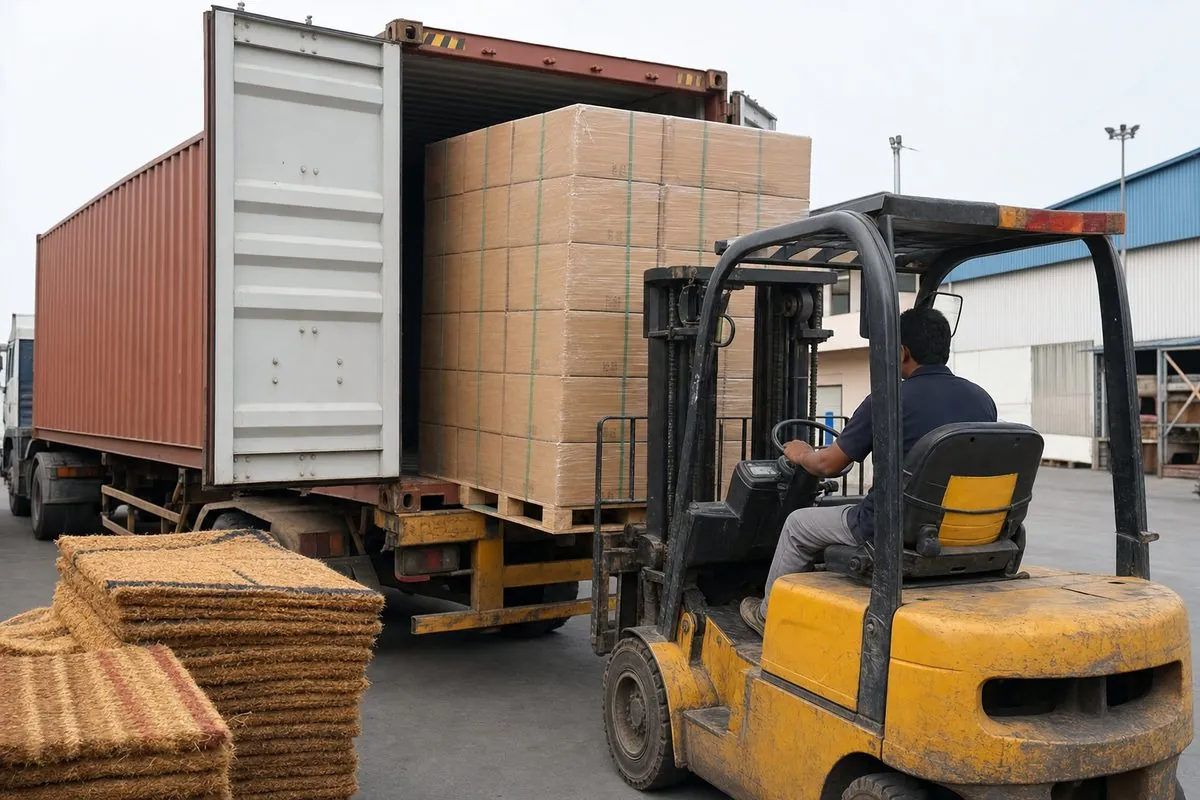
India exports finished coir mats — coconut-fibre doormats, mattings, tufted and woven entrance floor coverings under HS 5702.20 / 5703.90 as construction requires (India woven examples 57022010, 57022020 / 57022090; tufted examples 57039020 / 57039090) — from the Alappuzha (Alleppey) / coastal Kerala coir belt; Pollachi and western Tamil Nadu; Karnataka coir manufacturing units; Selective Odisha / Andhra capacity; Merchant consolidation via Kochi, Chennai, Tuticorin, Delhi-NCR export houses. Broader India coir & coir products exports: IBEF (citing DGCIS) reports about US$455 million in FY25 (vs about US$360 million in FY24). The same IBEF page also states FY25 shipments of 1,342,843 MT worth about US$434 million to 121 countries — treat both figures as IBEF-reported sector context (all coir categories: pith, fibre, mats, etc.), not mats-only, and re-verify against Coir Board / DGCIS extracts before contracts. FY25 value-share mix (IBEF): coir pith ~59.63%, coir fibre ~12.06%, tufted mats ~16.73%. Separately, HS 570220 (woven coir floor coverings) world-trade aggregates (OEC-style, 2024) show India as a leading exporter (~US$44.6M directional) with top importers including USA, South Korea, and UK — do not conflate that woven-line total with tufted/PVC programmes that often classify under HS 5703.90. Separate HS chapters — do not file finished doormats as coir fibre, yarn, or pith.
Buyers do not purchase "coir mats from India" as a single SKU. They purchase a construction (handloom, power-loom, tufted), a size card, a pile density, a colourway (natural or bleached), a backing type (unbacked, PVC, rubber), and optionally a print or logo programme — plus a moisture-aware packing story that survives ocean transit. Exporters who treat every silhouette as one catalogue line lose garden-centre and private-label accounts even when fibre quality looks fine on a sample photo.
This guide owns the product and SKU catalog pillar for Indian coir mat exports: variants, sizes (40×60 cm; 45×75 cm; 50×80 cm; 60×90 cm; 75×120 cm; Buyer-specific / roll matting by metre), pile and edge specs, MOQ by construction, channel fit, pricing bands, packaging, and container loading. Process steps live in How to Export Coir Mats from India; destination ranking in Best Countries for Indian Coir Mat Exports; country × construction demand in Most Demanded Indian Coir Mats by Country; the importer playbook in Source Coir Mats Directly from India; PVC/logo specialty depth in PVC-Backed Custom Logo and Eco Coir Doormat Export Opportunities; Coir Board mechanics in Coir Board Registration Benefits for Coir Mat Exporters; and document fields in Coir Mat Export Documentation Checklist.
Commercial quotes follow FOB named Indian port (Kochi / Tuticorin / Chennai / Nhava Sheva). Indicative commercial FOB planning bands only (not official published prices): natural/handloom ~US$2–12/pc; PVC-backed plain ~US$3–15/pc; custom logo ~US$4–20+/pc; rubber-backed premium ~US$5–25+/pc by size — verify on quote date The product catalog determines which band you belong in — and whether your size card, backing adhesion, and packing photos will survive a garden-centre DC audit.
Altus Exports operates as a merchant exporter from India and global sourcing partner for coir mat programmes — coordinating Alappuzha and Pollachi supply by construction, sample-locked specs, moisture-aware packing, and FCL booking from Cochin (Kochi), Tuticorin (V.O. Chidambaranar), Chennai, Nhava Sheva (JNPT), Mundra (westbound consolidations). If you need SKU-matched allocation rather than a vague "coir mats available" email, start here and use the linked cluster guides for corridors and process.
Key Takeaways
Summary Box
Executive Summary
Summary Box
India's exportable coir mat catalog is geographically concentrated in the Kerala–Tamil Nadu coir belt (Alappuzha (Alleppey) / coastal Kerala coir belt; Pollachi and western Tamil Nadu) but commercially fragmented across constructions, size cards, pile densities, backing systems, and print programmes. The product pillar answers: which SKU am I quoting, which HS line does it file under, which channel does it fit, which MOQ and lead-time band applies, and which packing discipline keeps coconut fibre dry through an ocean voyage.
This guide maps the full product stack — Handloom coir mats; Power-loom coir mats; Tufted coir mats; Coir matting (roll / cut piece); PVC-backed coir doormats; Rubber-backed / rubberized coir entrance mats; Brush and scraper mats; Printed / custom-logo coir mats; Bleached vs natural fibre colourways — with sizes, pile guidance, MOQ by SKU, channel fit, pricing logic, packaging, and FCL planning. Destination sequencing lives in Best Countries for Indian Coir Mat Exports; per-country assortment demand in Most Demanded Indian Coir Mats by Country; export process in How to Export Coir Mats from India.
The practical rule for exporters and buyers alike: lock construction, size, pile density, colourway, backing, and print intent in writing before discussing unit price. A US garden-centre buyer asking for PVC-backed 40×60 cm natural fibre mats and a German specialty retailer asking for handloom unbacked eco entrance mats are both buying "coir mats from India" — but they are not buying the same product, and treating them as one catalogue line is how claims and repeat orders die.
Market Size & Industry Overview
Key Statistics
This catalog sits inside Chapter 57 floor coverings of coconut fibres. Treat each construction as a separate commercial SKU. Woven exclusive-coir mats/mattings typically file under HS 5702.20 (India 57022010/20/90). Tufted coir and many PVC-/rubber-backed tufted programmes typically file under HS 5703.90 (India 57039020 / 57039090 per construction — confirm with CHA; Kerala AAR practice often places PVC-tufted coir under 57039090). Broader India coir & coir products exports: IBEF (citing DGCIS) reports about US$455 million in FY25 (vs about US$360 million in FY24). The same IBEF page also states FY25 shipments of 1,342,843 MT worth about US$434 million to 121 countries — treat both figures as IBEF-reported sector context (all coir categories: pith, fibre, mats, etc.), not mats-only, and re-verify against Coir Board / DGCIS extracts before contracts. FY25 value-share mix (IBEF): coir pith ~59.63%, coir fibre ~12.06%, tufted mats ~16.73%. Separately, HS 570220 (woven coir floor coverings) world-trade aggregates (OEC-style, 2024) show India as a leading exporter (~US$44.6M directional) with top importers including USA, South Korea, and UK — do not conflate that woven-line total with tufted/PVC programmes that often classify under HS 5703.90.
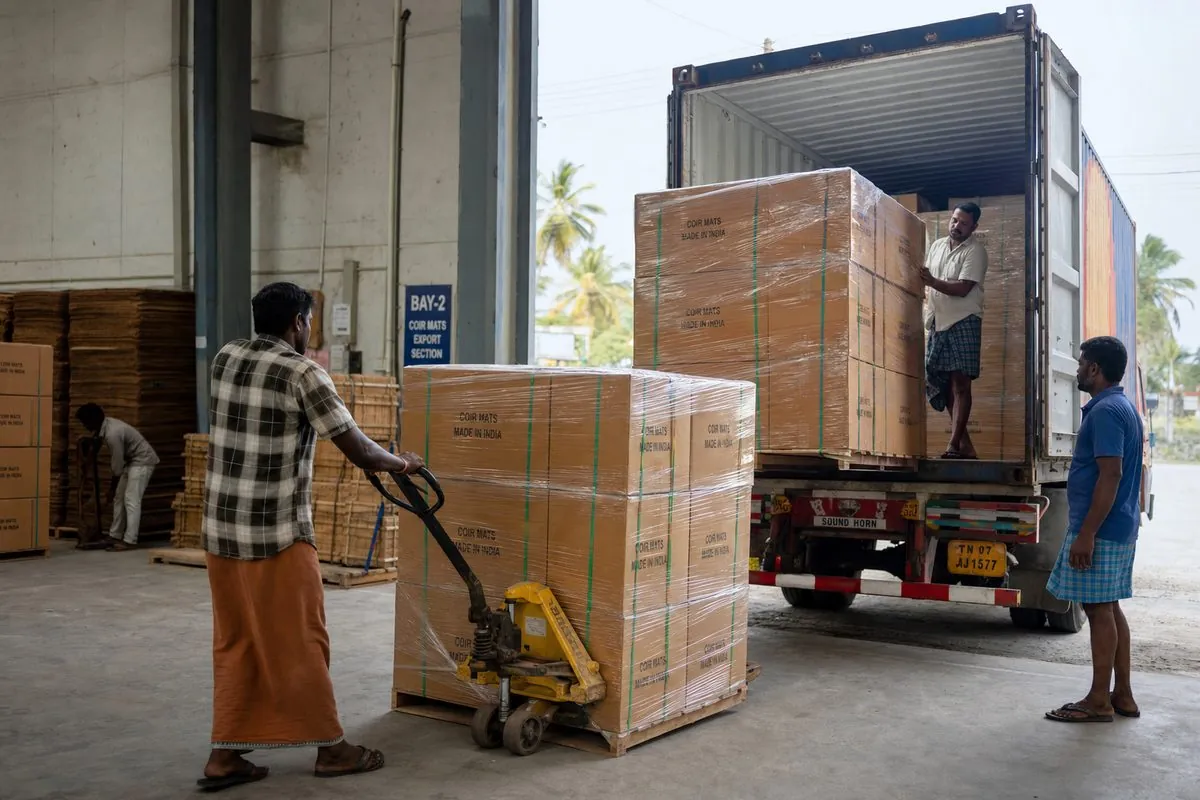
Most exportable handloom, power-loom, tufted, PVC-backed, rubber-backed, brush, logo, and roll programmes originate from Alappuzha (Alleppey) coastal Kerala and Pollachi / western Tamil Nadu, with Karnataka and selective Odisha / Andhra capacity and merchant consolidation via Kochi, Chennai, Tuticorin, and Delhi-NCR export houses. Stuffing at Cochin (Kochi), Tuticorin (V.O. Chidambaranar), Chennai, Nhava Sheva (JNPT), Mundra (westbound consolidations) is the logistics layer — product identity still starts with the size card and backing specification.
Coir Board of India (Ministry of MSME) registration (https://coirboard.gov.in/) supports exporter KYC for coir-product programmes, but it does not define handloom vs PVC-logo vs roll matting. SKU truth lives on the written specification sheet, golden sample, and packing photos. Broader lifestyle context: handicrafts & lifestyle products.
India coir mat product catalog at a glance
Swipe →
Data table — swipe horizontally on small screens
| Dimension | 2026 Snapshot | Product-Selection Implication |
|---|---|---|
| Directional HS 570220 scale | ~US$44.6M India export aggregates (2024 OEC-style) | Mats-only line — cite separately from sector coir totals |
| Sector context (broader coir) | IBEF/DGCIS FY25 sector summaries (~US$455M value; IBEF also cites ~US$434M with 1,342,843 MT) | Includes pith, fibre, mats — never present as mats-only |
| Core origin | Alappuzha / Pollachi / western Tamil Nadu | Construction streams differ by unit specialty |
| Primary HS lines | 5702.20 / 57022010 | Invoice description must match finished mat filing |
| SKU families | Handloom, power-loom, tufted, PVC, rubber, brush, logo, rolls | Separate quote templates and MOQ bands per family |
| Pricing structure | FOB named Indian port (Kochi / Tuticorin / Chennai / Nhava Sheva) | Price by size × construction × backing — never one flat /pc |
| Trial / wholesale MOQ | 200–1,000 pcs trial; 1,000–5,000+ pcs typical wholesale PVC/logo | Handloom specialty may accept lower MOQ after samples |
| Load ports | Cochin (Kochi), Tuticorin (V.O. Chidambaranar), Chennai, Nhava Sheva (JNPT), Mundra (westbound consolidations) | Same SKU ships from same origin — port choice is logistics |
Export Statistics
Key Statistics
Public trade extracts for India's floor coverings of coconut fibres under HS 5702.20 have been reported near ~US$44.6 million in 2024-style OEC aggregates, with the United States, South Korea, and the United Kingdom among leading importers. Those figures are directional planning inputs for market sequencing — not contractual guarantees and not a substitute for paid customs extracts when you are sizing a multi-season garden-centre contract.
Broader India coir and coir-products exports (pith, fibre, mats, and related goods) appear near US$434–455M in FY25 Coir Board / IBEF-style summaries, with tufted mats cited as a major manufactured-value share in some FY25 directional summaries (~17% of coir export value — re-verify). Always label sector totals separately from HS 570220 mat lines in buyer decks. Coir Board (https://coirboard.gov.in/) remains the institutional promotion track.
Directional Indian coir mat export profile (planning view)
Swipe →
Data table — swipe horizontally on small screens
| Metric | Directional Estimate | Notes |
|---|---|---|
| HS 570220 2024 value | ~US$44.6M | OEC-style aggregates — re-verify before citing in contracts |
| Sector coir context FY25 | US$434–455M | Broader coir basket — not mats-only |
| Primary product forms | Handloom, power-loom, tufted, PVC/rubber-backed, logo, rolls | See Product Categories for SKU depth |
| Origin concentration | Kerala–Tamil Nadu coir belt | Merchant exporters consolidate specialist units |
| Council / promotion | Coir Board | https://coirboard.gov.in/ |
| Leading partner cluster | USA, South Korea, UK | Directional partner set from trade extracts |
| Follow-on markets | Germany, Netherlands, Australia, Canada, France, Italy, UAE | Garden, home retail, and Gulf re-export demand |
| Pricing basis | FOB named Indian port (Kochi / Tuticorin / Chennai / Nhava Sheva) | Indicative merchant-trade planning bands only; confirm size, pile density, backing, print, and packing on quote date. Do not cite as government price series. |
Import Statistics
Key Statistics
Destination importers do not buy a generic coir SKU — they buy a channel role. Garden centres pull natural and PVC-backed size cards for spring resets; DIY chains run private-label assortments with barcode and hangtag discipline; specialty home retailers favour handloom and eco-positioned unbacked mats; hospitality distributors specify rubber-backed entrance mats; e-commerce private-label buyers need custom-logo capability and artwork SLAs. Map every RFQ to one of those roles before you open a price conversation, then confirm destination HS/HTS Chapter 57 breakouts with the buyer's broker.
Duty notes are planning references only. Always verify live schedules (USITC HTS, TARIC, GCC, FTA texts) before commercial quotes. USA planning: US HTS 5702.20.10 (floor coverings of coconut fibres, with pile) Column 1-General is typically Free (MFN) per USITC HTS — confirm live schedule and any Chapter 99 overlays before landed-cost quotes. Tufted coir under HTS 5703 may carry different rates — classify first, then price duty. EU planning: EU CN 5702 20 (woven coir) and CN 5703 90 (tufted) — confirm TARIC duty and preferential origin claims before CFR/CIF programmes. UK planning: UK tariff for coir floor coverings — verify live schedule by exact HS (5702.20 vs 5703.90) and preferential claim rules. Gulf planning: UAE / GCC schedules for coir mats — often re-export and garden/home retail demand; verify live duty by HS line.
Directional destination roles for Indian coir mat programmes
Swipe →
Data table — swipe horizontally on small screens
| Market | Primary Buyer Type | Corridor Role | Duty Planning Note |
|---|---|---|---|
| United States | Garden centres, DIY, e-commerce private label | Largest PVC/logo and natural doormat pull | US HTS 5702.20.10 (floor coverings of coconut fibres, with pile) Column 1-General is typically Free (MFN) per USITC HTS — confirm live schedule and any Chapter 99 overlays before landed-cost quotes. Tufted coir under HTS 5703 may carry different rates — classify first, then price duty. |
| United Kingdom | Garden retail, home specialty, private label | Eco-positioned and PVC volume programmes | UK tariff for coir floor coverings — verify live schedule by exact HS (5702.20 vs 5703.90) and preferential claim rules. |
| Germany | Home specialty, garden, eco retail | REACH-sensitive PVC/rubber programmes | EU CN 5702 20 (woven coir) and CN 5703 90 (tufted) — confirm TARIC duty and preferential origin claims before CFR/CIF programmes. |
| Netherlands | EU distribution hubs, garden importers | Re-distribution into EU garden retail | EU CN 5702 20 (woven coir) and CN 5703 90 (tufted) — confirm TARIC duty and preferential origin claims before CFR/CIF programmes. |
| South Korea | Commercial importers of finished coir floor coverings | Strong HS 570220 offtake in trade extracts | Confirm live Korean tariff for 5702.20 |
| Australia | Garden and DIY retail | Moisture QC expectations on ocean voyages | Confirm live Australian schedule |
| Canada | Home and garden retail | North American seasonal assortments | Confirm live Canadian tariff |
| United Arab Emirates | Retail and Gulf re-export distributors | Hospitality and home entrance programmes | UAE / GCC schedules for coir mats — often re-export and garden/home retail demand; verify live duty by HS line. |
Product Categories / Variants
Summary Box
This section is the core of the guide — the full product catalog for Indian coir mat exports under HS 5702.20. Each variant below carries distinct manufacturing disciplines, size and pile expectations, MOQ bands, packing rules, and channel fit. Do not collapse them into a single "coir mats available" offer sheet.
Catalog families covered: Handloom coir mats; Power-loom coir mats; Tufted coir mats; Coir matting (roll / cut piece); PVC-backed coir doormats; Rubber-backed / rubberized coir entrance mats; Brush and scraper mats; Printed / custom-logo coir mats; Bleached vs natural fibre colourways. Size cards commonly include 40×60 cm; 45×75 cm; 50×80 cm; 60×90 cm; 75×120 cm; Buyer-specific / roll matting by metre. Lock pile height/density, edge binding, colourway, and backing adhesion on the golden sample before bulk — those four attributes, not a brochure photo, define the commercial product.
Master product map — construction, typical sizes, pile, MOQ, channel fit
Swipe →
Data table — swipe horizontally on small screens
| Product | Typical sizes | Pile / construction notes | Typical MOQ band | Primary channel fit |
|---|---|---|---|---|
| Handloom coir mats | 40×60 to 75×120 cm | Visible handloom texture; natural or bleached; unbacked or light finish | Lower MOQ often possible after sample approval | Boutique eco retail, specialty home, gift programmes |
| Power-loom coir mats | 40×60, 45×75, 50×80, 60×90 | Consistent weave for volume; natural colourways dominate | 200–1,000 pcs → FCL | Wholesale distributors, mid-tier garden retail |
| Tufted coir mats | 40×60 to 60×90 common | Dense tufted pile; density and height on size card | 1,000–5,000+ pcs typical | Garden centres, DIY, home retail volume |
| PVC-backed coir doormats | 40×60, 45×75, 50×80 | PVC backing for grip/stability; plain or printed face | 1,000–5,000+ pcs typical | Garden centres, DIY, e-commerce private label |
| Rubber-backed / rubberized entrance mats | 45×75, 60×90, hospitality sizes | Rubber backing for heavy entrance traffic | Trial then programme MOQ | Hospitality, commercial entrances, premium retail |
| Brush / scraper mats | Buyer-specific scraper sizes | Aggressive scraper pile — not decorative density | Quote by scraper density + size | Utility entrances, farm/garden utility retail |
| Printed / custom-logo coir mats | 40×60, 45×75 primary retail | Artwork registration + colour strike-off required | 1,000–5,000+ pcs typical | Private label, branded garden/home programmes |
| Coir matting (roll / cut piece) | By metre / roll width | Crease avoidance; moisture barrier on rolls | Roll / metre MOQ by mill | Commercial runners, cut-piece wholesale |
Handloom coir mats
- HS intent
- 5702.20 / 57022010
- Sample lead
- 7–21 days typical for samples depending on construction
- Backing default
- Unbacked or light finish — confirm
Handloom coir mats are the craft-forward export line — woven on traditional or semi-traditional looms in Alappuzha and adjacent Kerala units, often with a visible hand-worked texture that specialty retailers use in eco and lifestyle storytelling. Typical retail sizes run 40×60 cm through 75×120 cm; pile is usually moderate and specified by height and density band rather than "thick" marketing language. Colourways are natural brown coconut fibre or bleached/lightened fibre where the buyer wants a cleaner aesthetic.
MOQ is often lower than PVC volume programmes after sample approval (Lower MOQ often possible after sample approval), but loom capacity and colourway consistency still need written confirmation. Channel fit: boutique eco retail, specialty home, gift assortments, and selective garden specialty — not the lowest-price DIY planogram. Pricing sits inside the natural/handloom band of roughly US$2–12/pc by size; never quote handloom as if it were interchangeable with power-loom PVC garden SKUs.
Power-loom coir mats
Power-loom coir mats deliver weave consistency for wholesale and mid-tier garden programmes where size tolerance and repeatability matter more than handloom texture. Pollachi and western Tamil Nadu capacity often anchors these runs. Size cards typically emphasise 40×60, 45×75, 50×80, and 60×90 cm with natural colourways; pile density is locked on the golden sample and checked lot-to-lot with gauges.
MOQ commonly starts at trial volumes (200–1,000 pcs) and scales to container programmes. Channel fit: wholesale distributors, mid-tier garden retail, and assortment fillers beside PVC-backed hero SKUs. Exporters should publish separate QC photos for power-loom edges and pile versus handloom — buyers who expected craft texture will reject a power-loom substitute even at a lower FOB.
Tufted coir mats
Tufted coir mats are a major manufactured-value export construction: dense tufted coconut-fibre pile on a structured base, finished with edge binding and optional PVC or other backings. Directional Coir Board / IBEF-style summaries have cited tufted mats as a significant share of coir export value — re-verify before using any percentage in a contract presentation. Commercial buyers specify pile height, tuft density, and size tolerance tightly because garden-centre planograms punish soft, uneven piles.
Standard sizes cluster around 40×60 cm, 45×75 cm, 50×80 cm, 60×90 cm; larger hospitality sizes appear on request. MOQ for volume tufted programmes often aligns with wholesale PVC/logo tiers (1,000–5,000+ pcs typical). Channel fit: garden centres, DIY chains, and home retail volume. Stock programmes can move in 2–4 weeks for stock sizes after confirmation; custom density or colourway shifts push toward the custom calendar.
PVC-backed coir doormats
PVC-backed coir doormats pair a coir face with a PVC backing for grip, dimensional stability, and retail durability. They dominate US and UK garden-centre and DIY programmes in plain natural faces and in printed/logo variants. Size heroes are typically 40×60 and 45×75 cm, with 50×80 cm as a step-up. Edge protection in packing matters — PVC-backed mats scrape and corner-crush if thrown loose into a container.
Directional FOB often sits ~US$3–15/pc for plain PVC-backed by size. MOQ for wholesale programmes: 1,000–5,000+ pcs typical. REACH / SVHC declarations matter for EU and UK programmes — treat chemical documentation as part of the product, not an afterthought PDF. Deep specialty pathways: PVC-Backed Custom Logo and Eco Coir Doormat Export Opportunities.
Rubber-backed / rubberized coir entrance mats
Rubber-backed or rubberized coir entrance mats target heavier traffic — hospitality lobbies, commercial entrances, and premium retail programmes that need grip and durability beyond thin PVC garden SKUs. Sizes often skew larger (45×75, 60×90, buyer-specific hospitality dimensions). Pile and rubber compound must both survive sample wash/traffic tests where buyers specify them.
Directional FOB for rubber-backed premium often sits ~US$5–25+/pc by size. Lead times and MOQs are programme-specific; expect trial lots before monthly or seasonal contracts. Channel fit: hospitality distributors, commercial facility suppliers, and premium garden/home specialty. EU/UK buyers may request REACH-style declarations for rubber compounds — prepare the pack before quoting CFR Europe.
Brush and scraper mats
Brush and scraper mats are utility constructions with aggressive scraper pile designed to remove mud and debris — not decorative entrance aesthetics. Quoting them on the same template as soft tufted garden mats is a product error: scraper density, bristle behaviour, and size are the commercial attributes. Buyers include farm/garden utility retail, industrial entrance programmes, and outdoor living assortments.
MOQ and pricing should be quoted by scraper density plus size, not copied from decorative pile bands. Pack for edge and tip protection; scrapers that arrive crushed fail the first DC QC photo. Keep fibre composition and HS filing as finished coir floor coverings under 5702.20 when the product is a mat — confirm with CHA if construction borders another heading.
Printed / custom-logo coir mats
Custom-logo and printed coir mats convert a base construction (often PVC-backed tufted or woven faces) into private-label retail SKUs. Artwork approval, colour strike-offs, and print registration are mandatory gates before bulk. Lead times typically extend to 4–8+ weeks including artwork approval for logo/private-label programmes. Directional FOB ~US$4–20+/pc by size and print complexity.
MOQ commonly 1,000–5,000+ pcs typical because print setup amortisation and retail carton marks demand volume. Channel fit: garden and home private label, branded retail programmes, and selective promotional hospitality. Never stuff a logo FCL with pending strike-off approval — that single process failure destroys seasons. Specialty depth lives in the PVC/logo companion post.
Coir matting (roll / cut piece)
Roll coir matting and cut-piece programmes serve commercial runners, wholesale cutters, and buyers who convert metreage into custom lengths. Packing rules differ from piece mats: Roll matting with crease avoidance and moisture barrier. Crease marks and moisture uptake are the primary claim drivers — treat roll winding diameter, wrap, and desiccant as specification items.
MOQ is usually expressed in metres or rolls by mill capacity, not piece counts. Channel fit: commercial flooring distributors, cut-piece wholesalers, and selective hospitality fit-out. Quote per metre with width, pile, and backing explicitly named; do not bury roll specs inside a doormat size-card PDF.
Bleached vs natural fibre colourways
Natural brown coconut fibre remains the default export colourway for garden and DIY programmes. Bleached or lightened fibre colourways serve specialty home and design-led assortments that want a cleaner visual against light flooring. Bleaching adds process cost, QC variance risk, and sometimes longer sample cycles — treat it as a distinct SKU attribute, not a free option on every quote.
Always photograph natural and bleached samples under consistent light for buyer approval. Colourway drift between sample and bulk is a top claim cause on specialty programmes. If a buyer wants both colourways in one FCL, segregate cartons and packing-list lines so DC receiving does not mix them.
Size card & pile specification discipline
Indicative size × channel planning matrix (directional)
Swipe →
Data table — swipe horizontally on small screens
| Size | Common constructions | Typical channels | Packing note |
|---|---|---|---|
| 40×60 cm | Tufted, PVC plain/logo, power-loom | Garden centres, DIY, e-commerce | Highest piece count per carton |
| 45×75 cm | Tufted, PVC, rubber-backed | Garden step-up, home retail | Balance of retail face and cube |
| 50×80 cm | Tufted, handloom, rubber | Home specialty, hospitality entry | Lower pcs/carton — plan cube early |
| 60×90 cm | Handloom, rubber, hospitality | Premium entrances, lobbies | Edge protection critical |
| 75×120 cm | Handloom, specialty woven | Boutique / oversized entrance | Often bale or oversized carton |
| Roll matting | Woven/tufted metre goods | Commercial cutters | Roll matting with crease avoidance and moisture barrier |
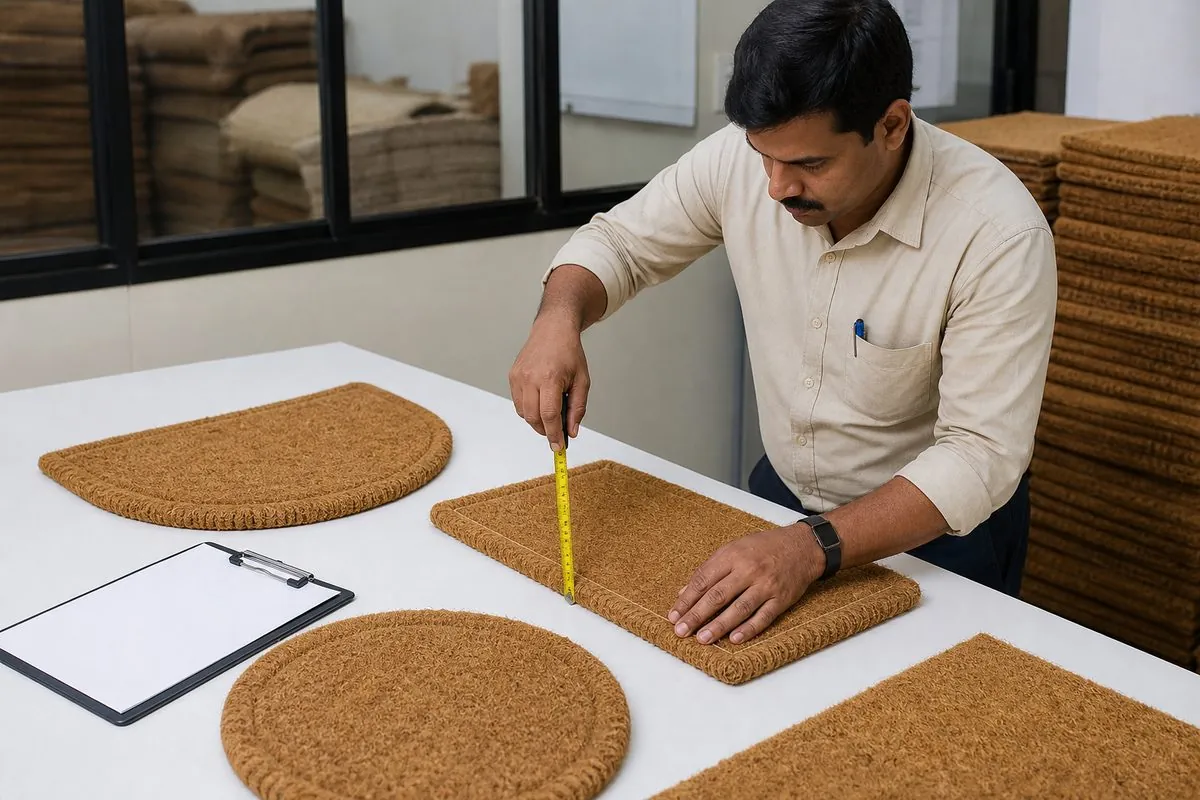
Publish a living size card for every construction you sell. Core retail sizes: 40×60 cm; 45×75 cm; 50×80 cm; 60×90 cm; 75×120 cm; Buyer-specific / roll matting by metre. For each size, record tolerance (± cm), pile height band, pile density band, edge-binding style, weight per piece (indicative), and backing type. Buyers use that card to planogram SKUs; exporters use it to reject impossible mix requests before quoting.
Pile is not "thick" or "premium" — it is a measurable height and density that QC must reproduce. Lot release typically checks size tolerance, pile density, edge finish, backing adhesion, and moisture before packing. Photograph the QC table for the first three lots of a new programme; garden buyers increasingly request that evidence after mould or size claims elsewhere in the category.
Manufacturing Overview
Export Tip
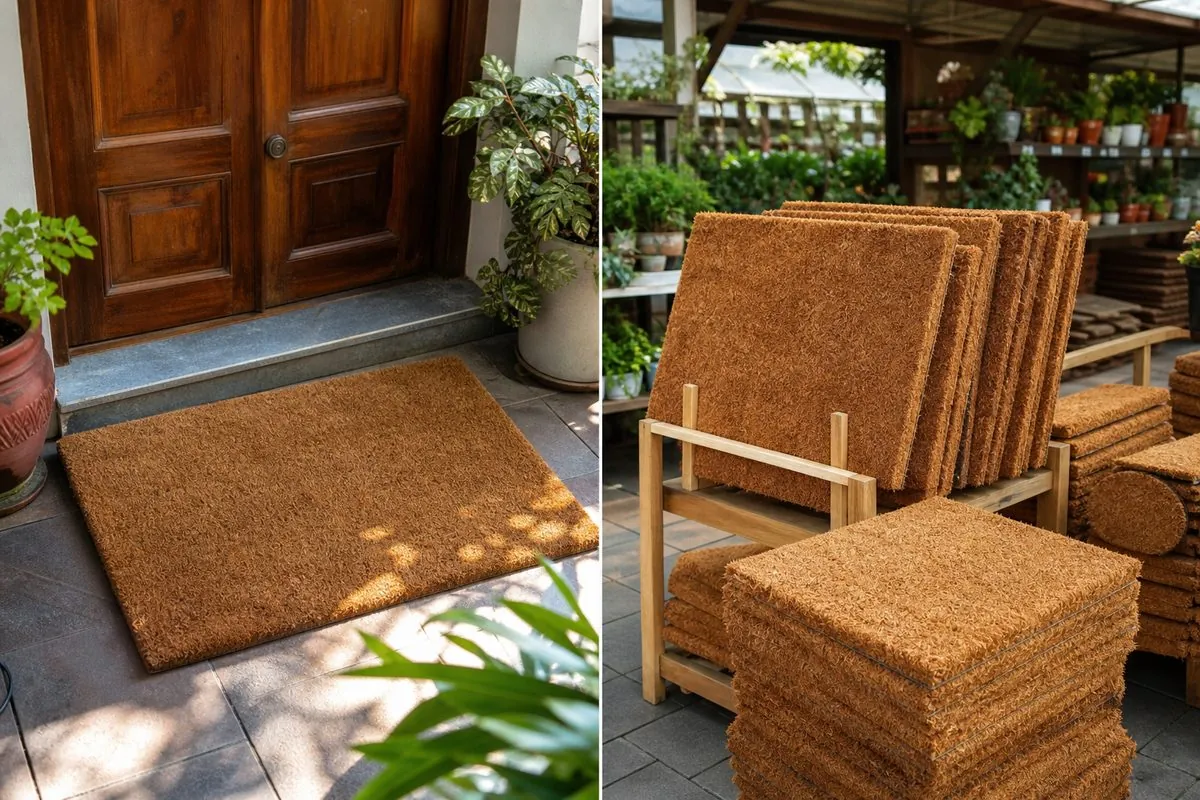
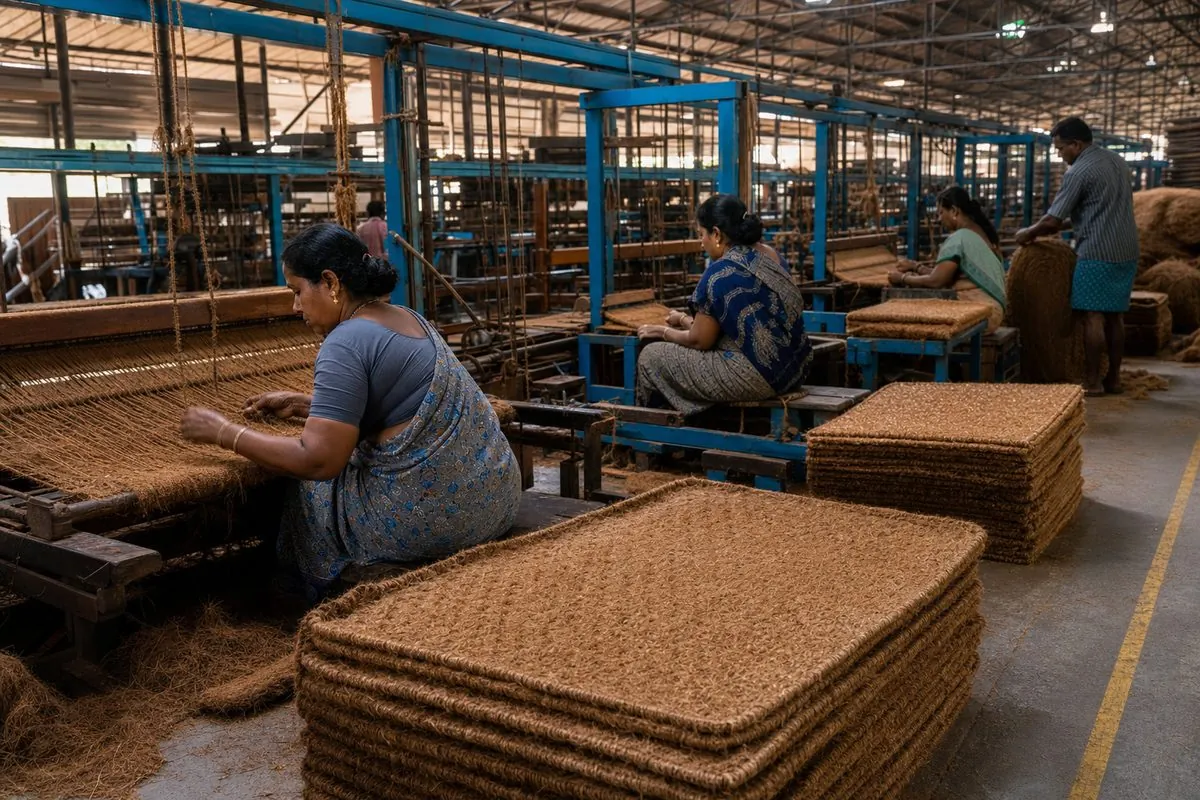
Coir mat manufacturing begins with coconut husk fibre preparation — retting, extraction, cleaning, and spinning or preparation for weaving and tufting — then moves through handloom or power-loom weaving, tufting, edge binding, optional bleaching, PVC or rubber backing, logo printing, and packing. Origin clusters: Alappuzha (Alleppey) / coastal Kerala coir belt; Pollachi and western Tamil Nadu; Karnataka coir manufacturing units; Selective Odisha / Andhra capacity; Merchant consolidation via Kochi, Chennai, Tuticorin, Delhi-NCR export houses.
Because the ecosystem is organised around specialist units rather than one vertically integrated factory for every construction, merchant exporters coordinate a network of production partners per order while preserving lot identity. Sample approval must lock size tolerance, pile height and density, edge finish, colourway, backing adhesion, and print registration before bulk.
Lead-time bands by product: samples 7–21 days typical for samples depending on construction; stock sizes 2–4 weeks for stock sizes after confirmation; custom logo/private-label 4–8+ weeks including artwork approval for logo/private-label programmes. Moisture management starts on the factory floor — fibre that leaves the unit damp will continue to absorb moisture in transit.
Loom-to-export — product identity gates
Swipe →
Data table — swipe horizontally on small screens
| Manufacturing gate | Product control | Failure mode if weak |
|---|---|---|
| Fibre preparation & colourway | Natural vs bleached consistency | Colour drift sample-to-bulk |
| Weave / tuft schedule | Construction stream separation | Wrong pile or texture vs PO |
| Size & pile QC | Tolerance gauges on every lot | Planogram rejects at destination DC |
| Backing adhesion | PVC/rubber bond tests | Delamination claims after humidity |
| Logo print registration | Strike-off approved artwork only | Private-label season failure |
| Dry staging & pack | Desiccant / moisture-barrier discipline for coconut-fibre goods | Mould claims despite "good" fibre |
Pricing Analysis
Buyer Tip
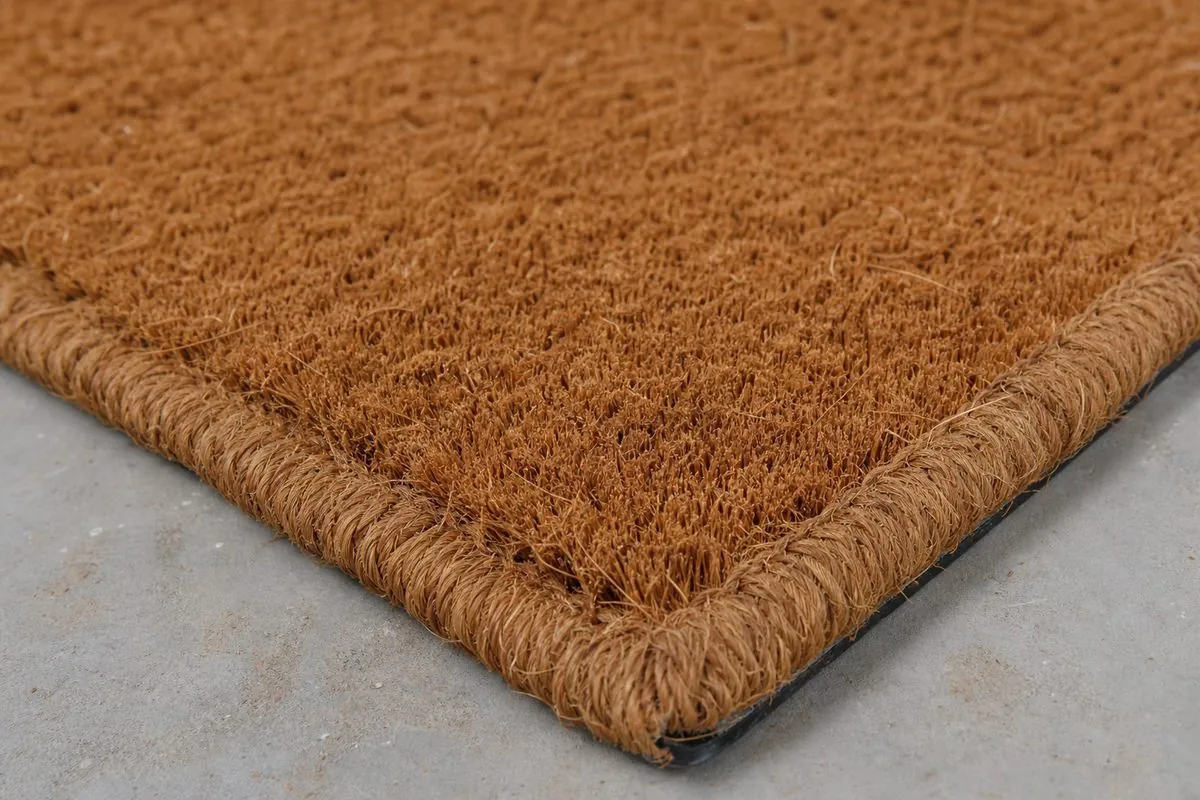
FOB named Indian port (Kochi / Tuticorin / Chennai / Nhava Sheva). Coir mat pricing is driven primarily by size, pile density, backing type, and print/logo complexity. Indicative commercial FOB planning bands only (not official published prices): natural/handloom ~US$2–12/pc; PVC-backed plain ~US$3–15/pc; custom logo ~US$4–20+/pc; rubber-backed premium ~US$5–25+/pc by size — verify on quote date
Premium spreads between handloom specialty, plain PVC volume, custom logo, and rubber-backed hospitality SKUs are often wider than buyers expect — because they encode labour intensity, print setup, chemical documentation burden, and moisture packing discipline, not just fibre weight. Publish separate quote templates per construction family; never blend handloom and PVC garden SKUs into one "India coir mat" line item.
When comparing offers, normalize Incoterm and named port first, then compare construction and size mix. A cheaper power-loom unbacked quote is not a substitute for a PVC-backed logo specification even if both are "doormats." Indicative merchant-trade planning bands only; confirm size, pile density, backing, print, and packing on quote date. Do not cite as government price series.
Directional FOB USD/pc pricing bands by coir mat construction
Swipe →
Data table — swipe horizontally on small screens
| Construction / grade | Directional FOB USD/pc | Typical adders | Quote discipline |
|---|---|---|---|
| Natural / handloom (by size) | ~US$2–12 | Bleaching, oversized sizes | Separate template from PVC volume |
| Power-loom plain | Inside natural band by size | Edge binding upgrades | Emphasise tolerance consistency |
| Tufted (plain) | Size-driven within volume band | Density upgrades | Lock pile gauges on sample |
| PVC-backed plain | ~US$3–15 | Edge protect pack, REACH pack | Name size mix on every PDF |
| Custom logo / printed | ~US$4–20+ | Artwork setup, colourways | Never quote without strike-off path |
| Rubber-backed premium | ~US$5–25+ | Hospitality sizes, compound docs | Programme pricing after trial |
| Brush / scraper | By scraper density + size | Tip protection packing | Do not price as decorative pile |
| Roll matting | Per metre / roll spec | Width, crease wrap, desiccant | Separate from piece-mat quotes |
MOQ Analysis
Buyer Tip
Minimum order quantities scale from sample lots through full-container wholesale, and they differ by construction. MOQ depends on size mix, backing type, and print setup — lock every tier in writing before production. ${COIR_MATS_MOQ.caveat}
Handloom specialty often accepts lower piece counts after sample approval because loom economics differ from PVC print setup. Custom-logo and plain PVC wholesale programmes amortise artwork, cartons, and hangtags across thousands of pieces. Roll matting uses metre/roll MOQs, not doormat piece logic.
Directional MOQ tiers by SKU family (coir mats)
Swipe →
Data table — swipe horizontally on small screens
| SKU family | Sample | Trial | Programme / wholesale | Notes |
|---|---|---|---|---|
| Handloom natural | 5–20 pcs | Often lower end of trial band | Buyer-specific after approval | Lower MOQ often possible after sample approval |
| Power-loom / tufted plain | 5–20 pcs | 200–1,000 pcs | Scale to FCL size mix | Size mix drives carton economics |
| PVC-backed plain | 5–20 pcs | 200–1,000 pcs | 1,000–5,000+ pcs typical | Garden / DIY volume default |
| Custom logo / printed | Strike-off + sample pcs | 200–1,000 pcs | 1,000–5,000+ pcs typical | Lead time 4–8+ weeks including artwork approval for logo/private-label programmes |
| Rubber-backed | 5–20 pcs | 200–1,000 pcs | Programme MOQ after trial | Hospitality sizes may raise MOQ |
| Brush / scraper | 5–20 pcs | By density SKU | Utility programme volumes | Quote density SKUs separately |
| Roll matting | Cut sample metres | Partial roll / trial metres | Mill roll MOQ | Metre logic — not pcs |
Packaging Standards
Export Tip
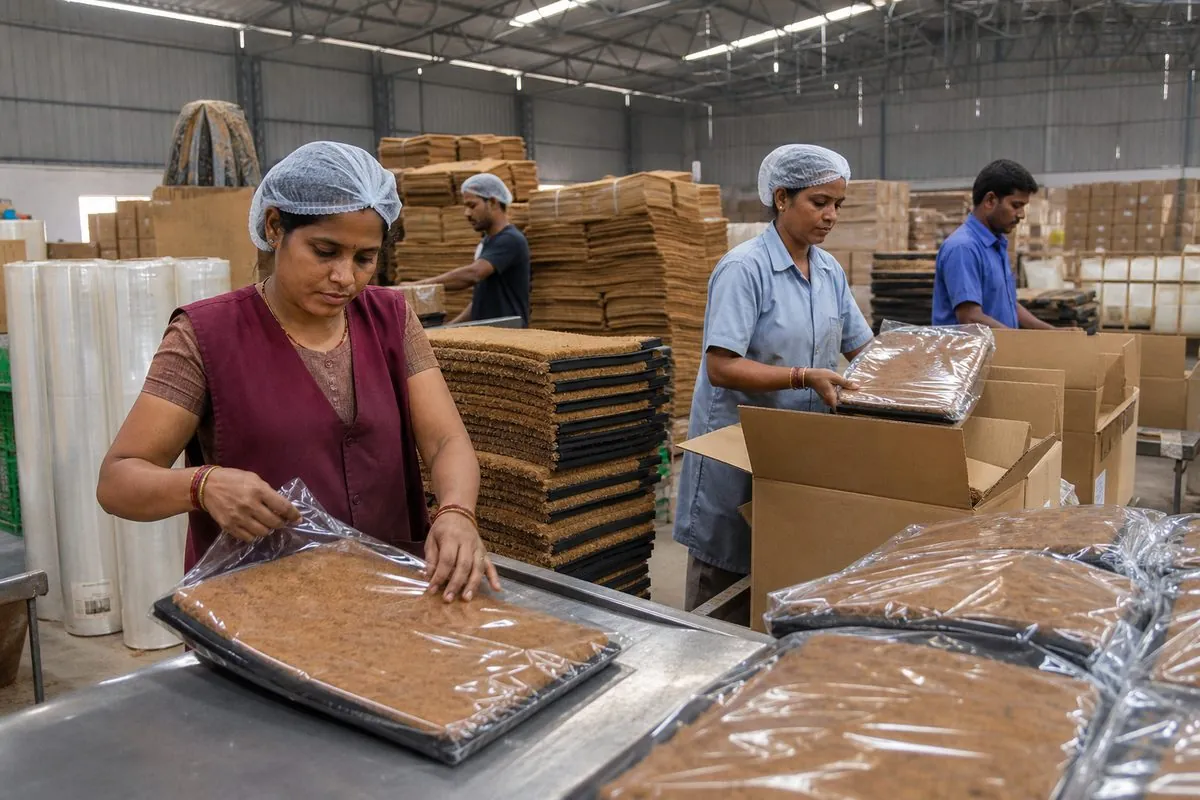
Export packaging for coir mats protects fibre from moisture and edges from crush. Unit packing: Individual poly bag or kraft wrap; edge protection for PVC-backed mats. Master packing: Master cartons or bales by size; palletize for FCL where specified. Rolls: Roll matting with crease avoidance and moisture barrier. Moisture discipline: Desiccant / moisture-barrier discipline for coconut-fibre goods.
Carton marks should carry size, construction, colourway, PO number, and destination marks exactly as the packing list. Private-label programmes add hangtags, barcodes, and inner poly print — those are product attributes with setup cost, not free packing upgrades. Photograph packed cartons and desiccant placement for the first three lots of a new buyer.
Packaging formats for coir mat export
Swipe →
Data table — swipe horizontally on small screens
| Format | Used for | Key control |
|---|---|---|
| Individual poly bag | Most piece mats | Seal integrity; avoid trapped wet fibre |
| Kraft wrap | Natural / handloom specialty | Edge wrap + moisture barrier where specified |
| Edge protectors | PVC-backed and oversized mats | Corner crush prevention |
| Master cartons | Retail size cards | Pcs per carton locked to size mix |
| Bales | Selected natural programmes | Compression vs pile recovery — buyer-approved |
| Palletization | FCL where specified | Dry warehouse staging before stuffing |
| Roll wrap + barrier | Roll matting | Crease avoidance + desiccant |
| Desiccant / barrier film | All ocean programmes | Desiccant / moisture-barrier discipline for coconut-fibre goods |
Container Loading Details
Export Tip
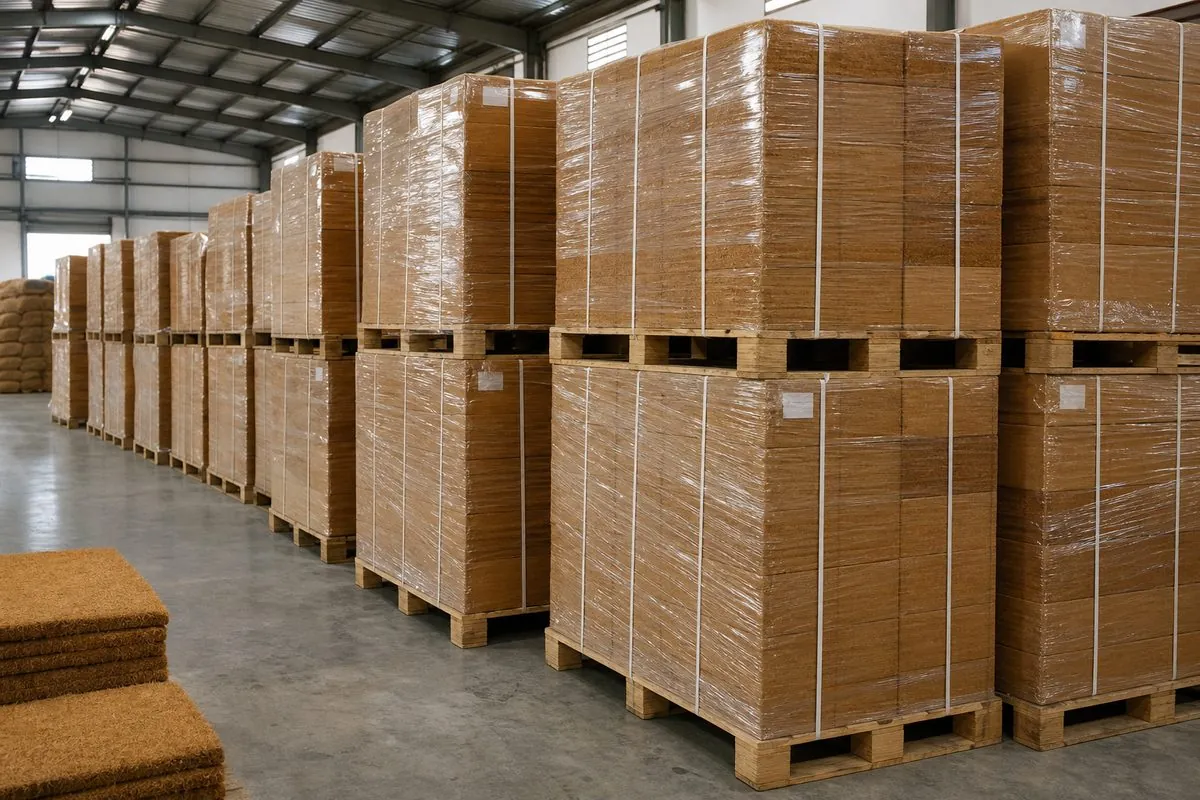
FCL stuffing for coir mats plans cube, piece count by size mix, and moisture protection — not a generic "how many mats fit in a container" guess. Confirm piece count by size mix with your forwarder before booking. Mixed-size programmes that look profitable on a per-piece FOB can miss payload or crush bottom cartons if stow is improvised at the dock.
Load ports commonly include Cochin (Kochi), Tuticorin (V.O. Chidambaranar), Chennai, Nhava Sheva (JNPT), Mundra (westbound consolidations). Inland haul from Alappuzha and Pollachi should preserve dry staging; rain-soaked trucking undoes factory moisture control. Photograph container floor, first layer, mid-stow, and seal for claim defence.
Directional container loading considerations for coir mats
Swipe →
Data table — swipe horizontally on small screens
| Factor | Planning note | Product implication |
|---|---|---|
| Size mix | 40×60 packs denser than 60×90 | Quote cube with mix ratios, not average size |
| Backing type | PVC/rubber add weight and edge risk | Edge protectors + carton strength |
| Private-label cartons | Retail cartons may cube worse than bulk poly | Recalculate FCL after carton approval |
| Rolls vs pieces | Rolls need different stow geometry | Do not mix roll and piece logic blindly |
| Moisture | Desiccant + dry container selection | Mould claims destroy garden seasons |
| Stuffing photos | Floor / mid / door / seal set | Evidence for arrival disputes |
| LCL trials | Useful before first FCL | Higher unit freight — plan landed cost |
| Port cut-off | Align haulage to sailing | Avoid humid dock storage delays |
Shipping Methods
Export Tip
Ocean FCL from Cochin (Kochi), Tuticorin (V.O. Chidambaranar), Chennai, Nhava Sheva (JNPT), Mundra (westbound consolidations) is the default for commercial coir mat programmes. Common Incoterms: EXW unit / warehouse; FOB Kochi / Tuticorin / Chennai / Nhava Sheva; CFR / CIF named destination port; DDP (selected large retail programmes only). Air freight is reserved for urgent samples and strike-off kits — not for wholesale piece economics.
First FCL relationships often stay FOB named Indian port so construction pricing is not confused with freight volatility. Move to CFR or CIF only when you can book ocean reliably and have verified destination duty assumptions with the importer. DDP appears only on selected large retail programmes with landed-cost teams.
Shipping method fit for coir mat programmes
Swipe →
Data table — swipe horizontally on small screens
| Method | Best fit | Watch-outs |
|---|---|---|
| Ocean FCL | Wholesale size cards, PVC/logo programmes | Cube engineering by size mix |
| Ocean LCL | Trials after samples | Higher unit freight; moisture still critical |
| Air courier | Samples, strike-offs, artwork kits | Not for wholesale economics |
| FOB named port | First commercial relationships | Buyer controls freight — clarify risk transfer |
| CFR / CIF | Repeat programmes with freight capability | Duty assumptions still buyer's to verify |
| DDP | Selected large retail only | Requires destination compliance depth |
Certifications
Compliance Notes
Certification and evidence for coir mats are layered: institutional credibility, product composition, plant systems, inspection, origin, chemical declarations for backings, and phytosanitary where destinations require plant-fibre controls. None of these replace a written size/pile/backing specification.
Evidence stack buyers commonly request: Coir Board registration / RCMC evidence; Fibre composition declaration (coconut coir); ISO plant quality systems where available; Third-party inspection (SGS / Bureau Veritas / Intertek) on request; Certificate of Origin; REACH / SVHC declarations for PVC or rubber backings where required; Phytosanitary certificate where destination plant-health rules require it for plant-fibre goods; Honest eco / biodegradable claim controls (no overclaim on polymer-backed mats). Honest eco / biodegradable claim controls matter — PVC-backed mats are not equivalent to unbacked natural fibre for biodegradability marketing. Overclaim fails retail audits faster than a slightly higher FOB.
Certification and evidence layers for coir mat exports
Swipe →
Data table — swipe horizontally on small screens
| Layer | Evidence | When buyers ask |
|---|---|---|
| Institutional | Coir Board registration | Vendor onboarding / KYC |
| Composition | Coconut coir fibre declaration | Every serious RFQ |
| Quality systems | ISO plant systems where available | Retail / private-label audits |
| Inspection | SGS / BV / Intertek on request | First FCL or claim recovery |
| Origin | Certificate of Origin | Preferential or customs programmes |
| Chemicals | REACH / SVHC for PVC or rubber | EU / UK backed programmes |
| Plant-fibre | Phytosanitary where required | Destination NPPO rules |
| Claims | Honest eco language only | Eco retail and marketplace listings |
Buyer Requirements
Buyer Requirements
SKU-level onboarding is what separates a catalog photo from a repeatable export programme. Buyers expect a construction sheet (size, pile density, edge finish, backing type, colourway), a signed golden sample for each SKU family, and packing photos that match the moisture SOP you quote. Institutional papers such as Coir Board membership and IEC belong in the vendor pack — the full membership diligence path is covered in Coir Board registration benefits for coir mat exporters — but they never replace construction acceptance tests.
Retail private-label buyers add barcode, hangtag, carton mark, and artwork SLA requirements. Hospitality buyers add traffic-test and rubber-compound expectations. Map requirements to the channel and construction before promising a generic "export pack" across handloom, tufted, and PVC-logo lines.
SKU and channel onboarding requirements for coir mat programmes
Swipe →
Data table — swipe horizontally on small screens
| Requirement | Why it matters | SKU impact |
|---|---|---|
| Construction / size card | Defines acceptance tests | All piece and roll SKUs |
| Golden sample sign-off | Sample-to-bulk match | Especially handloom & logo |
| Moisture packing SOP + photos | Mould claim prevention | All ocean lots |
| Coir Board + IEC (vendor pack) | Organised-exporter filter | All constructions — link Board guide |
| Artwork / strike-off | Private-label colour control | Custom logo only |
| REACH / SVHC pack | EU/UK chemical entry | PVC and rubber-backed |
| Eco claim posture | Retail audit survival | Natural vs backed disclosure |
| Incoterm + lead time in writing | Season calendar fit | All programmes |
Country-wise Opportunities
Market Snapshot
Country demand is owned in depth by the markets and demand-by-country guides. This catalog only maps which product families typically win where — so you do not send handloom boutique mats to a DIY planogram that only wants PVC 40×60, or rubber hospitality mats to an eco retailer that refuses PVC language without disclosure.
For destination ranking, duty, and freight sequencing, use Best Countries for Indian Coir Mat Exports. For construction × size × backing expectations by corridor, use Most Demanded Indian Coir Mats by Country. Top markets in planning view: United States, United Kingdom, Germany, Netherlands, South Korea, Australia, Canada, France, Italy, United Arab Emirates.
Product-to-market fit snapshot (directional)
Swipe →
Data table — swipe horizontally on small screens
| Market | Primary product pull | Secondary pull | Evidence intensity |
|---|---|---|---|
| United States | PVC plain / custom logo | Natural tufted | High packing + private label |
| United Kingdom | Garden PVC + natural | Handloom eco | Eco claim honesty |
| Germany | Natural / handloom | Documented PVC | REACH / SVHC |
| Netherlands | EU distribution assortments | Garden PVC | Carton + moisture |
| South Korea | Finished size-card mats | Selected backed | Formal docs |
| Australia | Garden / DIY seasonal | Natural specialty | Moisture QC |
| Canada | Home & garden | Private label | Seasonal planning |
| UAE | Rubber + retail assortments | Re-export mixes | Distributor continuity |
United States — PVC/logo & garden size cards
Product fit: PVC-backed plain and custom-logo doormats in 40×60 and 45×75 cm, plus natural tufted assortments for garden centres and e-commerce private label. Moisture packing and barcode/hangtag discipline win seasons; racing only on FOB loses them.
United Kingdom — Garden retail & eco framing
Product fit: natural and PVC-backed garden programmes with honest eco language, plus selective handloom for specialty. Post-Brexit tariff and claim rules need live verification; REACH-style chemical packs still matter for backings.
Germany & Netherlands — REACH-aware home/garden
Product fit: natural/handloom and carefully documented PVC/rubber programmes. Netherlands also acts as an EU distribution node — carton marks and moisture evidence travel with redistributed lots.
South Korea — Finished coir floor covering offtake
Product fit: finished mats with tight size cards and formal documentation cadence. Trade extracts show strong HS 570220 pull — treat construction clarity and lead-time reliability as the differentiators.
Australia & Canada — Garden / DIY seasonal
Product fit: natural and PVC-backed seasonal assortments with moisture QC for long ocean legs. Plan production against retail reset calendars, not against when loom capacity happens to free up.
France & Italy — Specialty home & design
Product fit: handloom, bleached colourways, and selective rubber-backed premium entrances. Smaller MOQs may work after samples; documentation and claim honesty still need EU chemical awareness for backed SKUs.
United Arab Emirates — Retail & Gulf re-export
Product fit: rubber-backed hospitality and retail natural/PVC assortments that survive warehouse splitting after Gulf discharge. Distributor programmes value consistent size cards across re-export destinations.
Export Process
Export Tip
End-to-end process depth — IEC sequencing, Incoterms, lead times, ports, moisture, and container overview — is owned by How to Export Coir Mats from India. In this product catalog, place process only as a sequencing overview so SKU selection stays primary.
Overview sequence: (1) IEC + GST + bank AD alignment; (2) Coir Board registration for coir-product credibility; (3) lock construction/size/pile/backing/print on a written sheet; (4) approve golden samples; (5) confirm MOQ and FOB named Indian port (Kochi / Tuticorin / Chennai / Nhava Sheva) quote; (6) produce with lot QC; (7) moisture-aware pack; (8) stuff FCL at a named port among Cochin (Kochi), Tuticorin (V.O. Chidambaranar), Chennai, Nhava Sheva (JNPT), Mundra (westbound consolidations); (9) file shipping bill under HS 5702.20 / 57022010 with CHA confirmation. Document field templates live in Coir Mat Export Documentation Checklist.
Sourcing Checklist
Checklist
Use this dual checklist when converting a SKU decision into an executable first lot. Buyers fail by underspecifying construction; exporters fail by quoting one price across handloom, PVC, logo, and rubber lines.
What buyers should lock before RFQ
- Construction family and channel role (garden, DIY, specialty, hospitality, e-commerce)
- Size mix percentages and tolerances
- Pile height/density band and colourway
- Backing type and print/logo status with artwork readiness
- Sample budget and trial MOQ willingness
- Destination compliance needs (REACH, phyto, eco claims)
What exporters should lock before quoting
- Active IEC and Coir Board registration for the invoicing entity
- Separate construction cards — never one blended coir sheet
- HS intent (5702.20 / 57022010) confirmed with CHA
- Unit capacity by construction and realistic lead times
- Moisture packing BOM and photo protocol
- Refusal to overclaim biodegradable language on PVC-backed SKUs
Common Buyer Mistakes
Common Mistakes Box
Most coir product failures are specification-confusion errors, not fibre mysteries. Buyers and new exporters repeatedly treat all doormats as interchangeable, order logo bulk before strike-off, ignore moisture packing, file finished mats under fibre/pith chapters, and market PVC-backed mats with unqualified biodegradable claims.
Use the table below as a pre-PO product review. If any row is unresolved, fix the SKU specification before negotiating unit price — otherwise every humidity spike becomes an argument instead of a controlled process.
Common product mistakes and corrections
Swipe →
Data table — swipe horizontally on small screens
| Mistake | Why it hurts | Better approach |
|---|---|---|
| Ordering "coir mats" without construction | Acceptance test undefined | Name handloom / tufted / PVC / rubber / logo |
| Skipping size mix ratios | Cube and planogram failure | Lock % by size on the PO |
| Logo bulk before strike-off | Private-label season loss | Approve artwork then produce |
| Ignoring moisture packing | Mould claims on arrival | Desiccant + dry staging SOP |
| Filing mats as fibre/pith | Customs and buyer distrust | Use HS 5702.20 with CHA |
| PVC sold as fully biodegradable | Retail audit failure | Honest construction-true claims |
| Substituting handloom with power-loom | Texture and brand mismatch | Re-sample or re-quote honestly |
| One FOB for all sizes | Margin collapse on large sizes | Price by size × construction |
Future Market Trends
Key Statistics
Product trends in Indian coir mat exports point toward tighter eco-claim scrutiny on PVC vs natural constructions, growing custom-logo private-label share in US/UK garden retail, denser tufted size-card programmes, and moisture-packing evidence as a default RFQ attachment rather than a post-claim excuse.
Expect more buyers to request digital size cards with pile gauges, packing BOM photos, and honest backing disclosure on first inquiry. Exporters with clear construction templates will outperform those competing on undifferentiated "coir mats available" emails.
Forward-looking product trends for Indian coir mat exports
Swipe →
Data table — swipe horizontally on small screens
| Trend | SKUs affected | Exporter response |
|---|---|---|
| Private-label logo growth | PVC/logo programmes | Artwork SLA + MOQ transparency |
| Eco claim scrutiny | Natural vs PVC-backed | Construction-true marketing only |
| REACH on backings | PVC / rubber | SVHC packs before EU/UK quotes |
| Moisture evidence default | All ocean SKUs | Packing photo SOP on every FCL |
| Tufted density competition | Garden tufted cards | Gauge-locked pile specs |
| Roll & hospitality niches | Rolls, rubber-backed | Separate quote paths |
Challenges & Solutions
Exporting coir mats at catalog scale involves challenges tied to fragmented specialist-unit supply, moisture sensitivity of coconut fibre, and wide construction range within a single product silhouette. Treat each challenge as a product-management problem, not only a logistics complaint.
Product-catalog challenges and practical solutions
Swipe →
Data table — swipe horizontally on small screens
| Challenge | Practical solution |
|---|---|
| Fragmented specialist units | Merchant exporter managing multi-unit consistency against one written spec |
| Buyers confusing construction tiers | Written size/pile/backing sheet before quoting |
| Moisture damage in transit | Dry warehousing, poly/kraft wrap, desiccant, rain-safe stuffing |
| HS confusion with fibre/pith | Active CHA relationship for HS 5702.20 / 57022010 |
| Logo artwork delays | Separate sample and artwork calendars; never stuff pending strike-off |
| Crowded plain PVC segment | Consistent QC, packing photos, and documentation as differentiators |
| Bleached colourway drift | Light-controlled sample photos + lot QC against golden sample |
| Cube misses on mixed sizes | Engineer carton plan from size mix before booking FCL |
Buyer/Exporter/Compliance Checklists
Checklist
Compliance Notes
Use the three checklists below as a pre-shipment and pre-PO gate for coir mat product programmes. They complement — and do not replace — the document field checklist in the documentation companion post.
Sources & References
- Coir Board of India
- Coir Board — Statistics
- Coir Board — Forms & Guidelines (Exporter Registration / RCMC)
- IBEF — Coir Industry in India (DGCIS-sourced export figures)
- Ministry of MSME — Coir product-wise export dashboard
- OEC — Floor coverings of coconut fibres (HS 570220)
- ITC Trade Map
- DGFT (India) — IEC / trade portal
- ICEGATE — Indian Customs EDI
- India CBIC / Customs Tariff
- USITC Harmonized Tariff Schedule — search 5702.20
- European Commission TARIC
- TaxGuru — GST classification note on coir mats with PVC/rubber/latex backing (HS 5703 90 90 practice)
- Altus Exports — Handicrafts & Lifestyle Products
- Altus Exports — Merchant Exporter India
All sources accessed 2026-07-26 (factual audit refresh). Prefer Coir Board, DGCIS/IBEF, CBIC tariff, USITC HTS, and TARIC when citing figures in contracts or buyer presentations. Label sector-wide coir totals separately from HS 5702.20 (woven) and HS 5703.90 (tufted / many backed programmes). Confirm every 8-digit Indian statistical line with a licensed CHA before shipping-bill filing.
Conclusion
India's top coir mat export products are distinct commercial SKUs under HS 5702.20 / 5703.90 as applicable — handloom, power-loom, tufted, PVC-backed, rubber-backed, brush/scraper, custom-logo, and roll matting — each with its own size card, pile band, MOQ, packing rule, and channel fit. Exporters who own that catalog clarity keep garden-centre and private-label accounts; exporters who sell a single silhouette at a single price do not.
Work with Altus Exports as your merchant exporter and global sourcing partner for coir mats — verified Kerala and Tamil Nadu supply, PVC/logo and natural mat programmes, export documentation, and FCL booking from inquiry to shipment.
Next reads: How to Export Coir Mats from India for process, Most Demanded Indian Coir Mats by Country for destination matrices, Source Coir Mats Directly from India for buyer playbook, PVC-Backed Custom Logo and Eco Coir Doormat Export Opportunities for logo programmes, Coir Board Registration Benefits for Coir Mat Exporters for council mechanics, and Find International Buyers for Coir Mats for prospecting.
Ready to allocate construction-matched coir mat programmes? Merchant exporter, global sourcing partner, export products from India, product sourcing company India, or contact Altus Exports. Related industry: Handicrafts & Lifestyle Products.