
How to Export Coir Mats from India: IEC to First FCL Process Guide
By Saurabh Mittal, Founder, Altus Exports
The operational process guide to export coir mats and coir doormats from India — Import Export Code, Coir Board registration, HS 5702.20 classification, Alappuzha and Pollachi manufacturing, FOB quoting, moisture-safe packaging, container stuffing, core documents, Incoterms, and first commercial shipment — with expert insight from Altus Exports.
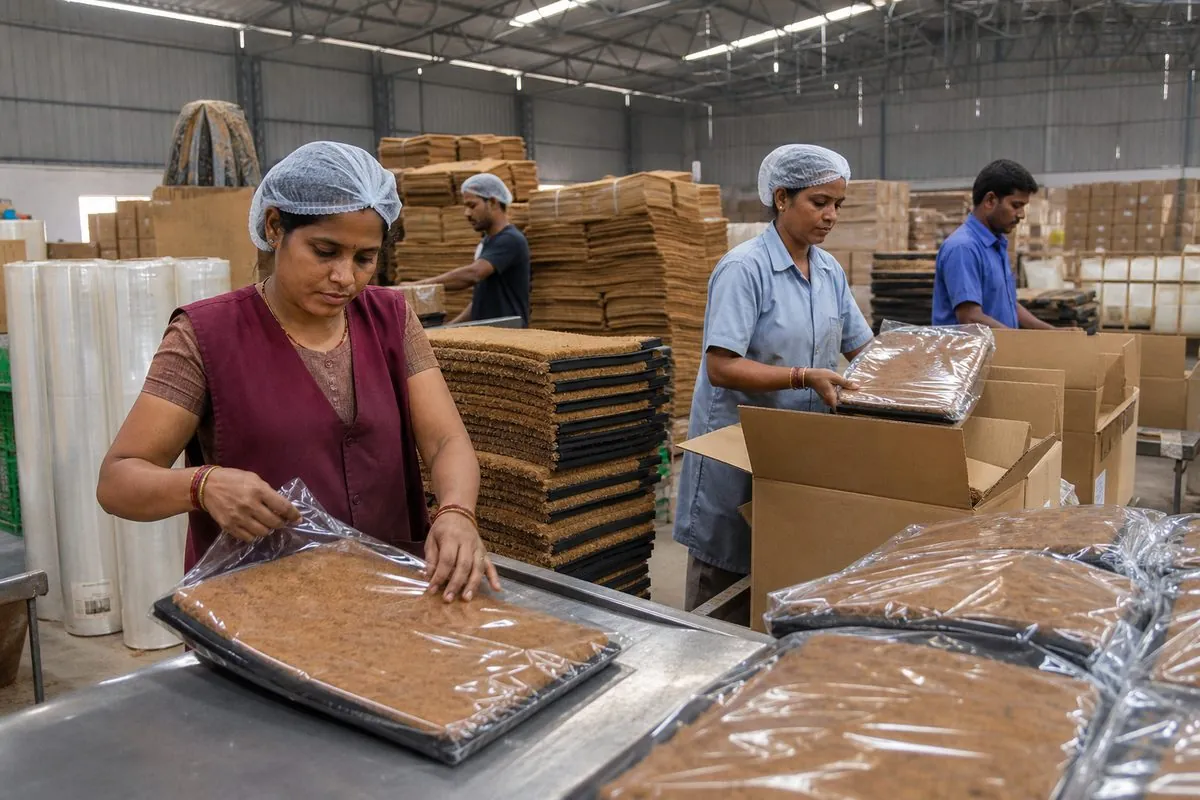
If you want to export coir mats from India — natural and bleached coconut-fibre doormats, handloom and power-loom constructions, tufted entrance mats, PVC-backed and rubber-backed programmes, brush and scraper mats, roll matting, and custom-logo private-label SKUs under HS 5702.20 / India 57022010 — you need an operational system, not a one-off factory WhatsApp inquiry. India's finished coir floor-covering spine is anchored in Alappuzha (Alleppey) and the coastal Kerala coir belt, with dense complementary capacity around Pollachi and western Tamil Nadu, plus selective Karnataka, Odisha, and Andhra units. Merchant exporters commonly consolidate lots for ocean dispatch through Cochin (Kochi), Tuticorin (V.O. Chidambaranar), Chennai, Nhava Sheva (JNPT), and Mundra for selected westbound consolidations.
This guide is the operational pillar for the coir mat cluster: Import Export Code (IEC) from DGFT, Coir Board registration for sector credibility, written construction and backing specifications, size and pile discipline, FOB quoting by piece type, moisture-barrier packaging, cube-aware FCL stuffing, shipping-bill and commercial-document alignment, Incoterm selection, and the path from inquiry to first full container load (FCL). It is written for first-time coir exporters, merchant houses adding coconut-fibre entrance-mat lines, garden-centre and home-retail importers evaluating India as origin, and private-label buyers planning logo doormat programmes.
Because this post owns process, Incoterms, lead times, and ports, several topics are covered at overview depth and linked out: the full SKU and construction catalog lives in Top Coir Mat Products Exported from India; destination ranking in Best Countries for Indian Coir Mat Exports; per-country construction demand in Most Demanded Indian Coir Mats by Country; the importer playbook in Source Coir Mats Directly from India; Coir Board mechanics in Coir Board Registration Benefits for Coir Mat Exporters; PVC/logo and eco specialty depth in PVC-Backed Custom Logo and Eco Coir Doormat Export Opportunities; field-by-field documents in Coir Mat Export Documentation Checklist; buyer prospecting in Find International Buyers for Coir Mats; and fair strategy in Trade Shows and B2B Marketplaces for Coir Mat Exporters.
Coir mats are not quoted like a single undifferentiated commodity. Commercial reality is piece-based FOB by size, pile density, fibre colourway (natural vs bleached), backing type (none, PVC, rubber), print or logo setup, and packing specification, expressed against a named Indian load port. Exporters who lock construction, artwork, moisture packing, and HS wording before production convert first trial cartons into wholesale repeats. Those who ship mixed sizes without a written reference sample or who file finished doormats under fibre or pith headings usually lose the second order even if freight arrives on time.
Altus Exports operates as a merchant exporter from India and global sourcing partner for coir mat programmes — coordinating Kerala and Tamil Nadu supply, PVC/logo and natural mat lots, export documentation, and FCL booking from inquiry through shipment. Work with Altus Exports as your merchant exporter and global sourcing partner for coir mats — verified Kerala and Tamil Nadu supply, PVC/logo and natural mat programmes, export documentation, and FCL booking from inquiry to shipment. If you need a structured first-container path rather than a cold factory email, start here and use the linked cluster guides for SKU depth and market selection. Ready to scope a programme? Contact Altus Exports.
Key Takeaways
Summary Box
Executive Summary
Summary Box
Exporting coir mats from India follows a repeatable operational sequence: register the legal entity (IEC + Coir Board registration), secure manufacturing capacity in Alappuzha, Pollachi, or an equivalent cluster against a written construction specification, quote on an FOB basis with a named Indian port, approve samples and artwork where required, book inland haulage to Kochi, Tuticorin, Chennai, Nhava Sheva, or Mundra, unitise mats in poly bags or kraft wrap inside master cartons or bales with moisture-barrier discipline, stuff to cube-safe FCL targets by size mix, file a shipping bill whose HS and description match the commercial invoice and packing list, and sail under an agreed Incoterm (most commonly FOB Kochi / Tuticorin / Chennai / Nhava Sheva, or CFR/CIF destination).
This process pillar does not replace SKU deep-dives, country ranking studies, or document field-by-field checklists — those live in the linked coir mat cluster posts. What it does own is the path from registration to first FCL: who holds which registration, how lead times stack, which ports and Incoterms actually move coconut-fibre floor coverings, and which operational mistakes destroy repeat business even when pile colour looks fine in a photo.
Broader India coir & coir products exports: IBEF (citing DGCIS) reports about US$455 million in FY25 (vs about US$360 million in FY24). The same IBEF page also states FY25 shipments of 1,342,843 MT worth about US$434 million to 121 countries — treat both figures as IBEF-reported sector context (all coir categories: pith, fibre, mats, etc.), not mats-only, and re-verify against Coir Board / DGCIS extracts before contracts. FY25 value-share mix (IBEF): coir pith ~59.63%, coir fibre ~12.06%, tufted mats ~16.73%. Separately, HS 570220 (woven coir floor coverings) world-trade aggregates (OEC-style, 2024) show India as a leading exporter (~US$44.6M directional) with top importers including USA, South Korea, and UK — do not conflate that woven-line total with tufted/PVC programmes that often classify under HS 5703.90. Destination planning commonly starts with United States, United Kingdom, Germany, Netherlands, South Korea, Australia, Canada, France, Italy, United Arab Emirates — each with distinct retail, garden-centre, and private-label preferences covered at overview depth in the country section below and in depth in the destination guides.
Market Size & Industry Overview
Key Statistics
- Primary HS
- 5702.20 / 5703.90 (confirm CHA)
- Other India lines (confirm live)
- 57022020 / 57022090
- Council
- Coir Board — Coir Board of India (Ministry of MSME)
- Core clusters
- Alappuzha (Alleppey) / coastal Kerala coir belt; Pollachi and western Tamil Nadu; Karnataka coir manufacturing units; Selective Odisha / Andhra capacity; Merchant consolidation via Kochi, Chennai, Tuticorin, Delhi-NCR export houses
- Load ports
- Cochin (Kochi), Tuticorin (V.O. Chidambaranar), Chennai, Nhava Sheva (JNPT), Mundra (westbound consolidations)
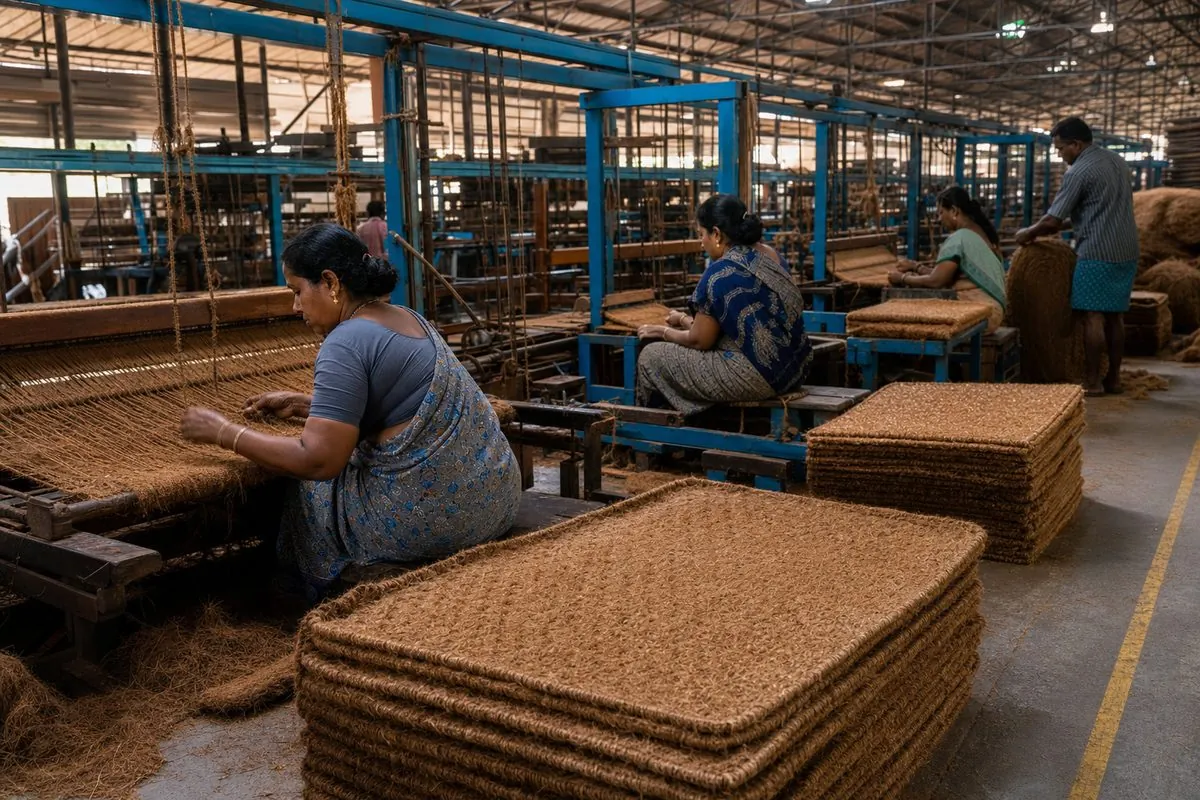
India's finished coir mat export industry is geographically concentrated but commercially diverse. Unlike single-mill metal categories, coconut-fibre entrance mats move through a dense MSME manufacturing belt in Kerala and Tamil Nadu — especially Alappuzha and Pollachi — with merchant exporters and trading houses consolidating handloom, power-loom, tufted, PVC-backed, and rubber-backed programmes for overseas garden centres, home retailers, hospitality buyers, and private-label importers. That cluster density is an operational advantage when you know how to write a specification; it is a risk when you shop only on piece price without moisture packing and size tolerance discipline.
Commercially, finished mats sit inside India's broader coir and coir-products export basket under the Coir Board lens. Broader India coir and coir products exports were about US$434–455M in FY25 in Coir Board / IBEF-style summaries covering pith, fibre, mats, and related goods — treat that band as all-coir sector context, not mats-only revenue. Tufted mats are often cited as a major manufactured-value share within sector summaries (directional around 17% of coir export value in FY25-style summaries — re-verify). For HS 570220 specifically, directional OEC-style aggregates show India as a leading exporter at about US$44.6M in 2024 — planning context, not a contract citation.
New exporters usually enter through stock natural or PVC-backed sizes on FOB south-coast terms, then expand into custom-logo, rubber-backed premium, or roll-matting programmes once sample approval, artwork workflow, and documentation rhythm are proven. Trying to launch multi-SKU private-label logos, multi-port CFR programmes, and aggressive eco claims simultaneously as a first shipment typically overloads QC and packing capacity.
India coir mat export operating map
Swipe →
Data table — swipe horizontally on small screens
| Node | Role in the export chain | Operational note |
|---|---|---|
| Alappuzha / coastal Kerala | Handloom, power-loom, tufted, and finishing capacity | Primary coir-belt origin — allocate early for custom logo programmes |
| Pollachi / western Tamil Nadu | Complementary manufacturing and finishing corridor | Coordinate size mix and backing type before production start |
| Karnataka / Odisha / Andhra (selective) | Supporting capacity for selected constructions | Confirm IEC-facing exporter identity and QC gates |
| Merchant consolidation | Lot assembly, export packing, buyer interface | Common path for garden-centre and private-label importers |
| Kochi / Tuticorin / Chennai / Nhava Sheva / Mundra | Ocean gateway | Match vessel string to inland transit and stuffing date |
Export Statistics
Key Statistics
Export planning for Indian coir mats should start from HS-line discipline, not from a blended "coir industry" headline alone. The commercially relevant planning line for finished coconut-fibre floor coverings is HS 5702.20, with India 57022010 commonly used for mats and matting. Related India lines such as 57022020 / 57022090 may apply to other coir floor-covering presentations — confirm live ITC-HS with your CHA. Fibre, yarn, pith, geotextiles, and rubberized mattress blocks sit under separate headings and must not be mixed into finished doormat shipping-bill narratives.
Broader India coir & coir products exports: IBEF (citing DGCIS) reports about US$455 million in FY25 (vs about US$360 million in FY24). The same IBEF page also states FY25 shipments of 1,342,843 MT worth about US$434 million to 121 countries — treat both figures as IBEF-reported sector context (all coir categories: pith, fibre, mats, etc.), not mats-only, and re-verify against Coir Board / DGCIS extracts before contracts. FY25 value-share mix (IBEF): coir pith ~59.63%, coir fibre ~12.06%, tufted mats ~16.73%. Separately, HS 570220 (woven coir floor coverings) world-trade aggregates (OEC-style, 2024) show India as a leading exporter (~US$44.6M directional) with top importers including USA, South Korea, and UK — do not conflate that woven-line total with tufted/PVC programmes that often classify under HS 5703.90. Use those aggregates to size opportunity and prioritize buyer outreach corridors, then validate current Coir Board, DGCI&S, or broker extracts before board or buyer presentations.
Directional Indian coir mat (HS 570220) export planning snapshot
Swipe →
Data table — swipe horizontally on small screens
| Metric | Indicative position (verify live) | How exporters should use it |
|---|---|---|
| All-coir sector exports (FY25 directional) | about US$455M (IBEF/DGCIS FY25 sector; IBEF also cites ~US$434M / 1,342,843 MT) (pith, fibre, mats, related — not mats-only) | Sector context for Coir Board conversations — label clearly as all-coir |
| HS 570220 India export value (2024 directional) | ~US$44.6M | Scale conversation for finished floor coverings — re-verify before citing |
| Primary tariff lines | 5702.20 or 5703.90 — confirm CHA | Match commercial description to the correct Indian code |
| Leading partner corridors (directional) | United States, United Kingdom, Germany, Netherlands, South Korea | Prioritize first-buyer outreach and vessel-string familiarity |
| Pricing convention | FOB named Indian port (Kochi / Tuticorin / Chennai / Nhava Sheva) | Quote by size, pile, backing, and print — avoid stale absolute screenshots |
| Governing council | Coir Board | Registration credibility and coir-export promotion track |
| Typical wholesale MOQ band | 1,000–5,000+ pcs typical | PVC/logo programme planning after sample approval |
| Origin clusters | Alappuzha + Pollachi + merchant consolidation | Allocate inland transit time into lead-time promises |
Import Statistics
Key Statistics
From the Indian exporter's seat, "import statistics" means understanding how destination markets absorb Indian coir mats — mass garden-centre retail versus specialty eco boutiques versus hospitality entrance programmes — and what that implies for construction, logo artwork, Incoterm, and inspection intensity. The United States, United Kingdom, Germany, Netherlands, South Korea, Australia, Canada, France, Italy, and the United Arab Emirates repeatedly appear among priority corridors for HS 570220-style trade. Duty and preferential treatment differ by corridor — US HTS, EU TARIC, UK tariff, and GCC schedules must be checked live before CFR/CIF landed-cost promises.
US HTS 5702.20.10 (floor coverings of coconut fibres, with pile) Column 1-General is typically Free (MFN) per USITC HTS — confirm live schedule and any Chapter 99 overlays before landed-cost quotes. Tufted coir under HTS 5703 may carry different rates — classify first, then price duty. EU CN 5702 20 (woven coir) and CN 5703 90 (tufted) — confirm TARIC duty and preferential origin claims before CFR/CIF programmes. UK tariff for coir floor coverings — verify live schedule by exact HS (5702.20 vs 5703.90) and preferential claim rules. UAE / GCC schedules for coir mats — often re-export and garden/home retail demand; verify live duty by HS line. Duty notes are planning references only. Always verify live schedules (USITC HTS, TARIC, GCC, FTA texts) before commercial quotes.
Directional destination absorption profile for Indian coir mat exports
Swipe →
Data table — swipe horizontally on small screens
| Destination | Typical demand character | Operational implication for Indian exporters |
|---|---|---|
| United States | Garden centres, home retail, private-label logo mats | Size assortments, PVC/rubber backing clarity, honest eco claims |
| United Kingdom | Retail entrance mats and garden-channel programmes | Tight packing and moisture discipline; post-Brexit tariff checks |
| Germany / Netherlands | EU retail and distribution hubs | REACH/SVHC readiness for PVC or rubber backings; TARIC verification |
| South Korea | Import of finished coir floor coverings | Consistent size and pile specs; clean commercial documents |
| Australia / Canada | Home and garden retail pull | Seasonal planning; phytosanitary readiness if destination requires |
| France / Italy / UAE | Specialty retail, hospitality, Gulf re-export / garden demand | Logo and premium constructions; fast-cycle FOB quotes for UAE desks |
Product Categories / Variants
Summary Box
- Handloom coir mats
- Power-loom coir mats
- Tufted coir mats
- Coir matting (roll / cut piece)
- PVC-backed coir doormats
- Rubber-backed / rubberized coir entrance mats
- Brush and scraper mats
- Printed / custom-logo coir mats
- Bleached vs natural fibre colourways
- Common export sizes: 40×60 cm; 45×75 cm; 50×80 cm; 60×90 cm; 75×120 cm; Buyer-specific / roll matting by metre.
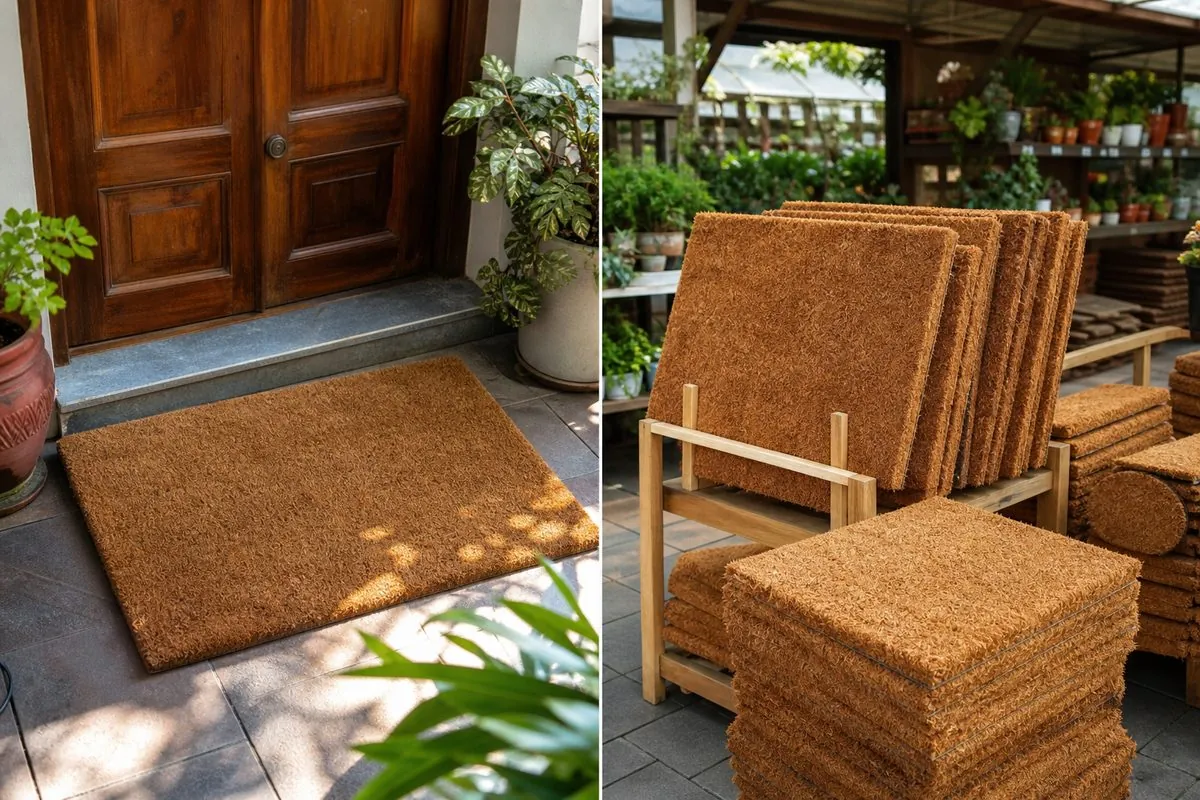
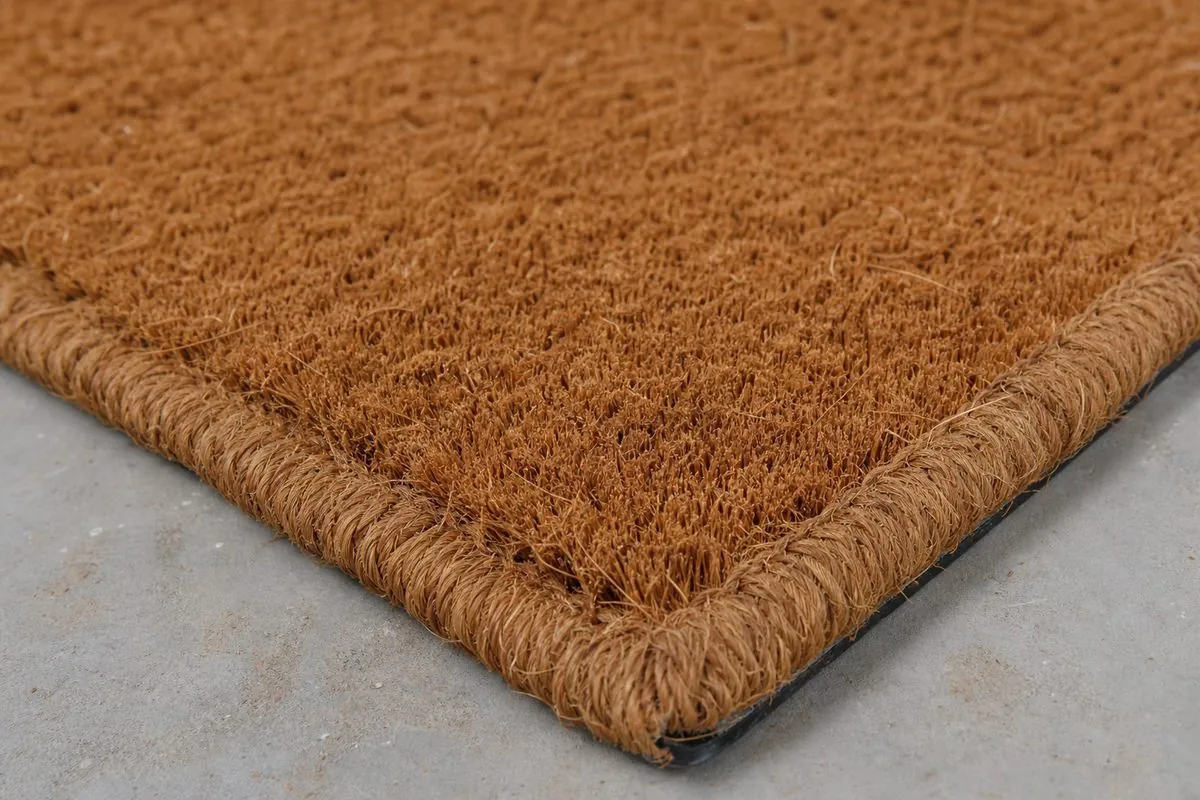
For process planning you only need a working map of what you are allowed to quote and ship — not a full construction encyclopedia. The operational categories that drive HS selection, sample approval, MOQ, and packing are handloom vs power-loom vs tufted constructions, roll matting vs cut mats, PVC-backed vs rubber-backed vs unbound, brush/scraper formats, printed or custom-logo programmes, and natural vs bleached fibre colourways. Full SKU-by-SKU MOQ logic, pile specs, and channel fit live in Top Coir Mat Products Exported from India and logo/eco specialty depth in PVC-Backed Custom Logo and Eco Coir Doormat Export Opportunities.
Working product map for coir mat export operations (overview)
Swipe →
Data table — swipe horizontally on small screens
| Category | Typical HS (India) | Process-critical checkpoint |
|---|---|---|
| Handloom / power-loom coir mats | 57022010 | Written size, pile, and edge-binding reference sample |
| Tufted coir mats | 57022010 | Pile density and tuft retention QC before packing |
| PVC-backed coir doormats | 57022010 | Backing adhesion + REACH/SVHC declarations where required |
| Rubber-backed / brush / scraper mats | Usually 57022010 — confirm presentation with CHA | Edge finish and scraper durability vs buyer brief |
| Printed / custom-logo programmes | 57022010 | Artwork approval + print durability protocol before bulk |
| Roll / cut-piece coir matting | 57022010 or related — confirm live | Roll packing without crease damage; metre-length accuracy |
Manufacturing Overview
Export Tip
From an exporter's process view, manufacturing is a specification-and-release problem as much as a weaving or tufting problem. Coconut fibre is processed into yarn or pile, formed on handlooms, power looms, or tufting lines, finished with edge binding, optionally backed with PVC or rubber, printed for logo programmes, inspected for size and pile, then packed under moisture discipline. Merchant exporters may consolidate multiple unit releases into a buyer-facing assortment while preserving SKU identity — critical when third-party inspection is booked.
Operationally, visit or video-audit the staging warehouse before first FCL: check how mats are dried and stored, how lot tags survive handling, whether poly bags and master cartons include moisture barriers, and how sample-approved constructions map to bulk production. A beautiful photograph attached to the wrong size or backing is still a failed shipment commercially.
Indicative lead-time bands to build into promises: samples 7–21 days typical for samples depending on construction; stock sizes after confirmation 2–4 weeks for stock sizes after confirmation; custom logo and private-label programmes 4–8+ weeks including artwork approval for logo/private-label programmes.
The Export Process: From IEC to First FCL
Export Tip
This is the core operational spine of this guide. Follow the steps in order. Compressing registration, sample approval, and stuffing into a single frantic week is the most common reason first coir mat containers sail with documentary mismatches, size mix errors, or moisture claims.
Step 1: Obtain an Import Export Code (IEC)
An IEC from DGFT is the legal baseline for commercial export from India. Apply online with PAN, business registration proof, bank details, and digital authentication. Align the IEC legal entity with GST, bank AD code, and the name that will appear on commercial invoices and shipping bills. Coir mat parcels filed under mismatched entities create avoidable holds and buyer distrust.
Step 2: Register with the Coir Board
Coir Board registers coir exporters and issues Registration-cum-Membership Certificate (RCMC) for coir fibre, yarn, and coir products under Foreign Trade Policy practice. Confirm current application route (Coir Board / DGFT dashboard), eligibility thresholds, and product-list fit with Coir Board and your CHA before locking copy. EPCH adjacency may apply only for clearly artware-style programmes. Full membership mechanics and buyer-credibility uses are covered in Coir Board Registration Benefits for Coir Mat Exporters. Keep registration current; lapsed status during a retail tender cycle weakens your documentary pack. Primary reference: https://coirboard.gov.in/.
Step 3: Define construction, backing, size, and Incoterm before outreach
Write a one-page specification: construction (handloom / power-loom / tufted), size, pile density, fibre colourway, backing type, logo or print requirement, inspection protocol, named load port, and Incoterm from the common set (EXW unit / warehouse; FOB Kochi / Tuticorin / Chennai / Nhava Sheva; CFR / CIF named destination port; DDP (selected large retail programmes only)). Do not open factory negotiations with "need coir mats ASAP" — that language produces non-comparable quotes.
Step 4: Secure manufacturing capacity or merchant consolidation
Work through verified Alappuzha, Pollachi, or merchant-exporter channels who can show prior export history on finished coir floor coverings. Verify that the entity quoting can actually release sample-matched bulk on the promised window. For importer-side verification tactics, see Source Coir Mats Directly from India.
Step 5: Quote FOB by piece type and lock inclusions
FOB named Indian port (Kochi / Tuticorin / Chennai / Nhava Sheva). Indicative commercial FOB planning bands only (not official published prices): natural/handloom ~US$2–12/pc; PVC-backed plain ~US$3–15/pc; custom logo ~US$4–20+/pc; rubber-backed premium ~US$5–25+/pc by size — verify on quote date. Indicative merchant-trade planning bands only; confirm size, pile density, backing, print, and packing on quote date. Do not cite as government price series. Put size mix, packing inclusions, artwork setup (if any), and inspection cost allocation in the same quotation PDF.
Step 6: Approve samples, artwork, and production identity rules
Agree a written reference sample for construction, size tolerance, edge finish, and backing. For logo programmes, lock artwork files, colour standards, and print durability expectations before bulk. Define how SKU codes will appear on cartons, packing list, and invoice. For first commercial FCL, many buyers specify SGS / Bureau Veritas / Intertek pre-shipment inspection — book the inspector before the container is stuffed.
Step 7: Plan packaging, moisture protection, and inland haulage
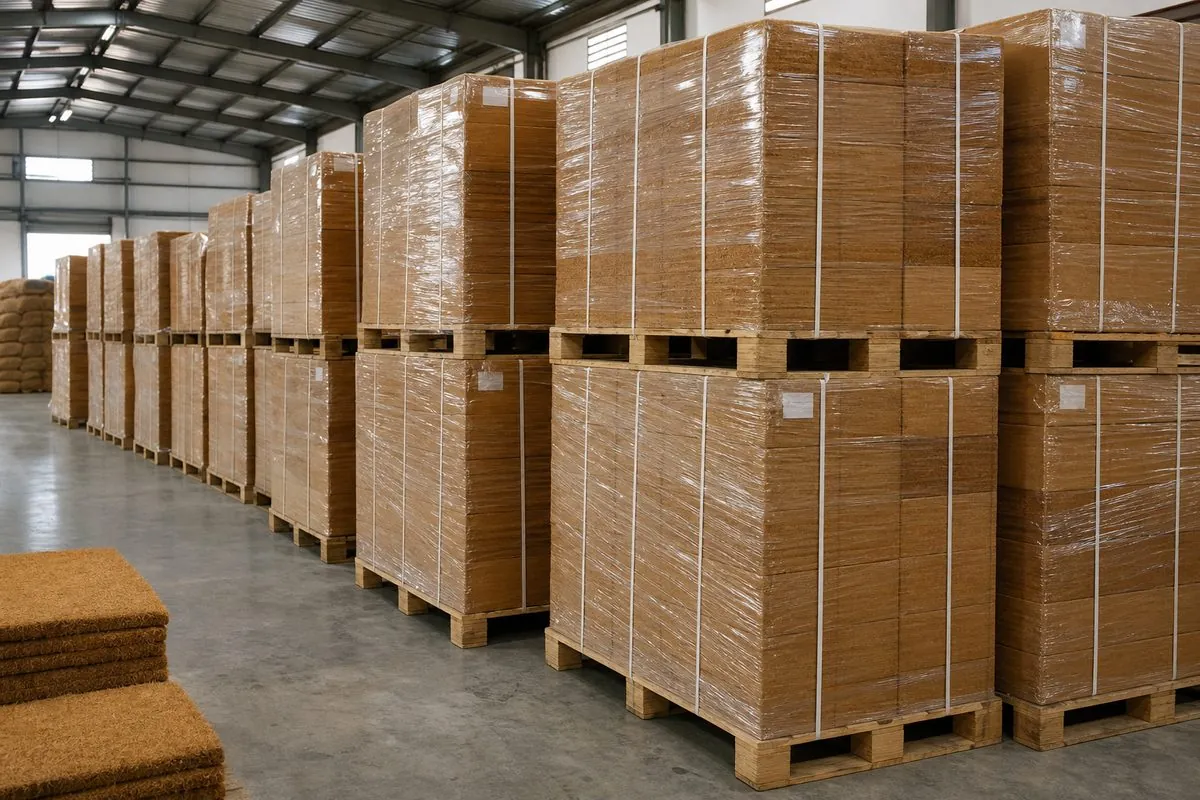
Individual poly bag or kraft wrap; edge protection for PVC-backed mats; Master cartons or bales by size; palletize for FCL where specified; Roll matting with crease avoidance and moisture barrier; Desiccant / moisture-barrier discipline for coconut-fibre goods. Sequence trucks from Kerala or Tamil Nadu staging to the chosen port so mats are not sitting in humid outdoor yards longer than necessary.
Step 8: Stuff the FCL to cube-safe targets
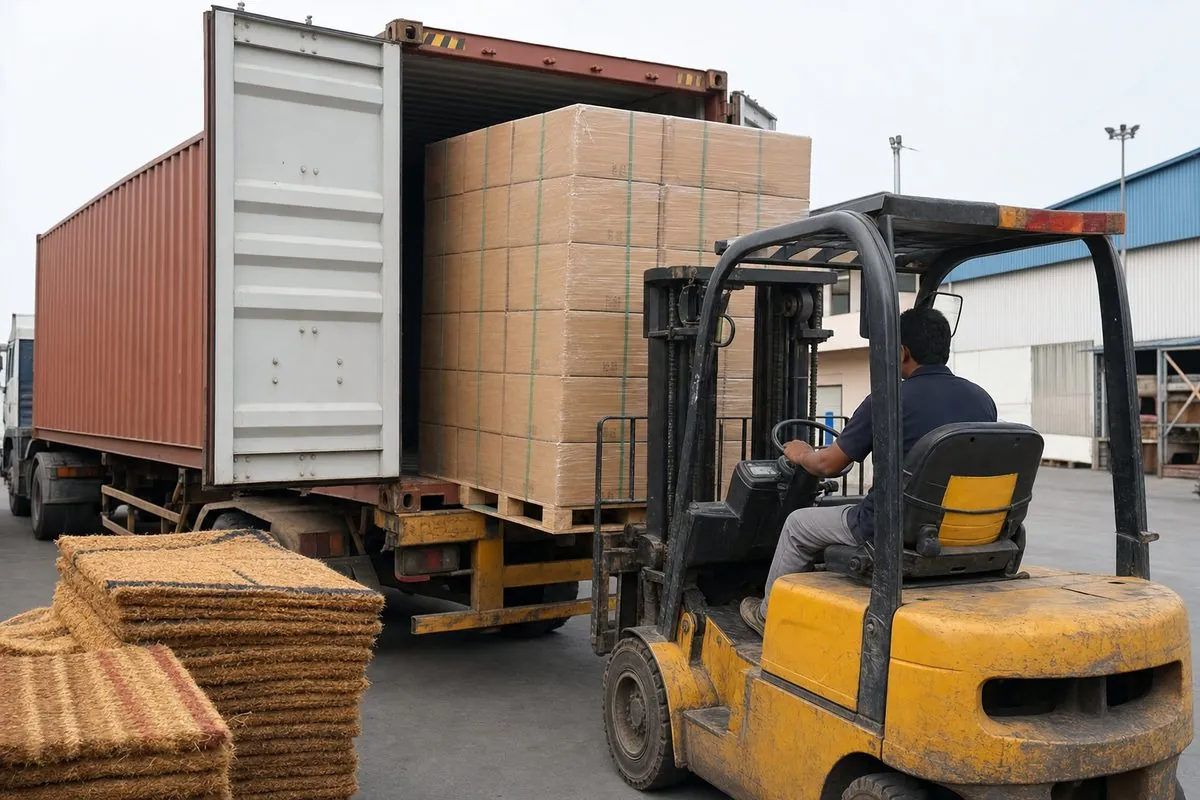
Plan piece counts by size mix and carton CBM with your forwarder — coir mats are often cube-constrained rather than weight-constrained. Photograph carton marks and seal numbers; retain a stuffing tally that matches the packing list by SKU. Do not substitute sizes at the dock without a revised packing list and buyer approval.
Step 9: Prepare the core export document set (overview)
In parallel with stuffing, assemble commercial invoice, packing list, shipping bill inputs, Certificate of Origin where needed, fibre composition declaration, bill of lading / sea waybill instructions, phytosanitary certificate if the destination requires it for plant-fibre goods, and inspection reports. Field-by-field templates and failure modes live in Coir Mat Export Documentation Checklist — this process guide only requires that HS description, piece counts, and SKU identity are identical across every document.
Step 10: Sail under the agreed Incoterm and start the buyer rhythm
Confirm who books freight and insurance under FOB vs CFR/CIF before gate-in. After first FCL, convert the relationship toward seasonal wholesale repeats where garden centres and retailers need continuity. Buyer discovery tactics are owned by Find International Buyers for Coir Mats and fair calendars by Trade Shows and B2B Marketplaces for Coir Mat Exporters.
Pricing Analysis
Buyer Tip
Coir mat export pricing is piece-based and specification-driven. The commercially accepted structure is FOB a named Indian port, with size, pile, backing, print setup, and packing treated as explicit drivers of the unit price. Natural handloom constructions typically sit at the lower end of planning bands; PVC-backed plain mats mid-range; custom logo and rubber-backed premium programmes higher. Indicative FOB bands often span roughly US$2–25 per piece by type — always reconfirm on quote date.
Operational pricing mistakes include quoting without a named size mix, mixing EXW factory numbers into an FOB conversation without inland and terminal costs, promising CFR landed costs before live duty checks, and treating logo setup as free when print plates or digital setup actually consume calendar time and money. Keep the quote transparent so buyers can compare Indian offers against other origins on an apples-to-apples basis.
Coir mat export price-build components (indicative structure)
Swipe →
Data table — swipe horizontally on small screens
| Component | What it covers | Exporter control tip |
|---|---|---|
| Base construction | Handloom / power-loom / tufted fibre and labour | Separate natural vs bleached colourways in the quote |
| Size & pile | Dimensions and pile density driving fibre consumption | Never average mixed sizes into one fuzzy piece price |
| Backing | PVC or rubber backing materials and adhesion process | State REACH/SVHC documentation inclusions when relevant |
| Logo / print setup | Artwork approval, plates or digital setup, print labour | Quote setup separately from per-piece run rate |
| Packing | Poly/kraft, master cartons or bales, desiccants, pallets | Include or exclude explicitly; moisture barriers are not free |
| Inspection | Third-party PSI when buyer requires | Allocate cost and nomination rights before stuffing |
| Inland + terminal (to FOB) | Cluster to port haulage, handling, gate-in | Recalculate when port or vessel string changes |
| Ocean (CFR/CIF only) | Freight and insurance when seller books | Never imply CFR numbers on an FOB-only allocation |
MOQ Analysis
Buyer Tip
Minimum order quantity in coir mats is driven by loom or tufting setup, print setup economics, carton engineering, and container cube — not by metal-style tonnage logic. Sample packs commonly sit at 5–20 pieces so buyers can validate construction and moisture packing. Trial commercial lots often run 200–1,000 pieces. Wholesale PVC-backed and logo programmes typically move to 1,000–5,000+ pieces. Handloom specialty lines can sometimes accept lower MOQs after sample approval.
MOQ figures are indicative commercial practice by construction and channel — not statutory minima. Lock MOQ in writing before production.
Indicative MOQ tiers for Indian coir mat export programmes
Swipe →
Data table — swipe horizontally on small screens
| Tier | Typical quantity | When it makes sense |
|---|---|---|
| Samples | 5–20 pcs | Construction and packing validation before commercial commitment |
| Trial / first commercial | 200–1,000 pcs | New buyer, new size mix, or first logo approval cycle |
| Wholesale PVC / logo | 1,000–5,000+ pcs typical | Retail and garden-centre repeats; best setup amortization |
| Handloom specialty | Lower MOQ often possible after sample approval | Boutique or hospitality programmes after sample lock |
Packaging Standards
Export Tip
- Unit pack
- Individual poly bag or kraft wrap; edge protection for PVC-backed mats
- Master pack
- Master cartons or bales by size; palletize for FCL where specified
- Rolls
- Roll matting with crease avoidance and moisture barrier
- Moisture
- Desiccant / moisture-barrier discipline for coconut-fibre goods
Packaging for coir mats is about piece identity, edge protection, and moisture control. Individual mats commonly ship in poly bags or kraft wrap, with extra edge protection for PVC-backed goods. Master cartons or bales group by size; palletization is used for FCL programmes when specified. Roll matting needs crease avoidance and moisture barriers. Coconut fibre absorbs ambient humidity — dry staging and desiccant discipline prevent mould claims that destroy otherwise acceptable pile quality.
Operational packaging failures that trigger claims include wet cartons sealed too early, missing size marks that scramble assortments, crushed PVC edges from over-compression, and roll matting creased into permanent folds. Specify packaging in the same PDF as the purchase order confirmation, and photograph sealed cartons before inland loading when the buyer requires evidence.
Container Loading Details
Export Tip
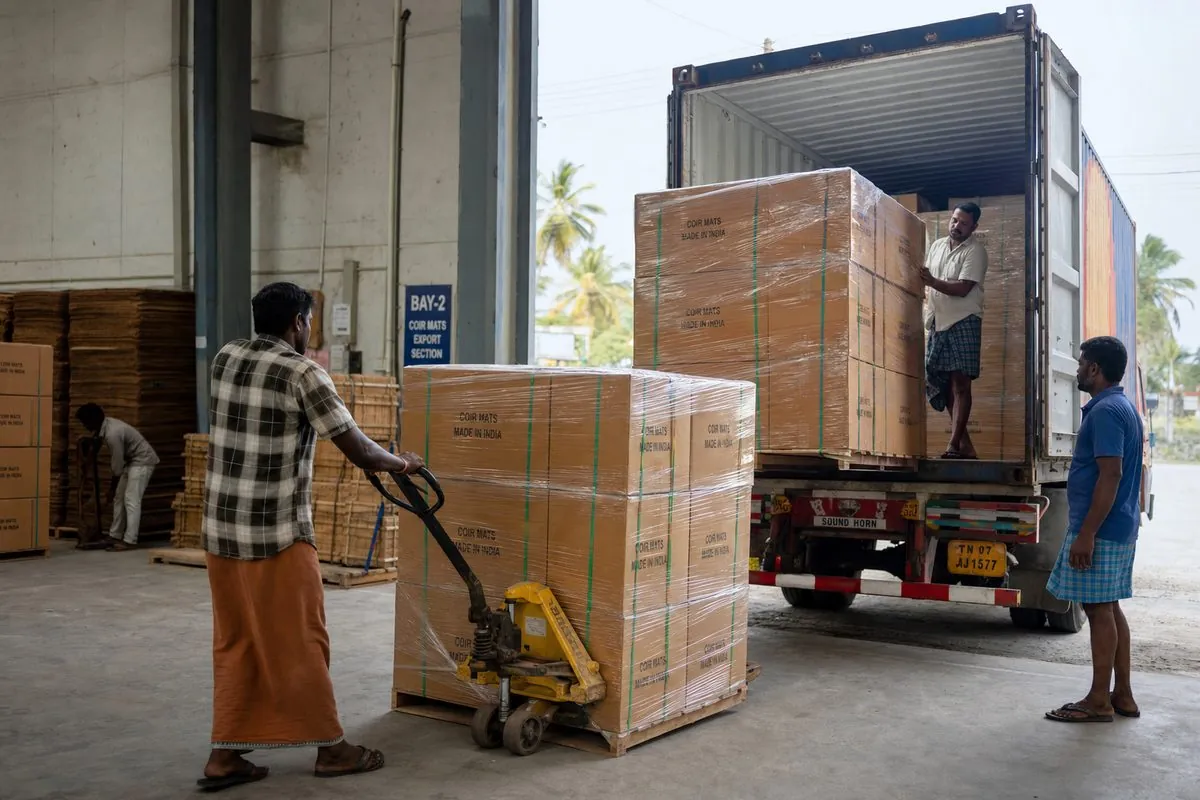
Most first commercial coir mat programmes target a 20ft or 40ft FCL planned by carton CBM and piece count by size, not by a single tonnage slogan. Overstuffing to chase freight per-piece savings is a false economy if cartons crush, moisture vents fail, or destination handling becomes unsafe. Stuffing tallies should reconcile SKU counts to the packing list before seals go on.
Indicative container loading planner for coir mat FCLs
Swipe →
Data table — swipe horizontally on small screens
| Parameter | Planning guide | Failure mode to avoid |
|---|---|---|
| Container type | 20ft or 40ft GP by volume of size mix | Assuming weight limit is the only constraint |
| Planning unit | Carton CBM × piece count by SKU | Averaging mixed sizes into one guess |
| Moisture control | Dry cartons, desiccants, avoid wet yard dwell | Sealing damp fibre into poly bags |
| Identity control | SKU marks visible; photos archived | Substituting sizes without revising documents |
| Edge / PVC protection | Prevent crush on backed mats | Over-compressing cartons to gain cube |
| Seal protocol | Seal number on packing list + B/L instructions | Sealing before inspector sign-off when PSI is contracted |
| Document reconciliation | SKU counts = invoice / packing list | Rounding differences left unexplained |
Shipping Methods
Export Tip
- Match inland gate-in appointments to vessel cut-offs — mats that miss a string often wait a full week in humid staging.
- Keep insurance responsibility explicit under the chosen Incoterm.
- For CFR/CIF, separate the piece-price conversation from the freight conversation in writing.
- Photograph seals and stow before the truck leaves the stuffing point when buyer remote witnessing is required.
- Primary planning ports: Cochin (Kochi), Tuticorin (V.O. Chidambaranar), Chennai, Nhava Sheva (JNPT), Mundra (westbound consolidations).
Ocean freight is the default for commercial coir mat volumes. South-coast and selected west-coast load ports — Kochi, Tuticorin, Chennai, Nhava Sheva, and Mundra — connect Kerala and Tamil Nadu origin goods to USA, Europe, East Asia, Australia, and Gulf vessel strings. Air freight is occasionally used for sample packs or urgent artwork approval pieces, not for wholesale FCL economics.
Common Incoterms for this category: EXW unit / warehouse; FOB Kochi / Tuticorin / Chennai / Nhava Sheva; CFR / CIF named destination port; DDP (selected large retail programmes only). First-time programmes usually stay on FOB named Indian port so freight volatility does not distort the piece-price conversation. Move to CFR/CIF only when you can book reliably and have verified destination duty assumptions. DDP appears mainly on selected large retail programmes.
Certifications
Compliance Notes
- Coir Board registration / RCMC evidence
- Fibre composition declaration (coconut coir)
- ISO plant quality systems where available
- Third-party inspection (SGS / Bureau Veritas / Intertek) on request
- Certificate of Origin
- REACH / SVHC declarations for PVC or rubber backings where required
- Phytosanitary certificate where destination plant-health rules require it for plant-fibre goods
- Honest eco / biodegradable claim controls (no overclaim on polymer-backed mats)
Coir mat export "certification" mixes trade documents, fibre honesty, and destination chemical rules for backings. Buyers commonly expect Coir Board registration evidence from the exporter, a fibre composition declaration confirming coconut coir, Certificate of Origin, ISO plant quality systems where available, third-party inspection when specified, REACH / SVHC declarations for PVC or rubber backings where required, phytosanitary certificates when the destination demands them for plant-fibre goods, and honest eco or biodegradable claim controls with no overclaim.
Buyer Requirements
Buyer Requirements
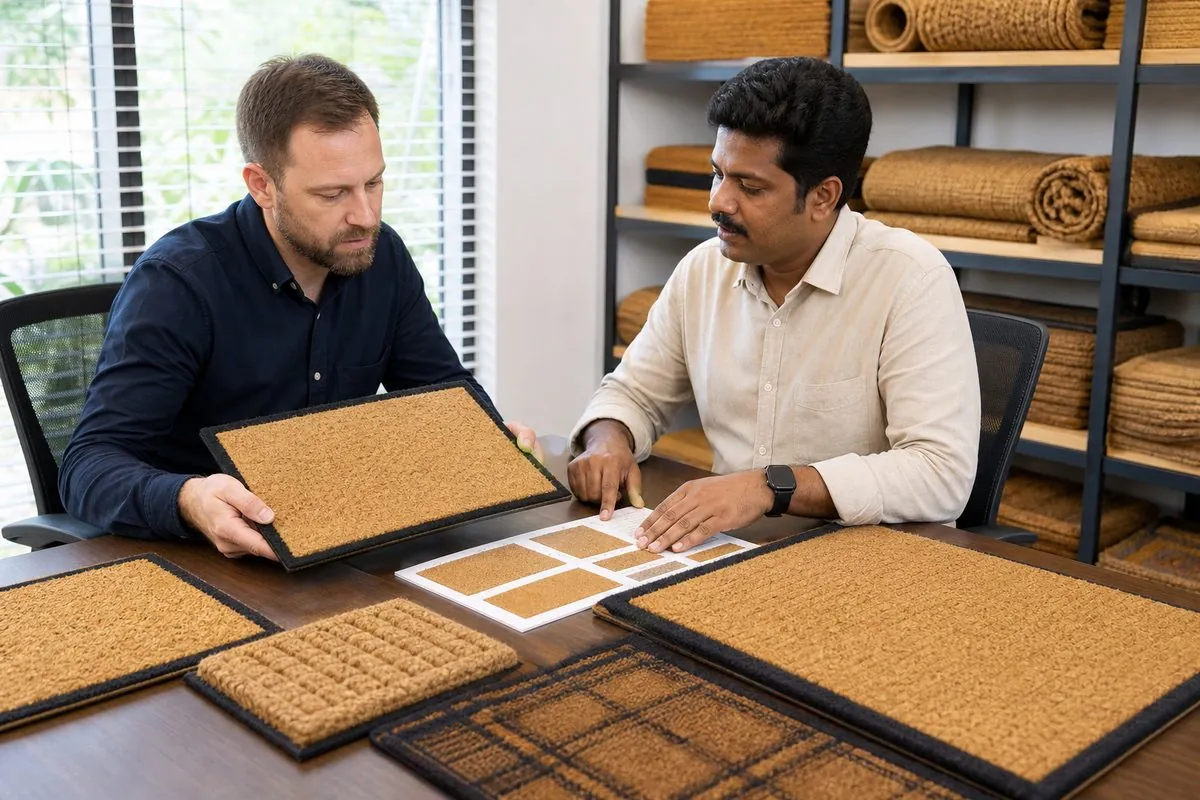
Retail and wholesale coir mat buyers evaluate exporters on four axes: construction certainty against a reference sample, documentary cleanliness, moisture-safe packing, and delivery reliability against a written FOB calendar. A US garden-centre buyer and a German specialty retailer may buy the same HS line but impose different logo artwork, backing chemistry, and inspection intensity. Ask early whether the buyer is private-label or stock-assortment — that single answer changes how you staff artwork workflow and claims response.
Typical first-order buyer asks include: Can you match this size and pile sample? Which backing — PVC or rubber? What is MOQ for logo mats? Which port and Incoterm? Who nominates the surveyor? What is the earliest FOB gate-in after artwork approval? Exporters who answer those in one structured PDF win faster than those who drip answers across chat apps. For importer-side verification depth, see Source Coir Mats Directly from India.
Country-wise Opportunities
Market Snapshot
Country selection for a first FCL should favor corridors where Indian coir mats already move and where your Incoterm, moisture packing, and inspection capacity match buyer norms. Deep ranking, duty tables, and construction-by-country matrices live in Best Countries for Indian Coir Mat Exports and Most Demanded Indian Coir Mats by Country. Below is an operational snapshot for priority corridors.
United States
The United States is a core garden-centre and home-retail destination for Indian coir doormats, including PVC-backed and custom-logo programmes. Buyers often emphasize size assortments, honest eco language, and reliable seasonal replenishment. Confirm live US HTS under 5702.20 and any Chapter 99 overlays before CFR landed-cost promises.
United Kingdom
UK retail and garden channels pull natural and backed entrance mats with strong expectations for packing cleanliness and moisture control. Post-Brexit tariff and preference rules must be verified live. FOB Kochi or Tuticorin with tight packing-list discipline is a common entry pattern.
Germany and the Netherlands
These markets combine end retail with EU distribution logic. REACH and SVHC declarations for PVC or rubber backings matter. TARIC duty checks should precede any CFR advantage claims. Construction consistency across cartons is non-negotiable for chain buyers.
South Korea
South Korea appears repeatedly among leading importers of coconut-fibre floor coverings. Buyers typically want consistent size and pile specs plus clean commercial documents. Lead-time honesty beats optimistic FOB dates that slip after sample approval.
Australia and Canada
Both markets show home and garden retail pull with seasonal planning habits. Ask early about phytosanitary requirements for plant-fibre goods and about preferred backing types. Trial MOQs in the 200–1,000 piece band often precede wholesale repeats.
France, Italy, and the United Arab Emirates
France and Italy frequently skew toward specialty and hospitality entrance programmes; UAE combines local garden/home demand with Gulf redistribution. Logo and premium constructions can outperform plain commodity mats when artwork and packing discipline are proven. Use Most Demanded Indian Coir Mats by Country when assortment — not process — is the open question.
Sourcing Checklist
Checklist
- Confirm IEC entity and Coir Board registration status before requesting factory allocation.
- Map intended construction (handloom / tufted / PVC-backed / logo) to HS 5702.20 / 57022010 with your CHA.
- Select load port from Kochi, Tuticorin, Chennai, Nhava Sheva, or Mundra based on vessel string and inland transit.
- Write FOB piece price + size mix + packing + inspection into one quotation template.
- Require a physical or couriered reference sample with production notes — not photos alone.
- Book third-party PSI when the buyer’s PO requires it — before stuffing.
- Engineer carton CBM and piece counts for the planned 20ft or 40ft FCL.
- Align commercial invoice, packing list, and shipping bill descriptions word-for-word on construction and HS.
- Photograph seals, carton marks, and stow; archive with the shipment folder.
- Schedule post-shipment claim window and survey contact details with the buyer in writing.
- For buyer discovery after process readiness, use Find International Buyers for Coir Mats.
- For SKU catalog decisions, switch to Top Coir Mat Products Exported from India.
Common Buyer Mistakes
Common Mistakes Box
Most failed first coir mat shipments are not fibre mysteries — they are process failures. Buyers (and new exporters acting like buyers) repeatedly make the same errors: treating "coir mat" as one interchangeable SKU, skipping sample approval, ignoring moisture packing, and choosing Incoterms that dump freight risk onto the unprepared party.
Common coir mat export mistakes and how to avoid them
Swipe →
Data table — swipe horizontally on small screens
| Mistake | Consequence | How to Avoid It |
|---|---|---|
| Ordering without a written size/pile/backing spec | Assortment mismatches and retail returns | Lock a reference sample and SKU sheet before bulk |
| Comparing FOB India quotes to CFR competitor quotes | False "cheapest" decisions | Normalize freight and duty before comparing |
| Skipping moisture-barrier packing sign-off | Mould or odour claims on arrival | Approve desiccant and dry-staging SOP in writing |
| Allowing stuffing before PSI attendance | Disputed piece counts or construction | Book surveyor before seals when PO requires PSI |
| Filing finished mats under fibre/pith HS | Customs holds and credibility damage | Use 5702.20 / 57022010 with CHA confirmation |
| Overclaiming biodegradable / eco language | Retail audit failure | Claim only what lot evidence supports |
| Underestimating Alappuzha/Pollachi-to-port inland time | Missed vessel strings | Put inland + stuffing + cut-off on one calendar |
Future Market Trends
Key Statistics
Looking forward, Indian coir mat export operations will be shaped by garden-centre and home-retail demand in the USA, UK, and EU, continued growth of PVC-backed and custom-logo private-label programmes, tighter chemical documentation for backings, and stronger expectations for moisture-safe packing evidence. Exporters who invest in sample discipline, artwork workflow, and calendar honesty — sample approval, bulk QC, stuffing, sailing — will outperform those competing only on the lowest piece screenshot.
Operational trends affecting Indian coir mat exporters
Swipe →
Data table — swipe horizontally on small screens
| Trend | What is changing | Process response |
|---|---|---|
| Private-label logos | More buyers want branded entrance mats | Build artwork approval into standard lead-time math |
| Backing chemistry transparency | REACH/SVHC questions on PVC and rubber | Keep declaration templates ready before RFQ reply |
| Moisture claims discipline | Faster photo/survey expectations on mould | Pre-agree packing SOP and evidence standards |
| Assortment complexity | Multi-size cartons in one FCL | SKU-level packing lists and stuffing tallies |
| EU/UK retail compliance | Stricter document packs for chain buyers | Single shipment data room; no chat-only amendments |
| Gulf and Australia seasonal pull | Garden-channel timing swings | Keep flexible FCL capacity without over-promising |
| Merchant consolidation | Overseas buyers prefer one accountable exporter interface | Clear lot-identity rules when combining factory releases |
| Honest eco positioning | Buyers reject vague biodegradable slogans | Lot-linked fibre claims only; no overclaim |
Challenges & Solutions
Exporting coir mats from India involves a specific set of operational challenges tied to natural-fibre moisture sensitivity, MSME cluster fragmentation, and retail assortment complexity — all addressable through the process discipline in this guide.
Coir mat export challenges and solutions
Swipe →
Data table — swipe horizontally on small screens
| Challenge | Root Cause | Solution |
|---|---|---|
| Fragmented MSME supply base | Many units of uneven formalization in Kerala/TN belts | Vet IEC/Coir Board status; use merchant exporters for consolidated programmes |
| Mould and moisture damage on arrival | Insufficient desiccants or humid warehouse storage | Engineer moisture barriers; enforce dry staging before carton seal |
| Size and pile inconsistency across a lot | No written reference sample governing bulk | Lock reference sample; request in-progress QC photos |
| Logo print delays | Artwork treated as afterthought | Approve files and colour standards before production start |
| HS misclassification risk | Finished mats confused with fibre or pith lines | File under 5702.20 / 57022010 with CHA confirmation |
| Finding qualified international buyers | Limited fair or trade-data outreach experience | See Find International Buyers for Coir Mats |
Buyer Checklist
Checklist
Exporter Checklist
Checklist
Compliance Checklist
Checklist
Compliance Notes
Sources & References
- Coir Board of India
- Coir Board — Statistics
- Coir Board — Forms & Guidelines (Exporter Registration / RCMC)
- IBEF — Coir Industry in India (DGCIS-sourced export figures)
- Ministry of MSME — Coir product-wise export dashboard
- OEC — Floor coverings of coconut fibres (HS 570220)
- ITC Trade Map
- DGFT (India) — IEC / trade portal
- ICEGATE — Indian Customs EDI
- India CBIC / Customs Tariff
- USITC Harmonized Tariff Schedule — search 5702.20
- European Commission TARIC
- TaxGuru — GST classification note on coir mats with PVC/rubber/latex backing (HS 5703 90 90 practice)
- Altus Exports — Handicrafts & Lifestyle Products
- Altus Exports — Merchant Exporter India
All sources accessed 2026-07-26 (factual audit refresh). Prefer Coir Board, DGCIS/IBEF, CBIC tariff, USITC HTS, and TARIC when citing figures in contracts or buyer presentations. Label sector-wide coir totals separately from HS 5702.20 (woven) and HS 5703.90 (tufted / many backed programmes). Confirm every 8-digit Indian statistical line with a licensed CHA before shipping-bill filing.
Conclusion
To export coir mats from India successfully, treat the path from IEC to first FCL as a single operating system: Coir Board-backed credibility, Alappuzha and Pollachi origin allocation, FOB piece quoting by size and backing, sample-locked constructions, moisture-protected packaging, cube-safe stuffing at Kochi, Tuticorin, Chennai, Nhava Sheva, or Mundra, and Incoterm clarity. SKU catalogs, country rankings, and document field checklists matter — but they only convert into revenue when the process calendar holds.
Work with Altus Exports as your merchant exporter and global sourcing partner for coir mats — verified Kerala and Tamil Nadu supply, PVC/logo and natural mat programmes, export documentation, and FCL booking from inquiry to shipment.
Next reads inside this cluster: Top Coir Mat Products Exported from India for SKU depth, Best Countries for Indian Coir Mat Exports for market selection, Coir Mat Export Documentation Checklist for document fields, and PVC-Backed Custom Logo and Eco Coir Doormat Export Opportunities for specialty programmes. Ready to structure your first parcel? Use merchant exporter services, global sourcing partner India, export products from India, or contact Altus Exports.