Coir Mat Export Documentation Checklist
By Saurabh Mittal, Founder, Altus Exports
A document-by-document operational checklist for exporting Indian coir mats under HS 5702.20 — commercial invoice, packing list with moisture notes, fibre composition declaration, Certificate of Origin, phytosanitary where needed, REACH/SVHC for PVC or rubber backings, shipping bill on ICEGATE, bill of lading, and a clean CHA broker handoff. Coir mats only: Alappuzha and Pollachi programmes consolidated via Kochi, Tuticorin, Chennai, or Nhava Sheva — not a Coir Board registration walkthrough and not a country-selection guide.
Exporting coir mats from India — handloom and power-loom doormats, tufted entrance mats, PVC-backed and rubber-backed retail programmes, brush and scraper mats, roll matting, and custom-logo private-label lines under HS 5702.20 — is not held together by one master form. It is held together by a reconciled stack: Importer–Exporter Code (IEC), GST registration, Coir Board registration evidence where used for coir-product programmes, commercial invoice, packing list with size/piece counts and moisture-control notes, fibre composition declaration (coconut coir), Certificate of Origin (COO), phytosanitary certificate where the destination requires it for plant-fibre goods, REACH / SVHC declarations for PVC or rubber backings where EU/UK programmes demand them, marine insurance as required by Incoterm, shipping bill filed through your Customs House Agent (CHA) on ICEGATE under the correct India statistical line (commonly 57022010; confirm 57022020 / 57022090 with your broker), bill of lading or sea waybill, optional third-party inspection reports, and e-BRC realisation after payment.
When any one of those documents is missing, inconsistent with the others, or written as marketing rather than evidence, three failures follow: Indian customs queries on HS or valuation; destination holds when size counts, fibre claims, or backing chemistry on the packing list do not match the carton contents; and — worst — retailer or LC rejection when REACH language, phytosanitary status, or HS declaration does not reconcile line by line. This checklist is written for that operational reality. It is not a substitute for your CHA, and it does not replace the Coir Board registration walkthrough — see Coir Board registration benefits for coir mat exporters for why Board registration exists and how to apply. It is the document-by-document reconciliation layer that turns an approved coir mat programme into a container that clears both ends and closes payment cleanly.
Scope note: this post owns the coir mat documentation checklist for the cluster. It does not rank destination markets — see best countries for Indian coir mat exports. It does not walk the full end-to-end export process — see how to export coir mats from India. Pair this checklist with source coir mats directly from India for buyer-side verification, and always confirm live HS breakouts, form numbers, and portal workflows with your broker before filing. Broader India coir & coir products exports: IBEF (citing DGCIS) reports about US$455 million in FY25 (vs about US$360 million in FY24). The same IBEF page also states FY25 shipments of 1,342,843 MT worth about US$434 million to 121 countries — treat both figures as IBEF-reported sector context (all coir categories: pith, fibre, mats, etc.), not mats-only, and re-verify against Coir Board / DGCIS extracts before contracts. FY25 value-share mix (IBEF): coir pith ~59.63%, coir fibre ~12.06%, tufted mats ~16.73%. Separately, HS 570220 (woven coir floor coverings) world-trade aggregates (OEC-style, 2024) show India as a leading exporter (~US$44.6M directional) with top importers including USA, South Korea, and UK — do not conflate that woven-line total with tufted/PVC programmes that often classify under HS 5703.90.
Key Takeaways
Summary Box
Executive Summary
Summary Box
Indian coir mats — primarily finished doormats and mattings from Kerala and Tamil Nadu manufacturing belts consolidated by merchant exporters for overseas garden centres, home retailers, and private-label programmes — succeed or fail on documentary discipline as much as on pile density and edge finish. Broader India coir & coir products exports: IBEF (citing DGCIS) reports about US$455 million in FY25 (vs about US$360 million in FY24). The same IBEF page also states FY25 shipments of 1,342,843 MT worth about US$434 million to 121 countries — treat both figures as IBEF-reported sector context (all coir categories: pith, fibre, mats, etc.), not mats-only, and re-verify against Coir Board / DGCIS extracts before contracts. FY25 value-share mix (IBEF): coir pith ~59.63%, coir fibre ~12.06%, tufted mats ~16.73%. Separately, HS 570220 (woven coir floor coverings) world-trade aggregates (OEC-style, 2024) show India as a leading exporter (~US$44.6M directional) with top importers including USA, South Korea, and UK — do not conflate that woven-line total with tufted/PVC programmes that often classify under HS 5703.90. Directional destination partners include United States, United Kingdom, Germany, Netherlands, South Korea, Australia, Canada, France, Italy, United Arab Emirates. Production and staging sit in Alappuzha (Alleppey) / coastal Kerala coir belt; Pollachi and western Tamil Nadu; Karnataka coir manufacturing units; Selective Odisha / Andhra capacity; Merchant consolidation via Kochi, Chennai, Tuticorin, Delhi-NCR export houses, with ocean exit typically through Cochin (Kochi), Tuticorin (V.O. Chidambaranar), Chennai, Nhava Sheva (JNPT), Mundra (westbound consolidations).
The commercial payoff for treating documentation as a controlled asset is not administrative — it is margin and velocity. Buyers in the USA, UK, Germany, Netherlands, South Korea, Australia, Canada, France, Italy, and UAE onboard coir mat vendors with a documentation-first filter: IEC, Coir Board registration where expected, fibre declaration, clear HS 5702.20 / 5703.90 posture by construction, Incoterm with named port, REACH language for backed programmes, and a stated moisture-packing protocol. Exporters who present that pack in the first serious inquiry — not after three follow-ups — convert Ambiente and IHGF introductions into trial cartons far more often than exporters who treat paperwork as a shipping-day task.
This guide organises that architecture into a document-by-document checklist tuned for finished coir mats. It walks commercial invoice line-item discipline, packing-list moisture and size-count controls, fibre declarations, REACH for PVC/rubber backings, phytosanitary where needed, COO, shipping bill HS controls, bill of lading, e-BRC realisation, and the broker handoff format your CHA actually wants — without duplicating the Coir Board registration walkthrough, the country demand matrix, or the end-to-end export process owned by peer cluster posts.
Market Size & Industry Overview
Key Statistics
Global demand for Indian coir mats concentrates in residential entrances, garden-centre assortments, hospitality lobbies, and retail private-label doormat programmes. Variants span Handloom coir mats; Power-loom coir mats; Tufted coir mats; Coir matting (roll / cut piece); PVC-backed coir doormats; Rubber-backed / rubberized coir entrance mats, and more. For documentation purposes, product diversity translates into document-pack variation: a natural handloom mat under HS 5702.20 carries different REACH depth than a PVC-backed logo programme; a roll-matting shipment needs different dimensional declarations on the packing list than piece-packed 40×60 cm doormats.
The same commercial invoice / packing list / fibre declaration / COO / shipping bill skeleton applies across constructions, but the technical identity layer flexes per programme. That is why a generic checklist copied from coir pith, fibre, or yarn fails — the finished-mat pack must speak size, pile, backing chemistry, fibre honesty, and moisture packing on every line.
What This Documentation Checklist Owns
Checklist
Compliance Notes
This post is the documentation owner for the coir mats cluster. It covers which documents an exporter must assemble, in what order, keyed to which authority or buyer expectation, with the reconciliation checks that matter when cartons are being sealed. It is deliberately narrow: it does not explain why Coir Board exists or how to apply for registration (see Coir Board registration benefits for coir mat exporters); it does not rank countries (see best countries for Indian coir mat exports); it does not own PVC/logo programme merchandising depth (see PVC-backed custom logo and eco coir doormat export opportunities); it does not walk the entire export process (see how to export coir mats from India).
What it does own: which document to produce, who is responsible, when to produce it in the shipment timeline, what coir-mat-specific content each document must carry to survive customs and buyer diligence, field-level reconciliation across invoice and packing list, HS declaration controls, moisture packing notes, and how to hand off the whole pack to your CHA without last-minute fibre or REACH scrambles.
Export Statistics
Key Statistics
For coir mat HS discipline on Indian shipping bills: finished floor coverings of coconut fibres classify under HS 5702.20. India statistical examples commonly cited in practice include 57022010 for mats and matting, with 57022020 / 57022090 for other breakouts — confirm live ITC-HS with your CHA before filing. Separate HS chapters — do not file finished doormats as coir fibre, yarn, or pith. Broader India coir & coir products exports: IBEF (citing DGCIS) reports about US$455 million in FY25 (vs about US$360 million in FY24). The same IBEF page also states FY25 shipments of 1,342,843 MT worth about US$434 million to 121 countries — treat both figures as IBEF-reported sector context (all coir categories: pith, fibre, mats, etc.), not mats-only, and re-verify against Coir Board / DGCIS extracts before contracts. FY25 value-share mix (IBEF): coir pith ~59.63%, coir fibre ~12.06%, tufted mats ~16.73%. Separately, HS 570220 (woven coir floor coverings) world-trade aggregates (OEC-style, 2024) show India as a leading exporter (~US$44.6M directional) with top importers including USA, South Korea, and UK — do not conflate that woven-line total with tufted/PVC programmes that often classify under HS 5703.90.
Export documentation anchors (directional)
Swipe →
Data table — swipe horizontally on small screens
| Metric | Directional Trend | Documentation Relevance |
|---|---|---|
| HS 570220 world/India aggregate | ~US$44.6M India export context (2024 directional OEC-style) | Cite as planning context only — never as a commercial invoice claim |
| Primary HS lines | 5702.20 / India 57022010 (confirm others) | Shipping bill and invoice must match finished-mat character; confirm with CHA |
| Primary industrial clusters | Alappuzha (Alleppey) / coastal Kerala coir belt; Pollachi and western Tamil Nadu | Workshop / consolidation address evidence must match production story |
| Load ports | Cochin (Kochi), Tuticorin (V.O. Chidambaranar), Chennai, Nhava Sheva (JNPT), Mundra (westbound consolidations) | Invoice Incoterm named place must match stuffing and B/L port of loading |
| Top destination markets (directional) | United States, United Kingdom, Germany, Netherlands, South Korea | COO preferential vs non-preferential, REACH, and phytosanitary prefs flex by market |
| Broader coir sector context | US$434–455M FY25 coir & coir products (sector-wide) | Never present sector totals as mats-only on documents |
Import Statistics
Key Statistics
On the import side, the USA anchors garden-centre and mass-retail doormat programmes with fibre labelling and honest eco-claim scrutiny. The UK and Germany concentrate home-specialty and eco-retail demand with REACH SVHC expectations on PVC and rubber backings. The Netherlands operates as both a direct market and a European distribution hub. South Korea and Australia add tight expectations on size tolerance, colourway honesty, and moisture/mould control after ocean transit. Canada tracks US patterns at smaller scale. France and Italy concentrate design and boutique home retail. The UAE mixes hospitality amenity volume with re-export. Documentation posture per destination is not optional — it is baked into vendor onboarding.
Destination documentation sensitivity for Indian coir mats
Swipe →
Data table — swipe horizontally on small screens
| Country | Documentation Sensitivity | Typical Docs Alongside Commercial Pack |
|---|---|---|
| USA | High — fibre labelling; eco-claim honesty | Fibre declaration, COO, QC report; phytosanitary if required |
| United Kingdom | High — UK REACH on backings; moisture claims | REACH/SVHC for PVC/rubber, fibre declaration, COO |
| Germany | High — REACH SVHC; eco-claim evidence | REACH declaration, fibre composition, COO |
| Netherlands | Medium-high — EU REACH and hub re-export docs | REACH, fibre declaration, clean B/L set |
| South Korea | Medium-high — size/spec diligence | Detailed packing list, QC, COO |
| Australia | Medium-high — mould/moisture and plant-health rules | Moisture packing notes; phytosanitary if required |
| Canada | Medium — mirrors US posture | Fibre declaration, COO, QC |
| France / Italy | Medium-high — design retail traceability | Fibre declaration, REACH if backed, COO |
| UAE | Medium — hospitality + re-export chain | Commercial pack, COO, B/L clarity |
Product Categories / Variants
Summary Box
- Handloom coir mats
- Power-loom coir mats
- Tufted coir mats
- Coir matting (roll / cut piece)
- PVC-backed coir doormats
- Rubber-backed / rubberized coir entrance mats
- Brush and scraper mats
- Printed / custom-logo coir mats
- Bleached vs natural fibre colourways
Coir mat export documentation splits primarily along construction and backing — not along cluster origin alone. A handloom natural mat and a PVC-backed logo mat share the same invoice / packing list / fibre skeleton, but REACH depth, artwork references, and packing notes differ. Roll matting adds linear-metre declarations that piece-packed doormats do not need.
Variant → HS cue → document emphasis
Swipe →
Data table — swipe horizontally on small screens
| Variant | Indicative HS Cue | Document Emphasis |
|---|---|---|
| Handloom / power-loom natural | 5702.20 / 57022010 | Fibre declaration + size-wise piece counts |
| Tufted coir mats | 5702.20 (confirm 8-digit) | Pile/density notes on invoice description |
| PVC-backed doormats | 5703.90 / 57039090 (confirm) | REACH/SVHC for PVC; backing callout on invoice |
| Rubber-backed / rubberized | 5703.90 (confirm CHA) | REACH for rubber compounds where required |
| Custom-logo / printed | 5702.20 | Artwork PO ref + ink/backing compliance |
| Roll matting | 5702.20 | Linear metres + roll IDs on packing list |
| Fibre / pith / yarn (contrast) | Separate HS chapters | Do not file finished mats as fibre or pith |
Manufacturing Overview
Export Tip
- Unit packing
- Individual poly bag or kraft wrap; edge protection for PVC-backed mats
- Master packing
- Master cartons or bales by size; palletize for FCL where specified
- Moisture discipline
- Desiccant / moisture-barrier discipline for coconut-fibre goods
- Sample lead
- 7–21 days typical for samples depending on construction
- Stock lead
- 2–4 weeks for stock sizes after confirmation
- Custom logo lead
- 4–8+ weeks including artwork approval for logo/private-label programmes
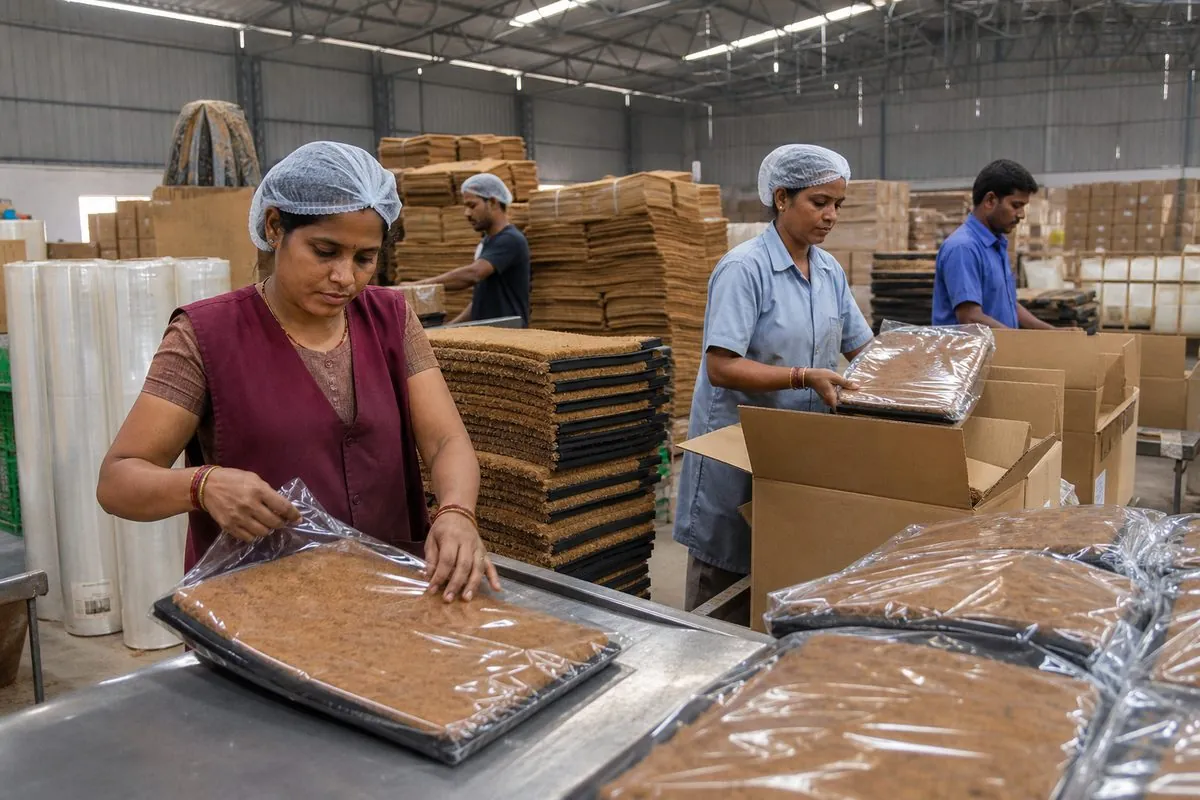
Coir mat production for export follows a consistent documentary sequence even when constructions differ: fibre selection → spinning/weaving or tufting → edge binding → optional PVC or rubber backing → optional print/logo → finishing → QC → moisture-controlled packing → inland haul to port → stuffing → shipping bill and B/L. Each stage produces documentation anchor points: construction and size on the commercial invoice; piece counts and moisture notes on the packing list; coconut-fibre honesty on the fibre declaration; backing chemistry on REACH statements; pre-shipment QC tagged to carton IDs.
For documentation purposes, the operational risk is not the loom — it is a backing compound swap, size mix change, or logo artwork revision that enters the carton without a refreshed invoice description, packing list, or compliance declaration. Buyers and destination retailers assume the documented programme matches the mats inside. Any material change should trigger updated documentation before the next commercial sailing.
The Coir Mat Export Document Stack: Master Inventory
Use this master inventory as the top-level checklist for every coir mat sailing. Not every document applies to every shipment — preferential COO applies only where an FTA claim is valid, phytosanitary applies when destination plant-health rules require it, and REACH declarations apply primarily to PVC/rubber-backed EU/UK programmes. Every applicable document must reconcile against the commercial invoice and packing list before the container is sealed.
Master coir mat document inventory
Swipe →
Data table — swipe horizontally on small screens
| # | Document | Owner | When Produced | Cross-Check Against |
|---|---|---|---|---|
| 1 | Purchase Order (PO) | Buyer | Before production | Proforma, commercial invoice |
| 2 | Proforma Invoice | Exporter | At quotation | PO, later commercial invoice |
| 3 | Commercial Invoice | Exporter | At shipment readiness | PO, packing list, shipping bill, COO, B/L |
| 4 | Packing List (with moisture notes) | Exporter / packing team | During carton/bale sealing | Invoice sizes/pieces, stuffing report |
| 5 | HS Classification Per SKU | Exporter with CHA | Before shipping bill | Invoice description, Coir Board product fit |
| 6 | IEC Certificate Copy | Exporter | Standing compliance file | Invoice header; shipping bill |
| 7 | GST Registration Copy | Exporter | Standing compliance file | Invoice GSTIN |
| 8 | Coir Board Registration Evidence | Exporter | Standing file; keep current | Invoice header; buyer vendor pack |
| 9 | Fibre Composition Declaration | Exporter / lab | Per programme + fibre change | Hangtags, carton labels, eco claims |
| 10 | REACH / SVHC Declaration (PVC/rubber) | Exporter | Per EU/UK backed programme | Backing compound identity, SVHC list version |
| 11 | Phytosanitary Certificate (if required) | Plant quarantine authority | Per destination requirement | PO, packing list, B/L |
| 12 | Certificate of Origin (COO) | Chamber / DGFT eCoO / Board route | Before clearance or destination claim | Invoice, packing list, HS |
| 13 | Pre-Shipment QC / Inspection Report | Exporter / third party | Before sealing | Packing list carton IDs, size mix |
| 14 | Marine Insurance Certificate | Insurer (or buyer under CIF) | Before loading | Invoice value, Incoterm |
| 15 | Shipping Bill (ICEGATE) | CHA | At export clearance | Invoice, packing list, IEC, HS 5702.20 or 5703.90 |
| 16 | Bill of Lading / Sea Waybill | Carrier / forwarder | At loading | Shipping bill, invoice, packing list |
| 17 | e-BRC (Bank Realisation) | Bank via DGFT eBRC | On payment realisation | Invoice value, shipping bill |
| 18 | Broker Handoff Pack | Exporter to CHA | Before shipping bill filing | All above indexed |
Commercial Invoice: Field-Level Controls
The commercial invoice is the commercial identity document. For coir mats, weak invoice wording is a leading cause of HS and valuation queries. Header fields must carry exporter legal name matching IEC, buyer legal name matching COO consignee where applicable, IEC number, GSTIN, Coir Board registration reference where used, PO reference, Incoterm with named place (for example FOB Kochi), currency, payment terms, port of loading, port of discharge, and country of origin (India).
Line items must state product as coir mats / coir doormats / coir matting, construction, size, backing type, logo/print status if any, piece quantity, unit price, and extended value. Avoid catalogue language such as 'assorted coir items'. Mixed sizes and constructions in one container require separate lines — do not average a 40×60 cm natural mat and a 60×90 cm PVC-backed logo mat into one convenience description.
Sample commercial invoice field table (coir mats)
Swipe →
Data table — swipe horizontally on small screens
| Field | Required Content | Failure Mode |
|---|---|---|
| Seller name | Exact IEC legal name | Trading-name mismatch vs IEC |
| Buyer / consignee | Legal name matching PO/COO | Nickname or brand-only consignee |
| IEC / GSTIN / Board ref | Current numbers on header | Expired Board evidence in vendor pack |
| Product description | Coir mat + construction + size + backing | Vague 'coir products' only |
| HS hint (optional note) | Agreed India HS with CHA | Conflict with shipping bill |
| Incoterm | Term + named Indian port | FOB without named place |
| Quantity | Pieces (or metres for rolls) matching packing list | Size mix not broken out |
| Unit price / currency | USD (or agreed) per pc / per m | Missing price basis |
| Payment | TT / LC reference | LC docs list not mirrored |
| Country of origin | India | Omitted or conflicting with COO |
Packing List: Size Counts and Moisture Packing Notes
Individual poly bag or kraft wrap; edge protection for PVC-backed mats Master cartons or bales by size; palletize for FCL where specified Roll matting with crease avoidance and moisture barrier Desiccant / moisture-barrier discipline for coconut-fibre goods The packing list is where those physical facts become documentary facts. It must list carton or bale IDs, size-wise piece counts (or roll metres), construction/backing callouts matching the invoice, gross and net weights, and container number after stuffing.
Moisture packing notes are not optional fluff for coconut-fibre goods. Record desiccant use, poly bag or kraft wrap, moisture-barrier film where used, and any mould-prevention instructions agreed with the buyer. Destination claims for musty smell or fibre swelling often turn on whether the packing list documented the moisture protocol. Never invent piece counts to 'clean up' a packing list — if carton tallies are incomplete, stop sealing and resolve with the packing floor before issuing the final list.
Sample packing list field table (coir mats)
Swipe →
Data table — swipe horizontally on small screens
| Field | Example Content | Reconciliation Check |
|---|---|---|
| Carton / bale ID | CTN-001 to CTN-240 | Matches stuffing report |
| SKU / size | 40×60 cm PVC-backed plain | Matches invoice line |
| Pieces per carton | 20 pcs | Cartons × pcs = invoice qty |
| Backing / construction | PVC-backed tufted | Matches REACH scope if any |
| Gross / net weight | Per carton + totals | Reconciles to B/L weight |
| Moisture control note | Poly bag + desiccant per carton; dry warehouse staging | Matches PO packing clause |
| Marks & numbers | Buyer PO / destination marks | Matches B/L marks |
| Container / seal (post-stuff) | MSCU1234567 / seal XYZ | Matches B/L |
Fibre Declaration, REACH, Phytosanitary, and COO
The fibre composition declaration is the technical honesty document for coir mats. It should state coconut coir (coconut fibre) as the pile/face fibre and disclose any secondary materials honestly — PVC backing, rubber backing, latex binder, printed ink systems, or bleached versus natural colourways. Hangtags and carton labels must match the declaration percentages and descriptions.
REACH / SVHC declarations apply when PVC or rubber backings (and associated plasticisers, adhesives, or ink systems) are in scope for EU or UK programmes. Cite the SVHC candidate list version used and keep backing compound identity on file. Do not paste a generic REACH footer onto a natural unbacked mat programme and call it done — and do not ship PVC-backed mats to Germany with no chemical posture when the PO requires one.
Phytosanitary certificates are destination-driven for plant-fibre goods. Confirm with the buyer and your CHA whether the importing country requires plant-health certification for coir mats. When required, align consignee, quantity, and packing description with the commercial pack. Certificate of Origin may be preferential (where an FTA reduces destination duty and rules of origin are met for HS 5702.20) or non-preferential for general customs declaration. Verify FTA coverage per destination with your broker before invoking preference.
Technical compliance documents by trigger
Swipe →
Data table — swipe horizontally on small screens
| Document | Trigger | Coir-Mat Watchpoint |
|---|---|---|
| Fibre composition declaration | Every programme | Coconut coir honesty; blend/backing disclosure |
| REACH / SVHC | EU/UK PVC or rubber-backed | Backing compound + list version cited |
| Phytosanitary | Destination plant-health rule | Do not omit if PO requires; do not invent if not |
| COO preferential | Valid FTA + origin rules met | HS 5702.20 rules-of-origin check |
| COO non-preferential | General customs origin | Consignee consistency |
| QC / inspection report | Buyer or self-release protocol | Size, pile, edge, moisture checks |
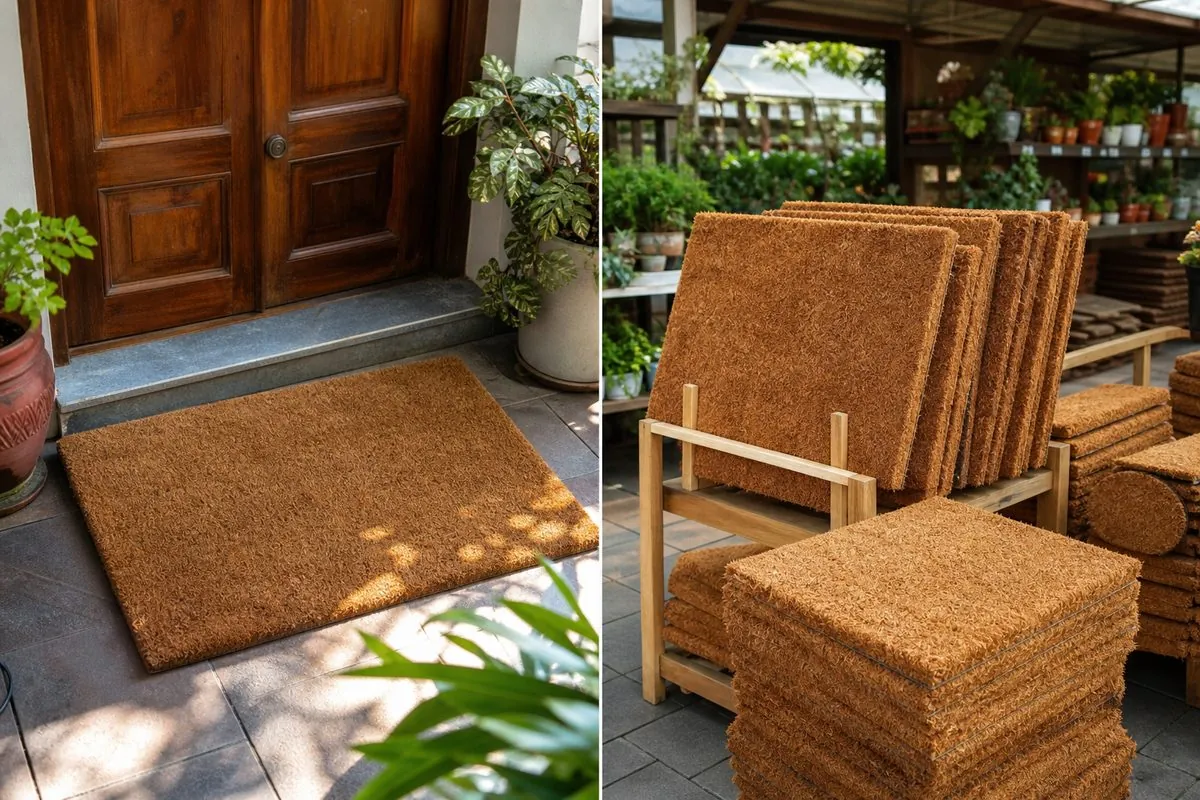
HS Declaration Controls
HS declaration controls are the spine of coir mat shipping-bill accuracy. Confirm the statistical breakout with your licensed broker before filing. Planning references: HS 5702.20 for floor coverings of coconut fibres (coir); India examples often include 57022010 for mats and matting — confirm 57022020 / 57022090 against live ITC-HS. Separate HS chapters — do not file finished doormats as coir fibre, yarn, or pith. Duty planning notes for destination landed-cost work — not for invoice claims — include: US HTS 5702.20.10 (floor coverings of coconut fibres, with pile) Column 1-General is typically Free (MFN) per USITC HTS — confirm live schedule and any Chapter 99 overlays before landed-cost quotes. Tufted coir under HTS 5703 may carry different rates — classify first, then price duty. EU CN 5702 20 (woven coir) and CN 5703 90 (tufted) — confirm TARIC duty and preferential origin claims before CFR/CIF programmes. UK tariff for coir floor coverings — verify live schedule by exact HS (5702.20 vs 5703.90) and preferential claim rules. Duty notes are planning references only. Always verify live schedules (USITC HTS, TARIC, GCC, FTA texts) before commercial quotes.
HS control checklist before ICEGATE filing
Swipe →
Data table — swipe horizontally on small screens
| Control | Pass Condition | Fail Condition |
|---|---|---|
| Essential character | Finished coir floor covering / mat | Filed as coir fibre, yarn, or pith |
| Invoice vs shipping bill | Same product story and value | Invoice says doormats; bill says fibre |
| Mixed SKUs | Separate lines per construction if needed | Single blanket description for PVC + natural mix |
| Board product fit | Coir Board registration covers mats programme | Registration evidence unrelated to finished mats |
| Backing disclosure | PVC/rubber called out where present | Silent backed mats with REACH buyer clauses |
| Statistical breakout | CHA-confirmed 8-digit India code | Guessed code from an old invoice template |
Shipping Bill, B/L, Insurance, and Broker Handoff
The shipping bill on ICEGATE is filed by your CHA using the commercial invoice, packing list, IEC, and Coir Board evidence where referenced. HS must match finished-mat character. Valuation must match invoice currency and value. After loading, the bill of lading or sea waybill must reconcile ports, consignee, container numbers, and weight with the packing list and shipping bill. Marine insurance follows the Incoterm — under CIF the exporter typically arranges cover; under FOB the buyer often does.
The broker handoff pack is an indexed folder — physical or digital — containing the commercial invoice, packing list with moisture notes, IEC and GST copies, Coir Board registration evidence, fibre declaration, REACH statement if applicable, phytosanitary if applicable, COO, insurance if required, QC/inspection reports, and draft B/L instructions. It should be cross-checked against the invoice and delivered to your CHA before shipping bill filing. Assembling it on cutoff day is the leading cause of last-minute fibre and REACH scrambles on south-coast coir sailings.
Transport and handoff document roles
Swipe →
Data table — swipe horizontally on small screens
| Document | Primary Job | Coir-Mat-Specific Watchpoint |
|---|---|---|
| Shipping bill | Indian export clearance | Correct HS 5702.20 / India 8-digit |
| B/L or sea waybill | Title / transport evidence | Weight and container vs packing list |
| Insurance | Risk cover per Incoterm | Insured value vs invoice |
| Broker handoff index | CHA filing readiness | Moisture notes + REACH + fibre in one pack |
| e-BRC | Payment realisation record | Reconcile to shipping bill monthly |
Pricing Analysis
Buyer Tip
Coir mats are not documented as a static catalogue price. Commercial invoices should reflect the agreed pricing structure: FOB named Indian port (Kochi / Tuticorin / Chennai / Nhava Sheva). Indicative commercial FOB planning bands only (not official published prices): natural/handloom ~US$2–12/pc; PVC-backed plain ~US$3–15/pc; custom logo ~US$4–20+/pc; rubber-backed premium ~US$5–25+/pc by size — verify on quote date Indicative merchant-trade planning bands only; confirm size, pile density, backing, print, and packing on quote date. Do not cite as government price series. From a documentation angle, the invoice must state the price basis clearly (FOB named port, currency, per-piece or per-metre) so banks and customs can reconcile value — without publishing stale brochure prices as 'current' on the invoice.
For deeper pricing programme design, see top coir mat products exported from India and PVC-backed custom logo and eco coir doormat export opportunities. This checklist only owns how price basis appears on commercial documents.
Price basis elements that belong on coir mat documents
Swipe →
Data table — swipe horizontally on small screens
| Element | Where It Appears | Note |
|---|---|---|
| FOB named port | Invoice header | FOB Kochi / Tuticorin / Chennai / Nhava Sheva |
| Per-piece / per-metre basis | Invoice lines | Rolls vs piece mats must not mix bases silently |
| Size / backing / logo extras | Invoice lines or debit note | Logo setup fees if separately billed |
| Packing upgrades | Invoice or packing clause | Palletisation / moisture barrier costs |
| Inspection | Invoice or separate debit | Third-party QC cost allocation per PO |
MOQ Analysis
Buyer Tip
Documentation load scales with programme size. Samples often sit at 5–20 pcs; trials at 200–1,000 pcs; wholesale PVC/logo programmes often 1,000–5,000+ pcs typical. Lower MOQ often possible after sample approval MOQ figures are indicative commercial practice by construction and channel — not statutory minima. Lock MOQ in writing before production. From a paperwork view, smaller trial lots still need a full fibre declaration, packing-list size identity, and HS posture — MOQ does not excuse incomplete reconciliation.
See how to export coir mats from India for process-level MOQ negotiation; this post only flags that every piece in the container must be document-backed.
Packaging Standards
Export Tip
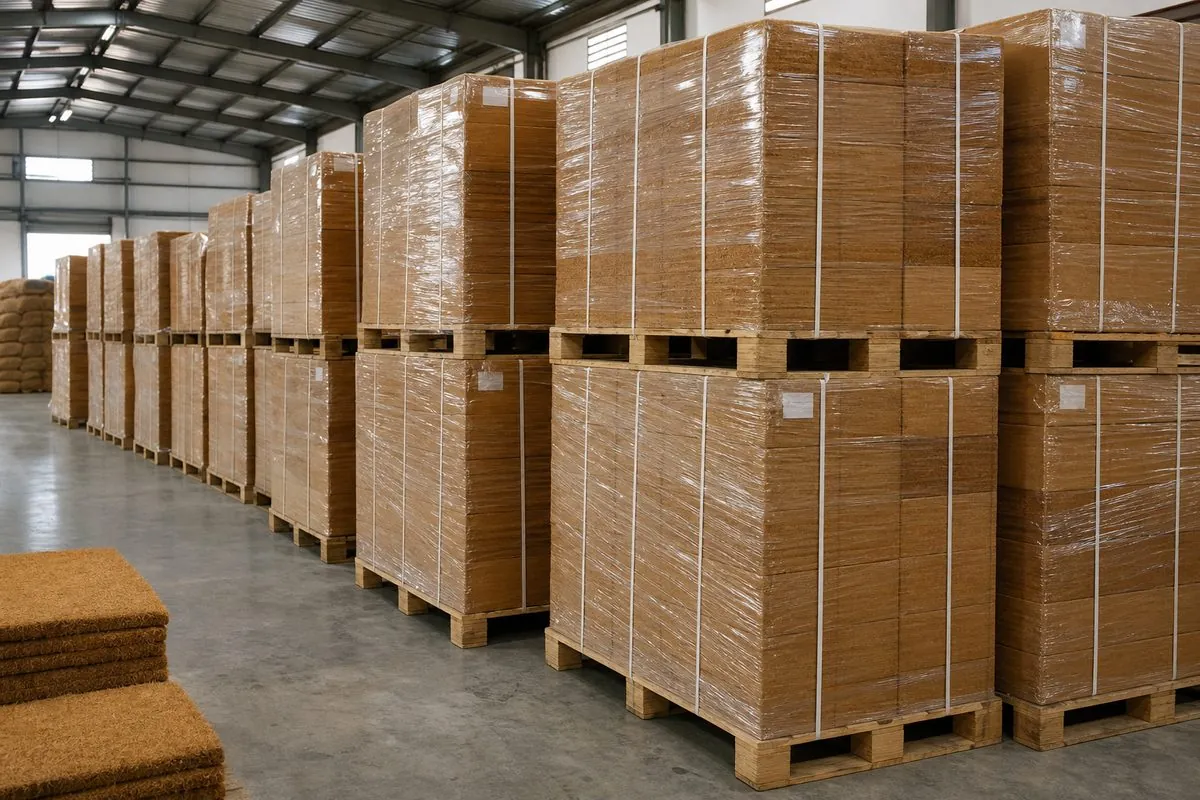
Export packaging for coir mats is moisture control and identity, not only retail presentation. Individual poly bag or kraft wrap; edge protection for PVC-backed mats Master cartons or bales by size; palletize for FCL where specified Roll matting with crease avoidance and moisture barrier Desiccant / moisture-barrier discipline for coconut-fibre goods Documentation must record those standards on the packing list and, where relevant, on inspection certificates. Damaged cartons, wet staging, or missing desiccants are both QC and documentation failures — fix before sealing and before issuing final packing lists.
Packaging → document map
Swipe →
Data table — swipe horizontally on small screens
| Physical Standard | Document Home | Watchpoint |
|---|---|---|
| Individual poly / kraft wrap | Packing list unit note | PVC edge protection called out |
| Master cartons or bales | Packing list rows | Size-wise piece math |
| Desiccant / moisture barrier | Packing list moisture note | Claim defence at destination |
| Palletisation (if used) | Stuffing / packing notes | ISPM-15 if wood pallets |
| Roll matting barriers | Packing list roll IDs | Crease and moisture notes |
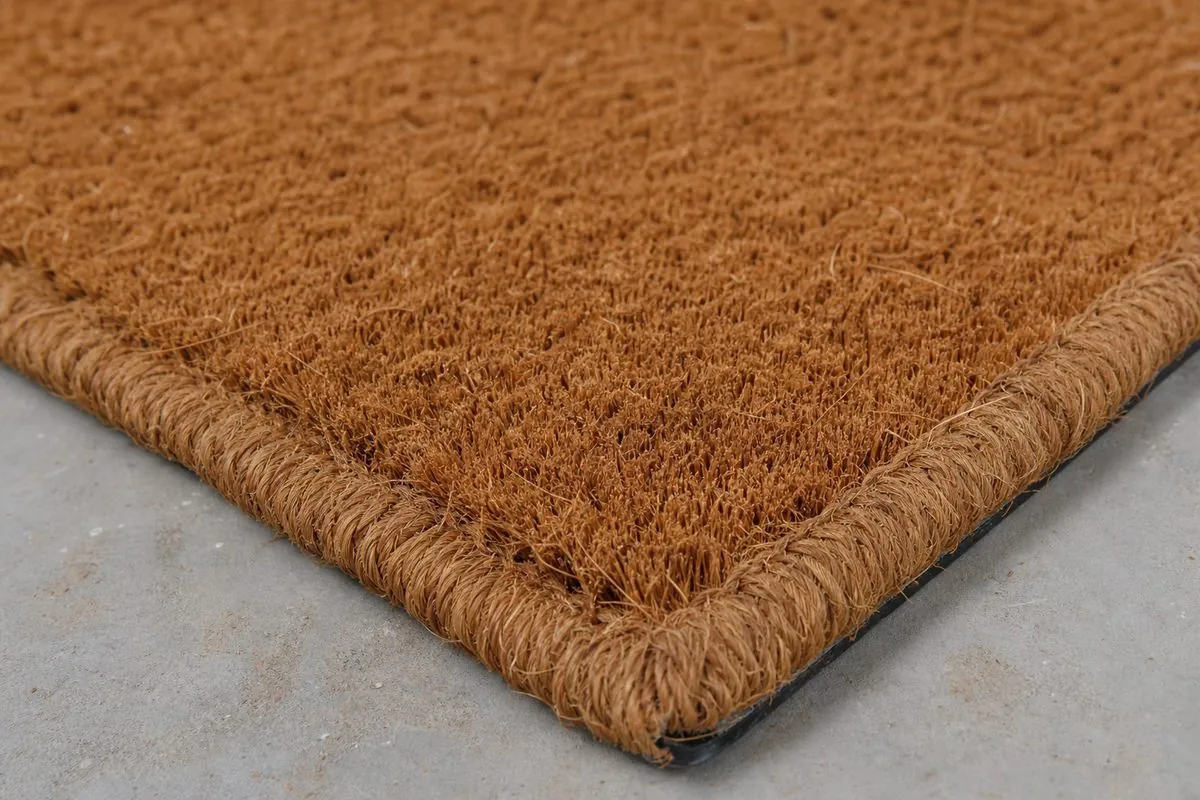
Container Loading Details
Export Tip
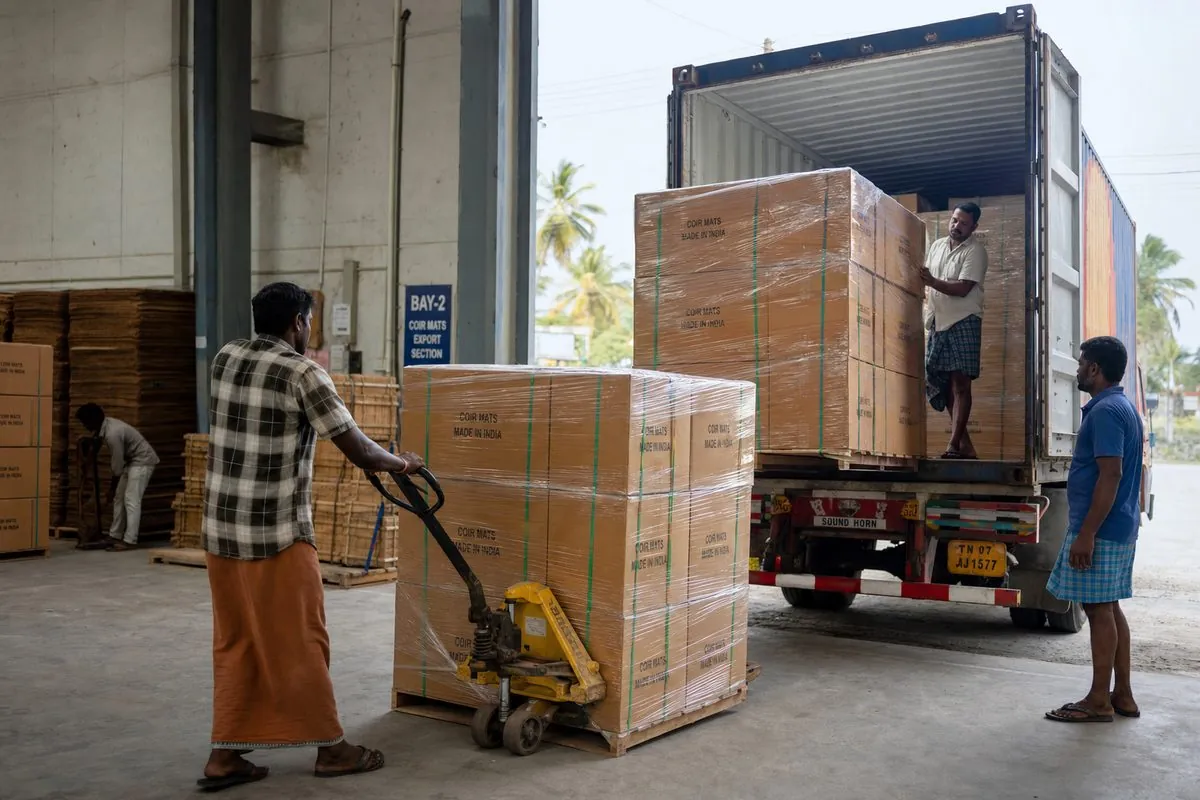
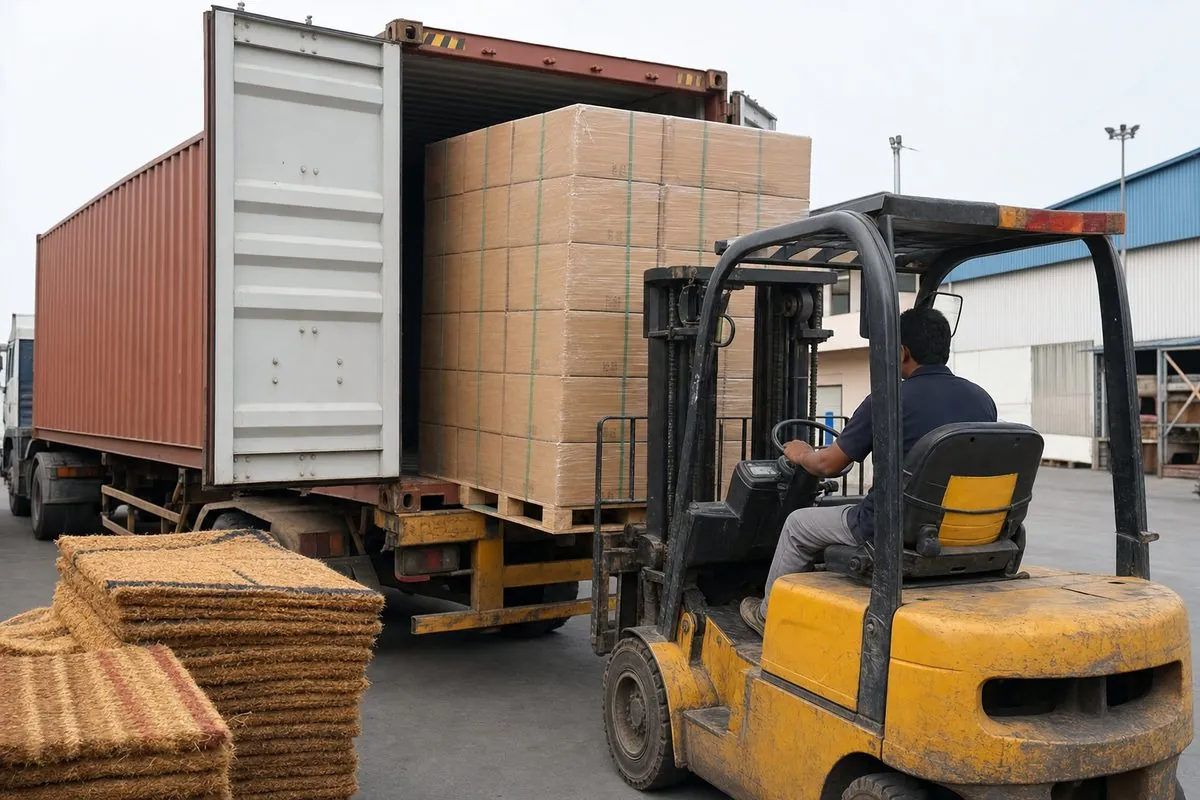
FCL planning for coir mats depends on size mix, cartonisation, and whether goods are palletised. Stuffing reports should record container number, seal number, carton/bale IDs loaded, and any remainder lots. The packing list and B/L weights must reconcile to what was actually stuffed. Overstating piece counts on documents to 'match' a contracted quantity is a compliance failure — re-count and amend documents instead.
Lead-time context for planning document assembly: samples 7–21 days typical for samples depending on construction; stock sizes 2–4 weeks for stock sizes after confirmation; custom logo programmes 4–8+ weeks including artwork approval for logo/private-label programmes. Build fibre declaration, REACH, phytosanitary (if any), and COO timelines backward from vessel cutoff, not forward from packing day. Common sizes in programmes include 40×60 cm, 45×75 cm, 50×80 cm, 60×90 cm, 75×120 cm, Buyer-specific / roll matting by metre.
Stuffing reconciliation checks
Swipe →
Data table — swipe horizontally on small screens
| Check | Pass | Fail |
|---|---|---|
| Piece count | Invoice = packing list = stuffed count | Short-shipped without credit note |
| Size mix | Each size line stuffed as declared | Substituted sizes without doc update |
| Moisture protocol | Executed and noted on packing list | Wet cartons sealed anyway |
| Container / seal | On packing list and B/L | Seal changed without amendment |
| Weight | Within tolerance of packing list | B/L weight invented to match PO |
Shipping Methods
Export Tip
Ocean FCL is the default for commercial coir mat export programmes from Cochin (Kochi), Tuticorin (V.O. Chidambaranar), Chennai, Nhava Sheva (JNPT), Mundra (westbound consolidations). LCL may suit trials when carton counts are low, with stricter moisture and mark discipline. Common Incoterms include EXW unit / warehouse; FOB Kochi / Tuticorin / Chennai / Nhava Sheva; CFR / CIF named destination port; DDP (selected large retail programmes only). Document sets change with Incoterm: FOB programmes emphasise clean B/L and buyer-arranged insurance; CFR/CIF programmes add freight and possibly insurance documents to the presentation set. Air freight is usually limited to samples — still require fibre and size identity discipline.
For logistics process depth beyond documents, see how to export coir mats from India.
Incoterm → document emphasis
Swipe →
Data table — swipe horizontally on small screens
| Incoterm | Exporter Doc Emphasis | Buyer Doc Emphasis |
|---|---|---|
| EXW | Invoice, packing list, fibre declaration at unit/warehouse | All onward transport and clearance |
| FOB named port | Export clearance pack + on-board B/L | Insurance and destination clearance |
| CFR | Freight arrangement evidence + B/L | Insurance if not seller's |
| CIF | Freight + insurance certificate + B/L | Destination clearance |
| DDP (selected retail) | Full landed documentary chain | Import compliance coordination |
Certifications
Compliance Notes
- Coir Board registration / RCMC evidence
- Fibre composition declaration (coconut coir)
- ISO plant quality systems where available
- Third-party inspection (SGS / Bureau Veritas / Intertek) on request
- Certificate of Origin
- REACH / SVHC declarations for PVC or rubber backings where required
- Phytosanitary certificate where destination plant-health rules require it for plant-fibre goods
- Honest eco / biodegradable claim controls (no overclaim on polymer-backed mats)
Coir mat programmes rely on fibre honesty, Board registration evidence, and backing chemistry more than fashion eco-labels. Core certification and evidence items include:
Buyer Requirements
Buyer Requirements
Buyer requirements show up as documentary clauses. Garden centres often require size tolerance evidence and moisture packing notes. Home retailers often require REACH language for PVC-backed logo programmes and honest biodegradable claim controls. Hospitality buyers require carton mark discipline and clean B/L language. Always convert verbal 'we need phytosanitary' or 'we need REACH' into a written scope: which SKUs, which destination, certificate originals vs copies, and whether third-party inspection is required.
Buyer type → document expectations
Swipe →
Data table — swipe horizontally on small screens
| Buyer Type | Typical Must-Have Docs | Common Add-Ons |
|---|---|---|
| Garden centre / DIY retail | Invoice, packing list, fibre declaration, COO | QC report, moisture notes |
| Private-label home retail | Full commercial pack + REACH if backed | Artwork PO refs, inspection |
| Hospitality amenity | Clean title docs, packing marks, COO | Split shipment discipline |
| Distributor / importer | LC-ready set where used, HS clarity | Phytosanitary if destination requires |
Country-wise Opportunities
Market Snapshot
Destination opportunity is owned by the countries post; this checklist only maps documentation posture. Anchor markets — United States, United Kingdom, Germany, Netherlands, South Korea, Australia, Canada, France, Italy, United Arab Emirates — share a common Indian export pack but differ on preferential COO use, REACH intensity, and phytosanitary triggers. Use best countries for Indian coir mat exports and most demanded Indian coir mats by country for market selection; use the table below only to pre-build destination-specific document variants.
Country → documentation variant (not a market-ranking guide)
Swipe →
Data table — swipe horizontally on small screens
| Market | Doc Variant Focus | Pointer |
|---|---|---|
| USA / Canada | Fibre labelling + eco-claim honesty | Keep claim language evidence-bound |
| UK / Germany / Netherlands / France / Italy | REACH on PVC/rubber backings | Prepare SVHC declarations early |
| Australia | Moisture + possible phytosanitary | Align packing notes to PO |
| South Korea | Size/spec packing-list depth | Break out sizes cleanly |
| UAE | Re-export chain clarity | Consignee consistency across docs |
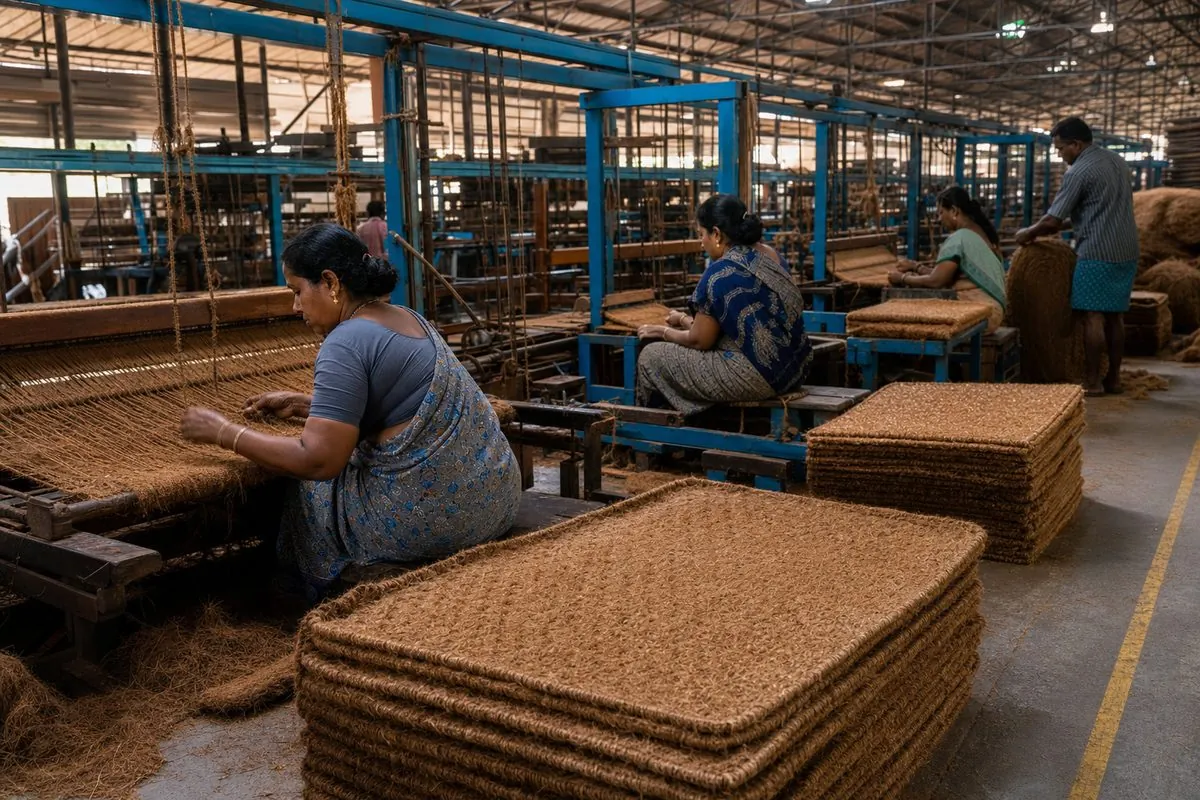
Export Process
Export Tip
A documentation-anchored coir mat export process runs: IEC and Coir Board registration in place (compliance file); buyer discovery and negotiation (proforma invoice); purchase order confirmation; production scheduling with Kerala / Tamil Nadu units; pre-shipment QC; fibre declaration and REACH/phytosanitary posture assembled per programme; export packing with moisture control (packing list); commercial invoice with per-SKU size and backing split; certificate of origin; marine insurance as required; shipping bill filed through CHA on ICEGATE under HS 5702.20; bill of lading issued on loading; e-BRC on payment realisation.
For the complete operational walkthrough (as opposed to this document-by-document owner), see how to export coir mats from India. For channel follow-up after fairs, see trade shows and B2B marketplaces for coir mat exporters. For buyer discovery methods, see find international buyers for coir mats.
Sourcing Checklist
Checklist
- Production lot confirmed with size mix, construction, and backing type
- HS posture confirmed with CHA in writing for finished mats (not fibre/pith)
- Packing list draft includes moisture-control notes
- Fibre composition declaration matches hangtags and carton labels
- REACH/SVHC drafted if PVC or rubber-backed EU/UK programme
- Phytosanitary need confirmed yes/no with buyer and CHA
- Incoterm and named port agreed; insurance responsibility clear
- Commercial invoice draft reviewed against PO and LC documentary list
- COO route and timeline confirmed
- CHA handoff pack index prepared
- Vessel cutoff and document cutoff diarised backward
Before you promise a sailing date, run this sourcing-side documentation checklist against the allocated coir mat lot.
Common Buyer Mistakes
Common Mistakes Box
- Requesting 'phytosanitary' without confirming the destination actually requires it for coir mats
- Sending LC documentary lists that conflict with the agreed Incoterm
- Assuming all coir mats are automatically '100% biodegradable' including PVC-backed SKUs
- Mixing natural and PVC-backed expectations on one PO line without separate compliance
- Changing consignee after COO issuance without re-issuing documents
- Treating size-count mismatches as minor clerical issues under LC or retail compliance
Buyers and their nominated banks create documentary friction when requirements are vague. The mistakes below are the ones Indian coir mat exporters see most often — and the exporter-side corrections that prevent sailing-day chaos.
Future Market Trends
Key Statistics
Through the late 2020s, coir mat documentation will keep tightening around chemical transparency and claim honesty: more EU/UK buyers will demand searchable REACH packs for PVC and rubber backings; more retailers will reject unsupported biodegradable language on backed mats; preferential origin claims will face closer rules-of-origin scrutiny on Chapter 57; and moisture/mould evidence will show up more often in destination claim files. Exporters who keep a version-controlled compliance folder — fibre declarations, REACH compound files, phytosanitary SOP, COO routes, CHA handoff templates — will clear south-coast cutoffs with less drama than those assembling papers from email threads.
Digitisation of DGFT eCoO, e-BRC, and ICEGATE workflows reduces friction only for exporters who already maintain clean digital packs. The trend rewards operational hygiene, not last-minute heroics.
Challenges & Solutions
Documentation challenges for coir mats are predictable. The solutions are process, not heroics.
Coir mat documentation challenges and solutions
Swipe →
Data table — swipe horizontally on small screens
| Challenge | Why It Happens | Solution |
|---|---|---|
| HS confusion with fibre/pith | Same coconut story, different chapters | CHA-confirmed 5702.20 finished-mat posture per SKU |
| Moisture claims at destination | Fibre hygroscopic; weak packing notes | Desiccant protocol + packing-list moisture fields |
| REACH surprises on PVC/logo | Backing treated as 'just plastic' | Compound file + SVHC declaration before PO acceptance |
| Size mix chaos | Assortment packed without line discipline | Size-wise invoice and packing list lines |
| Cutoff scrambles | Docs treated as sailing-day task | Indexed broker handoff 48–72h before filing |
| Eco overclaim | Marketing language copied onto invoice | Evidence-bound fibre declaration only |
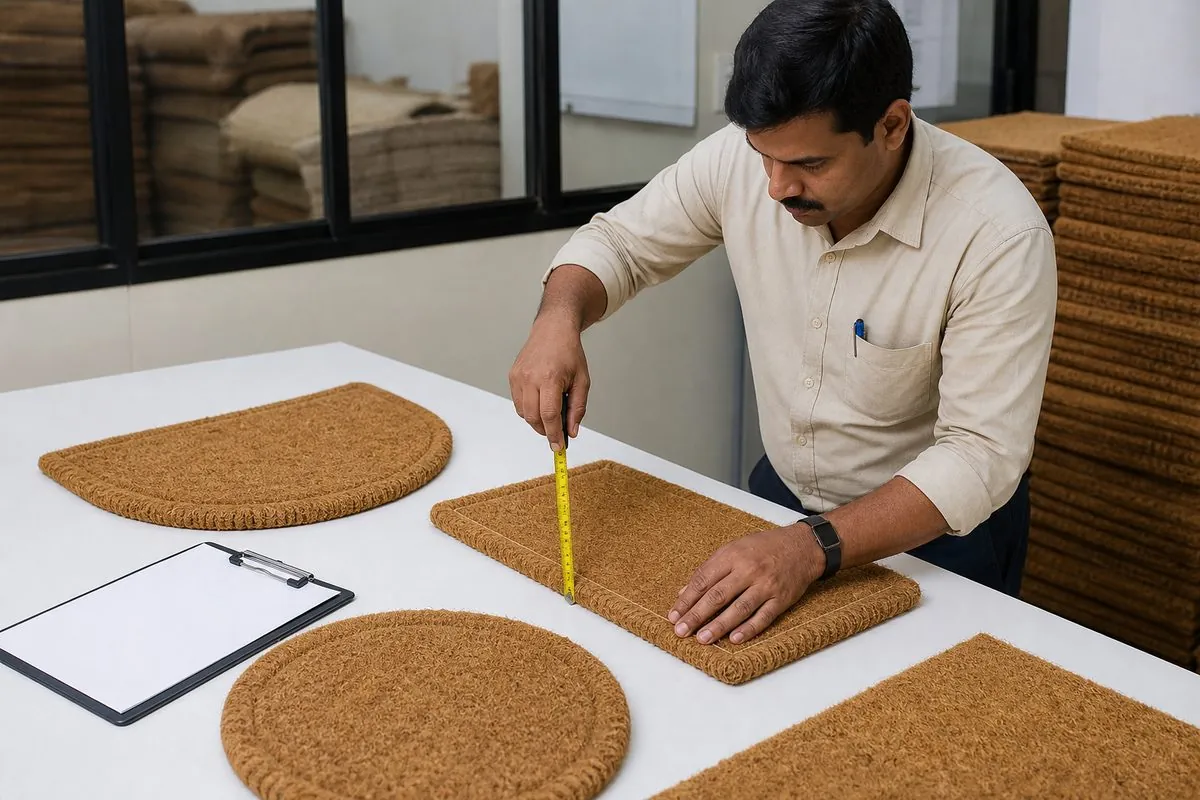
Buyer Checklist
Checklist
- Confirm construction, size mix, and backing type with a photo or sample reference
- Confirm HS posture (HS 5702.20 / India 57022010 as planning cue) with CHA endorsement noted
- Confirm Incoterm and named Indian load port from the south-coast / west-coast set
- Confirm whether REACH, phytosanitary, or third-party inspection is required
- Confirm moisture-packing protocol and carton marks
- Confirm payment instrument (TT vs LC) and documentary presentation list if LC
- Confirm eco / biodegradable claim language is evidence-bound
International coir mat buyers increasingly apply a short documentation filter before they discuss FOB or allocation. Use this buyer-side checklist as the mirror of your exporter pack — if you cannot answer these points in writing, the inquiry is not yet shipment-ready.
Exporter Checklist
Checklist
Treat the exporter checklist as a go/no-go gate. If any technical identity item is red, do not seal the container. Remaking a packing list after stuffing is possible; remaking fibre or REACH identity after the vessel sails is not.
Compliance Checklist
Checklist
Compliance Notes
Keep this standing compliance file separate from shipment-specific folders, then copy forward the templates into each sailing pack. For Board registration mechanics — not document referencing — see Coir Board registration benefits for coir mat exporters.
How Altus Exports Helps with Coir Mat Documentation
Altus Exports operates as a merchant exporter and global sourcing partner for coir mats programmes. We help consolidate Kerala and Tamil Nadu supply, reconcile invoice and packing-list identity, coordinate fibre declarations and REACH posture for backed programmes, and hand a clean indexed pack to the CHA for Kochi, Tuticorin, Chennai, or Nhava Sheva sailings — so USA, UK, EU, Korea, Australia, and Gulf buyers receive document sets that match the mats.
Work with Altus Exports as your merchant exporter and global sourcing partner for coir mats — verified Kerala and Tamil Nadu supply, PVC/logo and natural mat programmes, export documentation, and FCL booking from inquiry to shipment. For Board groundwork see Coir Board registration benefits for coir mat exporters; for process depth see how to export coir mats from India; for channel follow-up after events see trade shows and B2B marketplaces for coir mat exporters.
Conclusion
- Do next: Index the master document inventory and run the exporter checklist as a go/no-go gate before your next coir mat FCL. Bookmark this coir mat export documentation checklist as your standing reconciliation layer.
- Read how to export coir mats from India, top coir mat products exported from India, best countries for Indian coir mat exports, source coir mats directly from India, Coir Board registration benefits for coir mat exporters, most demanded Indian coir mats by country, find international buyers for coir mats, PVC-backed custom logo and eco coir doormat export opportunities, and trade shows and B2B marketplaces for coir mat exporters.
- For documentation-backed coir mat programmes with Altus as merchant exporter, see handicrafts & lifestyle products, merchant exporter services, export products from India, global sourcing partner, and product sourcing company.
The coir mat export documentation checklist is a reconciliation architecture, not a paper trail. Commercial invoice, packing list with size counts and moisture notes, fibre composition declaration, IEC, GST, Coir Board registration evidence, correct HS declaration under 5702.20 (India 57022010 and related breakouts as confirmed), REACH for PVC/rubber backings where required, phytosanitary where needed, COO, marine insurance as required, shipping bill through CHA on ICEGATE, bill of lading, e-BRC realisation, and a clean indexed broker handoff pack — all must reconcile across legal, commercial, and technical identity for every Alappuzha- or Pollachi-origin programme that leaves India's ports.
Actionable next steps: build a master compliance folder mirroring the master document inventory; version-control fibre and REACH declarations by programme; pre-agree phytosanitary need in writing; confirm HS with your CHA before every new construction; diary document cutoff backward from vessel cutoff; reconcile e-BRC monthly. Contact Altus Exports for a documentation readiness review connecting this checklist to real coir mat commercial outcomes.
Sources
- Coir Board of India
- Coir Board — Statistics
- Coir Board — Forms & Guidelines (Exporter Registration / RCMC)
- IBEF — Coir Industry in India (DGCIS-sourced export figures)
- Ministry of MSME — Coir product-wise export dashboard
- OEC — Floor coverings of coconut fibres (HS 570220)
- ITC Trade Map
- DGFT (India) — IEC / trade portal
- ICEGATE — Indian Customs EDI
- India CBIC / Customs Tariff
- USITC Harmonized Tariff Schedule — search 5702.20
- European Commission TARIC
- TaxGuru — GST classification note on coir mats with PVC/rubber/latex backing (HS 5703 90 90 practice)
- Altus Exports — Handicrafts & Lifestyle Products
- Altus Exports — Merchant Exporter India
All sources accessed 2026-07-26 (factual audit refresh). Prefer Coir Board, DGCIS/IBEF, CBIC tariff, USITC HTS, and TARIC when citing figures in contracts or buyer presentations. Label sector-wide coir totals separately from HS 5702.20 (woven) and HS 5703.90 (tufted / many backed programmes). Confirm every 8-digit Indian statistical line with a licensed CHA before shipping-bill filing.