
Source Coir Mats Directly from India: Importer Playbook
By Saurabh Mittal, Founder, Altus Exports
A practical buyer playbook for sourcing coir mats directly from India — RFQ specification, Alappuzha and Pollachi cluster verification, sampling, MOQ discipline, payment structuring, pile and backing QC, moisture control, and landed-cost decision flow for importers in the USA, UK, Germany, Netherlands, South Korea, Australia, Canada, France, Italy, and UAE, with expert insight from Altus Exports.
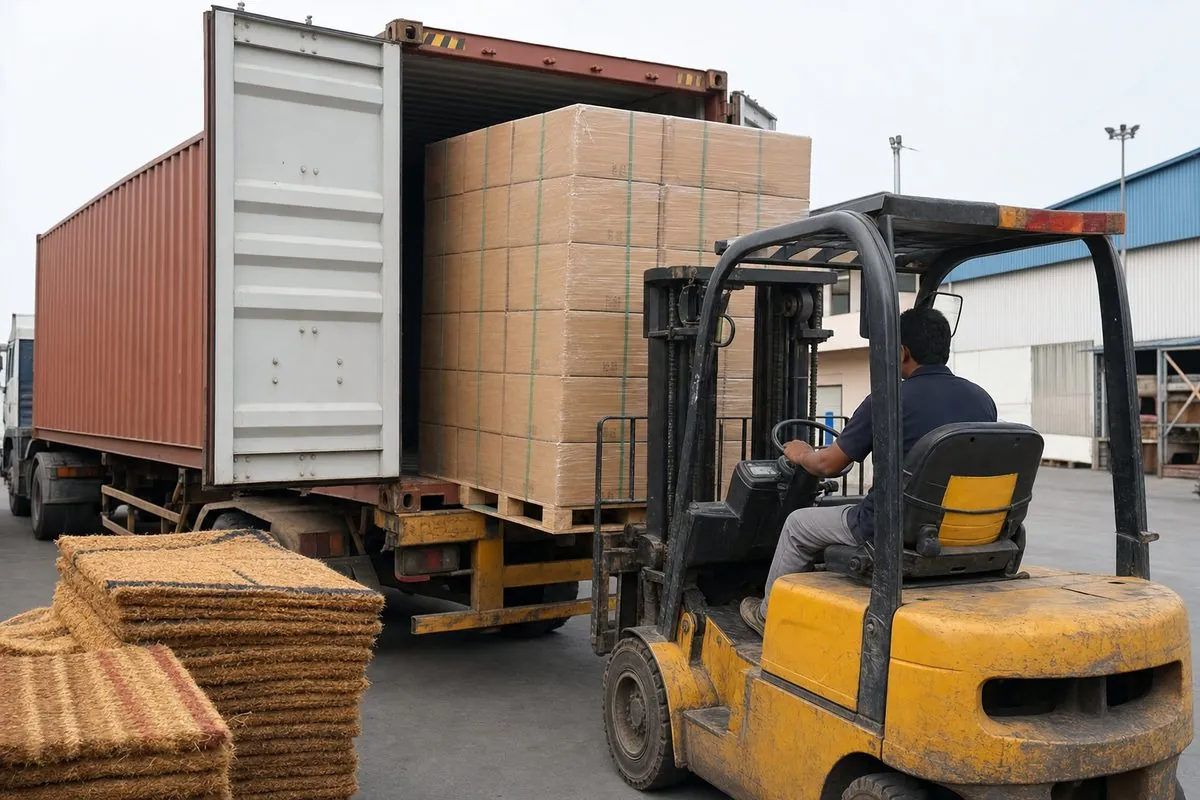
India's coir mat sector — handloom and power-loom mats, tufted entrance mats, PVC-backed and rubber-backed doormats, brush and scraper mats, roll matting, bleached and natural colourways, and custom-logo private-label programmes under HS 5702.20 — gives international buyers a distinctive sourcing proposition: deep coconut-fibre manufacturing in Alappuzha (Alleppey) / coastal Kerala coir belt and Pollachi and western Tamil Nadu, supporting capacity elsewhere in South India, and merchant consolidation through Cochin (Kochi), Tuticorin (V.O. Chidambaranar), Chennai. Broader India coir & coir products exports: IBEF (citing DGCIS) reports about US$455 million in FY25 (vs about US$360 million in FY24). The same IBEF page also states FY25 shipments of 1,342,843 MT worth about US$434 million to 121 countries — treat both figures as IBEF-reported sector context (all coir categories: pith, fibre, mats, etc.), not mats-only, and re-verify against Coir Board / DGCIS extracts before contracts. FY25 value-share mix (IBEF): coir pith ~59.63%, coir fibre ~12.06%, tufted mats ~16.73%. Separately, HS 570220 (woven coir floor coverings) world-trade aggregates (OEC-style, 2024) show India as a leading exporter (~US$44.6M directional) with top importers including USA, South Korea, and UK — do not conflate that woven-line total with tufted/PVC programmes that often classify under HS 5703.90.
Buyers who try to source coir mats directly from India without a structured process hit predictable problems: attractive fair samples followed by bulk-lot size variance or PVC edge curl, musty cartons from inadequate moisture control that erase margin on the first FCL, missing or unverifiable IEC and Coir Board documentation, generic Indian coir mat claims without Alappuzha or Pollachi production evidence, biodegradable marketing on PVC-backed mats that fail retail audit, and shedding or adhesion failures that surface only after goods reach the distribution centre. None of these failures are inherent to Indian coir manufacturing — they are the result of skipping verification steps under launch-date pressure.
This guide is written for importers, retail and DIY buyers, garden-centre procurement teams, hospitality amenity buyers, and private-label founders in United States, United Kingdom, Germany, Netherlands, South Korea, Australia, Canada, France, Italy, United Arab Emirates who want to source coir mats from India with a repeatable, lower-risk process. It owns the buyer-side operational playbook — how to write an RFQ, how to verify Alappuzha and Pollachi suppliers, how to sample and evaluate pile and backing quality, how to size MOQ and structure payment, how to run pre-shipment QC, and how to run a landed-cost decision flow. Market-selection questions (which country to enter first, duties, freight corridors, retail vs garden-centre ranking) live in Best Countries for Indian Coir Mat Exports; export-process and SKU depth live in How to Export Coir Mats from India and Top Coir Mat Products Exported from India. This playbook deliberately does not cover exporter registration how-tos or trade-show calendars.
Key Takeaways
Summary Box
Executive Summary
Summary Box
This guide sets out a structured buyer playbook for sourcing coir mats directly from India: define specifications, identify and verify Alappuzha and Pollachi manufacturers or merchant exporters, request samples with production lot references and fibre composition documentation, evaluate pile density, edge binding, size tolerance, and backing adhesion, negotiate on a landed-cost basis, place a trial order with written terms, run pre-shipment inspection on moisture control and packing integrity, and manage logistics through Kochi, Tuticorin, or Chennai to arrival at destination.
Because India's coir mat supply chain runs from village and MSME weaving units through mid-sized PVC backing lines and merchant exporters at variable formalisation levels, the highest-leverage buyer action is independent verification — of IEC and Coir Board status, of size and pile discipline, of backing chemistry documentation where required, of honest fibre and eco claims, and of export packing with moisture barriers for a category where musty fibre in ocean transit is a leading operational killer. Buyers who build this discipline into their first order convert faster into stable repeat-programme relationships than buyers who source on sample photos and FOB price alone.
Market Size & Industry Overview
Key Statistics
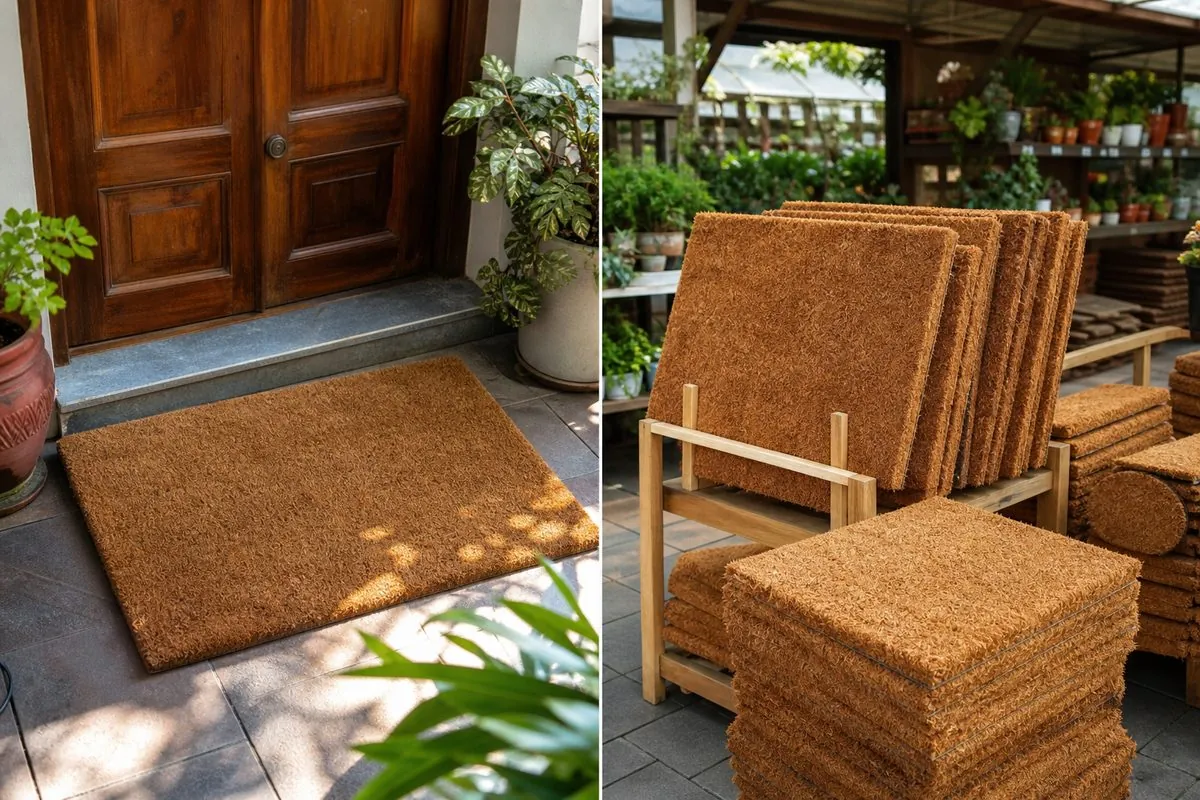
India's coir mat export economy is regulated at the export level by IEC from DGFT and, in practice, Coir Board registration for organised coir-product exporters (https://coirboard.gov.in/). Manufacturing depth sits in Alappuzha for handloom and tufted programmes; Pollachi and western Tamil Nadu for power-loom, finishing, and PVC-backed scale; with merchant consolidation for mixed FCL packing. Directionally, cite HS 5702.20 (~US$44.6M India 2024 directional) for mats-specific planning — not total coir-sector figures (about US$455M (IBEF/DGCIS FY25 sector; IBEF also cites ~US$434M / 1,342,843 MT) FY25 all products).
Alappuzha units range from family weaving shops to organised export finishers; Pollachi lines often add backing and print capacity for retail programmes. Buyers who understand this structure make better counterparty decisions: a skilled Alappuzha weaving unit without direct IEC is not disqualifying — but it means you are contractually buying through a merchant exporter or aggregator, and you should verify who holds export registration before paying a deposit.
Coir mat supply chain structure and buyer implications
Swipe →
Data table — swipe horizontally on small screens
| Supply Chain Node | Role | Buyer Implication |
|---|---|---|
| Alappuzha / coastal Kerala | Handloom, tufting, natural mats | Audit pile density, edge bind, dry storage |
| Pollachi / W. Tamil Nadu | Power-loom, PVC/logo finishing | Audit backing adhesion and size QC |
| Supporting clusters | Karnataka coir manufacturing units; Selective Odisha / Andhra capacity; Merchant consolidation via Kochi, Chennai, Tuticorin, Delhi-NCR export houses | Verify origin claims on COO/hangtags |
| Merchant exporters | Consolidation, docs, FCL booking | Strong fit for multi-SKU programmes |
| Coir Board-registered houses | Direct export under own IEC | Verify registration independently |
| CHA / customs brokers | HS 570220 filing | Confirm classification before production |
| Third-party inspectors | Pre-shipment AQL | Budget for trial and first wholesale |
| Merchant exporters (e.g. Altus) | Accountable multi-unit programmes | Reduces fragmentation risk |
Export Statistics
Key Statistics
For a buyer programme, export statistics matter as a supply-base reality check: India has commercial depth in natural coir mats, tufted brush mats, PVC-backed retail doormats, and custom-logo programmes, but production is fragmented across Kerala and Tamil Nadu units rather than a handful of mega-factory SKUs. Practically, start your first PO on proven forms — standard 40×60 or 45×75 cm PVC or natural mats — before scaling into complex multi-colour logo ladders or oversized roll programmes. Full exporter-side statistics framing lives in How to Export Coir Mats from India.
Directional export snapshot relevant to buyer sourcing decisions
Swipe →
Data table — swipe horizontally on small screens
| Metric | 2026 Indicative Position | Buyer Relevance |
|---|---|---|
| Primary HS | HS 5702.20 (57022010) | Confirm with destination broker before RFQ lock |
| India HS 570220 (2024) | ~US$44.6M directional | Supply depth exists — still verify capacity |
| Primary clusters | Alappuzha; Pollachi | Audit on-site or structured video |
| Sample lead time | 7–21 days typical for samples depending on construction | Air common for pile/backing approval |
| Stock lead time | 2–4 weeks for stock sizes after confirmation | Plan retail resets earlier |
| Custom logo lead time | 4–8+ weeks including artwork approval for logo/private-label programmes | Artwork approval drives calendar |
| Top buyer markets | United States, United Kingdom, Germany, Netherlands, South Korea, Australia | Align compliance docs to destination |
| Council baseline | Coir Board | Verify before sampling fees or deposits |
Import Statistics
Key Statistics
Import-side data helps buyers calibrate competition and compliance intensity in their home market. Directionally, USA and South Korea show strong HS 570220 import appetite; UK, Germany, and Netherlands concentrate European wholesale and retail; Australia and Canada show steady home/garden demand; France and Italy are specialty niches; UAE offers fast validation cycles. Use import statistics to prioritize documentation depth after your RFQ and audit framework are ready — not as a substitute for supplier verification. Market ranking detail lives in Best Countries for Indian Coir Mat Exports.
Import market signals relevant to direct sourcing decisions
Swipe →
Data table — swipe horizontally on small screens
| Destination | Buyer Profile | Sourcing Priority |
|---|---|---|
| USA | DIY retail, importers, private label | Size QC + Prop 65/backing awareness |
| UK | Garden centre + DIY | Seasonal calendar + moisture packing |
| Germany / Netherlands | Wholesale + specialty | REACH on PVC/rubber backings |
| South Korea | Programme importers | Spec discipline; sample=bulk match |
| Australia / Canada | Home/garden specialty | Honest eco claims; freight cube |
| France / Italy | Design / specialty retail | Finish quality; presentation packing |
| UAE | Hypermarket + re-export | Fast proof; presentation QC |
Product Categories / Variants
Summary Box
Specify constructions in RFQ language buyers and factories share. Common export variants: Handloom coir mats; Power-loom coir mats; Tufted coir mats; Coir matting (roll / cut piece); PVC-backed coir doormats; Rubber-backed / rubberized coir entrance mats; Brush and scraper mats; Printed / custom-logo coir mats; Bleached vs natural fibre colourways. Sizes: 40×60 cm, 45×75 cm, 50×80 cm, 60×90 cm, 75×120 cm, Buyer-specific / roll matting by metre. Catalogue depth lives in Top Coir Mat Products Exported from India; PVC/logo specialty in PVC-Backed Custom Logo and Eco Coir Doormat Export Opportunities.
Buyer RFQ language for coir mat variants
Swipe →
Data table — swipe horizontally on small screens
| Variant | Key Spec Fields | QC Focus |
|---|---|---|
| Natural handloom / power-loom | Size, pile height/density, colourway | Shedding, edge bind, odour |
| Tufted brush / scraper | Tuft density, brush height, size | Tuft retention; warp/weft stability |
| PVC-backed plain | PVC thickness/grade, size tolerance | Adhesion; edge curl; flatness |
| Custom logo PVC | Artwork colours, placement, MOQ | Print registration; adhesion |
| Rubber-backed premium | Rubber compound, weight, size | Odour; adhesion; finish |
| Roll matting | Width, weight/m, roll length | Crease avoidance; moisture |
Manufacturing Overview
Export Tip
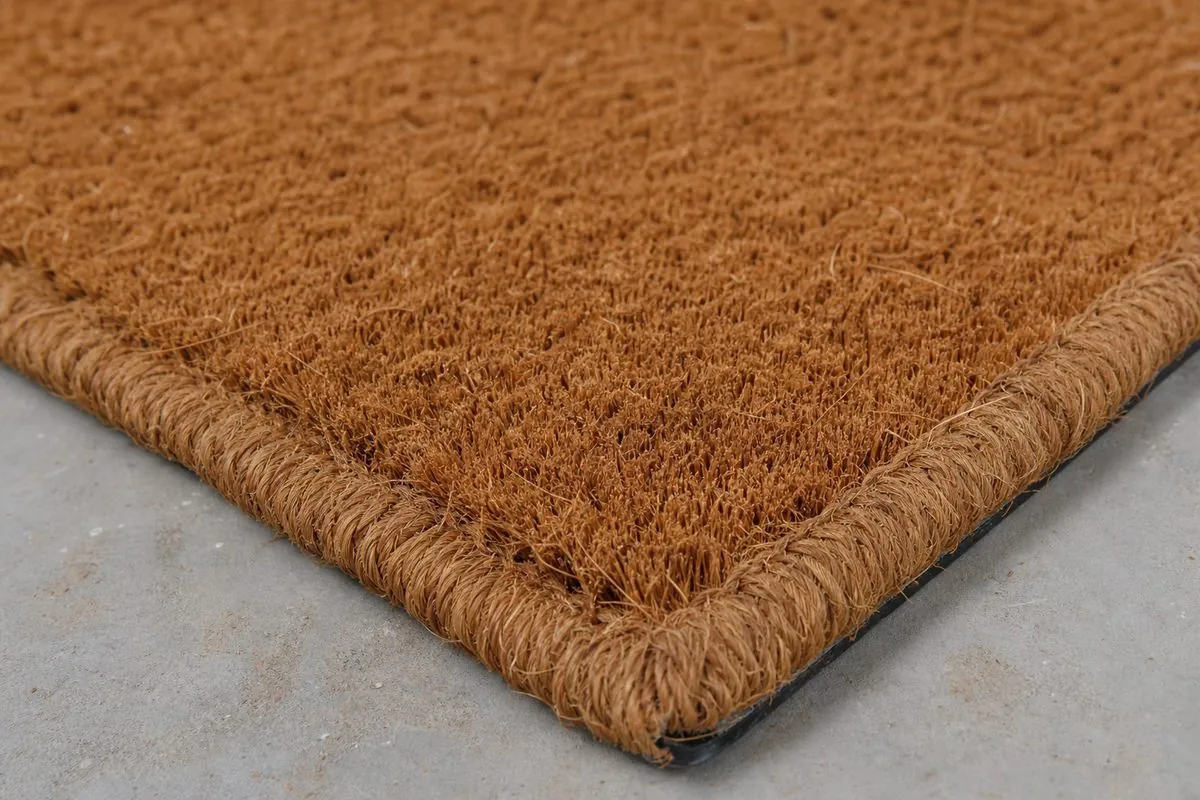
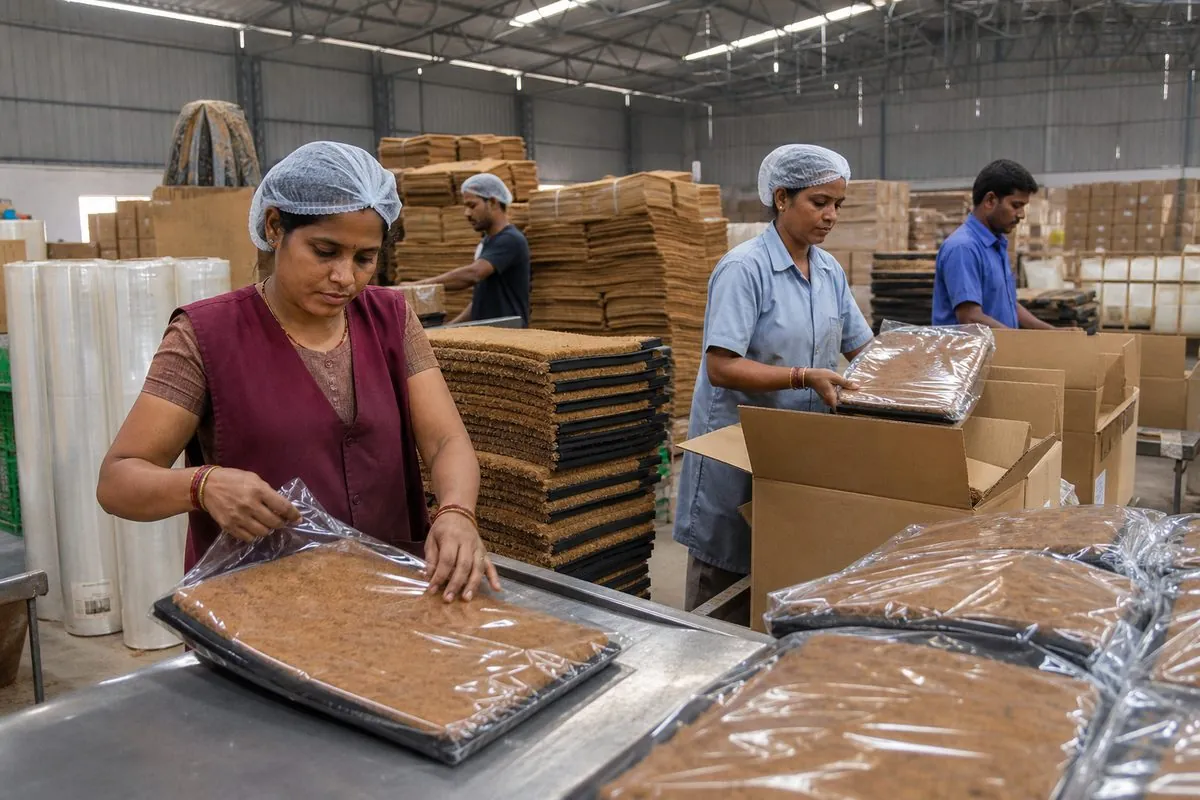
Buyer audits should follow the process that creates defects. Fibre preparation and moisture condition affect musty odour risk. Weaving or tufting drives pile density and shedding. Edge binding affects retail presentation. Bleaching drives colour consistency. PVC or rubber backing drives adhesion and edge curl. Logo printing adds registration and chemistry documentation needs. Export packing with desiccants decides ocean arrival condition.
When auditing Alappuzha, prioritise loom or tufting consistency, dry storage, and packing tables. When auditing Pollachi, prioritise cutting calibration, PVC line adhesion QC, and print setup control. Merchant exporters should show which physical units produce your PO — not only a showroom.
RFQ Playbook: How to Specify Coir Mats
Export Tip
A complete RFQ is the highest-leverage document in direct sourcing. Incomplete inquiries produce incomparable quotes and unenforceable quality expectations. Include commercial identity, technical specs, compliance needs, logistics preferences, and commercial terms in one brief.
Essential RFQ fields for sourcing coir mats from India
Swipe →
Data table — swipe horizontally on small screens
| RFQ Field | What to Specify | Why It Matters |
|---|---|---|
| HS intent | HS 5702.20 finished mats | Avoids fibre/pith misclassification |
| Size & tolerance | Exact cm + acceptable mm variance | Retail chargeback prevention |
| Construction | Handloom / power-loom / tufted / roll | Matches factory capability |
| Backing | None / PVC grade / rubber | Drives QC and chemistry docs |
| Colourway | Natural / bleached / custom | Colour consistency checks |
| Logo / artwork | File format, colours, placement | Lead time and setup cost |
| Packing | Individual poly bag or kraft wrap; edge protection for PVC-backed mats; desiccants | Ocean moisture risk control |
| Incoterm & port | EXW unit / warehouse or FOB Kochi / Tuticorin / Chennai / Nhava Sheva or CFR / CIF named destination port | Comparable landed quotes |
| MOQ stages | Samples 5–20 pcs; trial 200–1,000 pcs | Phased risk control |
| Compliance | REACH / Prop 65 / phyto as needed | Destination market access |
| Inspection rights | Pre-shipment AQL clause | Enforceable quality gate |
| Cluster preference | Alappuzha and/or Pollachi | Honest origin + capability fit |
Alappuzha & Pollachi Verification
Verification is not a brochure review. Confirm legal export identity, physical production geography, process capability, and packing discipline before deposits.
Supplier verification scorecard for coir mat buyers
Swipe →
Data table — swipe horizontally on small screens
| Check | Pass Signal | Fail / Hold Signal |
|---|---|---|
| IEC / Coir Board | Active docs match invoice entity | Vague claims; name mismatch |
| Production geography | Show Alappuzha or Pollachi line | Showroom-only; refuses site/video |
| Size QC | Written tolerance + measuring tools | Eye-ball only; no records |
| Backing QC | Peel-test habit on PVC lines | No adhesion checks |
| Moisture packing | Desiccant SOP + dry warehouse | Open-air damp staging |
| Eco claims | Construction-qualified language | Biodegradable on all PVC SKUs |
Legal and registration checks
- Match invoice company name to IEC on DGFT records
- Confirm Coir Board registration evidence for the exporting entity
- Ask who physically manufactures vs who exports — document both
- Reject name mismatches between Quotation, PI, and shipping docs early
Alappuzha unit audit focus
- Loom/tufting in operation — not only finished sample racks
- Pile density consistency across in-process mats
- Edge binding quality and dimensional checks
- Dry storage conditions and monsoon humidity controls
- Packing table with desiccants and moisture barriers staged
Pollachi / PVC line audit focus
- Cutting calibration and size tolerance records
- PVC adhesion peel checks and corrective-action logs
- Edge curl inspection after backing and cooling
- Print registration controls for logo programmes
- Backing chemistry supplier identification for REACH/Prop 65 inquiries
Pricing Analysis
Buyer Tip
FOB named Indian port (Kochi / Tuticorin / Chennai / Nhava Sheva). Indicative commercial FOB planning bands only (not official published prices): natural/handloom ~US$2–12/pc; PVC-backed plain ~US$3–15/pc; custom logo ~US$4–20+/pc; rubber-backed premium ~US$5–25+/pc by size — verify on quote date. Indicative merchant-trade planning bands only; confirm size, pile density, backing, print, and packing on quote date. Do not cite as government price series. Buyers should request comparable quotes on identical RFQ fields — size, backing, packing, Incoterm, and port — otherwise FOB comparisons are meaningless.
Indicative FOB bands buyers should expect (confirm on quote date)
Swipe →
Data table — swipe horizontally on small screens
| Construction | Indicative FOB (USD/pc) | Buyer Negotiation Note |
|---|---|---|
| Natural / handloom | US$2–12 | Density and size drive spread |
| PVC-backed plain | US$3–15 | Ask PVC grade and tolerance |
| Custom logo PVC | US$4–20+ | Separate setup vs unit price |
| Rubber-backed premium | US$5–25+ | Compound and finish grade |
| Roll matting | By metre / width | Confirm packing format |
MOQ Analysis
Buyer Tip
Phased MOQ protects buyers. 5–20 pcs for evaluation; 200–1,000 pcs to validate transit and bulk consistency; 1,000–5,000+ pcs typical for wholesale PVC/logo; Lower MOQ often possible after sample approval. MOQ figures are indicative commercial practice by construction and channel — not statutory minima. Lock MOQ in writing before production.
Phased MOQ framework for coir mat buyers
Swipe →
Data table — swipe horizontally on small screens
| Phase | Quantity | Validation Goal |
|---|---|---|
| Sample approval | 5–20 pcs | Pile, size, backing, colour, odour |
| Trial order | 200–1,000 pcs | Bulk consistency + ocean moisture |
| Wholesale repeat | 1,000–5,000+ pcs typical | Replenishment against proven QC |
| Programme FCL | 20GP / 40HC | Retail reset or seasonal garden push |
Packaging Standards
Export Tip
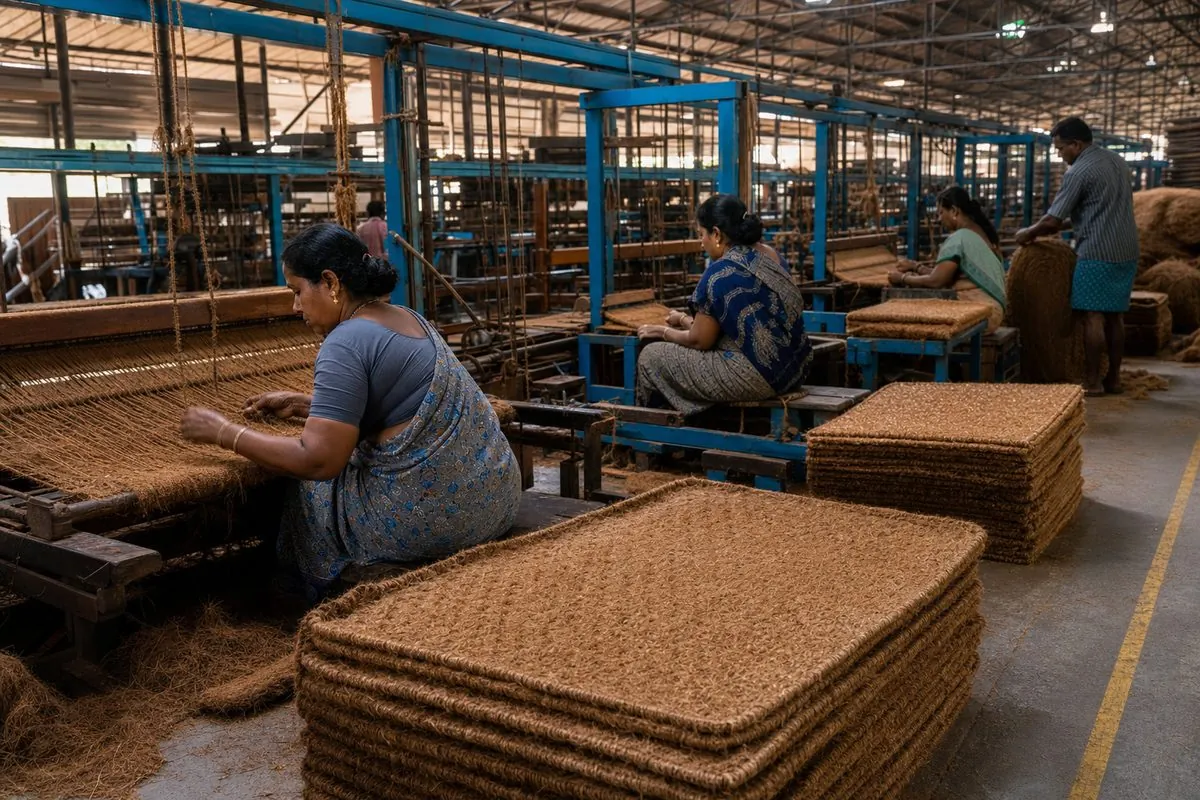
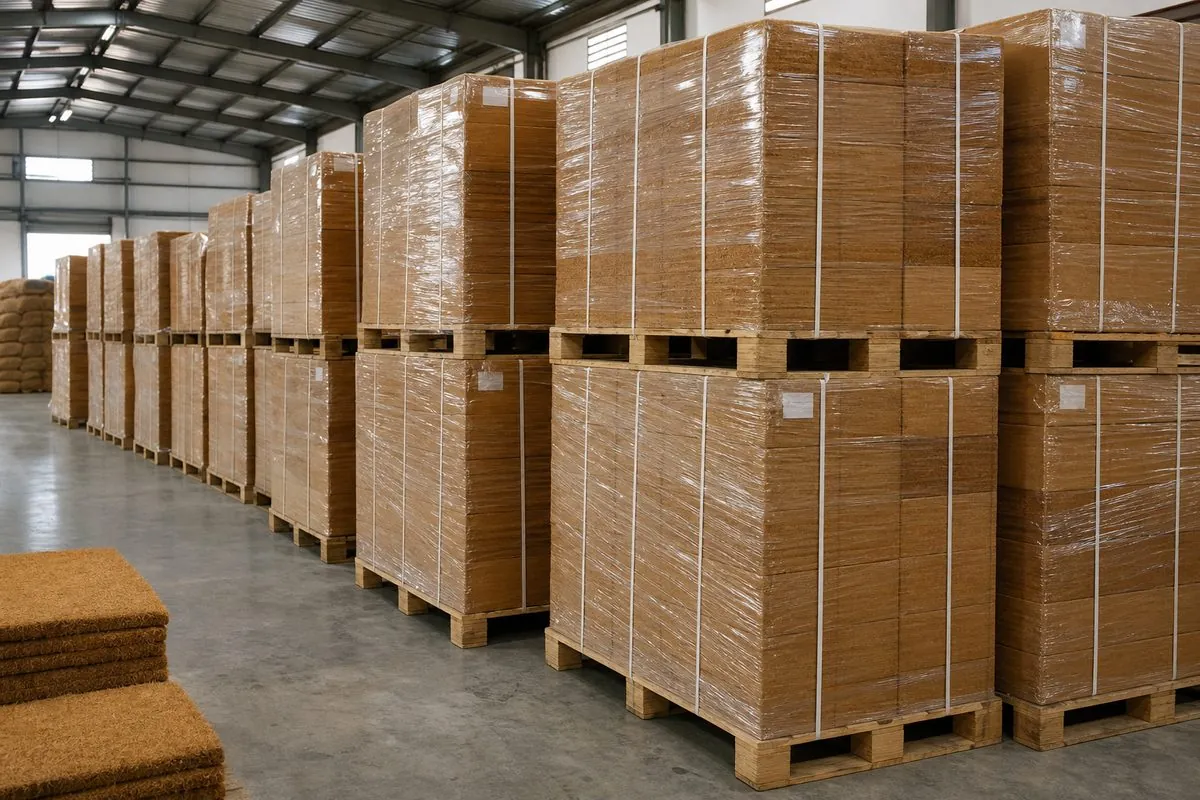
Specify packing in the RFQ and PO. Individual poly bag or kraft wrap; edge protection for PVC-backed mats Master cartons or bales by size; palletize for FCL where specified Roll matting with crease avoidance and moisture barrier Desiccant / moisture-barrier discipline for coconut-fibre goods Request photos or video from the packing table during trial production.
Buyer-specified packing requirements for coir mat trials
Swipe →
Data table — swipe horizontally on small screens
| Element | Specification | Verification Method |
|---|---|---|
| Moisture control | Desiccants; barrier liner if humid season | Open random cartons at PSI |
| PVC edge protection | Edge guards / no crush stacking | Photo of stuffing plan |
| Individual wrap | Poly or kraft per RFQ | Compare to approved sample |
| Carton marking | SKU, PO, size, destination icons | Packing list reconciliation |
| Retail inserts | Hangtags, barcodes if private label | Artwork sign-off before bulk |
Container Loading Details
Export Tip
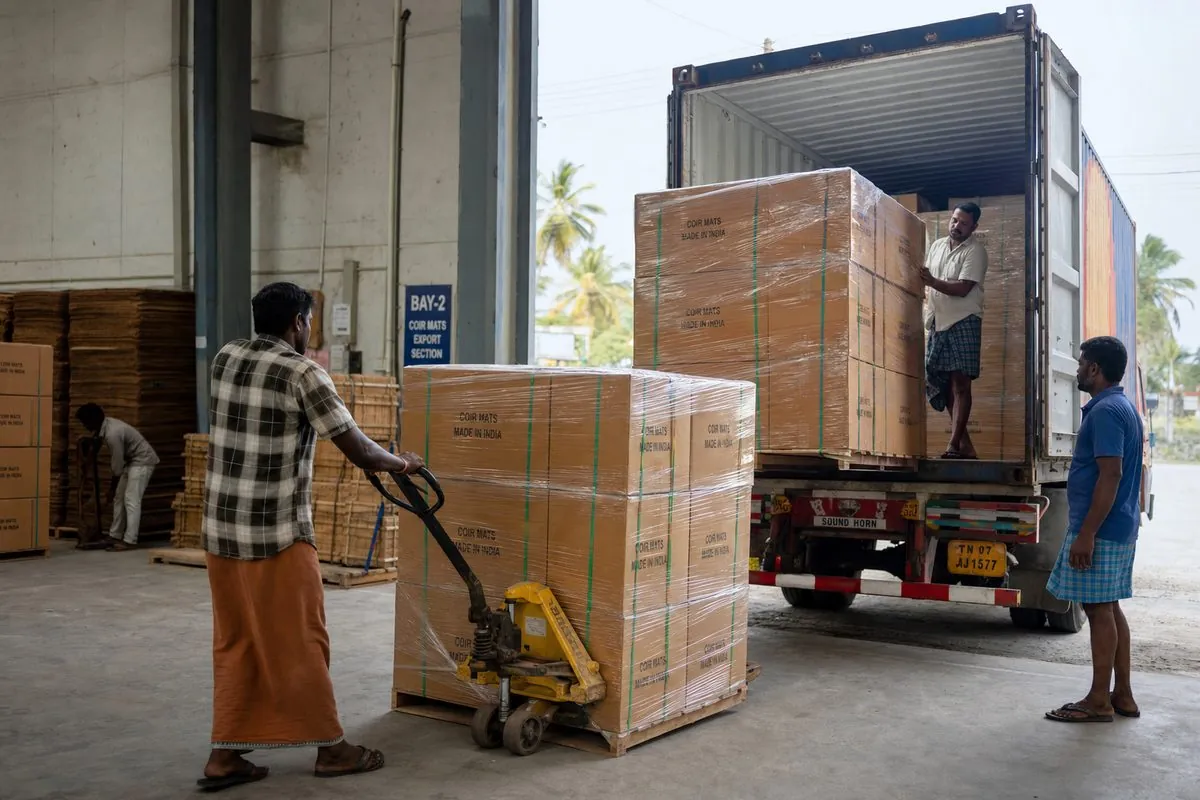
Coir mats punish both over-compression (PVC edge damage) and loose loading (scuff and shift). Trial LCL validates freight economics before FCL. Mixed SKU containers need strict packing-list discipline. Roll matting needs separate crease-avoidance logic from piece mats.
Container planning for coir mat trial and programme orders
Swipe →
Data table — swipe horizontally on small screens
| Shipment Type | Best For | Buyer Note |
|---|---|---|
| LCL trial | First 200–1,000 pcs validation | Higher per-unit freight OK for proof |
| 20GP FCL | Single-construction programme | Confirm stack height before stuffing |
| 40HC FCL | Multi-size retail assortment | Packing-list discipline mandatory |
| Air sample | Late logo or colour approval | Not economical for bulk mats |
Shipping Methods
Export Tip
Confirm Incoterm and named port in pro-forma — options commonly include EXW unit / warehouse; FOB Kochi / Tuticorin / Chennai / Nhava Sheva; CFR / CIF named destination port; DDP (selected large retail programmes only). Alappuzha production typically loads Kochi; Pollachi programmes often route Tuticorin or Chennai. Lead times: samples 7–21 days typical for samples depending on construction; stock 2–4 weeks for stock sizes after confirmation; custom logo 4–8+ weeks including artwork approval for logo/private-label programmes. Book sailings with monsoon humidity in mind.
Sampling & QC Playbook
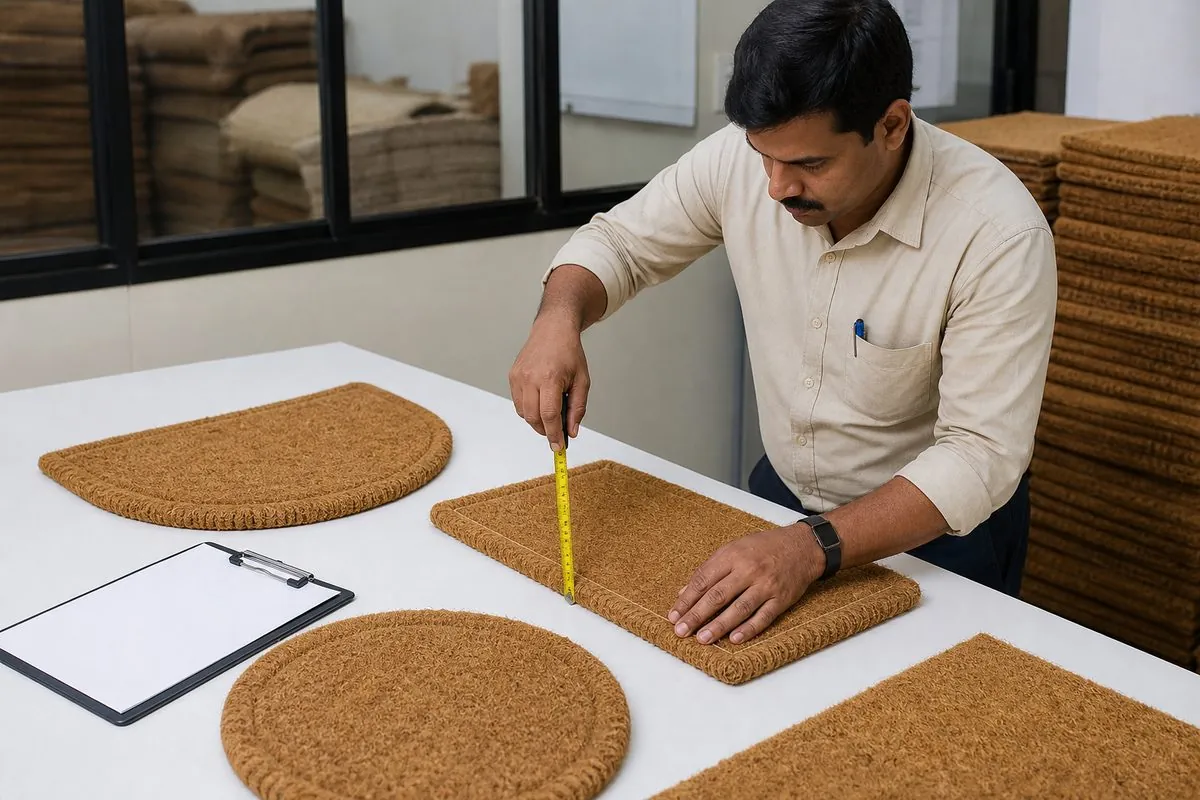
Sampling without production-lot linkage is theatre. Require lot references, measure size against tolerance, inspect pile density and shedding, check edge binding, evaluate odour, and for backed mats perform or witness adhesion and flatness checks. Retain approved references for pre-shipment comparison.
Pre-shipment QC checklist for coir mat trial lots
Swipe →
Data table — swipe horizontally on small screens
| QC Point | Method | Reject If |
|---|---|---|
| Size tolerance | Measure random pcs vs RFQ mm | Outside agreed variance |
| Pile / tuft | Visual + pull on random tufts | Excess shedding vs sample |
| Backing adhesion | Peel check on PVC/rubber | Delamination or soft bond |
| Edge curl / flatness | Lay flat on table | Persistent curl vs reference |
| Odour / moisture | Open cartons; smell; damp feel | Musty or damp fibre |
| Logo / print | Compare to signed artwork | Misregistration / wrong colours |
| Packing | Desiccants, wrap, marks | Missing moisture protection |
| Docs pack | Invoice, PL, COO, declarations | Entity or HS mismatches |
Landed-Cost Decision Flow
Never award a supplier on FOB alone. Run a simple decision flow: (1) RFQ-comparable FOB, (2) ocean freight on actual CBM, (3) insurance, (4) destination duty on confirmed 5702.20 line, (5) inland delivery, (6) compliance and inspection overhead, (7) claims allowance for moisture/backing risk. Choose the lowest credible landed cost among suppliers who passed verification and trial QC — not the lowest PI.
Landed-cost decision flow for coir mat importers
Swipe →
Data table — swipe horizontally on small screens
| Step | Input | Decision Gate |
|---|---|---|
| 1. Spec lock | Signed RFQ + sample approval | No PO without approved reference |
| 2. Supplier pass | IEC, Coir Board, audit scorecard | Fail = do not price further |
| 3. FOB compare | Identical Incoterm/port/specs | Discard non-comparable quotes |
| 4. Freight model | CBM × rate × surcharge | Re-rank if cube differs |
| 5. Duty & tax | Broker duty on 5702.20 | Include preferential rules if any |
| 6. Risk allowance | Moisture/backing claims % | Higher if packing SOP weak |
| 7. Trial proof | LCL/trial arrival QC | Scale only if trial passes |
| 8. Programme award | Landed unit + service reliability | Multi-PO relationship terms |
Certifications
Compliance Notes
Treat every certification as a claim with scope. Relevant evidence: Coir Board registration / RCMC evidence; Fibre composition declaration (coconut coir); ISO plant quality systems where available; Third-party inspection (SGS / Bureau Veritas / Intertek) on request; Certificate of Origin; REACH / SVHC declarations for PVC or rubber backings where required; Phytosanitary certificate where destination plant-health rules require it for plant-fibre goods; Honest eco / biodegradable claim controls (no overclaim on polymer-backed mats). Do not accept hangtag eco logos without construction-qualified language and backing chemistry evidence where applicable.
Certification verification checklist for coir mat buyers
Swipe →
Data table — swipe horizontally on small screens
| Claim | Evidence Required | Reject If |
|---|---|---|
| Coir Board registration | Active evidence matching exporter | Name mismatch with IEC entity |
| Coconut coir composition | Fibre declaration / test | Vague natural fibre only |
| REACH / SVHC | Backing/print supplier declarations | Cannot identify PVC/rubber source |
| Prop 65 awareness | Supplier declarations for USA | No chemistry discussion possible |
| Biodegradable / eco | Construction-specific qualified claim | Unqualified claim on PVC-backed mat |
| Third-party inspection | PSI report with AQL results | Inspection refused on trial lot |
Buyer Requirements
Buyer Requirements
Importers sourcing directly must reconcile destination requirements with Indian supplier capability before PO: fibre labelling, US HTS 5702.20.10 (floor coverings of coconut fibres, with pile) Column 1-General is typically Free (MFN) per USITC HTS — confirm live schedule and any Chapter 99 overlays before landed-cost quotes. Tufted coir under HTS 5703 may carry different rates — classify first, then price duty. EU CN 5702 20 (woven coir) and CN 5703 90 (tufted) — confirm TARIC duty and preferential origin claims before CFR/CIF programmes. barcode and hangtag formats for retail, moisture packing spec, inspection rights, and payment milestones. Garden-centre programmes add seasonal delivery windows; DIY retail adds chargeback clauses.
Align destination intensity using Best Countries for Indian Coir Mat Exports and document packs using Coir Mat Export Documentation Checklist.
Country-wise Opportunities
Market Snapshot
Direct sourcing success varies by destination compliance and logistics risk — build audit depth to match the market where your first PO will land. The subsections below focus on sourcing-risk implications, not market-ranking theory.
1. United States
Prioritize size tolerance and moisture packing on trial orders — USA retail chargebacks and summer warehouse humidity expose weak QC quickly. Require Prop 65 / backing chemistry awareness for PVC and printed programmes. Private-label DIY ladders need barcode-ready packing from trial stage.
2. United Kingdom
Align sampling to garden-centre spring calendars and DIY replenishment cycles. Moisture packing matters for winter storage arrivals. Specify natural versus PVC assortments separately so suppliers do not mix packing standards.
3. Germany
Build REACH/SVHC backing documentation into the RFQ before sampling PVC or rubber lines. Specialty buyers reject vague biodegradable copy. Insist on production-lot samples and written adhesion QC.
4. Netherlands
Hub importers may redistribute across the EU — documentation must be hub-grade from order one. Verify packing-list discipline for mixed assortments and REACH declarations travel with every lot.
5. South Korea
Programme buyers punish sample-to-bulk variance. Lock AQL, size tolerance, and pile density in writing. Prefer suppliers who can show prior export packing photos for similar constructions.
6. Australia
Honest eco claims and odour-free arrival matter as much as FOB. Model freight cube carefully — inefficient packing can erase natural-fibre margin. ACCC-aligned hangtag language should be approved before bulk.
7. Canada
Mirror USA packing and size QC standards; add bilingual label needs where applicable. Trial moisture performance on ocean arrival before scaling winter programmes.
8. France
Premium finish niche — edge binding, colour consistency, and presentation packing decide acceptance. Do not use France as a first-container experiment for unproven PVC lines.
9. Italy
Specialty volumes with high presentation expectations. Audit finish quality and clean individual wrapping. Landed-cost models should assume modest MOQs and higher per-unit freight share.
10. United Arab Emirates
Fastest proof-of-concept market for new finishes and packing SOPs — still require desiccants and dry staging. Hypermarket programmes value consistent sizing and clean presentation more than formal REACH packets on first orders.
Export Process
Export Tip
From the buyer side, the export process overview is: RFQ → supplier verification → sample approval → pro-forma and milestone payment → production → pre-shipment inspection → document check (invoice, packing list, COO, fibre/backing declarations) → ocean shipment under agreed Incoterm → arrival QC. Exporter registration steps and trade-show calendars are out of scope here; see How to Export Coir Mats from India, Coir Board Registration Benefits for Coir Mat Exporters, and Trade Shows and B2B Marketplaces for Coir Mat Exporters for those tracks.
Sourcing Checklist
Checklist
Use the buyer, exporter, and compliance checklists below as a pre-PO gate. Do not advance deposits until the buyer checklist items that protect legal identity and sample integrity are complete.
Buyer Checklist
Checklist
Exporter Checklist
Checklist
Compliance Checklist
Checklist
Compliance Notes
Common Buyer Mistakes
Common Mistakes Box
First-time coir mat buyers repeat predictable errors — below are the patterns that most often destroy first-container economics.
Common sourcing mistakes and how to avoid them
Swipe →
Data table — swipe horizontally on small screens
| Mistake | Consequence | How to Avoid It |
|---|---|---|
| Approving samples without production lot proof | Size/backing variance claims at destination | Require lot reference + PSI rights in PO |
| Paying 100% advance to unverified unit | Recovery difficult if QC fails | Milestone payment tied to documents |
| Accepting biodegradable labels on PVC mats | Retail audit failure | Qualified eco language in artwork sign-off |
| Comparing FOB only across suppliers | Hidden freight/duty/claims erode margin | Run landed-cost decision flow |
| Skipping trial before retail FCL | Chargebacks destroy seasonal listing | Prove packing on 200–1,000 pcs trial |
| Ignoring moisture packing in RFQ | Musty cartons; widespread claims | Desiccant spec and dry storage clause |
| Assuming merchant showroom = factory QC | Origin and quality misrepresentation | Audit actual Alappuzha/Pollachi line |
| Vague size tolerance in PO | Unenforceable disputes | Write mm tolerance into contract |
Future Market Trends
Key Statistics
Buyers should expect tighter retail scrutiny on eco claims and backing chemistry in the EU and California-facing USA chains — suppliers who maintain PVC/rubber documentation and honest hangtags now will win repeat programmes. Private-label PVC doormat ladders and natural garden assortments from Kerala and Tamil Nadu are directionally active as importers seek coconut-fibre authenticity — but only suppliers with proven moisture packing and size QC capture that demand sustainably.
Multi-SKU programmes managed through one accountable merchant exporter will outcompete fragmented unit-by-unit coordination as assortments broaden across natural, PVC, and logo lines. For construction preference by destination see Most Demanded Indian Coir Mats by Country.
Challenges & Solutions
Direct sourcing of coir mats involves challenges distinct from other home categories — moisture, backing adhesion, size tolerance, and freight cube dominate the buyer risk register.
Sourcing challenges and buyer-side mitigation
Swipe →
Data table — swipe horizontally on small screens
| Challenge | Typical Impact | Mitigation Strategy |
|---|---|---|
| Moisture / musty fibre | Retail rejection; odor claims | Desiccants; dry storage audit; PSI moisture check |
| PVC adhesion / edge curl | DIY chargebacks; returns | Peel-test on trial; edge protection packing |
| Size variance | Barcode/planogram failure | mm tolerance in PO; measure at PSI |
| False eco claims | Audit failure; delisting | Construction-qualified hangtags |
| HS misclassification | Customs delay; duty surprise | Broker + CHA confirm 570220 |
| Fragmented MSME base | Batch inconsistency | Merchant exporter with consolidated QC |
| Logo artwork delays | Missed retail resets | Artwork freeze dates in PO |
| Landed-cost surprises | Margin collapse | Full decision flow before award |
How Altus Exports Helps
Altus Exports supports international buyers as a product sourcing company in India and global sourcing partner — coordinating Alappuzha and Pollachi coir mat units, pile and backing QC, moisture packing discipline, HS 570220 triage, Coir Board-aligned export documents, and ocean logistics through Kochi, Tuticorin, and Chennai under one accountable merchant exporter relationship.
Whether you are a USA DIY importer planning a private-label PVC doormat ladder, a UK garden-centre buyer evaluating natural brush mats, a German specialty buyer requiring REACH-aware backings, or a UAE hypermarket buyer curating entrance-mat assortments, Altus structures RFQ-to-landed-cost decisions against real factory and compliance standards. Contact Altus Exports to begin supplier verification and sampling. Related industry: Handicrafts & Lifestyle Products. Work with Altus Exports as your merchant exporter and global sourcing partner for coir mats — verified Kerala and Tamil Nadu supply, PVC/logo and natural mat programmes, export documentation, and FCL booking from inquiry to shipment.
Sources & References
- Coir Board of India
- Coir Board — Statistics
- Coir Board — Forms & Guidelines (Exporter Registration / RCMC)
- IBEF — Coir Industry in India (DGCIS-sourced export figures)
- Ministry of MSME — Coir product-wise export dashboard
- OEC — Floor coverings of coconut fibres (HS 570220)
- ITC Trade Map
- DGFT (India) — IEC / trade portal
- ICEGATE — Indian Customs EDI
- India CBIC / Customs Tariff
- USITC Harmonized Tariff Schedule — search 5702.20
- European Commission TARIC
- TaxGuru — GST classification note on coir mats with PVC/rubber/latex backing (HS 5703 90 90 practice)
- Altus Exports — Handicrafts & Lifestyle Products
- Altus Exports — Merchant Exporter India
All sources accessed 2026-07-26 (factual audit refresh). Prefer Coir Board, DGCIS/IBEF, CBIC tariff, USITC HTS, and TARIC when citing figures in contracts or buyer presentations. Label sector-wide coir totals separately from HS 5702.20 (woven) and HS 5703.90 (tufted / many backed programmes). Confirm every 8-digit Indian statistical line with a licensed CHA before shipping-bill filing.
Conclusion
- Action: Complete RFQ and verify IEC/Coir Board before paying any sample fee or deposit.
- Read Best Countries for Indian Coir Mat Exports to align sourcing with destination compliance tier.
- Review Top Coir Mat Products Exported from India for SKU specification language.
- See Most Demanded Indian Coir Mats by Country for destination construction preferences.
- Prepare documents with Coir Mat Export Documentation Checklist.
- Verify PVC/logo and eco claim readiness in PVC-Backed Custom Logo and Eco Coir Doormat Export Opportunities.
- Find supplier discovery channels via How to Find International Buyers for Coir Mats and Trade Shows and B2B Marketplaces for Coir Mat Exporters (exporter-facing calendars — use only for awareness).
- Confirm Coir Board credentials via Coir Board Registration Benefits for Coir Mat Exporters.
- Exporter process reference: How to Export Coir Mats from India.
- Engage product sourcing company India, merchant exporter India, global sourcing partner, or contact Altus Exports to run verification and trial orders.
Sourcing coir mats directly from India rewards buyers who treat verification as part of procurement: complete RFQs, Alappuzha and Pollachi audits, samples with production lot proof, milestone payments, trial orders before seasonal FCL, pre-shipment QC on size, backing, and moisture, and landed-cost models that include duty, freight, compliance overhead, and claims allowance.
The suppliers worth a multi-year programme are those who answer moisture, size tolerance, and backing chemistry questions confidently on the first call, back Kerala or Tamil Nadu origin claims with production geography evidence, and ship trial cartons that arrive dry, on-size, and honestly labelled. Start there — market selection and SKU depth can scale once container one proves the relationship.