
How to Source Carpets and Rugs Directly from India: Buyer Sourcing Playbook
By Saurabh Mittal, Founder, Altus Exports
A practical buyer sourcing playbook for international importers, distributors, wholesalers, retail chains, and procurement teams sourcing carpets and rugs directly from India — how to write carpet RFQs (size, knot density, pile height, fiber, dye, backing), verify suppliers in Bhadohi, Kashmir, Jaipur, and Panipat, manage sampling and lab dips, run QC checkpoints, structure payment terms, and reduce first purchase-order risk with Altus Exports as your merchant exporter and global sourcing partner.
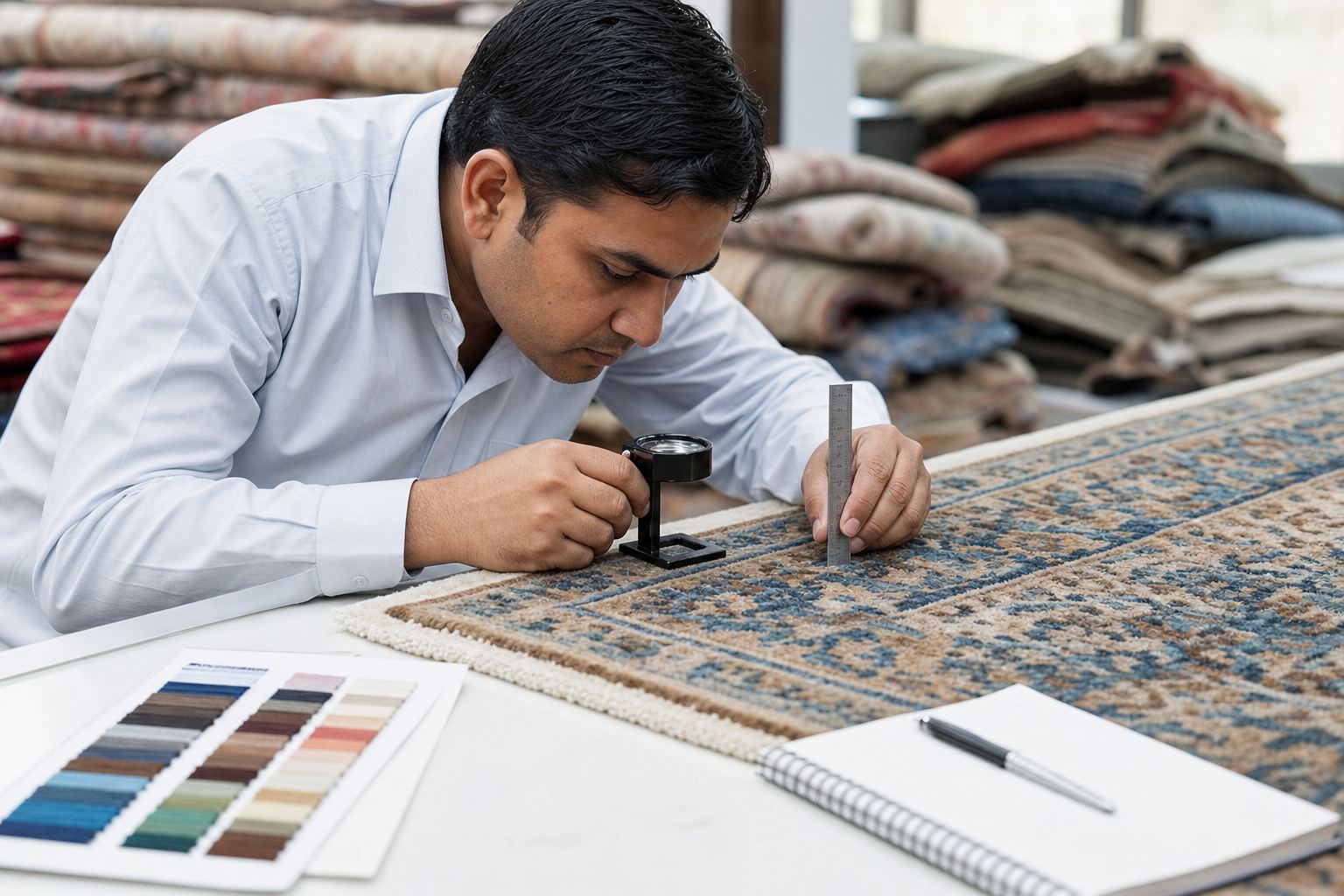
International buyers source carpets and rugs from India because few origins combine hand-knotted craft depth, tufted and flatweave volume, and machine-made programme capacity under one geography. Bhadohi–Mirzapur (Uttar Pradesh) remains the world's densest hand-knotted wool carpet belt. Kashmir supplies premium silk and fine-knot wool pieces. Jaipur and surrounding Rajasthan clusters excel in durries, kilims, and design-led hand-tufted rugs. Panipat (Haryana) anchors machine-made, recycled-yarn, and high-volume wholesale rugs for retail chains and distributors. For importers, wholesalers, retail chains, and procurement teams, that cluster map is the commercial starting point — not a tourist brochure.
Direct sourcing only pays when buyers treat carpet RFQs like engineered specifications, not style mood boards. Recurring first-order failures in this category are predictable: knot-density or pile-height claims that do not survive a tape measure, dye lots that drift from the approved lab dip, fringe and edge finishing that collapses in transit, and latex or jute backing that fails under humidity or warehouse stacking. Buyers who skip supplier verification in Bhadohi, Kashmir, Jaipur, or Panipat, skip sealed sample and lab-dip sign-off, or skip pre-shipment QC to save two weeks routinely lose far more than two weeks sorting a misdescribed container.
This playbook is written for international buyers — importers, distributors, wholesalers, retail chains, and procurement teams — who want a lower-risk path to source carpets and rugs directly from India. It covers RFQ writing, cluster-specific supplier verification, sampling and lab dips, QC checkpoints, MOQ and pricing, packaging and container loading, certifications, payment terms, and first-PO risk reduction. Altus Exports supports carpet and rug programmes as a merchant exporter, global sourcing partner, and export consulting desk — one accountable relationship from specification to shipment. This guide does not rewrite exporter-side process manuals or country-ranking market guides; it is a buyer-side sourcing playbook.
Key Takeaways
Summary Box
- Write carpet RFQs with measurable specs — finished size tolerance, knot density (KPSI) or tuft density, pile height, fiber content, dye type, and backing — before shortlisting any loom or mill.
- Match construction to cluster: Bhadohi for hand-knotted wool volume, Kashmir for premium silk and fine-knot wool, Jaipur for durries and design-led tufted rugs, Panipat for machine-made and wholesale volume.
- Treat sealed samples and lab dips as the production contract; photograph, retain, and tie every bulk dye lot and construction lot back to that sign-off.
- Build QC checkpoints for color, size tolerance, fringe/edge finish, and shedding before cargo cutoff — not after arrival claims.
- Use staged payment (typically 30–50% advance, balance against documents) on first POs; avoid 100% advance with unverified suppliers.
- Start with a trial assortment or LCL/small FCL before full-container programme volume once construction and color consistency are proven.
- A merchant exporter or global sourcing partner reduces first-order risk for multi-cluster or multi-construction carpet programmes — Altus Exports coordinates verification, sampling, QC, and export documentation under one desk.
Executive Summary
Summary Box
This buyer sourcing playbook sets out a repeatable sequence for international importers, distributors, wholesalers, retail chains, and procurement teams to source carpets and rugs directly from India with lower first-purchase-order risk. The sequence covers RFQ definition, cluster-aligned supplier discovery, legal and production verification, sample and lab-dip approval, landed-cost pricing, MOQ negotiation, packaging and stuffing plans, certification checks, payment structuring, pre-shipment QC, and documentation through sailing.
Carpets and rugs are not interchangeable soft-goods SKUs. Hand-knotted, hand-tufted, flatweave, and machine-made constructions have different cost drivers, lead times, defect modes, and HS classifications. A buyer who compares a Bhadohi hand-knotted quote to a Panipat powerloom quote on unit price alone is comparing different products. Specification discipline — size, knot or tuft density, pile height, fiber, dye chemistry, and backing — is the single highest-leverage buyer control.
Altus Exports positions carpet and rug sourcing around an accountable first shipment: verified looms and mills in the right clusters, written RFQs, sealed samples and lab dips, QC reports before cutoff, and document packs a destination broker can process without guesswork. Use Altus as your merchant exporter and global sourcing partner when you want supplier verification, sample management, quality checkpoints, and export execution under one relationship rather than fragmented loom-by-loom coordination.
Comparison table
Swipe →
Data table — swipe horizontally on small screens
| Sourcing Dimension | What to Lock in Writing | Why It Matters |
|---|---|---|
| Construction & density | Hand-knotted KPSI / tuft gauge / flatweave PPI / machine-made gauge | Density claims drive price and durability; vague RFQs invite inflation |
| Fiber & pile | Wool / silk / cotton / jute / PP / blends; pile height mm | Fiber mix and pile height control hand-feel, shedding, and wear |
| Dye & color | Vegetable / chrome / azo-free synthetic; lab-dip approval | Color mismatch is the most common retail return driver |
| Backing & finish | Latex / cotton / jute / synthetic; fringe or serging standard | Backing and fringe failures surface in transit and first use |
| Commercial terms | MOQ, FOB/CIF, payment milestones, PSI rights | Protects cash flow and clarifies reject/rework pathways |
Market Size & Industry Overview
Key Statistics
India remains one of the world's principal origins for handmade and machine-assisted carpets and rugs. Export value for carpets, rugs, and floor coverings typically sits in the multi-billion-rupee to multi-billion-dollar planning range depending on the fiscal year and HS basket used — handmade wool carpets from the Bhadohi–Mirzapur belt, premium Kashmir silk and wool pieces, Rajasthan flatweaves and tufted programmes, and Panipat machine-made and recycled-fiber rugs together form a diversified export base that serves US, EU, UK, Middle East, Australia, and Japan buyers.
Demand is split across channels: department stores and specialty rug retailers seeking design-led hand-tufted and flatweave assortments; hospitality and commercial buyers needing durable wool or wool-blend constructions; wholesalers and distributors filling breadth-of-line machine-made programmes; and online and retail-chain private-label buyers who need consistent colorways and size runs across seasons. Sustainability and social-compliance expectations — OEKO-TEX, GoodWeave, azo-free dyes, recycled content claims — increasingly sit beside traditional knot-density and pile-height language in RFQs.
For buyers, the industry overview that matters is cluster capability, not national slogans. Bhadohi–Mirzapur specializes in hand-knotted and hand-tufted wool carpets at volume. Kashmir specializes in fine-knot silk and wool art pieces with longer lead times and higher FOB. Jaipur and Rajasthan hubs specialise in durries, kilims, and fashion-forward tufted rugs. Panipat specializes in powerloom, handloom durrie volume, and recycled-yarn rugs at wholesale MOQs. Matching construction to cluster before outreach saves months of mismatched sampling.
Comparison table
Swipe →
Data table — swipe horizontally on small screens
| Cluster | Primary Strength | Typical Buyer Fit |
|---|---|---|
| Bhadohi–Mirzapur (UP) | Hand-knotted & hand-tufted wool carpets | Specialty retail, hospitality, mid-premium importers |
| Kashmir | Fine-knot silk & wool hand-knotted carpets | Luxury retail, collectors, premium galleries |
| Jaipur / Rajasthan | Durries, kilims, design-led tufted rugs | Design retail, DTC brands, Gulf décor buyers |
| Panipat (Haryana) | Machine-made, recycled-yarn, volume rugs | Wholesalers, retail chains, value distributors |
Export Statistics & Import Statistics
Key Statistics
Indian carpet and rug exports move primarily under HS Chapter 57 — notably 5701 (carpets of knotted pile), 5702 (woven, not tufted or flocked), 5703 (tufted), and related headings for other floor coverings. Exact annual figures fluctuate with wool prices, US and EU retail demand, and Middle East project cycles, but planning-level trade data consistently show the United States as a leading destination for Indian handmade and machine-made rugs, with Germany, the United Kingdom, UAE, Australia, Canada, and Japan among significant import markets depending on construction mix.
Import-side statistics matter for buyer planning because they signal where compliance and channel expectations are already organized. US programmes emphasise FTC fiber labeling, CPSIA where children's products apply, and increasingly social-compliance documentation. EU and UK programmes emphasise REACH chemical compliance for dyes and finishes, OEKO-TEX or equivalent substance limits, and accurate fiber content. Gulf buyers often prioritise design density, hospitality durability, and Arabic or bilingual labeling on retail packs. Use trade statistics to prioritise destination fit — not to promise a sales forecast.
Load ports commonly include Mundra and Nhava Sheva for North and West India cargo (Panipat, Jaipur, parts of Bhadohi flows), with inland routing from Eastern UP and Kashmir coordinated through container freight stations feeding those gateways or Kolkata depending on exporter logistics. Buyers should ask for FOB named port after the factory shortlist is clear, because inland haul from Kashmir or deep Bhadohi units to port can move landed cost as much as a small FOB delta.
Comparison table
Swipe →
Data table — swipe horizontally on small screens
| Trade Signal | Planning Interpretation | Buyer Action |
|---|---|---|
| HS 5701 hand-knotted flows | Premium handmade programmes remain India-competitive | Lock KPSI, fiber, and dye in RFQ; verify loom capacity |
| HS 5703 tufted flows | Design-led retail volume often sits in tufted SKUs | Approve pile height, latex backing, and colorways via lab dips |
| US as top destination cluster | Retail and wholesale channels are mature for Indian rugs | Align fiber labels and social-compliance docs early |
| EU/UK chemical scrutiny | Dye and finish chemistry is a gate, not an afterthought | Require azo-free / REACH-aware dye declarations |
| Gulf & Australia demand | Hospitality and design retail pull durable wool and flatweaves | Specify wear rating and size runs for project vs retail |
Product Categories
Summary Box
International buyers should structure carpet and rug assortments by construction first, then by fiber and design, because construction drives factory selection, MOQ, lead time, and defect risk more than pattern name ever will.
Comparison table
Swipe →
Data table — swipe horizontally on small screens
| Category | Typical Construction | Indicative FOB Range* | Primary Clusters |
|---|---|---|---|
| Hand-knotted wool carpets | Persian/Tibetan knot; KPSI bands by grade | $25–$120+ / sq m | Bhadohi, Kashmir |
| Hand-knotted silk / silk-blend | Fine-knot silk or silk-wool | $80–$300+ / sq m | Kashmir, select Bhadohi |
| Hand-tufted rugs | Hand-tufted wool or blends; latex backing | $8–$35 / sq m | Bhadohi, Jaipur |
| Flatweave / durrie / kilim | Cotton, wool, jute, or blends | $4–$18 / sq m | Jaipur, Panipat, Rajasthan |
| Machine-made / powerloom | PP, PET, wool-blend; gauge-defined | $2–$12 / sq m | Panipat |
| Recycled / eco rugs | Recycled PET, cotton scrap, jute | $3–$15 / sq m | Panipat, Jaipur |
| Custom / private-label programmes | Any construction with buyer artwork | Spec-dependent | Multi-cluster via exporter |
Pricing note on indicative FOB ranges
Indicative FOB ranges in the table above are planning anchors only; actual quotes depend on size mix, knot/tuft density, fiber grade, dye process, fringe finish, and order volume. Always request itemised quotations.
Handmade programmes
Hand-knotted and hand-tufted lines suit specialty retail, hospitality statement pieces, and premium private label. Lead times are longer; QC must emphasise knot or tuft consistency, color matching across panels, and fringe integrity.
Volume and wholesale programmes
Machine-made and flatweave lines suit distributors and retail chains that need repeatable size runs, faster replenishment, and tighter MOQ economics. QC emphasises gauge consistency, backing adhesion, dimensional stability, and packaging for high carton counts.
Manufacturing Overview
Export Tip
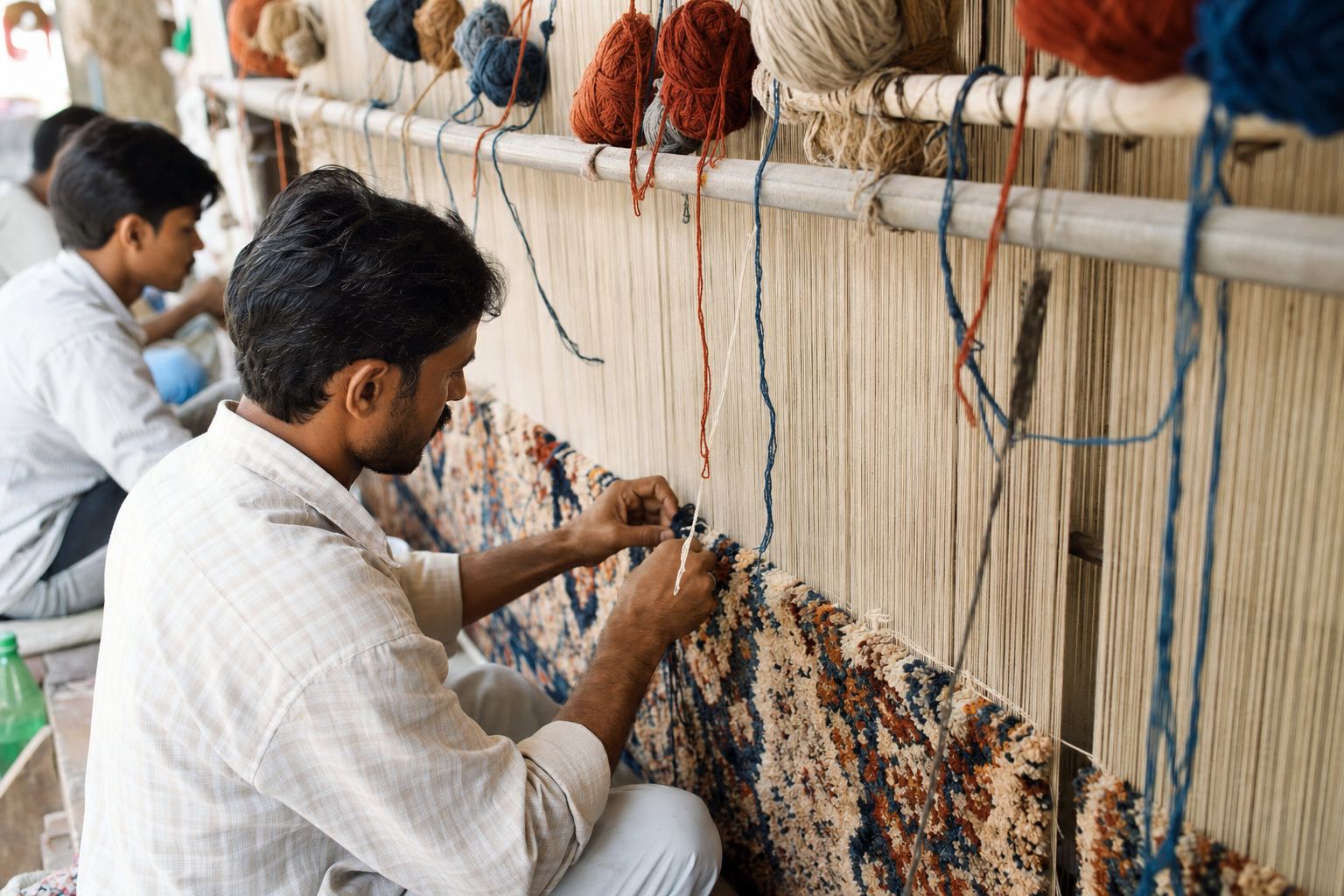
Understanding how Indian carpets and rugs are made helps buyers write enforceable RFQs and interpret factory claims. Hand-knotted production starts with yarn preparation (wool, silk, or blends), dyeing to approved lab dips, warping, knotting on vertical or horizontal looms, washing, stretching, clipping or carving, fringe finishing, and final inspection. Hand-tufted production uses a tufting gun into a primary backing, followed by latex application, secondary backing, carving or shearing, and edge finishing. Flatweaves are woven on pit or frame looms without pile. Machine-made rugs are produced on powerlooms with defined gauge and pile height settings, then finished and inspected at higher throughput.
Critical control points differ by process. For hand-knotted goods, knot density, yarn count, and color-lot continuity matter most. For tufted goods, latex curing, backing adhesion, and pile-height uniformity matter most. For machine-made goods, gauge setup, yarn lot consistency, and edge binding quality matter most. Buyers should ask suppliers to map their process steps to the QC checkpoints in the purchase order — a loom that cannot explain where color and size are checked mid-process is a loom that will surprise you at destination.
Comparison table
Swipe →
Data table — swipe horizontally on small screens
| Process Stage | Buyer Control Point | Evidence to Request |
|---|---|---|
| Yarn & fiber intake | Fiber content and lot identity | Fiber declaration; yarn lot tags |
| Dyeing | Lab-dip match and dye chemistry | Approved lab dips; azo-free / REACH statement |
| Knotting / tufting / weaving | Density, pile height, size | In-process measurement log |
| Washing & finishing | Hand-feel, shedding, fringe | Finish checklist; retention sample |
| Backing & edge | Latex cure, serging, fringe strength | Backing adhesion check; photos |
| Final inspection | AQL color, size, defects | PSI report before stuffing |
Pricing Analysis
Buyer Tip
Carpet and rug pricing in India is driven by construction labour intensity, fiber cost, dye process, size mix, and finishing — not by a single "India rug" commodity number. Hand-knotted wool at higher KPSI commands substantially more than hand-tufted wool of similar visual density because knotting labour dominates cost. Silk content multiplies FOB further. Machine-made polypropylene rugs price on yarn and loom efficiency and can undercut handmade constructions by an order of magnitude while serving different retail tiers.
Insist on itemised FOB quotations: fiber and yarn, dyeing, knotting or tufting or weaving labour, washing and finishing, fringe or serging, packaging, inland freight to port, and exporter margin where a merchant exporter is involved. A lump-sum square-meter price hides where costs will move on a repeat order when wool prices shift or when you add a new colorway. Compare landed cost — FOB plus ocean freight, insurance, duty, and destination handling — before ranking suppliers.
Beware quotes that sit dramatically below cluster norms for the declared KPSI, pile height, and fiber. Unusually low hand-knotted pricing often signals density inflation, fiber substitution, or unfinished fringe standards that will fail QC. Price discipline means matching quote language to measurable specs, not shopping the lowest number in an inbox.
Comparison table
Swipe →
Data table — swipe horizontally on small screens
| Cost Driver | Impact on FOB | Buyer Negotiation Lever |
|---|---|---|
| Knot / tuft density | High — labour intensive | Right-size KPSI to channel; do not overspec |
| Fiber (wool vs PP vs silk) | High — material cost | Blend where channel allows; lock fiber % |
| Dye process (veg vs synthetic) | Medium–high | Approve chemistry to claim needs, not prestige |
| Size mix & waste | Medium | Consolidate popular sizes; avoid odd runs |
| Finishing & fringe | Medium | Specify fringe vs serging by SKU |
| Order volume & repeatability | Medium | Programme volume after trial proof |
MOQ Analysis
Buyer Tip
Minimum order quantities for Indian carpets and rugs vary sharply by construction and customisation. Stock or running-line machine-made rugs from Panipat may start in the low dozens of pieces per size/color for trial, while custom hand-knotted programmes often require design approval, sample rugs, and higher piece or square-meter commitments before looms are allocated. Hand-tufted custom colorways typically sit between those extremes: higher than stock flatweaves, lower than fine-knot silk programmes.
First-time buyers should treat MOQ as a risk tool, not a volume trophy. A trial of a few sizes in one construction — shipped LCL or as a partial container — validates color, size tolerance, fringe quality, and shedding behavior before a full 40ft programme. Merchant exporters can sometimes consolidate mixed constructions or mixed cluster SKUs into one export shipment so buyers reach container economics without oversized minima on every design.
Comparison table
Swipe →
Data table — swipe horizontally on small screens
| Programme Type | Typical First-Order MOQ | Scale-Up Path |
|---|---|---|
| Stock machine-made / flatweave | 20–100 pcs per size/color | Full size run → 20ft/40ft FCL |
| Hand-tufted custom colorways | 50–200 pcs or sq m equivalent | After lab-dip lock → seasonal replenishment |
| Hand-knotted wool (standard designs) | 10–50 pcs depending on size | Repeat after PSI-clean trial |
| Kashmir silk / fine-knot | Small piece counts; long lead | Sample rug first; then limited edition runs |
| Private-label mixed assortment | Negotiated mixed MOQ via exporter | Consolidate clusters under one PO |
Packaging Standards
Export Tip
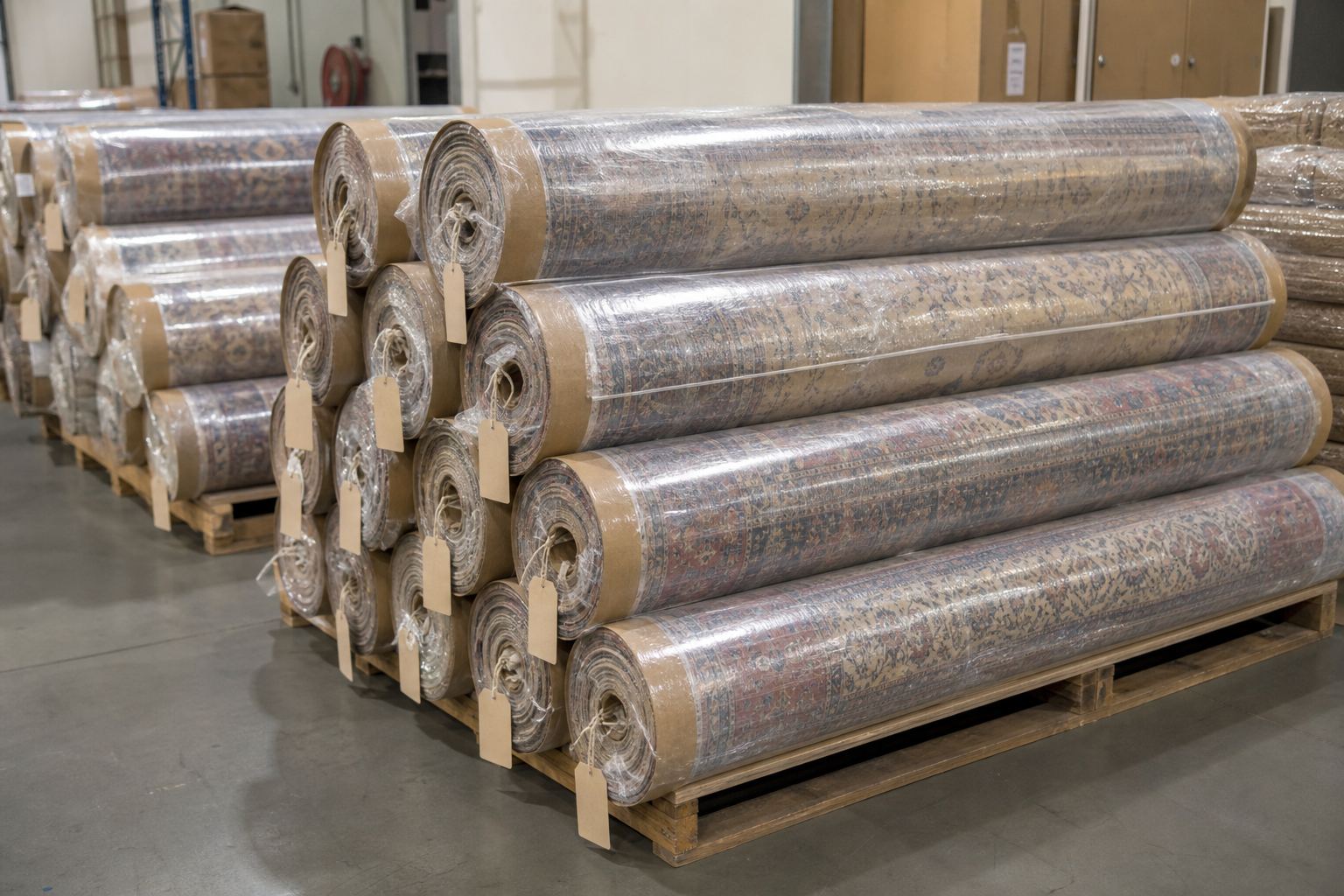
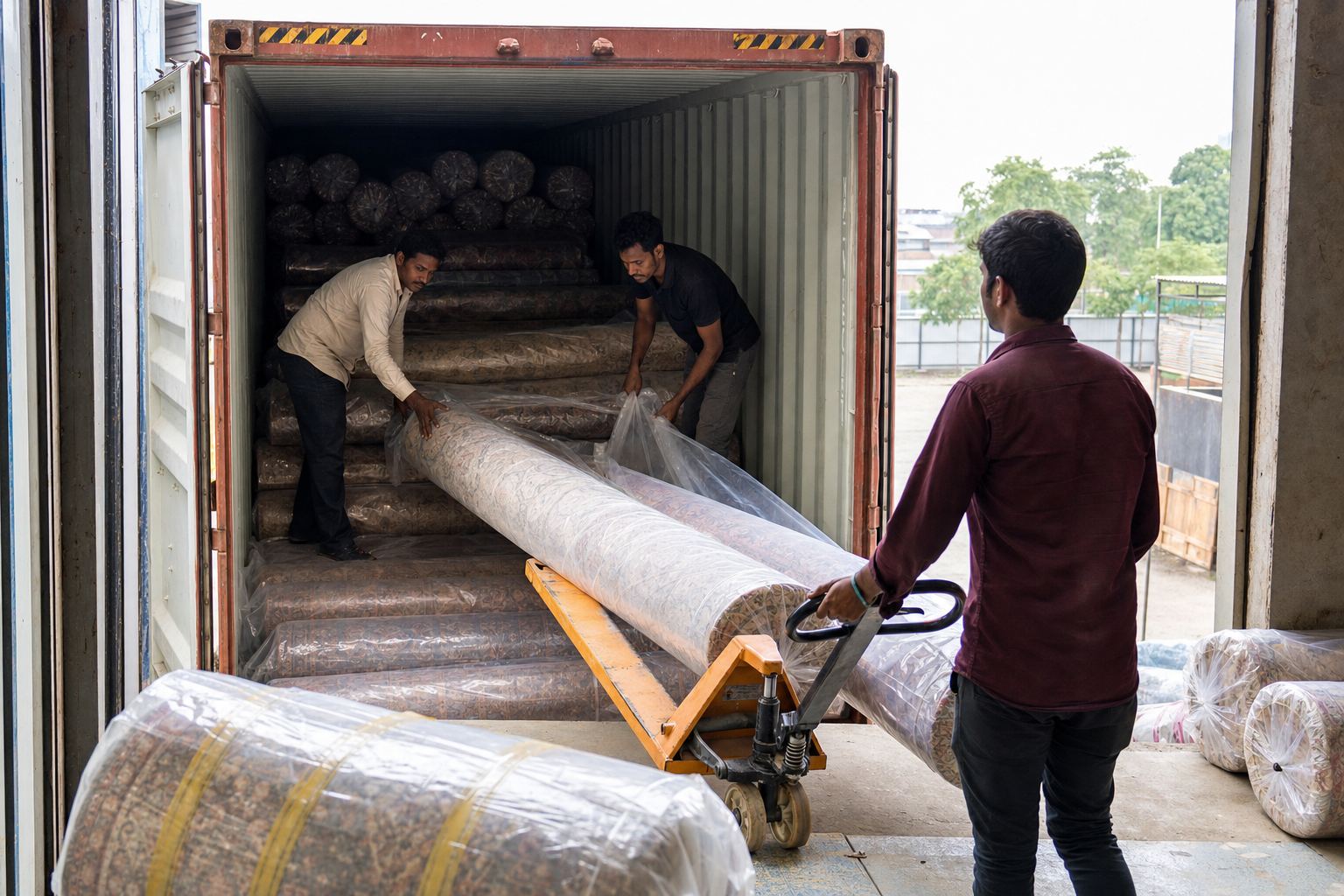
Carpet and rug packaging must protect pile, fringe, and backing through ocean humidity, compression, and multiple handling points. Individual rugs are commonly rolled pile-out or pile-in per buyer preference, wrapped in poly film, and protected at ends — especially fringe ends — before bundling or carton packing. Flatweaves and smaller accent rugs may ship folded in cartons with moisture barriers. Labels should show size, fiber content, country of origin, PO number, and handling marks consistent with destination retail or warehouse systems.
Do not leave packaging as a factory default. Specify roll direction, poly thickness, end caps or fringe guards, carton board grade for folded goods, and whether hanging samples or swatches are included. Photograph packed units before stuffing. ISPM-15 compliance is required for any wood packaging or pallets used in the shipment.
Comparison table
Swipe →
Data table — swipe horizontally on small screens
| Pack Format | Best For | Buyer Spec Notes |
|---|---|---|
| Poly-wrapped roll | Most area rugs and carpets | Protect fringe ends; mark size on outer wrap |
| Corrugated carton (folded) | Accent rugs, flatweaves, runners | Moisture barrier; avoid crease on pile goods |
| Bale / bundle | Wholesale volume flatweaves | Count tags; compression limits |
| Palletised rolls | FCL programmes with forklift receiving | ISPM-15 pallets; secure strapping |
| Sample / swatch packs | Retail training and lab retention | Label with dye-lot and construction code |
Container Loading
Export Tip
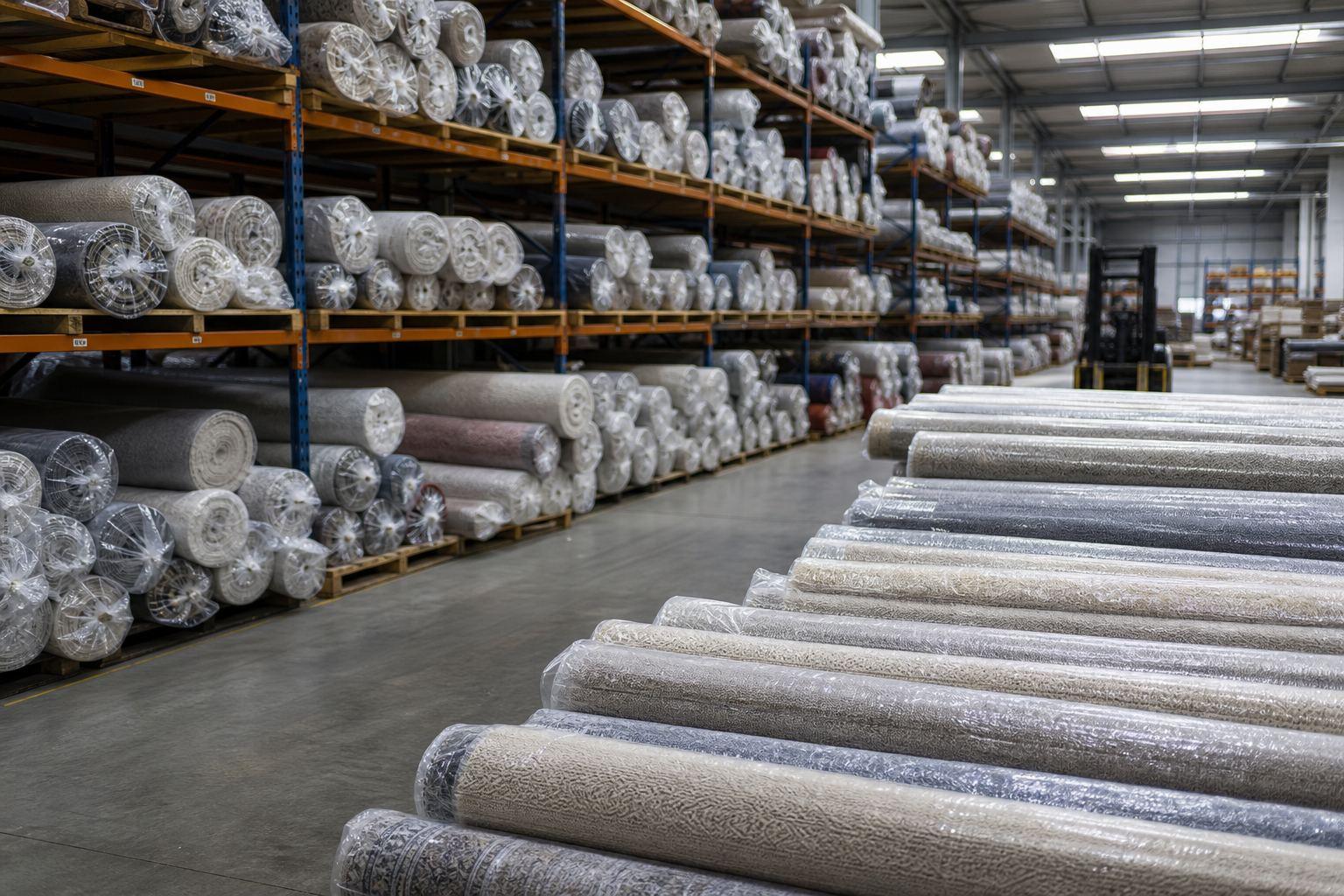
Container utilisation for carpets and rugs depends on roll diameters, size mix, and whether goods are floor-loaded or palletised. A 20ft container may hold a planning range of roughly 1,500–3,500 square meters of rolled rugs depending on pile height and roll tightness; a 40ft high-cube can carry substantially more. Exact figures must be calculated from your size assortment — oversized 9×12 and larger pieces consume cubic capacity quickly.
Agree a stuffing plan in writing: roll orientation, maximum stack height, use of dunnage, moisture absorber placement where relevant, and photo or video evidence of loading. Floor-loading maximises cube for wholesale programmes; palletising speeds destination unloading for retail DCs. Mixed constructions in one container need clear segregation and packing-list mapping so receiving teams do not confuse hand-knotted pieces with machine-made volume SKUs.
Comparison table
Swipe →
Data table — swipe horizontally on small screens
| Container | Planning Use Case | Loading Tip |
|---|---|---|
| 20ft FCL | Trial programmes; mixed LCL upgrade | Prioritise core sizes; avoid overpacking fringe ends |
| 40ft FCL / HC | Retail-chain and wholesale programmes | Balance heavy wool rolls with lighter flatweaves |
| LCL | First samples and small trials | Expect higher per-unit freight; protect against cross-cargo |
| Palletised FCL | DC-ready retail receiving | Confirm forklift access and pallet height limits |
Shipping Methods
Export Tip
Ocean freight is the default for commercial carpet and rug shipments from India. Air freight is reserved for approved samples, lab dips, urgent retail replenishment of hero SKUs, and showroom pieces — not for routine bulk. Primary gateways are Mundra and Nhava Sheva for most North and West India origin cargo; confirm named FOB port on the commercial documents.
FOB India port is the most common Incoterm for experienced importers who control freight and insurance. CIF destination port suits first-time buyers who want a single landed-price quotation including ocean freight and insurance. Confirm in writing who insures cargo, to what value (including duty if required), and when risk transfers. Share draft commercial invoice, packing list, and certificate of origin with your import broker before sailing.
Comparison table
Swipe →
Data table — swipe horizontally on small screens
| Method / Term | Best For | Notes |
|---|---|---|
| Sea FCL FOB | Repeat importers with freight contracts | Buyer controls carrier and insurance |
| Sea FCL CIF | First programmes needing landed simplicity | Confirm insurance coverage in writing |
| Sea LCL | Trials under full-container volume | Higher unit freight; longer handling chain |
| Air freight | Samples, lab dips, urgent SKUs | Costly; use for approvals not bulk |
Certifications
Compliance Notes
Certification requirements for carpets and rugs are market- and claim-driven. IEC is the legal baseline for any Indian exporter. Carpet Export Promotion Council (CEPC) membership is a strong credibility signal for organized handmade exporters. OEKO-TEX Standard 100 is widely requested for finished textiles free from harmful substance concentrations above defined limits. GoodWeave (or equivalent social-compliance programmes) matters for buyers making child-labour-free claims in US and EU retail. REACH-aware dye and finish declarations matter for EU and UK entry. Woolmark applies where wool-content marketing claims require it. Recycled-content claims need verifiable chain documentation, not marketing copy alone.
Never accept certification claims on letterhead alone. Request certificate numbers and verify them with the issuing body. Align the certifications you request to the claims you will print on hang-tags and websites — requesting every certificate by default adds cost and lead time without helping a programme that will only claim fiber content and country of origin.
Comparison table
Swipe →
Data table — swipe horizontally on small screens
| Credential | What It Signals | Buyer Verification Step |
|---|---|---|
| IEC (DGFT) | Legal export authority | Match entity name to invoice |
| CEPC membership | Organized carpet trade channel | Confirm active membership |
| OEKO-TEX Standard 100 | Harmful-substance limits on finished goods | Check certificate number online |
| GoodWeave / social compliance | Child-labour-free supply-chain claim | Verify licence scope covers product |
| REACH / azo-free dye statement | EU/UK chemical gate readiness | Tie statement to dye lots shipped |
| Woolmark (if claimed) | Verified wool content marketing | Confirm licence and product scope |
Buyer Requirements
Buyer Requirements
- Finished sizes and acceptable dimensional tolerance (e.g., ±2% or absolute cm band)
- Construction type and density metric (KPSI for knotted; gauge/pile for tufted; PPI for flatweave)
- Pile height in millimeters and face yarn specification
- Fiber content percentages (wool, silk, cotton, jute, PP, PET, blends)
- Dye type and color references (Pantone / approved lab dips)
- Backing type (latex, cotton, jute, synthetic) and edge finish (fringe, serging, binding)
- Shedding and color-fastness expectations for the channel
- Certifications and social-compliance documents required for retail claims
- Packaging, labeling, barcode, and hang-tag requirements
- Target FOB or landed price, MOQ, delivery window, Incoterms, and payment structure
- Pre-shipment inspection rights and AQL / reject pathway
Before outreach, international buyers should assemble a requirement sheet that a loom or mill can quote against without guessing. Incomplete RFQs produce incomparable prices and unenforceable disputes.
RFQ writing for carpets — the non-negotiables
A carpet RFQ that omits knot density, pile height, fiber, dye, or backing is not an RFQ — it is an invitation for suppliers to fill gaps with assumptions you will reject later. Write size, density, pile height, fiber, dye, and backing as measurable fields. Attach reference photos or prior approved samples where available. State whether quotes are per piece or per square meter, and which sizes are included in the assortment.
Country-wise Opportunities
Market Snapshot
Destination markets pull different constructions from India. Use this map for assortment prioritisation within a buyer playbook — not as a substitute for a full market-ranking study.
Comparison table
Swipe →
Data table — swipe horizontally on small screens
| Market | Strong Pull | Buyer Spec Emphasis |
|---|---|---|
| United States | Hand-tufted, flatweave, machine-made volume | Fiber labels, social compliance, size runs |
| Germany / EU | Wool handmade, OEKO-TEX programmes | REACH dyes, substance limits, accurate HS |
| United Kingdom | Design-led tufted and flatweave retail | Labeling, color consistency, retail packs |
| UAE / GCC | Hospitality wool and statement handmade | Durability, design density, project sizes |
| Australia | Wool and eco / recycled rugs | Fiber claims, outdoor vs indoor specs |
| Japan / Canada | Quality handmade and curated design | Finish precision, smaller premium assortments |
Sourcing Checklist
Checklist
- Written RFQ covering size tolerance, knot/tuft/weave density, pile height, fiber %, dye type, backing, fringe/edge, certifications, packaging, MOQ, Incoterms, and delivery window
- Cluster match confirmed (Bhadohi / Kashmir / Jaipur / Panipat) for the declared construction
- IEC verified on DGFT portal; entity name matches quotation and invoice letterhead
- CEPC membership or equivalent organized-trade credentials reviewed where relevant
- OEKO-TEX, GoodWeave, or other claimed certificates verified by certificate number
- Factory or loom video audit covering dyeing, knotting/tufting/weaving, finishing, and packing
- Paid samples and lab dips approved in writing with retained physical references
- Itemised FOB quote compared on landed-cost basis across shortlisted suppliers
- Trial MOQ and staged payment terms locked in the purchase order
- Pre-shipment inspection scope defined: color, size, fringe, shedding, backing adhesion
- Packaging and container stuffing plan agreed with photo evidence requirement
- Draft export document pack shared with destination broker before vessel cutoff
This is the main operational checklist for buyers sourcing carpets and rugs directly from India. Complete each item before deposit on a first PO.
Supplier verification in Bhadohi, Kashmir, Jaipur, and Panipat
Bhadohi–Mirzapur: verify loom capacity for your KPSI band, washing and finishing capability, and prior export document samples. Ask how dye lots are controlled across large hand-knotted runs.
Kashmir: verify fine-knot capability, silk chain-of-custody claims, longer lead-time honesty, and packing standards for high-value pieces. Premium pricing without premium process control is a red flag.
Jaipur / Rajasthan: verify design sampling speed, tufting gun capacity, latex backing quality, and durrie/kilim weave consistency for fashion SKUs.
Panipat: verify powerloom gauge control, recycled-yarn documentation if eco claims are made, and ability to hit retail-chain replenishment calendars.
Sampling and lab dips
Pay for courier samples and lab dips. Approve color on the actual fiber and construction you will buy — a yarn dip alone is insufficient for tufted or knotted programmes. Seal approved samples, photograph them under agreed lighting, and reference the sample ID on the PO and commercial invoice. Any bulk dye lot outside the approved tolerance is a reject trigger, not a post-sailing negotiation.
QC checkpoints — color, size, fringe, shedding
Color: compare bulk lots to sealed lab dips under standardised light; check cross-panel matching on large carpets.
Size tolerance: measure length and width against RFQ bands; reject systematic undersize that breaks retail fit.
Fringe and edge: pull-test fringe anchorage; inspect serging or binding for skipped stitches and uneven density.
Shedding: vacuum or hand-rub tests on wool pile lots; excessive first-shed beyond agreed norms is a finish issue, not a buyer education problem.
Backing: check latex cure and secondary backing adhesion on tufted goods; look for delamination risk before stuffing.
Payment terms and first-PO risk reduction
Typical first-PO structure: 30–50% advance against pro forma after sample approval; balance against bill of lading and agreed certificates. Prefer letter of credit for higher-value first handmade programmes. Never remittance of 100% advance to an unverified loom. Tie payment milestones to sample sign-off, production start, PSI clearance, and document release. Keep trial volume intentional — enough to test sell-through and claims, not enough to strand capital in a failed construction.
Common Buyer Mistakes
Common Mistakes Box
Most first-order carpet and rug failures trace to a short list of avoidable buyer mistakes. Treat this as a main risk section — not a footnote.
Comparison table
Swipe →
Data table — swipe horizontally on small screens
| Mistake | Consequence | How to Avoid |
|---|---|---|
| RFQ without KPSI / pile height / fiber / dye / backing | Incomparable quotes; unenforceable disputes | Use a measurable RFQ template before outreach |
| Choosing cluster by price, not construction | Wrong loom capability; chronic delays | Match construction to Bhadohi/Kashmir/Jaipur/Panipat |
| Approving color from photos only | Bulk dye-lot mismatch at retail | Require physical lab dips and sealed samples |
| Skipping fringe and shedding checks at PSI | Returns and chargebacks after arrival | Add fringe pull-test and shed check to PSI scope |
| Paying 100% advance on first PO | Weak leverage if quality fails | Staged payment after sample and PSI gates |
| Full container before trial assortment | Amplifies one construction error | Trial LCL or partial FCL first |
| Comparing FOB without landed cost | False savings vs freight and duty | Build landed-cost matrix per supplier |
| Accepting certification claims unchecked | Retail claim risk and customs questions | Verify OEKO-TEX / GoodWeave numbers |
| Ignoring backing adhesion on tufted rugs | Delamination in humid transit | Specify latex cure checks in QC |
| Letting cutoff pressure skip PSI | Problems discovered only at destination | Book inspection into the production calendar |

Future Market Trends
Key Statistics
Through the late 2020s, buyers sourcing carpets and rugs from India should expect continued pressure for traceable fiber claims, azo-free and REACH-aware dye documentation, and social-compliance credentials on handmade programmes. Recycled PET and cotton-scrap rugs from Panipat will keep growing in value retail, while design-led hand-tufted and flatweave programmes from Jaipur and Bhadohi will keep feeding specialty and DTC channels that refresh colorways seasonally.
Digital loom audits, shared lab-dip libraries, and tighter PSI photography standards will become normal buyer expectations rather than premium add-ons. Procurement teams that institutionalise RFQ templates, sealed-sample control, and cluster-matched supplier scorecards now will scale faster than teams that renegotiate every construction from zero.
Buyer Checklist
Checklist
- Complete measurable carpet RFQ before requesting quotes
- Shortlist suppliers by cluster-construction fit, not inbox price alone
- Verify IEC, CEPC (where relevant), and claimed product certificates independently
- Approve paid samples and lab dips in writing; retain sealed references
- Compare landed cost, not FOB-only headlines
- Lock staged payment, PSI rights, and reject/rework pathway in the PO
- Start with trial MOQ; scale after clean color, size, fringe, and shedding results
- Pre-alert destination broker with draft documents before sailing
Exporter Checklist
Checklist
- Maintain active IEC and be ready to share CEPC or organized-trade credentials
- Map constructions honestly to actual loom or mill capability
- Provide itemised FOB quotes tied to KPSI/pile/fiber/dye/backing language
- Support lab dips, sealed samples, and lot-linked dye records
- Run in-process checks for color, size, fringe, and shedding before offering cargo dates
- Share packing and stuffing photos; accommodate buyer PSI
- Issue consistent commercial invoice, packing list, and certificate of origin language
- Disclose lead times honestly for handmade vs machine-made programmes
Compliance Checklist
Checklist
Compliance Notes
- IEC active; exporter name consistent across all documents
- Correct HS heading under Chapter 57 for the construction shipped
- Fiber content labeling aligned to destination rules (e.g., US FTC)
- OEKO-TEX / GoodWeave / Woolmark certificates valid if claims are made
- Azo-free or REACH-aware dye declarations for EU/UK programmes
- ISPM-15 compliance for wood packaging materials
- Certificate of origin prepared for any preferential duty claims
- Packing list quantities and sizes match commercial invoice and cartons/rolls
Conclusion
- Next step for buyers: Send your carpet/rug RFQ — sizes, density, pile height, fiber, dye, backing, certifications, MOQ, and destination — for a verified supplier shortlist.
- Explore merchant exporter support when you want one IEC-accountable export desk for multi-cluster programmes.
- Use product sourcing company in India and global sourcing partner models to match your team's bandwidth.
- Review import products from India if you need end-to-end coordination from specification to first arrival.
- Ask Altus Exports for cluster-matched sampling plans before you fund a full container.
- Build internal scorecards: color match rate, size defect rate, fringe claims, and on-time sailing — improve suppliers with data, not anecdotes.
- Keep first POs intentional: prove construction and color, then scale assortment.
- Treat every approved lab dip as a contract artifact — retain it for the life of the programme.
- Contact Altus Exports to start a documented carpets and rugs sourcing pathway from India.
Sourcing carpets and rugs directly from India rewards buyers who write measurable RFQs, verify looms and mills in the right clusters, lock lab dips and sealed samples, inspect color, size, fringe, and shedding before cutoff, and structure first-PO payments to share risk. The origin advantage — handmade depth plus machine-made volume — is real only when specification discipline converts quotes into repeatable shipments.
If you are ready to build a lower-risk carpet and rug sourcing programme from India, share your constructions, size assortment, certification needs, target MOQ, and destination market with Altus Exports. As a merchant exporter, global sourcing partner, and export consulting desk, Altus coordinates supplier verification across Bhadohi, Kashmir, Jaipur, and Panipat, manages sampling and QC checkpoints, and executes documentation through shipment under one accountable relationship.