
Top Carpet and Rug Products Exported from India (2026 Product Mix Guide)
By Saurabh Mittal, Founder, Altus Exports
A product-mix deep dive into the top carpet and rug products exported from India in 2026 — hand-knotted Persian and Indo-Persian, Zeigler, hand-tufted wool, handloom pile, kilim and flatweave, silk, wool-silk, durrie, shaggy, and outdoor polypropylene. Covers materials, pile height, knot density ranges, HS 5701–5705 mapping, buyer channels, Bhadohi-Mirzapur, Kashmir, Jaipur, Agra, Panipat, and Amritsar clusters, FY25 export scale of about USD 1.54 billion with the USA near 59% of offtake, CEPC context, packaging, container loading, and how international buyers match construction to market demand with Altus Exports.
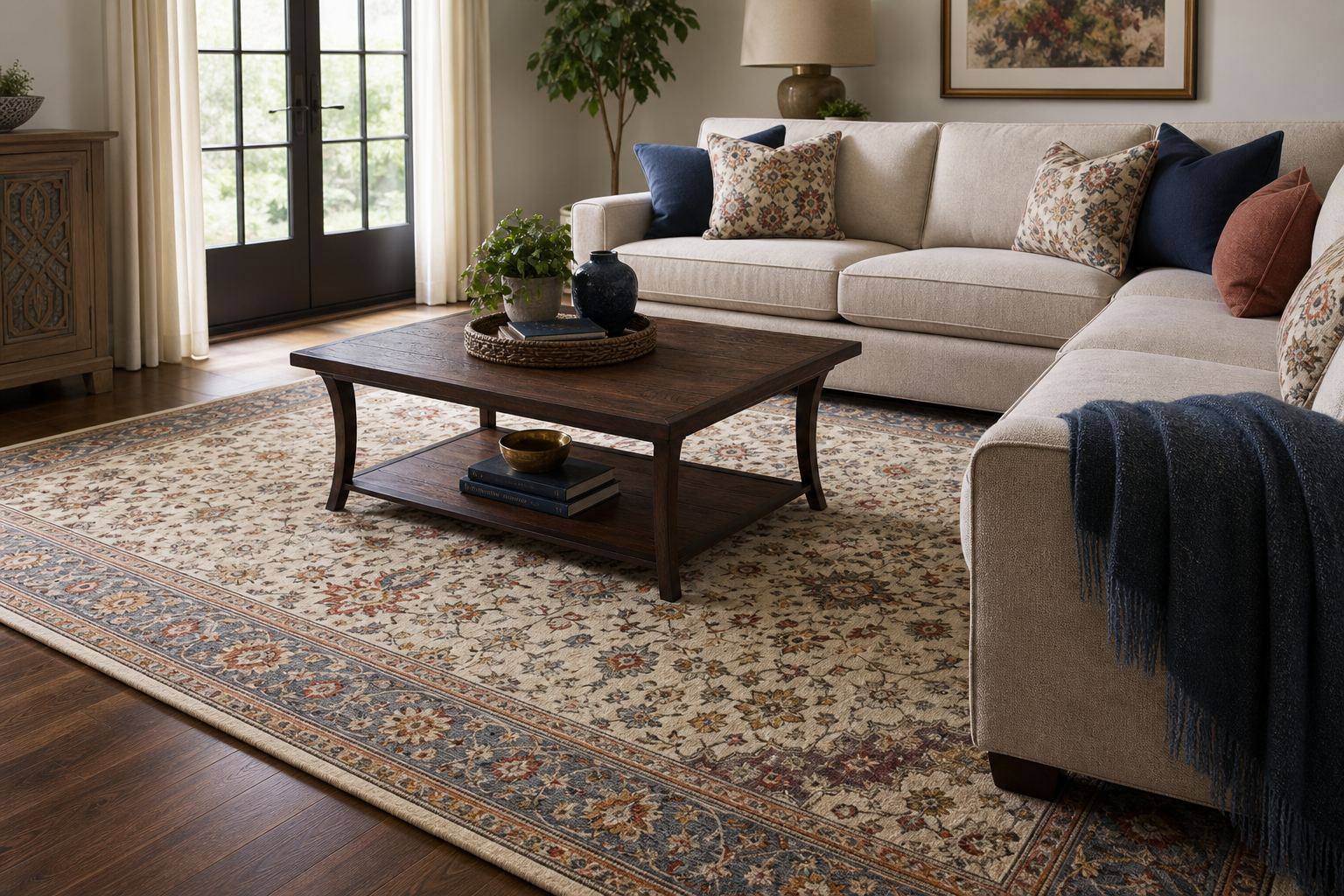
Indian carpet and rug exports are not one commodity line with a single price list. They are a product mix — hand-knotted Persian and Indo-Persian wool, Zeigler constructions, hand-tufted programs, handloom pile, kilim flatweaves, silk and wool-silk showpieces, durries, shaggy comfort rugs, and outdoor polypropylene where weatherability matters. Each line carries different materials, pile and knot-density expectations, HS classification under Chapter 57, lead times, MOQs, and buyer channels. Buyers who source "Indian carpets" as a vague category usually compare unlike SKUs and miss both quality and landed-cost reality.
In FY 2024–25, India's carpet and rug export value reached about USD 1.54 billion, with the United States absorbing roughly 59% of that offtake. India also accounts for roughly 40% of world handmade carpet exports — a structural share that reflects artisan density in Bhadohi-Mirzapur, Kashmir, Jaipur, Agra, Panipat, and Amritsar rather than a single factory model. That scale rewards catalogs that separate constructions clearly and price each on its own cost stack.
This guide is a product-mix deep dive, not a process manual or country ranking. For step-by-step shipping and registration, see How to Export Carpets and Rugs from India and CEPC Registration Benefits for Carpet Exporters. For destination fit, pair with Best Countries for Indian Carpet and Rug Exports. International buyers building an assortment can also use Source Carpets and Rugs Directly from India as the procurement companion to the product profiles below.
Key Takeaways
Summary Box
- India's carpet export story is a product mix: hand-knotted, Zeigler, hand-tufted, handloom, kilim, silk, wool-silk, durrie, shaggy, and outdoor PP each need their own spec, HS line, MOQ, and channel.
- FY25 carpet and rug exports were about USD 1.54 billion; the USA alone takes roughly 59% of Indian offtake, while India holds about 40% of world handmade carpet exports.
- HS 5701–5705 classification follows construction (knotted, woven, tufted, felt, other) — not marketing names — and should sit on every SKU card before quoting.
- Bhadohi-Mirzapur anchors volume handmade wool; Kashmir leads silk and fine-knot prestige; Jaipur and Agra mix design and finishing strength; Panipat and Amritsar scale tufted, handloom, durrie, and outdoor programs.
- CEPC membership and RCMC support credibility and market-access programs for organized carpet exporters without substituting for locked samples and written pile/knot specs.
- Premium retail and designer channels pay for knot density, silk content, and color fastness; volume retail and e-commerce reward hand-tufted, durrie, shaggy, and outdoor PP consistency at sharper FOB.
- A merchant exporter in India or global sourcing partner can map construction to cluster and certification path under one accountable export relationship.
Executive Summary
Summary Box
Use this summary to brief merchandising, compliance, and logistics before the construction profiles and tables below. The commercial question is not whether India can supply carpets — it can — but which product line fits which channel at what pile height, knot density, fiber mix, and FOB band.
Hand-knotted Persian and Indo-Persian wool remain the heritage premium of the mix, with Zeigler as a softer-palette, often mid-to-high decorative line that US and European interior channels recognize by name. Hand-tufted wool and handloom pile deliver volume and design flexibility for retailers who need faster turns than knotting allows. Kilim and durrie flatweaves serve reversible, lighter-weight programs. Silk and wool-silk occupy the top of the price ladder. Shaggy and outdoor polypropylene extend the mix into comfort and weatherable categories that many handmade-only suppliers still under-serve.
Plan every offer against HS 5701 (knotted), 5702 (woven, not tufted or flocked), 5703 (tufted), 5704 (felt), and 5705 (other). Incorrect construction mapping is one of the fastest ways to trigger a customs query even when the physical rug matches the sample. CEPC-aligned exporters who publish construction, fiber, size, pile, density, and packing on one SKU sheet clear vendor onboarding faster than suppliers who lead with adjectives alone.
Pair this product guide with Most Demanded Indian Carpets and Rugs by Country, Sustainable and Handwoven Carpet Export Opportunities, and the Carpet and Rug Export Documentation Checklist when you move from assortment design to first shipment.
Market Size & Industry Overview
Key Statistics
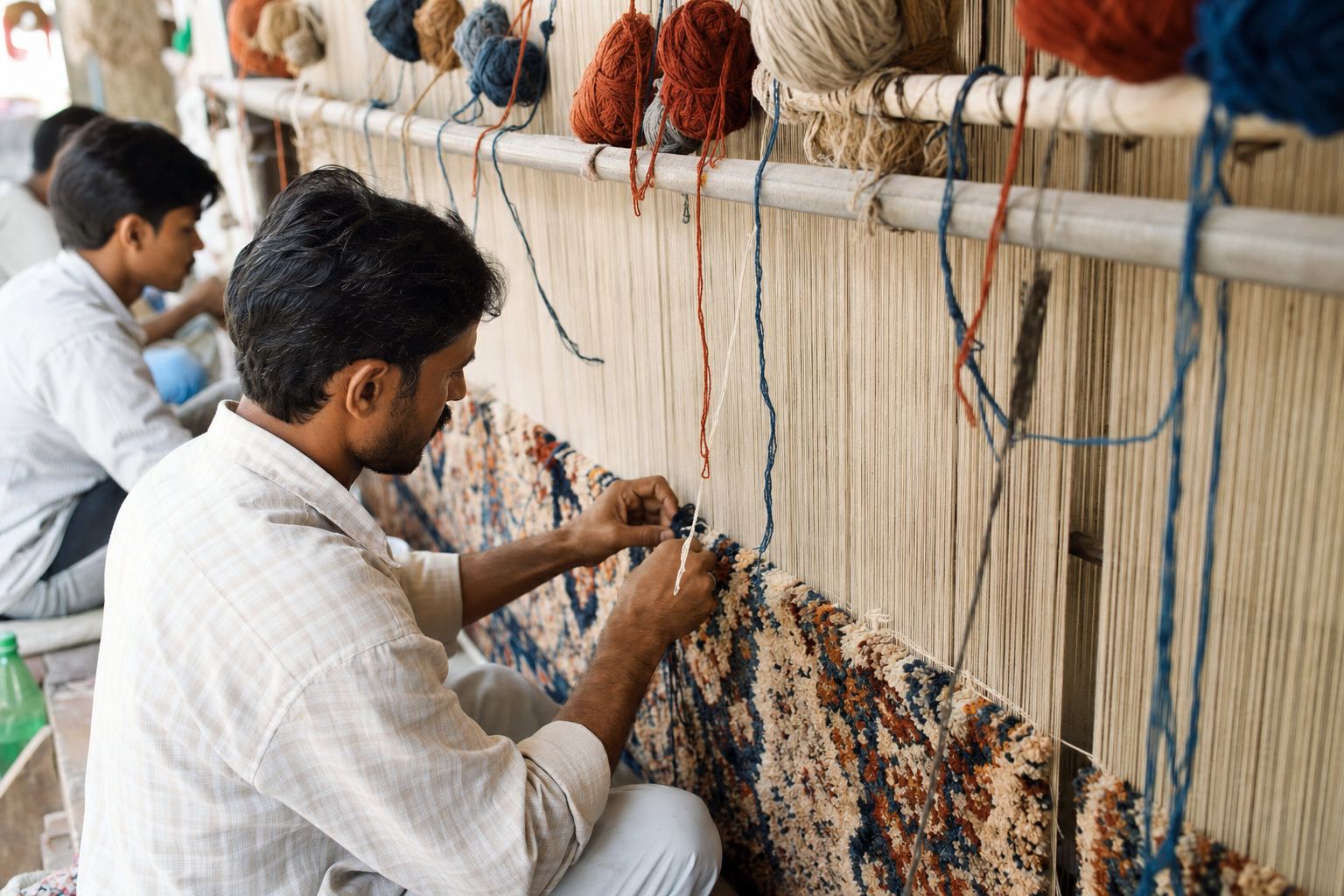
India's carpet and rug industry sits at the intersection of textiles and home furnishings and handicrafts and lifestyle products. Organized export houses, loom-shed MSMEs, and artisan networks coexist in the same clusters, which is why product mix — not average FOB — explains who wins programs.
Handmade share remains India's global differentiator. Roughly 40% of world handmade carpet exports originate in India, concentrated in constructions that still depend on skilled knotting, weaving, and finishing labor. Machine-tufted and synthetic outdoor lines coexist with that handmade core, especially in Panipat and Amritsar, giving buyers a ladder from artisan prestige to volume retail without leaving the country.
Institutional structure for the sector runs through the Carpet Export Promotion Council (CEPC), which supports registration, trade promotion, and buyer-facing credibility for exporters shipping under Chapter 57. CEPC does not replace product discipline: knot density claims, dye-lot control, and packing standards still decide whether a first container becomes a repeat program.
Market context for Indian carpet and rug product mix (FY 2024–25 directional).
Swipe →
Data table — swipe horizontally on small screens
| Metric | Indicative figure | Product-mix reading |
|---|---|---|
| India carpet & rug export value (FY25) | About USD 1.54 billion | Large enough to support premium and volume SKUs in parallel |
| USA share of Indian carpet exports | Roughly 59% | US retail, wholesale, and designer channels dominate offtake planning |
| India share of world handmade carpet exports | About 40% | Handmade constructions remain the strategic core of origin reputation |
| Primary HS chapter | HS 5701–5705 | Construction drives classification and duty modeling |
| Core export body for carpets | CEPC | RCMC and promotion support organized exporters |
| Primary clusters | Bhadohi-Mirzapur, Kashmir, Jaipur, Agra, Panipat, Amritsar | Match construction to cluster before RFQ |
Export Statistics
Key Statistics
Treat FY25's roughly USD 1.54 billion export value as a planning anchor, then split demand by construction. Hand-knotted value density is high per square meter; hand-tufted, handloom, durrie, and outdoor PP often move more square meters at lower unit FOB. A catalog that only quotes "wool rugs" without construction hides that split and makes destination forecasting unreliable.
The United States near-59% share means most serious product strategies either win US wholesale, specialty retail, e-commerce private label, or designer showrooms — or deliberately build a non-US hedge through Germany, UK, Netherlands, Australia, UAE, and Canada. Those secondary markets often pay more for silk, fine-knot, and certified sustainable narratives even when absolute volume is smaller.
Export offtake signals by construction family (directional commercial reading).
Swipe →
Data table — swipe horizontally on small screens
| Destination signal | Strong product lines | Planning note |
|---|---|---|
| USA (~59% of Indian carpet exports) | Hand-tufted, Zeigler, Indo-Persian, durrie, shaggy, outdoor PP | Volume plus mid-premium; lead with clear construction cards |
| Germany / wider EU | Fine hand-knotted, kilim, wool-silk, sustainable dye narratives | Expect denser QC and chemical compliance questions |
| UK | Indo-Persian, hand-tufted fashion colors, flatweaves | Strong private-label and interior wholesale lanes |
| Australia | Hand-tufted, outdoor PP, washable flatweaves | Weather and lifestyle positioning matter |
| UAE / GCC | Silk accents, oversized decorative rugs, hospitality corridor rugs | Size and statement design often trump knot-count marketing |
| Netherlands (re-export hub) | Mixed constructions for pan-EU distribution | Pack and label for onward EU retail, not only Dutch shelves |
Import Statistics
Key Statistics
Import-side statistics matter because buyers organize purchasing by tariff line and construction, not by Indian cluster folklore. When a US or EU importer pulls Chapter 57 data, knotted (5701), woven (5702), and tufted (5703) appear as separate lanes with different duty paths and competitor sets. Your offer should map to the lane the buyer already buys.
Handmade origin share (~40% of world handmade carpet exports) explains why Indian suppliers remain shortlisted even when machine-made competition from other origins is intense on price. Importers still need Indian depth for knotting, silk work, and certain flatweave aesthetics that industrial lines do not fully replace.
HS 5701–5705 lines buyers and brokers separate before assortment decisions.
Swipe →
Data table — swipe horizontally on small screens
| HS heading | What it covers | Typical Indian product fit |
|---|---|---|
| 5701 | Carpets and other textile floor coverings, knotted | Hand-knotted Persian, Indo-Persian, Zeigler, silk, wool-silk |
| 5702 | Woven, not tufted or flocked (includes many flatweaves and handloom woven constructions) | Kilim, many durries, certain handloom woven floor coverings |
| 5703 | Tufted carpets and other textile floor coverings | Hand-tufted wool and mixed-fiber programs; many shaggy tufted lines |
| 5704 | Felt floor coverings, not tufted or flocked | Niche felt rugs — confirm construction before quoting |
| 5705 | Other carpets and textile floor coverings | Some outdoor PP and miscellaneous constructions per broker advice |
Product Categories / Variants
Summary Box
The ten product lines below are the commercial core of India's carpet export mix. Each profile covers materials, typical pile, knot density or construction density cues, HS mapping, buyer channels, and cluster origin. Rank is by strategic importance to a balanced export catalog — not a claim that every factory should make all ten.
Read each card as a separate SKU family. A 8/8 hand-knotted Indo-Persian wool rug and a 12 mm hand-tufted fashion rug may both be "wool rugs from India," but they have different lead times, MOQs, defect languages, and retail price architectures.
Product-mix map — Indian carpet and rug export lines.
Swipe →
Data table — swipe horizontally on small screens
| Product line | Primary HS logic | Core clusters | Primary buyer channels |
|---|---|---|---|
| Hand-knotted Persian / Indo-Persian | 5701 | Bhadohi-Mirzapur, Agra, Jaipur | Specialty retail, designers, premium wholesale |
| Hand-knotted Zeigler | 5701 | Bhadohi-Mirzapur, Jaipur | US/EU interior and decorative wholesale |
| Hand-tufted wool | 5703 | Bhadohi-Mirzapur, Panipat, Jaipur | Big retail, e-commerce private label |
| Handloom pile / woven | 5702 (confirm) | Panipat, Amritsar, Bhadohi | Volume retail, hospitality corridors |
| Kilim / flatweave | 5702 | Jaipur, Panipat, Bhadohi | Design retail, reversible rug programs |
| Silk hand-knotted | 5701 | Kashmir, fine Bhadohi programs | Luxury retail, collectors, gift prestige |
| Wool-silk blend | 5701 | Kashmir, Bhadohi-Mirzapur, Jaipur | Premium decorative and designer |
| Durrie / dhurrie | 5702 | Panipat, Amritsar, Jaipur | Value retail, layering rugs, indoor-outdoor casual |
| Shaggy rugs | 5703 / 5705 (confirm) | Panipat, Amritsar | Comfort retail, e-commerce |
| Outdoor polypropylene | 5703 / 5705 (confirm) | Panipat, Amritsar | Patio, hospitality outdoor, mass retail |
#1: Hand-Knotted Persian and Indo-Persian Wool
- Materials
- Wool pile on cotton foundation (common export build)
- Pile (typical)
- About 8–14 mm after finish shear
- Knot density (commercial)
- Roughly 60–200+ KPSI by tier
- HS
- 5701
- Clusters
- Bhadohi-Mirzapur, Agra, Jaipur
Hand-knotted Persian and Indo-Persian wool carpets remain the prestige backbone of India's handmade export reputation. Warp and weft are typically cotton; pile is wool (often New Zealand or blended Indian wool depending on program). Designs range from classical Persian medallions and all-over florals to Indo-Persian adaptations tuned for Western living rooms. Finishing — washing, shearing, stretching — decides whether the rug photographs as luxury or as unfinished stock.
Typical pile height for export living-room sizes often sits around 8–14 mm after final shear, though antique-wash and distressed programs intentionally run lower and softer. Knot density for commercial export programs commonly spans roughly 60–200+ knots per square inch depending on design complexity and price tier; fine showroom pieces can run higher. HS mapping is almost always 5701.
Buyer channels: specialty rug retailers, interior designers, high-end department-store home floors, and selective online premium brands. Cluster origin: Bhadohi-Mirzapur for volume handmade capacity; Agra and Jaipur for design-led and finishing-strong programs. Indicative FOB varies widely by size, density, and wash — treat quotes as size-and-spec specific, not as a single per-sq-ft myth number.
#2: Hand-Knotted Zeigler
- Materials
- Wool pile; cotton foundation; decorative wash finishes common
- Construction
- Hand-knotted (named aesthetic within 5701)
- HS
- 5701
- Channels
- US/EU interior wholesale and design retail
- Clusters
- Bhadohi-Mirzapur, Jaipur
Zeigler (also styled Ziegler) constructions are hand-knotted rugs with softer, often washed or muted palettes and more open decorative layouts that US and European interior markets recognize as a named aesthetic rather than a generic oriental. Structurally they remain knotted carpets — usually wool pile on cotton foundation — but merchandising, color story, and finishing differentiate them from classical deep-red Persian looks.
Pile and density sit in a mid-to-premium handmade band: many commercial Zeigler programs target approachable luxury rather than museum-grade knot counts, while still delivering hand-knotted authenticity that tufted lines cannot claim. HS classification remains under 5701.
Buyer channels: US decorative wholesale, European interior importers, and design-led e-commerce that sells "Zeigler-style" as a searchable attribute. Clusters: Bhadohi-Mirzapur and Jaipur dominate exportable color and wash capability for this look.
#3: Hand-Tufted Wool Rugs
- Materials
- Wool (or wool-blend) pile; primary + secondary backing; latex
- Pile (typical)
- About 10–20 mm by program
- HS
- 5703
- MOQ character
- Lower lead time than knotted; design MOQs often per colorway
- Clusters
- Bhadohi-Mirzapur, Panipat, Jaipur
Hand-tufted wool is the volume workhorse for fashion-forward and private-label programs that need design agility without hand-knotting lead times. Yarn is punched through a primary backing with a tufting gun; latex and secondary backing lock the pile. Quality hinges on latex consistency, edge finishing, shedding control after initial vacuum cycles, and color-fastness on fashion dyes.
Typical pile for living-room tufted rugs often ranges about 10–20 mm depending on cut-pile versus loop and whether a carved pattern is specified. Density is described in tufts or gauge rather than KPSI; buyers should lock gauge, yarn count, and pile height in writing. HS mapping is typically 5703.
Buyer channels: US big-box and mid-market retail, Amazon-style private label, European promotional collections, and hospitality soft-goods distributors who refresh colorways seasonally. Clusters: Bhadohi-Mirzapur, Panipat, and Jaipur each run substantial tufted capacity with different design and price orientations.
#4: Handloom Pile and Woven Carpet Programs
- Materials
- Wool, blends, or cotton-rich yarns by tier
- HS
- Often 5702 — confirm woven vs tufted reality
- Strength
- Repeatable textures and runners at scale
- Clusters
- Panipat, Amritsar, Bhadohi
Handloom carpet programs bridge artisan narrative and scalable woven output. Depending on exact construction — woven pile versus flat — classification may fall under 5702, and buyers must confirm with a customs specialist rather than assuming tufted codes. These lines often serve corridor runners, solid-color fields, and textured weaves that photograph well for hospitality and volume retail.
Pile height, when present, is usually moderate and engineered for foot traffic rather than ultra-soft shag aesthetics. Yarn may be wool, wool-blend, or cotton-rich depending on price architecture. Panipat and Amritsar are especially strong for organized handloom and power-assisted woven capacity; Bhadohi also supplies woven programs adjacent to its knotted base.
Buyer channels: hospitality FF&E distributors, contract interior suppliers, and retailers who need repeatable solids and textures at MOQs above typical fine-knot art pieces.
#5: Kilim and Flatweave Rugs
- Construction
- Flatweave / kilim — minimal or no cut pile
- HS
- 5702 (typical)
- Buyer appeal
- Lightweight, geometric, layering-friendly
- Clusters
- Jaipur, Panipat, Bhadohi
Kilims and related flatweaves are reversible or near-reversible woven rugs without a deep cut pile. They travel lighter than knotted carpets, suit layering aesthetics, and appeal to buyers who want geometric, tribal, or contemporary flat patterns. Wool, wool-cotton, and jute-blend stories all appear in Indian export assortments; fiber choice should be explicit on the label and invoice.
Because there is little or no pile height to merchandise, value sits in weave tightness, color blocking, finishing of ends and sides, and dimensional stability after humidity cycles. HS mapping is commonly 5702 for woven flat floor coverings.
Buyer channels: design boutiques, Scandinavian-influenced retailers, US coastal and contemporary assortments, and e-commerce brands selling lightweight rugs with lower shipping cube. Clusters: Jaipur for design-led kilims; Panipat and Bhadohi for volume flatweave capacity.
#6: Silk Hand-Knotted Carpets
- Materials
- Silk pile; silk or fine cotton foundation
- HS
- 5701
- Cluster flagship
- Kashmir (plus fine Bhadohi programs)
- Positioning
- Ultra-premium; low piece MOQ, high value
Silk hand-knotted carpets occupy the top of India's prestige ladder. Pure silk pile — or silk pile on silk or fine cotton foundation — delivers sheen, fine detail, and high knot density that luxury retail and collector-adjacent buyers recognize immediately. Kashmir remains the signature origin story; select Bhadohi fine programs also export silk or silk-highlight pieces.
Pile is typically low and dense so pattern clarity stays sharp; knot densities for fine silk pieces can far exceed commercial wool programs. HS classification remains 5701. Moisture, packing crease, and light-fastness discipline matter more than in coarse wool lines because silk shows handling damage quickly.
Buyer channels: luxury specialty retailers, high-net-worth interior projects, Gulf statement pieces, and selective Japanese and European fine-rug importers. MOQs are often lower in piece count but higher in value — and sample approval cycles are longer.
#7: Wool-Silk Blend Hand-Knotted Carpets
- Materials
- Wool + silk pile (disclose % silk)
- HS
- 5701
- Channels
- Premium decorative and designer wholesale
- Clusters
- Kashmir, Bhadohi-Mirzapur, Jaipur
Wool-silk blends combine wool's resilience with silk's highlight sheen — often used in floral sprays, borders, or all-over mixed piles where silk catches light on raised motifs. They let buyers offer "silk look" prestige at a wider retail price than pure silk while retaining hand-knotted authenticity under HS 5701.
Spec sheets must state silk percentage and whether silk is pile-only or also in foundation accents. Vague "silk touch" marketing without fiber disclosure creates returns and customs risk. Clusters: Kashmir for fine blends; Bhadohi-Mirzapur and Jaipur for decorative wool-silk programs aimed at US and EU showrooms.
#8: Durrie (Dhurrie) Flatwoven Rugs
- Materials
- Cotton or cotton-wool flatweave common
- HS
- 5702 (typical)
- Clusters
- Panipat, Amritsar, Jaipur
- Commercial role
- Volume, layering, accessible price architecture
Durries (dhurries) are India's classic flatwoven floor coverings — often cotton or cotton-wool — used as layering rugs, casual living-room pieces, and value assortments. They are lighter to ship than knotted carpets and support bold stripes, geometrics, and solid fields that refresh seasonally.
Quality controls focus on weave evenness, color bleeding on first wash claims, edge binding, and accurate finished size. HS is typically 5702. Panipat and Amritsar are volume leaders; Jaipur adds design-led cotton flatweaves for lifestyle brands.
Buyer channels: value and mid retail, dorm and first-apartment assortments, hospitality casual spaces, and brands that sell rugs as décor accents rather than heirloom textiles.
#9: Shaggy Rugs
- Pile (typical)
- About 20–50 mm+ depending on SKU
- HS
- 5703 / confirm 5705 if atypical
- Clusters
- Panipat, Amritsar
- Risk focus
- Shedding, latex odor, pile crush
Shaggy rugs merchandise long, soft pile for comfort-led retail and e-commerce. Indian export shags are frequently tufted constructions using wool, acrylic, polyester, or blends — fiber disclosure and shedding expectations must be written into the spec. Pile heights of 20–50 mm+ appear in commercial ranges depending on brand positioning.
HS often falls under 5703 for tufted shags; some constructions may need 5705 confirmation with a broker. Panipat and Amritsar dominate scalable shaggy output. Buyer channels: comfort retail, online marketplaces, and youth-oriented home brands. Latex smell, pile collapse in high-traffic zones, and vacuum compatibility should be tested before catalog photography locks a claim.
#10: Outdoor Polypropylene Rugs
- Materials
- UV-stabilized polypropylene; outdoor-capable backing
- HS
- 5703 or 5705 — confirm with broker
- Clusters
- Panipat, Amritsar
- Channels
- Outdoor retail, hospitality exterior, e-commerce
Outdoor polypropylene (PP) rugs extend India's carpet mix into weatherable patio, balcony, and hospitality outdoor programs. UV-stabilized PP yarns, mold-aware backings, and quicker-dry constructions differentiate outdoor SKUs from indoor wool lines. These are not a substitute for handmade prestige — they are a parallel revenue lane that many pure-knotting sheds cannot serve alone.
HS may land in 5703 or 5705 depending on construction details; confirm before duty modeling. Clusters: Panipat and Amritsar. Buyer channels: mass retail outdoor seasons, garden centers, hotel pool decks, and e-commerce outdoor living. Fade ratings, drainage claims, and temperature flexibility should be evidenced, not assumed from indoor rug test methods.
Manufacturing Overview
Export Tip
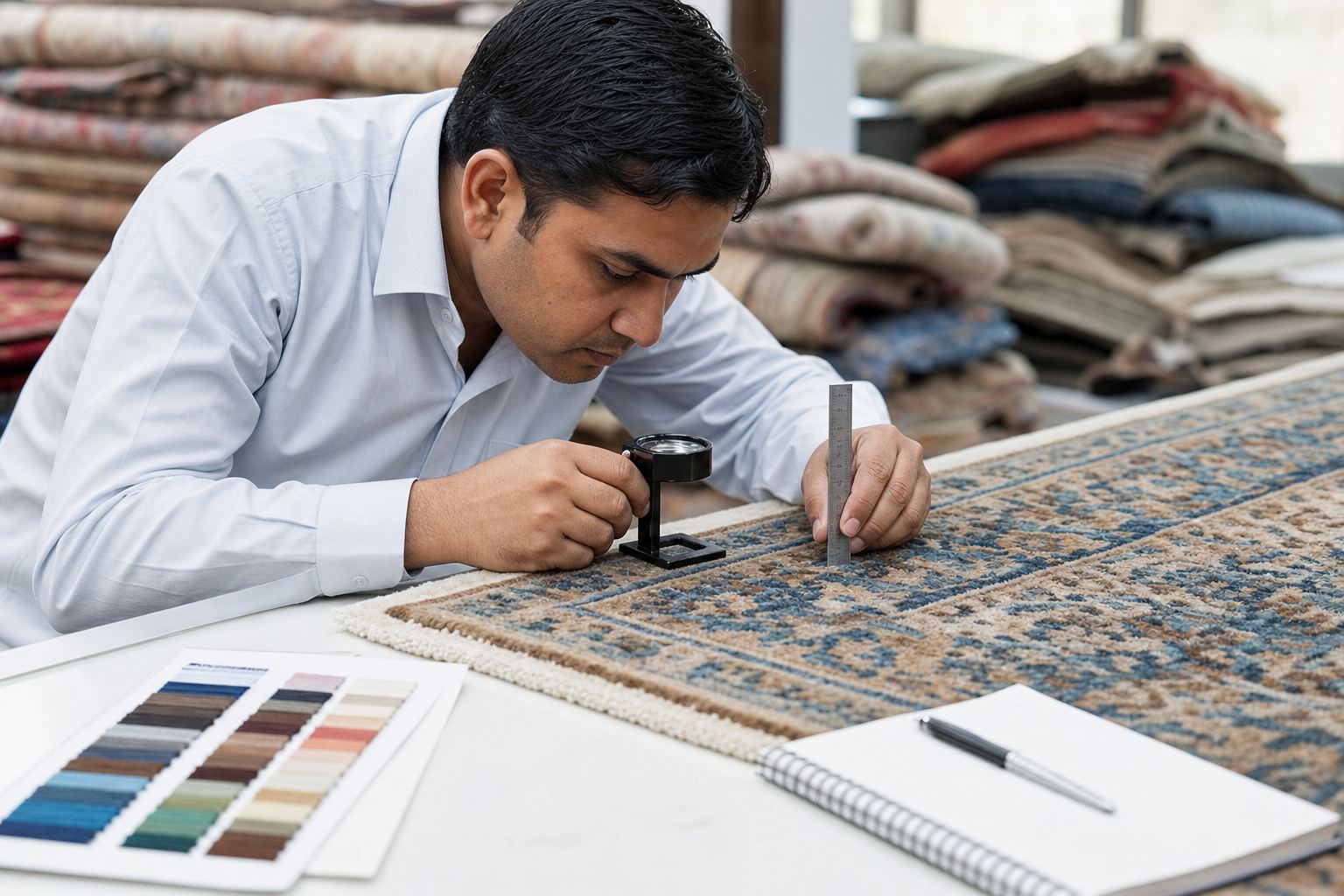
Export quality is created on the loom floor and in the wash-house, not in the brochure. Hand-knotted lines depend on cartoon accuracy, knot consistency, and disciplined shearing. Tufted lines depend on gunning uniformity, latex cure, and secondary backing adhesion. Flatweaves depend on tension control and end finishing. Outdoor PP depends on UV masterbatch and backing chemistry.
Cluster specialisation is manufacturing strategy: Bhadohi-Mirzapur for handmade wool depth; Kashmir for silk finesse; Jaipur for design and decorative finishing; Agra for classical handmade adjacency; Panipat and Amritsar for tufted, handloom, durrie, shaggy, and outdoor scale. Asking one shed to excel at all ten product lines usually produces mediocre samples across the board.
Manufacturing checkpoints by construction family.
Swipe →
Data table — swipe horizontally on small screens
| Stage | Control focus | Evidence to retain |
|---|---|---|
| Design lock | Cartoon / CAD, size, border, colorways | Signed artwork and lab-dip or pom approvals |
| Material intake | Wool/silk/PP lot, yarn count, moisture | Lot tags and fiber declarations |
| Construction | Knot density, gauge, weave tightness | In-process measurement sheet |
| Washing / finishing | Color bleed, hand-feel, shear height | Finish log and retention swatch |
| Backing / binding | Latex cure, serging, fringe integrity | Peel/adhesion checks where relevant |
| Final QC | Size tolerance, stains, odor, symmetry | Inspection report + photos |
Handmade Knotting and Fine Finishing
For 5701 programs, map loom allocation to delivery dates honestly. Fine silk and high-density wool cannot be compressed into tufted lead times without quality collapse. Keep retention samples from the approved wash lot so disputes reference the same hand-feel the buyer signed.
Tufted, Handloom, and Outdoor Lines
For 5703 and related volume lines, stabilize latex and backing suppliers; most field failures are adhesion and odor, not pattern. For outdoor PP, separate indoor wool QC checklists from UV and drainage tests so indoor inspectors do not "pass" a patio rug on the wrong criteria.
Pricing Analysis
Buyer Tip
Price the cost stack — fiber, labor hours per square meter, wash/finish, backing, packing, inspection, inland freight to load port, and exporter coordination — not a single mythical "India carpet FOB." Hand-knotted silk and fine Indo-Persian sit on a different elasticity curve than Panipat outdoor PP.
Indicative commercial bands move with size (5x8, 8x10, runners), density, fiber, and wash. Publish per-size quotes with construction named. Buyers comparing a knotted 8x10 to a tufted 8x10 on one spreadsheet without labeling construction will always misread value.
Pricing drivers for carpet and rug export SKUs.
Swipe →
Data table — swipe horizontally on small screens
| Cost driver | Effect on FOB | How to manage |
|---|---|---|
| Fiber (wool / silk / PP) | Silk and fine wool lift unit value sharply | Disclose fiber % and origin lot assumptions |
| Labor density | Higher KPSI or finer silk = more loom days | Quote lead time with density, not against tufted norms |
| Wash and finish | Antique wash, herbal wash, carving add cost | Approve finish standard on signed sample |
| Backing and latex | Tufted and shaggy cost stack | Lock supplier and cure parameters |
| Packaging & cube | Roll diameter and cartons change freight | Engineer pack before promising CIF |
| Compliance & inspection | Third-party QC and tests raise trial cost | Budget on first order, amortise on repeats |
MOQ Analysis
Buyer Tip
MOQs follow construction economics. Hand-knotted silk may move in small piece counts at high value. Hand-tufted fashion colors often need per-colorway minimums to justify gunning and latex setup. Outdoor PP and durries frequently prefer pallet or container logic once the design is locked.
Publish a ladder: courier sample or photo-approved production sample → mixed trial (LCL or small FCL) → repeat FCL. Buyers who demand full-container first orders on unproven fine-knot designs create cancel risk for both sides.
Directional MOQ ladder by product family.
Swipe →
Data table — swipe horizontally on small screens
| Product family | Typical first commercial step | Scale step |
|---|---|---|
| Hand-knotted wool (Indo-Persian / Zeigler) | Small mixed-size trial (piece-count based) | Repeat sizes once sell-through proven |
| Silk / wool-silk | Very small piece MOQ, high value | Expand SKUs after showroom feedback |
| Hand-tufted wool | Per colorway / design minimum | Full assortment FCL by season |
| Kilim / durrie | Design assortment pilot | Volume colorways on 20'/40' logic |
| Shaggy / outdoor PP | Pallet or LCL pilot | Seasonal FCL for retail calendars |
Packaging Standards
Export Tip
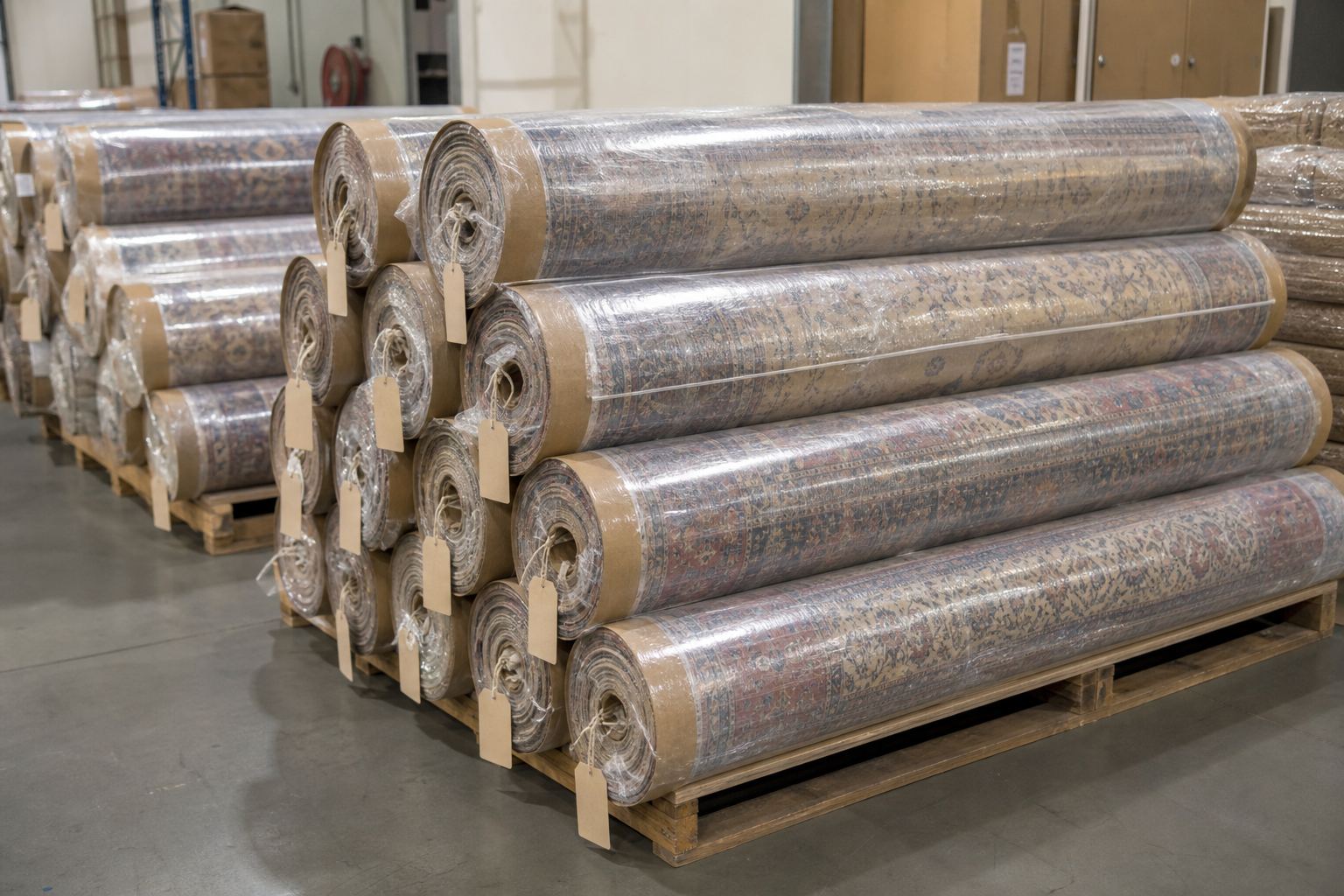
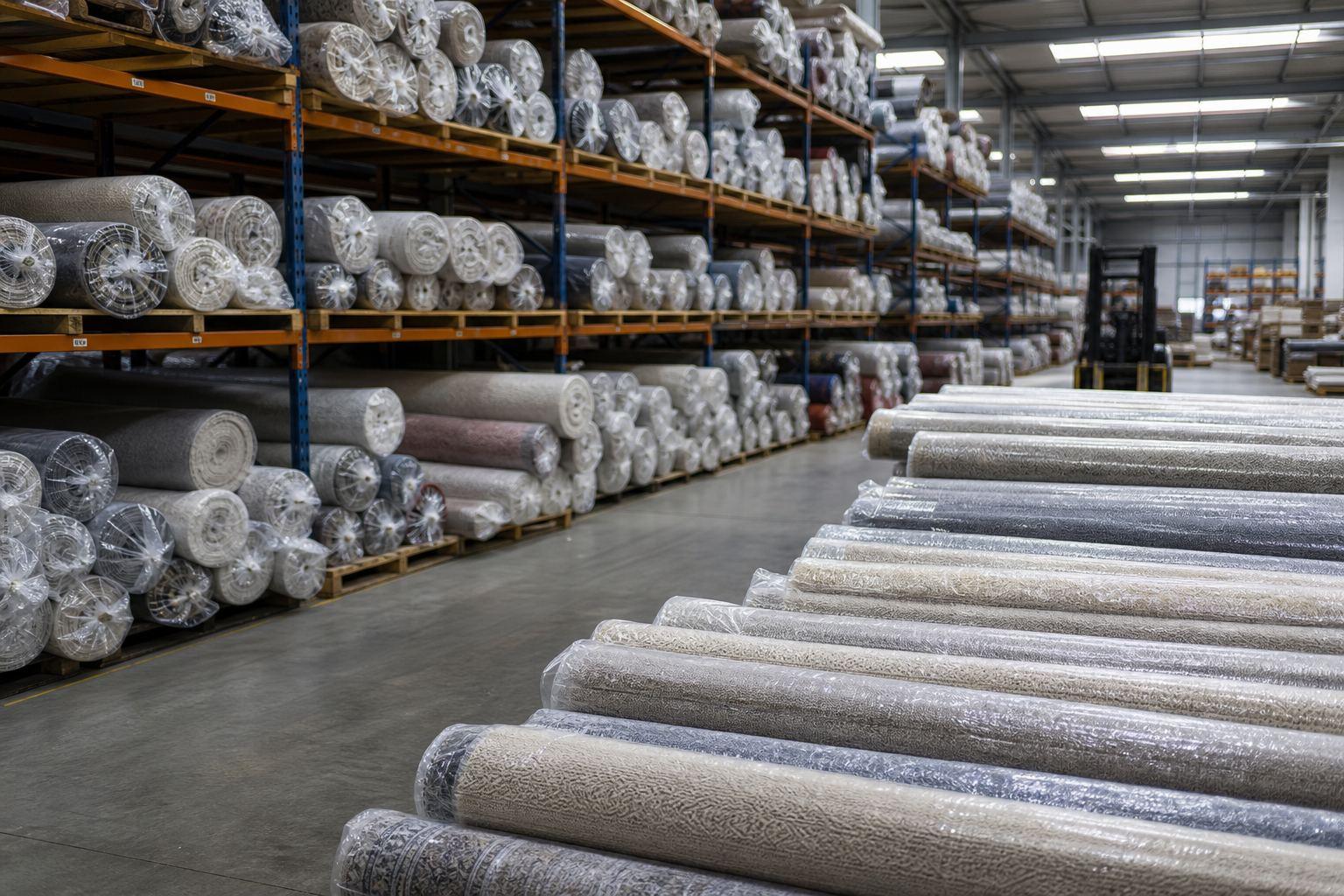
Carpet packaging is a quality system. Rolls need clean poly wrapping, edge protection, moisture control for sea freight, and marks that match the packing list size-by-size. Folding fine silk without crease protocols invites claims. Cartons for small rugs and runners need compression strength for stack height in containers.
Retail-ready programs may add individual polybags, care cards, and barcode labels; wholesale programs may use bulk roll packs with assortment lists. Align packaging to channel before production — not after the wash lot is finished. For materials and carton engineering support, buyers often coordinate packaging materials alongside the rug program.
Packaging standards by carpet / rug type.
Swipe →
Data table — swipe horizontally on small screens
| Pack format | Best fit | Control protected |
|---|---|---|
| Poly-wrapped roll + end caps | Hand-knotted and large tufted rugs | Pile crush, edge fray, dirt ingress |
| Inner poly + woven outer | Humid routes and longer dwell | Moisture and scuff resistance |
| Individual retail poly + insert | E-commerce and specialty retail | Care info, SKU identity, presentation |
| Corrugated carton (folded small rugs) | Durries, runners, small flatweaves | Cube efficiency with crease rules |
| Palletised roll bundles | FCL wholesale programs | Count accuracy and forklift handling |
Container Loading Details
Export Tip
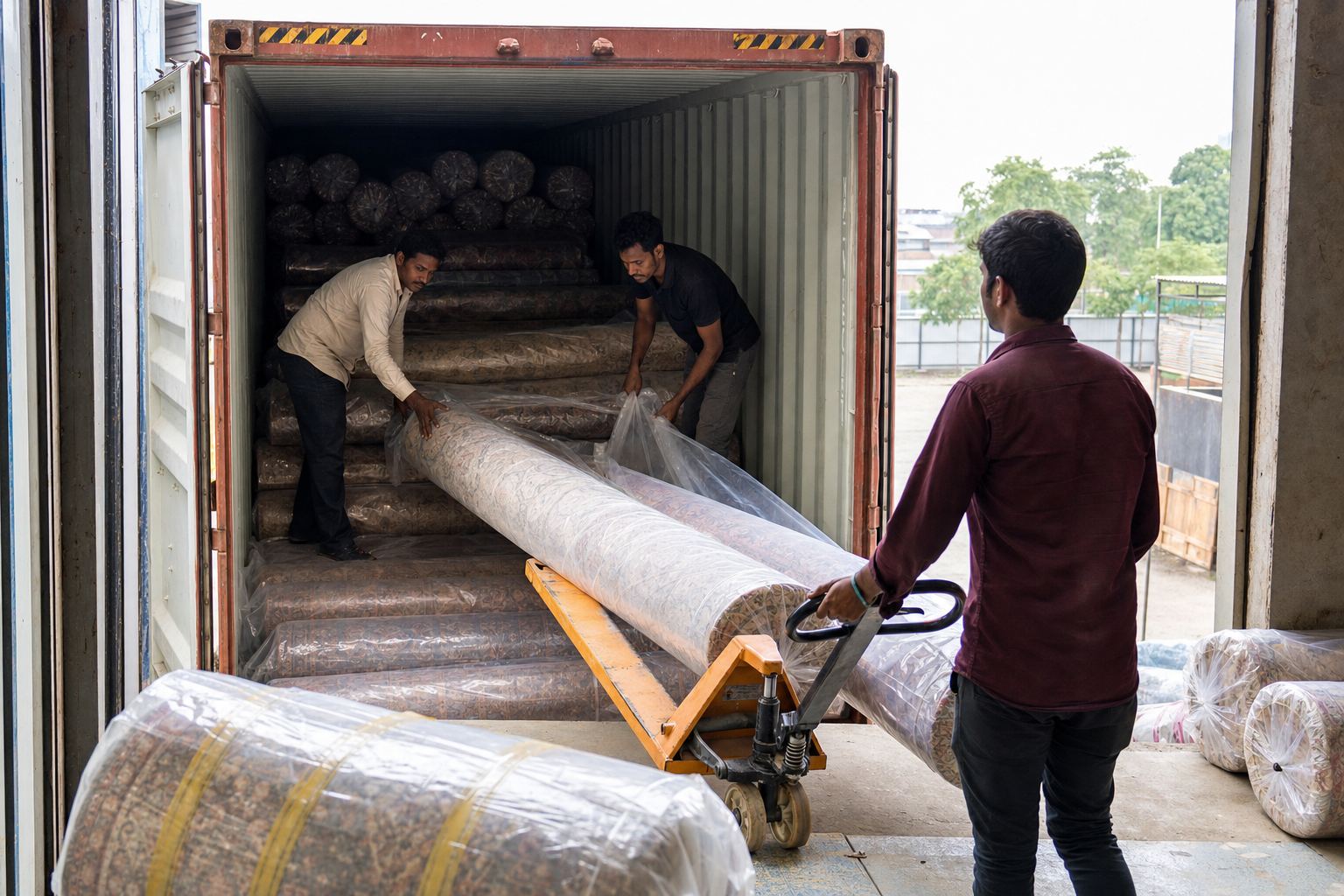
Carpets are cube-sensitive. Roll diameter, roll length, and mix of sizes determine whether a 20-foot or 40-foot container fills by volume before weight. Over-stacking soft rolls crushes pile; under-utilising cube inflates per-unit freight on CIF offers.
Photograph loading, record seal numbers, and reconcile size counts against the packing list before gate-in. Mixed constructions in one container need load plans that keep heavy latex-backed pieces from deforming delicate silk rolls.
Container loading reference for carpet and rug exports.
Swipe →
Data table — swipe horizontally on small screens
| Load plan | Application | Record to keep |
|---|---|---|
| Floor-loaded rolls | Standard knotted and tufted assortments | Roll count by size, photos, seal no. |
| Palletised small rugs | Durries, outdoor PP, runners | Pallet count + carton/roll map |
| Mixed premium + volume | Silk pieces with tufted fillers | Separation layers and handling notes |
| LCL consolidation | First trials and multi-SKU tests | Extra wrap, marks, freight refs |
| 40' HQ preference | Bulky shaggy and large decorative rolls | Cube calculation before booking |
Shipping Methods
Export Tip
Sea FCL is the default for commercial carpet programs. LCL suits assortment trials. Air is rarely economic except for small high-value silk samples or emergency replacements. Courier works for swatches, pom strings, and care-label proofs — not for full-size rug approval when hand-feel matters.
Common load ports for North Indian clusters include Mundra, Nhava Sheva, and sometimes Kolkata depending on inland routing. State Incoterms explicitly: FOB is common for experienced importers; CIF can help first-time buyers but needs honest freight assumptions based on cube.
Shipping methods for carpet and rug programs.
Swipe →
Data table — swipe horizontally on small screens
| Method | When to use | Carpet-specific note |
|---|---|---|
| Courier | Swatches, labels, small flat samples | Full-size hand-feel still needs a production sample |
| Air freight | Urgent high-value silk or replacements | Cost per kg usually punitive for bulky rugs |
| LCL sea | First paid assortment trials | Over-protect rolls; handling events multiply |
| 20' FCL | Denser, heavier assortments | Watch payload vs cube trade-off |
| 40' / 40' HQ FCL | Bulky decorative and shaggy mixes | Default for many US wholesale programs |
Certifications
Compliance Notes
Start with IEC, GST export readiness, and CEPC registration/RCMC for organized carpet export credibility. Add OEKO-TEX or equivalent chemical testing when EU and premium US retailers require it. Organic or responsible-wool claims need chain-of-custody evidence — never verbal "eco wool" labels.
Country-of-origin certificates, fumigation where wooden packing appears, and third-party inspection reports are commercial documents as much as compliance documents. Silk and children's-room positioning may trigger extra scrutiny depending on destination marketing claims.
Certification and document stack for carpet exporters.
Swipe →
Data table — swipe horizontally on small screens
| Document / certification | Relevance | Buyer value |
|---|---|---|
| CEPC RCMC / membership | Sector export identity for carpets | Signals organized Chapter 57 exporter |
| IEC + GST/LUT | Legal export transaction base | Basic vendor due diligence |
| Certificate of origin | Customs and preferential claims where applicable | Duty and clearance support |
| OEKO-TEX / chemical tests | Dyes and finishing chemistry | EU and premium retail onboarding |
| Third-party inspection report | Pre-shipment size, defect, packing checks | Reduces arrival disputes |
| Fiber / care labeling pack | Destination textile labeling rules | Retail shelf and e-comm compliance |
Buyer Requirements
Buyer Requirements
Serious carpet buyers ask for construction, fiber, size assortment, pile height, density metric, finish type, packing method, lead time, and HS heading — not "best quality handmade." Respond with a one-page SKU card per construction family and a photo set tied to the approved sample ID.
For US programs especially (given ~59% offtake share), expect barcode, carton marking, and on-time seasonal deliveries to matter as much as knot beauty. For EU programs, expect chemical and traceability questions earlier in vendor approval.
What strong carpet buyers ask — and how to answer.
Swipe →
Data table — swipe horizontally on small screens
| Buyer asks | Strong answer | Risky answer |
|---|---|---|
| What is the construction? | Knotted / tufted / flatweave named with HS 570x | Handmade carpet available |
| What is the fiber? | Wool / silk % / PP with backing described | Premium soft yarn |
| What density / pile? | KPSI or gauge + pile mm on the spec | High density assured |
| What is MOQ? | Sample → trial → FCL ladder by construction | Any quantity possible |
| Which cluster produces it? | Named cluster matched to construction | Anywhere in India |
Country-wise Opportunities
Market Snapshot
Keep this section brief and product-led. Full market selection belongs in Best Countries for Indian Carpet and Rug Exports and demand detail in Most Demanded Indian Carpets and Rugs by Country.
Country opportunity snapshot by product fit.
Swipe →
Data table — swipe horizontally on small screens
| Country / region | Product fit | Entry note |
|---|---|---|
| USA | Tufted, Zeigler, Indo-Persian, durrie, shaggy, outdoor PP | Largest offtake — assort by channel |
| Germany / EU | Fine knotted, kilim, wool-silk, tested dyes | Compliance-heavy, value-dense |
| UK | Indo-Persian, fashion tufted, flatweaves | Private label and interior wholesale |
| Australia | Tufted, outdoor PP, washable flats | Lifestyle and outdoor seasons |
| UAE / GCC | Silk accents, oversized decorative | Statement sizes and hospitality |
| Netherlands | Mixed constructions for EU redistribution | Pack for onward retail |
| Canada | Tufted and knotted mid-premium | Often follows US assortment logic |
Sourcing Checklist
Checklist
- Define construction, fiber, sizes, pile/density metric, finish, destination channel, and HS 5701–5705 heading before RFQs.
- Match cluster to construction (e.g., silk → Kashmir; outdoor PP → Panipat/Amritsar; classical knotted → Bhadohi-Mirzapur).
- Approve a production-representative sample with written tolerances for size, color, and pile height.
- Confirm CEPC-ready exporter identity, packing method, inspection scope, and Incoterm in the PI.
- Stage orders: sample → LCL/trial → FCL — especially on fine-knot and silk lines.
- Cross-check sibling guidance in Source Carpets and Rugs Directly from India before paying deposits.
Common Buyer Mistakes
Common Mistakes Box
- Comparing knotted and tufted FOB on one line without labeling construction.
- Ordering silk lead times on a tufted production calendar.
- Accepting "high density" claims without KPSI or gauge numbers.
- Skipping wash-lot approval on antique-wash Zeigler programs.
- Folding fine silk for cube savings without crease protocols.
- Assuming outdoor PP passes indoor wool QC checklists.
- Ignoring USA channel differences (designer vs big-box) despite ~59% offtake concentration.
- Treating CEPC membership as a substitute for third-party inspection.
- Mixing HS 5701 and 5703 goods under one vague invoice description.
- Launching ten constructions with one untested supplier instead of two proven lines.
Most first-order carpet failures are specification and comparison errors, not "bad Indian quality." Avoid these patterns:
Future Market Trends
Key Statistics
Through the late 2020s, expect three parallel trends in India's carpet product mix. First, handmade authenticity remains a premium moat — India's ~40% share of world handmade carpet exports supports continued demand for knotted wool, Zeigler aesthetics, and silk highlights when storytelling is backed by measurable specs. Second, volume channels will keep expanding hand-tufted, durrie, shaggy, and outdoor PP for speed and price architecture. Third, sustainability and chemical transparency will move from EU niche to broader retail expectation, rewarding exporters who invest in dye-house controls and credible fiber claims.
Design cycles will shorten for tufted and flatweave fashion colors while fine-knot classical patterns stay longer in assortment. Exporters who run a deliberate two-or-three-line core — rather than a thirty-SKU vanity catalog — will capture more repeat containers as US and EU retailers consolidate vendor lists.
Trade visibility through CEPC fairs, Domotex-type platforms, and digital showrooms will continue to matter; see Trade Shows for Carpet and Rug Exporters and Find International Buyers for Carpets and Rugs for pipeline tactics adjacent to this product guide.
Key Takeaways
Summary Box
- Build the offer as a product mix under HS 5701–5705, not as a single carpet commodity.
- Anchor planning on FY25 ~USD 1.54B exports, USA ~59% share, and ~40% world handmade share.
- Profile at least hand-knotted Indo-Persian, Zeigler, hand-tufted, handloom, kilim, silk, wool-silk, durrie, shaggy, and outdoor PP as distinct cards.
- Match Bhadohi-Mirzapur, Kashmir, Jaipur, Agra, Panipat, and Amritsar to the constructions they actually master.
- Use CEPC for sector credibility; use locked samples and inspection for shipment credibility.
- Package, load, and ship for cube and pile protection — freight errors erase handmade margins quickly.
Buyer Checklist
Checklist
- Issue a brief naming construction, fiber, sizes, pile/density, finish, target retail channel, and destination.
- Require SKU cards with HS 570x headings before comparing FOB quotes.
- Approve production samples with photo IDs retained on both sides.
- Confirm packing, Incoterms, inspection scope, and claim windows in writing.
- Score suppliers on repeatability across a second lot, not only on first-sample beauty.
Exporter Checklist
Checklist
- Keep CEPC, IEC, GST, and bank details consistent across documents.
- Maintain construction-wise catalogs with honest lead times and MOQ ladders.
- Train QC on knotted vs tufted vs flatweave vs outdoor defect languages separately.
- Photograph loading and archive inspection reports for every container.
- Do not claim organic, OEKO-TEX, or silk percentages without supporting evidence.
Compliance Checklist
Checklist
Compliance Notes
- Classify each SKU under the correct HS 5701–5705 heading with CHA confirmation.
- Align commercial invoice, packing list, shipping bill, and COO descriptions to construction and fiber.
- Meet destination textile labeling and any chemical testing required by the buyer channel.
- Use ISPM 15 compliant wood if wooden packing or pallets are part of the load plan.
- Attach inspection and test evidence to the shipment file before documents are released.

Conclusion
- Buyers: send your construction brief, sizes, and destination — Altus maps verified cluster capacity.
- Exporters: share your strongest two constructions and certifications for a product-market fit review.
- Explore export products from India to choose the right partnership model.
The top carpet and rug products exported from India succeed as a managed mix: hand-knotted Persian and Indo-Persian wool, Zeigler, hand-tufted programs, handloom weaves, kilims, silk and wool-silk prestige lines, durries, shaggy comfort rugs, and outdoor polypropylene. FY25's roughly USD 1.54 billion export base, US concentration near 59%, and India's about 40% share of world handmade carpet exports all reward exporters and buyers who speak in constructions, densities, and cluster strengths — not in vague handmade promises.
If you are building or refreshing a carpet assortment, start by shortlisting two or three constructions your channel can actually sell, map them to the right Indian cluster, and lock samples against written specs under HS 5701–5705. Altus Exports supports international buyers and Indian manufacturers as a merchant exporter, product sourcing company in India, and global sourcing partner across textiles and home furnishings and handicrafts and lifestyle floor-covering programs.
Next steps: review How to Export Carpets and Rugs from India, confirm council readiness via CEPC Registration Benefits for Carpet Exporters, and run documents against the Carpet and Rug Export Documentation Checklist before your first container sails.