
Carpet and Rug Export Documentation Checklist (India)
By Saurabh Mittal, Founder, Altus Exports
A document-by-document carpet and rug export documentation checklist for Indian manufacturers and MSMEs — commercial invoice, packing list, shipping bill, bill of lading, certificate of origin, fumigation/ISPM-15 for wooden packaging, US FTC fibre content labels, EU REACH/chemical evidence, CEPC/RCMC proofs, pre-shipment inspection reports, and cargo insurance — with HS 5701–5705 guidance, market and pricing tables, MOQ, packaging, container loading, shipping notes, buyer/exporter/compliance checklists, and a 48-hour pre-shipment audit from Altus Exports.

Carpet and rug export documentation is not a last-minute CHA form pack. It is the compliance operating system that converts a Bhadohi hand-knotted lot, a Kashmir wool programme, or a Jaipur hand-tufted assortment into a shipment that clears customs, survives retailer QC, and earns a repeat purchase order. A showpiece sample means little if the commercial invoice, packing list, shipping bill, bill of lading, certificate of origin, fibre content labels, ISPM-15 marks, CEPC/RCMC proofs, pre-shipment inspection report, and insurance certificate disagree on construction, fibre percentages, size, piece count, or value.
India's carpet exports — about USD 1.54 billion in FY25, with the USA taking roughly USD 921 million — move under HS Chapter 57 (5701 knotted, 5702 woven/kilim/dhurrie, 5703 tufted, 5704 felt, 5705 other). Misclassifying a tufted rug as knotted, inflating knot density on the invoice, or shipping untreated wood pallets into Australia are among the fastest ways to turn a clean loom run into demurrage and chargebacks. This guide covers carpets and rugs only — textile floor coverings under HS Chapter 57.
This is the carpet and rug export documentation checklist Altus Exports uses when coordinating consignments as a merchant exporter and global sourcing partner. It walks document-by-document through the commercial invoice, packing list, shipping bill, B/L, COO, fumigation/ISPM-15, US FTC fibre labels, EU REACH/chemical evidence, CEPC/RCMC proofs, PSI, and insurance — then supports that ops core with carpet-specific market, product, pricing, MOQ, packaging, container, and shipping tables. Pair it with how to export carpets and rugs from India for process sequencing and CEPC registration benefits for carpet exporters for council membership.
Key Takeaways
Summary Box
Executive Summary
Summary Box
Indian carpet and rug exports compete on artisan depth across Bhadohi–Mirzapur, Kashmir, Jaipur, Agra, and Panipat — but international buyers in the USA, Germany, the UK, the Netherlands, Australia, and the UAE qualify suppliers on documentation maturity as early as they qualify knot density. A clean document pack is now a commercial differentiator: importers who can share draft invoice, packing list, COO, fibre-label proofs, and PSI criteria before sailing convert trials into scheduled FCL programmes faster than factories that improvise paperwork after washing.
This article is written for documentation and compliance operations. Market size, product variants, pricing, MOQ, packaging, container loading, and shipping appear as supporting carpet-specific context so sourcing and ops teams stay on one page — not as a substitute for the process pillar. The operating sequence is foundations first (IEC, GST, CEPC/RCMC), then document-by-document shipment control, then destination labelling and chemical layers, then a shared buyer/exporter/compliance checklist before cutoff.
Altus Exports treats the carpet document pack as part of export management: we align HS 5701–5705 descriptions, roll IDs, fibre percentages, packing-list piece counts, shipping-bill data, ISPM-15 marks, PSI findings, and insurance certificates before cargo cutoff. Read destination selection in best countries for Indian carpet and rug exports and product ranking in top carpet and rug products exported from India — this guide focuses on the paperwork that keeps those programmes clearing.
Market Size & Industry Overview
Key Statistics
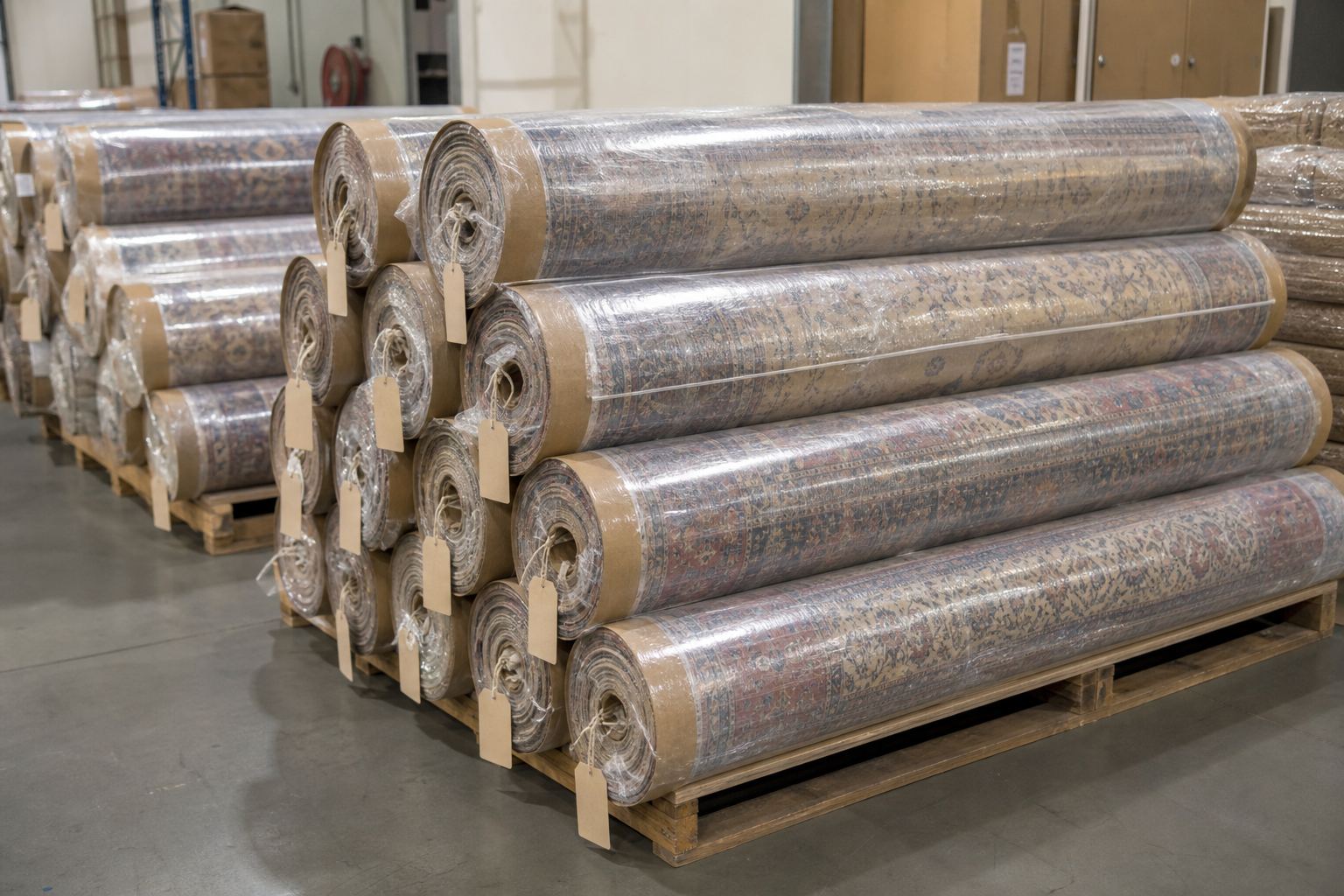
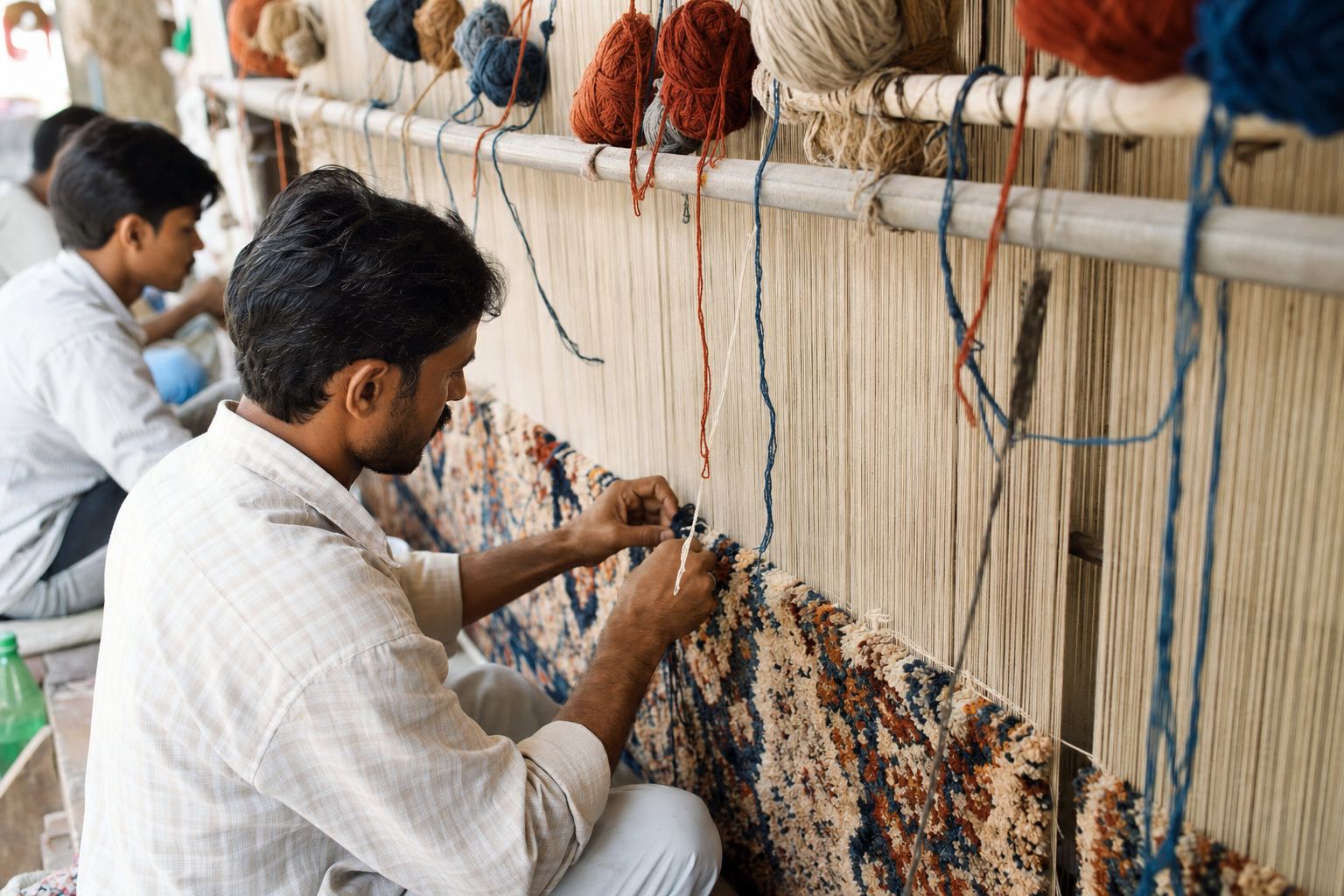
India remains a leading origin for handmade carpets and rugs — commonly cited at roughly forty percent of world handmade carpet exports, with an estimated eighty-five to ninety percent of domestic production destined overseas. More than two million artisans underpin knotting, weaving, tufting, washing, and finishing across the northern belt. That scale only converts into reliable export revenue when documentation matches construction claims.
Buyers span residential retail, e-commerce home décor, wholesale distributors, interior design trade, and hospitality procurement. Each channel raises a different document bar: mass retail emphasises FTC fibre labels and social compliance; EU design wholesalers emphasise REACH and composition honesty; Gulf hospitality programmes emphasise COO attestation and size accuracy for contract rooms.
Documentation complexity rises with product sophistication. A stock hand-tufted wool rug needs clear fibre percentages, size tolerance, and HS 5703 language. A fine Kashmir hand-knotted silk-accent piece needs honest KPSI claims, GI-aware origin language where used, and packing that protects pile through humid ocean transit — all reflected identically on the invoice and packing list.
Carpet documentation emphasis by production cluster
Swipe →
Data table — swipe horizontally on small screens
| Cluster | Primary constructions | Document emphasis |
|---|---|---|
| Bhadohi–Mirzapur (UP) | Hand-knotted, tufted, handloom | HS 5701/5702/5703 honesty; KPSI claims; CEPC RCMC |
| Kashmir (Srinagar belt) | Fine hand-knotted wool/silk | Premium invoice detail; GI-aware origin language |
| Jaipur / Rajasthan | Hand-tufted contemporary | Backing/latex notes; private-label artwork records |
| Agra (UP) | Knotted and tufted mid-market | Mixed-SKU packing lists; size reconciliation |
| Panipat (Haryana) | Tufted, durrie, volume lines | Piece-count accuracy; wholesale roll IDs |
| Eastern UP feeders | Weaving/finishing support | Producer address vs exporter-of-record clarity |
Export Statistics
Key Statistics
According to figures commonly aligned with IBEF and CEPC industry reporting, India's carpet exports reached approximately USD 1.54 billion in FY25, up from about USD 1.39 billion in FY24. Destination concentration is high: the United States accounted for roughly USD 921 million (~59%), Germany about USD 91.7 million, and the United Kingdom about USD 65.4 million. Secondary destinations across Europe, the Middle East, Australia, and elsewhere matter for diversification but should not dilute first-shipment document templates.
Export statistics matter for paperwork because destination mix drives certificate mix. US programmes push FTC fibre labelling, PSI protocols, and GoodWeave expectations. EU/UK programmes push REACH-aware chemical evidence and textile fibre labelling. Australia adds strict ISPM-15 biosecurity on wood packaging. UAE programmes often need Chamber-attested COO and Arabic retail label support for store-facing lines.
Build a document library by construction and destination. The first hand-tufted FCL to Savannah should become a reusable template for subsequent US lots — do not overwrite it blindly for a Hamburg hand-knotted wool programme with REACH test attachments.
HS Chapter 57 — document description cues for carpet/rug exports
Swipe →
Data table — swipe horizontally on small screens
| HS heading | Construction | Invoice description cue |
|---|---|---|
| 5701 | Knotted carpets and rugs | Hand-knotted wool rug, KPSI, pile height, size, fibre % |
| 5702 | Woven (kilim / dhurrie / kelem-type) | Handloom flatweave / dhurrie, fibre %, size, finish |
| 5703 | Tufted carpets and rugs | Hand-tufted wool/blend, gauge, backing type, size |
| 5704 | Felt floor coverings | Felt rug, fibre %, thickness, size |
| 5705 | Other textile floor coverings | Only when not classifiable under 5701–5704 |
| Buyer broker note | National tariff line | Align Indian shipping bill with importer HS preference |
Import Statistics
Key Statistics
Import intensity at destination tells you which document culture buyers operate in. US home-furnishing importers expect accurate fibre labels, clear construction descriptions, and often third-party PSI before sailing. German and wider EU importers focus on chemical compliance, composition percentages on product, and honest knotted-versus-tufted classification. UK buyers blend retail labelling discipline with post-Brexit import formalities. Australian importers add biosecurity scrutiny on wooden packaging. UAE and GCC buyers emphasise COO and retail label language for showroom programmes.
The importer's customs broker should review draft documents before the vessel sails from Mundra, Nhava Sheva, or linked ICD routing. A fifteen-minute broker review can catch HS mismatches, consignee spelling errors, missing piece counts, or fibre-label gaps while amendments are still cheap.
Do not assume a document pack that cleared Jebel Ali will clear Hamburg or Long Beach. Reuse structure, not destination assumptions.
Destination document watchpoints for carpet and rug imports
Swipe →
Data table — swipe horizontally on small screens
| Destination | Watchpoint | Best practice |
|---|---|---|
| United States | FTC fibre labels + PSI + social compliance | Match hangtag fibre % to invoice; share PSI draft early |
| European Union | REACH / chemical + fibre labelling regulation | Attach test evidence; print composition on product |
| United Kingdom | UK textile labelling + import formalities | Confirm importer filing duties and label language |
| Australia | ISPM-15 wood packaging biosecurity | Treated pallets/dunnage + treatment certificate on file |
| UAE / GCC | COO attestation + Arabic retail labels | Build 3–5 day attestation lead time |
| Germany / Netherlands | EU gateway QC + chemical scrutiny | SKU-level packing lists for redistribution hubs |
Product Categories / Variants
Summary Box
Documentation starts with construction identity. Every document must state whether the piece is hand-knotted, woven/flatweave, tufted, felt, or other; the fibre composition with percentages; finished size with tolerance; pile height or flatweave thickness where relevant; colourway or design code; and piece count. Vague descriptions such as "assorted handmade rugs" invite classification queries and buyer chargebacks.
Variant-specific proof differs. Knotted programmes need KPSI honesty against the approved sample. Tufted programmes need backing-system notes and dimensional stability after latex curing. Flatweaves need reversible-construction clarity where claimed. Silk or silk-blend accents need accurate fibre split — never "silk" when the face is predominantly art silk or viscose.
Product variant → document fields that must stay identical
Swipe →
Data table — swipe horizontally on small screens
| Variant | Must show on docs | Common filing error |
|---|---|---|
| Hand-knotted wool | KPSI, pile mm, fibre %, size | KPSI inflated vs sample |
| Hand-knotted silk-blend | Silk % vs wool/other split | "Silk" overclaim on viscose face |
| Hand-tufted wool/blend | Gauge, backing, size, fibre % | Filed under 5701 by mistake |
| Kilim / dhurrie | Flatweave type, fibre %, size | Vague "handmade carpet" wording |
| Viscose / art-silk accent | True fibre name and % | Marketing "silk look" on invoice |
| Private-label retail | SKU code matching hangtag | Invoice name ≠ hangtag name |
Hand-Knotted (HS 5701)
Invoice lines should name fibre, knot density (KPSI or knots per square inch / dm² as agreed), pile height in millimetres, finished size, wash/antique finish if any, and origin cluster where commercially relevant. Never upgrade knot density on paper to win a PO — US and EU retailers catch inflation with inspections and returns audits.
Woven / Kilim / Dhurrie (HS 5702)
State weave type, fibre %, size, and whether the piece is reversible. Mixed cotton-jute or wool-cotton flatweaves need explicit percentage splits on both the invoice and FTC/EU labels.
Hand-Tufted (HS 5703)
Name gauge or stitch density, pile height, fibre %, backing type (latex/action-back/etc.), and size. Do not describe tufted goods as hand-knotted on any document or hangtag — that single misstatement ends many retailer relationships permanently.
Manufacturing Overview
Export Tip
Carpet documentation should follow the manufacturing path: design lock or buyer artwork approval, yarn dyeing, loom allocation, knotting/weaving/tufting, washing and finishing, binding/serging, inspection, labelling, packing, and dispatch. Each step generates facts that must appear consistently in the document pack — especially lot or dye-lot identity, colourway codes, and size records.
Start drafting documents during production, not after packing. Parallel workstreams — draft invoice and packing-list structure, CEPC/COO application, PSI booking, fibre-label artwork check, REACH lab booking where required, ISPM-15 pallet sourcing, insurance placement under CIF — compress lead time and reduce last-minute errors.
Manufacturing milestones that feed carpet documentation
Swipe →
Data table — swipe horizontally on small screens
| Milestone | Document action | Owner |
|---|---|---|
| Spec / sample lock | Freeze invoice description, HS, fibre % | Sales + compliance |
| Production start | Assign lot / dye-lot / SKU batch codes | Factory QA |
| In-process QC | Record KPSI/gauge, pile, size tolerances | Factory QA |
| Finishing complete | Confirm final sizes and piece counts | Finishing + warehouse |
| Labelling | FTC/EU fibre & care hangtags applied | Packaging team |
| PSI (if required) | Issue inspection report against AQL/visual SOP | Third-party / buyer agent |
| Packing complete | Final packing list by roll/carton ID | Warehouse |
| Gate-in | Shipping bill + B/L draft check | CHA + logistics |
Core Shipment Documents — Master Map
These documents form the backbone of every carpet and rug export shipment. Treat them as one interlocking set — a change to construction language, fibre percentage, size, piece count, weight, or value on one document must be mirrored across all of them before cargo cutoff.
Core carpet/rug shipment document map
Swipe →
Data table — swipe horizontally on small screens
| Document | Purpose | Who issues / coordinates | Beginner tip |
|---|---|---|---|
| Commercial invoice | Value, construction, fibre, Incoterms | Exporter | SKU-level lines — never "assorted rugs" |
| Packing list | Rolls/cartons, piece counts, weights | Exporter | Reconcile physical count before seal |
| Shipping bill | Indian customs export declaration | Exporter / CHA | Match HS 5701–5705 and invoice wording |
| Bill of lading / AWB | Transport contract and title evidence | Carrier / forwarder | Confirm consignee/notify spelling early |
| Certificate of origin | Origin proof / preference claims | Chamber / CEPC | Request early for CEPA/ECTA where relevant |
| ISPM-15 evidence | Wood packaging treatment compliance | Treatment provider | Required whenever wood pallets/dunnage used |
| PSI report | Pre-shipment quality/quantity evidence | Inspection agency | Book against written AQL before packing ends |
| Insurance certificate | Cargo risk cover (CIF/CIP) | Insurer / broker | Sum insured must match invoice value logic |
Commercial Invoice Deep Dive for Carpets & Rugs
The commercial invoice is where most carpet documentation disputes originate, because it carries the construction and fibre claim buyers and customs rely on most heavily. Get this document right and most downstream paperwork falls into line.
SKU-level descriptions, not category labels
Write invoice lines the way you would describe the rug to a knowledgeable importer. "Hand-knotted wool rug, 9×12 ft, ~120 KPSI, pile 12 mm, 80% wool / 20% cotton, design code BH-214, natural wash" tells customs and the buyer's QC team what is inside the roll. "Handmade carpets — assorted" invites a query every time.
When a container holds knotted and tufted assortments, or mixed sizes and colourways, break the invoice into separate line items per SKU. Blended pricing across mixed constructions is a common trigger for post-delivery disputes because it becomes impossible to prove which pieces were billed at which specification.
Fibre composition and knot density as documented facts
Fibre percentages and KPSI/gauge claims must match the approved sample and any lab or inspection evidence. Never let a sales conversation upgrade knot density or silk content that production cannot deliver. US FTC labelling and EU fibre labelling make composition inflation both a commercial and a regulatory failure.
If a buyer negotiated a mixed fibre programme — for example, 100% wool flagship alongside wool-viscose value lines — show that split explicitly by line item and quantity.
Incoterms, value accuracy, and currency
State the Incoterm (commonly FOB Indian load port or CIF destination port) clearly, and declare the actual transaction value — under-invoicing exposes both parties to penalties and post-clearance audit risk. Fix currency (typically USD or EUR) before production starts so neither party absorbs an unplanned exchange swing at invoice stage.
Packing List Best Practices for Rolls and Cartons
The packing list is the document a destination warehouse actually uses when a container arrives. For carpets and rugs, specificity matters because programmes mix sizes, colourways, and constructions in the same FCL, and roll IDs must be findable without opening every bale.
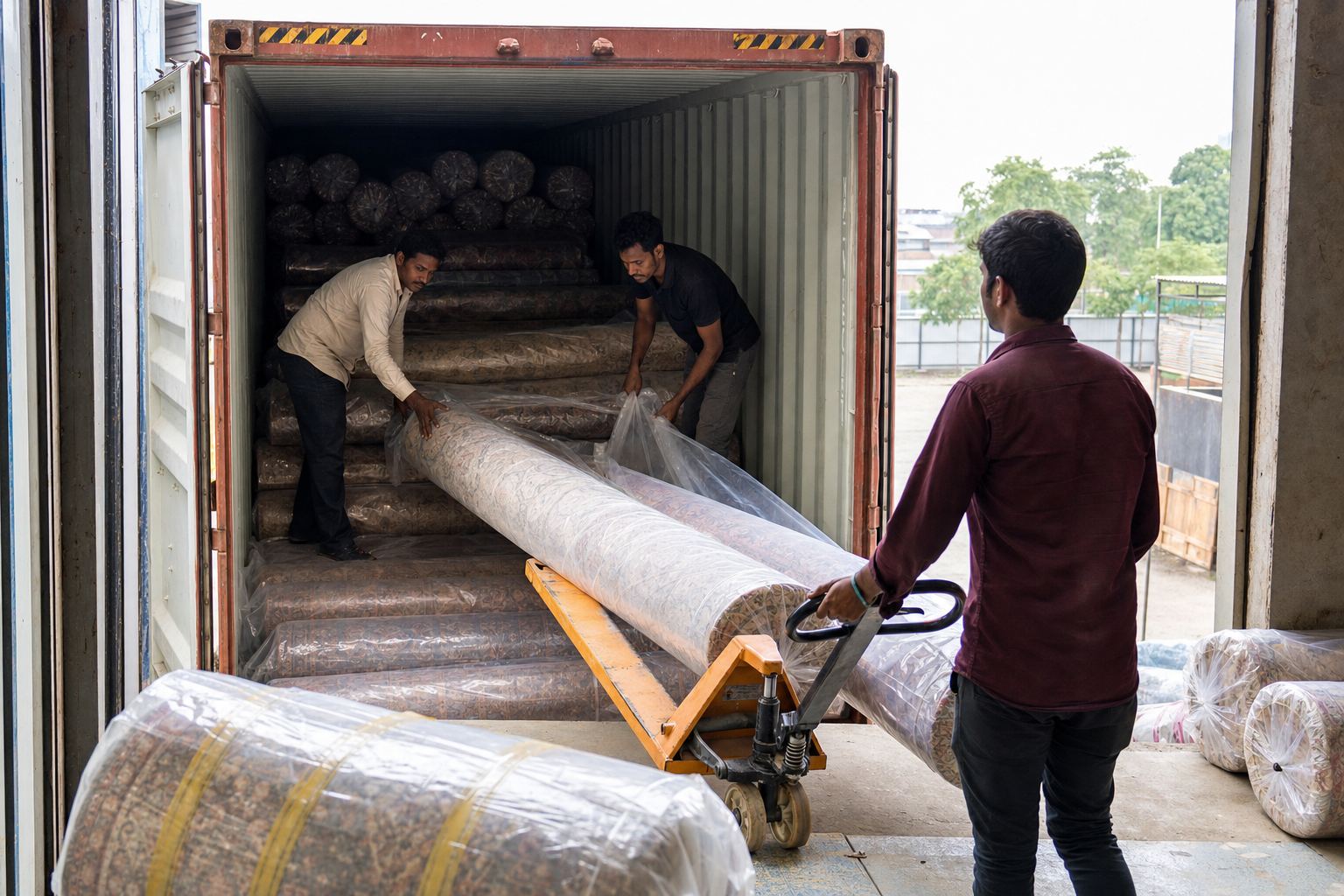
Show pieces per roll or carton, net and gross weight, dimensions, shipping marks, and design/SKU codes. For mixed assortments, break down exact quantities per SKU inside each carton or roll group rather than summarising only at container level. Weight declarations should be coherent with size and fibre — a packing-list gross weight wildly inconsistent with piece count times unit weight is an easy customs red flag.
Photograph packed rolls and cartons before sealing, especially for private-label or mixed-SKU shipments. Photos cost nothing and become decisive evidence in damage, quantity, or fibre disputes months later.
Shipping Bill, Bill of Lading, and Certificate of Origin
The shipping bill is filed electronically through ICEGATE and must mirror the commercial invoice on every material point: exporter IEC, product description, HS heading under Chapter 57, quantity, and value. Confirm classification with your CHA when construction changes between seasons — a factory that switches from knotted to tufted for a retail refill must not reuse last season's 5701 template.
For the bill of lading or airway bill, verify that shipper, consignee, and notify party details are spelled exactly as the buyer's import broker expects. Confirm freight prepaid or collect terms align with the agreed Incoterm; a CIF sale with freight marked "collect" creates destination confusion that email cannot fix after sailing. Record container and seal numbers and ensure they appear on the packing list.
Request the certificate of origin from CEPC or the Chamber of Commerce with enough lead time that it is ready before cargo cutoff. If the buyer's country offers preferential duty treatment — for example under India-Australia ECTA or India-UAE CEPA on eligible lines — confirm whether a preferential COO format is required. Standard and preferential certificates are not interchangeable.
ISPM-15 Fumigation and Wooden Packaging
Whenever wooden pallets, crates, or dunnage are used with carpet and rug shipments, ISPM-15 heat treatment or approved fumigation marks are mandatory for many destinations — Australia in particular, and commonly the EU and others. Untreated wood packaging can trigger biosecurity holds, re-treatment fees, and demurrage that dwarf the cost of sourcing treated pallets at origin.
Keep treatment certificates on file even when the physical ISPM-15 stamp is visible on the wood. Some destination authorities request documentary evidence beyond the stamp. Note wood packaging use on the packing list so warehouse and broker teams are not surprised at discharge.
If you can switch to plastic pallets or eliminate wood dunnage for a specific route, document that choice clearly so nobody assumes wood was used without marks. When wood is used, make ISPM-15 part of the packing SOP — not a last-day scramble.
Fibre Content Labels — US FTC and Destination Rules
United States retail and many wholesale channels require fibre content labelling under the Textile Fiber Products Identification Act (administered with FTC care guidance for textile products). Labels must disclose fibre percentages accurately, identify the country of origin, and carry care instructions where the Care Labeling Rule applies to the product form. A hangtag that says "100% wool" on a wool-viscose blend is both a retailer chargeback risk and a compliance failure.
The European Union textile fibre labelling regulation requires composition percentages on the product itself, not only on shipping paperwork. UK rules remain similarly demanding after Brexit. Japan may require Japanese-language quality labels for retail. Arabic dual-language labels are common for UAE store-facing packaging.
Build label artwork into the production calendar. Retrofitting fibre hangtags after rolls are poly-wrapped is expensive and error-prone. Cross-check every hangtag against the commercial invoice line before packing sign-off.
Fibre / care labelling by destination (carpet & rug retail channels)
Swipe →
Data table — swipe horizontally on small screens
| Market | Primary label expectation | Document link |
|---|---|---|
| USA | FTC fibre % + origin; care where applicable | Must match invoice fibre split |
| EU | Fibre composition on product; REACH-aware finishes | Invoice + chemical evidence file |
| UK | UK textile labelling aligned to retail channel | Invoice + hangtag proof |
| Australia | Fibre/care + ISPM-15 on wood pack | Packing list notes wood treatment |
| UAE / GCC | English + Arabic for many retail packs | Artwork approval record |
| Japan | Japanese quality labelling for retail | Confirm buyer vs origin print duty |

REACH and Chemical Compliance for EU Programmes
EU buyers increasingly treat dyes, finishing chemicals, latex and backing systems, and mothproofing or stain treatments as REACH-relevant risk areas. Exporters do not need to become chemical lawyers, but they do need a controlled evidence file: supplier declarations for restricted substances, OEKO-TEX or equivalent test reports where scoped, and honesty about which finishes were applied to the shipped lot.
Attach chemical evidence to the shipment archive even when the buyer only spot-checks annually. A REACH query after arrival is far harder to answer without lot-linked records. Never claim "chemical free" or "REACH certified" as marketing language unless a qualified programme and documentation actually support that claim.
UK programmes often mirror EU chemical scrutiny. Treat REACH-aware discipline as the default for any European retail or wholesale carpet programme rather than an optional EU-only add-on.
CEPC / RCMC Proofs in the Document Pack
Compliance Notes
The Carpet Export Promotion Council (CEPC), founded in 1982 under the Ministry of Textiles, issues RCMC pathways that carpet exporters use for scheme continuity, fair participation, and buyer vendor onboarding. RCMC is not a substitute for IEC — you still need IEC to file a shipping bill — but many US and EU importers ask for CEPC membership or RCMC evidence during diligence before a meaningful PO.
Keep a current PDF of CEPC membership / RCMC status in every buyer onboarding pack alongside IEC, GST, and company registration. When preferential or scheme-linked filings reference council status, ensure the membership number and validity dates are current. Read the full membership case in CEPC registration benefits for carpet exporters.
Merchant exporters consolidating multi-weaver supply should ensure the exporter-of-record entity holds the IEC and CEPC standing referenced on documents, while producer addresses on social-compliance or GI claims remain accurate.
Pre-Shipment Inspection (PSI) Documents
Serious carpet buyers — especially US retail and large EU distributors — often mandate pre-shipment inspection before stuffing. PSI reports typically cover piece count, size tolerance, colour match to sealed sample, pile height or flatweave thickness, construction verification (knotted vs tufted), packing condition, and labelling checks. Agree AQL or visual standards in writing before production ends.
The PSI report should reference the same SKU codes, sizes, and quantities that appear on the commercial invoice and packing list. A clean PSI that disagrees with the packing list is almost as damaging as no PSI at all. Share the draft report with the buyer before seal whenever the contract allows corrections.
Even when a buyer does not formally require PSI, internal inspection checklists with photos protect exporters in transit-damage and quantity disputes. Archive those records with the shipment PDF pack.
Cargo Insurance Certificates
Insurance certificates are required whenever the transaction moves under CIF or CIP terms, covering cargo risk from the agreed point through to the named destination. The sum insured should follow the commercial logic of the invoice value plus the percentage uplift your policy or Incoterm practice requires — not an arbitrary under-declared figure.
Under FOB, the buyer typically places insurance; still confirm in writing who covers inland haul to port and who covers ocean risk so gaps do not appear between factory gate and ship's rail. Name the insured parties, voyage, container references where known, and claim notification contacts on the certificate copy shared with the buyer.
High-value hand-knotted or silk-accent consignments justify earlier insurance placement and tighter packing photos. Do not wait until the vessel has sailed to discover coverage was never bound.
Pricing Analysis
Buyer Tip
Documentation has cost, and that cost belongs in the commercial conversation. PSI fees, REACH or OEKO-TEX panels, Chamber/CEPC COO issuance, ISPM-15 treated pallets, courier of originals, and broker coordination add direct expense and calendar time. The cheapest FOB quote that omits required certificates is not the cheapest landed programme.
Indicative FOB ranges vary widely by construction, fibre, knot density, size, and certification. Build from true ex-works cost plus export packaging, inspection, inland haul, documentation, and exporter margin before quoting FOB or modelling CIF.
Indicative FOB context and documentation cost drivers (directional)
Swipe →
Data table — swipe horizontally on small screens
| Construction / item | Indicative FOB context | Doc cost driver to confirm |
|---|---|---|
| Hand-tufted wool retail sizes | Lower–mid USD per sq. ft / piece band | PSI + FTC/EU labels |
| Handloom kilim / dhurrie | Lower–mid band by size | Fibre % honesty + packing list detail |
| Hand-knotted wool commercial | Mid–upper band by sq. ft | KPSI verification + PSI |
| Fine knotted / silk accents | Premium band | Premium PSI + insurance uplift |
| Social-compliance certified lines | Premium to uncertified equivalent | GoodWeave audit evidence |
| COO / ISPM / lab extras | Add to landed model | Attestation lead time + treated wood |
MOQ Analysis
Buyer Tip
MOQ affects documentation because small trials carry a high document cost per piece. A courier sample rug, an LCL pilot of mixed sizes, and a full FCL do not need identical certificate intensity, but they do need honest construction identity and consistent naming from sample approval through bulk documents.
Hand-tufted stock designs can often start at lower piece counts than fine hand-knotted custom colourways that consume loom months. Publish MOQ breaks so programme orders earn better pricing — and so packing lists stay auditable at SKU level.
Document scope by carpet/rug order stage
Swipe →
Data table — swipe horizontally on small screens
| Order stage | Likely documents | Main objective |
|---|---|---|
| Courier / air sample | Sample invoice, spec sheet, photo record | Construction and colour evaluation |
| LCL pilot | Invoice, packing list, COO, B/L, labels | Validate import and receiving process |
| FCL conventional | Full pack + ISPM-15 + PSI if required | Clear customs and scale |
| EU retail FCL | Full pack + REACH evidence + fibre labels | Protect chemical and label compliance |
| US retail programme | Full pack + FTC labels + social compliance + PSI | Survive retailer QC and chargeback rules |
Packaging Standards
Export Tip
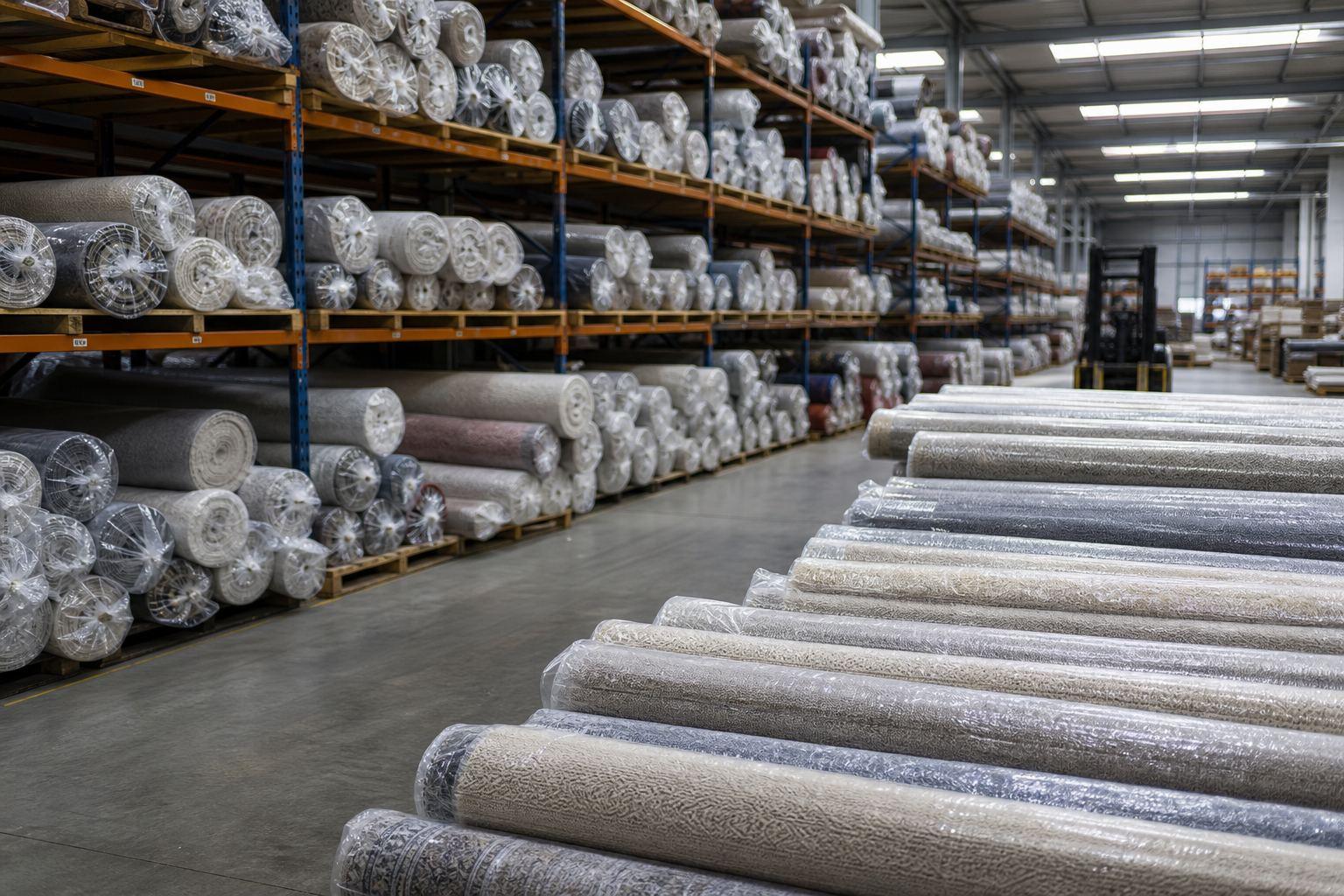
For a documentation checklist, packaging is a paper trail as much as a physical wrap. Every roll ID, carton mark, fibre hangtag, and ISPM-15 stamp must match the commercial invoice and packing list line for line — pile protection matters, but a beautiful wrap with mismatched marks still creates customs queries and retailer chargebacks.
Labels and marks should show product/SKU, size, fibre content, country of origin, and care instructions as required by destination. Social-compliance marks appear only when the shipment is within licensed scope. Packaging data must reconcile across invoice quantity, packing-list piece count, and shipping-bill weight.
Packaging–document consistency checks for carpets and rugs
Swipe →
Data table — swipe horizontally on small screens
| Packaging item | Document match | Risk if wrong |
|---|---|---|
| Roll / carton count | Invoice qty and packing list | Quantity claim / customs query |
| SKU / design code | Invoice line and hangtag | Mis-pick and chargeback |
| Fibre content hangtag | Invoice fibre % | FTC/EU labelling failure |
| ISPM-15 wood marks | Packing list / treatment cert | Biosecurity hold |
| Outer bale strength | Loading photos + PSI notes | Pile crush claims |
Container Loading Details
Export Tip
Treat stuffing day as a documentation gate, not only a warehouse chore. Before the doors close, reconcile invoice piece counts, packing-list roll or carton IDs, and the physical load — then archive container number, seal number, gross weight, and time-stamped loading photos for any later claim or customs query. Note ISPM-15 status for every wooden pallet, crate, or dunnage piece on the loading record so biosecurity holds do not appear as surprises at destination.
Mixed knotted and tufted programmes need SKU-wise load maps so crush protection and pick-face access match construction value. Exact fills for 20-foot or 40-foot containers vary with assortment and roll diameter; publish estimates only after your forwarder validates cube against the approved packing list.
Indicative container planning notes for carpet/rug FCLs
Swipe →
Data table — swipe horizontally on small screens
| Container | Typical use case | Documentation note |
|---|---|---|
| 20' FCL | Trial or focused SKU sets | Easier piece-count control; seal on packing list |
| 40' FCL / HQ | Programme replenishment | SKU-wise packing list mandatory |
| LCL | First samples / small trials | Extra marks; house B/L reconciliation |
| Mixed SKU FCL | Assorted sizes/colours | Roll ID map + photo load plan archived |
Shipping Methods
Export Tip
Sea freight FCL is the default for commercial carpet and rug programmes under FOB or CIF from Mundra, Nhava Sheva, and linked ICD corridors serving the northern belt. LCL suits pilots but needs stronger inner protection because cargo is handled more often. Air freight and courier serve samples and urgent high-value pieces; use AWB instead of B/L and keep descriptions accurate.
Document timelines change with mode. Air samples move faster than Chamber-attested COO originals for Gulf sea shipments. Align certificate and PSI lead times with the chosen method before promising sailing dates.
Shipping method vs document implications for carpets and rugs
Swipe →
Data table — swipe horizontally on small screens
| Method | Transport document | Documentation note |
|---|---|---|
| FCL sea | Bill of lading | Full pack + destination extras |
| LCL sea | B/L (groupage / house + master) | Reconcile marks on both B/L sets |
| Air freight | Air waybill | Samples / urgent premium pieces |
| Courier sample | Courier AWB | Simple invoice; honest sample description |
Certifications
Compliance Notes
For carpet and rug exports from India, IEC, GST readiness, and CEPC RCMC form the institutional layer. Buyer-facing certifications commonly include GoodWeave or comparable child-labour-free programmes for US/EU retail, OEKO-TEX or equivalent chemical testing where fibre and finishes warrant it, ISO 9001 for vendor onboarding, and destination fibre/care labelling compliance. GI-linked origin claims (Bhadohi Handmade Carpet, Mirzapur Dhurrie, Kashmir Handmade Carpet, and related marks) require production geography and documentation that support the claim.
Certificates must cover the exact producing unit and product family. A generic ISO PDF that does not name the loom shed on the invoice fails diligence. Never print marks you are not licensed to use.
Carpet and rug certification checklist
Swipe →
Data table — swipe horizontally on small screens
| Certificate / proof | Applies to | Key check |
|---|---|---|
| IEC | Exporter of record | Active on DGFT; matches shipping bill |
| GST / LUT | Tax identity / zero-rating | Matches invoice entity |
| CEPC RCMC | Carpet export council standing | Valid membership; shareable PDF |
| COO | Origin / preference | Product and exporter consistency |
| ISPM-15 | Wood packaging | Marks + treatment certificate |
| FTC / EU fibre labels | Retail-bound pieces | Fibre % matches invoice |
| REACH / OEKO-TEX evidence | EU chemical programmes | Scope covers dyes/finishes/backing |
| PSI report | Buyer-mandated QC | SKU and quantity match packing list |
| GoodWeave | Social compliance retail | Licensed marks only when in scope |
| Insurance certificate | CIF/CIP shipments | Sum insured and voyage details correct |
Buyer Requirements
Buyer Requirements
Serious carpet buyers share document requirements at inquiry stage: destination, importer of record, consignee, notify party, preferred HS heading, broker contacts, fibre-label rules, PSI criteria, social-compliance expectations, and whether originals must be couriered. Waiting until rolls are sealed creates amendment costs and missed sailing windows.
Buyers should also state who places cargo insurance under FOB versus CIF, who reviews draft documents before cutoff, and whether wood packaging is acceptable on the route. Exporters can prepare the pack; destination brokers own local entry nuance.
Country-wise Opportunities
Market Snapshot
Documentation readiness improves close rates in every carpet target market. US retail and wholesale reward FTC label discipline, PSI readiness, and social-compliance evidence. Germany and the wider EU reward REACH-aware chemical files and composition honesty. The UK rewards labelling accuracy and reliable lead times. Australia rewards ISPM-15 discipline. UAE and GCC programmes reward attested COO and bilingual retail labels.
A correct first document pack often converts a trial LCL into a scheduled FCL programme. A messy first pack often ends the relationship regardless of loom quality. For deeper market selection, see best countries for Indian carpet and rug exports.
Country opportunities and documentation implications
Swipe →
Data table — swipe horizontally on small screens
| Market | Opportunity angle | Document priority |
|---|---|---|
| USA | Largest value share; retail + e-commerce | FTC labels, PSI, social compliance, HS honesty |
| Germany / EU | Design-led wholesale and retail | REACH evidence, fibre on product, COO |
| United Kingdom | Retail and trade channels | Labelling accuracy, import formalities |
| Australia | Residential wool and contemporary lines | ISPM-15 + fibre/care labels |
| UAE / GCC | Hospitality and villa programmes | COO attestation, Arabic retail labels |
| Netherlands | EU distribution hub | SKU-level packing lists for re-export |
Sourcing Checklist (Buyer/Exporter/Compliance)
Checklist
Use one shared checklist with three lenses — buyer, exporter, and compliance — so the same carpet or rug shipment is reviewed from commercial, operational, and regulatory angles before cargo moves.
Buyer Checklist
- Provide full importer, consignee, and notify party details before packing ends.
- Confirm HS preference with your broker for the correct 5701–5705 heading.
- Specify construction, fibre %, KPSI/gauge, pile height, size tolerance, and certifications in writing.
- Request draft invoice, packing list, COO, label proofs, and PSI report for broker review before sailing.
- Confirm who places insurance under FOB vs CIF/CIP and who files destination entry.
- Verify CEPC/RCMC and social-compliance claims independently when they are material to the PO.
Exporter Checklist
- Confirm IEC, GST/LUT, and CEPC RCMC are active before accepting export POs.
- Lock product description and HS 5701–5705 heading on all templates per SKU.
- Assign lot/dye-lot and roll IDs early; print the same codes on labels and documents.
- Book PSI, COO, treated wood, and lab evidence in parallel with finishing — not after.
- Reconcile final piece counts and weights before issuing the shipping bill.
- Archive a complete PDF pack per shipment for repeat-order templates.
Compliance Checklist
- Cross-check construction, fibre %, size, HS code, and piece counts across every document.
- Ensure FTC/EU fibre hangtags match invoice percentages exactly.
- Confirm ISPM-15 marks and certificates whenever wooden packaging is used.
- Block knotted-vs-tufted misstatements and unlicensed certification marks.
- Verify REACH/chemical evidence scope covers dyes, finishes, and backing for EU lots.
- Retain PSI reports, loading photos, and document revisions for audit and claims.
Common Buyer Mistakes
Common Mistakes Box
Future Market Trends
Key Statistics
Carpet and rug documentation will become more digital, SKU-specific, and destination-aware. Buyers will expect searchable PSI archives, QR-linked roll histories, and faster draft sharing. Exporters who maintain controlled document libraries by construction and country will respond faster than those rebuilding Word files each shipment.
Traceability, social compliance, and chemical transparency will tighten invoice and hangtag language. Knot-density honesty and fibre disclosure will feature in RFQs more often. Private-label growth will push earlier artwork and label alignment into the documentation calendar.
Preferential trade paperwork under India's CEPA/ECTA-type arrangements will reward exporters who can issue the correct certificate of origin format on time — not those who discover preference rules after the vessel sails.
Expert Insights from Saurabh Mittal
Expert Insight Box
On Document Sequencing
Pre-Shipment Document Audit (48 Hours Before Cutoff)
- Cross-check commercial invoice, packing list, and shipping bill as one reconciled set
- Confirm knotted/woven/tufted language and fibre % are worded identically everywhere
- Verify piece counts and shipping marks on physical cargo match the packing list
- Confirm COO, ISPM-15, PSI, CEPC/RCMC proofs, and insurance are ready and correctly dated
- Photograph packed rolls/cartons and the sealed container before gate-in
- Share the full draft document pack with the buyer's import broker before departure
Run this audit 48 hours before cargo cutoff on every carpet and rug shipment, without exception. Reconcile the draft commercial invoice against the packing list against the physical roll/carton count on the factory floor. Confirm construction, fibre percentages, sizes, and HS language are identical across every document and hangtag. Share drafts with the buyer's broker at this stage — not after the vessel has sailed.
Conclusion
- Read: How to Export Carpets and Rugs from India
- Read: Top Carpet and Rug Products Exported from India
- Read: Best Countries for Indian Carpet and Rug Exports
- Read: Source Carpets and Rugs Directly from India
- Read: CEPC Registration Benefits for Carpet Exporters
- Read: Most Demanded Indian Carpets and Rugs by Country
- Read: Find International Buyers for Carpets and Rugs
- Read: Sustainable and Handwoven Carpet Export Opportunities
- Read: Trade Shows for Carpet and Rug Exporters
- CTA: Request a carpet and rug documentation review or trial-order coordination via Altus Exports.
Carpet and rug export documentation from India requires discipline across construction identity, HS 5701–5705 classification, fibre labelling, certificates, packaging, and transport documents. IEC, GST, CEPC RCMC, commercial invoice, packing list, shipping bill, B/L or AWB, COO, ISPM-15 evidence, FTC/EU fibre labels, REACH/chemical files, PSI reports, and insurance certificates must be planned as one pack — sequenced during production and audited before gate-in.
Altus Exports helps buyers and suppliers manage carpet and rug documentation as part of a full sourcing and shipment workflow. As a merchant exporter, global sourcing partner, and export consulting partner, we coordinate supplier documents, inspection, packing records, certificate applications, freight documents, and buyer review for hand-knotted, hand-tufted, handloom, kilim, dhurrie, and related floor-covering programmes from India's carpet clusters.
Ready to tighten your next carpet or rug document pack? Contact Altus Exports to align specs, certificates, and shipment paperwork before you book space — and continue with the cluster guides below. Explore Altus Exports textiles & home furnishings for related programmes.