
How to Export Carpets and Rugs from India: Complete Process Guide
By Saurabh Mittal, Founder, Altus Exports
A complete process guide on how to export carpets and rugs from India — covering CEPC registration, IEC and GST readiness, HS Chapter 57 classification (5701–5705), Bhadohi-Mirzapur, Kashmir, Jaipur, Agra, and Panipat clusters, knot-density honesty, sampling, packaging, container loading, Incoterms, certifications, buyer requirements, and a step-by-step first-shipment workflow. Learn how carpet manufacturers and MSMEs build repeat export programmes with Altus Exports.
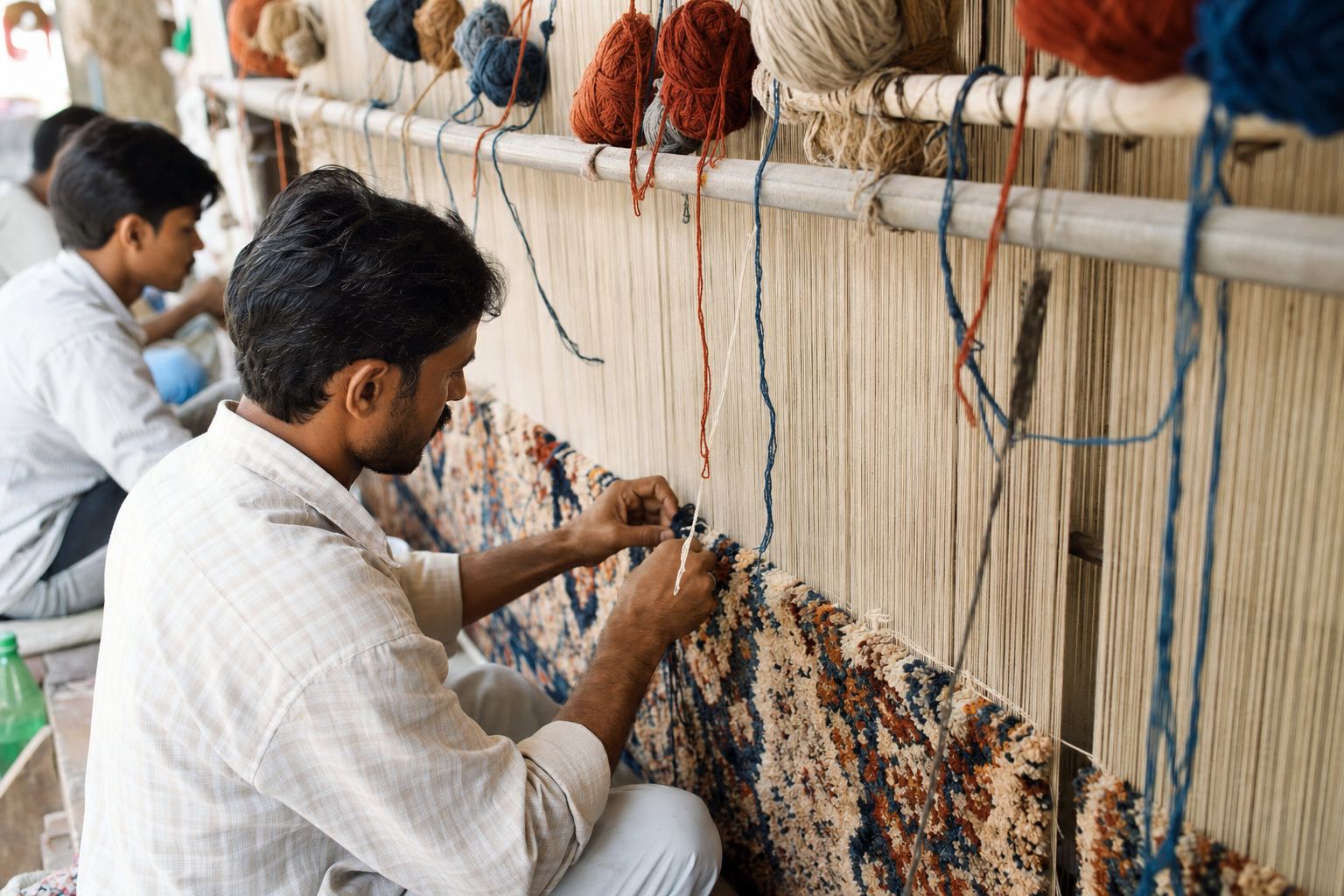
India is one of the world's foremost exporters of handmade carpets and rugs — textile floor coverings that span hand-knotted Persian-style pieces from Bhadohi and Kashmir, handloom and kilim weaves from Mirzapur and Jaipur, hand-tufted programmes from Panipat and Agra, and felt or other specialty constructions under HS Chapter 57. If you are learning how to export carpets and rugs from India, the opportunity is structural: India accounts for roughly forty percent of world handmade carpet exports and ships an estimated eighty-five to ninety percent of its production overseas, according to industry reporting aligned with IBEF and Carpet Export Promotion Council (CEPC) narratives. Few floor-covering origins combine this artisan depth with organised export infrastructure.
What separates successful carpet exporters from one-shipment sellers is process discipline, not loom skill alone. International buyers expect knot density (KPSI) claims that match the approved sample, honest pile height and fibre declarations, colourways that hold across dye lots, size tolerances that fit retail planograms, and packaging that protects pile through weeks of humid ocean transit. A showpiece sample photographed under studio lighting means very little if the bulk lot arrives with compressed pile, shade variation, inflated knot counts on the label, or missing GoodWeave child-labour-free documentation for a US or European retailer — and buyers who get burned once rarely place a second purchase order with the same factory.
This guide is the process pillar for carpet and rug export from India. It walks manufacturers, MSMEs, and merchant exporters through registrations (IEC, CEPC, GST), HS 5701–5705 classification, sampling and lead times, indicative FOB pricing and MOQs, packaging and container loading, certifications, buyer requirements, high-level country opportunities, and a step-by-step first-shipment workflow under FOB or CIF Incoterms. International buyers evaluating Indian carpet sourcing will also see how verified exporters structure QC of pile height, colour, and size so the tenth container matches the approved sample as closely as the first. For category depth on constructions and demand, see Top Carpet and Rug Products Exported from India.
Key Takeaways
Summary Box
Executive Summary
Summary Box
Exporting carpets and rugs from India is a documentation-and-specification business wrapped around artisan production. The commercial path is clear: obtain IEC from DGFT, register with CEPC for category credibility and market-support pathways, align GST and zero-rating formalities, classify each SKU under the correct HS 5701–5705 heading, develop and lock samples with written knot density, pile height, fibre content, size, and colour approvals, then produce, inspect, pack, and ship under agreed Incoterms — most often FOB Indian load port or CIF destination port.
India's carpet industry remains cluster-centric. Bhadohi-Mirzapur in Uttar Pradesh anchors much of the hand-knotted and dhurrie trade; Kashmir specialises in fine handmade carpets; Jaipur and Agra contribute design-led and tufted programmes; Panipat is a major hub for hand-tufted and related volume constructions. Geographic Indication (GI) products such as Bhadohi Handmade Carpet, Mirzapur Dhurrie, and Kashmir Handmade Carpet help buyers and exporters communicate origin authenticity — but only when the physical goods and paperwork support the claim.
This article emphasises first-shipment workflow over destination league tables. Country content stays high-level so exporters can choose one primary market and one backup, then invest in sampling cycles, lead-time honesty, and QC checkpoints that convert a trial LCL or mixed FCL into a repeat programme. Altus Exports supports manufacturers and international buyers as a merchant exporter and global sourcing partner when carpet programmes need one accountable export relationship across sourcing, inspection, and documentation.
Market Size & Industry Overview
Key Statistics
- Artisan base
- 2M+ artisans across carpet-related crafts (industry / CEPC narratives)
- Council
- CEPC founded 1982 under Ministry of Textiles
- World handmade share
- ~40% of world handmade carpet exports (IBEF / industry)
- Export orientation
- Est. 85–90% of production exported
India's carpet and rug industry combines artisan weaving traditions with organised export houses that consolidate workshop output into graded, labelled, and document-ready consignments. Industry narratives cited by IBEF and CEPC consistently frame India as a leading handmade carpet origin: roughly forty percent of world handmade carpet exports, with the large majority of domestic production — commonly cited at eighty-five to ninety percent — destined for overseas markets rather than the domestic floor-covering trade alone.
CEPC, founded in 1982 under the Ministry of Textiles, is the nodal export promotion council for carpets and rugs. It provides Registration Cum Membership Certificate (RCMC) pathways, market intelligence, exhibition platforms, and buyer-facing credibility that MSMEs need during vendor onboarding. More than two million artisans participate across knotting, weaving, tufting, finishing, washing, and related crafts — a labour depth that underpins both premium hand-knotted pieces and volume tufted programmes.
Cluster economics matter for process planning. Bhadohi-Mirzapur offers density of looms, wash houses, and finishers within a relatively compact geography. Kashmir commands premium handmade positioning with longer lead times. Jaipur and Agra serve design-driven and mid-to-premium programmes. Panipat specialises in scalable hand-tufted capacity suited to retailer and wholesale volume. Exporters who map SKUs to the cluster that can reproduce them consistently — rather than forcing every construction through one workshop — reduce first-order quality risk.
Major Indian carpet and rug clusters (indicative specialisation).
Swipe →
Data table — swipe horizontally on small screens
| Cluster | State / Region | Typical Strength | Export Relevance |
|---|---|---|---|
| Bhadohi–Mirzapur | Uttar Pradesh | Hand-knotted, dhurries, finishing & wash houses | Core handmade export belt |
| Kashmir | Jammu & Kashmir | Fine handmade knotted carpets | Premium GI-linked positioning |
| Jaipur | Rajasthan | Design-led woven & tufted programmes | Strong for fashion and retail assortments |
| Agra | Uttar Pradesh | Tufted and related floor coverings | Volume and mid-premium programmes |
| Panipat | Haryana | Hand-tufted, volume constructions | Retailer and wholesale scale |
Export Statistics
Key Statistics
According to figures commonly cited from Indian trade and industry sources aligned with IBEF and CEPC reporting, India's carpet exports reached approximately USD 1.54 billion in FY25, up from about USD 1.39 billion in FY24. That year-on-year lift reflects resilient demand for handmade and hand-finished floor coverings in major retail and wholesale markets, even as freight rates and consumer spending cycles fluctuate.
Destination concentration remains high. In FY25, the United States accounted for roughly USD 921 million — about fifty-nine percent of India's carpet export value — making US retail, wholesale, and e-commerce private-label programmes the dominant demand engine for many Indian exporters. Germany followed at about USD 91.7 million, and the United Kingdom at about USD 65.4 million. Secondary destinations across Europe, the Middle East, Australia, and other markets matter for diversification, but first-time exporters should treat the USA, Germany, and the UK as the primary process benchmarks for labelling, child-labour-free programmes, and QC expectations.
Export statistics should shape capacity planning, not only marketing slides. A factory that can ship one mixed LCL of sample-approved SKUs on time with clean documents is more valuable to a US importer than a larger loom count that cannot hold knot density or pile height across lots. Use trade data to size MOQs and lead times realistically before quoting programme volumes.
India carpet exports — headline figures (FY24–FY25; IBEF / industry sources).
Swipe →
Data table — swipe horizontally on small screens
| Metric | Value | Notes |
|---|---|---|
| India carpet exports FY25 | USD 1.54 billion | Up from ~USD 1.39B in FY24 |
| India carpet exports FY24 | USD 1.39 billion | Prior-year baseline |
| USA (FY25) | USD 921 million (~59%) | Largest destination by value |
| Germany (FY25) | USD 91.7 million | Major EU quality-led market |
| UK (FY25) | USD 65.4 million | Retail and wholesale programmes |
| World handmade share | ~40% | India share of handmade carpet exports |
| Production exported | 85–90% | Industry estimate of export orientation |
Import Statistics
Key Statistics
From the importer's perspective, Indian carpets and rugs enter destination markets primarily as handmade or hand-finished floor coverings classified under HS Chapter 57. US importers dominate offtake by value, followed by German and UK buyers who typically emphasise chemical compliance, fibre labelling accuracy, and social-compliance credentials. Importers in the Netherlands and other EU hubs often re-distribute across continental retail networks, which raises the bar for consistent size runs and carton/roll marking.
Major importers of Indian carpets (FY25 destination values; high-level).
Swipe →
Data table — swipe horizontally on small screens
| Importing market | Approx. Indian export value (FY25) | Typical buyer channels | Process focus for Indian exporters |
|---|---|---|---|
| United States | USD 921M (~59%) | Retail, wholesale, e-commerce private label | Labelling, knot honesty, child-labour-free programmes, PSI |
| Germany | USD 91.7M | Specialty retail, design wholesale | OEKO-TEX where fibre applies, REACH-aware finishes, size accuracy |
| United Kingdom | USD 65.4M | Retail chains, independent rug merchants | Fibre content, care labels, colour consistency |
| Other EU / re-export hubs | Material secondary share | Distributors serving multi-country retail | Uniform SKU codes, roll IDs, documentation match |
| UAE / GCC & others | Secondary / opportunistic | Hospitality, wholesale décor | Lead-time clarity, Incoterms, humidity-safe packing |
What importers actually reject
Import statistics show where volume sits; rejection patterns show where process fails. Common importer complaints include knot density inflated relative to the approved sample, pile crushed in transit from inadequate roll packing, shade lots mixed within a single PO colourway, size variance beyond agreed centimetre tolerances, and missing or mismatched certificates of origin and social-compliance documents. Designing your export process around those failure modes matters more than chasing every secondary destination on a map.
Product Categories / Variants
Summary Box
Carpet and rug export programmes should start with a narrow, reproducible assortment — typically three to eight core constructions — rather than a catalogue of one-off showpieces. Map each SKU to construction method, fibre, knot or stitch density band, pile height, size assortment, and finishing (washed, sheared, antique-finish, etc.). Beginners should prefer constructions their cluster already exports successfully.
HS Chapter 57 — primary headings for carpets and other textile floor coverings.
Swipe →
Data table — swipe horizontally on small screens
| HS heading | Construction focus | Typical Indian export examples |
|---|---|---|
| 5701 | Knotted | Hand-knotted wool, silk, or blended carpets |
| 5702 | Woven (including kelem / kilim / dhurrie-type) | Handloom woven, kilims, dhurries |
| 5703 | Tufted | Hand-tufted wool or synthetic-backed rugs |
| 5704 | Felt | Felt floor coverings and related articles |
| 5705 | Other | Other textile floor coverings not elsewhere classified |
Construction variants buyers request most often
- Hand-knotted (5701): premium programmes; KPSI / knot density must match sample and label claims
- Handloom woven / kilim / dhurrie (5702): design-led flatweaves and reversible constructions
- Hand-tufted (5703): volume retail sizes with latex or alternative backing systems
- Silk and silk-blend accents: higher value, higher damage and moisture sensitivity
- GI-linked lines: Bhadohi Handmade Carpet, Mirzapur Dhurrie, Kashmir Handmade Carpet where origin and process support the claim
Spec sheet fields that must be locked before quoting
Every commercial quote should reference a written specification: fibre content percentages, construction method, knot or stitch density, pile height in millimetres, finished size with tolerance, colourway and dye-lot policy, backing type for tufted goods, finishing process, and HS heading. Ambiguous descriptions such as "assorted handmade rugs" invite customs queries and buyer disputes.
Manufacturing Overview
Export Tip
Manufacturing for export carpets is a multi-stage chain: yarn preparation, dyeing, knotting or weaving or tufting on the appropriate loom, washing and finishing, shearing or carving where design requires it, quality grading, labelling, and packing. Export houses often coordinate loom owners, wash houses, and finishers under one QC plan so that a buyer's approved sample can be reproduced across multiple looms without uncontrolled variation.
Loom types and knot systems vary by cluster and construction. Hand-knotted programmes may use Persian (asymmetric) or Turkish (symmetric) knot traditions depending on design lineage; what matters commercially is that the density claimed on the invoice and hangtag matches a countable reality on the sample and bulk pieces. Tufted programmes depend on consistent pile height, backing adhesion, and edge finishing. Woven kilims and dhurries depend on warp tension discipline and colour-block accuracy.
Clusters, capacity, and lead-time reality
Comparison table
Swipe →
Data table — swipe horizontally on small screens
| Construction | Typical loom / process | Knot / density honesty checkpoint | Indicative lead-time band |
|---|---|---|---|
| Hand-knotted | Vertical loom; hand knotting | Count KPSI on face and confirm vs sample tag | Often several months by size/density |
| Kilim / dhurrie | Horizontal / pit loom weaving | Colour-block match; size tolerance | Weeks to a few months |
| Hand-tufted | Tufting frame + backing | Pile height gauge; backing adhesion | Often shorter than fine knotting |
| Felt / other | Felting / specialty process | Thickness and density consistency | Depends on process and finish |
Bhadohi-Mirzapur offers the deepest concentration of knotted and dhurrie capacity for many commercial programmes. Kashmir remains the reference for fine handmade carpets with longer artisan lead times. Jaipur and Agra support design-forward and tufted assortments. Panipat scales hand-tufted volume for retailer calendars. Lead times for hand-knotted pieces measured in months are normal; promising retail-speed delivery on fine knotting is one of the fastest ways to destroy trust.
Knot density without marketing inflation
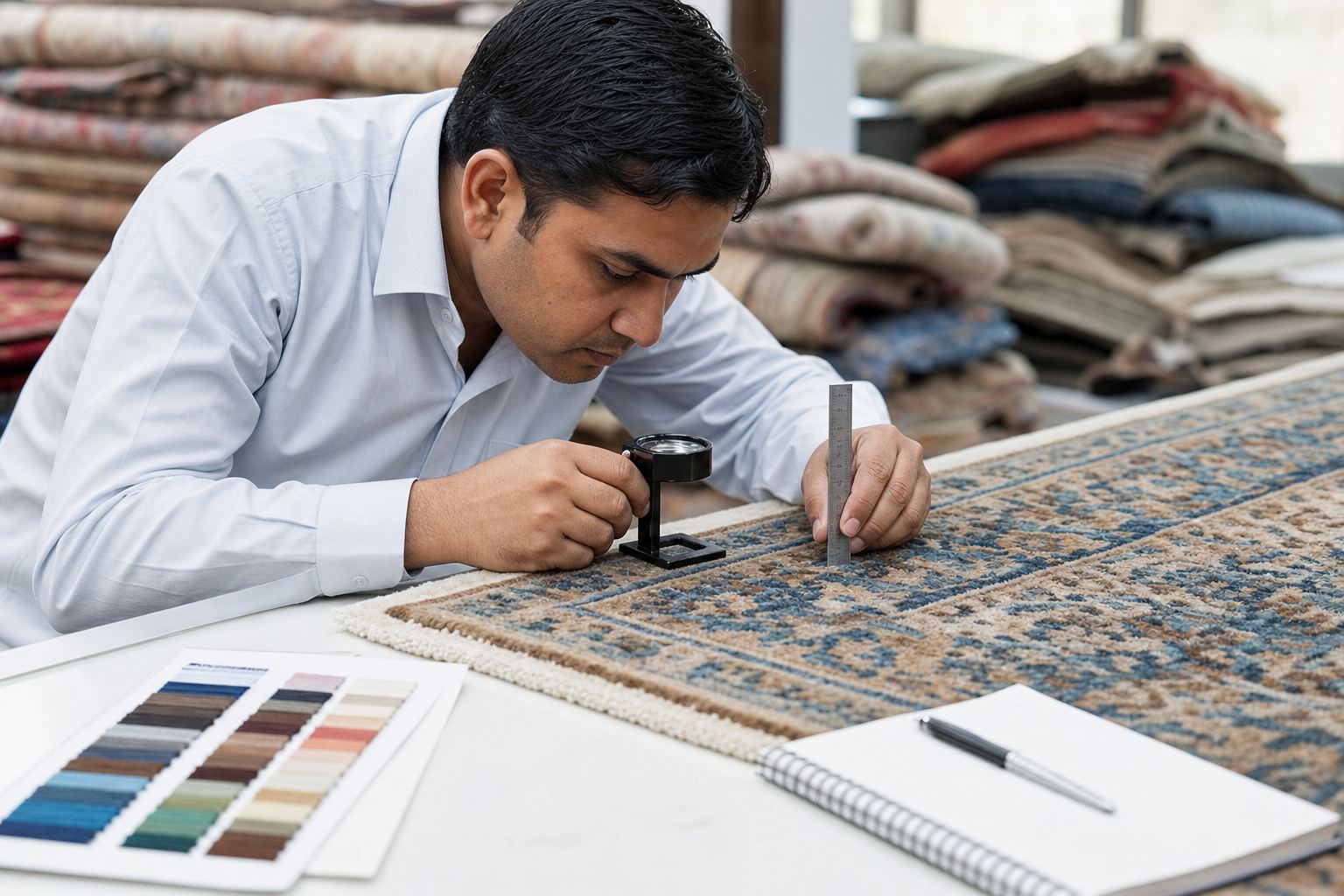
Knot density is the most abused specification in carpet export marketing. Buyers increasingly verify density against samples and against competing quotes. Exporters should photograph countable sections of the approved sample, record density in writing, and refuse to print inflated numbers on hangtags. A slightly lower honest density with consistent colour and finishing outperforms a inflated claim that fails incoming QC.
Pricing Analysis
Buyer Tip
Indicative FOB ranges for carpets and rugs vary widely by construction, fibre, knot density, size, finishing, and certification. The figures below are directional starting points for internal costing conversations — not fixed price lists. Always build from true ex-works cost (yarn, dyeing, labour, wash/finish, reject allowance) plus export packaging, inspection, inland haul, documentation, and exporter margin before quoting FOB or modelling CIF.
Indicative FOB ranges by construction (directional only; USD; India origin).
Swipe →
Data table — swipe horizontally on small screens
| Construction / tier | Indicative FOB basis | What moves price up or down |
|---|---|---|
| Hand-tufted wool (standard retail sizes) | Lower–mid USD per sq. ft / piece band | Pile height, backing, design complexity |
| Handloom kilim / dhurrie | Lower–mid band by size | Fibre, colour count, finishing |
| Hand-knotted wool (commercial density) | Mid–upper band by sq. ft | KPSI, size, wash/antique finish |
| Fine hand-knotted / silk accents | Premium band | Density, silk content, Kashmir/Bhadohi positioning |
| GI-linked / certified social-compliance lines | Premium to equivalent uncertified | Audit scope, traceability, labelling |
FOB vs CIF quoting discipline
Quote FOB when the buyer controls freight and insurance; quote CIF only when you can lock freight and cargo insurance accurately for the destination. Never blur Incoterms in email threads. A common first-order dispute is a "CIF-sounding" price that was actually calculated as FOB, leaving the buyer surprised by ocean freight. State currency, Incoterm, load port, validity date, and MOQ break points on every written quotation.
MOQ Analysis
Buyer Tip
- Publish MOQ breaks so programme orders earn better pricing than one-off trials
- Do not accept unrealistic MOQs that force quality shortcuts on knotting or finishing
- For mixed containers, agree SKU-level minimums so packing lists stay auditable
Minimum order quantities in carpet export depend on construction and whether the design is stock or custom. Hand-tufted volume lines can often start lower in piece count than fine hand-knotted custom colourways that require dedicated dyeing and long loom time. Buyers requesting mixed sizes across many SKUs should expect higher MOQs or longer lead times.
Typical MOQ bands (indicative; negotiate per factory capacity).
Swipe →
Data table — swipe horizontally on small screens
| Product type | Typical MOQ guidance | Notes for first orders |
|---|---|---|
| Stock hand-tufted designs | Often tens of pieces per size/colour | Good trial path for retail tests |
| Custom tufted private label | Higher piece counts per colourway | Dye and backing setup drive MOQ |
| Kilim / dhurrie programmes | Design- and colour-dependent | Lock colourways before loom allocation |
| Hand-knotted commercial | Often smaller piece counts but long lead times | MOQ is as much about loom months as piece count |
| Fine / silk-accent knotted | Low piece count, high value | Sample deposit and staged payments common |
Packaging Standards
Export Tip
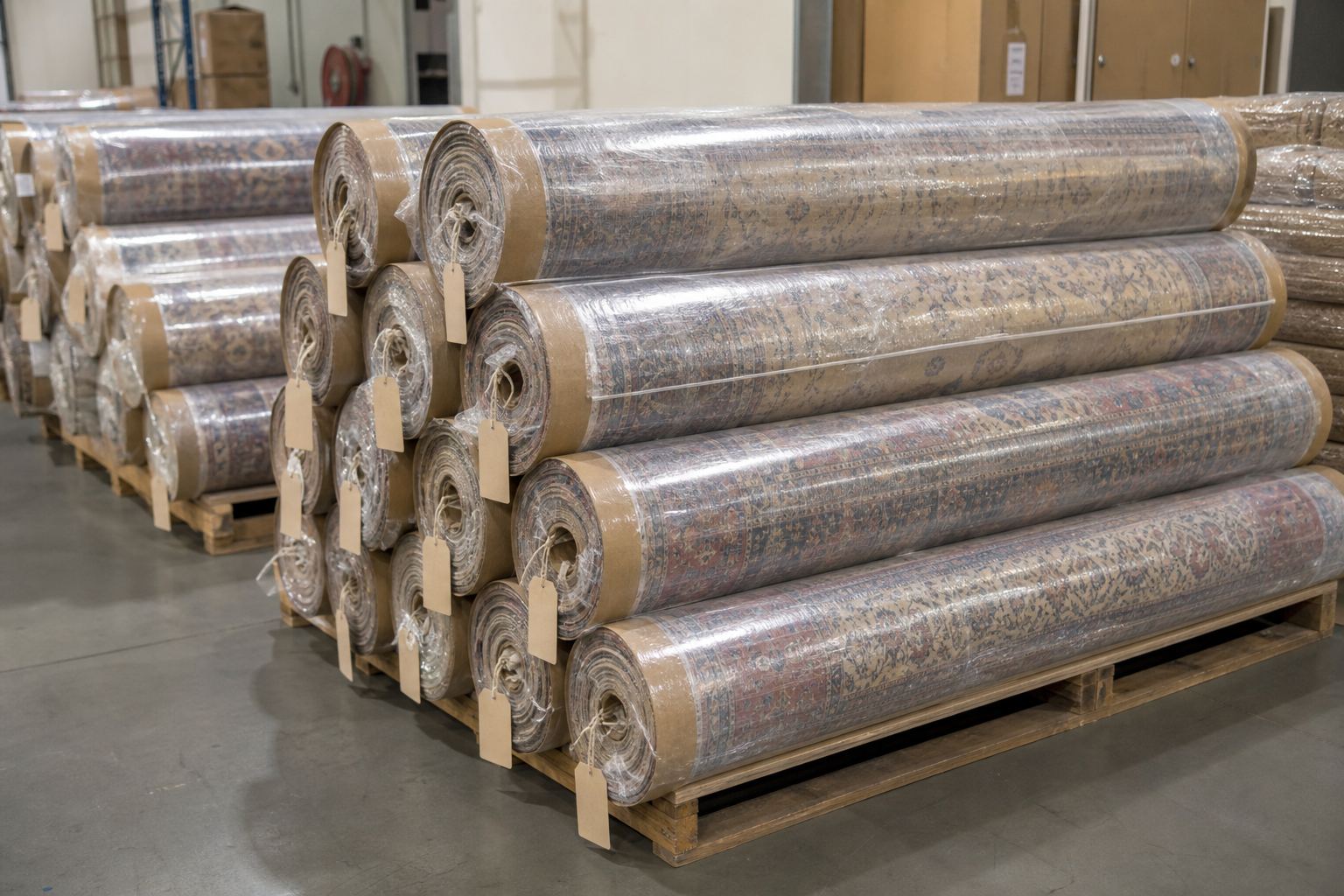
Packaging is part of the product for carpet and rug exports. Pile compression, edge abrasion, moisture staining, and label loss destroy first-order trust faster than a modest FOB disagreement. Export packing typically combines poly wrapping or bags, edge/corner protection where needed, moisture-aware barriers for humid routes, clear SKU and roll identification, and outer cartons or bales engineered for fork and container handling.
Packaging checklist for carpet/rug export lots.
Swipe →
Data table — swipe horizontally on small screens
| Element | Purpose | Failure mode if skipped |
|---|---|---|
| Poly / moisture barrier | Humidity and dust protection | Stains, odour, mildew risk |
| Edge / corner protection | Abrasion control in handling | Frayed edges, returns |
| SKU / roll ID labels | Warehouse and customs clarity | Mis-picks, document mismatch |
| Fibre & care hangtags | Retail and import labelling | Customs hold, retailer chargebacks |
| Outer carton / bale strength | Stack and fork durability | Crushed pile, claims |
Retail vs wholesale packing
- Individual poly wrap for each rug with hangtag and care/fibre labels visible or bagged with the piece
- Roll packing with pile protected inward or per buyer packing instruction — never leave pile exposed to carton abrasion
- Master cartons or bales with waterproof outer layers for ocean transit where humidity risk is high
- Photograph approved packing configuration and keep it as the packing SOP for every repeat lot
Labelling on the pack
Destination labelling often requires fibre content, country of origin, size, care instructions, and sometimes flammability or other market-specific statements. Social-compliance programme marks (where licensed) must only appear when the shipment is within scope. Incorrect fibre percentages on labels are a frequent customs and retailer compliance failure.
Container Loading Details
Export Tip
- Create a load plan diagram before stuffing day
- Record net/gross weights that reconcile with the packing list
- Use desiccants or moisture control where route humidity warrants it
- Seal container with recorded seal number on documents and photos
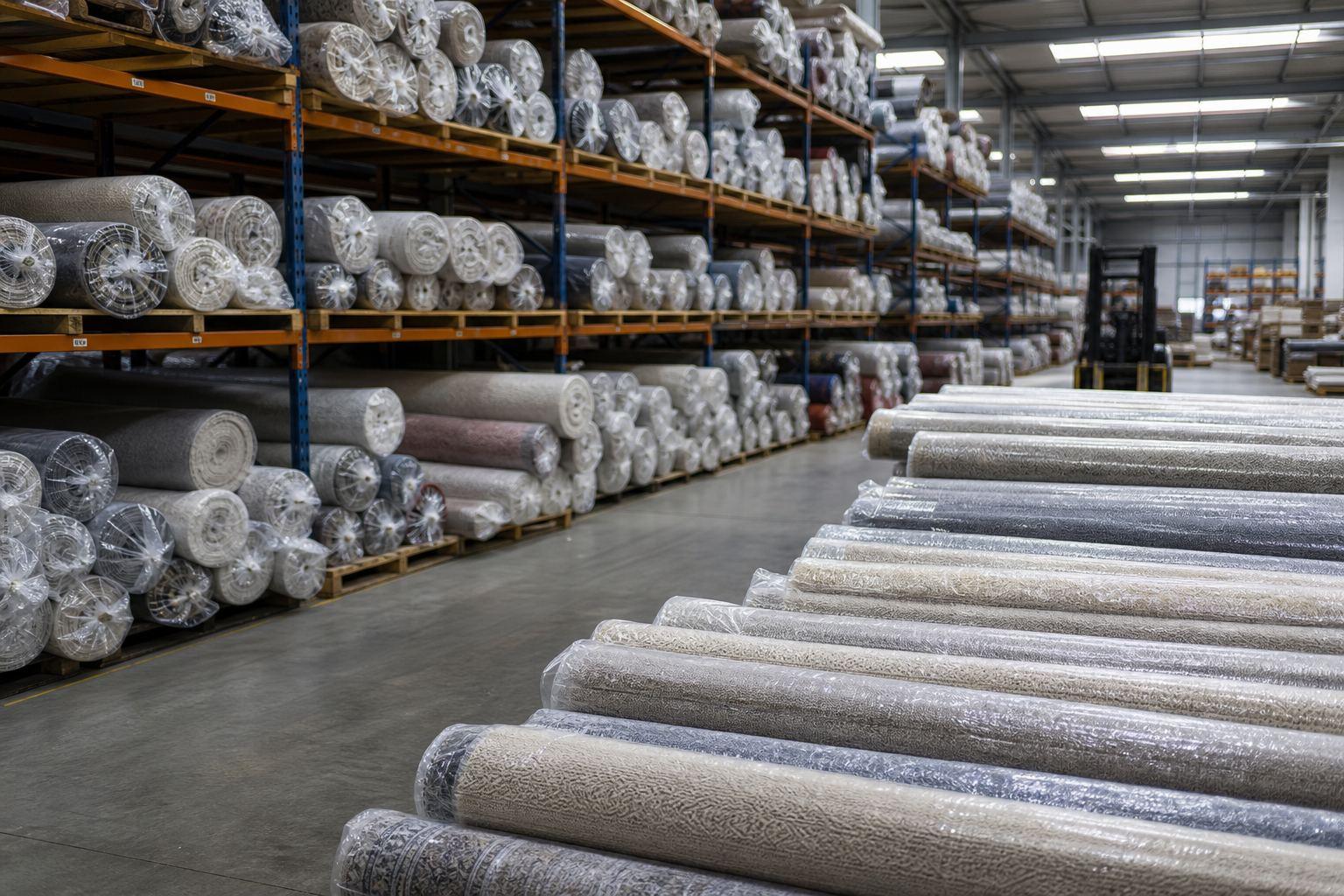
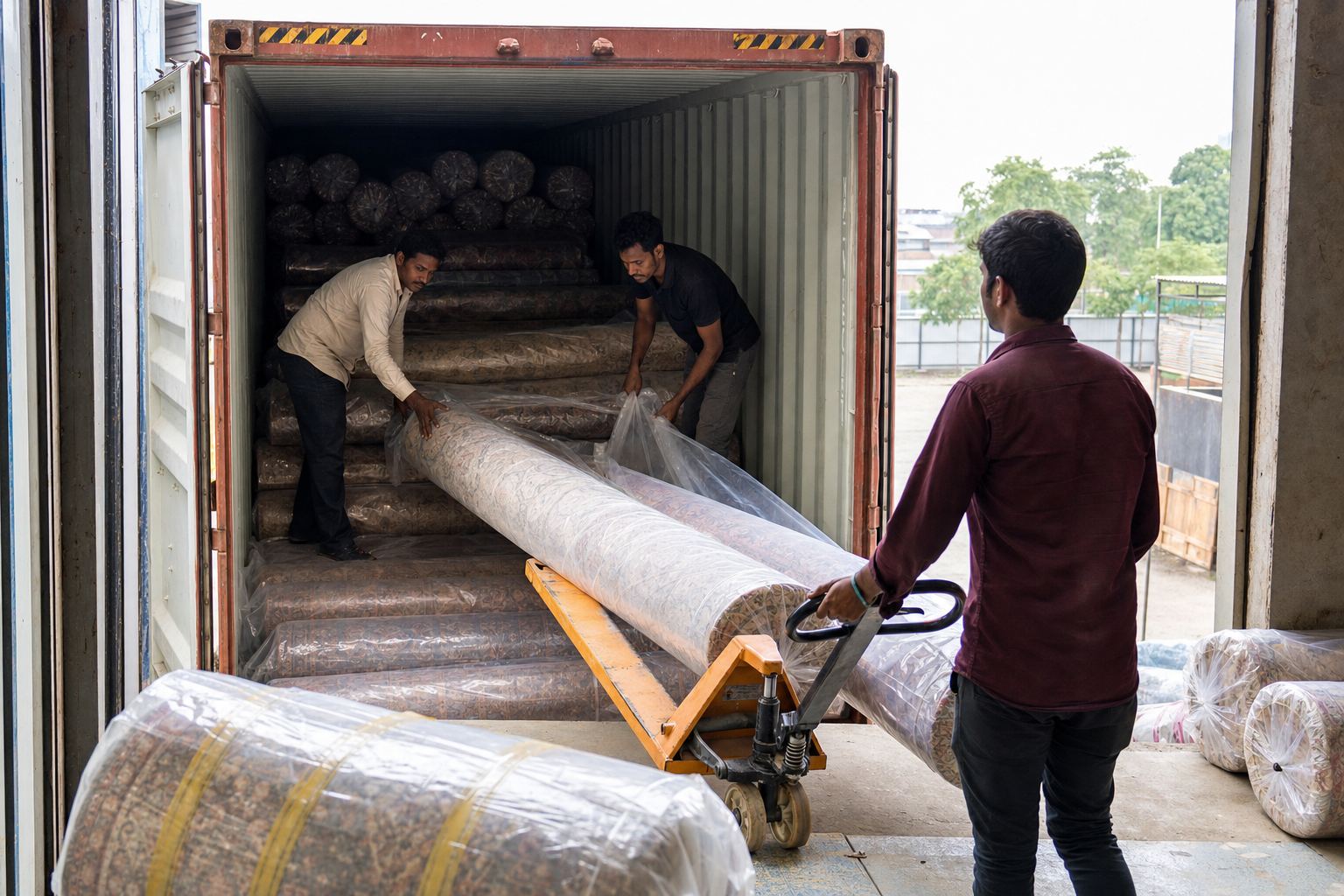
Stuffing carpets well means protecting pile and edges while preserving a countable load. Stagger rolls and cartons so lower tiers are not crushed, keep SKU and roll IDs readable for quantity checks, and brace against shifting on long ocean legs. Published pieces-per-container figures are only planning guides — actual fill depends on size mix, roll diameter, cartonisation, and whether you load a 20-foot trial or a 40-foot programme FCL.
Indicative container planning notes (verify with forwarder and actual cube).
Swipe →
Data table — swipe horizontally on small screens
| Container | Typical use case | Planning notes |
|---|---|---|
| 20' FCL | Trial or focused SKU sets | Easier quantity control; watch crush on lower rolls |
| 40' FCL / HQ | Programme replenishment | Higher cube; enforce stacking SOP and dunnage |
| LCL | First samples / small trials | Higher handling risk — upgrade inner protection |
| Mixed SKU FCL | Assorted sizes/colours | Strict packing list by roll ID; photo load plan |
Shipping Methods
Export Tip
Most commercial carpet and rug consignments move by sea freight. LCL suits first trials and sample-heavy assortments; FCL suits established distributor and retailer programmes once cube and value justify a full container. Air freight is reserved for urgent samples, high-value compact pieces, or emergency replenishment — not for routine volume.
Incoterms for first shipments
- State Incoterm, named place/port, and currency on every quote and PO acknowledgement
- Align payment terms (advance + balance against B/L copy is common for new buyers) with shipment risk
- Share draft documents with the buyer's broker before cutoff whenever possible
FOB Indian load port is the cleanest learning path for many MSMEs: you control export clearance and on-board delivery; the buyer controls main carriage and insurance. CIF destination port can be offered when you have freight contracts and can price insurance accurately. Avoid DDP on early shipments unless you truly understand destination import VAT, duties, and broker relationships.
Ports and inland movement
Carpet programmes from the northern belt typically move through inland container depots and load ports serving north and west India. Exact port choice depends on inland freight economics, container availability, and buyer routing preferences. Build inland haul time into the production calendar so washing and packing are not rushed into the last forty-eight hours before cutoff.

Certifications
Compliance Notes
Certification requirements for carpets and rugs are construction- and market-specific. Unlike food categories, the carpet process stack centres on social compliance, chemical safety where fibres and finishes warrant it, quality-system credibility, and destination labelling accuracy — not agricultural board registrations.
Carpet-relevant certifications and programmes (indicative).
Swipe →
Data table — swipe horizontally on small screens
| Credential | What it signals | Where buyers ask most |
|---|---|---|
| OEKO-TEX (where fibre/finish applies) | Harmful-substance limits on textiles | EU/UK specialty and retail programmes |
| GoodWeave (formerly RugMark) programmes | Child-labour-free / ethical production focus | USA and European retailers |
| ISO 9001 | Documented quality management | Vendor onboarding for larger importers |
| GI / origin documentation | Authentic regional construction claims | Premium handmade positioning |
| Destination fibre & care labelling | Legal retail labelling | USA, EU, UK, Australia |
Social compliance and chemical safety
US and European retailers increasingly require evidence of child-labour-free production through GoodWeave or comparable programmes. Budget audit readiness into programme pricing rather than scrambling after a purchase order arrives. Where wool, silk, or synthetic fibres and chemical finishes are used, OEKO-TEX or equivalent test evidence may be requested — especially for EU buyers sensitive to restricted substances.
What not to claim
Do not print certification marks you are not licensed to use. Do not claim GI status for goods produced outside the GI scope. Do not describe a tufted rug as hand-knotted. Misrepresentation is both a commercial and compliance risk that can end retailer relationships permanently.
Buyer Requirements
Buyer Requirements
- Written construction specs: fibre %, knot/stitch density, pile height, size tolerance, finishing
- Sealed/approved sample with photo record and signed approval form
- Clear MOQ, lead time, and Incoterm on every quotation
- Packing SOP with retail/wholesale labelling compliant for destination
- PSI access and right-to-reject language aligned with AQL or agreed visual standards
- Evidence of CEPC membership and IEC for credibility during vendor onboarding
- Social-compliance pathway (GoodWeave or equivalent) when selling into major retail
Serious carpet importers evaluate suppliers on sample fidelity, lead-time honesty, documentation maturity, and social-compliance readiness — not on the number of designs on a website. Understanding buyer requirements before outreach prevents wasted sampling cycles.
Country-wise Opportunities
Market Snapshot
Country selection for a first carpet export programme should be high-level and process-led. Choose one primary market whose compliance stack you can satisfy, plus one backup. Deep destination rankings belong in companion articles such as Best Countries for Indian Carpet and Rug Exports and Most Demanded Indian Carpets and Rugs by Country; this process guide only maps opportunity to operational readiness.
High-level market fit (process lens — not a ranking deep-dive).
Swipe →
Data table — swipe horizontally on small screens
| Market | Opportunity snapshot | Process priority |
|---|---|---|
| USA | Largest value share (~59% / ~USD 921M FY25) | Labelling, social compliance, PSI, knot honesty |
| Germany | ~USD 91.7M FY25; quality-led EU demand | Chemical/textile safety, size accuracy, docs |
| UK | ~USD 65.4M FY25; retail/wholesale | Fibre labelling, colour consistency |
| Other EU / hubs | Distribution and design wholesale | Uniform SKUs, REACH-aware finishes |
| UAE / others | Hospitality and wholesale décor | Lead times, humidity packing, Incoterms clarity |
How to choose without over-expanding
If your factory already ships to US importers with GoodWeave readiness, prioritise deepening that channel before opening three new geographies. If you are certification-light but strong on kilim design, a wholesale UK or Gulf trial may be a faster learning loop than a major US retailer RFP. Opportunity without process readiness is only a longer sample queue.
Sourcing Checklist
Checklist
- Verify IEC, GST, and CEPC membership of the exporting entity
- Visit or virtually audit loom sheds, wash houses, and finishing units tied to the PO
- Approve a sealed sample with knot density, pile height, fibre, size, and colour recorded
- Confirm HS heading (5701–5705) with the exporter's CHA before production
- Agree written lead time including washing, finishing, packing, and inland haul buffers
- Define PSI timing, inspector access, and acceptance criteria
- Lock Incoterms, payment terms, and document list in the PO
- Confirm packaging SOP and destination labelling proofs
- For GI claims, verify production geography and documentation trail
- Keep a single SKU master file shared by merchandising, production, and documentation teams
Whether you are an overseas buyer sourcing from India or an Indian merchant exporter consolidating loom capacity, use a sourcing checklist before money moves into bulk yarn and loom allocation.
Common Buyer Mistakes
Common Mistakes Box
- Approving a sample verbally without a sealed tag and photo record — Solution: written sample approval form before PO.
- Comparing quotes on FOB alone without matching knot density and pile height — Solution: score suppliers on identical written specs.
- Demanding retail lead times on fine hand-knotted pieces — Solution: separate tufted replenishment SKUs from knotted statement SKUs.
- Skipping social-compliance questions until after production starts — Solution: put GoodWeave requirements in the RFQ.
- Accepting vague HS descriptions on invoices — Solution: require 5701–5705 heading clarity before cargo booking.
- Ignoring packing photos until a damage claim arrives — Solution: make packing SOP part of sample approval.
- Mixing Incoterms across email threads — Solution: restate Incoterm on PO acknowledgement.
- Ordering too many SKUs on the first trial — Solution: narrow to a hero assortment that can be QC'd properly.
- Paying 100% advance to unverified entities — Solution: staged payments and exporter verification.
- Treating GI names as marketing adjectives — Solution: verify origin eligibility before hangtag print.
Most painful carpet import failures are process mistakes on the buyer side as much as loom mistakes on the supplier side. Avoid these patterns:
Future Market Trends
Key Statistics
Through the late 2020s, Indian carpet exports will be shaped less by novelty designs alone and more by traceability, social compliance, and specification transparency. Retailers and online brands want countable knot density, honest fibre content, and production pathways that can survive audits. Eco-forward dyes, traceable wool, and handwoven storytelling will continue to support premium positioning where evidence follows the narrative — see also Sustainable and Handwoven Carpet Export Opportunities.
Digital discovery is changing buyer outreach. Importers shortlist suppliers using shipment histories, certification databases, and CEPC fair follow-ups rather than relying only on a single annual brochure. Exporters with clean digital catalogues, accurate HS classification, and verifiable CEPC credentials will win more inbound RFQs than those competing purely on headline FOB.
Operationally, expect tighter incoming QC at destination warehouses: size scanning, shade comparison, and pile-height checks. Factories that invest in mid-production QC and packing engineering will convert more trials into replenishment programmes as global retailers diversify handmade floor-covering supply.
Export Process Step-by-Step
Export Tip
The following sequence is the practical operating system used by successful Indian carpet and rug exporters. Complete the steps in order. Skipping CEPC readiness, sample lock, or PSI to "save time" almost always costs more at the first customs hold, buyer rejection, or in-transit damage claim.
First-shipment document control matrix.
Swipe →
Data table — swipe horizontally on small screens
| Document | Owner | Must match |
|---|---|---|
| Commercial invoice | Exporter | SKU specs, value, Incoterm, HS heading |
| Packing list | Exporter | Roll/piece count, weights, dimensions |
| Shipping bill | Exporter + CHA | Invoice description and quantities |
| Bill of lading / AWB | Carrier / forwarder | Consignee, notify party, seal/container |
| Certificate of origin | Chamber / authorised agency | Origin and product description |
| Compliance certificates | Exporter / certifier | Scope covering actual producing units |
Step 1: Lock your product range and HS headings
Select three to eight reproducible SKUs across knotted, woven, or tufted constructions. Assign each SKU a working HS heading under 5701–5705 and confirm with your CHA before any shipping bill is drafted.
Step 2: Obtain IEC from DGFT
Apply for an Import Export Code on the DGFT portal. IEC is mandatory for shipping-bill filing and for operating as a recognised exporter during buyer due diligence. Keep PAN, bank, and address details consistent with GST records.
Step 3: Register with CEPC
Join the Carpet Export Promotion Council and complete RCMC formalities as applicable. CEPC membership signals category seriousness, unlocks council exhibitions and intelligence, and is frequently requested during vendor onboarding. For benefits detail, see CEPC Registration Benefits for Carpet Exporters.
Step 4: Complete GST and zero-rating setup
Ensure GST registration supports export of goods, including LUT or bond pathways where eligible. Align invoice HSN fields with Chapter 57 classifications before the first shipping bill.
Step 5: Develop and approve samples
Produce samples that represent true bulk capability — not heroic one-off pieces. Record knot density, pile height, fibre, size, and colour. Obtain written buyer approval and seal a retained counter-sample in your factory.
Step 6: Confirm PO, Incoterms, and payment terms
Convert the approved sample into a purchase order that restates specs, MOQ, lead time, Incoterm (FOB/CIF), payment structure, packing, and document list. Do not start bulk yarn dyeing on email intent alone.
Step 7: Produce with mid-line QC
Run in-process checks on density, pile height, shade, and size — not only a final glance before packing. Quarantine non-conforming pieces before washing and finishing consume more cost.
Step 8: Pre-shipment inspection (PSI)
Invite the buyer's inspector or a mutually agreed third party to verify the sealed-sample match, quantities, labelling, and packing. Resolve findings before container stuffing.
Step 9: Documentation set
Prepare commercial invoice, packing list, shipping bill, bill of lading or airway bill, certificate of origin, and any social-compliance or test certificates required by the PO. Descriptions and quantities must match across every document. Use the companion Carpet and Rug Export Documentation Checklist.
Step 10: Ship and hand over cleanly
Stuff to the approved load plan, record seal numbers, transmit documents and packing photos to the buyer/broker, and track sailing. Capture lessons learned into the SKU master file before the next PO.
Buyer Checklist + Exporter Checklist + Compliance Checklist
Checklist
Compliance Notes
Use the three checklists below as gates. A shipment should not sail until buyer, exporter, and compliance owners have each cleared their list.
Buyer checklist
Exporter checklist
Compliance checklist
Conclusion
Learning how to export carpets and rugs from India is less about finding a secret buyer list and more about building a repeatable export operating system: the right constructions, IEC and CEPC credentials, GST-ready invoicing, honest HS 5701–5705 classification, knot-density integrity, engineered packaging, PSI discipline, and documents that clear customs the first time. India's USD 1.54 billion FY25 carpet export base — with the USA, Germany, and the UK as major demand centres — remains open to manufacturers and MSMEs who treat specification honesty as seriously as loom craftsmanship.
The process is clear and repeatable: registrations, sealed samples, written POs, mid-line QC, PSI, and clean shipping. Best practices favour narrow assortments, FOB/CIF clarity, and programme buyers over one-off deals chased at fair-week discount pricing. If you are ready to move, complete your registrations, lock a tight sample kit, and start structured outreach this quarter.
International buyers and Indian manufacturers can work with Altus Exports for accountable carpet programmes — from cluster sourcing through documentation and first shipment. Start a conversation via our contact page, explore merchant exporter services, or engage us as your global sourcing partner in India.