
CEPC Registration Benefits for Carpet & Rug Exporters
By Saurabh Mittal, Founder, Altus Exports
A complete guide to Carpet Export Promotion Council (CEPC) registration for Indian carpet and rug exporters — founded in 1982 under the Ministry of Textiles, RCMC pathways, membership steps, India Carpet Expo access, Market Access Initiative schemes, and how council credibility shortens vendor onboarding with US and EU buyers. Includes market size, export and import statistics, product categories, manufacturing clusters, pricing, MOQ, packaging, container loading, shipping, certifications, checklists, and Altus Exports advisory context for MSMEs.
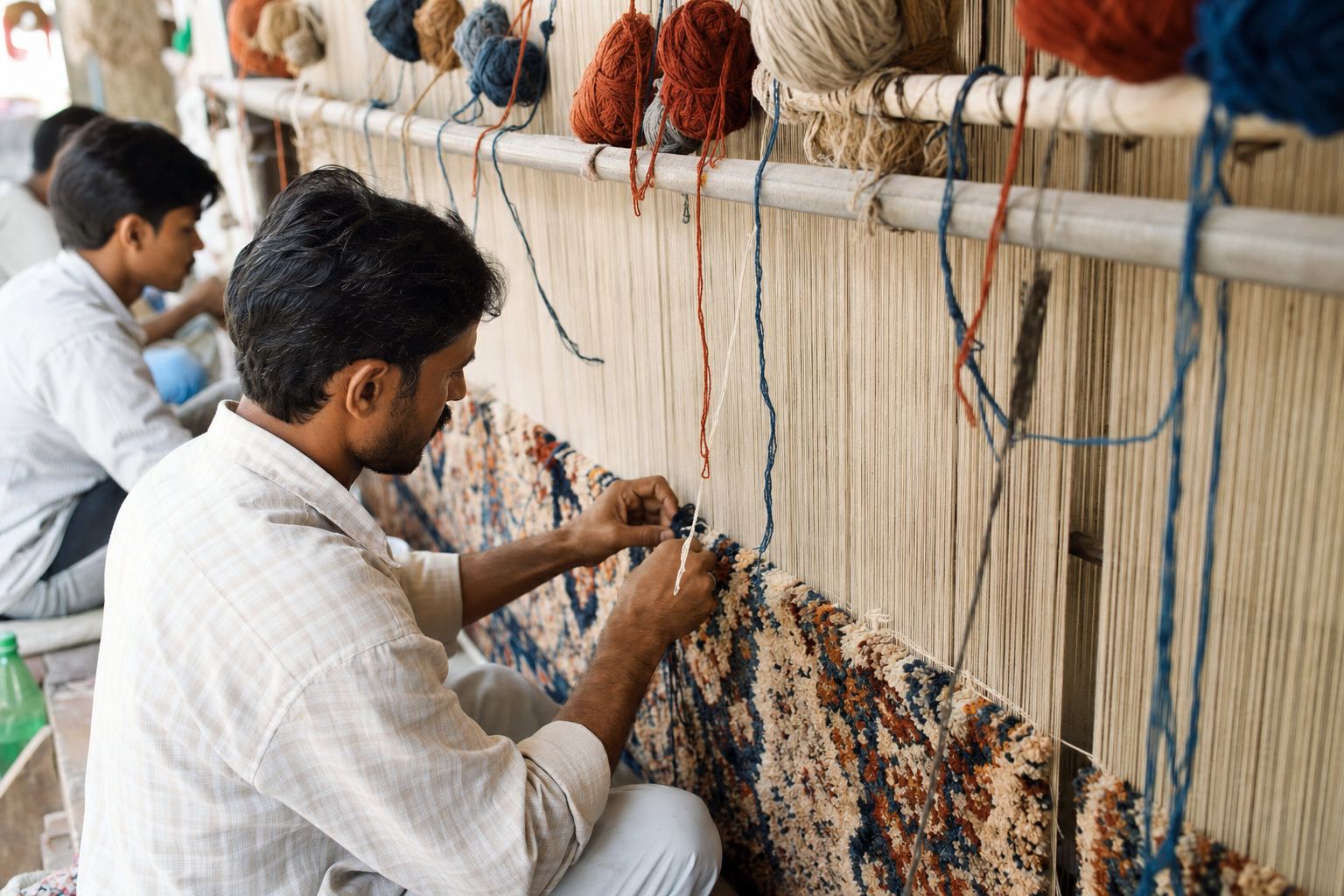
India's handmade carpet and rug industry is one of the country's most distinctive soft-goods export categories — rooted in Bhadohi–Mirzapur looms, Kashmiri knotting traditions, Jaipur tufting capacity, and complementary clusters that supply wool, silk, viscose, and cotton floor coverings to retailers, wholesalers, and hospitality buyers worldwide. Yet moving a container of hand-knotted or hand-tufted rugs from an Uttar Pradesh loom shed to a showroom in Hamburg, Atlanta, or Dubai requires more than weaving skill. International buyers increasingly qualify suppliers against a documented institutional framework before they invest time in design reviews, sample approvals, or factory audits.
For Indian carpet and rug exporters, that institutional framework centers on the Carpet Export Promotion Council (CEPC) — established in 1982 by the Ministry of Textiles, Government of India, to promote the export of handmade carpets, rugs, floor coverings, and allied products. CEPC registration is not a decorative certificate. It unlocks Registration-cum-Membership Certificate (RCMC) pathways, India Carpet Expo participation, Market Access Initiative (MAI) scheme support for overseas fairs, market intelligence, directory visibility, and the organised-exporter identity that US and EU procurement teams use during vendor onboarding.
This guide explains what CEPC is, why membership specifically benefits carpet MSMEs and manufacturer-exporters, how the application process works, how RCMC fits into export documentation and scheme claims, and how Altus Exports helps members navigate registration alongside product readiness. It also includes market size, trade statistics, product, pricing, MOQ, packaging, container loading, shipping, and certification data so the article meets a full export content brief — with those commercial layers kept carpet-specific and secondary to the CEPC narrative. Pair it with how to export carpets and rugs from India and the carpet and rug export documentation checklist. Always verify current fees and portal steps on cepc.co.in and dgft.gov.in, as administrative workflows evolve.
Key Takeaways
Summary Box
Executive Summary
Summary Box
Indian carpet and rug exports compete globally on craftsmanship depth, design range, and the ability to execute both heritage hand-knotted programmes and contemporary hand-tufted or handloom assortments at scale. Buyers in the United States, Germany, the United Kingdom, the Netherlands, Australia, and the UAE evaluate suppliers on construction quality, fibre honesty, lead-time reliability — and, increasingly, institutional compliance evidence before confirming a first purchase order.
CEPC registration sits at the centre of that institutional evidence for the carpet category. Membership and RCMC status determine fair access, MAI scheme eligibility in many cycles, directory visibility, and the organised-exporter checkbox that appears on retailer and distributor vendor questionnaires. This guide walks through CEPC benefits and registration end to end, then contextualises the council narrative against market size, trade statistics, product specifications, pricing, packaging, and certification data that carpet sourcing teams still need on the same page.
Read this alongside top carpet and rug products exported from India for product ranking and best countries for Indian carpet and rug exports for market selection — this article focuses on the CEPC registration and institutional-benefits layer that underpins both.
What Is CEPC?
The Carpet Export Promotion Council (CEPC) is a non-profit export promotion body set up in 1982 by the Ministry of Textiles, Government of India, to promote and develop the export of handmade carpets, handmade knotted carpets, rugs, floor coverings, and other allied products from India. CEPC maintains a working presence in Delhi, a registered office in Noida (Uttar Pradesh), and regional offices in Bhadohi (Uttar Pradesh) and Srinagar (Jammu & Kashmir) — reflecting the geography of India's primary handmade carpet production belts. The council counts more than 2,000 members across the country.
Practically, CEPC functions across five areas that matter directly to carpet exporters: institutional credibility (membership signals organised export channels), RCMC issuance and renewal support within India's DGFT-linked export promotion architecture, market access (India Carpet Expo, overseas exhibitions, trade delegations, and buyer-seller meets), Market Access Initiative and related scheme facilitation for eligible promotional activities, and market intelligence plus directory visibility where international buyers and trade missions look first.
None of these functions replace what a loom unit or finishing facility must still get right — knot density accuracy, pile height consistency, fibre composition honesty, colourfastness, and packing that survives ocean freight. Together, however, they materially shorten the distance between a Bhadohi or Kashmir manufacturer and a serious international buyer who will not open a compliance file for an entirely unregistered workshop.
Market Size & Industry Overview
Key Statistics
For CEPC-registered carpet exporters, supply geography shapes both product capability and audit readiness. The Bhadohi–Mirzapur belt in Uttar Pradesh remains India's largest handmade carpet production cluster, spanning hand-knotted, hand-tufted, and handloom constructions. Kashmir specialises in fine hand-knotted wool and silk programmes. Jaipur and surrounding Rajasthan capacity is strong in hand-tufted and contemporary design assortments. Agra, Panipat, and related northern hubs contribute tufted, durrie, and volume floor-covering lines that feed wholesale and retail programmes.
Global demand for carpets and rugs is driven by residential retail, e-commerce home décor, hospitality and contract flooring, interior design wholesale, and renovation cycles in mature markets. India competes on handmade craftsmanship, design flexibility, and the ability to execute private-label programmes across wool, wool-blend, silk, viscose, cotton, and jute constructions — while buyers simultaneously tighten expectations around labour compliance, fibre disclosure, and sustainability claims.
Industry structure ranges from large integrated manufacturer-exporters with in-house design studios and finishing lines to MSME loom units and merchant exporters who consolidate multi-weaver output, manage documentation, and coordinate buyer relationships. CEPC membership status is one of the clearest early signals buyers use to distinguish organised, export-ready capacity from informal domestic-market-only production.
Comparison table
Swipe →
Data table — swipe horizontally on small screens
| Production Cluster | State / Region | Primary Specialisation | Export Role |
|---|---|---|---|
| Bhadohi–Mirzapur | Uttar Pradesh | Hand-knotted, hand-tufted, handloom wool and blend rugs | Primary handmade carpet export hub |
| Kashmir (Srinagar belt) | Jammu & Kashmir | Fine hand-knotted wool and silk carpets | Premium and heritage programmes |
| Jaipur and surrounds | Rajasthan | Hand-tufted contemporary rugs, design-led assortments | Design and private-label programmes |
| Agra | Uttar Pradesh | Hand-knotted and tufted floor coverings | Traditional and mid-market export lines |
| Panipat | Haryana | Tufted, durrie, and volume floor coverings | Volume and wholesale programmes |
| Varanasi and eastern UP feeders | Uttar Pradesh | Weaving and finishing support capacity | Cluster feeder and consolidation |
Export Statistics
Key Statistics
Indian carpet and rug exports move primarily under HS headings 5701–5705, covering knotted, woven, tufted, felt, and other floor coverings. Exact annual values fluctuate with destination demand, freight markets, and fibre prices, but India remains a globally significant origin for handmade carpets — with the United States and European Union accounting for a large share of value, and the UAE, Australia, Canada, and Japan contributing additional programme volume. Directional figures below illustrate typical shipment patterns; confirm current-year data against DGCI&S, ITC Trade Map, and CEPC trade updates before investment decisions.
Comparison table
Swipe →
Data table — swipe horizontally on small screens
| Metric | Indicative Position (2024–2026) | Notes |
|---|---|---|
| Primary HS coverage | 5701–5705 | Knotted, woven, tufted, felt, and other carpets/rugs |
| HS 5701 | Carpets and other textile floor coverings, knotted | Hand-knotted wool/silk programmes |
| HS 5702 | Woven carpets and floor coverings (not tufted/flocked) | Handloom, kilim, durrie-type constructions |
| HS 5703 | Tufted carpets and textile floor coverings | Hand-tufted and machine-tufted volume lines |
| Leading export destinations | USA, Germany, UK, UAE, Netherlands, Australia | Confirm ranking annually via trade data |
| Leading production region | Bhadohi–Mirzapur (Uttar Pradesh) | Largest handmade carpet cluster |
| Typical shipment mode | Sea freight FCL/LCL | From Mundra, Nhava Sheva, and ICD-linked routing |
| CEPC role | Category council + RCMC + India Carpet Expo | Membership supports organised market access |
Import Statistics
Key Statistics
On the demand side, carpet and rug importers concentrate among home-furnishing retailers, e-commerce platforms, wholesale distributors, interior design trade channels, and hospitality procurement bodies in markets with strong residential and renovation demand. The table below summarises directional import intensity for destinations relevant to Indian handmade and tufted programmes.
Comparison table
Swipe →
Data table — swipe horizontally on small screens
| Country / Region | Import Intensity | Primary Use Case |
|---|---|---|
| USA | Very High | Residential retail, e-commerce, wholesale — broad construction mix |
| Germany | High | EU gateway; design-led and quality-conscious programmes |
| United Kingdom | High | Retail and trade channels; traditional and contemporary rugs |
| Netherlands | Medium–High | EU distribution hub and re-export logistics |
| UAE / GCC | Medium–High | Hospitality, villa, and wholesale floor-covering demand |
| Australia | Medium–High | Residential retail; wool and contemporary tufted lines |
| Canada | Medium | Retail and wholesale programmes aligned to North American tastes |
| Japan | Medium | Premium, precise-specification hand-knotted and design rugs |
Product Categories / Variants
Summary Box
Carpet and rug exports from India span multiple constructions and fibre stories. Understanding which category a buyer needs shapes loom allocation, knot density or gauge targets, finishing, labelling, and packaging. For a full ranked product breakdown, see top carpet and rug products exported from India — this guide keeps product ranking light and focuses on how CEPC registration applies across all forms.
Comparison table
Swipe →
Data table — swipe horizontally on small screens
| Category | Typical Construction | Primary Buyer Use |
|---|---|---|
| Hand-knotted wool | Persian/Tibetan knot densities by programme | Premium retail, designer, and heirloom channels |
| Hand-knotted silk / silk-blend | Fine knotting; higher value density | Luxury residential and specialty retail |
| Hand-tufted wool / blend | Tufted pile with latex/backing systems | Mid-to-upper retail and private label |
| Handloom / flatweave / kilim | Woven flat constructions | Casual residential, layered décor programmes |
| Durrie / cotton rugs | Flatwoven cotton or blend | Volume retail and seasonal assortments |
| Viscose / art-silk accent rugs | Tufted or woven fashion constructions | Trend-led e-commerce and décor retail |
| Sustainable / handwoven eco lines | Traceable wool, eco dyes, artisan programmes | Premium EU/US sustainability channels |
Manufacturing Overview
Export Tip
Handmade carpet production typically begins with design development (or buyer artwork adaptation), yarn sourcing and dyeing, loom allocation, weaving or tufting, washing and finishing, binding/serging, inspection, and export packing. Hand-knotted programmes require longer lead times and tighter knot-density control; hand-tufted programmes turn faster but demand disciplined backing, latex curing, and dimensional stability checks. Flatweaves and durries follow woven process flows with different finishing and packing constraints.
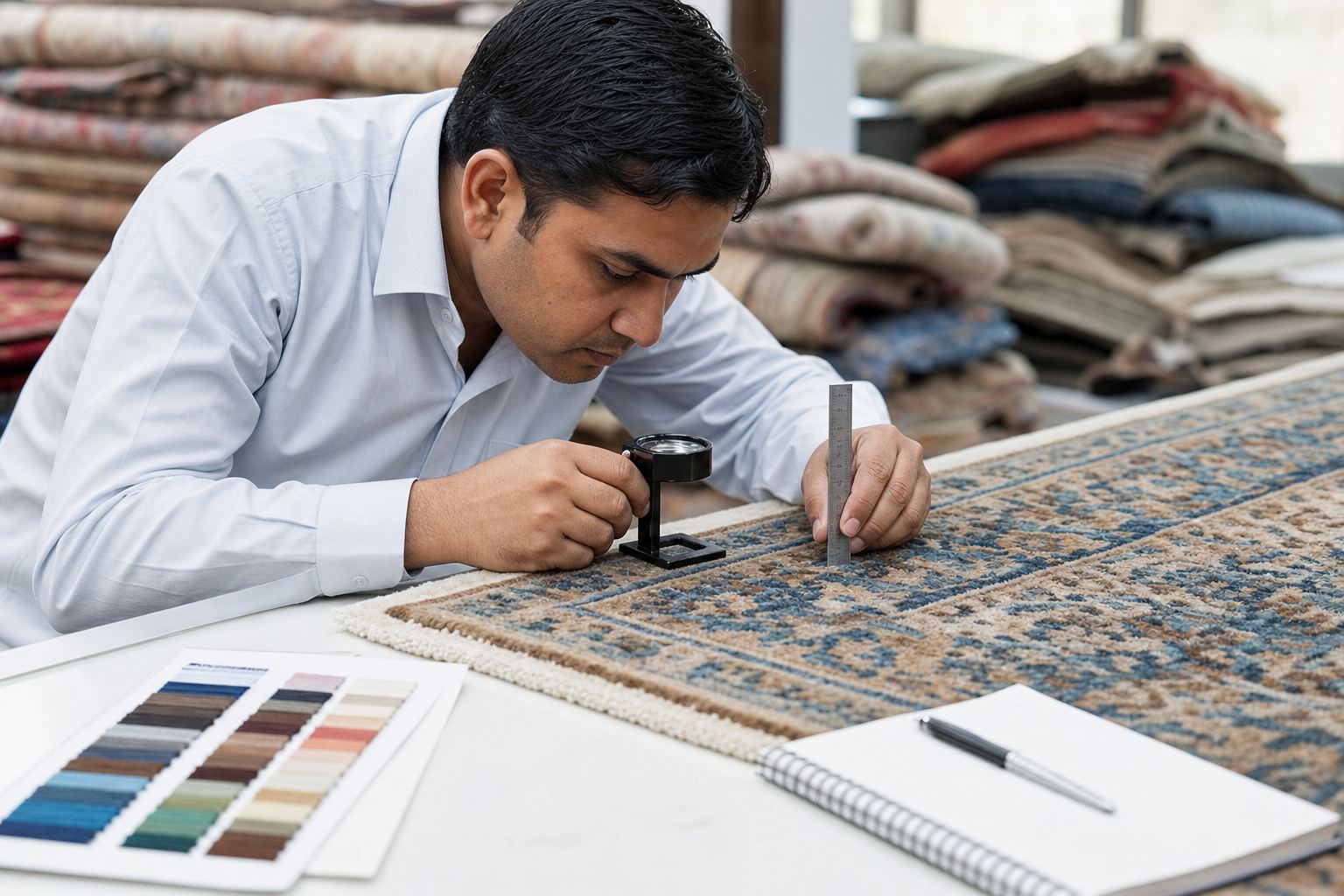
Export-oriented units maintain design locks and sample approval records, fibre composition and construction specification sheets, colourfastness and dimensional checks where buyers require them, and documented labour-compliance practices. Buyers evaluating a new Indian carpet supplier typically request loom capacity evidence, finishing capability, prior export references, and a clear statement of knot density or gauge — before committing to a trial assortment.
CEPC registration does not certify weaving quality directly, but registered exporters are more likely to operate under the documented commercial discipline that serious buyers expect — because membership itself required assembling entity, IEC, and compliance documentation as a precondition.

Why CEPC Membership Matters for Carpet Exporters
Carpets sit in a category where remote quality assessment is difficult: knot density claims, fibre composition, pile height, and colourfastness cannot be verified from a PDF catalogue alone. In that environment, third-party institutional signals carry outsized weight during initial vendor screening — before a buyer invests in factory visits, sample evaluation, or third-party inspection.
CEPC membership functions as one of those early screening signals. Sourcing managers building approved-vendor shortlists for a US big-box home programme, a German wholesale distributor, or a UK interior trade brand frequently filter candidate factories by council membership before deeper diligence. For a Bhadohi MSME or Kashmir manufacturer competing for that shortlist slot, CEPC membership is a low-cost way to avoid being filtered out before the conversation starts.
Membership also opens India Carpet Expo participation frameworks, MAI-supported overseas fair pathways in eligible cycles, market intelligence on destination demand and compliance shifts, and peer networks of carpet exporters navigating the same buyer categories — rather than generic export advice pulled from unrelated product lines.
Comparison table
Swipe →
Data table — swipe horizontally on small screens
| Buyer Screening Stage | Where CEPC Membership Helps |
|---|---|
| Initial vendor longlist | Council membership filters you into the organised exporter pool |
| Fair and expo access | Membership supports India Carpet Expo and CEPC-linked overseas participation |
| Vendor onboarding questionnaires | Many buyer forms explicitly ask for council/RCMC status |
| MAI / promotional scheme claims | Category-aligned membership supports eligible market-access applications |
| Trade mission visibility | Council directories feed outbound missions and B2B matchmaking |
Who Should Register with CEPC?
- Hand-knotted and hand-tufted manufacturers in Bhadohi–Mirzapur with direct export ambition
- Kashmir wool and silk carpet producers seeking organised market access
- Jaipur and Rajasthan tufted/contemporary rug exporters
- Merchant exporters consolidating multi-cluster carpet assortments
- MSMEs and startups with IEC and GST readiness entering carpet exports
- Private-label floor-covering brands shipping from Indian loom capacity
CEPC membership is relevant for manufacturer-exporters of handmade carpets and rugs, merchant exporters consolidating multi-weaver supply, MSMEs and startups entering carpet exports with a valid IEC, design-led private-label programmes shipping floor coverings from India, and organised producer groups constituted as eligible business entities. Eligibility generally requires engagement in carpet/rug export activity and foundational documents — IEC, GST, and entity proofs — that match across records.
You can typically seek registration categories such as Manufacturer Exporter, Merchant Exporter, or Merchant-cum-Manufacturer depending on documents submitted. State your intended category clearly during application so RCMC scope aligns with how you actually operate.
Core Benefits of CEPC Registration
Treat CEPC benefits as a commercial toolkit. The certificate opens institutional doors; your samples, construction honesty, packaging, and response discipline close orders.
Comparison table
Swipe →
Data table — swipe horizontally on small screens
| Benefit | What You Gain | How to Use It for Carpets |
|---|---|---|
| RCMC issuance | Formal export-council credential for carpet category | Include in every buyer onboarding pack alongside IEC and GST |
| India Carpet Expo access | Flagship bi-annual handmade carpet fair in Bhadohi | Book early; prepare SKU sheets, MOQs, and sample binders |
| MAI / market access schemes | Partial support pathways for eligible overseas promotion | Apply before fair commitments; retain eligible invoices |
| Overseas fair & delegation support | Participation frameworks for Domotex and related shows | Use for US/EU buyer meetings after sample maturity |
| Market intelligence | Destination demand, tariff, and compliance updates | Prioritise 1–2 markets rather than scattering outreach |
| Exporter directory visibility | Discovery channel for buyers and trade missions | Keep product categories and contact details updated |
| Buyer credibility | Stronger vendor questionnaire outcomes | Attach membership/RCMC to inquiry responses and fair kits |
| MSME capacity building | Seminars, workshops, and peer learning | Send operations staff, not only owners |
| Policy advocacy channel | Council voice to Ministry of Textiles / trade policy | Raise cluster-level logistics and compliance issues through membership forums |
| GI and heritage promotion linkages | Support contexts for GI and craft storytelling | Use only with verified origin and construction claims |
CEPC Registration Process: Step-by-Step
Export Tip
New CEPC membership and RCMC-related filings commonly move through DGFT-linked e-filing pathways used across India's export promotion council system, with CEPC as the category council for carpets and rugs. Confirm live instructions on cepc.co.in and dgft.gov.in before payment — portal screens and checklists change over time.
Step 1: Obtain IEC and align GST
Apply for an Import Export Code on the DGFT portal if you do not already hold one. IEC is mandatory for commercial export and for serious council membership workflows. Keep PAN, bank, and address details consistent with GST records — mismatches are the most common delay trigger.
Step 2: Prepare documentation
Assemble entity-specific documents: IEC copy, GST certificate, PAN, cancelled cheque, bank financial soundness certificate where required, partnership deed or incorporation papers, board resolution/authorised signatory proofs for companies, address proof, and MSME Udyam plus manufacturing self-declaration where seeking manufacturer-exporter classification. Incomplete packs cause the majority of delays.
Step 3: Complete membership / RCMC application
File the membership/RCMC application through the current DGFT-linked or council-directed pathway using your DGFT login credentials. Select the correct exporter category and declare carpet, rug, and floor-covering product focus carefully — category accuracy affects RCMC scope and fair programme relevance.
Step 4: Upload documents and pay fees
Upload clear self-attested scans. Names, addresses, and signatory details must match IEC and GST exactly. Pay the prescribed enrollment amount online as directed and retain payment acknowledgements with your compliance file. Verify live fee amounts before remitting.
Step 5: Verification and approval
Respond quickly to deficiency queries — quiet applications age into avoidable delays. On approval, retain membership and RCMC records digitally and in print. Diary annual renewal dates; RCMC continuity commonly depends on timely membership renewal even within a multi-year certificate window.
Step 6: Align catalogue claims before outreach
Before referencing CEPC membership in buyer-facing materials, make sure construction claims, fibre composition language, knot-density or gauge figures, and photography are accurate. Membership invites closer scrutiny — a mismatch between your council-listed profile and your loom floor damages credibility faster than having no membership at all.
Documents Required for CEPC Registration
Use this checklist as a preparation gate before opening the portal. Exact requirements vary by proprietorship, partnership, company, or other eligible entity types — and by merchant versus manufacturer category.
Comparison table
Swipe →
Data table — swipe horizontally on small screens
| Document | Why It Matters | Practical Tip |
|---|---|---|
| IEC certificate | Proves export authority under DGFT | Self-attest; match legal name exactly |
| GST registration | Tax identity for commercial operations | Ensure address consistency with IEC |
| PAN | Entity tax identity | Must align with IEC applicant |
| Bank financial soundness certificate | Confirms banking relationship | Use the account reflected in IEC where required |
| Business registration proofs | Deed / incorporation / MoA-AoA as applicable | Notarise partnership deeds when required |
| Address proof | Establishes business location | Keep identical across GST and IEC |
| Cancelled cheque / bank proofs | Banking validation | Name must match entity |
| Authorised signatory KYC | Identity of authorised persons | Use current authorised signatory only |
| MSME Udyam + manufacturing declaration | Supports manufacturer-exporter category | Link NIC/product codes to carpet manufacturing |
| Code of conduct / undertakings (if required) | Mandatory membership declarations | Follow current stamp-paper and wording instructions |
RCMC for Carpet Exporters: What It Means
Compliance Notes
The Registration-cum-Membership Certificate (RCMC) formally recognises an exporter's registered status with the relevant export promotion council for their product category. For carpet and rug exporters, RCMC connected to CEPC membership supports export documentation packs, buyer vendor onboarding, applications for certain government export and market-access benefits, and documentary processes where institutional membership proof is requested by banks or buyers.
RCMC validity is commonly multi-year but subject to timely annual membership renewal. Lapsing membership can interrupt continuity even if the underlying certificate period has not fully expired. Keep RCMC with IEC and GST in a master compliance file accessible to your export desk, CHA, and commercial team. Treat renewal as a calendar-critical task — not an afterthought addressed when India Carpet Expo booking or a shipping deadline is already imminent.
India Carpet Expo, Domotex, and MAI Schemes
India Carpet Expo — organised by CEPC and held bi-annually with a primary venue footprint in Bhadohi — is Asia's leading dedicated handmade carpet fair and one of the highest-ROI member benefits for exporters who prepare properly. Buyers attend to source hand-knotted, hand-tufted, handloom, and allied floor coverings under one roof. Membership frameworks and timely booth booking matter; turning up without SKU sheets, MOQs, and follow-up discipline wastes the opportunity.
Overseas, Domotex (Hanover) and related specialised floor-covering exhibitions remain central meeting points for US and European importers. CEPC supports member participation in specialised global fairs and trade delegations, and Market Access Initiative (MAI) / related promotional schemes can partially offset eligible costs in approved cycles. Apply before committing spend; retain invoices and participation evidence. Pair fair strategy with trade shows for carpet and rug exporters and find international buyers for carpets and rugs.
Pricing Analysis
Buyer Tip
Carpet FOB pricing varies widely by construction, knot density or gauge, fibre, size assortment, finishing, and design complexity. CEPC membership does not set prices — but credible members should quote within realistic bands so fair conversations convert. Ranges below are indicative planning benchmarks only.
Comparison table
Swipe →
Data table — swipe horizontally on small screens
| Product Type | Indicative FOB Guidance | Key Price Driver |
|---|---|---|
| Hand-knotted wool (mid densities) | Programme-specific; often quoted per sq. ft / sq. m | Knot density, wool grade, design complexity |
| Fine hand-knotted / silk-blend | Premium multiple over standard wool knotted | Knot count, silk content, finishing |
| Hand-tufted wool / blend | Lower than comparable hand-knotted; volume-sensitive | Gauge, pile height, latex/backing quality |
| Handloom / kilim / flatweave | Competitive mid-market bands | Weave density, yarn type, size mix |
| Durrie / cotton rugs | Volume pricing; assortment-driven | Cotton quality, dyeing, packing density |
| Sustainable / traceable artisan lines | Premium over conventional equivalent | Traceability, eco dyes, certification costs |
MOQ Analysis
Buyer Tip
Minimum order quantities for carpets depend on construction and whether the buyer is sampling a new relationship or placing a seasonal programme. Merchant exporters consolidating multi-weaver capacity can often support smaller trial assortments than a single loom unit allocating capacity to one designway.
Comparison table
Swipe →
Data table — swipe horizontally on small screens
| Order Type | Typical MOQ | Use Case |
|---|---|---|
| Design / quality sample | 1–3 pieces per SKU (paid samples preferred) | Construction and colour validation |
| Trial assortment | 20–50 pieces mixed sizes/SKUs | First commercial order for mid-size buyers |
| Seasonal programme order | 100–500+ pieces depending on construction | Retail and wholesale replenishment |
| Hospitality / contract | Project-specific; often size-locked | Hotel and commercial fit-outs |
Packaging Standards
Export Tip
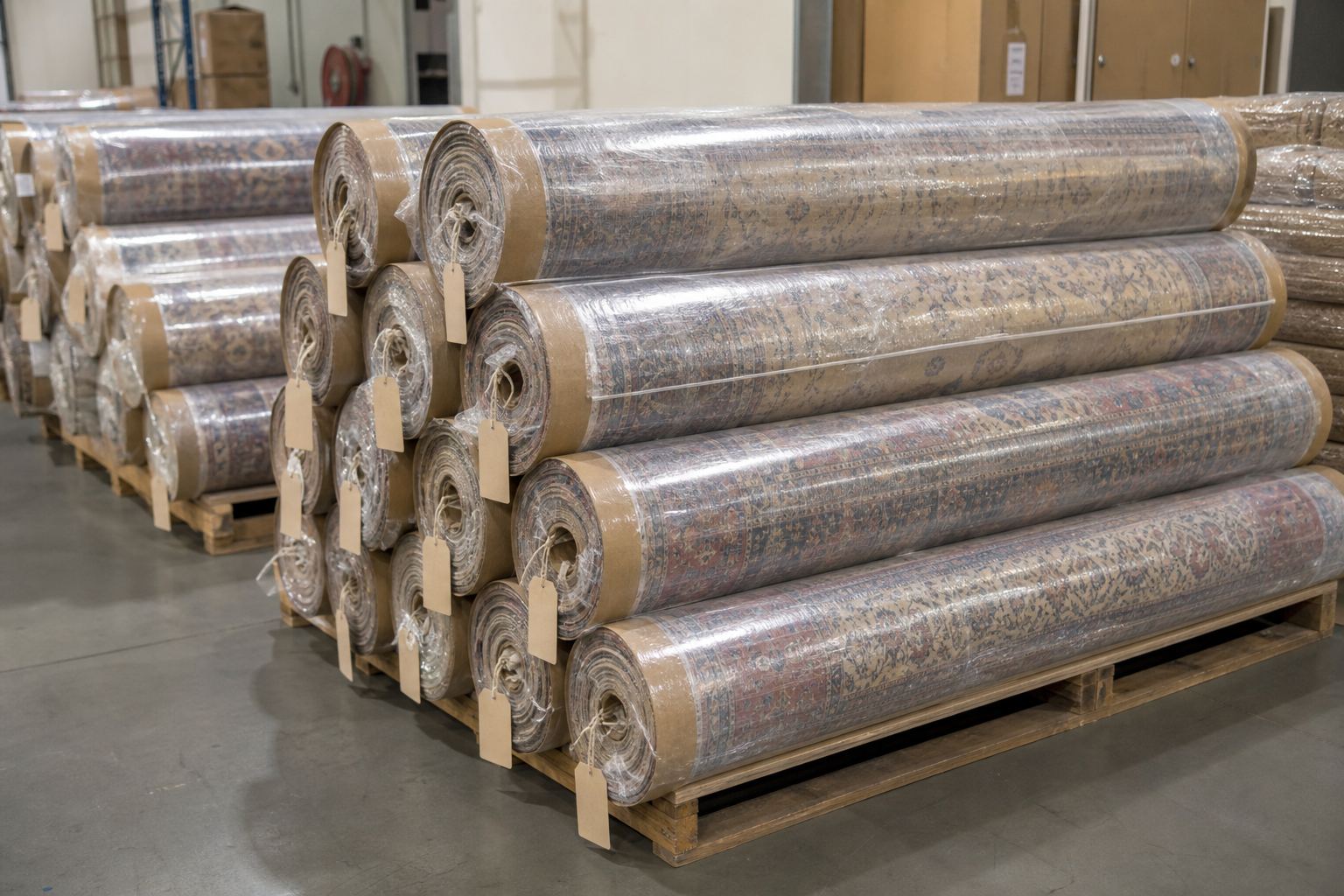
Carpet export packaging must protect pile, edges, and colour from compression damage, moisture, and warehouse handling across ocean transit. Rolled packing with protective wrap is standard for many constructions; flat-packed or bale methods apply to certain flatweaves and durries. Label each piece with construction, fibre, size, and order references buyers can scan at receipt.
Comparison table
Swipe →
Data table — swipe horizontally on small screens
| Packaging Format | Typical Use | Best Suited For |
|---|---|---|
| Poly/HDPE wrap + roll | Individual rug protection | Hand-knotted and hand-tufted pile rugs |
| Kraft/corrugated outer + roll | Added abrasion protection | Premium and long-haul FCL programmes |
| Bale / bundle packing | Space-efficient flat goods | Durries, kilims, flatweaves |
| Corner/edge guards | Edge protection in roll packs | High-value bound rugs |
| Desiccant + moisture barrier | Humidity control | Silk blends and moisture-sensitive finishes |
Container Loading Details
Export Tip
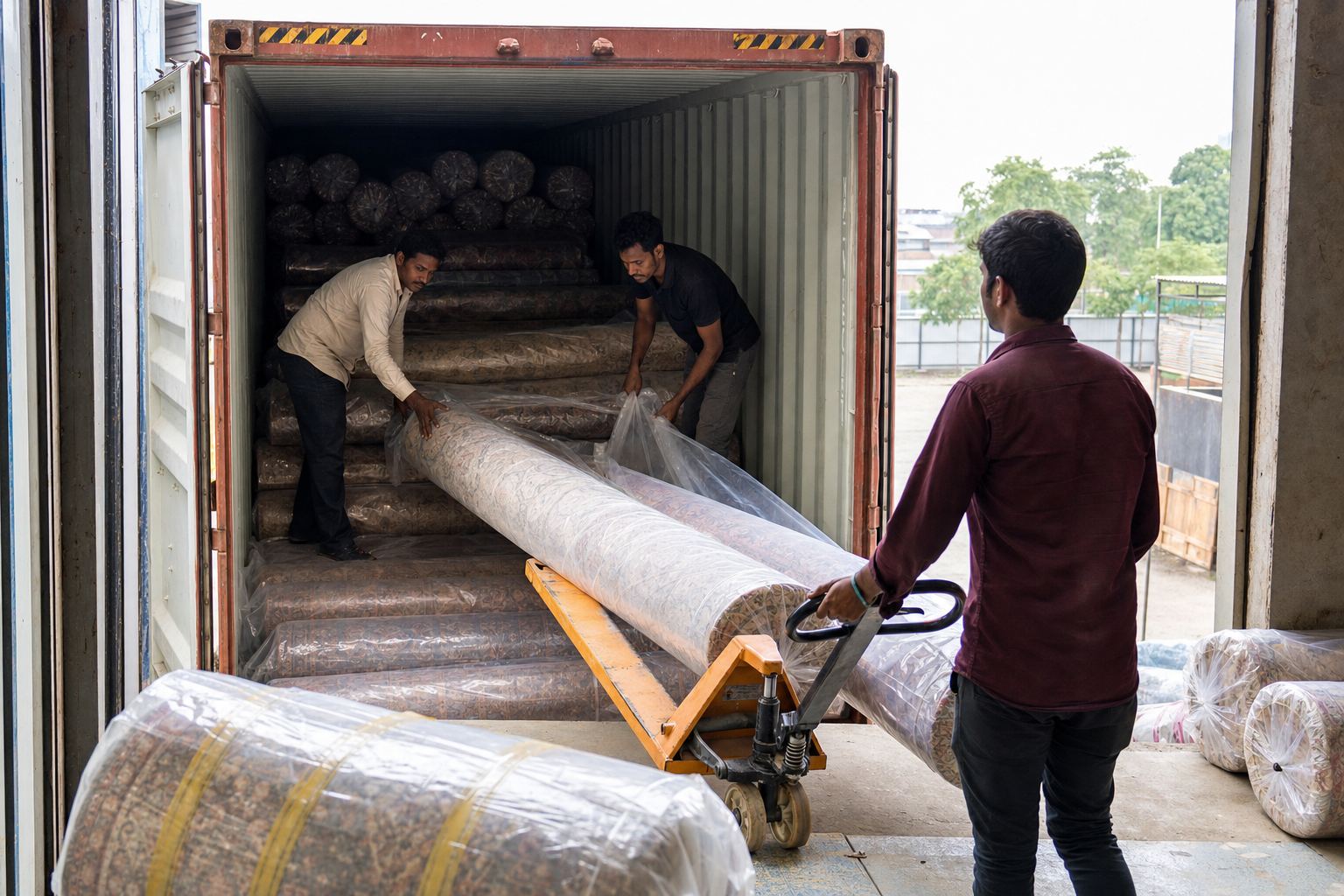
CEPC membership does not dictate stuffing method, but buyer questionnaires often ask how registered exporters control FCL loading for rolled rugs. Practical programmes balance cubic utilisation against crush risk — over-compression of pile during stuffing is a common quality complaint on arrival.
Comparison table
Swipe →
Data table — swipe horizontally on small screens
| Container Type | Indicative Loading Approach | Loading Note |
|---|---|---|
| 20-foot standard | Assortment-dependent; cubic often limits before weight | Protect rolls from floor moisture and side crush |
| 40-foot standard | Preferred for mixed-size retail programmes | Plan size mix to reduce void space without over-stacking |
| 40-foot high cube | Useful for bulky rolled assortments | Confirm lashing and dunnage for pile protection |
Shipping Methods
Export Tip
Nhava Sheva and Mundra are common gateway ports for northern and western India carpet exports, with ICD and CFS linkages serving Bhadohi and related clusters. Sea freight LCL suits trials; FCL suits programme volumes. Air freight is reserved for urgent samples and small high-value pieces.
Comparison table
Swipe →
Data table — swipe horizontally on small screens
| Route | Load Port (Typical) | Approx. Transit Time |
|---|---|---|
| India to USA East Coast | Nhava Sheva / Mundra | 28–40 days |
| India to USA West Coast | Nhava Sheva / Mundra | 30–40 days |
| India to Germany / Netherlands | Nhava Sheva / Mundra | 22–30 days |
| India to UK | Nhava Sheva / Mundra | 22–28 days |
| India to UAE (Jebel Ali) | Mundra / Nhava Sheva | 7–12 days |
| India to Australia | Nhava Sheva / Mundra | 25–35 days |
Certifications
Compliance Notes
Certification stacking for carpets varies by destination and channel. CEPC membership/RCMC and IEC are institutional baselines; labour, chemical, and sustainability credentials are layered based on retailer or destination requirements.
Comparison table
Swipe →
Data table — swipe horizontally on small screens
| Certification / Credential | Issuing Body / Pathway | Typical Requirement Trigger |
|---|---|---|
| IEC | DGFT | Mandatory for commercial export |
| CEPC membership / RCMC | CEPC (Ministry of Textiles framework) | Organised carpet export identity and scheme support |
| GST registration | GST authorities | Commercial tax identity |
| OEKO-TEX / chemical compliance | Accredited labs/programmes | EU/US retail chemical expectations |
| Labour / social compliance audits | Buyer-nominated audit firms | Large retail and hospitality programmes |
| ISO 9001 (where held) | Accredited certification bodies | Process discipline evidence for some buyers |
| Sustainability / traceability claims | Programme-specific verifiers | Premium eco and artisan channels |
| Country of origin / preferential docs | Chamber / customs pathways | Duty preference and customs clearance |
Buyer Requirements
Buyer Requirements
- CEPC membership / RCMC and IEC copies as institutional credibility evidence
- Construction specification: knot density or gauge, pile height, fibre composition percentages
- Size assortment, tolerance, and colour reference locks
- Colourfastness and dimensional stability test reports where the channel requires them
- Labour and social compliance evidence for retail programmes
- Packaging specification matching roll/bale and labelling requirements
- Realistic lead times by construction (hand-knotted vs hand-tufted vs flatweave)
International buyers evaluating a new Indian carpet supplier typically request a standard document and specification pack before confirming a trial assortment. Meeting these requirements consistently — not just for the first sample — is what converts a trial into a repeat programme.
Country-wise Opportunities
Market Snapshot
CEPC registration status is one qualifying factor among several that shape which markets an exporter can realistically pursue. For product × country demand detail, see most demanded Indian carpets and rugs by country. For market selection ranking, see best countries for Indian carpet and rug exports.
Comparison table
Swipe →
Data table — swipe horizontally on small screens
| Country / Region | Opportunity Level | Key Requirement Beyond CEPC |
|---|---|---|
| USA | Very High | Fibre honesty, labelling, retail compliance, reliable lead times |
| Germany / EU | High | Chemical compliance, sustainability storytelling, precise specs |
| United Kingdom | High | Retail packaging/labelling; traditional and contemporary mix |
| Netherlands | Medium–High | EU hub logistics; consistent wholesale assortments |
| UAE / GCC | Medium–High | Hospitality specs; mixed FCL programmes |
| Australia | Medium–High | Wool programmes; residential retail sizing |
| Canada | Medium | North America–aligned assortments and compliance |
| Japan | Medium | Premium precision; exact construction documentation |
Sourcing Checklist
Checklist
- Confirm the supplier's IEC and CEPC membership/RCMC are current before requesting samples
- Request written construction specs (knot density/gauge, pile height, fibre %) for each SKU
- Verify cluster capability (Bhadohi knotted vs Jaipur tufted vs Kashmir fine work) matches your assortment
- Ask for prior export shipment references to your destination market
- Confirm labour/social compliance posture for retail-channel programmes
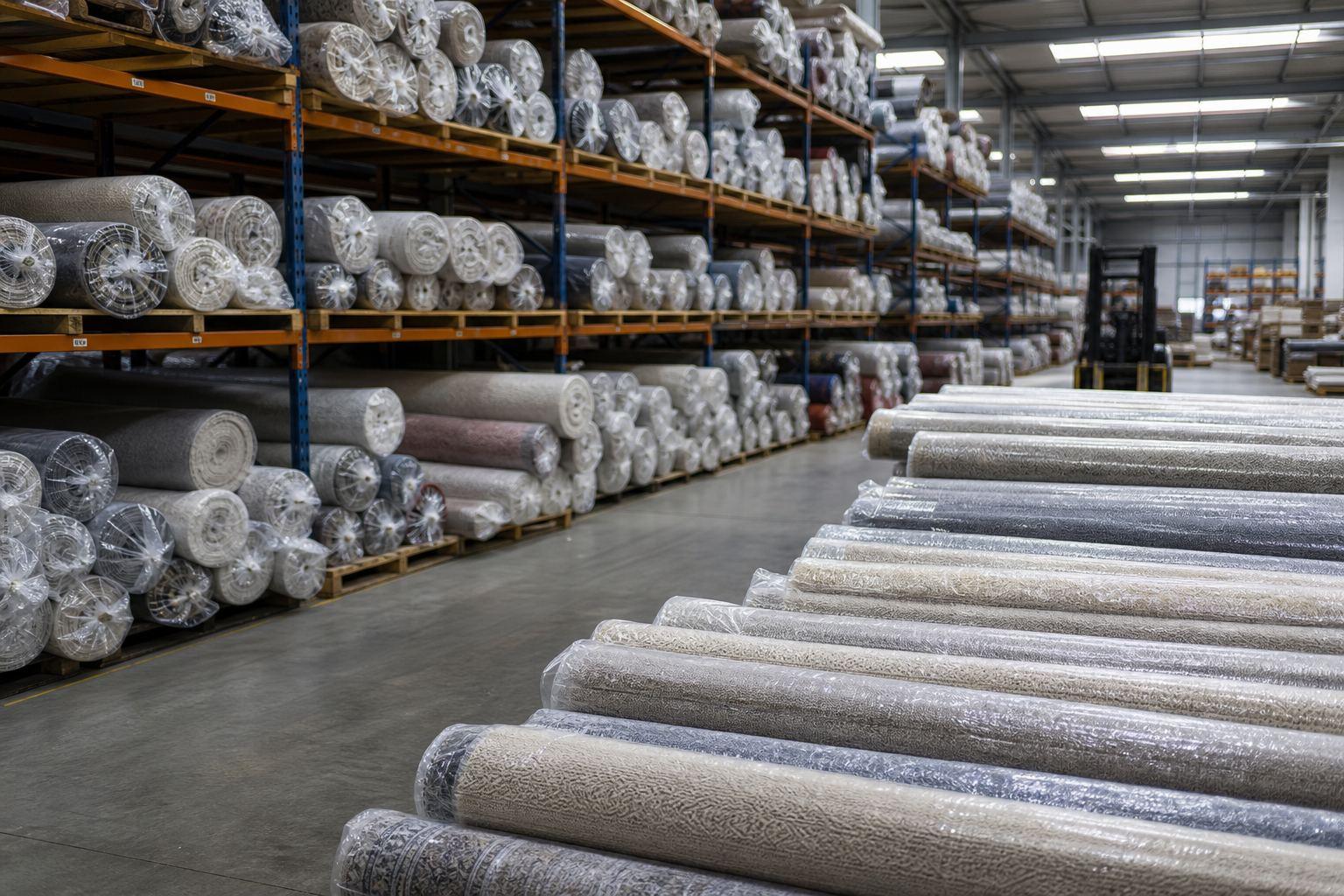
- Check packaging method (roll vs bale) against your warehouse handling
Buyer Checklist
Checklist
- Request CEPC/RCMC and IEC documentation as part of vendor qualification
- Define construction, fibre, size, and colour tolerances in writing before production
- Approve locked samples and retain countersamples before bulk weaving/tufting
- Confirm destination chemical and labelling requirements upfront
- Start with a paid trial assortment before full-season volume
- Clarify Incoterm, payment terms, and lead time by construction type
Exporter Checklist
Checklist
- Complete IEC, GST, and CEPC registration before active buyer outreach
- Prepare a standard buyer onboarding pack (RCMC, IEC, company profile, construction sheet templates)
- Diary CEPC renewal dates alongside GST filing deadlines
- Align catalogue photography and knot-density claims with actual loom capability
- Budget India Carpet Expo / Domotex participation with MAI application timing in mind
- Track construction-specific lead times separately for knotted, tufted, and flatweave lines
Compliance Checklist
Checklist
Compliance Notes
- IEC valid and consistent in name/address across GST and CEPC records
- CEPC membership current with renewal fee paid before deadline
- RCMC on file and available for buyer and bank requests
- HS code (5701–5705 subheading) confirmed with your CHA per SKU
- Commercial invoice, packing list, and shipping bill aligned on construction and fibre descriptions
- Labour and chemical compliance evidence retained for retail programmes
Common Buyer Mistakes
Common Mistakes Box
- Skipping CEPC/IEC verification and buying on price alone — Solution: request RCMC and IEC copies before sampling.
- Accepting vague knot-density or fibre claims — Solution: put exact construction specs in the purchase agreement.
- Ordering full-season volume before a validated trial — Solution: start with a paid assortment trial.
- Ignoring construction lead-time differences — Solution: plan hand-knotted calendars separately from tufted programmes.
- Under-specifying packaging — Solution: define roll/bale method, labelling, and moisture protection in writing.
- Assuming all Bhadohi suppliers are equivalent — Solution: compare sample locks and prior export references across units.
- Filing or describing goods under the wrong HS heading — Solution: confirm 5701–5705 classification with your broker.
- Treating council membership as a quality guarantee — Solution: still require inspection, construction checks, and countersamples.
Future Market Trends
Key Statistics
Through 2030, Indian carpet export competitiveness will hinge on three shifts: stronger buyer demand for traceable artisan and sustainable wool programmes; tighter chemical and social-compliance expectations from US and EU retail channels; and digital buyer discovery that rewards exporters who keep CEPC profiles, websites, and fair follow-up disciplined. CEPC's role as the category council — India Carpet Expo, MAI facilitation, and RCMC continuity — will remain central infrastructure for MSMEs that want to stay visible in organised trade.
Exporters who treat CEPC as a living platform — renewing on time, using expo cycles systematically, upgrading construction documentation, and investing in honest fibre disclosure — will capture disproportionate share of premium and private-label growth. Membership alone will not win that share; membership plus production discipline will.
How Altus Exports Helps
Altus Exports helps carpet and rug manufacturers and merchant exporters sequence IEC, CEPC membership and RCMC readiness, sample locks, construction documentation, packaging standards, and buyer outreach — and helps international buyers verify Indian carpet suppliers beyond a council listing alone through sampling coordination, specification clarity, and pre-shipment discipline.
Manufacturers preparing for CEPC registration should also review how to export carpets and rugs from India and source carpets and rugs directly from India. Buyers evaluating council-registered suppliers can explore textiles & home furnishings programmes through Altus Exports.
Conclusion
- Do next: Verify live CEPC membership and RCMC steps on cepc.co.in / dgft.gov.in, then file with a complete document pack before buyer outreach.
- Read how to export carpets and rugs from India, top carpet and rug products exported from India, best countries for Indian carpet and rug exports, source carpets and rugs directly from India, most demanded Indian carpets and rugs by country, find international buyers for carpets and rugs, sustainable and handwoven carpet export opportunities, carpet and rug export documentation checklist, and trade shows for carpet and rug exporters.
- Explore merchant exporter, export products from India, and find manufacturers in India partnership models.
CEPC registration is one of the highest-leverage institutional investments available to Indian carpet and rug exporters. Founded in 1982 under the Ministry of Textiles, the council provides the organised identity, RCMC pathway, India Carpet Expo access, MAI-linked promotional support, and buyer-facing credibility that unregistered loom units cannot match — especially with US and EU procurement teams that shortlist before they sample.
Membership opens doors; knot-density honesty, fibre disclosure, finishing quality, and export packaging walk you through them. Complete IEC and GST alignment, apply for CEPC membership with a clean document pack, diary renewals, prepare for India Carpet Expo with real SKUs and MOQs, and treat council status as a floor beneath which production discipline must sit. Altus Exports supports carpet MSMEs and buyers who need that institutional layer connected to commercial execution.