
Most Demanded Indian Carpets and Rugs by Country (Buyer Order Profiles 2026)
By Saurabh Mittal, Founder, Altus Exports
A demand-matching guide for Indian carpets and rugs under HS 57 — what buyers actually order in the USA, Germany, UK, Australia, Netherlands, UAE, Sweden, Canada, and Japan by construction, fibre, size grid, price tier, and channel. Built on CEPC / IBEF FY25 context (USD 1.54B; USA ~USD 921M / 59%; Germany ~USD 91.7M; UK ~USD 65.4M). Complements market-selection rankings with order-level profiles for exporters and importers working with Altus Exports.
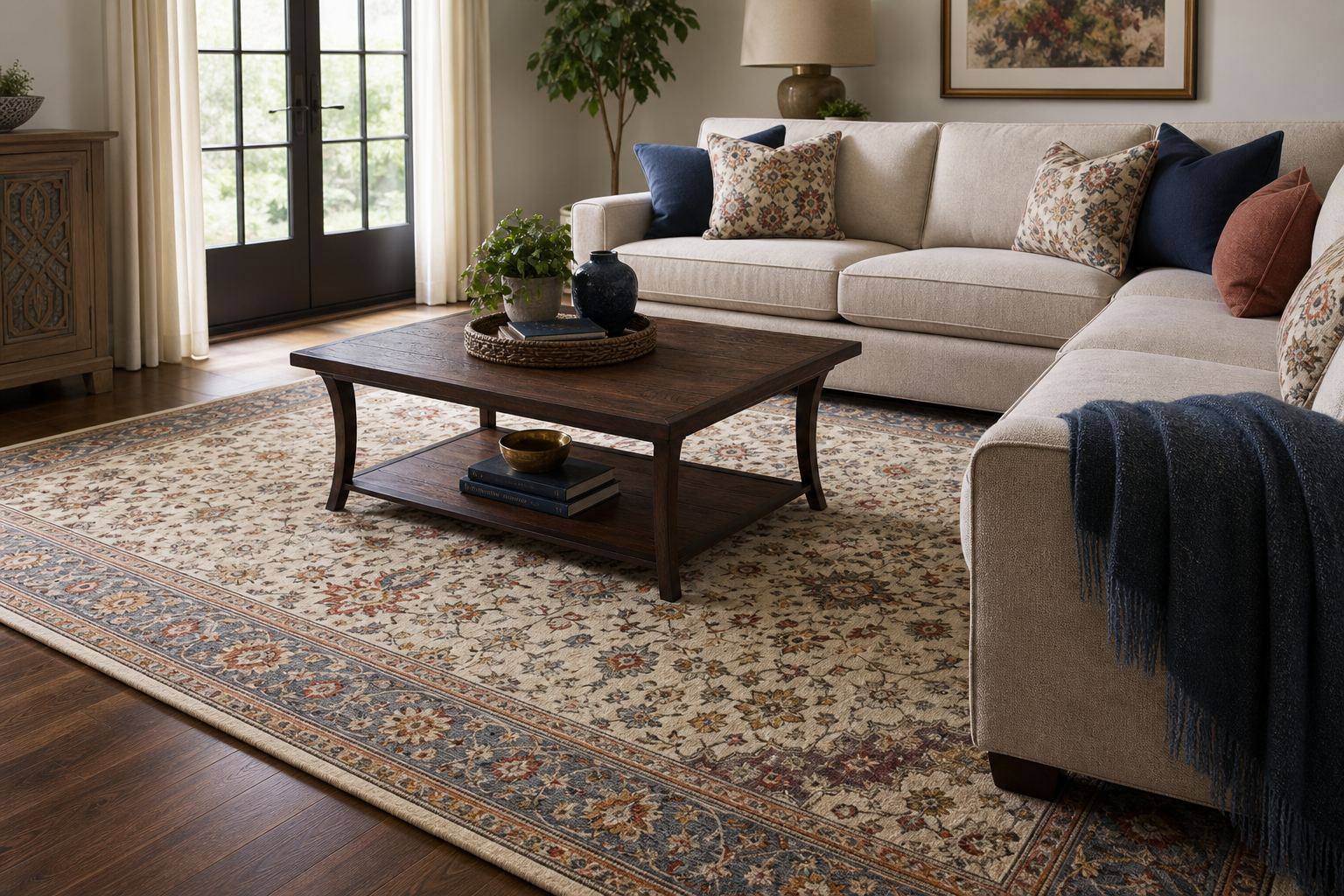
Knowing which countries buy Indian carpets is not the same as knowing what those buyers put on a purchase order. A US e-commerce importer ordering transitional hand-tufted wool in a full 2×3 through 9×12 size grid is not buying the same programme as a German design wholesaler requesting OEKO-TEX-documented hand-knotted wool with restrained colourways, and neither is buying what a UAE hospitality FF&E buyer wants — durable tufted runners, flatweave corridors, and fast replenishment. Demand matching means aligning construction method, fibre story, knot or pile specification, size assortment, price tier, and channel packaging to what each market actually orders — not what looks impressive in a showroom photograph.
India remains a leading origin for handmade and machine-assisted textile floor coverings under HS Chapter 57. According to CEPC / IBEF-aligned industry reporting for FY25, Indian carpet and rug exports reached about USD 1.54 billion. The United States alone absorbed roughly USD 921 million — about 59% of that total — while Germany (about USD 91.7 million) and the United Kingdom (about USD 65.4 million) anchored European demand. Australia, the Netherlands, Sweden, the UAE, Canada, and Japan round out the nine markets this guide profiles in depth. Reconfirm current-year figures via CEPC, DGCI&S, and IBEF before locking assortment plans, because construction mix shifts with design cycles and housing demand.
This article is deliberately different from Best Countries for Indian Carpet and Rug Exports, which ranks destinations for market selection, duties, and opportunity scoring. Here the focus is what buyers order: constructions, fibres, sizes, price tiers, and channels by country. Pair it with Top Carpet and Rug Products Exported from India for construction depth, How to Export Carpets and Rugs from India for process, and Source Carpets and Rugs Directly from India if you are an importer evaluating Indian suppliers. Altus Exports acts as merchant exporter and global sourcing partner for carpet programmes that need demand-fit assortment, QC, and shipment coordination under one accountable relationship.
Key Takeaways
Summary Box
Executive Summary
Summary Box
Indian carpet and rug demand abroad is channel-driven. Residential retail, interior-design wholesale, hospitality soft flooring, and e-commerce area-rug programmes pull different constructions from the same origin clusters — Bhadohi–Mirzapur (hand-knotted and hand-tufted), Jaipur (contemporary tufted and handloom), Agra and Kashmir (fine knotted and silk accents), and Panipat (dhurrie, flatweave, powerloom). Exporters who ship one generic assortment into every inquiry waste loom time on SKUs that never reorder.
This guide profiles nine priority destinations — the United States, Germany, the United Kingdom, Australia, the Netherlands, the UAE, Sweden, Canada, and Japan — against what buyers actually specify on purchase orders: construction family, fibre mix, size assortment, price tier, certification expectations, and channel packing. Use it after you have chosen candidate markets, or alongside market-selection work when you need to know whether your current loom strength can satisfy a destination's order profile.
Short answer: match Indo-Persian and transitional hand-knotted wool plus complete size grids to USA retail and e-commerce; match OEKO-TEX and REACH-aware design-led knotted and handloom to Germany, Netherlands, and Sweden; match good/better/best ladders to the UK; match contemporary tufted and flatweaves with ECTA origin discipline to Australia; match durable tufted and runners to UAE hospitality; match US-style assortments with bilingual labelling to Canada; match fine finishing and patient sampling to Japan. Pair demand profiles with Find International Buyers for Carpets and Rugs when you are ready to outreach, and with Sustainable and Handwoven Carpet Export Opportunities when buyers ask for eco dyes and verifiable artisan programmes.
2026 demand-matching snapshot for Indian carpets and rugs (HS 57)
Swipe →
Data table — swipe horizontally on small screens
| Dimension | 2026 Snapshot | Demand Implication |
|---|---|---|
| HS / tariff lines | 5701–5705 (confirm exact 8/10-digit line) | Order profile starts with correct construction heading |
| FY25 export value | ~USD 1.54B (CEPC / IBEF context) | Volume exists — assortment fit converts it |
| USA share | ~USD 921M / ~59% | Deepest order volume; size-grid discipline required |
| EU / UK anchors | Germany ~USD 91.7M; UK ~USD 65.4M | Design + chemical documentation on most POs |
| Core constructions ordered | Hand-knotted, hand-tufted, handloom, kilim/dhurrie, machine-made | Never quote one generic rug into every market |
| Clusters | Bhadohi–Mirzapur, Jaipur, Agra, Kashmir, Panipat | Source by construction the destination orders |
| Order drivers | Size grid, fibre honesty, colour lot, lead time | PO language beats showroom adjectives |
| Institutional layer | CEPC, DGFT IEC, GST | Credibility helps; demand fit still decides SKUs |
Market Size & Industry Overview
Key Statistics
What the global floor-covering market "wants" only matters when it shows up as a purchase order: which construction, fibre story, size grid, and channel pack each destination actually writes. US e-commerce briefs skew toward complete size ladders in transitional tufted and casual flatweave; German and Nordic design wholesale skew toward documented knotted and handloom with OEKO-TEX language; UAE hospitality skews toward durable runners and corridor metre-goods. Reading industry size without those order profiles leads exporters to build the wrong loom calendar.
India can fill those divergent briefs because CEPC-coordinated clusters specialise differently — Bhadohi–Mirzapur for commercial knotted and mixed handmade depth, Kashmir for fine handmade programmes, Jaipur and Agra for design-forward tufted and handloom, Panipat for flatweave and volume metre-scale. Directional HS 57 volumes from CEPC, DGCI&S, IBEF, and ITC Trade Map show capacity; they do not invent the SKU list. Reconfirm current-year figures before locking assortment.
Market size explains capacity opportunity; demand matching explains which SKUs fill that capacity profitably. A factory with strong Indo-Persian density should prioritise USA and German knotted programmes. A Jaipur unit with agile contemporary tufted colourways should prioritise Australian design retail and UK mid-tier ladders. A Panipat flatweave house should prioritise UAE hospitality runners and casual US e-commerce SKUs — not force fine Kashmir knotting into a channel that never orders it.
Industry factors that shape what carpet buyers order
Swipe →
Data table — swipe horizontally on small screens
| Industry Factor | Detail | Demand Relevance |
|---|---|---|
| Primary HS chapter | 57 (5701–5705) | Filters which construction appears on the PO |
| Key clusters | Bhadohi–Mirzapur, Jaipur, Agra, Kashmir, Panipat | Determines which order profiles you can fill |
| Dominant ports | Mundra, Nhava Sheva, ICD-linked inland rail | Affects lead time quoted on programme POs |
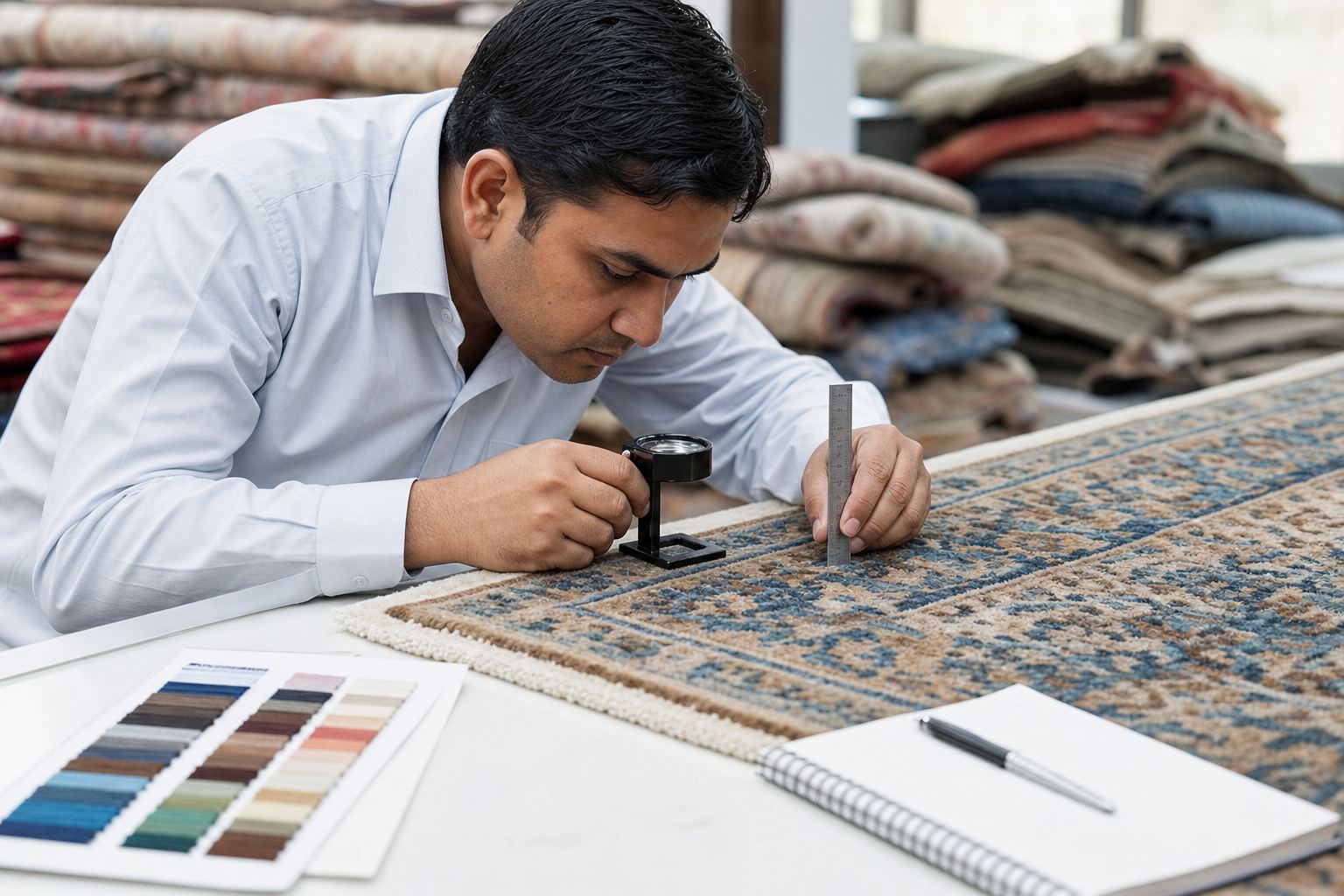
| Quality anchors on POs | Knot density, pile height, fibre %, colour fastness, size tolerance | These fields decide acceptance or rejection |
| Buyer types ordering | Retail, wholesale/design trade, hospitality, e-commerce | Buyer type dictates construction and MOQ |
| Institutional support | CEPC, DGFT, FIEO | Supports credibility; does not write the assortment |
Export Statistics
Key Statistics
Read FY25 export numbers as a demand-mix map, not a destination trophy list. CEPC / IBEF-aligned context of about USD 1.54 billion total — with the USA near USD 921 million (~59%), Germany near USD 91.7 million, and the UK near USD 65.4 million — tells you where order volume concentrates under HS 5701–5705. Inside those dollars, knotted wool (often 5701), woven/handloom (5702), and tufted (5703) move through different channels and price tiers; a high USA share does not mean every US buyer wants the same construction.
Exporters should track shipment trends by construction family and destination, not only at HS Chapter aggregate. Knotted lots, tufted lots, and flatweave lots often land in different buyer channels and price tiers even within the same country. Cross-check CEPC and DGCI&S export data with destination import statistics before locking a demand-matching plan for the nine markets profiled below.
Directional FY25 export statistics context for Indian carpets and rugs
Swipe →
Data table — swipe horizontally on small screens
| Export Dimension | Directional FY25 Pattern | Demand-Matching Action |
|---|---|---|
| Total export value | ~USD 1.54B (CEPC / IBEF context) | Reconfirm CEPC/DGCI&S before annual assortment planning |
| USA | ~USD 921M (~59%) | Build complete size grids and programme-ready constructions |
| Germany | ~USD 91.7M | Lead with OEKO-TEX and design-led knotted/handloom |
| United Kingdom | ~USD 65.4M | Present good/better/best ladders, not one hero SKU |
| Next-tier destinations | Australia, Netherlands, Sweden, UAE, Canada, Japan | Match construction to what each channel orders |
| Ports used | Mundra, Nhava Sheva, inland ICD consolidation | Quote lead time by actual load path |
| Pricing basis | FOB Indian port in USD is standard | Convert every quote to landed cost per market |
Import Statistics
Key Statistics
Import demand for Indian carpets is best read as a construction mix, not a country list. The same destination can import knotted heritage pieces for specialty retail, tufted transitional lines for e-commerce, and flatweave runners for hospitality — three different purchase-order profiles under one HS Chapter 57 umbrella. Ranking markets by offtake alone hides which SKUs actually clear customs and replenish warehouses.
Order writing differs by channel. Japan and Germany typically lock fewer suppliers with strict finishing and chemical specs. UAE hospitality scales once abrasion and replenishment are proven. Canada often mirrors US style grids with bilingual labelling. Australia pairs contemporary retail demand with ECTA facilitation (many Ch. 57 lines already Free MFN). Nordic buyers punch above population size on clean design and sustainability language. For destination scoring and duty notes, see Best Countries for Indian Carpet and Rug Exports.
How destination import demand translates into order profiles
Swipe →
Data table — swipe horizontally on small screens
| Market | Import Demand Character | What Typically Appears on the PO |
|---|---|---|
| USA | Deepest volume; retail + e-comm + hospitality | Size grid, fibre %, construction, vendor labelling pack |
| Germany | Quality filter + end market | OEKO-TEX, dye declarations, design boards, tolerances |
| UK | Mature retail and design trade | Good/better/best tiers, UK labelling, retail packing |
| Australia | Design retail + FTA opportunity | Contemporary constructions, COO for ECTA claims |
| Netherlands | EU redistribution hub | EU-ready docs that clear the strictest downstream market |
| UAE | Hospitality + wholesale speed | Durability, colour fastness, replenishment lead time |
| Sweden | Design + sustainability intensity | Eco dyes, honest fibre, clean design language |
| Canada | US-adjacent retail/e-comm | US-like styles + bilingual consumer labelling |
| Japan | Premium loyalty after long QC | Fine finishing, odour, dimensional precision, presentation |
Product Categories
Summary Box
- Hand-knotted (5701): premium programmes; KPSI / knot density must match sample and label claims
- Woven / handloom / kilim (5702): design-led and flatweave programmes; colour-block accuracy is critical
- Tufted (5703): mid-premium retail and e-commerce volume; pile height and backing adhesion drive QC
- Felt (5704) and other (5705): specialty niches — only quote when your factory actually produces them
- Never describe a tufted rug as hand-knotted on a PO, invoice, or hangtag
Demand matching only works when you speak in the construction language buyers use on purchase orders. Map each SKU to construction method, fibre, knot or stitch density band, pile height, size assortment, and finishing. For a ranked product breakdown, see Top Carpet and Rug Products Exported from India. This section stays focused on which categories different markets order most often.
Construction families most frequently ordered from India (HS 57)
Swipe →
Data table — swipe horizontally on small screens
| Category | Typical HS Heading | Markets That Order It Most | Order Notes |
|---|---|---|---|
| Hand-knotted wool | 5701 | USA, Germany, UK, Japan, Canada | KPSI honesty and wash finish decide repeat POs |
| Hand-knotted with silk accents | 5701 | USA premium, Japan, Germany specialty | Low volume, high scrutiny, long lead times |
| Hand-tufted wool / blend | 5703 | USA e-comm, UK mid-tier, Australia, UAE | Pile height, backing, and size grid drive volume |
| Handloom / woven | 5702 | Germany, Netherlands, Sweden, Australia | Design boards and colour discipline matter |
| Kilim / dhurrie / flatweave | 5702 / 5705 | USA casual, UAE hospitality, UK value, Nordics | Runners and corridor sizes often reorder fastest |
| Machine-made / powerloom | 5702 / 5705 | Value retail tiers, some hospitality | Price tier and consistency over artisan story |
Manufacturing Overview
Export Tip
- Bhadohi–Mirzapur
- Hand-knotted, hand-tufted, dhurrie — USA/EU knotted and volume tufted demand
- Jaipur
- Contemporary tufted and handloom — Australia, UK, Nordics design retail
- Agra / Kashmir
- Fine knotted and silk accents — Japan, USA premium, Germany specialty
- Panipat
- Flatweave, dhurrie, powerloom — UAE hospitality, US casual e-comm
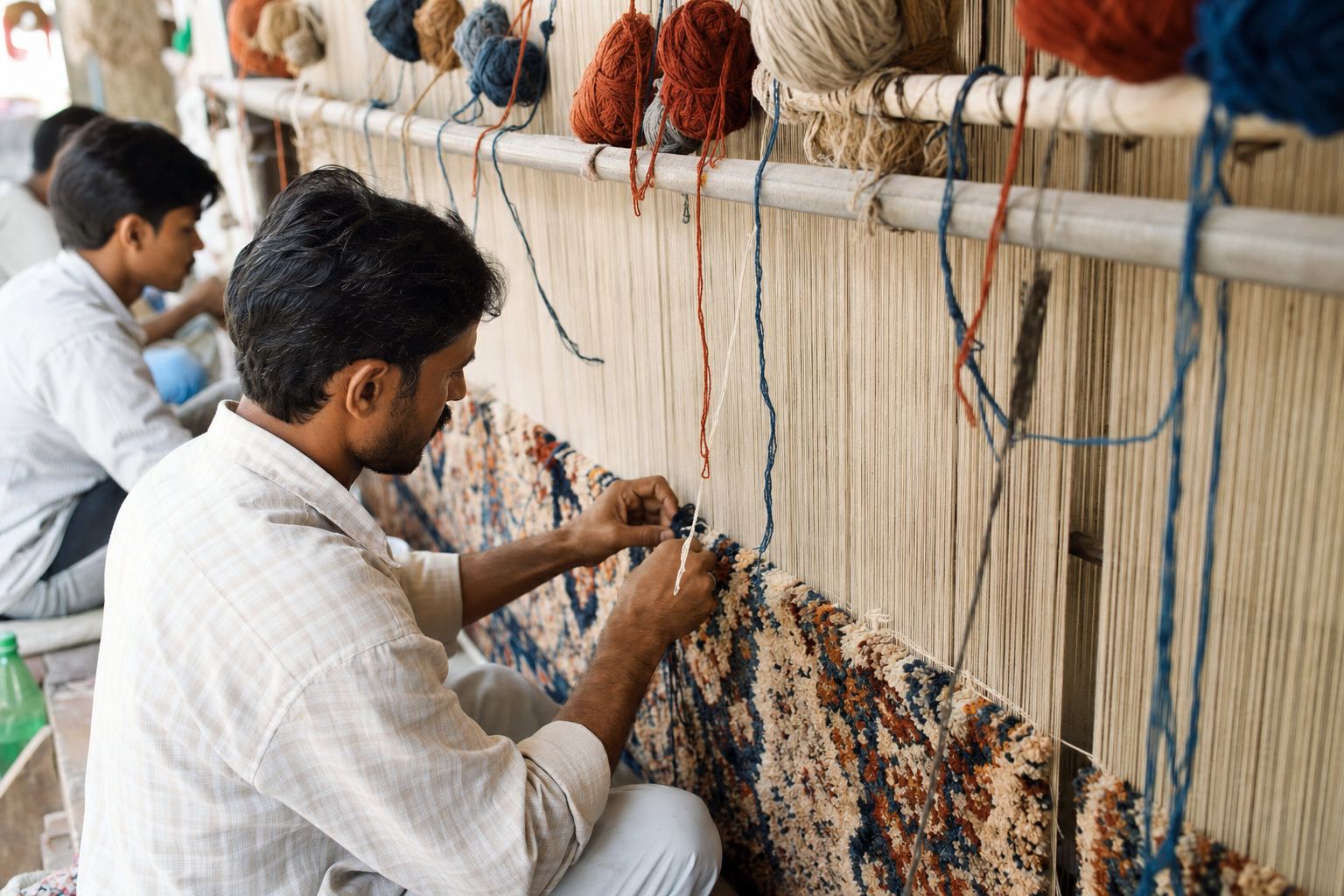
Demand matching starts at the loom: map each destination order profile to the cluster that actually produces that construction at the required density, finish, and calendar. Persian or Turkish knot traditions matter less commercially than countable KPSI on the sealed sample matching the hangtag. Tufted programmes win US and UAE replenishment when pile height and backing hold; kilims and dhurries win hospitality and casual e-commerce when colour blocks stay true across dye lots.
Route USA and EU commercial knotted volume through Bhadohi–Mirzapur depth; reserve Kashmir for fine handmade programmes that Japan, premium US, and specialty Germany will wait months for. Use Jaipur and Agra for design-forward tufted and handloom briefs common in Australia, UK, and Nordics. Lean on Panipat when UAE hospitality or US casual flatweave calendars need metre-scale speed. Promising retail-speed delivery on fine knotting is the fastest way to fail a PO written for a different construction.
Pricing Analysis
Buyer Tip
- State currency, Incoterm, load port, validity date, and MOQ break points on every written quotation
- Quote FOB when the buyer controls freight; quote CIF only when freight and insurance are locked
- Underpricing to win a first carpet PO often forces knotting shortcuts or weak packing — which kills the second order
Price the demanded assortment, not a generic rug. A German OEKO-TEX knotted programme, a US e-commerce tufted size grid, and a UAE hospitality runner each need their own ex-works build — yarn, dyeing, labour, wash, reject allowance — plus packing, inspection, inland haul, documentation, and margin before any FOB or CIF model. Directional bands in the table below are planning anchors only; never paste one square-foot number into nine destination RFQs.
Convert every construction quote to landed cost for the target channel before negotiating. Duty, freight cube, certification panels, and retailer chargeback risk change the winner even when FOB looks similar. Underpricing a first PO to "win the market" usually forces density or packing shortcuts that kill replenishment — the only metric that matters once demand matching works.
Indicative FOB ranges by construction (directional only; USD; India origin)
Swipe →
Data table — swipe horizontally on small screens
| Construction / Tier | Indicative FOB Basis | What Moves Price Up or Down |
|---|---|---|
| Hand-tufted wool (standard retail sizes) | Lower–mid USD per sq. ft / piece band | Pile height, backing, design complexity |
| Handloom kilim / dhurrie | Lower–mid band by size | Fibre, colour count, finishing |
| Hand-knotted wool (commercial density) | Mid–upper band by sq. ft | KPSI, size, wash/antique finish |
| Fine hand-knotted / silk accents | Premium band | Density, silk content, Kashmir/Bhadohi positioning |
| GI-linked / social-compliance lines | Premium to equivalent uncertified | Audit scope, traceability, labelling |
| Hospitality tufted / runners | Volume-oriented band | Abrasion performance, colour fastness, replenishment cadence |

MOQ Analysis
Buyer Tip
- Publish MOQ breaks so programme orders earn better pricing than one-off trials
- Do not accept unrealistic MOQs that force quality shortcuts on knotting or finishing
- For mixed containers, agree SKU-level minimums so packing lists stay auditable
MOQs follow the destination order profile. US e-commerce size grids raise piece counts across many SKUs even on stock tufted lines; fine knotted colourways for Japan or specialty Germany may accept lower piece counts but consume loom-months and dedicated dyeing. UAE hospitality often buys runner metres or corridor sets with replenishment cadence written into the brief. Treat MOQ as assortment depth plus capacity allocation — not a single factory minimum pasted onto every market.
Typical MOQ bands by product type (indicative; negotiate per factory capacity)
Swipe →
Data table — swipe horizontally on small screens
| Product Type | Typical MOQ Guidance | Notes for First Orders |
|---|---|---|
| Stock hand-tufted designs | Often tens of pieces per size/colour | Good trial path for retail and e-comm tests |
| Custom tufted private label | Higher piece counts per colourway | Dye and backing setup drive MOQ |
| Kilim / dhurrie programmes | Design- and colour-dependent | Lock colourways before loom allocation |
| Hand-knotted commercial | Often smaller piece counts but long lead times | MOQ is as much about loom months as piece count |
| Fine / silk-accent knotted | Low piece count, high value | Sample deposit and staged payments common |
| Hospitality runners / flatweaves | Programme metres or piece sets | Replenishment cadence matters more than one-off MOQ |
Packaging Standards
Export Tip
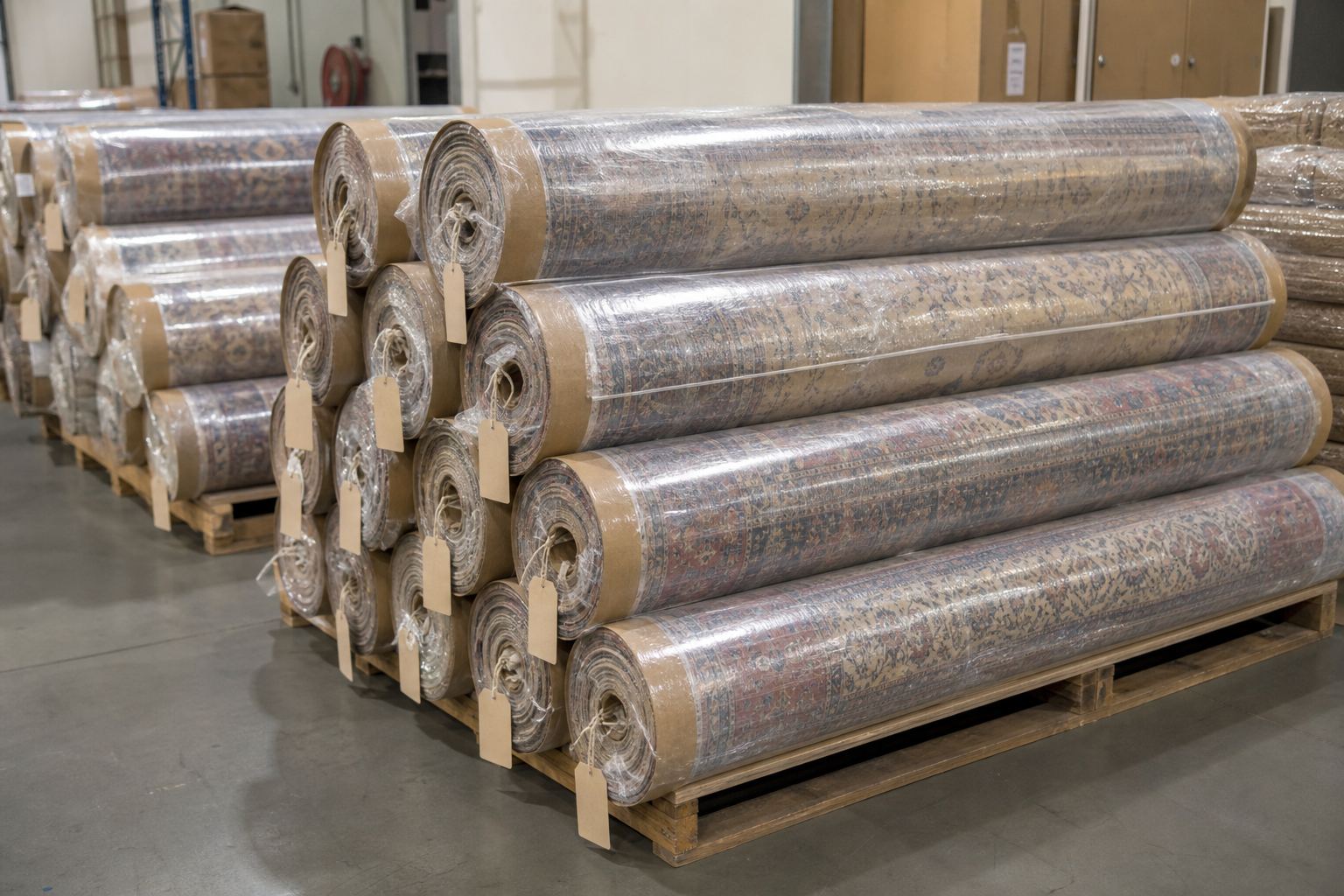
Pack to the channel that ordered the construction. US e-commerce programmes usually need individual poly, carton strength, and barcode-ready marks for smaller rugs. UAE hospitality often prefers consolidated rolls or bales that move quickly through hotel warehouses. Japan and premium EU long-haul programmes add stricter presentation, moisture control, and ISPM 15 wood rules when pallets or crates are used. Fibre and care hangtags must match the invoice line for the destination that will audit them.
Pile crush, edge abrasion, humidity stains, and missing roll IDs kill replenishment faster than a modest FOB gap. Build packing SOPs per market — not one "export pack" for every HS 57 SKU — and photograph marks before stuffing so chargebacks can be traced to the load plan rather than a warehouse dispute.
Packaging checklist for carpet and rug export lots
Swipe →
Data table — swipe horizontally on small screens
| Element | Purpose | Failure Mode if Skipped |
|---|---|---|
| Poly / moisture barrier | Humidity and dust protection | Stains, odour, mildew risk |
| Edge / corner protection | Abrasion control in handling | Frayed edges, returns |
| SKU / roll ID labels | Warehouse and customs clarity | Mis-picks, document mismatch |
| Fibre & care hangtags | Retail and import labelling | Customs hold, retailer chargebacks |
| Outer carton / bale strength | Stack and fork durability | Crushed pile, claims |
| ISPM 15 wood (if used) | Biosecurity compliance | Holds on Australia and other strict lanes |
Container Loading
Export Tip
- Create a load plan diagram before stuffing day
- Record net/gross weights that reconcile with the packing list
- Use desiccants or moisture control where route humidity warrants it
- Seal container with recorded seal number on documents and photos
- Do not close the container until invoice quantity, packing-list roll count, and physical count match
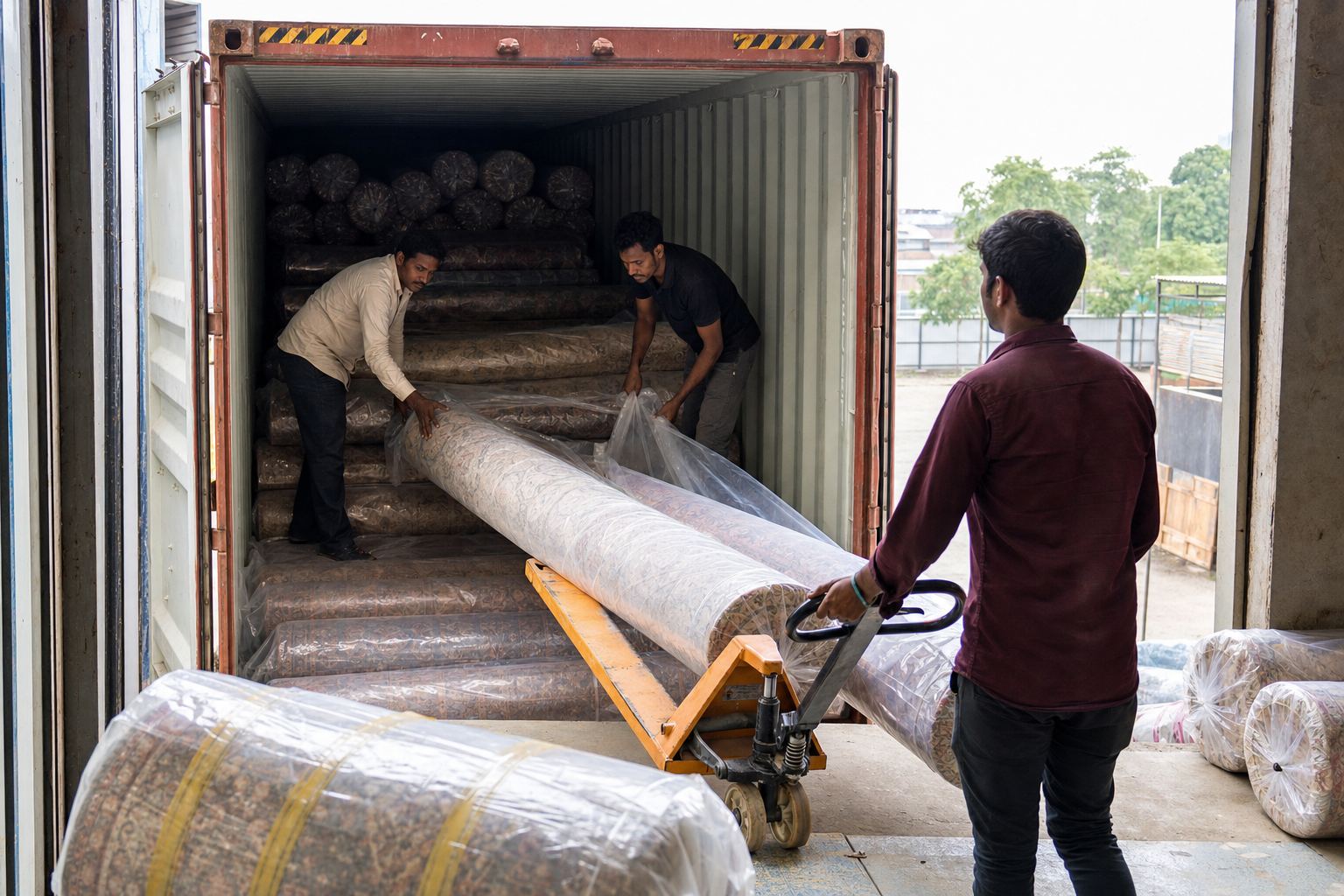
Load plans should reflect the assortment the destination actually ordered. A USA size-grid FCL with many cartoned small rugs needs different crush protection and pick-face access than a UAE hospitality runner programme of long rolls, or a Japan premium lot with fewer high-value pieces. Piece counts per 20-foot or 40-foot container swing with size mix and roll diameter — publish planning estimates only, then lock a photo load plan against the packing list before sealing.
Indicative container planning notes (verify with forwarder and actual cube)
Swipe →
Data table — swipe horizontally on small screens
| Container | Typical Use Case | Planning Notes |
|---|---|---|
| 20' FCL | Trial or focused SKU sets | Easier quantity control; watch crush on lower rolls |
| 40' FCL / HQ | Programme replenishment | Higher cube; enforce stacking SOP and dunnage |
| LCL | First samples / small trials | Higher handling risk — upgrade inner protection |
| Mixed SKU FCL | Assorted sizes/colours | Strict packing list by roll ID; photo load plan |
Shipping Methods
Export Tip
- Primary mode
- Sea freight FCL for programme volume; LCL for trials
- Common Incoterms
- FOB Indian port; CIF destination when freight is locked
- Key ports
- Mundra, Nhava Sheva, ICD-linked inland consolidation
- Air freight
- Samples, urgent replacements, premium small lots only
Most commercial carpet programmes move by sea freight under FOB Indian load port or CIF destination port. Air freight is reserved for sealed samples, urgent replacements, and high-value small lots. Dominant load ports for northern carpet-belt cargo are Mundra and Nhava Sheva, often fed by inland ICD consolidation from Uttar Pradesh and Rajasthan.
FOB is the cleanest learning path for many MSMEs: you control export clearance and on-board delivery; the buyer controls main carriage and insurance. CIF can be offered when you have freight contracts and can price insurance accurately. Avoid DDP on early shipments unless you truly understand destination import VAT, duties, and broker relationships. For documentation detail, use Carpet and Rug Export Documentation Checklist.
Certifications
Compliance Notes
Certification demand varies by market, but misrepresentation is a universal risk. Do not print marks you are not licensed to use. Do not claim GI status for goods produced outside GI scope. Do not describe a tufted rug as hand-knotted. US and European retailers increasingly require evidence of child-labour-free production through GoodWeave or comparable programmes. Where wool, silk, or synthetic fibres and chemical finishes are used, OEKO-TEX or equivalent test evidence may be requested — especially for EU, UK, and Nordic buyers.
Certifications and documents carpet buyers most often request
Swipe →
Data table — swipe horizontally on small screens
| Certification / Document | What It Covers | Markets That Ask Most |
|---|---|---|
| CEPC RCMC / membership evidence | Sector credibility and council standing | Broad — strengthens vendor onboarding |
| OEKO-TEX (where fibre/finish applies) | Harmful-substance limits on textiles | Germany, Netherlands, Sweden, UK |
| REACH-aware dye declarations | Restricted substances awareness | EU destinations and UK retail |
| GoodWeave / social compliance | Child-labour-free production evidence | USA retail, EU/UK specialty retail |
| Certificate of origin (preferential) | ECTA / India–UAE CEPA claims | Australia, UAE when preference claimed |
| ISPM 15 wood packaging | Phytosanitary wood treatment | Australia and other biosecurity-strict lanes |
| Fibre content / care labels | Consumer and customs labelling | USA, Canada, EU, UK, Japan |
Buyer Requirements
Buyer Requirements
- Written construction sheet: fibre %, construction method, KPSI or pile height, finished size with tolerance
- Sealed sample with retention piece and photo record
- Dye-lot and colour-fastness policy stated in the PO
- Packing SOP photos matching the approved configuration
- Lead time including weaving, washing, finishing, and documentation gates
- Incoterm, payment terms, and inspection window agreed before production starts
What buyers put on the RFQ tracks the construction they intend to reorder. US retail and e-commerce manuals stress size grids, fibre %, barcodes, carton marks, and increasingly GoodWeave-style social evidence. German, Dutch, and Nordic programmes lead with OEKO-TEX or equivalent chemical packs plus design boards. UK specialty retail wants good/better/best ladders with local labelling. UAE hospitality asks for abrasion, colour fastness, and replenishment windows before artisan storytelling. Japan trading houses write finishing, odour, and dimensional tolerances into multi-round sampling briefs.
Answer with construction sheets, sealed samples, and reproducible packing photos — not verbal assurances. Demand-matched programmes convert when the documents prove the SKU the destination actually ordered.
Country-wise Opportunities
Market Snapshot
The profiles below are the core of this guide: deep demand-matching briefs covering what each major market orders by construction, fibre, size, price tier, and channel. Use them to build a country × SKU assortment matrix. For market-selection scoring, duties, and sequencing strategy, cross-reference Best Countries for Indian Carpet and Rug Exports.
Demand-matching overview — what buyers order most by country
Swipe →
Data table — swipe horizontally on small screens
| Market | Most Ordered Constructions | Primary Channels | Buyer Order Priorities |
|---|---|---|---|
| USA | Hand-knotted wool, transitional tufted, casual flatweaves | Retail, e-comm, design wholesale, hospitality | Complete size grids, fibre honesty, replenishment |
| Germany | Design-led knotted, handloom, certified eco programmes | Specialty retail, design wholesale, contract | OEKO-TEX, REACH-aware dyes, design authenticity |
| UK | Mid-premium knotted, transitional tufted, flatweaves | Specialist retail, department stores, e-comm | Good/better/best ladders, UK labelling |
| Australia | Contemporary tufted/handloom, quality flatweaves | Specialty retail, DTC brands, design trade | Design + ECTA COO where preference still applies |
| Netherlands | Design-led handloom/knotted, certified tufted | EU distributors, design wholesale | Pan-EU documentation readiness |
| UAE | Tufted, dhurrie/flatweave runners, mid-knotted | Hospitality FF&E, wholesale, hypermarkets | Durability, colour fastness, speed |
| Sweden | Handloom, refined flatweaves, eco-documented knotted | Design retail, specialty home brands | Clean design, chemical transparency |
| Canada | Knotted, tufted, flatweave across tiers | Retail, e-comm, wholesale | US-like styles + bilingual labels |
| Japan | Fine hand-knotted, refined handloom | Trading houses, department stores | Finishing precision, odour, presentation |
1. United States — Size Grids, Transitional Designs, and Programme Volume
- Most ordered constructions
- Hand-knotted wool; transitional hand-tufted; casual kilim/flatweave; hospitality tufted
- Fibres
- Wool and wool blends primary; jute/cotton flatweaves; limited silk accents
- Sizes
- Full retail/e-comm grids + runners; incomplete grids stall programmes
- Price tiers
- Value tufted → mid private label → premium knotted
- Channels
- Retail chains, specialist rug stores, design wholesale, hospitality, e-commerce brands
- PO must-haves
- Fibre labelling, size tolerances, vendor marks, often social-compliance evidence
- Lead with your strongest reproducible construction and a complete size grid
- Do not enter US e-commerce on a single hero size
- Hospitality and retail are different order profiles — quote them separately
The United States is by far the largest destination for Indian carpets and rugs — about USD 921 million and roughly 59% of FY25 Indian export value in CEPC / IBEF-aligned context. What US buyers order most often is not a single construction: department-store and specialist retail programmes pull hand-knotted wool in Indo-Persian and transitional designs; e-commerce area-rug brands order hand-tufted mid-premium lines and casual flatweaves across complete size grids (commonly 2×3, 3×5, 5×7/5×8, 8×10, 9×12, plus runners); hospitality distributors order durable tufted and flatweave soft flooring with abrasion and colour-fastness performance.
Fibre demand is dominated by wool and wool blends, with jute and cotton flatweaves in casual living ranges and limited silk-accent knotted pieces in premium specialty retail. Price tiers span value e-commerce tufted, mid-premium private label, and upper hand-knotted. The order discipline that wins US programmes is size-grid completeness, photo-accurate colour, and fast replenishment on winning SKUs — not a single hero carpet without sister sizes.
2. Germany — Design-Led Knotted and OEKO-TEX-Documented Assortments
- Most ordered constructions
- Hand-knotted wool, design-led handloom, certified eco programmes, quality tufted
- Fibres
- Wool primary; natural-fibre flatweaves; eco-dye stories that are verifiable
- Sizes
- European residential and contract sizes; precision over endless grid breadth
- Price tiers
- Mid-to-premium; documentation supports margin
- Channels
- Specialist rug retailers, design wholesalers, department stores, contract furnishers
- PO must-haves
- OEKO-TEX, REACH-aware dyes, social compliance for retail vendors
Germany is the largest single EU destination among the markets profiled here (about USD 91.7 million in FY25 directional context) and functions as both an end market and a quality filter for wider European distribution. German buyers most often order design-led hand-knotted wool, refined handloom, and mid-tier tufted lines that arrive with chemical documentation ready. OEKO-TEX is frequently expected on the vendor checklist; REACH-aware dye declarations are scrutinised; design authenticity matters as much as price.
Size demand leans toward European residential dimensions and contract interiors rather than the widest US e-commerce grids. Colourways tend to be more restrained than US transitional palettes. Price tier sits mid-to-premium: Germany rarely rewards the cheapest tufted SKU if documentation and finishing are weak. Arrive with OEKO-TEX and dye documentation ready; Germany rewards preparation more than discounting.
3. United Kingdom — Good / Better / Best Construction Ladders
- Most ordered constructions
- Hand-knotted mid-premium, hand-tufted transitional, flatweaves for casual living
- Fibres
- Wool and blends; cotton/jute flatweaves in value tiers
- Sizes
- UK residential standards + runners; retail planogram fit
- Price tiers
- Explicit good/better/best ladders
- Channels
- Specialist retailers, department stores, design trade, e-commerce
- PO must-haves
- UK labelling; OEKO-TEX often expected; retail packing
The UK remains a substantial mature market (about USD 65.4 million in FY25 directional context). What UK buyers order most often is organised by tier: value flatweaves and accessible tufted for entry retail; mid-premium transitional hand-tufted and commercial-density hand-knotted for specialist and department-store home ranges; selected finer knotted pieces for design trade. Online marketplaces amplify the need for consistent photography, size labelling, and retail-ready packing.
Post-Brexit, UK labelling and retailer vendor standards apply independently of EU packs. Present a good/better/best construction ladder rather than a single premium SKU. Buyers expect suppliers to quote consistently across those tiers so merchandising teams can fill planograms without reinventing the origin story for every price point.
4. Australia — Contemporary Tufted, Handloom, and Preferential-Origin Discipline
- Most ordered constructions
- Hand-tufted and handloom contemporary; quality flatweaves; selected hand-knotted
- Fibres
- Wool and natural blends; rising eco-documented programmes
- Sizes
- Residential specialty sizes; DTC brands often start narrower then expand
- Price tiers
- Mid design retail to premium specialty
- Channels
- Specialty retail, DTC brands, design trade
- PO must-haves
- ECTA COO discipline; ISPM 15 if wood used; eco documentation
Australian buyers order design-forward hand-tufted and handloom assortments, quality flatweaves, and selected hand-knotted premium pieces for specialty retail and DTC rug brands. Contemporary colourways and lifestyle photography matter; sustainability, fibre origin, and dye chemistry questions increasingly appear early in vendor screening. Longer sea transit means moisture-aware packaging is part of the order specification, not an afterthought.
The India–Australia Economic Cooperation and Trade Agreement (ECTA / IndAus ECTA) creates preferential tariff pathways for remaining dutiable lines when a valid certificate of origin is executed correctly. Many typical knotted, woven, and tufted carpet lines already enter Australia at a Free (0%) general rate, so demand matching should emphasise design and QC first — and COO readiness for lines that still carry duty. Buyers who model duty savings will expect your COO process to be real before they place a programme PO.
5. Netherlands — EU Redistribution Orders with Pan-European Specs
- Most ordered constructions
- Design-led handloom and knotted; certified tufted for EU retail
- Fibres
- Wool and natural-fibre stories with chemical documentation
- Sizes
- EU residential and contract assortments for redistribution
- Price tiers
- Mid-to-premium design wholesale
- Channels
- Import distributors, design wholesalers, specialty retail
- PO must-haves
- EU chemical and labelling baseline; OEKO-TEX common
Dutch importers often write purchase orders that ultimately serve pan-European distribution via Rotterdam logistics. What they order most often mirrors German and broader EU design demand — design-led handloom and knotted programmes, certified tufted for wider EU retail — but documentation must satisfy the strictest destination in the chain, not only Dutch domestic requirements.
Treat Dutch partners as EU-network buyers. Prepare multi-country documentation packs, OEKO-TEX readiness, and construction sheets that travel with redistributed lots. Volume can look larger than Dutch population alone would suggest, because one PO may feed multiple national warehouses.
6. United Arab Emirates — Hospitality Runners, Tufted Durability, Wholesale Speed
- Most ordered constructions
- Tufted, flatweave/dhurrie, hospitality runners, selected mid-knotted
- Fibres
- Wool blends and durable synthetics/blends where hospitality specs require
- Sizes
- Runners, corridor lengths, standard hospitality room sizes
- Price tiers
- Volume hospitality and accessible wholesale
- Channels
- Hospitality FF&E buyers, wholesale distributors, hypermarket homeware
- PO must-haves
- Abrasion, colour fastness, replenishment lead time, clean commercial docs
UAE buyers order differently from Western retail. Hospitality FF&E programmes pull durable tufted goods, flatweave and dhurrie runners, corridor carpets, and selected mid-knotted pieces where design needs a heritage accent — not ultra-premium dense knotted showpieces as the first order. Wholesale distributors serving the wider Gulf want replenishment reliability and colour-fastness under high foot traffic and strong sunlight.
Price tiers lean volume-oriented for hospitality and accessible mid-tier for expatriate retail. Certification friction is lower than USA, EU, or Japan, but commercial documents and labelling still must be clean. India–UAE CEPA preferential outcomes should be checked line by line with a valid certificate of origin where claimed. Lead with durable constructions and short lead times; use UAE to prove export SOPs while earning reorder volume.
7. Sweden — Clean Design, Handloom, and Verifiable Eco Orders
- Most ordered constructions
- Handloom, refined flatweaves, eco-documented knotted and tufted
- Fibres
- Wool and natural fibres with verifiable dye chemistry
- Sizes
- Specialty design retail sizes; curated rather than exhaustive grids
- Price tiers
- Premium niche
- Channels
- Design retail, specialty home brands, interior trade
- PO must-haves
- OEKO-TEX, dye transparency, often social compliance
Swedish and wider Nordic buyers order assortments that punch above population weight on design intensity and sustainability expectations. Handloom, refined flatweaves, and eco-documented knotted or tufted programmes convert best. Colour language is typically restrained; fibre claims must be honest; chemical and social standards must be documentable without improvisation.
Volumes are smaller than Germany or the UK, but margins and brand placement can be excellent for the right construction. Enter after OEKO-TEX readiness. Lead with design boards and chemical documentation rather than a deep USA-style size grid on the first outreach.
8. Canada — US-Style Assortments with Bilingual Labelling
- Most ordered constructions
- Hand-knotted, hand-tufted, flatweave across value-to-premium tiers
- Fibres
- Wool and blends mirroring US retail preferences
- Sizes
- North American residential grids and runners
- Price tiers
- Similar ladder to USA programmes
- Channels
- Retail chains, specialist stores, e-comm, wholesale
- PO must-haves
- Bilingual labelling for many retail programmes; fibre honesty
Canadian buyers often order constructions similar to US programmes — knotted, tufted, and flatweave across price tiers for retail home, e-commerce, and design wholesale — but consumer-facing labelling for many programmes must support bilingual English/French requirements. Many Indian exporters reuse US-approved constructions successfully once Canada-specific labelling packs are ready.
Do not copy US HTS duty assumptions into Canadian landed-cost models. Confirm the Canadian Customs Tariff Chapter 57 line independently. Demand matching here is often about packaging and label localisation on top of a proven North American construction assortment.
9. Japan — Fine Finishing, Tight Tolerances, Trading-House Discipline
- Most ordered constructions
- Fine hand-knotted; select refined handloom
- Fibres
- High-grade wool; selective silk accents
- Sizes
- Exact dimensional compliance to buyer charts
- Price tiers
- Premium
- Channels
- Trading houses, department stores, specialty interior retailers
- PO must-haves
- Finishing, odour, tolerance, packaging presentation, multi-round sample discipline
Japanese buyers — often via trading houses — order fine hand-knotted carpets and select refined handloom pieces with impeccable finishing, minimal odour, tight dimensional tolerance, and presentation-grade packing. Sample cycles can run longer than in any Western market covered here. Once approved, loyalty and repeat-order consistency tend to be exceptionally strong.
India's share of Japanese carpet imports still has headroom relative to India's handmade strength. Demand matching for Japan means patience: never use Japan as a first-ever export market, and never send a mid-tier tufted hospitality assortment into a trading-house brief that asked for fine knotted finishing. Approach via patient sampling after exemplary QC systems are proven elsewhere.
Sourcing Checklist
Checklist
- Confirm HS line with CHA (5701–5705 exact subheading) for each construction you will sell
- Build a country × construction × size × price-tier matrix before outreach
- Convert every FOB band to landed cost for the shortlisted countries
- Match construction family to destination demand — do not force fine knotted into UAE hospitality first orders
- Sequence certifications to the climb list (OEKO-TEX for EU/Nordics; ECTA COO for Australia)
- Qualify backup weaving capacity in Bhadohi–Mirzapur or Jaipur for seasonal and capacity risk
- Verify port and inland consolidation path for Mundra or Nhava Sheva
Use the checklists below before locking a demand-matched assortment, committing certification spend, or filing a first shipping bill to a new destination. Carpet demand matching fails most often on construction mismatch, incomplete size grids, and quoting one FOB into nine different order profiles.
Common Buyer Mistakes
Common Mistakes Box
- Shipping the same assortment to every market — Solution: build the country × construction matrix before committing loom months.
- Offering dense hand-knotted programmes into UAE hospitality first orders — Solution: lead with durable tufted and flatweave runners for that channel.
- Entering US e-commerce without a complete size grid — Solution: launch with sister sizes or wait until the grid is ready.
- Skipping OEKO-TEX when targeting Germany, Netherlands, or Sweden — Solution: confirm chemical documentation before outreach.
- Treating hand-knotted and hand-tufted as interchangeable on POs — Solution: specify construction per destination and never mislabel.
- Assuming USA and Canada share identical labelling — Solution: prepare bilingual packs for Canadian retail programmes.
- Claiming ECTA preference for Australia without a valid COO process — Solution: build origin documentation before quoting duty savings.
- Under-specifying size tolerance for e-commerce programmes — Solution: write length/width tolerances into the PO.
- Ignoring pile-crush risk in over-compressed containers — Solution: engineer loading plans with a soft-flooring forwarder.
- Using Japan as a first-ever export market — Solution: prove QC elsewhere, then approach trading houses patiently.
- Copying EU documents for UK shipments — Solution: localise UK compliance as its own project.
- Quoting one blended FOB across nine markets — Solution: price by construction and channel, then convert to landed cost.
Wrong-construction orders — not soft offtake — kill most country programmes. The patterns below are the usual ways exporters misread what a market actually demands.
Future Market Trends
Key Statistics
Through the late 2020s, US offtake should remain the largest single destination pool, but the demanded mix inside that pool will keep shifting toward complete e-commerce size grids, transitional tufted designs, documented social-compliance lines, and hospitality runners alongside classic Indo-Persian knotted demand. Exporters who diversify order books across Germany, UK, Australia, Netherlands, UAE, Sweden, Canada, and Japan reduce exposure to any one retail inventory cycle.
EU and Nordic POs will treat OEKO-TEX and REACH-aware dye packs as baseline on organised retail and design wholesale. Gulf hospitality should keep ordering durable tufted and flatweave replenishment as fit-out pipelines evolve. Australia will reward contemporary design with real ECTA origin discipline where preference still applies. Japan stays a smaller, high-loyalty niche for fine finishing rather than volume grids.
Watch wool price swings, competing-origin design cycles, chemical tightening in Europe, and freight cube economics on long-haul lanes. Factories that stay CEPC-credible, construction-faithful, and deliberate about country × SKU matching will own repeat FCL demand. Build pipeline through Sustainable and Handwoven Carpet Export Opportunities and Trade Shows for Carpet and Rug Exporters.
Conclusion
- Read How to Export Carpets and Rugs from India for the operational sequence.
- Compare constructions in Top Carpet and Rug Products Exported from India.
- Rank destinations with Best Countries for Indian Carpet and Rug Exports.
- Use Source Carpets and Rugs Directly from India for buyer-side sourcing workflow.
- Complete CEPC Registration Benefits for Carpet Exporters.
- Explore Sustainable and Handwoven Carpet Export Opportunities.
- Build pipeline via Find International Buyers for Carpets and Rugs and Trade Shows for Carpet and Rug Exporters.
- Ship with Carpet and Rug Export Documentation Checklist.
Most demanded Indian carpets and rugs by country is a demand-matching problem: lock HS 5701–5705 with your CHA; map constructions to what each market orders; build size grids for USA and Canada programmes; present good/better/best ladders for the UK; arrive OEKO-TEX-ready for Germany, Netherlands, and Sweden; execute ECTA certificates of origin for Australia; lead UAE with durable tufted and runners; approach Japan only with fine finishing and patient sampling — from Bhadohi–Mirzapur, Jaipur, Agra, Kashmir, and Panipat clusters via Mundra or Nhava Sheva.
FY25 offtake — about USD 1.54 billion total, with the USA near USD 921 million (59%), Germany near USD 91.7 million, and the UK near USD 65.4 million — shows where volume concentrates. Your next PO still needs a construction decision: knotted, tufted, handloom, or flatweave for that channel. Manufacturers and traders ready to demand-match should finish IEC and CEPC readiness, lock construction data sheets, and open two markets with sealed samples priced for those order profiles. International buyers can work with Altus Exports as a merchant exporter and global sourcing partner for assortment matching, QC, and shipment. Explore textiles and home furnishings for related programmes.