
Top Dried Vegetable Products Exported from India
By Saurabh Mittal, Founder, Altus Exports
A commercial SKU catalogue of dried vegetable products exported from India — dehydrated carrot, potato, tomato, cabbage, cauliflower, beans, peas, spinach, beetroot, sweet corn, and mixed blends — covering cuts, drying methods, MOQ by SKU, packaging, and channel fit, with expert insight from Altus Exports.
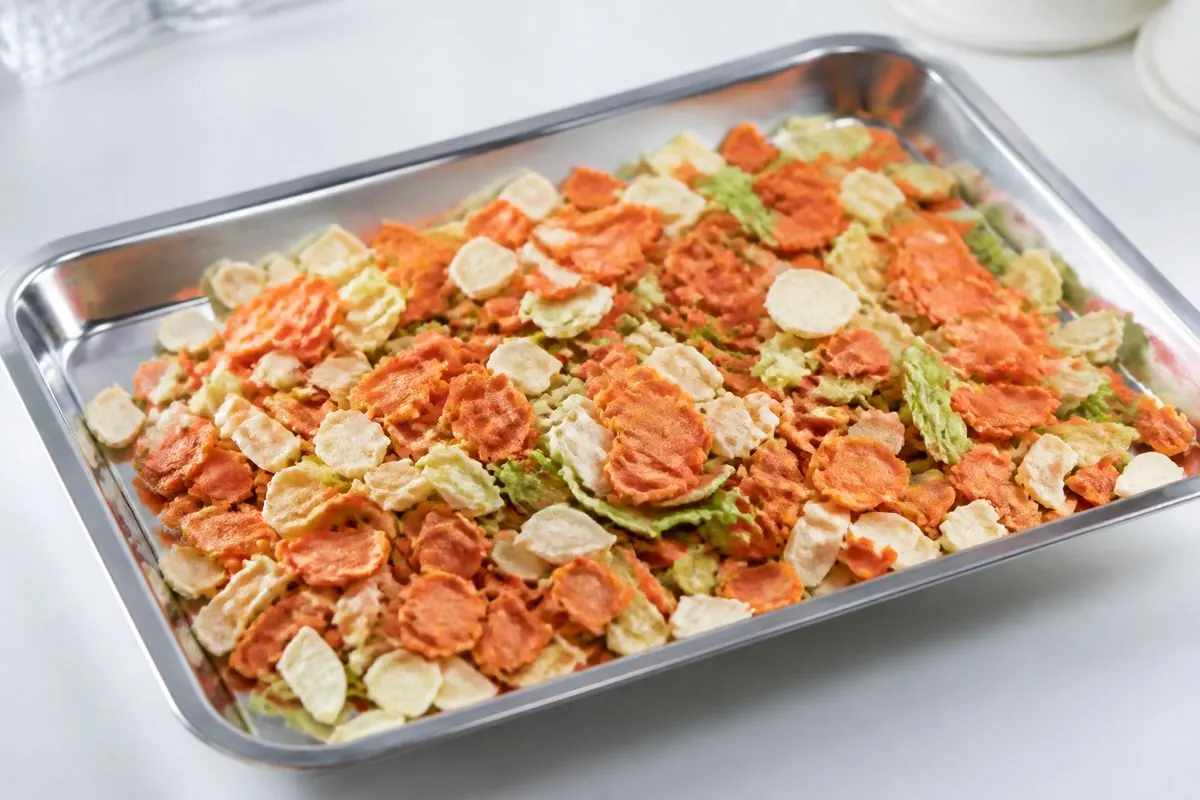
Dried vegetable products exported from India are not one commodity with interchangeable bags — they are a multi-SKU catalogue under Harmonized System heading 0712, especially 0712.90 for other vegetables and mixtures. Importers choosing between dehydrated carrot flakes, potato granules, tomato powder, cabbage kibbled, cauliflower pieces, green beans, peas, spinach powder, beetroot granules, sweet corn, and mixed vegetable blends are making channel decisions: soup-mix plants, seasoning houses, ready-meal manufacturers, snack formulators, foodservice distributors, and private-label retailers each buy different cuts, meshes, and drying methods. This guide owns that SKU taxonomy — vegetable family, cut (flakes, kibbled, granules, powder, slices), drying method (air-dried, drum-dried, freeze-dried), MOQ by SKU, and pack format — so procurement teams can write specifications that dehydrators can actually pack.
India's HS 0712 profile (~US$211.3M in 2023, ~79% dried onions; OEC ~US$288M 2024 directional) includes onion and garlic sibling volume that must not be mistaken for carrot or tomato capacity. When your RFQ is onion-led or garlic-led, use how to export dehydrated onion from India and how to export dehydrated garlic from India for those deep specs; this article stays on the multi-SKU other-vegetables catalogue. Fresh, frozen (0710), and prepared/preserved (2001–2005) vegetables remain out of scope.
Use this catalogue to select SKUs; use the pillar How to Export Dried Vegetables from India for registrations, Incoterms, and FCL process; use Most Demanded Indian Dried Vegetables by Country for destination preference matrices; and use Organic, Freeze-Dried & Premium Dried Vegetable Export Opportunities for specialty pathways. Altus Exports supports SKU matching as a merchant exporter in India and product sourcing company across verified Gujarat and Maharashtra dehydrator capacity.
Key Takeaways
Summary Box
Executive Summary
Summary Box
- Start with vegetable identity → cut → drying method → pack → MOQ.
- Open the SKU tables before requesting FOB quotes.
- Link pillar for process; link demand-by-country for destination prefs.
This article is a commercial taxonomy of dried vegetable products exported from India. It profiles SKU families by how buyers actually purchase — covering carrot, potato, tomato, cabbage, cauliflower, beans, peas, spinach, beetroot, sweet corn, and mixed blends across air-dried, drum-dried, and freeze-dried methods.
Each SKU family differs on cut preference, moisture and mesh norms, indicative FOB tier, MOQ practicality, and pack format. Choosing the wrong cut for an application wastes the trial order: seasoning color systems rarely need the same particle profile as soup-mix flake reconstitutions, and freeze-dried peas are not a drop-in substitute for air-dried peas at the same price.
Registration how-to, Incoterm deep-dives, and buyer prospecting tactics are intentionally out of scope here — they belong to the process pillar and find-buyers companions. Read this post to decide what to buy; read those posts to decide how to ship and whom to approach.
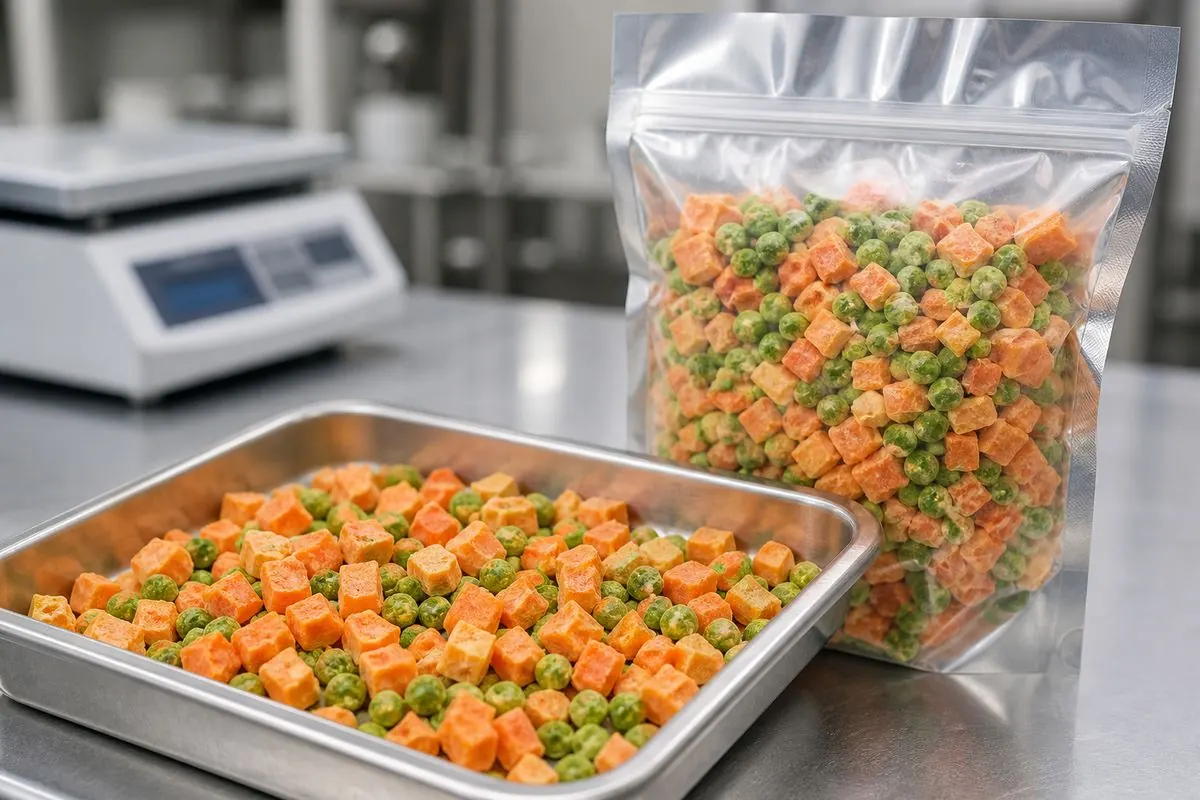
Market Size & Industry Overview
Key Statistics
- HS 0712 ~US$211.3M (2023) / OEC ~US$288M (2024 dir.); HS 071290 US$58.626M / 45,547.7 MT (WITS 2024).
- Application channels: soup · seasoning · ready meals · snacks · foodservice · retail PL.
- Supply: Gujarat Mahuva–Bhavnagar–Sihor + Maharashtra Nashik adjacency.
- SKU specialisation beats "we make all dehydrated vegetables" claims.
Market size for SKU planners is best read as two layers: total HS 0712 (onion-heavy — ~79% dried onions in 2023) and HS 071290 other/nes slices that better approximate carrot, potato, tomato, cabbage, and mixed programmes. Use ~US$211.3M (2023 verified) / OEC ~US$288M (2024 directional) for HS 0712, and US$58.626M / 45,547.7 MT (WITS 2024) for HS 071290 — always re-verify before assortment planning.
SKU demand is application-led. Soup and seasoning manufacturers pull carrot flakes, cabbage, mixed blends, and potato granules; ready-meal plants pull mixed vegetables and peas; snack and clean-label brands pull beetroot and tomato powders; premium retail pulls freeze-dried carrot and peas. Gujarat dehydrator belts and Maharashtra adjacency supply the commercial depth behind that assortment.
Exporters specialise: some lines dominate air-dried flakes; others invest in tomato powder color control or freeze-dried capacity. Buyers should match supplier specialisation to SKU, not assume every dehydrator packs every cut equally well.
Export Statistics
Key Statistics
- Plan catalogue SKUs under 0712 / 0712.90 with CHA eight-digit confirmation.
- Do not use onion 071220 tonnes as a proxy for carrot/tomato capacity.
- Top value partners (directional): Germany, Brazil, USA, Indonesia, UK.
- Re-verify HS 071290 partner slices before assortment bets.
Export statistics for a products catalogue should illuminate which SKU families ship under which HS planning lines — not restate the full process pillar. Multi-SKU other vegetables and mixtures plan under 0712.90; potato, tomato, sweet corn, and other India eight-digit splits must be CHA-confirmed because live ITC-HS maps change. Onion 0712.20 tonnes should not inflate your carrot capacity forecast.
Partner value concentration in Germany, Brazil, USA, Indonesia, and the UK tells assortment planners where industrial flake and powder programmes clear most often, while Japan and GCC corridors often pull tighter powder and Halal-ready packs. SKU mix inside those corridors is detailed in the demand-by-country companion — this section stays on export-volume context for catalogue decisions.
Export context for dried vegetable SKU planning (directional)
Swipe →
Data table — swipe horizontally on small screens
| Metric | Directional Cue | SKU Planning Implication |
|---|---|---|
| India HS 0712 export value | ~US$211.3M (2023) / OEC ~US$288M (2024 dir.) | Onion-heavy total; size 071290 SKUs separately |
| India global rank 2024 | Among leading exporters (OEC 2024 dir.) | Competitive on capacity — win on SKU fit and COA |
| HS 071290 India 2024 | US$58.626M / 45,547.7 MT | Better lens for other vegetables vs onion-heavy totals |
| Top destinations (0712 value) | 0712: DE/BR/US (onion-heavy); 071290: US/ID/NP/DE/MY | Prioritise industrial flake/powder readiness |
| 071290 partner cue examples | USA, Indonesia, Nepal, Germany, Malaysia | Assortment may differ from total 0712 leaders |
| Council stack (context only) | APEDA + IEC + FSSAI | Process detail in pillar post — not owned here |
| Primary dehydrator geography | Gujarat belt + Maharashtra adjacency | Ask which SKUs each plant packs weekly |
Import Statistics
Key Statistics
- USA/EU: carrot · potato · tomato · mixed with micro discipline.
- Japan: cabbage · spinach · carrot powders — mesh/color critical.
- UAE/GCC: mixed veg + Halal-ready foodservice packs.
- ASEAN: competitive air-dried flakes and blends.
Import statistics from a SKU angle ask: which destinations pull which products? USA and EU ingredient houses frequently specify carrot flakes, potato granules, tomato powder, and mixed blends with tight micro; Japan often emphasises cabbage, spinach, and carrot powder mesh/color; UAE foodservice pulls mixed dried vegetables and Halal-ready packs; Indonesia and Malaysia pull competitive air-dried volume SKUs.
Importers should build sample kits by corridor rather than shipping every SKU to every market. A Japan spinach powder trial and an Indonesia mixed-flake trial are different commercial products even when both leave Mundra in the same month. Full country × SKU matrices live in Most Demanded Indian Dried Vegetables by Country.
Import pull by destination × SKU emphasis (directional)
Swipe →
Data table — swipe horizontally on small screens
| Market | SKU Emphasis | Cut / Method Cue | Buyer Type |
|---|---|---|---|
| United States | Carrot, potato, tomato, mixed | Flakes/granules/powder; air-dried + selective FD | Soup, seasoning, retail PL |
| Germany / EU | Carrot, tomato powder, cabbage, mixed | Tight micro/MRL; sulfite honesty | Ingredient houses, ready meals |
| Brazil | Mixed dehydrate and industrial vegetables | Competitive air-dried programmes | Processors, importers |
| Indonesia | Mixed, carrot, cabbage volume SKUs | Air-dried flakes; moisture-stable packs | Wholesalers, processors |
| Japan | Cabbage, spinach, carrot powders | Fine mesh, color grade, positive-list MRL | Food manufacturers |
| United Kingdom | Tomato, carrot, mixed, potato | Robust COA; retail and foodservice | Distributors, manufacturers |
| UAE | Mixed vegetables, selective powders | Foodservice bags; Halal docs | Distributors, hypermarkets |
| Malaysia / Vietnam | Mixed and commodity air-dried | Competitive FOB cuts | Repackers, processors |
Product Categories & Variants: Dried Vegetable Products Exported from India
Summary Box
The catalogue below is the commercial heart of dried vegetable products exported from India. Quote each SKU with vegetable identity, cut, drying method, moisture target, mesh for powders, sulfite status, and pack format. Subsections profile the core families so buyers can shortlist before RFQ.
Core dried vegetable SKUs exported from India
Swipe →
Data table — swipe horizontally on small screens
| SKU Family | Common Cuts | Primary Channels | Spec Watchouts |
|---|---|---|---|
| Carrot | Flakes, cubes, powder | Soup, seasoning, ready meals, retail FD | Color grade, moisture, micro |
| Potato | Flakes, granules, powder | Foodservice, snacks, industrial | Mesh, ash, absorption |
| Tomato | Flakes, powder | Sauces, seasoning, snacks | Color, moisture, sulfite declare |
| Cabbage | Flakes, kibbled, powder | Soup mixes, Asian blends | Color, foreign matter, mesh |
| Cauliflower | Flakes, pieces, powder | Ready meals, snacks | Color, piece size |
| Green beans | Flakes, pieces | Ready meals, soups | Rehydration, micro |
| Peas | Flakes, pieces, powder; freeze-dried premium | Ready meals, retail FD | Method and color |
| Spinach / leafy | Flakes, powder | Seasoning, Japan powders | Mesh, color, MRL |
| Beetroot | Granules, powder, flakes | Snacks, color systems | Color, moisture |
| Sweet corn | Flakes, pieces | Mixed blends, foodservice | CHA HS confirmation |
| Mixed blends | Custom ratios of above | Soup, foodservice, retail | Ratio lock, aromatic segregation |
Dehydrated carrot (flakes, cubes, powder)
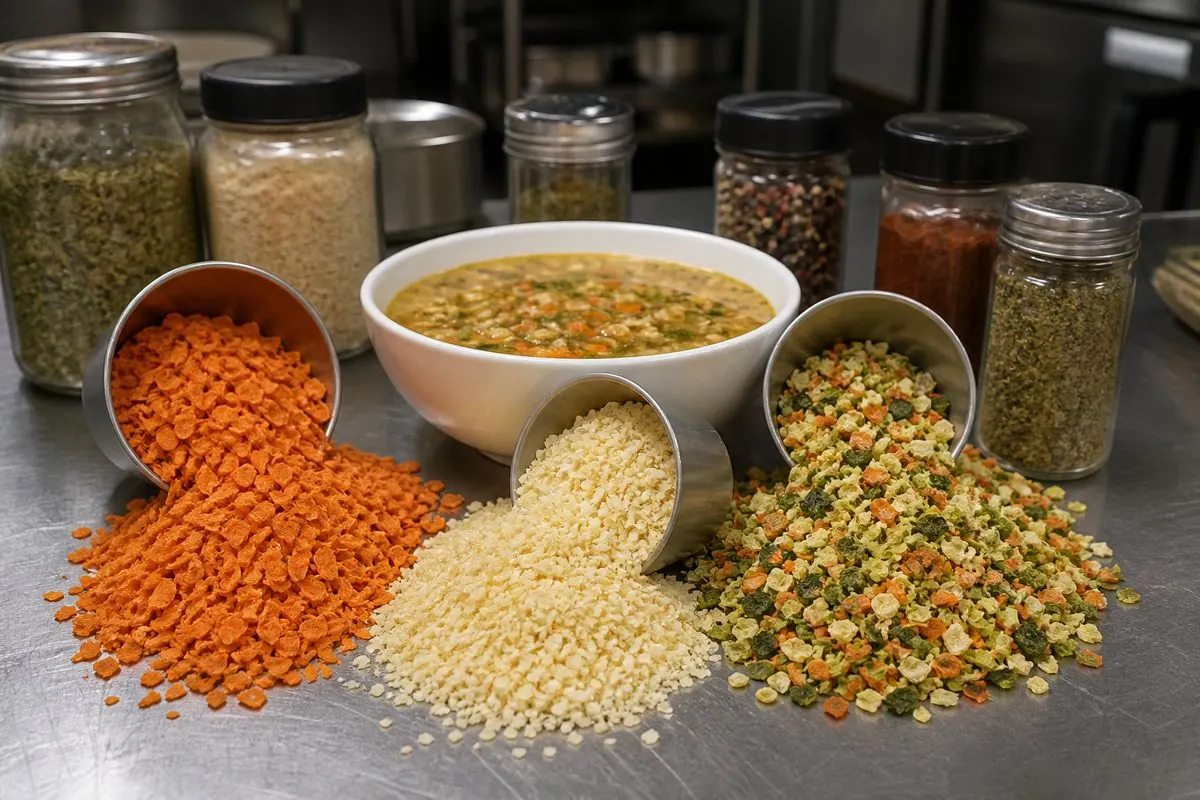
Carrot is a high-frequency industrial SKU for soup mixes, seasonings, and ready meals. Flakes and cubes dominate reconstitution applications; powder serves color and seasoning systems. Air-dried volume is the workhorse; freeze-dried carrot commands premium aroma and color for retail and specialty foodservice. Lock color grade and moisture in the written spec — orange uniformity is a common reject driver on first trials.
Potato flakes, granules, and powder
Potato products serve foodservice reconstitution, snack dusting, and industrial binders. Flakes and granules are distinct SKUs with different water absorption and mesh expectations — do not substitute without buyer approval. Ash, moisture, and black-spec foreign-matter controls matter. Confirm whether the buyer wants drum-dried character or standard air-dried profiles before quoting FOB.
Tomato flakes and powder
Tomato powder is typically a higher FOB tier than commodity mixed vegetable flakes because color, moisture, and application performance in sauces, seasonings, and snacks drive value. Flakes serve visible-inclusion recipes. Sulfite declaration, if any, must be explicit on COA and labels. Organic and freeze-dried tomato pathways are covered in the specialty companion post.
Cabbage and cauliflower
Cabbage flakes, kibbled, and powder appear in soup mixes and Asian cuisine blends; cauliflower follows similar cut logic for ready meals and snack inclusions. Color (white/cream versus yellowing) and foreign-matter discipline are primary QC gates. Japan-bound cabbage powders often need tighter mesh than wholesale flake programmes for ASEAN corridors.
Green beans, peas, spinach, beetroot, sweet corn
Beans and peas ship as flakes, pieces, or powders for ready meals and soups; freeze-dried peas are a premium retail SKU. Spinach and leafy powders require mesh, color, and MRL attention. Beetroot granules and powder serve color and clean-label snack systems. Sweet corn — confirm applicable 071290 line with CHA — serves mixed blends and foodservice. Each SKU needs its own moisture and micro line on the COA.
Mixed dried vegetable blends and cut definitions
Mixed blends are ratio products: carrot/cabbage/bean/pea compositions must be locked in the purchase order and verified on packing-list identity. Buyers reject silent ratio drift between sample and bulk. Cuts mean different things across plants — define flake size, kibbled dimensions, granule mesh, powder mesh, and slice thickness in millimetres or mesh numbers. If the blend includes onion or garlic aromatics, declare them and manage segregation; otherwise keep aromatic siblings out of neutral mixed lots.
Manufacturing Overview
Export Tip
- Ask: which SKUs run weekly vs campaign-only?
- Air-dried = volume; drum-dried = specialty profiles; freeze-dried = premium.
- Changeover cleaning protects color and aroma integrity.
- Retain SKU-specific samples — not one mixed jar for all vegetables.
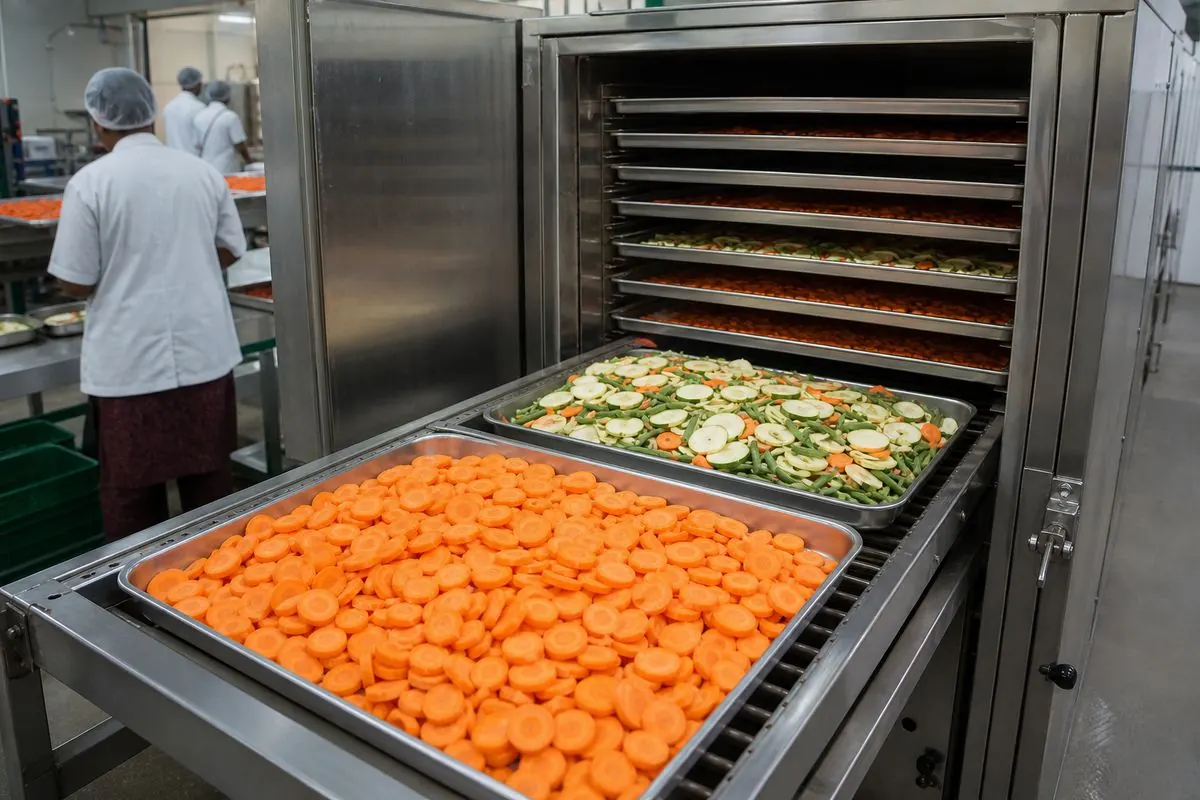
From a SKU perspective, manufacturing is about line allocation: carrot flake lines, tomato powder mills, spinach powder grinding, and freeze-dried pea chambers are different assets with different changeover and cleaning costs. Gujarat's Mahuva–Bhavnagar–Sihor dehydrator belt hosts much of India's commercial multi-SKU capacity; Maharashtra Nashik adjacency supports raw-material timing for several vegetables.
Air-drying remains the volume workhorse for flakes and kibbled cuts. Drum-drying appears on certain potato and specialty profiles. Freeze-drying creates premium SKUs with longer lead times and higher FOB. Metal detection, sieving, and moisture equilibration before packing protect mesh and micro claims. Cross-contamination with onion/garlic aromatics ruins neutral carrot or cabbage lots unless the RFQ is an aromatic blend.
Buyers auditing SKU capability should ask which vegetables and cuts run weekly, not which appear on a website collage. Specialty freeze-dried and organic manufacturing depth is expanded in Organic, Freeze-Dried & Premium Dried Vegetable Export Opportunities.
Drying methods vs typical SKU outcomes
Swipe →
Data table — swipe horizontally on small screens
| Drying Method | Typical SKUs | Commercial Trait | Lead-Time Cue |
|---|---|---|---|
| Air-dried | Carrot flakes, cabbage, mixed, beans, peas | Volume workhorse; competitive FOB tiers | Stock often 2–4 weeks |
| Drum-dried | Selected potato and specialty profiles | Distinct texture/absorption character | Confirm plant capacity |
| Freeze-dried | Carrot, peas, premium mixed, specialty powders upstream | Superior color/aroma; high FOB | Often 4–8+ weeks |
| Milled powders (from dried inputs) | Tomato, spinach, carrot, beetroot powders | Mesh-critical; N2/vacuum packing common | Depends on dried feedstock |
| Organic certified lots | Any SKU under NPOP/USDA/EU chain | Segregation + transaction certificates | Often 4–8+ weeks |
Export Process
Export Tip
For SKU catalogue users, "export process" means the product-selection sequence that must finish before logistics: define application → choose vegetable family → lock cut and drying method → approve sample COA → stage MOQ → choose pack format. Legal registrations, CHA filing, and Incoterms are owned by the pillar guide How to Export Dried Vegetables from India — do not treat this section as a registration how-to.
Step 1: Define the application and channel
Soup-mix reconstitution, seasoning powder systems, ready-meal inclusions, snack color, foodservice bags, and retail pouches pull different SKUs. Write the application on the RFQ before naming a vegetable — it prevents powder quotes when the plant needs 10 mm flakes.
Step 2: Select vegetable family and cut
Choose among carrot, potato, tomato, cabbage, cauliflower, beans, peas, spinach, beetroot, sweet corn, or mixed blends, then lock flake, kibbled, granule, powder, or slice dimensions. Ambiguous "dehydrated vegetables" RFQs produce incomparable quotes.
Step 3: Lock drying method and quality gates
Specify air-dried, drum-dried, or freeze-dried, plus moisture, mesh, color, micro, MRL schedule, and sulfite status. Freeze-dried and organic claims require segregation evidence — see the specialty post for pathway depth.
Step 4: Approve SKU samples and stage MOQ
Approve physical samples against the written SKU sheet, then stage trial tonnage before FCL. MOQ differs by SKU density and plant campaign size — use the MOQ analysis table later in this article.
Step 5: Hand off to process and documentation tracks
Once the SKU is locked, hand registrations, Incoterms, stuffing, and document packs to the process pillar and documentation checklist. SKU selection without process handoff is how good samples become failed containers.
Trade Statistics
Key Statistics
- Confirm eight-digit ITC-HS per SKU with CHA.
- Do not file dried powders under Chapter 20 prepared tomatoes by habit.
- Separate onion/garlic sibling stats from other-veg assortment planning.
- Use 071290 partner data when sizing non-onion catalogues.
Trade statistics for SKU owners emphasise classification hygiene per product family. Potato, tomato, sweet corn, and residual "other" lines under India 07129060 / 07129090 (and named garlic lines) are not interchangeable filing shortcuts. Misfiling tomato powder under a residual other line — or worse under prepared tomato headings in Chapter 20 — creates customs friction and broken trade-data feedback loops for future assortment planning.
When analysing export growth, track SKU-like proxies carefully: tomato powder value growth does not prove cabbage flake capacity. Separate onion 071220 and garlic-heavy filings whenever you size dehydrator investment for carrot or spinach programmes.
SKU-oriented HS planning notes (confirm live with CHA)
Swipe →
Data table — swipe horizontally on small screens
| SKU Family | Planning HS Lens | Filing Caution |
|---|---|---|
| Carrot / cabbage / cauliflower / beans / peas / spinach / beetroot / mixed | 0712.90 / India 07129090 other (confirm live) | Confirm residual vs named splits live |
| Potato flakes/granules/powder | Often potato-named 071290 lines — confirm | Do not assume residual other without CHA |
| Tomato flakes/powder | Often tomato-named 071290 lines — confirm | Avoid Chapter 20 prepared tomato defaults |
| Sweet corn | Sweet-corn 071290 splits — confirm | Verify against live ITC-HS |
| Onion (sibling) | 0712.20 / 07122000 | Use onion cluster — not this catalogue core |
| Garlic forms (sibling) | India 07129020 / 07129030 / 07129040 — confirm | Use garlic cluster for allicin/mesh depth |
| Frozen contrast | 0710 | Out of scope for dried catalogue |
Import Data Analysis
- Build sample kits from partner pull, not from plant leftovers.
- Powder-heavy corridors need mesh libraries; flake corridors need size boards.
- Halal-ready mixed packs for GCC foodservice inquiries.
- Re-run partner data quarterly as SKU mix shifts.
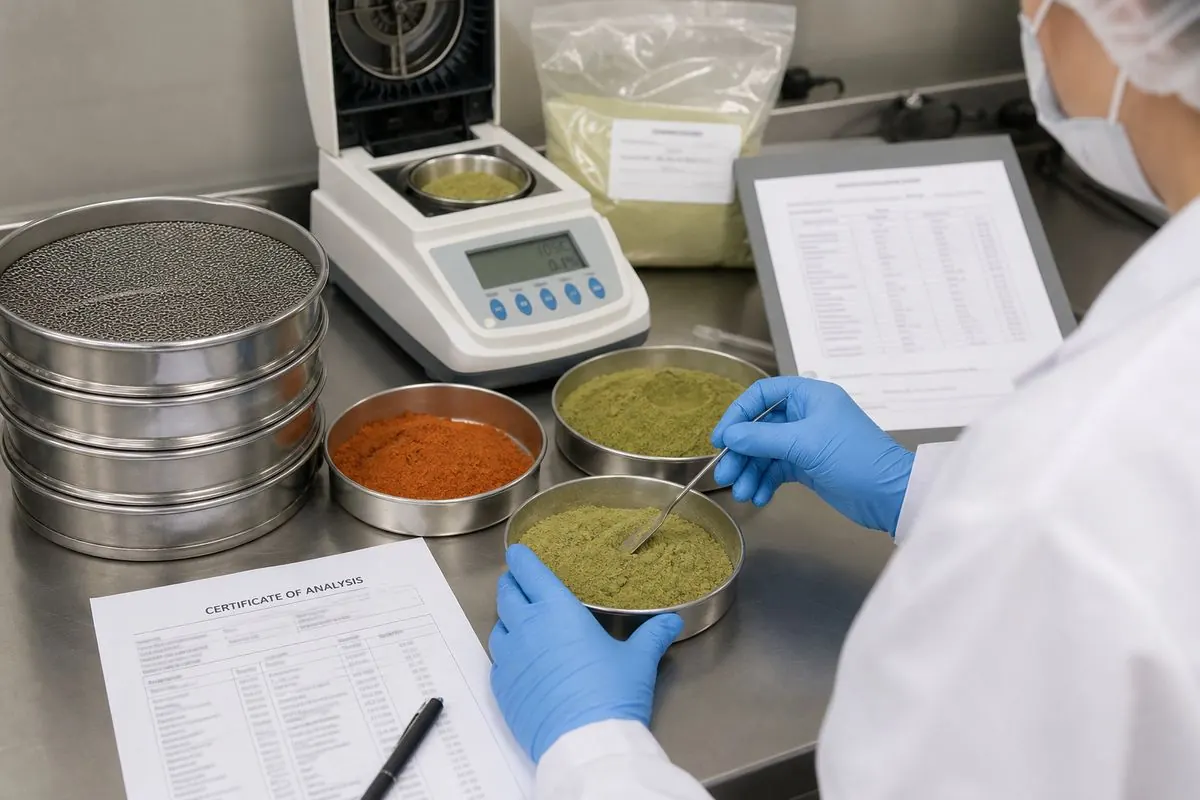
Import data analysis for assortment builders translates partner demand into sample-kit design. If USA and Germany lead value, stock carrot flakes, potato granules, tomato powder, and mixed blends in the master sample library. If Japan inquiries rise, add cabbage and spinach powder meshes. If UAE foodservice grows, prioritise mixed vegetable foodservice bags with Halal-ready documentation paths.
Duty notes remain planning references — USITC HTS 0712.90 duties are SKU-specific (not uniformly Free); EU TARIC and MRL rules bite on residues and sulfites, Japan positive-list rules bite on powders — but SKU selection should lead, with duty checked second. Ranking methodology stays in the best-countries post; this section only connects import pull to catalogue design.
Pricing Analysis
Buyer Tip
- Price the SKU sheet, not a generic "dehydrated veg" line.
- Tomato powder and freeze-dried tiers sit above commodity flakes.
- Retail PL adds conversion cost over bulk FOB.
- Verify every band on the quote date.
SKU pricing for dried vegetable products exported from India is FOB named Indian port USD/kg by vegetable, cut, drying method, mesh, moisture, certification, and pack. Commodity air-dried carrot, cabbage, and mixed programmes often sit mid-single-digit to low-teens USD/kg directionally; potato granules vary with mesh; tomato powder and specialty cuts higher; freeze-dried and organic/private-label substantially higher. Always verify on the quote date.
Never reuse onion flake or garlic powder price bands as defaults for carrot or spinach — sibling clusters publish their own bands. Compare landed cost including destination retest when two SKUs look close on FOB but differ on micro fail risk.
Directional FOB tiers by SKU family — verify on quote date
Swipe →
Data table — swipe horizontally on small screens
| SKU / Tier | Directional FOB Structure | Pricing Drivers |
|---|---|---|
| Air-dried carrot flakes/cubes | Mid-single-digit to low-teens USD/kg | Color, cut size, season |
| Air-dried cabbage / mixed blends | Mid-single-digit to low-teens USD/kg | Ratio complexity, foreign matter |
| Potato flakes / granules | Band by mesh and grade — verify | Ash, absorption, drum vs air profile |
| Tomato powder | Higher than commodity mixed flakes | Color, moisture, solubility |
| Spinach / beetroot powders | Often above basic flake bands | Mesh, color, MRL readiness |
| Freeze-dried carrot / peas | Substantially higher than air-dried | FD capacity, lead time, retail specs |
| Organic certified any SKU | Certified premium over conventional | Segregation + certificates |
| Private-label retail pouches | Bulk FOB + conversion | Artwork, film, pack size |
MOQ Analysis
Buyer Tip
- Sample every SKU separately — do not approve mixed jars as singles.
- Trial 1–5 MT (or 100–500 kg) before FCL on each new cut/method.
- Freeze-dried / organic: expect tighter campaign MOQs.
- Confirm density before quoting FCL capacity per SKU.
MOQ is SKU-specific because campaign sizes and densities differ. Tomato powder mills may prefer different trial minima than cabbage flake lines. Still, commercial practice clusters around samples 0.5–5 kg, trials 100–500 kg or 1–5 MT, wholesale 5–20+ MT, and FCL targets about 10–16 MT / 20ft depending on flake versus powder density.
Freeze-dried and organic SKUs often carry higher trial minima or longer campaign waits. Mixed blends need MOQ on the total blend and clarity on each component's tolerance. Do not promise a 20ft FCL of spinach powder from a plant that only campaigns leafy powders monthly without checking the calendar.
MOQ by SKU stage (indicative commercial practice)
Swipe →
Data table — swipe horizontally on small screens
| SKU Group | Sample | Trial | Wholesale / FCL Cue |
|---|---|---|---|
| Carrot flakes/cubes | 0.5–2 kg | 100–500 kg or 1–5 MT | 5–20+ MT; FCL ~10–16 MT / 20ft |
| Potato flakes/granules | 0.5–2 kg | 1–5 MT common | Mesh-specific wholesale; confirm density |
| Tomato powder | 0.5–1 kg | 100–500 kg or 1–5 MT | Often N2 packs; density affects FCL |
| Cabbage / cauliflower | 0.5–2 kg | 100–500 kg or 1–5 MT | Wholesale 5–20+ MT |
| Beans / peas air-dried | 0.5–2 kg | 1–5 MT | Ready-meal programmes scale to FCL |
| Spinach / leafy powders | 0.5–1 kg | 100–500 kg first | Campaign calendars matter |
| Beetroot / sweet corn | 0.5–2 kg | 100–500 kg or 1–5 MT | Confirm plant frequency |
| Mixed blends | 1–5 kg kit | 1–5 MT with ratio lock | FCL after ratio stability proven |
| Freeze-dried premium SKUs | 0.5–1 kg | Often smaller MT trials | Lead time 4–8+ weeks; higher FOB |
Packaging Standards
Export Tip
- Flakes/kibbled: 10/20/25 kg bags or cartons + liner.
- Powders: prefer N2/vacuum on premium SKUs.
- Retail PL: 50 g–1 kg with artwork freeze.
- Mark vegetable + cut + lot on every unit.
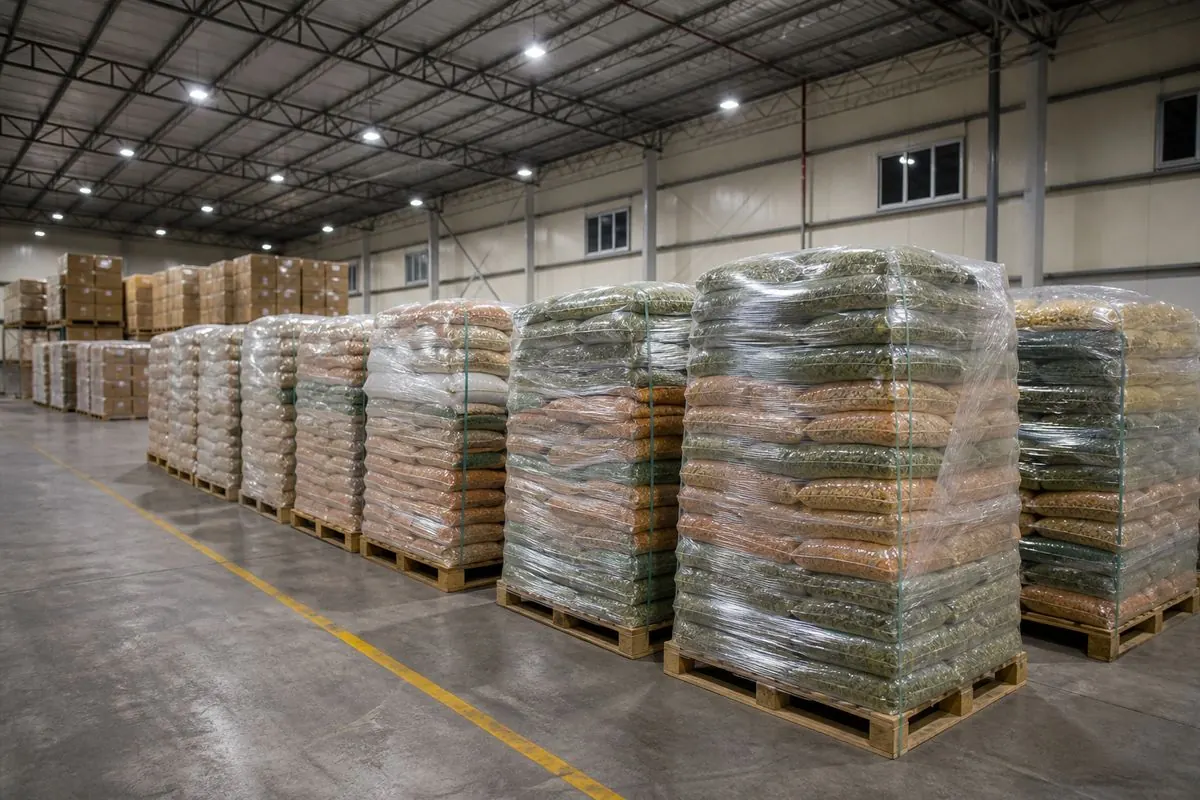
Packaging follows SKU risk. Flakes and kibbled cuts commonly ship in 10/20/25 kg food-grade bags or cartons with moisture-barrier liners. Fine tomato, spinach, and carrot powders often need nitrogen flush or vacuum. Beetroot and tomato can stain — liner quality and seal integrity matter. Retail private-label pouches (50 g–1 kg) need barcode, nutrition, allergen, and best-before fields frozen before packing starts.
Mixed blends should not share open packing lines with onion/garlic unless the blend is aromatic by design. Lot marks must state vegetable identity and cut so warehouse teams do not treat carrot flakes and cabbage flakes as fungible.
Pack formats by SKU type
Swipe →
Data table — swipe horizontally on small screens
| SKU Type | Preferred Pack | Why | Marking Must-Haves |
|---|---|---|---|
| Carrot / cabbage flakes | 10–25 kg bags/cartons + liner | Moisture control; handling ease | Vegetable, cut size, lot, net |
| Potato granules/flakes | 20–25 kg bags common | Foodservice bulk handling | Mesh/grade, lot, net |
| Tomato / spinach powders | N2 or vacuum + carton | Oxidation and moisture sensitivity | Mesh, moisture, lot |
| Mixed blends | 10–25 kg with blend code | Ratio identity for receiving | Blend code + component % if contracted |
| Freeze-dried pieces | Moisture-barrier cartons/pouches | Protect crisp structure | Method = freeze-dried on mark |
| Retail PL any SKU | 50 g–1 kg pouches + master carton | Shelf presentation | Barcode, nutrition, best-before |
Container Loading Details
Export Tip
- Recalculate payload when SKU mix changes.
- Segregate multi-SKU stacks on packing list lines.
- Powder-heavy loads: desiccant + seal checks.
- Indicative 20ft ~10–16 MT — confirm per density.
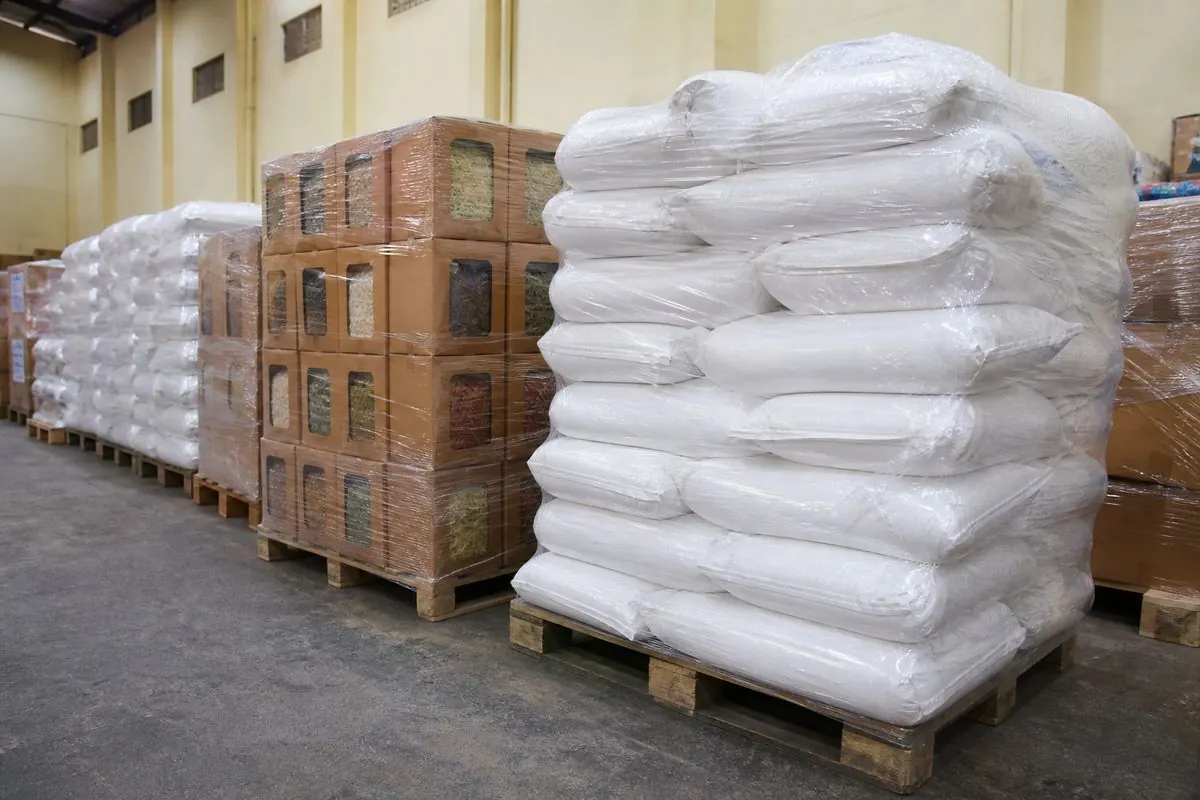
Container maths are SKU-density maths. Fine powders settle differently from bulky cabbage flakes. Indicative payloads remain about 10–16 MT per 20ft and 20–26 MT per 40ft HC for 10/20/25 kg formats, but a tomato-powder-heavy container will not match a flake-heavy mixed load. Confirm stow per SKU mix with the forwarder before promising MT to the buyer.
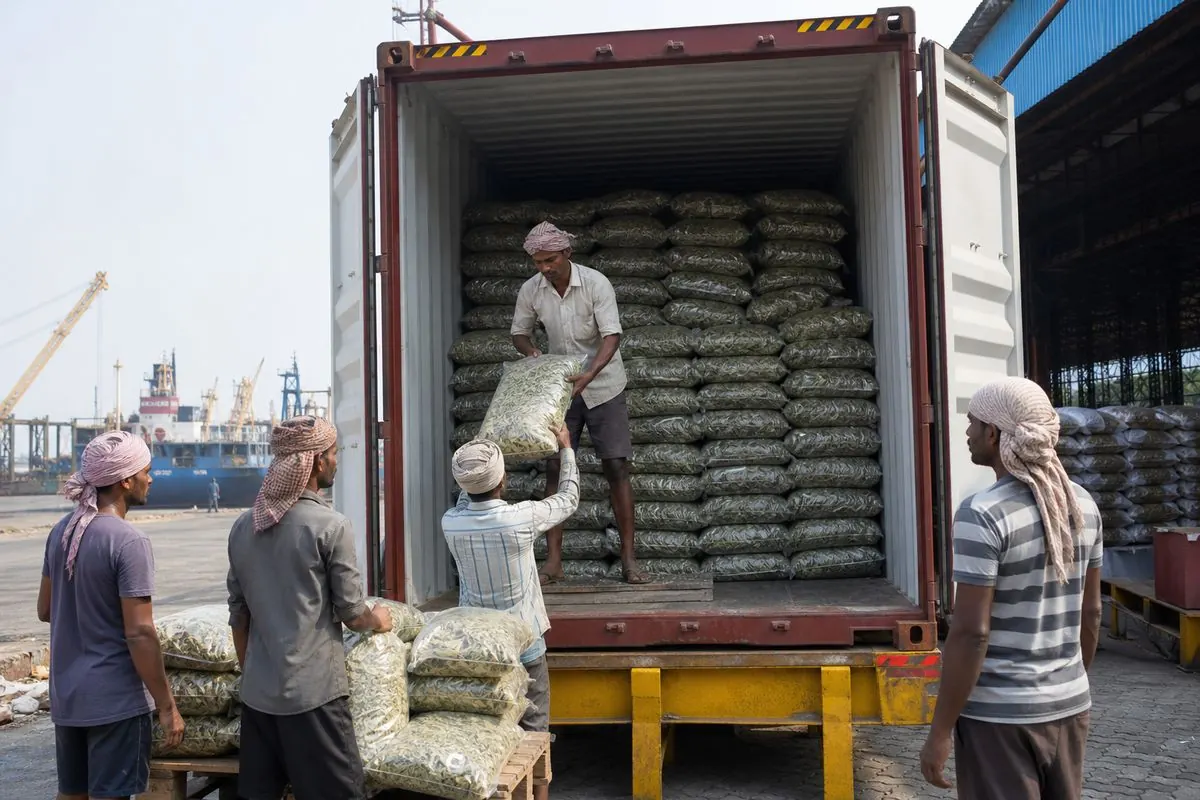
When stuffing multi-SKU containers, segregate stacks and mirror that segregation on the packing list. Photograph each SKU block. Hygroscopic powders need desiccant SOP on humid routes. Process stuffing discipline is detailed in the pillar; here the rule is simple: never assume one payload number fits every SKU.
Indicative stuffing cues by SKU mix
Swipe →
Data table — swipe horizontally on small screens
| Load Profile | Container Cue | Stuffing Note |
|---|---|---|
| Flake-heavy carrot/cabbage/mixed | 20ft ~10–16 MT typical band | Bulky cuts may hit cube before weight |
| Potato granule programmes | Confirm vs flake payload | Granule density differs from flakes |
| Powder-heavy tomato/spinach | Often weight-sensitive; confirm | N2 cartons change stow pattern |
| Freeze-dried light pieces | May cube out early | Do not promise flake MT numbers |
| Multi-SKU mixed container | Payload = sum of block plans | Segregate + photograph blocks |
| 40ft HC established programmes | ~20–26 MT indicative | Confirm axle/weight limits |
Shipping Methods
Export Tip
- Samples by air for powder/FD SKUs when speed matters.
- LCL for first SKU trials; FCL after ratio and COA stability.
- Stock air-dried ≠ freeze-dried calendar.
- Name SKU lead time on every proforma line.
SKU catalogue shipping choices follow product sensitivity more than generic freight habits. Air freight suits gram-to-kilogram powder and freeze-dried samples; LCL suits 100 kg–5 MT trials; FCL from Mundra or Nhava Sheva suits wholesale programmes. Freeze-dried and organic SKUs need calendar alignment with campaign slots — quoting seven-day production on a monthly freeze-dried line creates false expectations.
Lead-time cues by SKU tier: stock air-dried carrot/cabbage/mixed often 2–4 weeks; custom cuts and private-label 3–6 weeks; freeze-dried/organic 4–8+ weeks. Incoterm and port naming belong in the commercial offer but are process-owned in the pillar — keep SKU lead times explicit so buyers do not blend tomato powder campaigns with stock flake availability.
Certifications
Compliance Notes
- Universal: lot COA matched to SKU identity.
- Premium corridors: micro + MRL per SKU.
- Claim-driven: organic · Halal · Kosher · sulfite-free.
- Site audits: more common on powder programmes.
From a SKU view, certifications attach to claims you print on the specification sheet. Every commercial SKU needs a lot COA. Premium powders and EU/US/Japan destinations need micro and MRL reports. Organic claims need NPOP with destination equivalence. Halal matters for mixed foodservice packs into GCC. Site schemes (ISO 22000/HACCP/BRCGS) matter when the buyer audits the dehydrator for spinach powder or tomato powder programmes.
Do not claim freeze-dried, organic, or sulfite-free casually — each claim changes the evidence pack. Registration credentials (IEC/APEDA/FSSAI) are necessary context but process-owned in the pillar and APEDA post.
Certification emphasis by SKU claim
Swipe →
Data table — swipe horizontally on small screens
| SKU Claim / Channel | Evidence Pack | Notes |
|---|---|---|
| Any commercial SKU | Lot COA (moisture, micro, mesh/cut, residues as required) | Batch marks must match bags |
| US/EU/Japan powders | Micro + MRL + method references | Spinach/cabbage/carrot powders especially |
| Tomato powder programmes | Color/moisture COA + sulfite status | Declare SO₂ if used |
| Freeze-dried retail SKUs | Method declaration + premium micro | Do not label air-dried as FD |
| Organic SKUs | NPOP + USDA/EU transaction certificates | Segregation evidence |
| GCC mixed foodservice | Halal documentation | Blend components included |
| Private-label retail | Label compliance + COA + shelf-life support | Artwork freeze before pack |
Buyer Requirements
Buyer Requirements
- SKU sheet fields before FOB request.
- Numeric blend ratios for mixed products.
- Separate sample approval per SKU.
- Application note prevents cut mismatches.
Buyers sourcing dried vegetable products exported from India should issue a SKU sheet, not a vague dehydrate inquiry. Minimum fields: vegetable identity, cut dimensions or mesh, drying method, moisture maximum, color standard, micro limits, MRL schedule, sulfite status, pack format, trial MOQ, and target application. Attach a photo or retained sample when replacing an incumbent origin.
Factories quote faster — and fail less — when potato granules are not confused with potato flakes, and when mixed blend ratios are numeric. Ask for prior export lots of the same SKU, not generic "dehydrated vegetables" shipment photos. Process registrations and prospecting workflows sit outside this catalogue's ownership.
Country-wise Opportunities
Market Snapshot
- Match SKU library to corridor pull before travel or sampling spend.
- Powder investment for Japan/EU; flake volume for ASEAN.
- Tomato powder premium corridors need color QC first.
- Re-check demand-by-country before annual assortment resets.
Country opportunity for catalogue owners means where each SKU earns margin and repeat orders — not a full duty ranking. USA and EU reward consistent carrot, potato, tomato, and mixed industrial SKUs; Japan rewards powder mesh programmes; UAE rewards Halal-ready mixed foodservice; Indonesia rewards competitive air-dried flakes; Brazil rewards industrial dehydrate volume with broker-aligned entry. Deep ranking lives in Best Countries for Indian Dried Vegetable Exports; SKU × country matrices live in the demand-by-country post.
SKU opportunity heatmap (directional)
Swipe →
Data table — swipe horizontally on small screens
| Country / Region | Priority SKUs | Cut / Method Focus | Catalogue Note |
|---|---|---|---|
| United States | Carrot, potato, tomato, mixed | Flakes/granules/powder | Industrial + retail PL depth |
| Germany / EU | Carrot, tomato powder, cabbage, mixed | Micro-tight air-dried + powders | Sulfite/EtO honesty critical |
| Japan | Cabbage, spinach, carrot powders | Fine mesh powders | Enter after mesh library ready |
| Indonesia / Malaysia | Mixed, carrot, cabbage | Air-dried flakes | Competitive FOB cuts |
| UAE / GCC | Mixed vegetables, selective powders | Foodservice packs | Halal-ready blends |
| United Kingdom | Tomato, carrot, potato, mixed | Foodservice + retail | Robust COA culture |
| Brazil | Industrial mixed dehydrate | Air-dried volume | Broker path for entry |
| Canada / Australia | Premium powders + mixed | Selective FD/organic | Smaller but steady premium |
Sourcing Checklist
Checklist
Buyer Checklist
Exporter Checklist
Common Buyer Mistakes
Common Mistakes Box
Future Market Trends
Key Statistics
- Powder and FD premium growth alongside flake volume.
- Clean-label color SKUs (beetroot, tomato) expanding.
- Blend-ratio transparency becoming a buyer requirement.
- Mesh libraries becoming a sales asset for Japan/EU.
Assortment trends favour cleaner labels, tighter powder specs, and premium freeze-dried retail SKUs alongside enduring industrial flake demand. Beetroot and tomato powders continue to gain snack and seasoning adjacency; spinach and cabbage powders remain Japan-sensitive growth niches; mixed blends stay the foodservice workhorse when ratios are disciplined.
Organic and freeze-dried growth will not erase commodity air-dried carrot and cabbage volume — both tiers will coexist. Exporters that publish honest SKU sheets and mesh boards will outcompete collage marketing. Follow specialty pathway detail in the organic/freeze-dried companion post as premium inquiries rise.
Challenges & Solutions
- Challenge: vague RFQs — Solution: mandatory SKU sheet before quoting
- Challenge: flake vs granule confusion — Solution: photo boards + mm/mesh numbers
- Challenge: blend ratio drift — Solution: PO percents + packing-list codes
- Challenge: aromatic contamination — Solution: segregation unless blend is aromatic
- Challenge: FD vs air-dried mismatch — Solution: method on every line of COA and marks
- Challenge: wrong plant for powder — Solution: weekly-run verification before trial
SKU-level challenges differ from pure logistics challenges. Color drift on carrot, mesh failure on spinach powder, ratio drift on mixed blends, and aromatic contamination from onion lines are catalogue problems first. Solutions are specification discipline, plant specialisation matching, and separate retained samples per SKU.
Compliance Checklist
Checklist
Compliance Notes
Sources
- APEDA — Processed Vegetables (DGCIS FY2024-25 volume/value and destination notes)
- APEDA — RCMC / agri-processed export facilitation
- DGFT — Import Export Code (IEC) and foreign trade procedures
- FSSAI — food business licensing and product standards
- CBIC ICEGATE / Indian Customs — ITC-HS classification and shipping bills (confirm with CHA)
- India ITC-HS 0712 schedule (EximGuru reference) — 07122000 / 07129010–07129090 lines
- WITS / UN Comtrade — India HS 071290 exports by partner (2024)
- TrendEconomy — India HS 0712 exports/imports time series (2023 value and destination structure)
- OEC — India dried vegetables (HS 0712) bilateral profile (directional 2024 cues)
- ITC Trade Map — HS 0712 / 071290 partner verification
- USITC Harmonized Tariff Schedule — live US duty rates for HTS 0712
- EU TARIC — EU CN 0712 duties and measures
- FDA Prior Notice (food imports) — US food entry requirements
- Regulation (EC) No 396/2005 — EU pesticide MRLs
- Regulation (EU) 2018/848 — EU organic production and labelling
Trade figures, HS lines, and compliance notes in this article are directional planning aids. Re-verify against the primary sources below before quoting buyers or filing export documents.
SKU, cut, and moisture bands cited here are planning ranges — confirm dehydrator COA values on every lot before invoicing or buyer approval.
Conclusion
Choosing among dried vegetable products exported from India succeeds when vegetable identity, cut, drying method, MOQ, and pack format are locked before price negotiations — carrot flakes, potato granules, tomato powder, cabbage, cauliflower, beans, peas, spinach, beetroot, sweet corn, and mixed blends are different commercial products under HS 0712 / 0712.90.
Altus Exports helps importers and dehydrators match SKUs as a merchant exporter in India and global sourcing partner — contact us to build a sample kit or trial assortment. See our agriculture & food products industry page for related programmes.
Next reads: How to Export Dried Vegetables from India, Most Demanded Indian Dried Vegetables by Country, Organic, Freeze-Dried & Premium Dried Vegetable Export Opportunities, and pricing/process context in Best Countries for Indian Dried Vegetable Exports.