
Top Leather Footwear Products Exported from India (2026 Guide)
By Saurabh Mittal, Founder, Altus Exports
A category-by-category guide to the leather footwear products India exports in volume — men's formal, women's fashion, casual, boots, safety shoes, sandals, and children's footwear — with HS codes, materials, indicative pricing, MOQ, and the buyer profiles each category serves best.
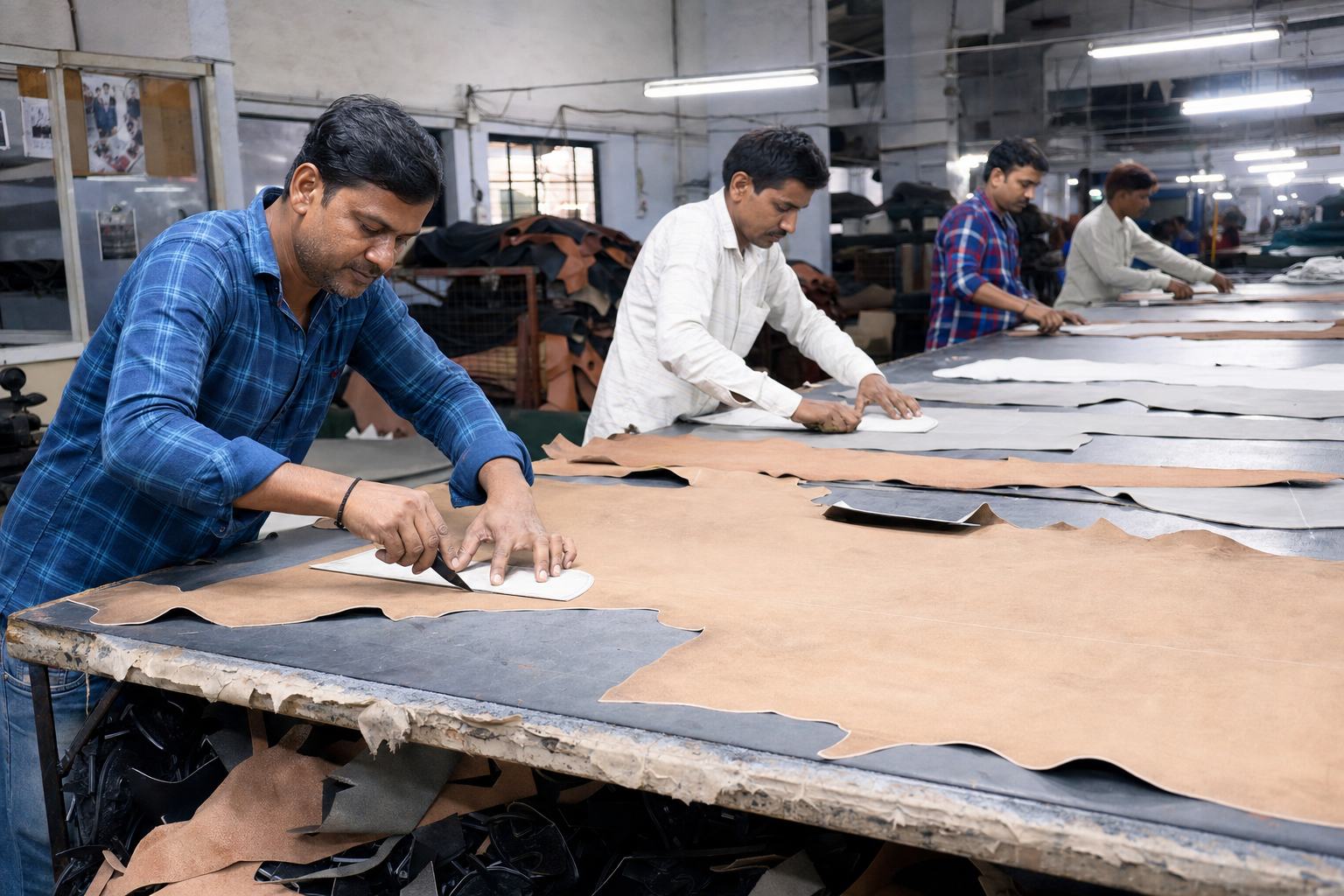
India exports a genuinely wide range of leather footwear — not a single commodity product, but seven distinct categories with different construction methods, target buyers, and price points.
Men's formal shoes, women's fashion footwear, casual and everyday styles, boots, safety and industrial footwear, sandals, and children's footwear each draw on different manufacturing clusters, leather grades, and compliance requirements, which means the right sourcing decision depends heavily on which category you are buying.
This guide is a product-depth reference — a category-by-category breakdown of what India exports, who buys it, and what it costs, rather than an operational how-to or a country-ranking guide. If you need the step-by-step registration-to-shipment process, see How to Export Leather Footwear from India.
If you are deciding which country to prioritise for a specific category, see Best Countries for Indian Leather Footwear Exports and Most Demanded Indian Leather Footwear by Country. Buyers evaluating suppliers for a specific category should also read Source Leather Footwear Directly from India.
India's manufacturing clusters specialise differently: Agra is the country's largest hub for men's and women's casual and formal footwear by volume, Kanpur combines tanning with finished footwear across multiple categories, the Ambur–Ranipet–Vellore–Chennai belt in Tamil Nadu built its reputation on export-oriented men's and women's fashion and safety footwear for European and North American buyers, and Jalandhar carries specific strength in component-heavy and sports-adjacent footwear.
Altus Exports works as a merchant exporter in India and global sourcing partner across all seven categories below — this guide distills that category-level sourcing experience for international buyers, distributors, and retail procurement teams.
Key Takeaways
Summary Box
Executive Summary
Summary Box
Buyers approaching Indian leather footwear as a single homogeneous product category consistently misjudge lead time, MOQ, and compliance requirements, because the seven categories India exports at scale — men's formal, women's fashion, casual, boots, safety shoes, sandals, and children's footwear — behave like seven distinct product businesses.
Each draws on a different combination of manufacturing cluster, construction method, leather grade, and destination-market compliance rule, and treating them interchangeably is the single most common sourcing mistake international buyers make when entering India for the first time.
This guide breaks the category down one by one: what it is, what it is made of, what it costs, what MOQ to expect, and which buyer profile it serves best.
It also covers market size and trade statistics for context, container loading and packaging benchmarks that shift meaningfully by category bulk, and the certifications each category carries — because a safety shoe and a fashion sandal do not share the same compliance burden even though both fall under the same broad HS heading.
Whether you are a wholesale distributor building a multi-category range, a retail chain sourcing a single private-label line, or a procurement team buying certified safety footwear for an industrial client, the category breakdown below is designed to be read selectively — jump to the category relevant to your programme, then use the pricing, MOQ, and certification tables to plan your first order with realistic expectations.
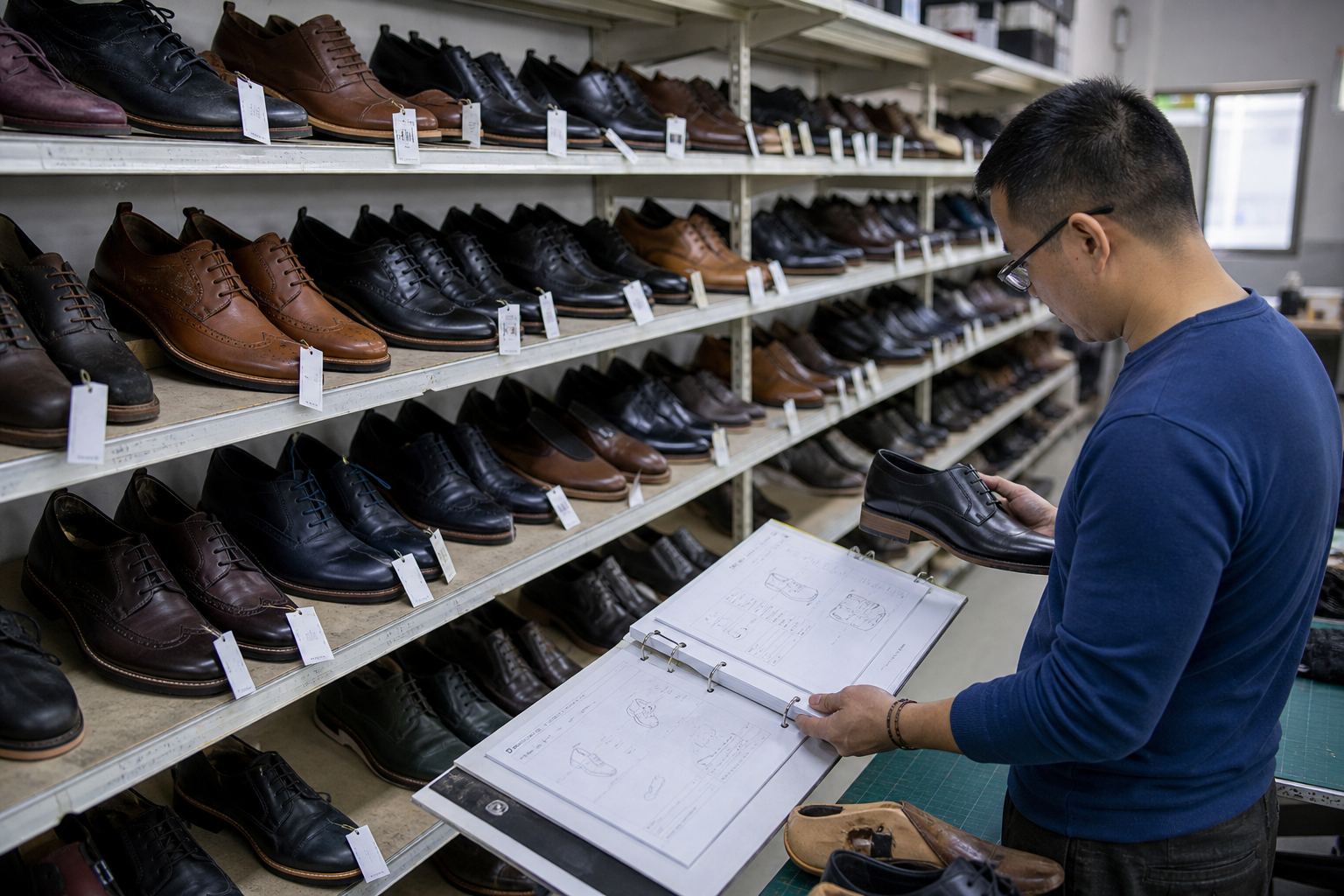
Market Size & Industry Overview
Key Statistics
India's leather footwear export base is built on category depth as much as volume. Rather than a single dominant product line, the country's manufacturing clusters have developed specialisations that map closely to buyer type: Agra's dense component and tannery ecosystem supports high-volume men's and women's casual and formal footwear at competitive pricing; the Tamil Nadu export belt around Ambur, Ranipet, and Vellore built decades of experience serving brand-owned and private-label programmes in Europe and North America, particularly for fashion and safety footwear requiring tighter compliance documentation; Kanpur's integrated tanning-to-footwear chain suits buyers who value traceability from raw hide to finished pair; and Jalandhar's component manufacturing strength serves footwear categories with heavier hardware and technical construction.
The Council for Leather Exports (CLE), tracked through leatherindia.org, is the sector's export promotion and regulatory reference body across every category covered in this guide. Buyers evaluating a new Indian supplier for any footwear category should confirm CLE membership and an active RCMC as a baseline credibility check before deeper category-specific evaluation.
Category choice should follow buyer need, not manufacturer convenience. A distributor building a value-driven casual footwear range and a procurement team sourcing certified safety shoes for an industrial client are solving fundamentally different problems, even though both may source from Indian leather footwear exporters.
India Leather Footwear Category Landscape (Indicative)
Swipe →
Data table — swipe horizontally on small screens
| Category | Leading Cluster(s) | Typical Buyer Profile | Compliance Emphasis |
|---|---|---|---|
| Men's formal | Agra, Kanpur, Tamil Nadu belt | Wholesale distributors, formalwear retail chains | Chromium VI (EU/UK); general commercial documentation |
| Women's fashion | Agra, Tamil Nadu belt, Delhi-NCR | Fashion retail chains, department stores | Colour/finish quality audits; chromium VI (EU/UK) |
| Casual | Agra, Jalandhar | Lifestyle retail, e-commerce private label | General commercial documentation |
| Boots | Agra, Kanpur, Tamil Nadu belt | Workwear distributors, fashion retail chains | Waterproofing/lining test reports where specified |
| Safety shoes | Tamil Nadu belt, Kanpur | Industrial distributors, PPE procurement teams | EN ISO 20345 or equivalent safety standard testing |
| Sandals | Rajasthan, Tamil Nadu belt | Warm-climate retail, resort and lifestyle brands | General commercial documentation |
| Children's | Agra, Delhi-NCR | Children's retail chains, department stores | CPSIA (USA); chromium VI (EU/UK) |
Export Statistics
Key Statistics
Export composition across categories has shifted gradually over recent years, with value-added categories — safety footwear and premium fashion lines — growing faster in export value than pure volume-driven casual and commodity segments, even though casual footwear remains the largest category by pairs shipped. The Council for Leather Exports and DGCIS publish periodic statistics on footwear export volume and value by HS sub-heading that new exporters and buyers should reference before setting category-level volume targets.
Indicative Export Share by Category (Value Basis)
Swipe →
Data table — swipe horizontally on small screens
| Category | Indicative Planning Mix (not CLE published) | Growth Trend | Primary Destinations |
|---|---|---|---|
| Men's formal and casual | ~30–35% | Stable, mature category | USA, Germany, UK, UAE, Netherlands |
| Women's fashion | ~25–30% | Growing with seasonal colourway demand | Germany, France, UK, USA, Italy |
| Boots | ~10–15% | Steady growth, workwear and fashion both contributing | USA, Germany, UK, Australia |
| Safety and industrial | ~8–12% | Fastest-growing category by value | Germany, UK, France, Middle East |
| Sandals | ~5–8% | Stable, seasonal demand pattern | UAE, Saudi Arabia, Southern Europe |
| Children's | ~4–6% | Gradual growth, compliance-sensitive | UK, Germany, USA |
Import Statistics
Key Statistics
Reading destination import data by category — not just by overall HS 6403 volume — reveals which markets favour which product lines. A market that imports heavily in safety footwear but lightly in fashion sandals is telling you something different about buyer profile than a market with the reverse pattern, and category-level demand signals should shape which product lines you prioritise for that destination.
Category Demand Signals by Top Importing Country (Indicative)
Swipe →
Data table — swipe horizontally on small screens
| Importing Country | Strongest Category Demand | Secondary Category Demand | Documentation Note |
|---|---|---|---|
| United States | Casual, boots | Women's fashion, children's | CPSIA mandatory for children's lines |
| Germany | Safety footwear, men's formal | Women's fashion | Chromium VI test reports expected across categories |
| United Kingdom | Men's and women's footwear, children's | Boots | Standard commercial docs; chromium VI compliance |
| UAE | Sandals, men's formal | Women's fashion | Growing quality documentation expectations |
| France | Women's fashion | Men's formal | Brand-level quality audits common in fashion category |
| Australia | Boots, casual | Safety footwear | Biosecurity and standard customs documentation |
Product Categories and Variants
Summary Box
This section is the core of the guide — a breakdown of each of the seven categories India exports in meaningful volume, covering construction, leather type, target buyer, and the sourcing considerations specific to that category. Use it alongside the pricing and MOQ tables later in this guide to plan a category mix that fits your distribution channel and target market.
Men's Formal Footwear
- Typical HS sub-heading
- 6403.51 (covering ankle) / 6403.59 (not covering ankle)
- Common construction
- Goodyear-welted, cemented, or Blake-stitched
- Indicative MOQ
- 300–1,200 pairs per style (trial to standard programme)
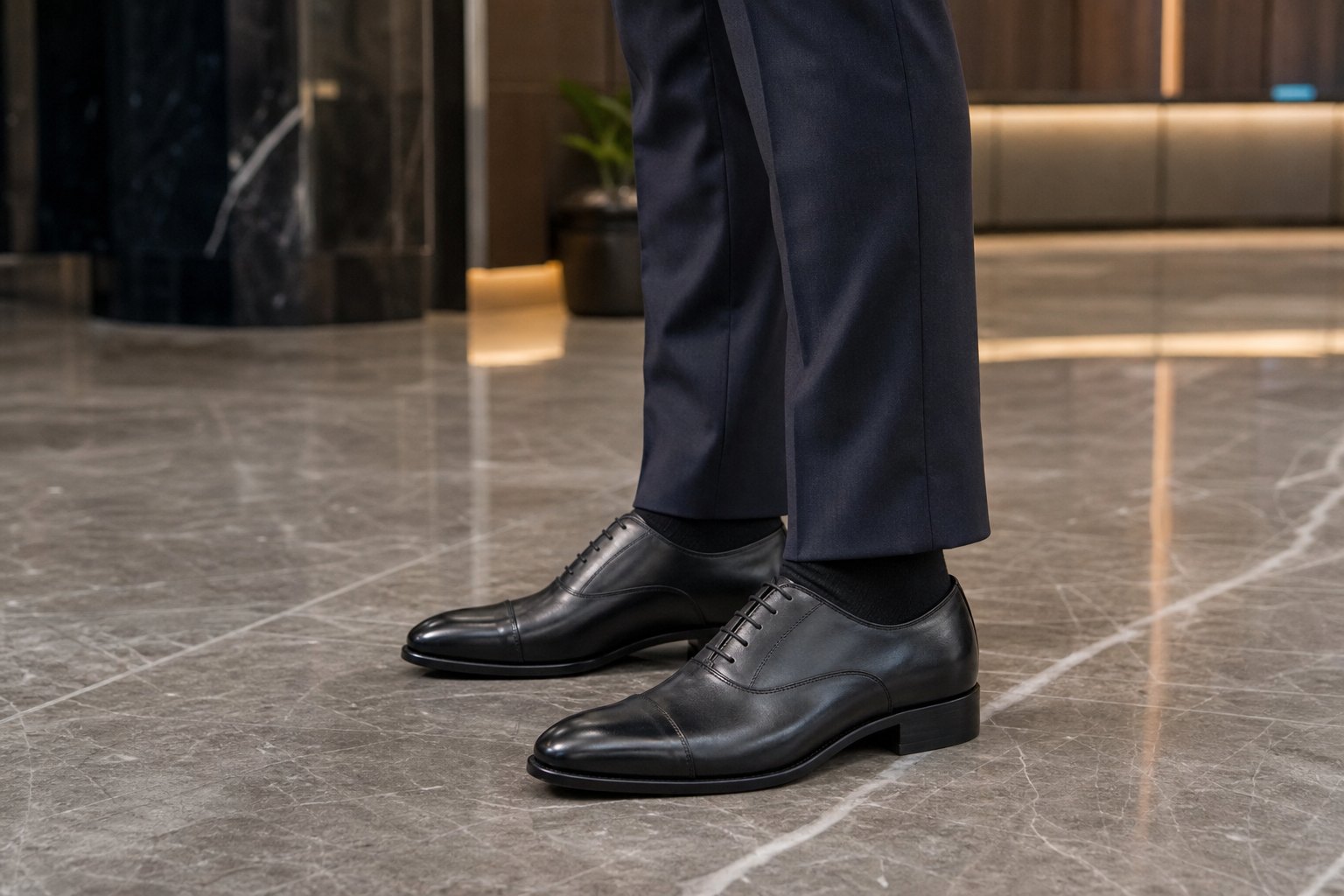
Men's formal footwear — Oxfords, Derbies, monk straps, and brogues — represents one of India's most established export categories, built on decades of Agra and Kanpur manufacturing experience. Construction ranges from fully Goodyear-welted premium lines to cemented-construction commodity ranges, with full-grain and corrected-grain leather both in common use depending on price positioning.
Buyers typically source men's formal footwear for wholesale distribution into department stores, formalwear retail chains, and corporate uniform or workwear procurement programmes. Colour range is typically conservative — black, brown, tan, and oxblood dominate — with buyers expecting consistent leather grain matching across a production batch.
Women's Fashion Footwear
- Typical HS sub-heading
- 6403.99 (general) / 6403.91 (ankle-covering boots)
- Common construction
- Cemented, injection-moulded sole units for casual fashion
- Indicative MOQ
- 300–1,000 pairs per style, higher colourway count than men's lines
Women's fashion footwear covers pumps, ballerinas, ankle boots, block-heel sandals, and seasonal fashion styles. This category carries the widest style turnover of any Indian footwear export line, with buyers frequently requesting seasonal colourways, heel height variations, and trim details (buckles, straps, perforations) that change every buying cycle.
Tight colour and finish matching matters more in this category than in any other — a fashion retail buyer rejecting a shipment for shade inconsistency across cartons is one of the most common quality disputes in the segment. Leather types range from smooth full-grain to suede and nubuck finishes depending on the season and target price point.
Casual and Everyday Footwear
- Typical HS sub-heading
- 6403.59 / 6403.99
- Common construction
- Cemented construction with rubber or EVA sole units
- Indicative MOQ
- 500–1,500 pairs per style; higher for e-commerce private label
Casual footwear — loafers, slip-ons, leather sneakers, and moccasin-construction styles — is the highest-volume category by pairs shipped, particularly from Agra and Jalandhar. This segment serves lifestyle retail chains and the fast-growing e-commerce private-label channel, where buyers prioritise price competitiveness and comfort features (cushioned insoles, flexible sole units) over premium leather grade.
Casual footwear programmes often move fastest from sample approval to bulk shipment because construction is simpler than formal or safety footwear, and sole units are frequently sourced from standardised component suppliers rather than custom-tooled per style.
Boots (Work and Fashion)
- Typical HS sub-heading
- 6403.91 (covering the ankle)
- Common construction
- Goodyear-welted or cemented with reinforced heel/toe
- Indicative MOQ
- 300–800 pairs per style; bulkier cartons reduce per-container count
Boots span two distinct sub-markets: work and outdoor boots built for durability and weather resistance, and fashion boots (chukkas, Chelsea boots, ankle boots) built for style. Both require more leather per pair than low-cut footwear and typically carry higher per-pair freight cost given carton bulk.
Work boot buyers commonly request waterproofing treatment, reinforced toe and heel construction, and specific sole compounds for oil or slip resistance. Fashion boot buyers focus more on silhouette, leather finish, and seasonal colour range, closely following the same trend cycles as women's fashion footwear.
Safety and Industrial Footwear
- Typical HS sub-heading
- 6403.40 only for protective metal toecap; composite/non-metal toe usually 6403.91/6403.99
- Common construction
- Direct-injected PU/PU sole, steel or composite toe cap
- Indicative MOQ
- 500–1,000 pairs per style; certification testing adds lead time
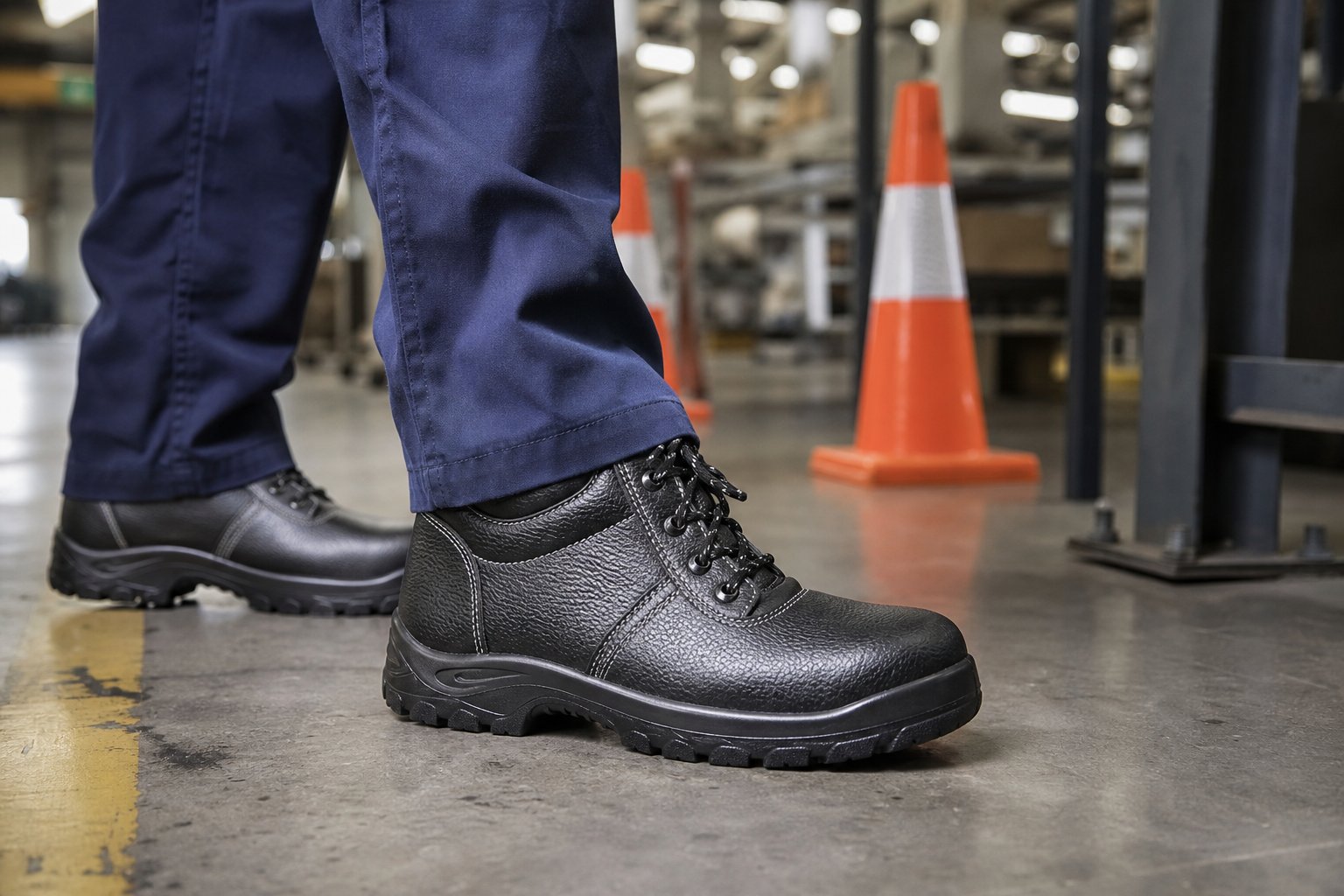
Safety footwear — steel-toe and composite-toe shoes and boots — serves industrial distributors and corporate PPE procurement programmes rather than retail shelves. This category carries the heaviest compliance burden of any leather footwear export line, since safety claims must be backed by testing against recognised standards such as EN ISO 20345 (or the buyer's local equivalent) covering impact resistance, slip resistance, and sole compound performance.
Tamil Nadu's export belt and select Kanpur manufacturers lead this category given established experience with European workwear brands and the testing infrastructure required to support certification claims. Buyers should never accept safety claims without current test certificates matching the specific style and toe-cap material shipped.
Sandals and Open Footwear
- Typical HS sub-heading
- 6403.99
- Common construction
- Strap-and-buckle or slide construction, cemented sole
- Indicative MOQ
- 300–800 pairs per style
Sandals and open footwear — leather-strap sandals, slides, and open-toe styles — serve warm-climate retail markets and resort or lifestyle brand programmes. Construction is simpler than closed footwear, which typically translates to lower per-pair pricing and higher pair-per-container counts given the compact carton size.
Rajasthan's traditional leather-craft base and the Tamil Nadu export belt both supply this category, with buyers choosing between handcrafted traditional styles (kolhapuris and similar ethnic constructions) and more standardised commercial sandal lines depending on the target retail positioning.
Children's Footwear
- Typical HS sub-heading
- 6403.99
- Common construction
- Lightweight cemented construction, flexible sole units
- Indicative MOQ
- 300–600 pairs per style; smaller size range reduces per-style volume
Children's leather footwear — school shoes, casual styles, and sandals sized for younger feet — is a smaller but steadily growing export category, sourced primarily from Agra and Delhi-NCR manufacturers with experience in the smaller size ranges and softer, more flexible sole construction that children's footwear standards typically require.
This category carries specific compliance obligations that other segments do not: CPSIA testing (lead content, phthalates, general safety) is mandatory for footwear entering the United States for children, and EU/UK buyers apply the same chromium VI limits as adult footwear alongside additional mechanical safety checks for small parts and sole flexibility.
Manufacturing Overview
Export Tip
Leather type is a category-crossing variable that affects every product line above. Full-grain leather retains the natural grain surface and is prized for durability and character in men's formal and premium boot categories. Corrected-grain leather has surface imperfections buffed away and an embossed grain applied, offering a more uniform, cost-efficient finish common in commodity casual and children's footwear. Nubuck (buffed full-grain) and suede (buffed split leather) provide a soft napped finish used heavily in women's fashion and casual styles.
Chrome tanning remains the dominant tanning method across Indian leather footwear manufacturing given its efficiency and consistent output, but chrome-free (vegetable or alternative-tanned) leather is gaining ground, particularly for EU-bound premium and fashion programmes where buyers maintain sustainability sourcing policies. Leather Working Group (LWG) certification of the tannery — independent of the tanning chemistry itself — has become a common buyer request across categories, not just premium fashion lines, as EU and US brands extend supply-chain traceability requirements down to raw material sourcing.
Construction Methods by Category
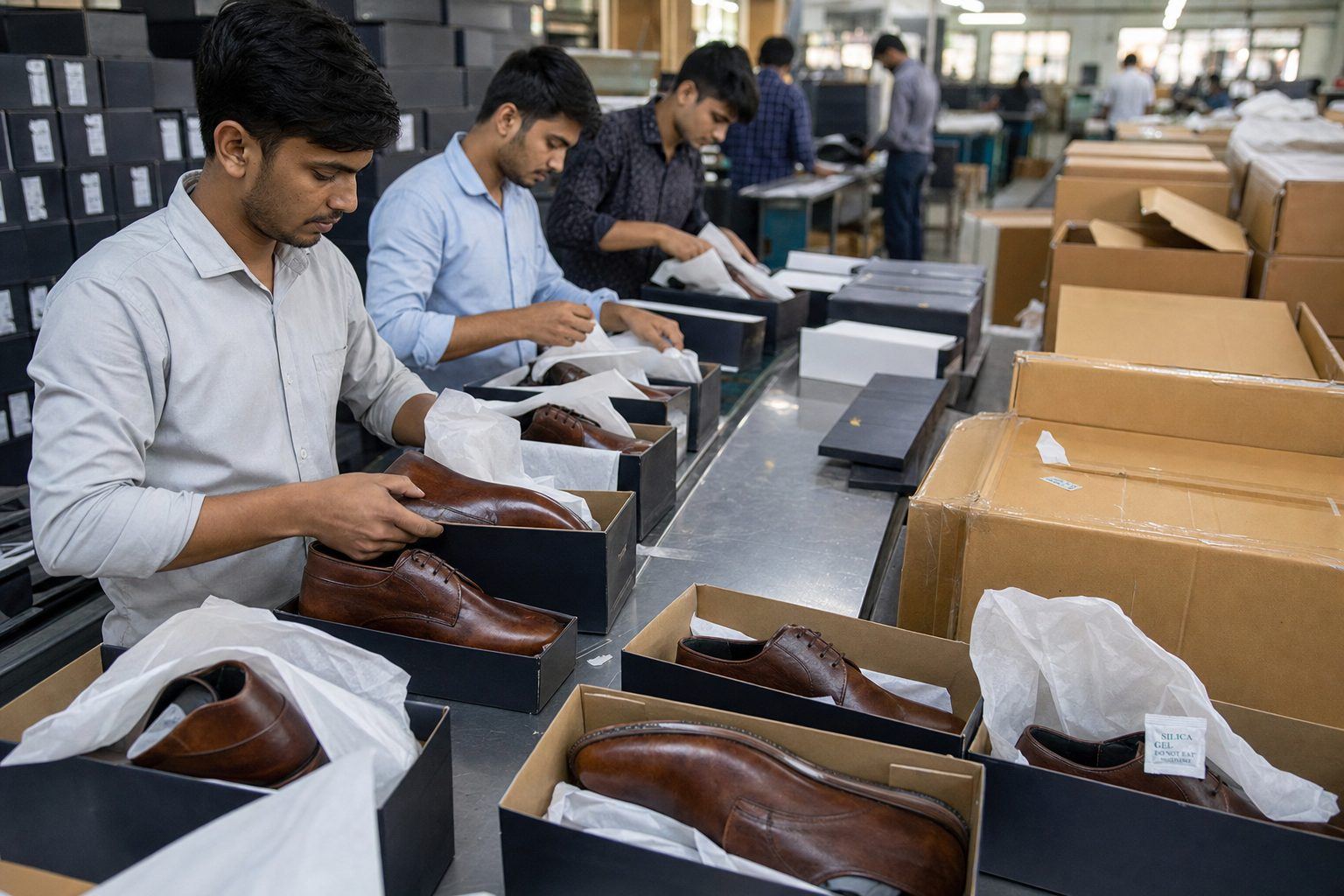
Goodyear-welted construction, where the upper, insole, and welt are stitched together before the outsole is attached, is common in premium men's formal footwear and quality boots, offering resoling durability that justifies a price premium. Cemented construction, where the upper is bonded directly to the sole unit with adhesive, is faster and less expensive, dominating casual, fashion, and children's categories. Direct-injected PU or PU/rubber soling is common in safety footwear, offering the cushioning and chemical resistance that industrial buyers require.
Lasting, Cutting, and Finishing Stages
Regardless of category, production runs through the same core stages: leather cutting to pattern, stitching of upper components, lasting over the shoe mould to set shape, sole attachment (welted, cemented, or injection-moulded depending on category), and finishing (polishing, edge dressing, and final inspection). The proportion of manual versus machine-assisted work at each stage shifts by category — safety footwear and Goodyear-welted formal shoes require more skilled manual finishing than high-volume cemented casual lines.
Pricing Analysis
Buyer Tip
Pricing varies meaningfully by category, construction complexity, and leather grade — the ranges below are indicative FOB planning figures. Always validate current pricing against recent factory quotations and leather cost movements before committing to a buyer price.
Indicative FOB Price Ranges by Category (USD/pair)
Swipe →
Data table — swipe horizontally on small screens
| Category | Entry-Level Range | Mid-Tier Range | Premium Range | Key Price Driver |
|---|---|---|---|---|
| Men's formal | $8–$12 | $12–$16 | $16–$22 | Leather grade; construction method |
| Women's fashion | $6–$10 | $10–$14 | $14–$18 | Heel construction; finish complexity |
| Casual | $5–$8 | $8–$11 | $11–$14 | Sole type; component quality |
| Boots | $12–$18 | $18–$25 | $25–$35 | Height, lining, waterproofing, sole system |
| Safety shoes | $10–$16 | $16–$22 | $22–$28 | Certification standard; toe cap material |
| Sandals | $4–$7 | $7–$9 | $9–$12 | Strap construction; hardware quality |
| Children's | $4–$6 | $6–$8 | $8–$10 | Size range; safety compliance features |
MOQ Analysis
Buyer Tip
Minimum order quantity and packaging format both shift by category, and buyers who apply a single MOQ assumption across every category tend to either overpay for small trial runs or underestimate the volume a factory needs to justify tooling and leather procurement for a new style.
Indicative MOQ by Category
Swipe →
Data table — swipe horizontally on small screens
| Category | Trial MOQ (per style) | Standard MOQ (per style) | Notes |
|---|---|---|---|
| Men's formal | 300–500 pairs | 600–1,200 pairs | MOQ scales with size-run breadth and colourway count |
| Women's fashion | 300–500 pairs | 500–1,000 pairs | Higher colourway count than men's lines raises effective MOQ |
| Casual | 500–800 pairs | 800–1,500 pairs | Higher for e-commerce private-label programmes |
| Boots | 300–500 pairs | 500–800 pairs | Bulkier cartons reduce per-container count and can raise effective unit cost |
| Safety shoes | 500–800 pairs | 800–1,000 pairs | Certification testing adds lead time regardless of volume |
| Sandals | 300–500 pairs | 500–800 pairs | Simpler construction supports smaller trial runs |
| Children's | 300–500 pairs | 500–600 pairs | Smaller size range reduces per-style volume |
Packaging Standards
Export Tip
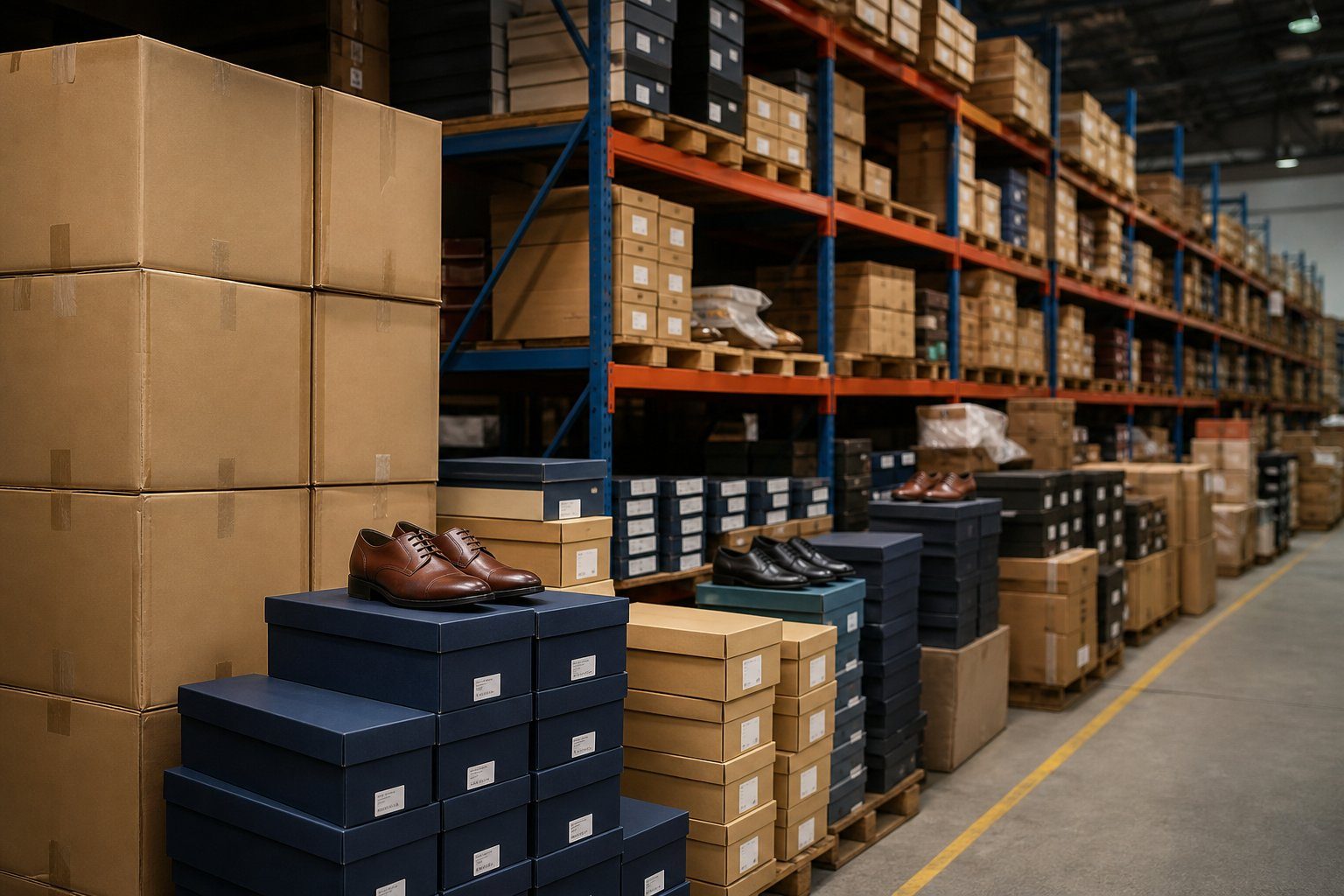
Packaging format shifts by category and buyer channel. Most categories use an individual shoe box with tissue paper, a size label, and hang tags, consolidated into master cartons by style and size ratio. Value-driven casual and sandal lines sometimes use polybags instead of boxes to reduce packaging cost, while safety footwear cartons typically carry a compliance label and certification insert alongside the standard box format.
Indicative Packaging Format by Category
Swipe →
Data table — swipe horizontally on small screens
| Category | Typical Packaging Format | Notes |
|---|---|---|
| Men's formal | Individual shoe box with tissue, size label, master carton | Consistent box grade expected across a wholesale batch |
| Women's fashion | Individual shoe box, tissue, hang tag, colourway-coded cartons | Colourway coding on cartons reduces sorting errors at destination |
| Casual | Individual shoe box or polybag for value lines, master carton | Polybag reduces per-unit packaging cost for e-commerce private label |
| Boots | Reinforced individual box given bulk, fewer pairs per master carton | Reinforced cartons reduce crushing risk during transit |
| Safety shoes | Individual box with compliance label, certification insert | Certification insert must match exact toe-cap and sole compound shipped |
| Sandals | Lightweight box or polybag, higher pairs per master carton | Compact carton size improves per-container pair count |
| Children's | Smaller individual box, size-range labelled master carton | Clear size-range labelling reduces retail sorting time |
Container Loading Details
Export Tip
Container loading benchmarks vary by category bulk — a container filled with sandals or ballerinas fits meaningfully more pairs than one filled with boots or safety shoes, given carton dimensions. Buyers planning a mixed-category container should model per-carton volume for each style rather than assuming a flat pairs-per-container figure across the whole load. All figures below are indicative planning benchmarks only.
Indicative Container Loading by Category Bulk (40ft HC, Pairs)
Swipe →
Data table — swipe horizontally on small screens
| Category | Approx. Pairs per 40ft HC | Relative Carton Bulk | Notes |
|---|---|---|---|
| Sandals / children's | ~11,000–13,000 pairs | Compact | Highest pair count per container given small carton footprint |
| Casual / women's fashion (low-cut) | ~9,000–11,000 pairs | Moderate | Standard mid-size carton, most common footwear container profile |
| Men's formal | ~8,000–10,000 pairs | Moderate | Slightly bulkier box given rigid formal shoe construction |
| Boots / safety shoes | ~6,000–9,000 pairs | Bulky | Height and reinforced construction reduce cartons per pallet layer |
Shipping Methods
Export Tip
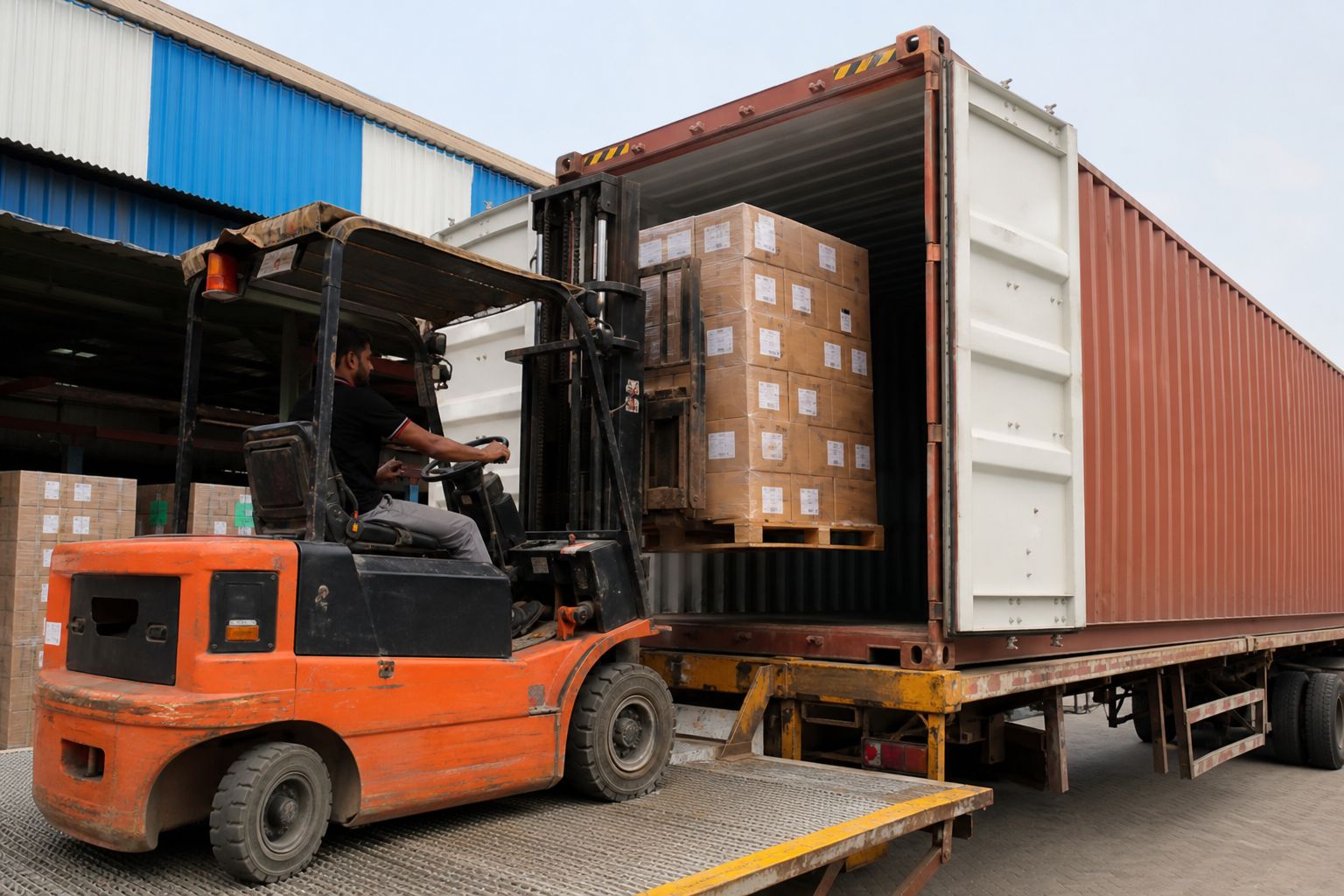
Sea freight in full container load (FCL) format is the standard shipping method across all seven categories for established buyer programmes, given the cost efficiency it offers on bulk volumes. Less-than-container-load (LCL) consolidation is common for buyers trialling two or three categories simultaneously in smaller quantities, since it avoids the cost of underfilling a full container across multiple style groups.
Air freight is used selectively across categories — most often for fashion sample shipments ahead of a buying season, urgent safety footwear replenishment for an industrial client, or premium children's footwear trial batches where speed to shelf outweighs the higher per-pair freight cost. FOB remains the dominant Incoterm across categories, with CIF and CFR used by buyers who prefer a single landed-cost quote regardless of which category they are importing.
Certifications
Compliance Notes
Certification requirements differ meaningfully by category, and buyers who apply a generic compliance checklist across every category risk missing the specific test that actually matters for their product line.
Category-Specific Certification Emphasis
Swipe →
Data table — swipe horizontally on small screens
| Category | Primary Certification / Test | Applies To | Notes |
|---|---|---|---|
| All categories (EU/UK) | REACH chromium VI test report | Leather components in any style | Mandatory regardless of category or price point for EU/UK-bound shipments |
| Children's footwear (USA) | CPSIA compliance (lead, phthalates, safety) | Footwear sized for children | Mandatory for US entry; test per production batch recommended |
| Safety footwear | EN ISO 20345 or equivalent safety standard | Steel-toe and composite-toe styles | Certificate must match exact toe-cap material and sole compound shipped |
| Premium / sustainability-focused lines | Leather Working Group (LWG) tannery certification | Any category, most requested in fashion and premium boots | Optional but increasingly expected by EU brands with sourcing policies |
Buyer Requirements
Buyer Requirements
- For men's formal and boots: ask about Goodyear-welting capability, resoling durability testing, and leather grain-matching process across a batch.
- For women's fashion: request colourway consistency records across at least two prior production runs, not just a single best-case sample.
- For safety footwear: require current EN ISO 20345 (or equivalent) test certificates matching the exact toe-cap material and sole compound to be shipped.
- For children's footwear: confirm CPSIA test reports (for US-bound orders) and chromium VI test reports (for EU/UK-bound orders) are available per production batch.
- For sandals: clarify hardware (buckle, strap) sourcing and corrosion resistance, particularly for coastal or humid destination climates.
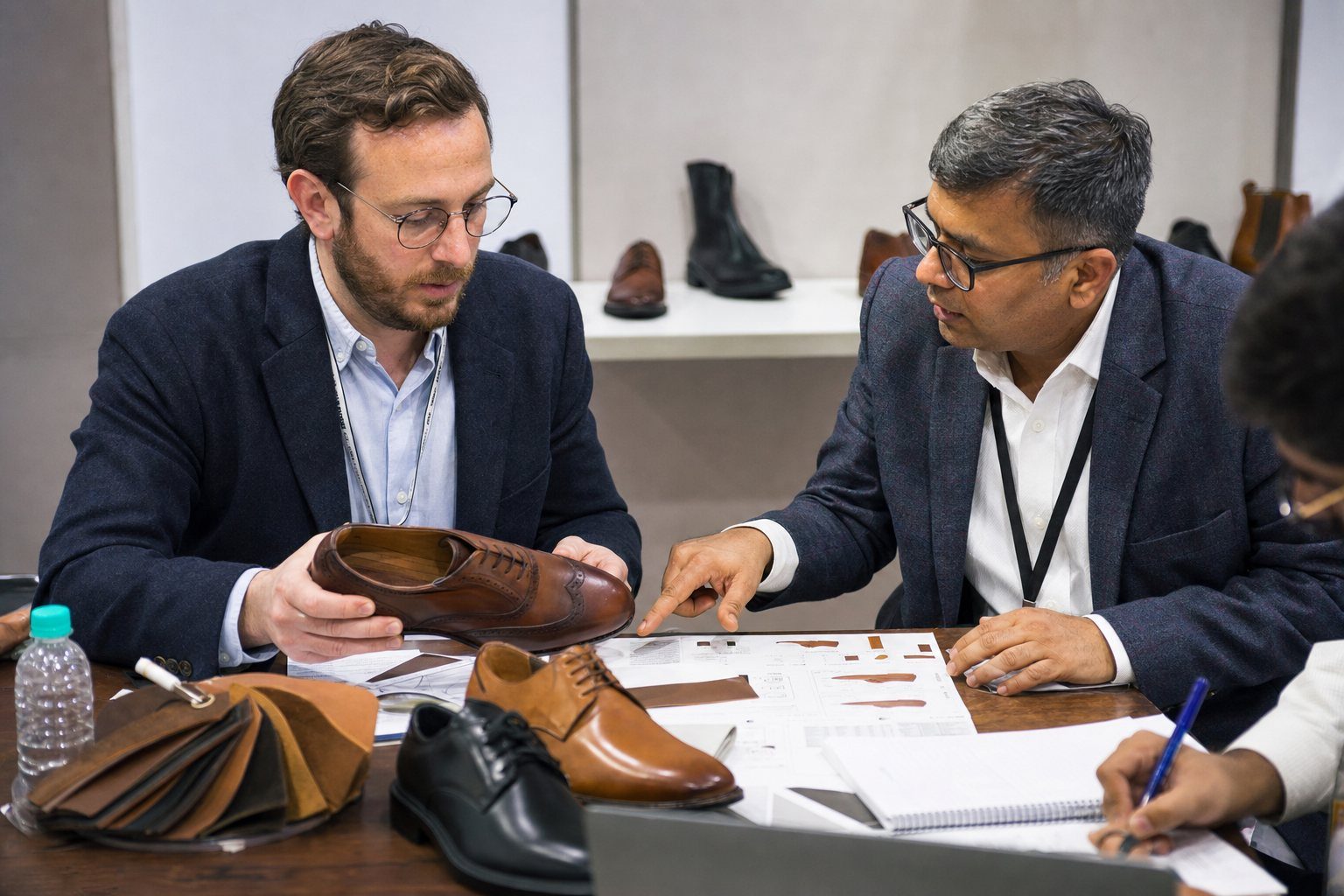
International buyers evaluating an Indian footwear exporter for a specific category typically look for verifiable evidence that the exporter's stated category strength matches actual production history — not just a product photo gallery. First-time buyers should be ready to ask these category-specific questions before placing a deposit.
Country-wise Opportunities
Market Snapshot
Category and country selection work together — see Best Countries for Indian Leather Footwear Exports for full market-by-market entry strategy and Most Demanded Indian Leather Footwear by Country for a category-specific breakdown by destination.
United States
Strong demand across casual, boots, and children's categories; e-commerce private label has become a significant channel for casual footwear specifically.
Germany
Safety footwear and men's formal footwear see the strongest demand, with buyers applying rigorous chromium VI and construction-quality checks.
United Kingdom
Broad category demand across men's, women's, and children's lines through established retail chains and wholesale distributors.
UAE
Sandals and men's formal footwear perform strongly, supported by the region's climate and re-export role for the wider Gulf.
Expert Insight: Category Discipline Beats Category Assumptions
Expert Insight Box
The buyers who scale fastest across multiple leather footwear categories from India are the ones who treat each category as its own sourcing project with its own timeline, certification requirements, and QC checkpoints — while still consolidating supplier relationships and documentation workflows where it genuinely saves time. That balance between category-specific rigour and operational consolidation is where an experienced merchant exporter adds the most value.
Sourcing Checklist
Checklist
Buyer Checklist
Checklist
Exporter Checklist
Checklist
Compliance Checklist
Checklist
Compliance Notes
Common Buyer Mistakes
Common Mistakes Box
Buyers new to a specific category often carry assumptions from a different category that do not transfer cleanly. A buyer experienced in sourcing casual footwear who moves into safety footwear procurement, for example, may under-budget for certification testing time — a mistake that a structured category-aware sourcing process avoids.
Expert Insight: Consolidation Without Losing Category Rigour
Expert Insight Box
Category mix shapes negotiating leverage as much as it shapes compliance planning. A buyer committing to men's formal, casual, and boots across a season gives a manufacturer better capacity planning visibility than three separate single-category orders spread across different suppliers — and that visibility routinely translates into better pricing and priority production slots during peak seasons, provided the buyer maintains category-specific quality discipline rather than treating the whole order as one undifferentiated batch.
Future Market Trends
Key Statistics
Three category-level trends stand out for the coming years: safety and industrial footwear continuing to grow faster in export value than any other category as European workwear brands expand certified sourcing from India; chrome-free and LWG-certified leather sourcing spreading from premium fashion lines into mainstream casual and children's categories as EU traceability rules extend further down the supply chain; and e-commerce private-label demand accelerating specifically within the casual and women's fashion categories, rewarding exporters who can turn samples around faster without sacrificing size-run consistency.
Buyers who build category-specific sourcing discipline now — rather than treating leather footwear as one undifferentiated product — will be better positioned to capture the categories growing fastest, rather than defaulting to whichever line was easiest to source first.
Conclusion
- Operational process: see How to Export Leather Footwear from India.
- Market selection: see Best Countries for Indian Leather Footwear Exports and Most Demanded Indian Leather Footwear by Country.
- Sustainability and premium sourcing: Sustainable and Premium Leather Footwear Export Opportunities.
- Buyer-side sourcing: Source Leather Footwear Directly from India and Find International Buyers for Leather Footwear.
- Explore merchant exporter, export products from India, and global sourcing partner partnership models for leather footwear.
India's leather footwear export strength lies in category depth: men's formal, women's fashion, casual, boots, safety shoes, sandals, and children's footwear each draw on distinct manufacturing clusters, construction methods, and compliance pathways. Buyers who match category selection to their distribution channel, understand the specific certification and QC requirements each category carries, and consolidate sourcing with an experienced partner where it makes sense consistently build more resilient, better-priced supply chains than those treating all footwear sourcing as one undifferentiated process.
Altus Exports supports international buyers across all seven leather footwear categories as a merchant exporter in India and global sourcing partner, coordinating category-specific sourcing, quality control, and documentation under one accountable relationship. Explore our export products from India and product sourcing company services, or connect with us through find manufacturers in India for verified category-specific footwear supply.