
How to Source Leather Footwear Directly from India: Buyer Playbook
By Saurabh Mittal, Founder, Altus Exports
A practical playbook for international buyers sourcing leather footwear directly from India — factory verification, RFQ discipline, fit and size-run sample approval, MOQ and pricing negotiation, quality control, and a safe first trial order, written for importers, distributors, wholesalers, and retail chains.
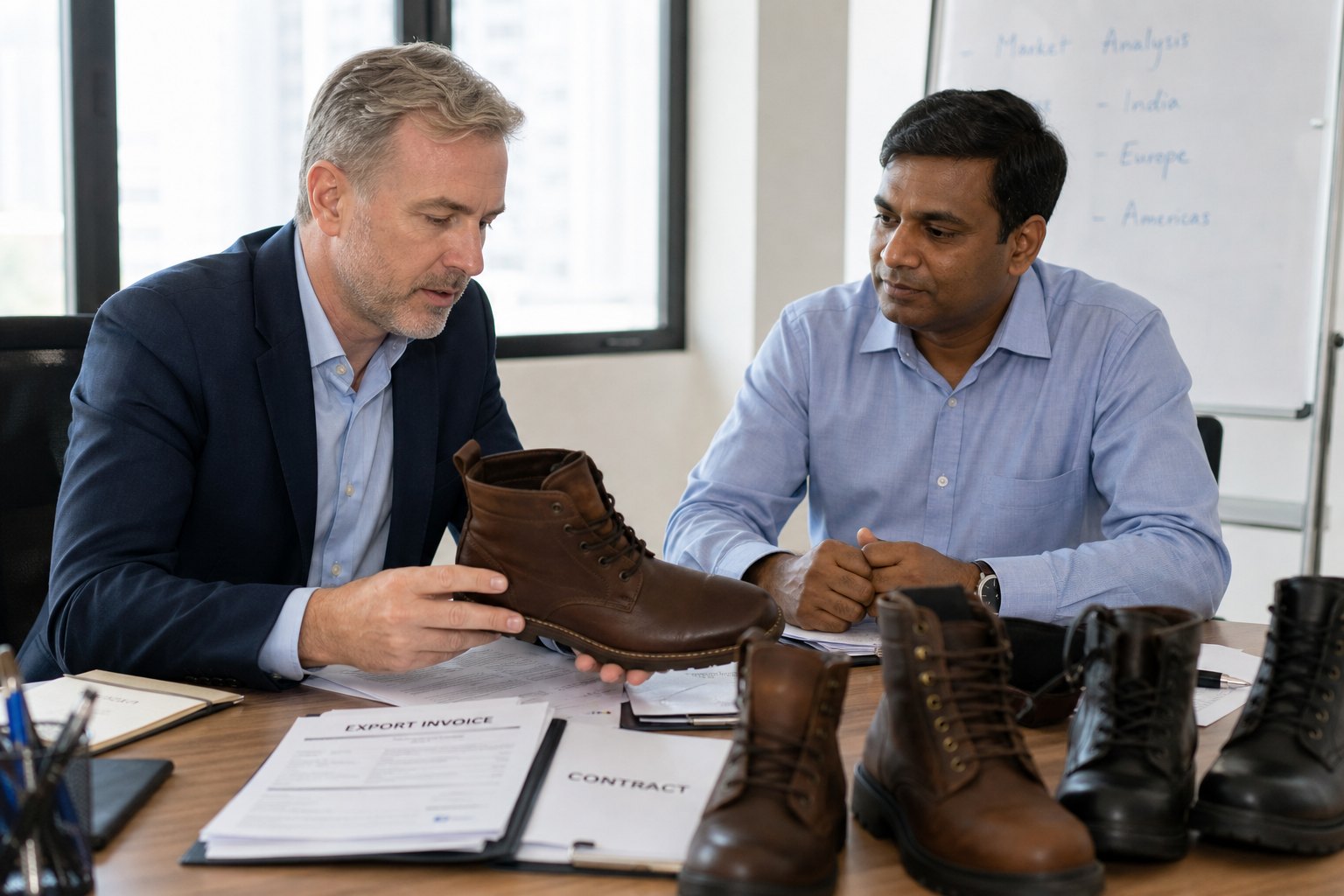
This is a buyer playbook, not a market overview.
If you are an importer, distributor, wholesaler, or retail chain buyer who has already decided you want Indian leather footwear — men's formal shoes for a department store programme, casual and boots for a mid-market retail chain, or safety footwear for an industrial distribution line — the open question is no longer 'why India,' it is 'how do I do this safely, from first outreach email to first bill of lading.' That is the question this guide answers, step by step.
Buyers who source leather footwear directly from India without a repeatable verification process run into the same failures again and again: a beautiful fit sample followed by an inconsistent size run, a factory that cannot produce a current Council for Leather Exports (CLE) registration on request, a 'genuine leather' claim with no traceable tannery record, or a first payment sent before any document was checked.
None of these failures are caused by bad manufacturing capability. They are caused by buyers skipping steps that take a few days and save months of dispute over returns, size-fit complaints, and customs delays.
This playbook walks through defining a written RFQ, verifying a factory's credentials, requesting and evaluating fit and size-run samples correctly, negotiating MOQ and pricing on a landed-cost basis, running quality control through bulk production, and placing a first trial order with terms that protect your capital. For CLE registration itself in depth, see CLE Registration Benefits for Leather Footwear Exporters.
For market and style context to sit alongside this process guide, see Most Demanded Indian Leather Footwear Styles by Country and Top Leather Footwear Products Exported from India.
Key Takeaways
Summary Box
Executive Summary
Summary Box
International buyers source leather footwear directly from India for reasons that hold up under scrutiny: a deep base of genuine leather tanning and finishing capacity, competitively priced skilled labour for lasting, stitching, and hand-finishing, and export clusters — Agra, Kanpur, Ambur, Ranipet, Chennai, Kolkata, and Jalandhar — that between them cover almost every leather footwear category from formal Goodyear-welted shoes to safety boots and leather sandals.
The commercial opportunity is real. What separates buyers who build a reliable multi-year supply relationship from buyers who have one bad container and quietly give up is process discipline, not luck.
This guide treats direct sourcing as a sequence of gates, each designed to catch a specific failure before it becomes expensive. The RFQ gate prevents vague quotations that cannot be compared. The verification gate prevents dealing with an entity that cannot legally export or that lacks the credentials serious buyers expect.
The sample and size-run gate prevents a bulk shipment that fits differently from the pair you approved. The trial-order gate prevents overcommitting capital before consistency is proven across a full size curve. The documentation and payment gate protects your capital if any of the earlier gates were missed.
None of these gates require you to be an expert in Indian leather tanning or shoemaking. They require you to ask for evidence instead of assurances, and to withhold the next payment or the next order size until that evidence checks out.
Buyers who follow this sequence consistently report faster time-to-first-shipment and far fewer size-fit and quality disputes than buyers who source on unit price and personal chemistry alone.
Market Size & Industry Overview
Key Statistics
India is among the world's largest producers of leather footwear, anchored by a base of raw hide processing, tanning, and finishing that few competing sourcing origins can match end-to-end within one country. The industry sits under the regulatory and promotional umbrella of the Council for Leather Exports (CLE), a statutory export promotion body under the Ministry of Commerce and Industry, headquartered in Chennai, which registers exporters, issues the RCMC, and coordinates India's presence at international leather and footwear fairs.
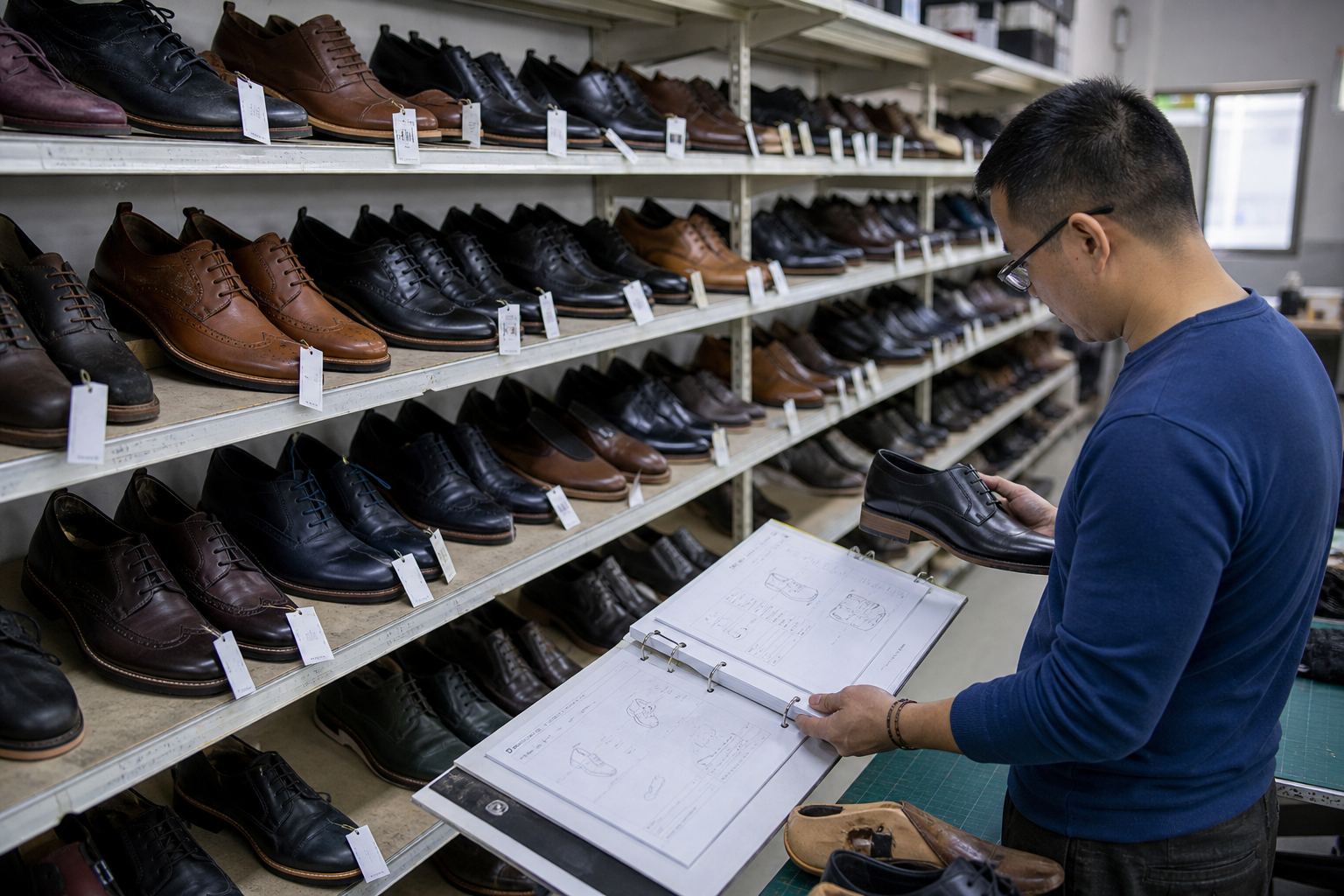
The supply chain a buyer sources through has several distinct layers, and confusing them is one of the most common sourcing mistakes. Tanneries convert raw or wet-blue hides into finished leather — this is where chrome tanning, chromium VI control, and Leather Working Group (LWG) environmental certification live. Component makers supply soles, insoles, linings, and hardware. Footwear manufacturing units cut, last, stitch or cement, and finish uppers and soles into completed pairs. Merchant exporters buy finished pairs from one or several factories and export under their own accountability. Buying agents introduce parties but do not always own quality or documentation outcomes.
India's leather footwear export base concentrates around a small number of regional clusters, each with a distinct specialisation. Agra in Uttar Pradesh is India's largest footwear manufacturing hub by unit count, historically strong in men's and women's casual and formal leather shoes. Kanpur carries a long tanning and leather goods heritage alongside footwear. Ambur and Ranipet in Tamil Nadu, close to Chennai and Vellore, form one of the most export-experienced tanning and footwear belts in the country, historically strong in men's formal and safety footwear for the EU and USA. Chennai hosts CLE's headquarters and a dense concentration of tanneries and finished-leather exporters. Kolkata supplies leather footwear and leather goods with a strong domestic and East Asian export orientation, and Jalandhar contributes leather uppers and components alongside its stronger sports-footwear specialisation.
India Leather Footwear Supply Chain Structure for Buyers
Swipe →
Data table — swipe horizontally on small screens
| Supply Chain Node | Role | What a Buyer Should Verify |
|---|---|---|
| Tanneries | Convert raw/wet-blue hides into finished leather; chrome or vegetable tanning | LWG certification tier, chromium VI test reports, effluent treatment compliance |
| Component suppliers | Soles, insoles, linings, eyelets, buckles, laces | Material composition, REACH-relevant chemical compliance for EU-bound orders |
| Footwear manufacturing units | Cutting, lasting, stitching or cementing, finishing | CLE RCMC, IEC, factory audit, production capacity versus your MOQ |
| Merchant exporters | Buy finished pairs, consolidate, export under their own accountability | Track record, buyer references, document sample sets from prior shipments |
| Buying agents | Introduction and local coordination only | Whether they accept quality and documentation accountability, or only introduce |
Export Statistics
Key Statistics
India's leather and leather products sector, including footwear, has consistently ranked among the country's significant export categories, with leather footwear representing one of the largest single product groups within that sector by both volume and value. Export destinations concentrate heavily in a small number of mature markets — the USA, UK, Germany, and other EU states have historically absorbed the majority of India's leather footwear exports, with the UAE, France, Netherlands, Australia, and Japan forming an important secondary tier.
For a buyer, the most useful reading of aggregate export data is not the headline total but the composition by product type. Men's leather footwear typically leads export volume, followed by women's leather footwear, with safety and industrial footwear forming a smaller but steady share tied to institutional and industrial demand cycles. National export scale confirms the sector is real and export-capable at volume; it does not confirm that the specific factory you are negotiating with can produce your exact style and size run consistently — treat export statistics as market-sizing context, not a substitute for factory-level verification.
Indicative India Leather Footwear Export Composition Relevant to Buyers
Swipe →
Data table — swipe horizontally on small screens
| Footwear Category | Indicative Planning Mix (not CLE published) | Typical HS Heading | Buyer Sourcing Note |
|---|---|---|---|
| Men's cemented casual / derby programmes | Usually highest RFQ volume for new importers | Lock last #, sole compound, and size ratio in the RFQ | Ask for three recent export references in your destination |
| Women's seasonal fashion flats / heels | Fast colourway churn — sample early | Approve Pantone/leather swatch before bulk dye lots | Require mid-line colour QC photos, not only end-of-line |
| Chelsea / chukka / fashion boots | Higher construction risk than flats | Specify shaft height, zipper/hardware brand, and waterproofing claims | Reject vague 'water resistant' language without a test method |
| Safety / industrial leather shoes | Certification-led; slower first PO | Demand EN ISO 20345 or ASTM F2413 certificate IDs matching the sample | Metal toecap vs composite toe changes HS line — confirm before booking |
| Sandals / open leather footwear | Attractive carton density, high hardware failure risk | Specify strap pull strength, buckle/rivet material, and sole bond | Inspect for edge finishing and lasting defects unique to open styles |
Import Statistics
Key Statistics
Reading import-side data from your own destination market is one of the fastest ways to sanity-check a supplier's claims before you spend money on a sample. HS 6403 import statistics from ITC Trade Map or your national customs data show whether India's presence in your market is growing or shrinking relative to Vietnam, China, Indonesia, and Brazil, and what unit values per pair are typical for the category you intend to buy. If a quoted FOB price per pair sits significantly below the average unit value reported for that HS code from India, treat it as a quality-risk signal that needs extra diligence, not a negotiating win.
Cross-reference a factory's claimed export history against the aggregate import pattern for their stated destination markets. A factory claiming several years of exports to German safety-footwear distributors should be traceable, at least in pattern, within destination-side import data for EN ISO 20345-certified footwear from India. A claim with no corroborating pattern in the data is not automatically false, but it warrants a direct question and, ideally, a reference check before any deposit changes hands.
Using Destination Import Data to Validate a Sourcing Decision
Swipe →
Data table — swipe horizontally on small screens
| Data Signal | What It Tells a Buyer | Action |
|---|---|---|
| Rising Indian share of your HS 6403 imports | Growing acceptance among buyers similar to you | Reasonable to proceed with standard verification |
| Falling Indian share versus Vietnam/China | Possible price, quality, or lead-time disadvantage | Ask the factory directly why; benchmark their FOB against the trend |
| Unit value per pair far below category average | Possible grade mismatch, thinner leather, or quality risk | Request additional construction and material testing before committing |
| No import pattern matching factory's claimed history | Claim may be exaggerated or for a different destination | Request redacted prior shipment documents and buyer references |
Product Categories and Variants
Summary Box
Buyers who ask for 'leather shoes from India' without specifying style, upper leather type, sole construction, and last shape receive quotations that cannot be compared to one another. Learn this taxonomy before you send your first RFQ — it is the language factories use in their own tech packs, and using it correctly signals that you are a serious counterparty worth quoting accurately. For customs purposes, most genuine leather footwear with leather uppers falls under HS 6403, distinct from HS 6404 (uppers of textile) and HS 6402 (uppers of rubber or plastics); confirm the correct heading with your customs broker since misclassification is a common cause of duty disputes at destination.
Men's Formal and Business Leather Footwear
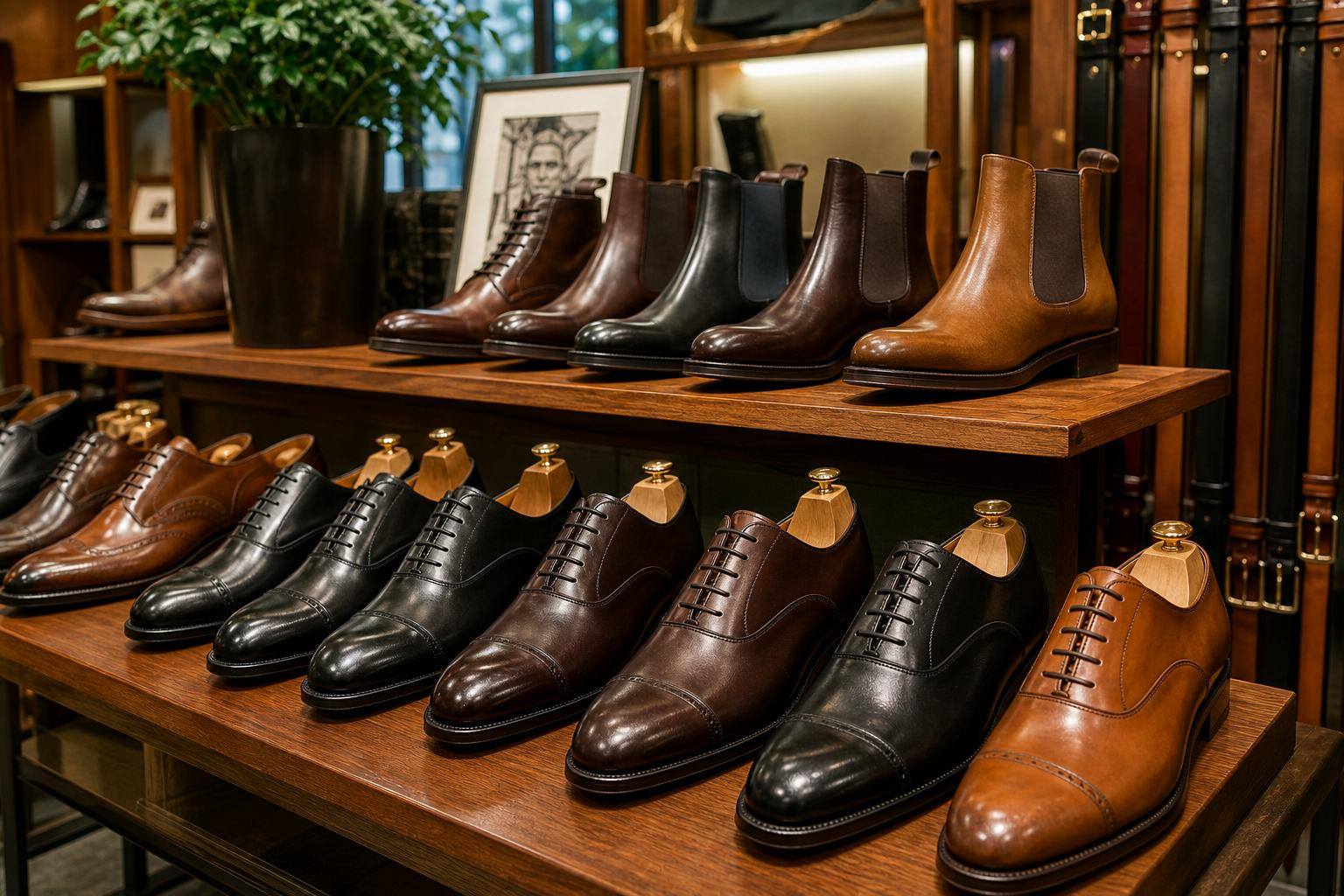
Oxfords, derbies, brogues, and loafers with full-grain or corrected-grain leather uppers, typically Goodyear-welted, cemented, or Blake-stitched construction depending on price tier. This category is the traditional strength of Agra and the Ambur-Ranipet belt, serving department stores and formal footwear distributors across the EU, USA, and UK.
Construction Types Matter for Buyers
Cemented construction is cost-efficient for mid-market price points; Goodyear-welted and Blake-stitched construction command a premium and are typically requested by buyers positioning a resoleable, longer-life formal shoe. Specify construction type in writing — factories will substitute cemented for welted construction to protect margin unless the specification explicitly forbids it.
Women's Fashion and Casual Leather Footwear
Pumps, flats, ankle boots, and casual leather shoes for women's fashion retail, sourced with faster seasonal turnaround and a wider range of upper finishes — patent, suede, and printed leather — than the men's formal category. Buyers in this category typically run shorter lead times and smaller size-run MOQs per colourway.
Casual, Sneaker-Style, and Loafer Leather Footwear
Leather-upper casual shoes and sneaker-hybrid styles combining leather uppers with rubber or EVA soles, serving the fastest-growing segment of leather footwear demand in retail chains and e-commerce-adjacent wholesale programmes. Sole unit sourcing — often from specialist component suppliers rather than the footwear factory itself — should be verified separately for durability and slip-resistance claims.
Leather Boots
Chelsea boots, work boots, and fashion ankle boots with full-grain or oiled leather uppers, often paired with rubber or PU outsoles for weather resistance. Boots typically carry a higher per-pair FOB than shoes due to material volume and construction complexity, and lower pairs-per-container yield given their bulk.
Leather Sandals
Men's and women's leather sandals, from simple slip-on styles to strapped and buckled designs, serving warm-climate retail markets and summer seasonal programmes. Sandals typically carry the lowest per-pair FOB in the leather footwear range and the highest pairs-per-container yield, making them attractive for buyers optimising landed cost on volume programmes.
Safety and Industrial Leather Footwear
Steel-toe and composite-toe safety boots and shoes with leather uppers, meeting standards such as EN ISO 20345 for the EU or ASTM F2413 for the USA. Ambur and Ranipet are particularly export-experienced in this category. Certification testing — impact resistance, slip resistance, and toe-cap protection — must be verified against the specific standard your destination market requires, since EU and US safety standards are not interchangeable.
Genuine, Full-Grain, and Corrected-Grain Leather — Know the Difference
'Genuine leather' is a marketing term, not a grade — it can legally apply to a low-quality split or bonded product as much as a premium hide. Full-grain leather retains the natural surface and grain, offering the highest durability and a premium look that develops patina over time. Corrected-grain (or 'top-grain') leather has the surface sanded and refinished with an embossed grain, offering more consistent appearance at a lower cost but reduced longevity. Specify the actual leather type — full-grain, corrected-grain, or split — rather than accepting 'genuine leather' as a sufficient specification.
Manufacturing Overview
Export Tip
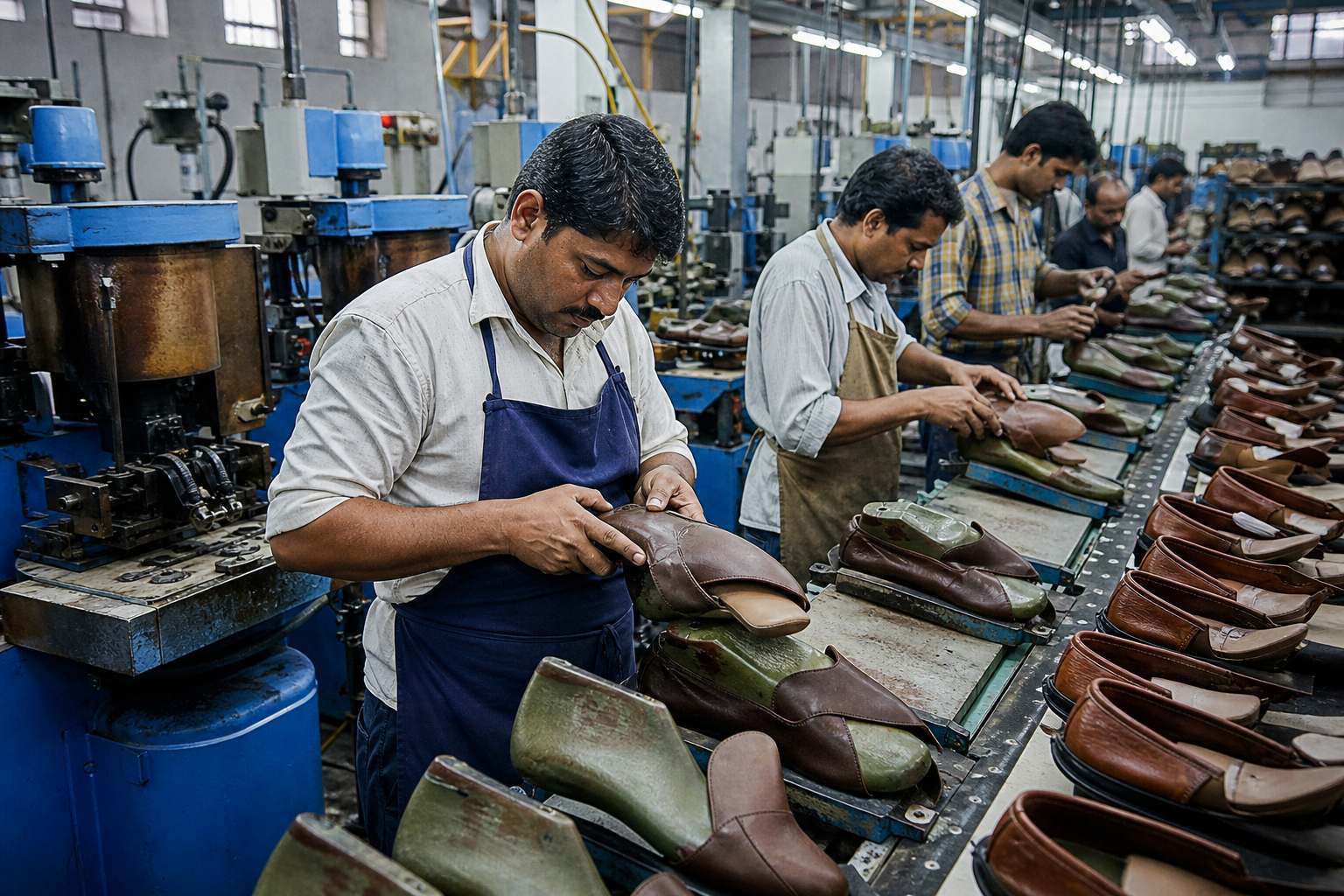
Understanding how a factory actually converts leather into a finished pair helps a buyer ask sharper questions during a factory audit or video call, and gives you the vocabulary to spot a factory that is glossing over a step. The core stages — cutting, lasting, stitching or cementing, and finishing — are consistent across clusters, but the equipment, skill depth, and quality-control discipline applied at each stage vary widely between an MSME workshop and an export-oriented mid-size factory.
Cutting and Component Preparation
Leather is cut into upper components using dies or computer-guided cutting systems, with grading checked against a marker pattern for the correct size curve. Skilled cutting minimises waste and ensures grain consistency across a pair — a factory that cuts carelessly from a hide's weaker edge sections produces uppers with uneven strength and finish, a defect that only shows up after weeks of wear.
Lasting
Lasting shapes the cut and stitched upper around a foot-formed mould (the last) to create the shoe's final three-dimensional shape and fit. This is the single most technically demanding stage for size-run consistency — a last that grades correctly from size 6 to size 11 requires precise pattern engineering, and factories vary widely in how consistently they execute it across a full size curve.
Stitching, Cementing, and Sole Attachment
Depending on construction type, soles are attached through cementing (adhesive bonding, cost-efficient), Goodyear welting (a stitched welt strip allowing resoling, premium positioning), or Blake stitching (a direct stitch-through method used for some dress shoes). Buyers should confirm which method a factory actually uses for their order, since factories sometimes substitute a cheaper method to protect margin unless the purchase order specifies construction explicitly.
Finishing
Finishing covers edge trimming, polishing, cleaning, and any branding elements — embossed logos, coloured stitching, or hardware. This is the stage most visible to a buyer's own quality inspector, and where cosmetic defects (uneven polish, glue residue, loose threads) are typically caught during pre-shipment inspection.
Pricing Analysis
Buyer Tip
Use the ranges below only for RFQ framing — leather footwear pricing swings materially with leather grade, construction type, hardware, and current raw hide prices, so reconfirm against a current quotation before committing. A lower FOB per pair from a factory with an inconsistent size-run track record is not actually cheaper once you account for return rates, rework, and failed-shipment risk. Compare landed cost per pair — FOB, freight, insurance, destination duty, and your own independent inspection — rather than FOB alone.
For safety footwear or REACH-sensitive EU-bound orders, confirm upfront whether certification testing costs are included in the quoted FOB or billed separately; factories who bundle testing cost into a headline-low FOB create confusion at invoice stage.
Indicative FOB Pricing Reference by Category (2026, per pair)
Swipe →
Data table — swipe horizontally on small screens
| Footwear Category | Indicative FOB Range (per pair) | Primary Buyer Use |
|---|---|---|
| Men's formal leather shoes (cemented) | $8–$18/pair | Mid-market retail and department store programmes |
| Men's formal leather shoes (Goodyear-welted/Blake-stitched) | $18–$40+/pair | Premium retail, longer product life positioning |
| Women's leather footwear (pumps, flats, casual) | $7–$16/pair | Fashion retail and seasonal wholesale programmes |
| Leather boots | $15–$35+/pair | Fashion and work-boot retail channels |
| Leather sandals | $4–$10/pair | Warm-climate retail and volume wholesale programmes |
| Safety and industrial leather footwear | $10–$25/pair | Industrial distribution, standard-certified lines |
MOQ Analysis
Buyer Tip
MOQ in leather footwear is quoted and negotiated in pairs, not weight or units of fabric — and it interacts directly with size-run ratio. A factory quoting 'MOQ 1,000 pairs' typically means 1,000 pairs distributed across your agreed size curve, not 1,000 pairs of a single size. Confirm the minimum quantity per size within that run, since very small quantities of extreme sizes can be uneconomical for a factory to cut and may be quietly dropped from your order unless the ratio is agreed in writing.
New buyers should quote realistic trial-order MOQs rather than accepting unrealistically small quantities that make cutting and lasting setup uneconomical for the factory, or unrealistically large first orders that overextend an unproven relationship on both sides.
Indicative MOQ Reference by Category and Order Stage
Swipe →
Data table — swipe horizontally on small screens
| Category | Sample Stage | Trial Order | Standard Programme MOQ |
|---|---|---|---|
| Men's formal leather shoes | 1 pair per size for fit review | 300–800 pairs | 1,200–3,000 pairs per style |
| Women's leather footwear | 1 pair per size for fit review | 300–800 pairs | 1,200–3,000 pairs per style |
| Leather boots | 1 pair per size for fit review | 200–500 pairs | 1,000–2,000 pairs per style |
| Leather sandals | 1 pair per size for fit review | 500–1,200 pairs | 2,000–5,000 pairs per style |
| Safety/industrial footwear | 1 pair per size plus test certificate | 300–700 pairs | 1,500–3,000 pairs per style |
Packaging Standards
Export Tip
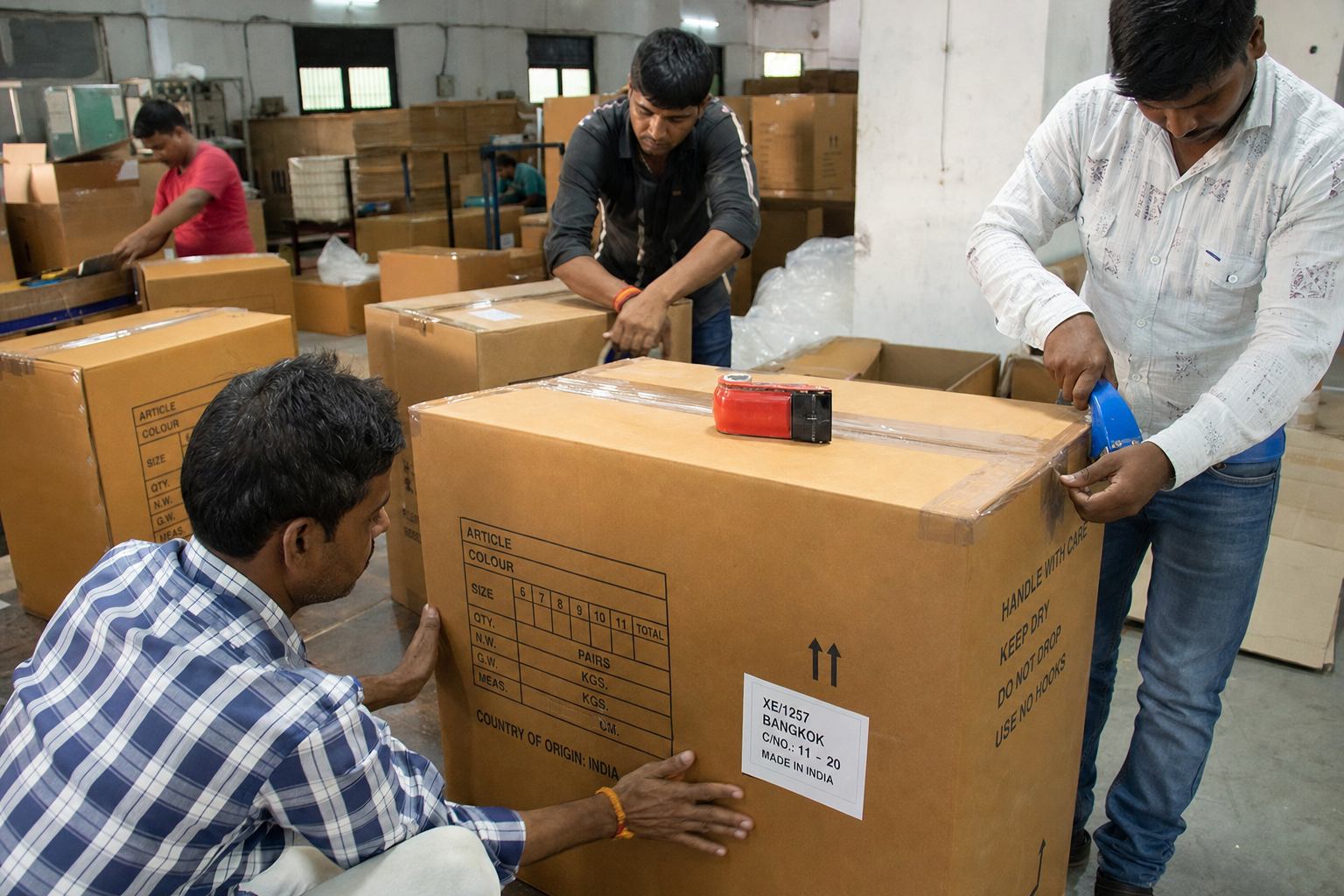
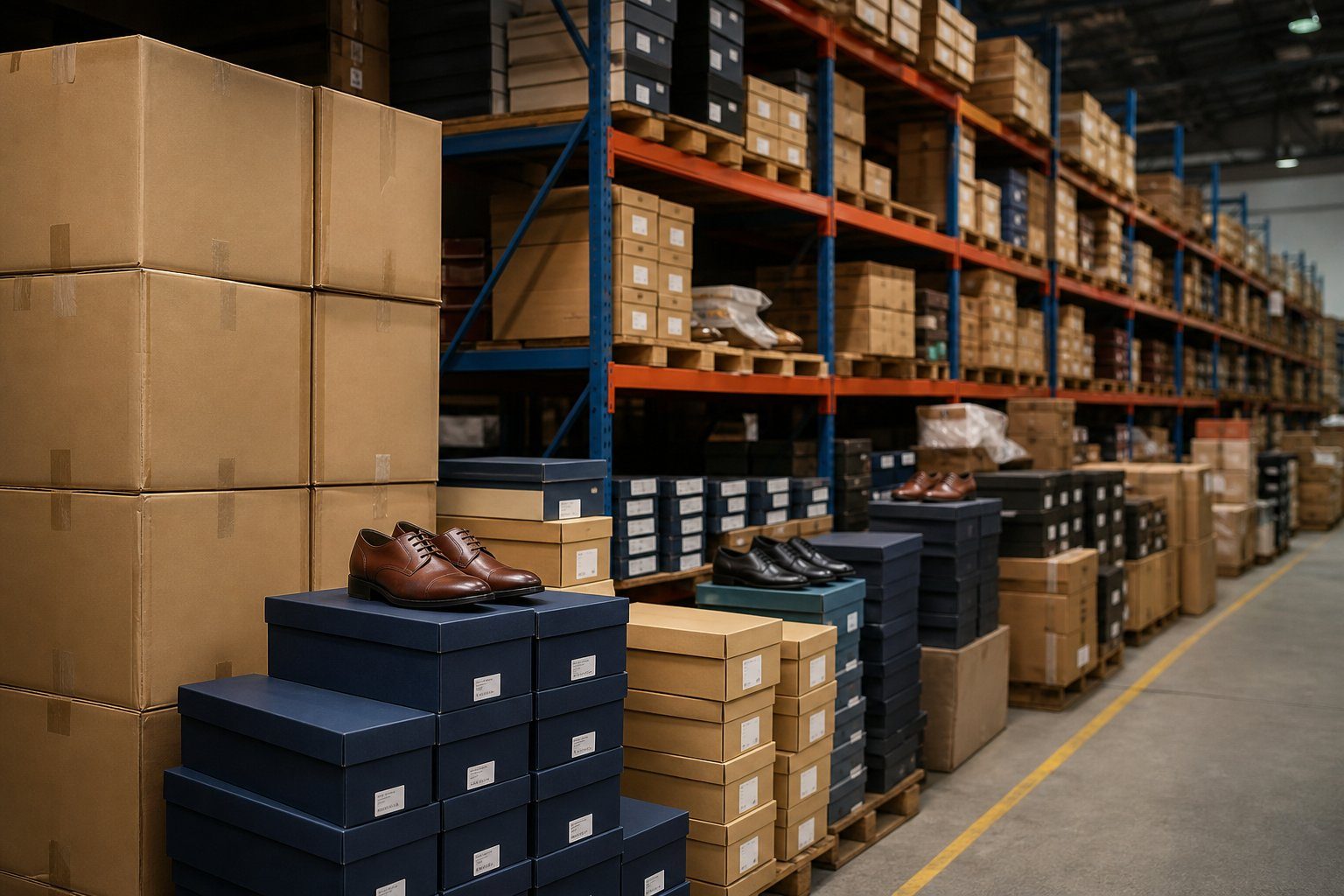
Packaging protects fit and finish, which protects everything else you have verified. Standard export format is one pair per individual shoe box, with shoe boxes packed into master cartons of 6 or 12 pairs depending on style and box size. Master cartons should carry size-ratio breakdown, style code, and PO number clearly marked to match the packing list — mismatches here are a leading cause of receiving disputes at destination warehouses.
Standard Export Packaging Formats for Leather Footwear
Swipe →
Data table — swipe horizontally on small screens
| Packaging Format | Typical Unit | Common Use Case | Key Requirement |
|---|---|---|---|
| Individual shoe box with tissue and size label | 1 pair per box | All finished-pair categories | Box must survive stacking without crushing; size label must match carton manifest |
| Master carton (6 pairs) | 6 pairs per carton | Bulky styles — boots, safety footwear | Carton must carry style, size ratio, PO number, and weight |
| Master carton (12 pairs) | 12 pairs per carton | Lighter styles — sandals, casual shoes | Higher container yield; confirm stacking limit for bottom-layer cartons |
| Silica gel sachets | Placed inside box or carton | All categories on longer transit lanes | Manages moisture during ocean transit; especially important for full-grain leather |
| Retail-ready barcoded packaging | Per buyer brand specification | Private-label retail chain programmes | Requires print-ready artwork and destination labelling confirmed early |
Container Loading Details
Export Tip
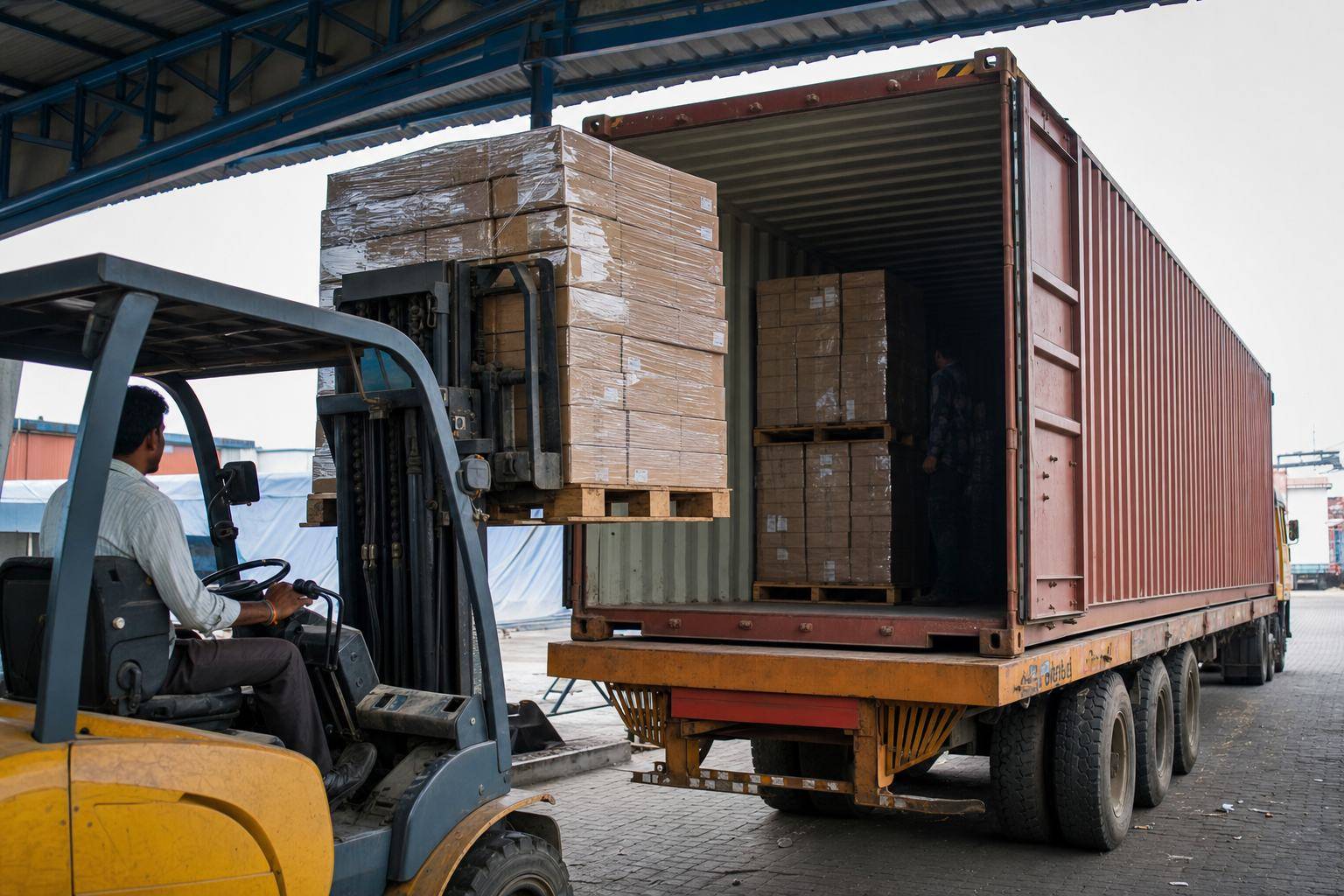
Container payload for leather footwear varies more by style than almost any other apparel-adjacent export category, because boots and boxed formal shoes consume far more container volume per pair than flat sandals. Always confirm actual payload with your forwarder based on the specific carton dimensions for your approved style, rather than assuming a round number from a different category.
Indicative Container Loading Benchmarks by Category
Swipe →
Data table — swipe horizontally on small screens
| Category | Indicative 20ft FCL Payload | Indicative 40ft FCL Payload | Notes |
|---|---|---|---|
| Men's formal leather shoes | ~6,000–8,500 pairs | ~12,500–17,500 pairs | Boxed formal styles consume more volume per pair than casual |
| Women's leather footwear | ~6,500–9,000 pairs | ~13,500–18,500 pairs | Slightly better yield than men's formal in similar box sizes |
| Leather boots | ~4,500–6,500 pairs | ~9,500–13,500 pairs | Lowest yield category; plan freight cost per pair accordingly |
| Leather sandals | ~10,000–14,000 pairs | ~20,500–29,000 pairs | Highest yield category; strongest landed-cost economics |
| Safety/industrial footwear | ~5,500–7,500 pairs | ~11,500–15,500 pairs | Confirm test-certificate lot references align with the shipped batch |
Shipping Methods
Export Tip
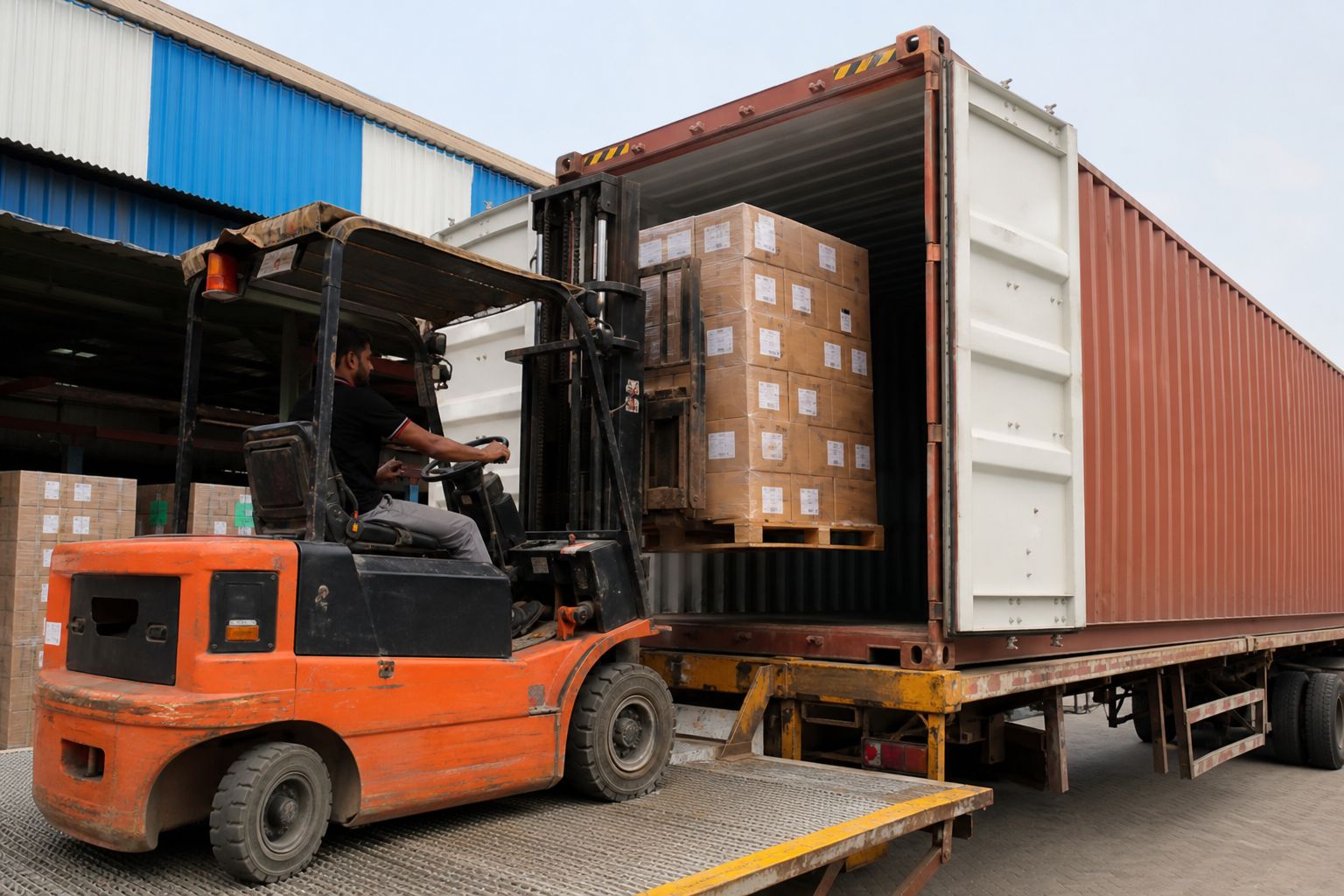
From a buyer desk, shipping is a landed-cost and control decision — not a freight textbook. Prefer FOB named Indian port when you already have a forwarder and want full visibility on ocean rates and insurance; prefer CIF/CFR only when you want one seller-side landing quote and accept less freight control. Match the load port to the factory cluster (Chennai for Ambur–Ranipet, Mundra/Nhava Sheva for Agra–Kanpur inland, Tuticorin as a South India alternative) so you are not financing unnecessary haul before the vessel.
Use air for sealed samples and emergency tops only. Put first commercial volume on LCL or a shared FCL only after last/size-run sign-off; move to dedicated FCL once weekly/monthly replenishment makes carton velocity predictable. For mode definitions, packing densities, and exporter-side cutoffs, see How to Export Leather Footwear from India — this playbook focuses on the Incoterm and control choices that protect buyers.
Certifications
Compliance Notes
Beyond CLE RCMC and standard export registrations, additional certifications unlock specific market segments and buyer trust. As a buyer, treat these as evidence to request, not boxes to tick blindly — ask for test reports referencing the specific style and batch you are ordering, not a generic annual certificate for the factory as a whole.
Certifications Relevant to Sourcing Leather Footwear from India
Swipe →
Data table — swipe horizontally on small screens
| Certification / Registration | Who Should Hold It | What It Protects the Buyer From |
|---|---|---|
| CLE RCMC and IEC | Every exporting factory or merchant exporter | Confirms legal export eligibility; standard first-check credential |
| Leather Working Group (LWG) tannery certification | The tannery supplying the leather | Environmental and traceability standards for sustainability-conscious programmes |
| REACH chromium VI test report | Batch-specific, for EU/UK-bound orders | Confirms hexavalent chromium in leather remains ≤ 3 mg/kg (REACH Annex XVII) |
| CPSIA compliance testing | Required for children's footwear entering the USA | Covers lead content, phthalates, and general child-product safety |
| EN ISO 20345 / ASTM F2413 | Safety footwear factories | Confirms toe-cap, impact, and slip-resistance performance for the specific standard |
| Independent pre-shipment inspection (SGS, Bureau Veritas, Intertek) | Arranged by buyer or factory before dispatch | Verifies size-ratio accuracy, construction quality, and AQL defect sampling |
Buyer Requirements
Buyer Requirements
- Valid IEC and current CLE RCMC, verifiable directly rather than trusting a certificate photocopy or screenshot
- A full size-run pre-production sample, fit-tested across at least three to five sizes, not a single best-case fit sample
- Written confirmation of leather type — full-grain, corrected-grain, or split — with a swatch sample alongside the finished pair
- Clear packaging specification matching your downstream use, whether bulk wholesale cartons or retail-ready barcoded boxes
- Realistic MOQ, size-ratio flexibility, and lead-time commitments aligned to actual cutting and lasting capacity
- Prior export document samples and buyer references from markets similar to yours, on request without excessive delay
This section flips the usual framing: rather than what a buyer needs, it is what a well-prepared Indian leather footwear exporter should be able to produce on request — and what you, as the buyer, should require before advancing past a first conversation. Treat hesitation or delay in producing any of these as a signal to slow down, not a paperwork inconvenience to overlook.
Country-wise Opportunities
Market Snapshot
Your sourcing checklist should flex slightly to reflect what your own market actually rewards. This section maps buyer-side priorities by destination so you calibrate diligence depth correctly — over-verifying a commodity casual-shoe purchase wastes time, and under-verifying a safety-footwear certification claim invites a costly compliance dispute. For deeper destination-specific style and demand mapping, see Most Demanded Indian Leather Footwear Styles by Country.
Buyer-Side Country Fit for Leather Footwear Sourcing
Swipe →
Data table — swipe horizontally on small screens
| Destination | Prioritise Sourcing | Sourcing Note |
|---|---|---|
| USA | Men's/women's formal and casual, safety footwear | Confirm ASTM F2413 for safety lines and destination-specific export history |
| UK | Classic men's formal (Oxfords, brogues, derbies) | Verify construction type — welted, Blake-stitched, or cemented |
| Germany | Compliance-conscious formal and casual | Require REACH chromium VI reports and LWG tannery reference |
| UAE | Men's formal and leather sandals | Prioritise size-run accuracy and price competitiveness |
| France | Mid-to-premium formal and casual | Prepare REACH documentation alongside finish claims |
| Netherlands | Mixed multi-category via Rotterdam hub | Verify size-ratio accuracy on large consolidated shipments |
| Australia | Casual and boots | Confirm biosecurity packaging compliance and size-standard labelling |
| Japan | Formal and casual with high construction consistency | Plan for a longer, document-intensive first-order qualification cycle |
United States of America
US importers and retail chains source men's and women's leather footwear at both commodity and mid-premium tiers, with safety footwear requiring ASTM F2413 certification for industrial distribution channels. Confirm CPSC-relevant labelling and verify factory export history to US buyers specifically before committing beyond a trial order.
United Kingdom
UK buyers favour classic men's formal leather footwear — Oxfords, brogues, and derbies — often through Goodyear-welted or Blake-stitched construction for department store and heritage-adjacent retail programmes. Post-Brexit import documentation should be confirmed separately from EU requirements even where they appear similar.
Germany
When sourcing for Germany, treat chemical and tannery evidence as purchase-order gates, not afterthoughts. Refuse deposit terms until you hold a REACH chromium VI report on the exact upper leather for your sample and, if LWG is claimed, a current tannery certificate ID you can verify. Style mix guidance for German retail and safety channels lives in Most Demanded Indian Leather Footwear by Country — use that post for demand, this checklist for verification order.
United Arab Emirates
UAE-facing RFQs should ask whether the goods stay in local retail or move into Gulf re-export — carton marks, size-ratio labels, and delivery appointments change with that answer. Build your diligence around size-run accuracy and price-band proof more than EU-depth chemical packs, unless the buyer explicitly needs REACH evidence for onward EU stock. Demand mapping for formal vs sandal mix is covered in the sister demand guide; here, lock Incoterms and payment security before you ship samples at scale.
France and Netherlands
French buyers, particularly in mid-to-premium retail, look for construction quality and finish consistency, with growing attention to traceability claims — prepare REACH compliance documentation alongside any chemical or finish claim. The Netherlands serves as both a direct consumption market and a major European distribution and re-export hub via Rotterdam, where buyers often consolidate multi-category footwear programmes and expect consistent size-ratio accuracy across large mixed-style shipments.
Australia, Japan, and Beyond
For Australia, put biosecurity and packing materials on the RFQ: declare wood packing / ISPM-15 status, origin labels, and any fumigation certificates before vessel booking — prevent a holds problem at destination, not after sailing. For Japan, plan a longer sample and document loop; do not discount aggressively to accelerate the PO — Japanese programmes typically retain suppliers after the first clean season more often than they chase the cheapest FOB. Style preferences for both markets are in the demand map post; use this section as your pre-PO diligence order.
Expert Insight: RFQ and Sample Discipline
Expert Insight Box
Export Tip
This sequencing matters more than it sounds. A buyer who leads with price signals to the factory that price is the deciding factor, which invites factories to quote aggressively and quietly cut corners on leather grade, sole bonding, or size-run precision to hit that number. A buyer who leads with a full RFQ and a size-run verification process signals a different kind of counterparty — one worth quoting honestly.
We also advise every new footwear buyer to think in four stages, not two: a written RFQ, a paid single-size fit sample, a size-run pre-production sample fit-tested before bulk cutting, and only then a scheduled trial order followed by a full-container programme. Buyers who skip from a fit sample straight to a full container because one pair fit perfectly are the ones who call us after the second shipment arrives with an inconsistent size curve.
Sourcing Checklist
Checklist
- Write a complete RFQ — style, last, upper leather grade, sole construction, size run, colour, certification, pack — before any outreach.
- Identify candidates through CLE member records, trade fairs, ITC Trade Map shipment data, and merchant exporter networks.
- Shortlist a maximum of three factories per category and score them on CLE RCMC, IEC, GST, export history, and QC infrastructure.
- Request a single-size fit sample first, then a full size-run pre-production sample before bulk cutting.
- Fit-test the size-run sample independently against your own reference standard before any commercial commitment.
- Compare landed cost per pair, not FOB alone, when negotiating pricing.
- Verify export compliance capability — CLE RCMC, IEC, GST — a second time immediately before placing the trial order.
Buyer Checklist
Checklist
Exporter Checklist
Checklist
Compliance Checklist
Checklist
Compliance Notes
Common Buyer Mistakes
Common Mistakes Box
Most preventable disputes in leather footwear sourcing trace to a short, recurring list of avoidable mistakes. Recognising them in advance is cheaper than resolving them after a container has sailed.
Expert Insight: Trial Order Discipline
Expert Insight Box
We tell every buyer the same thing before their first trial order: resist the temptation to size it to match your eventual programme volume. A trial sized to genuinely test consistency — a few hundred to low thousands of pairs depending on category — gives you a clean read on whether this factory can repeat what the sample promised, without betting your whole season on the answer.
The buyers who scale fastest into large, reliable India leather footwear programmes are consistently the ones who treated their first trial order as a test to pass or fail, not a formality to get through quickly. When a trial order reveals a size-ratio error or a finish inconsistency, that is the system working exactly as intended — better to find it on 500 pairs than on a full container.
Future Market Trends
Key Statistics
Three trends are shaping the buyer-side sourcing relationship over the coming years: growing buyer demand for digital, verifiable registration and traceability records rather than paper certificates alone; increased attention to leather origin, tannery certification, and chromium VI documentation as EU sustainability and deforestation-linked sourcing rules tighten; and steadier adoption of independent pre-shipment inspection as a standard step rather than an occasional precaution, even for mid-volume buyers who previously skipped it to save cost.
Buyers who invest early in RFQ discipline, size-run verification, and documented QC checkpoints will be positioned to scale confidently into full-container programmes, rather than being confined to whichever factory happens to be easiest to reach first through a marketplace listing.
Conclusion
- Next step: send your specification to Altus Exports for a factory shortlist and market-readiness assessment.
- Review Most Demanded Indian Leather Footwear Styles by Country to align sourcing with real destination demand.
- Read Top Leather Footwear Products Exported from India for category and construction depth.
- Understand the export side with How to Export Leather Footwear from India and CLE Registration Benefits for Leather Footwear Exporters.
- Complete your compliance picture with the Leather Footwear Export Documentation Checklist.
- Explore Best Countries for Indian Leather Footwear Exports, Sustainable & Premium Leather Footwear Export Opportunities, Find International Buyers for Leather Footwear, and Trade Shows for Leather Footwear Exporters.
- Explore product sourcing company in India, find manufacturers in India, and global sourcing partner service models.
Sourcing leather footwear directly from India rewards buyers who treat it as a quality-controlled process rather than a one-time purchase decision. Write your RFQ before you contact a factory. Verify CLE RCMC, IEC, and GST registration independently. Fit-test a full size-run sample against a signed reference standard before bulk cutting. Stage your exposure from sample to trial order to full programme. Use a merchant exporter or accountable sourcing partner if you are managing multiple factories or categories at once.
If you are ready to build a documented India leather footwear sourcing programme with fewer first-order surprises, share your style, size run, certification needs, target MOQ, and destination market with Altus Exports for a verified factory shortlist.