
APEDA Registration Benefits for Dehydrated Garlic Exporters
By Saurabh Mittal, Founder, Altus Exports
A complete guide to APEDA registration for dehydrated garlic exporters — why RCMC is mandatory under HS 0712.90, the step-by-step application and renewal process, documents and fees, how membership builds buyer credibility in the USA, EU, Japan, ASEAN, and GCC, NPOP organic facilitation, and shipping bill eligibility. Includes market size, export and import statistics, product variants, manufacturing overview, pricing and MOQ analysis, kraft+PE packaging and container loading benchmarks, certifications, checklists, and expert insights from Altus Exports.
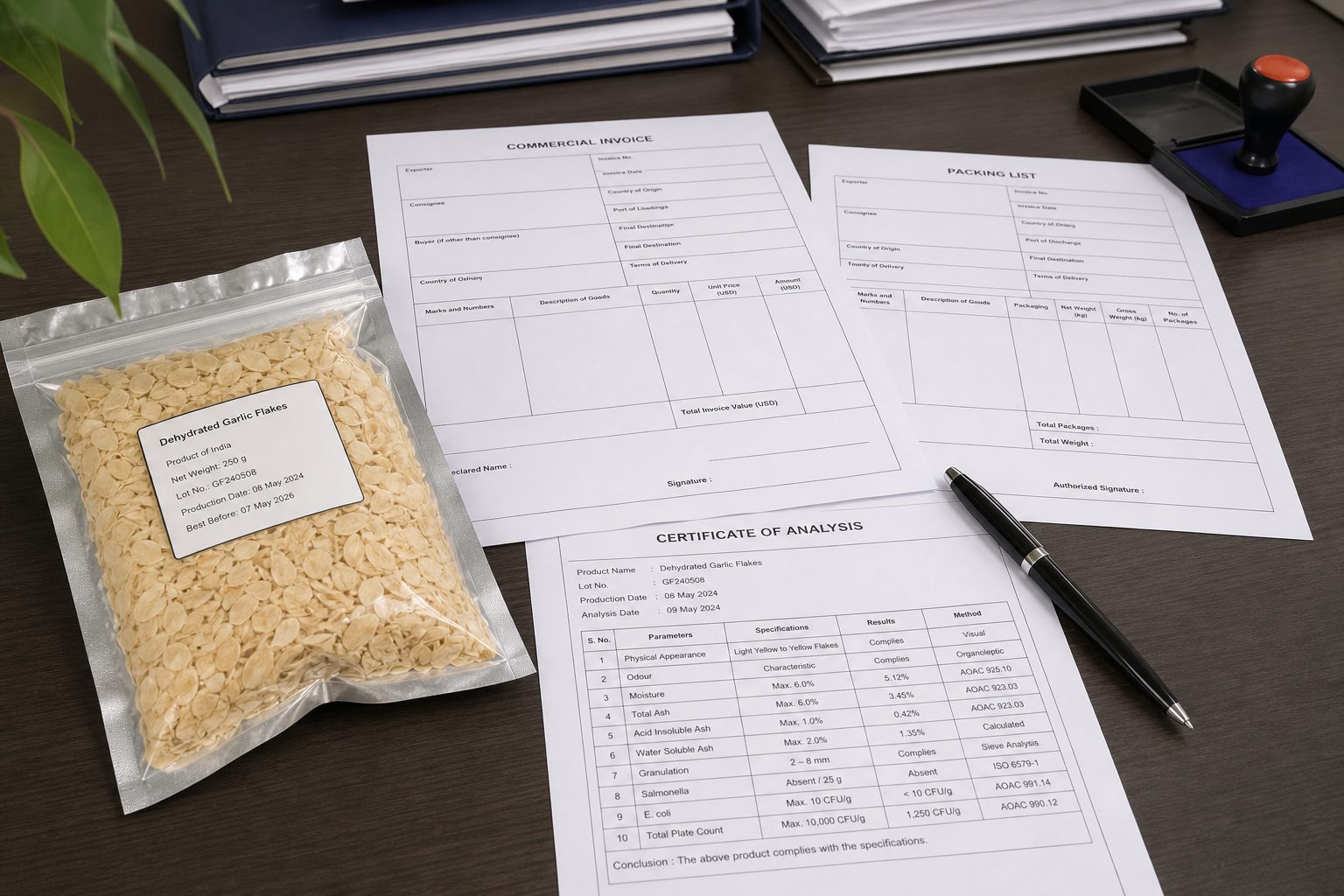
Dehydrated garlic — flakes (07129030), powder (07129020), and dried garlic (07129040) under HS 0712.90 — is one of India's most commercially important dehydrated vegetable export lines, drawing raw material from the Mandsaur–Neemuch garlic belt in Madhya Pradesh and processing capacity from Gujarat dehydration plants around Mahuva, Bhavnagar, and Sihor. Yet moving a lot of export-grade garlic flakes or 80–100 mesh powder from an Indian plant to a food manufacturer's dock in Rotterdam, Yokohama, Jakarta, or Jebel Ali requires more than allicin-preserving dehydration and kraft+PE packaging. International buyers — seasoning blenders, snack manufacturers, noodle producers, and private-label programmes — increasingly qualify suppliers against a documented institutional framework before a first purchase order is confirmed.
For Indian dehydrated garlic exporters, APEDA registration is the foundational credential in that framework. APEDA — the Agricultural and Processed Food Products Export Development Authority — is the government body mandated to register, regulate, and promote the export of scheduled agricultural and processed food products, and dehydrated garlic falls squarely within that scheduled dehydrated vegetable scope. Registration unlocks RCMC issuance, shipping bill eligibility continuity, market development assistance, quality infrastructure linkage, trade fair support (used lightly and linked rather than over-emphasised here), and the institutional identity that buyers reference during vendor onboarding.
This guide explains what APEDA is, why registration specifically matters for dehydrated garlic exporters, who should register, the step-by-step application and renewal process, documents and fees, RCMC mechanics, NPOP organic facilitation, shipping bill eligibility, and how membership shortens the path from first buyer inquiry to a confirmed container. It also includes market size, export and import statistics, product, pricing, MOQ, packaging, container loading, shipping, and certification data relevant to HS 0712.90 garlic programmes, plus sourcing, buyer, exporter, and compliance checklists. Pair this guide with how to export dehydrated garlic from India for the full operational stack and top dehydrated garlic products exported from India for product ranking detail. Always verify current fees and portal workflows on apeda.gov.in and dgft.gov.in, as administrative procedures are updated periodically.
Key Takeaways
Summary Box
Executive Summary
Summary Box
Dehydrated garlic export from India has grown from a regional Madhya Pradesh–Gujarat processing activity into a globally referenced supply category, competitive on price, cut variety (flakes, powder, granules, minced, chopped, toasted/roasted), allicin retention, and processing consistency as buyers diversify away from single-origin dependence on China. Buyers sourcing under HS 0712.90 evaluate Indian suppliers on moisture and mesh specification, kraft+PE packaging integrity, and — increasingly — institutional compliance evidence before committing to trial orders.
APEDA registration sits at the centre of that institutional evidence. It is not simply a government formality; it is the credential that determines RCMC issuance, shipping bill filing continuity for scheduled dehydrated vegetable products, market development assistance eligibility, quality infrastructure access, and buyer-facing credibility. This guide walks through the registration process end to end, contextualises it against market size, trade statistics, product specifications, pricing, packaging, and certification data, and provides checklists that sourcing teams, buyers, exporters, and compliance officers can apply directly to dehydrated garlic programmes.
Read this guide alongside top dehydrated garlic products exported from India for product-grade ranking and most demanded Indian dehydrated garlic by country for demand-fit matrices — this guide focuses specifically on the APEDA compliance and benefits layer that underpins both.
What Is APEDA?
APEDA stands for the Agricultural and Processed Food Products Export Development Authority, a statutory body established under the APEDA Act, 1985, functioning under India's Ministry of Commerce and Industry. APEDA promotes and develops export of scheduled products — including fruits, vegetables, dehydrated and dried vegetables, cereals, processed foods, and related categories — through registration services, market development assistance, quality infrastructure facilitation, trade fair support, and market intelligence.
For dehydrated garlic exporters, dried and dehydrated garlic (whole, cut, sliced, broken, flaked, granulated, or powdered) falls under APEDA's scheduled dehydrated vegetable category within HS 0712.90. APEDA issues the Registration-cum-Membership Certificate (RCMC) that exporters use across shipping documentation, scheme applications, and buyer onboarding packs. It also administers market development funds for trade fair participation, publishes market intelligence on key importing regions, and maintains a searchable exporter directory that international buyers use during sourcing cycles.
The dual mandate — regulatory registration body and commercial facilitation platform — is why established dehydrated garlic exporters treat APEDA as core infrastructure. An exporter without APEDA registration faces slower buyer onboarding, reduced scheme eligibility, shipping bill friction for scheduled products, and a credibility gap that sophisticated importers notice during the first vendor qualification call.
Market Size & Industry Overview
Key Statistics
For APEDA-registered dehydrated garlic exporters, supply geography shapes both product consistency and audit readiness. Mandsaur–Neemuch (Madhya Pradesh) concentrates fresh garlic trading that feeds dehydration programmes; Gujarat clusters around Mahuva, Bhavnagar, and Sihor host many of the plants that already maintain FSSAI, COA, and shipping-bill workflows buyers expect. Rajasthan belts extend raw-material options when MP crop timing is tight. APEDA RCMC does not replace plant hygiene systems — it signals that the exporter is formally authorised to ship these dried vegetable lines and can sit in buyer due-diligence packs alongside factory credentials.
Global demand for dehydrated garlic is driven by food manufacturing (seasonings, sauces, snacks, ready meals, instant noodles), spice blending, foodservice, and industrial catering — sectors that value shelf stability, transport efficiency, and consistent flavour delivery compared with fresh garlic. China remains the largest global supplier of dehydrated garlic by volume; India has built a competitive position on quality consistency, cut variety, English-language buyer communication, and China+1 diversification programmes — particularly for Western, ASEAN, Japanese, and Gulf markets.
Industry structure ranges from large integrated dehydration-cum-export units with in-house dryers and packing lines to smaller processing units that supply merchant exporters who consolidate volume, manage documentation, and coordinate buyer relationships. APEDA registration status is one of the clearest signals buyers use to distinguish organised, export-ready capacity from informal domestic-market-only processors.
Comparison table
Swipe →
Data table — swipe horizontally on small screens
| Production/Processing Cluster | State | Primary Specialisation | Export Role |
|---|---|---|---|
| Mandsaur | Madhya Pradesh | Raw garlic growing and trading; primary feedstock source | Sourcing and consolidation hub |
| Neemuch | Madhya Pradesh | Raw garlic growing and trading; major mandi activity | Sourcing and consolidation hub |
| Mahuva | Gujarat | Flakes, powder — industrial hot-air garlic dehydration | Primary export processing hub |
| Bhavnagar | Gujarat | Flakes, granules, minced, toasted/roasted garlic | Major export processing hub |
| Sihor | Gujarat | Granules and flakes; feeder units to Bhavnagar/Mahuva traders | Processing and consolidation |
| Rajasthan supply belts | Rajasthan | Raw garlic supply | Secondary feedstock channel |
Export Statistics
Key Statistics
India's dehydrated garlic exports move under HS code 0712.90 (other dried vegetables and vegetable mixtures), with Indian eight-digit tariff lines distinguishing garlic flakes (07129030), garlic powder (07129020), and dried garlic (07129040). Export volumes have grown as international food manufacturers diversify sourcing away from single-origin dependence on China. Directional figures below illustrate typical shipment patterns — always confirm current-year figures against APEDA trade statistics and DGFT export data before finalising sourcing or investment decisions.
Comparison table
Swipe →
Data table — swipe horizontally on small screens
| Metric | Indicative Position (2024–2026) | Notes |
|---|---|---|
| Primary HS Code | 0712.90 | Other dried vegetables — includes dehydrated garlic |
| Indian Tariff Line — Flakes | 07129030 | Garlic flakes |
| Indian Tariff Line — Powder | 07129020 | Garlic powder |
| Indian Tariff Line — Dried Garlic | 07129040 | Whole/cut dried garlic |
| India dried garlic export value | Tens of millions of USD annually (directional across 07129020/30/40) | Directional; confirm via APEDA/DGCI&S/ITC Trade Map |
| Leading Sourcing Region | Mandsaur–Neemuch (Madhya Pradesh) | Primary raw garlic belt feeding dehydration |
| Leading Processing Region | Gujarat (Mahuva–Bhavnagar–Sihor) | Industrial hot-air dehydration for garlic export packs |
| Typical Shipment Mode | Sea freight FCL/LCL | From Mundra, Pipavav, and Nhava Sheva ports |
| Export Growth Driver | China+1 diversification and convenience-food demand | Buyers seeking a second reliable dehydrated garlic origin |
| APEDA role | RCMC mandatory for scheduled dehydrated vegetable exports | Shipping bill continuity and buyer onboarding |
Import Statistics
Key Statistics
On the demand side, dehydrated garlic importers are concentrated among food manufacturers, seasoning houses, and ingredient distributors in markets with mature processed-food and snack industries. The table below summarises directional import intensity for key destination markets relevant to Indian HS 0712.90 garlic shipments — validate against ITC Trade Map or destination customs statistics for current-year figures.
Comparison table
Swipe →
Data table — swipe horizontally on small screens
| Country / Region | Import Intensity | Primary Use Case |
|---|---|---|
| USA | Very High | Seasoning blends, snack coatings, food manufacturing — powder and flakes |
| Germany | High | Food manufacturing; EU gateway — residue-clean and organic powder/flakes |
| Netherlands | High | EU distribution hub — re-export and blending |
| Japan | Medium–High | Premium food manufacturing — ultra-clean fine mesh powder |
| Indonesia / Malaysia (ASEAN) | High | Noodle and snack seasoning — volume flakes |
| UAE / GCC | Medium–High | Foodservice and industrial — Halal mixed FCLs |
| UK | Medium–High | Retail and foodservice seasoning blends |
| Canada / Brazil | Medium | Food processing and seasoning programmes |
Product Categories / Variants
Summary Box
Dehydrated garlic is exported in several forms, each suited to different buyer applications. Understanding which variant a buyer needs shapes drying protocol, mesh/particle size, moisture target (typically 5–6%), allicin retention, and packaging choice. For a full ranked product breakdown, see top dehydrated garlic products exported from India — this guide keeps product ranking light and focuses on how APEDA registration applies across all forms.
Comparison table
Swipe →
Data table — swipe horizontally on small screens
| Variant | Typical Specification | Primary Buyer Use |
|---|---|---|
| Garlic flakes | 3–8 mm pieces, moisture ~6% | Seasoning blends, dry mixes, snack coatings |
| Garlic powder | 80–100 mesh, moisture 5–6% | Spice blends, processed meat, sauces |
| Granules / minced | 1–3 mm, moisture ~6% | Rehydration-focused applications, dry mixes |
| Chopped garlic | 5–10 mm irregular pieces | Ready meals, sauces, marinades |
| Toasted / roasted garlic | Flakes or granules, roasted | Toppings, garnishing, flavour-forward snacks |
| Organic dehydrated garlic | NPOP/USDA/EU Organic certified equivalents | Premium retail and health-focused food brands |
Manufacturing Overview
Export Tip
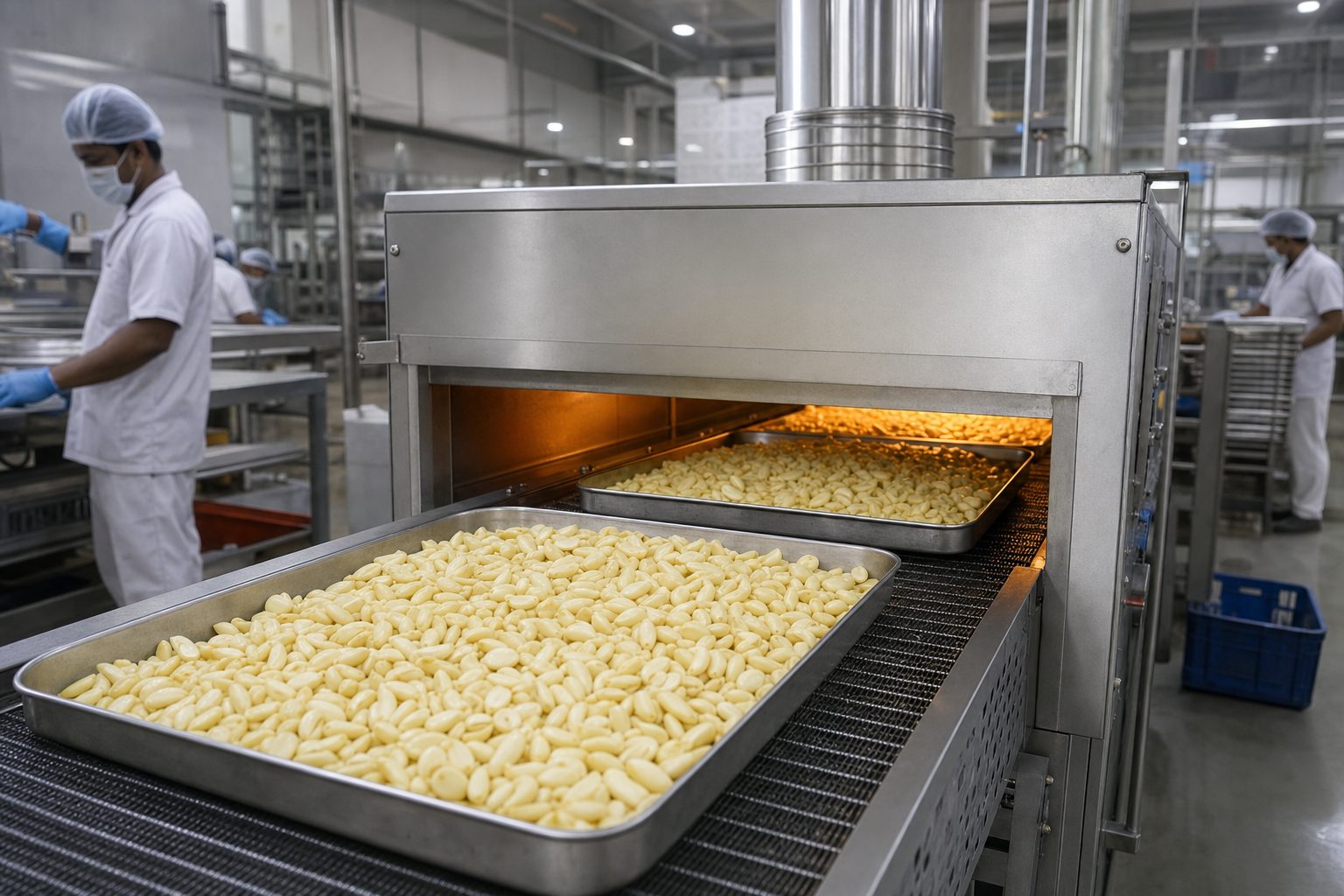
Dehydrated garlic production begins with raw garlic sourced from the Mandsaur–Neemuch belt in Madhya Pradesh or Rajasthan supply belts, selected for solids content and pungency suited to dehydration. Processing steps typically include washing, peeling, slicing or dicing to the target cut, tray or tunnel hot-air dehydration to a target moisture of approximately 5–6%, grading and sieving, milling for 80–100 mesh powder-grade material, metal detection, and packing in multiwall kraft bags with food-grade PE liners under controlled hygiene conditions.
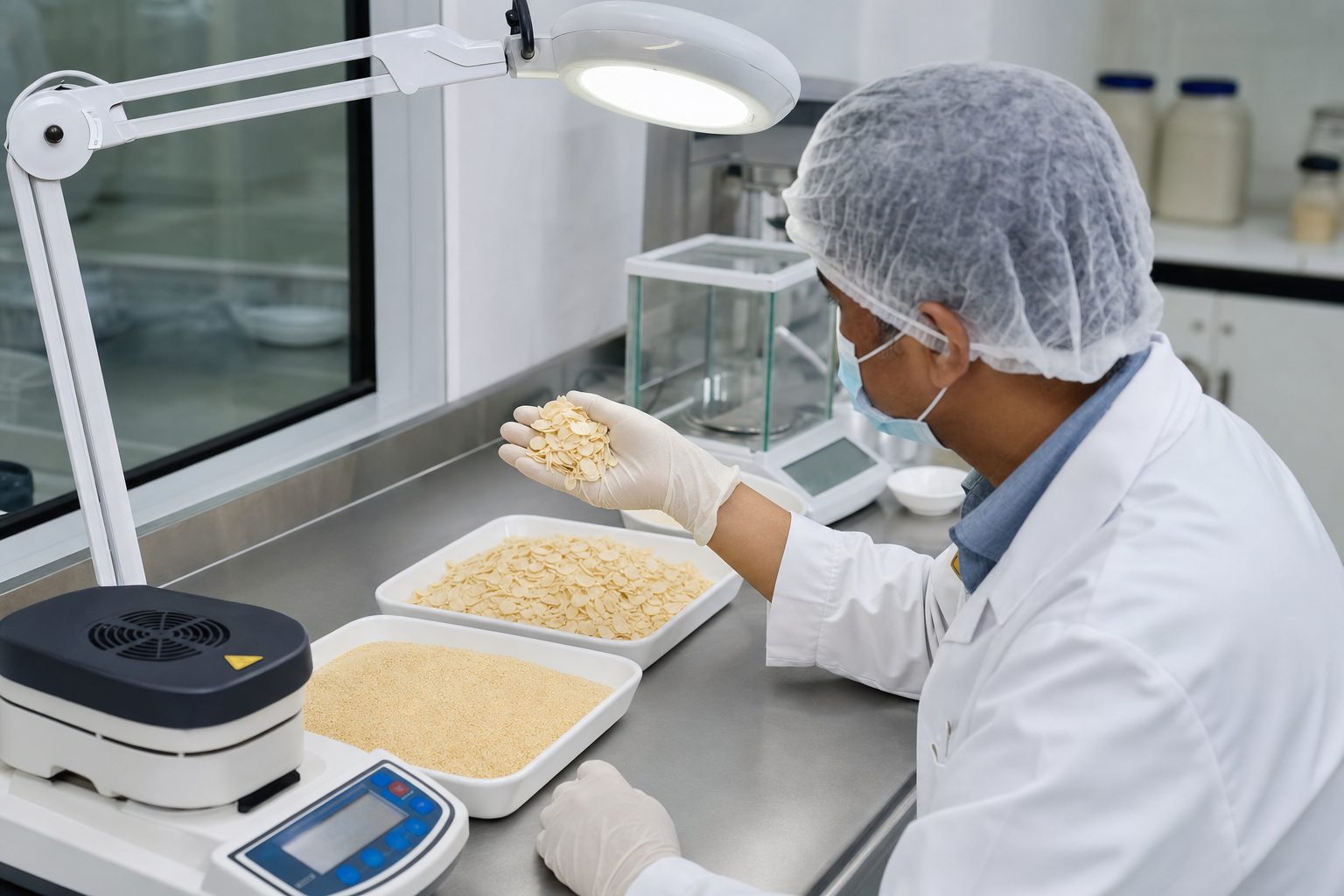
Export-oriented units maintain batch traceability from raw garlic lot to finished pack, moisture and microbiological testing at defined process checkpoints, allicin/pungency monitoring where buyers require it, and documented sanitation protocols aligned to FSSAI and HACCP requirements. Buyers evaluating a new Indian supplier typically request evidence of dryer capacity, batch consistency across multiple lots, and pest and foreign-matter control measures before committing to a trial shipment.
APEDA registration does not certify manufacturing quality directly, but registered exporters are more likely to operate under the documented process discipline that residue-sensitive and retail-grade buyers expect — because registration itself required assembling entity, licensing, and compliance documentation as a precondition.
Why APEDA Registration Matters for Dehydrated Garlic Exporters
Dehydrated garlic is a scheduled product under APEDA's mandate, which means commercial export requires APEDA registration as a matter of regulatory compliance, not optional best practice. Beyond the regulatory dimension, APEDA membership delivers practical commercial value: RCMC issuance for export documentation and shipping bill eligibility, market development assistance (MDA) eligibility for trade fair participation, quality infrastructure linkage to NABL-accredited labs, NPOP organic facilitation pathways, and a searchable exporter directory that buyers use during sourcing cycles.
Buyer trust is the most immediate commercial benefit. When a vendor onboarding pack includes IEC, GSTIN, FSSAI, APEDA RCMC, and recent lot COAs covering moisture 5–6%, ash, mesh, allicin/pungency, microbiology, and residues together, the perceived risk profile for a European food manufacturer, Japanese importer, or Gulf foodservice distributor drops meaningfully. Missing APEDA documentation causes buyers to pause, request workarounds, or move to already-registered competitors — particularly for retail-linked or private-label programmes where documentation completeness is part of the buyer's own compliance file.
Who Should Register with APEDA
- Dehydration and processing units in Gujarat (Mahuva, Bhavnagar, Sihor) with direct garlic export plans
- Merchant exporters consolidating multi-processor dehydrated garlic volume from Mandsaur–Neemuch feedstock
- MSMEs and startups with IEC and GST readiness entering garlic dehydration export
- Private-label brands exporting retail-packed flakes, powder, or granules
- Organic dehydrated garlic producers seeking NPOP-linked certification pathways
APEDA registration is relevant for any entity engaged in the commercial export of dehydrated garlic or related dehydrated vegetable products. This includes dehydration and processing units with direct export ambition, merchant exporters consolidating output from multiple Mandsaur–Neemuch traders and Gujarat processors, export houses, MSMEs and startups entering the dehydrated garlic export space with a valid IEC, and private-label brands exporting retail-packed dehydrated garlic.
Eligibility generally requires a valid IEC, GST registration, and entity constitution documents matching the business structure — proprietorship, partnership, private limited company, or producer entity. Manufacturer-exporter classification typically requires production evidence such as dryer capacity documentation; merchant-exporter classification requires procurement-and-export documentation. State your intended category explicitly during application, since default classification can affect RCMC scope and scheme eligibility.
APEDA Registration Process: Step-by-Step
Export Tip
The application pathway uses the APEDA online registration portal, with DGFT-linked credentials for IEC-holding exporters. The sequence below reflects the current organised pathway — confirm live portal instructions on apeda.gov.in before filing, as screen flows and document checklists are updated periodically.
Step 1: Obtain IEC
Apply for an Import Export Code on the DGFT portal if you do not already hold one. IEC is the foundation of all commercial export operations from India, and APEDA registration cannot proceed without a valid IEC. Keep PAN, bank details, and business address consistent with your GST registration to avoid name mismatches later in the process.
Step 2: Ensure FSSAI Registration/Licence
Dehydrated garlic is a food product subject to FSSAI regulation, so an appropriate FSSAI registration or licence — state or Central depending on turnover and export status — is required alongside APEDA membership. Export-oriented dehydration units typically require a Central FSSAI licence. Confirm current requirements on the FSSAI portal. Both APEDA and FSSAI credentials are typically presented together during buyer onboarding.
Step 3: Prepare Documentation
Assemble entity-specific documents: IEC copy, GST certificate, PAN, FSSAI registration/licence, cancelled cheque, bank financial soundness certificate where required, and entity constitution proofs (partnership deed, incorporation certificate, MoA/AoA for companies). Manufacturer-exporter classification may require dryer capacity or MSME Udyam documentation. Incomplete document packs cause the majority of processing delays.
Step 4: Register on the APEDA Portal
Create an applicant account on the APEDA online registration portal using your IEC and business email. The APEDA portal is the primary interface for new registration; follow current portal instructions for the membership/RCMC pathway applicable to scheduled dehydrated vegetable exporters.
Step 5: Complete Application and Select Product Categories
Fill the online application with entity details, IEC, product categories (select dehydrated/dried vegetables, specifying dehydrated garlic where prompted), export destination interests, and exporter type (manufacturer or merchant). Accurate product category selection matters because RCMC scope and scheme eligibility are tied to declared products. Confirm the current APEDA product heading for dried/dehydrated garlic on the portal before submission.
Step 6: Pay Registration Fees
Pay the prescribed registration fee online through the portal's payment gateway. First-year enrollment fees are typically structured as a one-time registration fee plus annual subscription plus applicable GST. Retain payment receipts and acknowledgement numbers with your compliance records, and never assume fee amounts are static — verify the live amount on the APEDA portal before remitting.
Step 7: Upload Documents and Submit Application
Upload clear, self-attested scans of all required documents. Names, addresses, and signatory details must match precisely across IEC, GST, FSSAI, and the application form — even minor spelling discrepancies between a partnership deed and the IEC generate deficiency notices. Label uploaded files clearly for reviewer convenience and submit only once every required upload is confirmed complete.
Step 8: Verification, Approval, and Ongoing Renewals
APEDA officials verify application completeness and document authenticity. Respond promptly to deficiency communication — within 24 to 48 hours where possible — to avoid application dormancy. On approval, APEDA issues the Registration-cum-Membership Certificate (RCMC). Download and store the RCMC alongside IEC, GSTIN, and FSSAI in your compliance file, and diary annual renewal dates so continuity is not broken. A lapsed membership can create shipping bill filing issues even when the shipment and other documentation are otherwise fully in order — treat renewals as a calendar-critical task months ahead of peak Mandsaur–Neemuch processing season.
Documents Required for APEDA Registration
Use this checklist as a preparation gate before opening the portal. Exact requirements vary by entity type and by manufacturer versus merchant exporter category.
Comparison table
Swipe →
Data table — swipe horizontally on small screens
| Document | Why It Matters | Practical Tip |
|---|---|---|
| IEC certificate | Mandatory for commercial export and APEDA eligibility | Self-attest; ensure the name exactly matches all other documents |
| GST registration certificate | Confirms legal commercial entity and tax identity | Address and legal name must align with IEC and deed |
| PAN card | Entity tax identity matching the IEC applicant | Use the correct entity PAN, not an individual proprietor's PAN for companies |
| FSSAI registration/licence | Food safety credential required for dehydrated garlic as a food product | Central FSSAI licence typically required for export-oriented units |
| Bank financial soundness certificate | Confirms banking relationship for the exporting firm | Use the account reflected in your IEC; letterhead must be current |
| Entity constitution proofs | Deed / incorporation certificate / MoA-AoA as applicable | Ensure the deed is notarised where required |
| Cancelled cheque / bank account proof | Banking validation for payment and refund records | Account name must match entity legal name exactly |
| Authorised signatory identity proof | KYC of the person signing the application | Use Aadhaar or passport; must match board resolution for companies |
| MSME Udyam + capacity evidence (manufacturer category) | Supports manufacturer-exporter classification | Attach dryer/processing unit evidence specific to dehydrated garlic |
APEDA Registration Fees and Costs
APEDA registration fees combine a one-time registration fee with an annual membership subscription, with 18% GST applied. As an approximate benchmark, first-year costs are commonly cited around ₹8,000 + 18% GST ≈ ₹9,440, but these figures are subject to revision. Annual renewal is lower since the one-time registration component does not recur. Always verify the live fee schedule on the official APEDA portal before remitting, as amounts may change without broad notice.
Registration and membership fees represent a small fraction of total dehydrated garlic export launch costs. Moisture, allicin, and microbiology testing, kraft+PE packaging engineering, climate-controlled storage, and trade fair participation typically dwarf membership fees. Measure ROI in qualified buyer conversions and scheme benefit eligibility, not in the certificate value alone. For fair lead-generation detail, see trade shows for dehydrated garlic exporters and find international buyers for dehydrated garlic — this guide stays light on that layer.
Comparison table
Swipe →
Data table — swipe horizontally on small screens
| Cost Item | Typical Nature | Planning Note |
|---|---|---|
| First-year registration + membership + GST | One-time registration + annual fee + 18% GST | Budget roughly ₹9,000–10,000 as a first estimate; verify live amount on portal |
| Annual renewal | Membership subscription + 18% GST | Diary renewal before the financial-year deadline; renewal is lower than first-year enrollment |
| Moisture, microbiology, residue, allicin testing | Per-batch and per-consignment testing costs | Budget for NABL-accredited lab fees per export lot |
| Organic certification (if applicable) | Third-party certification under NPOP or NOP/EU Organic | Recovers over 1–2 export seasons for appropriately scaled programmes |
| Export packaging (kraft bags + PE liners) | Food-grade packaging aligned to destination standards | Budget 14–25 kg multiwall kraft+PE as the standard bulk format |
| Fair participation via APEDA/MDA | Booth, travel, samples; partially reimbursable under MDA | Apply for MDA before the event; retain eligible expenditure invoices |
RCMC for Dehydrated Garlic Exporters: What It Means
Compliance Notes
The Registration-cum-Membership Certificate (RCMC) is issued by APEDA to confirm an exporter's registration and membership status for scheduled dehydrated vegetable exports, including dehydrated garlic under HS 0712.90. RCMC evidence is referenced in export documentation packages, buyer vendor onboarding packs, applications for government export incentives, and documentary credit transactions where institutional membership proof is a stated condition.
RCMC validity is typically multi-year but subject to annual fee payment; lapsing membership disrupts RCMC standing even within the nominal validity window. Keep the RCMC with IEC and FSSAI in a master compliance file accessible to your export desk, customs broker, and commercial team. Treat renewal as a calendar-critical task rather than an afterthought addressed only when a shipping bill deadline is imminent — a lapsed RCMC is one of the most common preventable causes of last-minute export documentation failure for dehydrated garlic consignments.
Shipping Bill Eligibility and APEDA Credentials
For scheduled dehydrated vegetable products including dehydrated garlic, customs and ICEGATE workflows expect APEDA credentials to be in order when shipping bills are filed. Exporters who allow RCMC membership to lapse often discover the problem only at the CHA desk — when a buyer-ready container is already packed and vessel cutoff is days away. Maintaining current APEDA registration is therefore not only a buyer-credibility issue; it is an operational shipping bill eligibility issue.
Before every peak season, reconcile IEC status, APEDA membership fee payment, FSSAI licence validity, and bank/GST name consistency. Confirm the correct eight-digit tariff line — 07129030 for flakes, 07129020 for powder, 07129040 for dried garlic — with your customs broker so shipping bills and commercial invoices align. Document consistency across invoice, packing list, COA, and shipping bill is as important as the RCMC itself for avoiding holds.
How APEDA Facilitates Organic Dehydrated Garlic Exports via NPOP
APEDA administers India's National Programme for Organic Production (NPOP). For dehydrated garlic exporters targeting organic retail and clean-label food manufacturing in the EU, Switzerland, and other equivalence-recognising markets, NPOP certification through an APEDA-accredited certifying body is the primary domestic pathway. Organic claims on export lots require lot-specific organic transaction certificates — a general company-level organic certificate is not sufficient for customs or buyer due diligence.
Exporters entering the organic dehydrated garlic segment should sequence: APEDA registration first, then initiate organic certification body engagement for NPOP (and USDA NOP or EU Organic pathways as required by destination), then approach premium buyers once in-conversion or certified documentation is available. Organic-certified garlic typically commands a 25–55% FOB premium over conventional equivalents across flakes, powder, and granules. Pair organic strategy with organic dehydrated garlic export opportunities.
Pricing Analysis
Buyer Tip
Dehydrated garlic FOB pricing varies by form, moisture specification, allicin/pungency grade, organic status, and crop-year raw garlic cost tied to the Mandsaur–Neemuch harvest cycle. The ranges below are indicative planning benchmarks — always request a live FOB quotation for your specific mesh size, moisture spec, and packaging requirement.
Comparison table
Swipe →
Data table — swipe horizontally on small screens
| Product Form | Indicative FOB Range (USD/kg) | Key Price Driver |
|---|---|---|
| Flakes (conventional) | 2.20–4.00 | Raw garlic cost, cut size, moisture grade |
| Powder (conventional) | 2.50–4.50 | Milling/sieving cost, 80–100 mesh; premium lots higher |
| Granules / minced (conventional) | 2.40–5.00 | Particle size control, rehydration profile |
| Toasted / roasted garlic | 3.50–7.00 | Roasting input cost, flavour profile, shelf-life packaging |
| Organic-certified equivalents | +25–55% over conventional equivalent | NPOP/USDA/EU Organic certification and segregated processing |
MOQ Analysis
Buyer Tip
Minimum order quantities for dehydrated garlic vary by exporter scale and whether the buyer is testing a new relationship or placing a programme order. Merchant exporters consolidating multiple processors can often support smaller trial MOQs than a single dehydration unit committing dryer capacity for one buyer.
Comparison table
Swipe →
Data table — swipe horizontally on small screens
| Order Type | Typical MOQ | Use Case |
|---|---|---|
| Trial / sample order | 500 kg – 1 metric tonne (LCL) | First-order quality and packaging validation |
| Standard commercial order | 1–5 metric tonnes | Repeat programme volume for mid-size buyers |
| Full container load (20 ft FCL) | Approx. 10–14 metric tonnes (form/density dependent) | Confirm load plan with forwarder; flakes load lighter than powder |
| Full container load (40 ft FCL) | Approx. 20–26 metric tonnes (form/density dependent) | Preferred for FCL programme volumes |
Packaging Standards
Export Tip
Packaging for dehydrated garlic export must control moisture ingress above all else, since the product is hygroscopic. The dominant export format is multiwall kraft paper bags with food-grade polyethylene liners, typically 14–25 kg net.
Comparison table
Swipe →
Data table — swipe horizontally on small screens
| Packaging Format | Typical Weight | Best Suited For |
|---|---|---|
| Multiwall kraft bag + PE liner | 14–25 kg | Standard commercial bulk shipments |
| Bulk bag (jumbo bag) | 500–1,000 kg | Large-volume industrial buyers with repacking lines |
| Carton with inner liner bag | 5–20 kg | Smaller commercial lots, carton-level traceability |
| Nitrogen-flushed / vacuum inner bag | Varies (within 14–25 kg outer) | Premium and organic lines; colour/allicin retention |
| Retail private-label pouch | 50 g – 1 kg | Direct-to-retail seasoning brands |
Container Loading Details
Export Tip
APEDA membership does not dictate stuffing method, but buyer questionnaires often ask how registered exporters control FCL loading for hygroscopic garlic. Practical programmes target roughly 10–14 MT in a 20ft or 20–26 MT in a 40ft with dry containers, desiccants where specified, and stacking that keeps kraft+PE bags off wet floors — details that belong in the same capability pack as your RCMC certificate.
Comparison table
Swipe →
Data table — swipe horizontally on small screens
| Container Type | Indicative Payload | Loading Note |
|---|---|---|
| 20-foot standard | Approximately 10–14 metric tonnes | Payload varies with cut density (flakes vs. powder) and packaging format |
| 40-foot standard | Approximately 20–26 metric tonnes | Preferred for FCL programme volumes to improve per-kg freight economics |
| 40-foot high cube | Slightly above standard 40ft payload | Useful for bulk-bag loads where cubic space is the limiting factor |
Shipping Methods
Export Tip
Mundra is a primary gateway port for Gujarat-origin dehydrated garlic, given proximity to Mahuva–Bhavnagar–Sihor processing; Pipavav and Nhava Sheva serve as alternate routing options. Sea freight LCL suits trials; FCL suits programme volumes. Air freight is reserved for samples.
Comparison table
Swipe →
Data table — swipe horizontally on small screens
| Route | Load Port | Approx. Transit Time |
|---|---|---|
| India to Netherlands / Germany (Rotterdam/Hamburg) | Mundra | 18–22 days |
| India to USA East Coast / Gulf Coast | Mundra / Nhava Sheva | 30–38 days |
| India to UAE (Jebel Ali) | Mundra | 7–10 days |
| India to Indonesia / Malaysia | Mundra / Nhava Sheva | 14–20 days |
| India to Japan (Yokohama/Kobe) | Mundra / Nhava Sheva | 22–28 days |
| India to UK (Felixstowe/Southampton) | Mundra / Nhava Sheva | 20–26 days |
Certifications
Compliance Notes
Certification stacking varies by destination and channel. FSSAI and APEDA RCMC are baseline for essentially all dehydrated garlic export programmes; other certifications are layered based on buyer, retailer, or destination-market requirements.
Comparison table
Swipe →
Data table — swipe horizontally on small screens
| Certification | Issuing Body / Pathway | Typical Requirement Trigger |
|---|---|---|
| FSSAI licence | Food Safety and Standards Authority of India | Mandatory for all food export businesses |
| APEDA RCMC | APEDA | Mandatory for scheduled dehydrated vegetable exports |
| HACCP | Accredited certification bodies | Requested by most institutional and retail buyers |
| ISO 22000 / FSSC 22000 | Accredited certification bodies | Food safety management system evidence for larger buyers |
| Halal | UAE/Gulf/Indonesia/Malaysia-recognised certifiers | Required for retail entry in Halal-observant markets |
| Kosher | Recognised Kosher certification agencies | Requested by some US and European food manufacturers |
| NPOP / USDA Organic / EU Organic | APEDA-accredited / destination pathways | Required for organic-labelled dehydrated garlic export |
| BRC / IFS | Accredited certification bodies | Often required by EU retail private-label programmes |
Buyer Requirements
Buyer Requirements
- APEDA RCMC and FSSAI licence copies as institutional credibility evidence
- Certificate of Analysis (COA) per lot covering moisture 5–6%, ash, mesh, allicin/pungency, microbiology, and residues
- Specification sheet confirming cut/mesh (e.g. 80–100 mesh powder), colour, and moisture target
- Packaging specification matching kraft+PE or premium nitrogen-flush requirements
- Pesticide residue test report where destination market applies strict MRL standards
- Halal, Kosher, or organic certification where the buyer's channel requires it
- Consistent lead time and responsive communication on specification questions
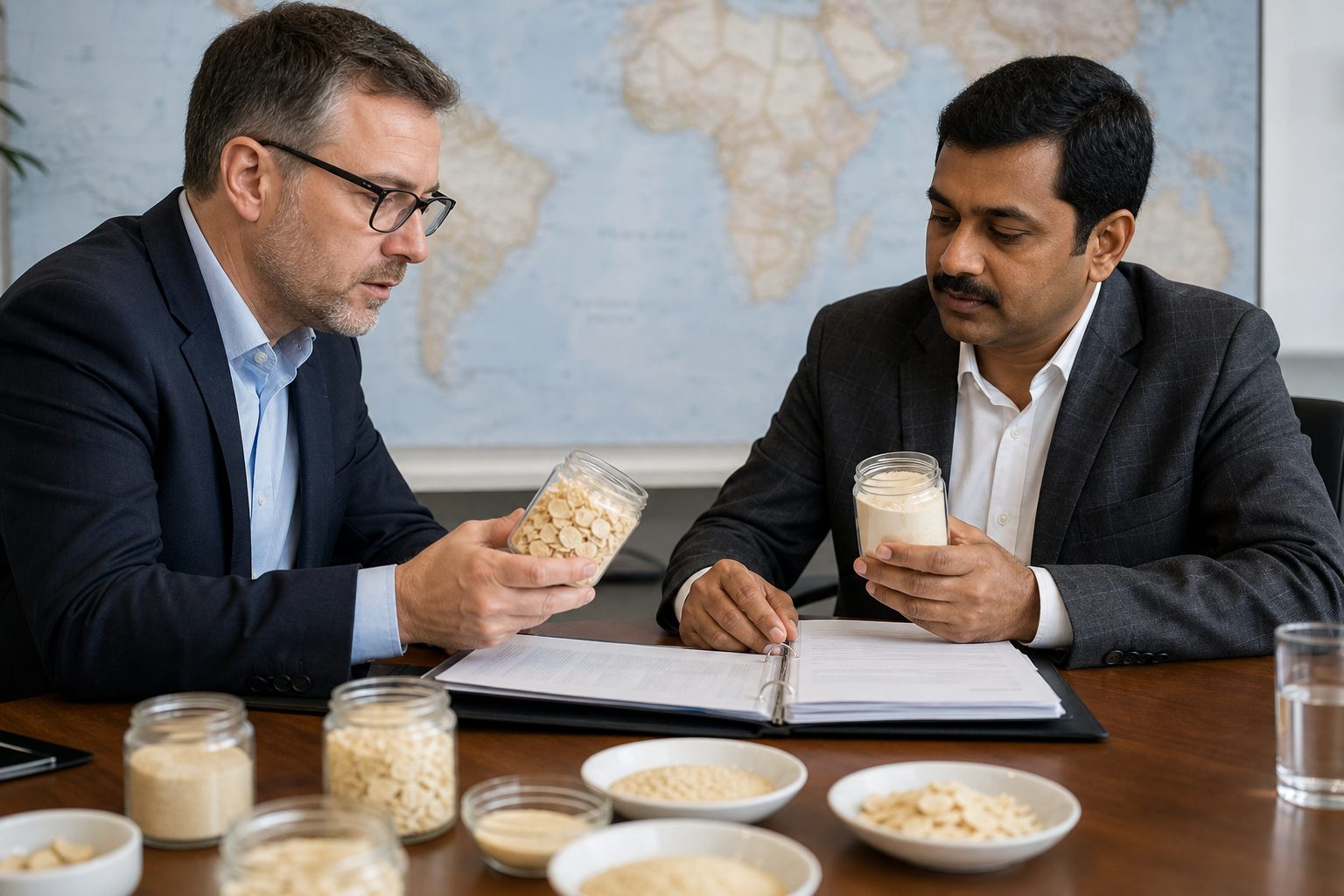
International buyers evaluating a new dehydrated garlic supplier typically request a standard document and specification pack before confirming a trial order. Meeting these requirements consistently — not just for the first sample — is what converts a trial into a repeat programme.
Country-wise Opportunities
Market Snapshot
APEDA registration status is one qualifying factor among several that shape which markets an exporter can realistically pursue in a given season. For detailed product × country demand matrices (what cuts and certs each market actually orders), see most demanded Indian dehydrated garlic by country. For market selection ranking, see best countries for Indian dehydrated garlic exports.
Comparison table
Swipe →
Data table — swipe horizontally on small screens
| Country / Region | Opportunity Level | Key Requirement Beyond APEDA |
|---|---|---|
| USA | Very High | FDA-aligned docs, residue-clean COAs; powder/flakes for seasonings |
| Germany / EU | High | Strict MRL and micro standards; organic premium demand |
| Japan | Medium–High | Ultra-strict residue panel; fine mesh powder |
| Indonesia / Malaysia | High | Volume flakes for noodles/snacks; Halal valued |
| UAE / GCC | Medium–High | Halal certification; mixed FCL programmes |
| UK | Medium–High | Retail labelling compliance; powder and flakes |
| Netherlands | High | EU distribution hub — consistent bulk supply |
| Canada / Brazil | Medium | Food manufacturing specs; growing diversification demand |
Sourcing Checklist
Checklist
- Confirm the processor's IEC, APEDA RCMC, and FSSAI licence are current before requesting samples
- Request recent lot COAs covering moisture 5–6%, ash, mesh, allicin/pungency, microbiology, and residues
- Verify dryer capacity and raw garlic sourcing zone (Mandsaur–Neemuch vs other belts) for consistency claims
- Confirm cut, mesh size (80–100 for powder), and moisture specification match your application before sampling
- Check organic certification status separately if targeting NPOP/organic-labelled programmes
- Ask for prior export shipment references to your target destination market
Buyer Checklist
Checklist
- Request APEDA RCMC and FSSAI documentation as part of vendor qualification
- Define your required cut, moisture 5–6% ceiling, mesh size, and kraft+PE packaging format in writing before quoting
- Confirm destination-specific certification needs (Halal, Kosher, organic) upfront
- Request a pre-shipment sample and lot-specific COA before committing to a full container
- Clarify Incoterm, payment terms, and lead time before production begins
- Establish a repeat-order communication cadence to reduce quality drift across lots
Exporter Checklist
Checklist
- Complete IEC, FSSAI, and APEDA registration before active buyer outreach
- Maintain a rolling lot-testing programme with an NABL-accredited lab covering moisture, micro, residues, and allicin where required
- Prepare a standard buyer onboarding pack (RCMC, FSSAI, COA template, company profile)
- Diary APEDA and FSSAI renewal dates alongside GST filing deadlines — protect shipping bill eligibility
- Confirm kraft+PE packaging and container loading plans (10–14 MT / 20ft; 20–26 MT / 40ft) match each buyer's handling capability
- Track certification-specific documentation (Halal, organic/NPOP) separately per programme
Compliance Checklist
Checklist
Compliance Notes
- IEC valid and consistent in name/address across GST, FSSAI, and APEDA records
- FSSAI licence current and matching the exporting entity
- APEDA RCMC current, with renewal fee paid before the financial-year deadline
- Lot-specific COA covering moisture 5–6%, ash, mesh, microbiology, residues, and allicin/pungency where required
- HS code 0712.90 eight-digit line (07129030/07129020/07129040) confirmed with your CHA
- Organic transaction certificate on file for any organic-labelled dehydrated garlic shipment
Common Buyer Mistakes
Common Mistakes Box
- Skipping APEDA/FSSAI verification and relying only on price comparison — Solution: request RCMC and FSSAI copies before sampling.
- Not specifying moisture 5–6% and mesh size clearly — Solution: put exact specifications in the purchase agreement, not a verbal understanding.
- Ordering full containers before a validated sample — Solution: start with a 500 kg–1 MT trial before committing to FCL volume.
- Ignoring destination-specific certification needs until goods arrive — Solution: confirm Halal, Kosher, or organic requirements during vendor qualification.
- Assuming all Indian dehydrated garlic is equivalent — Solution: request COAs and compare consistency across multiple lots, not one sample.
- Underestimating lead time for peak-season Mandsaur–Neemuch processing capacity — Solution: place orders ahead of the harvest-driven demand surge.
- Filing under the wrong HS/tariff line — Solution: confirm 07129030/07129020/07129040 with your CHA before every shipping bill.
- Allowing APEDA RCMC to lapse at shipping bill time — Solution: diary renewals months ahead of peak season.
Future Market Trends
Key Statistics
Through 2030, dehydrated garlic export from India is likely to see three structural shifts: expanding organic and clean-label demand from EU and US retail channels (with APEDA/NPOP as the domestic facilitation pathway), tighter residue and microbiological scrutiny from Japan and other technically demanding markets, and growing digital buyer discovery reducing reliance on intermediary trading houses. APEDA's evolving digital infrastructure — including online RCMC issuance and MDA claim processing — is expected to reduce administrative friction for registered exporters.
Exporters who treat APEDA as living infrastructure — maintaining current registration, upgrading testing discipline (moisture, allicin, residues), and using membership for buyer credibility rather than as a one-time certificate — will be positioned to capture disproportionate share of premium and organic segment growth as buyers consolidate around suppliers with complete institutional documentation.
Expert Insights from Saurabh Mittal, Founder of Altus Exports
Expert Insight Box
Two perspectives from Altus Exports on how APEDA registration functions in practice for dehydrated garlic programmes.
Shipping Bill Continuity Beats Last-Minute Scrambles
The most expensive APEDA failure is not a rejected application — it is a lapsed renewal discovered at vessel cutoff. Processors who diary renewals and keep RCMC, FSSAI, and IEC aligned across every document convert more first containers into repeat programmes because buyers never experience a documentation scramble mid-relationship.
Conclusion
- Next step for processors: Complete IEC, APEDA RCMC, and FSSAI licensing before approaching any international buyer.
- Next step for buyers: Share your target product form, destination market, certification needs, and volume — Altus Exports matches verified Indian dehydrated garlic processors and coordinates documentation and shipment.
- Explore How to Export Dehydrated Garlic from India for the full operational sequence.
- Explore Top Dehydrated Garlic Products Exported from India for flakes, powder, granules, toasted, and organic grades.
- Compare destinations in Best Countries for Indian Dehydrated Garlic Exports.
- Map demand fit in Most Demanded Indian Dehydrated Garlic by Country.
- International buyers should read How to Source Dehydrated Garlic Directly from India.
- Build your pipeline with How to Find International Buyers for Dehydrated Garlic.
- Explore the premium lane in Organic Dehydrated Garlic Export Opportunities.
- Use the Dehydrated Garlic Export Documentation Checklist as your pre-shipment gate.
- Plan buyer outreach around Trade Shows for Dehydrated Garlic Exporters.
- Browse export products from India and product sourcing company India for multi-category food export support.
APEDA registration is the institutional foundation for exporting dehydrated garlic from India under HS 0712.90: it underpins RCMC issuance, shipping bill eligibility, buyer onboarding credibility, NPOP organic facilitation, and scheme access. The Mandsaur–Neemuch garlic belt and Gujarat dehydration plants supply the product capability; APEDA membership converts that capability into an export-ready institutional identity that food manufacturers in the USA, EU, Japan, ASEAN, and GCC can qualify against.
If you are a Madhya Pradesh or Gujarat-linked processor, trader, or MSME ready to export dehydrated garlic, complete IEC, FSSAI, and APEDA registration before approaching international buyers. International buyers sourcing verified dehydrated garlic from India can work with Altus Exports as a global sourcing partner for coordinated sourcing, testing, and shipment under one accountable relationship.