
Dehydrated Garlic Export Documentation Checklist: Every Paper for HS 07129030/20/40 Shipments
By Saurabh Mittal, Founder, Altus Exports
A document-by-document dehydrated garlic export checklist for Indian dehydrators, processors, and merchant exporters shipping under HS 07129030 (flakes), 07129020 (powder), and 07129040 (dried garlic). Covers IEC, GST, FSSAI, APEDA RCMC, commercial invoice, packing list, shipping bill, bill of lading, certificate of origin, health certificate, lot-level Certificate of Analysis (moisture, ash, mesh, allicin/pungency, microbial counts, pesticide residues), preferential origin claims, FDA prior notice for USA shipments, Halal and Kosher certificates, organic transaction certificates, and lot-code alignment across every paper. Includes Mandsaur–Neemuch and Gujarat dehydrator context, packaging and container-loading detail, country-wise extras, pre-shipment gate checklists, and compliance guidance aligned with APEDA, FSSAI, DGFT, and CBIC practice — from Altus Exports.
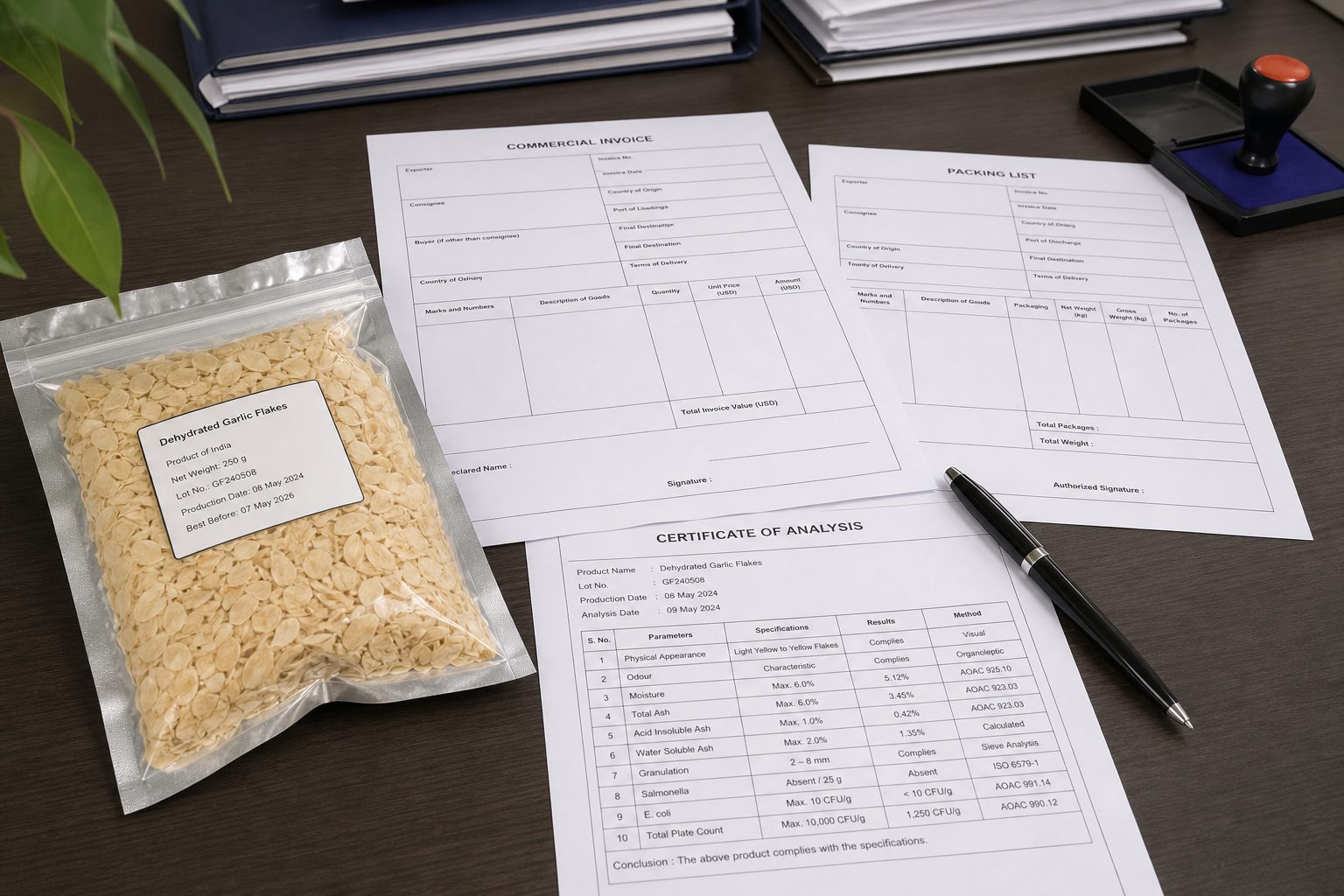
Dehydrated garlic export documentation is where compliant shipments succeed or stall — often at destination, after the vessel has sailed and the buyer has scheduled warehouse receipt. A container of Gujarat-origin garlic flakes can pass internal quality checks, meet moisture specifications, and be packed in export-grade kraft bags, and still be detained at US or EU borders because a Certificate of Analysis was issued for a different lot number, an APEDA RCMC was expired, or FDA prior notice was filed with mismatched product descriptions. In food-ingredient trade, paperwork is not administrative overhead — it is part of the product the buyer receives and the customs authority evaluates.
Documentation failures in dehydrated garlic exports are expensive. Detention charges, re-inspection fees, buyer penalties, payment holds, and loss of vendor-approval status all stem from preventable paperwork gaps. India's dehydrated garlic exports under HS 07129030 / 07129020 / 07129040 run into tens of millions of US dollars annually across Indian lines 07129020/30/40 (directional customs snapshots; confirm current-year APEDA/DGCI&S/ITC Trade Map figures before planning), with Gujarat's Mahuva–Bhavnagar–Sihor dehydrators and the Mandsaur–Neemuch Madhya Pradesh garlic belt supplying the majority of flakes, powder, granules, minced, chopped, and toasted/roasted output. Yet documentation errors remain a persistent reason Indian dehydrated garlic loses ground with premium international buyers who have experienced a single shipment hold.
This dehydrated garlic export documentation checklist walks Indian dehydrators, processors, and merchant exporters through every registration, core commercial document, quality certificate, certification paper, and shipping record required for international trade under HS 0712.90 / 07129030–40. You will find country-specific notes for the USA, EU, UK, Brazil, Indonesia, and the Middle East, a printable pre-shipment gate checklist, common mistakes with process fixes, and expert guidance on building documentation discipline into production planning. Pair it with how to export dehydrated garlic from India, APEDA registration benefits for dehydrated garlic exporters, and trade shows for dehydrated garlic exporters. Always verify current portal steps with APEDA, FSSAI, DGFT, and your customs house agent — procedures evolve.
Key Takeaways
Summary Box
- A dehydrated garlic export documentation checklist must be completed before cargo cutoff — lab COAs, health certificates, and organic transaction certificates are far harder to fix after the vessel sails.
- IEC, GST registration, FSSAI licence, and APEDA RCMC are foundational registrations; no serious buyer or customs authority accepts shipments without them aligned to the invoicing entity.
- Commercial invoice, packing list, shipping bill, and bill of lading must use identical product descriptions, HS 07129030/20/40 tariff lines, lot codes, net weights, and bag counts.
- Lot-level Certificate of Analysis covering moisture, ash, mesh, allicin/pungency, microbial parameters, and pesticide residues must match the exact batch shipped — not a representative sample from a prior production run.
- Lot codes must align across bag labels, COA, invoice, packing list, health certificate, preferential origin papers, and organic TCs — a single mismatch triggers holds.
- USA shipments require FDA prior notice with matching HTS fields; preferential origin claims must match invoice HS lines; EU shipments need MRL documentation; Middle East buyers frequently require Halal certificates.
- Toasted or further-prepared garlic products may fall under Chapter 20 rather than HS 0712.90 / 07129030–40 — confirm classification before drafting any export document set.
- Altus Exports helps agriculture & food products and spices & seasonings export programmes align documentation discipline with shipment execution.
Executive Summary
Summary Box
Dehydrated garlic export documentation is a solvable, systematic discipline once exporters stop treating paperwork as a port-side afterthought and start treating it as part of production planning. The exporters who consistently clear destination customs on first attempt combine three inputs: current registrations (IEC, FSSAI, APEDA RCMC), lot-locked quality documentation (COA, health certificate, and phytosanitary certificate when destination-required), and a reconciled commercial set (invoice, packing list, shipping bill, B/L, COO) where every field matches. None of the three works well alone; together they protect margin and buyer relationships.
This guide walks through the full documentation stack for HS 0712.90 / 07129030–40 dehydrated garlic exports — market context, export and import statistics, product variants and their document implications, manufacturing context from India's Mandsaur–Neemuch and Gujarat garlic dehydration clusterss, pricing and MOQ benchmarks that affect invoice structure, packaging and container-loading detail that drives packing list accuracy, shipping lead times, certification requirements, buyer-side document expectations, and country-by-country extras for the USA, EU, Brazil, Indonesia, and the Middle East. It closes with practical checklists for sourcing, buyer verification, exporter preparation, and compliance, plus expert perspective from Altus Exports on what actually prevents shipment holds.
The throughline is alignment. A document pack where invoice lot numbers, COA batch references, packing list bag counts, and shipping bill quantities reconcile on the first submission will clear faster than a perfect product with mismatched paperwork every time — and it protects scarce lab-testing budget for shipments that can realistically convert into repeat container programmes.
Market Size & Industry Overview
Key Statistics
Dehydrated garlic sits inside the broader dehydrated vegetables and food-ingredients category, which has grown steadily as food manufacturers substitute fresh-garlic handling, storage, and peeling labor with a shelf-stable, standardized, easy-to-dose dried format. Garlic flakes, garlic granules, minced garlic, granules, and garlic powder are foundational inputs for soups, sauces, snack seasoning, spice blends, seasoning and snacks, ready meals, and processed meat products across every major food-manufacturing region.
India is uniquely positioned as a supply origin because it combines one of the world's largest garlic cultivation bases with a mature dehydration-processing cluster centered on Madhya Pradesh's Mandsaur–Neemuch garlic belt and Gujarat's Mahuva, Bhavnagar, and Sihor dehydrators — where dedicated dehydration plants convert fresh red and white garlic into export-grade dried formats at industrial scale. Reported 2024 trade under HS 0712.90 / 07129030–40 was roughly tens of thousands of metric tonnes across garlic flake and powder lines (directional) and about tens of millions of US dollars annually (directional; confirm via APEDA/DGCI&S/ITC Trade Map) in value, with top destinations including the USA, Brazil, Germany, Indonesia, and Belgium.
Documentation expectations rise as markets mature. Buyers in the USA, Germany, and the broader EU increasingly request digital COA packs, pesticide residue panels aligned to destination MRLs, and traceability from dehydration plant to shipment lot before placing programme orders. Exporters who build documentation infrastructure now — consistent lot numbering, APEDA-linked export records, and fast certificate turnaround — capture disproportionate share of growing demand covered in organic dehydrated garlic export opportunities and best countries for Indian dehydrated garlic exports.
Export Statistics
Key Statistics
India's dehydrated garlic exports move under HS codes 07129030 / 07129020 / 07129040 (dried/dehydrated garlic — flakes 07129030, powder 07129020, dried garlic 07129040). Reported trade under these lines runs into tens of millions of US dollars annually (directional; confirm via APEDA/DGCI&S/ITC Trade Map). Gujarat dehydration capacity fed by Mandsaur–Neemuch raw garlic underpins a large share of that volume. Every export declaration, commercial invoice, and certificate of origin must reference this classification consistently — discrepancies between invoice descriptions and customs declarations are a common trigger for shipping bill queries and destination holds.
By 2024 reported value, the largest destinations for Indian dehydrated garlic included the USA, Brazil, Germany, Indonesia, and Belgium. Each market applies different import documentation requirements on top of the baseline Indian export set, which is why a single generic document pack rarely satisfies all buyers. Build destination-specific document templates once your core HS 0712.90 / 07129030–40 set is stable.
Comparison table
Swipe →
Data table — swipe horizontally on small screens
| Destination Market (2024 reported) | Approx. Share of India's HS 0712.90 / 07129030–40 Export Value | Primary Documentation Sensitivity |
|---|---|---|
| USA | Leading destination — confirm share via ITC Trade Map | FDA prior notice, facility registration, residue panels, HTS 0712.90.40 (~29.8% MFN — verify current HTSUS) |
| Brazil | ~11% | Portuguese-language COA summaries, SIF-equivalent health documentation |
| Germany | ~11% | EU MRL compliance, organic TC for certified lots, German importer PO alignment |
| Indonesia | ~7% | Halal certificate, BPOM-aligned labeling references on invoice |
| Belgium | ~6% | EU redistribution documentation, COO for preferential treatment claims |
| UK / Netherlands / other EU | Material secondary share | UK post-Brexit import rules, EU phytosanitary requirements |
| Middle East (UAE and neighbors) | Smaller share, high frequency | Halal, GCC-compliant COO, shorter lead-time document turnaround |
| Other markets (Japan, etc.) | Remainder of trade | Strict Japan MRL panels, lot-specific residue testing |
Import Statistics
Key Statistics
On the import side, HS 0712.90 / 07129030–40 shipment data across major destination customs authorities shows a consistent pattern: a handful of large-volume food manufacturers and ingredient distributors account for the bulk of tonnage in each market, while a long tail of smaller foodservice and private-label buyers place smaller, more frequent orders. Documentation overhead per shipment is similar regardless of volume — which is why importers with repeat programmes invest heavily in supplier document quality during vendor approval.
Destination import volumes from India vary by season, currency movement, and competing-origin pricing. Use the 2024 India-origin shipment benchmarks below to understand which markets justify building dedicated document templates and certification investments.
Comparison table
Swipe →
Data table — swipe horizontally on small screens
| Country | Approx. 2024 India-Origin Volume (HS 0712.90 / 07129030–40) | Key Import Documentation Focus | Typical Clearance Risk |
|---|---|---|---|
| USA | Material — confirm current-year via ITC Trade Map | FDA prior notice, HTS 0712.90.40 garlic (~29.8% MFN — confirm statistical suffix and current HTSUS with broker); do not confuse with Indian 8-digit 07129040 | Residue holds, prior notice mismatches |
| Brazil | Material — confirm current-year via ITC Trade Map | Health certificate, Portuguese COA summary | Invoice-description inconsistencies |
| Germany | Material — confirm current-year via ITC Trade Map | EU MRL documentation, organic TC | Residue exceedances, organic chain gaps |
| Indonesia | Material — confirm current-year via ITC Trade Map | Halal, BPOM references | Halal scope mismatches |
| Belgium | Material — confirm current-year via ITC Trade Map | EU phytosanitary, COO | Redistribution documentation gaps |
| UK / Netherlands / others | Material secondary volumes | UK import health certificate, EU TRACES | Post-Brexit document routing errors |
| UAE / GCC | Frequent smaller shipments | Halal, COO, commercial set alignment | Low duty but strict Halal verification |
| Japan / Canada / others | Smaller premium volumes | Japan-specific MRL panels | Residue testing scope gaps |
Product Categories / Variants
Summary Box
Product variant affects documentation detail. A shipment of 80–100 mesh garlic powder requires mesh-size declaration on the COA and invoice; flakes require cut-size parameters; organic lots require lot-specific organic transaction certificates. Toasted or further-prepared garlic may classify under Chapter 20 if further prepared — do not assume HS 0712.90 / 07129030–40 without confirming with your customs house agent and destination importer.
Commercialize 3–5 variants with consistent, repeatable specifications and locked document templates before you begin export — customs authorities and buyers ignore vague invoice descriptions that do not state moisture, mesh, and grade parameters.
Comparison table
Swipe →
Data table — swipe horizontally on small screens
| Variant | Typical Cut / Mesh Size | HS Classification Note | COA Parameters Required |
|---|---|---|---|
| Garlic flakes | 3–8 mm | HS 07129030 | Moisture, cut size, ash, allicin/pungency, TPC, Y&M, Salmonella, E. coli |
| Garlic powder | 80–100 mesh | HS 07129020 | Moisture, mesh, ash, allicin/pungency, microbial, pesticide panel |
| Garlic granules | 0.5–1 mm | HS 07129030 / 07129040 | Moisture, mesh, microbial panel, residues |
| Minced garlic | 1–3 mm | HS 07129030 / 07129040 | Moisture, particle size, microbial panel |
| Chopped dehydrated garlic | Varies | HS 07129040 | Moisture, cut size, microbial panel |
| Toasted / roasted garlic | Varies | Confirm HS — may remain 0712.90 or shift if further prepared | Moisture, colour, microbial; separate HS review |
| Dried garlic (whole/cut) | Varies | HS 07129040 | Moisture, microbial, residue panel |
| Organic dehydrated garlic | Varies | Matching HS line + organic TC | All conventional params plus organic TC per lot |
Manufacturing Overview
Export Tip
Understanding how Indian dehydrated garlic is produced strengthens your documentation credibility — buyers and customs authorities ask process questions, and vague answers signal an unverified trading intermediary rather than a real processor. Fresh garlic cloves are sourced seasonally from Madhya Pradesh's Mandsaur–Neemuch belt, Rajasthan supply belts, and Gujarat-linked channels, then peeled, sliced or diced to spec, and passed through continuous-belt or hot-air tray dehydration systems that reduce moisture from roughly 60–70% in fresh garlic cloves to at or below 5–6% in the finished dried product.
Gujarat's Mahuva–Bhavnagar–Sihor dehydrators, fed by Mandsaur–Neemuch raw garlic, host the majority of large-scale dehydration capacity, cold-chain-adjacent storage, and export-documentation infrastructure. Processors here typically run flakes, powder, granule, minced, and toasted/roasted lines in parallel. Lot numbering should be assigned at the end of each production run and flow through COA, invoice, packing list, and shipping bill without gap — this is the single most common documentation failure point in dehydrated vegetable exports.
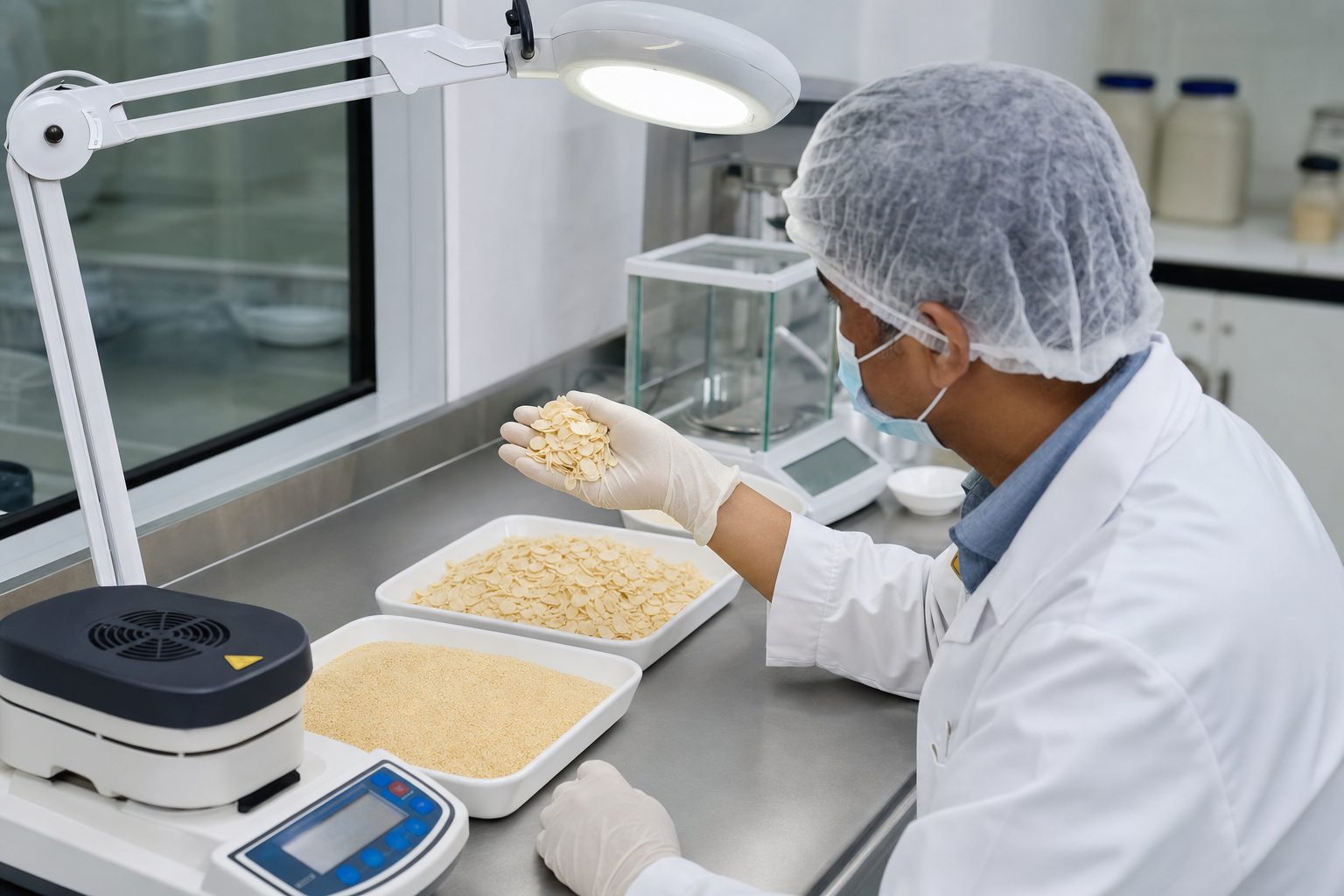
Quality-critical process controls include raw-material intake testing, dehydration temperature and time control, metal detection, sieving, and microbiological testing before packing. Buyers in regulated markets increasingly request process-control documentation alongside the finished-product Certificate of Analysis. Your FSSAI licence must match the legal entity and facility address on the health certificate and commercial invoice.
Pricing Analysis
Buyer Tip
Dehydrated garlic FOB pricing moves with fresh-garlic crop prices, which are seasonal and can swing sharply year to year. Invoice pricing must match the proforma invoice or purchase order reference, use the agreed Incoterm, and state currency clearly. Under-invoicing or description mismatches between quoted grade and shipped grade are compliance risks, not negotiation tactics.
Organic-certified dehydrated garlic commands a structural premium — typically 25–55% above comparable conventional FOB — and requires organic transaction certificates that match invoice lot numbers. Exporters who ship organic product without lot-specific TCs face immediate holds in the EU and USA.
Comparison table
Swipe →
Data table — swipe horizontally on small screens
| Grade / Variant | Conventional FOB Range (USD/kg) | Organic FOB Range (USD/kg) | Invoice Documentation Note |
|---|---|---|---|
| Garlic flakes | $2.20–$4.50 | $2.90–$6.50 | State cut size, moisture, and HS tariff line on invoice |
| Garlic granules | $2.40–$5.00 | $3.10–$7.00 | Match PO spec sheet description exactly |
| Minced garlic / granules | $2.40–$5.00 | $3.20–$7.20 | Declare mesh range on invoice and COA |
| Garlic powder | $2.50–$4.50 | $3.40–$8.00 | USA: invoice HTS 0712.90.40 (~29.8% MFN — confirm suffix/HTSUS with broker) |
| Toasted / roasted garlic | $3.50–$7.00 | $4.80–$10.00 | Confirm HS chapter before invoicing; toasted/roasted may need separate review |
MOQ Analysis
Buyer Tip
Minimum order quantity affects how lot numbers, COAs, and organic transaction certificates are structured. A trial shipment of 2 MT may ship as a single lot with one COA; a 24 MT container may comprise multiple lots each requiring separate COA pages and packing list sub-lines. Document your lot-splitting logic before production, not at the port.
Comparison table
Swipe →
Data table — swipe horizontally on small screens
| Buyer Type | Typical First-Order MOQ | Programme-Stage MOQ | Documentation Implication |
|---|---|---|---|
| Trial importer / sample buyer | 1–3 MT | N/A | Single-lot COA; simplified packing list |
| Food manufacturer / ingredient buyer | 5–10 MT | 10–20+ MT (FCL) | Multi-lot COA pack; detailed packing list per lot |
| Foodservice distributor | 3–5 MT | 10–20 MT | Consolidated invoice with SKU-level lines |
| Retail private label | 5–10 MT | 20+ MT recurring | Label artwork approval docs; organic TC per retail lot |
| Organic / clean-label brand | 1–5 MT (certified lot) | 10–20 MT | Lot-specific organic TC mandatory for every shipment |
Packaging Standards
Export Tip
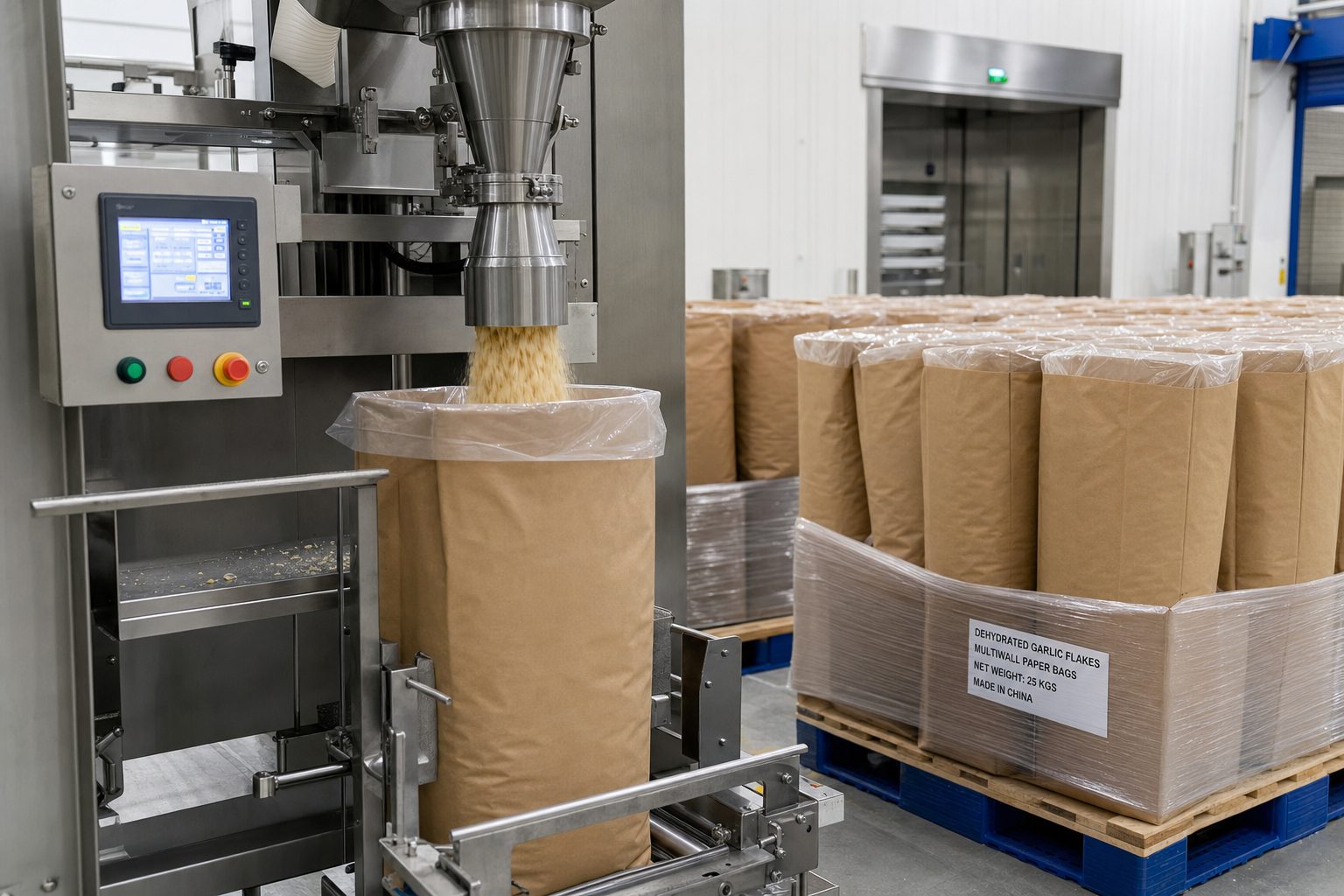
Packaging format drives packing list structure. Every bag count, net weight, gross weight, and pallet reference on the packing list must reconcile with the invoice and the physical load plan. Export documentation errors frequently originate from a last-minute packaging change that was not reflected across all documents.
Comparison table
Swipe →
Data table — swipe horizontally on small screens
| Packaging Format | Typical Size | Material | Packing List Fields Required |
|---|---|---|---|
| Kraft paper bag with PE liner | 14–25 kg | Multi-ply kraft + LDPE liner | Bag count, net weight per bag, lot number, pallet ID |
| PP woven bag with liner | 25 / 50 kg | Woven PP + liner | Bag count, net/gross weight, lot reference |
| Vacuum-sealed bags | 10–25 kg | Laminated barrier film | Seal integrity note; extended moisture spec on COA |
| Bulk / jumbo bags (FIBC) | 500–1,000 kg | Woven PP FIBC with liner | FIBC count, tare weight, lot number per bag |
| Retail pouches | 100 g – 1 kg | Metalized film | SKU-level lines, barcode, organic label proof |
| Carton with inner liner | 20 kg | Corrugated carton + PE liner | Carton count, inner bag count, label approval ref |
Container Loading Details
Export Tip
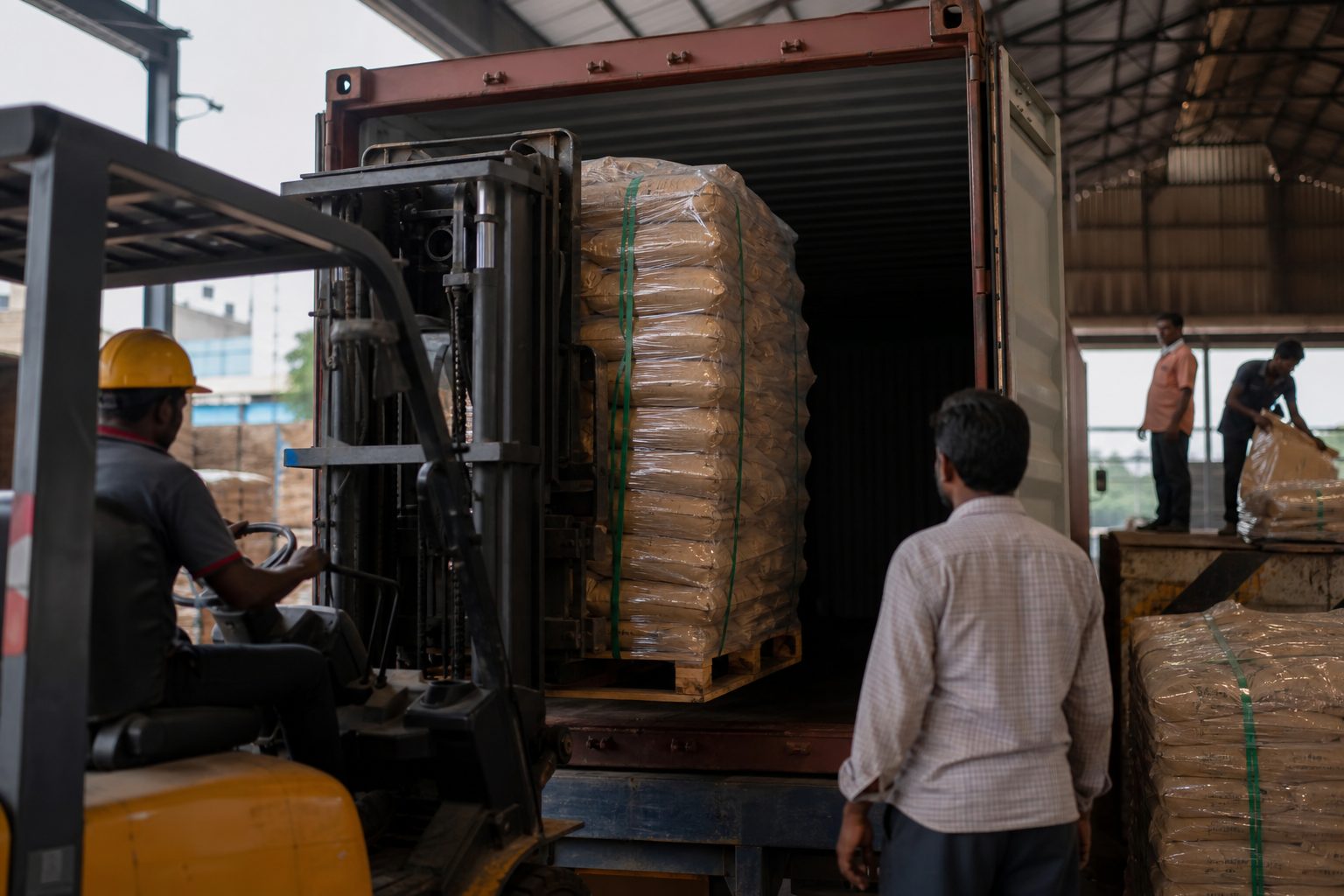
Container load plans must match packing list totals. Customs authorities and buyers routinely compare declared container weight against bill of lading figures and invoice quantities. A 40ft container of 25 kg bags typically loads about 20–26 MT net; document the exact load plan and attach it to the internal document pack even if not always required for customs filing.
Comparison table
Swipe →
Data table — swipe horizontally on small screens
| Container | Packaging | Approx. Net Load Capacity | Document Pack Note |
|---|---|---|---|
| 20ft dry container | 14–25 kg bags, palletized | About 10–14 MT | Packing list per pallet; verify total MT on invoice |
| 40ft dry container | 14–25 kg bags, palletized | About 20–26 MT | Most common FCL format; multi-lot COA index page |
| 20ft dry container | FIBC 500–1,000 kg | About 10–14 MT | FIBC count and tare on packing list mandatory |
| 40ft container | 25 kg bags, floor-loaded | About 20–26 MT | Floor-load diagram helps CHA reconcile weights |
| LCL / palletized | 25 kg bags on pallets | Typically under 10 MT | Part-load invoice must state LCL; separate B/L clauses |
Shipping Methods
Export Tip
Sea freight in dry containers is the standard mode for dehydrated garlic — no cold chain required. Document timing follows sailing schedules: shipping bill filing, health certificate issuance, any destination-required phytosanitary certificate, and bill of lading must complete before or at cargo handover. Air freight is rare except for urgent sample shipments, where airway bill and simplified invoice rules apply.
Major Indian load ports for dehydrated garlic exports are Nhava Sheva (JNPT) and Mundra on the west coast, with Chennai used for some Southeast Asia routings. Confirm current transit times with your freight forwarder before quoting, since routing affects certificate validity windows and insurance coverage dates on CIF shipments.
Comparison table
Swipe →
Data table — swipe horizontally on small screens
| Route | Typical Load Port | Approx. Transit Time | Shipping Document Set |
|---|---|---|---|
| India–USA (West Coast) | Nhava Sheva / Mundra | 25–35 days | B/L, shipping bill, FDA prior notice confirmation |
| India–USA (East Coast) | Nhava Sheva / Mundra | 35–45 days | B/L, insurance cert (if CIF), COO |
| India–Germany / Netherlands | Nhava Sheva / Mundra | 20–28 days | B/L, EU phytosanitary, organic TC if applicable |
| India–Brazil (Santos) | Nhava Sheva / Mundra | 30–40 days | B/L, health certificate, Portuguese COA summary |
| India–Indonesia | Mundra / Chennai | 12–18 days | B/L, Halal certificate, commercial invoice |
| India–UK | Nhava Sheva / Mundra | 22–30 days | B/L, UK import health certificate pathway |
| India–UAE (Jebel Ali) | Mundra / Nhava Sheva | 7–12 days | B/L, Halal, COO; short turnaround on certificates |
Certifications
Compliance Notes
Certification documents must match actual certificate scope and validity dates. Claiming HACCP, ISO 22000, NPOP, or Halal on the invoice without attaching current certificates — or attaching certificates whose scope does not cover the shipped facility — is a fast path to buyer rejection and payment hold.
Comparison table
Swipe →
Data table — swipe horizontally on small screens
| Certification / Registration | Document Type | Typically Required For |
|---|---|---|
| IEC (Import Export Code) | DGFT registration certificate | All exports; appears on shipping bill |
| GST registration | GSTIN certificate | Invoice tax compliance; buyer due diligence |
| FSSAI licence | FSSAI food business licence | All food exports; must match invoicing entity |
| APEDA RCMC | Registration Cum Membership Certificate | Dehydrated vegetable exports; buyer credibility check |
| HACCP / ISO 22000 | Food safety system certificate | USA and EU buyer vendor approval |
| NPOP / USDA NOP / EU Organic | Organic certificate + lot-specific TC | Organic shipments; EU and USA organic claims |
| Halal | Halal certificate from recognized body | Middle East, Indonesia, Malaysia buyers |
| Kosher | Kosher certificate | USA and select global kosher-market buyers |
| BRCGS / FSSC 22000 | Global food safety standard | UK and EU retail private-label programmes |
Buyer Requirements
Buyer Requirements
International dehydrated garlic buyers evaluate document quality during vendor approval before they evaluate price. A complete first-shipment document pack accelerates vendor approval and reduces the back-and-forth that delays repeat orders. Treat the document set below as the baseline for every HS 07129030, 07129020, or 07129040 shipment; add country-specific extras from the table in the next subsection.
Core Export Document Set — Document-by-Document for HS 07129030/20/40
Comparison table
Swipe →
Data table — swipe horizontally on small screens
| Document | Issued By | Must Match | Common Failure |
|---|---|---|---|
| Commercial invoice | Exporter | PO, proforma, lot numbers, HS code | Description vague; HS mismatch with shipping bill |
| Packing list | Exporter | Invoice lots, bag counts, net weights | Weight totals differ from invoice by even 50 kg |
| Shipping bill | CHA / customs | Invoice value, HS 0712.90 / 07129030–40, quantity | Filed after cutoff with outdated invoice revision |
| Bill of lading | Carrier / forwarder | Shipper, consignee, quantity, port pairs | Consignee name differs from invoice buyer entity |
| Certificate of origin | Chamber / authorized body | Invoice description, origin criteria | Generic product description without grade detail |
| Lot COA | Approved laboratory | Invoice lot number, production date | COA from prior lot reused for new shipment |
| Health certificate | Competent authority / APEDA pathway | FSSAI licence, facility address | Expired FSSAI number on certificate |
| Phytosanitary certificate | Plant quarantine authority | Product description, origin | Applied after cargo cutoff — too late for sailing |
| Organic transaction certificate | Organic certifier | Invoice lot numbers, certifier scope | Annual TC used instead of lot-specific TC |
| Halal / Kosher certificate | Recognized certifying body | Product scope, facility | Certificate scope covers fresh garlic but not dehydrated |
Every dehydrated garlic export shipment requires a reconciled core set: commercial invoice, packing list, shipping bill (export declaration), bill of lading, certificate of origin, health certificate, phytosanitary certificate only where the destination NPPO requires it, and lot-level Certificate of Analysis. The invoice must state exporter IEC, GSTIN, buyer details, Incoterm, payment terms, HS 0712.90 / 07129030–40 classification, product description with cut/mesh and moisture reference, lot numbers, total quantity, unit price, and total value. The packing list must mirror invoice lot numbers with bag counts, net weights per lot, gross weights, and packaging type.
The Certificate of Analysis must be issued per shipped lot and cover moisture content, ash, mesh or cut size, allicin/pungency where specified, total plate count, yeast and mold, Salmonella, E. coli, and pesticide residue panel appropriate to the destination market. Organic shipments require an organic transaction certificate covering the exact lot numbers on the invoice. Halal and Kosher certificates attach when the buyer's vendor specification requires them — not as optional extras.
Preferential Origin, FDA Prior Notice, and Lot-Code Alignment
Comparison table
Swipe →
Data table — swipe horizontally on small screens
| Control Point | Document Impacted | Alignment Rule | Failure Mode |
|---|---|---|---|
| Lot code assignment at packing | COA, invoice, packing list, bag labels | One production lot = one code across all papers | COA reused from prior run |
| HS tariff line selection | Invoice, shipping bill, COO, preferential origin | 07129030 flakes / 07129020 powder / 07129040 dried | Mixed lines on same invoice without clarity |
| FDA prior notice fields | Prior notice vs invoice vs packing list | Identical description, quantity, HTS | Prior notice filed with outdated invoice revision |
| Preferential origin claim | COO / preferential certificate vs invoice | Origin criteria and HS line match invoice | Duty preference claimed without eligible origin proof |
| Health certificate facility | Health cert vs FSSAI vs invoice entity | Same legal entity and plant address | Trading office address used instead of plant |
| Organic TC lot reference | Organic TC vs invoice lots | Exact lot codes on every certified line | Annual volume TC without lot codes |
Preferential origin certificates — Form A where still applicable, or destination-specific preferential certificates of origin under India's trade agreements — must state the same product description, HS line (07129030, 07129020, or 07129040), and origin criteria as the commercial invoice. Claiming preferential duty without matching origin evidence is a compliance failure, not a pricing tactic. Confirm current preferential eligibility with your CHA before promising a duty rate to the buyer.
FDA prior notice for USA-bound dehydrated garlic must be filed before arrival. The product description, quantity, and HTS classification on the prior notice must match the commercial invoice and packing list exactly — mismatches are a primary cause of FDA holds on dried vegetable entries. Coordinate prior notice filing with your US agent early enough that corrections can be made before the vessel arrives.
Lot-code alignment is the operational backbone of every other document. Assign lot codes at the end of each dehydration and packing run; print the same codes on bag labels, COA pages, commercial invoice lines, packing list rows, organic transaction certificates, and health certificate references. A single mismatched lot code between COA and invoice is enough to trigger destination laboratory re-testing or rejection. Altus Exports treats lot-code discipline as a production milestone, not a documentation afterthought — the same discipline covered in narrative form in how to export dehydrated garlic from India and registration context in APEDA registration benefits for dehydrated garlic exporters.
Country-Specific Documentation Extras
Comparison table
Swipe →
Data table — swipe horizontally on small screens
| Destination | Additional Documents | Duty Context | Critical Timing |
|---|---|---|---|
| USA | FDA prior notice, FDA food facility registration (US agent), residue panel on COA | Confirm current US HTS 0712.90 duty and sub-heading with importer broker for the exact garlic form | Prior notice before arrival; HTS sub-heading on invoice |
| EU (Germany, Belgium, Netherlands) | EU MRL residue compliance, organic TC for certified lots, TRACES phytosanitary entry | Confirm EU CET on CN 0712.90 dried garlic with importer | Phytosanitary before sailing; MRL panel scope confirmed with buyer |
| UK | UK import health certificate pathway, UK-specific organic documentation if applicable | Post-Brexit UK Global Tariff schedule | Confirm UK importer's CHED requirements before production |
| Brazil | Portuguese-language COA summary, health certificate alignment | Mercosur duty schedule | Health certificate in Portuguese or bilingual format |
| Indonesia | Halal certificate, BPOM-aligned product references | ASEAN preferential rates where applicable | Halal scope must cover dehydrated processing facility |
| UAE / GCC | Halal certificate, COO, commercial set in English | Typically ~5% CIF customs duty (+ VAT where applicable) — verify current GCC line | Halal verification increasingly strict at Jebel Ali |
| Japan | Japan-specific pesticide MRL panel on COA | Japan tariff on dried vegetables | Residue panel must match Japan positive list — confirm with lab |
Beyond the core set, destination markets impose additional requirements. Build a destination-specific document checklist template once the core set is stable — do not rediscover these requirements on every new shipment.
Country-wise Opportunities
Market Snapshot
Documentation requirements and market opportunity are linked: the markets with the highest dehydrated garlic demand from India also impose the strictest document scrutiny. Match your certification and document infrastructure investment to where your capacity is competitive.
USA
The USA is the largest single destination for Indian dehydrated garlic. FDA prior notice must be filed before the shipment arrives; the prior notice product description must match the commercial invoice and HTS sub-heading. Confirm the exact US HTS 0712.90 sub-heading and duty rate for flakes, powder, or granules with the importer's customs broker — dried garlic HTS schedules must be confirmed per form — never assume a generic dried-vegetable duty rate. Buyers increasingly request multi-residue panels on the COA. Build a USA-specific document template with your US agent's details pre-filled.
Germany and the Broader EU
Germany anchors EU demand, with Belgium and the Netherlands functioning as redistribution hubs. EU MRL compliance documentation must accompany the COA; organic lots require EU-equivalent organic transaction certificates. Confirm the current EU third-country duty on CN 0712 90 90 dried garlic (typically about 12.8% ad valorem) via TARIC with the importer before quoting landed cost. Complete any TRACES/plant-health filings required for the exact CN line before arrival — requirements are product- and destination-control dependent. Fi Europe and Anuga buyers expect document packs before first shipment, not after a hold.
Brazil
Brazil's processed-food industry drives strong bulk demand. Documentation in Portuguese or bilingual format accelerates clearance. Health certificate and COA alignment with Brazilian import health requirements is the primary clearance risk — not duty, which is typically manageable under Mercosur schedules.
Indonesia
Indonesia's seasoning and snack base drives granule and powder demand. Halal certification is frequently mandatory. Invoice product descriptions should reference specifications the buyer submitted to BPOM. Document turnaround must match shorter 12–18 day transit times from Indian west-coast ports.
Middle East (UAE and Saudi Arabia)
Shorter transit times from Mundra and Nhava Sheva to Jebel Ali make the Middle East attractive for frequent shipments. Halal certification is a baseline requirement; UAE customs duty is typically about 5% of CIF (plus 5% VAT) — verify the current rate with your buyer's customs broker. Gulfood-generated leads convert faster when a complete document pack is ready at first order, not assembled under time pressure.
Sourcing Checklist
Checklist
- Confirm HS 0712.90 / 07129030–40 classification for each product variant; resolve Chapter 20 status for toasted/further-prepared products before first export
- Obtain current IEC, GST, FSSAI, and APEDA RCMC registrations under the invoicing legal entity
- Appoint a customs house agent experienced in APEDA food exports and HS 0712.90 / 07129030–40 declarations
- Select an approved laboratory for moisture, microbial, and residue panels aligned to target destination MRLs
- Build a document master template: invoice, packing list, COA cover page, and country-specific extras
- Assign lot numbers at production completion and lock them across QC, packing, and documentation teams
- Pre-apply for health certificate timelines — and phytosanitary certificates only when the destination requires them — based on port cutoff schedules
- Cross-reference buyer PO specifications against invoice descriptions before signing any document
Buyer Checklist
Checklist
- Request the exporter's IEC, FSSAI, and APEDA RCMC copies during vendor approval — verify validity dates
- Confirm lot-level COA parameters match your vendor specification before approving shipment
- Verify FDA prior notice filing confirmation for USA-bound shipments before goods sail
- Check organic transaction certificate lot numbers match invoice lines for certified organic orders
- Review Halal and Kosher certificate scope covers the dehydration facility, not just the trading office
- Confirm Incoterm, payment terms, and document delivery method (original B/L vs telex release) in writing
- Request a pre-shipment document pack review 48 hours before sailing — not after arrival
- Reject shipments where invoice HS code, product description, or lot numbers do not match the COA
Exporter Checklist
Checklist
- Complete the pre-shipment document gate checklist 48 hours before cargo cutoff — no exceptions
- Reconcile invoice, packing list, and shipping bill quantities to the kilogram across all lots
- Issue lot-specific COAs from an approved lab; attach to the document pack before handing cargo to the forwarder
- File FDA prior notice for USA shipments with matching HTS sub-heading and product description
- Apply for health certificate with correct FSSAI licence number and facility address; add phytosanitary only if the destination NPPO requires it for dehydrated garlic
- Attach organic TC, Halal, and Kosher certificates when applicable — verify scope and validity
- Cross-check bill of lading consignee, notify party, and port pairs against invoice and PO
- Archive a complete document scan set per shipment for buyer queries and repeat-order reference
Compliance Checklist
Checklist
Compliance Notes
- Valid IEC and current APEDA RCMC before any export commitment or document issuance
- FSSAI licence current and matching the legal entity and facility on health certificate and invoice
- Certificate of Analysis per lot covering moisture, mesh size, microbial parameters, and destination-appropriate residue panel
- Health certificate (and phytosanitary certificate when required by the destination) arranged ahead of cargo cutoff, not after sailing
- Certification claims (HACCP, ISO 22000, NPOP, organic, Halal, Kosher) current and matched to actual certificate scope
- Destination-market-specific documentation confirmed before production — FDA prior notice, EU MRL documentation, Halal for GCC
- Commercial invoice, packing list, shipping bill, and bill of lading cross-checked for matching quantities, descriptions, and lot numbers
- Fried or oil-cooked products confirmed under correct HS chapter before any customs declaration
Common Buyer Mistakes
Common Mistakes Box
- Reusing COAs from prior lots for new shipments
- Vague invoice descriptions without cut, mesh, moisture, or HS sub-heading
- Shipping organic product without lot-specific organic transaction certificates
- Filing shipping bill with quantities that differ from the final invoice revision
- Applying for destination-required phytosanitary/health certificates after cargo cutoff
- Claiming certifications on invoice without attaching current, scope-matched certificates
- Assuming all dehydrated garlic products fall under HS 07129030/20/40 without HS review for toasted/further-prepared grades
Documentation-driven shipment failures follow recognizable patterns. Exporters who reuse a COA from a prior lot for a new production run cause the most frequent holds — buyers and customs authorities compare lot numbers, production dates, and seal numbers. Invoice descriptions that say "dehydrated garlic" without cut size, moisture reference, or HS sub-heading create clearance delays in the USA and EU. Organic shipments without lot-specific transaction certificates are rejected in Germany and the Netherlands routinely.
On the buyer side, approving shipments without pre-sailing document review, failing to confirm FDA prior notice filing before goods depart, and accepting Halal certificates whose scope does not cover the processing facility are common errors that convert into warehouse detention and payment disputes. On the exporter side, treating health certificate application as a port-side task rather than a production-milestone task is the single most expensive process gap.
Future Market Trends
Key Statistics
Through 2030, digital document submission, e-COO platforms, and buyer-side vendor portals will make document quality visible earlier in the supplier approval cycle. Exporters with consistent lot numbering, digital COA archives, and fast certificate turnaround will be easier for procurement teams to onboard — and harder to displace once approved.
Residue testing scope will continue expanding as the EU, USA, and Japan tighten MRL enforcement on Asian-origin dried vegetables. Building laboratory relationships and destination-specific residue panels into standard COA templates now reduces per-shipment scramble. Blockchain-anchored traceability from dehydration plant to shipment lot is emerging in organic and clean-label programmes — exporters who can provide farm-to-shipment data alongside conventional documents will command premium positioning.
Expert Insights
Expert Insight Box
Altus Exports works with dehydrated garlic processors and merchant exporters who have strong production capability but inconsistent documentation discipline — and with international buyers who need a verified, accountable route into India's Mandsaur–Neemuch and Gujarat garlic dehydration clusters with document packs that clear on first submission.
Why Pre-Shipment Document Review Saves More Than Post-Hold Fixes
A 48-hour pre-shipment document gate — where invoice, packing list, COA, and shipping bill are reconciled by someone who did not draft the original invoice — catches the majority of clearance failures before they become detention charges. The cost of this review is negligible against a single EU warehouse hold.
Conclusion
- Do this week: audit IEC, FSSAI, and APEDA RCMC validity; build a lot-numbering SOP that flows from production to COA to invoice.
- Read how to export dehydrated garlic from India, top dehydrated garlic products exported from India, best countries for Indian dehydrated garlic exports, and source dehydrated garlic directly from India.
- Also see APEDA registration benefits for dehydrated garlic exporters, most demanded Indian dehydrated garlic by country, find international buyers for dehydrated garlic, organic dehydrated garlic export opportunities, and trade shows for dehydrated garlic exporters.
- Explore merchant exporter, global sourcing partner India, and the agriculture & food products industry page.
- Also see spices & seasonings industry for adjacent sourcing categories and find manufacturers in India for verified supplier access.
Dehydrated garlic export documentation under HS 0712.90 / 07129030–40 is a systematic, repeatable discipline — not a port-side scramble. Complete IEC, GST, FSSAI, and APEDA RCMC registrations; build lot-locked COA workflows; reconcile invoice, packing list, shipping bill, and bill of lading before cargo cutoff; and add destination-specific extras for USA (FDA prior notice), EU (MRL and phytosanitary), and Middle East (Halal) before production begins. Exporters who treat documentation as part of production planning clear customs faster, collect payment sooner, and earn repeat programmes.
Altus Exports supports Gujarat dehydrators, Mandsaur–Neemuch-linked processors, and merchant exporters who need export documentation paired with shipment execution — not templates without operational follow-through. Share your product variants, certifications, and target markets to begin a practical export documentation plan.