
Organic Dehydrated Garlic Export Opportunities from India
By Saurabh Mittal, Founder, Altus Exports
A practical export guide to organic dehydrated garlic from India — why global clean-label and organic demand is accelerating, which certification pathways matter (NPOP, USDA Organic, EU Organic), how much premium the organic segment commands (25–55% over conventional), how to run segregation and transaction certificates, why powder and flakes are the priority SKUs, and what buyers actually require at Biofach and beyond. Includes pricing, MOQ, packaging, container-loading, and country-wise demand tables, plus guidance from Altus Exports as merchant exporter.
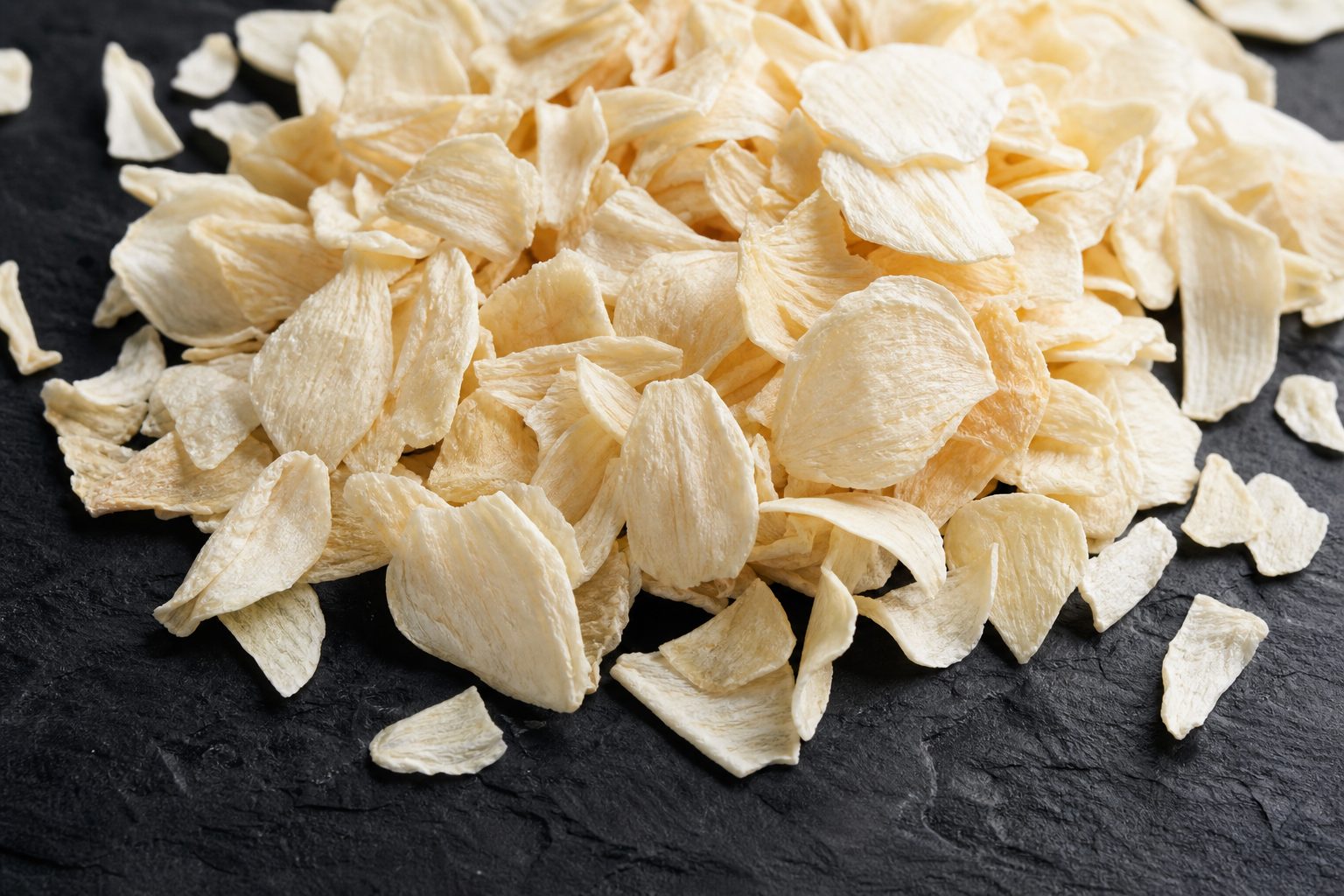
Global food buyers are rewriting ingredient specifications around clean-label claims, certified organic status, and verifiable supply-chain traceability — and dehydrated garlic sits squarely inside that shift. Consumer demand for recognisable, minimally processed ingredient declarations is rising sharply in Germany and the broader EU, the USA, the UK, Japan, and Australia. Retailer clean-label commitments and tightening food-import regulation are simultaneously raising the documentation floor for what counts as a credible organic claim. For Indian dehydrated garlic processors and merchant exporters, this is not a constraint — it is a commercial opening.
India's garlic supply chain — raw garlic from the Mandsaur–Neemuch belt in Madhya Pradesh, processed at Gujarat dehydration plants around Mahuva, Bhavnagar, and Sihor, with Rajasthan belts adding feedstock — already supplies conventional flakes (07129030), powder (07129020), and dried garlic (07129040) under HS 0712.90. A smaller but structurally important segment of that capacity is shifting toward NPOP, USDA National Organic Program, and EU Organic certified production — unlocking a premium buyer tier that conventional bulk supply simply cannot access, regardless of underlying product quality. Powder and flakes are the priority organic SKUs because they align with the largest clean-label and seasoning buyer categories.
This guide covers what organic dehydrated garlic means in commercial export terms — not a conventional export how-to. For the full conventional process, see how to export dehydrated garlic from India. Here we focus on certification pathways by destination market, 25–55% pricing premiums, segregation and transaction certificates, residue honesty, Biofach and organic-channel discovery, buyer requirements, and country-level demand. Pair it with find international buyers for dehydrated garlic, best countries for Indian dehydrated garlic exports, and top dehydrated garlic products exported from India.
Key Takeaways
Summary Box
- Organic dehydrated garlic from India is a growing premium export niche driven by clean-label demand, retailer sourcing commitments, and stricter destination-market compliance expectations — not a marketing rename of conventional HS 0712.90 supply.
- NPOP, USDA National Organic Program, and EU Organic are the three core certification pathways; the right choice depends entirely on your target destination market, not on which certifier is fastest.
- Organic-certified dehydrated garlic typically commands a 25–55% FOB premium over conventional grades of the same form, once certification, residue testing, and segregation costs are priced correctly.
- Buffer-zone and chain-of-custody documentation from Mandsaur–Neemuch (or other certified) garlic fields through Gujarat dehydration and packing is non-negotiable — an unverified claim risks customs holds and import alerts.
- Powder and flakes are the priority organic SKUs; granules, minced, and toasted can follow once certified crop and segregated mill capacity are stable.
- Transaction certificates (or Certificates of Inspection) per shipment, plus residue honesty on every lot, are what convert Biofach and organic-buyer meetings into repeat programmes.
- Margins in certified organic dehydrated garlic substantially exceed conventional bulk economics only when certification and testing costs are priced transparently into FOB rather than absorbed silently.
- Altus Exports supports Indian dehydrated garlic processors and international buyers building certified organic programmes through agriculture & food products and spices & seasonings sourcing.
Executive Summary
Summary Box
Organic dehydrated garlic is not a marketing variant of conventional supply — it is a structurally different commercial programme with its own certification requirements, cost structure, buyer base, and sales cycle. This guide is written for processors and merchant exporters deciding whether, and how, to build a certified organic dehydrated garlic export line alongside conventional production, and for international buyers evaluating Indian organic garlic supply against alternative origins.
The commercial opportunity is real: clean-label and organic ingredient demand is growing structurally in every major food-import market, and India's certified organic garlic cultivation base — while smaller than conventional Mandsaur–Neemuch volumes — is expanding as more farmer groups convert to NPOP-compliant practices. The opportunity belongs to exporters who invest in the certification, segregation, residue testing, and documentation infrastructure required to make the claim defensible, not to those who market "natural" or "chemical-free" language without a certificate to back it.
This guide covers certification pathways, 25–55% pricing premiums, buyer requirements, country-by-country demand, Biofach and organic-channel discovery, and a phased programme-building sequence, closing with checklists for sourcing, buyer verification, exporter readiness, and compliance, plus perspective from Altus Exports on what actually converts an organic-programme inquiry into a repeat certified-lot order.
Market Size & Industry Overview
Key Statistics
The global clean-label and organic ingredients market has grown from a specialty niche into mainstream retail and food-manufacturing procurement policy over the past decade. Dehydrated garlic sits inside this shift as a foundational ingredient in seasonings, snack coatings, sauces, and spice blends — categories where clean-label reformulation pressure is particularly intense because consumers scrutinise ingredient panels on exactly these product types.
Organic dehydrated garlic demand concentrates in markets with the most developed organic retail infrastructure: Germany and the broader EU, the USA, the UK, Japan, and Australia. Corporate sustainability commitments among large food manufacturers and retailer private-label organic ranges are structural demand drivers that are unlikely to reverse, distinguishing this from a short-term consumer fad. Biofach (Nuremberg) remains the flagship discovery venue for certified organic ingredient programmes.
India's organic garlic cultivation is smaller in absolute volume than conventional Mandsaur–Neemuch production, concentrated among NPOP-registered farmer groups in Madhya Pradesh, Rajasthan, and selected Gujarat-linked supply programmes. This supply constraint is precisely why the segment commands a 25–55% premium — certified organic dehydrated garlic is not commodity-abundant, and buyers who need it cannot simply substitute conventional powder or flakes and call it organic.
Export Statistics
Key Statistics
Organic dehydrated garlic currently represents a modest but growing share of India's total dehydrated garlic export value under HS 0712.90 and Indian lines 07129030 / 07129020 / 07129040 — the vast majority of tonnage remains conventional. Precise year-on-year organic-segment export data is not separately published in most trade-data sources at the product-variant level, so exporters should treat the figures below as directional industry benchmarking rather than official statistics, and confirm current volumes with APEDA and NPOP-accredited certifiers before finalising a business case.
Growth in the organic segment has tracked EU Farm to Fork organic-acreage targets, rising USA natural and organic grocery penetration, expanding Biofach buyer interest in Asian-origin organic dried garlic, and an expanding base of NPOP-certified garlic farmer groups willing to commit to multi-season organic supply contracts with dehydration processors.
Comparison table
Swipe →
Data table — swipe horizontally on small screens
| Destination Market | Organic Segment Trend | Primary Growth Driver |
|---|---|---|
| Germany / broader EU | Fastest-growing organic segment share | Farm to Fork targets, private-label organic, Biofach discovery |
| USA | Steady growth, still smaller share than EU | Natural/organic grocery expansion, clean-label reformulation |
| UK | Moderate growth | Retailer clean-label and Soil Association-aligned sourcing |
| Japan | Slow but high-value growth | JAS organic standard, premium processed-food segment |
| Australia | Emerging, small base | ACO-certified organic retail expansion |
| Middle East | Early-stage, growing from a low base | Health-conscious retail segment in UAE and Saudi Arabia |
Import Statistics
Key Statistics
Import-side organic dehydrated garlic demand is best estimated by triangulating three signals: growth in each market's certified organic packaged-food category generally, growth in dedicated organic dried-vegetable and seasoning SKUs specifically, and direct signals from organic food importer and distributor RFQs referencing NPOP or EU equivalence. All three point toward sustained growth in the certified organic dehydrated vegetable segment across the EU and USA through the remainder of the decade, even as absolute volumes remain a fraction of conventional HS 0712.90 trade.
Buyers in this segment are structurally different from conventional bulk buyers: they include organic food manufacturers, natural and health-food distributors, private-label organic retail brands, and baby-food and clean-label snack producers who specify certified organic garlic powder or flakes as a formulation requirement, not a marketing preference.
Comparison table
Swipe →
Data table — swipe horizontally on small screens
| Buyer Type | Typical Organic Volume per Order | Certification Expectation | Priority SKU |
|---|---|---|---|
| Organic food manufacturer | 2–10 MT per certified lot | NPOP + destination equivalence (NOP or EU Organic) | Powder, flakes |
| Natural / health-food distributor | 0.5–5 MT | NPOP with EU equivalence or NOP depending on market | Powder, flakes |
| Private-label organic retail brand | 5–15 MT recurring | Full certificate chain to retail organic logo requirements | Flakes, powder |
| Baby-food / clean-label snack producer | 0.5–2 MT per batch | Strict residue testing plus organic certification | Fine powder |
| Biofach / specialty organic importer | 1–5 MT trial then recurring | Transaction certificate per shipment + residue panel | Flakes, powder |
Product Categories / Variants
Summary Box
Every conventional dehydrated garlic form — flakes, powder, granules, minced, chopped, toasted — can in principle be produced under organic certification, but not every form is equally practical to certify given current organic garlic crop volumes. Powder and flakes currently see the most organic-certified supply and buyer demand because they align with seasoning, clean-label spice blends, and retail organic ranges. This section intentionally focuses on organic-specific availability and buyer fit rather than ranking forms by general export volume, which is covered in top dehydrated garlic products exported from India.
Comparison table
Swipe →
Data table — swipe horizontally on small screens
| Variant | Organic Supply Availability | Primary Certified-Buyer Segment | Certification Notes |
|---|---|---|---|
| Organic garlic flakes (07129030) | Moderate — priority certified cut | Retail clean-label seasoning, foodservice organic ranges | NPOP baseline; EU equivalence or NOP added by market |
| Organic garlic powder (07129020) | Moderate-to-high — strongest buyer demand | Clean-label spice blends, organic dry mixes | Milling line must be organic-segregated to avoid cross-contact |
| Organic granules / minced | Limited — smaller current supply base | Organic snack seasoning, formulators | Best suited to buyers with flexible lead times |
| Organic toasted / roasted | Limited — specialty | Premium organic snack and seasoning brands | Confirm HS if further prepared; segregation critical |
| Clean-label conventional (non-GMO, additive-free) | Wide availability | Buyers wanting traceability without full organic cost | Not organic-certified; positioned on residue and origin honesty |
Manufacturing Overview
Export Tip
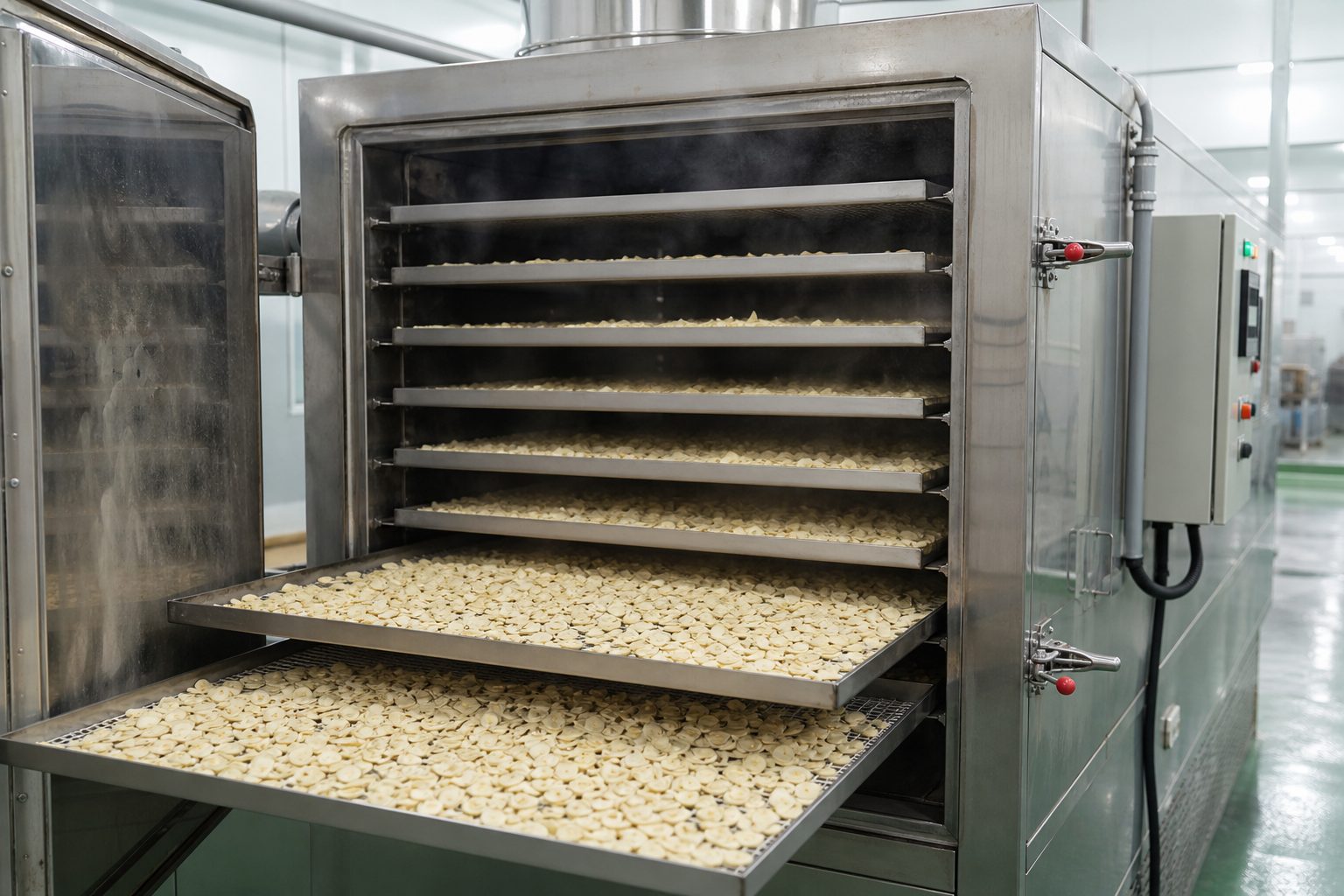
Building a defensible organic dehydrated garlic programme starts at the farm, not at the dehydration plant. NPOP certification requires documented field buffer zones free from prohibited synthetic pesticides and fertilisers, farmer group conversion records typically spanning 12–36 months, and a chain-of-custody system that tracks organic-certified garlic from Mandsaur–Neemuch (or other certified) field harvest through to the specific Gujarat dehydration run and finished-lot packing.
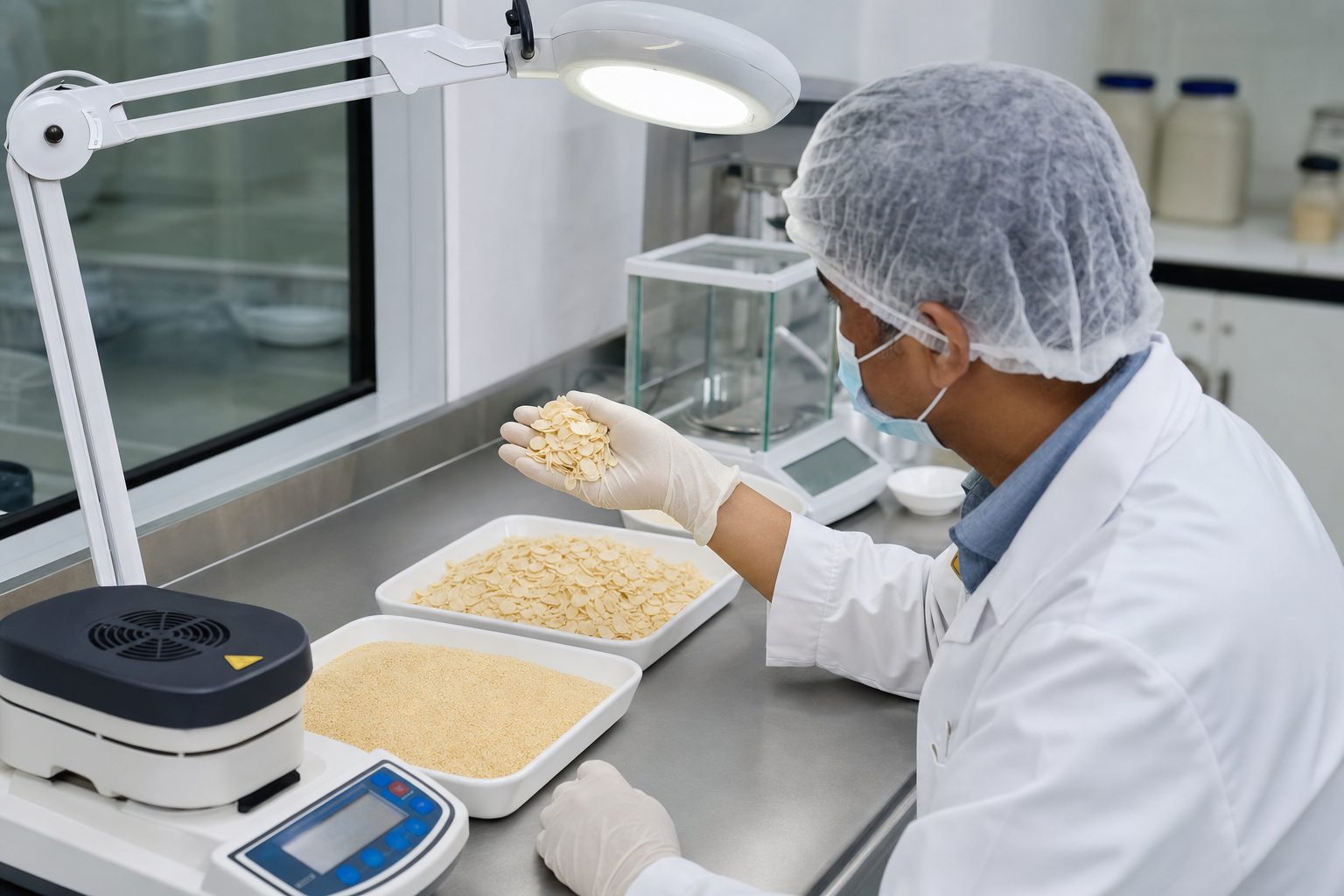
In practice, this means dedicating specific processing runs, and ideally dedicated equipment or thoroughly documented cleaning-and-changeover protocols, to organic-certified garlic lots so that cross-contact with conventional product cannot undermine the certification claim. Madhya Pradesh, Rajasthan, and Gujarat-linked farmer groups working with NPOP-accredited certifiers such as INDOCERT, LACON, IMO, and OneCert Asia are the primary organic garlic supply base feeding into export-oriented dehydration processors.
Testing intensity is higher for organic programmes than for conventional supply: pesticide-residue panels per season (and ideally per lot for serious buyers), moisture and microbial testing per lot as with conventional product, and periodic verification audits from the certifying body. Residue honesty — publishing actual results, including when a lot fails and must be diverted from organic claim — is what serious Biofach and EU buyers reward with repeat programmes.
Pricing Analysis
Buyer Tip
A common and costly mistake is building an organic dehydrated garlic programme, absorbing certification and testing costs internally, and then quoting buyers at close to conventional pricing out of fear of losing the deal. This destroys the commercial rationale for the entire organic investment. Certification, dedicated residue testing, segregation, and lower organic-crop yields justify — and organic buyers expect — a structural FOB premium of 25–55%.
In practice, the top of that 25–55% range typically applies to powder and flakes destined for EU private-label organic retail and Biofach-sourced programmes, where the full certificate chain to shelf commands the strongest buyer willingness to pay. Transparent line-item pricing for certification and testing signals programme maturity rather than scaring serious buyers away.
Comparison table
Swipe →
Data table — swipe horizontally on small screens
| Grade / Variant | Conventional FOB Range (USD/kg) | Organic FOB Implication | Organic Premium |
|---|---|---|---|
| Garlic flakes | $2.20–$4.50 | Conventional + 25–55% | +25–55% |
| Garlic powder | $2.50–$5.50 | Conventional + 25–55% | +25–55% |
| Granules / minced | $2.40–$5.00 | Conventional + 25–55% | +25–55% |
| Toasted / roasted | $3.50–$7.00 | Conventional + 25–55% | +25–55% |
MOQ Analysis
Buyer Tip
Organic programme MOQ is constrained more by certified garlic crop availability and dedicated dehydration-run scheduling than by buyer demand alone. Set MOQ expectations honestly around your certified lot size rather than promising conventional-scale volumes on an organic timeline.
Comparison table
Swipe →
Data table — swipe horizontally on small screens
| Buyer Type | Typical First-Order MOQ | Programme-Stage MOQ | Notes |
|---|---|---|---|
| Organic trial / sample buyer | 0.25–1 MT certified lot | Not applicable | Paid sample with full certificate copy and residue report |
| Organic food manufacturer | 2–5 MT per certified lot | 5–15 MT recurring | Dedicated dehydration run scheduling required |
| Natural / health-food distributor | 0.5–3 MT | 3–10 MT | Often multi-SKU consolidation across organic categories |
| Private-label organic retail brand | 3–8 MT | 10–20 MT recurring | Full retail organic logo chain-of-custody required |
Packaging Standards
Export Tip
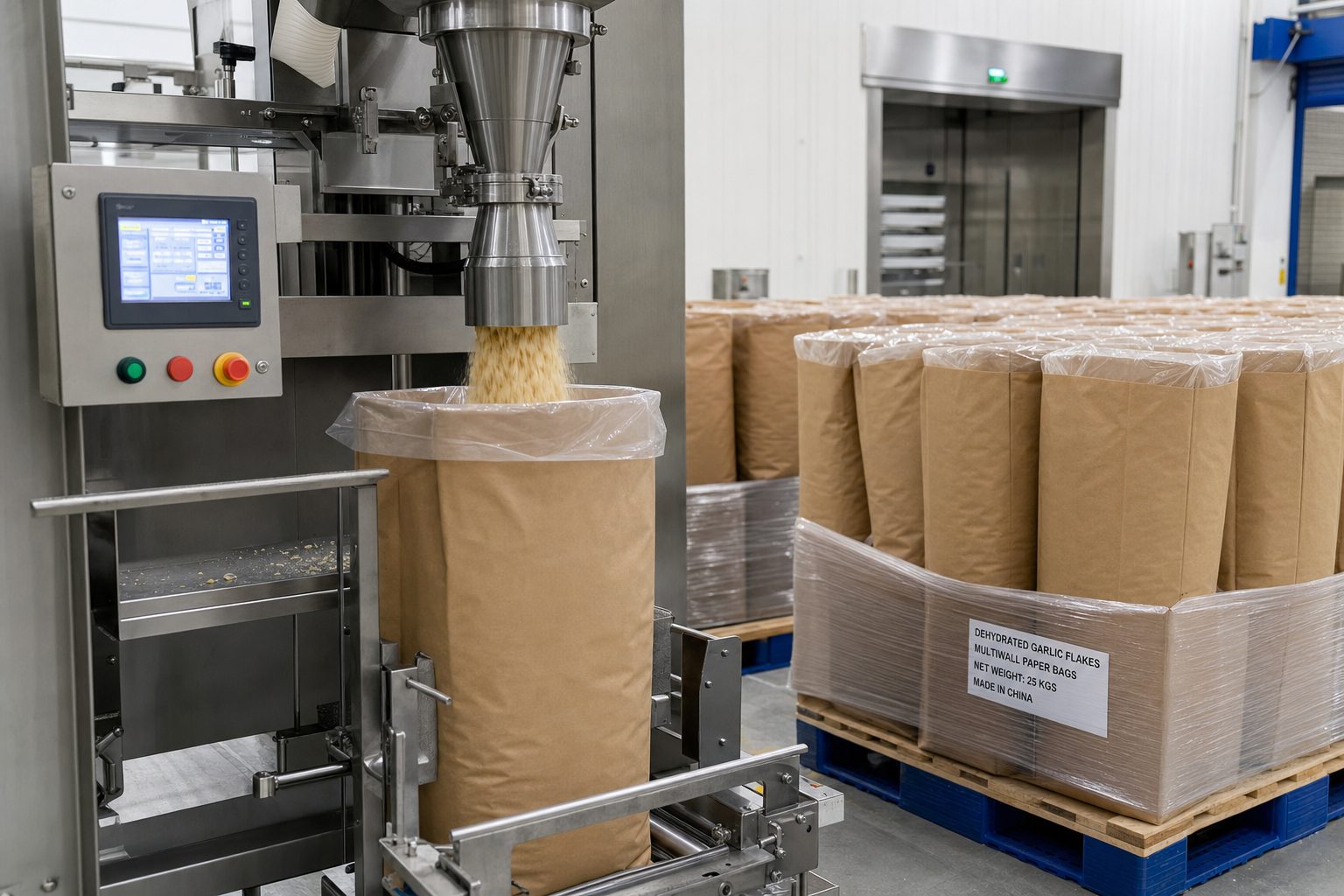
Organic and clean-label packaging carries additional labelling and segregation obligations beyond conventional export packs. Batch and lot traceability marking is essential, since organic buyers frequently request lot-level documentation to satisfy their own retailer or regulatory audits. Moisture-barrier integrity remains critical because organic powder and flakes are as hygroscopic as conventional grades.
Comparison table
Swipe →
Data table — swipe horizontally on small screens
| Packaging Format | Typical Size | Organic-Specific Requirement |
|---|---|---|
| Multiwall kraft bag with PE liner | 14–25 kg | Lot number and NPOP certificate reference printed on bag |
| Nitrogen-flushed / vacuum bags | 10–25 kg | Preferred for organic powder to preserve pungency and reduce contamination risk |
| Carton with inner liner | 5–20 kg | Common for premium retail-adjacent organic bulk programmes |
| Retail pouches | 50 g – 1 kg | Must carry destination-market organic logo compliance and ingredient declaration |
Container Loading Details
Export Tip
Physical container-loading economics for organic dehydrated garlic are similar to conventional supply, but many organic programmes recommend dedicating a full container to a single certified lot to avoid any co-mingling questions during buyer or certifier audits, even when volumes would technically allow consolidation with other cargo.
Comparison table
Swipe →
Data table — swipe horizontally on small screens
| Container | Packaging | Approx. Net Load Capacity | Organic Note |
|---|---|---|---|
| 20ft dry container | 25 kg bags, palletised | About 10–14 MT | Confirm load plan for certified lots; prefer single-lot |
| 40ft dry container | 25 kg bags, palletised | About 20–26 MT | Used for larger recurring organic programmes |
| LCL / palletised | 25 kg bags on pallets | Under 10 MT per part-load | Common for first organic trial shipments given smaller lot sizes |
Shipping Methods
Export Tip
Shipping mode and routing for organic dehydrated garlic mirror conventional export — dry sea freight in standard containers from Mundra, Pipavav, or Nhava Sheva, since the product is shelf-stable and does not require cold chain. The key operational difference is documentation: organic shipments require an additional organic Transaction Certificate or Certificate of Inspection issued per shipment by the certifying body, coordinated alongside the standard commercial documents and timed to be ready before vessel cutoff.
Comparison table
Swipe →
Data table — swipe horizontally on small screens
| Route | Typical Load Port | Approx. Transit Time | Additional Organic Document |
|---|---|---|---|
| India–Germany / Netherlands | Mundra / Nhava Sheva | 20–28 days | EU Organic import certificate / TRACES coordination |
| India–USA | Mundra / Nhava Sheva | 25–35 days | NOP import documentation with US importer of record |
| India–UK | Mundra / Nhava Sheva | 22–30 days | Soil Association-equivalent import documentation |
| India–Japan | Mundra / Nhava Sheva | 30–38 days | JAS organic import certificate coordination |
| India–UAE | Mundra / Nhava Sheva | 7–12 days | Organic claim docs + Halal where required |
Certifications
Compliance Notes
Certification choice must be driven by target export market, not by which certifier can issue fastest. The wrong certification for a destination market creates compliance rejections that damage buyer trust permanently — understand what each standard requires and how long conversion and annual audit cycles take before making promises to buyers. This is the organic niche — not a substitute for learning conventional export registration covered in how to export dehydrated garlic from India.
Comparison table
Swipe →
Data table — swipe horizontally on small screens
| Certification | Primary Market | What It Covers | Typical Timeline |
|---|---|---|---|
| NPOP | India base standard + EU equivalence pathway | Field buffer zones, farmer-group conversion, chain of custody, processing | 12–36 months farmer conversion + annual audit |
| USDA NOP | USA organic retail and food-service claims | Field, processing, and NOP system plan documentation | 6–18 months certification + annual audit |
| EU Organic | EU retail and private-label claims | Same core principles under EU-accredited certifier / equivalence | 6–18 months + annual audit |
| JAS Organic | Japan organic market claims | Field and processing under Japanese Agricultural Standard | 12+ months + annual audit |
| FSSAI | Baseline food safety — all export | Domestic legal manufacture and export eligibility | Ongoing licence |
| HACCP / ISO 22000 | Buyer due diligence baseline | Food-safety hazard control and management systems | 3–9 months + annual audit |
| Transaction Certificate / COI | Per shipment — all organic markets | Lot-specific organic transfer documentation | Coordinated per sailing |
Buyer Requirements
Buyer Requirements
Organic and clean-label buyers apply a different, generally more rigorous, due-diligence process than conventional bulk buyers. Certification documents alone are rarely sufficient — serious buyers want evidence that the certification claim is actively maintained, segregated, and residue-tested, not simply issued once and filed away.
Comparison table
Swipe →
Data table — swipe horizontally on small screens
| Verification Signal | What Good Looks Like | Red Flag |
|---|---|---|
| Certification specificity | Names exact certifier and asks for accreditation proof | Accepts "organic" claim with no certificate request |
| Testing expectations | Requests per-lot residue report and chain-of-custody statement | No interest in test data, price-only focus |
| Volume realism | Order size consistent with known organic crop constraints | Demands conventional-scale volume on organic certification |
| Documentation fluency | References NPOP, NOP, EU Organic, or Transaction Certificate accurately | Vague or incorrect terminology about organic standards |
| Segregation awareness | Asks about mill changeover and dedicated runs | Ignores cross-contact risk entirely |
What Organic Buyers Actually Ask For
Beyond the NPOP or destination-equivalent certificate itself, organic buyers typically request: the specific certifier name and accreditation status, farmer-group or field registration numbers behind the certified garlic lot (often Mandsaur–Neemuch or Rajasthan-linked groups), a chain-of-custody statement from field to finished pack, a per-lot pesticide-residue test report with honest results, confirmation of dedicated or properly segregated processing to avoid cross-contact with conventional garlic, and a Transaction Certificate or Certificate of Inspection for the specific shipment. Buyers who ask these detailed questions are the buyers worth prioritising.
Residue Honesty as a Commercial Advantage
Residue honesty means sharing actual laboratory panels — including non-detect results and, when necessary, diverting a failed lot away from organic claim rather than shipping it with a certificate that no longer matches reality. Buyers who discover a residue surprise at destination rarely return. Exporters who lead with transparent residue practice convert faster at Biofach and in EU private-label RFQs than those who treat residue testing as a checkbox.
Clean-Label Buyers Without Full Organic Requirement
A meaningful buyer segment wants clean-label attributes — non-GMO sourcing, no artificial additives, clear Mandsaur–Neemuch / Gujarat origin traceability, and strong residue discipline — without requiring full organic certification. These buyers are often easier and faster to convert than strict organic-certified accounts, and can be served from conventional supply with strong documentation, making this a useful stepping-stone commercial lane while a full organic programme is being built.
Biofach and Organic-Channel Discovery
Biofach (Nuremberg) is the highest-density organic ingredients fair for meeting certified buyers face to face. Pair Biofach with Gulfood, Anuga, SIAL, and Fi Europe for hybrid organic-and-conventional pipelines, but treat Biofach meetings as certificate-and-residue conversations first, price second. Bring current NPOP scope certificates, sample Transaction Certificate templates, powder and flakes sample kits with lot COAs, and a one-page segregation SOP summary. Follow up within 72 hours with digital copies of everything shown at the booth. For broader lead generation outside the organic niche, see find international buyers for dehydrated garlic.
Country-wise Opportunities
Market Snapshot
Certification requirements and buyer sophistication for organic dehydrated garlic differ substantially by destination. Match your certification investment to your primary target market before committing capital to certification across every scheme simultaneously.
Germany and the Broader EU
Germany anchors the strongest organic dehydrated garlic demand globally, supported by NPOP-EU equivalence recognition that eases import documentation while still requiring the full certificate chain for EU Organic logo use. German and Dutch buyers conduct rigorous due diligence, including residue panels and certifier verification, before approving a new organic supplier. Biofach remains the primary discovery venue.
USA
The USA organic and natural-food grocery segment continues to expand, but exporters targeting USA organic retail typically need NOP-accredited certification alongside NPOP. USA buyers increasingly combine organic certification requests with clean-label and non-GMO declaration requirements, and expect powder mesh consistency with full lot COAs.
UK
UK organic standards remain broadly aligned with EU frameworks in substance even though the UK operates independent import regulation post-Brexit. Soil Association-equivalent certification and careful labelling accuracy are scrutinised closely by UK border food-safety officers.
Japan
Japan's JAS organic standard and stringent pesticide maximum residue limits make this a smaller but high-value, compliance-intensive market. Exporters should commission Japan-specific residue panels before first shipment rather than relying on EU or USA test results alone.
Australia
Australia's strict biosecurity import framework and ACO-certified organic retail segment represent an emerging opportunity for well-documented Indian organic dehydrated garlic, though freight distance and import compliance overhead require careful landed-cost modelling.
Sourcing Checklist
Checklist
- Identify NPOP-registered garlic farmer groups in Mandsaur–Neemuch, Rajasthan, or Gujarat-linked programmes with 12+ months of conversion history
- Confirm certifier accreditation and current audit status before committing to a supply relationship
- Map field buffer-zone documentation and chain-of-custody records back to specific harvest batches
- Schedule dedicated or properly documented segregated dehydration runs for organic-certified lots at Gujarat plants
- Commission baseline pesticide-residue and microbial testing before offering organic powder or flakes to buyers
- Confirm which destination-market equivalence (NOP, EU Organic, JAS) you need before starting outreach
- Prioritise powder (07129020) and flakes (07129030) as the first certified SKUs before expanding forms
Buyer Checklist
Checklist
- Request the specific certifier name and verify accreditation independently
- Ask for farmer-group or field registration numbers behind the certified garlic lot
- Request a chain-of-custody statement from field through Gujarat dehydration to finished pack
- Require a per-lot pesticide-residue test report before accepting an organic claim at face value
- Confirm dedicated or documented segregated processing to rule out cross-contact with conventional garlic
- Verify certificate validity dates and Transaction Certificate / COI readiness against shipment timeline
- Confirm powder mesh or flake cut specs match your formulation before approving a paid sample
Exporter Checklist
Checklist
- Select your primary organic origin zone and certification pathway before committing to buyer outreach
- Price certification, residue testing, and segregation costs transparently into FOB at a 25–55% premium band
- Build a one-page organic programme summary: certifier, farmer-group scope, testing cadence, powder/flakes focus, and packaging options
- Offer a paid, lab-certified sample with full certificate copy and residue report to serious leads
- Set MOQ expectations honestly around certified crop and dehydration-run availability
- Add a certification and testing line item to every organic proforma invoice for transparency
- Prepare Biofach / fair kits with Transaction Certificate templates and segregation SOP one-pagers
Compliance Checklist
Checklist
Compliance Notes
- Current NPOP certificate matching the exact legal entity and processing facility on the shipment documents
- Destination-market equivalence certificate (NOP, EU Organic, JAS) confirmed and valid through expected arrival date
- Organic Transaction Certificate or Certificate of Inspection arranged per shipment ahead of cargo cutoff
- Per-lot pesticide-residue and microbial test reports matching the exact batch shipped — residue honesty mandatory
- Chain-of-custody documentation retained and available for buyer or certifier audit on request
- Labelling reviewed against destination-market organic logo and ingredient-declaration requirements before packing
- Correct HS 0712.90 / 07129030 / 07129020 / 07129040 filing confirmed with customs broker for the organic lot
Common Buyer Mistakes
Common Mistakes Box
- Accepting an organic claim without requesting certifier name, accreditation proof, and residue panel
- Assuming NPOP alone satisfies every destination market's organic import requirements
- Under-pricing certified organic garlic powder or flakes below the 25–55% premium band
- Promising volumes inconsistent with actual certified garlic crop and dehydration-run capacity
- Skipping per-lot residue testing because a general seasonal certificate already exists
- Ignoring mill segregation and changeover documentation for powder lines
The most common organic dehydrated garlic buyer mistake is accepting an "organic" or "natural" claim at face value without requesting the underlying certificate, certifier name, residue panel, and Transaction Certificate readiness — this exposes the buyer to import-alert risk and reputational damage if the claim is later challenged. A related mistake is assuming NPOP certification alone satisfies USA or Japan market requirements without confirming current equivalence status, which can cause a shipment to be rejected or held at destination customs.
On the exporter side, the most costly and common mistake is under-pricing organic product inside or below conventional FOB out of fear of losing a deal, which makes the entire certification investment commercially unsustainable. Exporters also frequently promise conventional-scale volumes on an organic timeline without accounting for certified-crop constraints, or mill organic powder on a non-segregated line and hope documentation will cover the gap.
Future Market Trends
Key Statistics
Through 2030, EU Farm to Fork organic-acreage targets, expanding USA natural and organic grocery penetration, and growing corporate clean-label reformulation commitments will continue to structurally grow demand for certified organic and traceable dehydrated garlic — with powder and flakes remaining the volume leaders inside the niche. Digital traceability tools and stronger Transaction Certificate workflows are moving from pilot programmes to buyer expectation among larger EU and USA private-label organic accounts.
India-specific dynamics through 2030 include growing NPOP certification coverage among Mandsaur–Neemuch and Rajasthan garlic farmer groups as conversion programmes expand, increasing Gujarat dehydration-processor investment in dedicated organic runs, Biofach participation by more Indian merchant exporters, and rising awareness that residue honesty is a commercial asset. Early movers who build credible certification, segregation, and testing infrastructure now will be positioned favourably as documentation standards continue to harden.
Expert Insights
Expert Insight Box
Altus Exports works as a merchant exporter with dehydration processors building certified organic garlic programmes and with international buyers who need verified, documented organic dehydrated garlic supply rather than an unverifiable "natural" marketing claim.
Why Transparent Pricing Wins in the Organic Segment
Exporters who fear losing a deal on price often absorb certification and testing costs silently rather than pricing a clear 25–55% premium into FOB — this consistently backfires, because serious organic buyers already expect and budget for a premium, and a suspiciously low organic quote invites more due diligence, not less.
Conclusion
- Next step: confirm your primary organic origin zone and certifier, commission baseline residue testing this season, and lock powder and flakes as hero SKUs.
- Read find international buyers for dehydrated garlic, how to export dehydrated garlic from India, and source dehydrated garlic directly from India.
- Also see top dehydrated garlic products exported from India, best countries for Indian dehydrated garlic exports, most demanded Indian dehydrated garlic by country, APEDA registration benefits for dehydrated garlic exporters, dehydrated garlic export documentation checklist, and trade shows for dehydrated garlic exporters.
- Explore merchant exporter, global sourcing partner India, export products from India, and the agriculture & food products industry page.
- Also see spices & seasonings industry and find manufacturers in India for verified organic supply access.
Organic dehydrated garlic from India represents a defensible, growing premium export niche for processors willing to invest in NPOP / USDA Organic / EU Organic certification, segregation, Transaction Certificates, and residue honesty that matches the rigour buyers now expect. India's expanding NPOP-certified garlic farmer-group base around Mandsaur–Neemuch and linked belts, processed through Gujarat dehydration plants, gives exporters a credible supply foundation — but the commercial return depends entirely on pricing the 25–55% premium transparently, prioritising powder and flakes, and matching certification choice to the right destination market.
Altus Exports supports Indian dehydrated garlic processors and international buyers building organic and clean-label programmes that deliver on every certification claim from field to shipment. Share your certification status, farmer-group scope, powder/flakes capacity, and target markets to begin a practical sourcing or export conversation.