
Cotton Home Textile Export Documentation Checklist
By Saurabh Mittal, Founder, Altus Exports
Document-by-document pre-shipment checklist for cotton home textile exports from India — commercial invoice, packing list, shipping bill, bill of lading, certificate of origin, TEXPROCIL RCMC, fibre and care label packs, multi-HS declaration controls, and OEKO-TEX/GOTS evidence for bed, bath, table, curtain, and hospitality programmes.
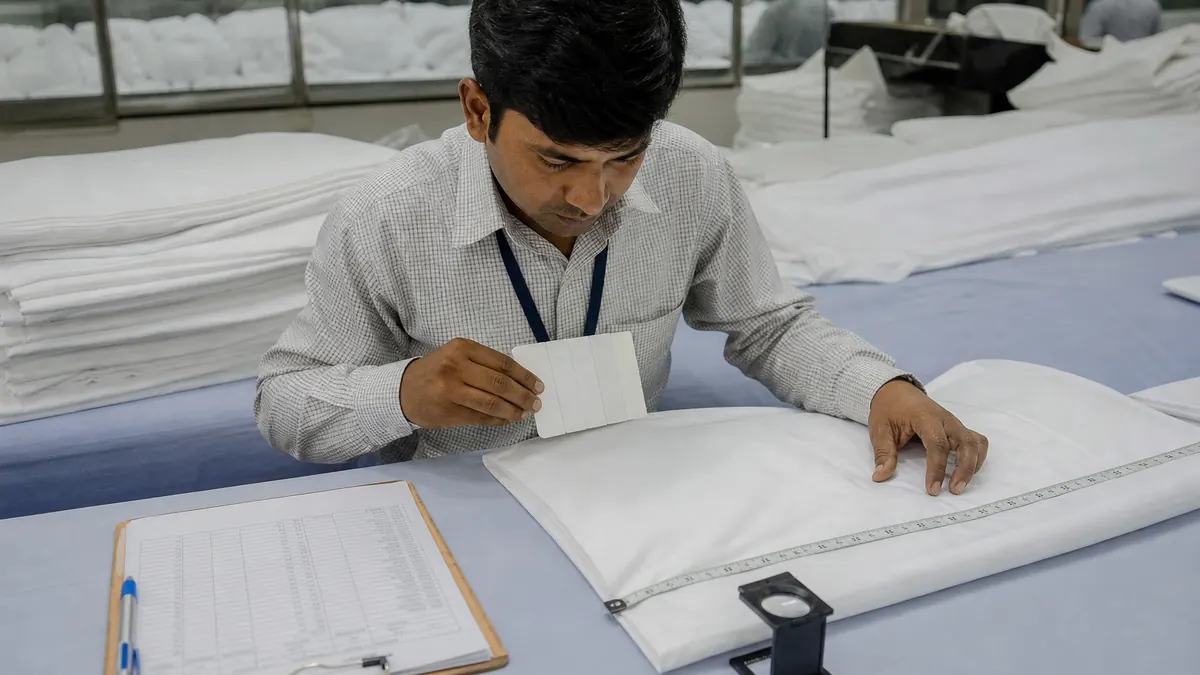
A cotton home textile export documentation checklist is the operational gate that decides whether a multi-SKU bed linen, terry bath and kitchen linen, table linen, curtain, quilt, or hospitality linen consignment clears destination customs on the first attempt — or sits in hold while commercial invoice, packing list, shipping bill, and fibre-label packs disagree on SKU code, shade lot, construction, and HS line. For mixed programmes under Chapter 63 — primarily 6302 bed/table/toilet/kitchen linen, 6303 curtains, 6304 other furnishing articles in assortment lines, and 6301 blankets when essential character is blanket — every commercial and compliance page must tell one reconciled story before the CHA files at Mundra, Nhava Sheva, Chennai, or ICD Delhi.
This guide is a document-by-document checklist — commercial invoice, packing list, shipping bill, bill of lading, certificate of origin, TEXPROCIL RCMC references, fibre and care label artwork or bulk-label declarations, OEKO-TEX and GOTS evidence packs where contracted, and broker handoff controls — plus the multi-HS declaration discipline that prevents misfiling when a home-textile basket mixes sheets, towels, napkins, drapes, and coordinated private-label sets. It does not restate why TEXPROCIL exists as an institution essay, and it does not rank which countries to enter; those topics live in sibling cluster posts.
For the end-to-end process that documentation supports, see How to Export Cotton Home Textiles from India. For council registration context, see TEXPROCIL Registration Benefits for Cotton Home Textile Exporters. When the RFQ is bedding-led or towel-led, cross-check bedsheets and terry towels without pasting those SKU deep-dives here. Altus Exports builds reconciled document sets under its export products from India service and textiles & home furnishings programmes.
Key Takeaways
Summary Box
Executive Summary
Summary Box
- Scan Summary / Stats / Tips callouts first, then open the document tables.
- Lock SKU + construction + destination label stack before final FOB on the invoice.
- On mobile: Takeaways → Document table → HS controls → Labels → Certs → Compliance → FAQ.
Cotton home textile export paperwork fails most often on reconciliation, not missing stamps. When commercial invoice construction claims, packing-list carton counts, shipping-bill HS lines, fibre-label percentages, and OEKO-TEX certificate scope diverge, destination customs and letter-of-credit banks treat the shipment as non-conforming even if the bed linen or terry inside the container would have passed retest.
This checklist walks exporters and importers through every page that must align before filing at Mundra, Nhava Sheva, Chennai, Tuticorin, or ICD Delhi: commercial set, TEXPROCIL credentials, fibre and care label packs, certification evidence, multi-HS controls, and broker handoff. It also flags when curtains, throws, or blankets need separate heading lines so mixed home-textile baskets do not collapse into a single incorrect subheading.
Use the document tables as a pre-shipment gate. Use the sourcing and compliance callouts as operator checklists. Use cluster links when you need process, TEXPROCIL membership narrative, organic/hospitality specialty pathways, or importer verification depth — those are owned elsewhere.
Market Size & Industry Overview
Key Statistics
- Council stack: TEXPROCIL RCMC + IEC + GST for cotton home textiles / cotton made-ups.
- Trade cue: HS 6302 FY 2023-24 ~US$1,858.84M; FY 2024-25 ~US$2,128.63M (+~14.5% YoY) — re-verify DGCI&S.
- Logistics: Mundra and Nhava Sheva primary west-coast gateways; Chennai/Tuticorin for southern Karur/Coimbatore programmes; ICD Delhi for Panipat parcels.
- Document risk rises with mixed-SKU FCL stuffing — each family needs clear invoice, label, and HS lines.
India's cotton home textile trade is large enough that destination brokers already know the category's common document failure modes. India HS 6302 exports reached roughly US$1,858.84M in FY 2023-24 and about US$2,128.63M in FY 2024-25 per DGCI&S commodity profiles — directional figures to re-verify — which means US CBP, EU customs, and UK HMRC teams see enough Indian bed and bath paperwork to notice when invoice descriptions and label packs do not match.
Demand comes from retail chains, department stores, e-commerce private label, hospitality and hotel linen, wholesale distributors, and importers building coordinated bed+bath+table programmes. Those buyers purchase documentation confidence — fibre labels, care symbols, certificate scope — as much as shade continuity. The United States typically absorbs roughly 62–67% of India's HS 6302 export value, followed by the UK, Australia, Canada, Germany, Mexico, Israel, UAE, Japan, and the Netherlands — useful context when brokers compare your pack to corridor norms, not as a market-entry ranking exercise.
Supply clusters in Panipat (Haryana), Karur and Coimbatore (Tamil Nadu), Solapur (Maharashtra), Tirupur-adjacent cut-and-sew, Delhi-NCR merchant consolidation, and Ahmedabad processing adjacency feed Mundra, Nhava Sheva, Chennai, and northern ICDs. Documentation programmes that ignore mill shade-lot marks at packing will invent SKU codes at the forwarder desk — the fastest route to destination holds.
Export Statistics
Key Statistics
- India HS 6302 FY 2023-24 ~US$1,858.84M; FY 2024-25 ~US$2,128.63M — re-verify DGCI&S before citing on buyer packs.
- USA share of India HS 6302 value typically ~62–67% — document US fibre/care label packs carefully for this corridor.
- Broader cotton textiles (TEXPROCIL basket) directional ~US$11.68B FY 2023-24 — label clearly as category context, not HS 6302 alone.
- Lock the live ITC-HS eight-digit with the CHA at shipping-bill time — presentation figures do not override the bill.
Export statistics matter to documentation teams because shipping-bill values and partner codes should be defensible against public trade cues. When an invoice for a coordinated bed+bath private-label programme under 6302 shows unit values wildly outside corridor norms without a construction or certification explanation, destination risk engines and banks ask questions.
Separate bed linen (6302), curtains (6303), other furnishing articles (6304 in assortment), and blankets (6301) when reading DGCI&S, ITC Trade Map, UN Comtrade, or WITS extracts. Filing a mixed basket under one aggregate description while statistics and buyer purchase orders expect SKU splits is a documentation control failure, not a market-research footnote.
India cotton home textile export cues (HS 6302 family) — directional; re-verify on quote date
Swipe →
Data table — swipe horizontally on small screens
| Metric | Directional Estimate | Documentation implication |
|---|---|---|
| HS 6302 India export value FY 2024-25 | ~US$2,128.63M (+~14.5% YoY vs FY 2023-24) | Invoice totals should be explainable vs corridor norms when PL or cert premiums apply |
| HS 6302 India export value FY 2023-24 | ~US$1,858.84M | Use as baseline when comparing YoY programme growth on buyer presentations |
| USA share of India HS 6302 exports | Typically ~62–67% of value | US Textile Fiber Products Identification Act + care labels mandatory in pack |
| Other leading HS 6302 partners | UK, Australia, Canada, Germany, Mexico, Israel, UAE, Japan, Netherlands | EU/UK fibre labelling and cert scope vary by partner — maintain annex matrix |
| Broader cotton textiles (TEXPROCIL basket) | Directional ~US$11.68B FY 2023-24 | Label as category context — do not equate to HS 6302 invoice lines |
| Governing council for this category | TEXPROCIL RCMC + IEC + GST | Attach current RCMC in KYC; confirm product-list fit before filing |
Import Statistics
Key Statistics
- USA: CBP textile entry + FTC fibre/care labelling + retail Prop 65 overlays where applicable on finishes.
- EU/UK: Textile fibre composition labelling; REACH where finishes apply; azo dye restrictions.
- Australia/Canada: Fibre disclosure and care labelling aligned to local textile rules.
- UAE/GCC: Hospitality programmes may add procurement documentation overlays when contracted.
Import statistics explain why destination document scrutiny is tight. The United States, United Kingdom, Germany, Australia, Canada, UAE, Japan, and Netherlands already import cotton home textiles at scale; their brokers know which fibre-label fields and certificate scopes fail. Documentation checklists that ignore destination import practice waste exporter time on generic packs that still trigger holds.
When buyers compare Indian arrivals to other origins, they compare paperwork completeness as much as FOB. A clean 6302 filing with lot-matched fibre labels and OEKO-TEX scope clears faster than a cheaper lot with vague "cotton home textiles" invoice text and hangtags from an unrelated production week.
Import-side document pressure by destination (planning — not a market ranking)
Swipe →
Data table — swipe horizontally on small screens
| Market | Import pressure on docs | Primary annexes beyond invoice/PL/BL |
|---|---|---|
| United States | High — CBP textile entry and FTC label enforcement | Fibre content labels, care labels, OEKO-TEX/GOTS if claimed, curtain flammability where required |
| United Kingdom | High — UK textile labelling post-Brexit | Fibre composition, care symbols, UKCA/CE finish notes as applicable |
| Germany / EU | High — EU textile fibre labelling + REACH on finishes | REACH declaration, azo compliance, GOTS/OEKO-TEX scope |
| Australia | Medium–high — ACCC fibre disclosure expectations | Care labels, construction specs on invoice |
| Canada | Medium–high — textile labelling act alignment | Bilingual care/fibre labels when retail-ready |
| UAE / GCC | Medium — hospitality procurement documentation | Hotel linen bulk marks, replenishment call-off refs |
| Japan | Medium–high — label language and construction discipline | Japanese care/fibre labels when retail PL |
| Mexico / Israel | Medium — US-adjacent or EU-adjacent label expectations | Confirm broker template per buyer |
Product Categories / Variants
Summary Box
- Name product family + construction + size on every invoice line.
- Never reuse label artwork from a different shade lot for a new stuffing.
- Retail PL packs need barcode fields reconciled to packing-list SKU codes.
- Curtain programmes may need flammability annexes — confirm with buyer broker.
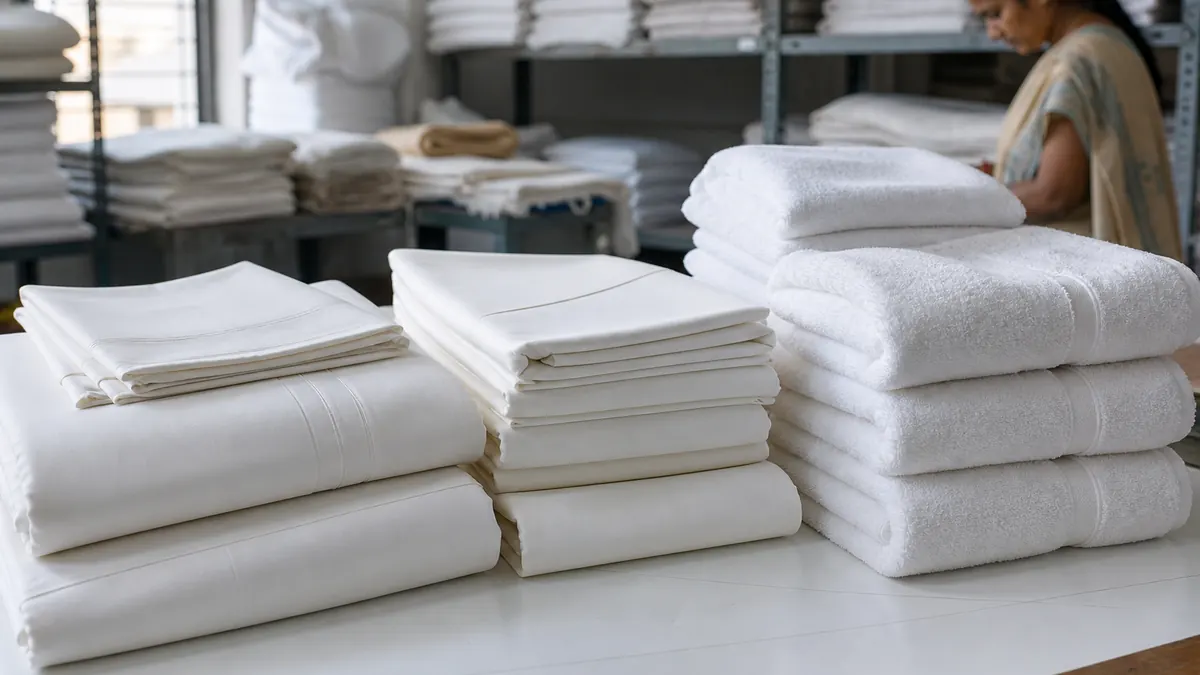
Documentation fields change with product family even when the export programme stays within Chapter 63. Bed linen sets, terry bath and kitchen linen, table napkins and tablecloths, curtains and valances, quilts and bedspreads, and coordinated private-label or hospitality programmes each need invoice descriptions and label packs that name the actual SKU — not a generic "cotton home textiles" line that destination warehouses cannot receive against.
Retail-ready private-label packs add hangtag artwork, barcode, fibre and care labels, and retail carton marks that must match invoice pack descriptions. Hospitality bulk cartons need linen-room labelling and shade continuity references. Organic or GOTS programmes need transaction certificates linked to the same lot ID as the commercial invoice.
Master document inventory — cotton home textile export pack
Swipe →
Data table — swipe horizontally on small screens
| Document | Must contain | Reconciles to | Common failure |
|---|---|---|---|
| Commercial invoice | Exporter/buyer legal names, per-SKU description, HS line, qty, unit price, Incoterm, port | Proforma, PO, shipping bill | Generic "home linen" line without size/construction |
| Packing list | Carton count, net/gross, SKU/size/colourway, shade lot | Invoice qty, carton marks, B/L | Carton maths ≠ invoice pcs |
| Shipping bill | Same HS splits as invoice, IEC, AD code | Invoice, CHA filing | Single 6302 line for mixed 6302+6303 basket |
| Bill of lading | Consignee, notify, packages, weight, container/seal | Invoice, packing list | Seal typo after sailing |
| Certificate of origin | Origin, HS, consignee, preferential claim if used | Invoice HS, buyer broker | Wrong FTA template |
| TEXPROCIL RCMC copy | Current council membership | Exporter KYC, buyer audit | Expired mid-season |
| Fibre content labels | Destination-language fibre % per market rules | Invoice SKU, hangtag artwork | Label language ≠ destination |
| Care labels | Care symbols/text per destination | Buyer spec, retail PL pack | Missing heat-setting symbol on terry |
| OEKO-TEX / GOTS pack | Certificate ID, scope, validity, lot link | Invoice premium line | Site cert without SKU/lot scope |
| Inspection / shade report | AQL result, shade continuity where contracted | Production lot, packing list | Report from different shade lot |
Bed, bath, and table linen document lines
Most Karur, Coimbatore, and Panipat commercial capacity ships bed linen, terry toilet and kitchen linen under the 6302 family, and table linen under 6302 table-linen subheadings — confirm eight-digit with CHA. Document packs emphasize construction (thread count or GSM where contracted), size, colourway/shade lot, fibre content labels, and care symbols. Keep terry-led RFQs linkable to the terry cluster without pasting pile chemistry essays here.
Curtains, soft furnishing, and specialty certificate lines
Curtains and drapes typically plan under 6303; decorative throws and cushion covers in assortment lines may plan under 6304 — deep SKU ownership stays in the throws cluster. Flammability documentation for curtains may be required in US, UK, or EU programmes. GOTS, OEKO-TEX, and hospitality custom programmes need extra certificate layers — specialty depth also lives in organic GOTS OEKO-TEX hospitality opportunities; this checklist only gates attachment and lot matching.
Manufacturing Overview
Export Tip
- Flow: fabric intake → cut/stitch → finish/dye/print → fold → polybag → carton → shade lot lock.
- Retain shade samples and finish records for every export lot.
- Declare fibre content accurately on labels before cartons seal — relabelling at port is expensive.
- Hospitality white programmes need shade continuity reports tied to lot IDs on the packing list.
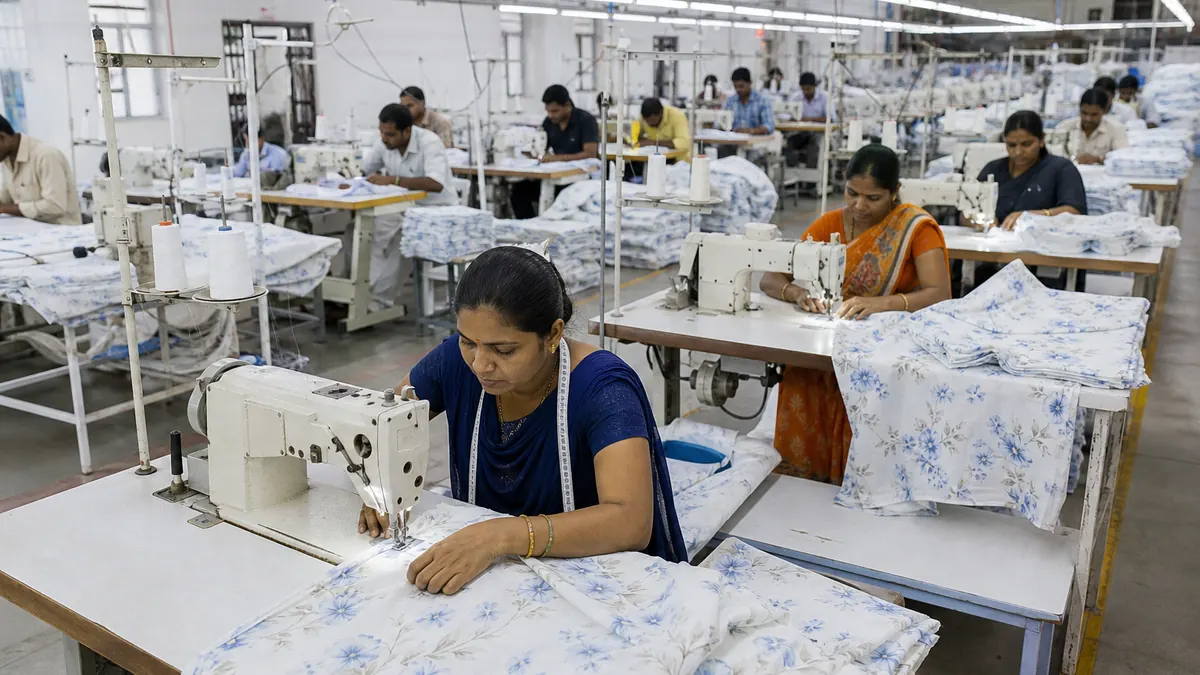
Documentation starts on the made-ups floor, not at the CHA desk. Shade lot IDs originate when grey fabric is cut, stitched, finished, folded, polybagged, and carton-packed by size and colourway. If production batch marks are not photographed and transferred to invoice and packing-list drafts before stuffing, export teams invent numbers that destination QC and label audits cannot reconcile against retained samples.
Panipat, Karur–Coimbatore, and Solapur capacity and Delhi-NCR merchant consolidation programmes should map which unit produced which lot. Merchant exporters consolidating multi-SKU FCLs must keep per-SKU lot files even when one bill of lading covers the container. Manufacturing literacy is what makes a documentation checklist executable.
Export Process
Export Tip
- Never file shipping bill before invoice/PL/label reconciliation.
- Mixed-SKU containers need per-SKU packing-list lines and HS splits.
- Buyer LC terms override generic checklists — map LC documentary conditions line by line.
Within the broader export process, documentation has its own sequence. Spec and Incoterm lock first; sample and lab-dip approval second; production shade lot lock third; commercial invoice and packing list draft fourth; label artwork and certificate annexes fifth; shipping-bill filing sixth; B/L and certificate of origin seventh; destination broker packs eighth. Skipping the shade-lot lock step before drafting invoice lines is the most common process error.
This section is the document assembly path — not a full IEC-to-first-FCL pillar rewrite. For registration timing, Incoterm selection narrative, and lead-time planning across samples (20–100 pcs/SKU), trial (500–3,000 pcs), and wholesale FCL programmes, use the pillar process guide.
Step 1 — Lock SKU, multi-HS control, and destination stack
Confirm product family, construction, size, colourway, Incoterm (EXW, FOB Mundra/Nhava Sheva/Chennai, CFR/CIF, selective DDP), and whether the lot is 6302 bed/bath/table, 6303 curtains, 6304 assortment furnishing, or 6301 blankets — or a mixed basket needing multiple invoice lines. Confirm destination annexes: US fibre/care labels, EU REACH, OEKO-TEX/GOTS scope, curtain flammability where required.
Step 2 — Reconcile commercial pages to shade lots
Draft commercial invoice and packing list from mill packing records. Cross-check carton counts, net/gross weight, shade lot IDs, and HS descriptions. Attach fibre/care label proofs or bulk-label declarations. Only then finalize shipping-bill data for the CHA.
Step 3 — File, sail, and archive
File shipping bill, obtain B/L, attach COO, send buyer PDF pack with certificate evidence. Archive stuffing photos, seal numbers, label approvals, and certificate validity snapshots by lot and sailing date.
Trade Statistics
Key Statistics
- Segment bed/bath/table vs curtains vs furnishing vs blankets before building buyer PDF packs.
- Re-verify ITC Trade Map / Comtrade / DGCI&S before putting figures on invoices or presentations.
- Confirm live ITC-HS eight-digit with CHA — presentation figures do not override the shipping bill.
Trade statistics deepen the export table by focusing on how document teams should segment data when preparing corridor-specific packs. HS 6302 partner cues tell you which annex patterns repeat — US fibre labels, EU REACH, hospitality bulk marks — not which market you must enter next.
When TEXPROCIL broader cotton textile basket figures (~US$11.68B FY 2023-24 directional) appear in buyer conversations, label them as category context that can include yarn and fabric lines beyond pure HS 6302 made-ups. Mislabelled statistics on a commercial presentation become documentation credibility problems later when invoice SKUs do not match the story told in marketing PDFs.
Trade-data segmentation rules for cotton home textile document teams
Swipe →
Data table — swipe horizontally on small screens
| Data cut | Use for documentation | Do not use for |
|---|---|---|
| HS 6302 aggregate | Category scale talking points with caveat labels | Single shipping-bill HS without CHA confirm |
| HS 6303 curtain lines | Separate invoice rows when drapes are in basket | Default code for pure bed-linen programmes |
| HS 6304 assortment furnishing | Throws/cushion lines in coordinated PL sets | Replacing throws cluster deep-dive content |
| HS 6301 blankets | Blanket essential-character programmes only | Filing sheet sets under blanket heading |
| 6302.60 terry family | Terry bath/kitchen planning lens | Pasting terry pile chemistry essays here |
| TEXPROCIL cotton basket | Council-scale context with broader-basket label | Equating yarn stats to made-ups invoice lines |
Import Data Analysis
- Map each active buyer to a destination annex set before production starts.
- Align invoice product identity with US fibre-label fields for US-bound lots.
- Store buyer-accepted certificate lists so OEKO-TEX/GOTS reports are not rejected after sailing.
Import data analysis for documentation means translating partner import practice into annex checklists. US textile entries fail on fibre-label mismatches more often than on freight. EU entries fail on composition and finish declarations. Document teams should maintain destination annex matrices tied to HS 6302/6303/6304 — updated when buyer brokers change templates — rather than one universal PDF for every sailing.
Importer playbooks that verify Panipat–Karur–Solapur mills and sample protocols belong in Source Cotton Home Textiles Directly from India. Here the analysis stays on which import-side documents must appear in the outbound pack and how they reconcile to Indian shipping-bill fields.
Pricing Analysis
Buyer Tip
- Commodity bed/bath bands: low-to-mid USD/pc or USD/set — verify quote date and construction.
- Hotel linen and certified private label: higher tier — put cost drivers in invoice description/notes.
- Never publish stale absolute USD prices as current on buyer-facing checklists.
Pricing enters the documentation checklist through invoice unit value, currency, Incoterm, and construction description — not through owning a full commodity price catalogue. FOB USD/pc or USD/set on the commercial invoice must match the proforma and the SKU actually stuffed. Quoting commodity bed/bath bands then shipping a GOTS private-label tier without amending documents creates LC and customs disputes.
Always label bands as directional and verify on the quote date. Document teams should freeze the quote-date reference on the invoice notes when cotton yarn indices move between proforma and stuffing.
Invoice pricing fields that must reconcile for cotton home textile shipments
Swipe →
Data table — swipe horizontally on small screens
| Invoice field | Must match | Common failure |
|---|---|---|
| Unit price USD/pc or USD/set | Proforma + email confirmation + quote date | Old proforma price left on final invoice |
| SKU description | Label artwork + packing-list line | Generic "home linen" vs specific sheet set |
| Construction / cert premium | GOTS/OEKO-TEX claim scope | Premium price without certificate attachment |
| Incoterm + named port | BL place of receipt / port of loading | FOB Mundra on invoice, Nhava Sheva on BL |
| Quantity pcs/sets | Packing list carton maths + shipping bill | Carton count not equalling invoice pcs |
| Currency and payment terms | LC / TT instructions | Currency mismatch vs LC |
| HS line on invoice | Shipping bill HS + COO HS | 6302 used for curtain-only lot |
| Shade lot / batch ID | Inspection report + packing list | Invoice lot from previous week's dye run |
MOQ Analysis
Buyer Tip
- Sample shade lots should follow the same naming rules as FCL lots.
- Trial clearances prove destination label formats before scaling.
- Confirm cube/weight mix before promising FCL capacity on invoice notes.
MOQ stages still need full document discipline. A 20–100 pc/SKU sample, a 500–3,000 pc trial, a 20′ or 40′ HQ wholesale lot, and a hospitality seasonal call-off all require shade lot IDs and label packs that can be audited. Buyers who accept sloppy sample paperwork teach exporters that FCL paperwork can be sloppy — then reject the container.
MOQ stages and documentation depth for cotton home textiles
Swipe →
Data table — swipe horizontally on small screens
| Stage | Typical MOQ | Minimum document set |
|---|---|---|
| Lab / buyer sample | 20–100 pcs/SKU or lab-dip sets | Spec sheet, HS indication, label mock-up, TEXPROCIL KYC on request |
| Trial order | 500–3,000 pcs hero or mixed LCL | Invoice, packing list, fibre/care labels, COO if asked |
| Wholesale programme | 1×20′ / 1×40′ HQ mixed FCL | Full commercial pack + certificate copies + inspection report |
| Private-label retail | As contracted (often trial then programme) | Hangtag artwork + barcode + label proofs reconciled to packing list |
| Hospitality call-off | Seasonal replenishment by SKU | Bulk carton marks, shade continuity report, laundry-durability spec refs |
| GOTS / organic programme | Often higher MOQ + longer lead | Transaction certificate linked to invoice lot line |
Packaging Standards
Export Tip
- Polybag and carton marks are QC and document controls together.
- ISPM-15 applies when wood pallets are used — note treatment on docs.
- Photograph SKU blocks on mixed loads before container seal.
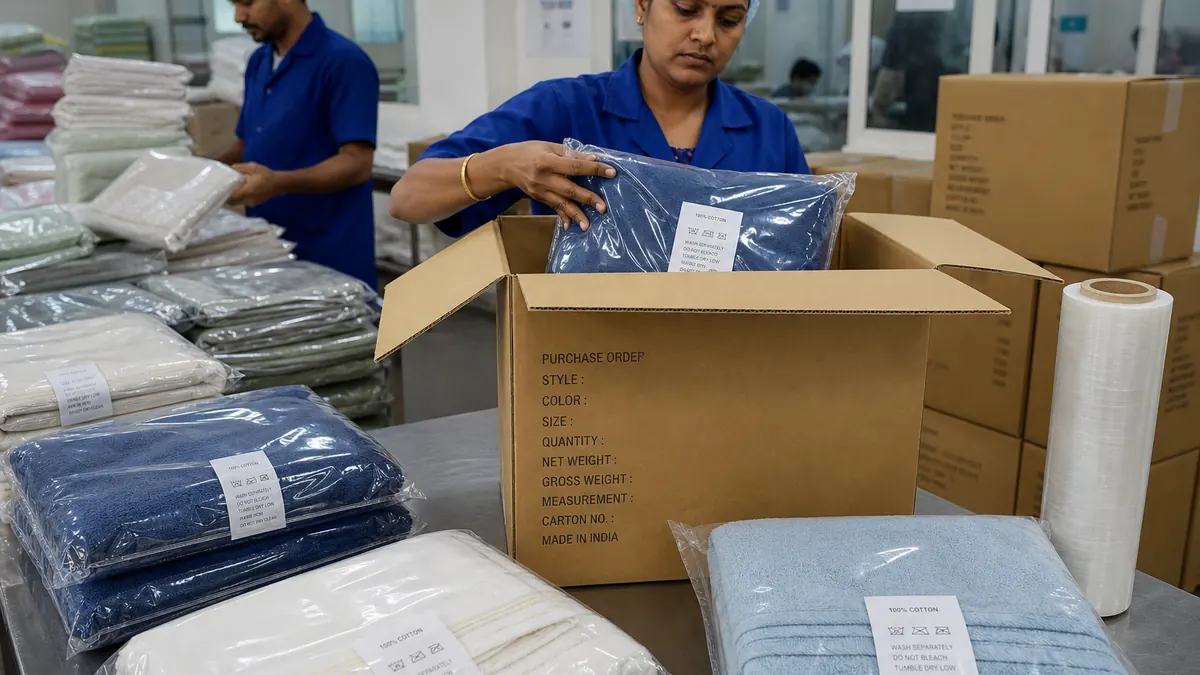
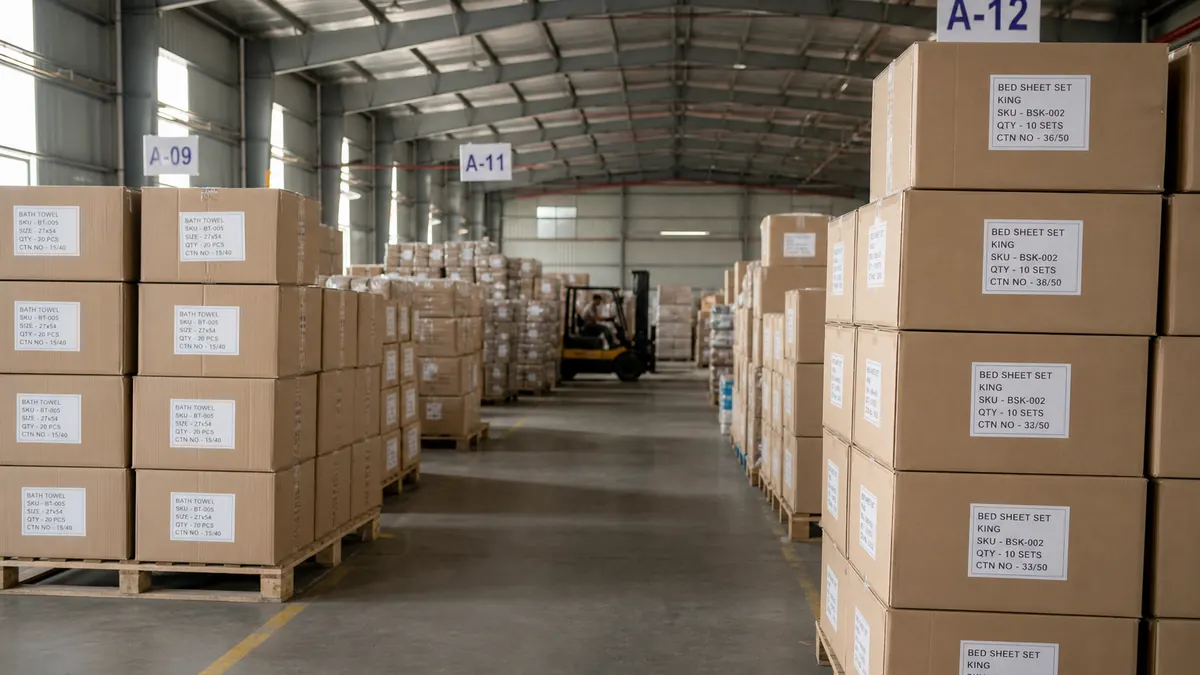
Packaging standards become documentation standards when carton marks, polybag inserts, and net weight print must appear on the packing list and match fibre/care labels. Standard export packs use polybag plus corrugated carton by size and colourway; retail-ready private label adds hangtags; hospitality bulk uses linen-room marks. Marking must include SKU/size/colourway, shade lot where contracted, net piece count, and exporter marks matching invoice and packing list.
Pack formats and packing-list fields for cotton home textile exports
Swipe →
Data table — swipe horizontally on small screens
| Format | Typical use | Packing-list must show | Marking risk |
|---|---|---|---|
| Polybag + master carton by size | Wholesale bed/bath/table | Carton count, pcs/carton, shade lot | Mixed sizes in one carton without line split |
| Retail-ready set pack | Private-label sheet sets | SKU code, barcode, set composition | Hangtag fibre % ≠ invoice description |
| Bulk hospitality carton | Hotel bed/bath programmes | Linen-room code, white-shade lot | Missing replenishment SKU on marks |
| Curtain polybag + stiffener | 6303 curtain programmes | Panel size, header type, colourway | Flammability tag missing when required |
| Mixed-SKU FCL block | Coordinated home-textile assortment | Per-family lines + segregation notes | Terry scent/bleed onto bed linen undocumented |
| Moisture-protected stow | Long ocean transit | Desiccant / humidity note if contracted | Buyer assumes SOP never documented |
Container Loading Details
Export Tip
- Photograph stuffed container and seal before gate-in.
- LCL trials still need seal and weight discipline.
- Northern Panipat parcels via ICD Delhi need inland leg docs aligned to port of loading.
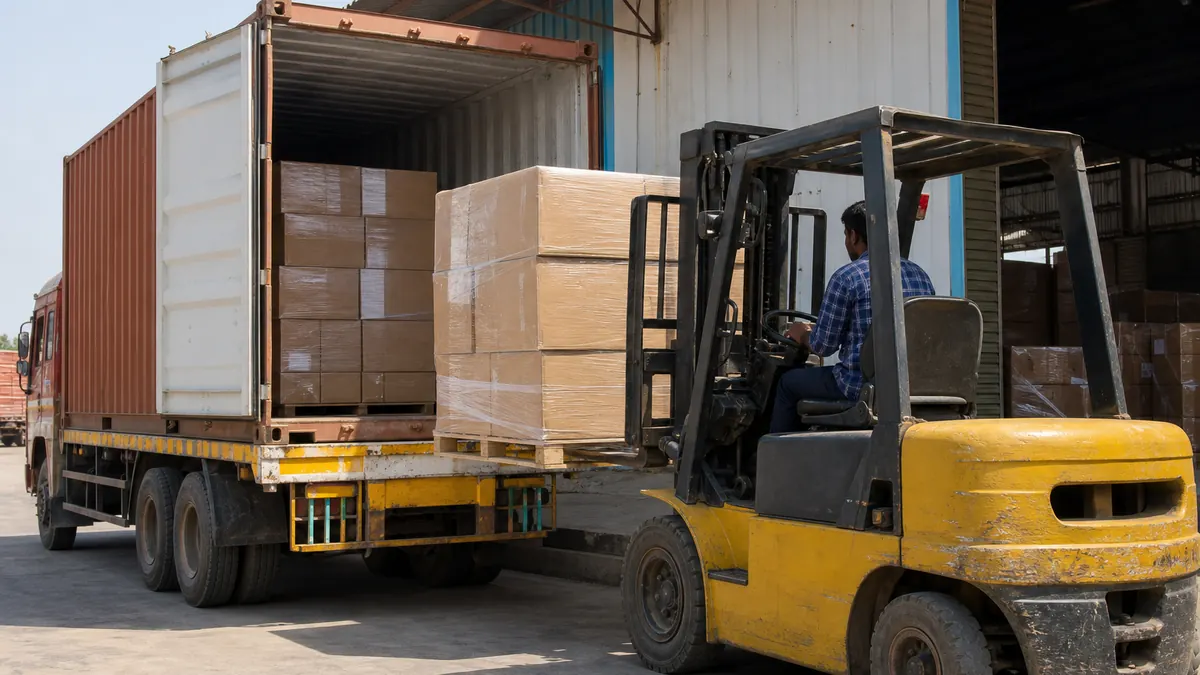
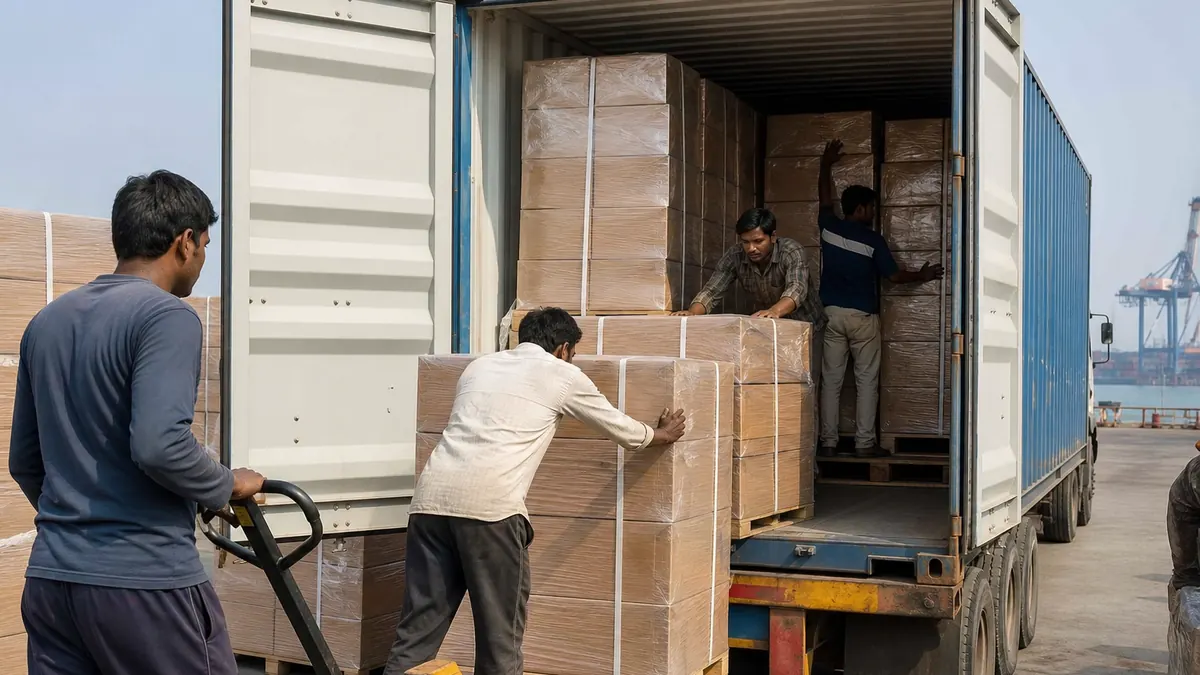
Container loading details belong on the documentation checklist because B/L container and seal numbers, stuffing photos, and packing-list weights must reconcile. Bulky quilts, comforters, and curtain programmes often cube-out before they weight-out; terry plus bed linen assortments need weight/cube mix confirmation with forwarder — do not promise stow numbers on invoice capacity notes without a plan.
Container loading identifiers that must appear in the document pack
Swipe →
Data table — swipe horizontally on small screens
| Loading element | Where recorded | Failure mode |
|---|---|---|
| Container number | BL + packing list notes + stuffing photo log | Typo vs customs declaration |
| Seal number | BL + exporter seal log | Seal broken/replaced without amendment |
| Net weight per SKU family | Packing list + shipping bill | Mixed SKU totals not split |
| Carton marks visible in photos | Archive with sailing file | No photo proof in shade disputes |
| Cube vs weight mix | Forwarder stow plan memo | Promising 40′ capacity for bulky quilt load |
| Pallet type (ISPM-15 / plastic) | Packing list + treatment cert if wood | Missing ISPM-15 evidence |
Shipping Methods
Export Tip
- Samples: air/express aligned to sample lead times.
- Trials: LCL or small FCL with full document reconciliation.
- Programmes: FCL with stuffing photo archive and BL draft review before release.
- Never mark FOB on invoice when the exporter is not handling main carriage as contracted.
Ocean FCL from Mundra, Nhava Sheva, Chennai, or Tuticorin is the default commercial path; LCL suits trials; air or express suits sample dispatch and urgent shade resamples. Shipping method changes which transport document appears — bill of lading versus air waybill — and how fast label approvals and certificate timelines must run. Incoterms on the invoice must match the actual freight arrangement: EXW factory/warehouse, FOB named Indian port, CFR/CIF, or selective DDP.
Certifications
Compliance Notes
- Expired certificates fail audits even when product tests correctly.
- REACH declarations belong in EU packs when finishes apply.
- GOTS scope must cover the exact SKU and lot on the invoice line.
Certifications in this checklist are attachment and validity controls. TEXPROCIL RCMC proves council membership for cotton made-ups programmes; lot inspection reports prove shade and stitch where contracted; OEKO-TEX Standard 100, GOTS, OCS, and BCI certificates prove claims only when scope covers the shipped lot. This is not an essay on why TEXPROCIL exists — for membership narrative see the TEXPROCIL benefits post.
Certification and credential attachments for cotton home textile exports
Swipe →
Data table — swipe horizontally on small screens
| Credential / cert | Purpose in the pack | Validity control |
|---|---|---|
| IEC | Exporter legal identity on shipping bill | Entity name matches invoice and bank AD code |
| TEXPROCIL RCMC | Council membership for cotton textiles / made-ups | Current membership; product-list fit confirmed |
| GST registration | Tax identity on commercial documents | Match legal entity on invoice |
| Fibre / care label approval | Destination market compliance proof | Artwork version = stuffed cartons |
| OEKO-TEX Standard 100 | Chemical safety claim support | Certificate ID + product class covers SKU |
| GOTS / OCS transaction certificate | Organic claim support | Scope covers SKU and lot |
| BCI / Better Cotton claim evidence | Sustainability claim with chain of custody | Claim language matches invoice notes |
| Certificate of origin | Origin preference or non-preferential proof | Correct template (preferential vs non-pref) |
| Third-party inspection (SGS/BV/Intertek) | Buyer-requested AQL/shade report | Lot ID = cartons stuffed |
| Curtain flammability test | US/UK/EU programme where required | Test report matches fabric/lot shipped |
Buyer Requirements
Buyer Requirements
- Written spec before FOB: family, construction, size, colourway, label language, cert scope.
- Approve sample and label mock-up before trial carton.
- Confirm buyer-accepted labs or cert bodies for OEKO-TEX/GOTS.
- Agree shade tolerance and claim windows in writing.
International buyers — retail chains, department stores, e-commerce private label, hospitality procurement, and wholesale distributors — typically require written specifications, approved samples, fibre/care label artwork, credential copies (IEC, TEXPROCIL RCMC), commercial invoice and packing list drafts before sailing, and destination annexes. Premium programmes add OEKO-TEX, GOTS, BCI chain-of-custody evidence, and third-party inspection.
Buyers using letters of credit will list documentary conditions that override generic exporter habits. Map every LC clause to a named PDF in the sailing pack before production finishes.
Country-wise Opportunities
Market Snapshot
- Maintain a per-buyer annex matrix, not one universal pack.
- Do not treat destination lists here as entry rankings.
- Re-confirm broker templates each season — forms change.
Country-wise opportunities in a documentation article mean destination document variants, not a ranking of where to expand next. The United States, UK, Germany, Australia, Canada, UAE, Japan, and Netherlands each attach different annex expectations to the same Indian cotton made-ups SKU. Use Best Countries for Indian Cotton Home Textile Exports when you need market-entry comparison; use the table below when you need to know which pages to assemble.
Destination document variants for Indian cotton home textile shipments
Swipe →
Data table — swipe horizontally on small screens
| Country / region | Document emphasis | HS / identity note |
|---|---|---|
| United States | FTC fibre/care labels, CBP textile entry, OEKO-TEX if claimed | Clear 6302/6303 lines; curtain flammability when required |
| United Kingdom | UK textile composition + care labels | Post-Brexit tariff line confirm with broker |
| Germany / EU | EU fibre labelling + REACH on finishes | CN 6302/6303 alignment with invoice |
| Australia / Canada | Local fibre disclosure and care rules | Bilingual labels when retail PL to Canada |
| UAE / GCC | Hospitality bulk marks, re-export clarity | Avoid vague mixed-SKU descriptions |
| Japan | Label language and construction discipline | Confirm Japanese care/fibre text when retail |
| Mexico / Israel | US-adjacent or EU-adjacent overlays | Broker template per buyer channel |
Sourcing Checklist
Checklist
Buyer Checklist
Exporter Checklist
Common Buyer Mistakes
Common Mistakes Box
Future Market Trends
Key Statistics
- More buyer portals archiving TEXPROCIL RCMC and OEKO-TEX/GOTS per lot.
- Tighter fibre-composition declarations on multi-fibre blends.
- Multi-SKU private-label kits demanding cleaner packing-list taxonomy.
- Digital label-proof versioning tied to shade lot IDs.
Customs pre-arrival automation and buyer vendor portals increase document scrutiny on cotton home textiles. Exporters who QC invoice, packing list, label artwork, and certificate scope before cutoff avoid demurrage trends at busy destination ports. Lot-level digital archives — stuffing photos, seal logs, certificate expiry calendars — are becoming programme requirements, not nice-to-haves.
Organic and GOTS growth increases certificate complexity; coordinated bed+bath+table private-label kits increase multi-SKU packing-list discipline; US and EU label rule updates increase fibre-declaration precision on every sailing. Documentation teams that treat these as permanent controls will outpace teams that scramble per shipment.
Challenges & Solutions
- Challenge: 6302 vs 6303 vs 6304 confusion — Solution: CHA-confirmed line list on every multi-SKU invoice before production.
- Challenge: Label artwork drift — Solution: lock approved artwork version; draft invoice from packing photos, not memory.
- Challenge: Missing GOTS/OEKO-TEX scope — Solution: attach certificate ID to invoice lot line 72 hours pre-sail.
- Challenge: Expired TEXPROCIL RCMC mid-season — Solution: calendar renewals against lead times (6–10+ weeks for hospitality custom).
- Challenge: LC discrepancies — Solution: map LC clauses to named PDFs at order acceptance.
The hardest documentation challenges in cotton home textile export are mixed-SKU multi-HS controls, shade-lot drift between mill and forwarder, destination label variability, certificate expiry during long GOTS or hospitality lead times, and LC discrepancies. Each has a procedural solution that costs less than a held container.
Compliance Checklist
Checklist
Compliance Notes
Multi-HS Declaration Controls
- One shipping bill can carry multiple HS lines — invoice and packing list must lead the split.
- CHA confirmation is mandatory — this table is planning only.
- Cross-link sibling clusters when one family dominates the RFQ.
Mixed home-textile FCLs are where documentation teams earn their keep. A single container may carry bed linen and pillowcases on 6302, terry bath towels on the 6302.60 family planning lens, table linen on 6302, curtains on 6303, decorative throws on 6304 in assortment programmes, and blankets on 6301 when essential character is blanket — each needing invoice lines, packing-list rows, and shipping-bill splits that tell the same story.
Never let marketing descriptions drive HS filing. Essential character, material composition, and product form at shipping-bill time must be confirmed with your CHA against live ITC-HS entries. When in doubt, split invoice lines rather than collapsing SKUs into one convenient heading.
Multi-HS declaration matrix for mixed cotton home textile programmes
Swipe →
Data table — swipe horizontally on small screens
| Product family | Planning HS family | Invoice must name | Do not file as |
|---|---|---|---|
| Bed linen, pillowcases, duvet covers | 6302 | Construction, size, colourway | 6304 unless essential character is furnishing article |
| Terry bath / kitchen linen | 6302 / 6302.60 family | GSM/size, pile type at category level | Deep terry HS essay — confirm 8-digit with CHA |
| Table linen — napkins, tablecloths | 6302 | Size, finish, colourway | 6303 curtain heading |
| Curtains, drapes, valances | 6303 | Panel size, header, lining if any | 6302 bed linen catch-all |
| Throws / cushion covers (assortment) | 6304 | Size, construction at category level | Replace throws cluster spec depth here |
| Blankets / bedspreads (blanket character) | 6301 | Material, size, weight class | 6302 sheet set heading |
Fibre and Care Label Documentation Pack
- Label language must match destination — not factory default English only when buyer requires local language.
- Care symbols for terry heat-setting and bleach tolerance must match buyer laundry spec.
- Archive label approval version numbers with each sailing.
Fibre and care labels are not marketing accessories — they are import documents. US-bound retail and many wholesale programmes require fibre content labels under the Textile Fiber Products Identification Act; EU and UK programmes require textile fibre composition labelling with care symbols aligned to ISO care labelling practice. Bulk hospitality shipments may use sewn-in or printed labels — but the fibre percentages on those labels must still match invoice SKU descriptions and any OEKO-TEX or GOTS claim scope.
Document teams should maintain a label approval file per buyer: artwork PDF, approved fibre percentages, care symbol set, language variants, and the shade lot IDs where that artwork was used. When production switches dye lots, re-confirm whether label colour references still match buyer packaging standards.
Fibre and care label pack by destination
Swipe →
Data table — swipe horizontally on small screens
| Destination | Label requirements | Document evidence | Common hold reason |
|---|---|---|---|
| United States | FTC fibre content + care labels on retail goods | Label artwork PDF, approval email, bulk sew-in photo | Generic "100% cotton" without legally compliant tag |
| European Union | EU textile fibre composition + care symbols | Label proof, REACH finish note if applicable | Missing fibre % in destination language |
| United Kingdom | UK textile labelling alignment | Post-Brexit label template approval | Old EU-only wording on UK PL |
| Canada | Textile labelling act — bilingual when retail | French/English label mock-up | English-only care on Quebec retail |
| Australia | ACCC fibre disclosure expectations | Care label aligned to ACCC guidance | Ambiguous blend percentages |
| Hospitality bulk | Often sewn-in brand/fibre mark | Bulk label spec on PO + packing list ref | White-shade lot not marked on carton |
GOTS and OEKO-TEX Evidence Pack
- Never claim GOTS on invoice without transaction certificate for that lot.
- OEKO-TEX product class must match the SKU — bath towel vs sheet set differ.
- Deep organic/hospitality pathway detail lives in the specialty cluster post.
Premium and private-label programmes increasingly require OEKO-TEX Standard 100, GOTS, OCS, or BCI claim evidence in the same PDF bundle as the commercial invoice. An OEKO-TEX certificate that covers only grey fabric does not automatically cover finished sheet sets unless scope says so. A GOTS transaction certificate must link to the exact lot on the invoice line — not a prior season's organic run.
Build a certificate index: certificate ID, issuing body, validity dates, product classes covered, and the invoice lot lines each certificate supports. Buyers auditing sustainability claims will reject premium pricing when evidence scope is vague.
GOTS / OEKO-TEX / OCS / BCI evidence pack checklist
Swipe →
Data table — swipe horizontally on small screens
| Certificate | Must prove | Attach to | Validity check |
|---|---|---|---|
| OEKO-TEX Standard 100 | Chemical safety for finished article or component | Invoice line + buyer compliance portal | Certificate ID active on sailing date |
| GOTS transaction certificate | Organic fibre chain for shipped lot | Invoice lot line + COO notes if asked | TC lot ID = production lot stuffed |
| OCS transaction certificate | Organic content claim scope | Invoice blend lines | Scope covers claimed organic % |
| BCI / Better Cotton claim | Mass-balance or physical chain per programme | Invoice sustainability note | Claim language matches buyer-approved wording |
| Scope certificate (GOTS/OCS site) | Site approval for processing stages | KYC pack — not substitute for shipment TC | Site cert alone without shipment TC fails audit |
Sources
- DGCI&S — Directorate General of Commercial Intelligence and Statistics
- Indian Trade Journal — HS 6302 commodity export profile (FY 2023-24)
- Indian Trade Journal / DGCI&S commodity profiles (HS 6302 updates)
- Ministry of Commerce & Industry — TRADESTAT
- TEXPROCIL — The Cotton Textiles Export Promotion Council
- TEXPROCIL — Cotton Home Textiles overview
- DGFT (India) — IEC / trade portal
- CBIC — Indian Customs Tariff (Chapter 63)
- ITC Trade Map
- UN Comtrade Database
- WITS World Integrated Trade Solution
- USITC Harmonized Tariff Schedule (search 6302)
- US CBP — Textile and apparel resources
- FTC — Textile Fiber Products Identification Act
- European Commission TARIC
- EU Regulation (EU) No 1007/2011 — textile fibre names & labelling
- UK Trade Tariff / UK Global Tariff
- UK DCTS goods graduation (Ch. 52 & 63 India — verify current notice)
- DFAT — Australia–India ECTA
- Australian Border Force — FTA Portal
- OEKO-TEX Standard 100
- GOTS — Global Organic Textile Standard
- Better Cotton (BCI)
- IPPC — ISPM 15 wood packaging
- Altus Exports — Textiles & Home Furnishings
All sources accessed 2026-08-08 during the cotton home textiles factual audit. Prefer primary government and multilateral databases (DGCI&S / Indian Trade Journal HS 6302 commodity profiles, TEXPROCIL, DGFT, USITC HTS, EU TARIC, UK Trade Tariff / DCTS graduation notices, DFAT ECTA, ITC Trade Map / UN Comtrade / WITS) when citing figures in contracts or buyer presentations. Re-verify live before every commercial quote.
Document field requirements vary by destination and LC terms — reconcile this checklist with broker filing rules and buyer portal uploads per consignment.

Conclusion
A complete cotton home textile export documentation checklist turns multi-SKU made-ups programmes — bed linen, terry bath and kitchen linen, table linen, curtains, quilts, and hospitality lines — into clearable shipments. Invoice, packing list, shipping bill, bill of lading, certificate of origin, TEXPROCIL RCMC, fibre and care labels, multi-HS controls, and OEKO-TEX/GOTS evidence must describe one programme under the correct Chapter 63 headings.
Altus Exports assembles reconciled export document sets for cotton home textile FCL and trial programmes through merchant exporter India and global sourcing partner India workflows. Explore textiles & home furnishings or contact the team to put a pre-shipment gate on your next sailing.
Continue with How to Export Cotton Home Textiles from India, TEXPROCIL Registration Benefits for Cotton Home Textile Exporters, Source Cotton Home Textiles Directly from India, and Organic GOTS OEKO-TEX Hospitality Opportunities.