How to Import Terry Towels from India: The Complete 2026 Buyer Guide
By Altus Exports
A practical decision sequence for specifying, sourcing, approving, shipping, and receiving cotton terry towels from India.

International buyers who want to import terry towels from India need a controlled sequence: define the product and market, qualify the production route, approve samples and evidence, contract measurable requirements, inspect bulk goods, reconcile documents, and verify receipt. WITS/UN Comtrade reports that India exported HS 630260 cotton terry toilet and kitchen linen worth US$1.151 billion and weighing 201.385 million kg in calendar 2024. This official category is broader than bath towels.
This guide covers the complete procurement path: defining a towel by size, GSM, yarn and performance; selecting and auditing a factory; validating samples; agreeing an indicative commercial model; inspecting production; and controlling labels, cartons, documents, customs and freight. Altus Exports works as an Indian merchant exporter, global sourcing partner, and export consulting expert—not merely a product broker—coordinating qualified manufacturing, quality evidence, commercial documentation and dispatch.
Executive Summary
Summary Box
International buyers who want to import terry towels from India need a controlled sequence: define the product and market, qualify the production route, approve samples and evidence, contract measurable requirements, inspect bulk goods, reconcile documents, and verify receipt. WITS/UN Comtrade reports that India exported HS 630260 cotton terry toilet and kitchen linen worth US$1.151 billion and weighing 201.385 million kg in calendar 2024. This official category is broader than bath towels.
This guide covers the complete procurement path: defining a towel by size, GSM, yarn and performance; selecting and auditing a factory; validating samples; agreeing an indicative commercial model; inspecting production; and controlling labels, cartons, documents, customs and freight. Altus Exports works as an Indian merchant exporter, global sourcing partner, and export consulting expert—not merely a product broker—coordinating qualified manufacturing, quality evidence, commercial documentation and dispatch.
Market Size & Industry Overview
Key Statistics
India's relevance is measurable at product level. WITS' 2024 exporter table lists China at US$1.920 billion, India at US$1.151 billion, Pakistan at US$1.085 billion, Türkiye at US$567.950 million and Portugal at US$223.933 million for HS 630260. These are separate reporter rows; they are not added here to estimate a world total or market share. The subheading covers toilet and kitchen linen of terry towelling or similar terry fabrics, of cotton. It is not a universal towel code or a bath-towel-only market.
Solapur is officially recognized for terry towel heritage and received a Geographical Indication tag in 2005, according to India's tourism portal. That fact does not establish any supplier's capability. Buyers should select a production route by verified machinery, process ownership, quality systems, available capacity and wet-processing controls—not by city reputation.
Comparison table
Swipe →
Data table — swipe horizontally on small screens
| 2024 leading HS 630260 exporters | Export value, USD million | Quantity, million kg | Buyer interpretation |
|---|---|---|---|
| China | 1,920.249 | 238.528 | Largest reported value and volume |
| India | 1,151.476 | 201.385 | Deep cotton-terry and private-label capacity |
| Pakistan | 1,084.703 | 228.597 | Major scale competitor |
| Türkiye | 567.950 | 61.899 | Higher average customs value mix |
| Portugal | 223.933 | 18.377 | Premium European supply position |
Export Statistics: India's 2024 Terry Towel Trade
Key Statistics
India's five largest listed destinations demonstrate both concentration and diversification. The United States dominated; the United Kingdom, Australia, Netherlands and Mexico were meaningful but much smaller. Values below are WITS/UN Comtrade calendar-year data, accessed July 17, 2026.
\*Calculated from reported value and quantity; not a supplier quotation.
The statistics support India's ability to execute large programs, but they do not establish that every supplier is capable. A buyer still needs factory-specific evidence: current capacity allocation, comparable order history, machinery list, subcontracting map, compliance scope and defect performance.
Comparison table
Swipe →
Data table — swipe horizontally on small screens
| Destination | India export value, USD million | Quantity, million kg | Implied customs value/kg* |
|---|---|---|---|
| World | 1,151.476 | 201.385 | $5.72 |
| United States | 709.201 | 120.270 | $5.90 |
| United Kingdom | 57.408 | 9.197 | $6.24 |
| Australia | 47.059 | 8.433 | $5.58 |
| Netherlands | 28.654 | 6.619 | $4.33 |
| Mexico | 28.299 | 4.359 | $6.49 |
Import Statistics: Where Demand Is Concentrated
Key Statistics
WITS reports the United States as the largest 2024 importer of HS 630260 at $2.122 billion and 275.251 million kg. The European Union aggregate was $1.043 billion and 159.967 million kg; Japan imported $537.671 million and 62.020 million kg. Germany and France also appeared among leading reporters, but their values overlap with the EU aggregate and must not be added to it.
Comparison table
Swipe →
Data table — swipe horizontally on small screens
| 2024 importer/reporting area | Import value, USD million | Quantity, million kg | Planning implication |
|---|---|---|---|
| United States | 2,121.518 | 275.251 | Scale, retailer protocols and federal labeling |
| European Union aggregate | 1,043.298 | 159.967 | Multilingual labels and EU product rules |
| Japan | 537.671 | 62.020 | Exacting finishing and packaging expectations |
| Germany | 324.256 | 42.753 | Included within EU aggregate; do not double-count |
| France | 233.352 | 32.685 | Included within EU aggregate; local-language execution |
| United Kingdom | 199.404 | Not shown in cited snippet | Separate UK importer obligations |
Product Categories and Variants
Summary Box
The commercial assortment should follow use case. The directions below are design hypotheses for a buyer brief, not observed market averages. Retail teams may prioritize coordinated color and shelf presentation; hospitality laundries may prioritize repeated-wash performance and replacement continuity. Promotional, spa and premium programs require their own validated performance and presentation criteria.
GSM is only fabric mass per square meter. It does not independently predict absorbency, durability or softness. Fiber length, yarn twist, pile height, ground construction, dyeing, finishing and laundering all matter. Use the specialist guide to build a terry towel specification before requesting quotations. HS 630260 applies only when the article is cotton toilet or kitchen linen made of terry towelling or similar terry fabric; non-terry cotton, man-made-fiber, fabric-in-the-piece, wearable, cleaning and other articles can fall elsewhere. Confirm the national line on the product's facts.
Comparison table
Swipe →
Data table — swipe horizontally on small screens
| Variant | Hypothetical specification direction | Main buyer use | Control point |
|---|---|---|---|
| Washcloth/face towel | Buyer-defined small format and GSM | Retail sets, hotels | Dimensional stability |
| Hand towel | Buyer-defined medium format and GSM | Bath and hospitality | Border consistency |
| Bath towel | Buyer-defined size, GSM and weight | Retail, hotel, institution | Finished weight and absorbency |
| Bath sheet | Buyer-defined large format and GSM | Premium retail | Actual piece weight and carton cube |
| Bath mat | Heavier construction | Hotels and retail | Skid claim validation; laundering |
| Kitchen towel | Lower/medium GSM, absorbent | Household retail | Lint and colorfastness |
| Pool/beach towel | Larger, yarn-dyed or printed | Resorts and seasonal retail | Light, chlorine and rub fastness |
| Organic/private label | Transaction-certified where claimed | Premium and responsible sourcing | Chain-of-custody evidence |
Manufacturing Overview: From Yarn to Packed Towel
Export Tip
Yarn and weaving
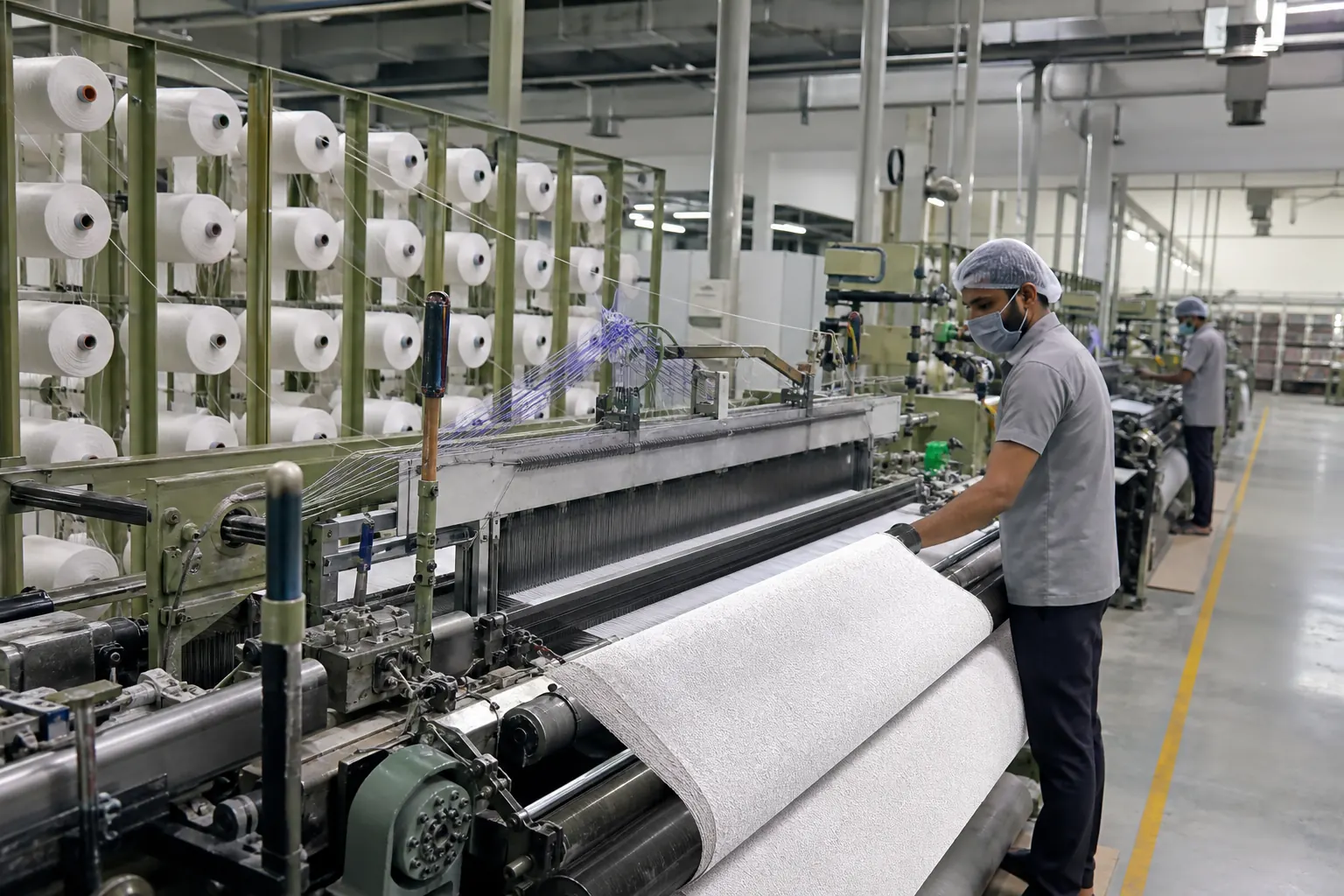
Terry fabric normally uses ground warp and weft for structural stability plus pile warp to form loops. Modern looms control pile geometry and borders; yarn choice influences hand, lint, strength and absorbency. Ring-spun, combed, low-twist and zero-twist descriptions must be defined in the tech pack because commercial terminology can vary.
Wet processing and finishing
Preparation can include desizing or scouring, bleaching, dyeing and washing. Finishing targets hand feel and dimensional stability, but excessive softener may temporarily change absorbency. Buyer-approved chemicals, shade standards, water quality and recipe control are important. If a sustainability or chemical claim is marketed, obtain evidence applicable to the actual facility, product and transaction.
Cutting, stitching and quality assurance
Fabric is cut, hemmed, labeled, inspected, folded and packed. Controls should include width/length after conditioning, piece weight, GSM calculation, loose threads, skipped stitches, stains, holes, shade variation, pile pulls, bowing, label correctness and metal-control procedures where required.
Build a Purchase Specification That Can Be Inspected
Use recognized methods where practical, such as ISO, AATCC or ASTM methods agreed with the laboratory. The contract should state the method version, conditioning, sample count and acceptance limit. A generic request to “pass international standards” is not objectively enforceable. The detailed next step is to verify towel quality evidence against the actual SKU, site, certificate scope and lot.
Comparison table
Swipe →
Data table — swipe horizontally on small screens
| Specification field | Example only | Acceptance method |
|---|---|---|
| Finished size | 70 × 140 cm | Conditioned measurement; agreed tolerance |
| Nominal GSM | 500 GSM | Weight/area calculation; agreed sampling |
| Fiber | 100% cotton | Label review and laboratory test if required |
| Yarn/construction | Combed ring-spun pile; defined ground | Mill declaration plus physical approval |
| Color | Buyer standard or Pantone reference | Lightbox comparison and approved tolerance |
| Performance | Absorbency, shrinkage, colorfastness | Named test method and pass criteria |
| Workmanship | Secure hems, no holes/stains | Defect catalogue and AQL plan |
| Label/pack | Market-specific artwork and barcode | Golden pack sample |
Pricing Analysis: Build the Landed-Cost Model
Buyer Tip
No responsible sourcing guide can promise a universal price. Towel cost changes with cotton and yarn markets, piece weight, dye depth, yarn type, weaving efficiency, order color distribution, testing, labeling, packaging, payment terms, Incoterm and freight. A lighter towel can cost more per kilogram if it requires elaborate borders, many colors or retail presentation.
Hypothetical model only: Set buyer-chosen inputs of 70 × 140 cm and 500 GSM. The calculated textile mass is 0.70 × 1.40 × 0.500 = 0.49 kg per piece, before tolerances and construction effects. Set a hypothetical EXW product-rate input of US$6.00/kg; multiplication produces US$2.94 per piece. None of these inputs is typical, observed, quoted, recommended, or offered by Altus Exports. Replace every input with approved-sample measurements and dated quotations, then model wholesale and landed cost.
Comparison table
Swipe →
Data table — swipe horizontally on small screens
| Cost layer | Illustrative assumption | Why it changes |
|---|---|---|
| Product | Quoted per piece or kg after tech pack | GSM, size, yarn, dye, construction |
| Packaging | Plain export carton vs retail-ready set | Inserts, bands, barcodes, recycled content |
| Testing/inspection | Per style/color/lot or inspection day | Protocol breadth and laboratory |
| Inland/export | Factory to port, clearance, documentation | Origin, port and service scope |
| Ocean/air freight | Current forwarder quote | Route, season, equipment and surcharges |
| Import charges | Duty, brokerage, port and taxes | Destination tariff line and Incoterm |
MOQ Analysis
Buyer Tip
MOQ is driven by yarn procurement, dye-lot economics, loom setup, label and carton printing, and the number of SKUs. Buyers should request both total-order MOQ and minimum per size/color. A supplier may accept a reasonable total but require a full dye lot per shade.
Ask for a pilot MOQ, repeat-order MOQ and price break at container scale. A low MOQ can carry higher setup allocation. Conversely, accepting a full container without validating wash performance creates avoidable inventory risk.
Comparison table
Swipe →
Data table — swipe horizontally on small screens
| Program type | MOQ input required from supplier | Practical negotiation lever |
|---|---|---|
| Existing stock/plain pack | Written SKU-specific stock quantity and validity | Use available size and shade |
| Custom color/private label | Written total, style, size and shade minimums | Consolidate sizes in one dye family |
| Retail band/barcode pack | Written print and packaging minimums | Use digital labels or common carton |
| Custom weave/border | Written loom-run and setup minimums | Limit border variants |
| Certified-organic order | Written certified-input and transaction conditions | Plan yarn and certification early |
Packaging Standards
Export Tip
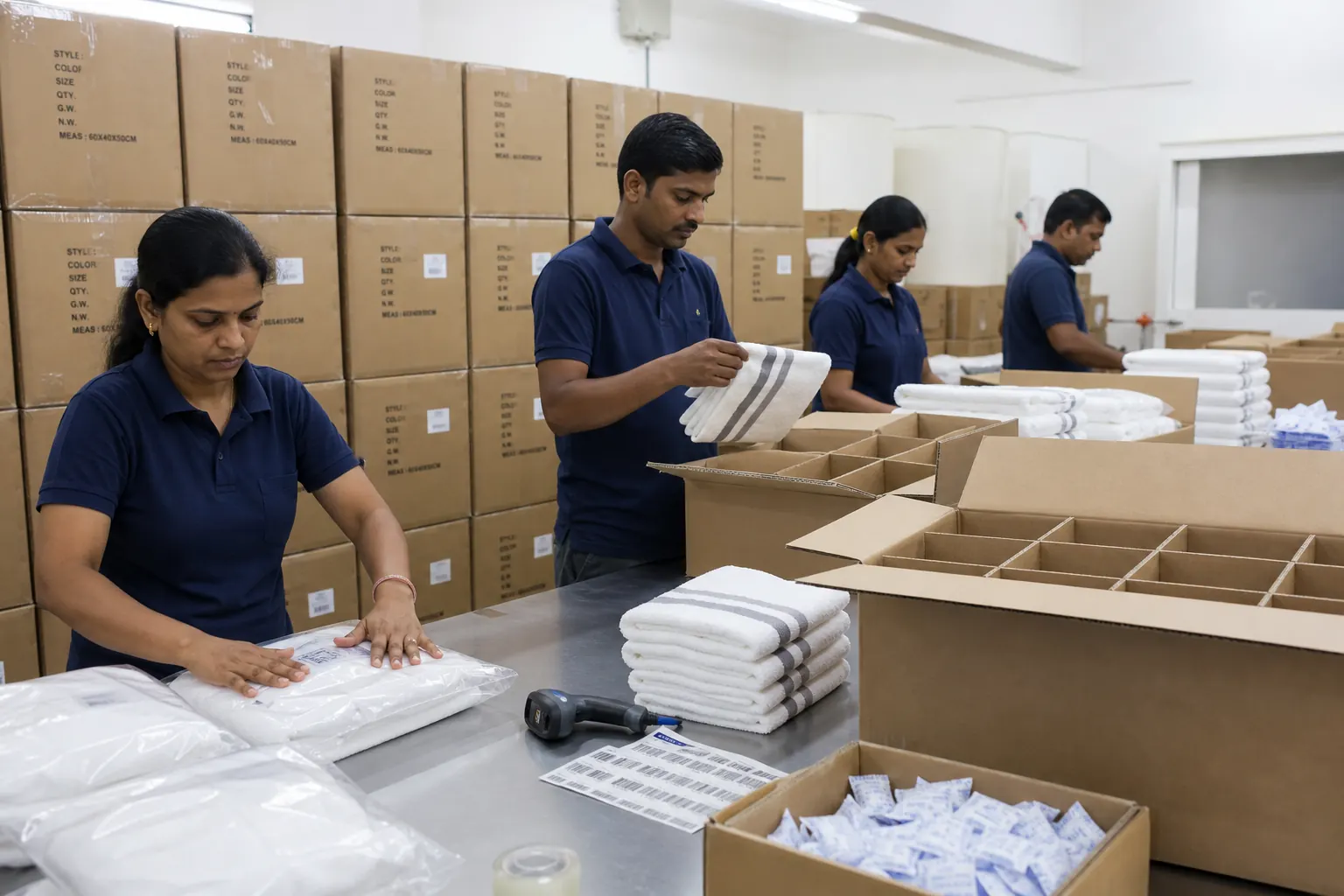
Packaging must protect against moisture, odor, contamination, abrasion and carton collapse while meeting retailer and country rules. Approve folding, assortment ratio, polybag policy, suffocation warnings where applicable, labels, barcode grade, carton dimensions, gross/net weight, shipping marks and pallet requirements. For wood packaging, verify ISPM 15 applicability with the destination and logistics provider.
Container Loading Details
Export Tip
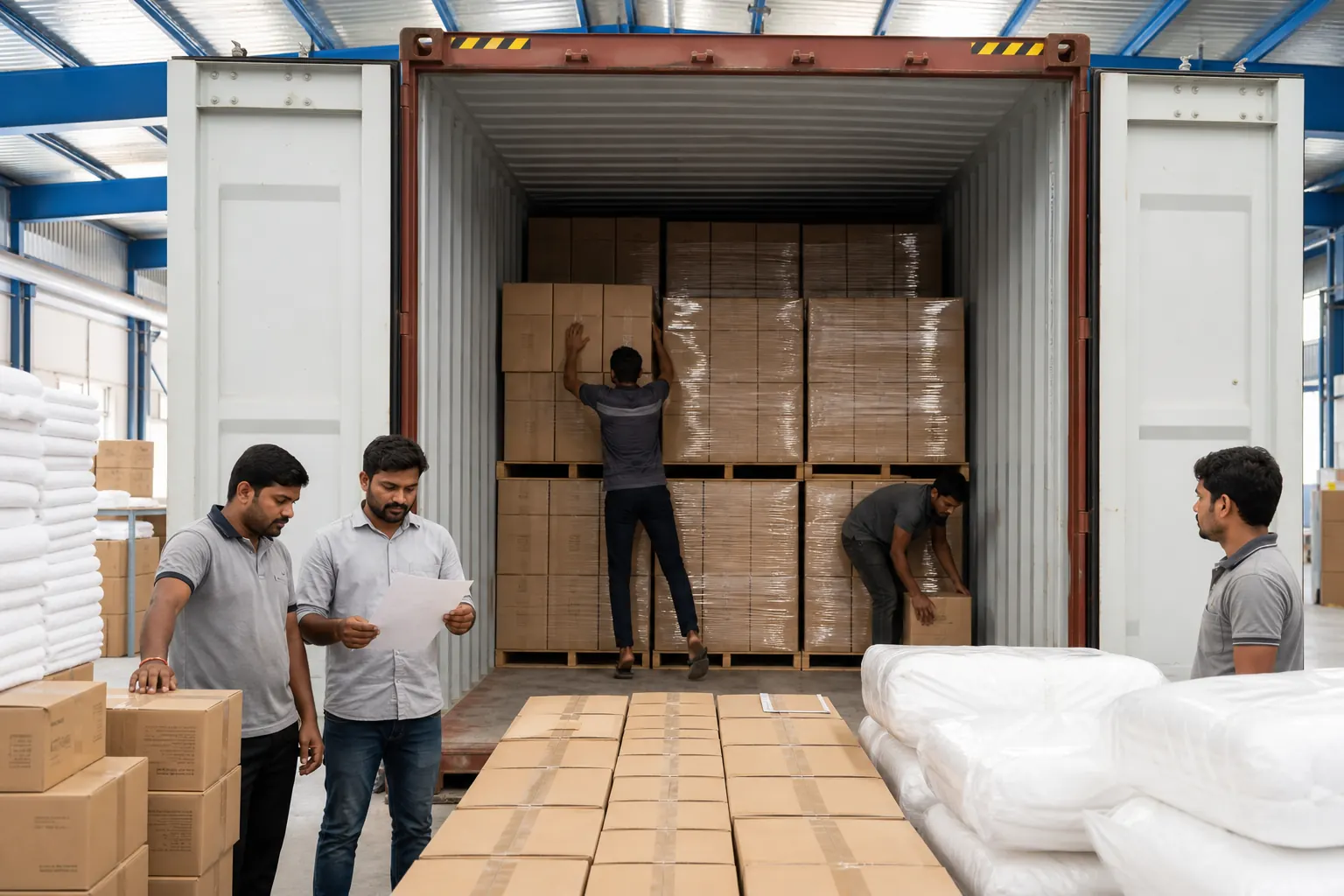
Towels are cube-sensitive, and compression changes both carton dimensions and presentation recovery. Loading must be calculated from the approved carton—not a generic internet figure. Confirm carrier payload, container internal dimensions, road limits, humidity strategy and whether pallets are required.
Every number in this table is an invented model input or arithmetic output, not a typical, observed, quoted or guaranteed loading figure. It intentionally excludes packaging weight, stowage loss, palletization, payload, axle, door and route constraints.
Comparison table
Swipe →
Data table — swipe horizontally on small screens
| Hypothetical model row | Explicit buyer-set input | Arithmetic output | Required replacement |
|---|---|---|---|
| Carton net mass | 40 pieces × 0.49 kg/piece | 19.6 kg | Approved pack-out measurement |
| 20-foot cube exercise | 28 m³ ÷ 0.085 m³/carton | 329 cartons, rounded down | Load plan and assigned equipment |
| 40HC cube exercise | 68 m³ ÷ 0.085 m³/carton | 800 cartons | Load plan and assigned equipment |
| 20-foot piece exercise | 329 cartons × 40 pieces | 13,160 pieces | Approved carton and final tally |
| 40HC piece exercise | 800 cartons × 40 pieces | 32,000 pieces | Approved carton and final tally |
Shipping Methods and Incoterms
Export Tip
Evaluate full-container ocean, LCL, air and courier against shipment size, urgency, handling risk, route availability and a dated freight quote. A buyer might model ocean freight for replenishment, LCL for a pilot, or air/courier for samples, but no mode, cost or transit time should be assumed before a forwarder confirms the named route and service.
FOB gives the buyer freight control after the named Indian port; CIF includes seller-arranged cost, insurance and freight to the named destination port but not all destination charges. DDP creates extensive importer, tax and regulatory obligations and should be used only when operationally supportable. Always state Incoterms® 2020, named place and responsibility matrix. Use the logistics spoke to prepare export documents and replace any model timing or loading input with current shipment evidence.
Certifications and Claims
Compliance Notes
Certifications are tools, not substitutes for product verification. OEKO-TEX states that STANDARD 100 is a label for textiles tested for harmful substances, with requirements linked to skin contact. GOTS covers qualifying organic textiles through processing, manufacturing, packaging, labeling, trading and distribution; scope and transaction documentation matter. Social-audit frameworks may be buyer-required but do not certify product quality.
Comparison table
Swipe →
Data table — swipe horizontally on small screens
| Evidence | What it can support | Verification action |
|---|---|---|
| OEKO-TEX STANDARD 100 | Tested harmful-substance scope | Check certificate number, article scope and validity |
| GOTS scope/transaction certificate | Organic processing and transaction claim | Verify entity, product, inputs and shipment evidence |
| ISO 9001 certificate | Quality-management system scope | Confirm site, scope, issuer and status |
| Social audit | Conditions against named protocol/date | Review findings, corrective actions and site identity |
| Lab report | Tested sample against listed methods | Match style, color, lot, date and laboratory |
Expert Insight — Saurabh Mittal
Buyer Requirements and Destination Compliance
Buyer Requirements
For the United States, FTC guidance explicitly includes towels and generally requires fiber content, country of origin, and manufacturer or responsible business identity/name or eligible RN. The FTC Care Labeling Rule is directed to wearing apparel and certain piece goods, so buyers should not casually describe it as a federal towel-care-label mandate; however, accurate care instructions are commercially important. Children's towel products may trigger additional requirements, including CPSIA considerations, depending on design and intended use.
In the EU, Regulation (EU) No 1007/2011 governs textile fiber names and composition labeling. REACH restrictions and the General Product Safety Regulation may also be relevant. The importer must determine languages, responsible economic operator, traceability and market-specific obligations. Other markets have separate consumer, customs and chemical rules.
Comparison table
Swipe →
Data table — swipe horizontally on small screens
| Buyer requirement package | Evidence expected before production |
|---|---|
| Legal entity and importer details | Exact label identity, address/RN where appropriate |
| Product specification | Signed tech pack and sealed sample |
| Restricted substances | Buyer RSL/MRSL and test plan |
| Packaging/manual | Approved artwork and barcode data |
| Quality protocol | Defects, AQL, methods and remedies |
| Logistics | Incoterm, ship window, routing and document list |
Country-wise Opportunities
Market Snapshot
The table below presents commercial screening hypotheses, not forecasts or proof of channel demand. Verified 2024 reporter data can identify lanes for further research, but it cannot establish margin, buyer appetite or supplier fit. A team should test channel economics, current tariffs, legal requirements, competition and service expectations before choosing a destination.
Comparison table
Swipe →
Data table — swipe horizontally on small screens
| Market | Opportunity | Procurement emphasis |
|---|---|---|
| United States | Mass retail, hospitality, institutional | Current FTC, customs and buyer-manual review |
| EU/Netherlands | Distribution and private label | EU fiber labels, REACH, GPSR and destination languages |
| United Kingdom | Retail and hospitality | Current UK tariff, label and importer review |
| Australia | Retail, resorts and household | Current tariff and care-label review |
| Mexico | Retail and value-to-mid programs | Current tariff, origin and label review |
| Japan | Household and hospitality | Current tariff, Japanese label and importer-specification review |
| Gulf markets | Hotels, spa and retail | Country-specific tariff, conformity and label review |
Sourcing Checklist
Checklist
- Define end use, target consumer, annual volume and replenishment cadence.
- Issue a tech pack with dimensions, GSM, yarn, construction, shade and tolerances.
- Identify required legal tests, buyer protocols and voluntary claims.
- Evaluate Indian bulk towel suppliers by factory identity, production locations, subcontractors and current available capacity.
- Compare quotations on normalized piece weight, pack, Incoterm and payment terms.
- Approve development, preproduction and golden pack samples.
- Establish production milestones, inline inspection and final inspection.
- Confirm tariff classification with the importer's customs broker.
- Book freight against approved carton cube and cargo-ready date.
- Reconcile invoice, packing list, origin evidence and transport document.
Buyer Checklist
Checklist
- [ ] Importer registration and customs broker ready
- [ ] Landed-cost model includes duty, tax, port and delivery
- [ ] Labels reviewed for each destination
- [ ] Purchase order matches approved specification
- [ ] Testing and inspection responsibility assigned
- [ ] Claim substantiation retained
- [ ] Payment milestones tied to evidence
- [ ] Cargo insurance responsibility confirmed
- [ ] Receiving inspection and claims window defined
Exporter Checklist
Checklist
- [ ] IEC and applicable Indian registrations active
- [ ] Factory, subcontractor and certificate scopes verified
- [ ] Commercial invoice and packing list consistent
- [ ] Shipping bill classification and values reviewed
- [ ] Certificate of origin arranged where required
- [ ] Bill of lading/air waybill instructions approved
- [ ] Lot traceability and test reports compiled
- [ ] Container condition, tally and seal recorded
- [ ] Export proceeds and post-shipment records managed
Compliance Checklist
Checklist
Compliance Notes
- [ ] HS 630260 suitability confirmed; HS 630293 considered for man-made fiber
- [ ] National tariff line and duty confirmed by broker
- [ ] Fiber, origin and responsible-party labels validated
- [ ] Chemical restrictions and buyer RSL mapped
- [ ] Product safety obligations assessed by intended use
- [ ] Children's-product rules assessed where relevant
- [ ] Packaging, barcode and language requirements approved
- [ ] Certification and sustainability claims substantiated
- [ ] Record retention and recall contacts established
Common Buyer Mistakes
Common Mistakes Box
- Buying on GSM alone and ignoring yarn, construction and wash performance.
- Treating a factory-level certificate as proof for every order.
- Failing to define finished-size and weight tolerances after laundering.
- Approving a hand-made sample without a production-equivalent sample.
- Comparing FOB, CIF and ex-works offers as if they were equivalent.
- Using HS 630260 for a polyester or microfiber item without review.
- Printing labels before the importer validates mandatory text.
- Booking a container from estimated cartons rather than final pack dimensions.
- Allowing undocumented subcontracting in dyeing, stitching or embroidery.
- Releasing final payment without inspection and document reconciliation.
Future Market Trends
Key Statistics
At the same time, tariff classifications remain material-specific. Growth in recycled polyester or blended products does not belong automatically in cotton HS 630260 statistics. Procurement dashboards should separate cotton terry, man-made-fiber toilet linen and other constructions to avoid false market conclusions.
Expert Insight — Saurabh Mittal
How Altus Exports Supports Importers
Altus Exports can help develop the sourcing brief, identify suitable production partners, normalize quotations, coordinate samples, organize inspections, check export documentation and manage supplier communication. Learn about our global sourcing and export services, our process to import products from India, and our textiles and home furnishings sector capability.
Conclusion
India is a proven global source for cotton terry linen, supported by $1.151 billion of reported HS 630260 exports in 2024. Yet country scale does not protect an individual purchase order. Reliable importing comes from a complete specification, verified facility route, relevant compliance evidence, production-equivalent approval, objective inspection and document control.
If you are planning a private-label, hospitality, wholesale or retail towel program, contact Altus Exports with target market, sizes, GSM, yarn preference, colors, annual volume, packaging and delivery window. We will structure a sourcing and export plan around your actual buying requirements.
Sources and Verification Notes
- WITS/UN Comtrade, India HS 630260 exports by destination, 2024: https://wits.worldbank.org/trade/comtrade/en/country/IND/year/2024/tradeflow/Exports/partner/ALL/product/630260
- WITS/UN Comtrade, HS 630260 exporters, 2024: https://wits.worldbank.org/trade/comtrade/en/country/ALL/year/2024/tradeflow/Exports/partner/WLD/product/630260
- WITS/UN Comtrade, HS 630260 importers, 2024: https://wits.worldbank.org/trade/comtrade/en/country/ALL/year/2024/tradeflow/Imports/partner/WLD/product/630260
- WITS/UN Comtrade, HS 630293 man-made-fiber category, 2023 comparator: https://wits.worldbank.org/trade/comtrade/en/country/ALL/year/2023/tradeflow/Exports/partner/WLD/product/630293
- U.S. FTC, Threading Your Way Through Textile Labeling Requirements: https://www.ftc.gov/business-guidance/resources/threading-your-way-through-labeling-requirements-under-textile-wool-acts
- U.S. FTC, Care Labeling Rule: https://www.ftc.gov/legal-library/browse/rules/care-labeling-textile-wearing-apparel-certain-piece-goods-text
- EUR-Lex, Regulation (EU) No 1007/2011: https://eur-lex.europa.eu/legal-content/EN/TXT/?uri=CELEX:32011R1007
- European Chemicals Agency, REACH textiles context: https://echa.europa.eu/regulations/reach/understanding-reach
- OEKO-TEX, STANDARD 100: https://www.oeko-tex.com/en/our-standards/oeko-tex-standard-100/
- Global Organic Textile Standard: https://global-standard.org/the-standard
- DGFT, Customs Import Export Procedures: https://content.dgft.gov.in/Website/CIEP.pdf
- Incredible India, Solapur Terry Towel and GI note: https://www.incredibleindia.gov.in/en/maharashtra/solapur-terry-towel
Access date for all sources: 2026-07-17.
Verification note: Trade values are reported in thousands of U.S. dollars by WITS and converted here to millions or billions. Calculated value-per-kilogram figures are arithmetic indicators. Pricing, MOQ, carton and container examples are explicitly hypothetical and must be replaced by order-specific quotations and loading calculations.