
Hotel Towel Supplier India: Hospitality, Spa, and Institutional Procurement Guide
By Altus Exports
Choose an Indian hotel towel supplier using laundry trials, linen-par planning, lifecycle cost, replenishment controls, compliance checks, and documented specifications.

Executive Summary
Summary Box
Choosing a hotel towel supplier in India is a lifecycle-cost decision, not a search for the lowest FOB unit price. Hospitality buyers need finished dimensions, weight tolerance, absorbency, whiteness or shade consistency, hem strength, dimensional stability, and performance after the property’s actual wash process. A towel that costs less but retires early, dries slowly, or disrupts housekeeping can be the more expensive program.
India has proven export depth in cotton terry linen. WITS, using UN Comtrade data, reports that India exported US$1.151 billion and 201.385 million kilograms of HS 630260 goods in 2024. The code covers cotton toilet and kitchen linen of terry towelling or similar terry fabrics; it is broader than hotel bath towels alone. India-reported destination rows were led by the United States, followed by the United Kingdom, Australia, the Netherlands, Mexico, Canada, and Japan among the rows verified for this guide.
Altus Exports positions itself as an Indian merchant exporter, global sourcing partner, and export consulting expert. For hospitality programs, that means translating property and laundry needs into controlled specifications, coordinating manufacturer qualification and inspections, and managing export execution without implying ownership of the factories.
Key Takeaways
Summary Box
Keyword and Entity Mapping
Comparison table
Swipe →
Data table — swipe horizontally on small screens
| Mapping layer | Terms and entities | Role in this article |
|---|---|---|
| Primary keyword | hotel towel supplier India | Hospitality supplier-selection intent |
| Supporting queries | hotel bath towels wholesale India; spa towel exporter India; institutional towels | Product and channel discovery |
| Operational entities | GSM, piece weight, linen par, OPL, outsourced laundry, cost per use | Lifecycle procurement |
| Product entities | bath towel, bath sheet, hand towel, washcloth, bath mat, pool towel | Hospitality assortment |
| Trade entities | HS 630260, HS 630293, WITS, UN Comtrade, Incoterms 2020 | Classification and export execution |
| Compliance entities | FTC Textile Fiber Rule, EU Regulation 1007/2011, OEKO-TEX, GOTS | Law and voluntary evidence |
| Related searches owned elsewhere | specifications, pricing, documentation, certifications | Linked to sibling cluster guides |
Market Size and Industry Overview
Key Statistics
There is no authoritative public figure that isolates “Indian hotel towels” from all products under HS 630260. Buyers should reject market reports that silently equate the customs code with hospitality demand. The best auditable proxy is India’s cotton-terry toilet and kitchen linen trade, supplemented by hotel openings, property renovation schedules, laundry utilization, and distributor sell-through.
WITS records India as the second-largest reporter row under HS 630260 in 2024, behind China and ahead of Pakistan. Reporter rows are not an additive global-market denominator: gross exports can include re-exports, and economic aggregates can overlap member countries. The figures establish origin-level export depth; they do not measure hotel demand or prove that every Indian mill can meet a hotel group’s durability or social-compliance program.
Comparison table
Swipe →
Data table — swipe horizontally on small screens
| 2024 HS 630260 reporter | Export value (US$ million) | Quantity (million kg) | Procurement interpretation |
|---|---|---|---|
| China | 1,920.249 | 238.528 | Largest reporter row shown |
| India | 1,151.476 | 201.385 | Second-largest reporter row shown |
| Pakistan | 1,084.703 | 228.597 | Third-largest reporter row shown |
| Türkiye | 567.950 | 61.899 | Fourth-largest reporter row shown |
| Portugal | 223.933 | 18.377 | Fifth-largest reporter row shown |
Hospitality demand is replacement-led
Hotel demand has three layers: opening stock for new properties, refurbishment or brand-conversion stock, and recurring replenishment. The third is often the most predictable. Permanent stains, frayed hems, pile loss, shrinkage, loss, and guest removal create continuous retirements. Procurement therefore needs an approved repeat standard and a reorder cadence, not a one-time product.
Export and Import Statistics
India’s 2024 HS 630260 destination rows demonstrate recorded trade flows across North America, Europe, Oceania, Latin America, and Asia. They do not establish end use, buyer type, final consumption, or an addressable hotel market. The Netherlands may also serve as a re-export hub. Use these data to frame questions, then validate hospitality demand with property pipelines, distributor sell-through, tenders, and buyer interviews.
For toilet or kitchen linen of man-made fibres, HS 630293 may be relevant; this wording is not limited to non-terry goods. Never classify a microfiber pool towel, woven cotton towel, or cotton-polyester product from a product name alone. Have the importer’s customs broker review fibre, fabric construction, intended use, origin, destination line, and trade date. Non-terry cotton toilet or kitchen linen commonly begins at HS 630291, while other materials may begin at HS 630299.
Comparison table
Swipe →
Data table — swipe horizontally on small screens
| India-reported destination, 2024 | Export value (US$ million) | Quantity (million kg) | Safe interpretation |
|---|---|---|---|
| United States | 709.201 | 120.270 | Destination flow; end use is not identified |
| United Kingdom | 57.408 | 9.197 | Destination flow; hotel demand needs separate evidence |
| Australia | 47.059 | 8.433 | Destination flow; channel mix is not identified |
| Netherlands | 28.654 | 6.619 | Re-export can affect final-market interpretation |
| Mexico | 28.299 | 4.359 | Destination flow; buyer type is not identified |
| Canada | 27.203 | 4.472 | Destination flow; use live Canadian requirements |
| Japan | 27.127 | 3.848 | India-reported exporter basis; mirror data can differ |
| World | 1,151.476 | 201.385 | India-reported gross exports to all partners |
Product Categories and Hospitality Grades
Summary Box
Hospitality “grade” is not a universal regulated classification. It is a buyer-defined bundle of performance requirements. The following bands are specification starting points, not industry guarantees.
Comparison table
Swipe →
Data table — swipe horizontally on small screens
| Program | Illustrative construction | Typical operational priority | Buyer validation |
|---|---|---|---|
| Economy/hostel | 350–450 GSM, compact size, open-end or value yarn | Fast drying, low replacement cash cost | Hem and shrinkage after aggressive wash |
| Midscale hotel | 450–550 GSM, ring-spun pile considered | Balance of hand, drying, and durability | Cost per acceptable use |
| Upscale/luxury | 550–700 GSM, combed/ring-spun options | Plush hand and visual fullness | Dryer capacity and guest-room standard |
| Spa | 500–700 GSM, colored or white | Soft hand, absorbency, treatment oils | Colorfastness, oil release, lint |
| Pool/gym | 350–500 GSM, striped or colored options | Throughput and identity control | Chlorine/color trial and dimensional stability |
| Healthcare/institution | Buyer-specific, often practical weight | Hygiene process compatibility and inventory control | Laundry protocol, identification, contract test plan |
Core assortment
- Bath towels and bath sheets: Guest-experience anchor; define finished dimensions after the agreed conditioning or wash method.
- Hand towels and washcloths: High-turnover pieces where hem integrity and loss rates can dominate cost.
- Bath mats: Heavier construction or distinct weave; avoid assuming the same laundering behavior as pile towels.
- Pool and gym towels: Often colored, striped, or woven with an identifier to reduce mixing and loss.
- Spa towels: Require testing with oils, creams, bleach alternatives, and high-frequency laundering.
Manufacturing Overview and Control Points
Export Tip
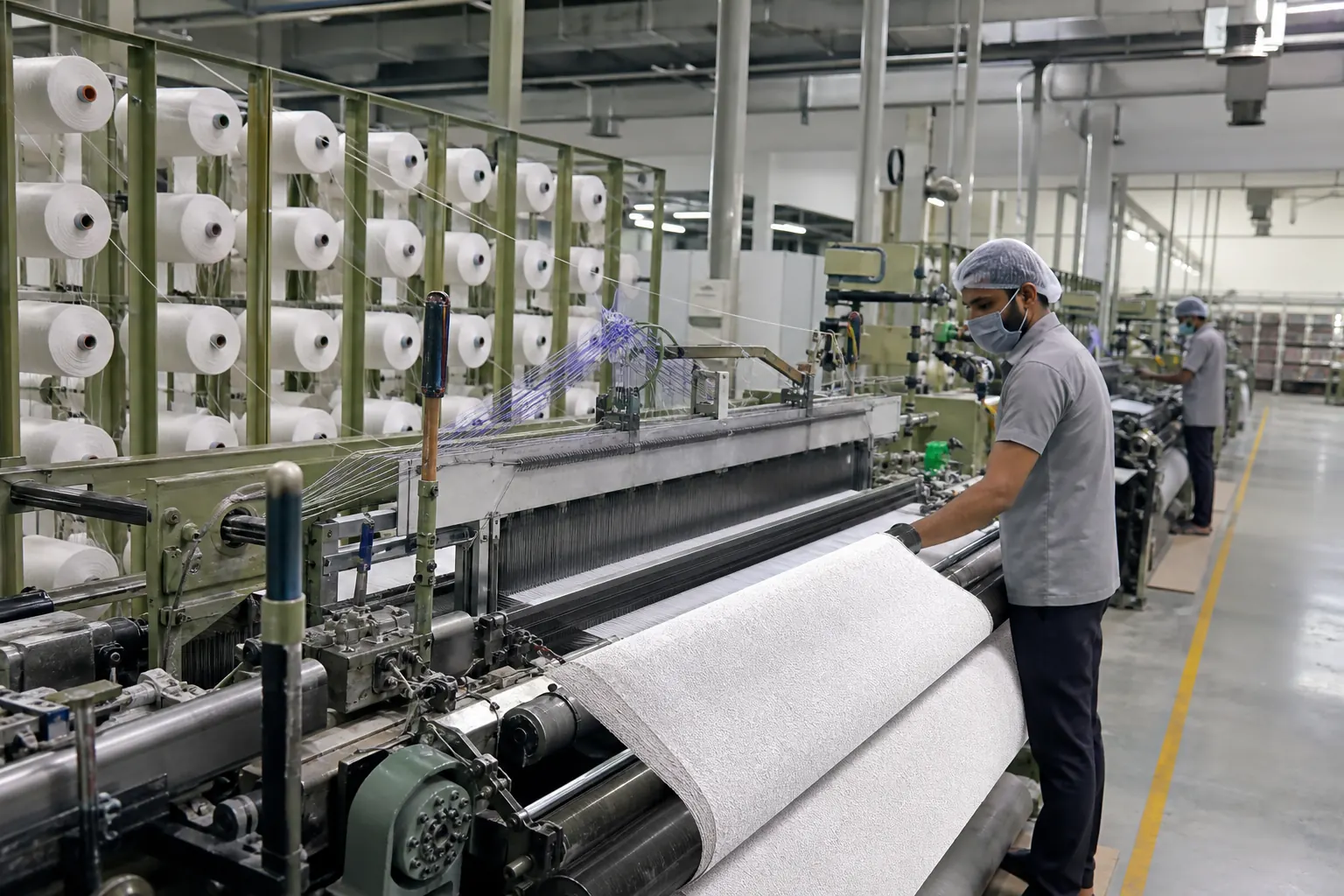
Terry towel production commonly moves through yarn sourcing, winding or preparation, warping, weaving, wet processing, drying, cutting, hemming, inspection, packing, and dispatch. Depending on the factory and program, bleaching, dyeing, softening, shearing, embroidery, and special finishes add process steps. The merchant exporter’s job is to map who controls each stage and preserve approved parameters through production.
Comparison table
Swipe →
Data table — swipe horizontally on small screens
| Stage | Hospitality risk | Control evidence |
|---|---|---|
| Yarn and lot allocation | Different hand, lint, or strength across reorders | Yarn specification and lot records |
| Warping/weaving | Variable pile, borders, width, or weight | Loom plan and in-process checks |
| Bleaching/dyeing | Shade, whiteness, absorbency, chemical residue | Recipe control and lot test report |
| Finishing | Over-softening can mask absorbency issues | Approved finish and absorbency trial |
| Cutting/hemming | Skew, size variation, seam failure | Measurement and seam inspection |
| Laundry simulation | Unexpected shrinkage or appearance loss | Agreed wash protocol and retained samples |
| Packing | Moisture, assortment errors, carton weakness | Packing audit and carton marks |
Laundry durability: define “acceptable” — acceptance criteria by checkpoint
Comparison table
Swipe →
Data table — swipe horizontally on small screens
| Trial checkpoint | Measurements | Possible rejection trigger |
|---|---|---|
| Before wash | Weight, dimensions, shade/whiteness, visual defects | Outside purchase tolerance |
| After 1–5 cycles | Initial shrinkage, absorbency, lint, hand | Excessive dimensional change or lint |
| After 20 cycles | Hem security, pile loss, appearance | Seam opening, distortion, unacceptable shade |
| After 50 cycles | Weight retention, edge wear, guest-facing appearance | Below buyer’s serviceability score |
| Extended trial | Continue to program-specific endpoint | Retirement according to documented criteria |
Quoting a wash-cycle number without a shared protocol is weak evidence. Water hardness, detergent chemistry, bleaching system, temperature, extraction, dryer temperature, load factor, finishing chemistry, and operator practice materially affect results. A sensible approval trial records the process and evaluates at agreed intervals.
Linen Par, Replenishment, and Total Inventory
“Three par” is a common starting concept—one set in use, one in processing, and one available—but it is not a law or universal optimum. An outsourced laundry with a long turnaround, remote resort, seasonal peak, or frequent loss may need more. An on-premise laundry with short cycles and strong controls may operate differently.
A transparent planning model — opening-stock formula
Comparison table
Swipe →
Data table — swipe horizontally on small screens
| Replenishment input | What to track monthly | Decision use |
|---|---|---|
| Occupied room nights | Actual by property and season | Normalize consumption |
| Pieces issued/returned | By SKU and department | Detect leakage or process loss |
| Permanent stains | Count and cause | Adjust chemistry or housekeeping |
| Hem/pile failures | Count and production lot | Trigger supplier corrective action |
| Missing pieces | Net inventory variance | Set controlled loss buffer |
| Laundry turnaround | Hours by weekday/peak | Set working par |
| Retirements | Units and reason | Forecast reorder |
| Lead time variability | PO-to-receipt range | Define safety stock |
For each SKU:
Opening units = rooms × pieces per occupied room × operational par × peak occupancy factor + event/spa demand + opening reserve.
Example scenario: 200 rooms × 2 bath towels × 3.2 par × 95% peak occupancy = 1,216 towels. Adding a separately justified 10% opening reserve produces about 1,338 towels. The 3.2 par and 10% are assumptions, not recommendations; replace them with observed laundry turnaround, loss, and retirement data.
Pricing Analysis: Cost per Acceptable Use
Buyer Tip
The following model contains hypothetical planning inputs dated July 17, 2026 for testing a spreadsheet. It is not an Altus quote, observed range, typical price, recommendation, or market benchmark. Replace every value with dated supplier quotations tied to SKU, quantity, packing, Incoterm place/version, payment terms, quote validity, and required evidence before making a procurement decision.
Price moves with cotton and yarn cost, dimensions, GSM, yarn construction, pile ratio, dyeing, whiteness, borders, hems, embroidery, tolerances, testing, packing, order mix, factory utilization, Incoterm, and payment terms. Compare like-for-like landed specifications.
Cost per acceptable use = landed piece cost ÷ accepted service uses before retirement.
A US$5.00 landed towel retired after 100 accepted uses costs US$0.050 per use. A US$6.50 towel retired after 180 accepted uses costs about US$0.036 per use. Both cycle counts are scenario assumptions. Hotels should populate the model with controlled pilot results and actual retirement logs.
Comparison table
Swipe →
Data table — swipe horizontally on small screens
| Hypothetical scenario item | Hypothetical FOB input | Required replacement evidence |
|---|---|---|
| Washcloth, 30 × 30 cm, 475 GSM | US$0.50/piece | Dated SKU-specific quotation |
| Hand towel, 40 × 70 cm, 475 GSM | US$1.25/piece | Dated SKU-specific quotation |
| Bath towel, 70 × 140 cm, 500 GSM | US$4.25/piece | Dated SKU-specific quotation |
| Bath sheet, 90 × 160 cm, 600 GSM | US$8.00/piece | Dated SKU-specific quotation |
| Bath mat, 50 × 75 cm, buyer-defined construction | US$2.70/piece | Dated construction-specific quotation |
MOQ Analysis
Buyer Tip
MOQs are commercial, not regulatory. A manufacturer may set minimums by color, size, loom setup, dye lot, embroidery design, or carton. A merchant exporter may consolidate compatible products, but consolidation cannot erase process minimums.
Use an annual blanket forecast with scheduled call-offs only when ownership, storage, shade-lot controls, cancellation terms, and aged inventory are contractually clear.
Comparison table
Swipe →
Data table — swipe horizontally on small screens
| Order type | Hypothetical planning MOQ | Evidence required before use |
|---|---|---|
| Existing white institutional construction | 1,000 pieces/SKU | Written supplier offer for named SKU |
| Custom GSM/size/border | 2,000 pieces/SKU | Written setup and allocation terms |
| Piece-dyed custom shade | 3,000 pieces/color | Written dye-lot minimum |
| Embroidered property identifier | 1,000 pieces/design | Written embroidery minimum |
| Multi-property annual program | Buyer-entered release quantity | Signed forecast, storage, and release terms |
Packaging Standards
Export Tip
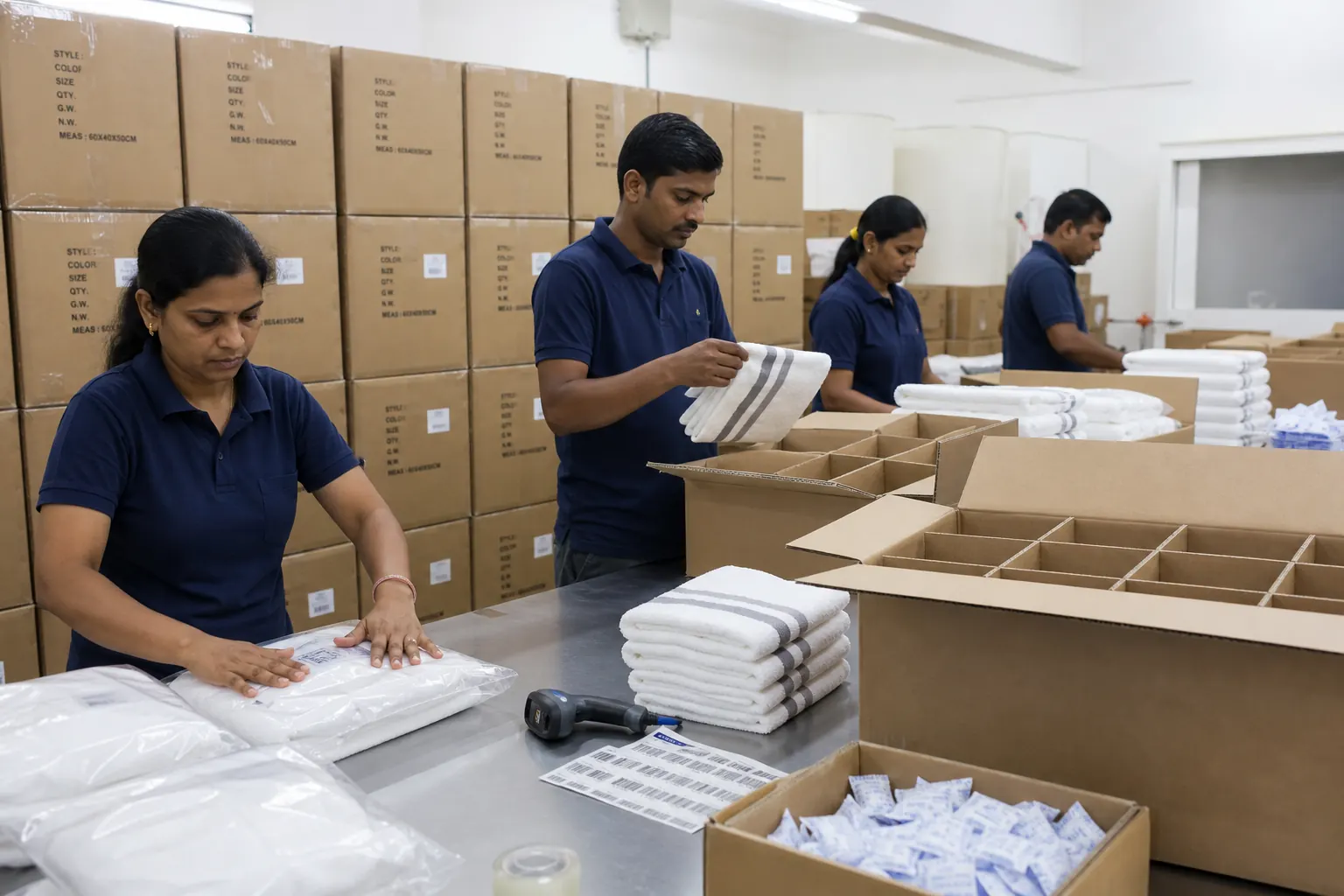
Institutional towels generally need efficient, moisture-protected bulk packing rather than consumer-facing decoration. Agree the count per inner pack and carton, fold, assortment, barcode if needed, carton dimensions, gross/net weight, carton strength, liner or bag use, shipping marks, and pallet rules.
Container Loading Details
Export Tip
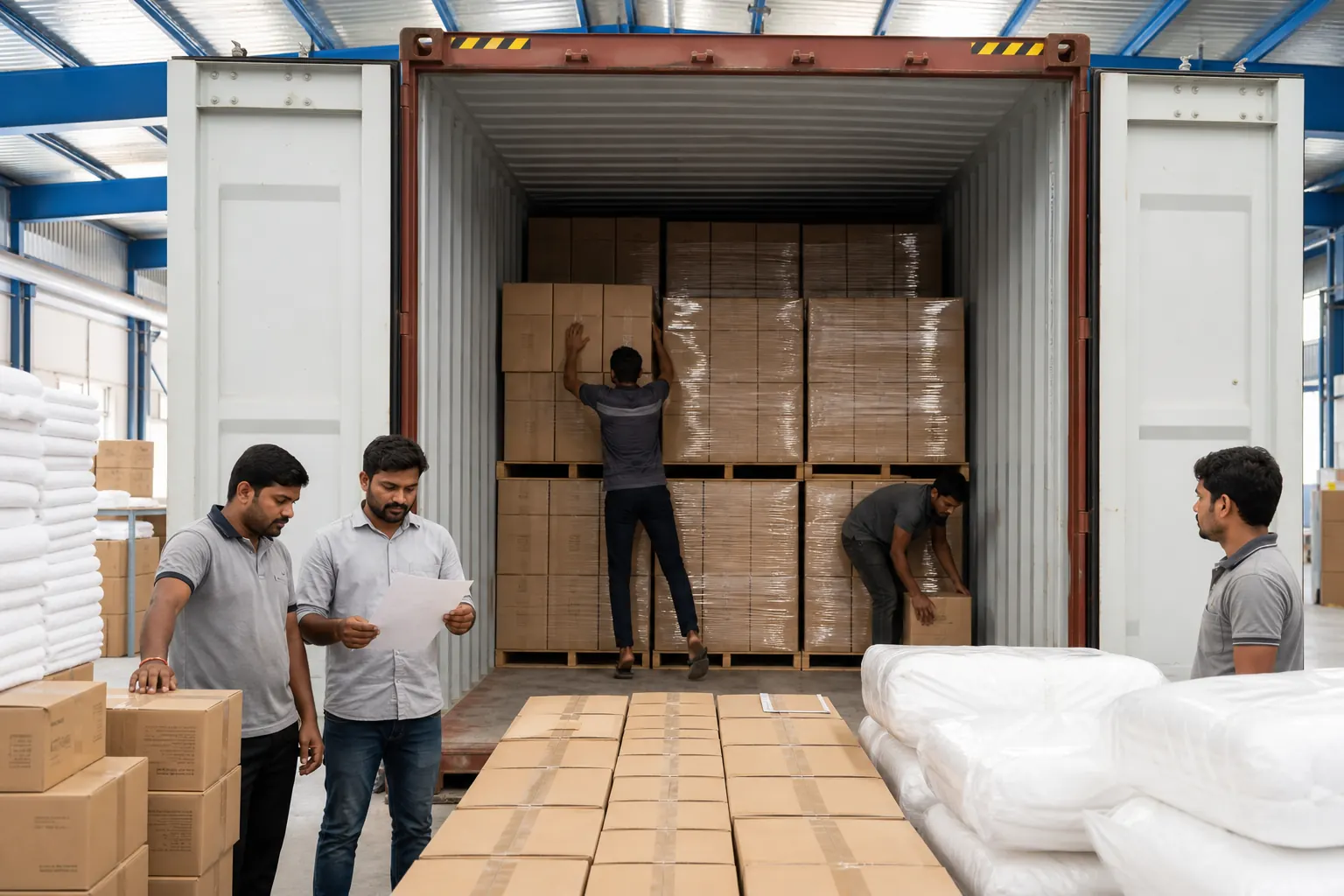
Capacity depends on compressed or uncompressed volume, towel mix, cartons, pallets, legal payload, container internal dimensions, and carrier limits. Weight rarely tells the full story because finished towels can cube out first.
These are CMA CGM’s published nominal equipment specifications, not a towel loading promise. No generic mixed-piece capacity is reproducible without approved folded dimensions, pack-out, measured cartons, packed weights, palletization, compression method, stowage loss, route limits, assigned equipment, and carrier acceptance.
Comparison table
Swipe →
Data table — swipe horizontally on small screens
| Dry equipment reference | Published nominal internal dimensions | Published nominal volume | Shipment-specific control |
|---|---|---|---|
| 20-foot standard | 5,900 × 2,352 × 2,393 mm | 33.2 m³ | Assigned CSC plate and measured carton plan |
| 40-foot standard | 12,034 × 2,352 × 2,395 mm | 67.8 m³ | Booking, route limits, weight distribution |
| 40-foot high cube | 12,034 × 2,352 × 2,700 mm | 76.4 m³ | Door clearance, pallets, dunnage, payload |
Shipping Methods and Lead-Time Planning
Export Tip
Ocean freight is the normal mode for replenishment and opening stock because towels are bulky relative to value. Less-than-container load can support pilots but adds handling and consolidation risk. Air freight is appropriate for samples or an expensive stockout, not routine replenishment.
For a hypothetical schedule model dated July 17, 2026, a buyer might enter 10 days for specification/sample alignment, 45 days for production after approvals, and 30 days for port-to-port transit. These are invented planning inputs—not typical ranges, evidence, quotations, or service promises. Replace them with the supplier’s dated production plan and the carrier’s named-service schedule, then add inspection, booking, transshipment, customs, and inland-delivery contingencies.
Use FOB, FCA, CFR, or CIF under Incoterms 2020 only after assigning freight, insurance, risk transfer, terminal costs, and import clearance; the specialist guide explains how to prepare export documents. For deeper landed-cost modeling, budget a replenishment program.
Certifications, Testing, and What Is Actually Required
Compliance Notes
Legal compliance and certification are different. A destination may mandate fiber labeling, origin marking, chemical restrictions, or accurate claims. A hotel group may additionally require an audited quality system, social audit, restricted-substances test, or preferred sustainability standard.
OEKO-TEX states that STANDARD 100 tests textiles and accessories against more than 1,000 harmful substances, with stricter criteria for more intensive skin contact. GOTS Version 8 was released in March 2026 but becomes effective March 1, 2027; in July 2026, buyers must verify which standard version appears on valid scope and transaction documentation.
Comparison table
Swipe →
Data table — swipe horizontally on small screens
| Evidence | What it addresses | Status |
|---|---|---|
| OEKO-TEX STANDARD 100 | Product tested against harmful-substance criteria | Voluntary unless contract requires |
| GOTS | Organic fiber and certified processing chain; Version 7 effective in 2026, Version 8 effective March 1, 2027 | Voluntary claim system |
| ISO 9001 | Quality management system | Voluntary; scope and certificate matter |
| Sedex/SMETA or amfori BSCI | Social-audit framework or program | Buyer-program requirement, not product law |
| ISO 6330:2021 | Domestic washing/drying test procedures | Voluntary method; commercial laundry needs buyer-specific protocol |
| Third-party inspection/testing | Lot conformity to agreed tests | Contractual control |
Buyer Requirements and Country Opportunities
Buyer Requirements
Market Snapshot
Law versus procurement program
Comparison table
Swipe →
Data table — swipe horizontally on small screens
| Market | Sourced signal or hypothesis | Tariff/compliance checkpoint dated July 17, 2026 |
|---|---|---|
| United States | Sourced: largest India-reported 2024 destination row; hotel/distributor fit remains a buyer hypothesis | Verify HTS statistical line, duty, and current measures in live HTS/CBP tools; apply FTC labeling |
| United Kingdom | Sourced destination flow; hospitality-distribution fit is a hypothesis | Standard third-country rate is 12%; qualifying Indian-origin goods may claim UK-India CETA preference from July 15, 2026, subject to the live line, staging, origin rule, and proof |
| EU | Hotel, spa, and laundry positioning is a market hypothesis | Verify TARIC by member state/date; comply with fibre labeling and applicable product rules |
| Canada | Sourced destination flow; institutional-channel fit is a hypothesis | Confirm the live tariff treatment, origin, fibre/dealer labeling, and bilingual details with CBSA and importer |
| Australia | Sourced destination flow; resort and spa positioning is a hypothesis | Apply the Consumer Goods (Care Labelling) Information Standard 2023 where covered; read its exemptions and verify current tariff |
| Japan | Sourced destination flow; hospitality/onsen positioning is a hypothesis | Confirm the 2026 national line, origin treatment, Japanese label requirements, and proof with importer/customs |
| UAE | Hospitality and redistribution positioning is a hypothesis | Use the UAE tariff system and confirm exact product scope, conformity, Arabic presentation, and importer obligations |
The United States FTC Textile Fiber Rule generally requires covered textile products, including towels, to disclose generic fiber names and percentages by weight, responsible company identity or RN where available, and country of origin. The EU requires fiber-composition labeling under Regulation (EU) No 1007/2011; consumer-market language and attachment rules must be checked. Canada requires fiber content and dealer identity, with fiber information generally in English and French. These are destination rules, not a universal global label.
Country duties change. Do not quote a preference without proving origin. In the UK, the standard third-country rate is 12%, while qualifying Indian-origin goods may claim UK-India CETA preference from July 15, 2026 only if the live commodity line, staging category, product-specific origin rule, and documentary proof support it. Australia’s current mandatory instrument is the Consumer Goods (Care Labelling) Information Standard 2023; it covers household textiles broadly but contains regulated-scope details and exemptions that must be checked for the exact article.
Expert Insights from Saurabh Mittal — Draft for Founder Review
Expert Insight Box
Procurement Checklists
Checklist
Sourcing Checklist
- [ ] Map property tier, room count, occupancy, amenities, spa/pool demand, and laundry model.
- [ ] Define every SKU by finished size, weight/GSM, fiber, construction, color, border, and hem.
- [ ] Issue one controlled RFQ and require deviations to be marked.
- [ ] Approve samples after a documented laundry trial.
- [ ] Compare landed cost per acceptable use.
- [ ] Verify manufacturing, wet-processing, embroidery, and packing locations.
- [ ] Follow the complete workflow to import hotel towels from India.
- [ ] Qualify an institutional supplier with capability and reference evidence.
Buyer Checklist
- [ ] Calculate opening par and reorder point from operating data.
- [ ] Provide destination label artwork and importer details.
- [ ] Nominate test methods, tolerances, inspection level, and defect rules.
- [ ] Review certificates in the issuing body’s database and confirm scope.
- [ ] Approve pre-production and shipment samples.
- [ ] Book safety stock before peak occupancy, not after a stockout.
- [ ] Choose hotel towel GSM and construction from end use.
- [ ] Set laundry-performance tests and acceptance criteria.
Exporter Checklist
- [ ] Confirm IEC and applicable Indian export registrations.
- [ ] Freeze product specification, packing BOM, Incoterm, payment, and timeline.
- [ ] Reserve yarn/process capacity and identify subcontractors.
- [ ] Maintain shade/whiteness and production-lot records.
- [ ] Coordinate inspection, commercial invoice, packing list, origin evidence, and transport document.
- [ ] Keep counter-samples and close corrective actions before dispatch.
Compliance Checklist
- [ ] Confirm six-digit HS and destination tariff line with the importer’s broker.
- [ ] Separate mandatory laws from voluntary hotel-group standards.
- [ ] Validate fiber, origin, responsible-party, language, and care information.
- [ ] Test claims such as organic, recycled, antimicrobial, or “Egyptian cotton” before use.
- [ ] Check chemical restrictions and buyer restricted-substances list.
- [ ] Verify packaging, wood, recycling, and importer obligations.
Common Buyer Mistakes
Common Mistakes Box
- Buying GSM instead of performance. Equal-GSM towels can differ in dimensions, pile ratio, yarn, finish, and durability.
- Approving an unwashed sample. Initial softness may come from finish and may not predict absorbency or lifecycle.
- Using a generic cycle claim. A cycle count without method and retirement criteria is not comparable evidence.
- Underestimating turnaround. Customs, inland transport, quality holds, and holiday capacity matter beyond production days.
- Mixing grades in one laundry. Similar-looking pieces with different shrinkage and drying profiles disrupt sorting.
- Ignoring reorder identity. Without an approved spec code and retained sample, a “same towel” reorder may drift.
- Assuming certificates are laws. This wastes effort in one market and misses actual labeling or chemical duties in another.
Future Trends
Hospitality programs are moving toward measurable lifecycle data: lot-linked retirements, automated linen counting, lower-temperature chemistry, energy-aware dryer planning, and scorecards that connect textile performance to laundry cost. Buyers will increasingly ask for traceability and substantiation of fiber and environmental claims rather than accepting marketing language.
The market-entry hypothesis for India is not simply heavier or softer towels. It is that repeatable institutional programs can compete through controlled specifications, testing evidence, responsive replenishment, and export documentation. Buyers should test that hypothesis with program-specific evidence. Sustainability review will also shift from one certificate to several auditable questions: fibre origin, processing chemistry, water and energy data, packaging, durability, and end-of-life route.
Expert Insights from Saurabh Mittal — Draft for Founder Review
Expert Insight Box
Conclusion and CTA
A capable hotel towel supplier in India should help create a controlled operating asset: a towel grade that survives the buyer’s laundry process, supports guest standards, fits dryer capacity, and can be replenished without specification drift. India’s export scale is a useful starting signal, but qualification rests on samples, production controls, transparent tests, and destination compliance.
For a hospitality or institutional sourcing brief, contact Altus Exports with property type, destination, SKU list, finished dimensions, target performance, annual volume, laundry protocol, certification needs, and required delivery window. Explore Altus’s textiles and home furnishings industry support, merchant exporter service, and global sourcing partner service.
Sources and Verification Notes
- WITS/UN Comtrade, India HS 630260 exports by destination, 2024: https://wits.worldbank.org/trade/comtrade/en/country/IND/year/2024/tradeflow/Exports/partner/ALL/product/630260
- WITS/UN Comtrade, HS 630260 exporter reporter rows, 2024: https://wits.worldbank.org/trade/comtrade/en/country/ALL/year/2024/tradeflow/Exports/partner/WLD/product/630260
- UN Comtrade, bilateral asymmetries: https://uncomtrade.org/docs/bilateral-asymmetries/
- US FTC, Textile Fiber Rule: https://www.ftc.gov/legal-library/browse/rules/textile-fiber-rule
- US FTC, textile labeling guidance: https://www.ftc.gov/business-guidance/resources/threading-your-way-through-labeling-requirements-under-textile-wool-acts
- European Union, Regulation (EU) No 1007/2011: https://eur-lex.europa.eu/eli/reg/2011/1007
- Your Europe, Textile Label: https://europa.eu/youreurope/business/product-requirements/labels-markings/textile-label/index_en.htm
- Canada Competition Bureau, textile labeling: https://competition-bureau.canada.ca/en/labelling/textile-labelling/textile-labelling-requirements
- Canada Border Services Agency, Customs Tariff 2026 Chapter 63: https://www.cbsa-asfc.gc.ca/trade-commerce/tariff-tarif/2026/html/00/ch63-eng.html
- UK Integrated Online Tariff, heading 6302: https://www.trade-tariff.service.gov.uk/headings/6302
- UK Government, UK-India CETA trade in goods: https://www.gov.uk/government/publications/uk-india-ceta-chapter-2-trade-in-goods
- Japan Customs, 2026 Chapter 63 tariff: https://www.customs.go.jp/english/tariff/2026_01_01/data/e_63.htm
- OEKO-TEX STANDARD 100: https://www.oeko-tex.com/en/our-standards/oeko-tex-standard-100
- GOTS Version 8.0: https://gotslive.global-standard.org/images/resource-library/documents/standard-and-manual/GOTS_v8.0_signed.pdf
- ISO 6330:2021: https://www.iso.org/standard/75934.html
- ACCC Product Safety, Care labelling for clothing and textiles mandatory standard: https://www.productsafety.gov.au/business/search-mandatory-standards/care-labelling-for-clothing-and-textiles-mandatory-standard
- Federal Register of Legislation, Consumer Goods (Care Labelling) Information Standard 2023: https://www.legislation.gov.au/F2023L01187/asmade/text
- CMA CGM, container specifications: https://www.cma-cgm.com/products-services/containers
All URLs accessed July 17, 2026. Commercial scenarios are explicitly labeled and should be refreshed at RFQ.