
Terry Towel Export Documentation: HS Codes, Packaging, Containers and Shipping From India
By Altus Exports
A practical 2026 guide to terry towel HS classification, invoices, packing lists, Shipping Bills, bills of lading, Certificates of Origin, ISF data, carton CBM, container loading, moisture controls, freight modes, and Incoterms for buyers sourcing from India.

International towel procurement does not end when a sample is approved. A commercially correct towel can still be delayed by a wrong tariff code, inconsistent invoice data, late Importer Security Filing inputs, weak moisture protection, or a loading plan based on an imaginary “standard pieces per container.” This guide explains terry towel export documentation from purchase order to destination clearance for importers, distributors, hospitality suppliers, retailers, and private-label programs.
Altus Exports operates as an Indian merchant exporter, global sourcing partner, and export consulting expert. We coordinate qualified manufacturing, product specifications, inspection, document control, packaging engineering, freight handoffs, and buyer-side data readiness. The importer and its licensed broker retain responsibility for destination classification, entry, duties, and local compliance.
Executive Summary
Summary Box
Cotton terry toilet and kitchen linen generally falls within six-digit HS 630260; man-made-fiber toilet and kitchen linen may fall within HS 630293. Fiber composition, construction, use, and destination tariff schedules determine the final national tariff line. A complete shipment file normally connects the purchase order, commercial invoice, packing list, Indian Shipping Bill, transport document, and—when requested or preference is claimed—Certificate of Origin. Sea shipments to the United States also require buyer-controlled ISF data on regulatory timelines.
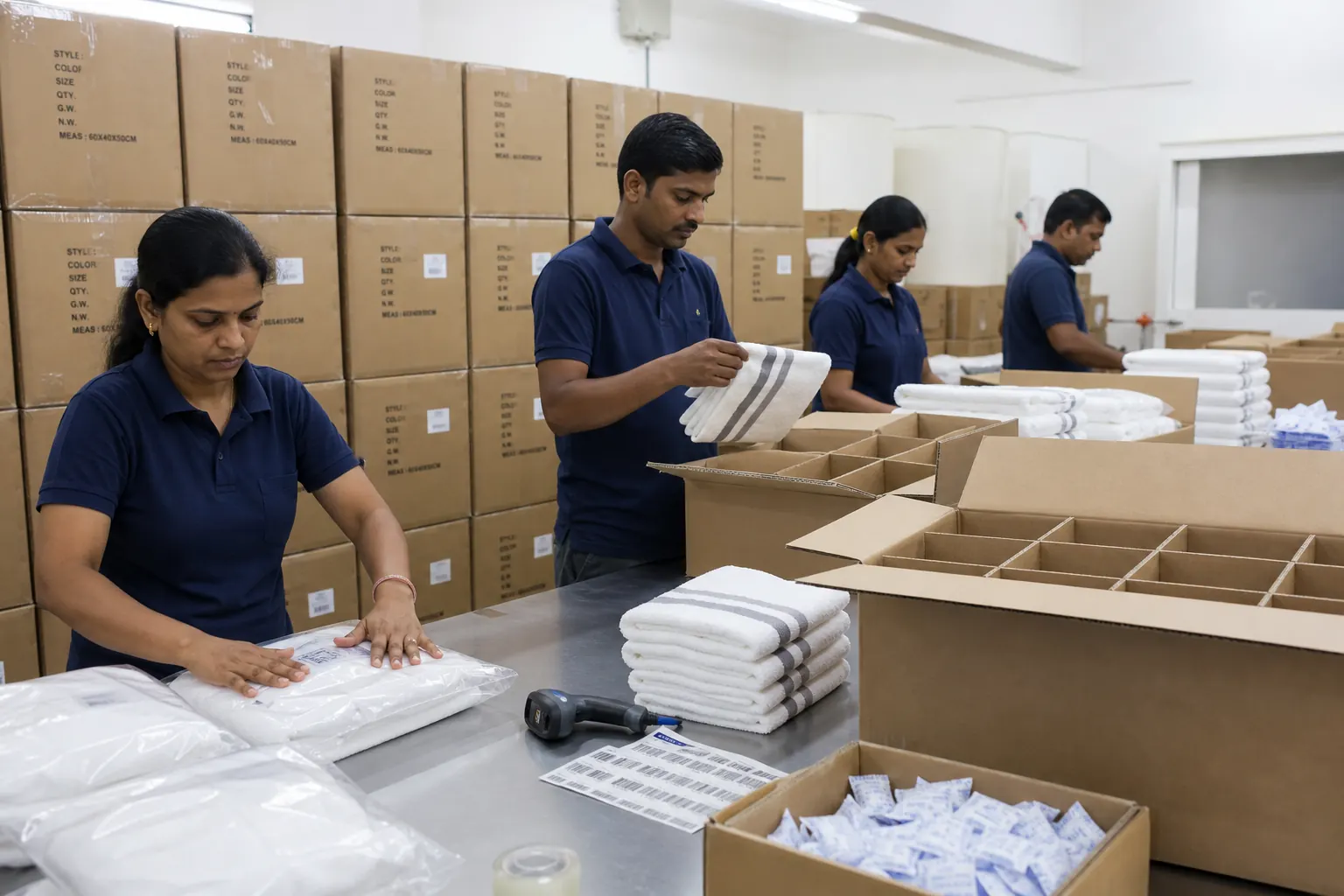
Packaging must be engineered from towel dimensions, GSM, fold, compression, pieces per polybag, carton dimensions, gross weight, and verified container equipment. Carton CBM equals length × width × height in meters. Loading estimates should apply an explicit utilization factor and then be checked by physical carton orientation, door dimensions, payload, palletization, and ventilation needs. Moisture prevention begins with dry goods, dry cartons, a container inspection, humidity-aware loading, and correctly selected desiccants—not simply adding plastic.
Key Takeaways
Summary Box
- “Terry towel” is not itself a complete customs classification.
- HS 630260 covers cotton toilet and kitchen linen of terry toweling or similar terry fabrics; HS 630293 addresses other toilet and kitchen linen of man-made fibers.
- The commercial invoice declares the transaction; the packing list describes physical packing.
- The Indian Shipping Bill is the customs export declaration, while the bill of lading is the carrier transport document.
- U.S. ISF is the importer’s filing responsibility, although the exporter supplies several data elements.
- CBM and container quantities are SKU-specific calculations, never universal towel counts.
- Moisture, odor, carton crush, shade mixing, and count errors are logistics risks that belong in the purchase specification.
Market Size and Industry Overview
Key Statistics
The most decision-useful market measure is the customs category, not a loosely defined commercial “towel market.” WITS, using UN Comtrade records and the HS 1988/92 presentation, reports 2024 world trade in HS 630260. The category includes cotton toilet and kitchen linen of terry toweling or similar terry fabrics; it can include more than bath towels, so it should not be represented as bath-towel-only revenue.
Export Statistics
Comparison table
Swipe →
Data table — swipe horizontally on small screens
| 2024 HS 630260 indicator | Value | Quantity | Procurement meaning |
|---|---|---|---|
| China world exports | US$1.920 billion | 238.528 million kg | Largest reported exporter |
| India world exports | US$1.151 billion | 201.385 million kg | Second-largest reported exporter |
| Pakistan world exports | US$1.085 billion | 228.597 million kg | Major cost and capacity competitor |
| Turkey world exports | US$567.950 million | 61.899 million kg | Strong regional supplier |
| Portugal world exports | US$223.933 million | 18.377 million kg | Higher-value European positioning |
These are gross trade values and quantities, not factory sales, market consumption, or Altus performance. Buyers should also recognize mirror-data differences, revisions, re-exports, and the broader scope of HS 630260.
Terry Towel HS Classification
Compliance Notes
HS 630260 versus HS 630293 — Six-digit heading first, national tariff line second
Comparison table
Swipe →
Data table — swipe horizontally on small screens
| Classification question | HS 630260 | HS 630293 |
|---|---|---|
| Product family | Toilet and kitchen linen | Toilet and kitchen linen |
| Material | Cotton | Man-made fibers |
| Construction language | Terry toweling or similar terry fabrics | “Other” toilet/kitchen linen of man-made fibers |
| Typical towel example | 100% cotton woven terry bath towel | Polyester or qualifying man-made-fiber towel |
| Buyer action | Confirm national tariff line | Confirm fiber rules and national tariff line |
Blended products require additional analysis. The invoice should not force a code from a marketing name. Obtain composition, construction, intended use, product photos, and test evidence, then ask the importer’s customs broker for a destination-specific decision. National schedules extend beyond six digits; U.S. HTSUS, EU Combined Nomenclature, UK Trade Tariff, and other systems may create different statistical or duty breakouts.
Classification data sheet
Comparison table
Swipe →
Data table — swipe horizontally on small screens
| Data field | Example specification | Why customs or broker needs it |
|---|---|---|
| Commercial identity | Bath towel, hand towel, washcloth | Establishes intended use |
| Fiber composition | 100% cotton by weight | Distinguishes cotton/man-made categories |
| Fabric | Woven loop terry | Confirms terry construction |
| Size and GSM | 70 × 140 cm, 550 GSM | Supports identity and valuation review |
| Finish | Yarn dyed, hemmed, washed | Clarifies processing |
| Set presentation | Single item or coordinated set | May affect classification analysis |
| Country of origin | India, subject to origin rules | Drives marking and tariff treatment |
Export Documentation Workflow
Core Indian and transport documents
Comparison table
Swipe →
Data table — swipe horizontally on small screens
| Document | Primary purpose | Prepared/issued by | Control point |
|---|---|---|---|
| Purchase order/contract | Commercial instructions | Buyer and seller | Version, SKU, Incoterm, payment |
| Commercial invoice | Value and customs declaration basis | Exporter | Parties, currency, origin, HS, values |
| Packing list | Physical packing statement | Exporter | Cartons, pieces, net/gross weight, CBM |
| Shipping Bill | Indian export customs declaration | Exporter/broker via ICEGATE | IEC, scheme, port, invoice, classification |
| Bill of lading | Cargo receipt and evidence of the carriage contract; negotiable forms may function as documents of title | Carrier/NVOCC | Shipper, consignee, marks, packages |
| Air waybill | Air transport receipt/contract | Airline/forwarder | Chargeable weight, routing, consignee |
| Certificate of Origin | Origin evidence | Authorized issuer under applicable process | Preferential versus non-preferential basis |
| Insurance certificate | Cargo cover evidence | Insurer/broker | Insured value, voyage, exclusions |
ICEGATE’s official web-forms manual identifies electronic forms including the Shipping Bill. The Shipping Bill supports customs assessment and Let Export Order processing; it is not interchangeable with a carrier bill of lading. DGFT made filing through the upgraded eCoO 2.0 system mandatory for preferential Certificate of Origin applications from January 17, 2025. This was an application-platform migration, not a new 2026 origin rule. A Certificate of Origin is not automatically required for every shipment; buyer-country rules, trade-agreement claims, banks, tenders, or contracts determine the need.
Commercial invoice controls
The invoice should identify seller, buyer, consignee when different, invoice number and date, PO, currency, Incoterm and named place, shipment terms, SKU-level descriptions, composition, quantities, unit prices, line values, total value, country of origin, packages, weights, and agreed HS references. Freight and insurance should be separately shown when valuation rules or terms require them. Do not write “samples/no commercial value” when customs requires a realistic value.
Packing list controls
The packing list should reconcile to the invoice but answer physical questions: shipping marks, carton range, SKU/color/size by carton, pieces, net weight, gross weight, carton dimensions, per-carton cube, total CBM, pallet count and dimensions if any. For mixed cartons, provide a carton-level matrix. Net textile weight, inner packaging, and outer packaging should not be confused.
Shipping Bill, B/L and Certificate of Origin
The customs broker files the Indian Shipping Bill using exporter and shipment data. After customs permission and physical movement, carrier documentation proceeds toward draft and final B/L issuance. The exporter and buyer should approve the draft against the letter of credit, invoice, packing list, and booking. For a preferential COO, origin must satisfy the relevant agreement’s product-specific rule; “shipped from India” alone does not prove preferential origin.
ISF and Destination Documents
For most U.S.-bound cargo arriving by vessel, 19 CFR 149.2 requires the ISF importer or authorized agent to transmit specified information through a CBP-approved system. Seller, buyer, importer of record/FTZ applicant number, consignee number, manufacturer or supplier, ship-to party, country of origin, and six-digit commodity HTSUS are generally due no later than 24 hours before foreign loading. Container stuffing location and consolidator have the later rule stated in the regulation. Changes must be updated when required.
Destination documents may include broker power of attorney, entry summary, customs bond, import license where applicable, textile fiber/care labels, conformity declarations, test reports, wood-packaging proof, and preference evidence. Requirements change. All duty, tax, sanctions, product-safety, and filing statements in this article are reviewed as of July 17, 2026; the importer should recheck official sources before shipment.
Comparison table
Swipe →
Data table — swipe horizontally on small screens
| Destination | Typical buyer-side readiness items | Timing/control note |
|---|---|---|
| United States | ISF for vessel cargo, customs bond, entry data, HTSUS, origin marking, textile labeling | Broker confirms current CBP/FTC requirements |
| European Union | EORI, customs declaration, CN/TARIC, importer product-compliance file, fiber labeling | Check member-state and EU rules at import date |
| United Kingdom | GB EORI, UK tariff code, customs declaration, labeling | Importer/broker validates duty/VAT |
| Canada | Business/import account, tariff classification, customs invoice data, textile labeling | Confirm bilingual and provincial considerations |
| Australia | Import declaration, tariff, biosecurity and packaging review | Wood and contamination controls matter |
| UAE/GCC | Importer registration, customs declaration, COO/invoice attestations if requested | Requirements vary by emirate/program |
Product Variants and Logistics Effects
Comparison table
Swipe →
Data table — swipe horizontally on small screens
| Variant | Logistics effect | Document/specification note |
|---|---|---|
| 400–500 GSM retail towel | Lower unit weight, often more pieces per carton | State finished GSM tolerance |
| 550–700 GSM premium towel | Higher weight and compression resistance | Check carton gross-weight limit |
| White institutional towel | Dense bale/carton programs possible | Control whiteness, wash durability, lot |
| Yarn-dyed towel | Shade segregation and colorfastness risk | Put color name/code on all documents |
| Jacquard/logo towel | SKU complexity and artwork approval | Identify design and IP authorization |
| Towel set | Retail pack creates void and mixed weights | Define set composition and HS review |
| Recycled-content blend | Certification/claim documents may apply | Declare exact composition and claim basis |
Manufacturing Controls Before Documentation
Towel documentation becomes reliable only when manufacturing data is controlled. A typical sequence is yarn sourcing, winding, warping, weaving, greige inspection, pretreatment, dyeing or bleaching, washing, hydro extraction, drying, finishing, cutting, hemming, label attachment, metal control where requested, final inspection, folding, and packing. GSM after finishing, finished dimensions after conditioning, shrinkage, absorbency, colorfastness, pile pull, seam strength, and weight drive commercial and logistics records.
Use a preproduction sample and sealed packing sample. Record actual packed carton dimensions after compression recovery, not the empty-carton dieline. Weigh multiple cartons across SKUs and use the highest credible operating figure for handling limits. Final inspection should verify SKU counts, carton marks, barcodes, assortment, odor, dampness, and random gross weights before the packing list is finalized.
Pricing, MOQ and Landed-Cost Structure
Towel prices depend on cotton/yarn, GSM, finished dimensions, construction, pile yarn, dye/bleach recipe, color depth, finishing, labels, retail packaging, testing, certification scope, order mix, wastage, payment terms, and Incoterm. There is no responsible universal per-piece export price.
MOQ is usually driven by yarn/dye lot, loom and processing economics, color count, custom trims, carton print run, and certification segregation. A merchant exporter can consolidate supplier management and mixed procurement, but consolidation does not erase factory-level technical minimums. Buyers should request MOQ by SKU, color, design, packaging type, and repeat status.
Comparison table
Swipe →
Data table — swipe horizontally on small screens
| Cost layer | Typical content | Buyer control |
|---|---|---|
| Ex-works product | Manufacturing, standard packing, margin | Lock technical and packing spec |
| Export/local logistics | Inland haulage, handling, customs/broker, documentation | Define inclusion in quote |
| International freight | Ocean/air/courier, surcharges | Compare routing and validity |
| Insurance | Cargo risk cover | Review exclusions and deductible |
| Destination | Duty, tax, brokerage, port, demurrage, delivery | Model with importer/broker |
| Risk reserve | Inspection, delay, rework, FX | Assign realistic contingency |
Packaging Calculations and CBM
Carton calculation method
Comparison table
Swipe →
Data table — swipe horizontally on small screens
| Scenario input | Assumption | Formula/result |
|---|---|---|
| External carton | 60 × 40 × 40 cm | 0.096 CBM |
| Towels per carton | 24 pieces | Buyer-approved fold |
| Order | 12,000 pieces | 500 cartons |
| Cargo cube | 500 × 0.096 | 48.00 CBM |
| Net towel weight | 0.78 kg × 12,000 | 9,360 kg |
| Packaging weight | 1.5 kg × 500 | 750 kg |
| Estimated gross | Net + packaging | 10,110 kg |
For a math-only hypothetical—not an operating capacity, supplier specification, MOQ, quotation, or shipment promise—assume a finalized export carton measures 60 × 40 × 40 cm externally and contains 24 bath towels. Its CBM is:
`0.60 m × 0.40 m × 0.40 m = 0.096 m³ per carton`
If the order contains 12,000 pieces:
`12,000 ÷ 24 = 500 cartons`
`500 × 0.096 = 48.00 m³ theoretical cargo cube`
If each towel’s packed net weight averages 0.78 kg, net goods weight is 9,360 kg. If each loaded carton has 1.5 kg of packaging, estimated gross weight is 10,110 kg. Both figures must be replaced by sampled production weights before final documents.
Packaging specification
Define inner polybag or paper band, bag thickness and ventilation, carton board grade, burst/edge-crush requirement, liners, tape pattern, strapping policy, barcode position, shipping marks, maximum gross weight, carton drop expectations, pallet requirements, and restricted packaging substances. Avoid over-compression that permanently crushes pile or causes cartons to rebound and bulge.
Container Loading Plans
Export Tip
Published carrier equipment guides show approximate nominal volumes around 33 m³ for a 20-foot standard, 67 m³ for a 40-foot standard, and 76 m³ for a 40-foot high cube, with dimensions varying by container series. Nominal volume is not usable cargo cube. Carton geometry, orientation, door opening, floor condition, load bracing, airflow, pallets, and operational clearances reduce utilization.
For the hypothetical 0.096-CBM carton, math may apply an arbitrary 85% utilization input solely to demonstrate arithmetic. It is not an operational utilization rate or evidence of container capacity:
Counts use `floor(planning cube ÷ 0.096)` and 24 pieces per carton. They are math-only hypothetical outputs—not operational capacities, guarantees, supplier capabilities, or universal towel counts. A carton-orientation simulation could produce fewer cartons. Confirm actual equipment, internal and door dimensions, payload plate, road weight rules, pallets, and stuffing method before the purchase order is balanced.
Comparison table
Swipe →
Data table — swipe horizontally on small screens
| Equipment scenario | Nominal cube | 85% planning cube | Math-only cartons | Math-only pieces |
|---|---|---|---|---|
| 20-ft standard | 33 m³ | 28.05 m³ | 292 cartons | 7,008 pieces |
| 40-ft standard | 67 m³ | 56.95 m³ | 593 cartons | 14,232 pieces |
| 40-ft high cube | 76 m³ | 64.60 m³ | 672 cartons | 16,128 pieces |

Moisture, Mold and Container Controls
Towels are hygroscopic. Packaging damp goods merely traps risk. Condition finished products, confirm moisture/odor acceptance, keep cartons off wet floors, avoid loading during rain, and inspect the container for holes, daylight, water stains, odor, protrusions, damaged seals, dirty floors, and door-gasket defects. Record container number, seal number, inspection photos, loading photos, and desiccant placement.
Use dry pallets compliant with destination wood-packaging rules when wood is used. Keep cartons away from container walls when the engineered plan requires airflow or condensate protection. Do not claim “mold proof.” Instead, specify preventive controls and evidence: conditioned goods, carton moisture checks where appropriate, container survey, weather log, sealed loading, desiccant calculation, and prompt unloading.
Sea, Air and Courier Shipping
Air chargeable weight generally uses the greater of actual and volumetric weight under the carrier’s applicable divisor. Courier divisors and surcharges vary. Ocean freight quotes have validity windows and may exclude origin/destination charges. Every freight, sailing, transit, cutoff, and production-to-delivery lead figure is route-, carrier-, port-, service-, season-, and date-specific; obtain a current written schedule rather than treating an example as a standard. Compare total landed cost, stockout exposure, handling, claims experience, and lead-time reliability.
Comparison table
Swipe →
Data table — swipe horizontally on small screens
| Mode | Best fit | Cost basis | Main risks |
|---|---|---|---|
| FCL ocean | Large, stable orders | Container plus local charges | Longer transit, condensation, schedule changes |
| LCL ocean | Smaller commercial volume | W/M and consolidation charges | Extra handling, co-loading odor/moisture |
| Air freight | Urgent launches or replenishment | Chargeable weight | Volumetric cost, capacity, security |
| Courier | Samples and very small parcels | Parcel/volumetric tariff | High unit cost, importer/tax surprises |
Incoterms for Terry Towel Contracts
State the rule, named place/port, and “Incoterms® 2020” in the contract. Incoterms do not determine title transfer, payment timing, product compliance, inspection rights, or remedies. Those need separate clauses.
Comparison table
Swipe →
Data table — swipe horizontally on small screens
| Incoterm® 2020 | Practical towel use | Buyer caution |
|---|---|---|
| EXW named place | Buyer controls nearly all movement | Export clearance structure may be impractical |
| FCA named place | Clear handoff to buyer’s carrier | Specify exact terminal/factory and loading |
| FOB named port | Common ocean commercial reference | Only for sea/inland waterway; buyer books main carriage |
| CFR named destination port | Seller arranges ocean freight | Risk transfers earlier than destination arrival |
| CIF named destination port | CFR plus minimum required insurance | Review cover; minimum may be insufficient |
| CPT named destination | Multimodal seller-arranged carriage | Risk and cost transfer points differ |
| CIP named destination | CPT with higher insurance requirement | Confirm policy and insured interest |
| DAP named place | Seller delivers ready for unloading | Buyer normally handles import clearance/taxes |
| DDP named place | Seller bears extensive import obligations | Use only after tax/importer feasibility review |
Certifications and Testing
Compliance Notes
Certification is requirement-specific, not automatically mandatory. Buyers may request OEKO-TEX® STANDARD 100 for harmful-substance-tested articles, GOTS or OCS for organic claims, GRS/RCS for recycled claims, ISO management-system certificates, social audits, or destination test reports. Verify certificate owner databases, scope, facility name, product category, validity, and transaction-document needs. A factory certificate does not automatically cover every product, subcontractor, exporter, logo, or shipment.
Buyer Requirements and Country Opportunities
Buyer Requirements
Market Snapshot
The 2024 WITS import profile indicates substantial HS 630260 demand in the United States, EU, Japan, Germany, and France. India’s leading reported destinations include the United States, United Kingdom, Australia, Netherlands, and Mexico.
Import Statistics
Comparison table
Swipe →
Data table — swipe horizontally on small screens
| Market opportunity | 2024 reported signal | Commercial preparation |
|---|---|---|
| United States | US$2.122B world imports; US$709.201M India exports to U.S. | ISF readiness, HTSUS, FTC labels, retailer routing |
| European Union | US$1.043B aggregate imports | CN/TARIC, fiber labeling, importer compliance data |
| Japan | US$537.671M imports; US$26.674M from India | Exact quality, packaging precision, importer labels |
| United Kingdom | US$57.408M India exports | UK tariff, labels, delivery reliability |
| Australia | US$47.059M India exports | Biosecurity-clean packaging, retail/hospitality specs |
| Netherlands | US$28.654M India exports | Hub distribution, EU document consistency |
| Mexico | US$28.299M India exports | Spanish data, origin/duty review, importer readiness |
Sourcing Checklist
Checklist
- [ ] Freeze size, GSM, composition, construction, color, tolerance, and performance tests.
- [ ] Approve preproduction, label, artwork, and packed-carton samples.
- [ ] Verify manufacturing and any certification scope.
- [ ] Define inspection level, defect classification, and test laboratory.
- [ ] Confirm MOQ by SKU/color and production lead time.
- [ ] Record final fold, pieces per inner, pieces per carton, and carton specification.
Buyer Checklist
Checklist
- [ ] Obtain broker-approved classification and duty treatment dated for entry.
- [ ] Provide importer, consignee, ship-to, tax, bond, and advance-filing data.
- [ ] Approve document templates and B/L instructions.
- [ ] Confirm Incoterm named place and insurance allocation.
- [ ] Validate destination labeling, packaging, product-safety, and extended-producer rules.
- [ ] Build demurrage, detention, examination, and delay contingencies.
Exporter Checklist
Checklist
- [ ] Maintain IEC, bank/AD and ICEGATE readiness as applicable.
- [ ] Reconcile PO, invoice, packing list, Shipping Bill, COO, and B/L.
- [ ] Use consistent invoice references and party names.
- [ ] Document origin, supplier, stuffing location, and consolidator data.
- [ ] Inspect container, weather, loading, seal, carton count, and moisture controls.
- [ ] Archive approvals, filing acknowledgments, test reports, and final originals.
Compliance Checklist
Checklist
Compliance Notes
- [ ] Confirm whether preference is claimed and prove the applicable origin rule.
- [ ] Verify sanctioned-party and restricted-party screening.
- [ ] Check current destination tariff, taxes, trade remedies, and licenses.
- [ ] Validate fiber, care, origin, language, and importer label rules.
- [ ] Confirm wood packaging, chemical, product-safety, and retailer requirements.
- [ ] Treat certification logos and environmental claims as controlled assets.
Common Buyer Mistakes
Common Mistakes Box
- Selecting HS 630260 solely because the item is called a towel.
- Approving product but not the final packed-carton sample.
- Asking for “one 40-foot container” without a carton and SKU loading model.
- Confusing Shipping Bill, bill of lading, and Certificate of Origin.
- Sending U.S. ISF data after the carrier’s cutoff.
- Letting invoice and packing-list units drift between pieces, sets, dozens, and cartons.
- Assuming CIF means risk stays with the seller until destination.
- Treating nominal container cube as usable cube.
- Adding desiccants without conditioning damp towels.
- Assuming a supplier certificate automatically covers the exporter, article, and shipment.
Future Trends
Electronic origin issuance, customs data matching, shipment APIs, and digital document exchange will reduce manual rekeying but make inconsistent master data more visible. Buyers will request carton-level identifiers, batch traceability, and structured product attributes earlier. Freight planning will increasingly connect packaging dimensions, order allocation, carbon reporting, and inventory forecasts. Regulatory traceability and digital product passports will push suppliers to preserve fiber, chemical, production, and logistics records beyond the traditional invoice packet.
How Altus Exports Supports Buyers
Altus serves as an Indian merchant exporter and sourcing partner, not as the buyer’s customs broker. We translate purchase requirements into supplier specifications, coordinate samples and inspections, engineer packing data, build scenario-based loading plans, assemble export documents, support broker data requests, and manage handoffs across factories, customs brokers, forwarders, carriers, and buyers.
Use the complete India towel import process, feed freight inputs into landed cost, verify destination-market demand and tariff context, and align private-label packaging with shipment data, or visit Altus Exports to discuss a program.
Conclusion
Reliable towel imports come from one controlled data chain: product specification to classification, classification to quote, packed reality to invoice and packing list, export declaration to carrier document, and buyer filing to destination entry. When those links agree, freight decisions become measurable and exceptions become manageable.
Altus Exports helps international buyers source Indian terry towels while coordinating manufacturing, quality, documentation, packaging, and logistics as one program. Contact Altus Exports for a destination-specific sourcing and shipment review.

Sources and Methodology
- WITS/UN Comtrade, India HS 630260 exports, 2024: https://wits.worldbank.org/trade/comtrade/en/country/IND/year/2024/tradeflow/Exports/partner/ALL/product/630260
- WITS/UN Comtrade, world HS 630260 exports, 2024: https://wits.worldbank.org/trade/comtrade/en/country/ALL/year/2024/tradeflow/Exports/partner/WLD/product/630260
- WITS/UN Comtrade, world HS 630260 imports, 2024: https://wits.worldbank.org/trade/comtrade/en/country/ALL/year/2024/tradeflow/Imports/partner/WLD/product/630260
- U.S. CBP, Importer Security Filing overview: https://www.cbp.gov/sites/default/files/documents/import_sf_carry_3.pdf
- U.S. eCFR, 19 CFR Part 149: https://www.ecfr.gov/current/title-19/chapter-I/part-149
- ICEGATE official portal/manual: https://www.icegate.gov.in/
- DGFT Certificate of Origin platform: https://coo.dgft.gov.in/
- Maersk dry equipment specifications: https://www.maersk.com/~/media_sc9/maersk/local-information/files/africa/south-africa/important-information/container-type-and-sizes/dry-equipment-specifications-updated.pdf
- ICC Incoterms rules information: https://iccwbo.org/business-solutions/incoterms-rules/
- WCO Harmonized System information: https://www.wcoomd.org/en/topics/nomenclature/overview/what-is-the-harmonized-system.aspx
Facts and links were reviewed on 2026-07-17. Trade figures are WITS presentations of UN Comtrade gross trade data in current U.S. dollars. They are category-level statistics and may be revised.
Keyword and Entity Map
Comparison table
Swipe →
Data table — swipe horizontally on small screens
| Search/entity cluster | Primary entities | Coverage location |
|---|---|---|
| Terry towel export documentation | Invoice, packing list, Shipping Bill, B/L, COO | Documentation workflow |
| Terry towel HS code | HS 630260, HS 630293, HTSUS, CN/TARIC | Classification |
| Destination filing | CBP, ISF, ICEGATE, DGFT | ISF and destination documents |
| Packaging and CBM | Carton dimensions, gross/net weight, 0.096 CBM | Packaging calculations |
| Container loading | 20-ft, 40-ft, 40-ft HC, utilization | Loading plans |
| Shipping and risk | FCL, LCL, air, courier, moisture | Freight and moisture |
| Contract delivery | Incoterms® 2020, FCA, FOB, CIF, DAP | Incoterms |
| Export partner | Altus Exports, merchant exporter, sourcing partner | CTA and support |