
Terry Towel Types and Specifications: The Complete B2B Sourcing Guide
By Altus Exports
A specification-first B2B guide to terry towel GSM, yarn, weave, dimensions, finishes, testing, packing, pricing and commercial planning.
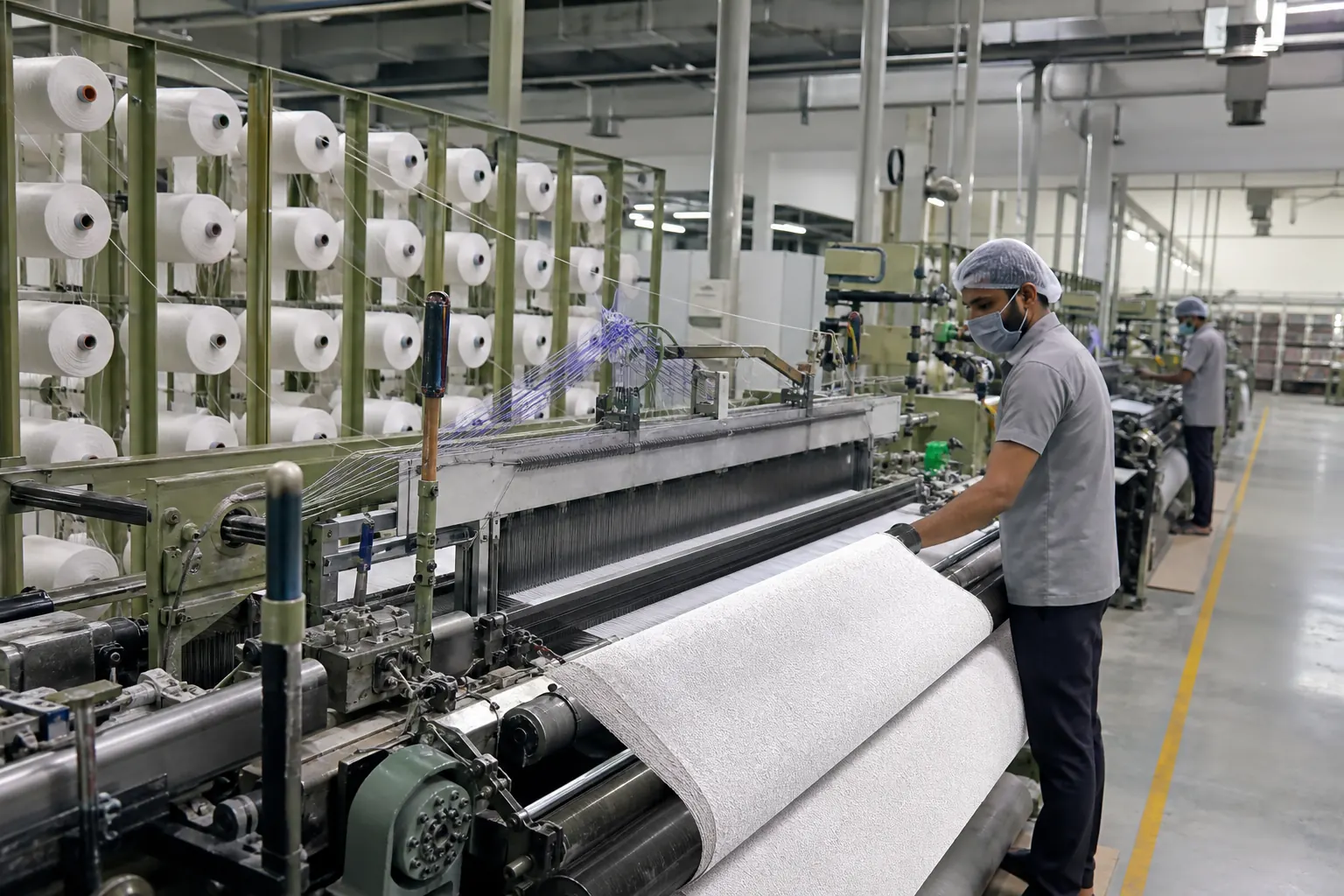
International towel programs fail less often when buyers define measurable requirements before asking for a price. This guide makes terry towel types and specifications commercially usable for importers, distributors, wholesalers, retail chains, hotel suppliers and procurement teams. It explains how GSM, yarn, pile, weave, size, finishing and testing interact—and how Altus Exports, an Indian merchant exporter, global sourcing partner and export consulting expert, can translate a buyer brief into mill-ready controls.
Executive Summary
Summary Box

Keyword and Entity Map
Comparison table
Swipe →
Data table — swipe horizontally on small screens
| Search role | Keywords and entities | Recommended use |
|---|---|---|
| Primary | terry towel types and specifications | Title, introduction, specification sections |
| Product | bath towel, hand towel, washcloth, bath sheet, hotel towel, beach towel | Category comparison |
| Technical | GSM, cotton count, ring-spun, combed cotton, zero-twist, dobby, jacquard | Product development |
| Performance | absorbency, shrinkage, colorfastness, tensile strength, pile pull | Testing and QC |
| Trade | HS 630260, India towel exports, FOB, CIF, MOQ, FCL | Procurement |
| Compliance | OEKO-TEX STANDARD 100, GOTS, REACH, CPSIA, labeling | Buyer due diligence |
| Brand entities | Altus Exports, WITS, UN Comtrade, OEC, ISO, ASTM, AATCC | Evidence and sourcing |
Market Size & Industry Overview
Key Statistics
HS 630260 is the international six-digit heading for cotton terry toilet and kitchen linen. Market totals and destination screening belong to the reporter-basis import-markets analysis; this page uses trade context only to align specifications with destination needs. Reporter rows must not be summed when an EU aggregate overlaps its member reporters.
India has integrated spinning, weaving, wet processing, stitching and made-up textile capability. Buyers can source commodity promotional towels, retail collections and institutional programs, but factory suitability depends on construction, certification scope, dyeing capability, order size and target market. Altus Exports’ textiles and home furnishings practice supports specification translation, sample coordination and shipment controls.
Comparison table
Swipe →
Data table — swipe horizontally on small screens
| Industry factor | Procurement implication |
|---|---|
| Cotton price and yarn quality | Changes cost, linting, strength and hand feel |
| Loom and jacquard capability | Determines borders, logos, patterns and repeatability |
| Processing route | Affects shade, absorbency, chemical residues and shrinkage |
| Sewing automation and skill | Influences dimensions, hems and appearance |
| Testing access | Supports objective approval and claim substantiation |
| Export experience | Reduces document, packing and routing errors |
Product Categories and Variants
Summary Box
Size and end-use matrix
Comparison table
Swipe →
Data table — swipe horizontally on small screens
| Product | Indicative finished size | Typical GSM range | Specification priority |
|---|---|---|---|
| Washcloth/face towel | 30 × 30 to 33 × 33 cm | 350–550 | Softness, low lint, neat hems |
| Guest towel | 30 × 50 to 40 × 60 cm | 400–600 | Presentation, embroidery compatibility |
| Hand towel | 40 × 60 to 50 × 100 cm | 400–650 | Absorbency, hanging performance |
| Bath towel | 65 × 130 to 75 × 150 cm | 400–700 | Weight, dry time, durability |
| Bath sheet | 90 × 160 to 100 × 180 cm | 500–750 | Coverage, premium hand feel |
| Hotel towel | Buyer-defined | 450–650 | Industrial wash life, bleach route |
| Kitchen towel | Buyer-defined | 300–500 | Absorbency, lint behavior, colorfastness |
| Beach towel | 75 × 150 to 100 × 180 cm | 300–550 | Print/jacquard, portability, color |
Finished dimensions vary by retailer and country; the following are planning ranges, not universal standards.
Pile and construction variants
- Conventional ring-spun terry: versatile construction for retail and hospitality.
- Combed-cotton terry: shorter fibers are removed before spinning, supporting smoother yarn.
- Zero-twist or low-twist towels: soft, lofty hand; require careful strength and laundering validation.
- Two-ply pile towels: can support durability and controlled loop appearance.
- Sheared velour: loops are cut on one face for print clarity and a velvet-like surface; the terry face remains absorbent.
- Jacquard terry: designs are woven through controlled pile patterning.
- Dobby border towels: decorative border formed through weave control.
- Yarn-dyed towels: yarn is dyed before weaving for stripes, checks or patterns.
- Piece-dyed towels: greige towel is dyed after weaving, useful for solid shades.
Understanding GSM, Yarn and Weave
GSM without the myths
Comparison table
Swipe →
Data table — swipe horizontally on small screens
| GSM band | Typical positioning | Benefits | Risks to control |
|---|---|---|---|
| 300–399 | Lightweight, gym, promotional, quick dry | Lower freight weight, faster drying | Thin perception, lower coverage |
| 400–499 | Mainstream retail and hospitality | Balanced cost and performance | Construction differences hidden by same GSM |
| 500–599 | Premium retail and hotel | Fuller hand and absorbency potential | Drying time and unit weight |
| 600–750 | Luxury and spa | High loft and substantial feel | Higher cost, wash load, freight and shelf space |
GSM means grams per square meter. Estimated unit weight is area multiplied by GSM: a 70 × 140 cm towel at 500 GSM has a theoretical fabric weight of about 490 grams before considering permitted dimensional and mass variation. Higher GSM generally increases material, fullness and wet weight. It may also slow drying. Low-GSM towels can perform well when yarn, pile geometry and finishing are engineered correctly.
Yarn systems
A terry towel typically uses pile warp, ground warp and weft. Pile yarn forms loops; ground yarn stabilizes the fabric; weft interlaces across the width. Cotton count systems can confuse buyers: English cotton count (Ne) is indirect, so a higher number is finer; tex is direct, so a higher number is heavier per length. Require the supplier to state the count system and ply instead of recording an ambiguous number.
Weave and pile geometry
Three-pick terry is common: loom motion creates the loop through a sequence of picks and beat-up action. Loop density and height influence apparent loft and snag behavior. Dense, controlled loops can feel substantial without excessive height. High or weak loops may pull. Dobby and jacquard mechanisms add border or design capability. Specification ownership means defining the appearance and performance outcome, then sealing a production-representative sample.
Complete Terry Towel Specification Sheet
Comparison table
Swipe →
Data table — swipe horizontally on small screens
| Specification field | Buyer instruction | Verification |
|---|---|---|
| Product and SKU | End use, style code, color code | PO and tech pack |
| Composition | Exact fiber percentage and permitted tolerance | Fiber-content test |
| Finished size | Length × width after agreed conditioning/wash state | Calibrated measurement |
| GSM/unit weight | Nominal and tolerance, test state | Cut-and-weigh method |
| Yarn | Spinning type, count system, ply, pile/ground/weft | Mill record/lab confirmation |
| Construction | Terry picks, pile face, dobby/jacquard, border | Sealed sample |
| Color | Pantone or physical standard, light source | Spectrophotometer/visual assessment |
| Performance | Absorbency, shrinkage, fastness, strength, lint | Agreed test methods |
| Sewing | Hem width, stitches per inch, thread, bartack | Inline/final inspection |
| Labels | Fiber, origin, care, brand, traceability | Artwork approval |
| Packaging | Fold, band, bag, barcode, carton, marks | Packaging mock-up |
| Inspection | AQL, defect classification, sample plan | Third-party report |
Manufacturing Overview
Export Tip
From yarn to packed towel
- Yarn sourcing and incoming checks: verify count, composition, strength and lot consistency.
- Warp preparation: prepare separate ground and pile systems with controlled tension.
- Weaving: form loops and borders according to loom settings.
- Greige inspection: identify missing loops, bars, stains and construction faults.
- Pretreatment and dyeing: desize, scour, bleach where needed, dye and wash off.
- Finishing: soften, dry, tumble or mechanically finish while controlling width and shrinkage.
- Cutting and hemming: cut panels, stitch side and end hems, attach labels.
- Final inspection and testing: verify dimensions, GSM, shade, workmanship and performance.
- Packing: fold, barcode, bag or band, carton and palletize if specified.
Processing should remove hydrophobic residues that impede wetting. Excessive softener can create a pleasant first touch but reduce initial absorbency. Buyers should test both first-use wetting and post-laundering performance under their intended care instructions.
Testing and Quality Acceptance
Inspection terminology must be explicit. AQL is a statistical sampling framework, not a promise that every unit is defect-free. Define critical, major and minor defects, inspection level, lot formation and acceptance numbers. Consider 100% checks for metal contamination or other truly critical hazards where risk analysis requires them.
Comparison table
Swipe →
Data table — swipe horizontally on small screens
| Test area | Buyer decision | Why it matters |
|---|---|---|
| Dimensions/shrinkage | Method, wash cycles, tolerance | Shelf fit and consumer expectations |
| GSM/unit weight | Conditioning and tolerance | Cost and consistency |
| Absorbency/wicking | Method and pass criterion | Core towel function |
| Colorfastness to washing | Grade requirement | Shade retention and staining |
| Colorfastness to rubbing | Dry/wet grade | Transfer risk |
| Chlorine resistance | Only when relevant | Hospitality bleach programs |
| Tensile/seam strength | Method and threshold | Service durability |
| Pile pull/snags | Agreed method/reference | Appearance and use |
| Fiber composition | Legal and claim tolerance | Label compliance |
| Restricted substances | Market/customer protocol | Chemical compliance |
Pricing Analysis
Buyer Tip
No reliable towel price exists without a complete specification. Cotton and yarn, GSM, finished area, dye depth, weaving complexity, order quantity, sewing, certification, testing, packaging, inland logistics and Incoterm all affect cost.
Hypothetical model input only: a model may test US$2.50–$8.50 per kg equivalent FOB before buyer-specific premiums, testing, packaging and inland exceptions. This is not observed pricing, a supplier offer or a customs value. Replace it with a dated quotation tied to the tech pack, quantity, Incoterm, validity and shipment window.
Comparison table
Swipe →
Data table — swipe horizontally on small screens
| Illustrative cost driver | Directional effect | Planning note |
|---|---|---|
| Higher GSM/larger size | Usually increases | More material and freight weight |
| Combed/organic/traceable cotton | Usually increases | Verify claim and chain of custody |
| Jacquard, velour or embroidery | Increases complexity | Add sampling and production time |
| Dark/reactive shades | May increase | Dye and wash-off requirements vary |
| Retail-ready packaging | Increases | Artwork, barcode and labor |
| Larger repeat volume | May reduce unit conversion cost | Subject to mill loading and yarn |
| Third-party tests/inspection | Adds direct cost | Budget by style/color/lot |
MOQ Analysis
Buyer Tip
MOQs are driven by yarn procurement, dye lot, loom setup, sewing and packaging. Every quantity below is a hypothetical model input only, not an observed norm or supplier commitment. Replace it with component-level minimums from qualified mills before costing inventory or promising delivery.
Negotiate MOQ by consolidating sizes in one dye lot, reducing colors, using an existing construction or accepting a development surcharge. Do not force uneconomic MOQs if they create shade or quality instability.
Comparison table
Swipe →
Data table — swipe horizontally on small screens
| Order type | Hypothetical MOQ model input | Main constraint |
|---|---|---|
| Existing construction, stock shade | 500–1,000 pieces | Stock and packing |
| Custom solid piece-dyed | 1,000–3,000 pieces/color | Dye lot |
| Custom dobby/jacquard | 2,000–5,000 pieces/design | Loom setup |
| Yarn-dyed stripe/check | 3,000–8,000 pieces/design | Yarn dyeing and warp |
| Retail set/private label | 1,000–5,000 sets | Components and packaging |
Packaging Standards
Export Tip
The approved packing instruction should cover fold dimensions, assortment, paper band or polybag material, suffocation warning where applicable, barcode grade and placement, carton board, gross/net weight, carton dimensions, shipping marks, moisture protection and pallet requirements.
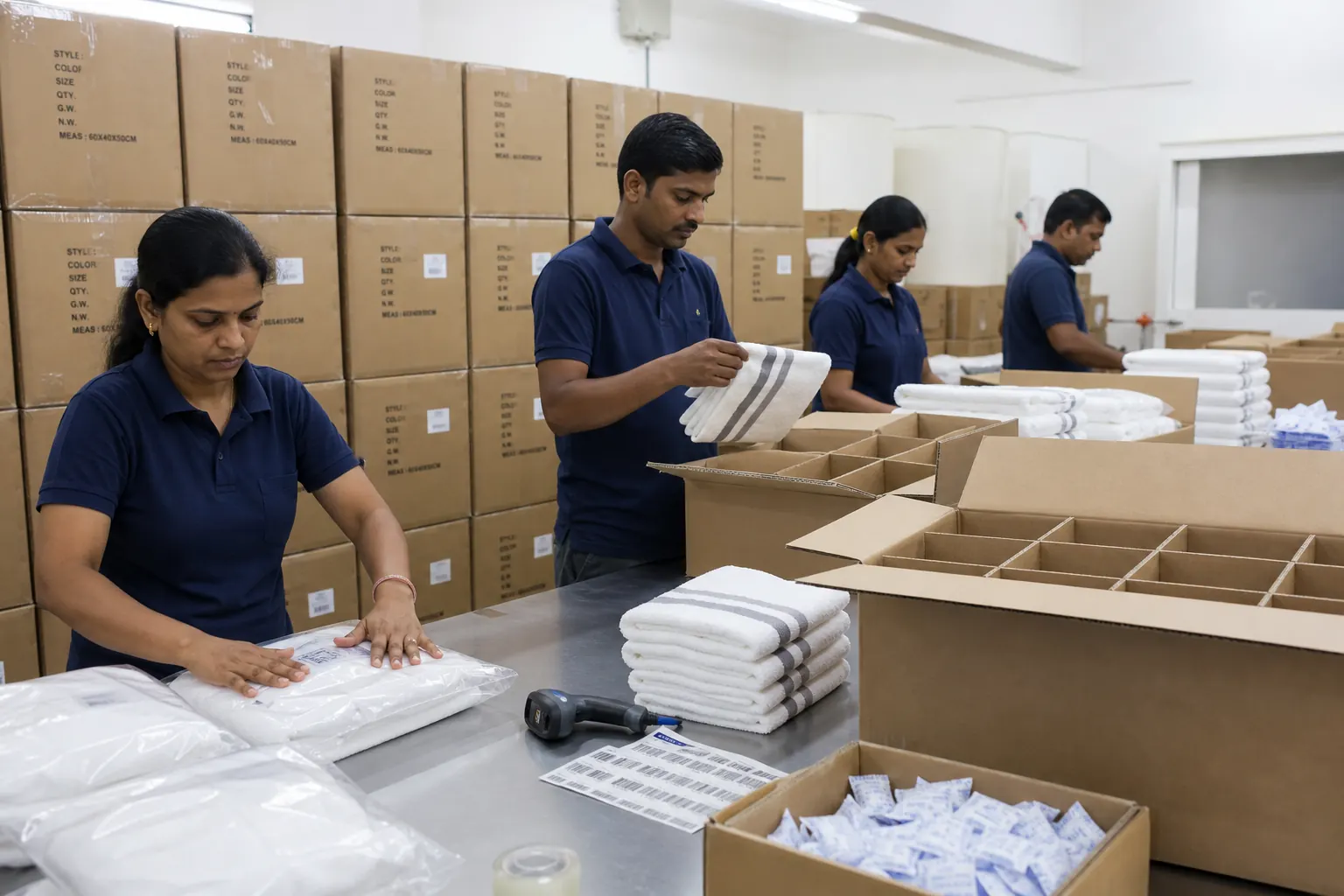
Container Loading Details
Export Tip
Towels are relatively bulky, so volume may constrain a shipment before payload. All volumes and payload ranges below are hypothetical model inputs only, not loadable carton counts or carrier commitments. Replace them with selected equipment data, approved carton measurements, verified gross weight and applicable road and carrier limits.
Finalize with actual carton measurements, verified gross weight, container specification, legal road limits and carrier acceptance. Use dry, odor-free containers; inspect floors, walls, doors and seals. Desiccants can help manage condensation but do not replace dry goods and sound packaging.
Comparison table
Swipe →
Data table — swipe horizontally on small screens
| Container | Hypothetical volume input | Hypothetical payload input | Model use |
|---|---|---|---|
| 20-foot dry | about 33 m³ | 8–14 metric tons | Smaller programs, dense packs |
| 40-foot dry | about 67 m³ | 16–24 metric tons | Standard FCL |
| 40-foot high cube | about 76 m³ | 18–26 metric tons | Bulky retail packs |

Shipping Methods
Export Tip
Sea FCL offers the best economics for regular volume. LCL suits smaller orders but introduces additional handling and consolidation risk. Air freight supports urgent samples or replenishment but is expensive for bulky towels. Courier is appropriate for development samples. Compare FOB Indian port, CFR and CIF carefully; Incoterms allocate tasks and risk but do not replace a detailed freight scope or cargo insurance review.
Certifications
Compliance Notes
- OEKO-TEX STANDARD 100: finished textile testing for harmful substances; verify certificate number and product class.
- GOTS: applies to certified organic textile processing and chain of custody; verify scope certificate and transaction documentation.
- ISO 9001/14001/45001: management-system certifications, not automatic product conformity.
- GRS/RCS: relevant only for substantiated recycled-content programs.
- Social audits: buyer-selected programs may assess workplace systems; scope and recency matter.
Certifications must match the supplier, processing facility, product and validity period.
Buyer Requirements and Compliance Checklist
Checklist
Compliance Notes
Buyer Requirements
- [ ] Confirm fiber and product classification.
- [ ] Validate country-of-origin marking and fiber/care labels.
- [ ] Map destination chemical restrictions and buyer RSL.
- [ ] Verify certification scope and expiry directly with scheme owner.
- [ ] Approve packaging, EPR/recycling marks and barcode rules.
- [ ] Agree testing methods, tolerances and corrective action.
- [ ] Screen wood packaging for ISPM 15 when used.
- [ ] Retain purchase, test, inspection and traceability records.
Export Statistics and Import Statistics
Key Statistics
Trade values are context, not specification inputs. The supplied WITS pages show these non-additive 2024 reporter values for HS 630260: United States $2.1215 billion, EU aggregate $1.0433 billion, Japan $537.7 million, Germany $324.3 million and France $233.4 million. These rows do not establish a global total.
Comparison table
Swipe →
Data table — swipe horizontally on small screens
| 2024 reporter view | WITS reporter value supplied | Correct use |
|---|---|---|
| United States | $2.1215B | National reporter value |
| European Union aggregate | $1.0433B | Regional view; overlaps member reporters |
| Japan | $537.7M | National reporter value |
| Germany | $324.3M | Member view already within EU aggregate |
| France | $233.4M | Member view already within EU aggregate |
Country-wise Opportunities
Market Snapshot
This specification page does not infer country preferences from reporter values. Treat proposed US retail, EU private-label, Japanese presentation or Gulf hospitality fit as a validation hypothesis until buyer interviews, assortment evidence and channel data support it. Translate validated destination requirements into measurable construction, performance, labeling and packing fields.
Use Terry Towel Import Markets for reporter-basis screening. Then source towels from India, specify hotel laundry performance, translate the spec into an OEM brief, turn specifications into acceptance criteria or see how GSM and yarn affect price on the owning cluster pages.
Sourcing Checklist
Checklist
- Define end user, target retail or contract price and annual volume.
- Issue a completed tech pack and reference sample.
- Verify mill capability for the chosen construction and processing.
- Develop samples using production-representative yarn and finishing.
- Approve color under specified light sources.
- Complete performance and compliance testing.
- Seal preproduction sample and packing mock-up.
- Monitor yarn, weaving, dyeing and sewing milestones.
- Conduct final inspection against approved documents.
- Release shipment only after document and loading review.
Buyer Checklist
Checklist
- [ ] Tech pack has tolerances, not only nominal values.
- [ ] Quote is like-for-like and Incoterm is named.
- [ ] MOQ is stated per style, color and size.
- [ ] Sample status—development, salesman or preproduction—is clear.
- [ ] Claims are supported by valid evidence.
- [ ] Inspection timing allows correction before shipment.
Exporter Checklist
Checklist
- [ ] Review feasibility before accepting PO.
- [ ] Lock yarn, shade, loom and processing route.
- [ ] Cascade the latest approved specification to every unit.
- [ ] Maintain lot and rework traceability.
- [ ] Verify invoice, packing list, origin and transport documents.
- [ ] Photograph packing, container condition and seal.
Common Buyer Mistakes
Common Mistakes Box
Another frequent error is over-specification. A costly requirement that does not improve consumer value can make a program uncompetitive. Prioritize fit-for-use performance, legal compliance and repeatability.
Future Market Trends
Key Statistics
Buyers are asking for traceable fibers, lower-impact wet processing, recycled packaging, digital product information and verified social/environmental claims. Quick-dry constructions may gain share where energy and laundering costs matter. Hospitality programs increasingly model cost per use rather than purchase price alone. Automated inspection and production data can improve consistency, but objective tests and physical approvals remain essential. Circular design will encourage mono-material components, repairable hems and claims backed by auditable chain-of-custody records.
Conclusion
The best terry towel is not the heaviest or cheapest; it is the construction that repeatedly meets a defined use, compliance profile and landed-cost target. Build the PO around measurable fiber, yarn, GSM, size, performance, workmanship and packing requirements. Then validate production against a sealed sample and agreed tests.
Altus Exports can serve as your India sourcing office across supplier discovery, sampling, quality coordination and shipment execution. Review our product sourcing service or contact Altus Exports with your target market, annual quantity, sizes, GSM, colors, tests, packing and delivery term.
Sources
- WITS/UN Comtrade, HS 630260 country product pages: https://wits.worldbank.org/trade/comtrade/en/country/JPN/year/2024/tradeflow/Imports/partner/ALL/product/630260
- United States: https://wits.worldbank.org/trade/comtrade/en/country/USA/year/2024/tradeflow/Imports/partner/ALL/product/630260
- European Union: https://wits.worldbank.org/trade/comtrade/en/country/EUN/year/2024/tradeflow/Imports/partner/ALL/product/630260
- Germany: https://wits.worldbank.org/trade/comtrade/en/country/DEU/year/2024/tradeflow/Imports/partner/ALL/product/630260
- France: https://wits.worldbank.org/trade/comtrade/en/country/FRA/year/2024/tradeflow/Imports/partner/ALL/product/630260
- India exports: https://wits.worldbank.org/trade/comtrade/en/country/IND/year/2024/tradeflow/Exports/partner/ALL/product/630260
- OEC, HS 630260 product profile: https://oec.world/en/profile/hs/toilet-or-kitchen-linen-of-cotton-terry-towelling
- U.S. International Trade Commission, Harmonized Tariff Schedule: https://hts.usitc.gov/
- European Commission, Access2Markets: https://trade.ec.europa.eu/access-to-markets/en/home
- Japan Customs, tariff schedules: https://www.customs.go.jp/english/tariff/
- OEKO-TEX STANDARD 100: https://www.oeko-tex.com/en/our-standards/oeko-tex-standard-100
- Global Organic Textile Standard: https://global-standard.org/the-standard
- European Chemicals Agency, REACH: https://echa.europa.eu/regulations/reach/understanding-reach
- U.S. Federal Trade Commission, textile labeling: https://www.ftc.gov/business-guidance/industry/textiles
- ISO, textile standards catalog: https://www.iso.org/ics/59.080/x/
Accessed July 17, 2026.