Terry Towel Certifications and Quality Standards: Testing, AQL and Compliance for Global Buyers
By Altus Exports
For global buyers, terry towel certifications and quality standards are not a folder of logos. Quality assurance is a controlled system linking the purchase specification, approved sample, manufacturing process, test methods, sampling plan, laboratory evidence, labels, claims, factory conditions and shipment release.
For global buyers, terry towel certifications and quality standards are not a folder of logos. Quality assurance is a controlled system linking the purchase specification, approved sample, manufacturing process, test methods, sampling plan, laboratory evidence, labels, claims, factory conditions and shipment release. This guide explains how to build that system when sourcing cotton terry towels from India.
Executive Summary
Summary Box
Key Takeaways
Summary Box
Market Size & Industry Overview
Key Statistics
HS 630260 is the most relevant six-digit trade category for cotton toilet and kitchen linen made from terry towelling or similar terry fabric. WITS/UN Comtrade reports India exported US$1.151 billion and 201.385 million kg in 2024, ranking second behind China in the WITS world exporter table. OEC describes approximately US$6.32 billion of global trade in the category in 2024.
Scale increases the importance of systematic conformity. One “bath towel” category can contain many sizes, GSM levels, yarns, dye routes, uses and pack formats. Trade data does not reveal test performance or certification status, and annual customs quantity cannot validate a supplier’s quality.
Comparison table
Swipe →
Data table — swipe horizontally on small screens
| 2024 HS 630260 indicator | Reported trade value | Quantity | QA relevance |
|---|---|---|---|
| Global trade, OEC | US$6.32 billion | Not used | Large, diverse category |
| India exports, WITS | US$1.151 billion | 201.385 million kg | Reported trade scale only |
| China exports, WITS | US$1.920 billion | 238.528 million kg | Largest reported exporter |
| Pakistan exports, WITS | US$1.085 billion | 228.597 million kg | Comparative reported exporter |
| Türkiye exports, WITS | US$567.950 million | 61.899 million kg | Comparative reported exporter |
Export Stats
The United States accounted for US$709.201 million of India’s reported 2024 HS 630260 exports. The United Kingdom, Australia, the Netherlands and Mexico followed among named destinations. These customs flows do not establish a factory’s experience, a shipment’s conformity or a claim’s validity; verify each directly.
Comparison table
Swipe →
Data table — swipe horizontally on small screens
| Destination from India | 2024 value | Quantity | QA planning implication |
|---|---|---|---|
| United States | US$709.201 million | 120.270 million kg | Robust label, tariff and retailer protocols |
| United Kingdom | US$57.408 million | 9.197 million kg | English fiber information and buyer controls |
| Australia | US$47.059 million | 8.433 million kg | Mandatory care-label review |
| Netherlands | US$28.654 million | 6.619 million kg | EU safety, traceability and fiber rules |
| Mexico | US$28.299 million | 4.359 million kg | Spanish-language and local standard review |
Import Stats
WITS may list both the EU aggregate and individual member reporters; do not add them as though they were mutually exclusive. Exports are generally valued FOB and imports CIF in WITS methodology.
Comparison table
Swipe →
Data table — swipe horizontally on small screens
| Import market | 2024 reported value | Quantity | Priority evidence |
|---|---|---|---|
| United States | US$2,121.518 million | 275.251 million kg | Fiber/origin identity, chemical and buyer tests |
| European Union aggregate | US$1,043.298 million | 159.967 million kg | Fiber labeling, REACH, GPSR traceability |
| Japan | US$537.671 million | 62.020 million kg | Exact workmanship and presentation criteria |
| Germany | US$324.256 million | 42.753 million kg | EU rules plus retailer RSL/social program |
| France | US$233.352 million | 32.685 million kg | EU rules and local-language information |
HS 630260 Scope and Alternatives
HS 630260 covers cotton toilet and kitchen linen of terry towelling or similar terry fabrics. Cotton bath towels, bath sheets, hand towels, washcloths and certain kitchen terry towels commonly fit when objective characteristics support the description. National tariff schedules add digits and may distinguish forms.
Potential alternatives include HS 630293 for toilet or kitchen linen of man-made fibers and HS 630291 for other cotton toilet or kitchen linen outside the terry subheading. Product function, fiber, construction and assembly control classification; a hood, decorative feature or blend may require closer analysis. The importer should obtain current broker advice or a binding ruling where facts are uncertain.
Product Categories and Risk Profiles
Summary Box
Comparison table
Swipe →
Data table — swipe horizontally on small screens
| Towel category | Main performance risk | Typical buyer verification |
|---|---|---|
| Bath towel/bath sheet | Absorbency, lint, shrinkage, shade | Performance lab panel and wash trials |
| Hand towel/washcloth | Measurement, hems, set matching | Finished measurement and workmanship |
| Hospitality towel | Repeated laundering, tensile loss, whiteness | Multi-cycle wash protocol and replacement analysis |
| Pool/beach terry towel | Colorfastness, print, large-size distortion | Laundering, crocking, light and dimensional tests |
| Salon/barber towel | Chemical/bleach exposure, staining | Buyer-defined chemical resistance protocol |
| Kitchen terry towel | Absorbency, staining, fiber label | End-use test and classification review |
| Baby/children’s hooded towel | Sensitive use, trim security, chemical limits | Age-specific legal risk assessment and testing |
| Certified organic/recycled towel | Claim integrity and chain of custody | Scope, transaction and label-approval documents |
Manufacturing and In-Process Quality Control
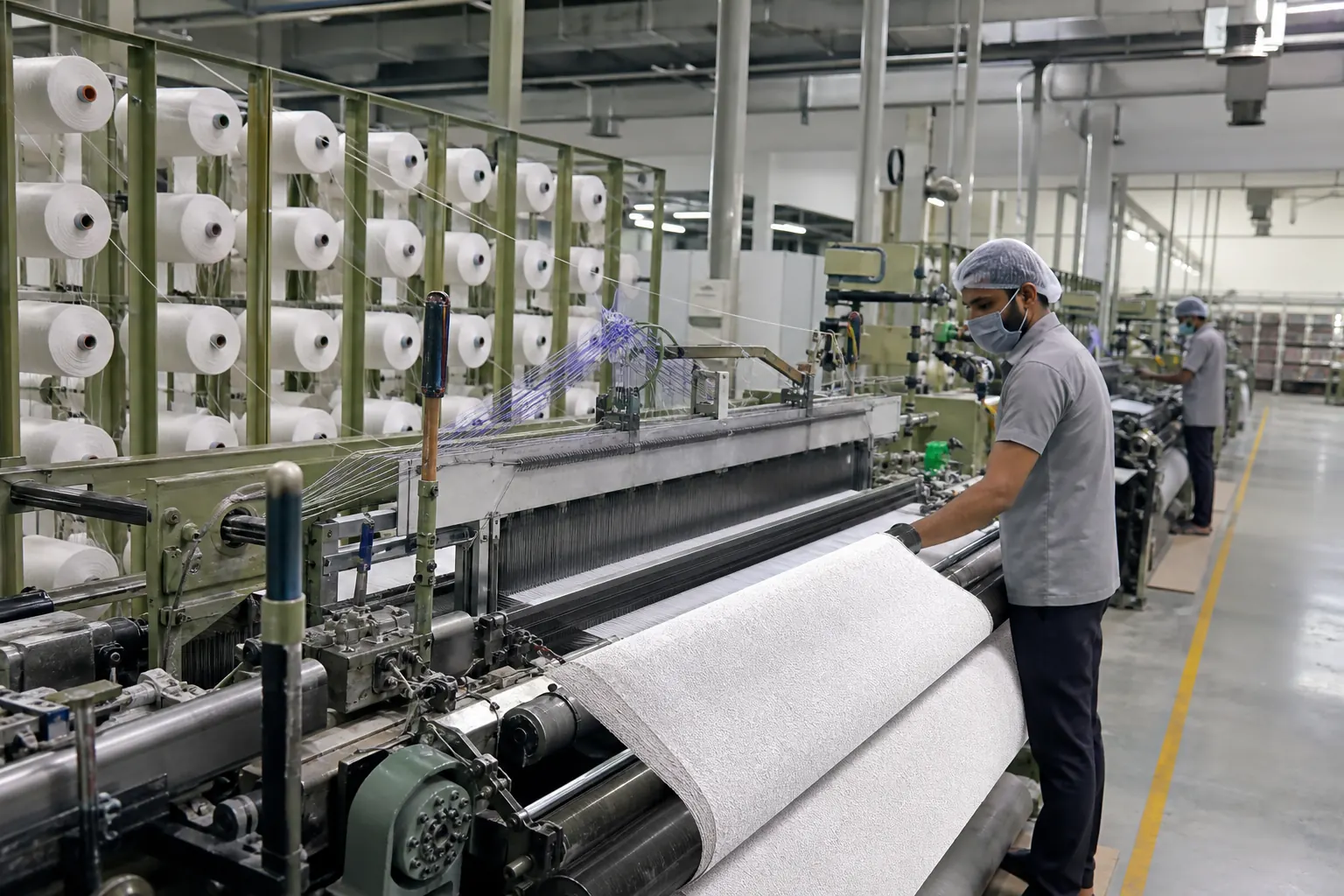
Quality begins before weaving. Yarn count, twist, blend and lot consistency affect pile behavior. Warping and loom settings affect picks, pile density and defects. Dyeing and washing control shade, pH, residues and dimensional change. Cutting and hemming determine measurements and seam durability. Packing controls assortment, moisture and traceability.
A control plan by production stage
Comparison table
Swipe →
Data table — swipe horizontally on small screens
| Stage | Control | Record |
|---|---|---|
| Incoming yarn | Count, composition, lot, certificate link | Goods receipt and test certificate |
| Weaving | Construction, width, GSM trend, loom defects | Loom/greige inspection sheet |
| Wet processing | Recipe, shade, pH, wash-off, batch | Dye-batch card and lab approval |
| Finishing | Hand feel, absorbency risk, dimensions | Finish recipe and test sample |
| Cutting/sewing | Size, hem, stitch, label placement | In-line audit |
| Packing | Assortment, barcode, carton count | Pack audit and carton trace code |
| Final release | AQL, lab status, documents | Signed shipment-release dossier |
The sample hierarchy
Use a development sample to confirm concept, a counter sample to confirm construction, lab dips for shade, a pre-production sample with final components, and a sealed approval sample for bulk comparison. Define which sample prevails if documents conflict. Never let a softener-heavy showroom sample silently override written absorbency or chemical requirements.
Traceability
Assign production lots by construction, color and dye batch. Map yarn and certified-material documents to output, and map packed cartons to production dates or lots. Retain tested specimens when appropriate. Traceability reduces the scope of investigation and recall; it does not itself prove conformity.
Use the cluster’s complete buyer workflow to place these controls within sourcing, contracting and shipment decisions. Before selecting methods, convert performance needs into testable specs.
Test Methods and Performance Standards
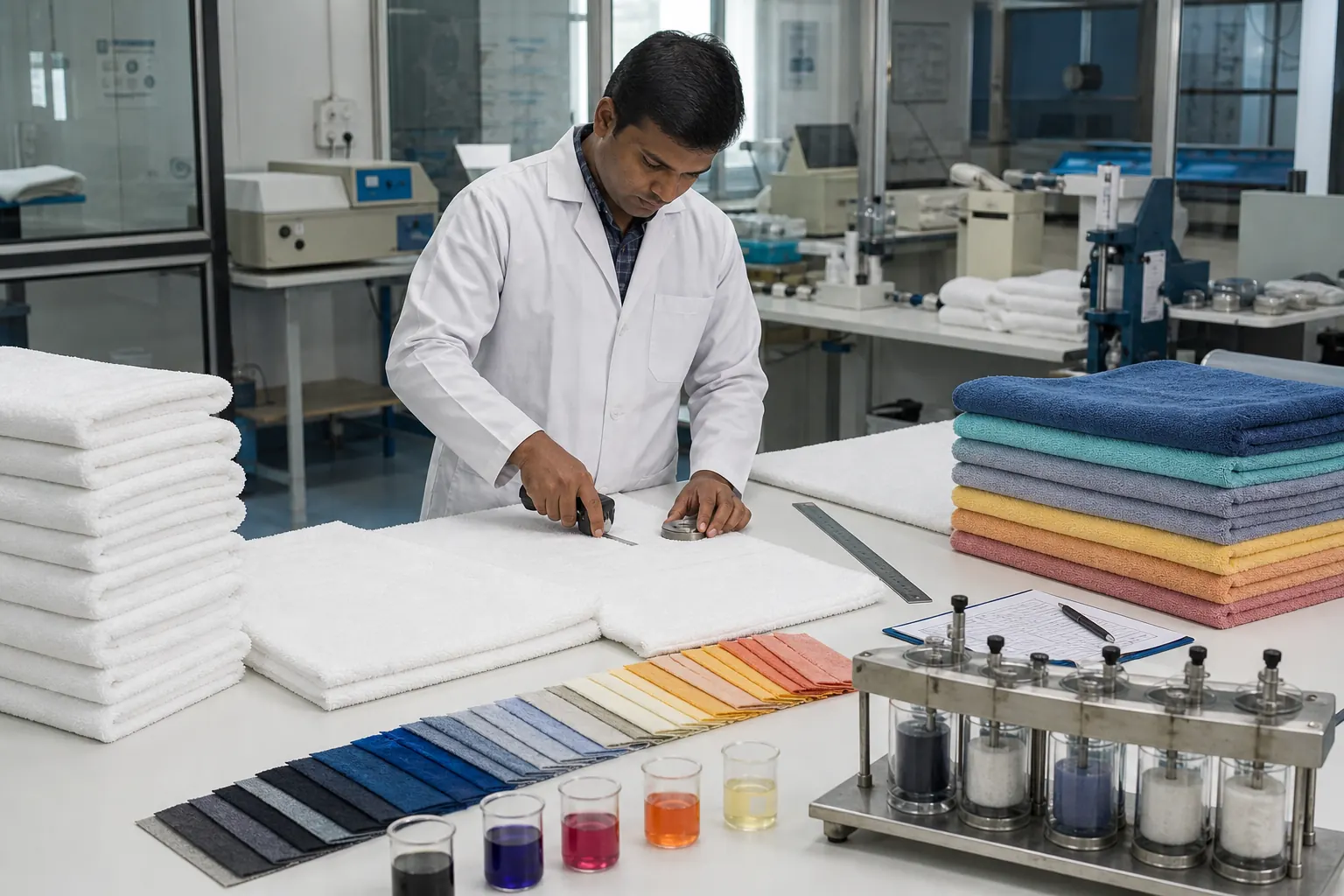
ASTM D5433-24 covers evaluation of household and institutional towel products and references performance areas such as dimensional change, colorfastness and absorbency. ASTM D4772-26 measures rapid surface water absorption and retention for terry fabrics; ASTM cautions that interlaboratory precision can be poor, so comparative acceptance testing should address laboratory agreement. AATCC TM135 addresses dimensional change after home laundering. Every contract and purchase order should name the exact edition of every standard; an undated “meet ASTM” requirement is incomplete.
Comparison table
Swipe →
Data table — swipe horizontally on small screens
| Property | Example method/framework | What to define in contract |
|---|---|---|
| Finished dimensions | Buyer procedure or relevant standard | Conditioning, points, tolerance |
| Mass per unit area | ASTM/ISO method selected by parties | Sampling location, conditioning, tolerance |
| Piece weight | Agreed conditioned weighing method | Scale resolution and range |
| Surface absorption | ASTM D4772-26 | Edition, apparatus and acceptance metric |
| Towel performance | ASTM D5433-24 | Edition, applicable product class and limits |
| Dimensional change | AATCC TM135 | Wash/dry cycles, temperature, calculation |
| Crocking | AATCC TM8 or agreed equivalent | Dry/wet grades and evaluation scale |
| Laundering fastness | Agreed AATCC/ISO method | Cycle, detergent, temperature, grades |
| Breaking/bursting strength | Construction-appropriate ASTM/ISO method | Direction, specimen and minimum |
| Extractable pH | Agreed textile method | Extraction and accepted range |
Testing after laundering
Initial softness can come from finish that reduces wetting. Test absorption and appearance after the agreed prewash or laundering cycles. Institutional buyers should use a protocol reflecting their laundry chemistry, temperature and drying—without claiming it is an ASTM method unless followed exactly.
Chemical testing
Build the panel from destination law, retailer restricted-substances list and intended user. Possible analytes include formaldehyde, certain azo colorants, heavy metals, phthalates in relevant components, alkylphenol ethoxylates, organotin compounds and per- and polyfluoroalkyl substances where relevant. The exact matrix, limits and methods must come from current legal and buyer requirements; a generic “eco test” is inadequate.
AQL Plans: Turning Defects Into Decisions
ISO 2859-1:2026 defines sampling schemes indexed by acceptance quality limit for lot-by-lot inspection and replaces the 1999 edition and amendments. The standard provides single, double and multiple plans plus switching rules. The buyer must select the edition, lot definition, inspection level, plan, AQLs and defect classifications.
AQL is not a guaranteed defect percentage
Comparison table
Swipe →
Data table — swipe horizontally on small screens
| Defect class | Towel examples | Commercial treatment |
|---|---|---|
| Critical | Prohibited sharp object, serious legal label failure, contamination presenting safety risk | Commonly no acceptance; buyer defines |
| Major | Wrong size beyond tolerance, open seam, severe shade mismatch, failed barcode, wrong fiber label | Likely impairs sale/use |
| Minor | Small removable thread, slight cosmetic irregularity within function | Does not materially impair use |
AQL is an index used with a sampling plan and process average concept. It is not permission to knowingly ship that percentage defective, and a passed sample does not prove zero defects. Critical safety or legal failures often use a no-acceptance policy, while major and minor thresholds are contract choices.
AQL workflow
- Define a homogeneous lot by style, color, size and process.
- Choose general or special inspection level.
- Use the ISO 2859-1:2026 table to derive a code letter from lot size.
- Select the corresponding sample and accept/reject numbers for each agreed AQL.
- Draw cartons and pieces randomly across the lot.
- Record defects by class; do not double-count one unit inconsistently.
- Apply accept/reject and switching rules.
- Define containment, reinspection and corrective-action consequences.
Lab Reports: How to Verify Evidence
Laboratories test samples, not factories or future lots. For color-sensitive chemical risks, select representative or worst-case shades. Define who pulls and seals samples. If the supplier selects an untraceable sample, a technically valid report may have weak shipment relevance.
Comparison table
Swipe →
Data table — swipe horizontally on small screens
| Report field | Verification question | Red flag |
|---|---|---|
| Laboratory | Is it competent/accredited for listed tests? | Unverifiable logo or address |
| Applicant/manufacturer | Do names match commercial parties? | Unexplained different company |
| Sample ID | Does it match style, color, lot and composition? | Generic “towel” description |
| Receipt/test dates | Are dates consistent with production? | Report predates material |
| Test method/edition | Is it the contract method? | “In-house” with no protocol |
| Result and unit | Is raw result shown against limit? | “Pass” only |
| Scope/limitations | What exactly was tested? | Missing pages or attachments |
| Authenticity | Can lab confirm report number/QR? | Edited PDF or inconsistent fonts |
Certifications: Legal, Voluntary and Contractual Layers
Compliance Notes
A voluntary scheme can become a contractual condition without becoming a law. Conversely, a contract cannot waive applicable product-safety, chemical, fiber-label or origin requirements. The purchase order should identify the source of each requirement—law, certification rule or buyer contract—and assign an owner, deadline and acceptance record.
Private-label teams can approve destination-market labels through the cluster’s detailed artwork and packaging workflow.
Comparison table
Swipe →
Data table — swipe horizontally on small screens
| Layer | Example | Status | Responsible decision and evidence |
|---|---|---|---|
| Destination law | Fiber label, product safety, applicable chemical restriction | Legally mandatory where applicable | Importer/seller legal review, approved artwork and required conformity evidence |
| Voluntary certification | OEKO-TEX STANDARD 100, GOTS, GRS, ISO 9001 | Not a universal legal prerequisite | Current certificate and authorized claim evidence within verified scope |
| Buyer contract | RSL, ASTM D5433-24 limits, ASTM D4772-26 metric, AQL, social audit | Contractually binding when agreed | Signed specification, named editions, reports, inspections and remedies |
OEKO-TEX STANDARD 100
STANDARD 100 is a label for textiles tested for harmful substances. OEKO-TEX states that every thread, button and accessory of a certified article is tested against a list of more than 1,000 harmful substances, with stricter requirements for more intensive skin contact. Buyers must verify certificate number, holder, product class, article description, components, annexes and validity in the official system.
It does not by itself certify organic fiber, recycled content, factory social compliance or superior absorbency. Date/source note: OEKO-TEX states certificates are valid for one year; verify the live certificate and current STANDARD 100 requirements in the official owner system (Source 8, accessed 2026-07-17).
Organic and recycled certification boundary
This quality guide checks whether a claimed certificate is authentic, current and relevant to the supplier or article. It does not duplicate organic/recycled custody routes, content thresholds, transaction-certificate rules or environmental-claim substantiation. For those decisions, verify GOTS and OCS claims.
For QA release, record the standard and edition, certificate holder, site, product scope, validity and claim-artwork approval, then link the evidence to the purchase order and lot. Date/source note: GOTS Version 8.0 was released in March 2026 and becomes mandatory for certified entities and approved chemical inputs on March 1, 2027 after transition; identify the edition actually governing a 2026 order (Source 9, accessed 2026-07-17).
ISO 9001
ISO 9001 defines requirements for a quality management system. ISO states that ISO itself does not certify or issue certificates; external certification bodies perform certification. Check the certificate’s organization, sites, scope, standard edition, certification body, accreditation and validity. Edition/source note: the official ISO overview identifies ISO 9001:2015; confirm the certificate’s stated edition and current ISO status rather than assuming it (Sources 12–13, accessed 2026-07-17).
ISO 9001 is useful evidence of process discipline, but it does not certify a specific towel or replace product testing, AQL inspection or buyer approval.
Fiber, Care and Origin Labeling
United States
FTC textile rules generally require fiber content, country of origin and manufacturer/dealer identity for covered textile products. Towels are listed in FTC guidance. Country of origin must appear on the front of the label. FTC guidance also notes Customs requirements for certain “flat” goods, including towels, to identify where fabric was made in relevant U.S.-processing scenarios.
The FTC Care Labeling Rule, 16 CFR Part 423, covers wearing apparel and certain piece goods, not ordinary finished towels. Voluntary towel care instructions still must be truthful and substantiated. Customs marking and state requirements should be reviewed separately.
European Union
Regulation (EU) No 1007/2011 governs textile fiber names and composition labeling, requiring listed fiber names and percentage by weight in descending order for multi-fiber products, with durable, legible, visible and accessible information in the official language(s) where sold. General Product Safety Regulation obligations and REACH chemical restrictions are separate. Ordinary towels do not receive CE marking merely because they are textiles.
United Kingdom and Australia
GOV.UK states the label must show fiber content, including fur and other animal parts where relevant, and English requirements continue under retained/amended rules. Australia’s Consumer Goods (Care Labelling) Information Standard 2023 applies to household textiles and allows required care information in English or specified international symbols, subject to the standard.
Pricing
Quality cost should be transparent. Separate development tests, certification extension, routine production checks, third-party inspections, shipment lab testing, social audits and retests. Avoid universal figures because panels, sample counts, countries and laboratories differ.
For the related commercial model, see Terry Towel Wholesale Price India. Every quotation should state currency, date, Incoterm and whether QA charges are included.
Comparison table
Swipe →
Data table — swipe horizontally on small screens
| QA cost item | Typical charging basis | Commercial control |
|---|---|---|
| Development test | Per sample/method | Approve panel before submission |
| Chemical panel | Per color/material group | Use risk-based worst case |
| Certification | Annual scope plus product work | Confirm claim eligibility first |
| Social audit | Per site/day/program | Check retailer acceptance |
| DUPRO inspection | Inspector-day | Set production completion window |
| Final random inspection | Inspector-day and travel | Define AQL and lot |
| Retest | Per failed method/sample | Assign responsibility in contract |
| Corrective reinspection | Inspector-day | Predetermine chargeback terms |
MOQ
Certification and testing affect MOQ because certified yarn must move through eligible sites, dye lots need representative tests, and fixed audit/test costs are spread across production. Ask MOQ by certified chain, construction, color, label and pack. Do not assume certified conventional production can be relabeled as organic or recycled for a small run.
Pilot orders can use standard constructions and limited shades, but do not waive critical legal tests. For new factories, increased inspection and lot segregation may be more important than a lower MOQ. Chain-specific minimums and certified-material claims belong in the linked organic/recycled sourcing guide, not in this QA method.
Packaging
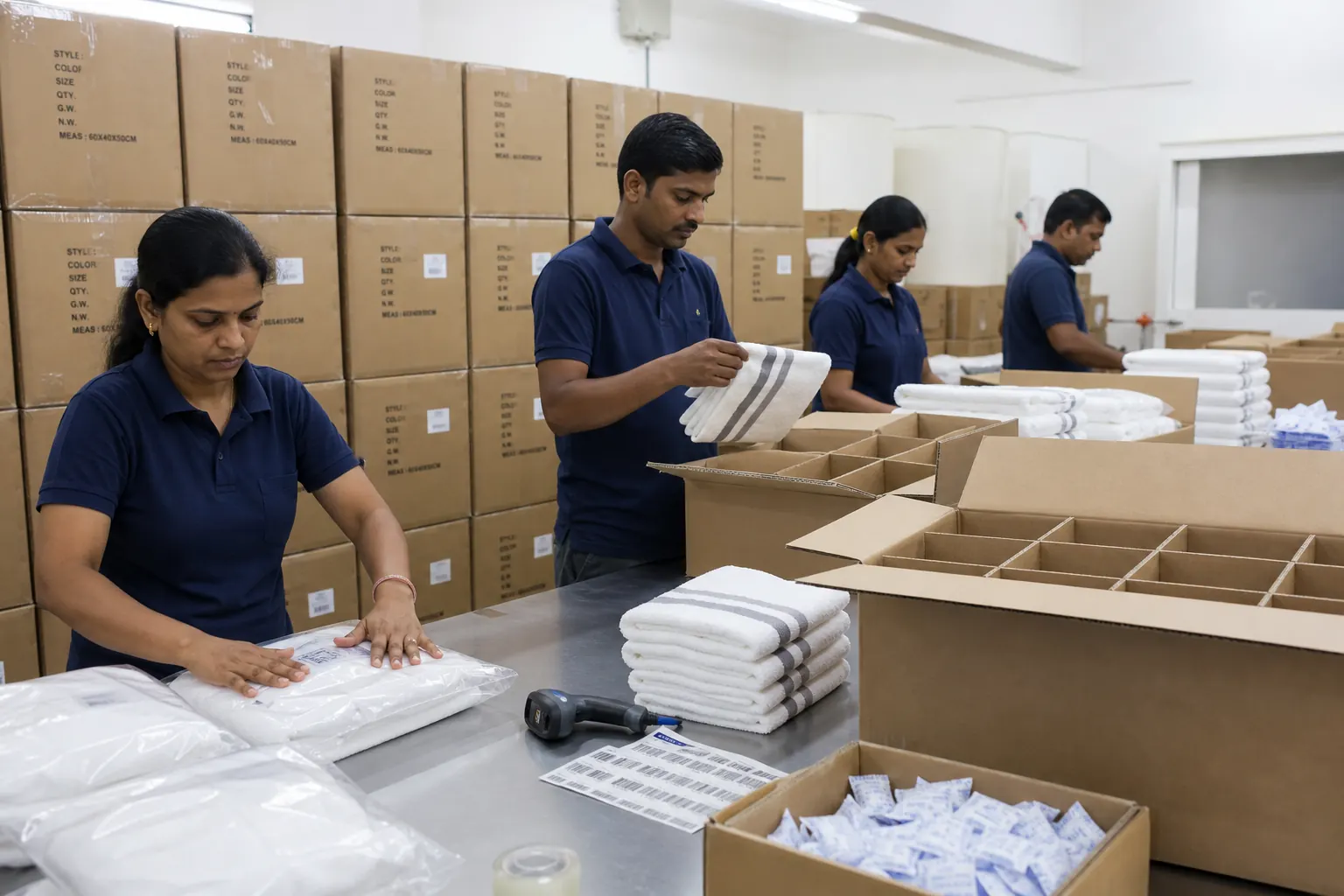
Packaging QA covers correct count, assortment, fold, label, barcode, warning, carton marks, moisture protection and transit strength. Inspect retail artwork against an approved version and scan barcodes from packed product. Check that certification logos and environmental claims use approved wording and license numbers.
Avoid unsubstantiated terms such as “chemical free,” “100% eco-friendly” or “non-toxic.” Paper or reduced-plastic packaging claims need precise boundaries and evidence. If wooden pallets are used internationally, verify applicable ISPM 15 treatment and marks.
Container Loading
Export Tip
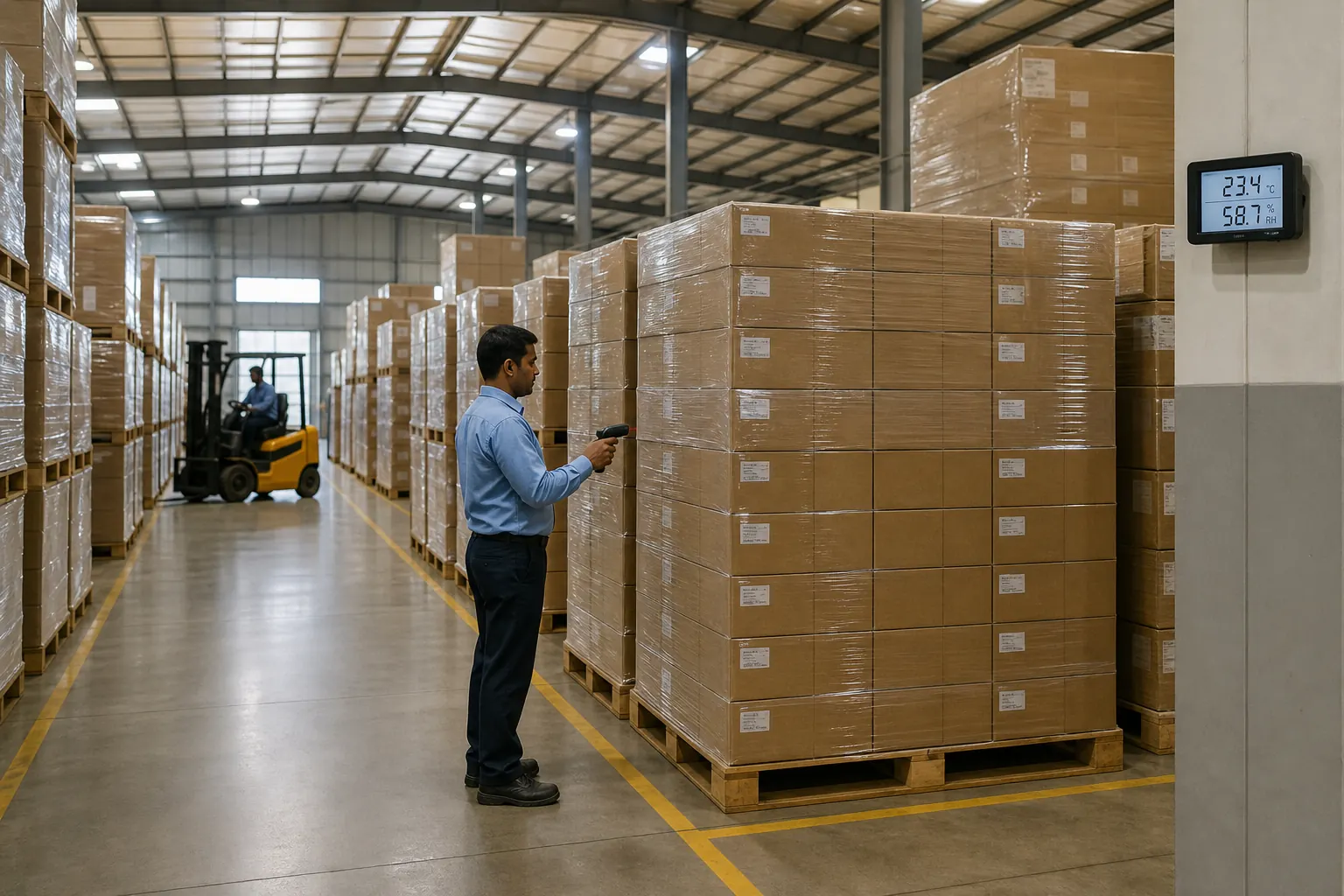
Before loading, confirm passed release status, carton count, container condition, dryness, odor, cleanliness, seal control and loading pattern. Record container and seal numbers, photographs and tally. Cartons should remain traceable by lot and avoid direct exposure to container walls where condensation risk exists.
Container-piece estimates remain illustrative until master cartons are sample-packed and measured. Quality release must precede loading; a departure deadline is not a reason to load rejected goods.
Comparison table
Swipe →
Data table — swipe horizontally on small screens
| Loading control | Acceptance record |
|---|---|
| Empty container | Condition photos and inspection |
| Carton count | Tally against packing list |
| Lot segregation | Carton codes and loading map |
| Moisture control | Product/carton checks and approved method |
| Weight distribution | Loading plan and verified gross mass process |
| Seal | Seal number on transport documents |
Shipping
The shipment dossier should include commercial invoice, packing list, shipping bill, bill of lading/airway bill, certificate of origin when required, final inspection report, agreed lab reports and claim-chain documents. Names, addresses, style numbers, quantities, HS classification and origin statements must reconcile.
Indian exporters generally require an IEC unless exempt. Altus Exports can coordinate the Indian document process and nominated logistics, while the importer and broker approve destination classification, tariff, product-safety and entry requirements.
Buyer Requirements
Buyer Requirements
Sourcing checklist
- [ ] Verify legal factory name, address, ownership and capabilities.
- [ ] Disclose and approve dyeing, sewing, printing and packing subcontractors.
- [ ] Validate certificates directly with scheme-owner databases.
- [ ] Assess capacity, laboratory controls and corrective-action history.
- [ ] Seal samples and retain version-controlled documents.
Buyer checklist
- [ ] Map each destination’s legal requirements.
- [ ] Define end use, users, composition, construction and claims.
- [ ] Name methods, conditions, limits, sampling and report format.
- [ ] Approve labels and certification-mark artwork.
- [ ] State AQL edition, levels, defect classes and remedies.
Exporter checklist
- [ ] Match factory purchase order to buyer specification.
- [ ] Maintain lot and certified-material traceability.
- [ ] Coordinate production checks, tests and final inspection.
- [ ] Block shipment after critical failure until written release.
- [ ] Reconcile shipping, origin, test and transaction documents.
Compliance checklist
- [ ] Separate mandatory law from voluntary labels and buyer rules.
- [ ] Verify current HS classification and national tariff line.
- [ ] Substantiate fiber, organic, recycled and functional claims.
- [ ] Review chemical restrictions and retailer RSL.
- [ ] Preserve evidence for market surveillance, complaints and recalls.
Destination QA Planning Contexts
Comparison table
Swipe →
Data table — swipe horizontally on small screens
| Market | Example buyer channel to verify | Priority quality/compliance work |
|---|---|---|
| United States | Retail, hospitality or institutional | FTC labels, origin, current HTS, retailer RSL/AQL |
| EU | Private label or certification-requesting program | Fiber regulation, REACH, GPSR, multilingual data |
| United Kingdom | Retail and hospitality | English fiber content and product safety |
| Australia | Hospitality, retail, beach programs | Mandatory care-label standard |
| Japan | Buyer-defined private label | Workmanship, size, shade and packaging controls |
| Canada | Retail and hospitality | Bilingual/federal requirements confirmed locally |
| GCC | Hotel and project orders | Destination labels, project specs, moisture control |
Common Buyer Mistakes
Common Mistakes Box
- Treating a factory certificate as a certificate for every product.
- Calling ISO 9001 a product-quality certification.
- Accepting a lab report whose sample cannot be traced to production.
- Writing “AQL 2.5” without inspection level, plan or defect definitions.
- Testing only the lightest shade in a dark-color program.
- Approving voluntary marks without scheme-owner authorization.
- Assuming a social audit proves product quality.
- Using “pass” without naming method and limit.
- Shipping before corrective action and reinspection.
- Copying U.S. care-label rules for apparel onto towels without checking scope.
- Adding CE marking to ordinary towels without a relevant CE-marking law.
- Using organic or recycled wording without transaction-chain evidence.
Future QA Scenarios
Buyer programs may request deeper traceability, digital product records, stricter chemical management, lower-impact packaging and faster corrective-action evidence. Treat these as scenarios to verify with the named buyer and destination, not as universal market movement. Exact legal applicability and implementation dates require current legal review.
Labs and factories may adopt more digital color data, machine-vision inspection and automated weight/measurement capture. These tools can improve consistency when calibrated and governed, but the contract still needs a named method, edition and acceptance decision.
Altus Exports’ QA and Compliance Role
As an Indian merchant exporter, sourcing partner and export consulting expert, Altus Exports can convert buyer requirements into factory controls, coordinate verified manufacturers, arrange lab dips and samples, monitor production, schedule third-party inspections, obtain lab evidence and align export documents. Explore textile and home furnishing sourcing, Altus export and sourcing services and private-label manufacturing support.
Altus coordinates evidence and execution; certification bodies, accredited laboratories, regulators, importers and qualified advisers retain their respective roles.
Conclusion
A complete terry towel quality program proves the right facts at the right level: legal compliance for the destination, certification for a specific claim, laboratory results for identified samples, AQL decisions for a defined lot, and traceability linking all evidence to the shipment. No logo replaces that system.
Build a verifiable Indian towel program. Share your destination, end use, specifications, claim requirements, test panel, AQL and shipment plan through the inquiry form on the Altus Exports homepage. Altus can coordinate sourcing, production controls, laboratories, inspections, certification documents, export paperwork and logistics.
Sources
- WITS/UN Comtrade, India exports HS 630260, 2024: https://wits.worldbank.org/trade/comtrade/en/country/IND/year/2024/tradeflow/Exports/partner/ALL/product/630260
- WITS/UN Comtrade, world exporters HS 630260, 2024: https://wits.worldbank.org/trade/comtrade/en/country/ALL/year/2024/tradeflow/Exports/partner/WLD/product/630260
- WITS/UN Comtrade, world importers HS 630260, 2024: https://wits.worldbank.org/trade/comtrade/en/country/ALL/year/2024/tradeflow/Imports/partner/WLD/product/630260
- OEC, HS 630260 profile: https://oec.world/en/profile/hs/toilet-or-kitchen-linen-of-cotton-terry-towelling
- ASTM D5433-24: https://store.astm.org/d5433-24.html
- ASTM D4772-26: https://store.astm.org/d4772-26.html
- ISO 2859-1:2026: https://www.iso.org/standard/85464.html
- OEKO-TEX STANDARD 100: https://www.oeko-tex.com/en/our-standards/oeko-tex-standard-100
- GOTS 8.0 official standard: https://gotslive.global-standard.org/images/resource-library/documents/standard-and-manual/GOTS_v8.0_signed.pdf
- Textile Exchange, RCS and GRS: https://textileexchange.org/recycled-claim-global-recycled-standard/
- Textile Exchange standards FAQ: https://hub.textileexchange.org/home/site-wide-content/standards-faqs
- ISO 9001 overview: https://www.iso.org/cms/render/live/en/sites/isoorg/contents/data/standard/06/20/62085.html
- ISO certification: https://www.iso.org/certification.html
- FTC textile labeling guidance: https://www.ftc.gov/business-guidance/resources/threading-your-way-through-labeling-requirements-under-textile-wool-acts
- 16 CFR 303.15: https://www.ecfr.gov/current/title-16/chapter-I/subchapter-C/part-303/section-303.15
- EU Regulation 1007/2011 summary: https://eur-lex.europa.eu/legal-content/EN/TXT/?uri=legissum:mi0088
- GOV.UK textile labeling: https://www.gov.uk/guidance/textile-labelling
- Australia care labeling mandatory standard: https://www.productsafety.gov.au/business/search-mandatory-standards/care-labelling-for-clothing-and-textiles-mandatory-standard
- DGFT IEC: https://www.dgft.gov.in/CP/?opt=iec-profile-management
- Altus Exports textiles and home furnishings: https://altusexports.com/industries/textiles-home-furnishings/
All sources accessed 2026-07-17.