Bulk Terry Towel Suppliers in India: A 2026 Wholesale Selection Guide
By Altus Exports
A practical framework for comparable RFQs, factory qualification, capability proof, sampling, scorecards, and pilot approval.

Searching for bulk terry towel suppliers India returns manufacturers, trading companies, merchant exporters and aggregators with very different control over weaving, dyeing, stitching, compliance and logistics. The best supplier is therefore not the company with the broadest catalog or lowest opening quote. It is the partner whose production route, quality controls, capacity, commercial terms and evidence fit the buyer's specific wholesale program.
India's supply credibility is supported by official trade data. WITS/UN Comtrade records $1.151 billion and 201.385 million kg of Indian exports in 2024 under HS 630260, cotton terry toilet and kitchen linen. Of that, the United States received $709.201 million and 120.270 million kg. Those figures demonstrate ecosystem depth, not the fitness of an individual vendor. Supplier selection still requires a comparable request for quotation, identity verification, capability assessment, product testing, production trial and delivery scorecard.
Altus Exports operates as a merchant exporter from India, global sourcing partner and export consulting expert. The role is to connect international wholesale demand to an appropriate production network while coordinating specification control, commercial comparison, quality evidence, packaging, documentation and dispatch.
Executive Summary
Summary Box
Searching for bulk terry towel suppliers India returns manufacturers, trading companies, merchant exporters and aggregators with very different control over weaving, dyeing, stitching, compliance and logistics. The best supplier is therefore not the company with the broadest catalog or lowest opening quote. It is the partner whose production route, quality controls, capacity, commercial terms and evidence fit the buyer's specific wholesale program.
India's supply credibility is supported by official trade data. WITS/UN Comtrade records $1.151 billion and 201.385 million kg of Indian exports in 2024 under HS 630260, cotton terry toilet and kitchen linen. Of that, the United States received $709.201 million and 120.270 million kg. Those figures demonstrate ecosystem depth, not the fitness of an individual vendor. Supplier selection still requires a comparable request for quotation, identity verification, capability assessment, product testing, production trial and delivery scorecard.
Altus Exports operates as a merchant exporter from India, global sourcing partner and export consulting expert. The role is to connect international wholesale demand to an appropriate production network while coordinating specification control, commercial comparison, quality evidence, packaging, documentation and dispatch.

Market Size & Industry Overview
Key Statistics
In the 2024 WITS exporter table, India is the second-highest reporter row by HS 630260 export value. The product scope is cotton toilet and kitchen linen made from terry towelling or similar terry fabrics, so the values must not be relabeled as “bath towels only.” Reporter values do not establish supplier capability, product mix, price position or global market share.
These reporter rows are not summed to create a world total or market share. Gross flows, re-exports and aggregate/member overlap make that calculation misleading.
Supplier candidates may present themselves as integrated mills, specialized factories, merchant exporters or stock wholesalers. Solapur's terry towel reputation and 2005 GI recognition are documented by an Indian government tourism source, but geography does not prove capability. Machinery, management, wet-processing control, quality records, compliance evidence and available capacity determine suitability.
Comparison table
Swipe →
Data table — swipe horizontally on small screens
| Reporter row, 2024 | HS 630260 value, USD million | Quantity, million kg | Safe interpretation |
|---|---|---|---|
| China | 1,920.249 | 238.528 | Highest exporter row shown |
| India | 1,151.476 | 201.385 | Second-highest exporter row shown |
| Pakistan | 1,084.703 | 228.597 | Third-highest exporter row shown |
| Türkiye | 567.950 | 61.899 | Separate reporter value |
| Portugal | 223.933 | 18.377 | Separate reporter value |
Export Statistics: Evidence of Supplier Ecosystem Depth
Key Statistics
India's 2024 destination table provides reporter-based evidence of active export lanes. The United States row was US$709.201 million and 120.270 million kg. The United Kingdom, Australia, Netherlands and Mexico rows below are direct rounded presentations from the source register; no market share or final-consumption claim is derived from them.
Calculated customs value per kilogram is not a wholesale quote. It blends different towel sizes, weights, qualities, packs and commercial values. It is useful as a macro signal only.
Comparison table
Swipe →
Data table — swipe horizontally on small screens
| Destination | Export value, USD million | Quantity, million kg | Calculated value/kg |
|---|---|---|---|
| United States | 709.201 | 120.270 | $5.90 |
| United Kingdom | 57.408 | 9.197 | $6.24 |
| Australia | 47.059 | 8.433 | $5.58 |
| Netherlands | 28.654 | 6.619 | $4.33 |
| Mexico | 28.299 | 4.359 | $6.49 |
Import Statistics: Markets Bulk Suppliers Must Understand
Key Statistics
WITS reports 2024 HS 630260 imports of US$2.122 billion for the United States, US$1.043 billion for the EU aggregate and US$537.671 million for Japan. These reporter values can guide a supplier's destination-readiness questions, but they do not prove channel requirements or demand for a particular SKU. Germany and France are within the EU aggregate, so adding them would double-count trade.
Comparison table
Swipe →
Data table — swipe horizontally on small screens
| 2024 importer | Import value, USD million | Quantity, million kg | Supplier-selection question |
|---|---|---|---|
| United States | 2,121.518 | 275.251 | Has the vendor executed FTC and retailer labels? |
| European Union aggregate | 1,043.298 | 159.967 | Can it handle languages, REACH and traceability? |
| Japan | 537.671 | 62.020 | Are finishing and pack tolerances disciplined? |
| Germany | 324.256 | 42.753 | What EU customer protocols are current? |
| France | 233.352 | 32.685 | Can artwork and claims be localized accurately? |
| United Kingdom | 199.404 | Not shown in cited extract | Does it understand separate UK obligations? |
Supplier Types: Choose the Right Commercial Model
Integrated manufacturer
An integrated mill may control spinning or yarn sourcing, weaving, wet processing, stitching and packing. This can improve traceability and scheduling, but buyers must verify what “integrated” actually includes. Large mills can also prioritize high-volume accounts and impose higher development thresholds.
Specialized manufacturer
A specialist may excel in a particular construction, hospitality white, jacquard border, promotional towel or flexible run size. Some processing may be outsourced. Outsourcing is not automatically a defect; undisclosed and uncontrolled outsourcing is.
Merchant exporter and sourcing partner
Comparison table
Swipe →
Data table — swipe horizontally on small screens
| Supplier model | Strength | Risk to test | Best fit |
|---|---|---|---|
| Integrated mill | Scale and process continuity | Flexibility, account priority | Large repeat programs |
| Specialized factory | Construction expertise | Outsourced process control | Focused or differentiated lines |
| Merchant exporter | Coordination and supplier options | Transparency and technical depth | Multi-SKU/global buyers |
| Stock wholesaler | Fast availability | Limited customization/continuity | Small tests and urgent replenishment |
A merchant exporter can combine production capabilities, hold one export-facing contract, coordinate inspections and documentation, and manage communication across facilities. This model is useful when a collection spans constructions or when the buyer lacks local resources. The buyer should still understand the nominated factory route and accountability.
Altus Exports' textiles and home furnishings capability is designed around this coordination problem.
Product Categories and Wholesale Variants
Summary Box
SKU architecture determines which capabilities to qualify. The table is a buyer-use framework, not a statement that every channel follows the same assortment. Before issuing the RFQ, send a comparable technical RFQ built around intended use, measurable construction and acceptance criteria.
HS classification follows the article's material, construction and use. HS 630260 is the six-digit subheading for cotton toilet or kitchen linen made of terry towelling or similar terry fabric; it is not a universal code for every towel. Non-terry cotton, man-made-fiber, fabric-in-the-piece, wearable, cleaning and other articles can fall elsewhere. Ask the importer's broker to confirm the national line; do not let marketplace keywords determine customs classification.
Comparison table
Swipe →
Data table — swipe horizontally on small screens
| Wholesale line | Common buying priorities | Supplier capability to verify |
|---|---|---|
| Hotel/institutional white | Wash durability, whiteness, replacement continuity | Bleach control, laundering tests, repeat yarn |
| Mass retail solids | Shade range, margin, barcode execution | Dye-lot control, packing lines |
| Premium bath | Hand feel, loft, yarn story | Combed/low-twist capability and after-wash result |
| Spa/gym | Absorbency, compactness, frequent wash | Seam strength and dimensional stability |
| Beach/pool | Large size, color, design | Yarn dye/print, light and chlorine fastness |
| Promotional | Logo, deadline, budget | Embroidery/printing controls and needle policy |
| Kitchen/utility terry | Lint, absorbency, value | Construction and colorfastness |
| Organic program | Certified claim and traceability | Applicable scope and transaction evidence |
Manufacturing Overview: Audit the Real Production Route
Export Tip
Supplier qualification should follow the order physically. Begin with approved yarn and incoming controls. At weaving, inspect loom type, pile formation, style changeover and fabric defect handling. At wet processing, examine recipe control, shade measurement, chemical management, water and effluent systems, and lot segregation. At stitching and finishing, review dimensions, hems, labels, loose-thread control, stain prevention and needle/metal procedures where applicable.
Capacity verification
Installed capacity is not available capacity. Ask for loom count and type, shift pattern, normal utilization, order book during your window, bottleneck process and subcontracted capacity. Cross-check the claimed monthly output against machinery, working days and comparable production records. Establish whether the order will run in one continuous lot or split across facilities.
Quality-system verification
Review incoming, inline and final inspection records; calibration status; nonconformance handling; corrective actions; lot identity; shade control; and complaint history. Ask the supplier to demonstrate a trace from packed carton back to production and test records.
Supplier Qualification Scorecard
A weighted scorecard forces cross-functional alignment. Procurement, quality, compliance and logistics should agree minimum gates before viewing price. Critical legal or safety failures should remain disqualifying even if the weighted total looks acceptable.
Comparison table
Swipe →
Data table — swipe horizontally on small screens
| Evaluation area | Suggested weight | Evidence | Gate example |
|---|---|---|---|
| Legal/export identity | 10% | Registration, IEC, bank and address checks | Identity matches contract |
| Technical capability | 20% | Machinery, samples, comparable styles | Can make frozen construction |
| Quality system | 20% | Records, calibration, CAPA, traceability | Major controls operational |
| Compliance/claims | 15% | Test and certificate verification | Required scope valid |
| Capacity/delivery | 15% | Order book, available capacity, OTIF | Ship window feasible |
| Commercial/MOQ | 10% | Normalized open costing and terms | Landed target viable |
| Communication | 5% | Response accuracy and escalation | Deviations disclosed |
| Packaging/logistics | 5% | Pack line, carton tests, documents | Buyer manual executable |
Request for Quotation: Create Comparable Offers
An RFQ should include annual and initial quantities, dimensions, GSM and tolerances, fiber, yarn and construction, colors, performance tests, labels, packaging, assortment, destination, Incoterm, ship window, inspection and claim requirements. Require suppliers to list exclusions and assumptions.
Comparison table
Swipe →
Data table — swipe horizontally on small screens
| RFQ response field | Required supplier answer |
|---|---|
| Product price | Per piece and per kg at specified tolerance |
| MOQ | Total, per style, per color and packaging item |
| Lead time | Development, material, production and cargo-ready |
| Capacity | Available during stated month, not installed |
| Process route | Owned and subcontracted sites |
| Testing | Included tests, laboratory and frequency |
| Commercial | Incoterm 2020, named place, payment, validity |
| Packaging | Pieces/carton, dimensions, net/gross weight |
Capability proof and sampling gates
Comparison table
Swipe →
Data table — swipe horizontally on small screens
| Gate | Supplier evidence | Buyer decision |
|---|---|---|
| Desk qualification | Legal identity, site list, process map, registrations | Reject, clarify or audit |
| Capability sample | Comparable construction from nominated route | Confirm technical fit |
| Development sample | Buyer brief translated into a physical towel | Revise or freeze specification |
| Production-equivalent sample | Bulk-intended yarn, machines, dye and finishing | Approve sealed reference |
| Golden pack | Final labels, fold, barcode and carton | Release packaging |
| Pilot lot | Intended route operating at meaningful production scale | Approve, correct or stop |
| Bulk lot | Inspection, tests, quantity and documents | Release shipment |
Do not accept a catalog sample as proof that the nominated route can repeat the product. Ask each candidate to connect every claim to a document, machine, record, test or sample from the actual facility. Approval should move through explicit gates; a later gate does not erase unresolved failures from an earlier one.
Pricing Analysis for Wholesale Programs
Buyer Tip
Supplier prices reflect actual material consumption and conversion. A 70 × 140 cm towel at 500 GSM has theoretical mass of 0.49 kg before production tolerances and construction effects. Compare the measured approved sample with the quote's cost weight. For sets, separate each component rather than averaging away an underweight item.
Hypothetical model—not a quotation: Set an invented weight input of 0.49 kg and an invented product-rate input of US$6.20/kg; the arithmetic product component is US$3.04. Add invented inputs of US$0.18 for retail packing, US$0.06 for testing/inspection and US$0.22 for origin logistics to produce US$3.50 in this simplified exercise. None is typical, observed, recommended or offered by Altus Exports. Replace every input with dated offers and compare FOB quotations.
MOQ Analysis: Find the Constraint, Not Just the Number
Buyer Tip
MOQ can originate in weaving setup, dye-lot minimum, yarn purchase, embroidery digitization, woven-label production, printed packaging or container economics. No quantity should be treated as typical. Require each supplier to state written total, style, shade, size, trim, packaging, pilot and repeat-order inputs with validity and assumptions. Procurement can then test whether a common construction, shared shade, standardized label or modular pack changes those quoted inputs.
An MOQ accepted below the natural production batch may carry a surcharge or be combined with other production. If shade and traceability matter, document whether aggregation is allowed. For supplier approval, a pilot should be large enough to exercise the real bulk process, not a sample-room shortcut.
Comparison table
Swipe →
Data table — swipe horizontally on small screens
| MOQ driver | Supplier question | Buyer response option |
|---|---|---|
| Dye lot | Minimum kilograms per shade? | Use fewer colors or shared shade family |
| Loom/style setup | Minimum meters per construction? | Consolidate sizes and borders |
| Yarn | Is special yarn stocked? | Choose standard yarn for pilot |
| Woven label | Printer minimum? | Use compliant printed label initially |
| Retail pack | Minimum print run? | Use generic band plus variable sticker |
| Certification | Minimum certified input/transaction cost? | Aggregate certified SKUs |
Packaging Standards for Distributors and Retail Chains
Export Tip
Bulk buyers should provide a packaging manual and approve a golden pack. Specify folding orientation, set configuration, inserts, label placement, barcode data and grade, polybag thickness/policy, warning text, carton board, tape, shipping marks, assortment, dimensions and weight limits. Decide whether cartons ship floor-loaded or palletized.
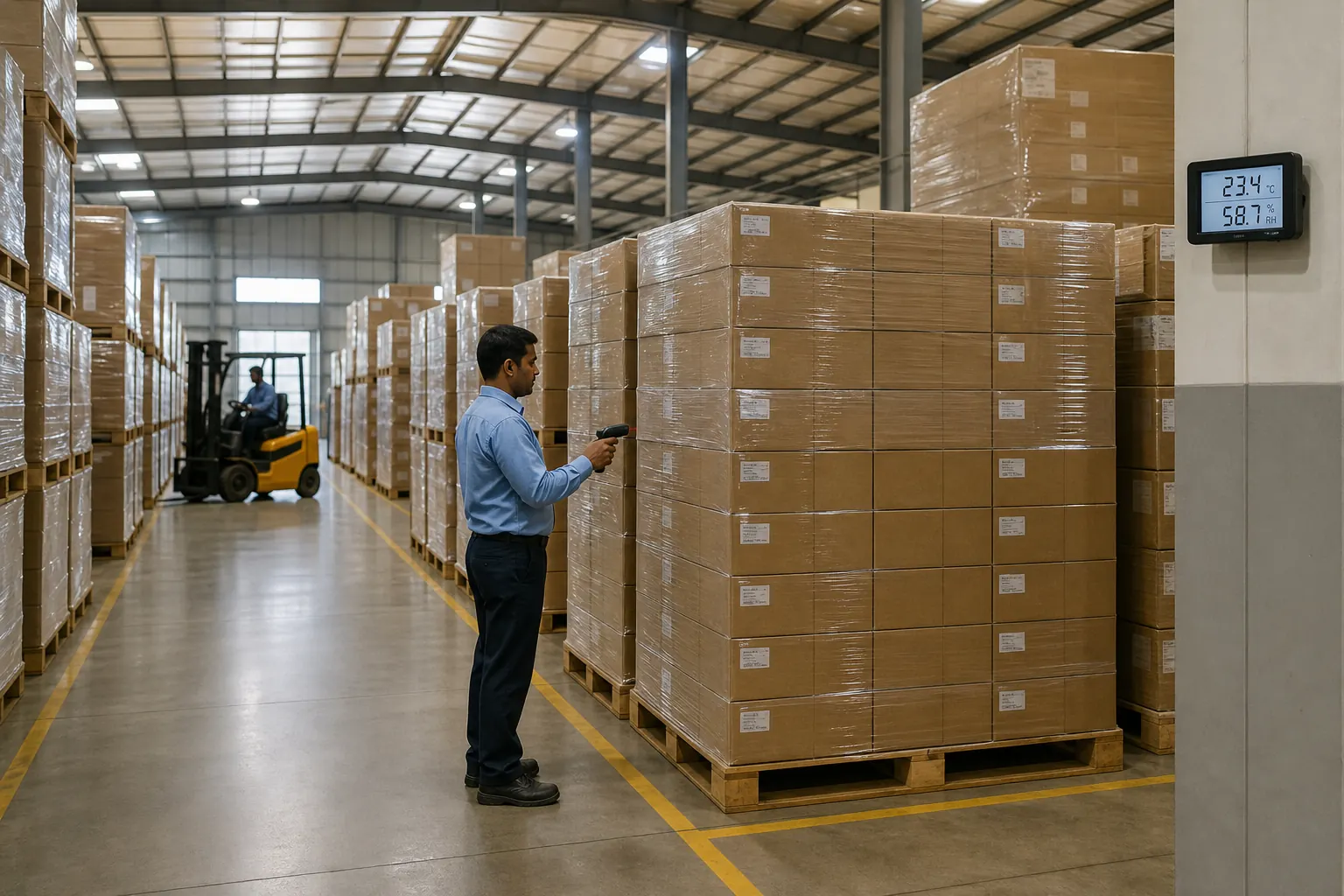
Conduct transport or carton testing when required by the buyer manual. Moisture control begins before loading: goods should be adequately dry, cartons stored off the floor, container condition checked and condensation strategy matched to route. Avoid placing unsubstantiated sustainability claims on packaging.
Container Loading Details
Export Tip
Supplier quotations often estimate loading before final packaging. Procurement should update landed cost after the golden pack establishes carton cube. Compression can improve utilization but may affect loft recovery, creasing and shelf presentation.
Every figure above is an explicit hypothetical model input or arithmetic output. It is not a typical, observed, quoted or guaranteed carton or container figure and excludes real-world stowage, packaging, pallet, payload, axle, door and route constraints.
Comparison table
Swipe →
Data table — swipe horizontally on small screens
| Hypothetical loading-model field | Invented input or output | Required replacement |
|---|---|---|
| Towel net mass | Input: 0.49 kg/piece | Approved bulk measurement |
| Carton assortment | Input: 36 pieces/carton | Golden-pack assortment |
| Net carton mass | Output: 17.64 kg | Measured net and gross weights |
| Carton cube | Input: 0.078 m³ | Sealed-carton measurement |
| 20-foot usable cube | Input: 28 m³ | Assigned-equipment load plan |
| Carton exercise | Output: 28 ÷ 0.078 = 358, rounded down | Stowage and payload validation |
| Piece exercise | Output: 358 × 36 = 12,888 | Final load plan and tally |
Shipping Methods and Delivery Governance
Export Tip
Evaluate full-container ocean, LCL, air and courier against shipment size, urgency, handling exposure, route availability and dated freight quotes. These are buyer decisions, not supplier-quality signals. Do not score a candidate on an assumed cost or transit time; compare offers only after the route, service, equipment, inclusions, exclusions and quote validity are aligned.
Supplier performance should be measured to a contractual cargo-ready date, not vessel arrival alone. The buyer or nominated forwarder influences booking availability and transit. Define who books, who files instructions, cut-off dates, free-time assumptions, document approval and escalation. Use Incoterms 2020 with a named place. FOB, CIF and DDP are not interchangeable price labels.
Certifications and Supplier Evidence
Compliance Notes
OEKO-TEX STANDARD 100 is described by its owner as a label for textiles tested for harmful substances. GOTS governs qualifying certified organic textiles and chain-of-custody stages. Both require scope verification. ISO certificates, social audits and laboratory reports answer different questions; none proves every other requirement. Use the evidence spoke to audit certificates and test reports for the nominated site, article, lot and validity period.
Comparison table
Swipe →
Data table — swipe horizontally on small screens
| Evidence type | Supplier claim to test | Verification |
|---|---|---|
| OEKO-TEX certificate | “Our towels are OEKO-TEX” | Number, article, class, site and validity |
| GOTS records | “We supply organic towels” | Scope, product, certified entities, transaction evidence |
| Social audit | “Factory is compliant” | Protocol, date, findings, CAPA and site |
| Lab report | “Product passes” | Same style/color/lot, methods and report authenticity |
| Quality certificate | “ISO-certified system” | Accredited issuer, exact location and scope |
Expert Insight — Saurabh Mittal
Buyer Requirements: What Qualified Suppliers Need From You
Buyer Requirements
Strong suppliers also qualify buyers. Provide realistic volume, decision authority, target market, intended use, technical pack, artwork timeline, testing protocol, claims, payment route and delivery window. Late changes in dimensions, GSM, color count or packaging can invalidate a quote and capacity reservation.
For U.S. sales, FTC guidance includes towels and generally requires fiber content, origin and responsible business identity. For EU sales, Regulation (EU) No 1007/2011 governs fiber names and composition labeling; REACH and broader product-safety obligations may apply. Certification is not a substitute for law. Destination importers should approve requirements.
Country-wise Opportunities for Wholesale Buyers
Market Snapshot
India-reported export rows confirm trade to the U.S., UK, Australia, Netherlands and Mexico. The opportunity labels above are commercial hypotheses for screening, not measured forecasts. Validate buyer-channel economics, competition, tariff treatment and service requirements before selecting a market or supplier.
Comparison table
Swipe →
Data table — swipe horizontally on small screens
| Market/channel | Hypothetical opportunity to validate | Supplier qualification emphasis |
|---|---|---|
| U.S. retail chains | Coordinated bath programs | Current retail manual, FTC label, OTIF and testing |
| U.S. hospitality | White replenishment programs | Buyer-defined wash protocol and continuity |
| EU distributors | Multi-country private label | Destination languages, GPSR traceability and REACH |
| UK wholesalers | Retail and institutional | Current UK tariff, label and claims review |
| Australia | Retail, resorts and spa | Current care-label and importer-specification review |
| Gulf hospitality | Hotel projects and replenishment | Country-specific conformity and label review |
| Japan | Household and hospitality formats | Current tariff, Japanese label and importer-specification review |
| Mexico | Retail programs | Current tariff, origin and label review |
Sourcing Checklist
Checklist
- Build a supplier longlist by construction, capacity and market experience.
- Issue confidentiality terms and one standardized RFQ.
- Verify legal name, address, IEC, bank account and factory relationship.
- Review sample-room and production-floor capability separately.
- Map all subcontracted wet processing, embroidery, stitching and packing.
- Validate current certificates directly with owners or issuers.
- Audit quality records and randomly selected lots.
- Approve lab dips, production sample and golden pack.
- Run pilot production through the intended route.
- Score quality, service, compliance, landed cost and delivery.
Buyer Checklist
Checklist
- [ ] One frozen specification sent to all candidates
- [ ] Forecast split by month, SKU and destination
- [ ] Required and preferred certifications separated
- [ ] Destination label artwork legally reviewed
- [ ] Supplier scorecard and approval authority assigned
- [ ] Pilot acceptance and escalation rules agreed
- [ ] Landed-cost comparison normalized
- [ ] Backup supplier strategy documented
- [ ] Risk-based supplier review cadence documented
Exporter Checklist
Checklist
- [ ] Contracting entity and nominated sites disclosed
- [ ] IEC, tax and banking records current
- [ ] Available capacity reserved against milestones
- [ ] Approved inputs and subcontractors controlled
- [ ] Bulk matched to sealed sample and shade
- [ ] Inspection and testing completed before release
- [ ] Invoice, packing list and shipping bill reconciled
- [ ] Origin and transport documents issued correctly
- [ ] Complaints traceable to corrective action
Compliance Checklist
Checklist
Compliance Notes
- [ ] Cotton HS 630260 versus man-made HS 630293 reviewed
- [ ] Destination national tariff line confirmed
- [ ] Fiber, origin and responsible-party labels approved
- [ ] RSL/MRSL and chemical restrictions mapped
- [ ] Product-use safety requirements assessed
- [ ] Children's-product status determined
- [ ] Certification claims checked against scope
- [ ] Packaging and environmental claims substantiated
- [ ] Traceability and recall records retained
Common Buyer Mistakes
Common Mistakes Box
- Shortlisting by online catalog breadth instead of production capability.
- Accepting a sample made in a sample room that bulk machinery cannot repeat.
- Auditing the office while missing the dye house and packing site.
- Using theoretical installed capacity as proof of schedule availability.
- Negotiating price before candidates quote the same specification.
- Confusing a social audit with product safety or quality certification.
- Ignoring per-color, yarn and packaging minimums behind the headline MOQ.
- Approving labels without the destination importer and legal review.
- Skipping pilot production for a complex private-label launch.
- Failing to score on-time-in-full delivery, claims and corrective actions.
Future Market Trends in Supplier Selection
Key Statistics
Supplier governance can be designed as an evidence system: certificate checks, lot-linked laboratory reports, production traceability, corrective actions, packaging data and approved backups. Whether a buyer requires these controls is program-specific and should be confirmed in the current manual, tender or contract.
Expert Insight — Saurabh Mittal
Working With Altus Exports
Altus Exports can structure the supplier-selection process, identify suitable facilities, normalize wholesale quotations, coordinate audits and sampling, organize quality checks, and support export documentation and freight readiness. Explore our services, read how we help buyers import products from India, or follow the complete India towel import process.
Conclusion
India's 2024 HS 630260 exports establish a large, internationally proven cotton-terry ecosystem. They do not remove vendor risk. The most dependable wholesale supplier is identified through a common RFQ, verified legal and factory route, measurable technical capability, relevant evidence, realistic capacity, pilot production and performance monitoring.
To build or benchmark your supplier panel, contact Altus Exports with destination market, channel, towel sizes, GSM, construction, color count, initial and annual volumes, packaging format, compliance protocol and target shipment date. We will develop a sourcing plan and comparable supplier pathway.
Sources and Verification Notes
- WITS/UN Comtrade, India HS 630260 exports by country, 2024: https://wits.worldbank.org/trade/comtrade/en/country/IND/year/2024/tradeflow/Exports/partner/ALL/product/630260
- WITS/UN Comtrade, top HS 630260 exporters, 2024: https://wits.worldbank.org/trade/comtrade/en/country/ALL/year/2024/tradeflow/Exports/partner/WLD/product/630260
- WITS/UN Comtrade, top HS 630260 importers, 2024: https://wits.worldbank.org/trade/comtrade/en/country/ALL/year/2024/tradeflow/Imports/partner/WLD/product/630260
- WITS/UN Comtrade, HS 630293 man-made-fiber toilet/kitchen linen comparator: https://wits.worldbank.org/trade/comtrade/en/country/ALL/year/2023/tradeflow/Exports/partner/WLD/product/630293
- U.S. FTC, textile labeling business guidance: https://www.ftc.gov/business-guidance/resources/threading-your-way-through-labeling-requirements-under-textile-wool-acts
- U.S. FTC, Textile Products Identification Act: https://www.ftc.gov/legal-library/browse/rules/textile-products-identification-act-text
- EUR-Lex, Regulation (EU) No 1007/2011: https://eur-lex.europa.eu/legal-content/EN/TXT/?uri=CELEX:32011R1007
- European Chemicals Agency, understanding REACH: https://echa.europa.eu/regulations/reach/understanding-reach
- OEKO-TEX, STANDARD 100 owner information: https://www.oeko-tex.com/en/our-standards/oeko-tex-standard-100/
- Global Organic Textile Standard: https://global-standard.org/the-standard
- DGFT, Customs Import Export Procedures: https://content.dgft.gov.in/Website/CIEP.pdf
- Incredible India, Solapur Terry Towel: https://www.incredibleindia.gov.in/en/maharashtra/solapur-terry-towel
All sources accessed 2026-07-17.
Verification note: Values are calendar-year gross trade data. Rounded million and billion presentations come from the cited WITS values. Commercial prices and every MOQ, carton, capacity or container figure are explicit hypothetical model inputs, supplier-response fields or arithmetic outputs—not observed ranges, universal claims or binding Altus Exports offers.