
Private Label Towel Manufacturer India: Complete OEM and Retail Program Guide
By Altus Exports
Build an Indian private-label towel range with controlled SKUs, artwork, labels, packaging, retail approval gates, compliance review, and reorder governance.

Executive Summary
Summary Box
A private label towel manufacturer in India converts a retailer’s concept into a repeatable assortment with controlled towel specifications, colors, woven or embroidered details, brand labels, care and legal labels, hangtags, belly bands, barcodes, cartons, and approved artwork. The critical work is not adding a logo. It is managing product and packaging data so the launch SKU can be reproduced accurately on the next purchase order.
India offers proven cotton-terry export depth. WITS, drawing on UN Comtrade, reports US$1.151 billion and 201.385 million kilograms of India-reported exports under HS 630260 in 2024. That code covers cotton toilet and kitchen linen of terry towelling or similar terry fabrics, not private-label bath towels exclusively. Customs values do not identify OEM contracts, retail channels, brands, margins, or final consumption.
Altus Exports works as an Indian merchant exporter, product sourcing company, global sourcing partner, and export consulting expert. In an OEM program, its role can include supplier mapping, brief translation, sample and artwork workflow, packaging coordination, inspection, documentation, and shipment management. Manufacturing and certification claims must always identify the actual facility and scope.
Key Takeaways
Summary Box
Keyword and Entity Mapping
Comparison table
Swipe →
Data table — swipe horizontally on small screens
| Layer | Keywords and entities | Article ownership |
|---|---|---|
| Primary | private label towel manufacturer India | OEM supplier and program intent |
| Secondary | OEM towel manufacturer India; custom branded towels; retail towel supplier | Commercial discovery |
| Product | bath towel, hand towel, washcloth, bath sheet, beach towel, kitchen towel | Assortment creation |
| Design | Pantone, lab dip, dobby, jacquard, embroidery, reactive print | Product development |
| Retail data | GTIN, GS1, SKU, PO, BOM, dieline, carton mark | Launch execution |
| Compliance | FTC Textile Fiber Rule, EU 1007/2011, Canada Textile Labelling Act | Market access |
| Trade | HS 630260, HS 630293, WITS, UN Comtrade, Incoterms 2020 | Export context |
Market Size and Industry Overview
Key Statistics
Public customs data does not isolate private-label towel contracts. HS 630260 is an auditable trade proxy for cotton terry toilet/kitchen linen, while retailer annual reports, category sales, sell-through, and import records are needed to test addressable demand. WITS shows India as the second-largest exporter reporter row in 2024, but rows must not be summed into a global-market denominator because gross flows, re-exports, and aggregate/member overlap can double count trade.
This India row shows origin capability, not automatic suitability. A private-label buyer still has to qualify weaving, dyeing, printing, embroidery, sewing, label, packaging, data, and social-compliance nodes. Apparent value per kilogram is not a supplier quote because mix, quality, reporting, and valuation basis vary.
Comparison table
Swipe →
Data table — swipe horizontally on small screens
| India reporter, 2024 | HS 630260 value (US$ million) | Quantity (million kg) | Safe OEM interpretation |
|---|---|---|---|
| World destination total | 1,151.476 | 201.385 | India-reported gross exports to all partners; not OEM revenue |
Export and Import Statistics
HS 630293 commonly begins the classification analysis for man-made-fibre toilet or kitchen linen, including products that may be terry; it is not limited to non-terry goods and is not a catch-all for every microfiber towel. Non-terry cotton toilet or kitchen linen commonly begins at HS 630291. Product composition, construction, use, national tariff text, origin, and trade date determine classification.
Comparison table
Swipe →
Data table — swipe horizontally on small screens
| 2024 import reporter row | Import value (US$ million) | Quantity (million kg) | Safe research use |
|---|---|---|---|
| United States | 2,121.518 | 275.251 | Largest reporter row shown; channel and OEM demand need separate evidence |
| European Union aggregate | 1,043.298 | 159.967 | Do not add member-state rows to this aggregate |
| Japan | 537.671 | 62.020 | Reporter-level demand proxy, not retail market size |
| United Kingdom | 199.404 | Not quoted | Value verified; reopen WITS before quoting weight |
| Australia | 155.009 | 20.111 | Reporter-level demand proxy |
| Canada | 148.564 | 35.757 | Investigate unusual unit values rather than speculate |
Product Categories and Assortment Architecture
Summary Box
A profitable collection is designed around consumer jobs and retail price ladders, not every possible color. Begin with hero SKUs, attach-rate items, and controlled extensions.
Comparison table
Swipe →
Data table — swipe horizontally on small screens
| Retail family | Typical design levers | Packaging route | Assortment risk |
|---|---|---|---|
| Solid bath program | GSM, yarn, color palette, dobby border | Belly band or hangtag | Too many slow colors |
| Premium bath | Larger sizes, combed/ring-spun options, refined border | Band, ribbon, box where justified | High cube and ticket-price pressure |
| Bath bundles | Coordinated bath/hand/wash sizes | Set band, sleeve, or box | Component shortages delay whole set |
| Beach/pool | Velour face, stripes, jacquard, print, fringe | Folded band or hanger | Artwork and color registration |
| Kitchen | Terry, waffle, yarn-dye, print, multipacks | Header card, band, or sleeve | Fiber/construction affects HS |
| Kids/gifting | Shapes, embroidery, themed packaging | Retail-ready pack | Safety and claim review |
Build a SKU matrix
Comparison table
Swipe →
Data table — swipe horizontally on small screens
| Field group | Minimum controlled data | Owner |
|---|---|---|
| Product | Size, tolerance, weight/GSM, fiber, yarn, weave, border, hem | Buyer + product developer |
| Color | Buyer color name, Pantone reference, lab-dip approval, shade tolerance | Buyer + dyehouse |
| Branding | Logo file, dimensions, placement, thread/weave colors | Brand + supplier |
| Legal label | Fiber, origin, responsible entity, language, care where applicable | Importer/compliance |
| Retail pack | Dieline, material, copy, barcode, price area, warnings | Packaging/brand |
| Logistics | Inner/carton quantity, carton marks, dimensions, gross/net weight | Supplier/logistics |
Each SKU row should include internal style, buyer style, GTIN, product name, size, color code, fiber, GSM or piece weight, construction, trim codes, care label, country-of-origin text, packaging code, carton quantity, dimensions, weights, and revision.
OEM Design, Trims, and Brand Treatments
Product design routes
Solid piece-dyed towels are the simplest platform for color-led retail collections. Yarn-dyed stripes and checks add pattern but increase yarn and setup complexity. Jacquard can integrate motifs into the weave. Velour creates a sheared face suited to printing. Reactive or pigment printing requires color, penetration, hand-feel, and wash-performance approval.
Logo and trim options
Comparison table
Swipe →
Data table — swipe horizontally on small screens
| Treatment | Best use | Key approval questions |
|---|---|---|
| Embroidery | Property, corporate, gift, or premium brand mark | Stitch count, backing, puckering, colorfastness, reverse appearance |
| Woven logo label | Discreet permanent branding | Fiber, fold, cut edge, placement, seam security |
| Jacquard logo | Integrated woven identity | Legibility, reverse, loom repeat, MOQ |
| Dobby border text/design | Subtle collection signature | Distortion and shrinkage |
| Printed artwork | Beach, kids, promotional, seasonal | Method, registration, hand, rub/wash fastness |
| Hangtag/belly band | Shelf communication | Dieline, claims, barcode scan, material |
Do not assume a manufacturer owns every process. Record the actual weaving, dyeing, printing, embroidery, label, and packaging sites. Subcontracting can be acceptable if approval, traceability, social-compliance scope, and quality ownership are clear.
Manufacturing and Development Workflow
Comparison table
Swipe →
Data table — swipe horizontally on small screens
| Gate | Deliverable | Buyer action | Release condition |
|---|---|---|---|
| 1. Brief | Range plan and target cost | Approve commercial direction | Feasible SKU count |
| 2. Technical | Tech pack and BOM draft | Resolve tolerances and tests | Controlled version |
| 3. Color | Lab dips/strike-offs | Approve under agreed lighting | Signed color reference |
| 4. Prototype | Construction sample | Test size, weight, hand, performance | Comments closed |
| 5. Artwork | Label/pack proofs and dielines | Legal, brand, language, barcode review | Approved files |
| 6. Pre-production | PPS with production materials | Approve complete SKU | Golden sample sealed |
| 7. Bulk | Production and in-line checks | Review exceptions | Shipment inspection passed |
| 8. Reorder | Change log and forecast | Confirm carryover data | Version locked |
Artwork approval discipline
File and revision control
Require editable source artwork plus press-ready files, named by SKU and revision. For every file, capture dimensions, colors, substrate, print method, finish, copy language, barcode number, and approval date. Digital proof approval does not replace a physical dummy when folds, cutouts, adhesive, board stiffness, or barcode curvature can change execution.

Pricing Analysis
Buyer Tip
The following values are hypothetical planning inputs dated July 17, 2026 for testing an OEM cost model. They are invented examples—not quotations, observed prices, typical ranges, or universal market levels. Replace them with dated supplier quotations tied to the controlled SKU, quantity, trims, packaging BOM, tests, Incoterm place/version, payment terms, validity, and production sites.
Additive cost drivers include custom-dyed yarn, jacquard setup, embroidery stitch count, print screens or digital print coverage, branded labels, low-run packaging, premium board, windows, ribbons, inserts, barcode labels, testing, inspection, palletization, and split shipments. Ask for separate product, trim, retail-pack, export-pack, testing, and tooling lines so future changes are visible.
Comparison table
Swipe →
Data table — swipe horizontally on small screens
| Hypothetical product scenario | Hypothetical FOB input | Evidence required before use |
|---|---|---|
| Washcloth, 30 × 30 cm, 475 GSM | US$0.60/piece | Dated SKU and pack quotation |
| Hand towel, 40 × 70 cm, 500 GSM | US$1.45/piece | Dated SKU and trim quotation |
| Bath towel, 70 × 140 cm, 525 GSM | US$4.75/piece | Dated private-label quotation |
| Bath sheet, 90 × 160 cm, 600 GSM | US$8.75/piece | Dated size and construction quotation |
| Buyer-defined three-piece bath set | US$7.50/set | Dated component and set-pack quotation |
MOQ Analysis and SKU Economics
Buyer Tip
MOQ can apply at five levels: construction, color or dye lot, design, trim, and packaging print run. A 12-color collection can satisfy the total order value while failing each color minimum.
These are scenarios, not factory commitments. Buyers should calculate gross margin after markdowns, packaging waste, testing, freight, duty, fulfillment, returns, and unsold inventory—not only ex-factory margin.
Comparison table
Swipe →
Data table — swipe horizontally on small screens
| Component | Hypothetical planning MOQ | Evidence required before use |
|---|---|---|
| Existing towel base | 1,000 pieces/SKU | Written supplier offer for named construction |
| Custom solid color | 3,000 pieces/shade | Written dye-lot minimum |
| Jacquard/unique weave | 3,000 pieces/design | Written loom/setup minimum |
| Embroidery | 1,000 pieces/design | Written embroidery minimum |
| Printed hangtag/band | 2,500 pieces/artwork | Written converter print minimum |
| Custom box | 3,000 pieces/dieline | Written packaging-converter minimum |
Packaging Standards and Retail Readiness
Export Tip
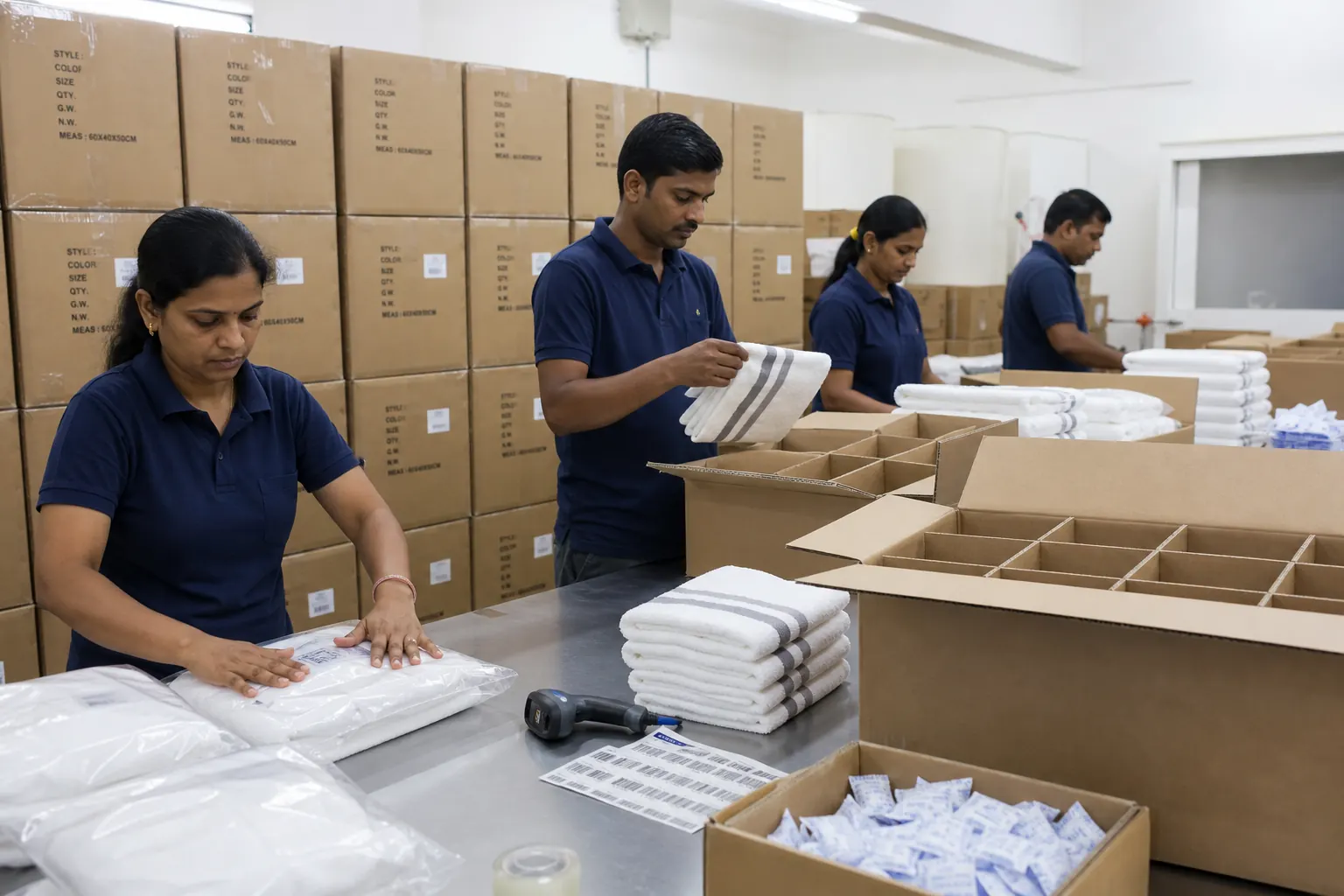
Retail packaging must protect, communicate, scan, shelve, ship, and comply. Options include paper belly bands, hangtags, sleeves, recyclable bags where accepted, ribbons, cartons, and e-commerce mailer configurations. Validate whether the towel can be touched by shoppers, whether the barcode remains flat, and whether shelf dimensions match the retailer’s planogram.
Comparison table
Swipe →
Data table — swipe horizontally on small screens
| Packaging layer | Required controls | Common failure |
|---|---|---|
| Sewn label | Content, origin, entity, language, placement | Wrong country or outdated RN/importer |
| Hangtag/band | Approved claims, barcode, style/color/size | Copy mismatch or poor scan |
| Consumer pack | Count, presentation, warnings where needed | Fold shifts during transit |
| Inner pack | Quantity and assortment | Color mixing |
| Master carton | Marks, PO, SKU, count, weights, dimensions | Warehouse rejection |
| Pallet, if used | Pattern, height, labels, treatment | Retailer routing-guide breach |
Container Loading
Export Tip
Private-label packs usually reduce container efficiency compared with bulk institutional packing. Boxes, hangers, display sleeves, pallet requirements, and assortment separation increase cube.
These are CMA CGM’s published nominal equipment specifications, not hypothetical towel capacities or carrier guarantees. Calculate loading only from approved pack-outs, measured carton dimensions and weights, SKU segregation, pallet plan, stowage loss, payload and axle restrictions, assigned equipment, and carrier acceptance. Generic mixed-piece capacities have been intentionally omitted because they are not reproducible.
Comparison table
Swipe →
Data table — swipe horizontally on small screens
| Dry equipment reference | Published nominal internal dimensions | Published nominal volume | OEM loading control |
|---|---|---|---|
| 20-foot standard | 5,900 × 2,352 × 2,393 mm | 33.2 m³ | Measure final retail pack and master carton |
| 40-foot standard | 12,034 × 2,352 × 2,395 mm | 67.8 m³ | Model SKU segregation, pallets, and stowage |
| 40-foot high cube | 12,034 × 2,352 × 2,700 mm | 76.4 m³ | Check door clearance and assigned CSC plate |
Shipping, Launch Calendar, and Reorders
Reverse-plan from shelf date
Build the critical path
Allow time for product development, color approvals, artwork and compliance review, packaging tooling, pre-production sampling, production, inspection, booking, ocean transit, customs, distribution-center intake, photography, and merchandising. For a hypothetical planning model, a buyer might enter 135 days from a stable brief to destination receipt. That invented input is not a typical production or transit range, quotation, or service promise. Replace each stage with dated supplier plans, buyer approval commitments, packaging-converter schedules, and the named carrier service.
Ocean FCL is normally most efficient. LCL can support pilots but introduces handling and potential carton damage. Air freight should be reserved for samples, limited launch quantities, or quantified stockout recovery.
Reorder governance
Every reorder should begin with a SKU status file: carryover, revised, discontinued, or new. Carryover means no uncontrolled substitution. Reconfirm golden sample, color standard, BOM, artwork revision, barcode, carton, compliance changes, certificate validity, production site, price, and timeline. Track first-production and reorder measurements to detect drift.

Certifications, Claims, and Buyer Requirements
Compliance Notes
Buyer Requirements
OEKO-TEX states that STANDARD 100 assesses textiles and accessories against more than 1,000 harmful substances. Textile Exchange explains that GRS is available as a business-to-business tool from 20% recycled content, while consumer-facing GRS labeling requires at least 50%, subject to its claims policy. GOTS Version 8 was released in March 2026 but becomes effective March 1, 2027; verify the active standard and certified chain at transaction time.
Comparison table
Swipe →
Data table — swipe horizontally on small screens
| Standard/evidence | Appropriate use | Important limitation |
|---|---|---|
| OEKO-TEX STANDARD 100 | Harmful-substance tested textile/article | Verify certified article and certificate scope |
| GOTS | Organic textile processing and chain claims | Version and transaction documentation matter |
| GRS/RCS | Recycled material and chain of custody | Claim thresholds and certified chain apply |
| ISO 9001 | Quality management system | Does not certify each towel |
| SMETA/amfori BSCI | Social-compliance assessment/program | Not a product-safety certificate |
| Third-party test report | Product performance or restricted substances | Applies to tested sample/lot and method |
Country opportunities and legal checkpoints
Comparison table
Swipe →
Data table — swipe horizontally on small screens
| Market | Sourced signal or OEM hypothesis | Legal/tariff checkpoint as of July 17, 2026 |
|---|---|---|
| United States | Largest 2024 import reporter row; retailer/club positioning is a hypothesis | FTC fibre, responsible party, and origin; verify live HTS line and current measures |
| European Union | Large aggregate reporter row; design or multilingual positioning is a hypothesis | Regulation 1007/2011 fibre labels and applicable product rules; confirm TARIC and member-state language |
| United Kingdom | Sourced import and India-export flows; home-textile positioning is a hypothesis | Standard third-country rate is 12%; qualifying Indian-origin goods may claim CETA preference from July 15, 2026 subject to live line, staging, origin, and proof |
| Canada | Sourced reporter flow; department/online positioning is a hypothesis | Fibre and dealer information; verify bilingual details, live treatment, and origin |
| Australia | Sourced reporter flow; lifestyle/beach positioning is a hypothesis | Consumer Goods (Care Labelling) Information Standard 2023 applies where covered and includes exemptions; verify tariff and claims |
| Japan | Sourced reporter flow; compact-premium positioning is a hypothesis | Confirm current national line, origin treatment, Japanese label requirements, and proof |
| UAE | Gifting and retail distribution are market hypotheses | Confirm UAE tariff, regulated-product scope, conformity route, Arabic presentation, and trademark needs |
US covered textile labels generally disclose fiber names and percentages by weight, company identity or RN, and country of origin. EU consumer textiles require fiber composition and destination-language handling under Regulation 1007/2011. Canada requires fiber and dealer information, with fiber information generally in English and French. These legal layers must be approved by the importer; voluntary certifications do not replace them.
Expert Insights from Saurabh Mittal — Draft for Founder Review
Expert Insight Box
Program Checklists
Checklist
Sourcing Checklist
- [ ] Define target consumer, price ladder, channel, launch date, and forecast.
- [ ] Map potential factories and all subcontracted processes.
- [ ] Issue a product tech pack, test protocol, and packaging brief.
- [ ] Compare suppliers on development accuracy, not sample speed alone.
- [ ] Verify capacity by process and peak-season constraints.
- [ ] Build a landed-margin model by SKU.
- [ ] Manage the India import journey through one accountable launch plan.
Buyer Checklist
- [ ] Create the SKU/GTIN matrix and reserve numbers through the buyer’s GS1 process.
- [ ] Assign owners for product, color, legal, artwork, and logistics approvals.
- [ ] Approve lab dips, prototypes, trim proofs, packaging dummy, and PPS.
- [ ] Seal golden samples and retain approved production references.
- [ ] Define inspections, defect rules, testing, and change-control procedure.
- [ ] Forecast reorder dates using sell-through and total lead time.
- [ ] Write the OEM product specification before artwork is released.
- [ ] Approve compliant retail labels with the destination importer.
Exporter Checklist
- [ ] Confirm IEC, buyer PO, Incoterm, payment, and consignee details.
- [ ] Translate every SKU into factory, trim, and packaging orders.
- [ ] Keep BOM and artwork revisions synchronized.
- [ ] Control samples and bulk materials by lot.
- [ ] Inspect barcode, assortment, carton marks, and measurements.
- [ ] Prepare invoice, packing list, origin support, transport documents, and buyer documents.
- [ ] Coordinate packaging and shipping documents from the same SKU data.
Compliance Checklist
- [ ] Confirm HS and national tariff line with the importer’s broker.
- [ ] Approve destination fiber, origin, dealer/responsible-party, language, and care information.
- [ ] Substantiate organic, recycled, absorbency, antimicrobial, and environmental claims.
- [ ] Verify certification number, facility, product, validity, and transaction scope.
- [ ] Screen product and packaging chemicals against law and buyer RSL.
- [ ] Check EPR, packaging labels, plastic, wood, and retailer routing-guide obligations.
- [ ] Substantiate organic product claims before artwork approval.
Common Buyer Mistakes
Common Mistakes Box
- Launching too many SKUs. Color-size multiplication fragments MOQ and leaves inventory.
- Treating mockups as production files. A visual concept lacks dielines, dimensions, fonts, color references, and print details.
- Approving only the towel. Wrong label or barcode can make conforming product unsellable.
- Skipping physical packaging. Folding, board, adhesive, window position, and scan quality need real validation.
- Using unsupported claims. Organic, recycled, antibacterial, and geographic-cotton claims require specific evidence.
- Allowing substitutions. Yarn, dye, finish, label material, and packaging changes can affect product and compliance.
- Reordering by photo. Photos do not control weight, dimensions, color, hand, trims, or carton data.
Future Trends
Private-label towel programs will use more structured product data, digital approvals, QR-linked traceability, lower-plastic packaging, modular designs, and demand-led replenishment. Digital product passports are a future direction under the EU Ecodesign for Sustainable Products framework, but towel-specific obligations and timing must be confirmed rather than presented as already universal.
Retailers will seek substantiated durability, fibre origin, chemical safety, and packaging claims. A market hypothesis worth testing is that smaller launches will favour standardized base constructions with variable labels or bands, while mature programs may justify custom weaving and packaging. India’s competitive hypothesis is coordinated design-to-reorder execution, not cotton cost alone; buyers should validate it against qualified alternatives and actual program results.
Expert Insights from Saurabh Mittal — Draft for Founder Review
Expert Insight Box
Conclusion and CTA
The right private label towel manufacturer in India is a program partner capable of turning an assortment idea into controlled, compliant, retail-ready SKUs and reproducing them on reorder. Product quality matters, but so do artwork accuracy, legal labels, barcode integrity, packaging execution, change control, and delivery planning.
Share your destination, channel, assortment concept, target retail and landed cost, annual forecast, launch date, product requirements, packaging approach, and certifications through Altus Exports contact. Review Altus’s textiles and home furnishings support, global sourcing partner service, and merchant exporter service.
Sources and Verification Notes
- WITS/UN Comtrade, India HS 630260 exports, 2024: https://wits.worldbank.org/trade/comtrade/en/country/IND/year/2024/tradeflow/Exports/partner/ALL/product/630260
- WITS/UN Comtrade, HS 630260 imports by reporter, 2024: https://wits.worldbank.org/trade/comtrade/en/country/ALL/year/2024/tradeflow/Imports/partner/WLD/product/630260
- UN Comtrade, bilateral asymmetries: https://uncomtrade.org/docs/bilateral-asymmetries/
- US FTC Textile Fiber Rule: https://www.ftc.gov/legal-library/browse/rules/textile-fiber-rule
- US FTC textile labeling guidance: https://www.ftc.gov/business-guidance/resources/threading-your-way-through-labeling-requirements-under-textile-wool-acts
- EU Regulation 1007/2011: https://eur-lex.europa.eu/eli/reg/2011/1007
- Your Europe textile label guidance: https://europa.eu/youreurope/business/product-requirements/labels-markings/textile-label/index_en.htm
- Canada Competition Bureau textile labeling: https://competition-bureau.canada.ca/en/labelling/textile-labelling/textile-labelling-requirements
- Canada Border Services Agency, 2026 Chapter 63: https://www.cbsa-asfc.gc.ca/trade-commerce/tariff-tarif/2026/html/00/ch63-eng.html
- ACCC Product Safety, Care labelling for clothing and textiles mandatory standard: https://www.productsafety.gov.au/business/search-mandatory-standards/care-labelling-for-clothing-and-textiles-mandatory-standard
- UK Integrated Online Tariff, heading 6302: https://www.trade-tariff.service.gov.uk/headings/6302
- UK Government, UK-India CETA: https://www.gov.uk/government/publications/uk-india-ceta-chapter-2-trade-in-goods
- Japan Customs, 2026 Chapter 63: https://www.customs.go.jp/english/tariff/2026_01_01/data/e_63.htm
- OEKO-TEX STANDARD 100: https://www.oeko-tex.com/en/our-standards/oeko-tex-standard-100
- GOTS Version 8.0: https://gotslive.global-standard.org/images/resource-library/documents/standard-and-manual/GOTS_v8.0_signed.pdf
- Textile Exchange, GRS and RCS: https://textileexchange.org/recycled-claim-global-recycled-standard/
- ISO 3758:2023: https://www.iso.org/standard/74401.html
- GS1, GTIN overview: https://www.gs1.org/standards/id-keys/gtin
- Federal Register of Legislation, Consumer Goods (Care Labelling) Information Standard 2023: https://www.legislation.gov.au/F2023L01187/asmade/text
- CMA CGM, container specifications: https://www.cma-cgm.com/products-services/containers
All URLs accessed July 17, 2026. Commercial scenarios require live quotation and destination review.