
Terry Towel Wholesale Price India: The 2026 Landed-Cost, MOQ and Incoterms Guide
By Altus Exports
Global buyers searching for a terry towel wholesale price in India need more than a unit quote. A commercially useful comparison fixes size, GSM, piece weight, yarn, construction, dyeing, finish, packaging, test plan, quantity, currency, quote validity and Incoterm.

Global buyers searching for a terry towel wholesale price in India need more than a unit quote. A commercially useful comparison fixes size, GSM, piece weight, yarn, construction, dyeing, finish, packaging, test plan, quantity, currency, quote validity and Incoterm. This guide shows how to build that comparison and where an Indian merchant exporter can remove hidden cost.
Executive Summary
Summary Box

Key Takeaways
Summary Box
Market Size & Industry Overview
Key Statistics
The most defensible terry-specific trade lens is HS 630260, “toilet linen and kitchen linen, of terry towelling or similar terry fabrics, of cotton.” WITS, using UN Comtrade data and HS 1988/92, reports 2024 world trade and country flows. OEC reports global trade of approximately US$6.32 billion in 2024, while WITS country tables show India as the second-largest exporter in the HS category.
The figures are directional for sourcing strategy, not a towel price index. HS 630260 aggregates multiple sizes, constructions, brands, pack formats and commercial channels. Customs values can reflect product mix and valuation conventions. A value-per-kilogram calculation from trade data must not be represented as a factory quote.
Comparison table
Swipe →
Data table — swipe horizontally on small screens
| Market indicator | 2024 reported value | Quantity | Buyer interpretation |
|---|---|---|---|
| Global HS 630260 trade, OEC | US$6.32 billion | Not used here | Category scale, not addressable market forecast |
| India exports, WITS | US$1.151 billion | 201.385 million kg | Reported trade scale only |
| China exports, WITS | US$1.920 billion | 238.528 million kg | Largest reported exporter |
| Pakistan exports, WITS | US$1.085 billion | 228.597 million kg | Comparative reported exporter |
| Türkiye exports, WITS | US$567.950 million | 61.899 million kg | Comparative reported exporter |
Export Stats: India’s Terry Towel Position
India exported US$1,151,475.73 thousand and 201,385,000 kg under HS 630260 in 2024. The United States received US$709,201.32 thousand and 120,270,000 kg, followed by the United Kingdom, Australia, the Netherlands and Mexico among reported destinations.
This destination concentration documents trade flows, not current capacity, seasonality or freight pressure. A sourcing partner should verify loom allocation, dye-house capacity and shipment windows directly rather than infer availability from annual exports.
Comparison table
Swipe →
Data table — swipe horizontally on small screens
| India destination | 2024 export value | Quantity | Share of India value, calculated |
|---|---|---|---|
| World | US$1,151.476 million | 201.385 million kg | 100.0% |
| United States | US$709.201 million | 120.270 million kg | 61.6% |
| United Kingdom | US$57.408 million | 9.197 million kg | 5.0% |
| Australia | US$47.059 million | 8.433 million kg | 4.1% |
| Netherlands | US$28.654 million | 6.619 million kg | 2.5% |
| Mexico | US$28.299 million | 4.359 million kg | 2.5% |
Import Stats: Where Demand Is Concentrated
WITS reports the United States as the largest 2024 importer under HS 630260, followed by the European Union aggregate and Japan. Germany also appears separately because WITS tables can display both the EU aggregate and member reporters; do not add Germany to the EU line to construct a world total.
Comparison table
Swipe →
Data table — swipe horizontally on small screens
| Import market | 2024 import value | Quantity | Commercial implication |
|---|---|---|---|
| United States | US$2,121.518 million | 275.251 million kg | Reported scale; verify tariff and labels |
| European Union aggregate | US$1,043.298 million | 159.967 million kg | Aggregate reporter; verify destination rules |
| Japan | US$537.671 million | 62.020 million kg | Reporter value; verify buyer specifications |
| Germany | US$324.256 million | 42.753 million kg | Member reporter overlapping EU aggregate |
| France | US$233.352 million | 32.685 million kg | Member reporter overlapping EU aggregate |
HS 630260 Scope and Classification Alternatives
HS 630260 covers cotton toilet or kitchen linen made of terry towelling or similar terry fabric. Typical bath towels, hand towels, washcloths and cotton terry kitchen towels can fall here when their objective characteristics match. National schedules add digits. In the United States, HTSUS 6302.60.00 is the corresponding line; official tariff treatment must be checked in the current USITC schedule.
Alternatives depend on material and construction: HS 630293 may cover toilet or kitchen linen of man-made fibers; HS 630291 can apply to other cotton toilet or kitchen linen that is not within the terry subheading; and other headings may apply where the article’s function or construction changes. Hooded or specially assembled products need fact-specific review. Obtain a broker determination or binding ruling where classification is uncertain.
Product Categories and Their Price Architecture
Summary Box
Comparison table
Swipe →
Data table — swipe horizontally on small screens
| Category | Typical commercial use | Primary cost sensitivity | Specification trap |
|---|---|---|---|
| Washcloth | Retail sets, hospitality | Hem/border cost per small piece | High make-up cost relative to weight |
| Hand towel | Hospitality, retail | Piece weight and border | Size tolerances alter set balance |
| Bath towel | Retail, hospitality | Cotton/yarn and GSM | Quoted GSM without measured weight |
| Bath sheet | Premium retail | High material consumption | Carton cube and shelf presentation |
| Pool/beach terry towel | Leisure, resort | Size, reactive print or yarn dye | Print coverage and colorfastness |
| Salon/barber towel | Professional laundry | Dye chemistry and wash durability | Bleach resistance must be specified |
| Kitchen terry towel | Kitchen use | Construction and pack count | Terry versus non-terry classification |
| Institutional towel | Hotels, healthcare | Laundry life and replacement rate | Lowest unit cost may raise cost per use |
The Core Cost Model
From size and GSM to estimated piece weight
For a rectangular towel, the planning formula is:
Estimated finished grams per piece = width (m) × length (m) × target GSM.
A hypothetical product model input of 70 × 140 cm at 500 GSM gives 0.70 × 1.40 × 500 = 490 grams as a geometric estimate. Borders, hems, pile distribution, tolerance and finishing can move actual weight. Contract on a measured finished-weight range and defined conditioning method, not the formula alone.
From piece weight to an FOB model
Comparison table
Swipe →
Data table — swipe horizontally on small screens
| Cost layer | Planning unit | Evidence to request |
|---|---|---|
| Cotton/yarn | USD/kg or INR/kg | Yarn count, type, quote date, supplier validity |
| Weaving loss and conversion | USD/kg finished | Loom type, standard loss, construction |
| Wet processing | USD/kg | Dye class, shade depth, washing, softener |
| Cutting/sewing/inspection | USD/piece | Hem and border details, inspection scope |
| Labels and packaging | USD/piece or set | Approved bill of materials |
| Testing/certification allocation | USD/order or lot | Lab quotation and allocation basis |
| Inland/export handling | USD/shipment | Port, haulage, customs and terminal assumptions |
| Exporter margin/risk | Percentage or amount | Included within final commercial offer |
An auditable model separates inputs:
Named hypothetical FOB scenario
The following is a model structure dated July 17, 2026, in USD, FOB Nhava Sheva, Incoterms 2020. Its hypothetical product input is a 70 × 140 cm, 500 GSM towel with 0.490 kg geometric estimated weight. Its still-unpopulated hypothetical commercial inputs are yarn/conversion cost per finished kilogram, process loss, sewing per piece, packaging per piece, test allocation per order, origin handling per shipment and exporter margin/risk. None is an observed average or offer; replace every input with a current written supplier or service-provider quotation.
GSM, Size, Yarn and Finish Cost Drivers
GSM and size
Comparison table
Swipe →
Data table — swipe horizontally on small screens
| Hypothetical product model input | Area | Nominal GSM | Estimated weight | Relative material index |
|---|---|---|---|---|
| 50 × 90 cm hand towel | 0.45 m² | 450 | 202.5 g | 41 |
| 70 × 140 cm bath towel | 0.98 m² | 400 | 392.0 g | 80 |
| 70 × 140 cm bath towel | 0.98 m² | 500 | 490.0 g | 100 |
| 80 × 160 cm bath sheet | 1.28 m² | 600 | 768.0 g | 157 |
GSM changes material use per square meter; size changes area. A smaller high-GSM towel can weigh less than a larger medium-GSM towel. Buyers should compare grams per piece and carton net weight alongside GSM.
*Hypothetical geometry inputs only; the calculated index uses the 490 g scenario as 100. It is not an observed product average and excludes border and tolerance effects.*
Yarn and construction
Carded, combed, ring-spun, open-end, zero-twist, low-twist and blended constructions have different raw-material, spinning, weaving and performance implications. “Premium cotton” is not a technical yarn specification. Require yarn count, pile/ground/weft details, twist description and approved reference sample.
Dyeing and finish
White, light, medium and dark shades consume different dyes and chemicals. Reactive dyeing, vat dyeing, bleach-resistant programs, yarn dye, printing, antimicrobial treatments, silicone softeners, shearing and special washes have different process routes. Any functional claim requires an agreed test and legal review.
Manufacturing: Where Cost Is Created
Production sequence and commercial controls
The commercial sequence is yarn sourcing, warping, sizing where applicable, weaving, greige inspection, bleaching or dyeing, washing, drying, finishing, cutting, hemming, labeling, final inspection, metal-control where required, packing and dispatch. Reprocessing creates cost and delay; first-pass shade approval and controlled recipes matter.
Altus Exports can map the order to a suitable Indian mill, coordinate lab dips and samples, monitor production, arrange independent or buyer-nominated testing and align shipment documents. As a merchant exporter, it provides a commercial counterparty while managing sourcing and export execution; the purchase contract should still name the responsible parties and accepted specifications.
Before pricing, normalize quotes to one specification. Buyers comparing production routes should also compare qualified suppliers against the same RFQ.
Pricing: FOB, CIF and DDP Boundaries
Incoterms 2020 define delivery, risk and selected cost obligations. They do not determine ownership, payment timing, warranty, governing law or product compliance.
Comparison table
Swipe →
Data table — swipe horizontally on small screens
| Term | Seller’s practical cost boundary | Buyer’s practical cost boundary | Key caution |
|---|---|---|---|
| EXW named place | Makes goods available | Loading, export, freight, import | Poor fit if buyer cannot execute Indian export formalities |
| FCA named place | Delivers cleared goods to carrier | Main carriage onward | Often operationally cleaner for container transport |
| FOB named port | Loads on board vessel | Ocean freight, insurance, import | Intended for sea/inland waterway; risk passes on board |
| CIF named destination port | FOB scope plus freight and minimum required insurance | Import clearance, duty, inland delivery | Risk still passes at origin shipment, not destination |
| DAP named place | Delivers ready for unloading | Import clearance and duties/taxes | Clarify demurrage and appointment constraints |
| DDP named place | Broadest seller delivery including import formalities | Unloading unless agreed | Seller must be legally able to act and account for taxes |
A landed-cost equation
Landed cost per sellable unit = (goods + origin charges + freight + insurance + duty + other border charges + brokerage + destination handling + inland delivery + finance + expected quality/shortage allowance) ÷ sellable units received.
Duty may be based on customs value rather than invoice value alone. DDP requires exact tax, registration and importer-of-record analysis. Never add a generic percentage and call it “DDP.”
MOQ Economics
MOQ arises from yarn procurement, warping length, loom setup, dye-lot size, shade approval, sewing-line changeover, label/packaging print minimums and compliance allocation. The binding MOQ may be per color or construction even when the order total looks large.
Comparison table
Swipe →
Data table — swipe horizontally on small screens
| MOQ layer | Question to ask | Cost lever |
|---|---|---|
| Construction MOQ | Minimum for one weave/GSM? | Share construction across sizes |
| Color MOQ | Minimum kilograms or pieces per shade? | Consolidate shades; use stock colors |
| Size/SKU MOQ | Minimum per finished size? | Build coordinated sets |
| Label MOQ | Printed or woven label minimum? | Use compliant generic base plus variable sticker |
| Carton MOQ | Custom print plate and run? | Start with plain export carton |
| Certification MOQ | Minimum viable certified run? | Confirm certified chain before sampling |
| Shipment MOQ | Minimum economical dispatch? | Consolidate into one sailing |
Negotiation that protects quality
Offer a rolling forecast, fewer dye lots, stable packaging, faster approvals, rational payment security and repeat order potential. Ask suppliers to disclose the cost of each option. Negotiate a price ladder by quantity and a raw-material validity mechanism. Avoid demanding a target without permitting specification changes; unexplained discounts can reappear as weight shortage, downgraded yarn, packaging substitution or skipped inspection.
Packaging
Packaging affects labor, material, cube, moisture management, retail readiness and waste obligations. Specify folding board, belly band, barcode, insert, polybag material and thickness, warning text where applicable, assortment, inner pack, carton grade, sealing, gross weight limit, marks and pallet requirements.
Comparison table
Swipe →
Data table — swipe horizontally on small screens
| Pack option | Cost/cube effect | Best use | Verification |
|---|---|---|---|
| Bulk folded in lined carton | Lowest retail-pack labor | Institutional programs | Count, protection, carton strength |
| Individual polybag | More material and labor | E-commerce or retail hygiene | Film spec, suffocation text if applicable |
| Paper band | Branding with lower plastic use | Shelf-ready sets | Rub resistance, barcode scan |
| Gift box | High cost and cube | Premium sets | Drop/compression and artwork |
| Vacuum compression | Lower cube, possible recovery risk | Selected bulky programs | Recovery and appearance trial |
| Palletized cartons | Easier handling, lower cube utilization | Warehouse requirements | Pallet spec and ISPM 15 if wood is used |
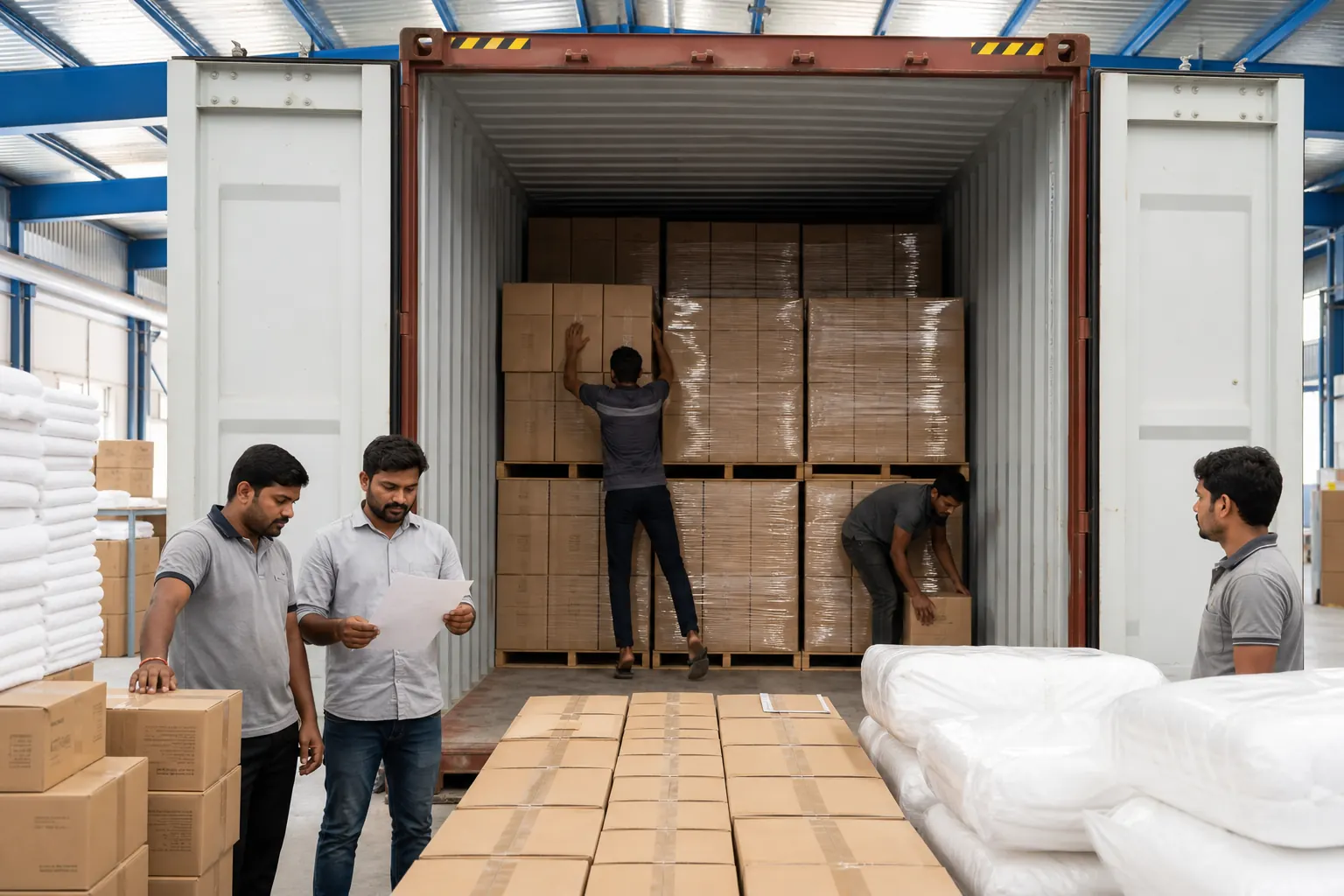
Container Loading
Export Tip
Whether a towel shipment reaches a volume, payload or route limit first is shipment-specific. Final loading depends on folded dimensions, pieces per carton, carton outside dimensions, assigned-container dimensions, weight limits, palletization and carrier rules.
Never promise pieces per container from nominal cubic capacity or the hypothetical inputs above. Conduct a master-carton pack trial, use external dimensions and model loading orientation. Leave an explicitly named, shipment-specific operational allowance for door clearance, bulging and safe weight distribution.
Comparison table
Swipe →
Data table — swipe horizontally on small screens
| Named planning input | Hypothetical model input | Status |
|---|---|---|
| Hypothetical carton outside dimensions | 60 × 40 × 40 cm | Scenario input, not an observed average |
| Calculated carton cube from that input | 0.096 m³ | Arithmetic result |
| Assigned 40-foot high-cube internal volume | Carrier/unit-specific | Replace with booking and CSC-plate data |
| Hypothetical planning utilization factor | 84% | Scenario input, not a benchmark or guarantee |
| Pieces per carton | Not populated | Replace after physical sample pack |
| Payload/legal road limit | Not populated | Replace with route and forwarder confirmation |
Shipping
Quote validity should reflect volatile freight. Define port pair, container type, direct or transshipment service, expected transit, sailing frequency, carrier, freight validity, origin and destination free time, detention/demurrage exposure, insurance basis and documentary cutoffs.
Indian exports require an IEC unless exempt, and commonly use a commercial invoice/packing list, shipping bill and bill of lading or airway bill. Certificates of origin, test reports and other documents depend on buyer, destination and claim. Altus Exports can coordinate the document set, but buyer and customs broker should approve classification and import requirements before production.
For operational detail, add logistics inputs to landed cost only after the pack-out, route, equipment and quote validity are known.

Certifications
Compliance Notes
Certification costs should be quoted only when the chain and product are eligible. OEKO-TEX STANDARD 100 is a harmful-substance-tested product label; GOTS addresses certified organic fibers and processing/chain requirements; GRS addresses recycled content and chain of custody; ISO 9001 concerns an organization’s quality management system. These are not interchangeable and are not universal legal prerequisites for ordinary towels.
Comparison table
Swipe →
Data table — swipe horizontally on small screens
| Evidence | What it can support | What it does not prove |
|---|---|---|
| OEKO-TEX STANDARD 100 certificate | Listed certified articles meet standard scope | Organic cotton or social compliance |
| GOTS scope + transaction documents | Eligible organic textile chain and shipment | Every product made by certificate holder |
| GRS scope + transaction documents | Eligible recycled material chain | Organic origin or universal product safety |
| ISO 9001 certificate | Audited QMS within certificate scope | Specific towel passed buyer tests |
| Accredited lab report | Tested samples met listed methods/limits | Untested production automatically conforms |
| Social audit | Site conditions at audit scope/time | Product technical quality |
Buyer Requirements
Buyer Requirements
A complete RFQ states end use, composition, size and tolerance, GSM and tolerance, measured piece-weight range, yarn/construction, shade standard, finish, performance tests, defect criteria, certification claims, label artwork, pack-out, quantity per SKU/color, destination, Incoterm, target ship window, inspection, payment and sample hierarchy.
Sourcing checklist
- [ ] Verify factory identity, capability, loom and wet-processing route.
- [ ] Confirm whether subcontractors handle dyeing, sewing or packing.
- [ ] Approve counter sample, lab dip and sealed production standard.
- [ ] Match certificate scope to product, facility and validity dates.
- [ ] Create a production and inspection calendar.
Buyer checklist
- [ ] Issue one version-controlled specification and artwork pack.
- [ ] State quantity by size, color and pack—not only total pieces.
- [ ] Define acceptable tolerances and test methods.
- [ ] Compare quotes under the same currency, validity and Incoterm.
- [ ] Obtain customs and labeling advice for the destination.
Exporter checklist
- [ ] Hold and maintain required Indian export registrations.
- [ ] Validate purchase orders against factory confirmations.
- [ ] Control samples, approvals, test reports and inspection release.
- [ ] Reconcile invoice, packing list, shipping bill and transport document.
- [ ] Preserve traceability and claim documentation.
Compliance checklist
- [ ] Classify goods using objective product facts.
- [ ] Distinguish law, voluntary certification and buyer contract.
- [ ] Approve fiber, country-of-origin, care and responsible-party labels.
- [ ] Verify restricted-substance and product-safety obligations.
- [ ] Substantiate organic, recycled, antimicrobial and environmental claims.
Country Opportunities
Market Snapshot
Comparison table
Swipe →
Data table — swipe horizontally on small screens
| Market | Example channel to validate | Price-model focus | Compliance focus |
|---|---|---|---|
| United States | Retail, hospitality or institutional program | Duty, port/local delivery, chargebacks | FTC fiber/origin identity; current HTS/Chapter 99 |
| EU | Private label, hospitality, sustainability programs | VAT/import model and multilingual SKUs | Regulation 1007/2011, REACH, GPSR |
| United Kingdom | Retail and hospitality | Duty/VAT and English packs | Fiber labeling and product safety |
| Japan | Buyer-defined finish or compact retail set | Inspection, presentation and lead time | Buyer-specific quality and Japanese labeling advice |
| Australia | Retail, hospitality and beach programs | Long-haul freight and care label changes | Mandatory care labeling standard |
| GCC | Hospitality and branded programs | Heat/moisture-resistant packaging and project lots | Country-specific labels and conformity checks |
Common Buyer Mistakes
Common Mistakes Box
- Comparing “500 GSM” without fixing dimensions and actual piece weight.
- Accepting “100% cotton” as a complete yarn and construction specification.
- Treating CIF as warehouse-delivered.
- Asking one total MOQ while ordering many small colors and labels.
- Using annual customs unit values as current factory prices.
- Ignoring destination charges on nominated freight.
- Approving a soft sample without testing absorbency after laundering.
- Paying for certificates without verifying scope and claim authorization.
- Changing artwork after production starts.
- Negotiating unit price while overlooking carton cube, defect risk and finance cost.
Future Trends
Scenario planning may need to test shorter quote-validity windows, traceable inputs, packaging changes, digital product data and buyer chemical-management requirements. These are potential program inputs, not universal market forecasts. Low-volume customization should be modeled with supplier-quoted dye-lot, setup and replenishment assumptions.
Automation in weaving, inspection and pack planning can reduce variation, while machine vision may improve defect detection. It will not replace a contractual specification or statistically valid acceptance plan. Freight and tariff volatility favors scenario models rather than one permanent landed-cost percentage.
How Altus Exports Supports a Price-Ready Program
Altus Exports positions itself as an Indian merchant exporter, global sourcing partner and export consulting expert. For terry towels, that means translating a buyer brief into a factory-ready RFQ, shortlisting suitable Indian producers, coordinating samples, validating commercial assumptions, arranging inspections/testing, managing export documents and coordinating logistics. Learn about textiles and home furnishings sourcing, export and sourcing services and the Altus Exports approach.
For the broader buying sequence, follow the end-to-end sourcing process. For technical quality and certification due diligence, continue to Terry Towel Certifications and Quality Standards.
Conclusion
The right terry towel wholesale price is the lowest controlled landed cost that delivers the approved performance, presentation, compliance and timing—not the lowest unqualified unit quote. Fix the specification, expose every cost boundary, test the product, model the route and negotiate production certainty.
Ready for a comparable quotation? Send Altus Exports your sizes, GSM, yarn/construction, colors, quantities, packaging, certification needs, destination and preferred Incoterm through the inquiry form on the Altus Exports homepage. The team can coordinate Indian sourcing, commercial comparison, samples, quality controls, export documents and shipment planning.
Sources
- WITS/UN Comtrade, India exports, HS 630260, 2024: https://wits.worldbank.org/trade/comtrade/en/country/IND/year/2024/tradeflow/Exports/partner/ALL/product/630260
- WITS/UN Comtrade, world exporters, HS 630260, 2024: https://wits.worldbank.org/trade/comtrade/en/country/ALL/year/2024/tradeflow/Exports/partner/WLD/product/630260
- WITS/UN Comtrade, world importers, HS 630260, 2024: https://wits.worldbank.org/trade/comtrade/en/country/ALL/year/2024/tradeflow/Imports/partner/WLD/product/630260
- WITS/UN Comtrade, Japan imports, HS 630260, 2024: https://wits.worldbank.org/trade/comtrade/en/country/JPN/year/2024/tradeflow/Imports/partner/ALL/product/630260
- OEC, HS 630260 profile: https://oec.world/en/profile/hs/toilet-or-kitchen-linen-of-cotton-terry-towelling
- ICC, Incoterms rules: https://iccwbo.org/business-solutions/incoterms-rules/
- DGFT, IEC profile management: https://www.dgft.gov.in/CP/?opt=iec-profile-management
- DGFT, Customs Import Export Procedures: https://content.dgft.gov.in/Website/CIEP.pdf
- USITC, Harmonized Tariff Schedule: https://hts.usitc.gov/
- FTC textile labeling guidance: https://www.ftc.gov/business-guidance/resources/threading-your-way-through-labeling-requirements-under-textile-wool-acts
- EU Regulation 1007/2011 summary: https://eur-lex.europa.eu/legal-content/EN/TXT/?uri=legissum:mi0088
- OEKO-TEX STANDARD 100: https://www.oeko-tex.com/en/our-standards/oeko-tex-standard-100
- GOTS official standard: https://gotslive.global-standard.org/images/resource-library/documents/standard-and-manual/GOTS_v8.0_signed.pdf
- Textile Exchange, RCS and GRS: https://textileexchange.org/recycled-claim-global-recycled-standard/
- ISO certification explanation: https://www.iso.org/certification.html
All sources accessed 2026-07-17.