
Source Cotton Home Textiles Directly from India: Importer Playbook
By Saurabh Mittal, Founder, Altus Exports
International importer playbook to source cotton home textiles from India — RFQ design, Panipat–Karur–Solapur mill verification, lab-dip and sampling protocols, QC gates, and landed-cost decision flow under HS 6302 without unnecessary intermediary risk.
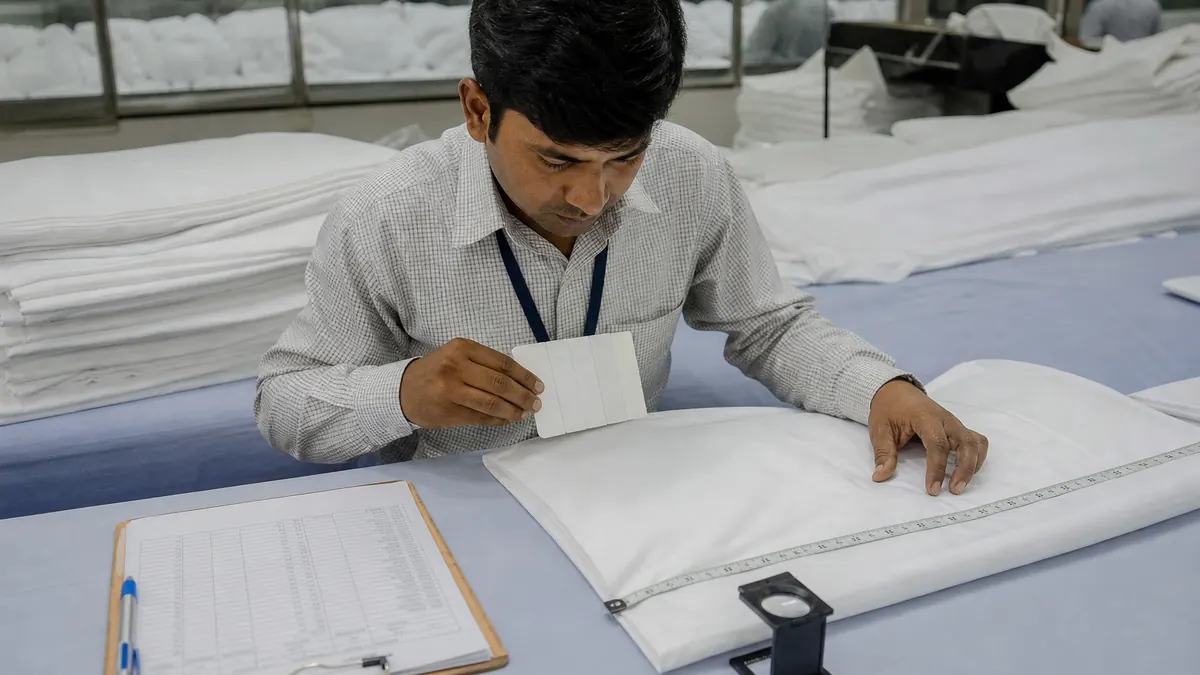
To source cotton home textiles from India successfully, treat supplier verification as a structured importer process — not a marketplace price race. India's cotton made-ups capacity clusters in Panipat (blankets, throws, terry adjacency), Karur and Coimbatore (export-disciplined bed, table, and curtain programmes), Solapur (terry and bath linen adjacency), Tirupur-adjacent cut-and-sew, and Delhi-NCR merchant consolidation, with export stuffing through Mundra, Nhava Sheva, Chennai, and ICD Delhi. Buyers who define construction, shade, GSM, fibre-label artwork, and pack format before outreach extract better value than those who negotiate undefined “home textiles” on FOB alone.
This importer playbook walks through the direct-sourcing sequence under HS 6302 (bed, table, toilet, kitchen linen) and related Chapter 63 assortment lines: writing an RFQ that mills can price honestly, auditing Panipat–Karur–Solapur plants, running lab-dip and size-set sample protocols, commissioning independent QC, modelling landed cost, and scaling from 20–100 pcs/SKU samples through 500–3,000 pcs trials to wholesale 20′/40′ HQ FCL. Trade context — India HS 6302 ~US$1,858.84M (FY 2023-24) / ~US$2,128.63M (FY 2024-25 directional) with the USA typically ~62–67% of value — helps you choose corridors, but does not replace lot-level verification.
For exporter-side process depth, see How to Export Cotton Home Textiles from India. For SKU and family selection, see Top Cotton Home Textile Products Exported from India. Whether you engage a product sourcing company in India or work mill-direct, the checkpoints below apply — product risk is shade, construction, and label specific.
Key Takeaways
Summary Box
Executive Summary
Summary Box
- Scan the coloured Summary / Tips / Mistake boxes first — then open QC and cost tables.
- Decide specification + destination compliance before negotiating FOB.
- Use the jump nav on mobile: Takeaways → RFQ/Audit → Pricing → Pack → Checklist → FAQ.
Sourcing cotton home textiles directly from India works when importers run a gated sequence: RFQ clarity → credential check → mill audit → lab-dip/sample approval → independent QC → landed-cost modelling → trial MOQ → FCL scale.
The Panipat–Karur–Solapur corridor map rewards buyers who share end-use channel (retail PL, hospitality, wholesale distributor) upfront rather than chasing the lowest undefined FOB.
This playbook compresses first-order shade, construction, and label risk for international retail procurement, hospitality linen buyers, and distributors evaluating Indian HS 6302 supply.
Market Size & Industry Overview
Key Statistics
- Cluster map: Panipat · Karur/Coimbatore · Solapur · Delhi-NCR · west/south ports.
- Council stack on supplier side: TEXPROCIL RCMC + IEC.
- Buyer job: RFQ → audit → sample → QC → landed cost → trial → scale.
- Trade cue: USA ~62–67% of HS 6302 value; UK, Australia, Canada, Germany follow (directional).
Direct buyers should map mill capacity, dye/print seasonality, and Mundra/Nhava Sheva/Chennai stuffing windows before negotiating annual programmes. India is a top-tier global origin for cotton home textiles (HS 6302 ~US$1,858.84M FY 2023-24; ~US$2,128.63M FY 2024-25 directional), which means supplier shade discipline and label-pack accuracy differentiate more than origin novelty.
Supply geography for importers: Panipat for blankets, throws, and terry-adjacent made-ups; Karur and Coimbatore for export-disciplined bed, table, and curtain lines; Solapur for terry and bath adjacency; Tirupur-adjacent for cut-and-sew; Delhi-NCR for merchant multi-cluster consolidation. Merchant exporters often consolidate multiple mill lots into one invoice — useful when you need single-interface programmes without losing plant-level audit rights.
TEXPROCIL's broader cotton textiles basket (~US$11.68B FY 2023-24 directional) includes yarn and fabric lines — do not confuse it with pure HS 6302 made-ups capacity when sizing supplier claims.
Export Statistics
Key Statistics
When verifying suppliers, confirm they actually file cotton home textile exports under HS 6302 (and 6303/6304 when assortment lines apply) relevant to your SKU — misclassification or unrelated apparel history is a red flag if your RFQ is bed-and-bath made-ups.
India's directional export scale means many units can show “export experience.” Ask for shipment evidence matching your product family and destination compliance tier, not generic export trophies.
India cotton home textile export context for importer due diligence (directional)
Swipe →
Data table — swipe horizontally on small screens
| Metric | Directional Estimate | Importer Use |
|---|---|---|
| India HS 6302 exports FY 2023-24 | ~US$1,858.84M | Sanity-check supplier volume claims vs national scale |
| India HS 6302 exports FY 2024-25 | ~US$2,128.63M (+~14.5% YoY) | Category is growing — verify mill capacity honestly |
| USA share of India HS 6302 | ~62–67% of export value | Ask for US shipment references when possible |
| Top destinations after USA | UK, Australia, Canada, Germany, UAE, Japan | Match supplier history to your corridor |
| Primary clusters | Panipat; Karur/Coimbatore; Solapur; Delhi-NCR | Plan audit travel / third-party inspection here |
| Ports | Mundra; Nhava Sheva; Chennai; ICD Delhi | Compare FOB named-port quotes apples-to-apples |
| Council credentials | TEXPROCIL RCMC + IEC | Hard gate before sample payment |
Import Statistics
Key Statistics
- Pull your market's label and cert rules into the written RFQ.
- Ask suppliers for corridor-specific shipment proof, not generic export lists.
- Landed-cost model must include destination broker and label compliance fees.
Your destination's import pattern should shape the RFQ. US and EU buyers typically need tighter fibre-label and care-label compliance; UK runs separate post-Brexit tariff; UAE hospitality programmes prioritise white-shade continuity and replenishment speed; Japan adds construction precision and certification evidence. Import your market's rules into the RFQ instead of discovering them after the trial lands.
For corridor ranking before you shortlist suppliers, see Best Countries for Indian Cotton Home Textile Exports — this playbook owns verification and sampling, not destination ranking.
Importer destination cues that change the RFQ (planning)
Swipe →
Data table — swipe horizontally on small screens
| Your Market | RFQ Emphasis | Verification Extra |
|---|---|---|
| USA | TPFIA fibre labels, care labels, CBP entry readiness, retail PL barcode if applicable | Label artwork sign-off before bulk dye |
| UK / EU / Germany | Fibre content labels, azo/REACH, OEKO-TEX if claimed | EU-accepted lab willingness for retest |
| Australia / Canada | Care/fibre labels, competitive construction specs | English-language label fields; Quebec bilingual if Canada retail |
| UAE / GCC | White-shade continuity, bulk hotel carton marks, fast replenishment | Hospitality laundry durability specs |
| Japan | Construction tolerance, cert evidence, tight size charts | Longer sample approval; smaller first trial |
Product Categories / Variants
Summary Box
- One RFQ = one clear programme definition — avoid “home textiles any SKU”.
- GOTS/hospitality custom needs 6–10+ week lead-time honesty in the RFQ.
- Private-label retail requires label artwork freeze before production start.
Shortlist SKUs before supplier calls. Core Indian export families include bed linen (sheets, pillowcases, duvet covers), terry bath and kitchen linen, table linen (napkins, placemats, tablecloths), curtains and drapes, quilts/comforters/bedspreads, and coordinated private-label bed+bath sets. Full catalogue depth lives in Top Cotton Home Textile Products Exported from India.
If your basket is bedsheet-led or terry-led, keep those RFQs explicit and link sibling guides — how to export bedsheets from India and import terry towels from India — because construction specs differ. Do not let a mixed home-textile RFQ silently inherit wrong thread-count or pile assumptions.
RFQ-ready product decisions for Indian cotton home textiles
Swipe →
Data table — swipe horizontally on small screens
| Decision | Options to Lock | Why Importers Care |
|---|---|---|
| Product family | Bed, terry bath/kitchen, table, curtains, quilts, coordinated PL set | Determines mill capability and HS heading |
| Construction | Yarn count, weave (percale/sateen/plain), terry GSM, quilt fill | Price, hand-feel, and durability claims |
| Shade / colour | Lab-dip standard, white point for hospitality, print repeat if applicable | Shade mismatch is the top first-order dispute |
| Size chart | Bed sizes (twin/full/queen/king), towel sizes, table dimensions | Dimensional tolerance disputes start here |
| Certification tier | Conventional, OEKO-TEX, GOTS/OCS, BCI — with chain-of-custody | Vendor approval gate for retail/hospitality |
| Pack format | Polybag + carton; retail PL; hotel bulk carton marks | Landed cost and label compliance |
Manufacturing Overview
Export Tip
- Verify cut-sew → pack hygiene with photos or on-site walkthrough.
- Confirm shade-lot marking and no mixed-shade carton stuffing.
- Retain reference samples from approved trial lots against bulk production.
Importer audits should confirm the mill's real process — not a brochure flowchart. Typical commercial line for cut-and-sew home textiles: grey fabric or purchased yarn → weaving/knitting → dye/print (or yarn-dye) → cut → sew → inspect → fold/polybag → carton pack → warehouse staging. Terry programmes add pile weaving and cut-fold-pack loops. Quilts add fill and quilting steps.
Ask to see shade-lot segregation, needle control, and carton marking discipline. Request recent dimensional tolerance data for the SKU you want — three consecutive lots beat a single perfect sample. Confirm whether the invoicing entity is a merchant consolidator and which plant feeds your lot.
Panipat excels at volume throws, blankets, and terry-adjacent lines; Karur/Coimbatore at export packing culture; Solapur at terry adjacency. Match mill type to RFQ before audit travel.
Pricing Analysis
Buyer Tip
Importers should demand FOB build-ups in USD/pc or USD/set by SKU — yarn index reference, construction premium, dye/print premium, cert premium, and pack format. Commodity bed/bath programmes often sit in low-to-mid USD/pc bands; hotel linen and certified private-label run higher. Verify on quote date.
Compare suppliers only on identical Incoterm, named port, construction, and label scope. A slightly higher FOB with honest shade discipline and TEXPROCIL-backed documentation often beats a cheap FOB that fails destination label audit.
Landed-cost build-up for importer decisioning (directional)
Swipe →
Data table — swipe horizontally on small screens
| Component | Typical Inputs | Importer Action |
|---|---|---|
| FOB | USD/pc or set at named port | Require written build-up per SKU |
| Inland haulage | Mill → ICD/port | Normalise when Incoterms differ |
| Ocean + insurance | Per Incoterm (FOB/CFR/CIF) | Get forwarder quote on trial date |
| Duty | Live HTS/TARIC/UKGT on HS 6302 line | Broker confirmation before PO |
| Broker + terminal | Destination fees | Include in corridor comparison |
| Label / lab compliance | Artwork, retest, cert TCs | Budget for EU/US/Japan tiers |
| Rejection reserve | Shade, size, label error risk | Higher on first trial with new mill |
MOQ Analysis
Buyer Tip
MOQ gates protect both parties while shade and construction consistency is unproven. Standard ladder: 20–100 pcs/SKU or lab-dip sets for sampling; 500–3,000 pcs hero SKU or mixed LCL trial; 1×20′ or 1×40′ HQ mixed FCL for wholesale; hospitality seasonal call-offs by contract.
Freeze-dried or certified organic trials may stay at lower pcs because certificate lots and dye capacity are scarcer. Never jump from unapproved lab-dip to full FCL.
MOQ ladder for importer sourcing programmes
Swipe →
Data table — swipe horizontally on small screens
| Stage | Typical Volume | Purpose |
|---|---|---|
| Lab-dip / strike-off | 1–3 colourways | Shade approval before bulk dye |
| Size-set sample | 20–100 pcs/SKU | Construction and dimensional check |
| Trial / LCL | 500–3,000 pcs mixed or hero | Sample-to-bulk shade match + docs |
| Wholesale FCL | 1×20′ or 1×40′ HQ | Scale after trial clearance |
| Hospitality call-off | Replenishment POs by season | White-shade continuity proven |
Packaging Standards
Export Tip
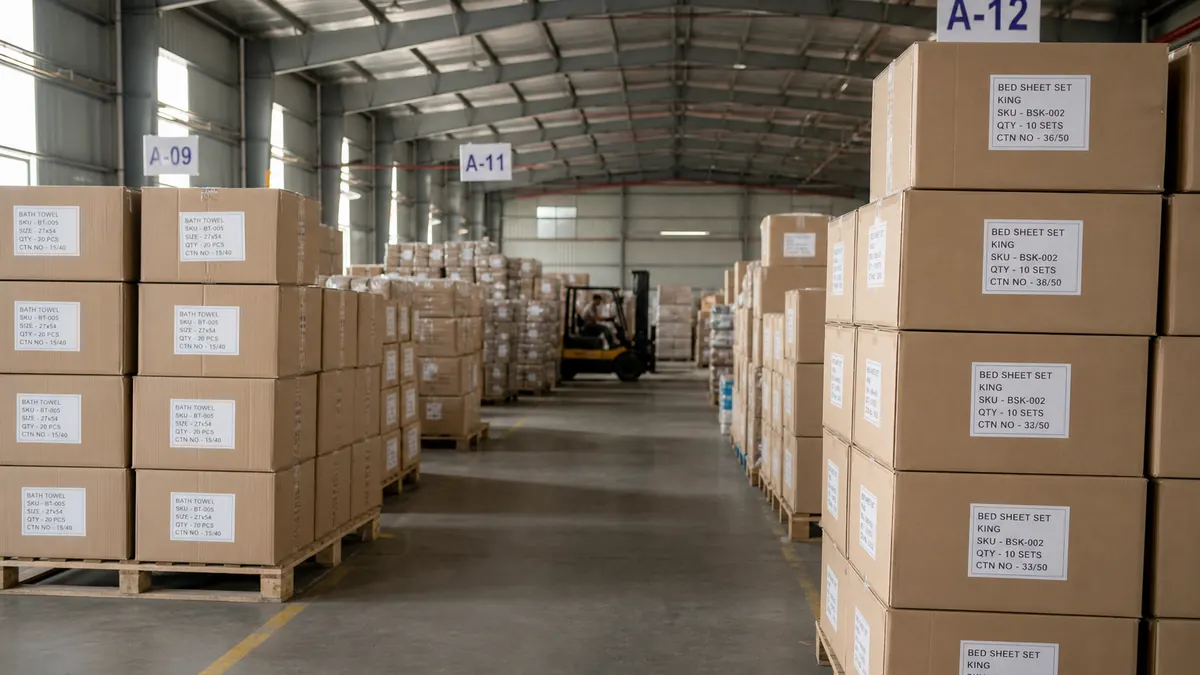
- Carton marks must reconcile to packing list and invoice line IDs.
- Size/SKU segregation prevents mixed-shade retail shelf problems.
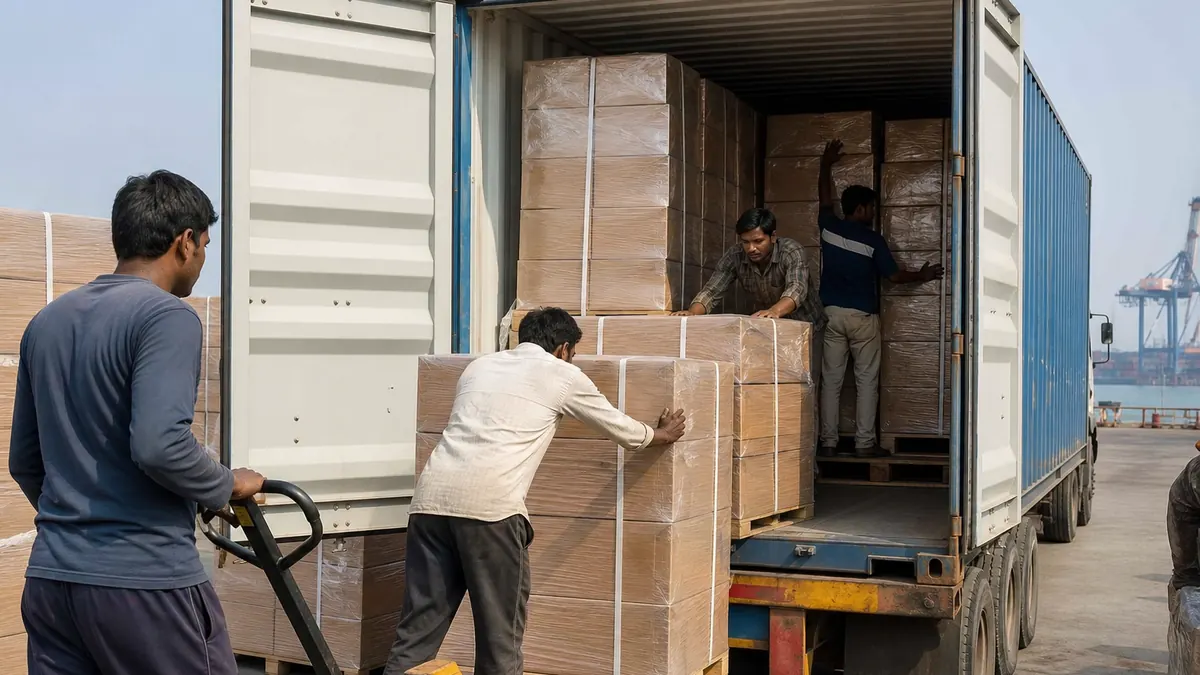
- Photograph packed cartons at stuffing for claims defence.
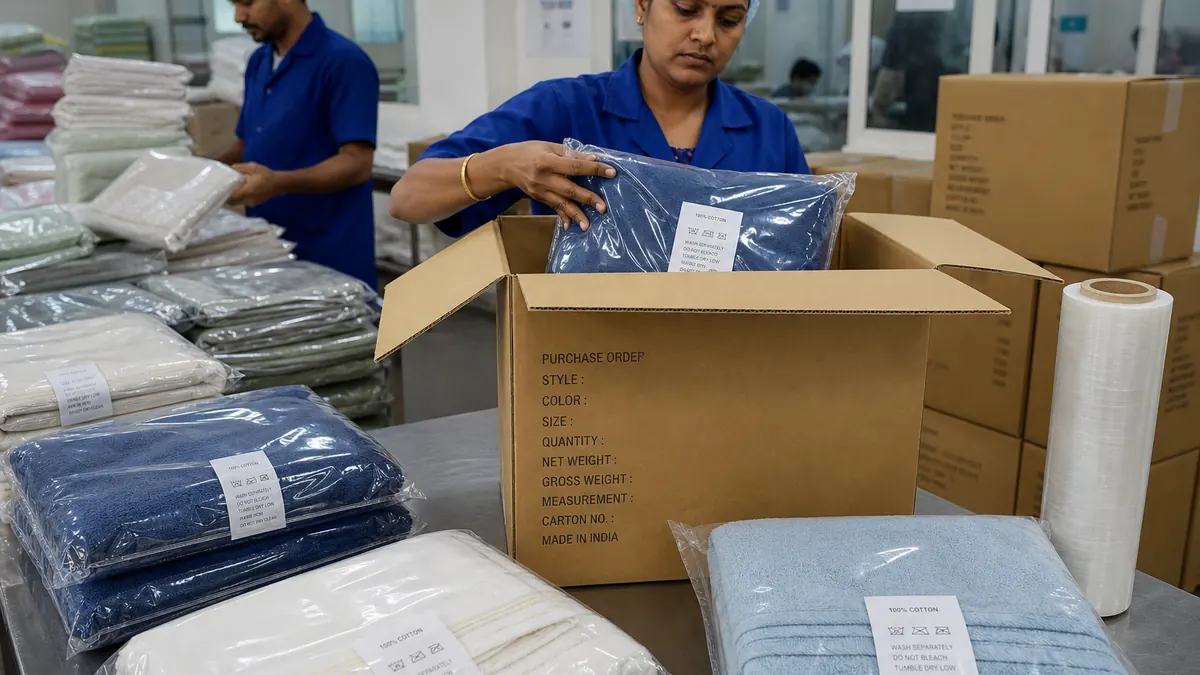
Importers should specify polybag material, fold method, carton burst strength, and marking fields in the RFQ. Retail PL needs barcode placement and consumer-facing label language. Hospitality bulk packs need linen-room SKU marks with fewer polybags.
Moisture protection (silica, carton lining) is cheap insurance on US and EU long-haul lanes — specify it rather than assuming export default.
Container Loading Details
Export Tip
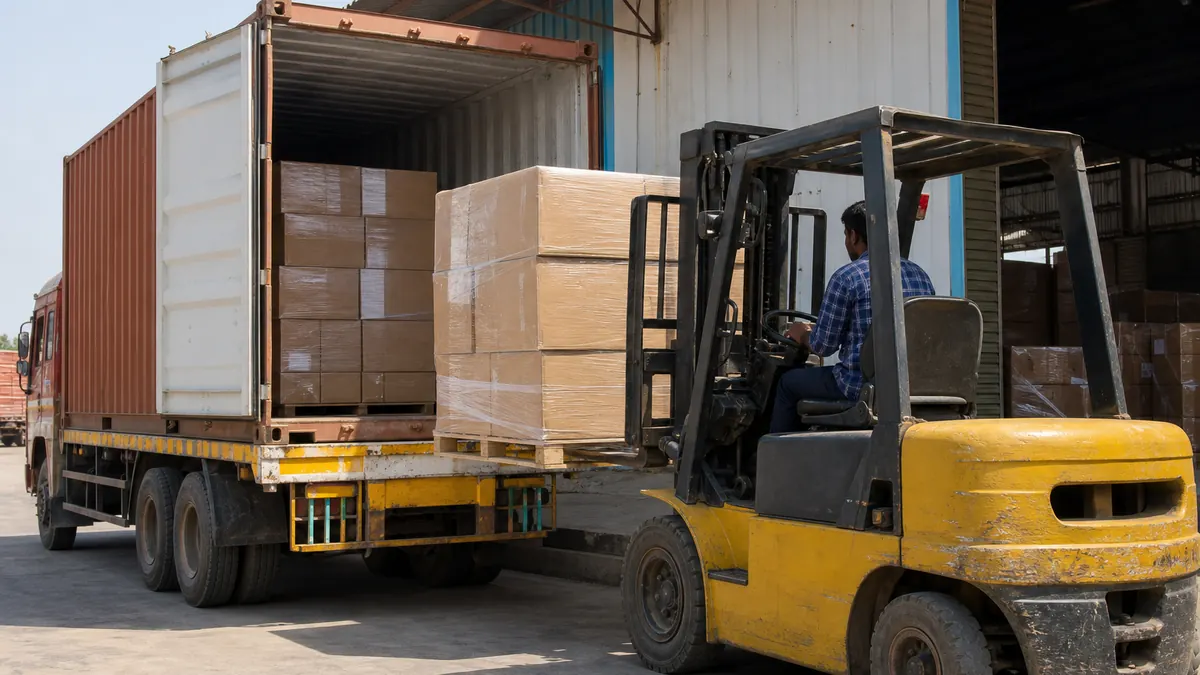
First-time importers often underestimate cube on quilts and curtains — trial LCL teaches stow behaviour before FCL commitment. Mixed bed+bath FCL is common; confirm weight/cube mix with forwarder so terry does not overweight a cube-limited load.
Panipat programmes may stuff via ICD Delhi/Mundra; Karur programmes via Chennai/Tuticorin. Named-port FOB keeps haulage visible when comparing suppliers.
Trial-to-FCL loading decision cues
Swipe →
Data table — swipe horizontally on small screens
| Programme Type | Loading Behaviour | Importer Note |
|---|---|---|
| Bed linen + pillowcases | Moderate cube | Good LCL trial candidate |
| Terry bath mix | Weight-heavy | Watch 20′ weight limits |
| Quilts / comforters | Cube-out early | Fewer pcs — adjust landed cost model |
| Curtain programme (6303) | Long cartons | Confirm HS and flammability docs |
| Mixed PL assortment | SKU block staging | Require stuffing photos on trial |
Shipping Methods
Export Tip
- Courier samples with batch/shade IDs — anonymous swatches waste time.
- Book trial sailings with buffer for dye-lot delays.
- Match payment milestones to BL and document reconciliation.
Samples ship courier/air; trials may use LCL ocean; scale uses FCL from Mundra, Nhava Sheva, or Chennai. Incoterms: EXW mill, FOB named port, CFR/CIF buyer port; DDP only with mature destination partner.
Lead times: stock commercial 3–5 weeks; dyed/printed PL 5–8+ weeks; GOTS/hospitality custom 6–10+ weeks. Pillar process: How to Export Cotton Home Textiles from India. Documents: documentation checklist.
Certifications
Compliance Notes
Lock cert scope in the RFQ: conventional with accurate fibre labels; OEKO-TEX Standard 100 for premium retail; GOTS/OCS for organic claims; BCI with chain-of-custody for sustainability claims. EU destinations may require REACH documentation on finishes; curtains may need flammability certs.
See TEXPROCIL Registration Benefits for Cotton Home Textile Exporters for council credibility and organic/hospitality specialty guide for certified programme depth.
Certification verification for importers
Swipe →
Data table — swipe horizontally on small screens
| Claim | Evidence to Request | Red Flag |
|---|---|---|
| OEKO-TEX Standard 100 | Valid cert matching SKU/component scope | Expired or wrong product class |
| GOTS / OCS organic | Transaction certificates for cotton and processing | Logo use without TC |
| BCI / Better Cotton | Mass-balance or physical chain docs | Marketing claim without CoC |
| ISO 9001 plant | Scope covers sewing/packing site | Office ISO only, not factory |
| Third-party inspection | SGS/BV/Intertek pre-shipment report | Refusal on first FCL |

Buyer Requirements
Buyer Requirements
- Require pre-production sample sign-off in writing.
- Name AQL level and inspection rights in the PO.
- Attach destination label rules as an annex — not an email afterthought.
International buyers should treat the RFQ as the contract backbone: construction tables, shade standards, tolerance bands, label artwork, inspection protocol, payment milestones, and claim windows. Vague “best quality home textiles” RFQs produce unenforceable disputes.
Retail chains add PL barcode and packaging compliance; hospitality buyers add laundry cycle durability and white-point continuity; distributors add assortment architecture across bed+bath+table in one FCL.
Country-wise Opportunities
Market Snapshot
- Pick corridor first → filter suppliers with matching shipment history.
- Ask mills which destinations they currently ship without label claims.
- Model landed cost per corridor before final supplier selection.
Corridor choice shapes supplier shortlisting — not vice versa. USA programmes (~62–67% of India HS 6302 value) dominate volume but demand label discipline; UK/EU premium tiers demand azo/OEKO-TEX readiness; UAE hospitality rewards shade speed on white linen.
This playbook does not rank destinations — see Best Countries for Indian Cotton Home Textile Exports. It ensures the supplier you pick can execute in your chosen corridor.
Sourcing Checklist
Checklist
RFQ Checklist (Importer)
Mill Verification Checklist
Export Process
Export Tip
From the importer's seat, the India export process is a coordination checklist: supplier produces against approved lab-dip; issues packing list aligned to carton marks; CHA files shipping bill under correct HS 6302/6303/6304 lines; commercial invoice reconciles; container stuffed with seal photos; B/L released per payment terms; you file destination entry with fibre-label compliance.
Merchant exporters consolidate multi-mill assortments — importers still audit feeding plants and retain inspection rights on trial and first FCL.
Importer-controlled gates in the export flow
- No bulk dye without written lab-dip approval.
- No balance payment without invoice / packing list / carton mark reconciliation.
- No FCL scale without trial arrival shade and size check against retained sample.
- Name load port on FOB to compare inland haulage honestly.
What this playbook does not own
- Exporter IEC/TEXPROCIL registration how-to — see TEXPROCIL cluster post.
- Trade-show calendars — see trade shows post.
- Per-country SKU preference matrices — see demand-by-country post.
- Destination ranking methodology — see best countries post.
Import Data Analysis
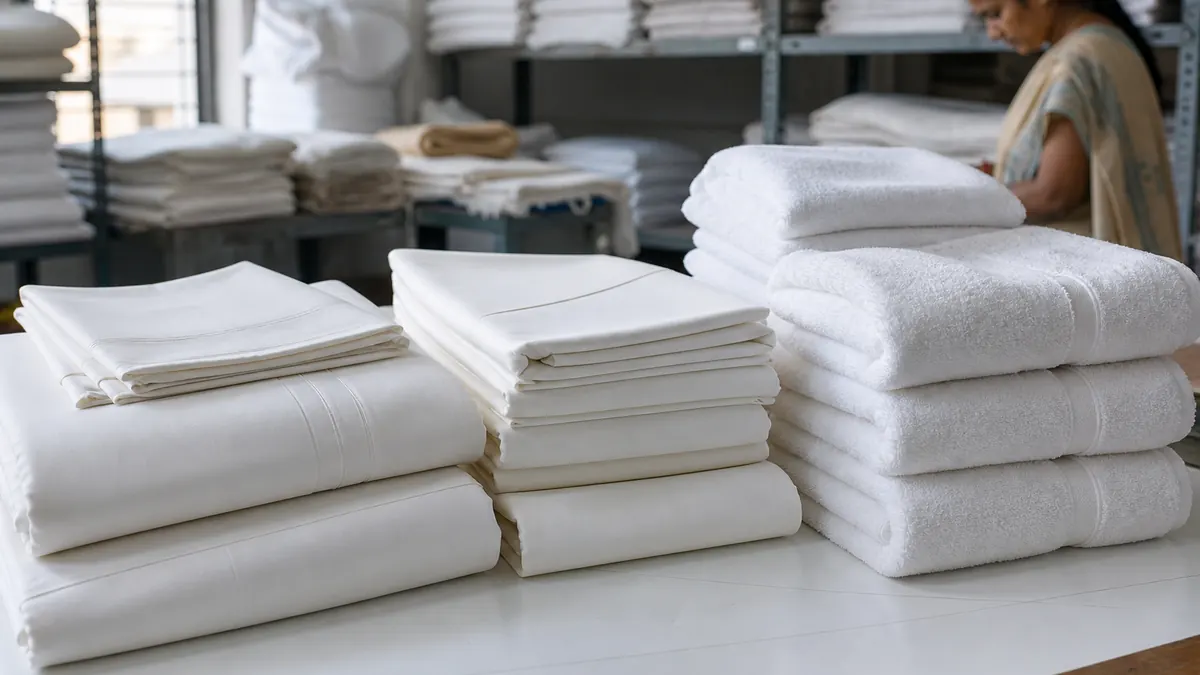
Importer-side data analysis should answer: Can this supplier hit my destination's compliance tier at a landed cost my channel can bear? Build a simple scorecard — credential completeness, audit findings, sample vs spec, independent QC delta, FOB competitiveness, lead-time honesty, payment-term risk — and weight compliance higher than a 3% FOB discount.
Compare at least two mills (or one mill plus one merchant consolidator) before first trial. Single-source decisions on brochure price are the most common first-order failure mode in home textile importing.
Importer supplier scorecard for Indian cotton home textiles
Swipe →
Data table — swipe horizontally on small screens
| Score Dimension | What Good Looks Like | Deal-Breaker Example |
|---|---|---|
| Credentials | Valid IEC, TEXPROCIL RCMC matching invoice entity | Trading name ≠ licensed entity |
| Mill audit | Traceable cut-sew-pack; shade segregation; carton marks | No access to actual production floor |
| Sample vs spec | Dimensions and shade within written bands | Beautiful sample, no tolerance table |
| Independent QC | AQL inspection passes on trial lot | Refusal to allow third-party pre-shipment inspection |
| Landed cost | Transparent FOB build-up + realistic freight | FOB far below peers with vague construction language |
| Lead time | Matches dye/print/cert scope honestly | Promises GOTS PL in stock lead time |
| Document rhythm | Invoice/packing list/carton mark reconciliation | Chaotic SKU IDs on first trial |
Common Buyer Mistakes
Common Mistakes Box
Future Market Trends
Key Statistics
- Multi-SKU PL assortments reward merchant consolidators with audit transparency.
- Hospitality replenishment programmes favour mills with white-shade continuity systems.
- Digital lab-dip approval speeds cycles — but retained physical swatches still matter.
E-commerce private-label bedding and bath continue to pull importers toward multi-SKU Indian assortments with shorter design cycles — RFQ discipline becomes more important, not less. Certified organic and hospitality premium programmes grow faster than commodity open-stock — plan longer lead times and cert chain-of-custody in the RFQ.
US and EU enforcement on fibre mislabelling and azo dyes raises the cost of weak documentation — importers who front-load label compliance win repeat programmes.
Challenges & Solutions
- Challenge: shade mismatch bulk vs sample — Solution: lab-dip approval, shade lot IDs, no mixed-shade cartons
- Challenge: size tolerance disputes — Solution: written tolerance table + size-set approval
- Challenge: label rejection at destination — Solution: artwork sign-off before production
- Challenge: supplier opacity — Solution: mill audit + TEXPROCIL/IEC verification
- Challenge: landed-cost surprises — Solution: broker duty check + forwarder quote before PO
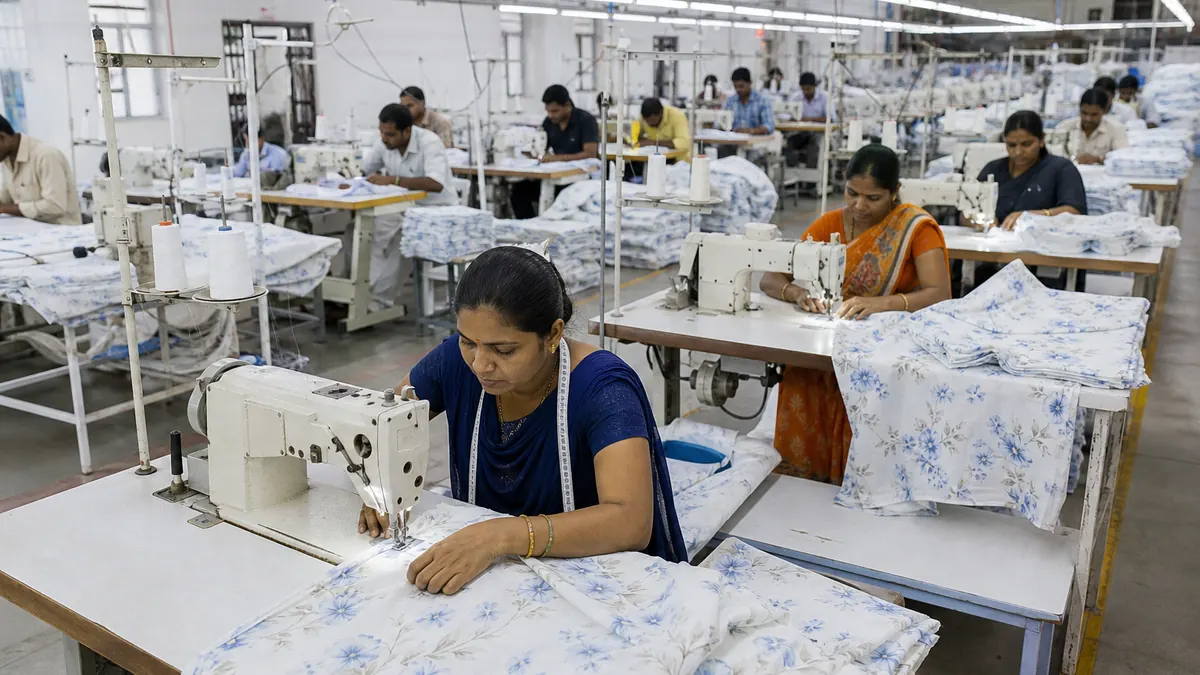
Direct sourcing challenges include shade lot variation across dye batches, dimensional drift on cut-and-sew lines, label artwork errors, and document reconciliation failures. Solutions are procedural — gates, retained samples, independent inspection, and phased payment.
Compliance Checklist
Checklist
Compliance Notes
Buyer Checklist + Exporter Checklist + Compliance Checklist
Checklist
Compliance Notes
Buyer Checklist (Summary)
- RFQ with construction, shade, sizes, labels, certs, MOQ, Incoterm
- Credential verification (IEC, TEXPROCIL RCMC)
- Mill audit or third-party inspection report
- Lab-dip and size-set approval with retained samples
- Landed-cost model approved by finance
- Trial PO with inspection and payment milestones
- Trial arrival check before FCL authorization
Exporter Checklist (What to Demand from Suppliers)
- Written FOB build-up per SKU with quote date
- Named port and realistic lead time by dye/cert scope
- Lab-dip submission before bulk production
- Stuffing photos and seal numbers on trial shipment
- Document pack preview before vessel departure
Sources
- DGCI&S — Directorate General of Commercial Intelligence and Statistics
- Indian Trade Journal — HS 6302 commodity export profile (FY 2023-24)
- Indian Trade Journal / DGCI&S commodity profiles (HS 6302 updates)
- Ministry of Commerce & Industry — TRADESTAT
- TEXPROCIL — The Cotton Textiles Export Promotion Council
- TEXPROCIL — Cotton Home Textiles overview
- DGFT (India) — IEC / trade portal
- CBIC — Indian Customs Tariff (Chapter 63)
- ITC Trade Map
- UN Comtrade Database
- WITS World Integrated Trade Solution
- USITC Harmonized Tariff Schedule (search 6302)
- US CBP — Textile and apparel resources
- FTC — Textile Fiber Products Identification Act
- European Commission TARIC
- EU Regulation (EU) No 1007/2011 — textile fibre names & labelling
- UK Trade Tariff / UK Global Tariff
- UK DCTS goods graduation (Ch. 52 & 63 India — verify current notice)
- DFAT — Australia–India ECTA
- Australian Border Force — FTA Portal
- OEKO-TEX Standard 100
- GOTS — Global Organic Textile Standard
- Better Cotton (BCI)
- IPPC — ISPM 15 wood packaging
- Altus Exports — Textiles & Home Furnishings
All sources accessed 2026-08-08 during the cotton home textiles factual audit. Prefer primary government and multilateral databases (DGCI&S / Indian Trade Journal HS 6302 commodity profiles, TEXPROCIL, DGFT, USITC HTS, EU TARIC, UK Trade Tariff / DCTS graduation notices, DFAT ECTA, ITC Trade Map / UN Comtrade / WITS) when citing figures in contracts or buyer presentations. Re-verify live before every commercial quote.
Supplier verification and sample protocols should reference the same Chapter 63 HS family the exporter will file, plus destination fibre-label rules (US TPFIA, EU 1007/2011, UK labelling).
Conclusion
To source cotton home textiles from India with lower first-order risk, run an importer playbook: precise RFQ, Panipat–Karur–Solapur mill audit, lab-dip and size-set approval, independent QC, landed-cost modelling, then trial MOQ before FCL scale under HS 6302.
Altus Exports supports international buyers as a product sourcing company in India and global sourcing partner across textiles & home furnishings. Contact the team to structure your first mill verification and trial shipment.
Continue with How to Export Cotton Home Textiles from India, Top Cotton Home Textile Products Exported from India, TEXPROCIL Registration Benefits for Cotton Home Textile Exporters, and the cotton home textile export documentation checklist.