
Cricket Bat Export Documentation Checklist: IEC, Shipping & Compliance
By Saurabh Mittal, Founder, Altus Exports
A complete cricket bat export documentation checklist for Indian manufacturers and MSMEs — IEC, GST, commercial invoice, packing list, shipping bill, bill of lading/AWB, certificate of origin, willow grade declarations, PSI reports, and ISPM-15 wood packaging. Market notes for the UK, Australia, USA, and UAE, a 48-hour pre-shipment audit workflow, common mistakes, and a Meerut case study. Avoid customs delays and buyer disputes with guidance from Altus Exports.
Cricket bat shipments fail documentation for the same reasons other exports do — mismatched weights, vague product descriptions, and missing certificates — with one category twist that most generic export guides never mention: willow grade and dimensional claims must match what is physically inside the carton. A commercial invoice that says "Grade 1 English willow" sitting on top of a carton of Grade 3 blades is not a paperwork slip; it is a dispute waiting to surface the moment a UK pro shop or Australian distributor opens the box.
Meerut and Jalandhar manufacturers ship thousands of cricket bats every season into the UK, Australia, the USA, the UAE, South Africa, and associate cricket nations. Most of those shipments clear customs cleanly because the exporter treats documentation as a production step — not a task squeezed in the night before cargo cutoff. The shipments that stall almost always share the same root causes: a packing list that does not reconcile with the commercial invoice, a certificate of origin filed after the vessel has already sailed, or a willow grade declaration that was never checked against the actual pressed blades in the master carton.
This is the cricket bat export documentation checklist we use with manufacturers and buyers at Altus Exports — covering registration foundations, the core shipment document set, category-specific attachments unique to sporting goods willow products, destination-market notes for the UK, Australia, USA, and UAE, a pre-shipment audit workflow, and the mistakes that cost exporters repeat orders. Use it before every sailing, not just your first one.
Key Takeaways
Summary Box
- Keep product names, willow grades, quantities, sizes, and weights identical across the commercial invoice, packing list, and shipping bill — a single mismatch is the fastest route to a customs query.
- State willow type (English vs Kashmir) and grade clearly on every document. Never blur grades to make an assortment look more premium than it is; grade inflation destroys buyer trust permanently.
- IEC, GST readiness, and SGEPC membership are the non-negotiable foundations. Without a valid IEC you cannot file a shipping bill; without SGEPC evidence, buyer onboarding takes longer than it should.
- Attach PSI (pre-shipment inspection) reports and weight logs whenever buyers require them — and even when they do not, because they protect you in disputes.
- ISPM-15 marks on wood packaging materials matter for Australia, the UK, and several other destinations. Untreated wood pallets or dunnage can trigger fumigation holds and demurrage.
- Run a 48-hour pre-shipment document audit on every shipment. Fixing a mismatch on land costs nothing; fixing it after the container gates in at destination costs weeks and money.
Why Documentation Errors Sink Cricket Bat Shipments
Cricket bats are a deceptively document-heavy category for a product that looks simple on a shelf. Buyers care about willow origin (English vs Kashmir), grade (often Grade 1 through Grade 4, or house-specific grading language), weight band, handle type, blade profile, and whether the bat is legal for match play under MCC Law 5. Every one of those attributes can appear — explicitly or implicitly — on your commercial invoice, and every one of them needs to match the physical bats a customs officer or the buyer's warehouse team finds when the carton is opened.
Destination customs authorities do not evaluate craftsmanship; they compare documents against each other and, on inspection, against physical cargo. A shipping bill that lists "cricket bats, English willow" while the commercial invoice separately itemises a mixed Kashmir and English willow assortment invites a classification query. A packing list that shows 480 units in 40 cartons while the actual count is 468 will hold cargo at the port of discharge until someone reconciles the difference — usually after the buyer has already called asking where their container is.
The commercial cost of documentation failure is rarely limited to the fine itself. Demurrage and storage charges accrue daily once a container sits beyond its free time at the destination terminal. Buyers who have already committed shelf space or a marketing calendar around a bat launch lose patience quickly when a shipment is delayed by paperwork rather than by transit time. And once a buyer has experienced one grade-inflation dispute or one documentation hold, the relationship rarely recovers to full trust — even if the underlying product was good.

Pre-Export Foundations
Before any shipment-specific document can be prepared correctly, four foundational registrations and account readiness items must be current. Skipping or half-completing any of these is the single most common reason first-time cricket bat exporters cannot file a shipping bill on schedule.
Import Export Code (IEC) on DGFT
Every commercial cricket bat export needs a valid Import Export Code issued by DGFT. IEC appears on the shipping bill and underpins your legal standing as an exporter of record. Keep your DGFT login, PAN linkage, and bank details consistent — mismatches between IEC records and GST records are a common and entirely avoidable source of delay when a CHA tries to file.
Manufacturers without their own IEC, or units that prefer not to manage export compliance directly, often ship through a merchant exporter who holds a valid IEC and takes on exporter-of-record responsibilities. This is common in Meerut and Jalandhar clusters where production strength does not always come paired with export administration capacity.
GST Compliance and Export Invoice Series
GST registration must support zero-rated export supplies, typically through a Letter of Undertaking (LUT) where eligible. Maintain a dedicated export invoice series with correct HSN codes for cricket bats and related sporting goods accessories, and make sure the place-of-supply fields and invoice format your accountant uses match what your CHA expects when filing the shipping bill.
A surprising number of documentation delays trace back to GST-side inconsistencies rather than shipping-side errors — an HSN code on the export invoice that does not match the code declared on the shipping bill, for example. Reconcile these before your first shipment, not after a query arrives from the GST department months later.
SGEPC Membership Evidence
Sports Goods Export Promotion Council (SGEPC) membership is not legally mandatory in the way IEC is, but it functions as a credibility signal that buyers, distributors, and even some destination retailers ask for during vendor onboarding. SGEPC evidence also opens access to fair participation, directories, and market intelligence specific to sporting goods exporters — channels that pure documentation compliance will never unlock on its own.
Keep your SGEPC certificate, membership number, and renewal status easily shareable as a PDF. Buyers conducting first-time vendor due diligence frequently request it alongside your IEC and company registration documents before issuing a purchase order of meaningful size.
Bank AD Code and Forex Receipt Readiness
Register your Authorised Dealer (AD) code with the port of export through your bank, since this is required before shipping bills can be filed against that specific port. Confirm your bank's process for foreign inward remittance so that advance payments and balance payments against B/L copy or documents-against-payment terms are recognised against the correct shipping bill and invoice reference — export incentive claims and bank reconciliation both depend on this linkage being clean from the first shipment.
Core Shipment Documents
- Commercial invoice — SKU, willow type/grade, sizes, unit price, Incoterms, and total value. Use precise SKU-level descriptions ("Grade 1 English willow, Short Handle, Harrow size") rather than "assorted cricket bats."
- Packing list — cartons, bats per carton, net/gross weight, and dimensions, reconciled exactly against invoice quantities and shipping marks on the physical cartons.
- Shipping bill / export declaration — filed through Indian Customs ICEGATE, mirroring invoice line items, HSN codes, and IEC details before departure.
- Bill of lading or airway bill — the carriage contract and title document; shipper, consignee, notify party, and cargo description must match the invoice and packing list.
- Certificate of origin — issued by the Chamber of Commerce or an authorised agency, confirming Indian manufacture for duty purposes and, where applicable, preferential trade treatment.
- Insurance certificate — required whenever the transaction moves under CIF or CIP terms, covering cargo risk from factory gate through to the agreed destination point.
These six documents form the backbone of every cricket bat export shipment, regardless of destination market or order size. Treat them as one interlocking set — a change to a quantity, weight, or description on one document must be mirrored across all of them before cargo cutoff.
Comparison table
Swipe →
Data table — swipe horizontally on small screens
| Document | Purpose | Who Issues / Coordinates | Beginner Tip |
|---|---|---|---|
| Commercial Invoice | Value, description, Incoterms | Exporter | State willow type/grade and SKU precisely |
| Packing List | Cartons, quantities, net/gross weight | Exporter | Reconcile bats per carton before cutoff |
| Shipping Bill | Indian customs export declaration | Exporter / CHA | Match invoice descriptions exactly |
| Bill of Lading / AWB | Transport contract and title evidence | Carrier / forwarder | Confirm consignee details early |
| Certificate of Origin | Origin proof / preference claims | Chamber / authorised body | Request early for preference programmes |
| Grade / Weight Declaration | Willow-grade and weight-log transparency | Exporter QC | Agree format with buyer before production |
| PSI Report | Pre-shipment inspection evidence | Inspector / exporter | Include MCC dimensions and handle checks |
| ISPM-15 Evidence | Wood packaging treatment compliance | Treatment provider | Required for many destination wood pallets |
Commercial Invoice Deep Dive for Cricket Bats
The commercial invoice is where most cricket bat documentation disputes originate, because it is the document that carries the grading claim buyers rely on most heavily. Get this document right and most downstream paperwork falls into line naturally.
SKU-level descriptions, not category labels
Write invoice lines the way you would describe the product to a knowledgeable buyer, not the way you would describe it to someone browsing a catalogue thumbnail. "Cricket bats, English willow, Grade 1, Short Handle, Size Harrow, 2lb 8oz–2lb 10oz weight band" tells customs and the buyer's broker exactly what is inside the carton. "Cricket bats — assorted" invites a query every time, because it gives an inspecting officer nothing to verify against.
When a single shipment contains multiple grades or willow types, break the invoice into separate line items per grade and size band rather than blending them into one quantity and one unit price. Blended pricing across mixed grades is one of the most common triggers for buyer disputes after delivery, because it becomes impossible to prove which units were billed at which grade once the carton is opened and sorted.
Willow grade as a documented, not verbal, claim
Willow grading in the bat industry sits partly on objective criteria (grain count, blemish presence, face condition) and partly on house convention that varies slightly between manufacturers. Whatever grading language your factory uses internally, document it consistently on the invoice, the packing list, and any grade declaration you issue — and never let a sales conversation upgrade a grade that production QC did not sign off on.
If a buyer specifically negotiated a grade mix — say, 60% Grade 1 and 40% Grade 2 in a single container — the invoice should show that split explicitly by line item and quantity, not as a single blended SKU. This protects both parties if a dispute arises later about what was actually agreed and shipped.
Incoterms, currency, and value accuracy
State the Incoterm (commonly FOB or CIF for cricket bat shipments) clearly on the invoice, and make sure the value declared reflects the actual transaction price — under-invoicing is illegal and exposes both exporter and buyer to penalties and post-clearance audit risk in either country. Fix currency (typically USD, GBP, or AUD depending on destination) before production starts so neither party absorbs an unplanned exchange-rate swing at invoice stage.
Packing List Best Practices for Bat Cartons
The packing list is the document a destination warehouse team actually uses when a container arrives — it tells them what is in which carton before anyone needs to open a single box. For cricket bats, that specificity matters more than in many other categories because bats are packed in mixed configurations: individual sleeves, tube packs, and master cartons with dividers protecting edges and toes.
Show bats per carton, gross and net weight per carton, and carton dimensions, and make sure shipping marks physically printed on the cartons match the marks referenced in the packing list line by line. For assortment cartons carrying more than one SKU, break down exact quantities per SKU inside that specific carton rather than summarising totals at the pallet or container level — a buyer's warehouse team allocating stock to different retail accounts needs to know which carton holds which size and grade without opening every box on the dock.
Weight declarations deserve particular attention in this category. Cricket bats have a narrow, buyer-specified weight band (commonly quoted as a range like 2lb 8oz to 2lb 10oz), and a packing list gross weight that is wildly inconsistent with the declared unit weight multiplied by carton count is an easy red flag for a customs officer comparing numbers on a screen before cargo is even opened.
Shipping Bill, Bill of Lading, and Certificate of Origin
The shipping bill is filed electronically through ICEGATE and must mirror the commercial invoice on every material point: exporter IEC, product description, HSN code, quantity, and value. Cricket bats typically classify under sporting goods HSN codes; confirm the exact code with your CHA rather than reusing a code from a previous shipment without checking whether packaging or configuration changes affect classification.
For the bill of lading or airway bill, verify that shipper, consignee, and notify party details are spelled exactly as the buyer's import broker expects — a transposed company name or missing suite number on a notify party can delay release even when every other document is perfect. Confirm freight prepaid or collect terms align with the agreed Incoterm; a CIF sale with freight marked "collect" on the B/L creates confusion at destination that email cannot resolve quickly once the vessel has sailed.
The certificate of origin should be requested from the Chamber of Commerce (or another authorised issuing agency) with enough lead time that it is ready before cargo cutoff, not requested the same week the container is due to gate in. If the buyer's country offers preferential duty treatment under an applicable trade arrangement, confirm early whether a preferential certificate of origin format is required instead of the standard non-preferential version — the two are not interchangeable and issuing the wrong one can cost the buyer duty savings they were counting on.
Category-Specific Attachments
- Willow grade declaration / cleft origin notes — for English willow programmes, a signed declaration stating grade criteria applied and, where relevant, cleft origin or supplier batch reference.
- MCC Law 5 dimensional inspection sheet — lot sample or 100% inspection record confirming blade length, width, and edge dimensions fall within legal limits, as agreed with the buyer.
- Weight log — evidence of ±10g tolerance (or whatever tolerance the buyer specified) across the shipped lot, referenced against the weight band declared on the invoice.
- Pre-shipment inspection (PSI) report — an independent or in-house QC sign-off confirming grade, weight, dimensions, and packaging condition before cargo leaves the factory.
- ISPM-15 fumigation/heat treatment evidence — for any wood packaging materials (pallets, dunnage, crates) used in the shipment, required by many destinations including Australia and the UK.
- Private-label artwork approval record — for branded orders, a signed sign-off on sticker placement, logo reproduction, and packaging artwork before bulk printing.
Beyond the universal export document set, cricket bats carry several category-specific attachments that buyers increasingly expect — particularly for programme orders, club and league supply, and private-label arrangements. Build lead time for these into your production schedule rather than assembling them the week of sailing.
PSI Reports and Willow Grade Declarations in Practice
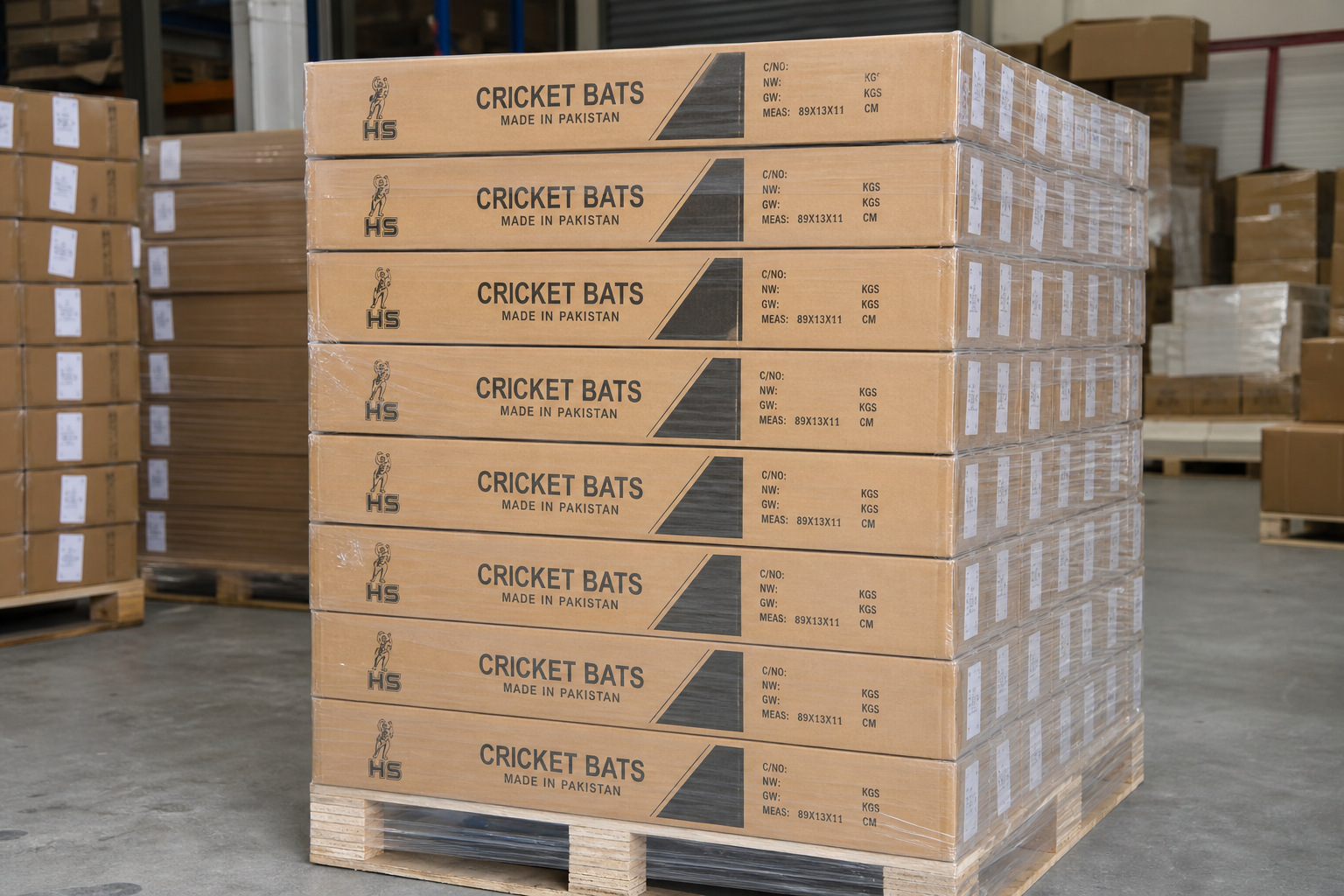
Pre-shipment inspection for cricket bats should verify four things together, not separately: willow grade against sample reference, weight against the declared band, MCC Law 5 dimensions against legal limits, and packaging condition against the agreed carton configuration. A PSI report that checks weight but skips grade verification, or checks dimensions but ignores packaging, leaves a gap that surfaces later as a buyer complaint rather than a caught issue before departure.
Willow grade declarations work best when they are specific and falsifiable — referencing grain count ranges, blemish tolerance, and face condition criteria rather than a generic "premium quality" statement that cannot be checked against anything concrete. If your factory maintains internal grading photographs or reference samples, cite them in the declaration so a dispute, if one arises, has something concrete to compare against rather than relying on memory or goodwill months after the shipment sailed.
Market Notes: UK, Australia, USA, and UAE
Core documentation requirements are broadly consistent across destinations, but each major cricket bat import market layers on its own expectations. Confirm current requirements with your buyer's broker before finalising your document pack, since retail-channel expectations shift faster than customs rules.
United Kingdom
UK retailers and distributors increasingly expect REACH-aware materials declarations during vendor onboarding, particularly for handle grips, adhesives, and any coated or painted components. Willow grade transparency matters more in the UK than almost any other market, because pro shops and club buyers often have technical staff who can assess a bat's grade on sight — a documentation claim that does not match what the buyer's own eyes tell them ends the relationship quickly.
Australia
Australian biosecurity rules are strict on wood packaging materials — confirm ISPM-15 treatment evidence is attached and legible before cargo departs, since Australian customs and biosecurity authorities are known for rigorous inspection of untreated or poorly documented wood packaging. Build extra lead time into Australia-bound shipments for this reason; a fumigation hold at the Australian end costs far more in time and storage than the treatment itself would have cost at origin.
United States
For junior and youth-market bats sold through US retail channels, buyers may request CPSIA-related material assurances, particularly around any painted or coated components on bats marketed to younger age groups. Confirm with your buyer whether their specific retail programme requires this documentation before production, since requirements vary by retail channel and by whether the product is positioned for youth or adult use.
UAE and GCC
UAE distributors selling into physical retail typically require a certificate of origin and, for store-facing packaging, Arabic-language retail labels alongside English. Confirm labelling requirements with your buyer early, since retrofitting Arabic labels onto already-packed cartons is far more expensive than building bilingual artwork into the original packaging design.
Pre-Shipment Document Audit
- Cross-check commercial invoice, packing list, and shipping bill as a single reconciled set — not three separate documents prepared by three different people
- Confirm willow grade, weight band, and size descriptions are worded identically everywhere they appear
- Verify carton count and shipping marks on the physical cartons match the packing list exactly
- Confirm certificate of origin and any preferential documentation are ready and dated correctly relative to expected arrival
- Photograph packed cartons before sealing, particularly for mixed-grade or private-label shipments
- Share the full draft document pack with the buyer's import broker before vessel departure
Run this audit 48 hours before cargo cutoff, without exception, regardless of how many times you have shipped to this buyer before. Reconcile the draft commercial invoice against the packing list against the actual carton count on the factory floor. Confirm willow grade and weight-band language is identical across every document. Share drafts with the buyer's broker at this stage — not after the vessel has sailed — so that any correction is a five-minute edit rather than a formal amendment process.
Photograph cartons before sealing, especially for any shipment carrying mixed grades or private-label branding. These photographs cost nothing to take and become the single most useful piece of evidence if a damage claim, grade dispute, or quantity discrepancy surfaces after the buyer receives the container. Fix mismatches on land, at your own facility, where a correction takes minutes — not after the container gates in at destination, where a correction can take weeks and cost real money in demurrage and storage.
Common Documentation Mistakes and How to Fix Them
- Blended grade pricing on one invoice line — Solution: separate line items per grade and size band, always.
- Vague descriptions like "cricket bats — assorted" — Solution: SKU-level descriptions with willow type, grade, size, and weight band.
- Weight declared on invoice inconsistent with actual PSI weight logs — Solution: reconcile before invoicing, not after a buyer complaint.
- Certificate of origin requested too late — Solution: apply as soon as production quantities are confirmed, not the week of cutoff.
- Untreated wood packaging without ISPM-15 marks — Solution: source only treated pallets and dunnage for export cartons.
- No written sample or grade sign-off before bulk production — Solution: signed approval sheet referencing photographs, retained on file.
- Shipping marks on cartons that do not match the packing list — Solution: print marks from the same reconciled data source used for the packing list.
- Ignoring destination-specific labelling (Arabic retail labels, CPSIA assurances) — Solution: confirm buyer channel requirements before packaging artwork is finalised.
- Treating documentation as a task for cutoff week — Solution: start certificate and PSI workflows in parallel with production, not after it.
- No photographic record of packed cartons — Solution: photograph every mixed-grade or branded shipment before sealing, as standard practice.
- Inconsistent HSN codes between invoice and shipping bill — Solution: confirm classification with your CHA once per product line, then reuse consistently.
- Grade inflation to satisfy a buyer's target price — Solution: quote honestly for the grade you can deliver; never adjust the label instead of the price.
Most preventable cricket bat export delays trace back to a short, repeatable list of errors. Review this list against your own process before your next shipment.
Case Study: A Meerut Exporter Clears a UK Distributor Shipment Without Amendment
Challenge: A Meerut-based cricket bat manufacturer had strong domestic sales but only one prior export shipment — a small sample order to a UAE buyer. A UK sports goods distributor placed a trial LCL order combining Grade 1 and Grade 2 English willow bats across three sizes, with a strict requirement for grade-accurate invoicing and MCC Law 5 dimensional compliance documentation, since the distributor planned to resell into club and academy channels where technical scrutiny is high.
Approach: The manufacturer engaged an export coordinator to separate the order into distinct invoice line items by grade and size before production began, rather than quoting a single blended price. A dimensional inspection sheet was built into the QC process for every lot, checking blade length and width against MCC Law 5 limits on 100% of units rather than a sample, given the buyer's stated resale channel.
Documentation and packing: The commercial invoice and packing list used identical SKU codes for each grade-and-size combination. A signed willow grade declaration referenced the approved sample photographs on file. Weight logs were compiled per carton and cross-checked against the invoice weight band before finalising the packing list. Wood dunnage used in the master cartons carried valid ISPM-15 treatment marks in anticipation of UK biosecurity checks.
Shipping and review: Draft documents were shared with the distributor's UK broker five days before cutoff, giving time to confirm consignee spelling and notify party details on the bill of lading. Cartons were photographed carton-by-carton before sealing. The LCL shipment moved via Nhava Sheva with cargo insurance under CIF terms.
Results: The shipment cleared UK customs without a single document amendment. The distributor's warehouse team reported that carton-level packing list detail let them allocate stock to two separate retail accounts without reopening every box. A repeat order followed within 60 days, this time as a larger FCL consolidation with a narrower, better-selling size range.
Lessons learned: Grade-separated invoicing, 100% dimensional inspection where the resale channel demands it, and early document sharing with the destination broker converted a first-order trial into a repeat programme. For a broader look at readiness sequencing before your first cricket bat export, see How to Export Cricket Bats from India.
Working with CHA Partners and Merchant Exporters
A capable Customs House Agent (CHA) is not just a filing service — a good CHA catches HSN misclassification, weight inconsistencies, and missing certificates before a shipping bill is submitted, saving you from a query that would otherwise surface only after cargo has already moved to the port. Choose a CHA with specific sporting goods or willow product experience where possible, since the grading and dimensional documentation nuances in this category are not universal knowledge across every agent.
Manufacturers who lack in-house export administration capacity often ship through a merchant exporter who manages IEC, documentation, CHA coordination, and buyer communication under one accountable relationship. Altus Exports supports cricket bat manufacturers and international buyers with exactly this kind of coordination — verifying willow grade claims against production, aligning PSI and dimensional inspection to buyer requirements, and preparing document packs alongside production milestones rather than after packing is already finished. Explore merchant exporter services or our global sourcing partner offering if you need this layer of support.
Align your entire documentation workflow with the broader export documentation checklist for India so that cross-category process discipline — certificate lead times, invoice-packing list reconciliation, and pre-shipment review — applies consistently even as your product range grows beyond cricket bats into other sporting goods or engineering categories.
Conclusion
- Next step for manufacturers: Share your willow grades, current registrations (IEC, SGEPC), and target markets with Altus Exports for a documentation readiness review before your next sailing.
- Next step for buyers: Send your grade, sizing, and destination-market requirements — we verify Indian cricket bat exporters and coordinate documentation and shipment on your behalf.
- Explore export products from India and find manufacturers in India to choose the right sourcing model for your cricket bat programme.
- Read How to Export Cricket Bats from India for the full end-to-end process, from product selection through first shipment.
- Compare markets in Best Countries to Export Indian Cricket Bats before locking your primary destination.
- Build buyer pipeline with How to Find International Buyers for Cricket Bats and Trade Shows and B2B Marketplaces for Cricket Bat Exporters.
- Match demand with Most Demanded Indian Cricket Bats by Country and review category depth in Top Cricket Bat Products Exported from India.
- Buyers sourcing directly should read How International Buyers Can Source Cricket Bats Directly from India.
- Explore willow sustainability angles in Sustainable Cricket Bat Export Opportunities for buyers prioritising responsible sourcing.
A cricket bat export documentation checklist is only useful if it is followed on every shipment, not just the first one when nerves keep everyone careful. The categories that fail — grade inflation, blended invoicing, late certificates, unreconciled packing lists, untreated wood packaging — are avoidable with a 48-hour pre-shipment audit and documents that are prepared alongside production rather than after it.
Willow grade honesty is not a compliance nicety in this category; it is the foundation of every repeat order. Buyers who receive exactly the grade, weight, and dimensional compliance their paperwork promised come back with bigger programme orders. Buyers who discover a gap between the invoice and the carton do not.