
Sustainable Cricket Bat Export Opportunities: FSC Willow & Responsible Sourcing
By Saurabh Mittal, Founder, Altus Exports
Sustainable and responsible cricket bat export opportunities from India — FSC and traceable English willow, durable product design that reduces replacement waste, compliant grips/stickers, ISPM-15 packaging, and what UK and Australian retailers now ask during vendor onboarding. A practical, document-backed sustainability guide for Meerut and Jalandhar manufacturers from Altus Exports.

Premium cricket retail in the UK and Australia has quietly changed its vendor onboarding questionnaire over the past few seasons. Buyers now ask how willow is sourced, whether clefts carry chain-of-custody documentation, what the grip and sticker materials are made of, and how packaging is disposed of — not only how the bat performs at the crease. Sustainable cricket bat exports from India are becoming a genuine margin protector for manufacturers who can answer these questions with paperwork rather than marketing language, and a real risk for those who cannot.
This shift matters because cricket bat manufacturing has always depended on a natural, increasingly scrutinised raw material. English willow (Salix alba var. caerulea) is grown on a limited number of estates in the UK, and the sustainability of that supply chain is now a purchasing criterion in its own right for retailers managing their own environmental commitments. Kashmir willow, used at volume across value and youth segments, faces a parallel but different conversation — less about certification schemes and more about responsible forestry practice, durability, and honest labelling that avoids overstating what a mid-market bat can deliver.
This guide maps the practical sustainability levers available to Indian manufacturers in Meerut and Jalandhar: traceable willow clefts, FSC chain-of-custody where it genuinely applies, durability engineering that reduces replacement waste, REACH-aware grips and stickers, ISPM-15-compliant wood packaging, and — just as important — where to draw the line so sustainability claims never drift into greenwashing. Manufacturers building their broader export programme should pair this guide with how to export cricket bats from India for the full production and compliance sequence, since sustainability credentials sit on top of, not instead of, MCC Law 5 and grade discipline.
Key Takeaways
Summary Box
- Sustainable cricket bat exports win premium UK and Australian listings only when FSC or traceable willow claims are backed by documents through every production lot — never printed as decoration.
- Durability — handle integrity, controlled moisture, proper pressing — is itself a sustainability feature, because a bat that lasts two seasons instead of half a season generates fewer replacement shipments and less packaging waste.
- REACH-aware grips, inks, and stickers are increasingly a hard requirement for UK and EU-linked retail programmes, not a nice-to-have differentiator.
- ISPM-15 compliant, right-sized wood packaging reduces both damage-related waste and biosecurity risk at destination customs in Australia and the UK.
- Kashmir willow lines can be positioned responsibly through honest labelling and durability engineering even without formal FSC certification, which remains realistic mainly for English willow chains.
- Sustainability is a door-opener for premium listings and brand RFQs — it never replaces grade honesty, MCC Law 5 compliance, or consistent QC as the foundation of a buyer relationship.
What Buyers Actually Mean by "Sustainable" Bats
When UK and Australian retail buyers use the word sustainable during vendor onboarding, they typically mean a specific, checkable bundle of claims rather than a vague environmental sentiment: known willow origin with some form of traceability, responsible forestry claims that are backed by documentation where certification is claimed, chemical compliance on grips and printed inks, and packaging that is either recyclable, biodegradable, or at minimum right-sized to avoid excess material. Retailers increasingly separate these questions from performance questions entirely — a buyer may ask about willow sourcing on one form and MCC Law 5 dimensional compliance on another, but both must pass before a listing proceeds.
It is worth being direct about sequencing: performance and legality still come first. A beautifully sustainable bat that fails MCC Law 5 dimensional limits, or that misrepresents its willow grade, will not list regardless of its environmental story — sustainability is an additional filter applied after basic compliance, not a substitute for it. Manufacturers who lead a buyer conversation with sustainability claims while their grading or dimensional QC is inconsistent tend to lose credibility on both fronts at once.
Buyer expectations also differ meaningfully by market and price tier. UK independent retailers serving club and premium recreational cricketers ask the most detailed willow-traceability questions, often as part of a formal vendor questionnaire. Australian retailers combine sustainability interest with strong biosecurity scrutiny on wood packaging given the country's import controls. UAE and value-tier US and associate-nation buyers currently ask fewer sustainability questions, focusing more on price, replenishment speed, and durability — though this is shifting as global retail sustainability reporting requirements extend down supply chains.
Comparison table
Swipe →
Data table — swipe horizontally on small screens
| Buyer Expectation | What It Actually Requires | Where It Matters Most |
|---|---|---|
| Traceable willow origin | Cleft-to-lot documentation, supplier chain records | UK premium retail, brand RFQs |
| FSC or equivalent chain-of-custody | Certified supply chain with audited paperwork | UK/EU premium listings only |
| Chemical compliance on grips/inks | REACH-aware material declarations | UK, EU-linked programmes |
| Responsible packaging | ISPM-15 wood, right-sized cartons, reduced plastic | UK, Australia (biosecurity-driven) |
| Durability / longevity | Moisture control, pressing quality, handle integrity | All markets, rising priority |
| Honest labelling | Accurate grade and material claims, no greenwashing | All markets, reputational risk everywhere |
Willow Traceability and FSC: What Is Real and What Is Not
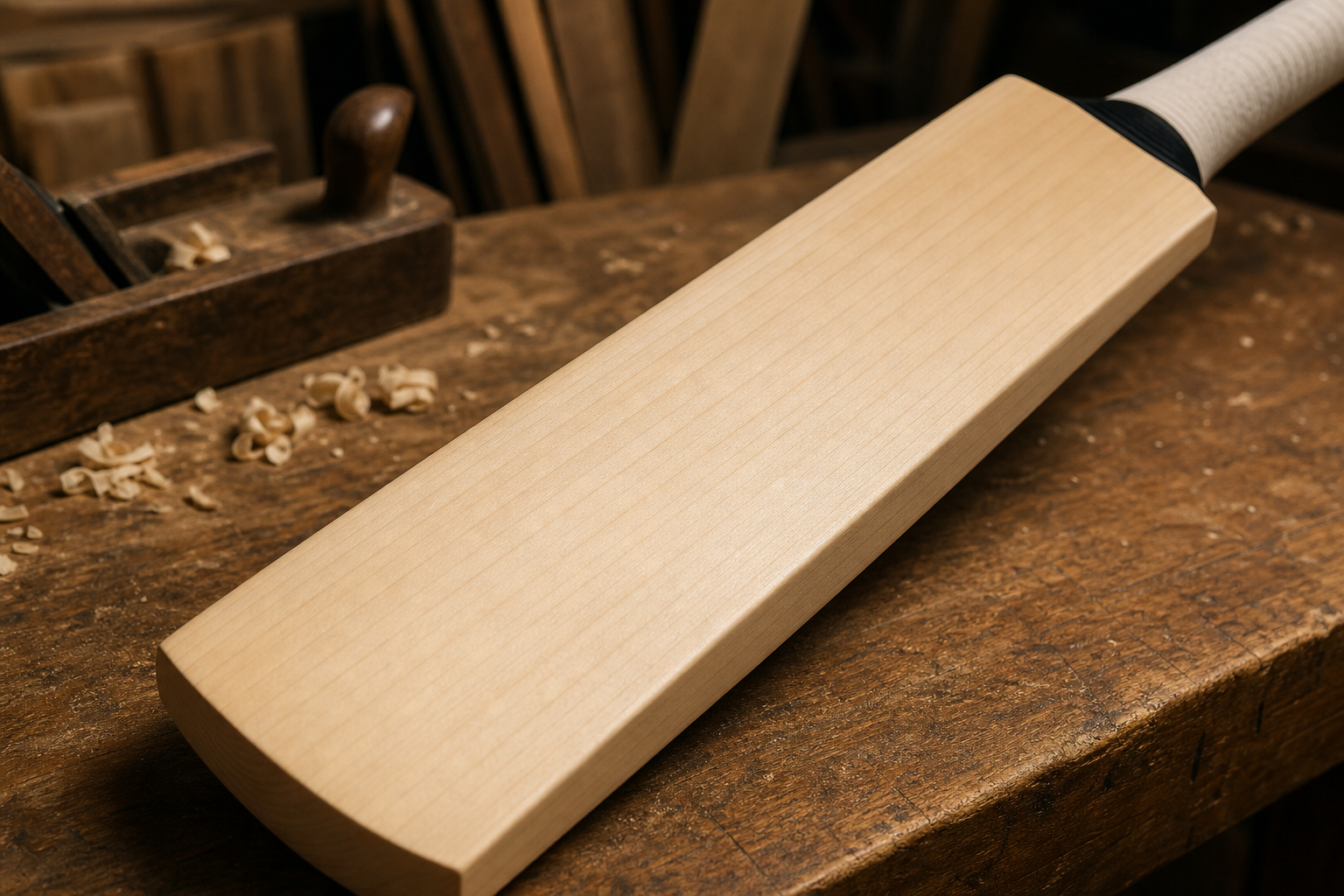
Forest Stewardship Council (FSC) chain-of-custody certification applies most realistically to English willow supply chains, where a limited number of UK growers and cleft suppliers can maintain documented custody from forest to Indian pressing unit. If your English willow clefts genuinely carry FSC or an equivalent chain-of-custody credential, the discipline required is straightforward in principle but demanding in practice: maintain the certificate trail through every production lot, tag batches so a specific bat can be traced back to its cleft consignment, and never let uncertified stock mix into a batch labelled as certified.
The honest constraint most manufacturers face is availability. FSC-certified English willow clefts are a smaller, sometimes pricier slice of total supply, and demand from UK and European pressers competes directly with Indian pressing units for the same certified volume. Manufacturers should quote FSC-specific SKUs separately from standard English willow lines, with pricing that reflects the certified supply premium, rather than blending certified and uncertified stock and hoping the paperwork sorts itself out later.
Kashmir willow sits in a genuinely different category. Formal FSC chain-of-custody programmes are far less established across Kashmir willow supply chains today, which means claiming FSC certification on Kashmir willow bats is usually not defensible. That does not mean Kashmir willow has no honest sustainability story — regional sourcing, lower transport-related footprint compared to imported English willow, and responsible harvesting practices at the estate level are all legitimate points to communicate, provided they are described accurately as sourcing practices rather than dressed up as formal certification the supply chain does not yet support.
The single non-negotiable rule across both willow types is this: if you cannot evidence a sustainability claim with documents that would survive a buyer audit, do not print it on a sticker, carton, or product page. A single exposed false claim damages trust with that buyer permanently and can spread through the tightly networked cricket retail community faster than almost any other reputational error a manufacturer can make.
Designing for Longevity: Durability as a Sustainability Feature
One of the most underrated sustainability arguments available to Indian cricket bat manufacturers is durability itself. A bat that survives two full seasons of regular club play generates roughly half the replacement shipments, half the packaging waste, and half the embedded transport footprint of a bat that cracks or delaminates after half a season — regardless of whether either bat carries a certification sticker. Framing durability explicitly as a sustainability and total-cost argument resonates strongly with buyers who are increasingly measured on returns, replacement rates, and customer complaints as much as on unit sales.
Practical durability engineering starts with moisture control. Willow pressed and stored above safe moisture thresholds is more prone to cracking and premature edge failure once it reaches a humid destination market, effectively converting a raw-material problem into a customer-facing sustainability failure months after shipment. Consistent kiln and storage discipline, validated with moisture readings logged per batch, is a low-cost intervention with an outsized durability payoff.
Handle assembly is the second major lever. Quality cane, correctly seasoned and bonded with sound splice technique, prevents the handle failures that are among the most common reasons a bat is discarded well before the blade itself wears out. Toe guards and edge treatments further extend usable life by protecting the areas most exposed to yorkers and abrasive pitch contact. None of these interventions are exotic — they are standard good manufacturing practice — but framing them explicitly to buyers as durability and waste-reduction measures, supported by simple failure-rate data where available, turns routine QC into a sustainability differentiator.
There is also a positioning argument worth making directly to buyers: exporting a durable, honestly graded mid-tier bat can be a more genuinely sustainable choice than exporting an ultra-light premium cosmetic bat pressed to shave grams at the expense of structural margin, if that lighter bat is statistically more likely to crack within a season. Sustainability conversations should include this trade-off explicitly rather than assuming premium price automatically means premium environmental outcome.
REACH-Aware Grips, Stickers, and Chemical Compliance
- Standardise on vetted grip and sticker suppliers who provide material safety declarations
- Retain REACH-aware documentation against each purchase batch, not only at initial supplier onboarding
- Avoid switching grip or ink suppliers opportunistically for marginal cost savings without re-verifying compliance
- Be ready to produce documentation promptly during buyer audits — delayed responses read as a red flag
Grips, printed logos, protective stickers, and edge treatments introduce chemical compliance questions that many manufacturers overlook while focused on willow and construction. UK and EU-linked retail programmes increasingly expect REACH-aware material declarations for rubber grips, adhesives, and printed inks — confirming that restricted substances above regulatory thresholds are not present in materials that reach the end consumer's hands.
Building REACH awareness into your supply chain does not require becoming a chemical compliance laboratory. It requires selecting grip and sticker suppliers who can provide material safety declarations or test summaries for their components, retaining those declarations against each purchase batch, and being able to produce them promptly when a buyer's compliance team asks during onboarding or periodic audit. Manufacturers who standardise on a small number of vetted grip and sticker suppliers, rather than switching sources opportunistically for small cost savings, find this documentation dramatically easier to maintain.
This is also a genuine area of buyer risk reduction, not only compliance box-ticking. A grip material later found to breach REACH limits creates a recall and reputational problem for the retailer as well as the manufacturer, which is why increasingly buyers push this requirement down the supply chain proactively rather than discovering it after a product safety complaint. Manufacturers who can answer REACH questions confidently and with paperwork at the first onboarding conversation stand out clearly against competitors who cannot.
Packaging and Chemicals: ISPM-15, Plastics, and Right-Sizing
- ISPM-15 compliant, correctly marked wood packaging for all pallets and wood-based crating
- Right-size master cartons to reduce void space, transit damage risk, and discarded material volume
- Minimise plastic where retail handling allows; favour recyclable tubes, kraft sleeves, or cartons
- Use recyclable or biodegradable void-fill rather than loose polystyrene wherever protection standards permit
- Validate protection first with drop and compression testing, then layer sustainability improvements onto that structure
- Avoid oversized master cartons that increase both damage risk and unnecessary air-freight replacements
Wood packaging materials used in cricket bat export cartons and pallets must comply with ISPM-15 treatment and marking standards, which is as much a biosecurity requirement as a sustainability one — particularly for Australia, whose import biosecurity controls are among the strictest in any cricket-importing market. Non-compliant wood packaging risks fumigation delays, re-export orders, or destruction at the port, turning a packaging shortcut into a costly and entirely avoidable shipment failure.
Beyond wood compliance, sustainable packaging choices for cricket bats centre on right-sizing and material selection. Oversized master cartons increase both transit damage risk (more void space means more movement) and the volume of packaging material discarded at the retailer's receiving dock — a cost and waste problem retailers notice and increasingly ask about directly. Minimising plastic where retail handling allows, favouring recyclable tubes, kraft sleeves, or cartons, and using void-fill materials that are recyclable or biodegradable rather than loose polystyrene all contribute to a packaging profile buyers can describe positively to their own sustainability reporting.
None of this should come at the expense of protection. A lighter, more sustainable-sounding carton that fails to protect edges and toes through ocean transit generates exactly the kind of damage claims and air-freight replacements that erase any environmental benefit several times over through wasted product and expedited shipping. Carton engineering — validated drop and compression testing before bulk packing — should determine the minimum viable protective structure, and sustainability improvements should be layered onto that validated structure, not substituted for it.
Positioning Kashmir Willow Responsibly Without Overclaiming
Kashmir willow occupies a large share of global cricket bat volume, particularly for schools, tennis-ball and tape-ball formats, and value-tier club cricket, yet it rarely carries the formal certification infrastructure available to English willow. Manufacturers exporting Kashmir willow lines should resist the temptation to borrow English willow sustainability language and instead build an honest, distinct narrative appropriate to that supply chain.
Legitimate points to communicate include regional sourcing within India (shorter transport distances compared to imported English willow clefts), responsible harvesting relationships with local growers, and — most powerfully — the durability and honest grading arguments covered earlier, which apply equally regardless of willow type. Manufacturers can also describe practical steps such as moisture-controlled seasoning and reduced reject rates as evidence of responsible resource use, since every rejected blank represents wasted willow that a tighter QC process avoids.
What manufacturers should explicitly avoid is applying FSC logos, chain-of-custody language, or unqualified "sustainably sourced" claims to Kashmir willow product lines without a supply chain that can actually support them. Buyers who later discover a certification claim on a Kashmir willow product that has no supporting documentation will reasonably question every other claim on that manufacturer's entire catalogue, including claims on genuinely certified English willow SKUs.
Case Study: Building a Documented Sustainability Programme for UK Retail
Challenge: A Jalandhar-based cricket bat manufacturer supplying mid-premium English willow bats to a growing UK independent retail account was asked, during a routine vendor review, to complete a formal sustainability questionnaire covering willow chain-of-custody, grip chemical compliance, and packaging material disclosure — none of which the manufacturer had documented systematically before.
Approach: Rather than responding with marketing language, the manufacturer worked with its English willow cleft supplier to confirm which specific lots carried genuine chain-of-custody documentation and segregated those lots physically and administratively from standard, uncertified stock. Grip and sticker suppliers were audited for material safety declarations, with two suppliers who could not provide adequate documentation replaced. Packaging was reviewed against ISPM-15 requirements and right-sized following drop-test validation.
Documentation build: The manufacturer created a simple batch-tracking system linking each finished bat lot back to its willow cleft consignment, grip supplier batch, and packaging specification — not a sophisticated software system, but a disciplined spreadsheet-and-file process that could answer any single question on the retailer's questionnaire within minutes rather than days.
Buyer response: The retailer's sustainability review passed on the first submission for the SKUs supported by genuine FSC chain-of-custody documentation. For Kashmir willow value SKUs in the same range, the manufacturer disclosed honestly that formal certification did not apply, describing durability data and responsible sourcing practices instead — an answer the retailer accepted without objection because it was accurate and specific rather than evasive.
Results: The account expanded from a single seasonal order to a standing programme contract with quarterly reorders, and the retailer referred the manufacturer to a sister buying group evaluating suppliers for a similar sustainability-conscious range. The documentation system built for this one buyer now supports every subsequent English willow sustainability inquiry with minimal incremental work.
Lessons learned: A documented, honest sustainability programme — including honest disclosure of where certification does not apply — converts a compliance request into a competitive advantage, while any temptation to overstate Kashmir willow credentials would have risked the entire relationship, including the genuinely certified English willow business.
Commercial Opportunity: Where Sustainability Actually Moves Revenue
Sustainability credentials are best understood as a door-opener for premium UK and Australian listings and brand-owner RFQs, rather than a standalone revenue driver or a replacement for grade honesty. Buyers use sustainability questionnaires increasingly as an early-stage filter — manufacturers who cannot answer them credibly may be excluded from consideration before price or product quality even enters the conversation, particularly for larger retail groups and private-label brand programmes with formal supply chain governance.
The commercial upside compounds over time rather than appearing in a single transaction. A manufacturer with documented FSC willow lines, REACH-aware grips, and ISPM-15 packaging discipline becomes a lower-risk, easier-to-approve vendor for every subsequent buyer conversation, shortening onboarding cycles and reducing the audit friction that otherwise slows first orders with new retail accounts. This groundwork pairs directly with broader market entry work — see best countries for Indian cricket bat exports for where sustainability-conscious buyers concentrate, and SGEPC registration benefits for exporters for the institutional credibility that complements a sustainability programme during buyer onboarding.
Manufacturers should size the investment to their actual buyer mix. A unit selling primarily into UAE wholesale and associate-nation programmes may reasonably defer formal FSC chain-of-custody investment until a specific premium UK or Australian RFQ justifies it, while continuing to build durability data and clean packaging practice that benefit every market regardless of certification status. Sustainability investment, like every other export capability, should follow demonstrated buyer demand rather than speculative branding.
Future Outlook: Sustainability Expectations Through 2030
Through 2030, sustainability expectations in cricket bat retail are likely to move from vendor-questionnaire checkboxes toward verified, ongoing reporting as major UK and Australian retail groups extend their own corporate sustainability disclosure obligations down through their supply chains. Manufacturers who build batch-level traceability systems now — even simple ones — will be far better positioned than those who treat sustainability as a one-time onboarding exercise to pass and forget.
Willow supply itself is likely to remain a genuine constraint on how far FSC-style certification can scale across the industry, particularly for Kashmir willow, which means honest, well-differentiated sustainability narratives by willow type will likely remain more durable and credible than industry-wide certification claims. Manufacturers who invest in the durability and responsible-sourcing story appropriate to each willow type, rather than waiting for a single universal certification standard, will be better positioned regardless of how certification schemes evolve.
Packaging expectations will likely tighten fastest, given the direct biosecurity relevance in markets like Australia and the general retail push toward reduced plastic. Manufacturers who standardise ISPM-15 compliance, right-sized cartons, and reduced-plastic void fill now will avoid a scramble later, when these practices shift from buyer preference to explicit onboarding requirement. Across all these trends, the constant remains what it has always been in this category: grade honesty and MCC Law 5 compliance are the floor, and sustainability credentials are the differentiator layered carefully on top.

Conclusion
- Next step for manufacturers: Share your willow types, current certification status, and packaging practices with Altus Exports for a sustainability-readiness review.
- Next step for buyers: Send your sustainability questionnaire or vendor requirements — we match verified Indian cricket bat manufacturers who can document their claims.
- Explore the Altus Exports cricket bat programme and export products from India for partnership models.
- Build the full production and compliance sequence with how to export cricket bats from India.
- Target the right markets with Best Countries to Export Indian Cricket Bats in 2026 and Most Demanded Indian Cricket Bats by Country.
- Strengthen institutional credibility with SGEPC Registration Benefits for Exporters.
- Complete your paperwork readiness using the Cricket Bat Export Documentation Checklist and plan fairs with Trade Shows for Cricket Bat Exporters.
- Build your buyer pipeline with How to Find International Buyers for Indian Cricket Bats.
- Review category depth in Top Cricket Bat Products Exported from India.
- Buyers sourcing into India should read Source Cricket Bats Directly from India: Buyer Playbook.
Sustainable cricket bat export opportunities from India are real and growing, but they reward manufacturers who treat sustainability as a documentation discipline rather than a marketing layer. Traceable willow claims that survive an audit, durability engineering framed explicitly as waste reduction, REACH-aware grips and stickers, and ISPM-15-compliant, right-sized packaging together build the credible profile that UK and Australian buyers now expect during vendor onboarding — and that increasingly determines which manufacturers even reach a pricing conversation.
The path forward is straightforward: confirm exactly which of your willow lines can genuinely support certification claims, build simple batch-tracking that links finished bats back to cleft, grip, and packaging sources, and communicate Kashmir and English willow sustainability stories honestly and separately rather than blending them into one unsupported narrative. Manufacturers ready to formalise this work can pair it with Altus Exports' export coordination to reach the UK and Australian buyers who value it most.