
Source Cricket Bats Directly from India: The Complete Buyer Playbook
By Saurabh Mittal, Founder, Altus Exports
A complete international buyer playbook for sourcing cricket bats directly from India — how to find and verify Meerut and Jalandhar manufacturers, confirm English and Kashmir willow grading honesty, lock samples, set MOQs, run pre-shipment inspection, negotiate Incoterms, and choose between direct factory export and a merchant exporter model. Includes a buyer case study, common mistakes, and a document-by-document risk checklist from Altus Exports.
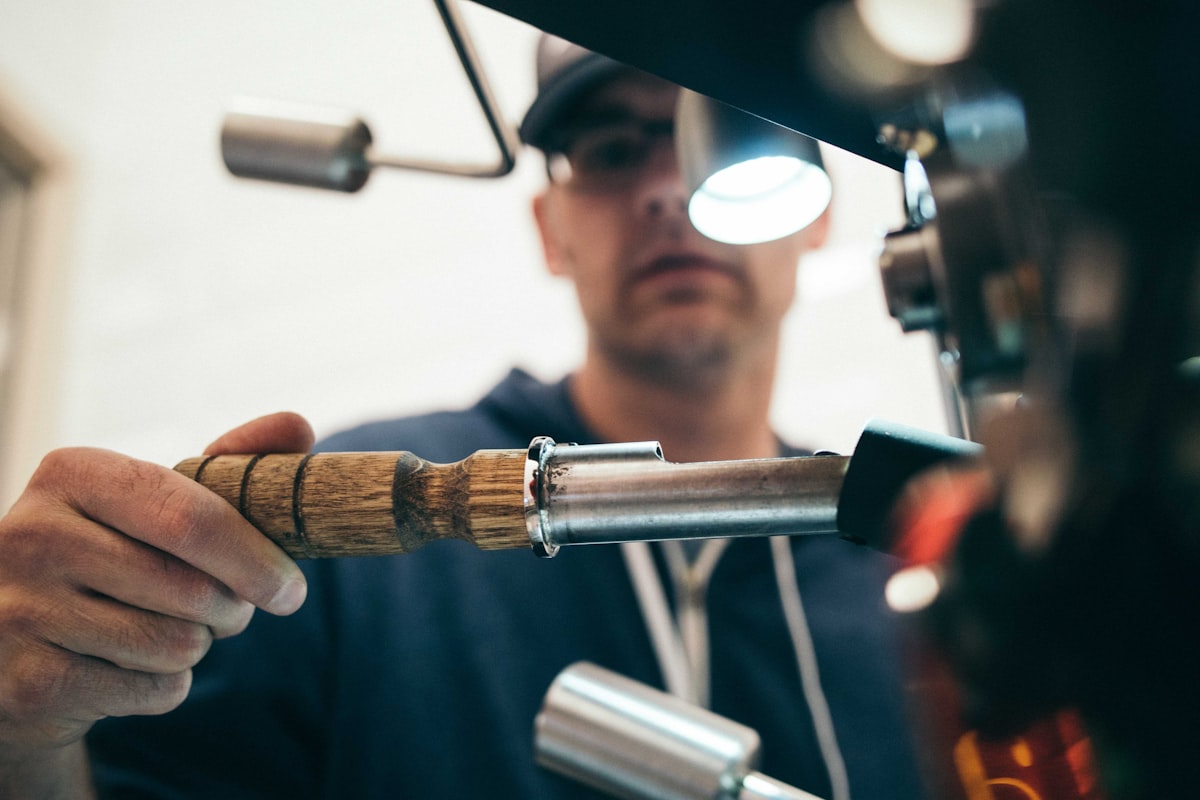
India supplies most of the world's cricket bats — from junior Kashmir willow sticks sold through school programmes to Grade 1+ English willow bats stocked in Surrey and Melbourne pro shops. For international retailers, distributors, academies, and brand owners, that concentration of manufacturing capability in Meerut (Uttar Pradesh) and Jalandhar (Punjab) makes sourcing cricket bats directly from India an obvious commercial move. The FOB advantage over UK-finished or locally assembled equivalents is real, often 30–50% for comparable willow grades, and the clusters can support everything from stock SKUs to fully custom private-label profiles.
But direct sourcing only pays off when buyers treat Indian bat factories like regulated suppliers, not like a catalogue website. The category has three recurring failure modes that erode first-order economics faster than freight costs ever could: grade inflation on paperwork and stickers, sample-to-bulk drift in weight and profile, and packaging that looks fine on a factory bench but collapses under ocean transit vibration and humidity. Buyers who skip verification, sample sign-off, or pre-shipment inspection to save two weeks routinely lose far more than two weeks sorting out a damaged or misdescribed container.
This playbook walks importers, retailers, and brand owners through the full sourcing sequence — supplier discovery and verification, willow and grade fundamentals, MCC Law 5 compliance, sample control, MOQ negotiation, packaging validation, Incoterms and payment structuring, and the choice between direct factory export and a merchant exporter relationship. It closes with a real-world buyer case study, a mistakes checklist, and answers to the questions international buyers ask most often before placing a first cricket bat order from India. Buyers who prefer a single accountable partner can also explore verified cricket bat sourcing through Altus Exports.
Key Takeaways
Summary Box
- Sourcing cricket bats directly from India works best when buyers verify willow type, grade criteria, and weight tolerance in writing before any deposit is paid.
- Meerut (Uttar Pradesh) and Jalandhar (Punjab) are the two dominant manufacturing clusters, supported by Kashmir willow supply chains that feed both regions.
- MCC Law 5 dimensional compliance (blade length ≤ 965 mm, width ≤ 108 mm) is non-negotiable for club, league, and academy-facing SKUs — non-compliant bats are unsaleable in organised cricket markets.
- Approved sealed samples should become the production master, not a marketing reference — photograph, retain, and tie every bulk lot back to that sign-off.
- Pre-shipment inspection with weight logs, dimensional checks, and handle pull tests catches sample-to-bulk drift before it becomes a container-load problem at destination.
- Buyers new to India sourcing usually get lower first-order risk from a merchant exporter than from unmanaged direct factory relationships — see order models compared below.
- Start with trial MOQs of 50–200 units, validate sell-through and damage/claim rates, then scale into container programmes once the supplier proves consistent.
Why Buyers Source Cricket Bats Directly from India
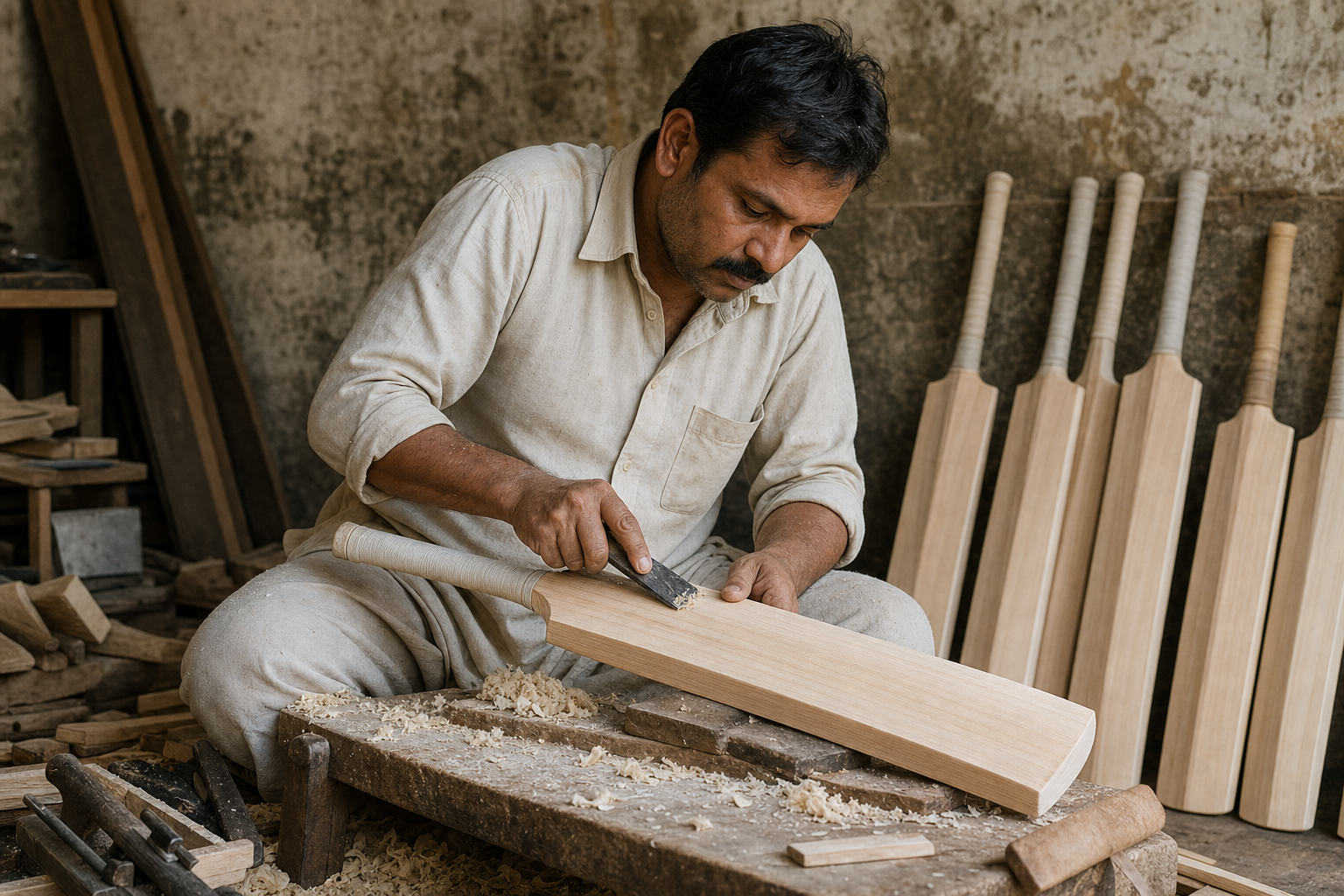
India's cricket bat industry is unusual among sporting goods categories because it combines craft-level blade pressing with organised export infrastructure. Meerut alone hosts hundreds of units ranging from small workshops finishing a few hundred bats a month to integrated exporters running English willow, Kashmir willow, and junior lines side by side under one roof. Jalandhar adds a second cluster with strong handle-fitting and finishing capability, historically tied to India's broader sports goods manufacturing base.
For buyers, that density means real choice: you can source a single hero SKU at high volume from one specialist factory, or consolidate a full assortment — professional, club, junior, and tape-ball bats — through one exporter capable of running mixed production lines. Unlike categories where India competes mainly on price, cricket bat buyers often choose Indian sourcing because the willow-pressing skill and finishing quality genuinely rival UK-finished bats at a meaningfully lower landed cost.
The commercial logic strengthens further for private-label and brand-owner buyers. Meerut OEM units can execute custom sticker artwork, colourways, weight profiles, and packaging specifications that would be prohibitively expensive to develop in-house. That flexibility is why independent retailers, online cricket specialists, and regional distributors increasingly build their own branded ranges on Indian production rather than reselling third-party brands alone.

Understanding Willow: English vs Kashmir, and Why Grade Language Matters
Almost every sourcing mistake in this category traces back to a misunderstanding — or a deliberate obscuring — of willow type and grade. English willow (Salix alba var. caerulea), grown mainly in the UK and imported into India as clefts, produces lighter, more responsive bats prized by club and professional players. Kashmir willow, grown domestically, is denser and heavier but far more affordable, making it the backbone of school, recreational, and tape-ball/tennis-ball demand across the Gulf, South Asia, and diaspora leagues.
Grading within English willow (commonly described using systems such as Grade 1, Grade 1+, Grade 2, and player grade) is not standardised by any independent regulator — each factory applies its own internal criteria for grain count, blemish tolerance, and cosmetic finish. This is precisely where grade inflation creeps in: a bat marketed as "Grade 1" by one supplier may match what another calls "Grade 2" elsewhere. Buyers who do not lock grading criteria in writing against a physical reference sample have no enforceable basis to reject an inflated bulk lot.
Practical buyer protection starts with defining grain count bands, blemish rules, face and edge cosmetics, and pick-up feel against an approved reference bat — not a written grade label alone. Ask suppliers to state willow type and grade on the commercial invoice and on product stickers identically, and compare that language across every shipment. A supplier who quietly shifts terminology between the sample invoice and the bulk invoice is often the same supplier who shifted the willow.
Comparison table
Swipe →
Data table — swipe horizontally on small screens
| Willow Type | Typical Buyer | Price Position | Key Verification Point |
|---|---|---|---|
| English willow Grade 1 / 1+ | UK, Australia, South Africa premium retail | Highest FOB | Grain count, blemish rules, cleft origin documentation |
| English willow Grade 2 / player grade | Mid-tier retail, club programmes | Mid FOB | Consistent grading language across invoice and stickers |
| Kashmir willow club/recreational | UAE, USA diaspora, schools | Lower FOB, high volume | Weight consistency, moisture control, handle integrity |
| Custom/private-label profiles | Brand owners, e-commerce, pro shops | Varies by spec | Written spec sheet with weight band, profile, and artwork |
Where Indian Cricket Bats Are Made
Meerut and Jalandhar are not interchangeable clusters — each has a distinct production character that should inform which factories you shortlist for a given assortment.
Meerut, Uttar Pradesh
Meerut is India's largest cricket bat and sports goods manufacturing hub, hosting blade pressing, handle fitting, grip and sticker finishing, and export packing under one ecosystem. Organised exporters here can support full private-label programmes — custom artwork, colourways, and packaging — alongside stock SKUs, and many run English willow, Kashmir willow, and junior lines in parallel to serve mixed-assortment buyers with one supplier relationship.
Jalandhar, Punjab
Jalandhar's sports goods base adds a second sourcing option, particularly strong in handle assembly, grip finishing, and broader sporting goods diversification (protective gear, balls, and accessories often sit alongside bat production). Buyers building a multi-category cricket assortment sometimes find Jalandhar suppliers efficient for consolidating bats with pads, gloves, and balls into one container.
Kashmir Willow Supply Chain
Kashmir willow is grown and roughed into clefts within Jammu & Kashmir before being shipped to Meerut and Jalandhar for pressing and finishing. Buyers sourcing high volumes of Kashmir willow bats should ask suppliers about their upstream cleft procurement — factories with direct grower or roughing-unit relationships tend to offer more consistent density and moisture profiles than those buying opportunistically on the open cleft market.
Supplier Verification Checklist
Checklist
Verification is the single highest-leverage step in direct sourcing, because it is cheaper to disqualify a weak supplier before a deposit than to dispute a bulk shipment after it sails. Treat every prospective factory against the same checklist regardless of how strong the sample photos look.
Legal and registration checks
- Valid Import Export Code (IEC) issued by DGFT — request the certificate, not just a claim
- GST registration consistent with the entity name on quotations and invoices
- SGEPC (Sports Goods Export Promotion Council) membership preferred — see our SGEPC registration guide for why this matters
- ISO 9001 or BIS evidence where the supplier claims certification — ask for certificate numbers you can independently verify
Production and process checks
- Factory video audit of blade pressing, handle binding, grip fitting, and finishing lines — live video calls reveal far more than static photos
- Willow procurement documentation distinguishing English cleft origin from Kashmir source, with batch or lot references
- Sample of grade stickers and commercial invoice language, checked for consistent grading terminology
- Evidence of moisture-content control during pressing — ask how blades are dried and tested before assembly
Commercial and reputational checks
- References from buyers in your region or retail channel, ideally contacted directly rather than relying on supplier-provided testimonials
- Export history to markets with compliance rigour similar to yours — a factory that only ships casual tape-ball bats may not be ready for a UK academy programme
- Willingness to accept staged payment terms rather than insisting on 100% advance for a first order
MCC Law 5 and Dimensional Compliance
The Marylebone Cricket Club's Law 5 defines the legal dimensions and construction of a cricket bat used in match play: overall length not exceeding 965 mm, and blade width not exceeding 108 mm, along with edge and depth limits introduced in more recent revisions to curb oversized "bulging" profiles. For any bat destined for club, league, school, or academy use — which covers the overwhelming majority of commercial cricket bat trade — dimensional non-compliance makes a bat unsaleable, regardless of willow quality or finish.
Buyers should require dimensional QC records for every export lot, not just the approved sample. A supplier can press a compliant sample bat and still drift on bulk production if pressing jigs are not recalibrated or if quality checks are skipped under delivery pressure. Ask for a measurement log — length, width, edge depth — sampled across the lot at an agreed AQL (acceptable quality level), and cross-check a portion of that log during pre-shipment inspection.
This is also where buyer-side product knowledge protects you commercially. If your business serves club or league channels, build MCC Law 5 language directly into your purchase order and supplier scorecard, and reject lots that fail spot-check measurements rather than accepting a supplier's verbal assurance that "it's basically compliant."
Sampling and Specification Lock
Sampling is where a buyer converts a factory's marketing claims into an enforceable production standard. Do not treat samples as a formality before placing an order — treat them as the contract.
What to define before requesting samples
- Grain count band and blemish rules for the willow face and edges
- Moisture content limit at time of dispatch
- Edge and spine profile, including depth and bulge dimensions relative to MCC Law 5 limits
- Handle type (short handle / long handle), splice construction, and grip brand or specification
- Weight band with tolerance (commonly ±10g) and balance point if relevant to your market
- Toe guard presence, material, and fitting standard
- Sticker artwork, colourway, and packaging configuration for private-label programmes
Sample logistics and sign-off
Pay for courier samples rather than requesting free units — paid samples filter out suppliers who are not serious about the relationship and establish a paper trail of commercial intent. Request samples across your full SKU range, not just the hero product, since finishing quality can vary noticeably between a factory's flagship bat and its secondary lines.
Approve samples in writing — an email confirmation referencing photographs, measurements, and weight is sufficient, but it must exist. Retain the approved sample physically as your production master and, where possible, keep a second reference copy at your own warehouse for future dispute resolution. Any bulk deviation outside the agreed tolerance band is a reject, not a negotiation point raised after the container has already sailed.
Order Models: Direct Factory Export vs Merchant Exporter
International buyers sourcing cricket bats from India generally choose between two models, and the right choice depends less on price and more on your operational bandwidth and India experience.
Direct factory export
Direct sourcing suits buyers with existing India experience, high single-SKU volume that justifies dedicated factory attention, and the internal capacity to manage quality control, documentation review, and logistics coordination themselves. It can offer marginally better unit economics on large, simple orders, but it also means you absorb the verification burden, the sample management workload, and the documentation risk without an intermediary layer.
Merchant exporter model
A merchant exporter suits first-time India importers and buyers running multi-SKU or multi-category programmes who want one accountable IEC holder responsible for supplier selection, sample coordination, QC, and export documentation. This model typically costs a small margin over pure factory-gate pricing, but it substantially reduces first-order risk because the exporter has existing relationships, audit history, and leverage with factories that an unfamiliar overseas buyer does not yet have.
Compare the two models in more detail in merchant exporter vs manufacturer exporter. Many buyers who start with a merchant exporter for their first one or two container programmes eventually graduate toward semi-direct relationships once they understand the supplier base — but very few skip the intermediary step successfully on a first order.
MOQs, Pricing, and Payment Structuring
Minimum order quantities and payment terms are negotiable but should be anchored to realistic risk-sharing rather than either party's ideal position. Stock profile bats commonly start around 50–100 units for a trial order; custom or private-label profiles often need a prototype approval cycle first, followed by MOQs of 50–200+ units depending on artwork complexity and packaging investment. Container programmes scale into the hundreds or low thousands once a supplier relationship is proven.
For pricing, insist on an FOB quotation that itemises willow/material cost, pressing and finishing, packaging, inspection, and inland freight to port separately from the exporter's margin — a single lump-sum FOB number makes it impossible to negotiate intelligently or to identify where costs shift on a repeat order. Cross-check quotations against the willow grade and volume you are actually ordering; a Grade 1 quote based on a small sample order will not hold at scale unless the supplier confirms willow availability for the full run.
Payment terms for first orders typically involve a deposit (commonly 30–50%) against pro forma invoice, with the balance due against a scanned bill of lading or, for higher-trust relationships, a letter of credit. Avoid 100% advance payment structures for new suppliers regardless of how attractive the pricing looks — staged payment is one of your few practical levers if quality or timeline commitments are not met.
First Shipment Risk Controls
- Staged payment for new suppliers — never 100% advance on a first order, regardless of pricing incentives offered
- Pre-shipment inspection with dimensional and weight reports — third-party or your own representative, sampled at an agreed AQL across the lot
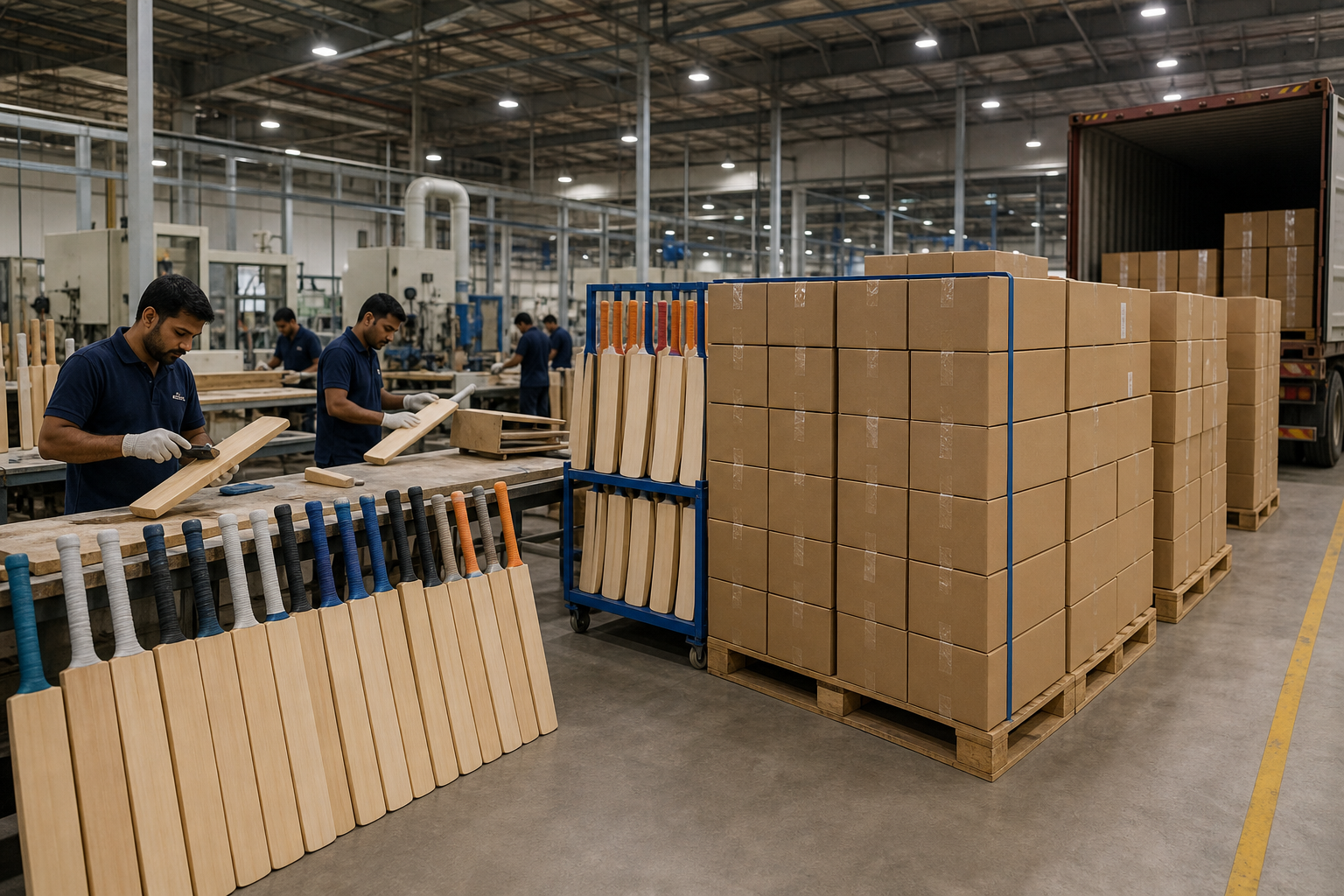
- Tube or sleeve packing for premium grades — individual protection prevents edge and face scuffing that destroys retail-ready presentation
- Draft document share with destination broker — send commercial invoice, packing list, and certificate of origin drafts before sailing so your import broker can flag mismatches early
- Cargo insurance aligned to Incoterms — confirm who insures the cargo and to what value under your agreed FOB or CIF terms
- Photographed carton sealing — request or take photos of packed cartons before container loading, useful evidence for any later damage claim
A disciplined first shipment protects the entire relationship, because the way a supplier handles your first order predicts how they will handle every order after it.
Common Mistakes International Buyers Make
Common Mistakes Box
- Accepting grade labels without a physical reference sample — Solution: lock grain count, blemish rules, and cosmetics against an approved bat, not a written grade name.
- Skipping factory verification because sample photos looked strong — Solution: run a video audit and reference checks before any deposit.
- Ordering full container volume before a trial MOQ — Solution: validate sell-through and claim rates on 50–200 units first.
- Ignoring MCC Law 5 dimensional checks on bulk lots — Solution: require a measurement log sampled across every shipment, not just the sample bat.
- Paying 100% advance on a first order — Solution: use staged payment tied to pro forma invoice and bill of lading.
- Treating packaging as the factory's problem, not yours — Solution: specify sleeve/tube packing and carton dividers in writing before production.
- Accepting verbal sample approval instead of written sign-off — Solution: confirm approval by email with photos and measurements attached.
- Comparing suppliers on FOB price alone — Solution: itemise cost components and compare landed cost, claim history, and lead-time reliability.
- Assuming SGEPC or ISO claims are automatically verified — Solution: request certificate numbers and check them independently.
- Skipping pre-shipment inspection to save a week — Solution: build PSI into your production calendar from day one, not as an optional add-on.
Most first-order problems in direct cricket bat sourcing trace back to a small set of avoidable mistakes:
Case Study: A UK Retailer's First Direct Sourcing Programme
Challenge: An independent UK cricket retailer with a growing online presence wanted to reduce dependence on a UK-based wholesaler and source English willow bats directly from Meerut to improve margin on its own private-label range, while maintaining the grade consistency its junior and club customers expected.
Approach: The retailer worked with a merchant exporter to shortlist three Meerut factories, ran video audits of pressing and finishing lines, and requested paid samples across Grade 1, Grade 2, and a junior Harrow-size line. Each sample was measured against MCC Law 5 limits and weighed, with results logged against the supplier's own stated specifications.
Sample lock and negotiation: One factory's Grade 1 samples matched written specifications exactly; a second factory's "Grade 1" samples measured closer to what the first factory called Grade 2. The retailer selected the first factory, locked grain count and blemish criteria in writing, and negotiated a 40% deposit with balance against scanned bill of lading for a trial order of 150 units across three SKUs.
Documentation and shipping: The commercial invoice used identical willow-grade language to the approved sample sign-off. Bats were packed in individual sleeves within divided master cartons, photographed before sealing, and shipped LCL from a Delhi-region ICD through Nhava Sheva to Felixstowe with cargo insurance aligned to the agreed FOB terms.
Results: The trial shipment cleared UK customs without amendment. Pre-shipment inspection had already flagged and corrected two bats outside the weight tolerance before the container was sealed, avoiding a destination-side dispute. The retailer placed a repeat order within four months for double the volume across the same three SKUs, plus a fourth junior size added after in-market sell-through data came in.
Lessons learned: Written grade criteria backed by physical reference samples, not marketing labels, made the difference between two nearly identical-sounding suppliers. For buyers structuring similar programmes, see how to find international buyers for Indian cricket bats and top cricket bat products exported from India for assortment planning context.
Future Outlook for Direct Cricket Bat Sourcing from India
Through 2030, direct sourcing of cricket bats from India will be shaped by three forces: rising buyer sophistication around willow provenance and sustainability, digital verification tools that make factory audits easier for overseas buyers, and continued growth in private-label and brand-owner sourcing as e-commerce retailers seek differentiated assortments rather than reselling established brands. Buyers increasingly expect suppliers to document FSC or traceable willow sourcing alongside traditional grade claims — see sustainable cricket bat export opportunities for how this is developing.
SGEPC-registered exporters with clean digital catalogues, verifiable certifications, and consistent QC documentation will increasingly out-compete unregistered workshops for serious international RFQs, even when unit pricing is similar. Buyers who build repeatable verification and sampling processes now — rather than treating every new supplier relationship as a fresh negotiation from zero — will scale faster as demand in markets like the USA and associate cricket nations continues to grow.
Conclusion
- Next step for buyers: Share your target willow grades, volumes, and destination market — we verify suppliers and coordinate sampling through shipment.
- Next step for manufacturers: Review our how to export cricket bats from India guide to align your factory with buyer verification expectations.
- Explore export products from India and global sourcing partner services to choose the right partnership model.
- Compare destination-market demand in most demanded Indian cricket bats by country before finalising your assortment.
- Review top cricket bat products exported from India for a category-by-category demand breakdown.
- Understand council credibility signals in SGEPC registration benefits for exporters before shortlisting factories.
- Use the cricket bat export documentation checklist to review paperwork before every shipment.
- Build buyer-side pipeline knowledge with how to find international buyers for Indian cricket bats and plan fair attendance using trade shows for cricket bat exporters.
- Compare market sequencing in best countries for Indian cricket bat exports and sustainability expectations in sustainable cricket bat export opportunities.
Sourcing cricket bats directly from India rewards buyers who bring the same rigour to procurement that they would apply to any regulated manufacturing category: verified suppliers, written specifications, locked samples, dimensional compliance, staged payments, and pre-shipment inspection. The FOB advantage over other willow-bat origins is genuine, but it only converts into sustainable margin when quality is consistent from the first trial order through the tenth container.
If you are ready to source directly, start narrow — one or two clusters, a tight sample set, and a trial MOQ — before committing to full container programmes. International buyers who prefer a single accountable partner for supplier verification, sampling, QC, and documentation can work with Altus Exports for verified cricket bat sourcing from Meerut and Jalandhar.