
How to Export Cricket Bats from India: Complete Guide for Manufacturers
By Saurabh Mittal, Founder, Altus Exports
A complete guide on how to export cricket bats from India — covering Meerut and Jalandhar manufacturing clusters, English and Kashmir willow grades, MCC Law 5 compliance, SGEPC registration, IEC, GST, export documentation, packaging, pricing, and buyer outreach. Learn how sports goods MSMEs and bat manufacturers reach retailers, academies, and distributors in the UK, Australia, UAE, South Africa, and the USA, avoid first-order quality mistakes, and build repeat export programmes with Altus Exports.
India produces the majority of the world's cricket bats — from junior Kashmir willow sticks for school programmes to Grade 1+ English willow bats sold through UK and Australian pro shops. If you are learning how to export cricket bats from India, the opportunity is structural: Meerut, Jalandhar, and the broader Kashmir willow supply chain already feed independent retailers, academy procurement teams, club suppliers, and diaspora leagues across more than fifty countries. Very few sporting-goods categories combine this much manufacturing depth with this much unmet international demand for reliable, honestly graded product.
What separates successful cricket bat exporters from one-shipment sellers is process discipline, not craftsmanship alone. International buyers expect MCC Law 5 dimensional compliance on every bat, honest willow grading that matches the invoice and stickers, weight consistency within a tight tolerance, moisture-controlled pressing, and packaging that protects edges, toes, and handles through weeks of ocean transit. A beautiful sample bat photographed under studio lighting means very little if the bulk container arrives with warped blades, loose handles, inflated grade claims, or crushed cartons — and buyers who get burned once rarely give a second chance to the same factory.
This guide walks Indian manufacturers, MSMEs, and merchant exporters through the full path from product selection to a repeatable export programme: registrations (IEC, SGEPC, GST), willow-grade discipline, MCC Law 5 specifications, pricing that protects margin, packaging engineering, documentation that clears customs without amendment, and buyer discovery that does not depend on one trade fair a year. International buyers evaluating cricket bat sourcing from India will also see, section by section, how verified exporters structure quality control and logistics so the tenth container is as clean as the first.
Key Takeaways
Summary Box
- How to export cricket bats from India starts with willow-grade honesty, MCC Law 5 compliance, IEC, and SGEPC readiness — not cold emails to overseas retailers.
- Meerut (Uttar Pradesh) and Jalandhar (Punjab) remain the primary sports goods manufacturing clusters for export-grade cricket bats, supported by Kashmir's willow supply chain.
- Top import markets for Indian cricket bats include the UK, Australia, UAE/GCC, South Africa, the USA, and ICC associate nations — each with different willow preferences and compliance expectations.
- Export documentation typically includes a commercial invoice, packing list, shipping bill, bill of lading or airway bill, certificate of origin, and willow/grade declarations where buyers require them.
- Individual sleeves, tube packs, dividers, and master cartons with ISPM-15 compliant wood packaging protect bats far better than loose bundling — damage claims destroy first-order trust faster than price disputes.
- Most MSMEs reach international cricket bat buyers faster through trade data, SGEPC channels, B2B portals, and a merchant exporter in India than by building an overseas sales office from scratch.
Why India Dominates Global Cricket Bat Manufacturing
India's position at the centre of global cricket bat manufacturing rests on four structural advantages: a deep base of skilled blade pressers and handle fitters, specialised regional clusters that have refined the craft over decades, access to both imported English willow clefts and domestic Kashmir willow, and a product range that spans junior school bats through professional player-grade blades. Unlike single-factory industrial categories, cricket bat export from India typically combines cleft selection, pressing, shaping, handle bonding, grading, and export-grade finishing under one coordinated production and QC system — which is why international buyers increasingly prefer working with Indian exporters who can consolidate multiple grades and sizes into one compliant shipment rather than sourcing each SKU from a different unit.
Scale in Meerut and Jalandhar lets exporters run junior, recreational, club, and professional SKUs side by side in the same production programme, something few competing origins can match at a comparable FOB. English willow bats manufactured in India routinely compete with UK-made equivalents at thirty to fifty percent lower FOB for comparable grades, while Kashmir willow — grown and processed largely around the Kashmir valley — serves high-volume school, tennis-ball, and associate-nation demand where price and durability matter more than grain aesthetics. That dual portfolio, premium English willow alongside value Kashmir willow, is exactly why large distributors consolidate their annual bat buying programmes through Indian partners instead of splitting orders across multiple countries.
Institutional support matters for beginners entering this trade. DGFT issues the Import Export Code (IEC), which is the legal foundation for any export shipment. The Sports Goods Export Promotion Council (SGEPC) — not the handicrafts-focused EPCH — is the relevant council for cricket bat and sports equipment exporters, offering membership pathways, market intelligence, and exhibition access. BIS awareness and ISO 9001 quality systems at organised manufacturing units further strengthen buyer confidence during vendor onboarding, especially for retail chains and distributors that run formal supplier audits before placing a first purchase order.
Comparison table
Swipe →
Data table — swipe horizontally on small screens
| Product Type | Primary Clusters | Typical Markets |
|---|---|---|
| English willow Grade 1 / 1+ | Meerut, Jalandhar | UK, Australia, South Africa, premium retail |
| Kashmir willow club & recreational | Meerut, Kashmir supply chain | UAE, USA, associate nations, schools |
| Junior / Harrow sizes | Meerut, Jalandhar | UK, Australia, academy programmes |
| Custom / private-label profiles | Meerut OEM units | Brand owners, e-commerce, pro shops |
| Tennis-ball / tape-ball bats | Meerut volume lines | Diaspora leagues, GCC, South Asia |
| Professional / player-grade | Meerut, Jalandhar select units | Pro shops, endorsement programmes |
Understanding the Global Market for Indian Cricket Bats
The global market for Indian cricket bats is demand-led by specialist sporting-goods retail, club and academy procurement, e-commerce brands, and distributor networks that supply schools and leagues across the cricket-playing world. Trade patterns typically place the United Kingdom and Australia among the highest-value destinations for English willow bats, given their deep club cricket culture and willingness to pay for Grade 1 and Grade 1+ quality. The UAE and wider GCC region drive fast-moving wholesale volume built on expatriate leagues, school sports departments, and sports hypermarkets, while South Africa buys across the full grade spectrum for retail and grassroots development programmes. The United States is a smaller but rapidly growing import market, propelled by Major League Cricket visibility, university clubs, and diaspora community leagues.
Demand trends favour bats that look handcrafted but perform like precision sporting equipment: consistent blade dimensions within MCC Law 5 limits, honest grain counts and grade labelling, weight logs that match what was promised at sampling, and packaging that survives ocean transit without edge or toe damage. Buyers still want the craftsmanship story — pressing technique, willow selection, handle assembly — but they will not tolerate lot-to-lot variation that breaks a retail planogram, disappoints a paying club member, or fails a pre-match equipment check. This is why organised exporters who standardise QC checkpoints on every batch consistently outperform loose aggregators of workshop output on repeat business.
Popular categories in the current cycle include Grade 1 and Grade 1+ English willow bats for premium retail, durable Kashmir willow club bats for volume programmes, junior and Harrow-size bats for school and academy procurement, custom private-label profiles for brand owners and e-commerce sellers, and tennis-ball or tape-ball bats for diaspora recreational leagues. Emerging opportunities include private-label collections for UK and Australian direct-to-consumer cricket brands, hospitality- and academy-linked bulk programmes in the Gulf, and CPSIA-aware junior ranges tailored to the growing US youth cricket segment.
Comparison table
Swipe →
Data table — swipe horizontally on small screens
| Market | Demand Profile | Popular Categories | Beginner Opportunity |
|---|---|---|---|
| UK | Premium; compliance and origin-aware | English willow Grade 1/1+, junior/Harrow | Strong if grading and QC are transparent |
| Australia | High per-capita consumption; junior and club growth | Lightweight English willow, junior sizes | Good for exporters with weight-consistent pressing |
| UAE / GCC | Fast wholesale cycles, expatriate demand | Kashmir willow, tennis-ball bats | Strong first market for many MSMEs |
| South Africa | Established cricket nation across grades | Value to premium English/Kashmir mix | Reliable seasonal consolidation buyer |
| USA | Fastest-growing; leagues, universities, diaspora | Value Kashmir, junior, CPSIA-aware bats | High growth but needs compliance discipline |
| Associate nations | Durable mid-price import demand | Kashmir and mid-grade English willow | Useful for volume container fillers |
How to Export Cricket Bats from India: Step-by-Step Guide
Export Tip
The following ten steps are the practical operating sequence used by successful Indian cricket bat exporters. Complete them in order. Skipping registrations, sample sign-off, or packaging validation to "save time" almost always costs more at the first customs hold, buyer rejection, or in-transit damage claim than the time it would have taken to do it properly the first time.
Step 1: Define Your Product Range
- Lock Grade 1, Grade 2, and Kashmir SKUs as separate, clearly labelled product lines
- Photograph face, edge, spine, and toe of each approved sample under consistent lighting
- Reject SKUs that cannot reliably hold weight tolerance across production lots
- Confirm cleft and handle supply continuity across seasons before committing SKUs to a catalogue
Start by selecting three to eight core SKUs across willow grades and sizes that you can reproduce consistently — not a catalogue of one-off showpiece bats. Map each SKU to a weight band, grain count, edge profile, handle type (short handle or long handle), and grip specification. Beginners should prefer categories with an established export track record from their cluster, such as Meerut Grade 1 English willow or Jalandhar Kashmir willow club bats, rather than inventing an entirely new profile with no buyer reference point to anchor pricing or specification discussions.
Step 2: Identify Export Markets
Choose one primary market and one backup rather than trying to serve every cricket-playing country at once. Use import demand data, freight economics from your nearest port or ICD, buyer payment norms, and compliance complexity to decide. A Meerut unit strong in Kashmir willow volume production may start with UAE wholesale before tackling UK retail programmes that demand stricter grading transparency, willow-origin questions, and packaging standards for premium goods.
Step 3: Obtain IEC Registration
Apply for an Import Export Code on the DGFT portal (dgft.gov.in). IEC is mandatory for shipping bill filing and for claiming most export benefits available to sports goods exporters. Keep your PAN, bank account details, and address proof consistent with your GST records to avoid processing delays. Most clean, error-free applications are processed within a few working days.
Step 4: Register with SGEPC
The Sports Goods Export Promotion Council (SGEPC) is the relevant council for cricket bat and sports equipment exporters — not EPCH, which serves handicrafts. SGEPC registration signals category seriousness to international buyers, unlocks council exhibitions and directories, and provides market intelligence specific to sporting goods trade. For cricket bat export from India, SGEPC membership is one of the strongest credibility markers for MSMEs entering organised retail and distributor channels, and many overseas buyers ask for it explicitly during vendor onboarding.
Step 5: Complete GST Requirements
Ensure your GST registration supports export of goods, including the Letter of Undertaking (LUT) or bond needed for zero-rated supplies where eligible. Align invoice formats, HSN codes for sporting goods, and place-of-supply fields with your customs house agent (CHA) before your first shipping bill. GST mismatches are a common beginner delay even when the bats themselves are of excellent quality and correctly graded.
Step 6: Lock MCC Law 5 Specifications
Confirm and document that every bat complies with MCC Law 5: overall length not exceeding 965 mm and blade width not exceeding 108 mm, along with legal edge and construction limits. Build dimensional QC into every production lot, not just the sample. Club, league, and academy buyers in the UK, Australia, and other established cricket nations treat a non-compliant bat as commercially unsaleable regardless of finish quality, so this step is non-negotiable rather than a nice-to-have.
Step 7: Build Export Pricing
Export price is not domestic price plus freight. Build FOB from true ex-works cost — willow cleft or cane cost, labour, pressing, finishing, and a realistic reject allowance — plus export-grade packaging, in-line and pre-shipment inspection, inland haul to port, documentation, and your exporter margin. Then model CIF or DDP landed cost for the buyer's destination market. Offer clear MOQ breaks so programme-sized orders earn meaningfully better pricing than trial quantities. Underpricing to win a first purchase order almost always creates quality shortcuts that quietly kill the second order.
Step 8: Validate Packaging
Approve individual sleeves or tubes for premium bats, dividers inside master cartons, moisture-control wrap for sea freight, and ISPM-15 compliant wood packaging materials for pallets. Edge, toe, and handle damage destroy first-order buyer trust faster than almost any price disagreement. Run drop tests and compression tests on sample cartons before committing to bulk packing specifications, and photograph the approved packaging configuration for reference during every subsequent production run.
Step 9: Find and Qualify Buyers
Combine trade data prospecting, LinkedIn outreach to category buyers, SGEPC fairs and directories, B2B portals, and referrals. Verify company registration, payment history, and order realism before committing production capacity to a new buyer. For a structured approach to identifying serious international buyers rather than chasing every inbound inquiry, see how to find international buyers for cricket bats and trade shows for cricket bat exporters.
Step 10: Document, Inspect, and Ship
Prepare the commercial invoice, packing list, shipping bill, bill of lading or airway bill, and certificate of origin with identical product descriptions and willow-grade declarations across every document. Run pre-shipment inspection against weight logs and dimensional records, not just a visual check. Share draft documents with the buyer's import broker before cargo cutoff. Align this workflow with our cricket bat export documentation checklist so nothing is discovered for the first time at the port.
Export Documentation Checklist
Checklist
Compliance Notes
Documentation is where many first-time cricket bat exporters lose days — and sometimes lose the buyer entirely. Destination customs authorities compare the invoice, packing list, and transport documents line by line. A quantity mismatch, a vague description such as "assorted sports goods," or a willow grade on the invoice that does not match the physical bats invites examination, storage charges, and lasting damage to buyer trust.
Use the checklist below as a pre-shipment gate. Do not book the cargo cutoff until every draft has been reviewed by your CHA and, wherever possible, shared with the buyer's import broker for a final sanity check.
Comparison table
Swipe →
Data table — swipe horizontally on small screens
| Document | Purpose | Who Issues / Coordinates | Beginner Tip |
|---|---|---|---|
| IEC | Legal authority to export/import | DGFT | Keep the PDF and DGFT login credentials secure |
| GST + LUT (if applicable) | Zero-rated export compliance | GST portal / accountant | Match HSN codes on invoice and shipping bill |
| Commercial Invoice | Value, description, buyer/seller terms | Exporter | State willow grade and SKU precisely, never "mixed bats" |
| Packing List | Carton count, net/gross weight, dimensions | Exporter | Must reconcile exactly with invoice quantities |
| Certificate of Origin | Preferential or non-preferential origin proof | Chamber / authorised agency | Confirm whether the buyer needs a preferential COO |
| Bill of Lading / AWB | Evidence of shipment contract | Carrier / forwarder | Check consignee and notify-party spelling carefully |
| Insurance Documents | Cargo risk cover under CIF/CIP | Insurer / exporter | Photograph packing before sealing for claims support |
| Grade / Weight Declaration | Willow-grade and weight-log transparency | Exporter QC | Agree the declaration format with the buyer before production |
| SGEPC membership proof | Council membership evidence | SGEPC | Useful for buyer onboarding and fair access |
| ISPM-15 wood packaging certificate | Phytosanitary compliance for wood packaging | Treatment provider | Required almost everywhere wood pallets/crates are used |
How to Find International Buyers for Cricket Bats
Buyer discovery for cricket bat export works best as a portfolio of channels rather than a single marketplace listing or a single annual trade fair. Trade shows create face-to-face trust and let buyers physically inspect grain, weight, and finish. Digital channels create a steady weekly pipeline of new leads. Referrals from existing buyers and domestic sporting-goods clients consistently produce the highest close rates of all three.
Trade fairs and SGEPC exhibitions
SGEPC-linked exhibitions and international sporting-goods fairs remain high-intent venues for cricket bat buyers. Prepare a focused booth assortment across your locked SKUs, a price list with clear MOQs, a sample policy, and a lead-capture process that does not rely on memory. Follow up within seventy-two hours — most fair leads die from a slow response, not from a weak product range.
B2B portals, trade data, and LinkedIn
Use B2B portals for discovery, not as your only sales engine. Pair them with import shipment data to identify active importers of cricket bats into the UK, Australia, UAE, South Africa, and the USA. On LinkedIn, target category buyers, sporting-goods assortment managers, and club or academy procurement leads with SKU-specific messages — grade, size range, and lead time — rather than generic "we are exporters" pitches that get ignored.
Associations, referrals, and export partners
- Shortlist fifty target importers per primary market using trade data filters
- Send a one-page capability sheet: cluster, willow grades, SKUs, MOQ, lead time, certifications
- Offer paid sample kits with clear credit terms against the first confirmed order
- Track every lead in a simple CRM with next-action dates so nothing goes cold
- Prioritise buyers who already import Indian cricket bats — switching cost is lower for them than for a first-time importer of Indian sports goods
Trade associations, existing domestic retail clients with overseas sister operations, and merchant exporters can open doors far faster than cold outreach alone. Altus Exports supports buyer matching and export coordination for cricket bat sourcing when manufacturers need market access without building an international sales team from the ground up — see also source cricket bats directly from India for the buyer-side view of this same relationship.
Packaging and Shipping Best Practices
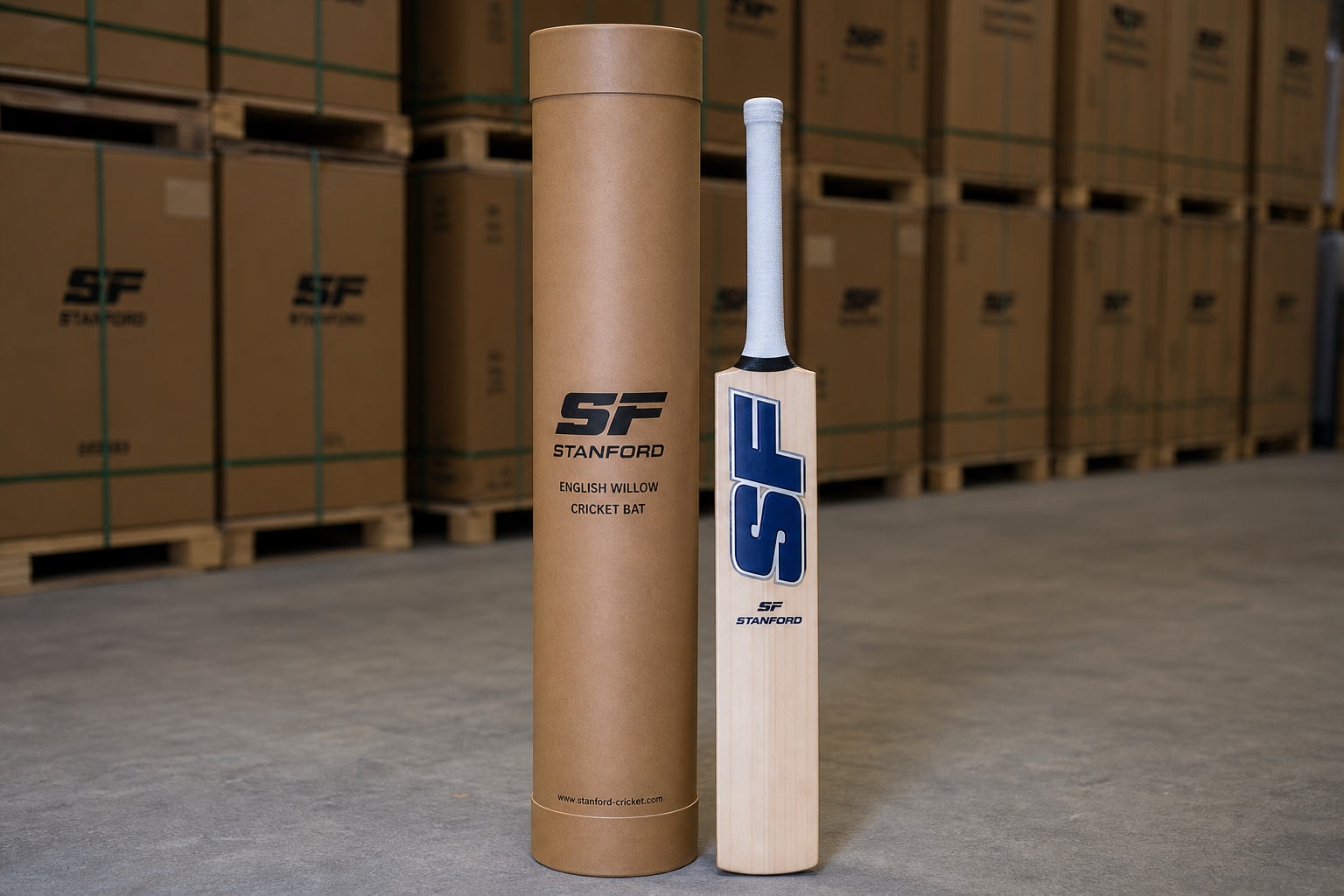
Packaging is part of the product for international cricket bat shipments. A perfectly pressed Grade 1 blade that arrives with a cracked toe or a chipped edge is a failed export, regardless of how competitive the FOB price was.
Sleeves, tubes, dividers, and moisture control
- Premium English willow bats: Individual sleeves or tubes, edge and toe protectors, and "fragile" handling marks that match carrier rules for high-value cargo
- Kashmir willow and recreational bats: Divided master cartons that keep bats from rubbing against each other, with corner protection at both toe and handle ends
- Handle and grip protection: Soft wraps around the handle-blade junction, the weakest point on most bats, to prevent cracking under stacking pressure
- Moisture control: Desiccant or moisture-barrier wrap for sea freight, since humidity swings during a multi-week voyage can warp blades that were perfectly dry at packing time
Compliance, freight options, and cost control
Confirm destination labelling requirements (willow origin, country of origin, grade declaration, and any junior-safety warnings for markets such as the USA under CPSIA). Choose LCL for trial shipments, FCL for established distributor programmes, and air freight for urgent samples or high-value compact orders. Cost optimisation comes from carton engineering that improves cube utilisation, mixed-SKU consolidation across grades and sizes, and accurate weight declarations — never from under-insuring cargo to shave a small percentage off the landed cost.
Common Mistakes New Cricket Bat Exporters Make
Common Mistakes Box
- Inflating willow grade on the invoice or stickers — Solution: grade honestly and let quality earn repeat orders.
- Shipping without written sample approval — Solution: require a signed sheet or email sign-off with photos and weight before bulk production.
- Ignoring moisture content during pressing — Solution: measure and log moisture; blades warp badly in humid destination climates.
- Under-packing edges and toes in master cartons — Solution: individual protection plus dividers, tested with drop trials.
- Quoting FOB without export packaging and inland costs — Solution: engineer packaging cost into the price before quoting, not after.
- Skipping SGEPC / weak buyer credentials — Solution: complete IEC and SGEPC registration before serious outreach begins.
- Vague invoice descriptions — Solution: SKU-level descriptions with grade and size matching the packing list and COO exactly.
- Accepting unpaid, endless sample cycles from unverified buyers — Solution: charge for samples against credit on the first confirmed order.
- Over-promising lead times before checking cleft and cane supply — Solution: build a capacity calendar tied to real raw-material availability.
- Choosing markets only by headline size, not compliance fit — Solution: score markets on regulatory readiness and your proven SKU strength.
- No mid-production QC checkpoints — Solution: in-line inspection for weight, dimensions, and finish, not only a final check before packing.
- Working with unverified subcontractors for handle fitting or finishing — Solution: map every finishing vendor and audit the steps that matter most.
Most first-order failures in cricket bat export are process failures, not craftsmanship failures. Avoid these twelve patterns:
Case Study: Exporting English Willow Bats to the UK
Challenge: A Meerut-based manufacturer of English willow cricket bats had sold reliably to Indian domestic retailers for years but had never exported. A UK independent cricket retailer requested a mixed assortment across Grade 1, Grade 1+, and Harrow sizes, with a first trial LCL shipment to Southampton — and strict weight and grain-count tolerances on every bat.
Approach: The manufacturer partnered with an export coordinator to complete IEC verification, SGEPC registration, GST/LUT alignment, and a written specification sheet for each SKU covering weight band, edge profile, and handle type. Two hero SKUs were engineered first for packaging drop tests; the rest of the assortment followed only once sample approval was in writing.
Buyer search and negotiation: The UK lead came through a combination of SGEPC exhibition follow-up and LinkedIn outreach to independent retail owners already stocking Indian-made English willow bats. Payment terms settled at forty percent advance and sixty percent against a scanned copy of the bill of lading for the trial shipment.
Documentation and shipping: The commercial invoice and packing list used identical SKU codes and grade declarations. The certificate of origin and shipping bill descriptions matched exactly. Cartons were photographed before sealing, and the LCL shipment moved through a major Indian port with cargo insurance and a pre-alert sent to the buyer's broker in advance.
Results: The trial shipment cleared UK customs without a single document amendment. In-transit damage was limited to one cracked toe on a single bat, which was credited without dispute. The buyer placed a repeat FCL order within ninety days for a narrowed twelve-SKU core range — higher volume, fewer variants, and noticeably better margin than the trial batch.
Lessons learned: Narrow the assortment early, treat packaging as a genuine production step rather than an afterthought, and price for repeat-programme economics instead of one-shot trial pricing. For readiness sequencing that applies well beyond cricket bats, see The First 10 Steps Every Indian Manufacturer Should Take Before Starting Exports.
Future Outlook for Indian Cricket Bat Exports
Through 2030, Indian cricket bat exports will be shaped less by debates over English versus Kashmir willow and more by digital discovery, grading transparency, and supply reliability. AI-driven sourcing tools already help international buyers shortlist suppliers by category, certification, and shipment history, which means exporters with clean digital catalogues, honest grading documentation, and verifiable credentials will win more inbound inquiries than those relying purely on price.
Sustainability is also moving from a marketing footnote to a genuine purchase criterion, particularly in the UK and Australia: responsibly sourced willow, FSC-aware supply chains, reduced plastic in packaging, and transparent labour practices are increasingly part of buyer due diligence. Growth in the United States, driven by Major League Cricket, university clubs, and diaspora leagues, is likely to keep expanding demand for value Kashmir willow and CPSIA-aware junior bats even as premium English willow demand in the UK and Australia stays steady.
Exporters who invest now in SGEPC visibility, consistent weight and grading QC systems, and destination-compliant labelling will be better positioned as global sporting-goods retailers diversify their supplier base and demand more accountability from every origin. India's manufacturing depth in this category is a durable advantage — process maturity is what converts that depth into long-term, compounding export revenue rather than one-off container sales.
Conclusion
- Next step for manufacturers: Share your willow grades, target markets, and current registrations with Altus Exports for an export readiness review.
- Next step for buyers: Send your assortment brief, MOQ, and destination requirements — we match verified Indian cricket bat exporters and coordinate documentation and shipment.
- Explore export products from India and merchant exporter services to choose the right partnership model.
- Review Top Cricket Bat Products Exported from India for category demand, clusters, and buyer-market fit.
- Compare destinations in Best Countries to Export Indian Cricket Bats in 2026 before locking your first market.
- Complete council readiness with SGEPC Registration Benefits for Exporters.
- Use the Cricket Bat Export Documentation Checklist before every shipment.
- Build pipeline with How to Find International Buyers for Cricket Bats and Trade Shows for Cricket Bat Exporters.
- Match demand with Most Demanded Indian Cricket Bats by Country and Sustainable Cricket Bat Export Opportunities.
- Buyers sourcing into India should read Source Cricket Bats Directly from India.
Learning how to export cricket bats from India is less about finding a single secret buyer list and more about building a genuine export operating system: the right SKUs, IEC and SGEPC credentials, GST-ready invoicing, MCC Law 5 compliance, honest pricing, engineered packaging, and documentation that clears customs the first time. The global market for Indian cricket bats remains wide open to manufacturers and MSMEs who treat quality consistency and grading honesty as seriously as pressing craftsmanship.
The requirements are clear and repeatable: registrations, disciplined market selection, packaging engineering, and document control. Best practices favour narrow assortments, written sample sign-offs, and programme buyers over one-off deals chased at fair-week discount pricing. If you are an Indian manufacturer ready to move, complete your registrations, lock a tight sample kit, and start structured buyer outreach this quarter. International buyers seeking verified partners can work with Altus Exports for cricket bat sourcing under one accountable export relationship.