
Indian Supplier Verification Checklist: 25 Things International Buyers Should Check
By Saurabh Mittal, Founder, Altus Exports
An Indian supplier verification checklist should confirm the legal entity, registrations, export ability, real operating location, production capability, quality controls, commercial terms, compliance evidence, and relevant references. Verify each claim with documents,…

Choosing an Indian supplier is not a one-document exercise. A company registration can be genuine while the proposed factory has no available capacity. A good sample can be genuine while the production process is poorly controlled. A persuasive sales contact can represent a legitimate trading company but not disclose that it is not the manufacturer you expect.
That is why international buyers need an operational checklist rather than a quick “is this company real?” search. The purpose is not to assume every supplier is risky. It is to replace assumptions with evidence before an order, deposit, product launch, or customer commitment makes a mistake expensive.
The 25-Point Indian Supplier Verification Checklist below helps buyers examine eight areas: identity, credentials, facility, capacity, quality, commercial terms, compliance, and references. It is designed for a prospective manufacturer, exporter, or trading supplier. The depth of checking should increase with order value, product complexity, regulatory exposure, customization, and the size of the proposed advance payment.
How to use the 25-point checklist
Checklist
- Verified: you have direct, current, and consistent evidence.
- Partly evidenced: the supplier made a plausible claim, but a key confirmation is missing.
- Unverified or concerning: the evidence conflicts, is outdated, cannot be independently checked, or the supplier avoids the question.
Altus Exports uses this kind of evidence-led approach when supporting international buyers with supplier identification and verification in India. It is equally useful when you are working directly with a supplier or comparing several candidates yourself.
This guide is the deeper operational companion to the supplier verification checklist for importers. That earlier overview is useful for a quick orientation; this article provides the 25 specific checks and the decision discipline needed before appointment. For the full end-to-end process, see the Indian supplier due diligence complete guide.
Treat every item as one of three outcomes:
Record the source, date, owner, and next action for every item. A PDF supplied by the supplier is not automatically independent verification. For example, a registration number may need checking against the relevant public source; a production claim may need a live walkthrough, a capacity calculation, or a reference from a comparable buyer.
Do not make the checklist a reason to delay every low-risk purchase indefinitely. Match the effort to the risk. A small, standardized purchase with no deposit needs less investigation than a private-label food-contact item, a regulated electrical product, or a large order requiring tooling and 30% advance payment.

The 25-Point Indian Supplier Verification Checklist
Checklist
Group 1: Identity checks
Identity is the foundation. You need to know exactly who you are speaking with, who will contract with you, who will receive funds, and whether that entity controls the factory or is acting as an intermediary.
1. Confirm the exact legal entity name
Ask for the supplier’s full legal name exactly as it appears in its incorporation and tax records. Record its trading name separately. Do not accept a logo, website domain, or salesperson’s email signature as proof of the contracting entity.
The name should be identical, or the relationship should be clearly explained, across the quotation, pro forma invoice, purchase order, bank beneficiary, tax documents, and export documentation. A small naming difference may be legitimate, but it needs an explanation before payment.
2. Confirm the entity’s physical operating address
Request the registered address and the actual office and factory addresses. These may be different. Ask which location will make the product, which entity owns or leases it, and whether a third-party unit is involved.
Check that the address is specific enough to locate: building, road or industrial area, city, state, and postal code. Map results, directory listings, and video calls can provide context, but they do not replace a controlled walkthrough or visit for higher-risk orders.
3. Identify the supplier’s role: manufacturer, trader, or exporter
Ask plainly: “Do you manufacture this product at your own facility? If not, what is your role and which party controls production?” A trader can be a useful supplier if it adds value through consolidation, product knowledge, or export execution. The risk comes from assuming a trader is the factory, or from unclear responsibility when quality fails.
For a detailed method of separating authentic manufacturers from intermediaries, read how to check whether an Indian manufacturer is genuine.
4. Verify authorized contacts and decision makers
Get the names, titles, company emails, and phone numbers for the commercial owner, quality contact, production contact, and finance contact. During a call, ask who can approve specifications, prices, production changes, corrective action, and bank-detail updates.
Avoid relying on a single salesperson. A genuine operating business should be able to introduce the people responsible for the commitments in its quote. If all conversations, documents, and payment instructions flow through one person who will not identify colleagues, treat that as a verification gap.
Group 2: Credentials and business-record checks
Credentials establish that an entity exists and can operate in the way it claims. They do not prove that it can produce your product well, but missing or inconsistent credentials are material concerns.
5. Check company registration details
Ask for the legal form and relevant corporate identification details. Where applicable, use official records to confirm that the name and status align with the supplier’s claim. Note that not all Indian businesses have the same corporate form, so do not assume one document type fits every supplier.
The practical question is consistency: is the company that quotes, contracts, invoices, and receives payment the company shown in the records? If a group company, proprietor, or exporter is involved, document the relationship and contractual accountability.
6. Verify GST registration where relevant
Request the GSTIN and confirm that the registered name and principal address align with the supplier’s documents. GST information is useful for identity and tax context, but it is not a quality or export-capability certificate.
Read the detailed credential process in how to verify Indian company registration, GST, and export credentials. Keep a dated copy or screenshot of the result in your supplier file rather than relying on a verbal confirmation.
7. Confirm export capability and IEC details when the supplier exports
If the supplier will export directly, ask whether it holds the necessary export credentials and who will appear as exporter on shipping documents. A manufacturer may use a merchant exporter instead; that can be legitimate if roles, liability, bank details, and document control are clear.
Confirm the proposed Incoterm, exporting party, port or airport arrangement, and responsibility for commercial invoice, packing list, certificate needs, and customs documentation before the order is released.
8. Review bank-beneficiary consistency
The bank account beneficiary should match the contracting and invoicing entity, unless a documented business reason explains the difference. Do not treat a request to pay an unrelated individual, a newly introduced third party, or an overseas account as routine.
Independently verify any bank-detail change through a known phone number or live contact, not by replying to the email that announced it. This is both a commercial control and a basic defense against payment diversion.

Group 3: Facility and operational reality checks
A credible company may have a polished online presence without controlling a working factory. Facility checks establish what actually exists and where the work will occur.
9. Obtain a current, guided facility walkthrough
For meaningful orders, request a live video walkthrough led by someone who can answer questions. Ask the camera operator to show exterior signage, entry, production areas, material storage, equipment, work in progress, finished goods, quality areas, packing, and dispatch.
Avoid accepting only pre-recorded promotional video. It is not proof that the footage is current, belongs to the company, or relates to your product. A guided call should permit reasonable follow-up requests, such as showing a machine plate, a production traveler with sensitive details obscured, or the current date on a screen.
10. Confirm access to the actual production process
If the supplier says it manufactures, establish which processes are performed in-house and which are subcontracted. This is especially important for plating, printing, molding, stitching, testing, assembly, heat treatment, or specialized finishing.
Subcontracting is not automatically negative. It changes the control plan. Ask who selects and supervises the subcontractor, how incoming and outgoing quality are checked, whether your specification reaches that party, and whether you can audit the critical process when needed.
11. Assess equipment relevance and condition
Look for equipment that is appropriate to the claimed process, product dimensions, tolerances, and material. Ask what machine or line will make your order, whether it is already allocated, and what happens during maintenance or breakdown.
Do not mistake a large number of machines for fit. One well-controlled process with capable operators may be more relevant than a crowded workshop with unrelated equipment. Capture photos or observations only with permission and respect supplier confidentiality.
Group 4: Capacity and delivery checks
Capacity is not a number printed in a brochure. It is the ability to make your specification, at your quality level, in your required quantity and date, alongside the supplier’s other commitments.
12. Test the claimed capacity with simple production math
Ask for the proposed line, number of shifts, operators, output per shift, planned start date, and expected yield. Compare that with your required quantity and realistic changeover, inspection, rework, packing, and dispatch time.
A supplier that says it can make 100,000 units per month should be able to explain the assumptions behind that figure. If it cannot, classify capacity as a claim, not a verified fact.
13. Review current order load and available slots
Ask what production is already scheduled during your intended window and whether your order needs a dedicated line, tooling, or material booking. Request a high-level plan without requiring disclosure of other customers’ confidential information.
The strongest answer acknowledges constraints. “No problem, we have unlimited capacity” is less useful than a dated schedule explaining when samples, materials, production, inspection, and shipment can occur.
14. Check material sourcing and supply continuity
Ask whether raw materials are standard stock, buyer-nominated, imported, seasonal, or made to order. Identify minimum purchase quantities, material lead times, alternate sources, color or batch variability, and the point at which materials must be committed.
Capacity can fail because material does not arrive, not because the factory lacks machines. For product categories with volatile metals, textiles, polymers, or packaging inputs, treat material availability as a separate order gate.
15. Evaluate delivery planning and escalation
Ask for a milestone plan: sample approval, material arrival, first production, in-process check, final inspection, packing, ready date, and shipment handoff. Confirm who sends updates, how often, and what happens if a milestone slips.
For a more detailed evaluation method, see how to evaluate the manufacturing capacity of an Indian supplier.
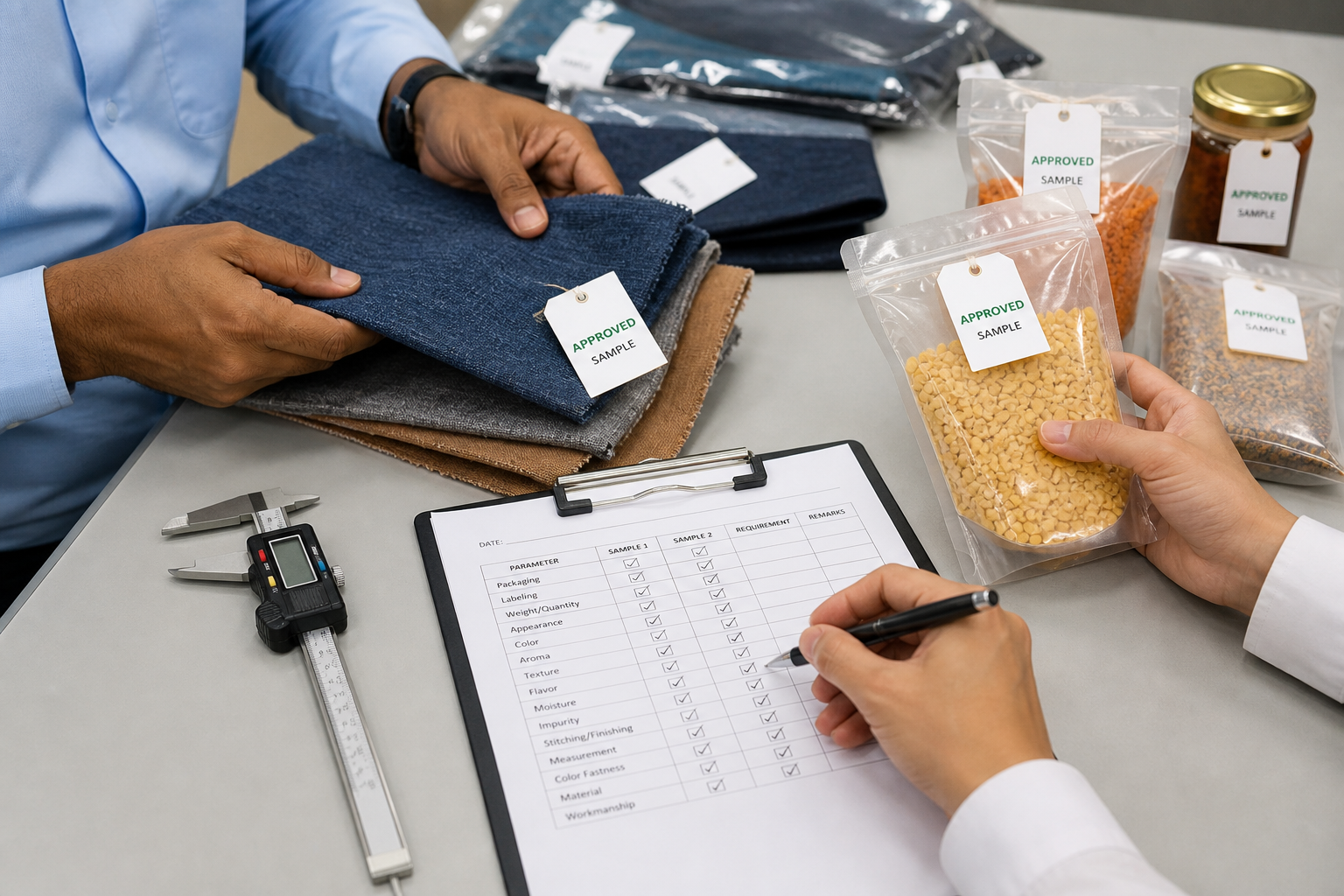
Group 5: Product and quality checks
Verification must be product-specific. A supplier can be capable in a broad category but unsuitable for your performance standard, finish, packaging, labeling, or destination-market requirement.
16. Match the product specification to the quotation
Provide a controlled specification containing drawings, materials, dimensions, tolerances, colors, labeling, packaging, tests, and applicable standards. Then compare the supplier’s quotation line by line. Identify every assumption, alternative, exclusion, and open question.
Never accept “same as sample” as the only production specification for a complex or custom product. Samples can fade, be revised, or hide material and tolerance differences.
17. Evaluate samples as evidence, not approval theater
Ask what type of sample you are receiving: development sample, pre-production sample, production sample, or retained reference sample. Compare it to the written specification, inspect it against agreed acceptance criteria, and record approved revisions in writing.
A sample proves only what was sent. It does not prove the factory can repeat it at volume. The next check is whether the supplier has a documented process to reproduce the approved configuration.
18. Review the quality-control process and records
Ask about incoming material checks, in-process controls, final inspection, defect classification, measurement tools, calibration, traceability, and corrective action. Request anonymized examples of inspection formats or reports where appropriate.
The aim is not to require every supplier to have the same formal system. It is to learn whether controls are systematic enough for your risk. A company that cannot explain how it detects a recurring defect before packing requires closer oversight.
19. Agree inspection standards before production starts
Define the inspection timing, sample size approach, critical/major/minor defect categories, functional tests, packaging checks, photo requirements, rework authority, and disposition process. Where an independent inspection is appropriate, name the provider or selection process in advance.
For quality-specific decision gates, use how to verify product quality before buying from an Indian manufacturer. Do not leave quality terms until the goods are already ready to ship.
Group 6: Commercial and transaction checks
Commercial verification is where many preventable disputes begin. A low unit price is not comparable if it rests on different materials, MOQs, tooling, packing, payment, or delivery terms.
20. Normalize quotations before comparing price
Put each supplier’s quote into one comparison sheet. Include product version, material, finish, tooling, unit price, MOQ, packaging, artwork, tests, lead time, Incoterm, payment terms, validity, and exclusions.
Ask why the lowest quote differs. Sometimes it is efficient production. Sometimes it omits a component, uses a different material, assumes a different quantity, or excludes a required cost. Comparable scope is more valuable than a quick price promise.
21. Check payment terms against the evidence level
Higher deposits deserve stronger verification and tighter milestones. Match payment to defined outputs: approved sample, material evidence where justified, completed production, passed inspection, shipping documents, or another mutually agreed control.
No payment structure eliminates all risk, and the correct arrangement depends on supplier history, product economics, and both parties’ bargaining position. The key is that payment timing should not outrun the evidence you have received.
22. Confirm Incoterms, ownership, and document responsibilities
State the agreed Incoterm and named place or port precisely. Clarify who books freight, who insures where relevant, who prepares documents, when title and risk transfer under your contract, and who handles destination-market requirements.
Do not rely on shorthand such as “we handle shipping.” It leaves too much unaddressed when documents, duties, damage, or delays become an issue.

Group 7: Compliance and responsible-supply checks
Compliance needs are product- and market-specific. Avoid accepting a generic certificate list as proof that your particular SKU meets your destination requirements.
23. Validate product compliance evidence for your market
Identify the regulations, standards, labeling, testing, declarations, and technical files that apply to your product and market. Ask the supplier what it has supplied for comparable products, what evidence it can provide, and what remains your responsibility as importer or brand owner.
Check scope and validity: does the report cover the same material, model, facility, test method, and revision? If not, it may be useful background but not evidence of compliance for your order.
24. Review labor, environmental, and traceability controls proportionately
Where your buyer policy, customer contract, or product risk requires it, ask about workforce practices, health and safety, environmental controls, restricted substances, origin traceability, and subcontractor oversight. A third-party social or environmental audit may be appropriate for some categories and not others.
Be clear about your requirements rather than asking a supplier to guess. If a claim matters to your brand or customer, state what evidence and remediation process you require.

Group 8: References, reputation, and decision checks
References close the gap between documents and operating behavior. They are not always available because of confidentiality, but a supplier should be able to provide some credible way to demonstrate relevant delivery experience.
25. Seek relevant references and run a controlled first order
Ask for references, case examples, shipment history with sensitive details removed, or other appropriate evidence of comparable work. When speaking to a reference, ask about communication, quality consistency, issue handling, delivery, and whether the product and order scale resemble yours.
Then use a controlled first order where practical. Limit the scope, define acceptance criteria, maintain an approval trail, and preserve the option to stop before scaling. The first order is a verification stage, not merely a buying event.
Altus Exports can coordinate this process through supplier research, on-ground verification, commercial comparison, sample follow-up, and quality reporting for buyers that do not have a local India team. The goal is not to replace buyer judgment; it is to make the evidence behind that judgment more complete.
A practical verification sequence before a purchase order
- Receive a signed supplier profile, legal details, and initial quote.
- Independently check entity, GST, export role, and bank-beneficiary alignment.
- Hold a live technical call and facility walkthrough.
- Issue a controlled RFQ and specification pack to two or three candidates.
- Compare normalized quotations and capacity plans.
- Obtain, inspect, and formally approve samples.
- Agree inspection, compliance, payment, and shipment controls in the purchase order.
- Place a pilot order, review performance, then decide whether to scale.
The checklist is most effective when sequenced. First, screen identity and credentials before spending heavily on samples or travel. Second, validate the operating facility and product fit. Third, test capacity, quality controls, and commercial assumptions. Fourth, complete compliance and reference checks. Finally, make the first order small enough to learn without exposing the business to disproportionate risk.
An illustrative sequence for a private-label buyer might be:
This is more reliable than trying to “verify” a supplier only after a problem appears. It also gives good suppliers a fairer process: they know what evidence is needed and when decisions will be made.

Common mistakes when using a supplier checklist
Common Mistakes Box
Checklist
Treating a document as a complete answer
Registrations, certificates, photographs, and references are pieces of evidence. They should reinforce one another. A document that cannot be connected to the contracting entity, actual facility, product, or current order does not resolve the underlying question.
Asking every supplier the same vague questions
Ask the same core questions, but make them product-specific. A metal component supplier, food processor, textile factory, and export trader need different technical and compliance evidence.
Selecting the supplier before the checklist is complete
Once a team becomes invested in the lowest quote or best sample, it may rationalize gaps. Use a decision gate: no appointment or major deposit until the minimum required checks are verified or a documented exception is approved.
Confusing a remote review with an audit
Video calls are valuable, especially early in a project, but they have limitations. For higher-risk products or payments, consider an on-site visit, independent audit, or a local representative. Read how to conduct a supplier audit in India without visiting the factory for a disciplined remote approach.
Ignoring fraud signals because the commercial offer is attractive
An unusually low price, urgency to pay, unexplained bank change, copied credentials, or resistance to a live walkthrough should cause the process to pause. See how to identify fake Indian suppliers and export scams for pattern-based warning signs and response steps.
When to get on-ground support
Independent local support can be especially useful when the buyer cannot travel, the product needs technical observation, several factories are being compared, or the value of a mistake exceeds the cost of verification. The supporter should document what it observed, distinguish facts from supplier representations, and disclose the scope and limits of its review.
Altus Exports provides global sourcing partner support in India and manufacturer-finding support for buyers who need structured supplier research and verification. A clear product brief, target market, volume, and planned order value make it possible to define an appropriate level of work.

Conclusion
An Indian supplier verification checklist is valuable only when it turns claims into decision-ready evidence. Confirm who you are buying from, what it can actually make, how it will control quality, what the contract and payment terms mean, and whether the evidence remains consistent across the transaction.
Use the 25-Point Indian Supplier Verification Checklist before appointing a supplier or committing a material payment. For buyers that need an on-ground operating partner, Altus Exports can help structure supplier verification, comparison, samples, and first-order controls before a larger sourcing commitment.