
MCC Law 5 and Match-Grade Cricket Ball Export Opportunities
By Saurabh Mittal, Founder, Altus Exports
A focused guide to the compliance and construction pathway behind premium cricket ball exports from India — MCC Law 5 match specifications, alum-tanned leather grading, seam QC discipline, and the club, league, and licensed-retail buyers who pay materially higher margins for verified match-grade leather balls under HS 95066920.
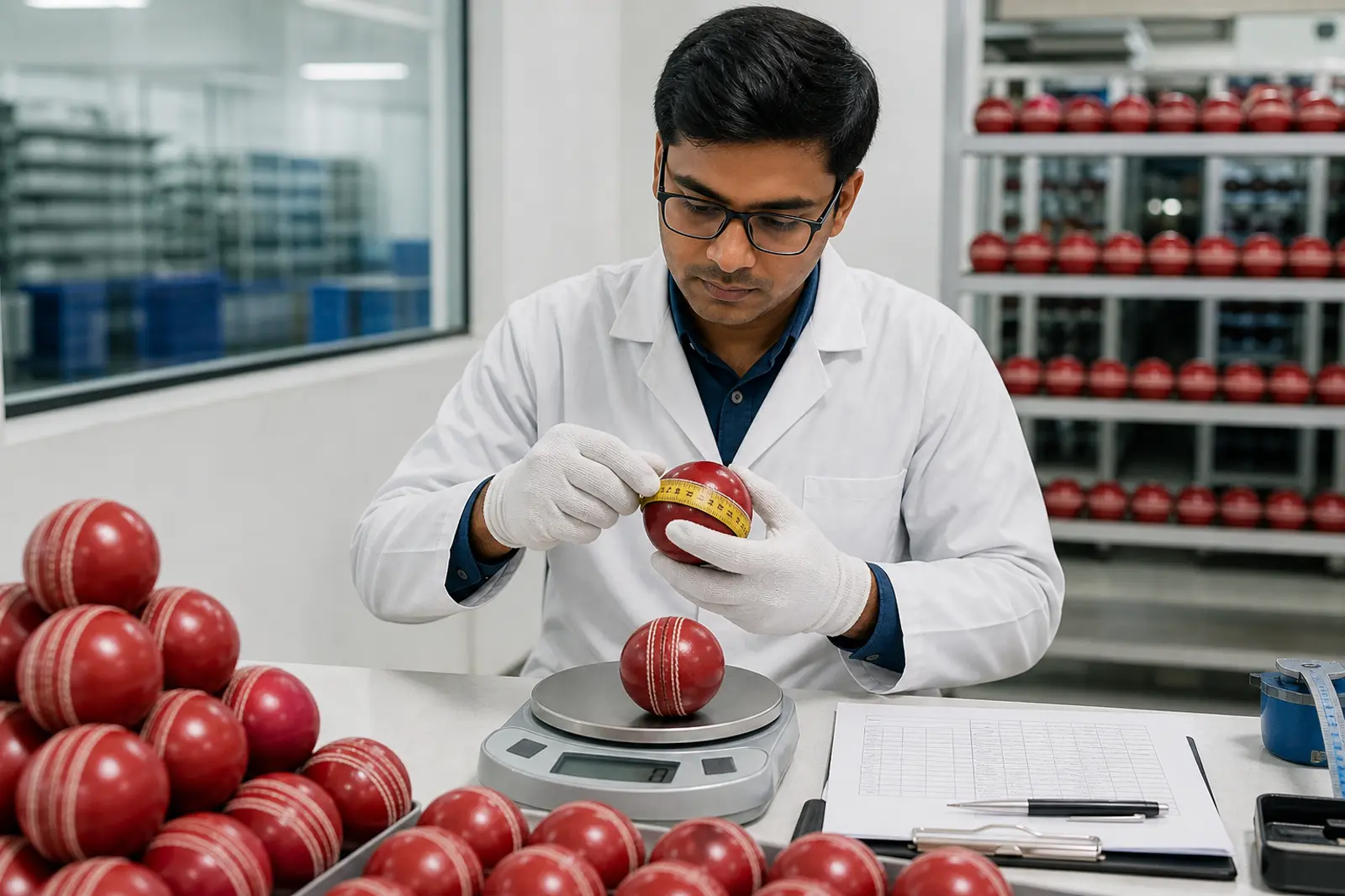
Most Indian cricket ball exports move through training, practice, and synthetic construction — reliable, high-volume, and priced accordingly. A smaller, materially more profitable segment of the trade sits above that commodity tier: alum-tanned leather match balls manufactured to MCC Law 5 specifications that clubs, leagues, academies, and licensed retail programmes buy at two to four times the FOB price of a standard training ball under the same HS 95066920 heading. This guide is deliberately narrow and does not repeat the general export process or SGEPC membership mechanics covered elsewhere in our cricket ball content cluster — it focuses specifically on what MCC Law 5 actually requires, what Meerut leather ball manufacturing demands that training-grade production does not, and which buyers pay a premium for verified match-grade cricket balls.
For the baseline export sequence — IEC, GST, general shipping process — see How to Export Cricket Balls from India. For the export council registration that underpins organised exporter status generally, see SGEPC Registration Benefits for Cricket Ball Exporters, which this guide deliberately treats as a prerequisite rather than a topic in its own right here. What belongs in this guide is the match-grade specification ladder itself — MCC Law 5 weight, circumference, seam, and rebound parameters — and the manufacturing discipline and buyer economics that sit behind it.
Whether you run or are considering investing in a premium leather ball line in Meerut, or you are an international buyer sourcing match-grade cricket balls for a professional league, academy programme, or licensed retail launch, this guide walks through the compliance pathway end to end: what MCC Law 5 tests, how lot QC and seam inspection work, realistic cost and timeline to release a match-grade SKU, the premium buyer segments that actually require it, and the pricing economics that make this tier worth the additional investment for the right manufacturer.
Key Takeaways
Summary Box
Executive Summary
Summary Box
Match-grade cricket ball export is a narrow but genuinely lucrative segment within India's broader cricket ball trade. It rewards manufacturers who invest in alum-tanned leather sourcing, skilled hand-stitching, consistent cork-and-rubber core preparation, and a disciplined lot QC relationship with documented release protocols — and it punishes manufacturers who market 'match quality' language loosely without underlying lot compliance data, since serious buyers in this segment verify claims before committing volume.
This guide treats MCC Law 5 compliance as an investment decision with a real cost and payback timeline, not a marketing checkbox. For a Meerut manufacturer already producing consistent alum-tanned leather construction, releasing one or two hero match-grade SKUs with documented lot QC can open buyer segments — club and league supply, licensed retail programmes — that pay materially better margins than commodity training-ball volume, provided the manufacturer has already validated real buyer demand for that specific SKU before funding the production run.
Market Size & Industry Overview
Key Statistics
The global market for match-grade leather cricket balls is a fraction of the overall cricket ball trade by unit volume, concentrated among club and league programmes, academies, specialty retailers, and licensed retail programmes tied to major competitions. India's match-grade manufacturing capacity is smaller and more concentrated than its broader training and synthetic output, with a limited number of Meerut facilities investing in the alum-tanning relationships, skilled stitching benches, and consistent quality systems that make MCC Law 5 lot release realistic.
That concentration is itself the opportunity: because relatively few Indian manufacturers currently hold documented MCC Law 5 lot compliance on active premium SKUs, an exporter who invests properly in this tier faces less domestic price competition than in the commodity training-ball and synthetic segments, where dozens of Meerut and Jalandhar units compete primarily on price.
Match-grade segment versus commodity cricket ball segment
Swipe →
Data table — swipe horizontally on small screens
| Dimension | Match-Grade MCC Law 5 Segment | Commodity Training / Practice Segment |
|---|---|---|
| Typical construction | Alum-tanned leather, hand-stitched seam, cork-and-rubber core | Lower-grade leather or synthetic, machine-assisted stitching |
| Directional FOB range | ~USD 15–28+ per piece | ~USD 5–10 per piece |
| Primary buyers | Clubs, leagues, academies, licensed retail | Wholesale distributors, schools, practice programmes |
| Domestic supplier competition | Limited — few Indian units hold documented lot compliance | High — many units compete primarily on price |
| Investment required | Premium leather inventory plus skilled stitching and lot QC | Standard stitching lines, minimal lot testing cost |
Export Statistics
Key Statistics
Export data does not typically isolate match-grade leather cricket balls as a separate line item from the broader HS 95066920 heading, so exporters and buyers in this tier work primarily from directional industry knowledge and direct buyer relationships rather than published trade statistics specific to MCC Law 5 compliance status. What can be said directionally is that India's overall cricket ball export base is dominated by training, practice, and synthetic construction, with match-grade alum-tanned output representing a small but growing share concentrated among a handful of established Meerut exporters.
Directional export profile for the match-grade segment
Swipe →
Data table — swipe horizontally on small screens
| Metric | Directional Estimate | Notes |
|---|---|---|
| Applicable HS heading | 9506.69.10 (international); 95066920 (India) | Match-grade and commodity cricket balls share the same HS classification |
| Primary manufacturing base | Established Meerut leather ball exporters | Requires alum-tanning relationships and skilled hand-stitching most training-only units lack |
| Dominant destination profile | UK, Australia, South Africa, UAE, USA | Markets with concentrated club, league, and academy cricket infrastructure |
| Growth trajectory | Growing directionally as cricket expands in USA and associate nations | Driven by structured league and academy programme expansion |
Import Statistics
Key Statistics
On the buyer side, match-grade cricket ball demand concentrates among procurement teams that have a specific, often contractual, requirement for verified performance — a county league's official match-ball supply agreement, an academy's equipment standard, or a licensed retail programme tied to a specific competition or club brand. These buyers rarely negotiate on price the way commodity wholesale buyers do; they negotiate on lot compliance validity, supply consistency, seam QC documentation, and — for licensed programmes — branding and intellectual-property compliance alongside the ball itself.
The UK, Australia, South Africa, and the UAE host the largest concentration of structured club and league programmes that specify MCC Law 5-compliant match balls, alongside growing demand from academy and league programmes in the USA, Bangladesh, and Sri Lanka as cricket infrastructure formalises in those regions.
Directional demand profile for match-grade cricket balls by destination market
Swipe →
Data table — swipe horizontally on small screens
| Market | Primary Match-Grade Buyer Type | Demand Driver |
|---|---|---|
| UK | County clubs, specialty retailers, licensed retail programmes | Deep, established cricket infrastructure and club licensing ecosystem |
| Australia | Club and academy procurement, specialty retail | Strong club cricket culture with defined ball standards |
| South Africa | Club and provincial league procurement | Established domestic cricket structure with match-ball specifications |
| UAE | Academy and league procurement | Growing investment in structured cricket infrastructure |
| USA | League and academy procurement, specialty retail | Expanding structured cricket programmes and league formalisation |
| Bangladesh | Club and institutional procurement | Growing domestic cricket infrastructure |
| Sri Lanka | Club and retail procurement | Established cricket culture with import demand for premium match balls |
Product Categories & Match-Grade Tiers
Summary Box
Within the match-grade category, three practical tiers matter to exporters and buyers: full MCC Law 5 lot-compliant match balls (documented weight, circumference, seam, and rebound within specification for first-class and limited-overs use), alum-tanned club-grade match balls manufactured to near-specification quality but without full lot documentation (sometimes marketed honestly as 'club match, pre-compliance QC'), and premium private-label match balls where branding, packaging, and margin structure matter as much as the underlying specification. Each tier attracts a different buyer and commands a different FOB band.
Match-grade tiers and their typical buyer fit
Swipe →
Data table — swipe horizontally on small screens
| Tier | Specification Equivalent | Typical Buyer |
|---|---|---|
| MCC Law 5 lot-compliant match | Full weight, circumference, seam, rebound documentation | Leagues, county clubs, premium academy programmes, flagship licensed retail |
| Alum-tanned club match (pre-compliance QC) | Near-specification quality, lot documentation in progress | Club suppliers, mid-tier specialty retail, academy programmes |
| Private-label premium match | MCC Law 5 or club-grade spec with branded packaging | Licensed retail programmes, e-commerce brands, club-branded supply |
Manufacturing Overview
Export Tip
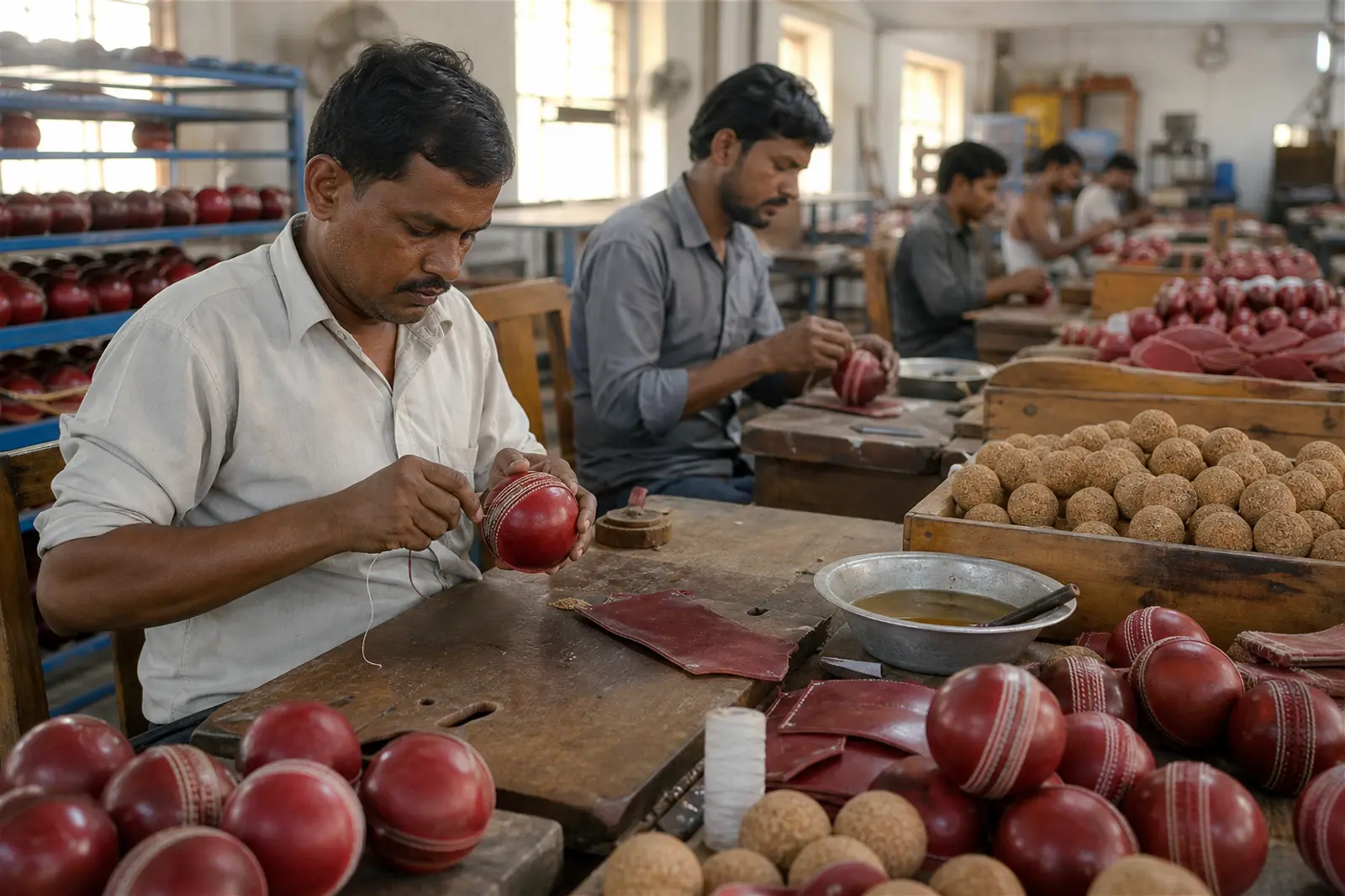
Alum-tanned leather match ball manufacturing is a materially different discipline from training-grade production, not simply a premium variant of it. Leather selected for match-grade use must meet tighter grain, thickness, and tanning consistency standards — alum tanning (aluminium-sulphate based) produces the firm, durable cover that holds shape through extended match play and responds predictably to seam and swing behaviour. The cork-and-rubber core must be centred and compressed to consistent density, since even minor core irregularity shows up in rebound testing and player feel during lot QC.
Seam construction is where Meerut's skilled hand-stitchers earn their premium. MCC Law 5 specifies seam height and prominence parameters that affect both ball behaviour and durability — a seam that sits too proud or too flat fails lot release even when weight and circumference pass. Hand-stitched closure with six rows of waxed thread, executed by experienced stitchers who maintain consistent tension and stitch spacing, is the production method behind nearly all lot-compliant match balls. Machine-assisted stitching can produce acceptable training balls but rarely achieves the seam consistency that match-grade lot release demands.
Export Process
Export Tip
Pursuing match-grade lot compliance sits as an add-on layer to the standard export process, not a replacement for it — IEC, SGEPC RCMC, sourcing, and documentation all still apply exactly as covered in How to Export Cricket Balls from India. What follows is specific to the match-grade decision and lot release pathway itself.
Step 1: Validate real buyer demand before committing to match-grade production
Confirm with prospective buyers — clubs, leagues, academies, licensed retail partners — that they specifically require MCC Law 5 lot compliance or documented alum-tanned match-grade quality and would commit to a volume programme around a specific SKU, before funding premium leather inventory and skilled stitching capacity speculatively.
Step 2: Lock the exact leather grade, core, and seam specification to be released
Lot compliance applies to a specific model — leather tanning grade, core construction, seam method, and ball colour together. Finalise this specification and freeze it before beginning production, since any material change after lot release typically requires re-testing and re-documentation.
Step 3: Establish lot QC protocols aligned with MCC Law 5 parameters
Build an in-factory QC station with calibrated scales, circumference gauges, rebound testing apparatus, and seam inspection protocols. Document the release criteria before production begins, not reactively after a buyer asks for compliance data.
Step 4: Complete lot release testing across the full parameter set
Testing covers weight (155.9–163 g), circumference (22.4–22.9 cm), seam height and integrity, rebound height consistency, and visual leather grade uniformity. Budget realistic time for this — it is a batch-by-batch discipline, not a one-time exercise.
Step 5: Maintain post-release quality discipline
Lot compliance is tied to ongoing manufacturing consistency, not a one-time achievement. Maintain the same incoming leather inspection and seam bench controls used for the released batch across every subsequent production run of that model.
Step 6: Bring match-grade stock into the standard export and documentation flow
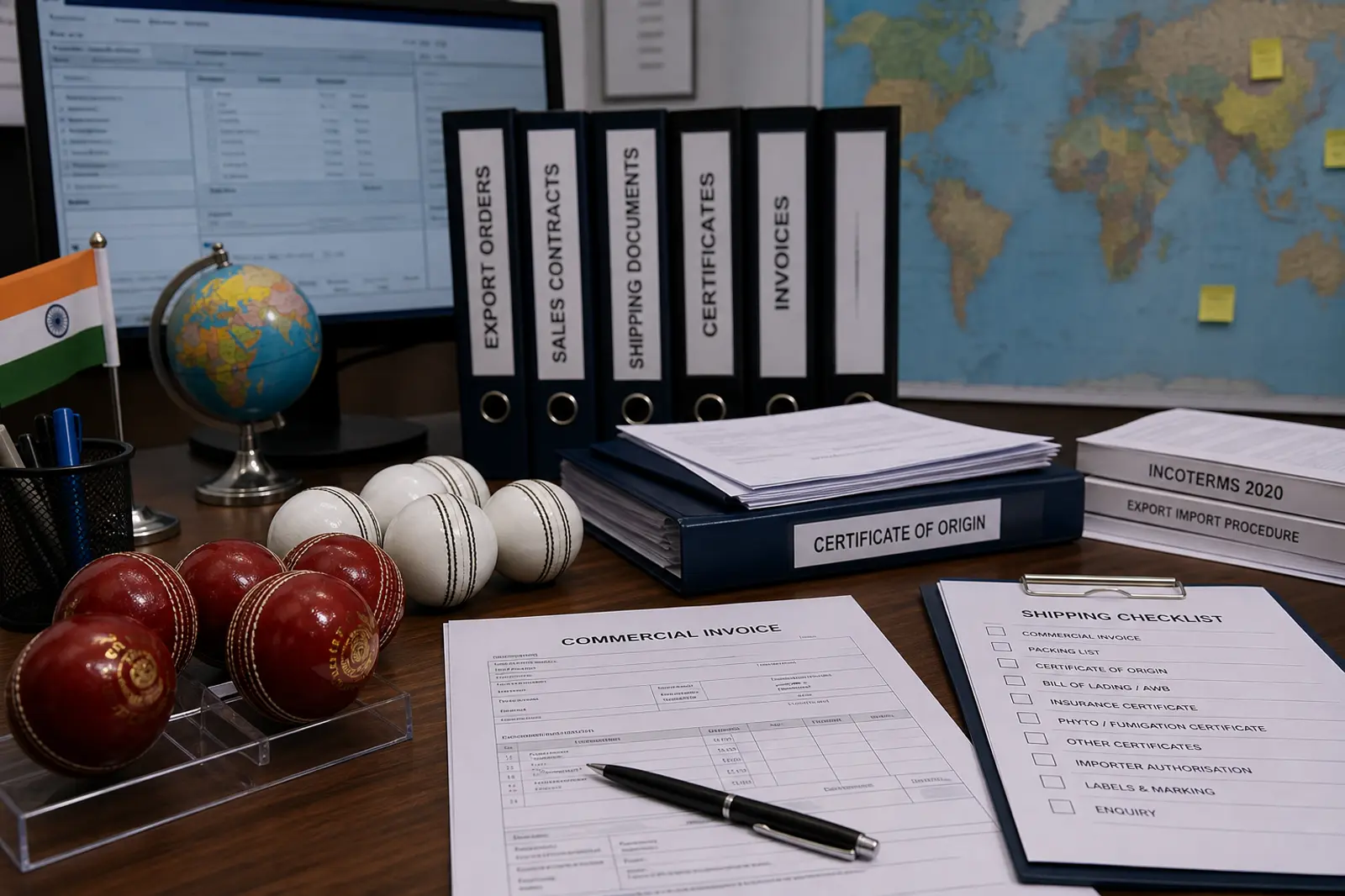
Once lot-released, the model moves through the same registration, pricing, packaging, and documentation sequence as any other cricket ball export, with lot QC documentation added to the buyer-facing and compliance document set. See Cricket Ball Export Documentation Checklist for the full paperwork sequence.
Pricing Analysis
Buyer Tip
Match-grade leather cricket balls command a substantial premium over commodity construction, and that premium reflects real cost inputs — premium alum-tanned leather, skilled hand-stitching labour, higher-grade cork-and-rubber cores, lot QC equipment and labour, and private-label packaging when applicable — rather than specification status alone inflating price. Buyers in this segment generally accept and expect this pricing structure, since they are typically paying to solve a specific contractual or performance requirement rather than shopping purely on unit cost.
Private-label programmes add a further margin layer: buyers sourcing branded match balls for licensed retail or club programmes typically expect FOB pricing that leaves them 40–60% retail margin after landed cost, import duty, and distribution — which means the exporter's FOB must be disciplined enough to support that structure while still covering premium production costs.
Directional FOB USD/pc pricing by match-grade tier
Swipe →
Data table — swipe horizontally on small screens
| Tier / Construction | Directional FOB USD/pc | Typical Buyer |
|---|---|---|
| Practice leather (reference point) | ~5–10 | Academies, wholesale, schools |
| Alum-tanned club match, pre-compliance QC | ~12–18 | Club suppliers, mid-tier specialty retail |
| MCC Law 5 lot-compliant match | ~15–28+ | Leagues, county clubs, premium academy programmes |
| Private-label MCC Law 5 match (branded packaging) | ~18–32+ | Licensed retail, e-commerce brands, club-branded supply |
MOQ Analysis
Buyer Tip
MOQs in the match-grade tier are shaped by premium leather inventory commitment and skilled stitching capacity rather than simple cost-per-unit economics — the fixed cost of sourcing alum-tanned leather and allocating experienced stitchers needs to spread across a meaningful production run to make match-grade pricing sustainable for the manufacturer.
Typical MOQ ranges by match-grade tier
Swipe →
Data table — swipe horizontally on small screens
| Tier | Typical MOQ (pieces per model) | Note |
|---|---|---|
| Alum-tanned club match, pre-compliance QC | 500–1,500 | Lower barrier since lot documentation is in progress |
| MCC Law 5 lot-compliant match | 1,000–3,000 | Lot QC cost and premium leather spread across the run |
| Private-label MCC Law 5 match | 2,000–5,000+ | Branding tooling and packaging investment; typically needs committed buyer volume |
Packaging Standards
Export Tip
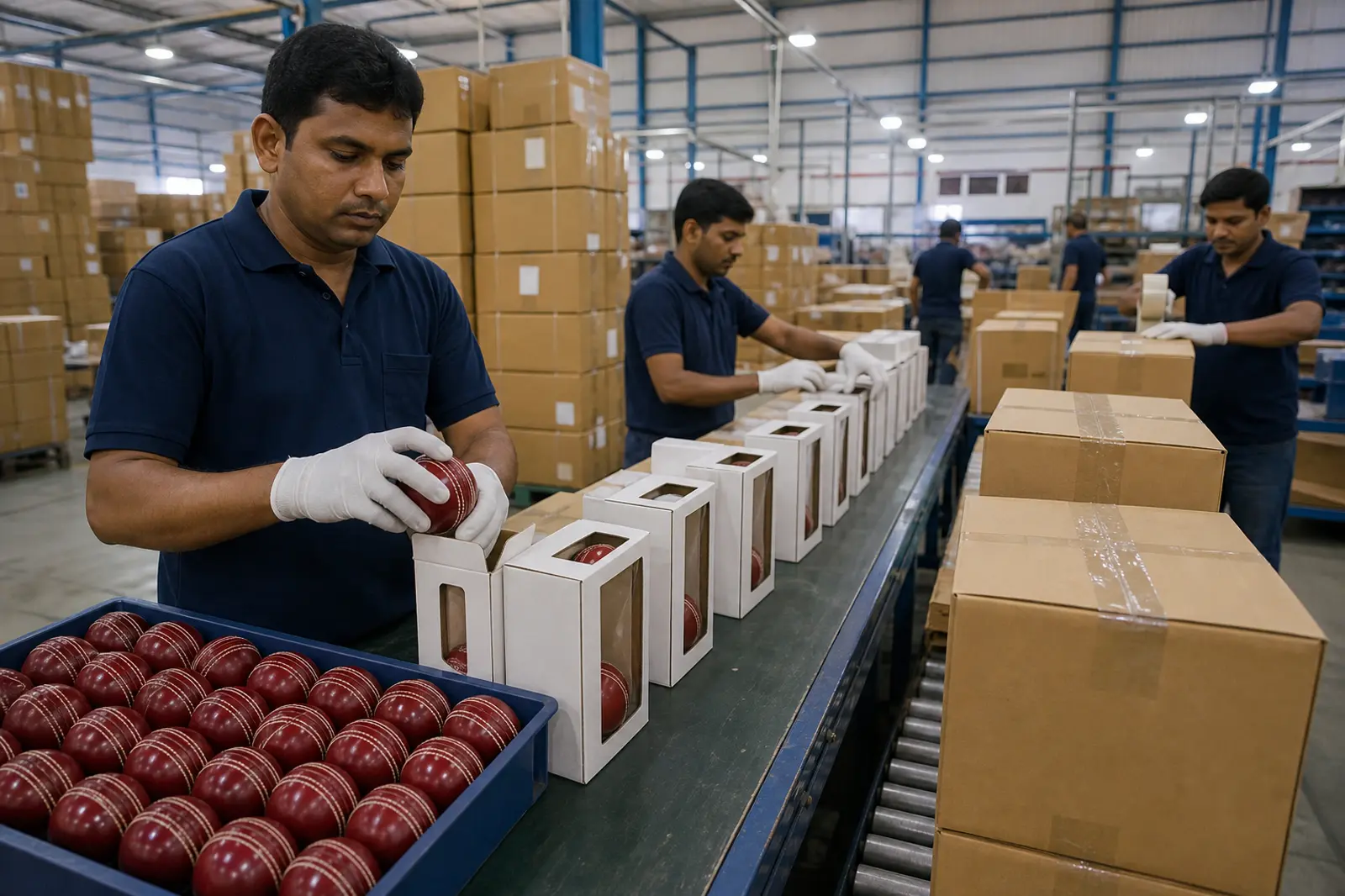
Match-grade cricket balls typically move through more premium and branding-conscious packaging than commodity stock, since licensed retail and flagship club programmes expect shelf-ready or gift-quality presentation, not just functional protection during transit.
Packaging formats for match-grade leather cricket balls
Swipe →
Data table — swipe horizontally on small screens
| Format | Typical Use | Key Requirement |
|---|---|---|
| Individual printed box | Licensed retail, flagship club-branded programmes | Shelf-ready design, MCC Law 5 compliance note clearly displayed |
| Protective box plus branded sleeve | Club and league bulk supply | Balance of protection and presentable unboxing for institutional buyers |
| Bulk master carton (6–12 pcs) | Large club or league programme orders | Corrugated, moisture-protected, clearly marked with lot reference |
| Climate-aware packing | All leather match-grade shipments | Moisture protection critical for alum-tanned leather during sea transit |
Container Loading Details
Export Tip
- 20-foot FCL — suitable for club and mid-size licensed retail programme orders
- 40-foot FCL / HC — suits established league or large licensed retail programmes
- LCL — common for smaller match-grade trial orders or first shipments to a new club buyer
- Palletisation with moisture barriers is standard for premium and printed-box SKUs to reduce crush and humidity risk given the higher unit value
Match-grade leather cricket balls are weight-denser than synthetic lines and require moisture protection during transit — container plans balance carton stacking with humidity control rather than maximising piece count alone, which buyers in this tier consider a fair trade given the unit value involved.
Shipping Methods
Export Tip
Ocean freight remains the default for bulk match-grade orders given the category's shelf-stable, non-perishable nature, typically routed via Nhava Sheva or Mundra with Delhi ICD serving the Meerut cluster. Air freight sees more frequent use in this segment than in commodity cricket ball exports — league and licensed-programme launch timelines are often fixed to a competition calendar, and buyers in this tier are more willing to absorb air-freight cost to hit a hard launch date than a wholesale training-ball buyer would be.
Certifications
Compliance Notes
This is the core subject of the guide, so the detail here is deliberately more extensive than a typical certifications section: understanding exactly what MCC Law 5 specifies, and how lot QC and seam inspection actually work, is what separates a credible match-grade exporter from one making marketing claims a serious buyer will eventually ask to verify.
What MCC Law 5 lot compliance testing actually covers
Swipe →
Data table — swipe horizontally on small screens
| Test Parameter | What It Verifies | Why Buyers Care |
|---|---|---|
| Weight (155.9–163 g) | Ball mass sits within defined tolerance | Consistent feel and bowling behaviour across match balls |
| Circumference (22.4–22.9 cm) | Ball size stays within tight tolerance | Consistent grip and batting characteristics |
| Seam height and integrity | Seam prominence and stitch security within specification | Swing, spin, and durability behaviour during extended match play |
| Rebound height | Rebound consistency across repeated bounces | Predictable ball behaviour off pitch and bat |
| Leather grade uniformity | Visual and tactile consistency across the lot | Professional presentation and player confidence in ball quality |
Buyer Requirements
Buyer Requirements
Buyers in the match-grade tier run more rigorous due diligence than commodity cricket ball buyers, and for good reason — a league or licensed retail programme has its own reputational exposure if a supplier's MCC Law 5 claim turns out to be inaccurate. Expect requests for lot QC documentation referencing the exact model and release date, production samples matched to the released specification for independent verification, evidence of consistent post-release manufacturing controls, and — for licensed programmes — clear intellectual-property and branding compliance alongside the ball itself.
Buyers also frequently ask how a manufacturer will handle a leather supplier or seam process change after lot release, since any material change to the released specification typically requires re-testing and re-documentation. A credible answer here — a defined change-control process — often matters as much to a serious buyer as the original lot release documentation itself.
Country-wise Opportunities
Market Snapshot
Match-grade cricket ball opportunity concentrates in markets with structured club, league, and academy infrastructure rather than tracking general cricket ball import volume — a market that imports large volumes of practice balls is not automatically a strong match-grade market if it lacks that structured competition layer.
Country-wise match-grade cricket ball opportunity profile
Swipe →
Data table — swipe horizontally on small screens
| Country | Opportunity Driver | Buyer Focus |
|---|---|---|
| UK | Deep county club and specialty retail infrastructure | County clubs, specialty retailers, licensed retail programmes |
| Australia | Strong club cricket culture with defined standards | Club and academy procurement, specialty retail |
| South Africa | Established provincial and club league structure | Club and provincial league procurement |
| UAE | Rising investment in structured cricket infrastructure | Academy and league procurement |
| USA | Expanding league and academy formalisation | League suppliers, academy programmes, specialty retail |
| Bangladesh | Growing domestic cricket infrastructure | Club and institutional procurement |
| Sri Lanka | Established cricket culture with premium import demand | Club suppliers, specialty retail |
Sourcing Checklist
Checklist
Buyer Checklist
Exporter Checklist
Common Buyer Mistakes
Common Mistakes Box
Future Market Trends
Key Statistics
Structured cricket league and academy infrastructure is expanding steadily across the USA, UAE, Bangladesh, and Sri Lanka, which should widen the buyer base for match-grade leather cricket balls beyond the traditionally dominant UK, Australia, and South Africa markets over the coming years. As these programmes formalise procurement standards, more of them are likely to specify MCC Law 5 lot compliance or documented alum-tanned match-grade quality explicitly in tender or supply-agreement language, rather than relying on informal quality assurances from suppliers.
Private-label match ball programmes — where e-commerce brands, club networks, and licensed retailers source branded alum-tanned balls from Meerut with custom packaging — are growing as a margin-rich channel that sits alongside traditional club and league procurement. Manufacturers who can combine documented lot QC with flexible private-label packaging and reliable reorder supply are likely to see disproportionate growth in this tier compared with commodity training-ball volume.
Challenges & Solutions
- Challenge: premium leather inventory cost and skilled stitching capacity are hard to justify without confirmed buyer demand — Solution: secure a letter of intent or committed trial order from a serious buyer before funding a match-grade production run.
- Challenge: post-release quality drift risking loss of buyer trust — Solution: maintain the same incoming leather inspection and seam bench discipline used for the original release batch on every subsequent production run.
- Challenge: buyers confusing club-grade alum-tanned balls with formally lot-compliant models — Solution: label and price the two tiers distinctly and never imply MCC Law 5 compliance that has not been formally documented for that specific lot.
- Challenge: leather supplier or tanning grade changes risking invalidated lot compliance — Solution: build a documented change-control process that flags any material change for re-testing review before production.
- Challenge: moisture damage during sea transit affecting leather quality on arrival — Solution: invest in climate-aware packaging and palletisation as standard for all match-grade shipments, not an optional upgrade.
- Challenge: differentiating a genuinely lot-compliant exporter from marketing-only claims in a crowded supplier pool — Solution: lead with lot QC documentation itself, model-specific release records, and a transparent post-release quality process in every buyer conversation.
Compliance Checklist
Checklist
Compliance Notes

Conclusion
- Next step for manufacturers: validate committed demand for a specific match-grade model with at least one serious buyer before funding premium leather inventory and skilled stitching capacity.
- Next step for buyers: share your specification tier requirement (MCC Law 5 lot-compliant or alum-tanned club match), target volume, and timeline — Altus Exports will match verified Meerut suppliers.
- Explore export products from India and global sourcing partner services for broader multi-category sourcing support alongside match-grade cricket ball programmes.
- Consider product sourcing company India services if you are evaluating match-grade cricket balls alongside other premium sports goods for a diversified programme.
Match-grade, MCC Law 5-compliant cricket ball export is a genuine premium-margin opportunity within India's cricket ball trade, but it rewards a specific kind of manufacturer: one willing to invest in alum-tanned leather relationships, maintain disciplined seam bench and lot QC control, and build relationships with the club, league, academy, and licensed-retail buyers who actually value and will pay for documented match-grade quality. It is not a path for every Meerut exporter, and it should not be pursued speculatively without validated buyer demand — but for the right manufacturer with the right buyer relationships already in progress, it delivers materially better economics than commodity training-ball volume ever will.
If you manufacture alum-tanned leather cricket balls and are considering match-grade lot release, start by validating real buyer demand for a specific model before funding premium leather inventory, and build your lot QC process before the first production run begins. If you are a club, league, academy, or licensed retail buyer sourcing match-grade cricket balls from India, verify every lot QC claim against the exact model and release date before committing volume. Altus Exports coordinates both sides of this relationship as a merchant exporter in India — reach out via our contact page to discuss match-grade sourcing or export readiness.
This guide is the match-grade depth companion to our broader cricket ball content cluster. For the full export process, see How to Export Cricket Balls from India. For product and construction depth generally, see Top Cricket Ball Products Exported from India. For registration fundamentals, see SGEPC Registration Benefits for Cricket Ball Exporters. For buyer discovery, see How to Find International Buyers for Cricket Balls and Trade Shows and B2B Marketplaces for Cricket Ball Exporters. For market selection, see Best Countries for Indian Cricket Ball Exports and Most Demanded Indian Cricket Balls by Country.