
Top Cricket Ball Products Exported from India
By Saurabh Mittal, Founder, Altus Exports
A complete product catalogue of cricket ball types, leather grades, weight classes, and packaging formats exported from India — match, training, synthetic, tennis, wind, and junior balls, with MOQ-by-SKU and MCC Law 5 benchmarks, from Altus Exports.
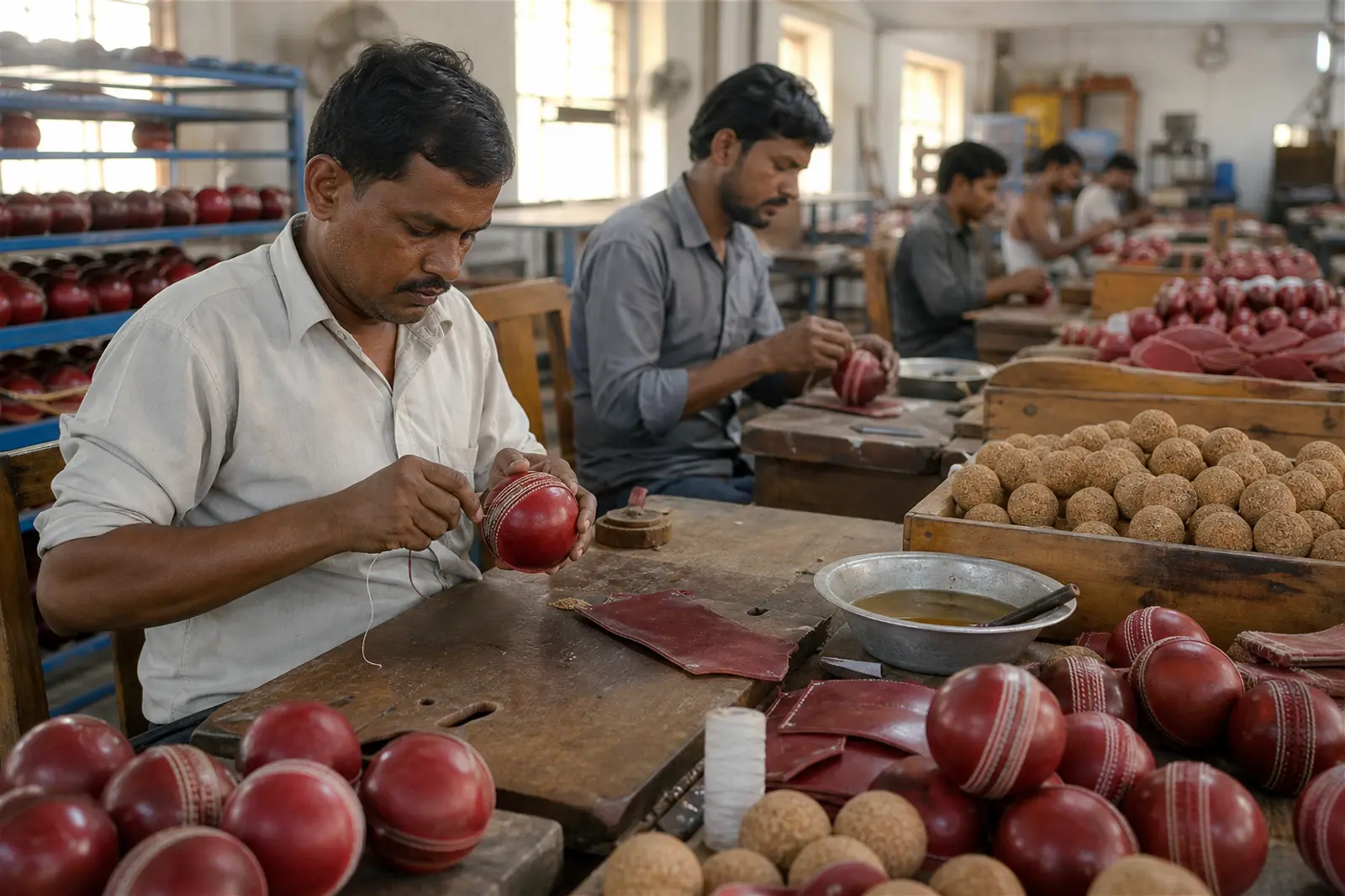
Ask an international buyer what an Indian cricket ball is, and most will describe a single product — a red leather sphere with a raised seam. In reality, cricket balls exported from India span a genuinely wide product range disguised inside one familiar silhouette: red and white leather match balls, alum-tanned training grades, synthetic practice lines, tennis cricket balls, wind balls, and junior formats, each built to different leather grades, core constructions, and weight specifications, and each aimed at a distinct buyer segment with its own pricing logic and MOQ expectations. This guide is the product-level companion to How to Export Cricket Balls from India, which covers the end-to-end export process, registrations, and Incoterms — here, the focus is entirely on what you are actually buying or selling: leather grade, core type, colour, and packaging, SKU by SKU.
Getting leather grade and ball-type terminology right matters commercially, not just technically. A buyer who orders 'match balls' without specifying alum-tanned Grade A vs. Grade B leather, red vs. white colour, or cork-and-rubber vs. composite core — will receive wildly different quotes from different Meerut and Jalandhar suppliers, none of which are directly comparable until the specification is pinned down. This guide gives you that shared vocabulary, plus directional MOQ and pricing benchmarks by SKU, so that your first request for quotation is specific enough to produce comparable, actionable responses. For country and buyer-specific angles once you have your product shortlist, see Best Countries for Indian Cricket Ball Exports and Most Demanded Indian Cricket Balls by Country.
Trade figures, pricing bands, and MOQ tiers in this guide are directional planning inputs based on typical Meerut and Jalandhar export practice; always confirm current specifications and pricing against a fresh supplier quotation before committing to a production run. For the operational process — registrations, documentation, and shipping — see the process pillar linked above, and for direct supplier access, see Source Cricket Balls Directly from India or work with a merchant exporter in India who already maintains verified relationships across ball types.
Key Takeaways
Summary Box
Executive Summary
Summary Box
This guide catalogues the cricket ball products India exports at commercial scale, organised around the three variables that actually determine price, quality, and buyer fit: leather grade (or synthetic material), core construction, and weight class. Product type (match, training, synthetic, tennis, wind, junior) sits on top of those three variables and determines which combination of leather grade and core type a buyer should specify for their use case and price point.
Buyers who understand this structure negotiate faster and get fewer surprises on bulk delivery, because they can specify exactly what they want rather than relying on a supplier's interpretation of a vague request. Exporters who present their range this way — rather than a flat price list — differentiate themselves credibly against competitors quoting on price alone. Altus Exports works across this full product range as a merchant exporter and global sourcing partner in India, matching buyer specifications to the right combination of Meerut and Jalandhar suppliers. For the operational and registration side of exporting these products, see How to Export Cricket Balls from India.
Market Size & Industry Overview
Key Statistics
India's cricket ball product range is anchored by Meerut, Uttar Pradesh's dense leather-ball manufacturing ecosystem, which produces the full grade spectrum from synthetic practice balls to premium alum-tanned red and white match balls, supported by Jalandhar, Punjab's capacity in synthetic moulding, rubber practice lines, and tennis cricket ball variants. This breadth is unusual — many competing sourcing origins specialise in one or two product tiers, while India's cluster depth lets export houses offer buyers a genuinely wide product range from a single sourcing relationship.
Product-mix trends have shifted over recent years: synthetic and tennis cricket balls have grown alongside informal and school cricket participation globally, private-label training-ball programmes have expanded as cricket retailers seek differentiated SKUs, and premium alum-tanned match-ball capability has become a genuine differentiator for export houses able to invest in Grade A leather sourcing and MCC Law 5 lot-release protocols. Buyers evaluating India as a sourcing origin should think in terms of which specific SKUs a supplier has demonstrated capability in, rather than assuming uniform capability across the entire product range.
Export Statistics
Key Statistics
Cricket ball product-mix export data is not typically published at the SKU level by any single public source — treat the figures below as directional estimates drawn from typical Meerut and Jalandhar export patterns, and validate current-year product-mix trends against your sourcing partner's live order book rather than a single published statistic.
Directional product-mix profile of Indian cricket ball exports
Swipe →
Data table — swipe horizontally on small screens
| Product Type | Directional Volume Share | Dominant Grade / Material |
|---|---|---|
| Leather training balls | Largest single volume share | Grade B/C alum-tanned leather |
| Red leather match balls | Second-largest volume share | Grade A/B alum-tanned leather |
| Synthetic practice balls | Meaningful and growing share | Moulded PVC or composite |
| White leather match balls | Steady niche share | Grade A/B alum-tanned white leather |
| Tennis cricket balls | Smaller, informal-cricket-linked share | Rubber or felt-covered moulded core |
| Wind balls | Smaller, indoor-training niche share | Lightweight PVC or foam composite |
| Junior cricket balls | Smaller, school-programme share | Reduced weight leather or synthetic |
Import Statistics
Key Statistics
Destination-market demand for specific cricket ball SKUs correlates closely with buyer type: cricket retailers and distributors buy training and match balls in volume, club and academy suppliers buy match balls across leather grades, and school procurement teams buy synthetic and junior balls for programme supply. The table below is a working model for aligning your product mix to buyer type, not a substitute for direct market research in your target country.
Directional buyer-type demand by cricket ball product category
Swipe →
Data table — swipe horizontally on small screens
| Buyer Type | Primary SKUs Purchased | Typical Volume Pattern |
|---|---|---|
| Cricket specialty retailers | Match balls, training balls, synthetic practice lines | Repeat wholesale orders, seasonal peaks before league seasons |
| Distributors and wholesalers | Full product range, mixed-SKU containers | Large consolidated orders across leather grades |
| Clubs, academies, and schools | Training balls, match balls, junior formats | Recurring seasonal procurement |
| Federation and league procurement | Red and white match balls, Grade A leather | Contract-driven bulk orders aligned to competition calendars |
| E-commerce and DTC cricket brands | Training balls, synthetic lines, private-label match balls | Smaller, frequent replenishment orders |
Product Categories & Variants
Summary Box
- Red leather match balls — Test and multi-day cricket; Grade A/B alum-tanned red leather; cork-and-rubber core; MCC Law 5 men's standard (5.5–5.75 oz, 8.81–9 in circumference)
- White leather match balls — limited-overs and day/night cricket; Grade A/B alum-tanned white leather; same MCC Law 5 dimensional standards as red
- Leather training balls — club and academy practice; Grade B/C alum-tanned leather; cork-and-rubber or composite core; may not require full MCC Law 5 lot-release
- Synthetic cricket balls — moulded PVC or composite shells; school and entry-level practice; no leather content; lower MOQ thresholds
- Tennis cricket balls — rubber or felt-covered; informal and street cricket formats; popular in South Asian diaspora markets
- Wind balls — lightweight PVC or foam composite; indoor nets and junior training; reduced rebound for safety
- Junior cricket balls — reduced weight and circumference for youth programmes; leather or synthetic variants
Every cricket ball exported from India falls into one of seven core product types, and understanding the typical leather grade, core, and weight profile for each helps buyers specify accurately from the first inquiry.
Manufacturing Overview
Export Tip
Leather cricket ball manufacturing in Meerut follows a consistent sequence regardless of grade: alum-tanned cowhide is selected by grade, dyed red or white, cut into two hemispherical panels, stamped with the manufacturer's mark, and hand-stitched around a cork-and-rubber core with six rows of waxed thread. The seam profile — its height, shape, and consistency — is the most visible quality differentiator and the attribute bowlers evaluate first. Synthetic and tennis cricket balls follow a different path through Jalandhar's moulding lines: PVC or rubber compounds are injected or wrapped around a solid core, with branding applied post-moulding and no hand-stitching involved.
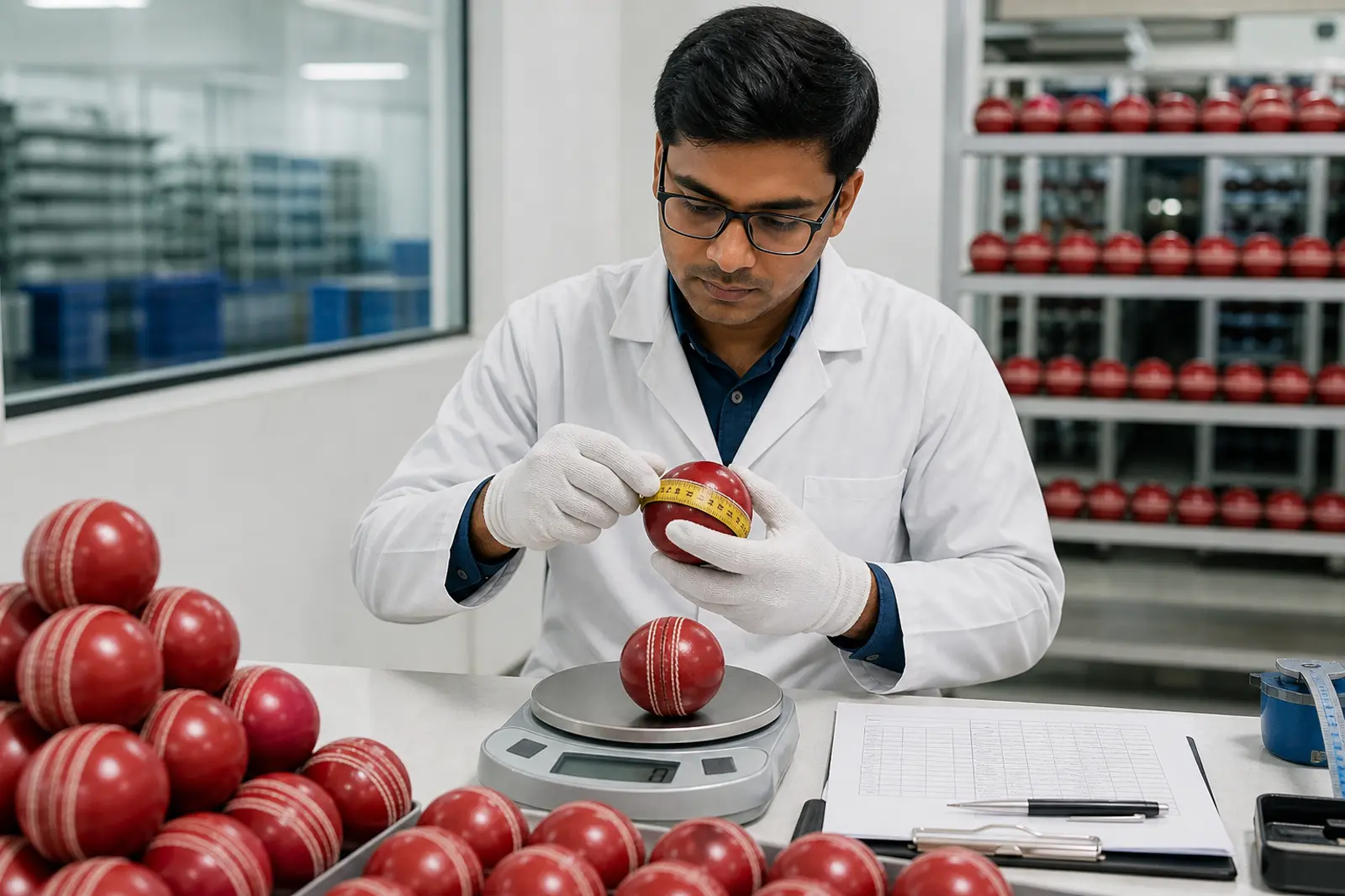
Quality control at lot release covers weight, circumference, seam shape, rebound consistency, and visual inspection for leather defects or stitching irregularities. Match-grade balls undergo full MCC Law 5 dimensional testing; training and synthetic lines may follow a simplified specification agreed with the buyer. Because Meerut's ecosystem is organised around specialist units — tanneries, panel cutters, stitching lines, core suppliers — rather than a single integrated factory, coordinating leather grade consistency across a production run is the central operational skill for any exporter in this category.
Leather Grades & Weight Classes
Leather grade is the single most important specification variable across every leather cricket ball product type, and understanding the trade-offs helps buyers avoid both overpaying for unnecessary Grade A leather and underspecifying for their actual use case.
Alum-tanned leather grade reference for cricket ball exports
Swipe →
Data table — swipe horizontally on small screens
| Grade | Leather Quality | Typical Use | Directional FOB USD/pc |
|---|---|---|---|
| Grade A | Premium alum-tanned, minimal surface defects, consistent dye | First-class and premium club match balls | ~12–30+ |
| Grade B | Good alum-tanned, minor acceptable defects, consistent seam | Club match and high-volume training | ~6–12 |
| Grade C | Entry alum-tanned or blended, visible defects acceptable | School and academy training programmes | ~4–8 |
Weight and Circumference Classes
Weight and circumference classes for cricket ball exports
Swipe →
Data table — swipe horizontally on small screens
| Class | Weight | Circumference | Typical Buyer |
|---|---|---|---|
| Men's (MCC Law 5) | 5.5–5.75 oz (155.9–163 g) | 8.81–9 in (22.4–22.9 cm) | Adult club, league, and federation match play |
| Women's | 4.94–5.31 oz (140–150.5 g) | 8.25–8.88 in (21.0–22.5 cm) | Women's league and club competition |
| Junior (under-13) | 4.69–5.06 oz (133–143 g) | 8.06–8.69 in (20.5–22.0 cm) | Youth academy and school programmes |
| Junior (buyer-specified) | Below Under-13; no MCC standard | Below Under-13; confirm in RFQ | Primary school and beginner programmes — specify weight/circumference in writing |
Export Process
Export Tip
At the product level, the export process for cricket balls follows the same registration and documentation sequence described in How to Export Cricket Balls from India, with product-specific gates at sample approval and lot-release stages. The critical product-level decision points are: confirming leather grade and core type in writing before production; approving physical samples against MCC Law 5 tolerances for match-grade SKUs; and matching packaging format (individual box vs. bulk carton) to the buyer's channel before the first bulk run is booked.
Exporters quoting across multiple SKUs in a single container should build separate FOB price lines for each ball type and leather grade rather than averaging across the mix — buyers comparing quotations need line-item clarity to evaluate whether the SKU mix matches their channel requirements. For documentation specifics, see Cricket Ball Export Documentation Checklist.
Pricing Analysis
Buyer Tip
Cricket ball pricing is driven primarily by leather grade and core construction for leather lines, and by mould complexity and material grade for synthetic and tennis balls. Treat the figures below as directional FOB bands for planning purposes; always confirm current pricing against a fresh quotation.
Directional FOB USD/pc pricing by SKU category
Swipe →
Data table — swipe horizontally on small screens
| SKU Category | Directional FOB USD/pc | Primary Cost Driver |
|---|---|---|
| Synthetic / practice balls | ~1.50–4 | Mould complexity, PVC/compound grade, print/branding |
| Grade C leather training | ~4–6 | Entry leather cost, stitching labour, core type |
| Grade B leather training / club match | ~6–10 | Mid leather cost, stitching precision, core laminate |
| Grade A red/white match balls | ~10–18 | Premium leather selection, MCC Law 5 QC, stitching precision |
| Premium private-label match balls | ~15–30+ | Grade A leather, custom branding, accredited lot-release testing |
| Tennis cricket balls | ~1.50–3.50 | Rubber compound, felt/PVC cover, mould volume |
| Wind balls / junior synthetic | ~1.00–3.00 | Lightweight compound, reduced material input |
MOQ Analysis
Buyer Tip
Minimum order quantities for cricket balls scale from sample-size lots through to full-container wholesale, and MOQ thresholds vary meaningfully by SKU tier — premium match balls with Grade A leather selection typically require higher MOQs than synthetic practice lines.
Directional MOQ by SKU category
Swipe →
Data table — swipe horizontally on small screens
| SKU Category | Sample MOQ | Trial MOQ | Wholesale MOQ |
|---|---|---|---|
| Synthetic / practice balls | 12–24 pcs | 500–1,000 pcs | 3,000–8,000 pcs |
| Grade C leather training | 12–24 pcs | 500–1,500 pcs | 3,000–8,000 pcs |
| Grade B leather training / club match | 12–36 pcs | 500–2,000 pcs | 3,000–10,000 pcs |
| Grade A red/white match balls | 24–50 pcs | 1,000–2,000 pcs | 5,000–10,000+ pcs |
| Premium private-label match balls | 24–50 pcs | 1,000–2,000 pcs | 5,000–10,000+ pcs |
| Tennis cricket balls | 12–24 pcs | 500–1,000 pcs | 3,000–8,000 pcs |
| Junior balls (all types) | 12–24 pcs | 500–1,500 pcs | 3,000–8,000 pcs |
Packaging Standards
Export Tip
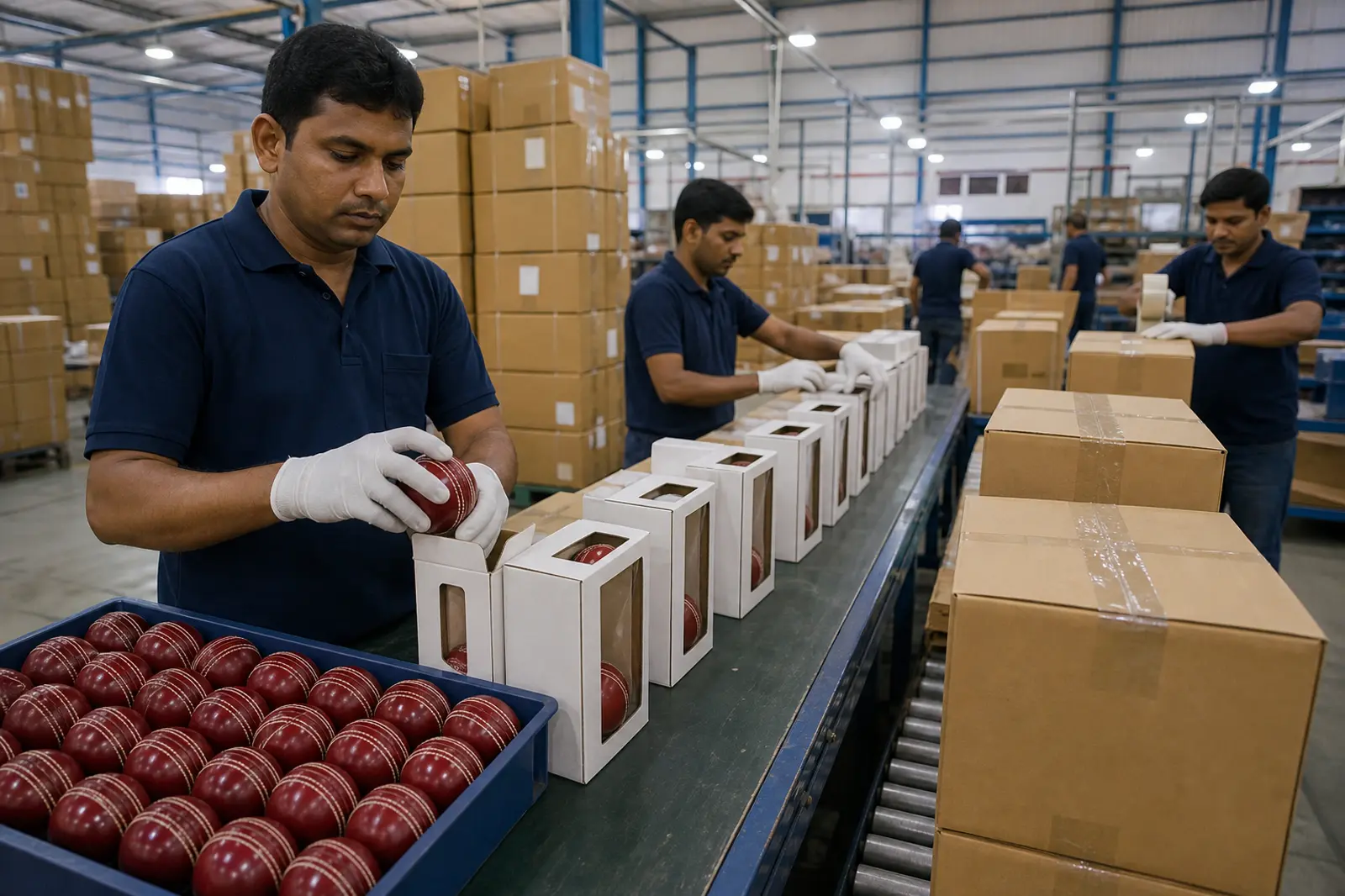
Packaging format should be matched to SKU tier and buyer channel from the first quotation — retail buyers need shelf-ready individual boxes, while club and wholesale buyers typically accept plain or minimally branded master cartons at higher density.
Packaging standards by cricket ball SKU tier
Swipe →
Data table — swipe horizontally on small screens
| SKU Tier | Individual Packaging | Master Carton Density | Special Requirements |
|---|---|---|---|
| Grade A match balls | Branded individual box, 1 pc | 6–12 pcs per carton | Desiccant sachets, MCC Law 5 label on box |
| Grade B training / club match | Plain or branded box, 1 pc | 12–24 pcs per carton | Desiccant sachets for sea transit |
| Grade C training | Poly bag or plain box | 24–36 pcs per carton | Moisture protection for leather |
| Synthetic / practice | Poly bag | 36–72 pcs per carton | Standard corrugated cartons |
| Tennis cricket balls | Poly bag or mesh bag | 48–100 pcs per carton | Higher density, lower per-unit packaging cost |
| Junior balls | Poly bag or small box | 24–48 pcs per carton | Age-appropriate labelling where required |
Container Loading Details
Export Tip
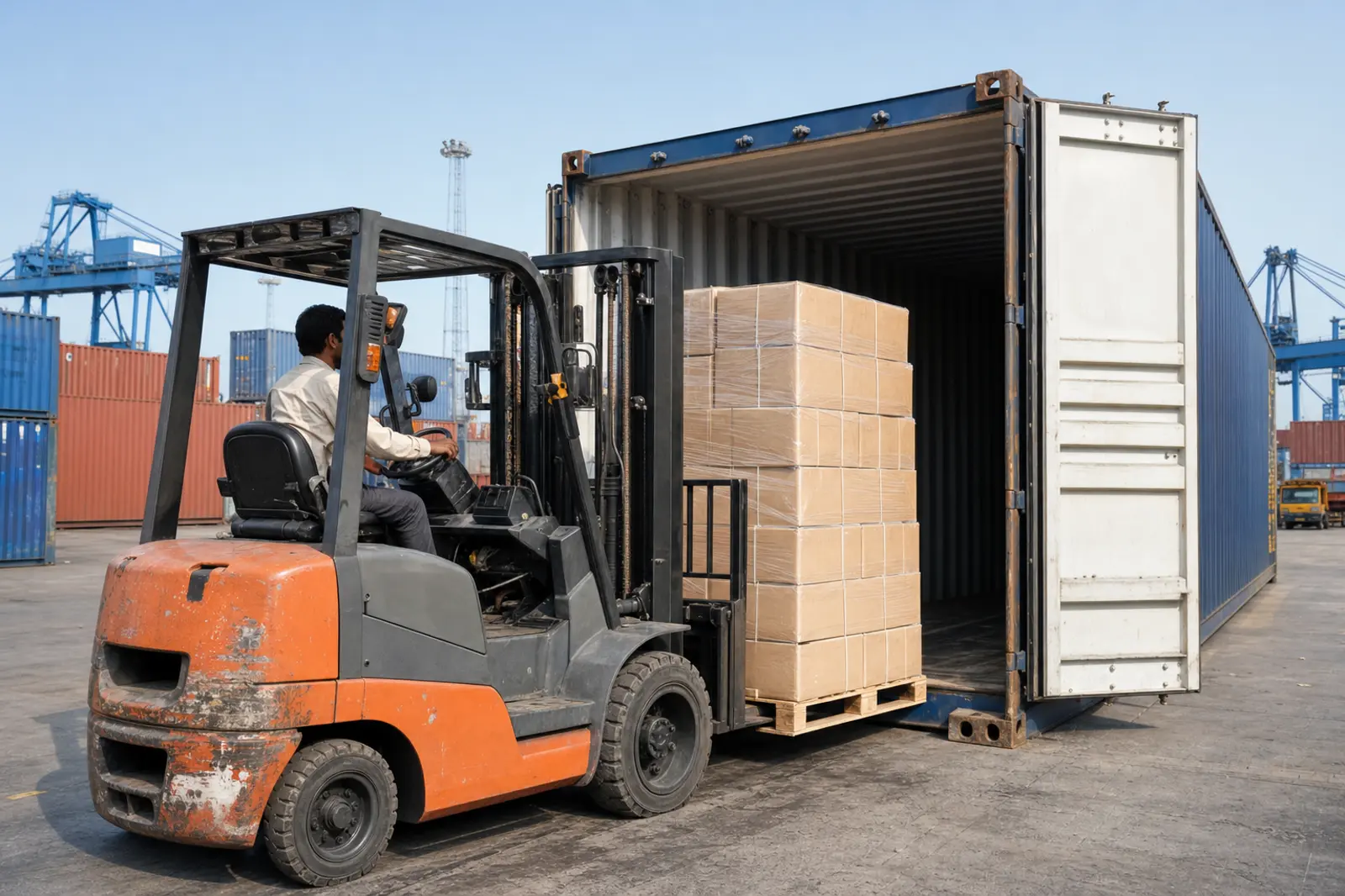
Container loading for cricket balls depends on SKU mix, master-carton density, and pallet configuration — not a fixed piece count per container. Individually boxed Grade A match balls load at lower volume density than poly-bagged synthetic practice lines. Exporters planning mixed-SKU containers should model measured carton CBM and gross weight per SKU with their forwarder before quoting freight-inclusive pricing.
Directional container loading guidance by SKU mix (volume-constrained — confirm CBM with forwarder)
Swipe →
Data table — swipe horizontally on small screens
| Container Type | SKU Mix | Loading Consideration | Loading Note |
|---|---|---|---|
| 20-foot FCL | Grade A match balls (boxed) | Lower carton density; palletised leather cartons recommended | Moisture protection essential; weight-dense cargo |
| 20-foot FCL | Synthetic practice (poly-bagged) | Higher carton density than boxed leather | Standard corrugated stacking; confirm crush limits |
| 40-foot HC | Mixed leather training + match | Segregate grades in separate carton zones | Better per-unit freight economics for established programmes |
| 40-foot HC | Tennis cricket balls | Highest density; minimal individual packaging | Confirm carton dimensions before FCL commitment |
Shipping Methods
Export Tip
Ocean freight under FCL or LCL is the standard shipping method for all cricket ball SKU categories. Lead times run 7–14 days for samples, 2–4 weeks for standard stock orders, and 4–8 weeks for custom private-label programmes requiring leather selection, branding approval, and MCC Law 5 lot-release testing before production. Air freight is reserved for urgent sample shipments and trade-show kits.
Primary export gateways are Nhava Sheva and Mundra, with Delhi ICD and ICD Ludhiana serving Meerut and Jalandhar cargo consolidation. Incoterms commonly used are EXW, FOB, and CFR/CIF. For the full shipping and Incoterms process, see How to Export Cricket Balls from India.
Certifications
Compliance Notes
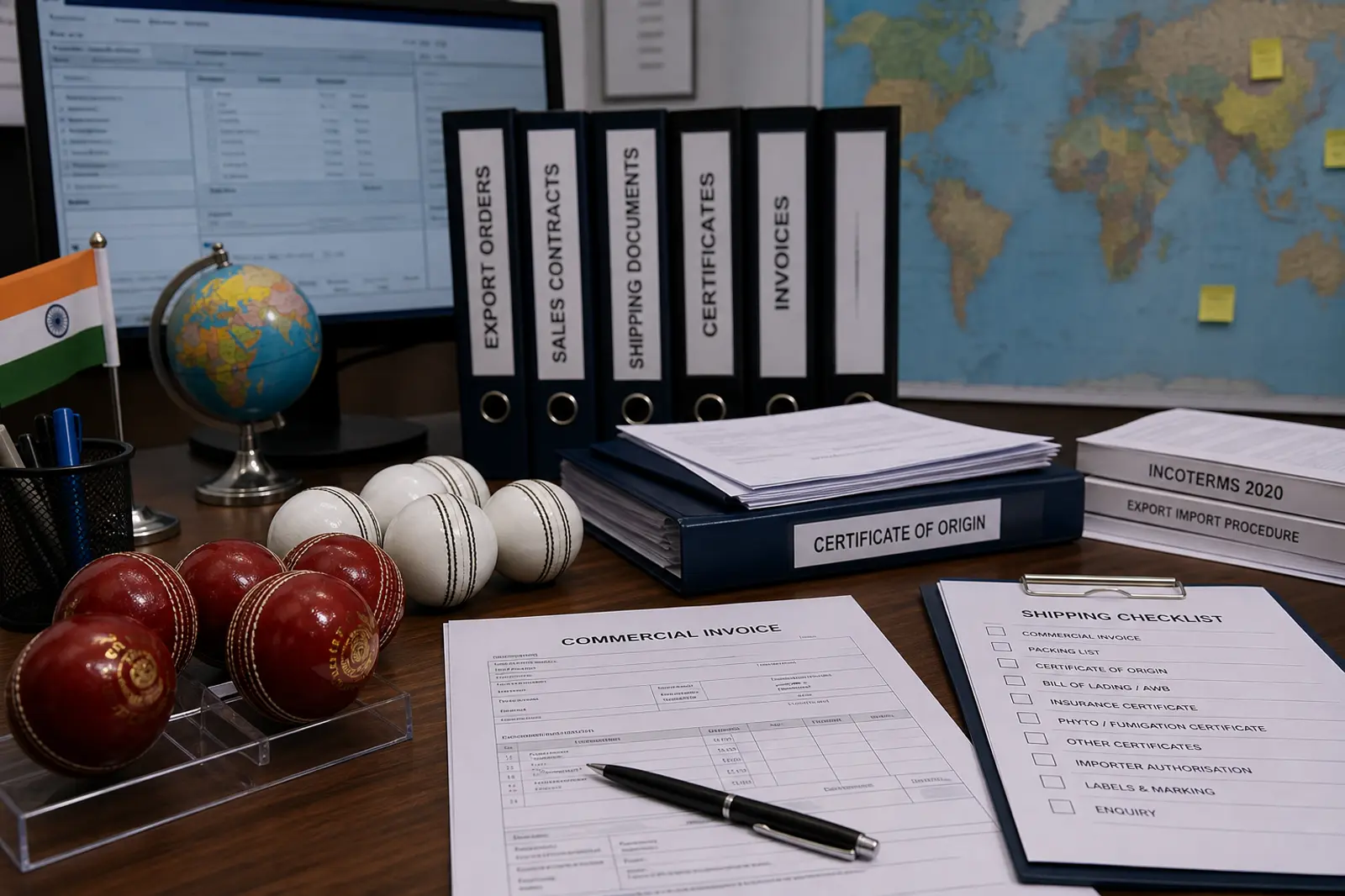
Certification requirements scale with SKU tier. Synthetic and practice balls typically require only IEC, SGEPC RCMC, and a buyer-agreed specification sheet. Match-grade leather balls require MCC Law 5 compliance documentation, and EU-bound leather balls may require REACH compliance for tanning chemicals and coatings.
Certification requirements by cricket ball SKU tier
Swipe →
Data table — swipe horizontally on small screens
| SKU Tier | Required Certifications | Optional / Buyer-Requested |
|---|---|---|
| Synthetic / practice | IEC, SGEPC RCMC | Buyer QC protocol, REACH (EU) |
| Grade C training | IEC, SGEPC RCMC | Weight/circumference test report |
| Grade B club match | IEC, SGEPC RCMC, weight/circumference test | MCC Law 5 partial compliance note |
| Grade A match balls | IEC, SGEPC RCMC, MCC Law 5 lot-release | Accredited test lab certificate, REACH (EU) |
| Premium private-label | All Grade A requirements + branding approval | Independent third-party lot verification |
Buyer Requirements
Buyer Requirements
Buyers evaluating Indian cricket ball suppliers by SKU should request separate specification sheets for each ball type under consideration, rather than a single generic product sheet. At minimum, each spec sheet should cover: leather grade (A, B, or C), core type, colour, weight and circumference class, seam profile description, directional FOB price by MOQ tier, packaging format, and lead time. Match-grade buyers should additionally request MCC Law 5 test documentation and a sample lot for independent evaluation before bulk commitment.
Retail and private-label buyers should confirm branding placement, box design approval process, and barcode/label compliance for their destination market before production begins. Distributors ordering mixed-SKU containers should confirm carton segregation requirements and whether the exporter can consolidate multiple grades under a single bill of lading.
Country-wise Opportunities
Market Snapshot
SKU demand varies by destination market: cricket-playing nations with established club structures (UK, Australia, South Africa) prioritise Grade A and B leather match and training balls, while emerging cricket markets (USA, Nepal, continental Europe) often start with synthetic and training lines before upgrading to match-grade leather. For a full country-by-country market analysis, see Best Countries for Indian Cricket Ball Exports.
Directional SKU demand by destination market
Swipe →
Data table — swipe horizontally on small screens
| Market | Top SKUs | Grade Focus | Volume Pattern |
|---|---|---|---|
| United Kingdom | Red match, white match, training | Grade A/B leather | Seasonal peaks before county season |
| Australia | Red match, training, synthetic nets balls | Grade A/B leather | Year-round club demand |
| UAE / Gulf | Training, synthetic, tennis cricket | Grade B/C + synthetic mix | Wholesale consolidation hub |
| South Africa | Red match, training | Grade B leather | Club and school programme supply |
| USA | Synthetic, tennis cricket, junior | Synthetic dominant | Growing league-driven demand |
| Bangladesh / Sri Lanka | Red match, training, tennis cricket | Grade B/C leather + synthetic | Volume wholesale programmes |
| Nepal | Training, synthetic, junior | Grade C + synthetic | School programme driven |
Sourcing Checklist
Checklist
Buyer Checklist
Exporter Checklist
Common Buyer Mistakes
Common Mistakes Box
Future Market Trends
Key Statistics
SKU mix in Indian cricket ball exports is likely to shift toward a broader synthetic and tennis cricket ball share as cricket participation expands in non-traditional markets where informal and school formats dominate initial adoption. Premium Grade A match ball demand in established cricket nations is likely to remain steady, with private-label programmes gaining share as cricket retailers seek differentiated branding rather than generic stock.
Buyers are increasingly requesting leather grade transparency and MCC Law 5 documentation as standard RFQ requirements rather than optional add-ons, which favours exporters who maintain written specification sheets and lot-release records per SKU. Sustainability scrutiny around leather tanning processes is emerging among European buyers, creating early demand for exporters who can document alum-tanned leather sourcing credibly.
Challenges & Solutions
- Challenge: buyers comparing incompatible SKU quotes across suppliers — Solution: provide line-item FOB pricing with leather grade, core type, and packaging format explicit for each SKU.
- Challenge: leather grade inconsistency within a bulk lot — Solution: approve a pre-production sample lot and hold bulk production to that signed specification.
- Challenge: mixed-SKU container consolidation creating customs classification complexity — Solution: confirm HS heading 95066920 applies to all SKUs in the container and document each SKU separately on the packing list.
- Challenge: MCC Law 5 claims on training-grade SKUs that don't meet match standards — Solution: label SKUs accurately by grade and provide test documentation only for SKUs that have passed lot-release testing.
- Challenge: packaging mismatch between sample and bulk delivery — Solution: include packaging specification in the signed order confirmation, not just the verbal sample approval.
- Challenge: lead time underestimation for custom private-label match balls — Solution: quote 4–8 weeks for custom programmes and build leather selection and branding approval milestones into the production timeline.
Managing a multi-SKU cricket ball export programme involves specific product-level challenges that differ from single-SKU commodity exports.
Compliance Checklist
Checklist
Compliance Notes
Conclusion
- Next step for buyers: send an RFQ specifying ball type, leather grade, colour, weight class, packaging format, MOQ tier, and Incoterms — Altus Exports will return line-item FOB pricing per SKU.
- Next step for exporters: audit your supplier network's capability across leather grades and ball types, then build a written SKU catalogue before your next buyer outreach cycle.
- Need help sourcing cricket balls alongside other sports goods? Our product sourcing company India services consolidate multi-category programmes under one relationship.
- For export logistics beyond product selection, see export products from India and global sourcing partner services.
Understanding the cricket ball product catalogue exported from India — red and white match balls, alum-tanned training grades, synthetic practice lines, tennis cricket balls, wind balls, and junior formats — is the foundation for every successful sourcing relationship in this category. Buyers who specify leather grade, core type, colour, and weight class from the first RFQ get comparable quotes, faster sample approval, and fewer surprises on bulk delivery. Exporters who present their range with line-item clarity per SKU differentiate themselves credibly against competitors quoting on price alone.
Use this guide to build your SKU shortlist, then take your specification to a verified Meerut or Jalandhar supplier network — or work with Altus Exports as a merchant exporter in India to match your exact product mix across leather grades and ball types under one accountable sourcing relationship. Reach out via our contact page with your target SKUs, volumes, and MCC Law 5 requirements.
This guide is the product pillar for our cricket ball content cluster. For the end-to-end export process, see How to Export Cricket Balls from India. For market selection, see Best Countries for Indian Cricket Ball Exports. For direct sourcing, see Source Cricket Balls Directly from India. For MCC Law 5 depth, see MCC Law 5 Match-Grade Cricket Ball Export Opportunities.