
Most Demanded Indian Coffee Varieties by Country (2026)
By Saurabh Mittal, Founder, Altus Exports
A demand intelligence guide mapping exactly which Indian coffee grades, species, and processes each major destination country orders — Robusta Parchment AB for Italian espresso blends, organic Arabica for German specialty retail, Monsoon Malabar for EU loyalists, and more.
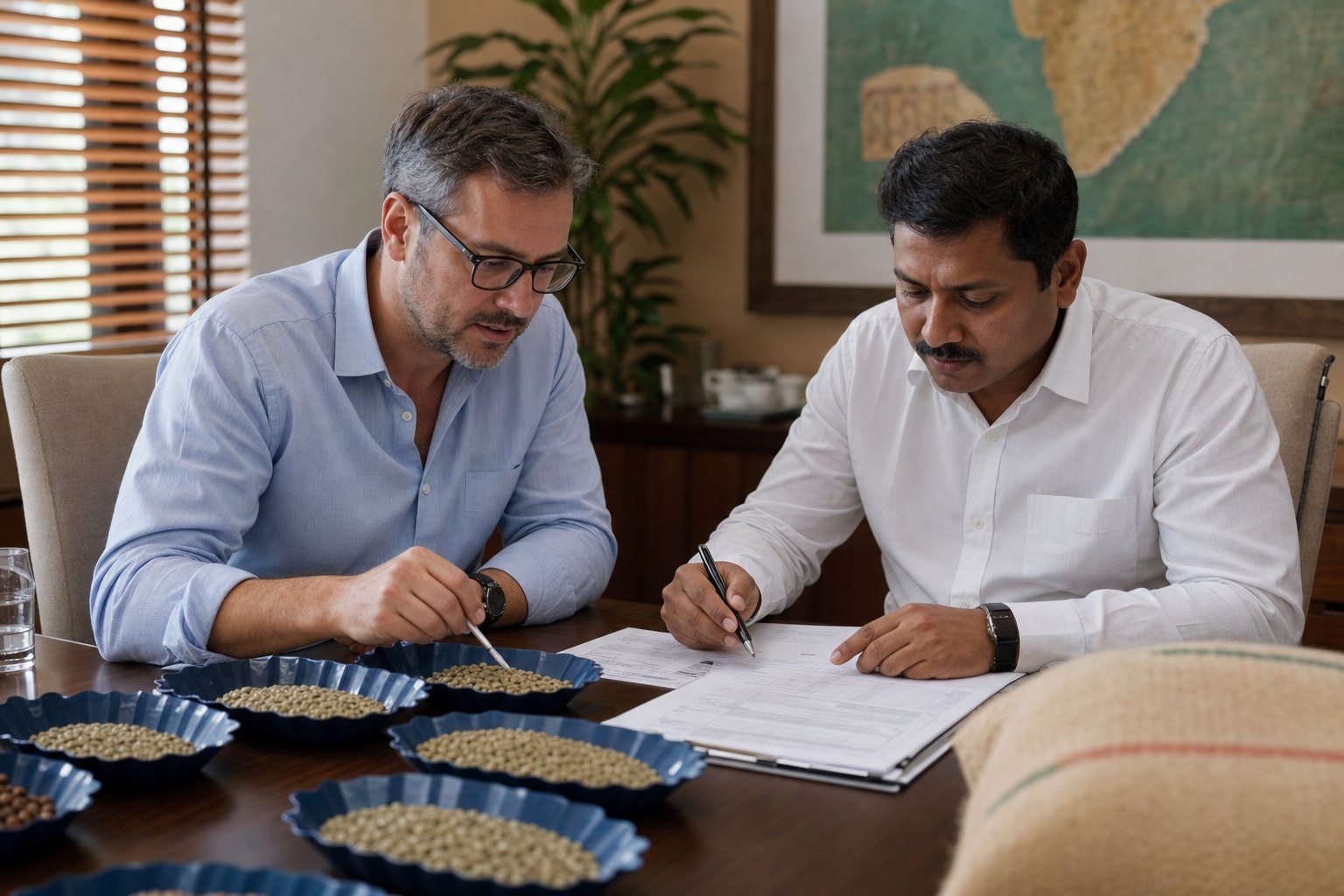
Not all international coffee buyers order the same beans. A Milan roaster sourcing Robusta Cherry AB for espresso blending has entirely different specifications from a Hamburg specialty importer seeking organic-certified Arabica Plantation A with documented traceability, or a Moscow trading house buying commodity Robusta for instant coffee manufacture at the tightest possible landed cost. India's competitive advantage — deep Robusta volume, distinctive Monsooned Malabar, GI-tagged Arabica origins, and a growing organic and specialty segment — is most commercially valuable when exporters know exactly which coffee type, grade, and process each destination actually purchases.
This is a demand intelligence guide, not a market-selection framework. It maps the most demanded Indian coffee by country in 2026 — translating species, process, grade, and certification preferences into practical product and go-to-market guidance for exporters deciding what to produce, and for buyers benchmarking their own requirements against real market patterns. India exports roughly 300,000–400,000 tonnes of coffee annually under HS 0901 (green and roasted) and HS 2101 (instant and soluble), with Robusta accounting for close to two-thirds of production and Arabica — including the distinctive Monsooned Malabar process — supplying premium channels disproportionate to its volume share.
For choosing which countries to enter first as a strategic decision, see Best Countries for Indian Coffee Exports. Use this guide alongside Top Coffee Products Exported from India and How to Export Coffee from India. Validate demand signals continually with Coffee Board export statistics, DGCIS trade data, and ITC Trade Map HS 0901/2101 analysis.
Key Takeaways
Summary Box
Executive Summary
Summary Box
Global coffee import demand splits into three commercial streams: commodity green coffee for large-scale roasting, blending, and instant coffee manufacture; specialty and single-origin green coffee for premium retail and third-wave café culture; and finished retail products — roasted whole bean, ground, and instant coffee — for direct-to-consumer and food-service channels. Indian exporters can supply all three, but the species, process, certification, and documentation investment required differs materially by stream and by country.
The practical implication for an exporter or buyer reading this guide is straightforward: a grade produced correctly for one market can be entirely wrong for another, even within the same species. Robusta destined for Italian espresso blending and Robusta destined for Russian instant-coffee manufacture look similar on paper but are evaluated against different cupping thresholds, different price ceilings, and different documentation expectations. This guide exists to make those differences explicit, country by country, so that production and outreach decisions are grounded in real demand patterns rather than assumptions.

Market Size & Industry Overview
Key Statistics
India's coffee-growing ecosystem spans shade-grown estates across Karnataka's Western Ghats (Kodagu/Coorg and Chikmagalur), Kerala's Wayanad district, Tamil Nadu's Nilgiris, and the tribal-cooperative Araku Valley in Andhra Pradesh. This range produces genuine species and micro-climate diversity: Robusta at lower altitudes for volume and blend strength, Arabica above roughly 1,000 metres for a milder, more aromatic cup, and Monsoon Malabar — a process unique to the Malabar coast that exposes cured green coffee to humid monsoon winds for several weeks, producing a low-acid, full-bodied cup with a dedicated following mainly in Europe.
Competing origins shape buyer expectations in every market. Vietnamese and Brazilian Robusta and Conillon set the commodity price benchmark that Indian Robusta is compared against in Italy and Belgium; Colombian, Ethiopian, and Central American washed Arabica set the specialty cupping benchmark that Indian Arabica and Monsooned Malabar compete against in Germany, the USA, and Japan. Indian exporters win not by undercutting these benchmarks on price alone, but by matching grade specification with documentation reliability and consistent, repeatable cup quality across shipments.
India Coffee Export Snapshot (Indicative)
Swipe →
Data table — swipe horizontally on small screens
| Metric | Approximate Figure | Relevance |
|---|---|---|
| Annual production | ~360,000–370,000 MT (2024–25; Coffee Board ~363,500 MT) | Sets the ceiling on total exportable volume across all grades |
| Annual commercial exports | ~389,000 MT (FY 2024–25 permits); recent range ~300,000–400,000 MT | Confirms India's scale as the 5th-largest coffee exporter |
| Export value (FY 2024–25) | About US$1.8 billion (Coffee Board) | Value rose sharply with global prices; reconfirm annually |
| Robusta share of production | ~65–70% | Anchors volume demand in Italy, Belgium, and Russia |
| Arabica share of production | ~30–35% | Anchors specialty and premium demand in Germany, USA, and Japan |
| HS headings | 0901 (green/roasted); 2101 (instant/soluble) | Confirm sub-heading before comparing FOB quotes across grades |
The Three Demand Streams
Commodity buyers in Italy, Belgium, and Russia prioritise cup consistency, moisture control, and FOB price stability across large volumes. Specialty buyers in Germany, the USA, Japan, and South Korea pay premiums for cupping-score transparency, estate traceability, and organic or Rainforest Alliance certification. Belgium operates significantly as a European Robusta trading and re-export hub centred on Antwerp, which changes how import statistics from that market should be read — high Belgian import volume does not always mean high Belgian consumption.
Export Statistics
Key Statistics
India exports roughly 300,000–400,000 MT of coffee annually across recent crop years (Coffee Board permit data put FY 2024–25 near ~389,000 tonnes), with export value about US$1.8 billion in FY 2024–25. Green coffee — predominantly Robusta — makes up the largest share of export volume, reflecting sustained demand from Italy, Belgium, Russia, and Germany for blending, roasting, and instant coffee manufacture. Instant and soluble coffee, classified separately under HS 2101, contributes a large share of export value (Coffee Board / PIB reporting places value-added / instant near ~38–41% of export value in recent assessments) even though its tonnage share is smaller than green coffee.
Karnataka — principally Kodagu (Coorg) and Chikmagalur — accounts for the large majority of national production and export volume; Kerala's Wayanad district, Tamil Nadu's Nilgiris, and the Araku Valley in Andhra Pradesh contribute the balance under distinct growing conditions and origin identities. Grade-level export statistics are less granular in public Coffee Board and DGCIS data than country-level statistics, but auction catalogue analysis by grade tier and buyer import patterns under HS 0901/2101 confirm the demand profiles detailed later in this guide.
Export Indicators and Grade-Demand Implications
Swipe →
Data table — swipe horizontally on small screens
| Export Indicator | Approximate Scale | Grade / Demand Implication |
|---|---|---|
| Total annual export volume | ~300,000–400,000 MT (recent crop years) | Green Robusta dominates volume; Arabica and Monsooned Malabar drive value share |
| Robusta share of production | ~65–70% | Volume markets (Italy, Belgium, Russia) built around Robusta supply |
| Arabica share of production | ~30–35% | Specialty and premium-channel demand concentrated here |
| Indicative export value | about US$1.8 billion (FY 2024–25, Coffee Board) | Confirms sustained export demand across grades |
| Primary export ports | New Mangalore, Cochin, Chennai | Origin-region templates should centre on nearest load port |
Import Statistics
Key Statistics
Import-side data under HS 0901/2101 — available through trade platforms such as ITC Trade Map, national customs portals, and commercial trade intelligence services — tells an exporter which grade and certification bundle to have ready before the first email to a new buyer. Italy consistently functions as India's largest single-country buyer of green coffee by value, much of it destined for large-scale roasting and blending rather than direct retail. Belgium, by contrast, operates significantly as a European Robusta trading and re-export hub centred on Antwerp, so high Belgian import figures do not translate one-to-one into Belgian domestic consumption.
Germany and the USA show rising import volumes of organic-certified and specialty-grade Arabica, with import data increasingly segmented by certification status rather than origin alone. Russia's import patterns split between direct-consumption Robusta and instant-coffee manufacturing inputs, with technical regulation and Russian-language labelling requirements shaping which shipments clear fastest. UAE import data reflects its dual role as a direct-consumption and regional re-export market — shipments frequently move onward to other Gulf and East African markets after Dubai-based blending or repackaging.
Import Demand Profile by Market
Swipe →
Data table — swipe horizontally on small screens
| Import Market | Demand Profile | Typical Indian Coffee Types | Key Requirement |
|---|---|---|---|
| Italy | Largest value destination; roasting/blending | Robusta Parchment/Cherry AB, Arabica plantation, Monsooned Malabar | Cupping sheet/COA, consistent grade |
| Germany | Specialty, organic, and blending consumption | Arabica plantation, organic-certified, specialty micro-lots | Organic transaction certificate, EU MRL residue documentation |
| Belgium | Trading/re-export hub (Antwerp) | Robusta Parchment/Cherry AB | Standard commercial docs; volume consistency valued over certification |
| Russia / CIS | Direct consumption + instant coffee manufacture | Robusta, instant coffee (HS 2101) | Technical regulation alignment; Russian-language labelling |
| USA | Specialty retail + growing organic segment | Arabica specialty, Monsooned Malabar, organic-certified | FDA-aligned food safety docs, USDA Organic where claimed |
| UAE / Gulf | Direct consumption + regional re-export | Robusta and Arabica blends | Halal-friendly processing preference |
Product Categories / Variants
Summary Box
Purchase orders from international coffee buyers reference species, process, and grade nomenclature, not generic product descriptions. Exporters must translate curing-works output into the grade language buyers actually use in their own specification sheets — and demand for each grade concentrates in different countries.
Grade-to-Market Demand Map
Swipe →
Data table — swipe horizontally on small screens
| Coffee Type / Grade | Process / Character | Primary Demand Countries |
|---|---|---|
| Robusta Parchment AB | Washed, larger screen | Italy, Belgium, Russia (blending) |
| Robusta Cherry AB | Natural/unwashed | Italy, Belgium, Russia (volume blending) |
| Arabica Plantation A/B | Washed | Italy, Germany, USA (specialty and blending) |
| Monsooned Malabar AA | Monsoon-cured, low acid | Italy, Germany, wider EU specialty |
| Specialty single-origin (80+ cupping) | Washed or natural, traceable | USA, Japan, South Korea, Germany |
| Instant / soluble coffee | Spray-dried or freeze-dried | Russia, USA, South Korea, CIS markets |
Robusta Grades
Robusta is graded principally by process and screen size. Parchment AB (washed, larger screen) and Cherry AB (natural/unwashed, larger screen) are the two grades demanded in the highest volume by Italy, Belgium, and Russia for blending and instant coffee manufacture.
Where Parchment AB and Cherry AB Are Demanded
Italian and Belgian roasters generally prefer Parchment AB for cup consistency in espresso blends; Russian and CIS instant-coffee manufacturers accept Cherry AB more readily where strength and price matter more than cup cleanliness.
Arabica Grades
Arabica follows a parallel structure — Plantation A, B, and C for washed processing, Cherry AB and PB for natural processing — with grade determined by screen size, density, and defect count. Germany, the USA, and specialty buyers within Italy demand Plantation A/B most heavily, paying premiums for cupping-score transparency.
Monsooned Malabar
Monsoon Malabar is a distinctly Indian process producing a low-acid, full-bodied, distinctive cup. Its strongest and most consistent demand remains in Italy and wider EU specialty channels, with smaller but growing demand in the USA and Japan among specialty roasters seeking traceable, distinctive single-origin offerings.
Instant, Roasted, and Organic-Certified Formats
Instant/soluble coffee (HS 2101) is demanded heavily by Russia, the USA, and South Korea as a manufacturing input. Roasted coffee adds destination-market labelling and roast-date freshness requirements. Organic-certified lots, whether Robusta or Arabica, require NPOP certification with an EU or USDA NOP recognition pathway and command a meaningful premium specifically in Germany, the USA, and Japan.
Manufacturing Overview
Export Tip
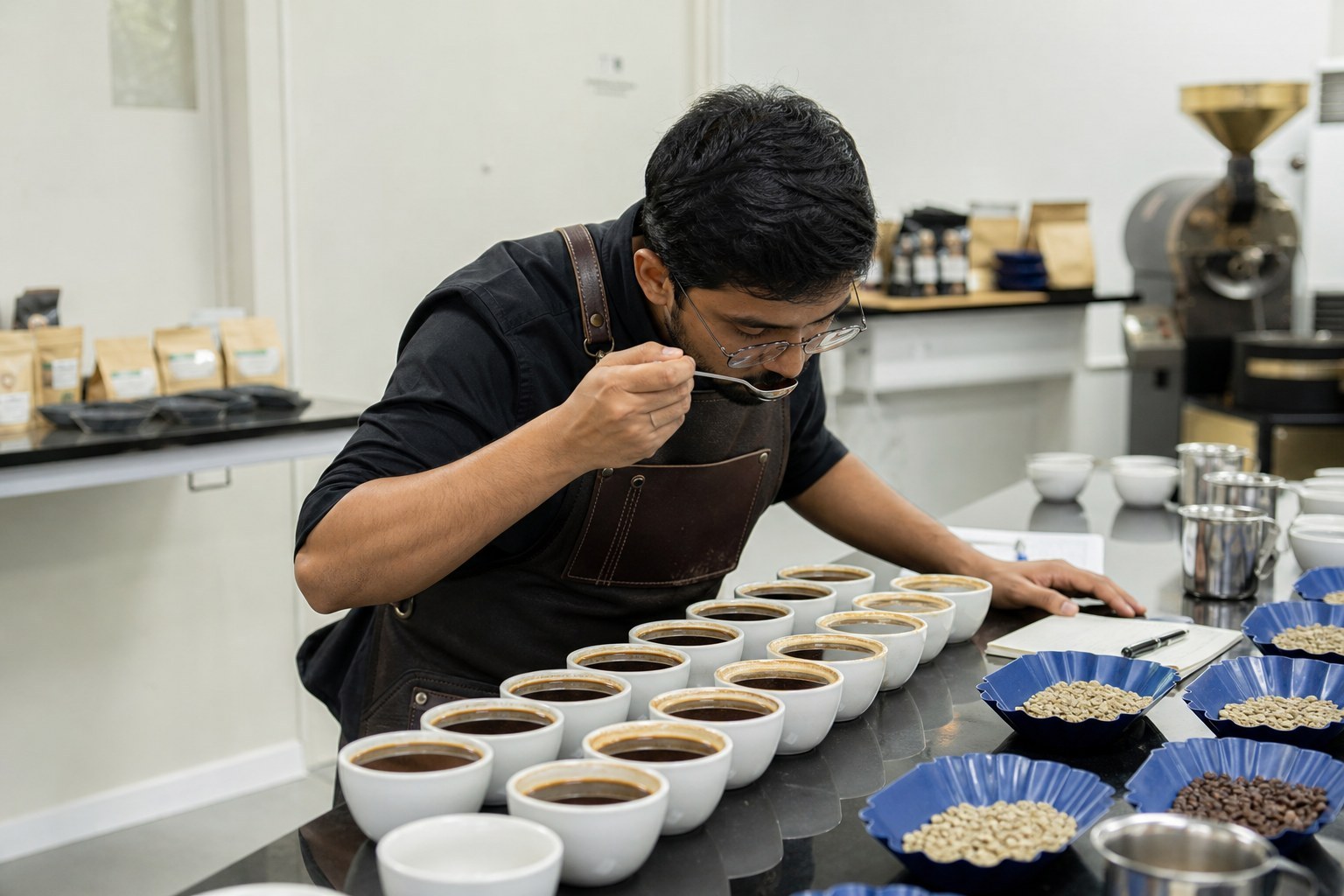
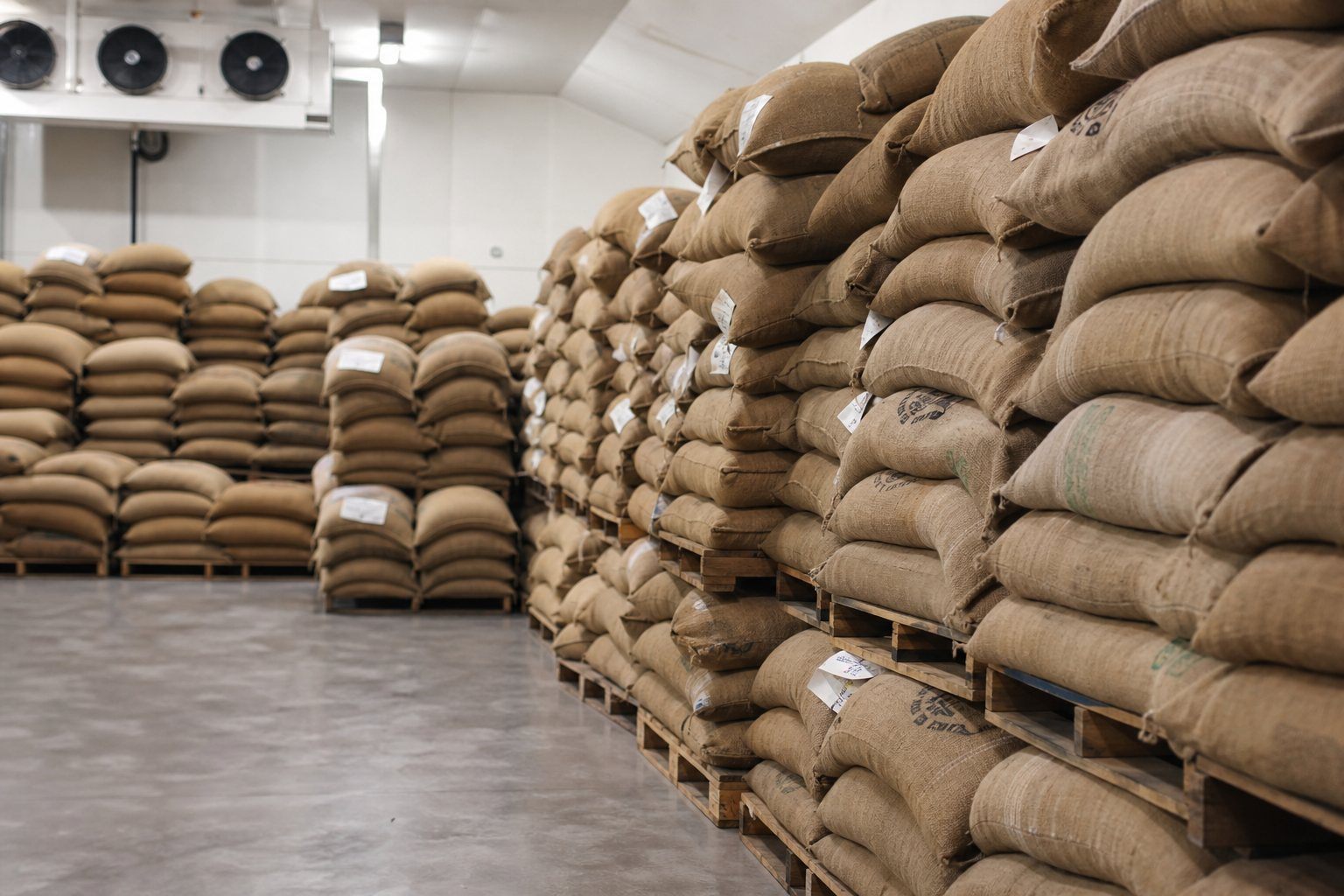
Translating demand profiles into export execution requires a grade-first manufacturing workflow: identify destination grade and process demand, procure or cure to that specification, validate with professional cupping evaluation, then pack and document accordingly. Procurement runs through estate relationships, licensed curing works in Kodagu, Chikmagalur, or Wayanad, or the Coffee Board's e-auction and private-treaty channels. Blending multiple curing-works lots to achieve a consistent commodity cup is standard for Robusta export programmes destined for Italy, Belgium, and Russia; Monsooned Malabar and single-estate Arabica lots destined for Germany, the USA, and Japan require batch traceability from cherry intake through to bagging.
Operational separation matters when serving more than one demand tier from the same facility. A curing works supplying both a commodity Italian Robusta programme and a certified-organic German Arabica programme should maintain distinct intake lines, storage bays, and document files for each — shared equipment or storage between a commodity line and a certified-organic line creates chain-of-custody risk that can void the organic claim entirely.
Pricing Analysis
Buyer Tip
Pricing varies more by grade, process, and certification than by country alone, though country does shape the achievable ceiling within a grade. Robusta Parchment AB and Cherry AB trade in a comparatively narrow FOB band across Italy, Belgium, Russia, and the UAE — roughly $2.20–$3.20/kg — because these markets compete on the same international Robusta futures benchmark and treat Indian supply as broadly substitutable against Vietnamese and Brazilian origin at similar quality. Arabica plantation grades command a wider band, $3.50–$5.50/kg FOB, with Italy, Germany, and the USA paying toward the upper half for consistent, well-documented lots.
Monsooned Malabar and specialty single-origin micro-lots occupy a different pricing logic entirely — buyers pay for scarcity, distinctive cup character, and traceability rather than benchmarking against a futures index. Monsooned Malabar AA FOB typically ranges $4.50–$7.50/kg; specialty single-origin lots scoring 80+ on the SCA scale can command $6.00–$15.00/kg or more. Organic certification adds a 20–40% premium over conventional equivalents in Germany, the USA, and Japan specifically.
FOB Pricing by Grade and Destination Tier
Swipe →
Data table — swipe horizontally on small screens
| Grade / Category | Italy/Belgium/Russia FOB | Germany/USA Specialty FOB | Typical MOQ |
|---|---|---|---|
| Robusta Parchment/Cherry AB | $2.20–$3.20/kg | N/A (commodity) | 5 MT trial; 1x20ft FCL standard |
| Arabica Plantation A/B | $3.50–$5.50/kg | $3.50–$5.50/kg (conventional) | 5 MT trial; 1x20ft FCL standard |
| Monsooned Malabar AA | $4.50–$7.50/kg | $4.50–$7.50/kg | 1–2 MT trial; 3–5 MT standard |
| Specialty single-origin (80+ cupping) | N/A | $6.00–$15.00+/kg | 500 kg–1 MT trial |
| Organic-certified (Robusta or Arabica) | 20–40% premium | 20–40% premium | Certifier-dependent minimum |
MOQ Analysis
Buyer Tip
MOQ expectations track demand tier as closely as pricing does. Commodity buyers in Italy, Belgium, and Russia are comfortable moving quickly from a 5 MT trial to a full 20-foot container once cupping is approved, because their specification is relatively stable across batches. Specialty and organic buyers in Germany, the USA, and Japan deliberately keep trial quantities smaller — 500 kg to 2 MT — because they are validating certification chains and cupping consistency that a larger commitment would expose them to more risk on before proof exists.
MOQ by Demand Tier and Destination
Swipe →
Data table — swipe horizontally on small screens
| Demand Tier | Typical Destinations | Trial Order | Standard Programme |
|---|---|---|---|
| Commodity Robusta blending | Italy, Belgium, Russia | ~5 MT | 1 x 20ft FCL (~17–19 MT) |
| Commodity Arabica blending | Italy, Germany | ~5 MT | 1 x 20ft FCL (~17–19 MT) |
| Monsoon Malabar / premium Arabica | Italy, Germany, EU specialty | 1–2 MT | 3–5 MT |
| Specialty single-origin | USA, Japan, South Korea | 500 kg–1 MT | Estate-dependent, often under 5 MT |
| Instant/soluble manufacturing input | Russia, USA, South Korea | Finished-product batch dependent | Contract-volume dependent |
Packaging Standards
Export Tip
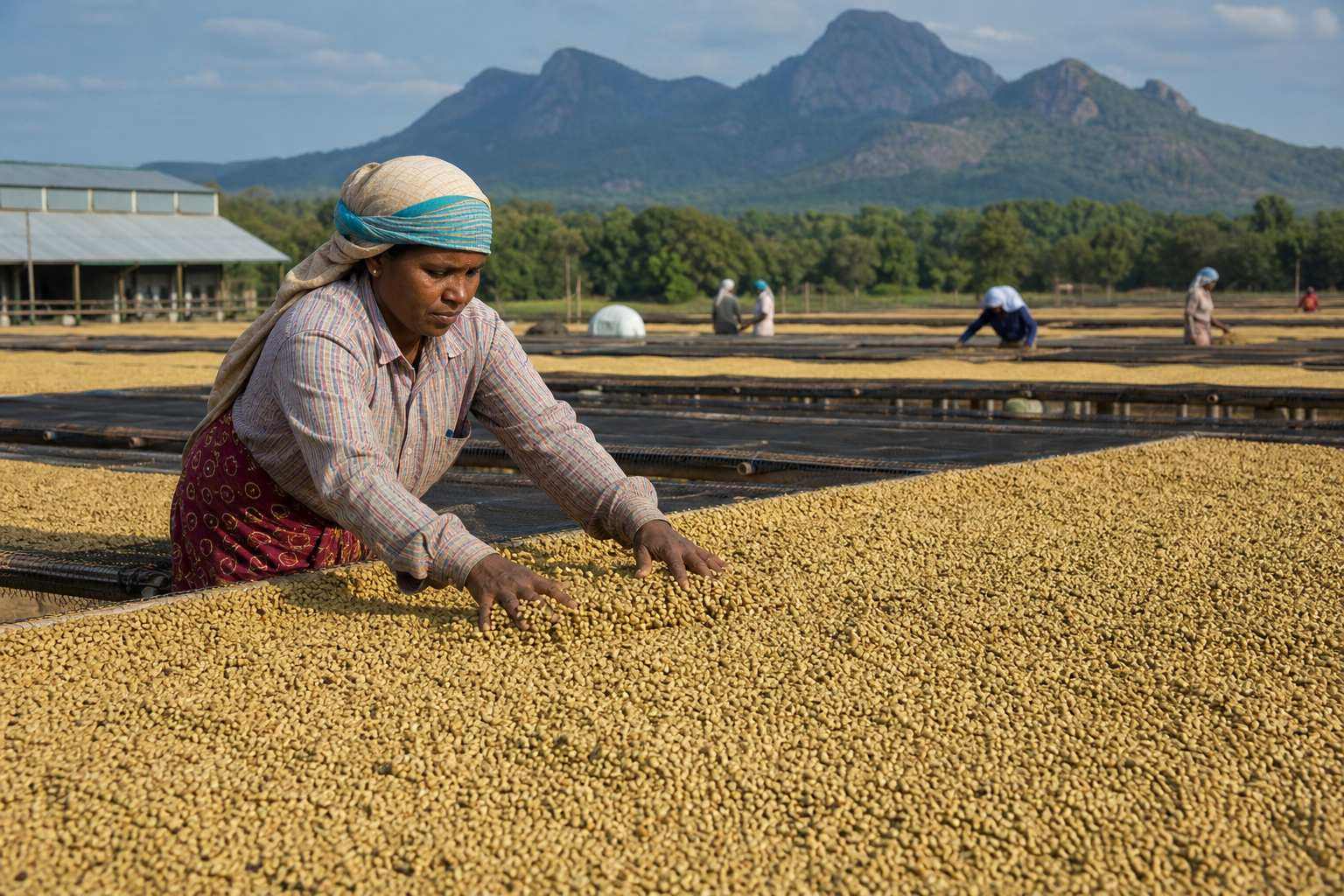
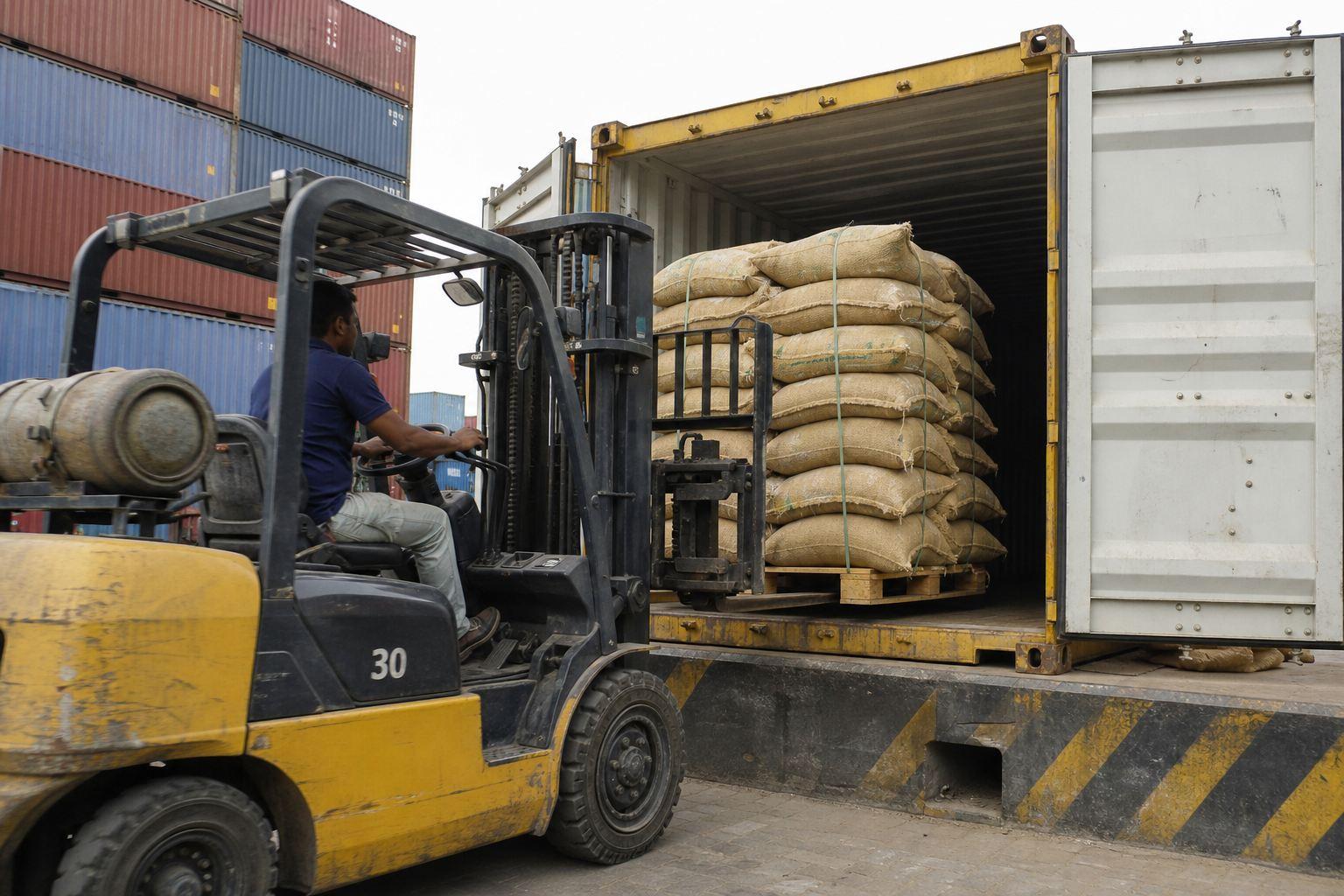
Packaging format should follow demand tier, not a single default. Bulk commodity Robusta and Arabica destined for Italy, Belgium, and Russia typically ship in 50–60 kg jute bags with GrainPro or vacuum-sealed polythene liners. Large-volume Robusta programmes sometimes use bulk super sacks (FIBC bags of roughly 1,000 kg) to reduce handling cost. Monsooned Malabar and specialty lots destined for Germany, the USA, Japan, and South Korea often use vacuum-sealed multi-ply bags in smaller units, while retail-ready programmes require valve-sealed foil pouches or tins matching the buyer's branding and destination labelling requirements.
Packaging Format by Destination Demand Tier
Swipe →
Data table — swipe horizontally on small screens
| Pack Format | Typical Use | Destination Fit |
|---|---|---|
| 50–60 kg jute bag with GrainPro liner | Bulk commodity Robusta/Arabica | Italy, Belgium, Russia |
| FIBC bulk super sack (~1,000 kg) | Large Robusta blending programmes | Belgium, Russia, UAE re-export |
| Vacuum-sealed multi-ply bag | Monsoon Malabar and specialty trials | Germany, USA, Japan, South Korea |
| Valve-sealed foil pouch / tin | Retail-ready roasted or specialty green | Germany, USA, Japan retail channels |
Container Loading Details
Export Tip
A standard 20ft FCL of bagged green coffee typically carries roughly 17–19 MT depending on bag weight, stacking plan, and bean density. Commodity programmes to Italy, Belgium, and Russia routinely move at full FCL volume once a buyer relationship is established; specialty and organic programmes to Germany, the USA, and Japan more often ship as LCL consolidations or partial-container lots given smaller trial and standard-programme volumes.
Container Planning by Demand Tier
Swipe →
Data table — swipe horizontally on small screens
| Shipment Type | Typical Destinations | Planning Consideration |
|---|---|---|
| 20ft FCL, bulk bagged green | Italy, Belgium, Russia commodity programmes | Confirm bag count and weight basis against invoice |
| LCL consolidated shipment | Germany, USA, Japan specialty/organic trials | Strong outer cartons; clear lot marks for consolidation |
| 40ft FCL, mixed retail cartons | Germany, USA retail-ready programmes | Confirm carton dimensions and pallet plan |
| Palletised specialty micro-lot | Japan, South Korea premium channels | Confirm pallet standard and dunnage condition |
Shipping Methods
Export Tip
Sea freight in 20ft or 40ft FCL containers remains the default for bulk green coffee across every destination in this guide — green coffee is stable, dry cargo that does not require cold chain when packed correctly. Key Indian load ports include New Mangalore (closest to Kodagu and Chikmagalur), Cochin (serving Wayanad-origin supply), and Chennai (serving Nilgiris-origin supply). Transit times run roughly 20–28 days to major European ports serving Italy, Germany, and Belgium, shorter windows to the UAE, and 25–40 days to the USA depending on coast.
Air freight and courier are reserved for cupping samples and urgent small specialty consignments bound for Japan or South Korea, where the cost per kilogram makes air freight impractical for anything beyond sample volume. LCL sea freight suits Germany and USA specialty trial orders below a full container.
Certifications
Compliance Notes
Certification requirements scale directly with demand tier and destination. A commodity Robusta shipment to Belgium needs a lighter documentation set than an organic Arabica shipment to Germany claiming a USDA Organic label.
Universal Baseline
Coffee Board of India exporter registration (RCMC), an FSSAI food business licence, and a lot-specific cupping sheet or certificate of analysis are baseline requirements across every destination market in this guide, regardless of grade or volume.
Germany and Wider EU
Pesticide MRL compliance under EU Regulation 396/2005 and NPOP or EU Organic certification for organic claims are required in addition to the baseline set.
United States
FDA-aligned food safety documentation and USDA NOP certification specifically for organic label claims — NPOP certification alone does not qualify for a USDA Organic claim.
UAE, Japan, and South Korea
Gulf retail channels often require halal certification. Japan and South Korea expect strict residue documentation and origin traceability records referencing estate or curing-works identity.
Buyer Requirements
Buyer Requirements
- Species (Robusta or Arabica), process (washed, natural, or Monsooned Malabar), and grade nomenclature matching your destination market's expectations
- Moisture maximum (typically 10–12%), defect count, and screen size appropriate to your demand tier
- Cupping score expectation on the SCA 100-point scale for specialty and premium tiers
- Organic certification pathway (NPOP plus USDA NOP or EU Organic) where a shelf organic claim is intended
- GI-origin documentation where a Coorg, Chikmagalur, Wayanad, or Araku Valley claim is intended
- Packaging format and MOQ appropriate to trial versus programme stage
- Destination-specific compliance — EU MRL panels, FDA-aligned documentation, or halal certification as applicable
Buyers evaluating Indian coffee by demand tier should state their requirements explicitly rather than asking for a generic quote. The specification below reflects what serious buyers across every destination in this guide actually put in writing before requesting a sample.
Country-wise Opportunities
Market Snapshot
Each destination market applies a different lens to the same underlying Indian coffee supply base. This is the core demand-intelligence section of this guide — building one grade-and-process master with market-specific certification add-ons scales faster than rebuilding the offer from scratch for every buyer.
Country Demand Profile Summary
Swipe →
Data table — swipe horizontally on small screens
| Country | Top Types/Grades Ordered | Preferred Format | Key Certifications | FOB Range (US$/kg) |
|---|---|---|---|---|
| Italy | Robusta Parchment/Cherry AB; Arabica plantation; Monsooned Malabar | 50–60 kg jute bags, GrainPro liner | Cupping sheet/COA, phytosanitary where required | $2.20–$7.50 |
| Germany | Arabica plantation, organic-certified, specialty micro-lots | Jute bags; vacuum-sealed specialty formats | NPOP/EU Organic, EU MRL panel | $3.50–$15.00+ |
| Belgium | Robusta Parchment/Cherry AB | 50–60 kg jute bags | Standard commercial docs, COA | $2.20–$3.20 |
| Russia/CIS | Robusta, instant coffee inputs (HS 2101) | Bulk sacks; manufacturing inputs | COO, technical regulation alignment | $2.20–$3.00 |
| USA | Arabica specialty, Monsooned Malabar, organic-certified | Bulk sacks (commodity); retail cartons (specialty) | USDA NOP (organic), FDA-aligned docs | $3.50–$15.00+ |
| UAE/Gulf | Robusta and Arabica blends | Bulk sacks; regional re-export | COO, halal (retail) | $2.20–$5.50 |
| Japan/South Korea | High cupping-score Arabica, Monsooned Malabar, specialty micro-lots | Vacuum-sealed specialty formats | Phytosanitary, cupping COA, traceability | $6.00–$15.00+ |
Italy
Italy is India's largest single-country buyer of green coffee by value, absorbing Robusta Parchment AB and Cherry AB alongside Arabica plantation grades and Monsooned Malabar, largely for large-scale roasting and espresso blending rather than direct retail. Italian roasters buy on consistency and long-term contract reliability more than spot-price advantage — a supplier who delivers the same cup profile shipment after shipment earns renewal even at a modest price premium over a cheaper, less consistent alternative. Documentation focus: cupping sheet or COA per lot, certificate of origin, and a phytosanitary certificate where required. MOQ: 1 x 20ft FCL for established programmes; 5 MT for trials.
Germany
Germany anchors European specialty, organic, and blending demand for Indian coffee, splitting into two camps: bulk Robusta and Arabica importers supplying EU redistribution networks, and specialty organic retailers seeking Arabica plantation grades and Monsooned Malabar with NPOP or EU Organic certification and full pesticide MRL compliance under EU Regulation 396/2005. Grade demand concentrates in Arabica Plantation A/B and specialty single-origin micro-lots (80+ cupping) for the organic and specialty channel. MOQ: 500 kg–2 MT for specialty organic trials; 5–10 MT for conventional bulk.
Belgium
Belgium operates significantly as a European Robusta trading and re-export hub centred on Antwerp — import volumes reflect both direct Belgian roasting demand and onward European redistribution. Buyers here name Robusta Parchment AB and Cherry AB most frequently, prioritising volume consistency and reliable delivery schedules over certification depth. FOB pricing tracks closely with Italian Robusta benchmarks given shared commodity trading dynamics between the two markets.
Russia
Russia imports substantial Indian Robusta for direct consumption and instant-coffee manufacture (HS 2101), alongside CIS markets including Kazakhstan and Uzbekistan. Russian buyers focus on strength, body, and price stability over specialty positioning; instant-coffee input contracts require manufacturing-process documentation alongside standard commercial paperwork. Payment and banking compliance require careful structuring given evolving international payment corridors. MOQ: 10–20 MT for direct container programmes.
United States of America
US demand for Indian coffee spans two distinct tiers: commodity Robusta and Arabica inputs for large-scale roasting, and specialty Arabica, Monsooned Malabar, and organic-certified single-origin lots for premium natural-food and private-label retail. Specialty buyers name cupping score explicitly — 80+ points on the SCA scale is a common minimum threshold — and increasingly request USDA NOP organic certification and full traceability to estate or curing works. MOQ: 5 MT commodity trial scaling to a full 20-foot FCL; 500 kg–1 MT for specialty and Monsooned Malabar trials.
United Arab Emirates
The UAE functions as both a direct-consumption market and a regional re-export hub — Indian Robusta and Arabica blends frequently move onward to other Gulf and East African markets after Dubai-based blending, roasting, or repackaging. Buyers prioritise blend consistency, competitive landed cost, and reliable delivery over cupping-score storytelling, though halal-friendly processing matters for retail-bound lines. MOQ: 10–20 MT for established regional trading-house programmes.
Japan and Beyond
Japan combines premium specialty demand with canned and instant-coffee manufacturing volume, and applies some of the strictest residue and traceability documentation standards among Indian coffee's destination markets. High cupping-score Arabica and Monsooned Malabar find a quality-conscious, repeat-buying audience once documentation and consistency are proven. South Korea's specialty café culture is smaller in absolute volume but growing quickly, rewarding single-origin storytelling and cupping-score transparency over commodity pricing. Both markets: MOQ 500 kg–5 MT depending on tier; FOB for specialty Arabica and Monsooned Malabar $6.00–$15.00+/kg.
Expert Insight #1 — Saurabh Mittal
Expert Insight Box
Sourcing Checklist
Checklist
- Identify destination grade and process demand using Coffee Board statistics, ITC Trade Map, and auction catalogue analysis before production planning.
- Match species and grade nomenclature exactly to what your target country's buyers use in their own specification sheets.
- Confirm certification pathway — NPOP plus USDA NOP or EU Organic — before promising an organic shelf claim to Germany or the USA.
- Blend Robusta lots to a consistent commodity cup for Italy, Belgium, and Russia; maintain estate-level traceability for Monsooned Malabar and specialty Arabica.
- Issue a lot-specific cupping sheet or certificate of analysis for the exact batch shipped, never a prior lot's report.
- Size trial orders to the demand tier — 5 MT for commodity, 500 kg–2 MT for specialty and organic programmes.
- Segregate commodity and certified-organic production lines physically to protect chain-of-custody claims.
Buyer Checklist
Checklist
Exporter Checklist
Checklist
Compliance Checklist
Checklist
Compliance Notes
Common Buyer Mistakes
Common Mistakes Box
Expert Insight #2 — Saurabh Mittal
Expert Insight Box
Future Market Trends
Key Statistics
Through 2030, per-country demand for Indian coffee will keep shifting toward documentation depth as much as grade preference. EU deforestation-linked sourcing rules (EUDR) will raise traceability expectations for Robusta and Arabica shipments into Italy, Germany, and Belgium alike. Japan and South Korea's specialty segments will keep rewarding cupping-score transparency and estate traceability over commodity pricing, and the USA's organic and specialty tier will continue diverging in requirements from its commodity roasting-input tier within the same country.
Exporters who track destination-specific demand shifts through Coffee Board statistics, ITC Trade Map data, and direct buyer specification sheets — rather than assuming last year's grade mix still fits this year's buyers — will capture disproportionate share as these markets continue to segment further by certification and traceability depth.
Conclusion
- Action: share your target destination and grade requirements with Altus Exports for a demand-fit sourcing review.
- Continue with Best Countries for Indian Coffee Exports for the market-selection framework behind this demand data.
- Read Top Coffee Products Exported from India and How to Export Coffee from India.
- Complete your compliance foundation: Coffee Board Registration Benefits for Exporters and the Coffee Export Documentation Checklist.
- Build your buyer or seller pipeline with How to Source Coffee Directly from India and Organic & Specialty Coffee Export Opportunities from India.
- Explore agriculture & food products, merchant exporter, and global sourcing partner service models.
The most demanded Indian coffee by country in 2026 maps to specific species, processes, and grades: Robusta Parchment AB and Cherry AB for Italy, Belgium, and Russia's volume blending and instant-coffee manufacture; Arabica Plantation A/B and organic-certified specialty lots for Germany and the USA; Monsooned Malabar for a loyal, premium-paying EU specialty following; and high cupping-score Arabica with strong traceability documentation for quality-conscious Japan and South Korea.
Whether you are an exporter deciding what to produce or a buyer benchmarking your own requirements, ground the decision in what your specific destination actually orders — not in a generic assumption about 'Indian coffee.' Share your target destination, grade, and certification requirements with Altus Exports for a demand-fit sourcing review.