
How to Source Coffee Directly from India: Buyer Playbook
By Saurabh Mittal, Founder, Altus Exports
A practical playbook for international buyers who want to source coffee directly from India — supplier verification, cupping samples, RFQ structure, MOQ and pricing negotiation, and a safe first purchase order, written for importers, roasters, and retail buyers.
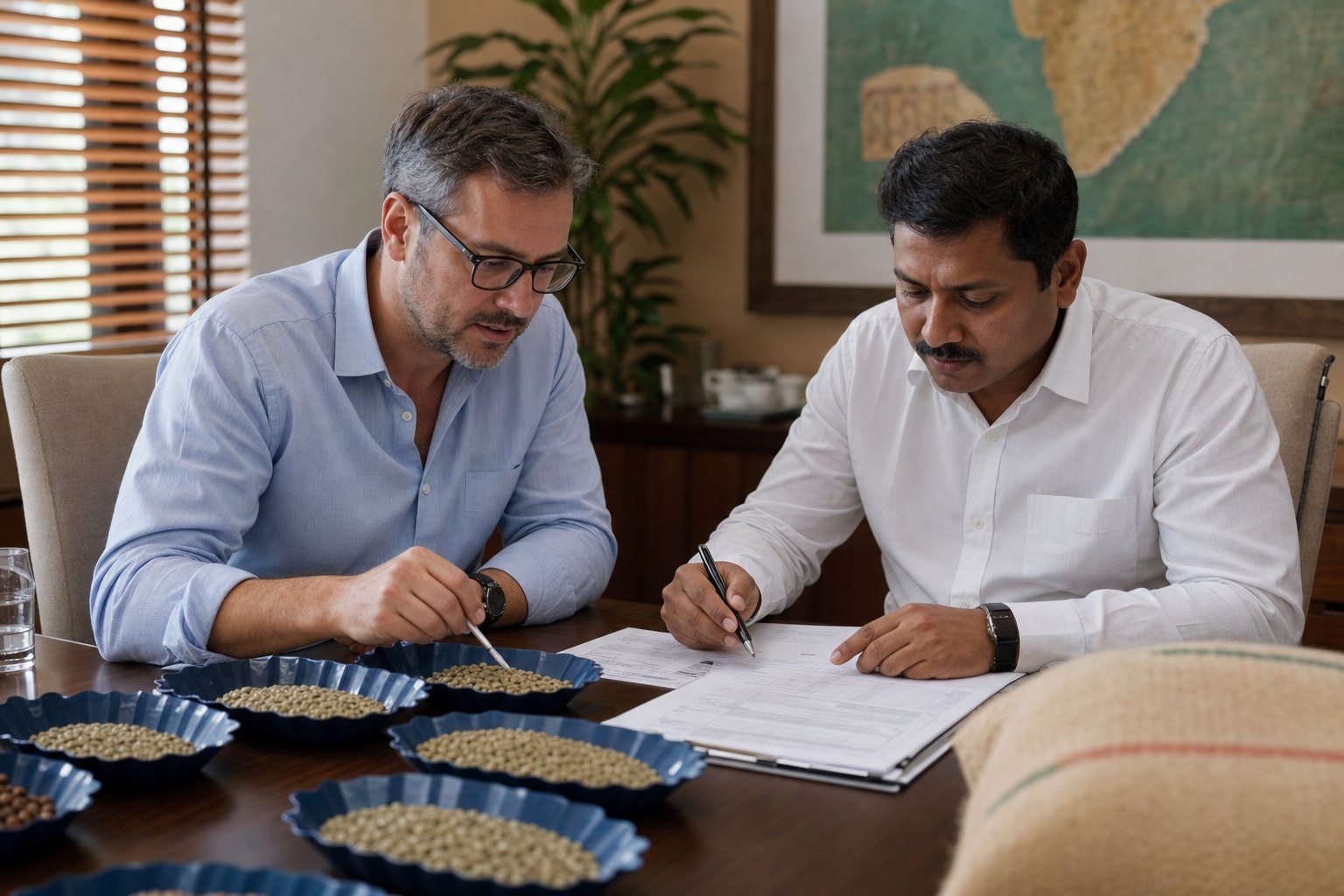
This is a playbook, not a market overview. If you are an importer, roaster, retail buyer, or food manufacturer who has decided you want Indian coffee — Robusta for blending, Arabica for a cleaner cup, or monsoon Malabar for a distinctive specialty line — the open question is no longer 'why India,' it is 'how do I do this safely.' That is the question this guide answers, step by step, from your first outreach email to your first bill of lading.
Buyers who source coffee directly from India without a repeatable verification process run into the same failures again and again: a beautiful sample cup followed by an inconsistent bulk lot, a curing works that cannot produce a current Coffee Board registration, a monsoon Malabar claim with no traceable batch record, or a first payment sent before any document was checked. None of these failures are caused by bad coffee. They are caused by buyers skipping steps that take a few days and save months of dispute.
This playbook walks through verifying a supplier's credentials, requesting and cupping samples correctly, building an RFQ that produces comparable quotations, negotiating MOQ and pricing on a landed-cost basis, and placing a first purchase order with terms that protect your capital. For market and grade context to sit alongside this process guide, see Most Demanded Indian Coffee Varieties by Country and Top Coffee Products Exported from India.
Key Takeaways
Summary Box
Executive Summary
Summary Box
International buyers source coffee directly from India for three reasons that hold up under scrutiny: competitively priced Robusta for blending, plantation-grown Arabica with a genuinely distinctive cup, and monsoon Malabar — a process unique to India's Malabar coast that no other origin can replicate. The commercial opportunity is real. What separates buyers who build a reliable multi-year supply relationship from buyers who have one bad container and quietly give up is process discipline, not luck.
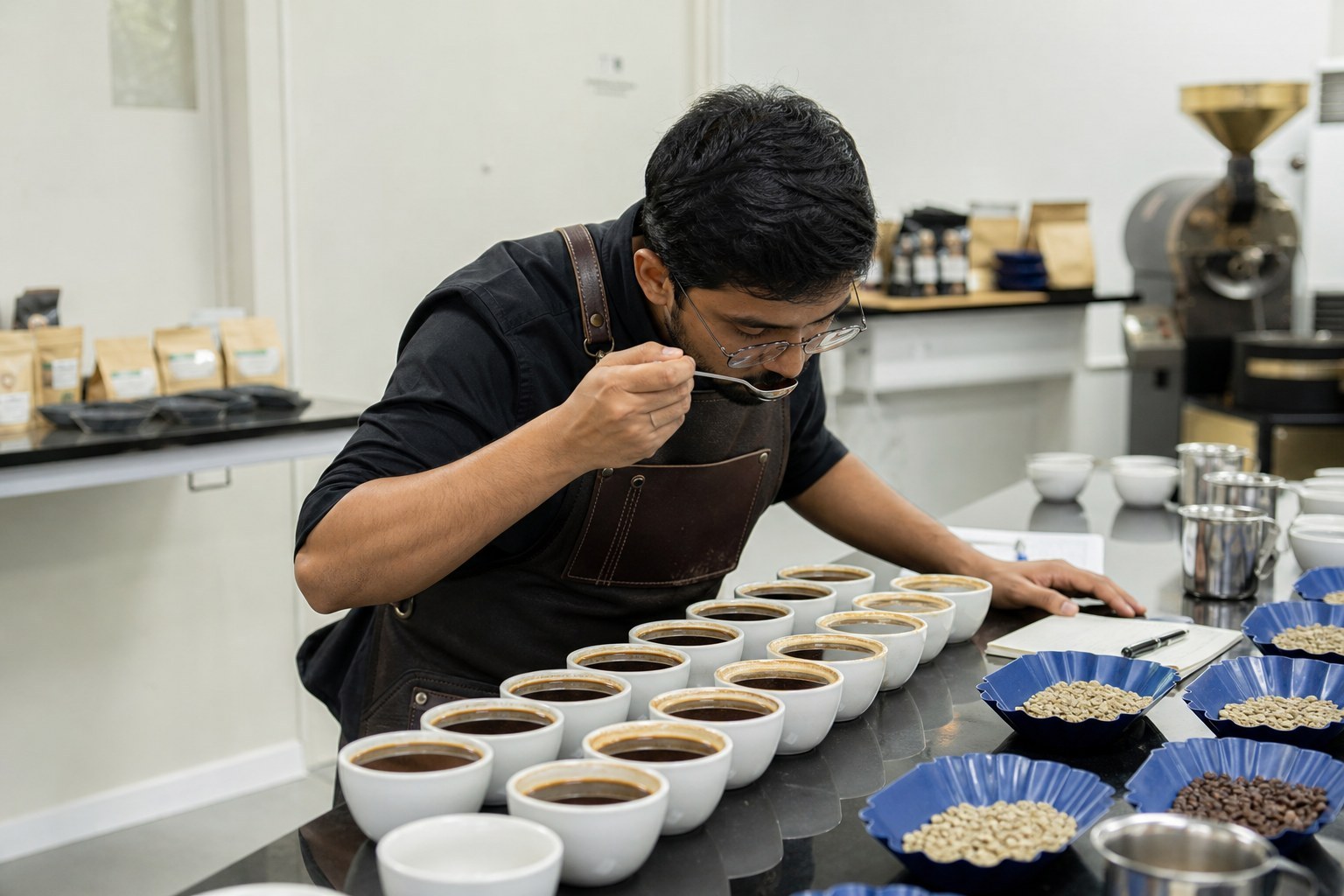
This guide treats sourcing as a sequence of gates, each designed to catch a specific failure before it becomes expensive. Specification gate prevents vague quotations. Verification gate prevents dealing with an entity that cannot legally export. Sample and cupping gate prevents a bulk lot that does not match what you approved. Trial-order gate prevents overcommitting capital before consistency is proven. Documentation gate prevents customs delays on cargo that is otherwise compliant.
None of these gates require you to be an expert in Indian coffee agronomy. They require you to ask for evidence instead of assurances, and to withhold the next payment or the next order size until that evidence checks out. Buyers who follow this sequence consistently report faster time-to-first-shipment and fewer disputes than buyers who source on price and personal chemistry alone.
Market Size & Industry Overview
Key Statistics
India produces roughly 360,000–370,000 tonnes in 2024–25 (Coffee Board final crop estimate ~363,500 tonnes), placing it as the world's 7th-largest coffee producer. Robusta accounts for roughly two-thirds of that output, grown at lower altitudes for volume and blend strength; Arabica, grown above roughly 1,000 metres, supplies a milder, more aromatic segment. Monsoon Malabar sits apart from both — cured green coffee, typically Arabica, is exposed to humid monsoon winds along the Malabar coast for several weeks, producing a low-acid, full-bodied cup with a dedicated following in Europe.
The supply chain a buyer sources through has several distinct layers, and confusing them is one of the most common sourcing mistakes. Estates grow and initially process cherry. Curing works pulp, ferment or dry, hull, and grade cherry into export-ready green coffee — this is the node where moisture control and defect discipline live. Export houses and merchant exporters sell established grades or consolidate multi-origin supply under their own accountability. Buying agents introduce parties but do not always own quality or documentation outcomes. Knowing which layer you are actually dealing with changes what you should verify and what you should expect.
India's Coffee Board of India, a statutory body under the Ministry of Commerce, gives the sector real institutional backbone: mandatory exporter registration through RCMC, curing works licensing under the Coffee Act, and an e-auction platform that provides standardised lot grading and price transparency. That infrastructure is credible at the national level — but individual estates and curing works within it vary widely in documentation discipline, which is exactly why buyer-side verification remains necessary regardless of how strong the sector-level institutions are.
India Coffee Supply Chain Structure for Buyers
Swipe →
Data table — swipe horizontally on small screens
| Supply Chain Node | Role | What a Buyer Should Verify |
|---|---|---|
| Estates / growers | Cherry cultivation; washed vs unwashed processing decision | Estate identity and location for any specialty or origin claim |
| Curing works | Pulping, fermentation/drying, hulling, grading into export grades | Coffee Act licensing, moisture and defect discipline, cupping records |
| Coffee Board e-auction | Standardised lot grading and price discovery | Auction lot number and grade against your own reference |
| Export houses | Sell established export grades | Depth of cupping documentation, not just export volume |
| Merchant exporters | Buy, consolidate, and export under their own accountability | Track record across multiple origins and buyer references |
| Buying agents | Introduction and local coordination only | Whether they accept quality and document accountability, or only introduce |
Where Buyer-Ready Supply Concentrates
Kodagu (Coorg) and Chikmagalur in Karnataka's Western Ghats account for the large majority of national production and host the highest concentration of organised, export-experienced curing works. Wayanad in Kerala and the Nilgiris in Tamil Nadu add Arabica volume with distinct micro-climate character. The Araku Valley in Andhra Pradesh is smaller in volume but increasingly relevant for buyers seeking tribal-cooperative traceability and a documented direct-trade origin story.
Export Statistics
Key Statistics
India exports roughly 300,000–400,000 tonnes of coffee annually across recent crop years (Coffee Board provisional data), with FY 2024–25 export value about US$1.8 billion (Coffee Board); values remain sensitive to international pricing. For a buyer, the most useful reading of this data is not the headline total but the composition: green coffee dominates volume, while instant/soluble coffee under HS 2101 contributes a disproportionately large share of value relative to its tonnage. Before comparing FOB quotes from two suppliers, confirm which HS sub-heading and product form each is actually quoting — green Robusta, roasted coffee, and instant coffee occupy very different price bands.
National export scale tells you the sector is real; it does not tell you whether the specific curing works you are speaking with can produce your specification consistently. Treat export statistics as context for negotiation, not as a substitute for supplier-level verification. A country that exports hundreds of thousands of tonnes annually still contains individual counterparties who cannot legally ship a single container.
Indicative India Coffee Export Composition Relevant to Buyers
Swipe →
Data table — swipe horizontally on small screens
| Coffee Type | Approx. Export Share (Volume) | Typical HS Heading | Buyer Sourcing Note |
|---|---|---|---|
| Green Robusta | ~55–60% | 0901.11 | Best sourced via curing works or Coffee Board e-auction lots with grading transparency |
| Green Arabica (incl. monsoon Malabar) | ~20–25% | 0901.11 | Best sourced with estate-level traceability and cupping documentation |
| Roasted coffee | ~2–4% | 0901.21 | Confirm roast-date freshness protocol for retail-ready programmes |
| Instant / soluble coffee | ~12–18% (larger share by value) | 2101.11 / 2101.12 | Verify spray-dried vs freeze-dried process against your price expectations |
Import Statistics
Key Statistics
Reading import-side data from your own destination market is one of the fastest ways to sanity-check a supplier's claims before you spend money on a sample. HS 0901 and HS 2101 import statistics from ITC Trade Map or similar platforms show whether India's presence in your market is growing or shrinking relative to Vietnam, Brazil, Colombia, and Ethiopia, and what unit values are typical for the grade you intend to buy. If a quoted FOB price sits significantly below the average unit value reported for that product category from India, treat it as a quality-risk signal that needs extra diligence, not a negotiating win.
Cross-reference a supplier's claimed export history against the aggregate import pattern for their stated destination markets. A curing works claiming several years of exports to German organic buyers should be traceable, at least in pattern, within destination-side import data for organic-certified Indian coffee. A claim with no corroborating pattern in the data is not automatically false, but it warrants a direct question and, ideally, a reference check before any deposit changes hands.
Using Destination Import Data to Validate Sourcing Decisions
Swipe →
Data table — swipe horizontally on small screens
| Data Signal | What It Tells a Buyer | Action |
|---|---|---|
| Rising Indian share of your HS 0901 imports | Growing acceptance among buyers similar to you | Reasonable to proceed with standard verification |
| Falling Indian share versus Vietnam/Brazil | Possible price, quality, or logistics disadvantage | Ask the supplier directly why; benchmark their FOB against the trend |
| Unit value far below category average | Possible grade mismatch or quality risk | Request additional cupping and lab evidence before committing |
| No import pattern matching supplier's claimed history | Claim may be exaggerated or for a different product form | Request redacted prior shipment documents and references |
Product Categories / Variants
Summary Box
Buyers who ask for 'Indian coffee' without specifying species, grade, and process receive quotations that cannot be compared to one another. Learn this taxonomy before you send your first RFQ — it is the language suppliers use in their own specification sheets, and using it correctly signals that you are a serious counterparty worth quoting accurately.
Green Robusta
Robusta is graded by process and screen size. Parchment AB (washed, larger screen) is favoured for its cleaner cup and blend consistency; Cherry AB (natural/unwashed) offers a fuller, sometimes rougher body at typically lower processing cost. Both serve blending and instant-coffee manufacture as their primary end use.
Parchment AB vs Cherry AB
Specify which one you want and why: Parchment AB for cup consistency in an espresso blend base, Cherry AB where body and cost matter more than cup cleanliness. Do not accept a supplier substituting one for the other without written approval, even when they claim it is 'basically the same.'
Green Arabica
Arabica follows a parallel grading structure to Robusta — Plantation A, B, and C for washed processing, Cherry AB and PB for natural processing — determined by screen size, density, and defect count after hulling. Arabica is the grade family buyers reach for when cupping score and cup character, not just strength, drive the purchase decision.
Plantation Grades vs Cherry Grades
Plantation grades generally deliver a cleaner, brighter cup suited to specialty and premium blending; Cherry grades trade some cup clarity for fuller body and lower cost. State your target cupping score and end use so the supplier can recommend the grade that actually fits, rather than the grade they happen to have in stock.
Monsoon Malabar
Monsoon Malabar is a genuinely unique Indian process: cured green coffee, typically Arabica though Robusta versions exist, is exposed to humid monsoon winds in specially ventilated warehouses along the Malabar coast for several weeks. The beans swell, lose acidity, and develop a low-acid, full-bodied, distinctive flavour. Because the name carries commercial value, buyers should insist on curing-works traceability evidence for any monsoon Malabar claim rather than accepting the label on invoice description alone.
Specialty, Organic, and Roasted or Instant Formats
Specialty single-origin micro-lots scoring 80 or above on the SCA cupping scale command premium pricing tied to estate traceability and consistent cupping across lots, not just a single good sample. Organic-certified Robusta or Arabica requires NPOP certification with a recognised pathway into USDA NOP or EU Organic for your destination label claim. Roasted and instant/soluble coffee add finished-product considerations — roast-date freshness, grind specification, and destination-market labelling — layered on top of the green-coffee specification underneath.
Manufacturing Overview
Export Tip
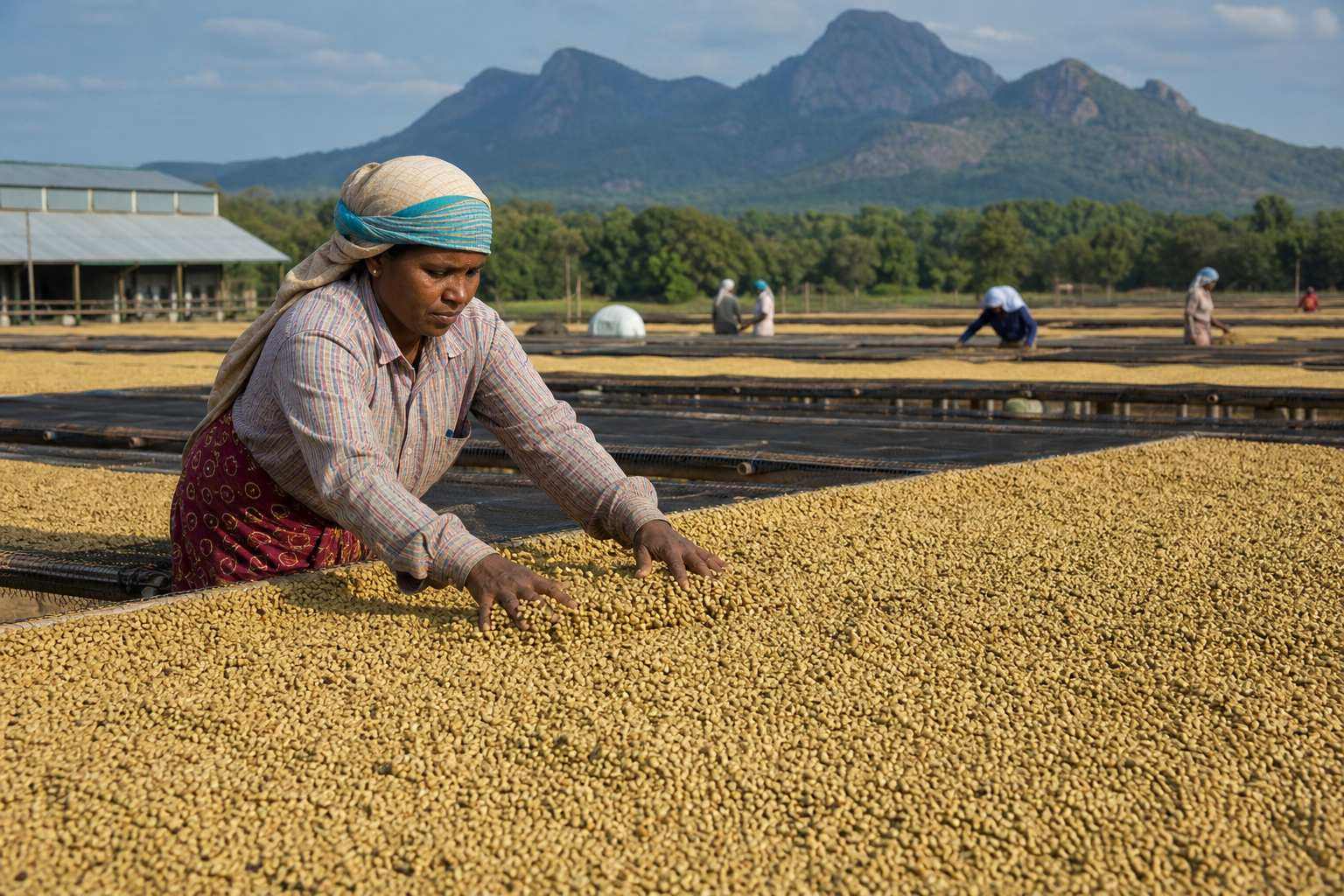
Understanding how a curing works actually converts cherry into your export lot is not academic — it directly shapes the verification questions you should ask. Fresh cherry arrives and is sorted, then pulped for washed processing or dried whole for natural/unwashed processing. Parchment or dried cherry is stored, then hulled to remove the outer layer, producing green coffee. Green coffee is graded by screen size and density, cupped to confirm liquor quality, and bagged for export.
Moisture control runs through every stage. Coffee packed above roughly 12% moisture risks mould and quality loss in transit; premium buyers push suppliers toward 10–11.5% for a safety margin. Ask any curing works you are evaluating to show you their moisture-testing records at intake and at packing, not just a single certificate dated months earlier. A curing works that cannot produce these records on request is telling you something about its documentation discipline, independent of how good the sample cup tastes.
For monsoon Malabar specifically, the process adds a distinct manufacturing stage: cured green coffee is deliberately exposed to humid monsoon-season air in ventilated warehouses for several weeks, monitored for controlled moisture uptake. Ask for batch records showing exposure duration and moisture progression — this is the traceability evidence that separates a genuine monsoon Malabar lot from a conventional lot relabelled to capture a premium.
Pricing Analysis
Buyer Tip
Use the ranges below only for RFQ framing. Coffee Board permit data for FY 2024–25 (~US$1.8 billion on ~389,000 tonnes) showed how quickly Indian unit values can move, so lock nothing until you reconfirm against e-auction / ICTA and ICE Arabica/Robusta. Indicative 2026 planning bands: commodity Robusta Parchment AB/Cherry AB about $2.20–$3.20/kg FOB; Arabica Plantation A/B about $3.50–$5.50/kg FOB; monsoon Malabar AA about $4.50–$7.50/kg FOB; specialty single-origin or 80+ micro-lots often $6.00–$15.00/kg+ depending on estate reputation and traceability; organic-certified lots commonly add a 20–40% premium over conventional peers.
A lower FOB from a supplier with an inconsistent cupping track record is not actually cheaper once you account for failed-shipment risk. Compare landed cost — FOB, freight, insurance, destination duty, and your own independent lab or cupping check — rather than FOB alone. For organic or GI-claim lots, confirm upfront whether certification transaction certificates are included in the quoted price or billed separately; suppliers who bundle certification cost into a low headline FOB create confusion at invoice stage.
Indicative FOB Pricing Reference by Grade (2026)
Swipe →
Data table — swipe horizontally on small screens
| Coffee Grade | Indicative FOB Range | Primary Buyer Use |
|---|---|---|
| Robusta Parchment AB / Cherry AB | $2.20–$3.20/kg | Blending, instant coffee manufacture |
| Arabica Plantation A/B | $3.50–$5.50/kg | Specialty blending, premium retail |
| Monsoon Malabar AA | $4.50–$7.50/kg | Distinctive EU specialty retail |
| Specialty single-origin / micro-lot (80+ cupping) | $6.00–$15.00+/kg | Direct-trade retail, single-origin bags |
| Organic-certified (Robusta or Arabica) | 20–40% premium over conventional | Certified organic retail channels |
MOQ Analysis
Buyer Tip
MOQ should match the stage of your relationship with a given supplier, not the supplier's preferred production batch size alone. First orders should always be smaller than what you expect your programme volume to become — the point of a trial order is to prove consistency, not to test your logistics capacity on day one.
MOQ by Sourcing Stage and Grade
Swipe →
Data table — swipe horizontally on small screens
| Grade / Programme Type | Sample Stage | Trial Order | Standard Programme |
|---|---|---|---|
| Commodity Robusta | 250 g–1 kg cupping kit | ~5 MT | 1 x 20ft FCL (~17–19 MT) |
| Commodity Arabica | 250 g–1 kg cupping kit | ~5 MT | 1 x 20ft FCL (~17–19 MT) |
| Monsoon Malabar / premium Arabica | 250 g–500 g | 1–2 MT | 3–5 MT |
| Specialty single-origin / micro-lot | 100 g–250 g | 500 kg–1 MT | Estate-dependent, often under 5 MT |
| Organic-certified lots | 250 g with transaction certificate | 1–5 MT | 5+ MT once certification chain is verified |
Packaging Standards
Export Tip
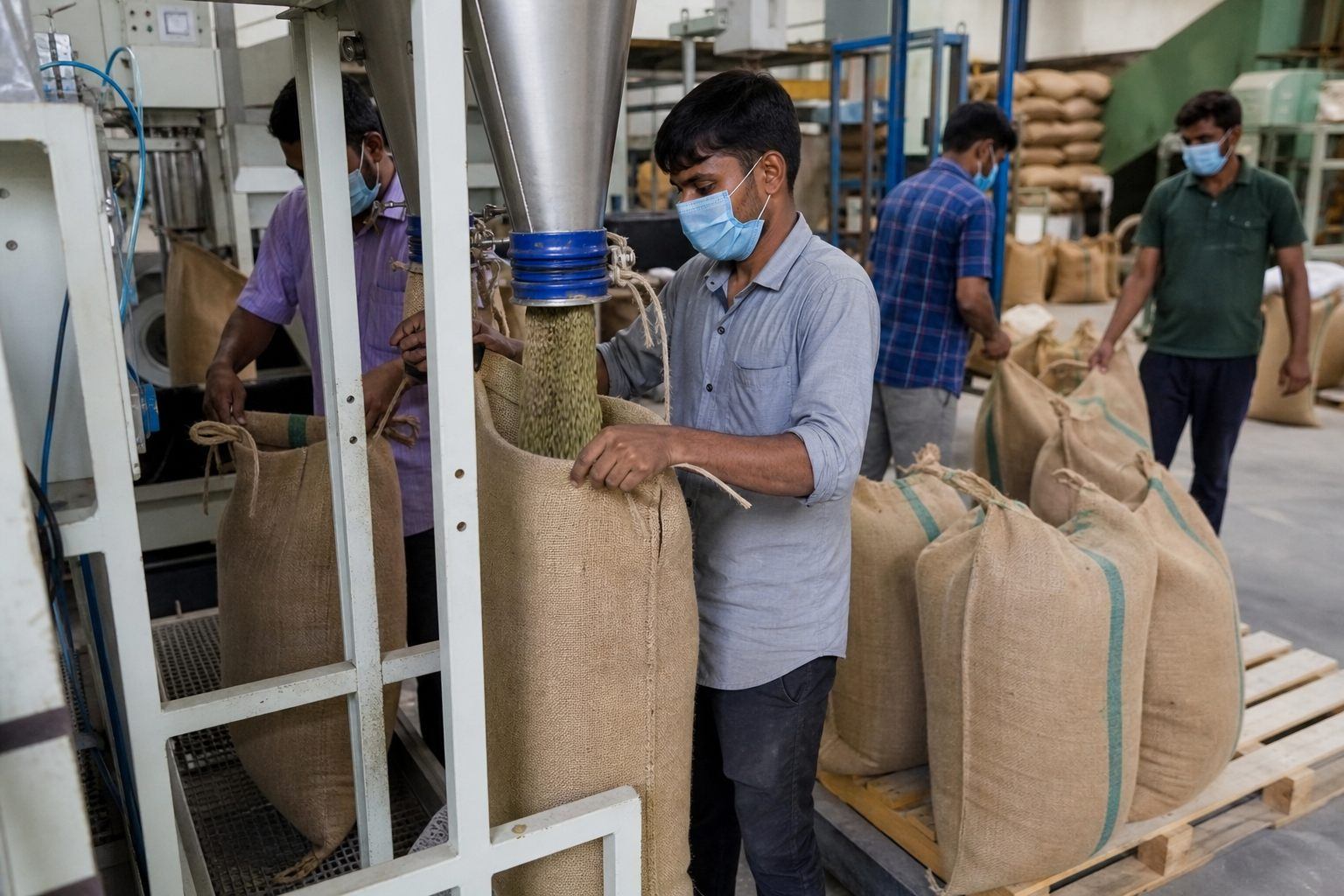
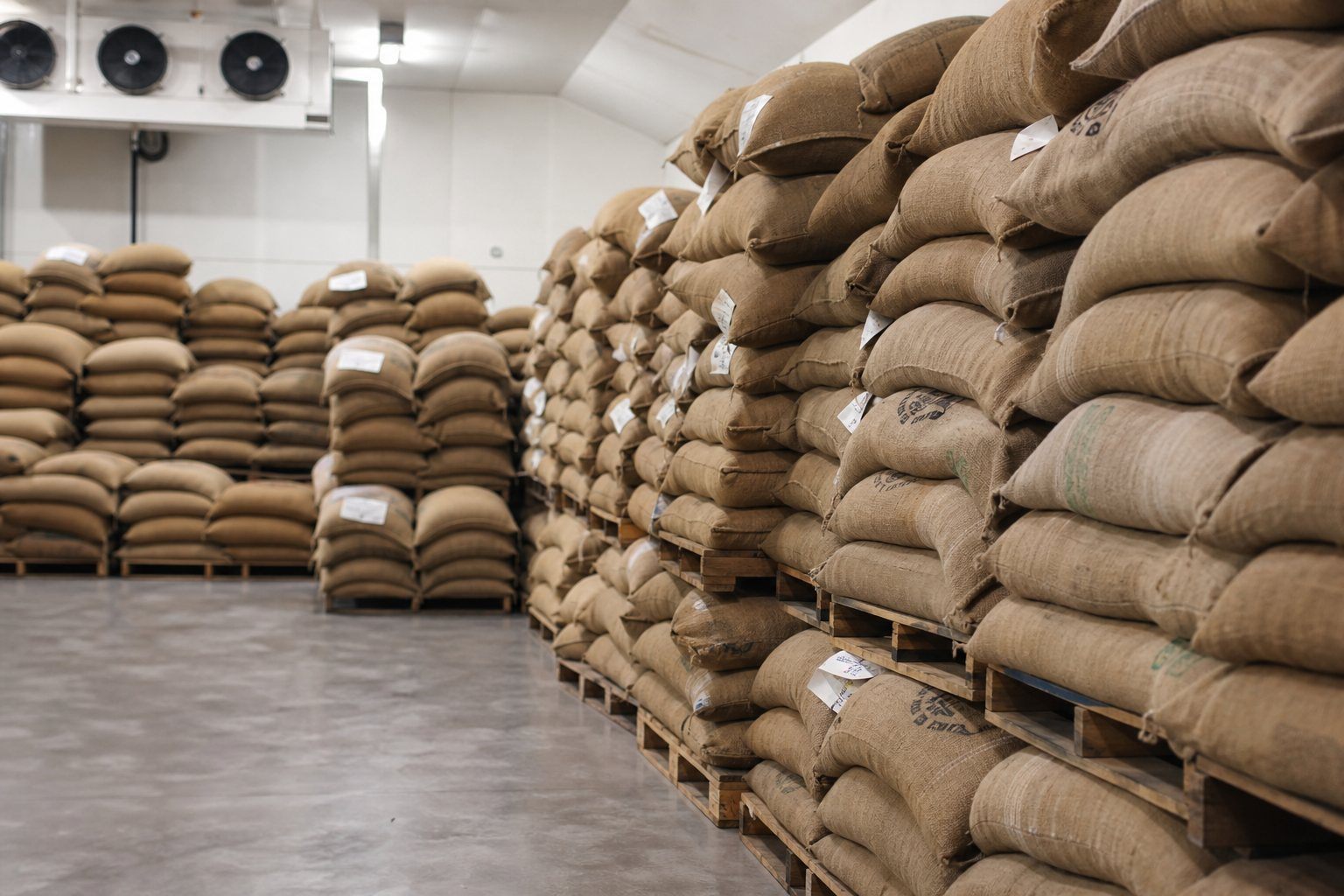
Packaging protects moisture content, which protects everything else you have verified. Bulk export standard is 50–60 kg jute bags fitted with GrainPro or vacuum-sealed polythene liners; bulk super sacks (FIBC bags of roughly 1,000 kg) reduce handling cost for large Robusta programmes but require careful moisture management given the larger internal volume. Retail-ready programmes need valve-sealed foil pouches or tins matching your branding and shelf-life claim, agreed in advance through sample approval — not assumed after the bulk order is placed.
Packaging Formats for Coffee Export from India
Swipe →
Data table — swipe horizontally on small screens
| Pack Format | Typical Use | Buyer Verification Point |
|---|---|---|
| 50–60 kg jute bag with GrainPro liner | Bulk commodity Robusta/Arabica | Liner integrity, stitching, no signs of prior moisture damage |
| FIBC bulk super sack (~1,000 kg) | Large Robusta blending programmes | Internal moisture-barrier lining and handling instructions |
| Vacuum-sealed multi-ply bag (retail-adjacent) | Monsoon Malabar and specialty trial lots | Seal integrity and batch/lot code on every unit |
| Valve-sealed foil pouch / tin | Retail-ready roasted or specialty green | Label artwork compliance and roast-date or pack-date accuracy |
Container Loading Details
Export Tip
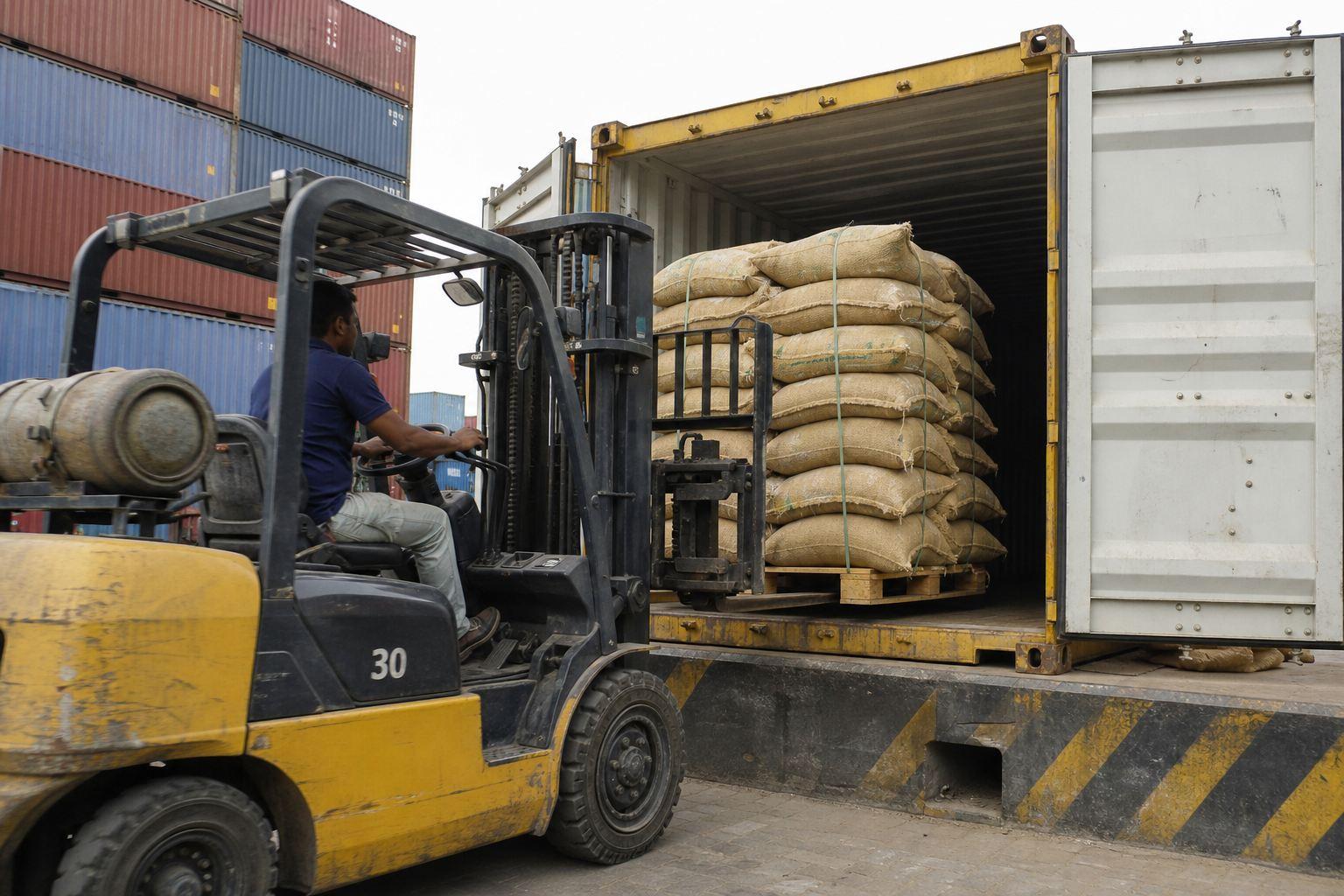
A standard 20ft FCL of bagged green coffee typically carries roughly 17–19 MT depending on bag weight, stacking plan, and actual bean density — confirm the specific payload with your forwarder rather than assuming a round number. Before sealing, verify bag count against the packing list, confirm the container floor is dry and odour-free, and check that dunnage and stacking pattern will not crush lower layers on a long transit.
For mixed programmes — commodity Robusta plus a smaller monsoon Malabar or specialty trial in the same shipment — insist on clear physical separation and distinct lot marking within the container. Cross-contaminated or unclearly marked mixed loads create receiving disputes at destination that a few extra minutes of loading-photo review would have prevented.
Container Loading Reference for Bagged Green Coffee
Swipe →
Data table — swipe horizontally on small screens
| Container | Indicative Payload | Buyer Check Before Sealing |
|---|---|---|
| 20ft FCL, 60 kg jute bags | ~17–19 MT | Bag count matches packing list; liner intact |
| 20ft FCL, 50 kg jute bags | ~19–21 MT | Confirm actual bag weight against invoice basis |
| 40ft FCL, mixed retail cartons | Volume-driven, confirm with forwarder | Carton dimensions and pallet plan pre-agreed |
| LCL trial shipment | Sub-container, higher per-unit freight | Strong outer cartons; clear lot marks for consolidation |
Shipping Methods
Export Tip
Sea freight in 20ft or 40ft FCL containers is the default for bulk green coffee — stable, dry cargo that does not need cold chain when packed correctly. Key load ports are New Mangalore (closest to Kodagu and Chikmagalur), Cochin (serving Wayanad-origin supply), Chennai (serving Nilgiris-origin supply), and Nhava Sheva for broader consolidated shipments. Transit times run roughly 20–28 days to major European ports, shorter to the UAE, and 25–40 days to the USA depending on coast.
Air freight and courier are reserved for samples and urgent small specialty lots — the cost per kilogram makes them impractical for commercial volume. LCL sea freight is the right instrument for trial orders below a full container, at the cost of higher per-unit freight and more handling. Whichever method you use, confirm Incoterms in writing before booking: FOB is standard for buyer-managed freight, CIF when the exporter arranges ocean freight and insurance to your destination port.
Certifications
Compliance Notes
Certification verification is not paperwork theatre — it is the fastest, cheapest due diligence available to a buyer before any money moves. Confirm each of the following independently rather than accepting a certificate photocopy at face value.
Coffee Board RCMC
The Registration-cum-Membership Certificate from the Coffee Board of India is the baseline legal credential for any commercial coffee exporter. Its absence disqualifies a supplier outright, regardless of how good their sample cups.
FSSAI Licence
Coffee is a regulated food product in India; FSSAI licensing must cover the specific curing, processing, and packing facility you intend to buy from — not merely the parent company's head-office registration.
IEC (Import Export Code)
Verify the Import Export Code on the DGFT portal and confirm the registered name matches exactly what appears on your quotation and, later, your commercial invoice.
Organic and GI-Origin Documentation
For organic claims, verify the certifying body's accreditation and confirm the certificate is a lot-specific transaction certificate, not an annual blanket certificate. For Coorg, Chikmagalur, Wayanad, or Araku Valley origin claims, cross-check the estate address against the GI-registered region boundaries.
Buyer Requirements
Buyer Requirements
- Species (Robusta, Arabica, or a specific blend ratio) and processing method (washed or natural)
- Grade name using India's own nomenclature — Parchment AB, Plantation A/B, Cherry AB/PB, Monsooned Malabar AA
- Moisture threshold (typically ≤10–12%), screen size, and defect-count limit
- Cupping score target on the SCA scale where relevant, and reference sample for comparison
- Certifications required — Coffee Board RCMC, FSSAI, organic, GI-origin, or Rainforest Alliance
- Pack format, retail or bulk, and any labelling requirements for your destination market
- Target FOB or CIF price, MOQ for trial and programme stages, and delivery window
Before you send a single RFQ, decide what you actually require and put it in writing. This document becomes the reference every subsequent sample, cupping report, and invoice is measured against — and it is the single most effective tool for preventing the drift between sample quality and bulk-lot quality that causes most disputes.
Country-wise Opportunities
Market Snapshot
Your sourcing checklist should flex slightly to reflect what your own market actually rewards. This section maps buyer-side priorities by destination so you calibrate diligence depth correctly — over-verifying a commodity blending purchase wastes time, and under-verifying a specialty claim invites a costly retail dispute.
Buyer-Side Country Fit for Coffee Sourcing
Swipe →
Data table — swipe horizontally on small screens
| Destination | Prioritise Sourcing | Sourcing Note |
|---|---|---|
| Italy | Robusta Parchment/Cherry AB, Arabica plantation | Source via curing works or e-auction lots for grading transparency |
| Germany | Organic Arabica, monsoon Malabar | Require NPOP/EU Organic documentation and residue testing |
| Belgium | Robusta Parchment/Cherry AB | Prioritise volume consistency and reliable delivery |
| Russia | Robusta, instant-coffee inputs | Confirm technical regulation and labelling alignment |
| USA | Split: commodity and specialty/organic tiers | Match verification depth to the tier you are buying for |
| UAE | Robusta and Arabica blends | Confirm halal-friendly processing for retail-bound lines |
| Japan / South Korea | High cupping-score Arabica, monsoon Malabar | Insist on repeat-lot cupping consistency before committing |
Italy
Italian roasting houses buy Robusta Parchment/Cherry AB and Arabica plantation grades primarily for espresso blending, valuing long-term consistency over spot-price advantage. Source via curing works or Coffee Board e-auction lots for grading transparency, and expect buyers here to reference cupping sheets more than certificates.
Germany
German buyers split between bulk blending and a serious organic/specialty segment. If you are sourcing for the German market, require NPOP or EU Organic transaction certificates and a full pesticide MRL panel before committing to anything beyond a trial sample.
Belgium
Belgium's Antwerp trading hub handles significant re-export volume alongside direct Belgian roasting demand. Robusta Parchment/Cherry AB dominates; buyers here prioritise volume consistency and reliable delivery schedules over deep certification.
Russia
Russian buyers source Robusta for direct consumption and instant-coffee manufacture, prioritising strength, body, and price stability. Confirm technical regulation alignment and Russian-language labelling for retail-bound lines, and structure payment and banking arrangements carefully given evolving international payment corridors.
United States of America
US demand splits sharply between commodity roasting inputs and a specialty segment that explicitly names an 80+ SCA cupping score, USDA NOP organic certification (NPOP alone does not qualify for a USDA Organic claim), and full estate traceability. Match your verification depth to which tier you are actually buying for.
United Arab Emirates
The UAE functions as both a consumption market and a regional re-export hub, so Robusta and Arabica blends often move onward into other Gulf and East African markets. Halal-friendly processing matters for retail-bound lines; blend consistency matters more than cupping-score storytelling.
Japan and Beyond
Japan (and increasingly South Korea) rewards high cupping-score Arabica and monsoon Malabar backed by repeat-lot cupping consistency, not a single excellent sample. Buyers here rarely switch suppliers once trust is established, but the qualification bar for a first order is high — plan for a longer, more document-intensive verification cycle.
Expert Insight #1 — Saurabh Mittal
Expert Insight Box
This sequencing matters more than it sounds. A buyer who leads with price signals to the supplier that price is the deciding factor, which invites suppliers to quote aggressively and quietly cut corners on documentation or cupping consistency to hit that number. A buyer who leads with verification and cupping evidence signals a different kind of counterparty — one worth quoting honestly.
Sourcing Checklist
Checklist
- Write a complete specification — species, grade, process, moisture, defect count, cupping target, certification, pack — before any outreach.
- Identify candidates through Coffee Board registered exporter records, the e-auction platform, trade fairs, and ITC Trade Map shipment data.
- Shortlist a maximum of three suppliers per category and score them on RCMC, FSSAI, IEC, export history, and cupping infrastructure.
- Request samples with lot-level cupping notes and lab reports, not samples alone.
- Cup the sample independently against your own reference standard before any commercial commitment.
- Compare landed cost, not FOB alone, when negotiating pricing.
- Verify export compliance capability — RCMC, FSSAI, IEC — a second time immediately before placing the trial order.
Buyer Checklist
Checklist
Exporter Checklist
Checklist
Even though you are the buyer, knowing what a properly prepared exporter or curing works should have ready helps you spot a supplier who is not export-ready before you waste a sample cycle on them.
Compliance Checklist
Checklist
Compliance Notes
Common Buyer Mistakes
Common Mistakes Box
Expert Insight #2 — Saurabh Mittal
Expert Insight Box
Future Market Trends
Key Statistics
Through 2030, sourcing coffee directly from India will be shaped by three forces relevant to buyers specifically: rising digital traceability that links estate-level lot data to export documentation, growing premium positioning for monsoon Malabar and GI-origin Arabica in specialty channels, and tighter EU regulatory scrutiny around deforestation-linked sourcing (EUDR) that will make documented, traceable supply chains a competitive advantage rather than a nice-to-have.
Buyers who build a documented, verification-led sourcing process now — rather than scrambling to retrofit traceability once a regulation forces the issue — will face materially less disruption as these requirements tighten across their destination markets.
Conclusion
- Next step: send your specification to Altus Exports for a supplier shortlist and market-readiness assessment.
- Review Most Demanded Indian Coffee Varieties by Country to align sourcing with real destination demand.
- Read Top Coffee Products Exported from India for grade and category depth.
- Understand the export side with How to Export Coffee from India and Coffee Board Registration Benefits for Exporters.
- Complete your compliance picture with the Coffee Export Documentation Checklist.
- Explore Best Countries for Indian Coffee Exports and Organic & Specialty Coffee Export Opportunities from India.
- Browse agriculture & food products and explore product sourcing company in India and global sourcing partner service models.
Sourcing coffee directly from India rewards buyers who treat it as a quality-controlled process rather than a one-time purchase decision. Write your specification before you contact a supplier. Verify Coffee Board RCMC, FSSAI, and IEC independently. Cup every lot against a signed reference sample. Stage your exposure from sample to trial order to full programme. Use a merchant exporter or accountable sourcing partner if you are managing multiple origins or grades at once.
If you are ready to build a documented India coffee sourcing programme with fewer first-order surprises, share your species, grade, certification needs, target MOQ, and destination market with Altus Exports for a verified supplier shortlist.