
Tea Board Registration Benefits for Tea Exporters in India
By Saurabh Mittal, Founder, Altus Exports
A complete guide to Tea Board registration benefits for Indian tea exporters — what the Tea Board of India is, who must register, exporter licence application steps, documents and fees, Darjeeling GI origin certification, quality and auction infrastructure access, buyer-seller programmes, and how membership builds buyer confidence in UAE, Iraq, Russia, USA, UK, Germany, and Iran. Written for tea estate owners, bought-leaf factories, Kolkata merchant exporters, and MSME packers preparing to export under HS 0902. Includes fee benchmarks, an Assam estate case study, council comparisons, and Altus Exports advisory context.
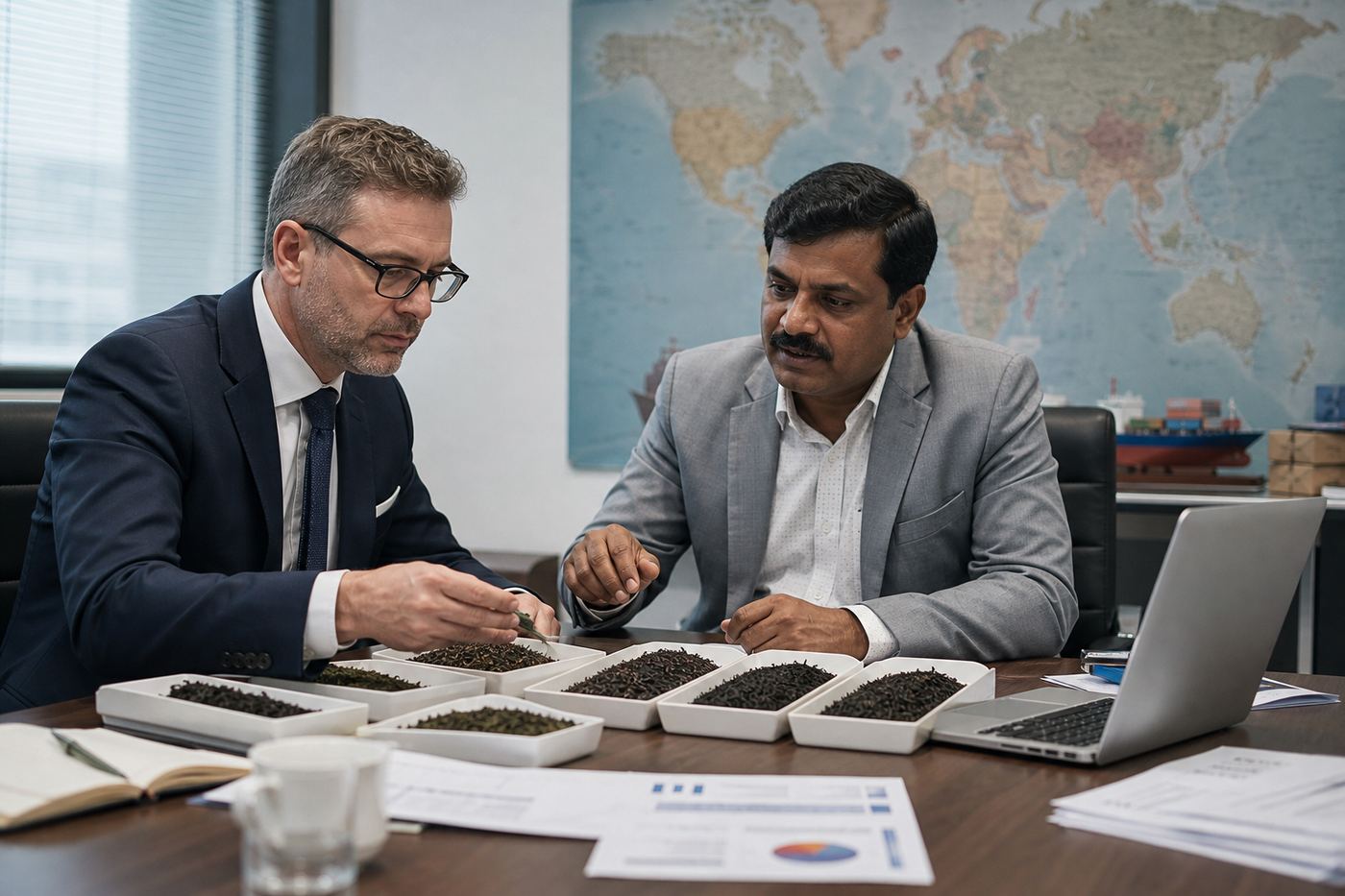
India exports more than 200 million kilograms of tea annually — predominantly Assam CTC for Gulf and CIS chai markets, Darjeeling orthodox for European and Japanese premium retail, and Nilgiri orthodox and green tea for specialty channels in North America and the Middle East. Yet moving tea from estate or factory to an overseas buyer requires navigating an institutional layer that goes far beyond auction catalogue numbers. International importers, supermarket private-label teams, and Gulf distributors expect exporters to operate inside recognised regulatory frameworks before they open a serious inquiry.
For tea exporters in India, Tea Board of India registration is the foundational credential. The Tea Board — a statutory body under the Tea Act, 1953, and the Ministry of Commerce and Industry — is the sole government authority mandated to regulate, promote, and develop tea production and export in India. Exporter registration is not a formality; it unlocks shipping-bill eligibility under HS Chapter 0902, Darjeeling Geographical Indication (GI) origin certification, export statistics access, buyer-seller facilitation, and the institutional identity that international buyers use during vendor onboarding. Unlike honey (APEDA) or spices (Spices Board RCMC), tea has its own dedicated export authority — and APEDA registration does not substitute for Tea Board credentials on tea shipments.
This guide explains what the Tea Board is, why registration matters for tea exporters specifically, who should register, the step-by-step application process, documents and fees, how the Board supports Darjeeling GI and quality programmes, and how to use membership for sustained buyer access. Pair it with how to export tea from India and the tea export documentation checklist for the full compliance stack. Always verify current fees and portal instructions on teaboard.gov.in, as administrative workflows are updated periodically.
Key Takeaways
Summary Box
- Tea Board registration benefits for tea exporters centre on mandatory exporter licence eligibility — without it, commercial shipment under HS 0902 cannot proceed through customs.
- Obtain IEC and FSSAI first; Tea Board exporter registration applications require consistent IEC, GST, and FSSAI details — name mismatches are the most common delay trigger.
- Tea Board registration is the tea-sector equivalent of RCMC for scheduled agri-products — buyers treat it as baseline vendor qualification alongside IEC and FSSAI.
- Darjeeling GI origin certification through the Tea Board is a separate, high-value benefit — exporting tea labelled Darjeeling without verified GI documentation is illegal.
- Registration unlocks export statistics, auction price indices, buyer-seller meets, and policy scheme awareness that materially improve market selection and pricing discipline.
- Altus Exports helps tea estate owners, bought-leaf factories, and merchant exporters align Tea Board registration and product readiness for agriculture & food products export programmes targeting UAE, Iraq, Russia, USA, UK, Germany, and Iran.
Market Overview
India is the world's second-largest tea producer after China, with annual production exceeding 1,400 million kg across Assam, West Bengal (Darjeeling, Dooars, Terai), Tamil Nadu (Nilgiri), Kerala, Karnataka, Himachal Pradesh (Kangra), and Tripura. Export volume consistently ranks among the top five globally, with black tea accounting for approximately 96% of shipments. The structural demand drivers — Gulf chai culture, CIS commodity consumption, European specialty orthodox retail, North American RTD and iced-tea applications, and Iranian traditional tea consumption — create a diversified buyer base that rewards exporters who hold valid Tea Board credentials and can document grade consistency.
The competitive landscape includes Kenya (high-volume CTC), Sri Lanka (orthodox premium under Ceylon branding), China (green tea dominance), and Vietnam (low-cost commodity). India's differentiation rests on CTC scale comparable to Kenya, orthodox and GI-protected Darjeeling unavailable from commodity origins, and an auction infrastructure centred on Kolkata, Coonoor, and Guwahati that registered exporters can leverage for transparent price discovery. Tea Board registration situates exporters inside this institutional ecosystem rather than outside it as informal traders.
International buyers evaluating Indian tea suppliers in 2026 increasingly request Tea Board exporter registration evidence during onboarding questionnaires — alongside IEC, FSSAI, cupping reports, and residue test certificates. Missing Tea Board documentation causes buyers to pause, request workarounds, or move to already-registered competitors. In residue-sensitive markets such as Germany, the UK, and Japan, Tea Board-linked traceability and GI certification evidence often determines whether a first conversation converts to a sample request.
Comparison table
Swipe →
Data table — swipe horizontally on small screens
| Market Cluster | Primary Indian Tea Demand | Registration Relevance |
|---|---|---|
| UAE / Gulf | Assam CTC BP, BPS, PD; bright liquor | Exporter licence + halal-ready documentation |
| Iraq / Iran | Strong CTC, Dust grades; value pricing | Tea Board registration for shipping-bill continuity |
| Russia / CIS | CTC BP, BPS; malty Assam profiles | Registration + COO for customs alignment |
| USA | CTC for RTD; Darjeeling/Nilgiri specialty | Registration + FDA-aligned food safety docs |
| UK / EU | Darjeeling orthodox; Assam orthodox; organic | GI certificates + EU MRL residue panels |
| China | Orthodox and green tea imports | Registration + phytosanitary where required |
Product Overview
Summary Box
Tea Board registration benefits apply across the full export product spectrum under HS Chapter 0902 — not to a single SKU. Understanding which products fall under Tea Board jurisdiction helps exporters select the correct registration category and prepare buyer-facing documentation that matches product type.
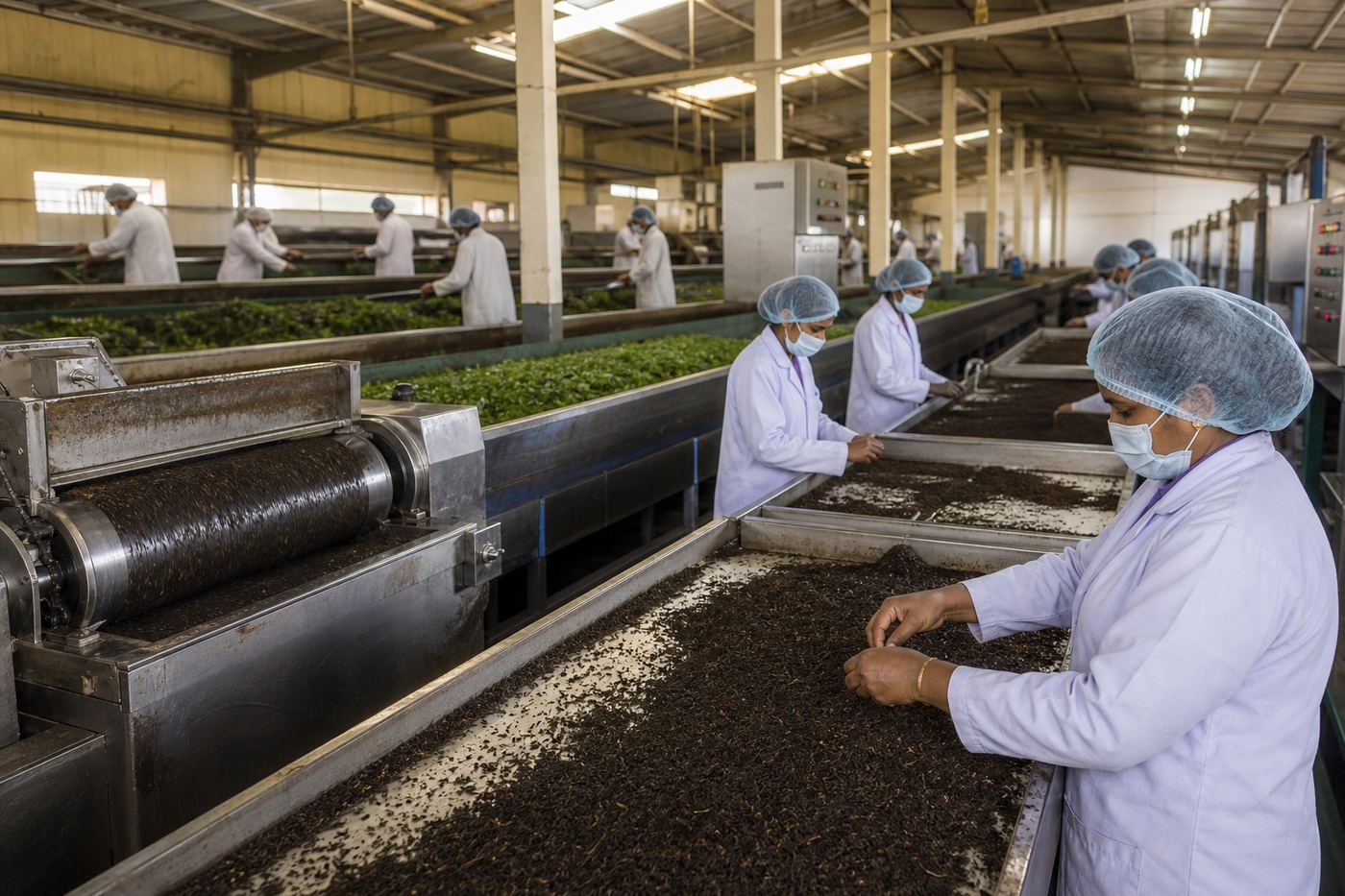
Assam CTC (Crush, Tear, Curl) is the volume backbone: grades BP (Broken Pekoe), BPS (Broken Pekoe Souchong), PD (Pekoe Dust), and various Dust grades defined by particle size, liquor colour, and briskness. Most bulk export moves under HS 090240 — other black tea in sacks exceeding 3 kg per unit. Assam orthodox offers whole-leaf and broken grades (OP, BOP, TGFOP) with richer character for premium bulk channels. Darjeeling orthodox — protected under GI Tag 35 — commands the highest per-kilogram export pricing for first and second flush harvests; Tea Board issues origin certificates for legitimate GI exports. Nilgiri orthodox and green tea provide bright, fragrant profiles; green tea retail packs fall under HS 090210 or 090220 depending on unit weight.
Registration does not prescribe which grades you must export — it authorises you to export legally and access Board facilitation programmes. Product strategy remains exporter-driven; registration is the licence to execute that strategy through formal channels. For detailed grade nomenclature and regional profiles, see top tea products exported from India.
Comparison table
Swipe →
Data table — swipe horizontally on small screens
| Product Type | HS Subheading | Typical Packing | Registration Note |
|---|---|---|---|
| Assam CTC bulk | 090240 | 30–60 kg PP sacks | Dominant export volume; FOB Kolkata |
| Assam / Nilgiri orthodox bulk | 090240 | 30–50 kg paper/PP sacks | Cupping specs critical |
| Darjeeling GI orthodox | 090240 / 090230 | Bulk or retail tins <3 kg | GI origin certificate mandatory |
| Green tea bulk | 090220 | 30–40 kg sacks | Moisture 3–4%; Cochin port |
| Retail private-label packs | 090230 / 090210 | 100 g–500 g cartons | Destination labelling compliance |
Export Process
Export Tip
Tea Board exporter registration follows a defined sequence. Treat registration as parallel infrastructure — not a substitute for grading discipline, cupping evaluation, packaging engineering, or buyer outreach. The steps below reflect the organised pathway; confirm live portal instructions on teaboard.gov.in before filing.
Step 1: Obtain Import Export Code (IEC)
Apply for IEC on the DGFT portal if you do not already hold one. IEC is mandatory for all commercial export operations and is the foundation of Tea Board registration. Keep PAN, bank details, and address consistent with GST registration to avoid name mismatches that delay every subsequent filing.
Step 2: Secure FSSAI Central Licence
Tea is a food product regulated by FSSAI. Export-oriented processors, blenders, and packers typically require a Central FSSAI licence. FSSAI's Food Safety and Standards (Food Products Standards and Food Additives) Regulations prescribe quality parameters for tea including moisture content, extraneous matter limits, and absence of unauthorised additives. Both Tea Board registration and FSSAI credentials are required together during buyer onboarding.
Step 3: Prepare Entity Documentation
Assemble IEC copy, GST certificate, PAN, FSSAI licence, cancelled cheque, bank details, company incorporation documents (MoA/AoA for companies, partnership deed for firms), board resolution for authorised signatories, and for estate-direct exporters, estate registration evidence where applicable. Manufacturer-exporter and merchant-exporter classifications may require different supporting documents — state your intended role explicitly.
Step 4: Apply on Tea Board Portal
File the exporter registration application through the Tea Board of India online portal with entity details, IEC, product scope (black tea, green tea, specialty), and export destination interests. Upload clear, self-attested document scans with names matching precisely across IEC, GST, and FSSAI records.
Step 5: Pay Registration Fees and Complete Verification
Remit prescribed registration fees via the portal payment gateway. Retain payment receipts. Tea Board officials verify application completeness; respond to deficiency notices within 24–48 hours. On approval, the Board issues an exporter registration number cited on shipping bills under HS 0902.
Step 6: Activate GI and Quality Programmes (If Applicable)
Darjeeling GI exporters must separately apply for Tea Board GI origin certification and logo licensing. Organic tea exporters engage NPOP-accredited certifiers independently — Tea Board registration does not confer organic status. For organic channel depth, see organic and specialty tea export opportunities.
Trade Statistics
Key Statistics
India's tea export statistics — published by the Tea Board and DGFT — provide the quantitative backbone for registration ROI analysis. In recent years, India has exported about 255–280 million kg in recent calendar years, with export value typically around US$830–924 million in FY25 (DGCIS/IBEF methodologies differ) depending on auction prices and currency movement. Assam-origin tea accounts for the majority of export volume; South Indian orthodox and green tea represent a growing share in value terms.
Top destination countries by volume historically include the UAE, Russia, Iran, Iraq, the USA, the UK, Germany, and China — with re-export through the Netherlands and Saudi Arabia adding distribution-layer complexity. Registered exporters access Tea Board export dashboards, monthly destination-wise statistics, and auction price indices that informal traders cannot reference credibly in buyer negotiations.
HS code analysis under 0902 confirms that subheading 090240 (bulk black tea) dominates Indian export filings, while 090230 (retail black tea packs) and 090210/090220 (green tea) grow as private-label and wellness channels expand. Exporters who cite Board-published statistics in buyer presentations demonstrate institutional engagement that supports premium pricing on orthodox and GI lines.
Comparison table
Swipe →
Data table — swipe horizontally on small screens
| Indicator | Approximate Range | Source / Use |
|---|---|---|
| Annual export volume | ~255–280 million kg (recent calendar years) | Tea Board export statistics |
| Annual export value | ~US$830–924M (FY25, DGCIS/IBEF) | DGFT / Tea Board |
| Black tea share of exports | ~96% | Tea Board product split |
| Primary HS subheading | 090240 (bulk black) | Shipping bill analysis |
| Top destination (volume) | UAE, Russia, Iran | Destination-wise export data |
| Fastest-growing segment | Organic / specialty orthodox | NPOP-certified estate programmes |
Import Data Analysis
Import data analysis — through DGFT export statistics, ITC Trade Map, and destination customs data — helps registered exporters prioritise markets where Indian tea already holds share versus markets requiring new certification investment. The UAE consistently ranks as India's largest single-country tea export destination by volume, absorbing Assam CTC for domestic consumption and re-export across the Gulf. Russia and the CIS bloc import substantial CTC volumes, with Indian origin competing against Kenyan tea on liquor colour and price.
Iran and Iraq remain significant CTC markets with specific strength and colour preferences that Assam factories can meet through blending discipline. The USA imports Indian tea for RTD (ready-to-drink) tea, iced tea, and growing specialty retail — CTC commodity and Darjeeling/Nilgiri premium lines coexist. UK and Germany import orthodox and Darjeeling for premium retail, with EU MRL residue compliance as the primary quality gate. China imports limited Indian orthodox and green tea, primarily for blending and specialty channels.
Registered exporters who reference import data in buyer conversations — 'India supplied X million kg to your market last year under HS 090240' — convert institutional statistics into commercial credibility. Pair data analysis with best countries for Indian tea exports for market selection framework and with most demanded Indian tea by country for grade-level demand profiles.
Comparison table
Swipe →
Data table — swipe horizontally on small screens
| Destination | Indian Tea Import Signal | Grade/Data Insight |
|---|---|---|
| UAE | Highest single-country volume | CTC BP/BPS; bright coppery liquor |
| Russia | Large CTC offtake | BP, BPS; malty Assam preferred |
| Iran | Strong traditional consumption | CTC and Dust; value-sensitive |
| USA | Growing specialty + RTD | CTC commodity; Darjeeling/Nilgiri premium |
| UK | Orthodox and blenders | Darjeeling, Assam orthodox, Kenyan-style CTC |
| Germany | EU gateway; residue-strict | Darjeeling organic; EU MRL panels |
Country-wise Opportunities
Market Snapshot
Tea Board registration benefits translate differently across destination markets. The credential itself is universal; the commercial leverage varies by buyer type and compliance culture.
UAE and Gulf Markets
Gulf distributors and retailers treat Tea Board registration as a baseline legitimacy signal. Registration enables smooth shipping-bill filing for Assam CTC containers through Jebel Ali and other Gulf ports. Combine registration with halal certification for retail-packed tea, FSSAI compliance, and cupping consistency. MOQ typically starts at 10–20 MT (one 20-foot FCL). FOB Kolkata pricing for Assam CTC BP commonly ranges US$2.80–4.20/kg depending on auction cycle.
Iraq, Iran, and CIS
These markets prioritise volume CTC with strong liquor at competitive FOB pricing. Tea Board registration ensures customs documentation continuity — buyers in Tehran, Baghdad, and Moscow have long experience with Indian tea and expect exporter licence numbers on documentation packs. Incoterms: FOB Kolkata or CFR destination port. Payment terms often involve documentary credit where registration evidence supports LC opening.
USA and Canada
North American buyers source Indian CTC for beverage manufacturing and Darjeeling/Nilgiri for specialty retail. Registration supports FDA-aligned food safety documentation workflows. FOB Cochin or Kolkata with residue test reports where buyers specify pesticide panels. Retail private-label programmes under HS 090230 require destination-compliant labelling.
UK, Germany, and EU
European buyers demand Darjeeling GI origin certificates for premium lines, EU MRL residue compliance, and NPOP/EU Organic certification for organic channels. Tea Board GI certification is the legal backbone for Darjeeling exports. Germany serves as EU redistribution hub — Dutch and German importers reference registration during vendor qualification.
Pricing Analysis
Buyer Tip
Tea Board registration does not set prices — auctions, direct estate sales, and buyer negotiations do. Registration benefits appear in pricing power through buyer trust, GI certification access, and statistical credibility rather than direct price subsidies.
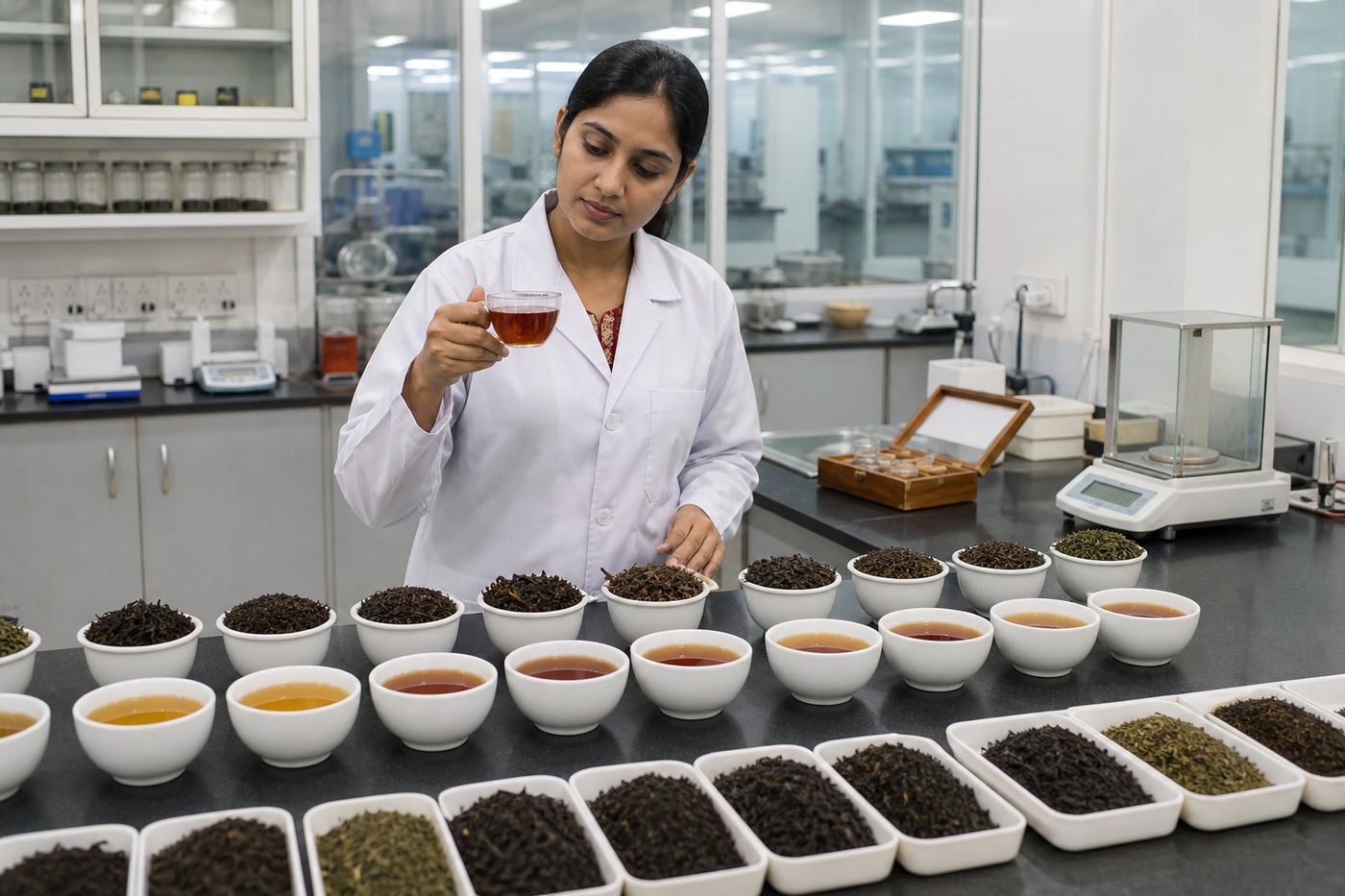
Assam CTC FOB Kolkata typically trades US$2.50–4.50/kg at auction depending on season, grade, and global Kenyan price benchmarks. Darjeeling first-flush FTGFOP can exceed US$15–40/kg for verified GI estate lots. Nilgiri orthodox BOP ranges US$4.00–7.50/kg FOB Cochin. Green tea bulk export pricing varies US$3.50–6.00/kg by origin and organic status.
Build FOB from estate or auction procurement cost plus blending, cupping evaluation, moisture testing, residue panel (where required), export-grade packaging (30–60 kg food-grade PP sacks at US$0.15–0.30/kg packed cost), Tea Board documentation, inland haulage to Kolkata/Cochin, and exporter margin. Organic certification adds US$0.50–1.50/kg amortised cost but unlocks 30–60% premium in EU and North American specialty channels.
Comparison table
Swipe →
Data table — swipe horizontally on small screens
| Grade / Type | FOB Range (US$/kg) | Typical MOQ | Incoterm |
|---|---|---|---|
| Assam CTC BP | $2.80–4.20 | 10–20 MT | FOB Kolkata |
| Assam CTC Dust/PD | $2.50–3.80 | 10–20 MT | FOB Kolkata |
| Assam orthodox BOP | $4.50–7.00 | 2–10 MT | FOB Kolkata |
| Darjeeling FTGFOP (1st flush) | $15–40+ | 500 kg–2 MT | FOB Kolkata |
| Nilgiri orthodox BOP | $4.00–7.50 | 2–10 MT | FOB Cochin |
| Nilgiri green tea bulk | $3.50–6.00 | 2–10 MT | FOB Cochin |
| Organic Darjeeling/Nilgiri | +30–60% premium | 500 kg+ | FOB per origin port |
Benefits of Tea Board Registration for Tea Exporters
Treat Tea Board benefits as a commercial toolkit. The certificate opens institutional doors; your grading, cupping, and documentation discipline close orders.
Comparison table
Swipe →
Data table — swipe horizontally on small screens
| Benefit | What You Gain | How to Use It for Tea |
|---|---|---|
| Exporter licence / registration | Mandatory shipping-bill credential for HS 0902 | Include in every buyer onboarding pack alongside IEC and FSSAI |
| Darjeeling GI origin certification | Legal authority to export tea labelled Darjeeling | Apply for GI certificates per estate; match lot to origin docs |
| Export statistics and intelligence | Destination-wise volume, value, and auction price data | Prioritise 1–2 markets using Board-published data |
| Buyer-seller meets and trade promotion | Tea Board-organised overseas exhibitions and buyer programmes | Prepare cupping samples, spec sheets, and MOQ/pricing before events |
| Quality and grading orientation | Access to Board quality standards and cupping frameworks | Align factory output to export grade specifications |
| Policy and scheme awareness | Notifications on export incentives, freight subsidies, and trade agreements | Track DGFT and Ministry of Commerce updates for tea-specific schemes |
| Auction infrastructure linkage | Kolkata, Coonoor, Guwahati auction access for registered trade | Use auction catalogue numbers in traceability documentation |
| Buyer credibility | Institutional signal to international importers and blenders | Attach Tea Board registration to all inquiry responses and fair presentations |
| Shipping and compliance continuity | Uninterrupted export documentation under Tea Act framework | Calendar renewal before peak export season (Oct–Mar) |
Documents Required for Tea Board Registration
Comparison table
Swipe →
Data table — swipe horizontally on small screens
| Document | Why It Matters | Practical Tip |
|---|---|---|
| IEC certificate | Mandatory for export and registration eligibility | Self-attest; name must match all other documents |
| GST registration certificate | Tax identity; confirms legal commercial entity | Address and legal name must align with IEC |
| PAN card | Entity tax identity | Use correct entity PAN for companies vs proprietors |
| FSSAI central licence | Food safety credential for tea as food product | Verify export-category coverage |
| Company incorporation / partnership deed | Proves legal entity constitution | Board resolution required for companies |
| Cancelled cheque / bank proof | Banking validation | Account name must match entity legal name |
| Estate registration (estate exporters) | Confirms tea garden ownership or management | Required for direct estate export classification |
| Address proof | Establishes registered business location | Keep consistent across GST, IEC, and FSSAI |
| Authorised signatory KYC | Identity verification of applicant | Match signatory to board resolution |
Tea Board Registration Fees and Costs
Tea Board exporter registration fees are modest relative to total export launch investment. Verify live fee schedules on teaboard.gov.in before remitting — amounts are subject to periodic revision. Registration fees represent a small fraction of cupping infrastructure, residue testing, packaging engineering, and fair participation costs.
Budget registration alongside parallel investments: NABL-accredited residue panels for EU-bound tea (US$300–800 per lot depending on compound count), professional cupping evaluation (US$50–150 per sample set), food-grade PP sack packaging (US$0.15–0.30/kg packed cost), and inland haulage to Kolkata or Cochin (US$0.05–0.12/kg depending on origin).
Comparison table
Swipe →
Data table — swipe horizontally on small screens
| Cost Item | Typical Nature | Planning Note |
|---|---|---|
| Tea Board registration fee | One-time + renewal | Verify live amount on portal |
| FSSAI central licence | Annual renewal | Required before registration |
| Cupping and quality evaluation | Per lot / per sample | Budget for every export consignment |
| Pesticide residue panel | Per lot at NABL lab | EU-bound tea requires 200+ compound panels |
| PP / paper sack packaging | Per kg packed | 30–60 kg sacks; palletisation additional |
| Fair participation | Booth, travel, samples | Tea Board buyer-seller meets reduce net cost |
Challenges & Solutions
- Applying without IEC — Solution: complete DGFT IEC before opening the Tea Board portal.
- Missing FSSAI licence — Solution: Central FSSAI licence should precede or accompany Tea Board registration.
- Name mismatches across IEC, GST, FSSAI, and deed — Solution: harmonise all legal names before uploading documents.
- Treating registration as the export plan — Solution: parallel cupping discipline, packaging engineering, and buyer outreach.
- Exporting Darjeeling without GI certificate — Solution: apply for Tea Board GI origin documentation per estate.
- Lapsed registration at shipping-bill filing — Solution: calendar renewal before October–March peak season.
- Assuming APEDA RCMC covers tea — Solution: tea requires Tea Board registration; APEDA is for other scheduled products.
- Cupping inconsistency across lots — Solution: professional tasters' evaluation per consignment with documented scores.
- Moisture above 5% at packing — Solution: re-dry before export packing; record on quality certificate.
- Document lot-number mismatches — Solution: align sack serials across invoice, packing list, and COA.
- Quoting buyers before landed-cost modelling — Solution: build FOB from procurement, testing, packing, haulage, and margin.
- Ignoring destination residue requirements — Solution: run EU/Japan panels before quoting premium markets.
Tea Board vs Other Export Bodies for Tea Exporters
Tea exporters sometimes ask whether APEDA, Spices Board, or FIEO registration replaces Tea Board credentials. For tea as the primary export product, the Tea Board is the correct and mandatory authority. Other bodies are complementary.
Comparison table
Swipe →
Data table — swipe horizontally on small screens
| Body | Primary Role for Tea Exporters | When to Engage |
|---|---|---|
| Tea Board of India | Mandatory exporter registration, GI certification, export promotion | Primary and mandatory for all commercial tea exporters |
| FSSAI | Food safety licence for tea as regulated food | Mandatory for all processors; required before buyer onboarding |
| APEDA | Scheduled agri-product registration (not tea) | Only if you also export honey, fruits, or other APEDA products |
| Spices Board | Spice RCMC (not tea) | Only if you also export spices under Spices Board jurisdiction |
| FIEO | Broad exporter federation, cross-sector advocacy | Supplementary networking and policy representation |
| DGFT | IEC issuance, export policy, incentive schemes | IEC first; foundation for all export operations |
Case Study: Assam Estate Using Tea Board Registration for Gulf Contract Supply
Background: A mid-size Assam bought-leaf factory near Jorhat produced 800,000 kg annually but sold only through domestic brokers. Management wanted direct export to a Dubai distributor who enquired about 15 MT monthly Assam CTC BP.
Registration process: Completed IEC and Central FSSAI licence first, then filed Tea Board exporter registration with company incorporation documents and board resolution. Received exporter registration number within three weeks after one deficiency correction (GST address mismatch).
Commercial activation: Attached Tea Board registration, FSSAI, and IEC to buyer onboarding pack. Pre-shipment cupping confirmed liquor colour (bright coppery), strength (strong), and briskness (good). Moisture: 4.1%. Residue panel: all compounds within EU MRL (buyer's stated requirement exceeded Gulf minimum).
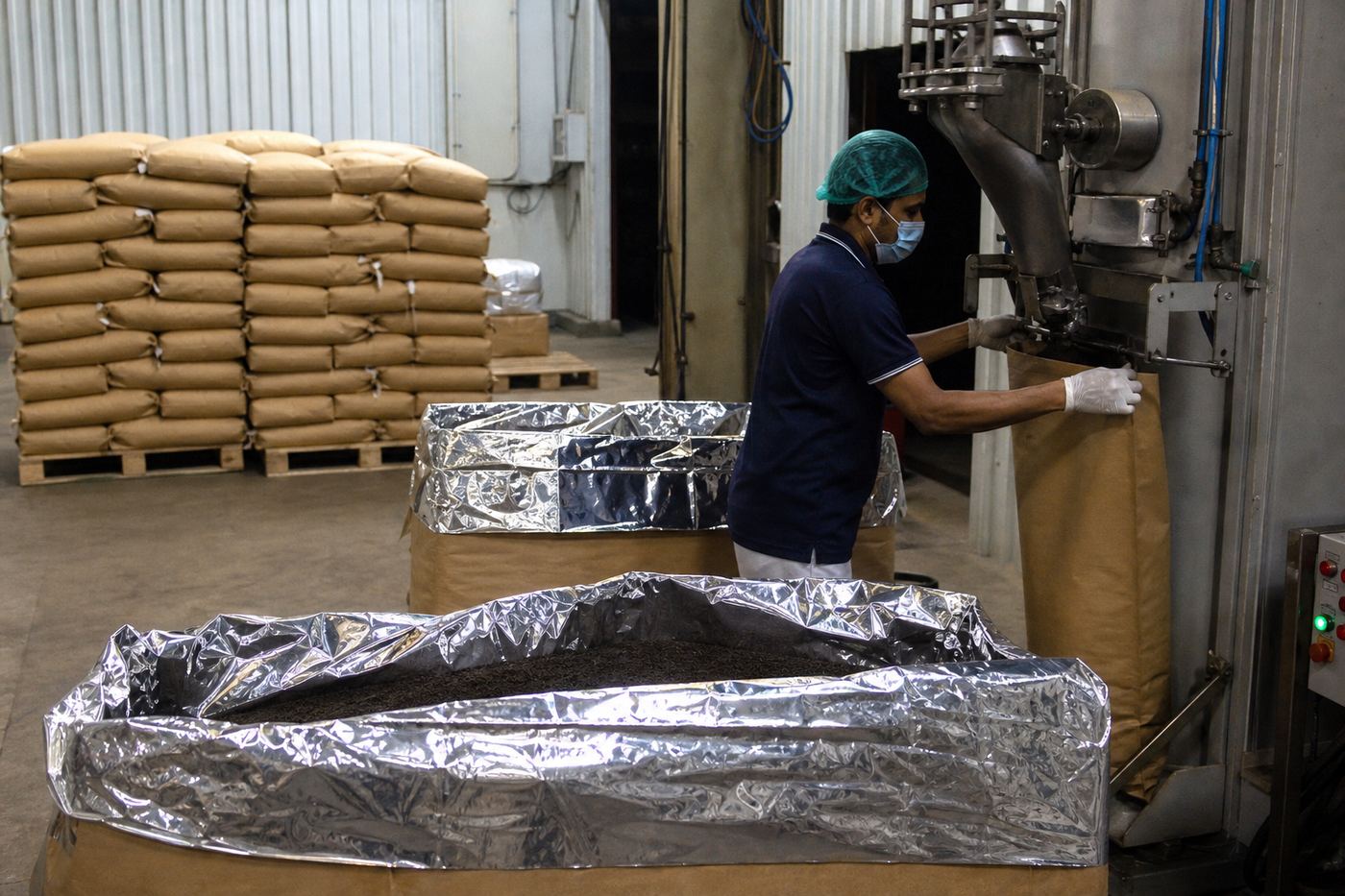
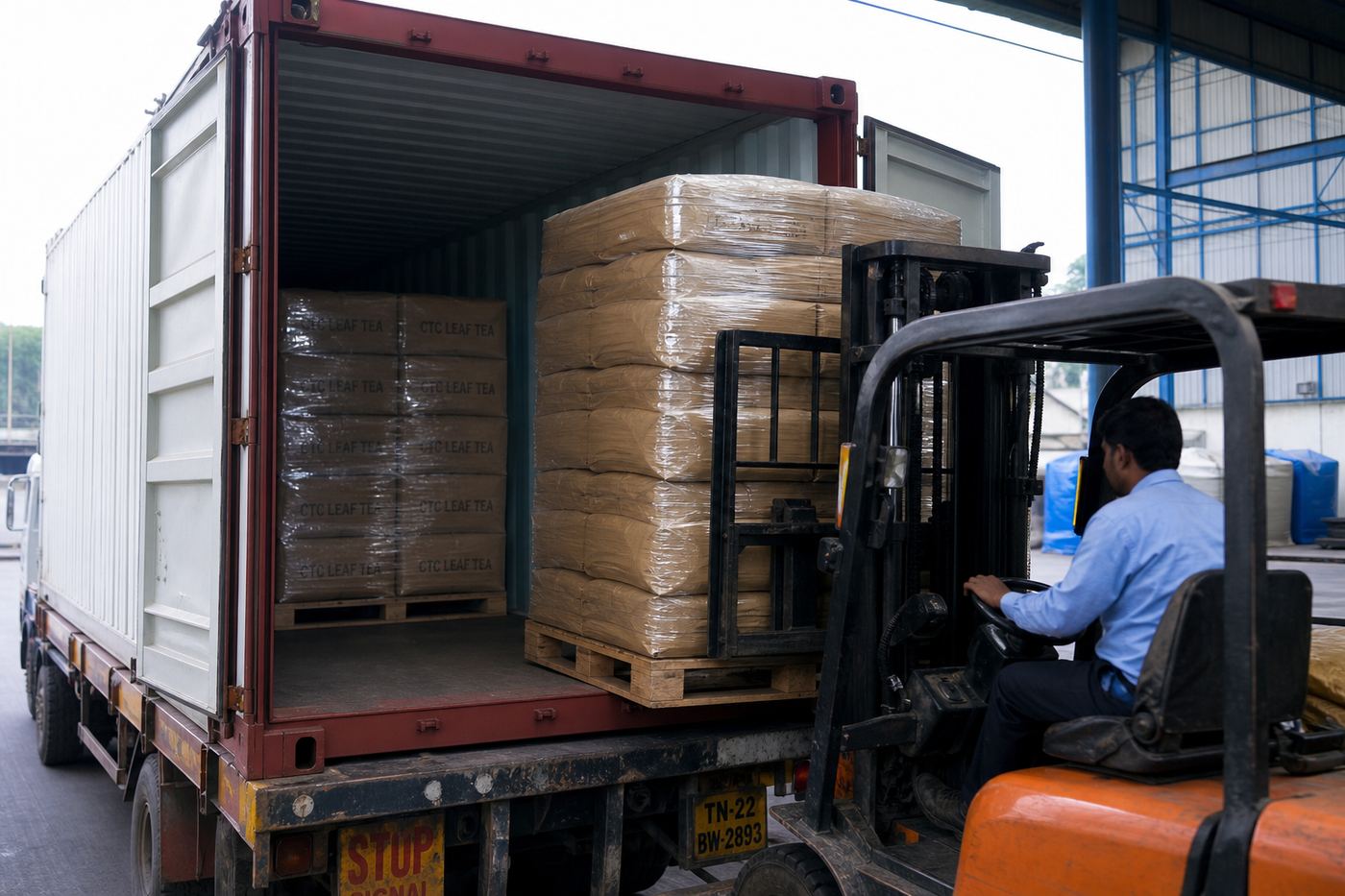
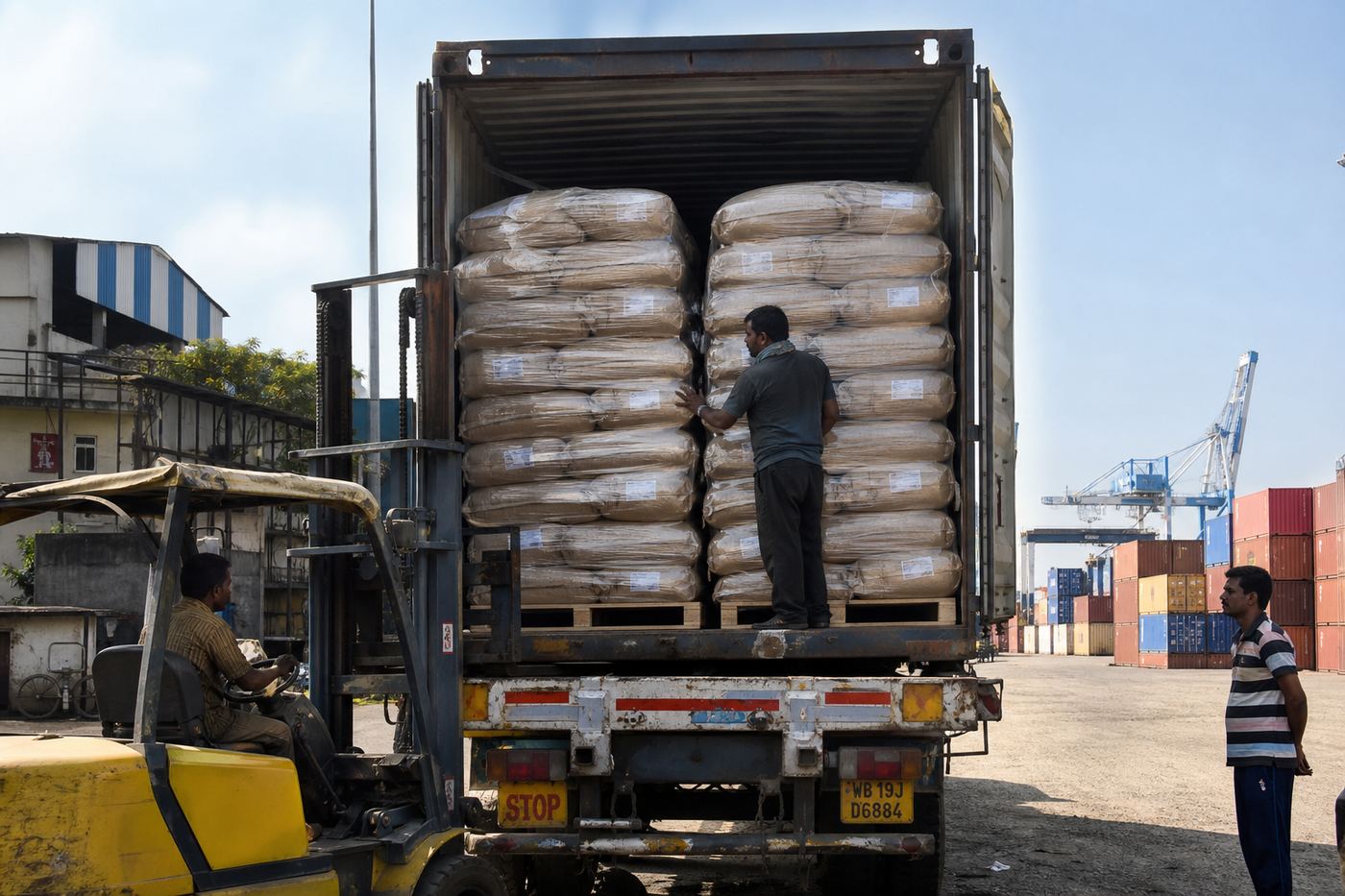
Logistics: First 15 MT shipped FOB Kolkata in 250 PP sacks of 60 kg, palletised, stretch-wrapped. Incoterm: FOB Kolkata. MOQ established at 15 MT per month. Documents: commercial invoice, packing list, bill of lading, certificate of origin, quality certificate with cupping report, phytosanitary certificate.
Results: Consignment cleared Jebel Ali without examination. Buyer cited Tea Board registration and consistent cupping as reasons for six-month contract at US$0.12/kg above previous Kenyan origin. Factory invested in additional packing line capacity.
Lessons learned: Registration converted a broker-dependent domestic operation into a contract-export programme. GI and quality documentation discipline mattered as much as the registration certificate itself.
Expert Insights from Saurabh Mittal
Expert Insight Box
Tea Board registration benefits are commercially realised only when exporters treat the credential as the start of a documentation system — not the finish. Buyers in Dubai, Moscow, London, and Hamburg have decades of cupping experience. They detect grade drift immediately. Registration gets you into the conversation; cupping consistency and lot-aligned documents get you the repeat order.
For estate owners and MSME packers entering export, the highest-leverage decision is sequencing: IEC, FSSAI, Tea Board registration, then professional cupping infrastructure, then buyer outreach with a complete credential pack. Merchant exporters who already hold Tea Board registration and maintain buyer relationships in target markets compress this timeline significantly.
Altus Exports operates as a merchant exporter and global sourcing partner for agricultural and food products from India, including tea. We coordinate estate and factory sourcing, grade validation, Tea Board documentation, FSSAI compliance, and shipment execution from Kolkata, Cochin, and Nhava Sheva — giving international buyers one accountable relationship for Indian tea procurement.
Executive Summary
Summary Box
This compliance guide is for Indian gardens, bought-leaf factories, Kolkata merchant exporters, and MSME packers preparing Tea Board exporter licensing. Pair the registration steps with the buyer-evidence sections so outreach starts only after credentials exist.
Exporting into a 255–280 million kg annual flow still requires sector licensing. Tea Board credentials, FSSAI, and accurate HS 0902 filing are how serious programmes enter that trade — brochure outreach without a licence does not.
Buyer Requirements
Buyer Requirements
- Grade and manufacture method stated on every quote (CTC/orthodox + grade letters).
- Cupping approval recorded against a sealed sample retained by both parties.
- Destination compliance notes (residues, Halal, organic, GI) agreed before production.
- Payment terms and inspection windows written into the proforma.
Once licensed, exporters still win programmes only when they can table FSSAI, grade cupping samples, lot COAs, pack specifications, and clear FOB/CFR terms — the licence opens the door; the evidence pack closes the order.
Common Buyer Mistakes
Common Mistakes Box
- Ordering 'Indian tea' without CTC/orthodox, grade, and pack detail.
- Skipping cupping approval and disputing liquor after arrival.
- Assuming APEDA or Spices Board credentials cover tea exports.
- Comparing suppliers on FOB alone without landed-cost and document risk.
- Over-ordering first containers before proving grade consistency across lots.
Most first-shipment tea failures are process failures, not leaf failures. Avoid the patterns below before you fund samples or containers.
Sourcing Checklist
Checklist
- Written spec: origin, CTC vs orthodox, grade, pack, Incoterm, HS 0902 sub-heading.
- Verify Tea Board exporter licence and FSSAI independently.
- Approve cupping sample and lot COA before scaling volume.
- Confirm packaging standard, MOQ stage, and lead time in writing.
- Model landed cost (freight, duty, brokerage) — not FOB alone.
Use this readiness checklist when evaluating whether a Tea Board–licensed exporter can support your programme. It connects licence proof, FSSAI, cupping samples, and commercial terms before you fund a trial shipment.
Exporter Checklist
Checklist
- IEC, GST, FSSAI, and Tea Board exporter licence are current.
- Grade sheet, cupping protocol, and pack format are locked.
- Lot COA template matches invoice and packing-list fields.
- Port, stuffing plan, and Incoterm are confirmed with the CHA/forwarder.
- Buyer claim window and rejection terms are agreed before sailing.
Exporters and merchant partners should clear this readiness list before outreach or first stuffing. It reduces document mismatches and cupping disputes on the first FCL.
Compliance Checklist
Checklist
Compliance Notes
- Tea Board exporter licence covers the exporting entity for HS 0902.
- Correct 0902.10/20 (green) or 0902.30/40 (black) by pack weight.
- Organic/GI claims have lot-linked certificates before packing completes.
- Destination residue, Halal, or label rules are reflected in the document pack.
- Lot numbers match across invoice, packing list, COA, and cartons/sacks.
Scan this compliance box before filing the shipping bill. Tea has its own statutory pathway — do not reuse APEDA or Spices Board credential assumptions.
Conclusion
- Do next: Verify live Tea Board registration fees and process on teaboard.gov.in, then file with a complete document pack before buyer outreach begins.
- Read how to export tea from India, the tea export documentation checklist, top tea products exported from India, most demanded Indian tea by country, best countries for Indian tea exports, find international buyers for tea, source tea directly from India, trade shows for tea exporters, and organic and specialty tea export opportunities.
- Explore agriculture & food products, merchant exporter, export products from India, global sourcing partner, and product sourcing company India partnership models.
Tea Board registration benefits for tea exporters encompass mandatory exporter licence eligibility, Darjeeling GI origin certification access, export statistics and market intelligence, buyer-seller facilitation, quality orientation, and the institutional credibility that shortens vendor onboarding in UAE, Iraq, Russia, USA, UK, Germany, and Iran. The key steps are clear — obtain IEC and FSSAI first, complete Tea Board registration with a clean document pack, calendar renewals, and activate GI and quality programmes where product strategy requires them.
Actionable next steps: verify IEC, GST, and FSSAI consistency; assemble the document checklist from this guide; complete Tea Board registration before buyer outreach; commission professional cupping evaluation for your target grades; and prepare a credential pack with registration, cupping reports, and MOQ/pricing. Altus Exports supports tea estate owners, bought-leaf factories, and merchant exporters who need registration frameworks, product readiness, and buyer connectivity aligned to real export execution.