
Top Tea Products Exported from India (Assam, Darjeeling, Nilgiri & More)
By Saurabh Mittal, Founder, Altus Exports
A product-by-product guide to the top tea exported from India — Assam CTC, Assam orthodox, Darjeeling first and second flush, Nilgiri, green tea, and specialty grades — with grade-vs-market comparison tables, pricing, and MOQ benchmarks.
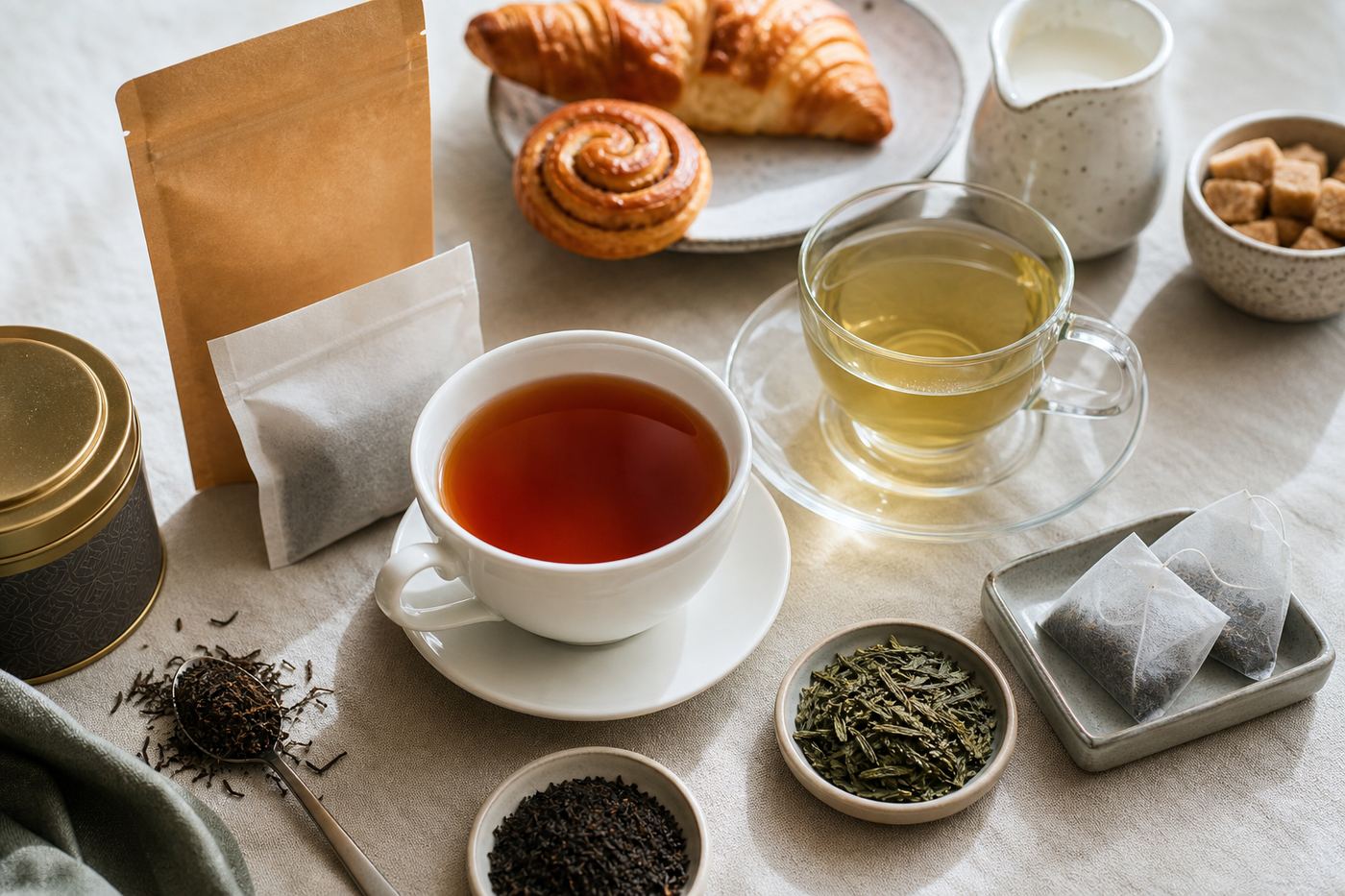
India is the world's second-largest tea producer, and its export catalogue spans a wide product range: commodity Assam CTC black tea, orthodox black tea, GI-protected Darjeeling across four flushes, Nilgiri whole-leaf tea, green tea, and a growing specialty segment covering organic, Fairtrade, and flavoured lines. Choosing the right product for the right market is the single highest-leverage decision an Indian tea exporter makes — and the one international buyers most often get wrong when sourcing for the first time.
This guide is a product-by-product catalogue of the top tea exported from India, built for buyers comparing grades and for exporters deciding where to focus production. For the operational steps to actually export a shipment — registration, licensing, documentation, and logistics — see How to Export Tea from India. For market-by-market entry strategy, see Best Countries for Indian Tea Exports and Most Demanded Indian Tea by Country.
India exports tea under HS code 0902, with black tea representing roughly 96% of export volume and FY25 export value exceeding US$900 million. Assam and South India CTC dominate volume to the Middle East, Russia, and CIS markets; Darjeeling, Assam orthodox, and Nilgiri serve premium channels in the UK, Germany, USA, and Japan. Altus Exports works as a merchant exporter in India and global sourcing partner matching Indian tea products to destination-market demand — this catalogue reflects that field experience.
Key Takeaways
Summary Box
Executive Summary
Summary Box
India's tea export catalogue is far broader than the commodity CTC that dominates export volume statistics. Six distinct product families — Assam CTC, Assam orthodox, Darjeeling, Nilgiri, green tea, and specialty/organic/flavoured tea — serve substantially different buyers, price points, and compliance requirements. Treating them as interchangeable is the fastest way to waste a sourcing cycle.
This guide profiles each product family with grade nomenclature, indicative FOB pricing, MOQ expectations, and the destination markets each is best suited for. It also covers packaging, container loading, certification, and country-fit tables that apply across the catalogue. For the step-by-step export process itself, see the companion guide How to Export Tea from India, which this article deliberately keeps light on to focus on product depth.
Buyers should use this guide to shortlist product categories before requesting quotations; exporters should use it to benchmark their own product mix against realistic destination-market fit.
Market Size and Industry Overview
Key Statistics
India produces roughly 1.3–1.4 billion kg of tea annually, making it the world's second-largest producer after China. Of that output, a comparatively modest export share — typically 10–12% — reaches international markets, with the balance consumed domestically. Assam and South India account for the majority of production volume, while Darjeeling represents a small but disproportionately high-value share of exports.
FY25 tea export value exceeded US$900 million, with black tea's roughly 96% volume share reflecting the scale of CTC production. The remaining volume — green tea, orthodox, and specialty/flavoured tea — is smaller in tonnage but often carries substantially higher unit value, making product selection a margin decision as much as a volume decision.
Indian Tea Product Landscape Snapshot (Indicative)
Swipe →
Data table — swipe horizontally on small screens
| Dimension | Approximate Figure | Relevance to Product Selection |
|---|---|---|
| Total annual production | ~1.3–1.4 billion kg | Deep raw material base across all six product families |
| Export share of production | ~10–12% | Export-grade selection is a minority, higher-scrutiny segment |
| FY25 export value | US$900 million+ | Confirms sustained international demand across product mix |
| Black tea share of exports | ~96% | CTC and orthodox black tea dominate; other categories are smaller, higher-margin niches |
| Growing regions | Assam, Darjeeling, Nilgiri, Dooars, Terai, Kangra | Origin determines which product family and grade a garden can supply |
| HS classification | HS 0902 (0902 10/20 green, 0902 30/40 black) | Product type and pack weight both determine the correct sub-heading |
Export Statistics
Key Statistics
Tea Board of India export statistics show a broadly stable export volume band year over year, with product mix shifting gradually toward higher-value specialty and organic segments even as CTC retains the dominant volume share. Understanding this split helps buyers gauge how much of India's export capacity is realistically available for each product category.
Indicative Export Volume Share by Product Family
Swipe →
Data table — swipe horizontally on small screens
| Product Family | Approx. Export Volume Share | HS Sub-heading | Primary Value Driver |
|---|---|---|---|
| Assam CTC (black) | ~55–60% | 0902 40 (bulk) / 0902 30 (retail pack) | Volume and price competitiveness |
| South India CTC (black) | ~15–20% | 0902 40 / 0902 30 | Volume; competitive with Assam on price |
| Orthodox black tea (Assam, Nilgiri) | ~10–12% | 0902 40 / 0902 30 | Whole-leaf appearance and cup character |
| Darjeeling (GI origin) | ~1–2% | 0902 30 / 0902 40 | GI scarcity and flush-timing premium |
| Green tea | ~2–3% | 0902 10 / 0902 20 | Growing specialty and CIS demand |
| Specialty / organic / flavoured | ~3–5% | Classified within 0902 by form | Certification and private-label premium |
Import Statistics: Destination Product Preferences
Key Statistics
Reading import-side data by product type — not just by country — sharpens sourcing decisions. A market that imports large volumes of Indian tea overall may import almost none of a specific product family, which matters enormously when a buyer is trying to place a Darjeeling-specific or organic-specific order.
Destination Product Preference Signals (Indicative)
Swipe →
Data table — swipe horizontally on small screens
| Destination | Dominant Product Preference | Secondary Interest | Sourcing Note |
|---|---|---|---|
| UAE | Assam CTC (BOP, BOPSM) | Blended grades for regional re-export | Re-export hub; product mix reflects onward markets |
| Iraq | Strong Assam CTC (PD, PF, BOP) | Minimal orthodox interest | Karak-tea culture demands strength and colour |
| Russia / CIS | CTC BP/BOP | Flavoured black tea retail | Gift packaging and flavoured blends growing |
| USA | CTC for foodservice | Darjeeling, Nilgiri, organic specialty retail | Two distinct buyer types within one country |
| UK | Darjeeling, Assam orthodox | English Breakfast blend components | Heritage and GI-origin credentials matter most |
| Germany | Organic Darjeeling, certified CTC | Nilgiri and Fairtrade specialty | Certification is the primary market-access gate |
| Japan | Ultra-premium Darjeeling, Nilgiri | High-grade Assam orthodox | Small volume, very high unit value |
Product Categories and Variants Exported from India
Summary Box
This is the core of the guide: a profile of each major Indian tea product family, its grade nomenclature, and the destination markets it is realistically suited for. Buyers should match their intended use — bag tea manufacturing, specialty retail, foodservice, or private label — to the product family before requesting samples.
Assam CTC Black Tea
Assam CTC Grades vs Market Fit
Swipe →
Data table — swipe horizontally on small screens
| Grade | Cup Character | Best-Fit Markets | Indicative FOB (USD/kg) |
|---|---|---|---|
| BP (Broken Pekoe) | Strong, coloury, medium particle | UAE, Russia, Egypt | $2.00–$3.00 |
| BOP (Broken Orange Pekoe) | Strong, brisk, well-balanced | UAE, Iraq, Iran | $2.20–$3.20 |
| BOPSM (Small Broken) | Very strong, high colour | Iraq, Iran, UAE blends | $2.30–$3.50 |
| PD (Pekoe Dust) | Strong, fast-brewing, high colour | Iraq, Libya, domestic blenders | $1.90–$2.80 |
| PF (Pekoe Fannings) | Strong, quick infusion | Iraq, CIS, bag-tea manufacturing | $1.90–$2.80 |
| Dust | Strongest, lowest appearance grade | Domestic blending, bag-tea, low-cost export | $1.80–$2.60 |
Assam CTC is India's largest-volume export product, processed through Cut-Tear-Curl rollers into small, dense granules that brew quickly into strong, colourful liquor. It is the backbone of India's commodity tea trade, particularly to the Middle East, Russia, and CIS markets, where strong-brew preferences dominate.
Assam Orthodox Black Tea
Assam Orthodox Grades vs Market Fit
Swipe →
Data table — swipe horizontally on small screens
| Grade | Cup Character | Best-Fit Markets | Indicative FOB (USD/kg) |
|---|---|---|---|
| OP (Orange Pekoe) | Full-bodied, malty | UK, Germany, USA | $4.00–$6.00 |
| FOP (Flowery Orange Pekoe) | Aromatic, tippy leaf | UK, Germany, Japan | $4.50–$7.00 |
| GFOP (Golden Flowery Orange Pekoe) | Rich, golden tips, premium appearance | UK, USA specialty, Germany | $5.00–$8.00 |
| TGFOP (Tippy Golden FOP) | Highest orthodox grade, complex aroma | UK, Germany, Japan specialty | $6.00–$10.00 |
Assam orthodox tea is rolled to preserve whole or twisted leaf structure, producing a fuller, more nuanced cup than CTC. It commands a meaningful premium over CTC and serves specialty and blending buyers in the UK, Germany, and USA who value leaf appearance alongside cup character.
Darjeeling Tea (GI Origin)
Darjeeling is India's most globally recognised tea, protected by Geographical Indication (GI) certification that restricts the name to tea grown within the defined Darjeeling district. Flush timing drives both flavour character and price, making Darjeeling a calendar-driven product rather than a year-round commodity.
First Flush (Spring)
Harvested in March–April, first flush produces light, floral, delicate liquor and commands the highest prices of the Darjeeling calendar due to scarcity and buyer demand from UK, German, and Japanese specialty channels. Indicative FOB pricing ranges from $10.00 to $35.00+ per kg depending on estate reputation and garden-specific demand.
Second Flush (Summer)
Harvested in May–June, second flush develops the distinctive muscatel character Darjeeling is best known for, and is often preferred by connoisseurs over first flush. Indicative FOB pricing ranges from $8.00 to $25.00 per kg, with strong demand from UK, Germany, and USA specialty retailers.
Monsoon (Rains) Flush
Harvested during the summer monsoon, this flush produces a stronger, less delicate liquor at lower price points, often used for blending or value-tier retail rather than single-estate marketing. It offers buyers a lower-cost entry into genuine Darjeeling sourcing.
Autumnal Flush
Harvested in October–November, autumnal flush produces a fuller-bodied, coppery liquor distinct from spring and summer flushes, valued by some specialty buyers for its unique seasonal character. Pricing sits between monsoon and second flush levels, offering a fourth distinct product within the Darjeeling calendar.
Nilgiri Tea
Nilgiri Tea Grades vs Market Fit
Swipe →
Data table — swipe horizontally on small screens
| Form | Cup Character | Best-Fit Markets | Indicative FOB (USD/kg) |
|---|---|---|---|
| Nilgiri CTC | Bright, brisk, fast-brewing | Domestic blending, Middle East value tier | $2.00–$3.00 |
| Nilgiri Orthodox (OP) | Fragrant, clean, medium-bodied | UK, USA, Germany specialty | $3.50–$6.00 |
| Nilgiri Organic Orthodox | Clean, certified, retail-ready | Germany, USA, UK organic retail | $4.50–$10.00 |
Nilgiri tea, grown in the hill regions of Tamil Nadu, produces a bright, brisk, fragrant liquor available in both CTC and orthodox forms. It is often positioned as a clean-cup, good-value specialty tea and is increasingly targeted for organic certification, making it a strong fit for UK and US buyers seeking specialty alternatives to Darjeeling at a lower price point.
Green Tea
Green Tea Grades vs Market Fit
Swipe →
Data table — swipe horizontally on small screens
| Grade / Style | Cup Character | Best-Fit Markets | Indicative FOB (USD/kg) |
|---|---|---|---|
| Chunmee-type green | Robust, slightly smoky | CIS, North Africa-linked trade | $2.50–$4.00 |
| Specialty green (Darjeeling/Nilgiri) | Delicate, grassy, clean | Germany, USA, Japan specialty | $4.00–$12.00 |
| Organic certified green | Clean, certified, retail-ready | Germany, USA organic retail | $5.00–$14.00 |
Indian green tea, produced primarily in Darjeeling, Nilgiri, and limited Assam volumes, is unfermented and processed to preserve a lighter, grassier cup profile. It remains a smaller export category than black tea but serves distinct demand in CIS markets, specialty US and German retail, and growing domestic wellness-driven consumption that is increasingly extending into export.
Specialty, Organic, and Flavoured Tea
Specialty Segment Overview
Swipe →
Data table — swipe horizontally on small screens
| Category | Typical Base | Best-Fit Markets | Indicative FOB (USD/kg) |
|---|---|---|---|
| Organic certified CTC or orthodox | Assam, Nilgiri, Darjeeling | Germany, USA, UK | $3.50–$8.00 |
| Fairtrade certified tea | Assam, Darjeeling estates | UK, Germany, Netherlands | $4.00–$10.00 |
| Flavoured / masala chai blends | CTC base with added flavouring | USA, UK, UAE retail, Russia | $3.00–$8.00 |
| Instant tea / soluble powder | Processed extract | Japan, USA food manufacturing | $5.00–$12.00 |
Beyond origin-based categories, a growing specialty segment spans organic-certified black and green tea, Fairtrade-certified programmes, and flavoured or scented tea — masala chai bases, Earl Grey-style bergamot blends, and fruit-infused retail lines. This segment is the fastest-growing part of India's tea export catalogue by value, driven by private-label and branded retail demand in the USA, UK, Germany, and UAE.
Manufacturing Overview
Export Tip
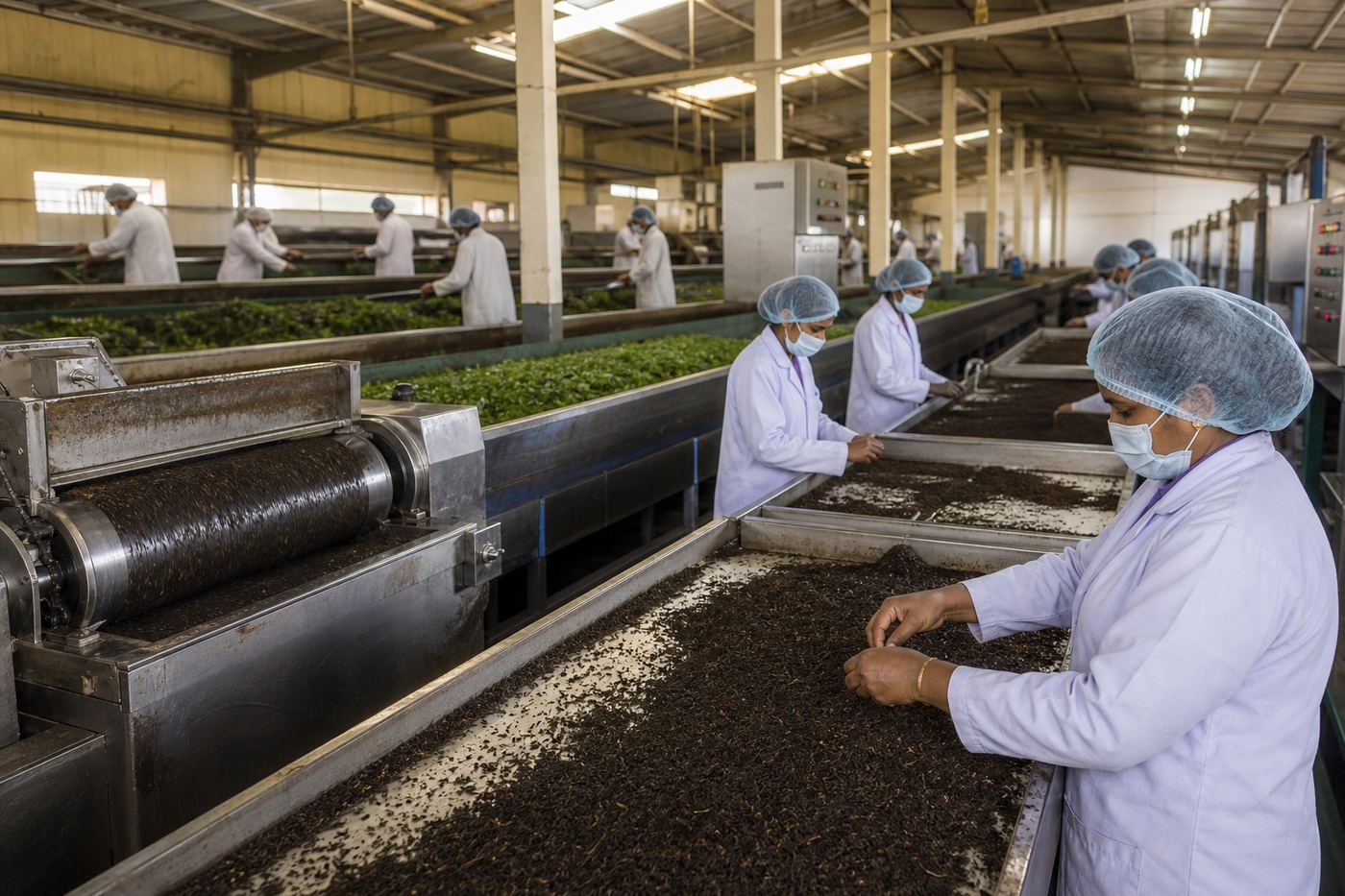
All Indian black tea products share the same core manufacturing stages — plucking, withering, rolling, fermentation, drying, and sorting — with the rolling stage determining whether the output is CTC or orthodox. CTC processing produces the granular particles used in Assam and South India commodity grades, while orthodox processing preserves whole or twisted leaf for Assam orthodox, Nilgiri orthodox, and all Darjeeling grades. Green tea skips fermentation entirely, with leaf steamed or pan-fired shortly after withering to preserve its lighter character.
For a detailed step-by-step breakdown of tea processing alongside the full export process — registration, sourcing, sampling, documentation, and shipment — see How to Export Tea from India, which covers manufacturing and export logistics in depth.
Pricing Analysis: Indicative FOB Ranges Across the Product Catalogue
Buyer Tip
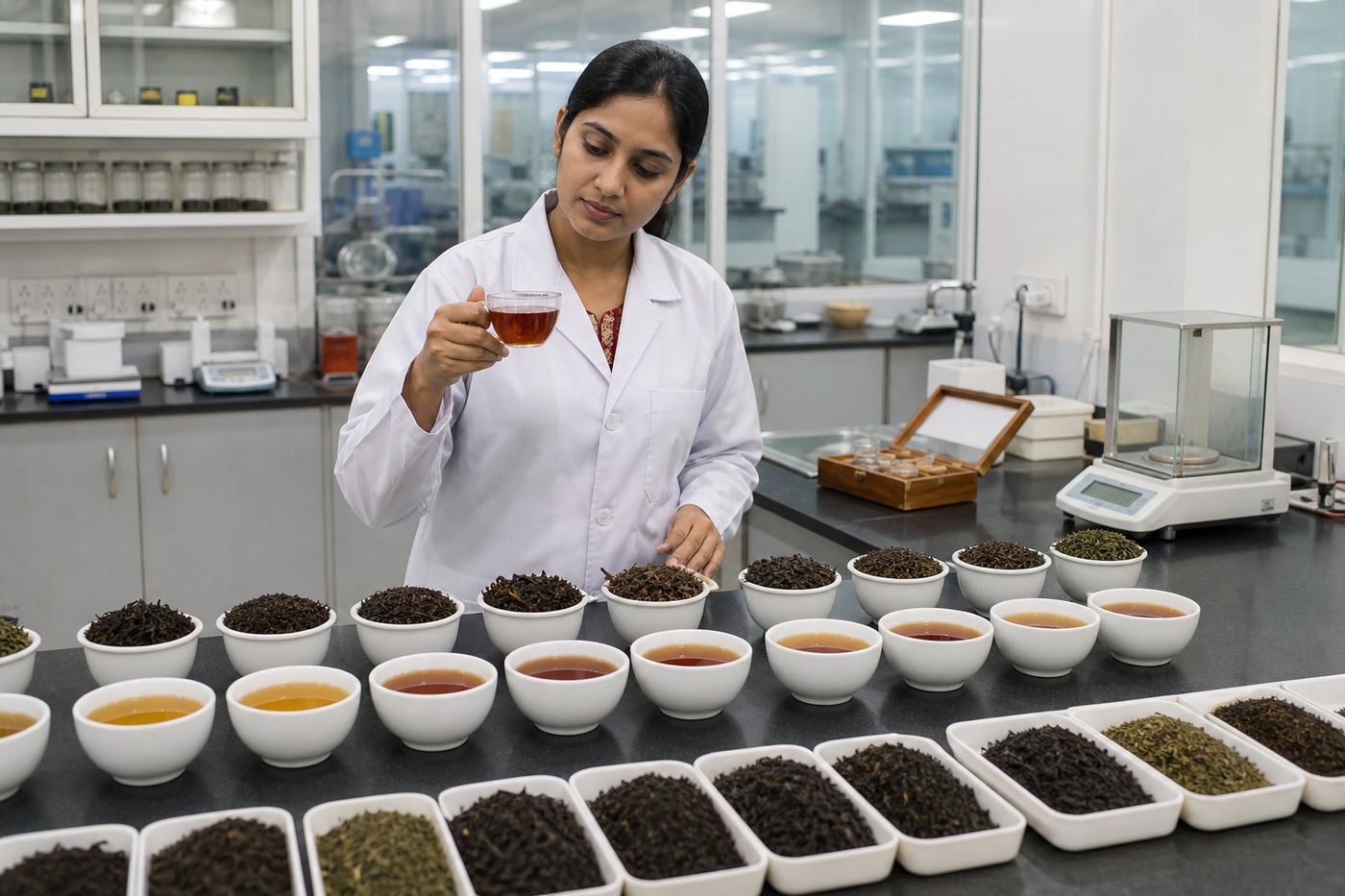
Consolidating indicative FOB pricing across all six product families shows the wide spread that product selection creates — from sub-$2.00/kg commodity CTC dust to $35.00+/kg Darjeeling first flush. Buyers should treat these as starting benchmarks to validate against current auction data, not fixed quotations.
Indicative FOB Price Ranges by Product Family (USD/kg)
Swipe →
Data table — swipe horizontally on small screens
| Product Family | Lower Grade Range | Upper Grade Range | Key Price Driver |
|---|---|---|---|
| Assam / South India CTC | $1.80–$2.60 | $2.30–$3.50 | Auction cycle; blend strength and colour |
| Assam Orthodox | $4.00–$6.00 | $6.00–$10.00 | Leaf appearance; tippy grade proportion |
| Darjeeling (all flushes) | $3.00–$8.00 (monsoon) | $10.00–$35.00+ (first flush) | Flush timing; GI scarcity; estate reputation |
| Nilgiri | $2.00–$3.00 (CTC) | $4.50–$10.00 (organic orthodox) | Certification; clean-cup positioning |
| Green tea | $2.50–$4.00 | $5.00–$14.00 (organic specialty) | Origin, certification, specialty positioning |
| Specialty / organic / flavoured | $3.00–$4.00 | $8.00–$12.00 | Certification premium; private-label value-add |
MOQ Analysis by Product
Buyer Tip
MOQ expectations vary widely across the product catalogue — commodity CTC is priced and packed for full-container efficiency, while premium and flush-specific Darjeeling is often sold in smaller, higher-value lots that make full containers unrealistic for a single buyer.
Typical MOQ by Product Family
Swipe →
Data table — swipe horizontally on small screens
| Product Family | Trial Order MOQ | Standard Programme MOQ |
|---|---|---|
| Assam / South India CTC | 5 MT | 1 x 20ft FCL (~10–12 MT) |
| Assam Orthodox | 1–2 MT | 3–5 MT per shipment |
| Darjeeling (per flush) | 200–500 kg | 1–2 MT per flush order |
| Nilgiri | 500 kg–1 MT | 2–5 MT per shipment |
| Green tea | 500 kg–1 MT | 2–3 MT per shipment |
| Specialty / organic / flavoured (finished retail) | 500 kg–1 MT finished | Scales with retail programme size |
Packaging Standards by Product
Export Tip
Packaging format tracks product value and end use — bulk commodity CTC prioritises cost-efficient moisture protection, while premium Darjeeling and specialty lines prioritise aroma preservation and retail presentation.
Packaging Format by Product Category
Swipe →
Data table — swipe horizontally on small screens
| Product Category | Standard Packaging | Unit Size | Key Requirement |
|---|---|---|---|
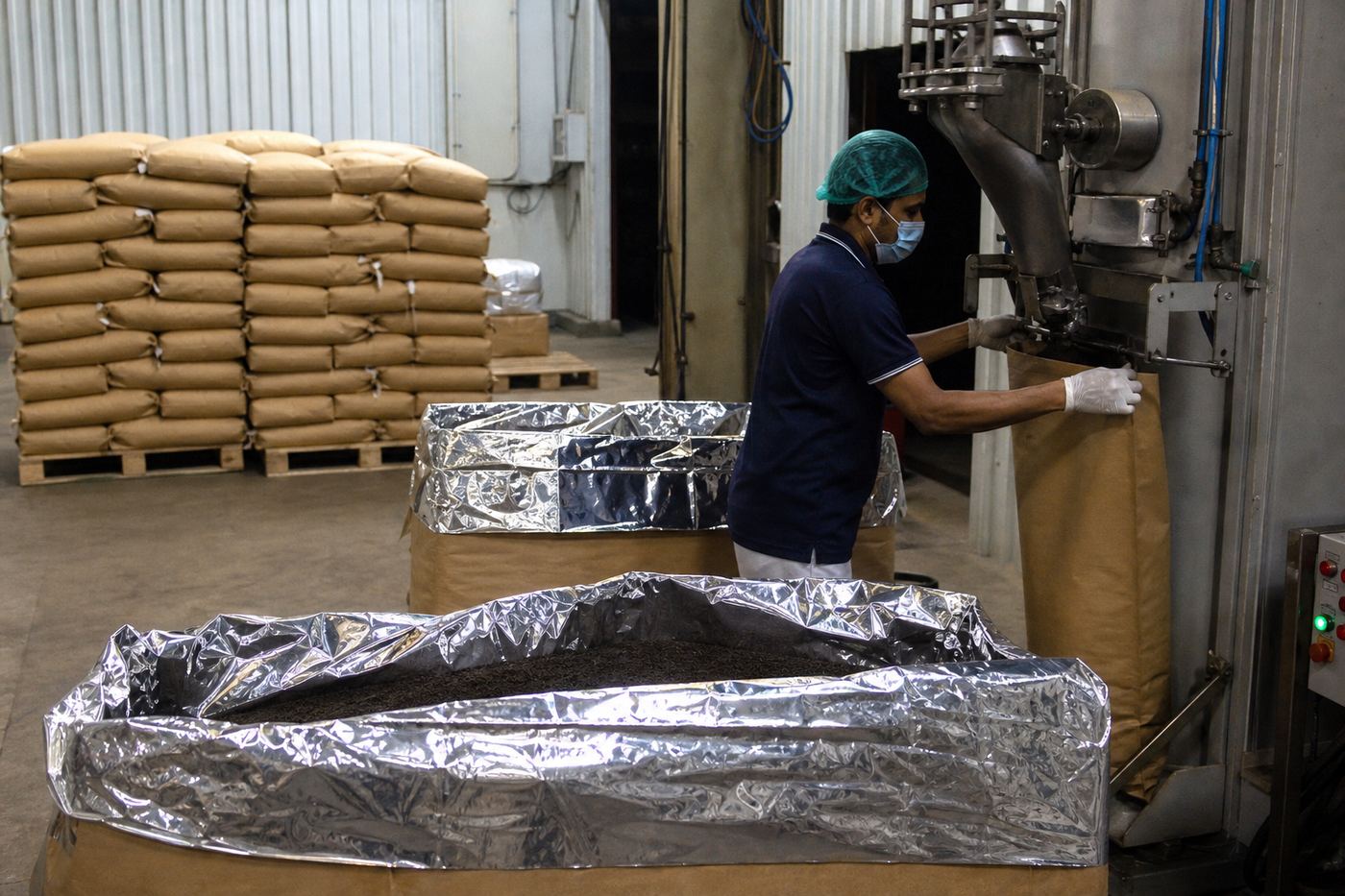
| Assam / South India CTC (bulk) | Multiwall paper sacks with PE liner | 25–60 kg | Moisture barrier integrity |
| Assam Orthodox (bulk) | Multiwall sacks or plywood chests | 20–50 kg | Aroma retention during transit |
| Darjeeling (all flushes) | Foil-lined chests or vacuum multi-ply bags | 5–25 kg | Aroma and flush-freshness preservation |
| Nilgiri | Multiwall sacks (CTC) or foil bags (orthodox) | 20–50 kg | Matches CTC or orthodox handling needs |
| Green tea | Vacuum-sealed multi-ply bags | 5–25 kg | Oxidation control for unfermented leaf |
| Specialty / retail-ready | Tea bags or retail tins/pouches | Per SKU specification | Label and branding compliance |
Container Loading Details
Export Tip
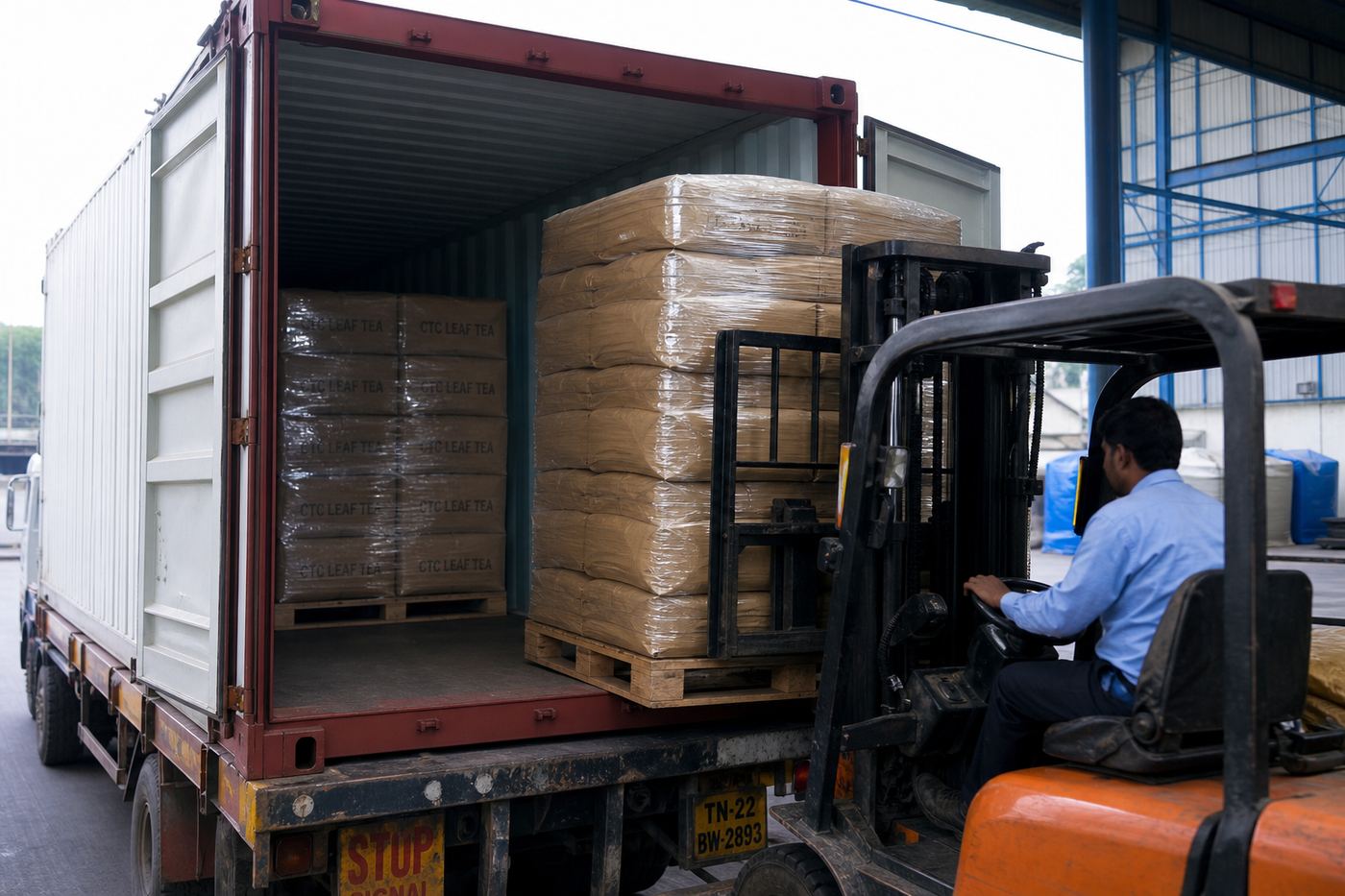
Container loading benchmarks vary by product bulk density. CTC packs efficiently by weight, while orthodox and Darjeeling chests often reach a container's volume limit before its weight limit.
Indicative Container Loading by Product Type
Swipe →
Data table — swipe horizontally on small screens
| Product Type | Container | Approx. Net Weight | Notes |
|---|---|---|---|
| Assam / South India CTC | 20ft FCL | ~10–12 MT | ~200–240 sacks (50 kg each) |
| Assam / South India CTC | 40ft FCL | ~20–24 MT | ~400–480 sacks (50 kg each) |
| Assam Orthodox / Nilgiri Orthodox | 20ft FCL | ~7–9 MT | Lower bulk density than CTC |
| Darjeeling (foil chests) | 20ft FCL or LCL | ~5–8 MT (rarely full container for one buyer) | Often shipped as consolidated LCL |
Shipping Methods
Export Tip
Sea freight in FCL or LCL configuration handles the vast majority of Indian tea exports across all product families, chosen for cost efficiency on both bulk CTC volumes and consolidated premium lots. Air freight is reserved for time-sensitive premium orders — most notably Darjeeling first-flush samples and trial lots where freshness and speed to market justify the higher cost per kilogram. Kolkata/Haldia, Cochin, and Nhava Sheva remain the primary load ports across the product catalogue, chosen by origin proximity and buyer routing preference.
Certifications by Product Category
Compliance Notes
Certification requirements scale with product positioning — commodity CTC requires only the baseline registrations, while Darjeeling and specialty organic products carry additional mandatory or commercially expected certifications.
Certification Relevance by Product Category
Swipe →
Data table — swipe horizontally on small screens
| Certification | Assam/South India CTC | Assam/Nilgiri Orthodox | Darjeeling | Organic/Specialty |
|---|---|---|---|---|
| Tea Board of India exporter licence | Mandatory | Mandatory | Mandatory | Mandatory |
| FSSAI food business licence | Mandatory | Mandatory | Mandatory | Mandatory |
| Darjeeling GI certification | Not applicable | Not applicable | Mandatory for GI claims | Mandatory if Darjeeling-origin |
| NPOP / organic certification | Rare | Occasional | Occasional (organic estates) | Mandatory for organic claims |
| ISO 3720 | Optional | Optional | Optional, often expected by UK/EU buyers | Optional |
| Rainforest Alliance | Rare | Occasional | Occasional | Common for EU sustainability-focused buyers |
Buyer Requirements Across the Product Catalogue
Buyer Requirements
- Commodity CTC buyers: consistent grade specification, competitive FOB pricing, and reliable container-programme scheduling
- Orthodox buyers: leaf appearance consistency, tippy-grade proportion, and cupping notes matched to blend requirements
- Darjeeling buyers: estate name, flush identification, GI certificate, and harvest-date traceability
- Nilgiri and green tea buyers: clean-cup verification and, increasingly, organic certification documentation
- Specialty/private-label buyers: formulation consistency, packaging compliance, and confidentiality on custom blends
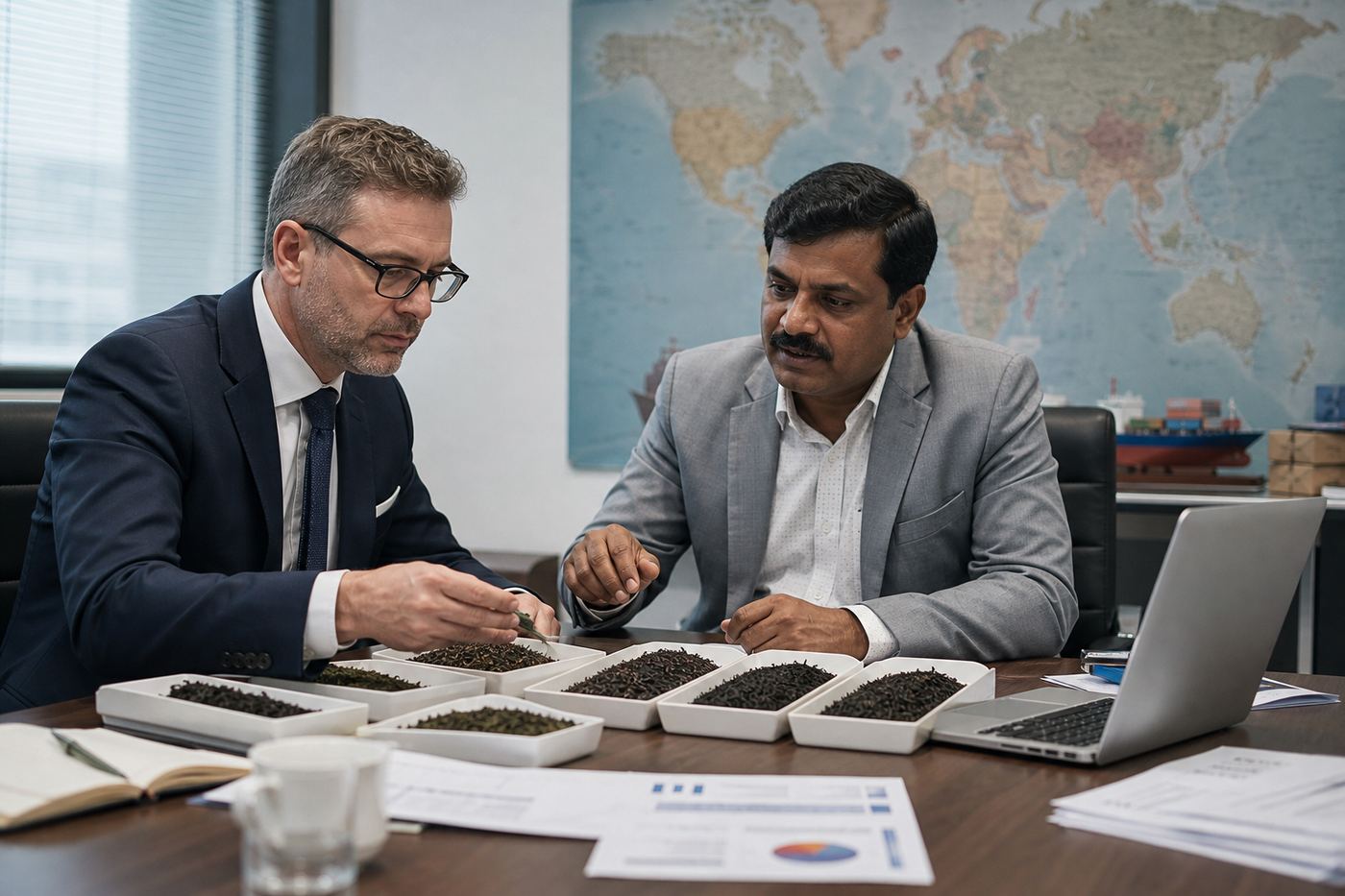
Buyer expectations shift meaningfully by product family. Commodity CTC buyers prioritise price consistency and container economics; specialty and Darjeeling buyers prioritise traceability, flush-specific documentation, and cupping consistency across successive lots.
Country-wise Opportunities by Product
Market Snapshot
Matching product family to destination country is the fastest way to avoid a failed first shipment. For full market-entry strategy per country, see Best Countries for Indian Tea Exports.
Country-Product Fit Matrix (Overview)
Swipe →
Data table — swipe horizontally on small screens
| Country | Best-Fit Product(s) | Weak Fit |
|---|---|---|
| UAE | Assam/South India CTC, blended grades | Ultra-premium Darjeeling first flush |
| Iraq | Strong Assam CTC (PD, PF, BOP) | Delicate green tea, light orthodox |
| Russia / CIS | CTC BP/BOP, flavoured black tea | Ultra-premium single-estate Darjeeling |
| USA | CTC (foodservice) + Darjeeling/Nilgiri (specialty) | Low-grade Dust for specialty retail |
| UK | Darjeeling, Assam orthodox | Undifferentiated commodity CTC |
| Germany | Organic Darjeeling, certified CTC, Nilgiri organic | Uncertified conventional CTC |
| Japan | Ultra-premium Darjeeling, Nilgiri, high-grade orthodox | Commodity Dust and Fannings |
Sourcing Checklist for International Buyers
Checklist
Exporter Checklist for Product Positioning
Checklist
Compliance Checklist
Checklist
Compliance Notes
Common Buyer Mistakes When Selecting Tea Products
Common Mistakes Box
Product selection mistakes are common among first-time buyers unfamiliar with India's tea nomenclature and calendar-driven Darjeeling market. The patterns below account for a large share of failed first orders.
Common Product Selection Mistakes
Swipe →
Data table — swipe horizontally on small screens
| Mistake | Consequence | Fix |
|---|---|---|
| Requesting 'Darjeeling tea' without specifying flush | Receives whichever flush is in stock, often mismatched to intended use | Always specify flush and harvest year in the RFQ |
| Assuming CTC and orthodox are interchangeable | Wrong cup character delivered; buyer complaints on brew strength | Specify processing method, not just origin, in every order |
| Buying unverified 'Darjeeling' without GI certificate | Risk of non-GI tea sold under a protected name | Request GI certificate reference on every Darjeeling invoice |
| Ordering commodity Dust for a specialty retail launch | Product fails visually and in cup quality on retail shelf | Match grade tier to retail positioning before ordering |
| Skipping cupping on organic claims | Organic certificate present but cup quality inconsistent | Cup every batch regardless of certification status |
Future Market Trends
Key Statistics
Three product-level trends are shaping India's tea export catalogue: growing organic and Fairtrade certification adoption across Assam, Darjeeling, and Nilgiri estates in response to German and US specialty demand; increased buyer interest in flush-specific and estate-specific Darjeeling marketing, rewarding traceability over generic 'Darjeeling blend' positioning; and steady growth in flavoured and private-label specialty tea for US and UAE retail, expanding beyond origin-driven marketing into formulation-driven differentiation.
Exporters who diversify their product catalogue across commodity, orthodox, and specialty tiers — rather than depending on a single grade — are better positioned to capture margin across both stable volume markets and the faster-growing premium segment.
Conclusion
- Next: for the full step-by-step export process, see How to Export Tea from India.
- Choosing a market: Best Countries for Indian Tea Exports and Most Demanded Indian Tea by Country.
- Registration detail: Tea Board Registration Benefits for Exporters.
- Documentation: Tea Export Documentation Checklist.
- Buyer-side sourcing: How to Source Tea Directly from India and Find International Buyers for Tea.
- Specialty depth: Organic & Specialty Tea Export Opportunities from India.
- Trade show planning: Trade Shows for Tea Exporters.
- Browse agriculture & food products for related industry context.
India's top exported tea products span a wide spectrum: Assam CTC for commodity volume, Assam and Nilgiri orthodox for mid-premium blending, Darjeeling across four distinct flushes for ultra-premium specialty, green tea for a smaller but growing niche, and an expanding specialty/organic/flavoured segment for private-label and branded retail. Matching the right product to the right destination market — using the comparison tables in this guide — is the highest-leverage decision in Indian tea sourcing.
Altus Exports connects international buyers with verified Indian tea suppliers across this full product range as a merchant exporter in India and global sourcing partner. Explore export products from India, product sourcing company services, or find manufacturers in India for grade-matched supplier introductions.