
Top Hand Printed Textile Products Exported from India: Product Catalogue Guide
By Saurabh Mittal, Founder, Altus Exports
A complete product catalogue guide to the top hand printed textile products exported from India — block print, Bagru, Sanganer, Dabu, Ajrakh, Kalamkari, and hand screen print across cushion covers, throws, table linen, curtains, scarves, and yardage — with MOQ by colourway, packaging by fabric format, pricing bands, and buyer channel mapping from Altus Exports.
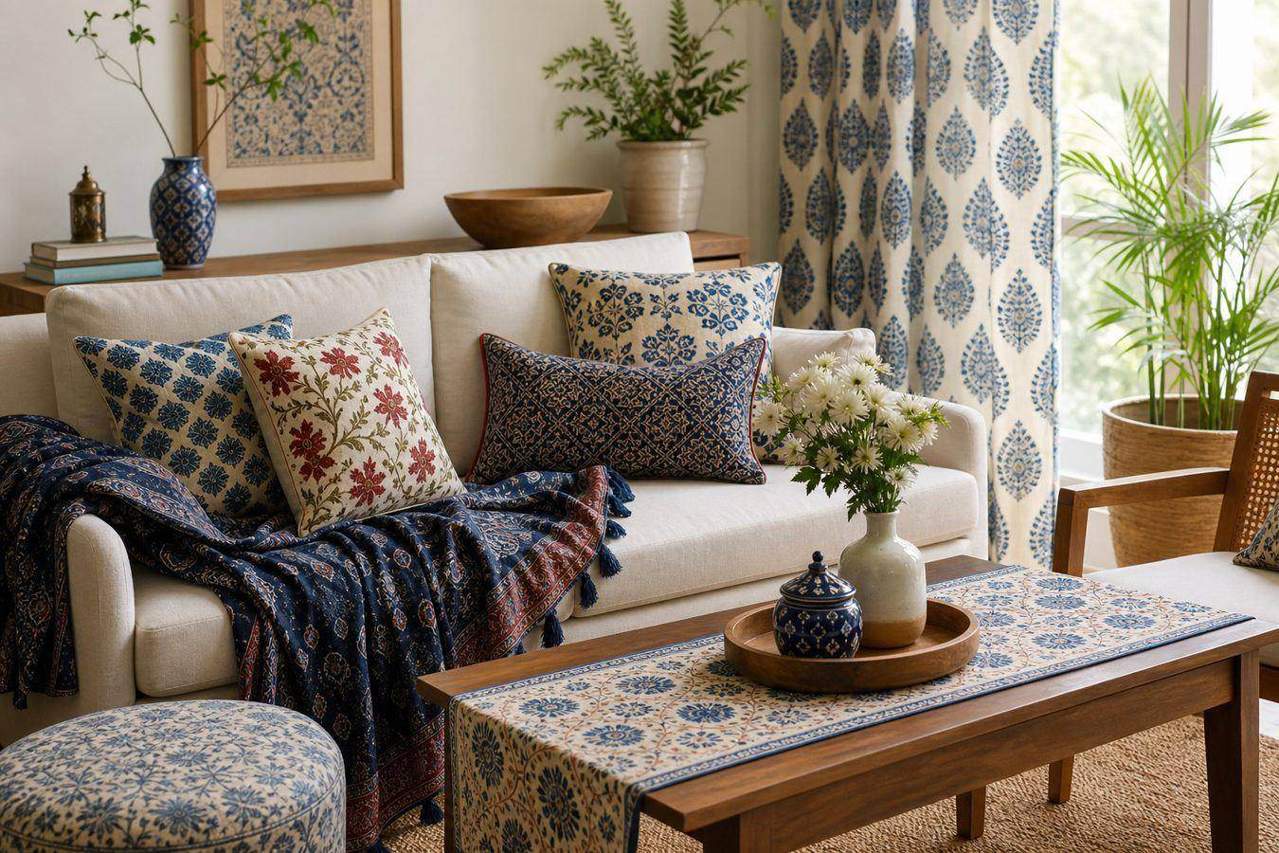
India exports a wide spectrum of hand printed textile products to home specialty retailers, design boutiques, e-commerce private-label brands, hospitality soft-furnishing procurement teams, fashion fabric buyers, and wholesale showrooms across the United States, Germany, the United Kingdom, the UAE, and beyond. The catalogue is not one undifferentiated "Indian print fabric" line — it spans Bagru and Sanganer woodblock print on cotton bases, Dabu mud-resist geometry, Kutch Ajrakh natural-dye resist yardage, Machilipatnam and Srikalahasti Kalamkari narrative and floral motifs, and volume hand screen print programmes converted into cushion covers, throws, table linen, curtains, scarves, and coordinated soft-furnishing assortments in Panipat, Karur, and Tirupur.
What separates a successful hand print sourcing programme from a one-container experiment is SKU selection discipline matched to buyer channel, not artisan catalogue breadth alone. A US home specialty chain wanting a coordinated living-room print story needs different hero SKUs, colourway MOQs, and packaging formats than a European fashion fabric buyer sourcing Sanganer yardage by the roll, or a UAE hospitality buyer specifying Kalamkari table runners with azo-free reactive dyes and retail-ready care labels. This guide maps the top hand printed textile products exported from India by print technique and made-up format, with indicative FOB bands, MOQ by colourway, packaging standards by yardage versus made-up, and channel-fit guidance — so importers, distributors, and procurement teams can build a defensible first assortment before issuing a purchase order.
This article is the product catalogue pillar for the hand printed textiles export cluster. The end-to-end export process — IEC, EPCH RCMC, strike-off QC, ports, Incoterms, and lead times — lives in How to Export Hand Printed Textiles from India. Destination-market ranking lives in Best Countries for Indian Hand Printed Textile Exports. Buyer-side sourcing and strike-off playbooks live in Source Hand Printed Textiles Directly from India. Country-by-country technique demand mapping lives in Most Demanded Indian Hand Printed Textiles by Country. Sustainable and natural-dye programme depth lives in Block Print, Ajrakh, Kalamkari & Sustainable Hand Printed Textile Export Opportunities.
Key Takeaways
Summary Box
Executive Summary
Summary Box
This guide catalogues the top hand printed textile products exported from India organised by print technique — block print (Bagru, Sanganer, contemporary), Dabu mud-resist, Ajrakh, Kalamkari, and hand screen print — and by made-up format: cushion covers, throws, table linen, curtains and drapery, scarves and stoles, apparel-facing yardage, and coordinated soft-furnishing programmes. For each major category it sets out typical fabric bases, indicative FOB pricing bands, MOQ by colourway, packaging format, HS heading patterns, and the buyer channels where that SKU class performs best.
Use this catalogue to shortlist hero SKUs for your first purchase order, structure strike-off and trial MOQs by colourway, and align packaging specifications with your destination channel before you engage an exporter or artisan unit. Process steps — registration, documentation, shipping — are intentionally linked out to the cluster process pillar rather than duplicated here.
Market Size & Industry Overview
Key Statistics
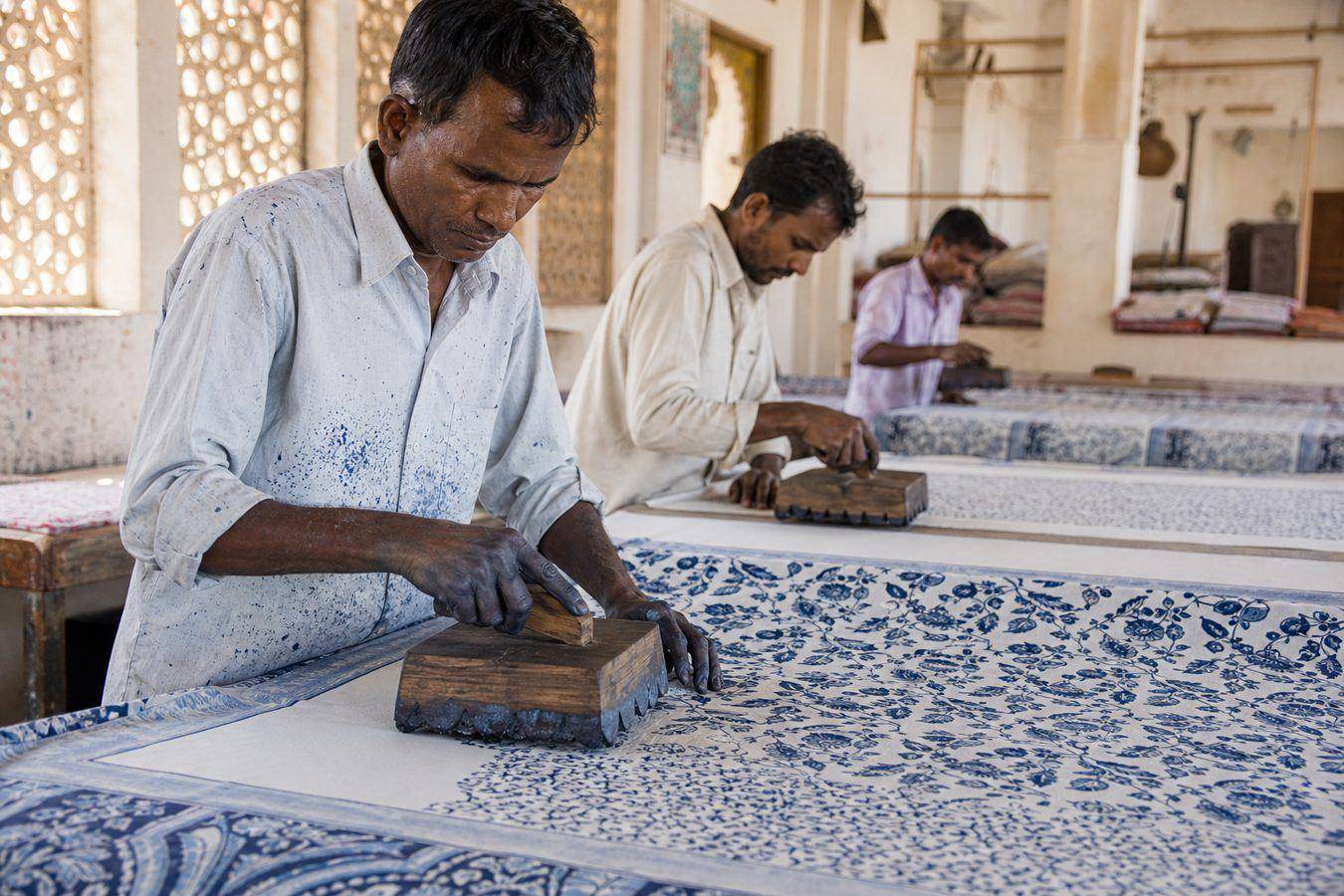
India's hand printed textile export supply base is distributed across craft-print artisan clusters and made-up conversion belts rather than concentrated in a single industrial park. Rajasthan's Jaipur–Sanganer–Bagru corridor produces the block-print and Dabu programmes that dominate international visual association with Indian print. Gujarat's Kutch and Ajrakhpur belt supplies Ajrakh natural-dye resist yardage and made-ups prized in premium and heritage-positioned retail. Andhra Pradesh's Machilipatnam and Srikalahasti units produce Kalamkari table linen, yardage, and narrative panels. Panipat, Karur, and Tirupur convert printed base fabric — sourced from artisan clusters or printed in-house — into high-velocity cushion covers, throws, curtains, and scarves at volumes suited to department stores and e-commerce private label.
Directionally, demand is strongest where buyers want technique-led storytelling with repeatable colourway supply — home specialty retail, design boutiques, hospitality soft furnishings, and fashion fabric programmes — rather than undifferentiated commodity print fill. EPCH tracks textile handicraft export streams relevant to craft-print lines; TEXPROCIL adjacency applies when cotton made-ups classify under cotton textile made-ups rather than EPCH-scheduled handicraft headings. Treat aggregate trade figures as directional context, not as a single published "hand print total."
Print technique to cluster mapping for top exported products
Swipe →
Data table — swipe horizontally on small screens
| Print Technique | Primary Cluster | Typical Fabric Base | Top Export Formats |
|---|---|---|---|
| Bagru block print | Bagru, Rajasthan | Scoured cotton, khadi cotton | Cushion covers, yardage, scarves |
| Sanganer block print | Sanganer, Rajasthan | Fine cotton, mulmul, voile | Yardage, curtains, table linen, apparel fabric |
| Dabu mud-resist | Bagru/Jaipur belt | Cotton, sometimes silk blend | Yardage, throws, coordinated sets |
| Ajrakh | Kutch/Ajrakhpur, Gujarat | Cotton, modal, silk blend | Yardage, throws, stoles, heritage programmes |
| Kalamkari | Machilipatnam, Srikalahasti | Cotton, cotton-silk | Table linen, yardage, wall panels, stoles |
| Hand screen print | Panipat, Karur, Tirupur | Cotton, linen blend, viscose | Cushions, throws, curtains, volume yardage |
Export Statistics
Key Statistics
EPCH publishes a dedicated "Handprinted Textiles" export category: Rs 2,450.62 crore in FY 2023-24, rising to Rs 3,216.94 crore in FY 2024-25 (+31.27% YoY in rupee terms; ~US$380–382 million directional). By EPCH's FY 2024-25 country-wise data, UAE absorbs the largest named value, followed by USA, UK, France, Germany, Canada, Japan, Australia, and Netherlands — supplement this with ITC Trade Map data on printed cotton fabrics (HS 5208/5209 family) and furnishing made-ups imports (6303/6304) by destination for a fuller picture, with channel mix varying by technique premium and compliance burden.
Within buyer conversations, block-print cushion covers, Ajrakh yardage, and Kalamkari table linen consistently rank among the highest-velocity first-order SKUs for new importers — not because they represent the largest published trade line, but because they combine manageable MOQ, clear channel fit, and strong retail margin storytelling. Always label trade figures as directional and re-verify against latest EPCH, TEXPROCIL, DGFT, and ITC Trade Map releases.
Directional export velocity by product format (buyer-facing, not official HS totals)
Swipe →
Data table — swipe horizontally on small screens
| Product Format | Directional Export Velocity | Primary Buyer Channel |
|---|---|---|
| Block-print cushion covers | Very high | Home specialty retail, e-commerce, wholesale |
| Ajrakh yardage and throws | High (premium) | Design boutiques, heritage retail, fashion fabric |
| Kalamkari table linen | High (premium) | Home specialty, hospitality, gift wholesale |
| Sanganer yardage | High | Curtain private label, apparel fabric, design trade |
| Hand screen print curtains | Medium-high (volume) | Department stores, hospitality, e-commerce |
| Printed scarves/stoles | Medium | Design boutiques, museum shops, gift wholesale |
| Coordinated colourway programmes | Growing | Retail chains, hospitality FF&E procurement |
Import Statistics
Key Statistics
Import-side data helps buyers and exporters understand where destination demand concentrates. By EPCH's Handprinted Textiles FY 2024-25 country-wise data, UAE leads by value (Rs 1,539.46 crore) with fast wholesale and hospitality velocity, followed by USA (Rs 319.92 crore) with the deepest import base for printed furnishing and apparel-facing cotton prints; UK, France, and Germany show quality- and cert-conscious design retail; Canada, Japan, and Australia are smaller but strategically relevant niches. Supplement with ITC Trade Map and national customs publications on printed cotton fabrics and furnishing made-ups for a fuller picture, since these HS families are not fully disaggregated by print method.
For country-specific technique preferences — which markets favour Ajrakh over Bagru, which require OEKO-TEX before first order, which hospitality channels specify Kalamkari table programmes — see Most Demanded Indian Hand Printed Textiles by Country. For market-entry ranking methodology, see Best Countries for Indian Hand Printed Textile Exports.
EPCH Handprinted Textiles import demand signals by destination (FY 2024-25 value order)
Swipe →
Data table — swipe horizontally on small screens
| Destination | EPCH FY24-25 Value (Rs crore) / Import Profile | Technique Fit |
|---|---|---|
| UAE | 1,539.46 — fast wholesale and hospitality | Volume screen cushions, table linen, curtain panels |
| USA | 319.92 — large printed furnishing and apparel fabric base | Block print cushions, screen curtains, Sanganer yardage |
| UK | 65.56 — design retail and soft furnishings | Coordinated block print programmes, Kalamkari table |
| France | 49.32 — craft-provenance retail | Heritage Ajrakh, fine Sanganer, Kalamkari |
| Germany | 46.26 — quality- and cert-conscious print retail | Ajrakh, GOTS organic block, azo-free Kalamkari |
| Japan | 35.92 — quality-focused selective sourcing | Fine block yardage, restrained colourway programmes |
| Australia | 22.17 — premium niche home textile | Natural-dye programmes, certified print lines |
Product Categories / Variants
Summary Box
The sections below catalogue top exported hand printed textile products by technique and made-up format. Each entry covers typical specifications, indicative FOB, MOQ by colourway, packaging format, HS heading pattern, and best-fit buyer channel. Bedding-led printed programmes that classify primarily under sheet-set logic may also reference the bedsheet export cluster and TEXPROCIL registration guide — this catalogue treats printed bed linen only as a print-technique SKU format, not as a thread-count-led bedding guide.
Block Print Cushion Covers (Bagru & Sanganer)
Block-print cushion cover export profile
Swipe →
Data table — swipe horizontally on small screens
| Attribute | Typical Specification |
|---|---|
| Fabric base | Scoured cotton 140–200 GSM; fine cotton for Sanganer |
| Print technique | Hand woodblock, 2–4 colour passes |
| HS heading (verify) | 6304 furnishing articles |
| Indicative FOB | US$2–12/pc depending on size, colours, finish |
| Strike-off MOQ | 5–20 pcs/SKU/colourway |
| Trial MOQ | 200–500 pcs/hero SKU/colourway |
| Packaging | Polybag + export carton; colourway/size label |
| Best channels | Home specialty, e-commerce private label, wholesale showrooms |
Block-print cushion covers are among the highest-velocity hand printed export SKUs — accessible MOQ, strong retail margin, and immediate visual impact in store and e-commerce photography. Bagru covers typically feature earth-toned natural-dye or azo-free reactive palettes on scoured cotton with visible hand-block registration character. Sanganer covers often use finer cotton bases with floral and paisley repeats suited to design-forward retail. Envelope-back and zip closures, knife-edge and piped finishes, and insert-ready sizing (45×45 cm, 50×50 cm, 18×18 in, 20×20 in) are standard export specifications.
Ajrakh Yardage, Throws & Stoles
Ajrakh product export profile
Swipe →
Data table — swipe horizontally on small screens
| Format | Indicative FOB | Strike-off MOQ | Packaging |
|---|---|---|---|
| Cotton yardage (44–58 in width) | US$8–25+/m | 1–5 m/colourway | Roll + tube; moisture barrier; dye lot label |
| Throws (130×170 cm typical) | US$15–45/pc | 5–20 pcs/colourway | Folded polybag + carton; breathable wrap |
| Stoles / scarves | US$8–25/pc | 5–20 pcs/colourway | Individual polybag; hangtag for retail |
| Modal / silk-blend premium | Premium above cotton bands | 1–5 m/colourway | Tissue interleave; avoid plastic sweat |
Ajrakh from Kutch and Ajrakhpur represents India's premium heritage print export tier — natural-dye resist cycles producing indigo, madder, black, and white geometry with depth that machine rotary cannot replicate. Yardage exports serve fashion fabric buyers and curtain private-label programmes; throws and stoles serve design boutiques and museum retail. Buyers must accept natural-dye lot variation within agreed tolerance and plan colourway MOQs accordingly.
Kalamkari Table Linen & Yardage
Kalamkari table linen export profile
Swipe →
Data table — swipe horizontally on small screens
| SKU Type | Typical Dimensions | Indicative FOB | Best Channel |
|---|---|---|---|
| Table runner | 30×180 cm, 40×200 cm | US$8–25/pc | Home specialty, hospitality |
| Placemat (set of 4–6) | 33×48 cm typical | US$12–35/set | Gift wholesale, e-commerce |
| Napkin | 40×40 cm, 50×50 cm | US$3–10/pc | Hospitality, coordinated dining programmes |
| Tablecloth | 150×250 cm and custom | US$25–45/pc | Hospitality, premium home retail |
| Yardage (apparel/wall) | 44–54 in width | US$8–20+/m | Fashion fabric, interior design trade |
Kalamkari table linen — runners, placemats, napkins, and tablecloths — exports strongly to home specialty retail, hospitality FF&E procurement, and gift wholesale. Machilipatnam and Srikalahasti units supply narrative floral and figurative motifs as well as contemporary simplified florals for volume retail. Fabric bases are typically cotton or cotton-silk; natural-dye and azo-free reactive pathways both export, with compliance documentation requirements differing materially by destination.
Sanganer & Screen Print Yardage
Printed yardage export profile by technique
Swipe →
Data table — swipe horizontally on small screens
| Technique | Width | Indicative FOB | Wholesale MOQ |
|---|---|---|---|
| Volume screen print cotton | 44–58 in | US$2.5–6/m | 500–2000 m/colourway |
| Bagru block yardage | 44–54 in | US$4–10/m | 100–500 m/colourway |
| Sanganer fine block | 44–54 in | US$6–15/m | 100–300 m/colourway |
| Ajrakh yardage | 44–58 in | US$8–25+/m | 100–300 m/colourway |
Printed cotton yardage — block, screen, or hybrid — is the backbone SKU for fashion fabric buyers, curtain private-label programmes, and apparel brands sourcing print-by-the-metre. Volume screen print from Panipat and Karur belts delivers repeat consistency for retail chains; Sanganer fine block yardage delivers craft character for design trade. Width, weight, repeat length, and colour count drive pricing more than any single factor.
Printed Throws, Curtains & Coordinated Programmes
Throws and curtain export profile
Swipe →
Data table — swipe horizontally on small screens
| Product | Typical Spec | Indicative FOB | Packaging |
|---|---|---|---|
| Throw / blanket | 130×170 cm, 150×200 cm cotton | US$12–35/pc | Folded polybag + carton |
| Curtain panel (unlined) | 140×250 cm per panel | US$15–35/pc | Folded bag; header tape specified |
| Curtain panel (lined) | 140×250 cm | US$25–45/pc | Heavier carton; vertical fold minimisation |
| Coordinated 3-SKU set | Cushion + throw + runner | US$25–60+/set | Colourway-labelled inner packs + master carton |
Throws and curtain panels extend block print and screen print programmes from hero cushion SKUs into full room-set storytelling — increasingly requested by home specialty chains and hospitality procurement teams. Coordinated colourway programmes bundle cushion, throw, and curtain SKUs from one block library or screen separations, requiring strict colourway MOQ discipline and colourway-separated packing across the assortment.
Printed Scarves & Stoles
Printed scarves and stoles export under apparel accessory headings — typically 6214 — with Ajrakh, Bagru, Kalamkari, and fine Sanganer techniques all represented. Size ranges from narrow neck scarves to full stoles (55×200 cm and wider). Hem finish (rolled, machine, hand), fringe, and label placement drive both FOB and retail readiness.
Manufacturing Overview
Export Tip
Manufacturing pathways differ materially by technique. Block print units carve or maintain wood blocks, scorch and mordant fabric, register repeats by hand, and wash-fix dyes — labour intensity is high and output per day is low relative to screen print. Ajrakh units run multi-day resist and vat-dye cycles with drying intervals between passes. Kalamkari combines pen work and block fills with boil-fast fixation. Made-up conversion adds cutting, stitching, and finishing — often at a separate facility from the print unit — which means export-ready cushion covers and table linen require coordination between artisan printer and conversion workshop.
Buyers sourcing top exported SKUs should understand where value is added: a Bagru cushion cover may be printed in Bagru and stitched in Jaipur or Delhi-NCR; an Ajrakh throw may be printed in Ajrakhpur and finished at a Karur conversion unit for export packing standards. Merchant exporters like Altus Exports exist precisely to manage this multi-node coordination while presenting one accountable export interface to international buyers.
Pricing Analysis
Buyer Tip
Hand printed textile pricing reflects technique labour, dye chemistry, fabric base quality, repeat complexity, made-up conversion, and certification — not commodity cotton index alone. The table below sets directional FOB bands by product class; confirm at quote date with fabric weight, colour count, and destination labelling requirements specified.
Directional FOB pricing matrix for top hand printed textile exports
Swipe →
Data table — swipe horizontally on small screens
| Product Class | Technique | Directional FOB (USD) | Primary Price Driver |
|---|---|---|---|
| Cushion cover | Bagru/Sanganer block | $2–12/pc | Size, colour passes, edge finish, labelling |
| Cushion cover | Hand screen | $2–8/pc | Print area, colour count, volume tier |
| Throw | Block / Ajrakh | $12–35/pc | Size, dye type, natural-dye premium |
| Table runner | Kalamkari / block | $8–25/pc | Length, motif complexity, dye pathway |
| Curtain panel | Screen / block | $15–45/pc | Lining, header, dimensions |
| Yardage | Volume screen | $2.5–6/m | Weight, width, colour count |
| Yardage | Heritage Ajrakh / fine block | $8–25+/m | Natural-dye cycles, resist passes |
| Scarf / stole | Ajrakh / Kalamkari | $8–25/pc | Size, hem, fabric blend |
| Private-label certified organic | GOTS block/screen | Premium, evidence-dependent | Cert scope, strike-off cycles, testing |
MOQ Analysis
Buyer Tip
MOQ in hand printed textiles is structured by colourway and technique, not by factory alone. A single design in three colourways is effectively three SKUs with three strike-off cycles and three bulk minimums. Natural-dye Ajrakh and custom-carved block programmes carry higher effective MOQs because setup labour is front-loaded. Volume screen print carries lower metre MOQs but less craft differentiation.
MOQ by colourway and technique for top export SKUs
Swipe →
Data table — swipe horizontally on small screens
| Stage | Block Print Made-ups | Ajrakh / Kalamkari | Volume Screen / Yardage |
|---|---|---|---|
| Strike-off | 5–20 pcs/SKU/colourway | 1–5 m or 5–20 pcs/colourway | 1–5 m/colourway |
| Trial | 200–500 pcs/hero SKU/colourway | 50–200 m or 100–300 pcs/colourway | 100–500 m/colourway |
| Wholesale | By colourway/carton (500–2000+ pcs total programme) | 100–500 m/colourway typical | 500–2000 m/colourway |
| FCL programme | 20GP/40HC mixed made-ups | Roll-heavy 40HC | Roll-heavy 20GP/40HC |
Technique-Specific MOQ Considerations
Technique-specific MOQ considerations
Swipe →
Data table — swipe horizontally on small screens
| Technique | MOQ Driver | Buyer Tip |
|---|---|---|
| Bagru block | Block availability, colour passes | Reuse existing blocks to lower first MOQ |
| Custom block carve | Carving cost amortised over bulk | Budget block fee in first-season costing |
| Ajrakh natural dye | Vat setup, drying time | Limit colourways per order to reduce lot variance |
| Kalamkari narrative | Hand-drawn element labour | Simplified motifs lower MOQ for volume retail |
| Hand screen | Screen making per separation | Reuse separations across seasons to reduce setup |
Packaging Standards
Export Tip
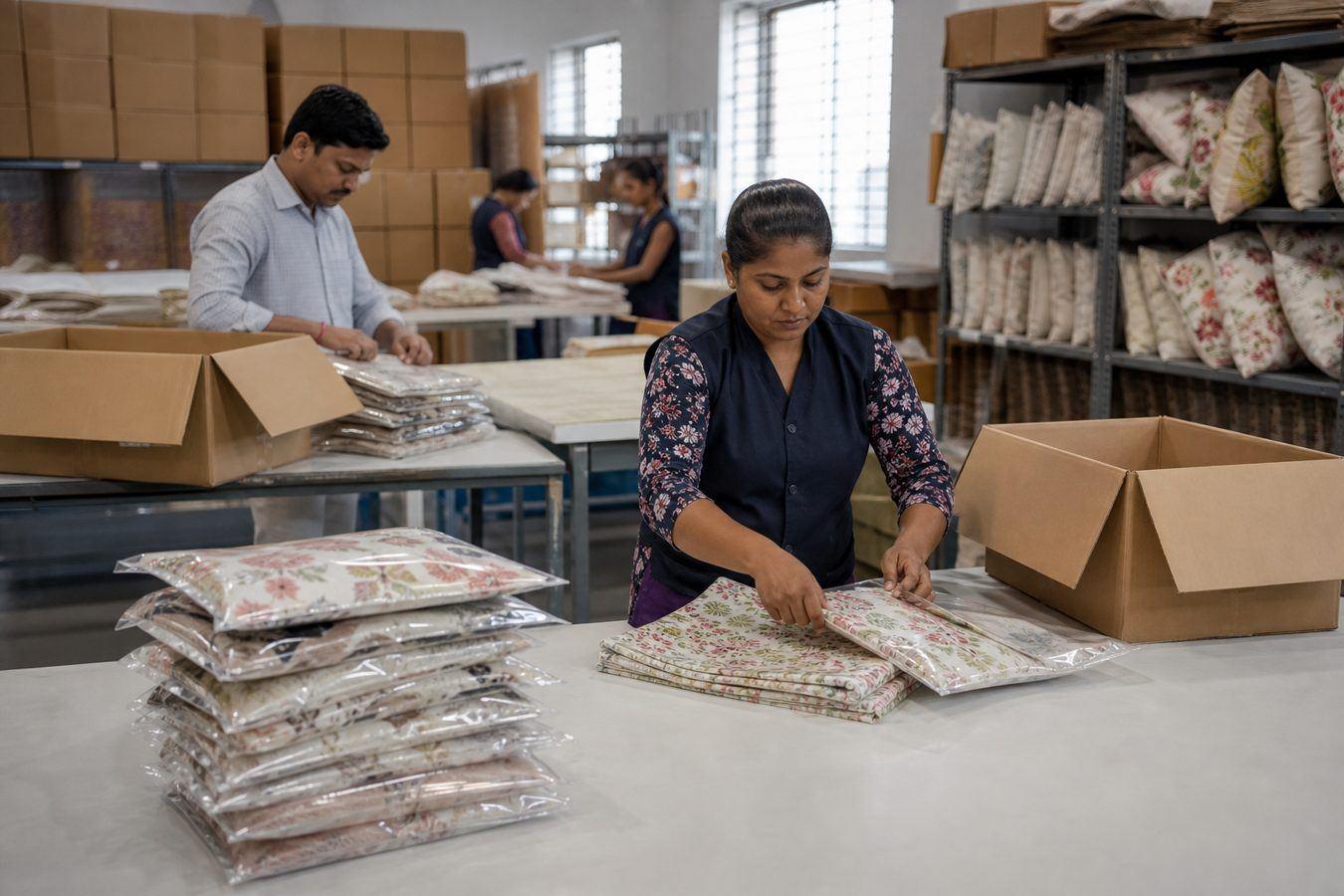
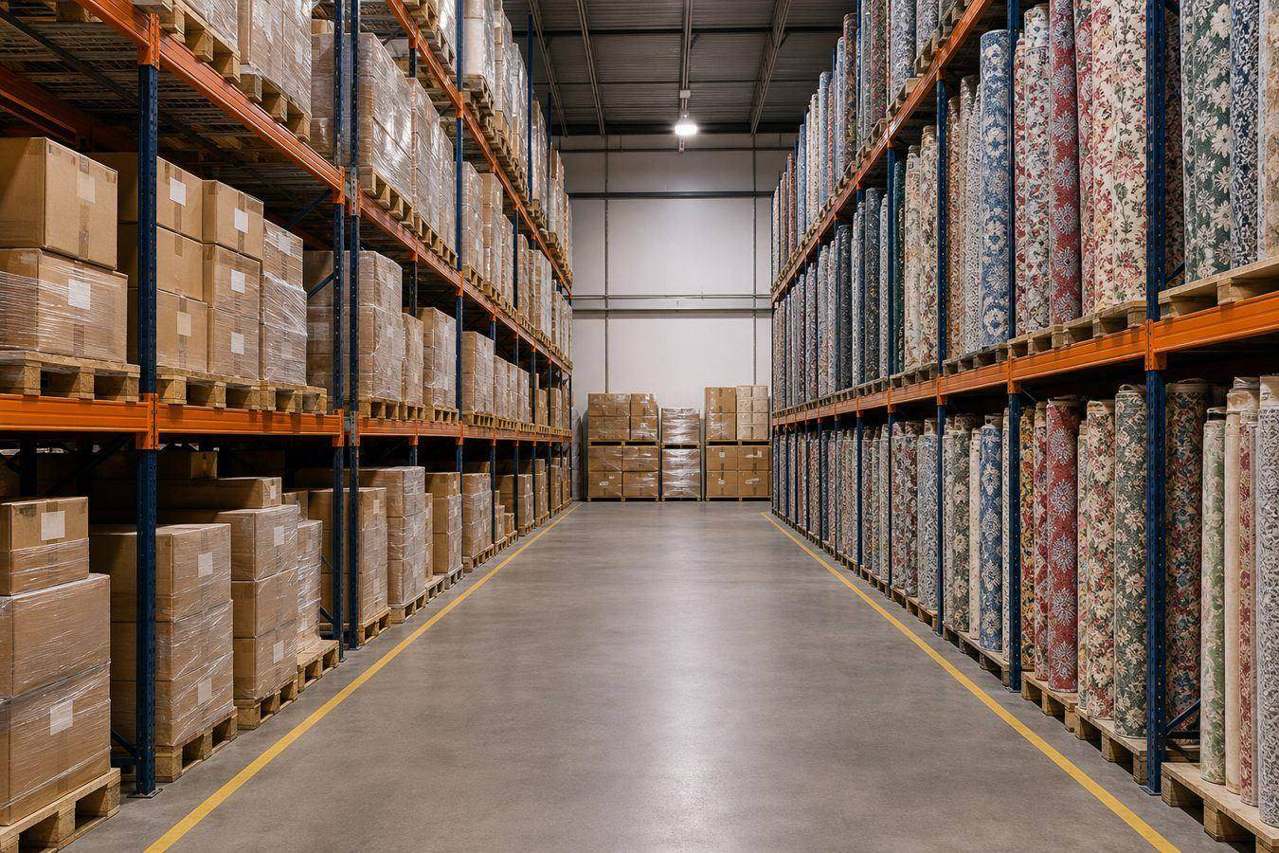
Packaging for hand printed textile exports splits into two dominant formats: roll or bale for yardage, and polybag plus export carton for made-ups. The choice is driven by product form, not buyer preference alone — shipping yardage folded in cartons creases block-print emboss; shipping cushion covers on rolls wastes CBM. Retail-ready channels add hangtags, care labels, barcodes, and sometimes individual gift boxes — each layer affects FOB and carton engineering.
Packaging standards: yardage vs made-up
Swipe →
Data table — swipe horizontally on small screens
| Format | Yardage | Made-ups (cushions, throws, table, curtains) |
|---|---|---|
| Primary wrap | Roll on tube or bale with poly outer | Individual polybag per SKU |
| Moisture protection | Poly sleeve + desiccant for ocean transit | Polybag + carton desiccant in humid season |
| Labelling | Roll-end: design, colourway, metre count, dye lot | Polybag: size, colourway, SKU code |
| Carton contents | Multiple rolls/bales per master carton | Mixed SKU cartons only with colourway separation |
| Retail-ready add-ons | Swatch cards, hanger samples separate | Hangtag, care label, barcode, insert card |
| Heritage / natural dye | Breathable wrap; avoid sealed plastic long-term | Tissue interleave; no airtight poly for long storage |
| Crush protection | Vertical roll staging in container | Max cartons per stack specified; no heavy on light |
Container Loading Details
Export Tip
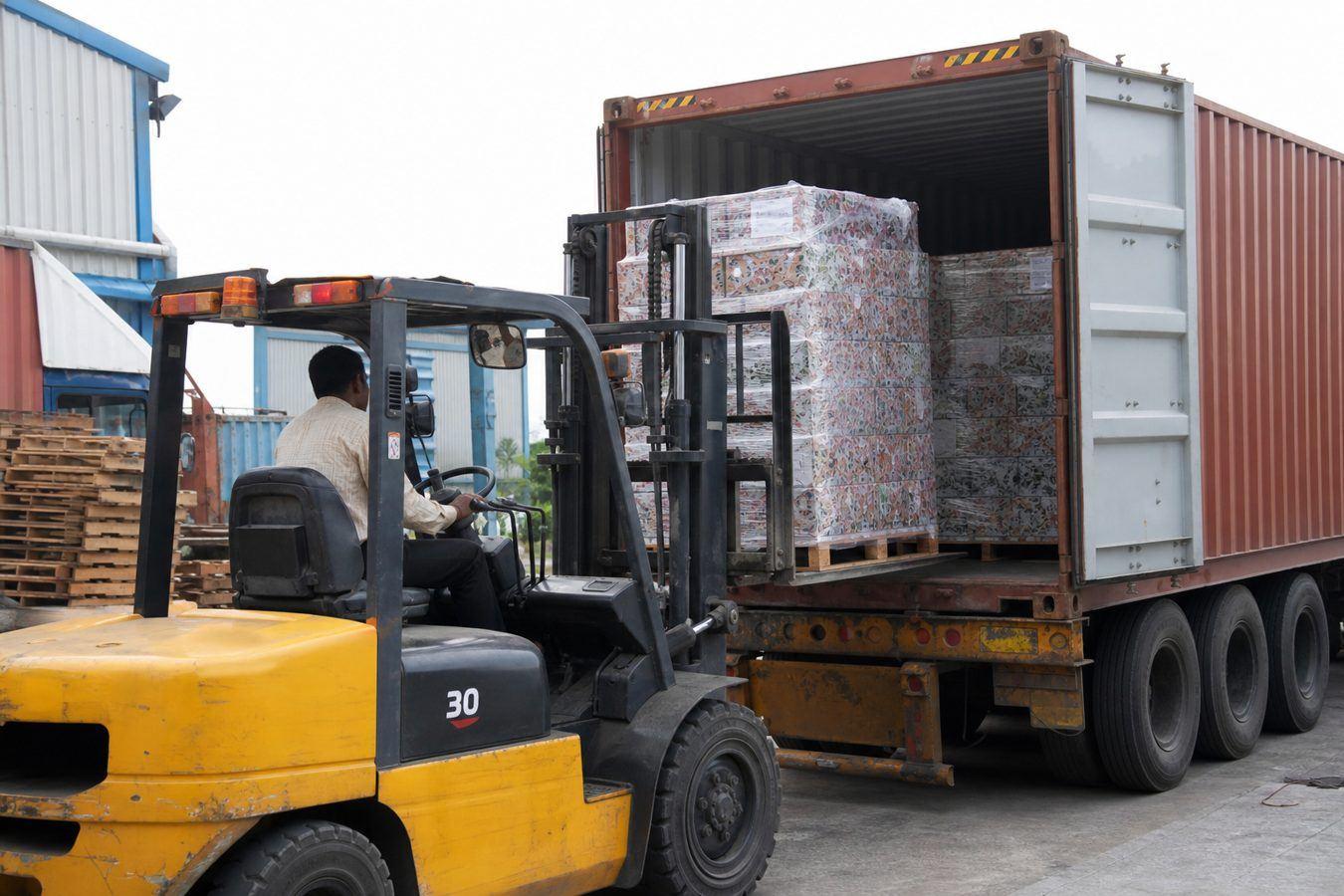
Container loading plans differ between roll-heavy yardage programmes and made-up carton programmes — and between mixed coordinated assortments that combine both. Yardage-dominant FCL loads optimise roll count and vertical staging; made-up-dominant loads optimise carton stack height and crush limits on folded block-print surfaces.
Container loading by product mix
Swipe →
Data table — swipe horizontally on small screens
| Programme Type | Preferred Container | Loading Logic |
|---|---|---|
| Yardage-only FCL | 40HC | Vertical rolls; moisture barrier; dye lot manifest |
| Made-up-only FCL | 40HC or 40GP | Palletised cartons; crush limit 5–8 cartons high depending on SKU |
| Mixed yardage + made-ups | 40HC | Rolls on one side; cartons staged without compression on rolls |
| Trial LCL | LCL consolidation | Minimum viable CBM; accept higher per-unit freight |
| Scarf/ small accessory heavy | 40GP may suffice | Higher piece count per CBM than throws/curtains |
Shipping Methods
Export Tip
- Strike-offs: air freight, 7–21 days — typically 1–5 m or 5–20 pcs per colourway
- Trial orders: LCL ocean, 4–8 weeks — validate colourway packing before FCL commitment
- Wholesale yardage: FCL ocean, roll-stuffed 20GP or 40HC depending on metre volume
- Wholesale made-ups: FCL ocean, carton-stuffed 40HC preferred for crush-sensitive block print
- Incoterms: FOB Nhava Sheva or Mundra most common for catalogue programmes; CIF for buyers wanting single-point freight
Shipping method selection follows the same logic as the process pillar: air for strike-offs and urgent sample kits; ocean LCL for trial colourways; ocean FCL for wholesale and retail programmes. Product-form specifics add nuance — natural-dye Ajrakh rolls benefit from breathable packing even in ocean transit; retail-ready made-ups with hangtags need carton dimensions that protect tags from bending.
Certifications
Compliance Notes
Certification requirements vary by product tier and destination, not by technique alone. A volume screen-print cushion for UAE wholesale may export with fibre content labelling only; the same SKU for German premium retail may require OEKO-TEX Standard 100 and azo-free dye documentation. GOTS applies when organic fibre and certified processing claims are made — scope must cover the exact fabric and print pathway.
Certifications by product tier and channel
Swipe →
Data table — swipe horizontally on small screens
| Channel | Typical Certification Ask | Most Relevant SKUs |
|---|---|---|
| US home specialty retail | Fibre content & care labelling; azo-free declaration | Cushions, throws, table linen, curtains |
| EU premium retail | OEKO-TEX; azo-free; REACH awareness | Ajrakh, Kalamkari, organic block print |
| GOTS organic private label | GOTS scope covering fabric + print | Organic cotton block/screen yardage and made-ups |
| Hospitality FF&E | Flammability awareness; durability testing | Curtains, upholstery-facing yardage, table linen |
| Fashion fabric wholesale | Fibre composition; colourfastness reports | Sanganer yardage, Ajrakh yardage, screen print |
| Craft / museum retail | Honest hand-print declaration | Heritage Ajrakh, Kalamkari narrative pieces |
Buyer Requirements
Buyer Requirements
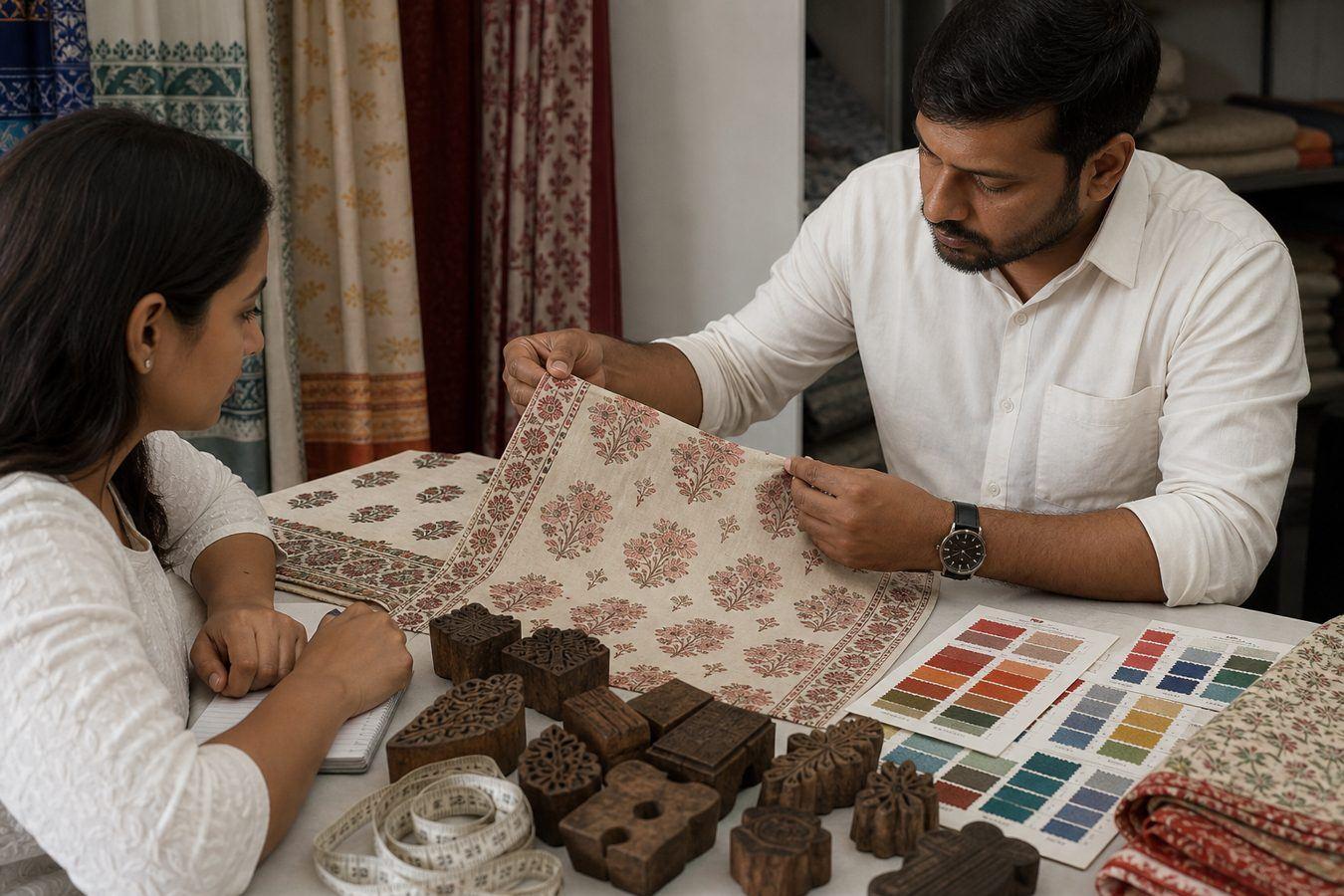
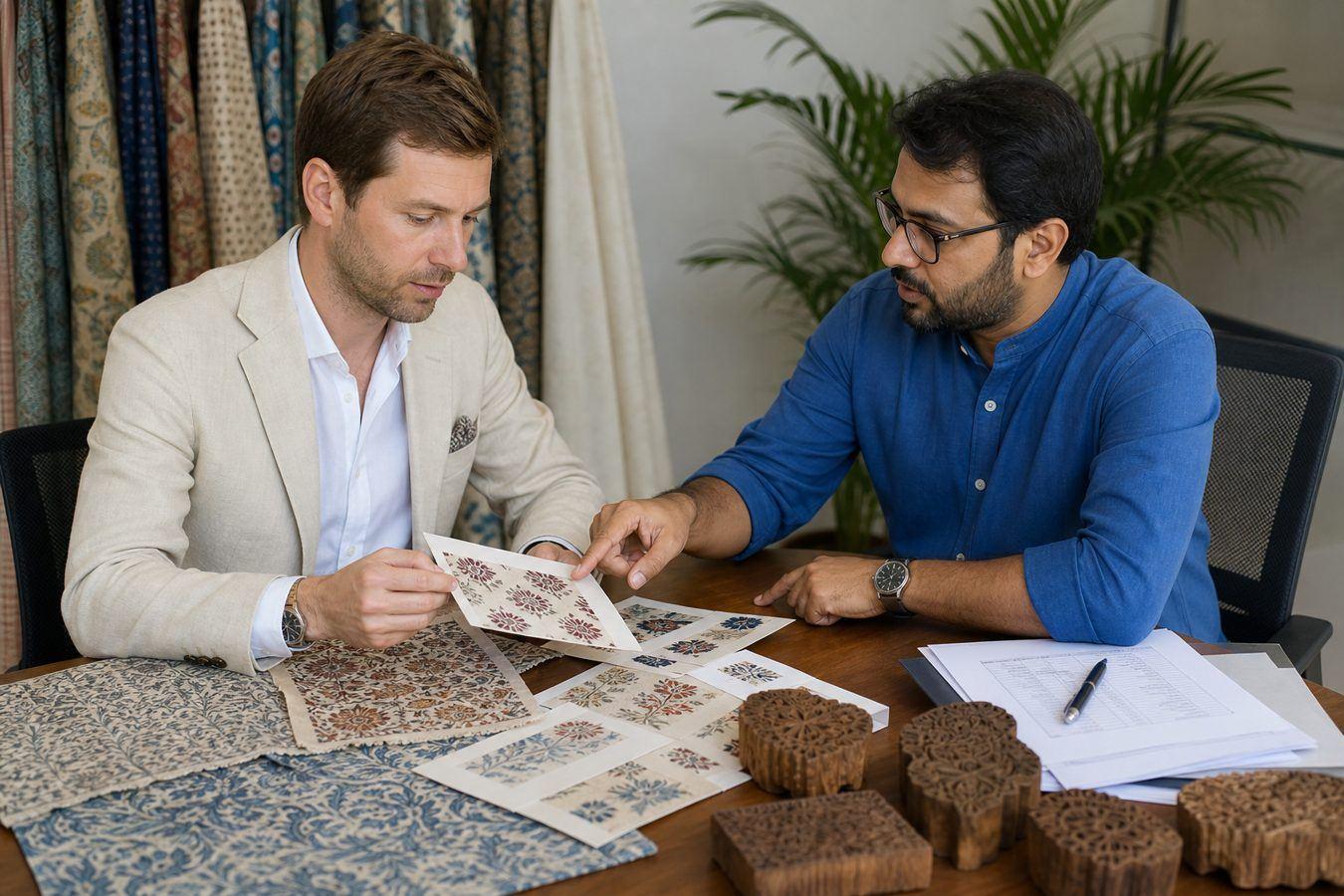
Buyers selecting top hand printed textile SKUs typically require: a programme sheet listing technique, fabric base, dimensions, and colourway count; physical strike-offs per colourway before bulk; FOB pricing by SKU and volume tier; packaging specification matched to channel (wholesale bulk vs retail-ready); fibre content and care label drafts for destination market; and honest print-method documentation. Procurement teams running coordinated colourway programmes also require cross-SKU colour consistency standards — the throw must match the cushion within an agreed Delta-E or visual reference tolerance.
For importer-side vetting of artisan units and strike-off workflows, see Source Hand Printed Textiles Directly from India. For export registration and shipping process, see How to Export Hand Printed Textiles from India.
Country-wise Opportunities
Market Snapshot
Country-wise SKU fit varies: USA buyers pull high volumes of block-print cushions and screen-print curtains; German buyers pull certified Ajrakh and azo-free Kalamkari; UAE buyers pull volume screen made-ups with fast reorder; UK and French buyers pull design-led coordinated programmes. Full market ranking lives in Best Countries for Indian Hand Printed Textile Exports; technique-by-country demand detail lives in Most Demanded Indian Hand Printed Textiles by Country.
Top SKU fit by directional destination
Swipe →
Data table — swipe horizontally on small screens
| Country | Hero SKUs | Pricing Tier |
|---|---|---|
| USA | Block cushions, screen curtains, Sanganer yardage | Mid to premium |
| Germany | GOTS/OEKO-TEX Ajrakh, azo-free Kalamkari table | Premium |
| UK | Coordinated block programmes, Kalamkari runners | Mid to premium |
| UAE | Volume screen cushions, table linen, curtains | Value to mid |
| France | Heritage Ajrakh stoles, fine Sanganer yardage | Premium |
| Australia | Natural-dye throws, certified print lines | Premium |
| Japan | Fine block yardage, restrained colourways | Premium selective |
Sourcing Checklist
Checklist
Buyer Checklist
Exporter Checklist
Compliance Checklist
Checklist
Compliance Notes
Common Buyer Mistakes
Common Mistakes Box
Product selection mistakes are expensive in hand print because strike-off and bulk MOQs are front-loaded per colourway. Recognising common errors before the first purchase order saves a full season.
Common product-selection mistakes and corrections
Swipe →
Data table — swipe horizontally on small screens
| Mistake | Consequence | Correction |
|---|---|---|
| Ordering too many techniques in first PO | Spread QC attention; miss season window | Start with 1–2 techniques and 2–3 hero SKUs |
| Ignoring colourway MOQ math | Effective MOQ 3× planned if 3 colourways | Budget strike-offs and bulk per colourway explicitly |
| Specifying yardage packing for made-ups | Creased block emboss; damaged hand-feel | Match pack format to product form |
| Choosing custom block without carve budget | Surprise setup fee; delayed strike-off | Confirm block carve cost and lead time upfront |
| Mixing natural-dye Ajrakh with strict Delta-E standards | Lot variation disputes in bulk | Set visual tolerance or limit colourways per vat lot |
Future Market Trends
Key Statistics
Coordinated colourway programmes — cushion, throw, curtain, and table from one print library — will continue gaining share over single-SKU orders as home specialty chains simplify planogram storytelling. GOTS organic print, regenerative cotton block programmes, and fair-trade Kalamkari private label are moving from niche to mainstream premium in EU and US coastal retail. Digital print is not replacing hand block at the premium tier, but hybrid programmes combining artisan hero SKUs with screen-print volume fill are growing — buyers should specify which SKUs must be hand printed versus screen acceptable.
See Block Print, Ajrakh, Kalamkari & Sustainable Hand Printed Textile Export Opportunities for sustainable and premium programme depth.
Challenges & Solutions
Product-catalogue challenges in hand print sourcing centre on technique selection, colourway MOQ planning, and packaging format alignment — all solvable with the discipline mapped in this guide.
Product catalogue challenges and solutions
Swipe →
Data table — swipe horizontally on small screens
| Challenge | Root Cause | Solution |
|---|---|---|
| SKU proliferation | Too many techniques in first programme | Hero SKU shortlist by channel fit |
| Colourway MOQ blowout | Design colourways multiplied without MOQ math | Budget per colourway; reuse blocks/screens |
| Packaging mismatch | Yardage logic applied to made-ups | Separate packaging BOM by format |
| Price benchmark confusion | Comparing Ajrakh to volume screen | Quote by technique tier, not blended average |
| Season miss on custom block | Block carve lead time underestimated | Confirm carve calendar before design sign-off |
Expert Insights
Expert Insight Box
Altus Exports builds hand printed textile product programmes for international buyers as a merchant exporter and global sourcing partner — shortlisting hero SKUs by channel, coordinating strike-offs across Bagru, Sanganer, Kutch, and Kalamkari clusters, engineering colourway MOQs and packaging by yardage versus made-up format, and delivering export-ready assortments with one accountable interface.
Conclusion
- Next step: Send your channel profile and hero SKU shortlist to Altus Exports via Contact.
- Understand the full export process in How to Export Hand Printed Textiles from India.
- Rank destinations in Best Countries for Indian Hand Printed Textile Exports.
- Vet suppliers with Source Hand Printed Textiles Directly from India.
- Match SKUs to country demand in Most Demanded Indian Hand Printed Textiles by Country.
- Explore sustainable programmes in Block Print, Ajrakh, Kalamkari & Sustainable Hand Printed Textile Export Opportunities.
- Work with Altus as merchant exporter, global sourcing partner, or product sourcing company.
The top hand printed textile products exported from India span block print cushion covers, Ajrakh throws and yardage, Kalamkari table linen, Sanganer curtain and apparel fabric, hand screen volume programmes, and coordinated soft-furnishing colourway assortments — each with distinct technique clusters, FOB bands, MOQ by colourway, and packaging formats. Select hero SKUs matched to your buyer channel, approve strike-offs per colourway, run trial MOQs before FCL commitment, and engineer packaging separately for yardage rolls versus made-up cartons.
Share your target channel, preferred techniques, and first-season SKU shortlist with Altus Exports for an assortment plan, strike-off schedule, and indicative FOB quote across India's hand print clusters.