
Source Hand Printed Textiles Directly from India: Importer Playbook
By Saurabh Mittal, Founder, Altus Exports
A practical importer playbook for sourcing hand printed textiles directly from India — print-technique RFQ specification, auditing Jaipur, Kutch, Andhra Pradesh, and made-up conversion units, strike-off and colourway approval, print-registration and colourfastness QC, and landed-cost decision flow for buyers in the UAE, USA, UK, France, Germany, Canada, Japan, Australia, and Netherlands, with expert insight from Altus Exports.
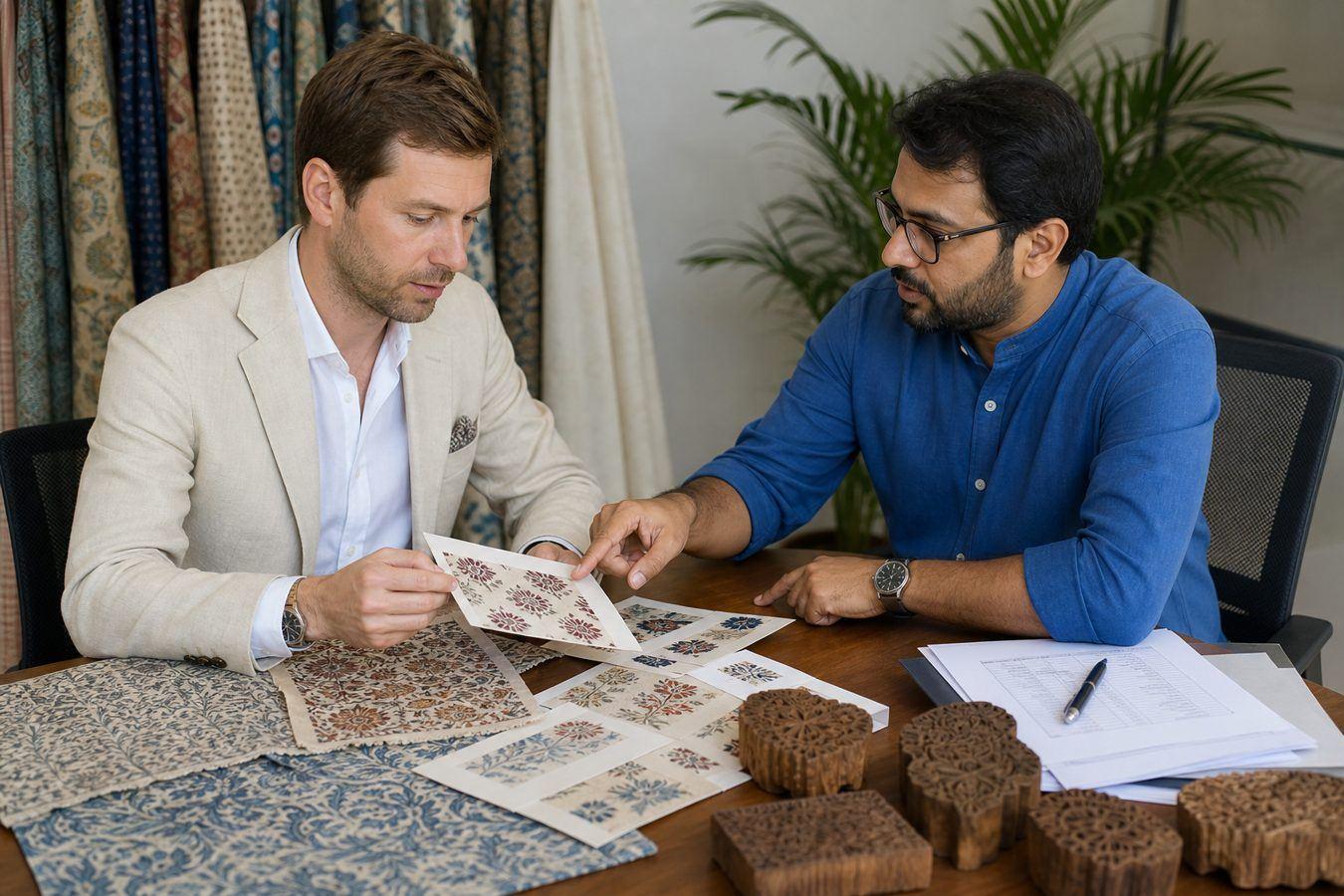
India's hand printed textile sector offers international buyers a genuinely unusual advantage: one country of origin covering Bagru and Sanganer woodblock print from Rajasthan, Ajrakh natural-dye resist from Kutch, Kalamkari from Andhra Pradesh, volume hand screen print and made-up conversion from Panipat, Karur, and Tirupur belts, and coordinated soft-furnishing programmes consolidated through Delhi-NCR merchant exporters. For a buyer building a print-led home textile, hospitality soft-furnishing, or fashion fabric programme, that breadth means fewer supplier relationships, fewer separate freight bookings, and one consolidated commercial invoice — instead of importing block-print yardage from one country and cushion conversion from another. But that same breadth is also the complication: print registration consistency, colourway MOQ economics, dye chemistry compliance, and export-readiness vary enormously not just supplier to supplier but technique to technique, and a single coordinated shipment can legitimately span printed cotton yardage under HS 5208/5209 and furnishing made-ups under 6303/6304.
Buyers who try to source hand printed textiles directly from India without a structured process run into the same recurring problems: a beautiful Ajrakh strike-off followed by bulk-lot colour drift, print registration misalignment on cushion covers because bulk was matched to a photograph rather than a sealed sample, azo-dye or fibre-labelling gaps that surface only when retail legal teams review the assortment, and a spring soft-furnishing order that missed the shipping window because production was booked too close to the retail launch deadline. None of these failures are inherent to Indian hand printed textile sourcing — they are the predictable result of skipping verification, strike-off approval, and calendar-planning steps under deadline pressure.
This guide is written for importers, home textile retail buyers, design boutique owners, hospitality procurement teams, fashion fabric distributors, and private-label brands in the UAE, USA, UK, France, Germany, Canada, Japan, Australia, and Netherlands who want to source hand printed textiles directly from India with a repeatable, lower-risk process. It walks through print-technique RFQ specification, auditing artisan and print units across Rajasthan, Gujarat, and Andhra Pradesh clusters, strike-off and colourway approval, print-registration and colourfastness QC, and landed-cost decision flow — and explains when a merchant exporter or global sourcing partner reduces colourway risk more effectively than managing multiple cluster relationships independently. This guide focuses on the buyer-side sourcing process rather than exporter registration how-to or trade-show calendars; for those, see How to Export Hand Printed Textiles from India and Trade Shows and B2B Marketplaces for Hand Printed Textile Exporters. For destination-market context, see Best Countries for Indian Hand Printed Textile Exports and Top Hand Printed Textile Products Exported from India.
Key Takeaways
Summary Box
Executive Summary
Summary Box
This guide sets out a structured importer playbook for sourcing hand printed textiles directly from India: define specifications across every print technique and made-up format in your programme, identify and audit the right clusters (Jaipur–Bagru, Kutch, Andhra Pradesh Kalamkari belts, or Panipat/Karur conversion units, or a Delhi-NCR consolidator), request strike-offs with dye-chemistry and labelling documentation, evaluate print registration and colourfastness against written tolerance, negotiate on a landed-cost basis, place a trial order with written terms, conduct pre-shipment inspection against the sealed strike-off, and manage multi-line logistics through arrival.
Because India's hand printed textile supply chain runs across several distinct technique clusters, each with its own workshop scale, dye chemistry, and formalisation level, the single highest-leverage buyer action is independent verification — of IEC/EPCH status, of strike-off-to-bulk print registration discipline, and of azo-dye and fibre-labelling readiness for your destination market. Buyers who build this discipline into their first colourway convert faster into stable, repeat-programme relationships than buyers who source on Instagram photos and FOB price alone.
Market Size & Industry Overview
Key Statistics
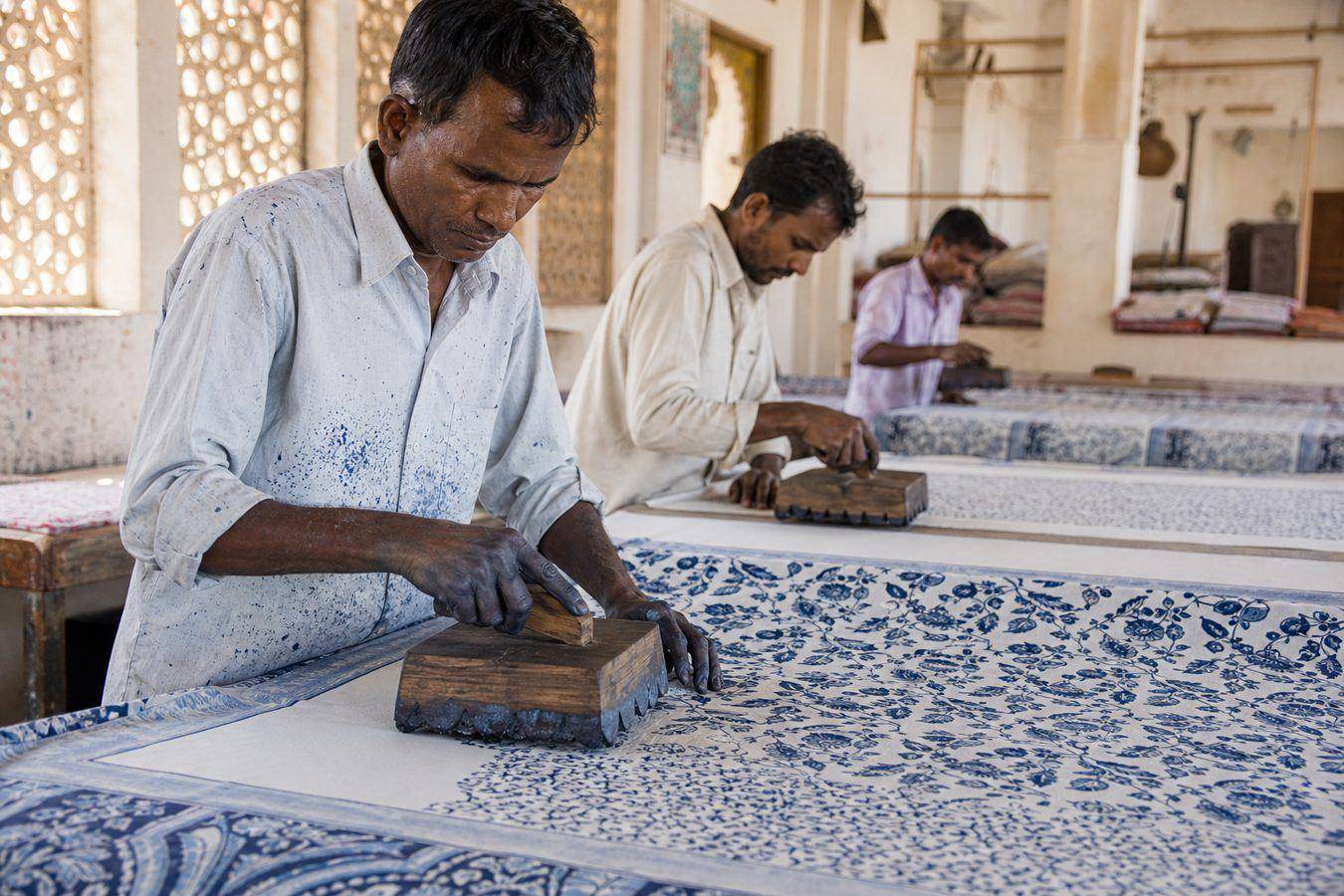
India's hand printed textile economy is organised around technique-specific clusters, each regulated at the export level by IEC from DGFT and, in practice, EPCH RCMC registration for most organised textile-handicraft and hand printed artware exporters — with TEXPROCIL adjacency when cotton made-ups classify under cotton textile schedules rather than EPCH lines. Jaipur, Sanganer, and Bagru supply woodblock and Dabu resist print; Kutch and Ajrakhpur supply Ajrakh natural-dye programmes; Machilipatnam and Srikalahasti supply Kalamkari; Panipat, Karur, and Tirupur supply made-up conversion and hand screen volume; and Delhi-NCR functions as the merchant-exporter consolidation layer where multi-cluster colourway programmes are packed and shipped as one export relationship.
Directionally, total Indian handicrafts exports excluding carpets were Rs 33,122.79 crore in FY 2024-25 (EPCH), with textile-handicraft and hand printed artware representing a meaningful share of that wider basket. What matters more for a buyer than any single export figure is understanding that this is a fragmented, multi-cluster supply base: artisan workshops, mid-sized print units, aggregators, export houses, and merchant exporters all sit between fabric scouring and your container, with formalisation and QC maturity varying meaningfully across each cluster and each node.
Buyers who understand this structure make better counterparty decisions — a Bagru workshop with excellent block carving but no direct export registration is not disqualifying, but it changes who is contractually and legally accountable for your shipment, and typically means you are actually buying through an aggregator or merchant exporter rather than the workshop itself, whether or not that is made explicit upfront.
Hand printed textile supply chain structure and buyer implications
Swipe →
Data table — swipe horizontally on small screens
| Supply Chain Node | Role | Buyer Implication |
|---|---|---|
| Artisan print workshops (Bagru, Ajrakhpur, Kalamkari) | Technique-specific hand printing at workshop scale | Excellent for craft authenticity; verify who holds export registration |
| Mid-sized print units (Sanganer, conversion belts) | Semi-mechanised block or screen capacity | Better fit for consistent trial and wholesale colourway volumes |
| Made-up converters (Panipat, Karur, Tirupur) | Stitching and finishing of printed fabric into cushions, throws, curtains | Registration QC at conversion stage is as critical as at print stage |
| Aggregators | Consolidate multi-workshop output within one technique | Colourway consistency can weaken without written tolerance |
| Export houses | Direct export under own registration, often single-cluster specialists | Verify IEC/EPCH status independently before contracting |
| Merchant exporters (Delhi-NCR) | Consolidate multi-cluster print programmes under one accountable relationship | Strong fit for coordinated soft-furnishing and private-label programmes |
| EPCH-registered exporters | Registered for textile handicraft export benefits and IHGF access | Baseline credibility signal; not itself a QC guarantee |
Export Statistics
Key Statistics
India's hand printed textile export volume has grown as global home specialty retail, e-commerce private label, and design boutique channels broaden sourcing toward coordinated print collections rather than single-SKU purchasing. Block-print cushion covers, Ajrakh throws, Kalamkari table linen, printed curtain panels, and fashion fabric yardage represent large-volume, buyer-friendly starting categories, while private-label and OEKO-TEX or GOTS-certified organic print lines are among the fastest-growing premium conversations as compliance and provenance positioning mature into genuine retail differentiators.
Directional export snapshot relevant to buyer sourcing decisions
Swipe →
Data table — swipe horizontally on small screens
| Metric | 2026 Indicative Position | Buyer Relevance |
|---|---|---|
| Total handicrafts excl. carpets (EPCH context) | Rs 33,122.79 crore FY 2024-25 | Reflects genuine craft export scale; supply base remains fragmented |
| Dominant export forms | Block print made-ups, Ajrakh/Kalamkari yardage, screen print retail programmes | Safest starting categories for a first order |
| Fastest-growing sub-segments | Private-label and certified organic/natural-dye print | Requires strike-off plus cert verification, not claims alone |
| Supply base formalisation | Highly variable across workshops, units, and exporters | IEC/EPCH verification is essential, not optional |
| Applicable HS families | 5208/5209, 6303, 6304, 6214, 6302 as classified | Confirm current classification with your customs broker |
| Primary sourcing clusters | Jaipur–Bagru, Kutch, Andhra Pradesh, Panipat/Karur/Tirupur, Delhi-NCR | Match cluster to print technique and required scale |
Import Statistics
Key Statistics
Buyer concentration mirrors EPCH's Handprinted Textiles destination-market data broadly: by FY 2024-25 country-wise value, the UAE leads (Rs 1,539.46 crore, with a likely re-export/wholesale component), followed by the USA (Rs 319.92 crore), UK, France, Germany, Canada, Japan, Australia, and Netherlands as smaller but strategically important destinations. Understanding where your buyer profile sits within this landscape helps calibrate supplier expectations — an established Indian merchant exporter is more likely to have UAE, USA, or German print-programme shipment experience than experience with a smaller or newer destination market.
EPCH-informed buyer-region profile for Indian hand printed textile imports (FY24-25 value order)
Swipe →
Data table — swipe horizontally on small screens
| Buyer Region | Typical Buyer Profile | Sourcing Consideration |
|---|---|---|
| UAE | Hypermarkets, hospitality, corporate gifting | Faster sample-to-trial cycle given shorter freight transit |
| USA | Home specialty, e-commerce PL, fashion fabric | Most consolidators have USA experience; verify azo and fibre label readiness |
| UK | Retail chains, boutiques, hospitality | Confirm UK labelling and registration tolerance expectations |
| France | Design and lifestyle retail | Prioritise craft narrative and strike-off presentation quality |
| Germany | Design retail, compliance-conscious distributors | Confirm azo, OEKO-TEX/GOTS, and labelling before committing |
| Canada | Retail distributors, home chains | Similar profile to USA; confirm bilingual labelling if needed |
| Japan | Department stores, select boutiques | Prioritise registration QC evidence on first contact |
| Australia | Specialty home retail | Confirm seasonal colourway fit for reversed summer Christmas |
| Netherlands | Wholesale distributors, EU re-export | Smaller EPCH value for this category; confirm multi-line HS documentation for hub redistribution |
Product Categories & Variants (Brief Overview)
Summary Box
Specify the exact print technique, fabric base, and made-up format in your RFQ rather than asking generically for 'Indian block print' — different clusters price, produce, and pack differently, and vague requests produce quotations that cannot be fairly compared. For deeper SKU catalogues, see Top Hand Printed Textile Products Exported from India.
Product category snapshot for buyer RFQ specification
Swipe →
Data table — swipe horizontally on small screens
| Category | Typical Cluster | Sourcing Note |
|---|---|---|
| Bagru / Sanganer block print yardage | Jaipur belt | Confirm repeat size, colourway MOQ, and mordant chemistry |
| Ajrakh natural-dye yardage and throws | Kutch / Ajrakhpur | Longer lead times; verify natural-dye fastness claims |
| Kalamkari table linen and yardage | Andhra Pradesh | Confirm narrative vs geometric range and conversion quality |
| Dabu mud-resist print | Bagru belt | Verify resist wash-out consistency lot to lot |
| Hand screen print retail programmes | Panipat / conversion belts | Confirm honest hand-screen vs rotary claims |
| Printed cushion covers, throws, curtains | Panipat, Karur, Tirupur | Registration QC at stitch-and-finish stage critical |
| Coordinated soft-furnishing programmes | Delhi-NCR consolidated | Confirm strike-off approval across all SKUs before bulk |
Manufacturing Overview (Brief)
Export Tip
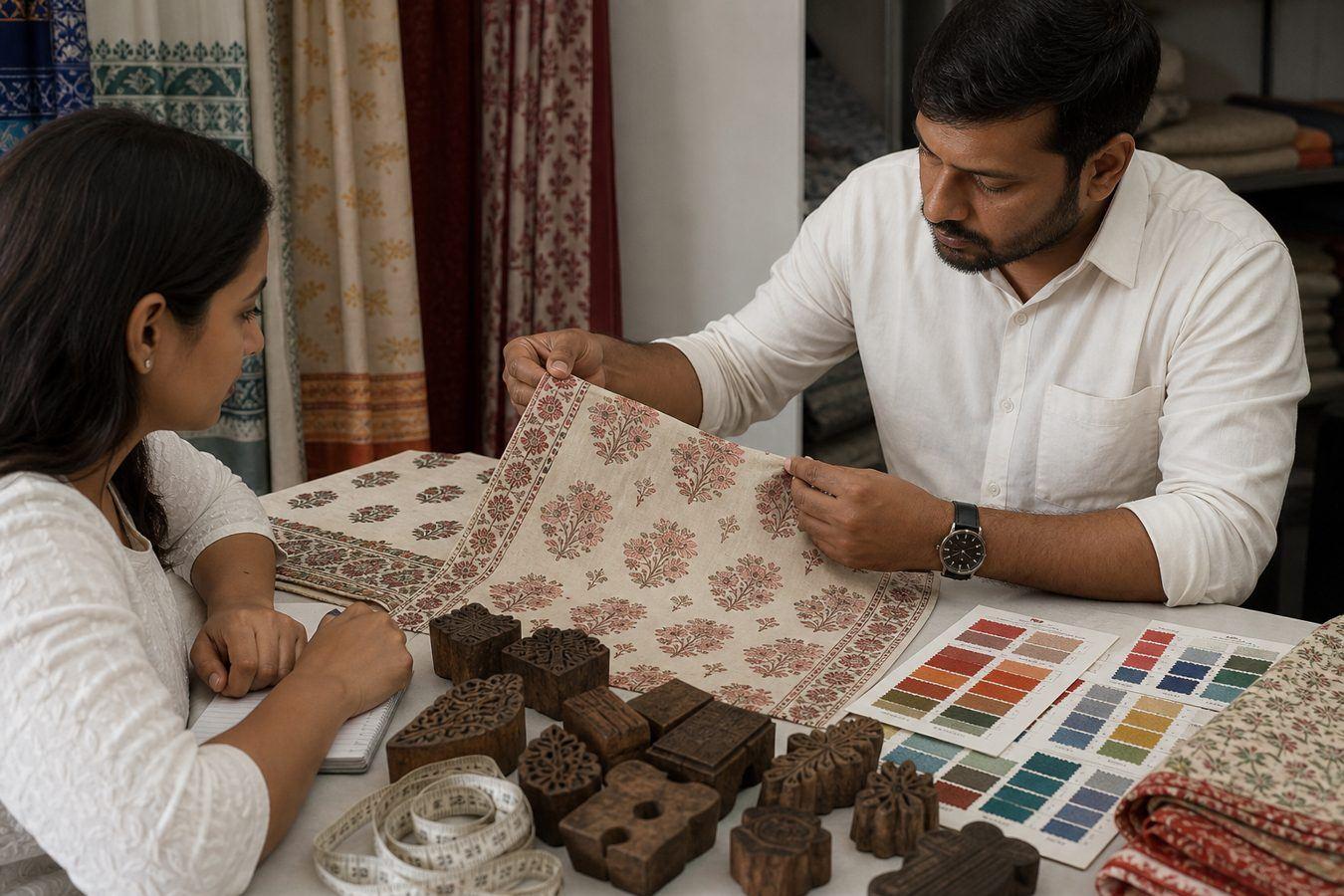
Buyers get more out of a cluster visit by understanding each print technique's process than by inspecting only a finished sample. Block print moves through fabric preparation, mordant or resist application, repeated block impressions, and fixation; Ajrakh adds multiple natural-dye immersion and resist cycles; Kalamkari combines hand drawing or block overlay with mordant and dye baths; hand screen print uses manual screens for repeat placement at higher volume. Made-up conversion then cuts, stitches, and finishes printed fabric into cushions, throws, and curtains — a stage where registration can drift if cutting layout is not controlled against the strike-off.
Ask any candidate supplier or consolidator directly how they monitor print registration and colourfastness from strike-off through bulk production and immediately before sealing cartons — not only whether a final inspection report exists for one hero SKU. Full manufacturing detail from the exporter's side is covered in How to Export Hand Printed Textiles from India.
The Importer's RFQ-to-Landed-Cost Playbook for Hand Printed Textile Programmes
Export Tip
This is the core operational sequence of this guide — the concrete steps an importer follows from a standing start to a confident, documented first wholesale colourway order. Follow the steps in order; skipping strike-off approval to save two weeks typically costs far more when a trial shipment arrives with registration drift, azo-test failure, or a rejected customs declaration.
Step 1: Write a Complete Print-Programme RFQ
Document, for every SKU and colourway: print technique (block, Ajrakh, Dabu, Kalamkari, hand screen — and honest distinction from rotary), fabric base and GSM, colourway list with Pantone or reference swatch, print registration tolerance in millimetres, dye chemistry (azo-free requirement, natural-dye claims), made-up dimensions and stitching spec where applicable, packaging format (roll wrap, polybag, retail hangtags), certification requirements (OEKO-TEX, GOTS, azo test method), target FOB/CFR/CIF price, colourway MOQ, and delivery window including any soft-furnishing launch cut-off. A vague RFQ — 'nice block print cushions, best price' — produces incomparable quotes and invites assumptions you will reject at strike-off stage.
Step 2: Map Your Programme to the Right Print Clusters
Match each product to its best-fit cluster: Jaipur–Sanganer–Bagru for woodblock and Dabu, Kutch for Ajrakh, Machilipatnam–Srikalahasti for Kalamkari, Panipat/Karur/Tirupur for made-up conversion and volume screen. For a genuinely multi-technique soft-furnishing programme, decide early whether you will manage each cluster relationship directly or consolidate through a Delhi-NCR merchant exporter — the more techniques and colourways in your programme, the stronger the case for consolidation.
Step 3: Identify Candidate Print Units or a Consolidating Merchant Exporter
Use EPCH's registered-exporter directory, IHGF Delhi exhibitor lists, Heimtextil referral networks, and trusted sourcing partners to identify candidates. For a single-technique trial, direct workshop or print-unit relationships can work; for a coordinated multi-colourway retail programme spanning print and conversion, a merchant exporter who already coordinates Jaipur, Kutch, and Panipat belts under one accountable relationship materially reduces your coordination burden. Prefer candidates with documented export history to your target market where possible.
Step 4: Audit Artisan and Print Units
Audit priorities differ by technique. For block print (Bagru/Sanganer), verify block alignment, repeat consistency, mordant fixation, and whether bulk will use the same blocks as the strike-off. For Ajrakh (Kutch), verify natural-dye recipes, immersion cycle control, and colourfastness sampling method. For Kalamkari (Andhra Pradesh), verify outline consistency and mordant penetration. For made-up conversion, verify cutting layout against registration marks and stitch quality. Request to see in-progress production, not only finished samples, and confirm whether the unit holds direct IEC/EPCH registration or exports through an aggregator or consolidator.
Step 5: Strike-Off Sampling with Dye-Chemistry and Label Documentation
Require azo-free dye confirmation, fibre-content draft labels, and care-label language aligned to your destination market alongside physical strike-offs — 1–5 metres per colourway or 5–20 pieces per made-up SKU. Seal the approved strike-off with signed date, supplier reference, and registration tolerance in writing. A sample without this documentation is a marketing prop, not compliance evidence, since azo and fibre-labelling questions often surface only when retail legal teams review the assortment.
Step 6: Evaluate Print Registration, Colourfastness, and Documentation Quality
Physically inspect strike-offs against your tolerance: measure registration drift across repeat length, rub-test colourfastness where your channel requires it, and compare hand-feel and GSM to specification. Cross-check documentation: verifiable IEC and EPCH registration? OEKO-TEX or GOTS certificate numbers checkable against the certifier's database? Commercial acceptability requires both a satisfactory physical strike-off and satisfactory documentation — one strong colourway with weak labelling elsewhere is not sufficient for a full programme trial order.
Step 7: Calculate and Negotiate on a Landed-Cost Basis
Compare landed cost across the whole programme, not FOB in isolation: FOB price by colourway, ocean freight, insurance, destination duty across every HS line in the shipment, destination-side compliance cost (azo retesting, label rework), and your own quality-rework cost for registration drift or colour mismatch. A lower FOB metre rate from a unit with weak bulk-lot QC can produce a higher effective landed cost once claims, markdowns, and unsellable retail stock are accounted for. Model landed cost across at least two candidates before committing.
Step 8: Place a Trial Order with Written Terms
Structure a trial at 50–200 metres per colourway or 200–500 pieces of hero made-ups — often LCL — with written reference to the sealed strike-off, registration tolerance, azo-test method, label language, Incoterms, payment milestones (avoid 100% advance on first orders), and pre-shipment inspection rights. Tie delivery to your launch calendar explicitly; do not accept verbal lead-time assurances for seasonal programmes.
Step 9: Pre-Shipment QC Against the Sealed Strike-Off
Inspect bulk lots against the sealed strike-off, not a new sample: registration tolerance, colourway match under agreed light source, GSM and hand-feel, label placement and fibre-content language, and carton packing that protects hand-feel finishes. Hold shipment on any colourway that breaches written tolerance — releasing drifted bulk to save a sailing date typically costs more at destination than delaying one week.
Step 10: Manage Multi-Line Logistics and Broker Handoff
Share draft commercial invoice, packing list, and certificate of origin with your destination customs broker before sailing — especially when one shipment carries 5209 yardage and 6304 made-ups on the same invoice. Reconcile colourway lot numbers across invoice, packing list, and bill of lading. Full document field detail sits in Hand Printed Textile Export Documentation Checklist.
Pricing Analysis
Buyer Tip
FOB pricing for hand printed textiles varies primarily by print technique labour intensity, fabric base, colourway count, and certification tier — not by whether you found the unit on a marketplace or at IHGF Delhi Fair. Insist on itemised quotations separating fabric, print labour, dye chemistry, finishing, packaging, inspection, and inland freight to port from the exporter's margin.
Directional FOB bands for buyer landed-cost modelling
Swipe →
Data table — swipe horizontally on small screens
| Product Category | Directional FOB | Landed-Cost Variable to Model |
|---|---|---|
| Volume printed cotton yardage | US$2.5–8/m | Azo test, roll packing, duty by 5208/5209 line |
| Heritage Ajrakh / fine block yardage | US$8–25+/m | Natural-dye fastness retest, cert premiums |
| Cushion covers / small made-ups | US$2–12/pc | Registration QC at conversion; 6304 duty line |
| Throws / table linen / curtains | US$8–45/pc or set | Flammability where applicable; bulk CBM freight |
| Private-label / GOTS organic print | Evidence-dependent premium | Transaction certificate chain; label artwork cost |
MOQ Analysis
Buyer Tip
Colourway MOQ economics drive negotiation more than piece-count headlines — a block print programme may require 50 metres minimum per colour because of block setup even when you only wanted 200 cushion covers in two colourways.
Directional MOQ tiers and buyer negotiation anchors
Swipe →
Data table — swipe horizontally on small screens
| Stage | Typical MOQ | Buyer Action |
|---|---|---|
| Strike-offs | 1–5 m/colourway or 5–20 pcs/SKU | Pay for strike-offs; do not expect free unlimited colourways |
| Trial order | 50–200 m/colourway or 200–500 pcs | Validate sell-through before seasonal FCL |
| Wholesale | By colourway, design, or carton | Negotiate against calendar slot, not price alone |
| Seasonal FCL | 20GP / 40HC | Confirm launch cut-off in writing before deposit |
Packaging Standards
Export Tip
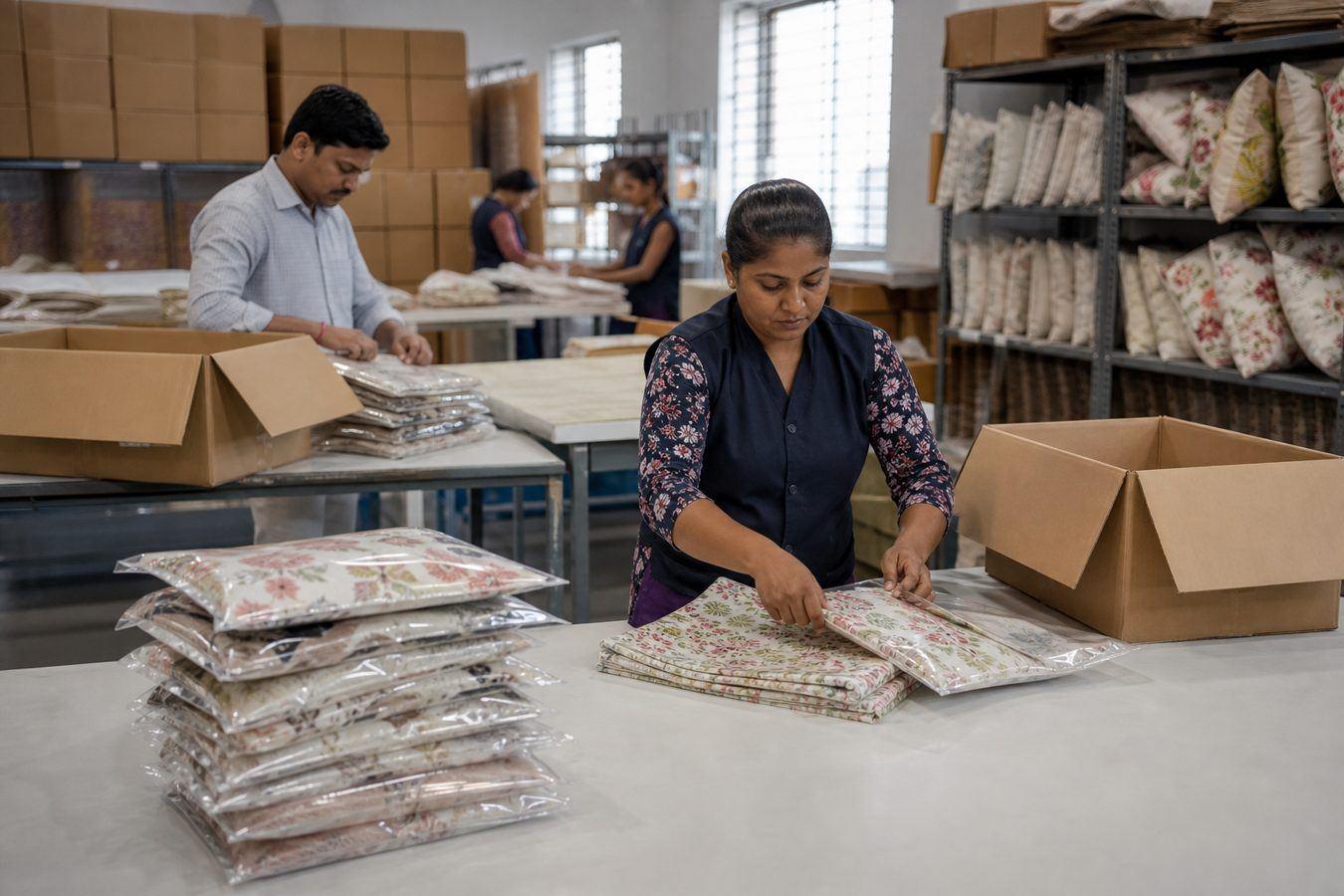
Packaging specification belongs in your RFQ, not the supplier's default. Roll-wrapped yardage needs moisture barrier and colourway labels; made-ups need polybag plus export carton without crushing hand-feel; retail programmes need hangtags and care labels in destination language before production starts.
Packaging requirements to specify in your RFQ
Swipe →
Data table — swipe horizontally on small screens
| Format | Best For | Specify in RFQ |
|---|---|---|
| Roll wrap + tube or bale | Printed yardage | Metre count, colourway ID, moisture barrier |
| Polybag + master carton | Cushions, throws, table linen | Colourway/size label; crush height limit |
| Retail hangtag + care label | Private-label retail | Fibre and care language for destination market |
| Colourway-separated cartons | Multi-SKU programmes | Carton count maps to invoice lines |
| Desiccant sachets | Natural-dye Ajrakh, long transit | Humidity control for Gulf and EU sailings |
Container Loading Details
Export Tip
Trial orders often ship LCL; proven colourway programmes scale to FCL. Confirm CBM after you know roll versus carton ratio — coordinated programmes mixing yardage rolls and bulky made-up cartons need stuffing plans that protect registration and hand-feel on top layers.
Shipping format guidance for buyer order planning
Swipe →
Data table — swipe horizontally on small screens
| Format | Typical Volume | Buyer Note |
|---|---|---|
| LCL consolidated | Trial colourways under ~15 CBM | Higher per-unit freight; acceptable for first test |
| 20ft FCL | Single-programme focus | Confirm colourway mix and crush risk before booking |
| 40ft HC FCL | Multi-colourway retail programmes | Request photos at container seal for damage claims |
| Air freight | Urgent strike-offs only | Costly; not for bulk replenishment |
| ICD Delhi/Dadri origin | Rajasthan print cargo | Confirm inland transit time in lead-time calculation |
Shipping Methods
Export Tip
- FOB: buyer arranges main carriage; common for repeat importers with established brokers
- CFR/CIF: exporter coordinates ocean freight; useful for first trial if forwarder relationship is immature
- DDP: selective and rare for first print trials — compliance and duty risk stay with seller
- Air: strike-offs and urgent sample kits only; never default for bulk colourways
- Document draft share with broker before sailing — non-negotiable for multi-line shipments
Match Incoterms to your risk tolerance and broker capability. FOB from Mundra or Nhava Sheva is common for experienced importers; CIF simplifies budgeting for first orders when a merchant exporter coordinates freight. Confirm who insures cargo and to what value before production begins. Destination sequencing guidance sits in Best Countries for Indian Hand Printed Textile Exports — this guide owns landed-cost flow, not market ranking methodology.
Certifications
Compliance Notes
Verify certificate numbers independently — OEKO-TEX and GOTS claims on a website are not verification. For natural-dye and organic programmes, see depth in Block Print, Ajrakh, Kalamkari & Sustainable Hand Printed Textile Export Opportunities. EPCH membership context sits in EPCH Registration Benefits for Hand Printed Textile Exporters.
Certifications and documents buyers should request before bulk
Swipe →
Data table — swipe horizontally on small screens
| Document | What It Proves | When Required |
|---|---|---|
| IEC + EPCH RCMC verification | Legal export entity and council registration | All first orders |
| Sealed strike-off sign-off | Registration and colour approval baseline | Before any bulk deposit |
| Azo-dye test report | Restricted amines compliance | USA, EU, UK, Japan premium retail |
| Fibre content & care label proofs | Destination labelling compliance | All retail-ready SKUs |
| OEKO-TEX / GOTS certificates | Chemical or organic chain claims | When marketing makes those claims |
| Honest technique declaration | Hand print vs rotary authenticity | Craft-positioned programmes |
| Pre-shipment inspection report | Bulk matches sealed strike-off | Trial and wholesale releases |
Buyer Requirements
Buyer Requirements
Your destination market sets the documentation bar before you shortlist suppliers. USA retail needs US Textile Rules labelling and azo awareness; EU and UK need EU Textile Regulation labels and test evidence; Japan needs registration QC proof; UAE may proceed with lighter initial documentation for décor-only SKUs. Build these requirements into your RFQ on day one — adding azo testing after bulk production starts is expensive and slow.
For per-country technique and certification preference depth — which colourways and fabrics each market prefers — see Most Demanded Indian Hand Printed Textiles by Country. That post owns the demand matrix; this guide owns how you source against it.
Country-wise Opportunities
Market Snapshot
Landded-cost optimisation differs by destination even when FOB is identical — duty lines, azo-retest frequency, and freight transit all shift the true cost. Use this table to align your first direct-sourcing programme with a market your supplier can actually document for.
Destination fit for first direct-sourcing programmes (buyer lens)
Swipe →
Data table — swipe horizontally on small screens
| Market | First-Order Fit | Documentation Bar | Calendar Pressure |
|---|---|---|---|
| UAE | Excellent proof-of-concept | Lower for décor-only SKUs | Medium — hospitality and Eid peaks |
| USA | Strong once labels and azo ready | Medium | High — spring/autumn launch |
| UK | Good mid-tier entry | Medium–High | High — seasonal buying |
| France | Good for narrative craft lines | High | High — Maison & Objet cycle |
| Germany | Strong for premium craft once certified | High | High — Heimtextil cycle |
| Canada | Pair with USA documentation base | Medium | High — mirrors USA |
| Japan | Advanced — precision QC required | High | High — fixed seasonal windows |
| Australia | Niche after seasonal nuance understood | Medium | Medium — reversed summer Christmas |
| Netherlands | Good as EU hub programme; smaller EPCH value for this category | High | High — EU distribution planning |
Sourcing Checklist
Checklist
Buyer Checklist
Exporter Checklist
Compliance Checklist
Checklist
Compliance Notes
Common Buyer Mistakes
Common Mistakes Box
Most first-order problems in direct hand printed textile sourcing trace back to a small set of avoidable mistakes — recognising them early saves entire colourway seasons.
Common importer mistakes and corrective actions
Swipe →
Data table — swipe horizontally on small screens
| Mistake | Consequence | Corrective Action |
|---|---|---|
| Approving bulk from photos, not strike-offs | Registration drift and colour claims | Require sealed strike-off sign-off per colourway |
| Skipping print-unit audit | Wrong technique capacity or dye chemistry | Audit in-progress production, not showroom samples |
| Comparing FOB only | Hidden azo, label, and breakage cost | Model full landed cost before selecting supplier |
| 100% advance on first order | No leverage if bulk fails tolerance | Use staged payment tied to inspection release |
| Vague RFQ on print technique | Rotary sold as hand print | Specify technique and verify in audit |
| Ignoring conversion-stage QC | Misregistered cushions despite good yardage | Inspect made-ups at converter, not only print unit |
Future Market Trends
Key Statistics
Through 2030, direct sourcing of hand printed textiles from India will be shaped by rising buyer expectations for azo documentation, OEKO-TEX and GOTS traceability, and honest craft-technique claims — plus digital audit tools that make remote print-unit verification easier for overseas buyers. Private-label and natural-dye Ajrakh programmes will continue to outperform undifferentiated commodity screen print in USA and EU premium channels for buyers who invest in strike-off discipline now.
EPCH-registered exporters and merchant consolidators with verifiable QC protocols and clean digital strike-off catalogues will increasingly out-compete unregistered workshops for serious international RFQs, even when unit pricing looks similar. Buyers who build repeatable verification and sampling processes now scale faster as demand in Australia, Japan, and secondary EU markets continues to grow.
Challenges & Solutions
Direct sourcing challenges cluster around colourway risk, multi-cluster coordination, and documentation — all manageable with the playbook sequence above.
Direct sourcing challenges and practical solutions
Swipe →
Data table — swipe horizontally on small screens
| Challenge | Root Cause | Solution |
|---|---|---|
| Colourway drift in bulk | No sealed strike-off baseline | Written sign-off per colourway before bulk deposit |
| Multi-cluster coordination failure | Too many direct relationships for one programme | Consolidate through one merchant exporter for coordinated ranges |
| Customs delay on mixed shipments | Invoice/packing list HS mismatch | Broker review of drafts before sailing |
| Azo failure at destination | Testing treated as optional | Build azo test into strike-off stage for EU/USA/Japan |
| Missed launch window | Verbal lead times | Tie contract to calendar cut-off with penalty clause |
Expert Insights
Expert Insight Box
Altus Exports supports international buyers sourcing hand printed textiles from India through print-unit verification, strike-off coordination, pre-shipment QC, and multi-line export documentation — operating as a product sourcing company in India and global sourcing partner for coordinated soft-furnishing and private-label programmes.

Conclusion
- Next step for buyers: Share your target print techniques, colourways, volumes, and destination market — we verify units and coordinate strike-offs through shipment.
- Review How to Export Hand Printed Textiles from India to understand exporter-side expectations.
- Compare destination sequencing in Best Countries for Indian Hand Printed Textile Exports.
- Align assortment planning with Top Hand Printed Textile Products Exported from India.
- Use Most Demanded Indian Hand Printed Textiles by Country for technique-market fit.
- Explore sustainable programmes in Block Print, Ajrakh, Kalamkari & Sustainable Hand Printed Textile Export Opportunities.
- Prepare paperwork with Hand Printed Textile Export Documentation Checklist.
- Understand council credibility in EPCH Registration Benefits for Hand Printed Textile Exporters.
- Explore merchant exporter services, export products from India, find manufacturers in India, or contact Altus Exports directly.
Sourcing hand printed textiles directly from India rewards buyers who bring the same rigour to procurement that they apply to any craft-sensitive manufacturing category: verified print units, written print-programme RFQs, sealed strike-offs, registration and colourfastness compliance, staged payments, and pre-shipment inspection against the approved sample. The FOB advantage over other print origins is genuine, but it only converts into sustainable margin when colourway quality is consistent from the first trial order through the tenth container.
If you are ready to source directly, start narrow — one or two print techniques, a tight strike-off set, and a trial MOQ — before committing to full seasonal FCL programmes. International buyers who prefer a single accountable partner for print-unit verification, sampling, QC, and documentation can work with Altus Exports across Jaipur, Kutch, Andhra Pradesh, and made-up conversion belts.