
Most Demanded Indian Hand Printed Textiles by Country (Buyer Preferences Guide)
By Saurabh Mittal, Founder, Altus Exports
A country-by-country demand guide for Indian hand printed textile exports — block print cushion covers and yardage in the USA; OEKO-TEX and GOTS-driven Ajrakh and organic cotton prints in Germany and the EU; heritage block and coordinated soft-furnishing demand in the UK; hospitality table linen and curtain print programmes in the UAE; design-forward Kalamkari and Ajrakh in France and the Netherlands; eco-positioned throws in Australia; and boutique block print in Canada and Japan. Includes technique × fabric × certification × price-ladder matrices, HS codes, MOQ benchmarks, duty notes, and Saurabh Mittal's insight on reading print demand correctly, from Altus Exports.
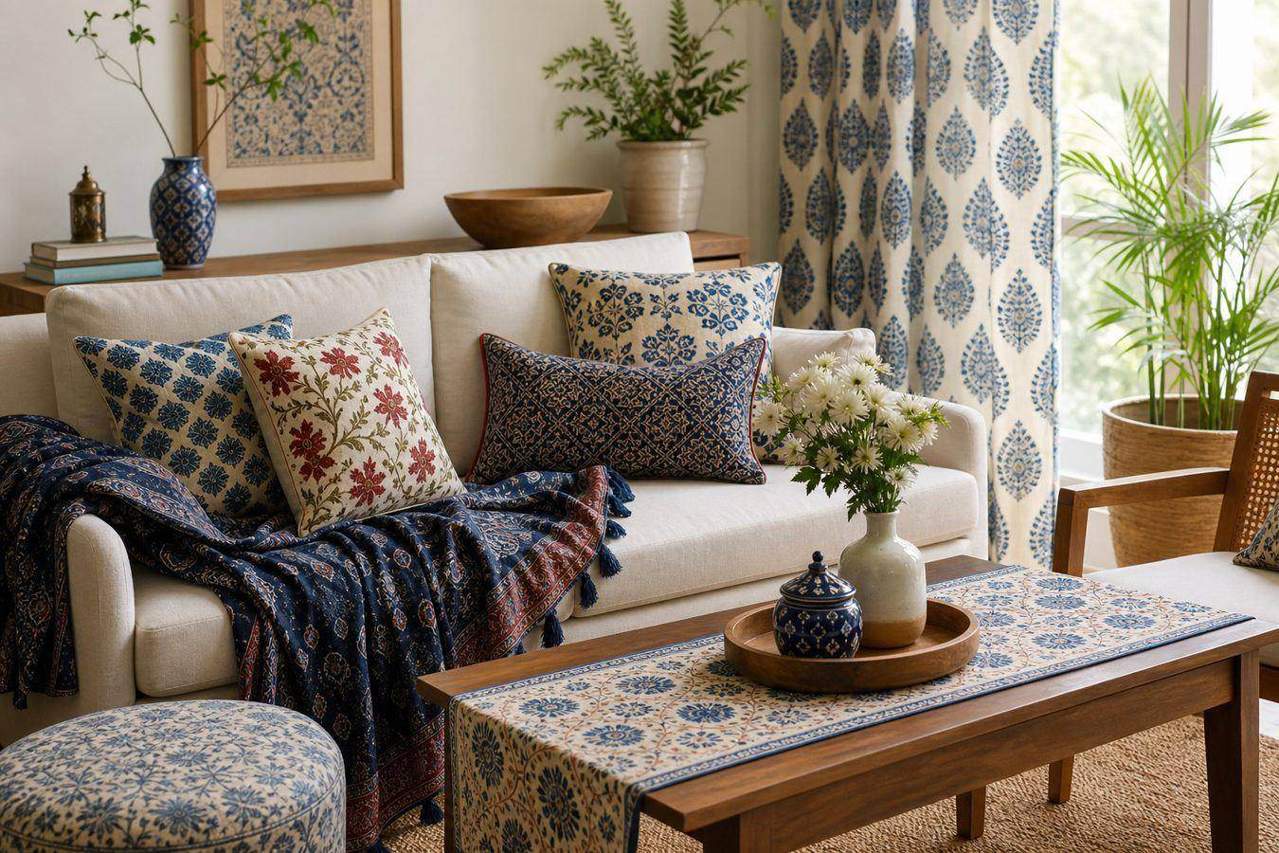
Global hand printed textile demand is not uniform, and treating it as one homogeneous export market is one of the fastest ways for an Indian block-print workshop or merchant exporter to misallocate colourway capacity. An Ajrakh throw with natural-dye documentation that sells confidently through a German design boutique may be entirely the wrong hero SKU for a Dubai hospitality procurement team seeking fast-replenishment screen-print table linen, and a volume Bagru block cushion programme that moves through US home specialty retail may sit unsold in a Japanese department store assortment built around precise dimensional specs and muted colour palettes. Hand printed textiles are bought and styled differently across roughly a dozen serious import markets, and print technique, fabric base, certification, colourway depth, and channel structure all shift accordingly.
This guide breaks down the most demanded Indian hand printed textiles by country — covering the United States, Germany, the United Kingdom, the UAE, the Netherlands, France, Australia, Canada, and Japan — so manufacturers, exporters, and international buyers can align assortment planning to real channel needs instead of guessing from aggregate export statistics. Technique preference, fabric base, certification expectations, packaging norms, and retail versus hospitality-channel dynamics all get their own treatment for each market.
It closes with HS classification, MOQ, and FOB benchmarks by market, a practical country × technique × fabric × certification × price-ladder matrix you can apply to your own top SKUs, and answers to the demand-planning questions Indian hand printed textile exporters ask most often. For end-to-end export process and registration context, pair this guide with how to export hand printed textiles from India and EPCH registration benefits for hand printed textile exporters. For macro destination ranking and freight comparison, see best countries for Indian hand printed textile exports — this post owns SKU-level demand detail, not ranking methodology.
Key Takeaways
Summary Box
- Hand printed textile demand varies sharply by country — print technique, fabric base, certification, price band, and retail channel all shift market to market, so a single catalogue rarely fits every destination.
- The USA rewards block print cushion covers, throws, and yardage at home specialty retail and e-commerce private-label scale; Germany and the wider EU reward OEKO-TEX, GOTS, and azo-free Ajrakh and organic cotton prints.
- The UK rewards heritage block print and coordinated soft-furnishing programmes at design boutiques and home furnishing retail; the UAE rewards hospitality table linen, curtain panels, and fast-replenishment print made-ups.
- France and the Netherlands lean toward design-forward Ajrakh and Kalamkari for boutique retail; Australia rewards eco-positioned block print and GOTS organic cotton; Canada tracks US patterns at smaller scale; Japan rewards precise sizing and restrained colour palettes.
- Build a country × technique × fabric × certification × price-ladder matrix before committing colourway capacity to any single destination.
- GOTS, OEKO-TEX, and REACH documentation are rising purchase criteria across the EU, UK, and Australia, and matter less — though still relevant — for fast-moving hospitality channels in the UAE.
Executive Summary
Summary Box
Indian hand printed textile exports span block print (Bagru, Sanganer, contemporary), Ajrakh, Dabu/mud-resist, Kalamkari, and hand screen print across cushion covers, throws, table linen, curtains, scarves, apparel yardage, and coordinated soft-furnishing programmes. Buyers in the USA, Germany, the UK, the UAE, the Netherlands, France, Australia, Canada, and Japan source through home specialty retail, department stores, design boutiques, e-commerce private label, hospitality soft furnishings, fashion fabric buyers, and gift/wholesale showrooms — but the hero SKU within each channel differs materially by destination.
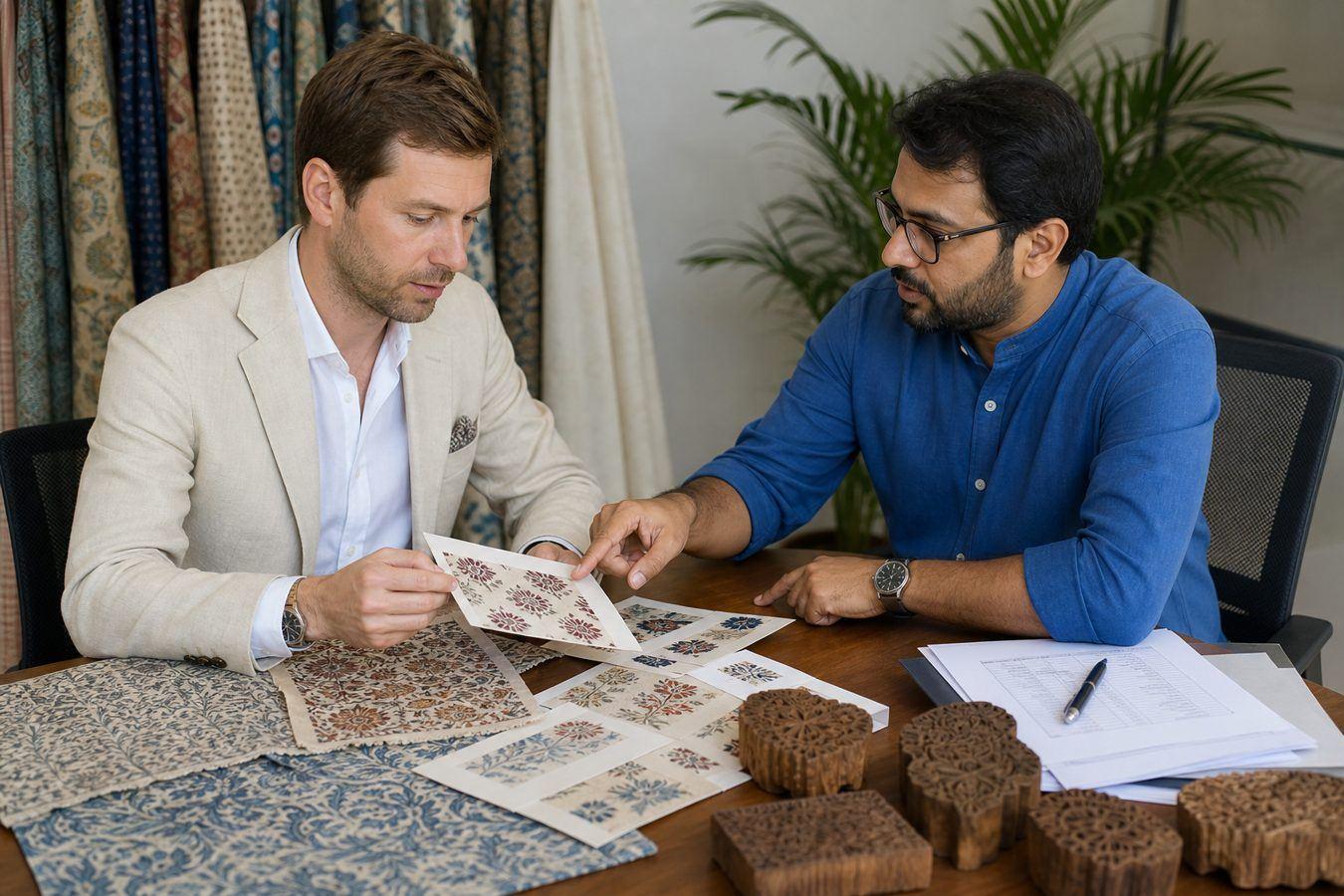
This guide maps those differences as a demand intelligence layer: which print techniques, fabric bases, certifications, colourway strategies, and FOB price bands buyers in each country actually reorder — not how to rank destinations macro-economically (that belongs in post 3) and not how to execute export paperwork step by step (that belongs in post 1). Use the matrices below to align strike-off development, certification investment, and production planning before your next seasonal programme ships.
Market Size & Industry Overview
Key Statistics
India's hand printed textile supply map clusters around Jaipur–Sanganer–Bagru (Rajasthan block and Dabu), Kutch / Ajrakhpur (Gujarat Ajrakh), Machilipatnam / Srikalahasti (Andhra Pradesh Kalamkari), Panipat / Karur / Tirupur (made-up conversion and volume screen), and Delhi-NCR (merchant consolidation). Directionally, the USA, Germany, the UK, the UAE, the Netherlands, France, Australia, Canada, and Japan anchor import demand — figures should be verified against latest EPCH, DGFT, and ITC Trade Map releases under printed fabric (5208/5209 and related) and made-up headings (6304, 6303, 6214, 6302 when bedding-led) before publishing or quoting buyers.
Unlike commodity rotary-print bedding, hand printed textiles are bought on craft story, print registration quality, colourway depth, and honest print-method claims as much as on price. That makes country-level SKU preference at least as important as headline export volume when planning which colourways to develop for which buyer channel.
Why Hand Printed Textile Demand Varies by Country
Three structural factors explain most country-level variation: how retail and hospitality channels are organised locally, how sustainability and certification literacy shapes buyer questionnaires, and how climate and interior-design culture influence preferred fabric weight and colour palette. A market with deep private-label e-commerce infrastructure and home specialty retail scale — the United States is the clearest example — develops different hero SKUs than a market where GOTS-certified organic print is close to baseline for organised retail, as in much of Germany and the wider EU.
Print technique economics compound this further. Heritage Ajrakh and multi-stage natural-dye block programmes carry real labour and lead-time cost tied to Kutch and Rajasthan craft cycles, which pushes them toward markets willing to pay for story and certification depth. Volume hand screen print on cotton at accessible price points remains the default for hospitality and hypermarket-driven channels prioritising replenishment speed over craft narrative — particularly in the UAE and parts of the GCC corridor.
Comparison table
Swipe →
Data table — swipe horizontally on small screens
| Country / Region | Most Demanded Techniques | Primary Fabric Bases | Certification Expectation | Dominant Price Ladder |
|---|---|---|---|---|
| United States | Block print, hand screen hybrid | Cotton, cotton-linen blends | Care labelling; OEKO-TEX rising in premium | Mid: US$3–8/m yardage; US$4–10/pc cushions |
| Germany / EU | Ajrakh, organic block, Kalamkari (premium) | Organic cotton, linen, natural-dye cotton | OEKO-TEX, GOTS, REACH/azo-free baseline | Premium: US$8–25+/m heritage; US$10–18/pc made-ups |
| United Kingdom | Heritage block, coordinated sets | Cotton, linen | UK care labelling; OEKO-TEX for premium retail | Mid-premium: US$5–12/pc cushions; US$12–30 throws |
| UAE | Hand screen volume, block accent | Cotton, poly-cotton hospitality blends | Hospitality durability; lighter cert depth | Value-mid: US$2–6/pc cushions; US$6–20 table linen |
| Netherlands | Ajrakh, contemporary block | Cotton, linen, blends | REACH; OEKO-TEX for organised retail | Mid-premium: US$6–15/pc; US$5–12/m yardage |
| France | Ajrakh, Kalamkari, fine block | Cotton, silk blends | Azo-free; design-story documentation | Premium: US$10–25+/m; US$12–20/pc made-ups |
| Australia | Eco block print, organic cotton screen | Organic cotton, linen | GOTS, OEKO-TEX growing baseline | Mid-premium: US$6–14/pc; US$5–10/m organic yardage |
| Canada | Block print, hand screen (US-adjacent) | Cotton, blends | Care labelling similar to USA | Mid: US$3–8/m; US$4–10/pc cushions |
| Japan | Fine block, restrained Kalamkari | Cotton, linen | Precise care labels; chemical safety awareness | Premium niche: US$8–18/pc; US$8–15/m yardage |
Export Statistics
Key Statistics
Aggregate export share data provides useful context before diving into country-specific SKU detail, though exporters should read it as background rather than a production plan — the same country can hide very different buyer segments underneath a single import-share number. Hand printed textiles do not map to a single HS total; directional framing uses printed fabric lines (5208/5209 and chapter 54/55 where applicable) and made-up headings (6304 furnishing articles, 6303 curtains, 6214 scarves, 6302 when bedding-led). Verify current figures via EPCH trade statistics, DGFT dashboards, and ITC Trade Map.
By EPCH's dedicated Handprinted Textiles export data for FY 2024-25, the UAE leads Indian hand printed textile import demand by value (Rs 1,539.46 crore), followed by the USA (Rs 319.92 crore), the UK, France, Germany, Canada, Japan, Australia, and the Netherlands. USA remains the deepest single retail and private-label channel by buyer count and reorder volume even though it is not the top EPCH-value market. For macro ranking methodology, duty corridors, and freight comparison between destinations, see best countries for Indian hand printed textile exports — this section orients only; post 3 owns the ranking framework.
EPCH Handprinted Textiles destination framing FY 2024-25 (value order) — verify against latest EPCH/DGFT/ITC Trade Map releases.
Swipe →
Data table — swipe horizontally on small screens
| Destination | EPCH FY24-25 Value / Demand Position | Primary Import Formats |
|---|---|---|
| UAE | Largest named value (Rs 1,539.46 crore); fast hospitality/retail cycle | Table linen, curtains, cushion bulk programmes |
| United States | Second-largest named value (Rs 319.92 crore); deepest retail/PL channel | Block print cushions, throws, yardage, private label |
| United Kingdom | Design and heritage retail | Coordinated block print soft furnishings |
| France | Boutique and artisanal premium | Kalamkari, Ajrakh, fine block made-ups |
| Germany | Premium/certification-led EU retail | Ajrakh, organic block, OEKO-TEX/GOTS programmes |
| Canada | US-adjacent scale | Block print cushions and yardage |
| Japan | Premium niche | Fine block, restrained palettes, precise sizing |
| Australia | Eco-positioned growth niche | Organic cotton block print, GOTS throws |
| Netherlands | Smaller named EPCH value for this category; EU distribution and design retail | Ajrakh, contemporary block, coordinated sets |
Import Statistics
Key Statistics
Import-side demand mirrors the technique and channel split above. US importers pull block print cushion covers and yardage for home specialty chains and e-commerce private label, with rising OEKO-TEX expectations in premium tiers. German and broader EU importers prioritise documented azo-free and REACH-compliant print programmes, with GOTS organic cotton lines carrying measurable price premiums. UK buyers blend heritage block aesthetics with seasonal colourway refreshes at home furnishing retail. UAE hospitality and retail channels import high-volume screen and block-accent made-ups with durability and replenishment cadence as primary purchase criteria.
Comparison table
Swipe →
Data table — swipe horizontally on small screens
| Country | Top Imported Techniques | Illustrative Channel Mix (non-statistical) |
|---|---|---|
| USA | Block print, hand screen hybrid | Home specialty retail leads; e-commerce private label and boutiques follow |
| Germany | Ajrakh, organic block, Kalamkari | Department/design retail leads; organic specialty and wholesale follow |
| UK | Heritage block, coordinated programmes | Home furnishing retail leads; boutiques and e-commerce follow |
| UAE | Hand screen, block accent | Hospitality and retail/hypermarket lead; gifting is a secondary channel |
| Netherlands | Ajrakh, contemporary block | Design retail and EU distribution lead; e-commerce is a smaller channel |
| France | Kalamkari, Ajrakh, fine block | Boutique retail leads; department store and wholesale follow |
| Australia | Eco block, organic screen | Home furnishing chains lead; e-commerce and department retail follow |
| Canada | Block print (US-adjacent) | Home specialty leads; e-commerce and retail follow |
| Japan | Fine block, Kalamkari (niche) | Department/specialty stores lead; design retail follows |
Product Categories / Variants
Summary Box
Country demand maps onto specific made-up formats and yardage types differently. The table below summarises which product categories see strongest reorder velocity by destination — not a full SKU catalogue (see top hand printed textile products exported from India).
Comparison table
Swipe →
Data table — swipe horizontally on small screens
| Product Format | USA | Germany/EU | UK | UAE | Australia |
|---|---|---|---|---|---|
| Cushion covers | High | Medium (premium block) | High | High (volume) | Medium |
| Throws / blankets | High | High (Ajrakh/GOTS) | High | Medium | High (eco) |
| Table linen | Medium | Medium (Kalamkari premium) | High | High (hospitality) | Medium |
| Curtains / drapery | Medium | Low-medium | Medium | High (hospitality) | Low-medium |
| Scarves / stoles | Medium | Medium | Medium | Low | Low-medium |
| Apparel yardage | Medium (fashion PL) | High (organic print) | Medium | Low | Medium |
| Print yardage ( furnishing) | High | High (heritage) | High | Medium | Medium |
Manufacturing Overview
Export Tip
Meeting country-specific demand requires routing production to the right cluster: Bagru and Sanganer for US and UK heritage block programmes; Kutch for German, French, and Dutch Ajrakh hero SKUs; Andhra Pradesh for Kalamkari table linen and apparel fabric destined for France and premium EU retail; Panipat/Karur for UAE hospitality volume and US private-label screen hybrids. Merchant exporters in Delhi-NCR typically coordinate strike-off approval, colourway MOQ consolidation, and certification documentation across clusters — a model international buyers use to reduce first-order print-registration risk.
Country demand only converts when cluster capability matches buyer specification: natural-dye Ajrakh for Germany requires Kutch cycle times and chemistry documentation; fast-replenishment UAE table linen requires Panipat/Karur conversion speed and commercial-laundry durability testing — not the same production line.
United States — Block Print Cushions, Throws, and Private-Label Yardage
- Primary technique demand: Bagru/Sanganer block print; hand screen hybrid for scale private label
- Key fabric bases: Cotton 140–180 GSM; cotton-linen blends for premium tiers
- Key channels: Home specialty retail, e-commerce private label, design boutiques
- Certification: Care labelling mandatory; OEKO-TEX rising in premium
- Price ladder: Yardage US$3–8/m; cushions US$4–10/pc; throws US$12–28/pc
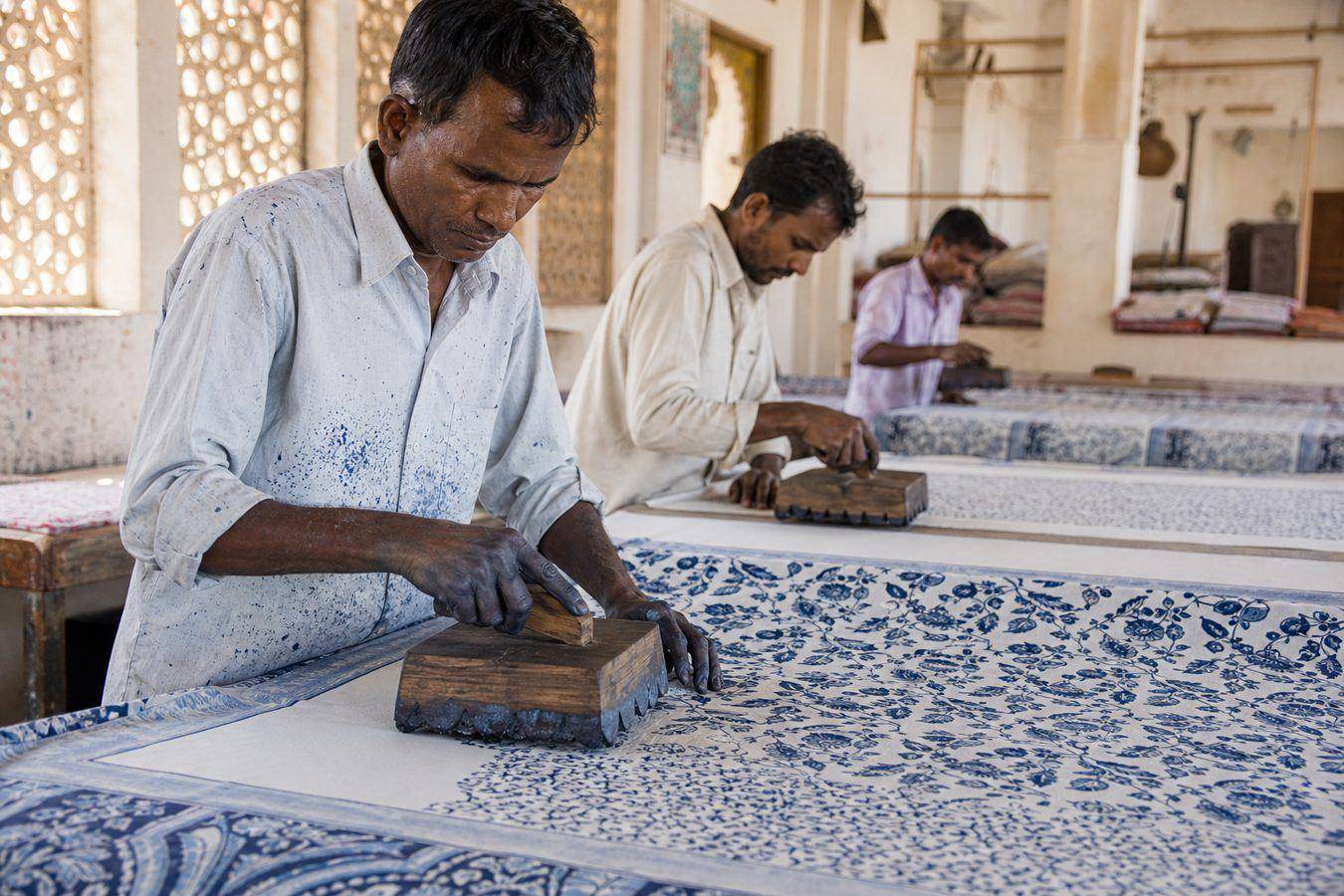
The United States is India's second-largest hand printed textile destination by EPCH-reported value (behind the UAE) but the deepest single channel by buyer count and reorder volume, and buyer expectations reflect a market built around home specialty retail and e-commerce private-label scale. Block print cushion covers in cotton and cotton-linen blends serve as the volume workhorse across value and mid-tier programmes, with coordinated throw and yardage lines supporting shop-the-room merchandising. Hand screen print hybrids appear in larger private-label programmes where registration tightness must improve over pure artisan block but craft story still matters on hangtags.
Private-label consistency is the defining buyer priority: dye-lot and print-registration consistency across repeat production runs spanning months, not just a strong first strike-off. Buyers evaluating new Indian partners scrutinise colourway repeatability heavily, since a private-label programme that drifts in shade or block alignment between runs creates costly retail returns. Fibre content and care labelling under US Textile Fiber Products Identification Act rules apply across retail channels and should be confirmed before shipping.
Premium US tiers increasingly request OEKO-TEX Standard 100 for print dyes and finishes, though value channels may accept compliant reactive systems with documented azo-free declarations rather than full certification.
Germany and the Wider EU — Ajrakh, Organic Block, and Certification-Led Retail
- Primary technique demand: Ajrakh, organic block, premium Kalamkari
- Key fabric bases: GOTS organic cotton, linen, natural-dye cotton
- Key channels: Department stores, design boutiques, organic specialty retail
- Certification: OEKO-TEX, GOTS, REACH/azo-free documentation baseline
- Price ladder: Heritage yardage US$8–25+/m; made-ups US$10–18/pc premium tier
Germany anchors a leading EU hand printed textile import appetite for Indian craft print alongside France, and buyer expectations across Germany and much of the wider EU are shaped heavily by certification maturity. OEKO-TEX Standard 100 and GOTS have moved from differentiator to close-to-baseline expectation across much of organised German and EU retail for premium print programmes, particularly department stores and organic-positioned design boutiques. REACH chemical compliance and azo-free dye restrictions are regulatory requirements, not optional certifications, for any textile entering the EU market.
Ajrakh natural-dye yardage and throws from Kutch, organic cotton block print from Rajasthan, and select Kalamkari table linen lines dominate the premium reorder tier. Buyers scrutinise batch-level certification records connecting finished print goods back to certified cotton sourcing and audited dye processes — especially for organic-labelled retail lines. Exporters targeting this market should read block print, Ajrakh, Kalamkari & sustainable hand printed textile export opportunities alongside this section.
United Kingdom — Heritage Block and Coordinated Soft Furnishings
- Primary technique demand: Bagru/Sanganer heritage block; coordinated multi-SKU programmes
- Key fabric bases: Cotton, linen, cotton-linen blends
- Key channels: Home furnishing retail, design boutiques, e-commerce
- Certification: UK care labelling; OEKO-TEX for premium tiers
- Price ladder: Cushions US$5–12/pc; throws US$12–30/pc; table linen sets US$15–35/set
The UK hand printed textile market is shaped by home furnishing retail chains and design boutiques built around accessible, frequently refreshed ranges — coordinated cushion, throw, and table linen programmes in heritage block patterns alongside contemporary geo and floral colourways. Buyers want dependable colourway depth, retail-ready packaging, and print-registration consistency across seasonal refreshes rather than one static hero design.
Post-Brexit UK fibre content and care labelling regulations apply separately from EU rules even where requirements look similar on paper, and exporters should confirm current UK-specific requirements rather than assuming EU compliance automatically satisfies UK retail. OEKO-TEX documentation supports premium listings but is not always mandatory at value-tier chains.
UAE — Hospitality Table Linen, Curtains, and Volume Print Made-Ups
- Primary technique demand: Hand screen volume; block print accents on hero SKUs
- Key fabric bases: Cotton, poly-cotton hospitality blends
- Key channels: Hospitality procurement, retail, hypermarkets, regional distributors
- Certification: Durability/wash testing; lighter OEKO-TEX unless premium retail
- Price ladder: Cushions US$2–6/pc; table linen US$6–20/pc; curtains US$8–25/panel
The UAE presents a demand profile built around hospitality soft-furnishing procurement and retail/hypermarket volume for resident and tourist households. Hand screen print and block-accent cushion programmes dominate retail volume, while hospitality buyers prioritise table linen, napery, and curtain panels with commercial-laundry durability and fast replenishment over craft narrative depth. The UAE also functions as a regional re-export gateway, meaning demand booked through UAE distributors often serves buyers across the broader GCC corridor.
Certification depth is lighter than Germany for most volume channels, but fibre content labelling and hospitality durability specifications matter intensely. Arabic-inclusive retail packaging improves hypermarket sell-through where applicable.
Netherlands and France — Design-Forward Ajrakh and Kalamkari
- Netherlands — Primary demand: Ajrakh, contemporary block; channels: design retail, EU distribution; price ladder: US$6–15/pc made-ups
- France — Primary demand: Kalamkari, Ajrakh, fine block; channels: boutique and department premium; price ladder: US$10–25+/m yardage
The Netherlands functions as both a consumption market and an EU distribution hub for design-forward hand printed textiles, with strong demand for Ajrakh throws, contemporary block print cushions, and coordinated yardage programmes destined for broader European retail. France leans more boutique and artisanal: Kalamkari table linen, Ajrakh scarves, and fine block print made-ups with strong design-story packaging for department store premium floors and independent design retail.
Both markets reward honest print-method claims and azo-free documentation, with France particularly sensitive to craft provenance narrative on hangtags and wholesale linesheets.
Australia and Canada — Eco Block Print and US-Adjacent Scale
- Australia — Primary demand: Eco block print, GOTS organic cotton; certification: GOTS/OEKO-TEX for premium; price ladder: US$6–14/pc made-ups
- Canada — Primary demand: Block print US-adjacent assortments; price ladder: US$3–8/m yardage; US$4–10/pc cushions
Australian hand printed textile demand runs through home furnishing chains and e-commerce with organic cotton block print and GOTS-certified throws carrying a genuine premium positioning. Buyers expect sustainability documentation alongside print quality, mirroring trends visible in Germany though at smaller absolute volume. Freight lead times require replenishment buffers in production planning.
Canada tracks US demand patterns at smaller scale — block print cushions, throws, and yardage for home specialty retail and e-commerce — with care labelling expectations similar to the USA and slightly lower volume MOQ flexibility on first orders.
Japan — Fine Block, Restrained Palettes, and Precision Sizing
- Primary technique demand: Fine block print, select Kalamkari premium lines
- Key fabric bases: Cotton, linen; lighter weights preferred
- Key channels: Department stores, specialty home textile retailers
- Certification: Care labelling; chemical safety awareness
- Price ladder: Cushions US$8–18/pc; yardage US$8–15/m
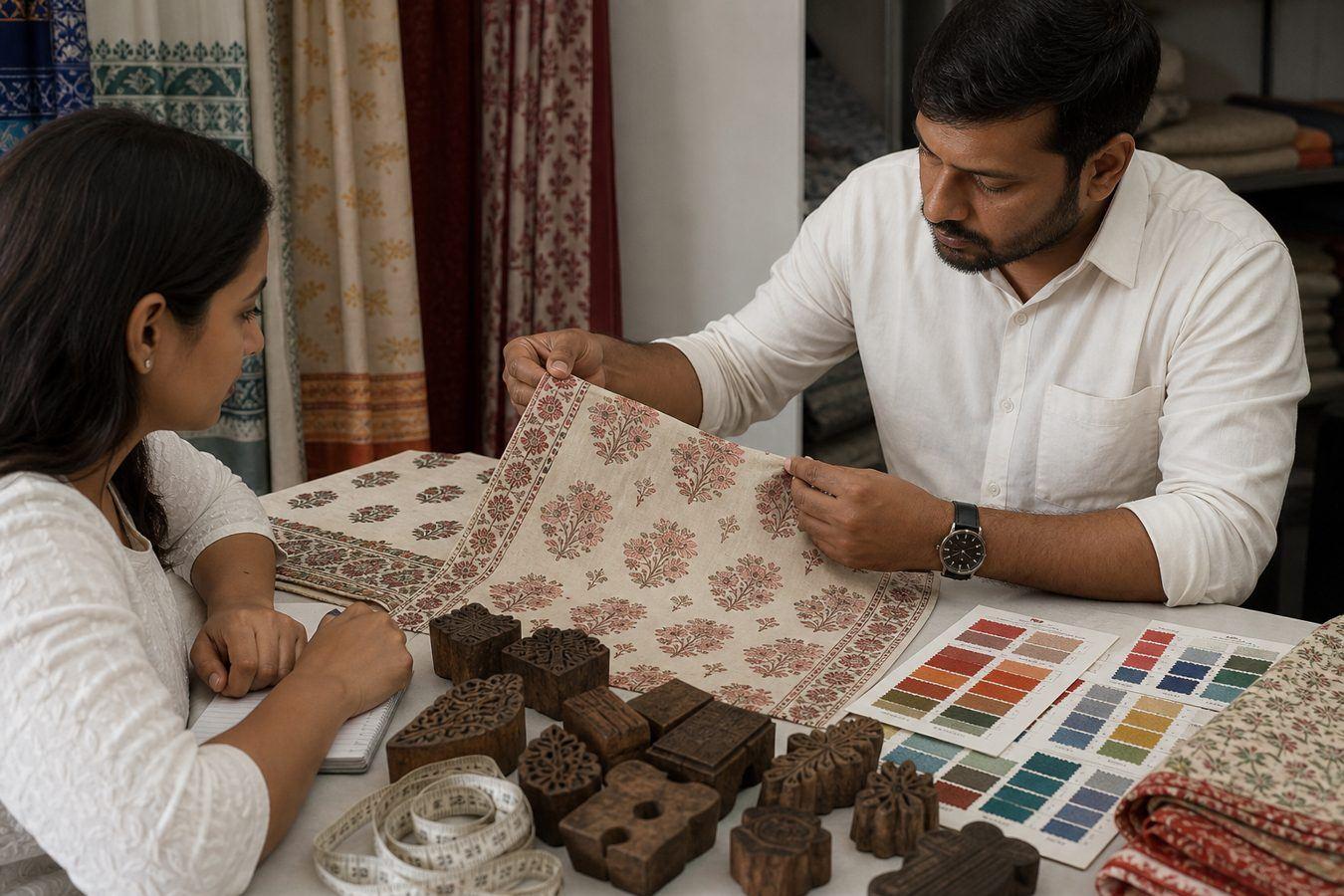
Japan represents a premium, quality-exacting niche for Indian hand printed textiles rather than a volume anchor. Fine block print with restrained colour palettes, precise dimensional compliance for cushions and table linen, and meticulous finishing quality dominate buyer expectations. Japanese department stores and specialty home textile retailers evaluate print registration and fabric hand-feel closely, often comparing strike-offs across competing origins before committing.
Organic and natural-dye lines form a smaller but growing niche layered on top of core fine-block expectations. Exporters should confirm exact sizing charts rather than assuming Western dimension equivalents.
Pricing Analysis
Buyer Tip
Country-specific demand only translates into orders when quotations align with realistic FOB bands for that market's dominant channel. Indicative FOB ranges below are directional USD and should be confirmed at quote date with your merchant exporter.
Comparison table
Swipe →
Data table — swipe horizontally on small screens
| Market | Volume Tier FOB | Premium/Craft Tier FOB | Primary Price Driver |
|---|---|---|---|
| USA | Yardage US$3–5/m; cushions US$4–7/pc | Yardage US$6–8/m; throws US$18–28/pc | Private-label consistency, retail packaging |
| Germany / EU | Screen cotton US$3–6/m | Ajrakh US$12–25+/m; GOTS throws US$15–22/pc | GOTS/OEKO-TEX certification depth |
| UK | Cushions US$5–8/pc | Coordinated sets US$12–30/pc throw tier | Heritage design, seasonal colourway depth |
| UAE | Cushions US$2–4/pc | Hospitality table linen US$10–20/pc | Replenishment speed, laundry durability |
| Netherlands | Yardage US$5–8/m | Ajrakh throws US$14–20/pc | Design positioning, EU distribution |
| France | Kalamkari yardage US$8–15/m | Fine block made-ups US$12–20/pc | Craft story, boutique packaging |
| Australia | Cotton block US$4–7/pc cushions | GOTS organic US$8–14/pc | Organic certification, sustainability narrative |
| Canada | Similar to USA at ~10–15% smaller MOQ | Premium block similar to US premium tier | US-adjacent channel expectations |
| Japan | Fine block US$8–12/pc cushions | Premium Kalamkari US$12–18/pc | Sizing precision, finishing quality |
MOQ Analysis
Buyer Tip
MOQ expectations vary by print technique and country channel. Block and natural-dye programmes carry higher colourway MOQs because each shade requires separate block or resist setup. Use this directional framework when negotiating first orders.
Comparison table
Swipe →
Data table — swipe horizontally on small screens
| Market / Channel | Strike-Off MOQ | Trial MOQ | Programme MOQ |
|---|---|---|---|
| USA private label | 1–5 m/colourway or 5–20 pcs/SKU | 200–500 pcs hero SKU | 1,000–3,000 pcs/SKU or FCL mix |
| Germany GOTS organic | 1–3 m/colourway certified | 100–200 m/colourway | 500 m+/colourway or 500+ pcs |
| UK retail coordinated | 5–20 pcs/SKU per colourway | 200–500 pcs across 3–5 SKUs | Carton multiples by colourway |
| UAE hospitality | 5–10 pcs/SKU | 500–1,000 pcs | 2,000+ pcs replenishment |
| Japan premium | 5–10 pcs/SKU exact size | 200–300 pcs | 500+ pcs after sample approval |
Packaging Standards
Export Tip
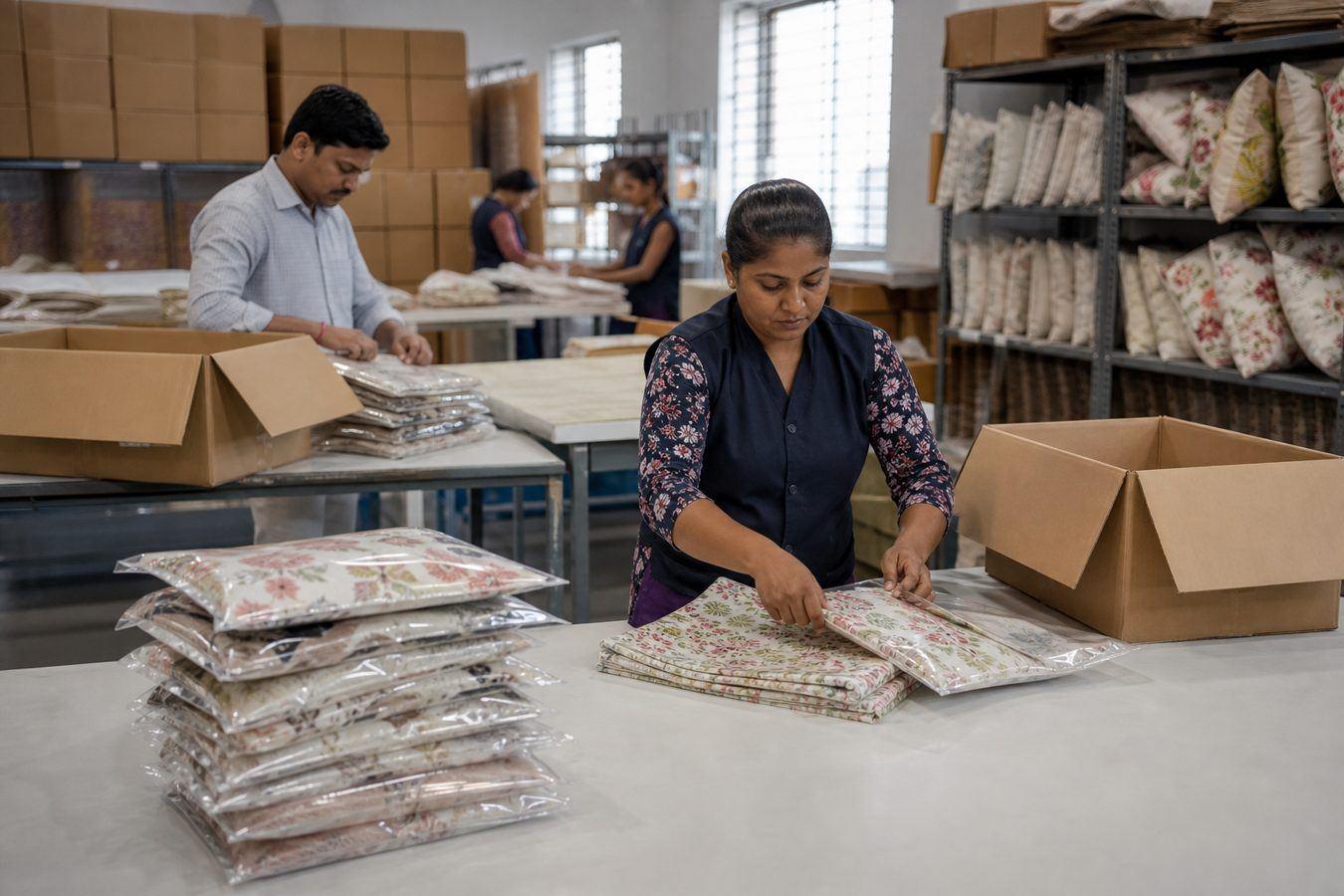
Packaging expectations differ by market and channel. UK, US premium, and EU design retail generally expect retail-ready polybags, hangtags, and care labels. UAE hospitality prioritises bulk functional packing for storage and commercial laundry. GOTS programmes for Germany and Australia often require certified batch coding on packaging materials where certification scope demands it.
Comparison table
Swipe →
Data table — swipe horizontally on small screens
| Market | Retail Packaging Expectation | Label Requirements |
|---|---|---|
| USA | Polybag + hangtag; branded sleeve for premium PL | FTC fibre content and care |
| Germany / EU | Retail-ready; eco kraft options for premium | EU fibre label; GOTS/OEKO-TEX logo rules if certified |
| UK | Retail-ready seasonal packaging | UK-specific care/fibre rules post-Brexit |
| UAE | Bulk cartons; retail polybag for hypermarket | Fibre content; Arabic optional for retail |
| Australia | Retail-ready; sustainability-forward materials | Care labelling; GOTS hangtag if certified |
Container Loading Details
Export Tip
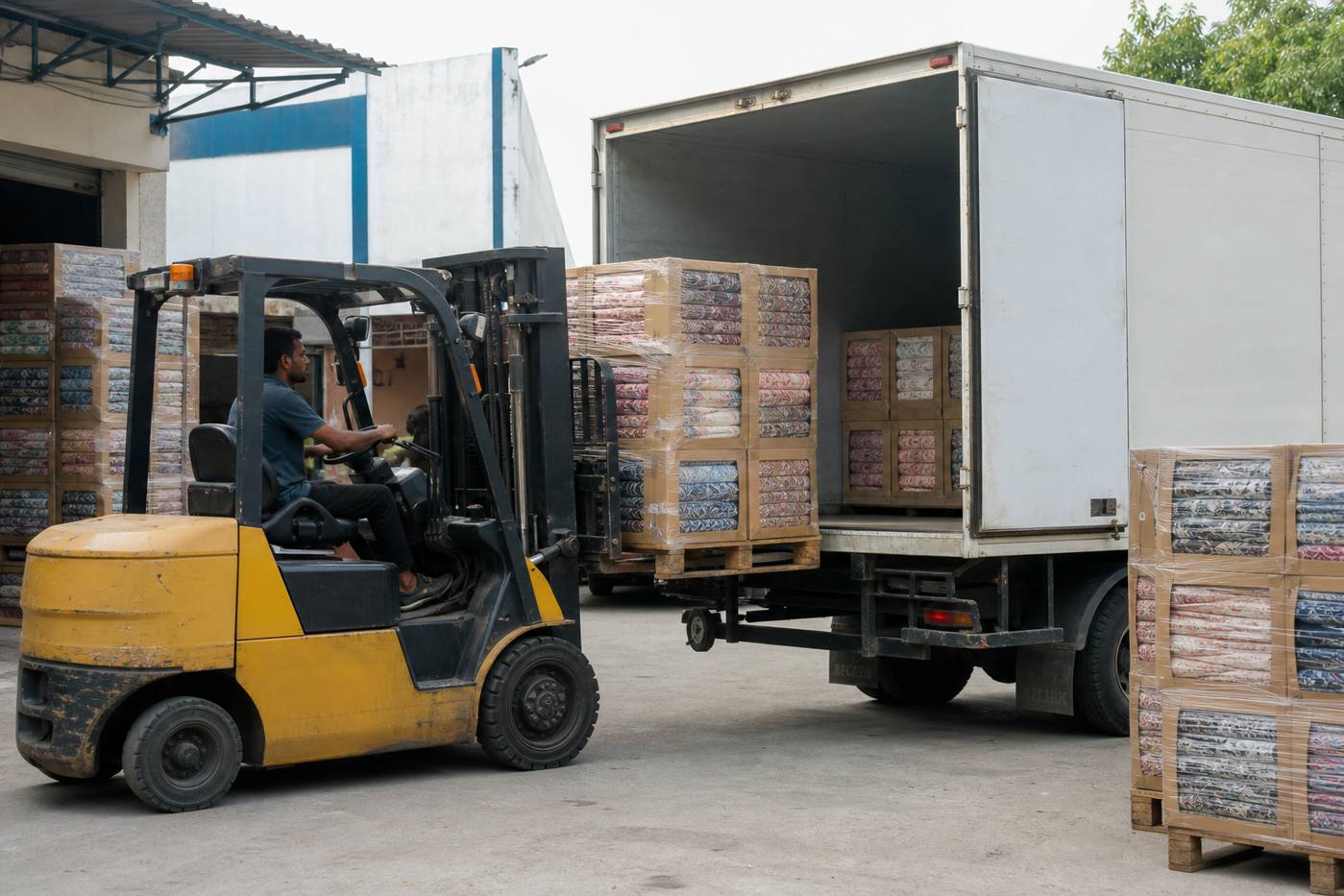
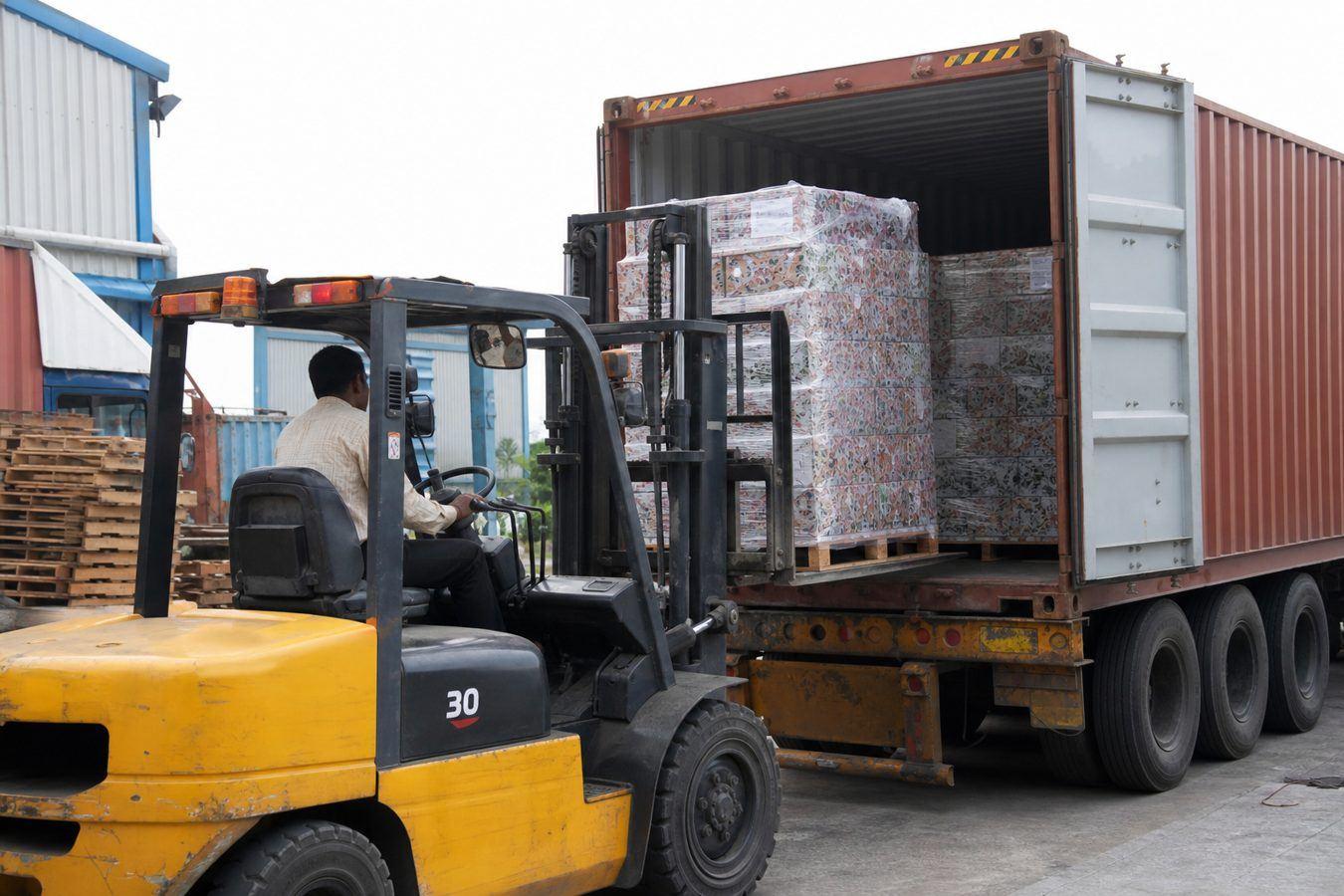
Country programmes influence container mix: US and UK retail programmes often ship high cube-count cushion cartons; Germany/Ajrakh programmes may mix roll-packed yardage with made-up cartons; UAE hospitality loads favour table linen and curtain bulk. Plan 20GP/40HC stuffing against CBM by SKU mix — see how to export hand printed textiles from India for operational loading detail.
Comparison table
Swipe →
Data table — swipe horizontally on small screens
| Programme Type | Typical Container | Loading Notes |
|---|---|---|
| US/UK cushion FCL | 40HC | High carton count; avoid crush on embossed prints |
| EU Ajrakh yardage + throws | 20GP or 40HC | Mix rolls upright with made-up cartons |
| UAE hospitality table linen | 40HC | Bulk cartons; weight rarely limits before cube |
| Multi-country LCL trial | LCL | Group by colourway to simplify customs valuation |
Shipping Methods
Export Tip
Shipping mode selection follows channel urgency: air for strike-offs and urgent sample kits; LCL for trial colourways; FCL for wholesale and retail programmes. US and EU West Coast/East Coast routing typically sails from Nhava Sheva or Mundra; Gujarat Ajrakh programmes often use Mundra or Pipavav; Delhi-NCR consolidated programmes may clear via ICD Delhi/Dadri. Lead times: strike-offs 7–21 days; stock-ready 4–8 weeks; custom block/natural-dye 8–14 weeks — plan against retail seasons 4–9 months ahead for US and EU buyers.
Certifications
Compliance Notes
Certification demand maps tightly to country tier. Baseline IEC, GST, and EPCH RCMC support vendor qualification globally — see EPCH registration benefits. Product-level certifications below vary by destination.
Comparison table
Swipe →
Data table — swipe horizontally on small screens
| Certification | USA | Germany/EU | UK | UAE | Australia |
|---|---|---|---|---|---|
| OEKO-TEX Standard 100 | Premium tier rising | Baseline organised retail | Premium tier | Optional | Growing baseline |
| GOTS organic | Niche premium | Baseline organic retail | Premium niche | Rare | Strong premium |
| REACH / azo-free dyes | Best practice | Mandatory regulatory | EU-adjacent awareness | Best practice | Best practice |
| Flammability (furnishing) | Some channels | Some EU channels | UK-specific rules | Hospitality specs | Select retail |
| Honest hand-print claims | All channels | All channels | All channels | All channels | All channels |
Buyer Requirements
Buyer Requirements
Across all countries, hand printed textile buyers request strike-offs with print-registration approval, colourfastness summaries, honest print-method documentation, MOQ clarity per colourway, and institutional credentials (IEC, EPCH RCMC, GST). Country-specific overlays include GOTS/OEKO-TEX packs for Germany and Australia, hospitality durability specs for UAE, FTC/EU care labels for US/EU retail, and exact sizing charts for Japan.
Country-wise Opportunities
Market Snapshot
The master demand matrix below consolidates technique, fabric, certification, and price-ladder preferences for quick assortment planning. Cross-reference with source hand printed textiles directly from India when qualifying suppliers against these profiles.
Master demand matrix — country × technique × fabric × certification × price ladder (directional).
Swipe →
Data table — swipe horizontally on small screens
| Country | Hero Techniques | Fabric Base | Cert Priority | Target FOB Band |
|---|---|---|---|---|
| USA | Bagru/Sanganer block; screen hybrid | Cotton; cotton-linen | Care label; OEKO-TEX premium | Mid US$3–8/m; US$4–10/pc |
| Germany | Ajrakh; organic block | GOTS cotton; linen | OEKO-TEX + GOTS + REACH | Premium US$8–25+/m |
| UK | Heritage block coordinated sets | Cotton; linen | UK care; OEKO-TEX premium | Mid-premium US$5–12/pc |
| UAE | Screen volume; block accent | Cotton; poly-cotton | Durability testing | Value-mid US$2–6/pc |
| Netherlands | Ajrakh; contemporary block | Cotton; blends | REACH; OEKO-TEX retail | Mid-prem US$6–15/pc |
| France | Kalamkari; Ajrakh; fine block | Cotton; silk blends | Azo-free; craft story | Premium US$10–25+/m |
| Australia | Eco block; organic screen | GOTS cotton | GOTS/OEKO-TEX | Mid-prem US$6–14/pc |
| Canada | Block (US-adjacent) | Cotton | Care label | Mid US$3–8/m |
| Japan | Fine block; premium Kalamkari | Cotton; linen light | Care label; chemical safety | Premium US$8–18/pc |
Import Statistics Analysis by HS Family
Key Statistics
Buyers analysing trade data should search multiple HS families — print method alone does not set heading. Directional mapping: printed cotton fabrics 5208/5209; furnishing articles/cushion covers 6304; curtains 6303; scarves 6214; printed bed linen 6302 when bedding-led (link bedsheet cluster only for bedding programmes).
Comparison table
Swipe →
Data table — swipe horizontally on small screens
| HS Family | Typical Hand Print SKUs | Primary Destinations |
|---|---|---|
| 5208/5209 printed cotton fabrics | Block/Ajrakh/Kalamkari yardage | USA, Germany, UK, Netherlands |
| 6304 furnishing articles | Cushion covers, print throws | USA, UK, UAE, Australia |
| 6303 curtains | Print curtain panels | UAE, UK, USA hospitality |
| 6214 scarves/stoles | Ajrakh/Kalamkari stoles | France, Germany, Japan niche |
| 6302 printed bed linen | Print bedding (bedding-led only) | USA, UK — confirm TEXPROCIL adjacency |
Building Your Country × Technique Assortment Matrix
Market Snapshot
Translate this guide into an operating tool: for each target country, list hero print technique, fabric base, certification requirement, primary channel, MOQ, packaging spec, and target FOB band for your top five SKUs. Revisit the matrix twice yearly — certification expectations in Germany and Australia and hospitality growth in the UAE shift faster than mature US block print demand.
Matrix columns to include
- Destination country and primary channel (home specialty, boutique, hospitality, e-commerce PL)
- Print technique (block, Ajrakh, Dabu, Kalamkari, hand screen)
- Fabric base and GSM band
- Certification requirement (OEKO-TEX, GOTS, azo-free, care label only)
- Target FOB band and colourway MOQ
- Production cluster routing (Jaipur, Kutch, Andhra Pradesh, Panipat/Karur)
Sourcing Checklist
Checklist
Buyer Checklist
- Match strike-off requests to country-appropriate technique and fabric base — do not request Ajrakh lead times for UAE volume screen specs
- Request certification documentation aligned to destination (GOTS for Germany/Australia, care labels for USA/Canada)
- Verify honest hand-print vs rotary claims with production evidence
- Confirm colourway MOQ and replenishment lead time before retail listing commitments
- Cross-check HS classification per SKU with import broker before duty calculation
Exporter Checklist
- Build separate catalogue tiers by destination — US mid block, EU premium Ajrakh, UAE hospitality volume
- Invest certification budget where price ladder supports it (Germany/Australia GOTS before UAE volume)
- Route production to correct cluster per technique — Kutch for Ajrakh, Jaipur for Bagru, Panipat for hospitality volume
- Maintain strike-off archive with print-registration photos for buyer reorder reference
- Link EPCH RCMC in onboarding packs — see EPCH registration benefits
Buyer Checklist + Exporter Checklist + Compliance Checklist
Checklist
Compliance Notes
Comparison table
Swipe →
Data table — swipe horizontally on small screens
| Compliance / Planning Item | USA | Germany/EU | UAE | Action Owner |
|---|---|---|---|---|
| Fibre content care label | FTC rules | EU Textile Regulation | Retail/hospitality spec | Packaging team |
| OEKO-TEX / GOTS | Premium tier | Baseline organic/premium | Optional | Compliance / cert manager |
| Azo-free / REACH dye docs | Best practice | Mandatory EU | Best practice | Dye house / QC |
| Print-method honesty | All markets | All markets | All markets | Sales + production |
| Country matrix updated | Quarterly review | Quarterly review | Quarterly review | Commercial director |
Common Buyer Mistakes
Common Mistakes Box
- Shipping the same block print catalogue to every market — Solution: use the master demand matrix above before committing colourways.
- Leading with Ajrakh pricing in UAE hospitality RFQs — Solution: match volume screen specs and durability testing for that channel.
- Underestimating GOTS/OEKO-TEX as baseline in Germany — Solution: invest in genuine certification, not marketing language alone.
- Ignoring Japan sizing conventions — Solution: confirm exact dimensional charts with buyers before bulk production.
- Assuming EU care-labelling equals UK post-Brexit — Solution: confirm UK-specific requirements separately.
- Misreading aggregate export volume as proof any SKU fits any market — Solution: use this post for SKU fit; use post 3 for destination ranking.
Challenges & Solutions
Comparison table
Swipe →
Data table — swipe horizontally on small screens
| Challenge | Impact | Solution |
|---|---|---|
| Single catalogue across nine countries | Weak sell-through everywhere | Build country × technique matrix; split catalogues |
| Certification investment misaligned to price ladder | Margin erosion or lost listings | Certify only where buyer channel pays premium (DE/AU first) |
| Wrong cluster routing | Missed lead times and quality specs | Kutch Ajrakh for EU premium; Panipat volume for UAE hospitality |
| Colourway MOQ vs buyer trial size | Approved strike-off but no production | Merchant-exporter consolidation or shared colour runs |
| Honest print claim disputes | Retail compliance risk | Document print method; retain block/screen evidence |
Future Market Trends
Key Statistics
Through 2030, expect Germany, the Netherlands, and Australia to push OEKO-TEX and GOTS closer to baseline for organised retail print programmes; the USA to grow private-label hand screen hybrid lines alongside core block print; the UAE and broader Gulf to expand hospitality print demand for table linen and curtains; and Japan to remain a premium niche rewarding fine block and precise sizing. Sustainability-led natural-dye and Ajrakh programmes will capture disproportionate margin in EU design retail even as volume growth continues in US and UAE mid-tier channels.
Export Process Note
Export Tip
This guide owns demand intelligence, not operational export steps. For IEC-to-shipment process, Incoterms, ports, and print-registration QC overview, see how to export hand printed textiles from India. For EPCH registration, see EPCH registration benefits for hand printed textile exporters. For buyer prospecting, see find international buyers for hand printed textiles.
Expert Insights
Expert Insight Box
Buyers who build assortment from country-level technique fit rather than factory catalogue order reduce first-container markdown risk materially. A German buyer who starts with Kutch Ajrakh throws and documented GOTS batch traceability gets reorder velocity faster than one who imports generic reactive block cushions marketed as artisan craft.
Exporters running multi-country programmes from one cluster should resist the temptation to photograph one Bagru line and sell it into US, German, and UAE channels without adaptation — certification depth, packaging, and price band must shift even when the underlying block carving skill stays constant.
Conclusion
- Next step for manufacturers: Share your current print-technique range and target markets with Altus Exports for a country-assortment fit review.
- Next step for buyers: Send your market, channel, and price-band requirements — we match verified Indian hand printed textile exporters to the right technique, certification, and price tier.
- Continue with top hand printed textile products exported from India for category-level SKU detail.
- Sequence market entry using best countries for Indian hand printed textile exports before committing to a primary destination.
- Review how to export hand printed textiles from India for the full export process.
- Buyers should read source hand printed textiles directly from India for supplier verification.
- Build pipeline with find international buyers for hand printed textiles and trade shows for hand printed textile exporters.
- Strengthen credentials with EPCH registration benefits and explore sustainable hand printed textile export opportunities.
- Keep paperwork clean with the hand printed textile export documentation checklist.
The most demanded Indian hand printed textiles by country vary enough that a one-size-fits-all export assortment leaves real revenue on the table in every market it touches. The USA rewards block print cushions, throws, and private-label yardage; Germany and the wider EU reward OEKO-TEX and GOTS-documented Ajrakh and organic block; the UK rewards heritage coordinated programmes; the UAE rewards hospitality table linen and volume print made-ups; France and the Netherlands reward design-forward Kalamkari and Ajrakh; Australia rewards eco-positioned organic print; Canada tracks US patterns; and Japan rewards fine block with precise sizing.
If you are planning your next colourway cycle or export push, map your top SKUs against the country demand matrix in this guide before committing capacity. International buyers and manufacturers can work with Altus Exports as a global sourcing partner and product sourcing company for demand-aligned hand printed textile programmes.