
How to Find International Buyers for Hand Printed Textiles from India
By Saurabh Mittal, Founder, Altus Exports
A lead-generation and buyer-verification guide for Indian block print, Ajrakh, Kalamkari, and hand screen textile exporters — mining printed-fabric and furnishing made-up import data, prospecting home-textile distributors on LinkedIn, qualifying retail and hospitality buyers before strike-offs ship, and building a CRM pipeline that converts verified print-textile demand into repeat FCL programmes.
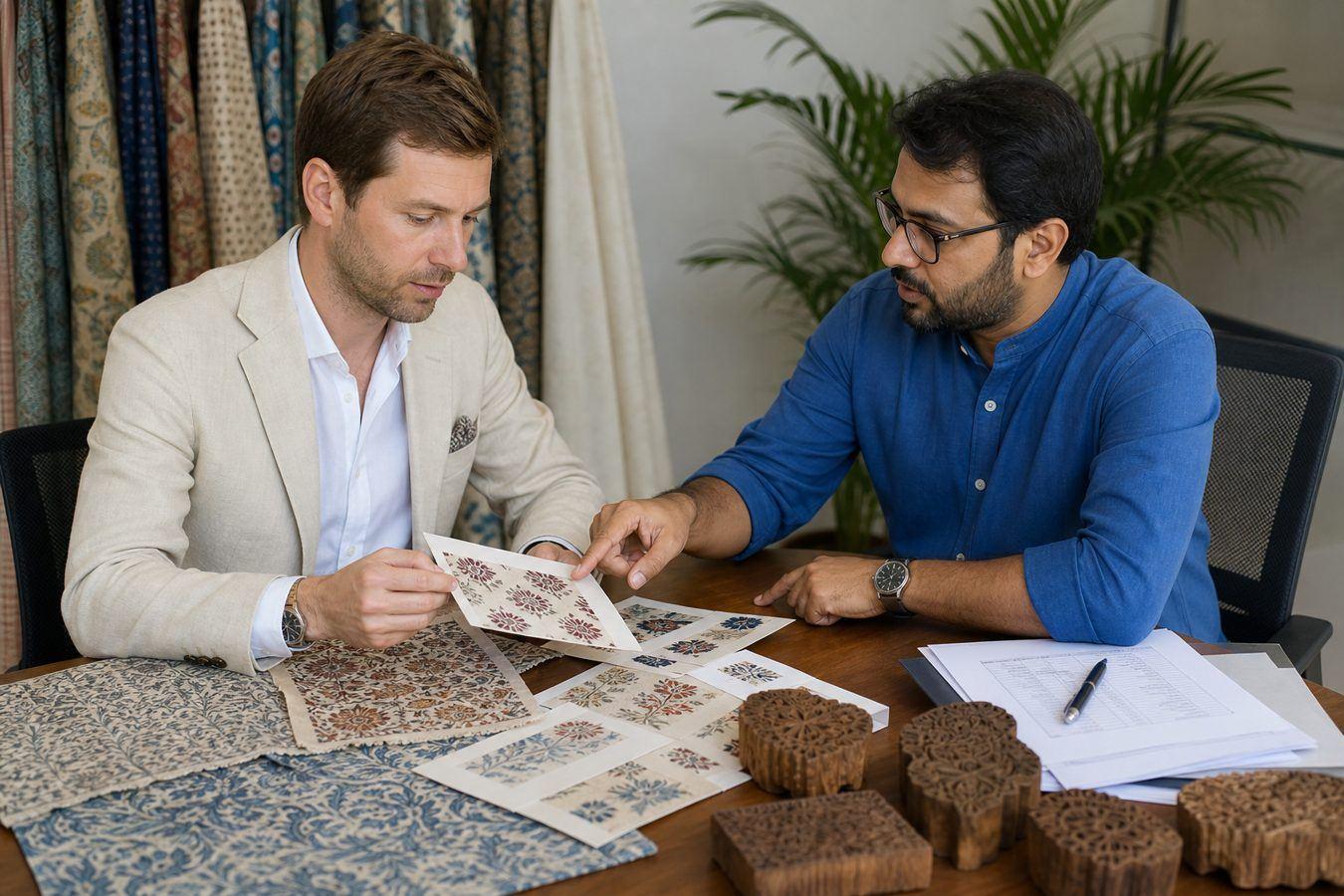
Finding genuine international buyers is the hardest part of hand printed textile export for most Indian print units, merchant exporters, and design-led sourcing houses — harder than carving a new block, harder than matching an Ajrakh resist repeat, and harder than clearing a colourway-heavy FCL without registration drift.
India exports hand printed textiles — block print from Jaipur–Sanganer–Bagru, Ajrakh from Kutch, Kalamkari from Andhra Pradesh, Dabu mud-resist, and hand screen programmes converted in Panipat, Karur, and Tirupur — into home specialty retail, department stores, design boutiques, e-commerce private label, hospitality soft furnishings, and fashion fabric channels across the UAE, the USA, the UK, France, Germany, Canada, Japan, Australia, and the Netherlands.
Global demand for Indian craft print is real, but it does not become a purchase order in your inbox on its own.
This guide is a prospecting and buyer-qualification playbook focused on channels that produce named, verifiable leads for print textiles — HS import data for printed cotton fabrics and furnishing made-ups, LinkedIn outreach to home-textile procurement decision-makers, and EPCH/IHGF buyer-seller meets used as one input among several — closing with a verification model that filters brokers and time-wasters before they consume your strike-off budget.
It is deliberately narrow: this is not a full export documentation checklist (see Hand Printed Textile Export Documentation Checklist) and not a craft-technique or sustainability deep dive (see Block Print, Ajrakh, Kalamkari & Sustainable Hand Printed Textile Export Opportunities).
Pair this guide with Most Demanded Indian Hand Printed Textiles by Country to target the right print technique per market, Trade Shows and B2B Marketplaces for Hand Printed Textile Exporters for fair-by-fair calendars, and the pillar How to Export Hand Printed Textiles from India for end-to-end execution once a buyer is qualified.
Altus Exports works as a merchant exporter in India and global sourcing partner connecting verified Indian hand printed textile suppliers with qualified international demand.
Key Takeaways
Summary Box
Executive Summary
Summary Box
Buyer discovery in hand printed textiles fails for a predictable reason: exporters run one channel at a time, chase inquiry volume instead of qualification, and ship strike-offs before verifying that a lead can actually import, pay, and approve print registration under destination-market labelling rules. This guide reframes lead generation as a data-plus-verification discipline tailored to craft-print programmes.
Trade data under printed-fabric and furnishing made-up headings tells you who already imports block print, Ajrakh, Kalamkari, and hand screen home textiles into your target market; LinkedIn extends that list to named decision-makers in home specialty retail and hospitality procurement; EPCH buyer-seller meets and Heimtextil-class fairs compress months of cold outreach into higher-intent conversations; and a scoring model separates buyers worth a paid strike-off from brokers who will never convert.
The commercial payoff is specific: exporters who run this system typically build a working pipeline of 40–60 verified accounts within a single quarter and convert two to four of them into trial shipments within 90–150 days. None of this replaces export readiness — EPCH registration, a valid IEC, and colourway-consistent strike-offs must exist before outreach begins, not after a buyer replies.
This guide walks through market context, print technique framing, pricing bands, MOQ by colourway, packaging, and certifications only as far as a prospecting exporter needs them to sound credible in a first exchange; deeper operational detail lives in the linked cluster guides.
Market Size & Industry Overview
Key Statistics
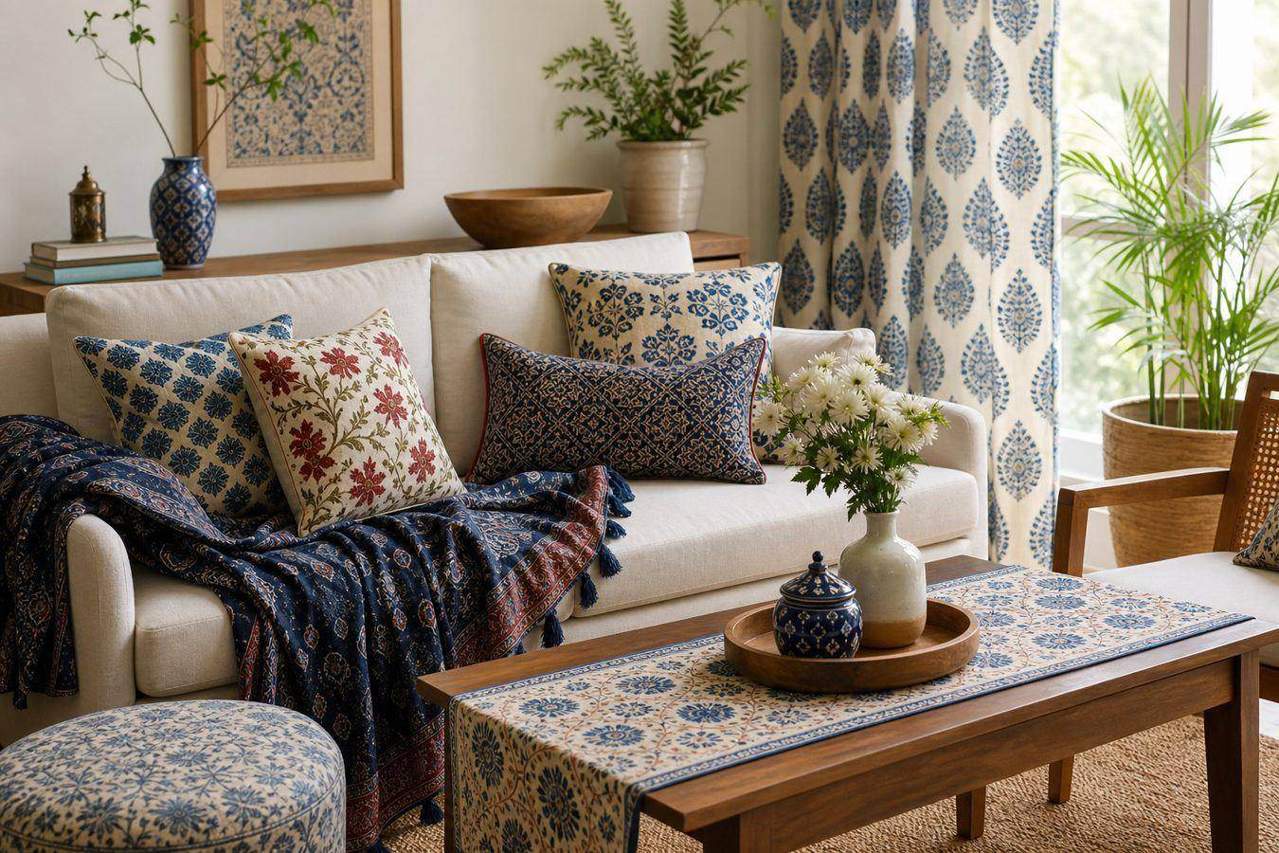
Hand printed textiles sit at the intersection of India's textile handicraft export story and the global home-furnishing soft-goods market. EPCH and DGCI&S handicraft export statistics consistently show textile handicraft and artware — including hand printed yardage, cushion covers, throws, table linen, curtains, and scarves — among India's highest-visibility lifestyle export categories, with repeat purchasing across North America, Europe, the Gulf, and Oceania. What a first-time exporter does need to prove, in every outreach message, is that their specific print cluster and colourway discipline can meet a specific buyer's registration, azo-dye, and fibre-labelling expectations.
Export Promotion Council for Handicrafts (EPCH) is the primary RCMC lens for hand printed textile artware lines; TEXPROCIL adjacency applies when cotton made-ups classify under cotton textile made-ups — confirm the route with your CHA per SKU mix. Understanding where India's print clusters sit relative to global demand shapes which buyers are worth prospecting first: a Bagru block-print unit prospecting a German organic-print private-label buyer is a stronger fit than the same unit prospecting a commodity rotary-print price buyer without craft positioning.
India Hand Printed Textile Industry Snapshot (Directional)
Swipe →
Data table — swipe horizontally on small screens
| Dimension | Approximate Figure / Fact | Relevance to Buyer Prospecting |
|---|---|---|
| Product scope | Block print, Ajrakh, Dabu, Kalamkari, hand screen — yardage and made-ups | Lead with three to five hero colourways, not an undifferentiated print catalogue |
| HS families | 5208/5209 printed fabrics; 6303 curtains; 6304 furnishing articles; 6214 scarves — verify per SKU | Correct HS mapping is the first filter when reading import trade data |
| Primary print clusters | Jaipur–Sanganer–Bagru; Kutch/Ajrakhpur; Machilipatnam–Srikalahasti; Panipat/Karur conversion | Cluster shapes which buyer segment (heritage, organic, volume soft furnishings) is the right fit |
| Regulatory body | EPCH — epch.in; TEXPROCIL adjacency for cotton made-ups | First credential most buyers verify before a serious conversation |
| Major export ports | Mundra, Nhava Sheva; ICD Delhi/Dadri; Pipavav/Ahmedabad corridor | Port choice affects lead time claims made in outreach |
| Leading destinations (EPCH FY24-25 value order) | UAE, USA, UK, France, Germany, Canada, Japan, Australia, Netherlands | Where trade-data prospecting yields the deepest named-buyer lists |
Export Statistics
Key Statistics
EPCH's dedicated Handprinted Textiles export data for FY 2024-25 shows the UAE leading by value (Rs 1,539.46 crore), followed by the USA (Rs 319.92 crore), the UK, France, Germany, Canada, and Australia, with Japan representing a design-led, quality-sensitive niche. For lead generation, export statistics answer one question: where does India already have trading relationships and reputation in craft print? That is a useful filter for which market to prospect first if you have no prior export history — a buyer in a market that already imports Indian hand printed home textiles at scale is far more responsive than one in a market where Indian-origin print requires category education alongside supplier qualification.
Directional Destination Signals for Hand Printed Textile Prospecting
Swipe →
Data table — swipe horizontally on small screens
| Destination | Typical Print Demand | Lead-Gen Priority Signal |
|---|---|---|
| USA | Block print cushions, throws, table linen; fashion yardage | 6304/5208 importers with recent multi-origin sourcing (India + Pakistan/Turkey) |
| Germany | Organic/natural-dye Ajrakh, OEKO-TEX print programmes | Retail buyers with documented azo-dye and REACH-aligned supplier history |
| UK | Heritage block print, Kalamkari table linen, boutique assortments | Design boutique and department store private-label sourcing offices |
| UAE | Hospitality soft furnishings, gift wholesale print made-ups | Gulf wholesalers and re-export distributors into wider MENA |
| Netherlands / France | Design-led print, sustainable private label | Concurrent India + Morocco + Turkey sourcing signals active print buyers |
| Australia / Canada | Throws, cushion covers, curtain panels | Home specialty retail with fibre-labelling discipline |
Import Statistics
Key Statistics
Export statistics tell you what India ships; import statistics tell you who is receiving it — and that distinction is the foundation of trade-data prospecting for hand printed textiles. Import records under printed cotton fabric and furnishing made-up headings reveal which named companies already import block print, Ajrakh, Kalamkari, and hand screen home textiles into your target country, at what volumes, and from which competing origins such as Pakistan, Turkey, Morocco, Bangladesh, or Indonesia. The single most useful qualification question is: has this company imported printed home textiles from India or a competing origin in the last 12–24 months?
A second filter — does the buyer import from multiple origins — often flags multi-origin buyers willing to add a well-documented Indian print supplier alongside existing relationships. Volume thresholds matter too: a buyer regularly clearing 20,000-metre colourway programmes or 5,000-piece cushion-cover seasons sits in a different pipeline tier than a boutique retailer testing 300 printed throws, and outreach messaging, strike-off size, and pricing framework should match that tier from the first email.
Top Importing Countries — Demand Signals for Print-Textile Prospecting
Swipe →
Data table — swipe horizontally on small screens
| Importing Country | Import Role | Typical Print Category Demand | What to Check in Trade Data |
|---|---|---|---|
| USA | Direct retail and wholesale distribution | Block print cushions, throws, scarves, yardage | Multi-origin sourcing; consolidator vs. direct retail buyer |
| Germany | Retail chains and specialty importers | Ajrakh, organic print, OEKO-TEX programmes | Azo-dye compliance history; GOTS/OEKO-TEX in RFQs |
| UK | Retail chains and design boutiques | Heritage block print, Kalamkari table linen | Department store and boutique private-label offices |
| UAE | Re-export hub and hospitality procurement | Printed curtains, table linen, cushion covers | Gulf wholesalers reselling into Saudi Arabia and wider region |
| Netherlands | Trading and EU redistribution | Mixed print made-ups for wider Europe | Volume consistency valued alongside design storytelling |
| Japan | Design-led specialty import | Fine block print, natural-dye Ajrakh | Long trust-building cycle; registration QC paramount |
Product Categories / Variants
Summary Box
Before prospecting, commercialise a defined print range — not a vague "we export all hand prints" claim. Successful exporters lead with three to five hero colourways they can reproduce with consistent print registration, dye lot control, and fibre content: block print cushion covers, Ajrakh throws, Kalamkari table runners, hand screen curtain panels, or fashion yardage in defined GSM bands. Buyers ignore vague listings and reply to precise ones with strike-off cards and colourway grids already attached. For full category depth across techniques and made-up formats, see Top Hand Printed Textile Products Exported from India.
HS classification sits at the centre of product framing in outreach: printed cotton fabrics often map to 5208/5209; curtains to 6303; cushion covers and other furnishing articles to 6304; scarves and stoles to 6214. Naming the correct heading family in a first message — rather than a generic textile reference — signals to a procurement buyer that you understand classification, which is itself a trust signal in a category where misclassified invoices are common.
Product Categories and Typical Buyer Type (Prospecting Lens)
Swipe →
Data table — swipe horizontally on small screens
| Category | Typical HS Family | Typical Trial MOQ | Primary Buyer Type |
|---|---|---|---|
| Printed cotton yardage (block/screen) | 5208 / 5209 | 50–200 m per colourway | Fashion fabric buyers, private-label apparel, soft furnishing converters |
| Ajrakh / natural-dye yardage | 5208 / 5209 | 50–150 m per colourway | Premium home specialty, organic private label |
| Kalamkari table linen | 6302 / as classified | 200–500 pcs per design | Design boutiques, hospitality, gift wholesale |
| Block print cushion covers | 6304 | 200–500 pcs per colourway | Home specialty retail, e-commerce private label |
| Printed throws / bedspreads (print-led) | 6304 / 6302 as classified | 150–400 pcs per design | Department stores, lifestyle e-commerce |
| Printed curtains / drapery | 6303 | 100–300 pcs per colourway | Hospitality, home specialty, interior trade |
| Printed scarves / stoles | 6214 | 100–300 pcs per design | Fashion accessories, museum shops, gift wholesale |
Manufacturing Overview
Export Tip
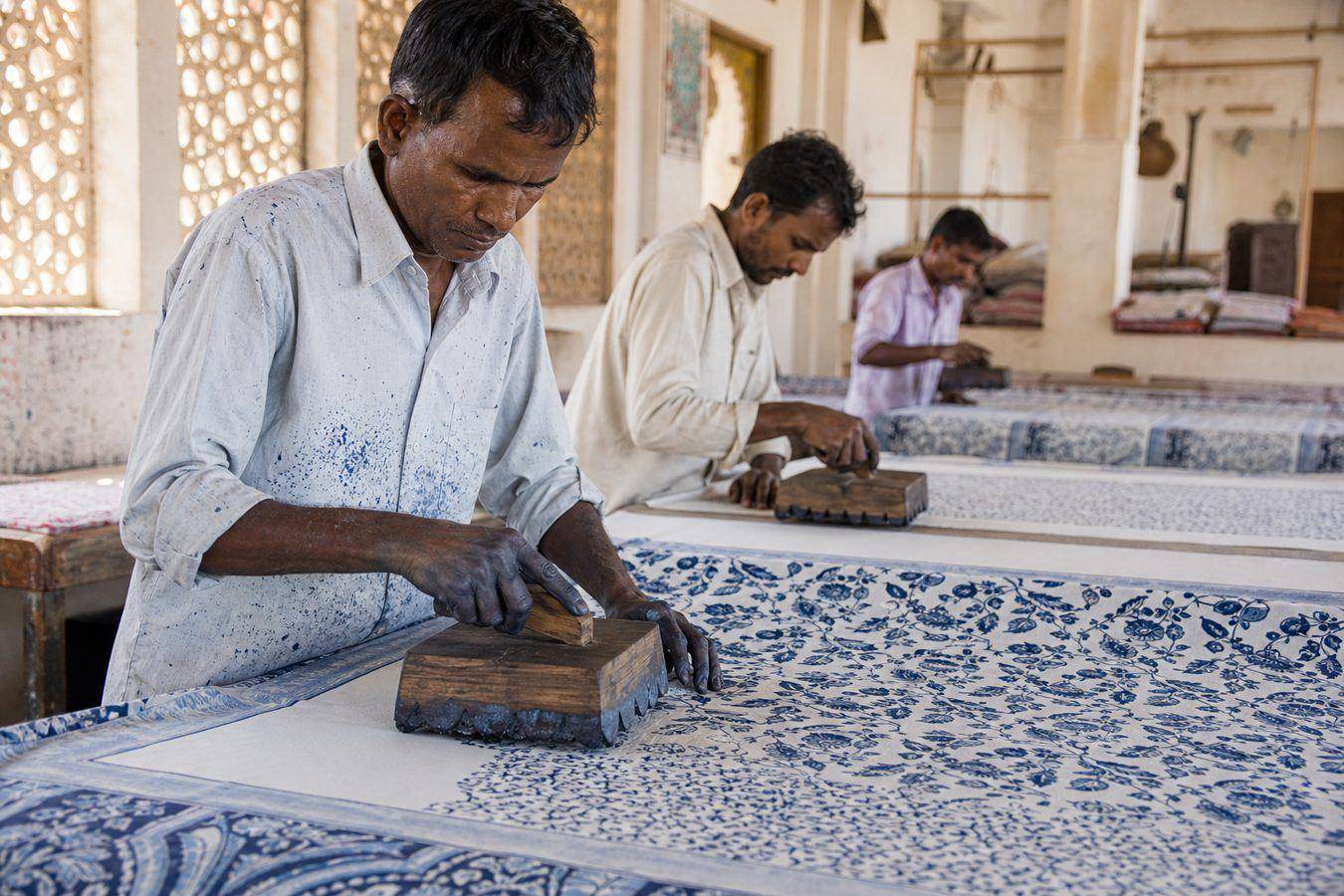
Knowing where and how a print programme is made matters to prospecting because buyers ask about it early — a procurement manager evaluating a new Indian supplier wants to know which cluster your production sits in, because cluster reputation shapes their risk assessment on registration drift and dye consistency. Jaipur–Sanganer–Bagru is India's deepest block-print and Dabu corridor, strong in heritage and contemporary colourway programmes. Kutch and Ajrakhpur anchor natural-dye Ajrakh resist print with longer lead times and premium positioning. Machilipatnam and Srikalahasti supply Kalamkari narrative and temple-motif programmes. Panipat, Karur, and Tirupur convert print yardage into volume cushion, curtain, and table-linen programmes with screen-print capacity alongside hand processes.
Delhi-NCR merchant exporters often consolidate multi-cluster print sourcing for private-label retail programmes. Print method — hand block, mud-resist Dabu, Ajrakh double-dye, Kalamkari pen-and-block, hand screen — should be stated plainly in any outreach message, since honest "hand printed" claims versus rotary hybrid production is one of the first diligence questions a serious buyer asks.
Pricing Analysis
Buyer Tip
Export price is not domestic wholesale price plus freight. Build FOB from fabric base cost, print labour and block amortisation, dye chemistry (natural vs. reactive), finishing, QC and strike-off overhead, packaging, inland haulage to the load port, documentation, and exporter margin. Benchmark against competing origins: Pakistani and Turkish block print sets the volume reference for many cushion and yardage programmes, while India's advantage is strongest in heritage Ajrakh, fine Bagru/Sanganer registration, and Kalamkari storytelling at mid-premium tiers.
In buyer negotiations during prospecting, quote the full package — fabric GSM, print technique, colourway count, registration tolerance, fibre content, packaging format, Incoterm, payment terms, MOQ per colourway, and lead time — rather than a bare per-metre or per-piece number. Buyers who negotiate only unit price without specification lock-in generate registration disputes later.
Indicative FOB Price Ranges for Prospecting Conversations (Directional USD)
Swipe →
Data table — swipe horizontally on small screens
| Category | Indicative FOB Range | Primary Destinations | Key Price Driver |
|---|---|---|---|
| Volume printed cotton yardage | $2.5–8/m | USA, UAE, Australia | GSM; screen vs. block; colourway count |
| Heritage Ajrakh / fine block yardage | $8–25+/m | Germany, USA, Japan | Natural dye cycles; registration complexity |
| Block print cushion covers | $2–12/pc | USA, UK, UAE | Size; insert vs. cover-only; retail packaging |
| Kalamkari table linen sets | $8–45/set | USA, UK, France | Handwork density; natural dye; set composition |
| Printed throws / table covers | $8–45/pc | Germany, Canada, Australia | Size; fibre base; certification premiums |
| GOTS/OEKO-TEX organic print programmes | Evidence-dependent premium | Germany, Netherlands, USA | Transaction certificates; audit scope |
MOQ Analysis
Buyer Tip
MOQ honesty by colourway accelerates conversion far more than aggressive pricing. Hand print production is colourway-constrained: each new block alignment, resist paste, or Kalamkari mordant bath carries setup cost that does not scale down gracefully. If a unit can reliably supply 3,000 metres of one Bagru colourway per quarter, say so plainly in outreach. Serious buyers respect supply realism and abandon exporters who overpromise volume then deliver registration drift on the actual bulk order.
Typical MOQ by Order Stage (Hand Printed Textiles)
Swipe →
Data table — swipe horizontally on small screens
| Order Stage | Yardage MOQ | Made-Up MOQ | Notes |
|---|---|---|---|
| Strike-offs / sampling | 1–5 m per colourway | 5–20 pcs per SKU | Paid strike-offs filter unqualified leads |
| Trial order | 50–200 m per colourway | 200–500 pcs hero SKU | Single-colourway focus reduces registration risk |
| Wholesale programme | By colourway / design / carton | By colourway / design / carton | Forward block and dye booking for season |
| Retail FCL programme | Planned against 20GP/40HC CBM | Planned against 20GP/40HC CBM | Retail seasons often booked 4–9 months ahead |
Packaging Standards
Export Tip
Packaging questions surface early in a serious buyer conversation, because packaging format signals whether a supplier is set up for retail-ready programmes or bulk wholesale only. Standard export packing for made-ups uses individual polybags with colourway and size labels, export cartons with moisture barriers, and hangtags and care labels aligned to US Textile Rules or EU Textile Regulation fibre declarations. Yardage ships roll-wrapped or baled with colourway tags and lot references that match invoice and packing-list fields.
Standard Export Packaging Formats for Print Programmes
Swipe →
Data table — swipe horizontally on small screens
| Packaging Format | Typical Contents | Common Use Case | Key Requirement |
|---|---|---|---|
| Polybag + export carton (made-ups) | 1–6 pcs per inner depending on SKU | Cushion covers, throws, table linen | Colourway/size labels; avoid crushing embossed prints |
| Roll wrap + tube or bale (yardage) | 25–100 m rolls typical | Fashion and furnishing fabric programmes | Lot tags matching strike-off approval |
| Moisture barrier / silica | Per carton or roll | Long-haul ocean transit | Protects natural dyes and sizing |
| Retail hangtags & care labels | Per SKU | Private-label retail programmes | Fibre content and care symbols for destination market |
Container Loading Details
Export Tip
A buyer asking about container loading is usually estimating freight cost per unit before committing to a trial order — being ready with real CBM numbers, not vague estimates, moves the conversation forward. Print made-ups in polybags and cartons are typically volume-constrained; rolled yardage consumes CBM differently than folded throws. Mixed FCL programmes combining yardage rolls and made-up cartons require forwarder dunnage planning to prevent crush marks on fine block registration.
Indicative Container Loading Benchmarks (Directional — Confirm with Forwarder)
Swipe →
Data table — swipe horizontally on small screens
| Container Type | Made-Ups (Cushion/Throw Mix) | Yardage Rolls | Notes |
|---|---|---|---|
| 20-foot FCL | ~8,000–15,000 cushion covers OR ~2,000–4,000 throws | ~15,000–25,000 m (GSM dependent) | Standard unit for mid-size print programmes |
| 40-foot HC | ~18,000–30,000 cushion covers OR ~5,000–9,000 throws | ~30,000–50,000 m (GSM dependent) | Preferred for large retail colourway programmes |
| LCL consolidation | 200–2,000 pcs mixed SKUs | 500–3,000 m trial colourways | Common for first orders and multi-strike-off consolidation |
| Air freight sample kits | Strike-offs and strike-off cards | 5–50 m urgent colourways | Qualification stage — not bulk economics |
Shipping Methods
Export Tip
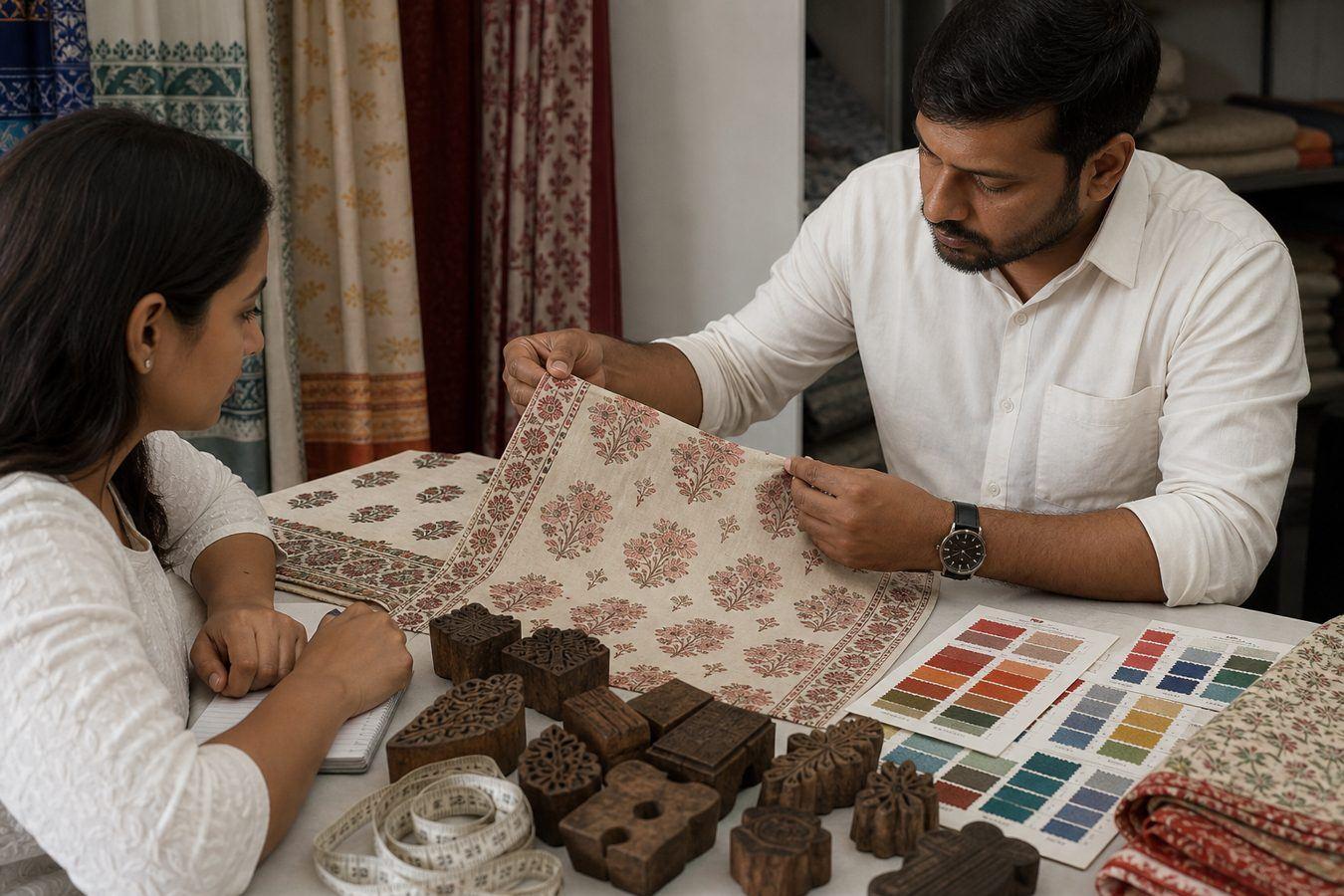
Sea freight is the dominant shipping method for hand printed textile export from India, chosen for cost efficiency on wholesale and retail colourway programmes. FOB Mundra, Nhava Sheva, or ICD Delhi/Dadri is the Incoterm used on the majority of shipments, with the exporter delivering to the named load port and the buyer arranging main carriage; CFR and CIF are common with buyers who prefer a single landed-cost quote. Gujarat print clusters often route through Mundra or Pipavav; Rajasthan and Delhi-NCR programmes through Nhava Sheva or ICD Dadri. Strike-offs and urgent sample kits typically move by air with 3–7 day transit, since speed to a buyer's registration approval matters more than freight cost at the qualification stage.
Certifications
Compliance Notes
Buyers evaluating an unfamiliar Indian print supplier check certifications as a proxy for operational discipline before they check anything about design or price. EPCH membership and RCMC come first for textile handicraft lines; OEKO-TEX Standard 100 and GOTS matter specifically to premium and organic-print buyers; azo-free and REACH-aligned dye claims are non-negotiable for EU and UK-bound programmes. Honest "hand printed" versus rotary hybrid claims surface in the first or second exchange — a sustainability deep dive lives in the dedicated premium guide, not here.
Certifications Buyers Check During Prospecting
Swipe →
Data table — swipe horizontally on small screens
| Certification / Registration | Mandatory or Optional | Relevance to Prospecting |
|---|---|---|
| EPCH RCMC | Effectively mandatory for handicraft print lines | First credential most buyers verify before trial deposit |
| Valid IEC (DGFT) | Mandatory | Confirms legal export eligibility |
| OEKO-TEX Standard 100 | Optional — baseline for EU/US premium | Chemical safety on prints and finishes |
| GOTS (organic print programmes) | Optional — required for organic claims | Transaction certificates expected by German/Dutch buyers |
| Azo-free / REACH-aligned dyes | Mandatory for EU/UK | Screen early in EU buyer conversations |
Buyer Requirements
Buyer Requirements
Buyers will ask whether you can execute export operationally before they engage seriously on price. Be ready to confirm an active IEC, current EPCH RCMC, strike-off approval workflow, standard export packaging, fibre and care labelling readiness, and familiarity with FOB or CIF terms. Incoterms clarity in early conversations signals professionalism — quoting "best price" without FOB/CIF definition is a qualification red flag from the buyer's side too.
Buyer Verification Signals — Legitimate vs. Red Flag
Swipe →
Data table — swipe horizontally on small screens
| Verification Signal | What Good Looks Like | Red Flag |
|---|---|---|
| Business legitimacy | Registered importer, VAT/EIN traces, home-textile trade association | Only personal Gmail, no entity trail, no import footprint |
| Purchasing history | Printed fabric/made-up import shipments visible in trade data | Claims 50,000-piece first order with zero import history |
| Specification awareness | Asks about print registration, colourfastness, GSM, fibre content | Only asks for "cheapest block print" with no QC discussion |
| Payment reliability | Normal advance/LC/SBLC terms discussion | Unusual payment platforms or third-party transfers |
| Communication pattern | Named buyer, consistent company domain email | Changing identities mid-thread, multiple names on one account |
Country-wise Opportunities
Market Snapshot
Country selection should drive prospect list construction, not the reverse — build separate pipelines per market tier rather than one global blast list. For detailed market-by-market entry strategy, see Best Countries for Indian Hand Printed Textile Exports and Most Demanded Indian Hand Printed Textiles by Country.
UAE and the Gulf
The largest named EPCH Handprinted Textiles destination by value, driven by hospitality soft furnishings, gift wholesale, and re-export into wider MENA; proximity to India means faster transit than European or US routes, making the Gulf a strong first-export-market choice for smaller print units.
USA
The second-largest named EPCH value and the deepest single craft-print and soft-furnishing import channel by buyer count, for Indian block print cushions, throws, table linen, and fashion yardage; verify import history in 5208/6304 families before quoting, since many US importers work through consolidators that obscure the actual retail buyer.
UK and France
Design-led demand where heritage block print and Kalamkari storytelling matter alongside registration QC; concurrent India, Turkey, and Morocco import activity signals active multi-origin print buyers worth prioritising.
Germany and the Netherlands
Strong demand for Ajrakh, organic print, and OEKO-TEX/GOTS programmes; prospecting targets home specialty retail, sustainable private label, and wholesalers with documented multi-origin sourcing and azo-dye compliance history. Netherlands registers a smaller named EPCH value for this category despite its EU redistribution role.
Australia, Canada, and Japan
Australia and Canada reward fibre-labelling discipline on cushion and throw programmes; Japan demands exceptional registration consistency and longer trust-building cycles around fine block and natural-dye Ajrakh lines.
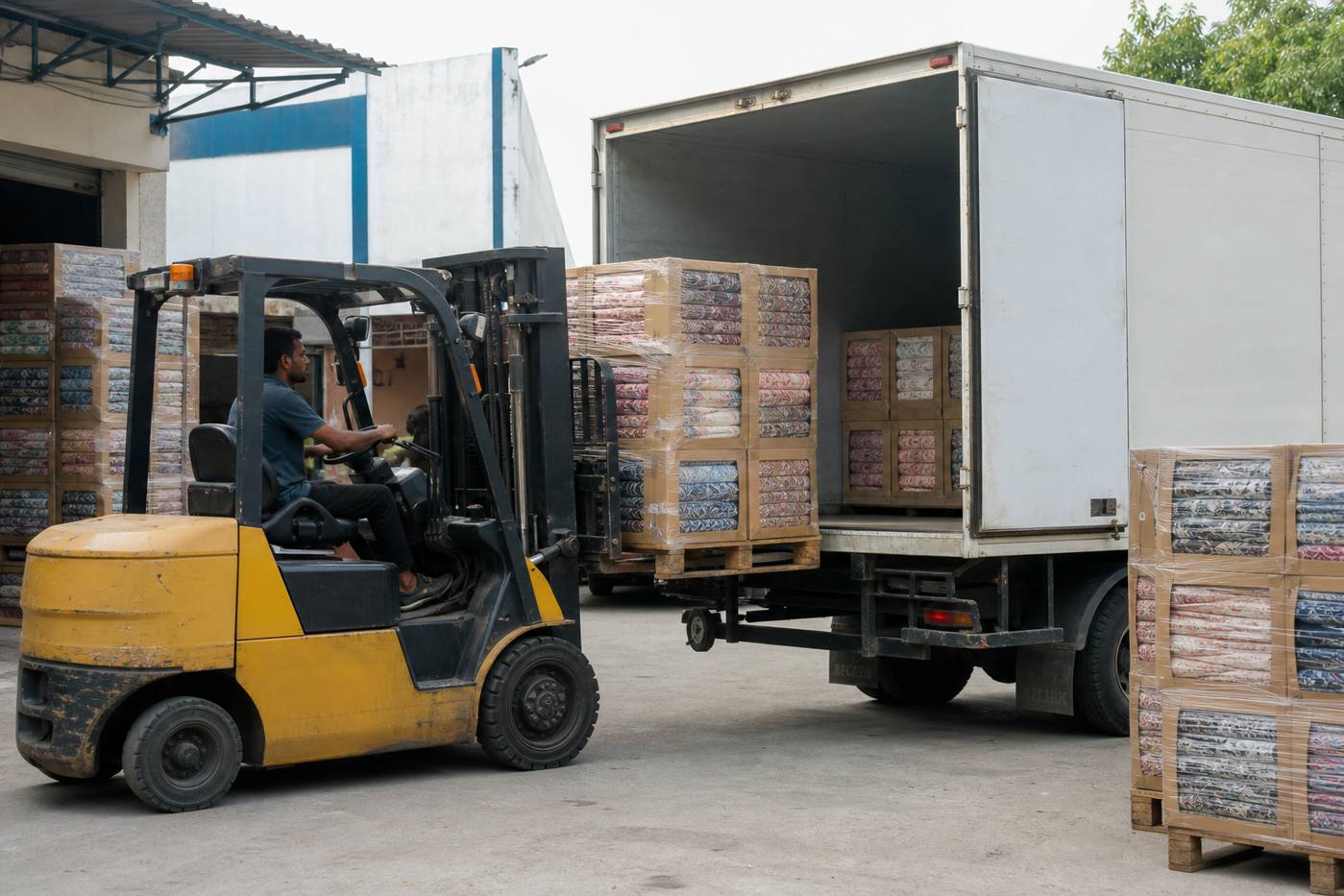
Expert Insight: Segment Before You Prospect
Expert Insight Box
Speed, print-registration clarity, and proof of colourway consistency convert hand printed textile inquiries. Reply quickly with a structured quotation: print technique, fabric GSM, colourway MOQ, registration tolerance, lead time post-PO, Incoterm, payment terms, packaging, and proforma validity. Share a one-page colourway sheet with your EPCH registration reference and strike-off turnaround time, and offer paid strike-offs dispatched within a specified timeframe rather than unlimited free samples to unverified accounts.
Sourcing Checklist
Checklist
Common Buyer Mistakes
Common Mistakes Box
First-time exporters make predictable mistakes when prospecting internationally for hand printed textiles — mistakes a structured verification process is designed to prevent.
Future Market Trends
Key Statistics
Trade-data access is becoming more granular and affordable, letting even mid-size print exporters run shipment-level prospecting that used to require expensive subscriptions. EPCH and industry bodies continue expanding digital buyer-seller matching alongside IHGF Delhi Fair and Heimtextil-class events, reducing the cost of attending a fair without follow-up infrastructure. On the buyer side, retail and hospitality importers are asking for traceability evidence earlier — print technique honesty, azo-free dye documentation, and OEKO-TEX/GOTS scope now surface in the first or second exchange rather than at contract stage, rewarding exporters who prepare that evidence pack in advance.
Challenges & Solutions
The most common prospecting challenges in hand printed textiles are not mysterious — they are operational gaps that a disciplined pipeline fixes.
Prospecting Challenges and Practical Solutions
Swipe →
Data table — swipe horizontally on small screens
| Challenge | Why It Blocks Conversion | Solution |
|---|---|---|
| Unqualified inquiry volume | Strike-off budget consumed by brokers | Score leads with import data before sampling |
| Registration drift on bulk vs. strike-off | Buyer trust destroyed on first shipment | Document registration tolerance in writing pre-PO |
| Vague "hand print" claims | Buyer diligence fails; retail delisting risk | State technique honestly; separate hand block from rotary hybrid |
| Slow response to RFQs | Serious buyers move to Turkish/Pakistani suppliers | 24–48 hour structured quote with colourway sheet |
| Single-channel dependence | Pipeline freezes between fairs | Year-round HS data + LinkedIn + selective fairs |
Buyer Checklist
Checklist
Exporter Checklist
Checklist
Compliance Checklist
Checklist
Compliance Notes
Expert Insight: A Weekly CRM Rhythm
Expert Insight Box
The exporters who build durable buyer pipelines treat CRM discipline as seriously as print QC discipline. Run every account through defined stages — research, contacted, strike-off, quotation, negotiation, first shipment, repeat colourway — and review the pipeline every week: which deals need strike-off follow-up, which need payment confirmation, which need a registration update to stay warm. Measure three numbers monthly: qualified technical conversations, strike-off-to-order conversion rate, and repeat colourway rate.
Conclusion
- Next: match technique to market with Most Demanded Indian Hand Printed Textiles by Country.
- Importer playbook: Source Hand Printed Textiles Directly from India.
- Fair-by-fair playbook: Trade Shows and B2B Marketplaces for Hand Printed Textile Exporters.
- Premium angle: Block Print, Ajrakh, Kalamkari & Sustainable Hand Printed Textile Export Opportunities and the full process in How to Export Hand Printed Textiles from India.
- Explore export products from India and Textiles & Home Furnishings industry coverage.
Finding international buyers for hand printed textiles from India comes down to combining the strongest channels — printed-fabric and furnishing made-up trade data, LinkedIn prospecting to home-textile procurement teams, and selective EPCH/Heimtextil fair attendance — with strict buyer verification, colourway-specific documentation readiness, and a CRM-managed pipeline that respects buyer time and registration standards. Proactive sharing of colourway sheets and strike-off evidence is the most effective trust-builder in a category where print registration shapes buyer decisions.
Altus Exports supports hand printed textile manufacturers and merchant exporters who need buyer access paired with strike-off coordination and shipment execution — not just leads without follow-through. Explore our merchant exporter and global sourcing partner services, or connect through product sourcing company India and contact for verified print supply.