
Chemexcil & FSSAI Registration Benefits for Essential Oil Exporters
By Saurabh Mittal, Founder, Altus Exports
How Chemexcil membership and FSSAI food-grade licensing unlock fragrance-house and flavor-house buyer segments for Indian essential oil exporters under HS 3301.
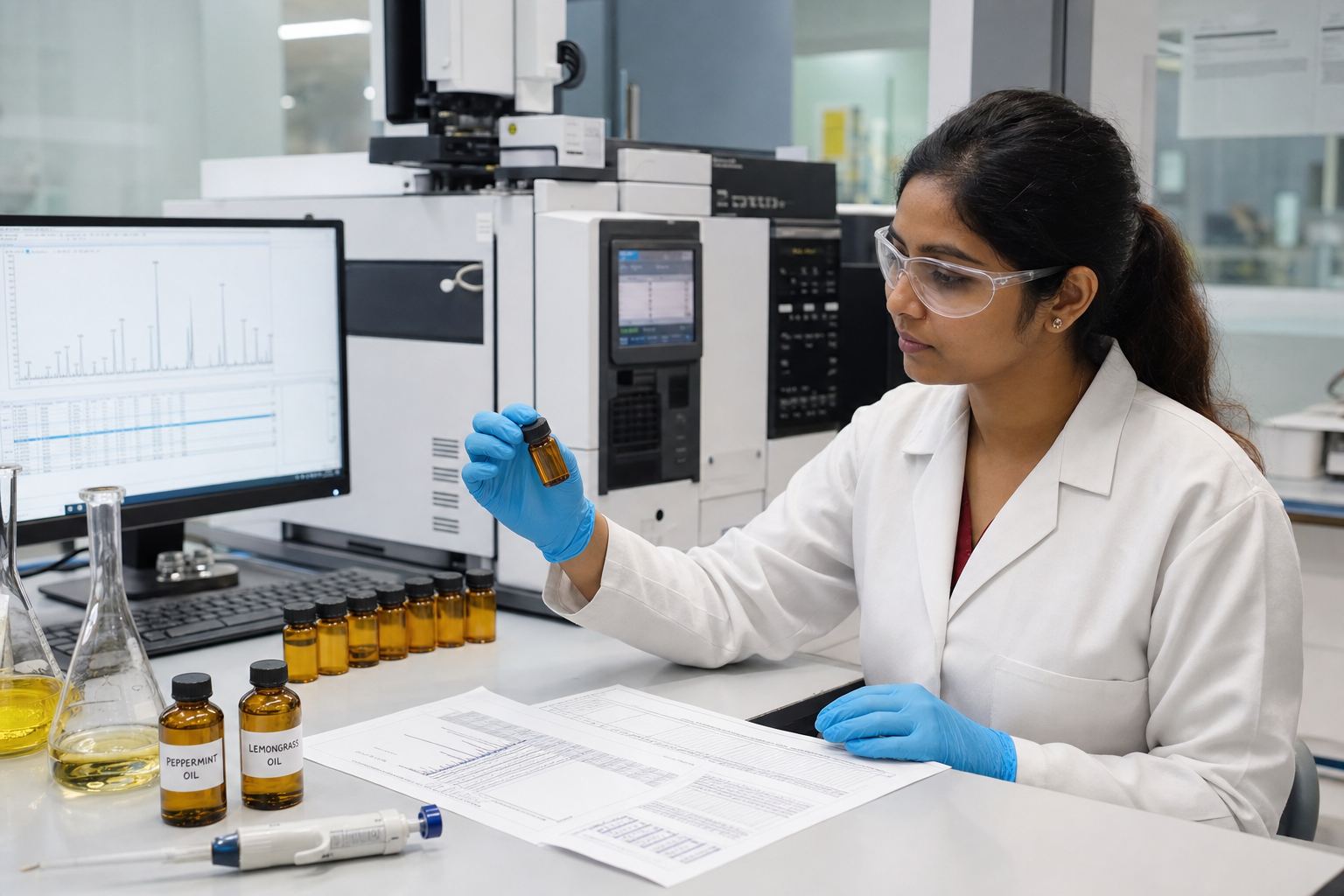
India's essential oil trade under HS code 3301 spans two commercially distinct worlds that share the same botanical raw material. A drum of mentha oil distilled in Barabanki, Uttar Pradesh, can end up flavoring chewing gum in Chicago, scenting a soap bar in Marseille, or filling an aromatherapy diffuser bottle in Dubai — and each destination applies a different regulatory lens to the identical liquid. Fragrance-house buyers care about IFRA usage limits and olfactive consistency.
Flavor-house buyers care about FSSAI-aligned food-additive status and GC-MS-verified marker compounds. Neither buyer category will move past the first qualification email without the credential set that signals they are dealing with a legitimate, traceable Indian exporter rather than a spot-market reseller of unknown origin oil.
Chemexcil (the Basic Chemicals, Cosmetics & Dyes Export Promotion Council) and FSSAI (the Food Safety and Standards Authority of India) sit at the center of that credibility question, but they answer different parts of it. Chemexcil membership and its Registration-cum-Membership Certificate (RCMC) are the export-promotion and government-recognition layer that essential oil exporters need to access Foreign Trade Policy incentives, trade fair participation, and baseline industry legitimacy. FSSAI licensing is the food-safety layer that specifically unlocks flavor, beverage, confectionery, and oral-care buyers who purchase essential oils as food ingredients rather than fragrance or industrial inputs.
Exporters who understand which credential unlocks which buyer segment — and who hold both where their product mix demands it — compete for materially different price bands than exporters who treat registration as a single generic checkbox.
This article is a credentials deep-dive. It does not repeat the full essential oil export process, documentation checklist, or country-by-country market ranking that sibling cluster articles already cover in detail — see Most Demanded Indian Essential Oils by Country for the destination-market demand map referenced throughout this piece. What follows is the registration logic specific to Chemexcil and FSSAI, how each credential maps to fragrance-house versus flavor-house buyer categories, where IFRA, REACH, and GC-MS certificates of analysis fit around those two Indian registrations, and how Altus Exports operationalizes this dual-credential positioning for exporters and international buyers working on HS 3301 programs.
Readers who need the step-by-step export workflow, container logistics, or full documentation sequence for essential oil shipments from India should consult the broader how-to-export cluster article. This piece focuses specifically on what Chemexcil and FSSAI registration do — and do not — deliver, and how to sequence both credentials against your product mix and buyer pipeline.
Key Takeaways
Summary Box
Executive Summary
Summary Box
India's HS 3301 exports (essential oils, resinoids, extracted oleoresins, and concentrates) totaled approximately USD 925 million in FY2023-24 per DGCI&S data, broadly flat against the prior fiscal year. The United States is the single largest destination at roughly 29% of export value, followed by China and Malaysia. Within that headline number sits a narrower essential-oil-specific subcategory (HS 330129, essential oils excluding citrus and mint concretes) that UN Comtrade puts at roughly USD 133 million and 3,395 metric tons for calendar year 2024 — India ranks fifth globally by value in that narrower line and holds close to 6% of world exports. Treat any single figure as directional; fiscal-year DGCI&S data and calendar-year Comtrade data will never match exactly, and buyers should always request the current-year series before quoting programs.
The credentialing question that matters more than the headline export number is this: which registration unlocks which buyer? An exporter shipping mentha oil to a US confectionery flavor house needs a different document pack than one shipping the same botanical family's peppermint oil to a European soap manufacturer. Chemexcil RCMC is common ground for both — it is the baseline government-recognized exporter credential referenced across the entire HS 3301 category, covering fragrance, flavor, industrial, and aromatherapy end uses alike. FSSAI licensing is the credential that specifically applies when the oil crosses into food, beverage, confectionery, or oral-care end use, and its absence is often the single reason a flavor-house RFQ stalls at supplier qualification.
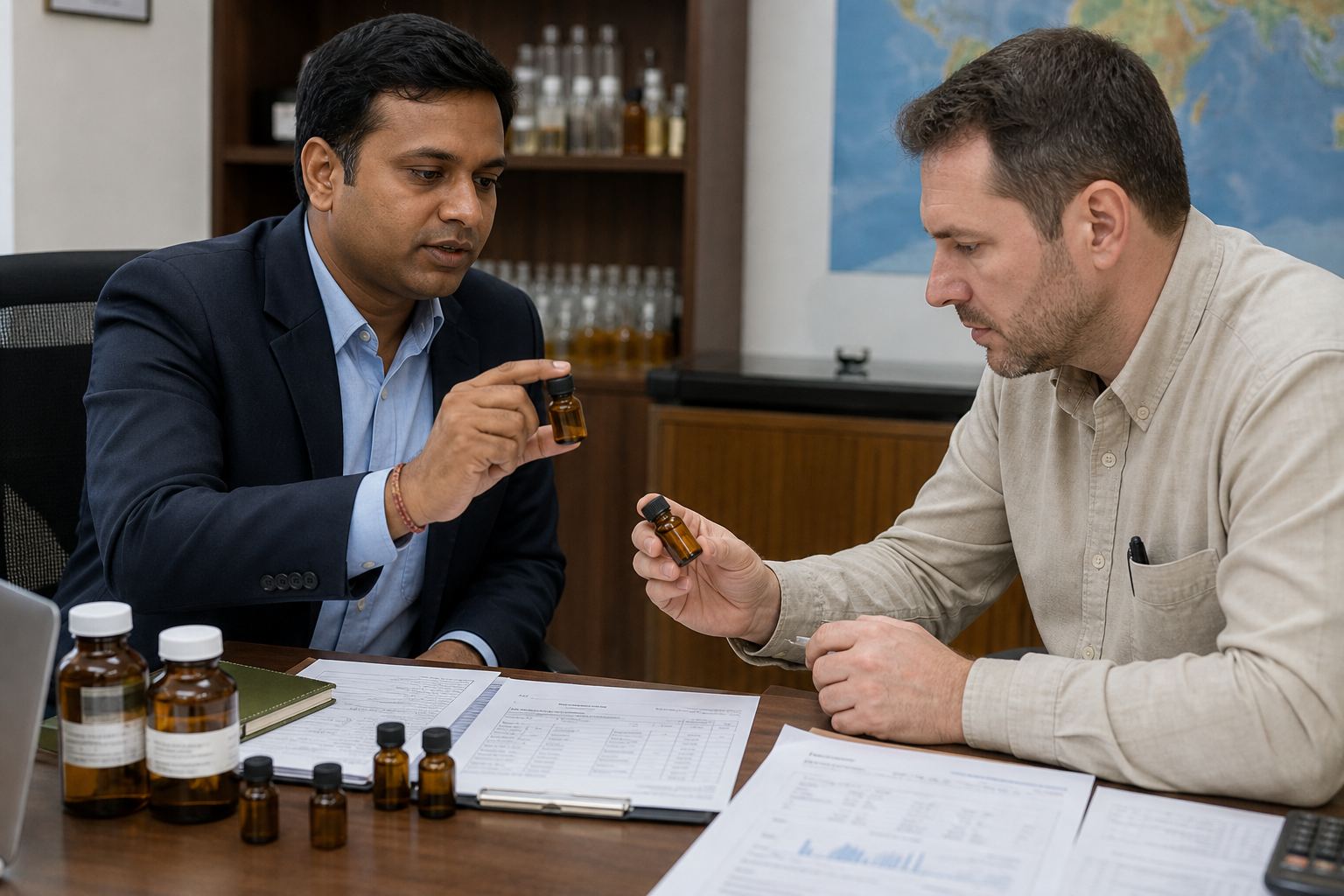
This distinction is not academic. Essential oil exporters who position their entire catalog — mentha, citrus, lemongrass, clove, eucalyptus, vetiver — under one generic 'certified exporter' claim without differentiating fragrance-track from flavor-track documentation lose qualification time with buyers who ask a very specific first question: is this oil food-grade, and can you prove it against FSSAI's flavoring-agent standards? Exporters who answer that question precisely, on the first email, move to sample dispatch faster than exporters who send a general company brochure.
Market Size & Industry Overview
Key Statistics
India's essential oil trade is dominated by volume from a single botanical family: mentha. Industry estimates place India's mint oil production (Mentha arvensis-derived crude oil, plus peppermint and spearmint) at roughly 38,000 to 42,000 metric tons for the 2024-25 crop season, with India supplying an estimated 75% to 85% of global mentha oil volume — a concentration of world supply in one crop that has few parallels in the essential oil trade. Uttar Pradesh accounts for more than 90% of India's mentha cultivation, concentrated in the Barabanki, Chandausi, Sambhal, Badaun, Rampur, Bareilly, Sitapur, and Moradabad belt, supported by an estimated 9,000 to 10,000 primary distillation units and 120 to 140 secondary processing (menthol) plants.
Beyond mentha, India's essential oil export basket includes lemongrass and citronella from Kerala, Karnataka, and parts of Uttarakhand; clove leaf and bud oil, cardamom oil, and pepper oil from Kerala and Tamil Nadu; eucalyptus and basil oils from multiple states; vetiver (locally 'khus') from Uttar Pradesh and Tamil Nadu; and sandalwood oil under strict cultivation and export controls given the species' historically regulated harvest status. Kannauj, Uttar Pradesh — India's traditional perfume city — retains a niche but commercially significant floral distillation tradition (rose, jasmine, and other absolutes and concretes) using centuries-old deg-bhapka copper-still methods, feeding both domestic ittar demand and a small volume of premium international fragrance-house buyers.
This mixed basket — high-volume commodity mentha at one end, low-volume ultra-premium florals at the other — means credentialing needs vary sharply by product line within a single exporter's catalog. A mentha oil program moving multiple 20-foot containers of crude oil to a US flavor distributor needs airtight FSSAI-aligned flavor documentation. A five-kilogram jasmine absolute shipment to a Parisian fragrance house needs impeccable GC-MS and IFRA-alignment paperwork but may never touch an FSSAI conversation. Exporters serving both ends of that spectrum need a document strategy that flexes by SKU, not a single certificate stapled to every invoice.
India Essential Oil (HS 3301) Market Snapshot
Swipe →
Data table — swipe horizontally on small screens
| Metric | Value | Notes |
|---|---|---|
| Export Value (HS 3301, FY2023-24) | ~USD 925 million | DGCI&S; fiscal year, reconfirm current year |
| Export Value (HS 330129, CY2024) | ~USD 133 million / 3,395 MT | UN Comtrade / WITS; excl. citrus & mint concretes subheading |
| Global Rank (HS 330129) | #5, ~6% world share | UN Comtrade CY2024 |
| Mentha Oil Production (2024-25 est.) | ~38,000–42,000 MT | Industry estimates; India ~75–85% of world supply |
| Mentha Export Share of Production | ~60–65% | Balance consumed domestically — FMCG, pharma, tobacco |
| Top Mentha Cluster State | Uttar Pradesh (>90% share) | Barabanki, Chandausi, Sambhal, Rampur belt |
| Primary HS Code | 3301.xx | Confirm 8-digit ITC-HS with CHA per specific oil |
| Key Export Ports | Nhava Sheva, Kandla, Cochin, Tuticorin | Port choice depends on cluster origin |
Export Statistics: India's HS 3301 Trade Flows
Key Statistics
India's HS 3301 exports reached approximately USD 924.67 million in FY2023-24, per DGCI&S data, a marginal 0.38% decline from roughly USD 928 million in FY2022-23 — essentially a flat year after a stronger 2021-22 recovery. The United States held the top destination position with roughly USD 271 million, or about 29.3% of total HS 3301 export value, followed by China at approximately USD 98.6 million (10.7%) and Malaysia at approximately USD 71.4 million (7.7%). These three markets alone account for close to half of India's declared HS 3301 export value, though the mix of oils each market buys differs substantially — a distinction covered in depth in the sibling country-demand article.
The narrower HS 330129 subheading (essential oils excluding citrus fruit and mint types, including concretes and absolutes) offers a useful cross-check: UN Comtrade figures show India exporting roughly USD 132.8 million and 3,395 metric tons under this line in calendar year 2024, up about 2.9% year-on-year, with an average unit value near USD 39 per kilogram — though unit values in this subheading swing enormously by product mix, since a shipment blending commodity eucalyptus oil with a small volume of premium jasmine absolute produces a very different average than a pure eucalyptus consignment. For calendar year 2023, the same subheading showed Malaysia, France, and the United States as the leading individual destinations by value, each in the low-to-mid twenty-million-dollar range.
Exporters and buyers should treat any single cited figure as directional rather than final. DGCI&S fiscal-year data, UN Comtrade calendar-year data, and industry association estimates rarely reconcile precisely because of timing differences, HS subheading scope, and reporting revisions. Reconfirm current-year statistics via DGCI&S, WITS, or ITC Trade Map before using any number in a buyer-facing quotation or investment memo.
India HS 3301 Export Destinations, FY2023-24 (DGCI&S)
Swipe →
Data table — swipe horizontally on small screens
| Destination | Export Value (USD mn, approx.) | Share of Total | Notes |
|---|---|---|---|
| World (HS 3301 total) | 924.67 | 100% | Essentially flat vs. FY2022-23 |
| United States | 271.02 | 29.31% | Largest single destination |
| China | 98.55 | 10.66% | Bulk/industrial-leaning demand |
| Malaysia | 71.44 | 7.73% | Regional distribution/re-export hub |
| EU-27 (aggregate, illustrative) | Sum of member states | ~15–18% (directional) | Sum carefully; do not use a single fixed axis |
| UK | Single-digit % (directional) | Reconfirm | Post-Brexit compliance path distinct from EU |
| UAE / GCC | Single-digit % (directional) | Reconfirm | Re-export hub for wider MENA |
Import Statistics: Who Buys India-Origin Essential Oils and Why
Key Statistics
From the destination-market side, India competes with China, Indonesia, Sri Lanka, Egypt, Bulgaria, Brazil, and Madagascar as an essential oil origin, each with different specialty strengths — Bulgaria and France for rose, Madagascar and Indonesia for clove and ylang-ylang, Egypt for geranium and chamomile, Brazil for orange terpenes. India's structural advantage is volume-scale reliability in mentha and a growing reputation for lemongrass, citronella, eucalyptus, and select spice-derived oils, backed by GC-MS testing infrastructure that has matured significantly over the past decade.
United States imports flow through two distinct channels that rarely overlap operationally: flavor and fragrance (F&F) houses — IFF, Givaudan, Symrise, Firmenich-DSM, and a long tail of regional flavor distributors — who purchase FSSAI-and-IFRA-aware commodity and specialty oils in bulk drums, and wellness/aromatherapy brands who purchase smaller, GC-MS-heavy, often organic-certified lots direct from Indian exporters or via specialty importers. European imports concentrate through Germany, France, and the Netherlands as ingredient-distribution gateways, with REACH compliance sitting squarely on the importer's desk but requiring full compositional disclosure from the Indian exporter to support classification.
GCC markets function largely as a re-export and blending hub — Dubai-based fragrance compounders import Indian vetiver, citronella, and lemongrass as base notes and fixatives for oud-adjacent and Arabic perfumery blends, then redistribute across the wider Middle East and North Africa. China's demand mix leans toward bulk mentha-family oils and industrial inputs with less certification depth expected at initial qualification than US or EU buyers require, reflecting the price-competitive, volume-driven nature of that channel.
Product Categories & Variants: Mapping Oils to Credential Requirements
Summary Box
Not every essential oil in an Indian exporter's catalog needs the same credential stack. The commercially useful way to think about product categories is by end-use buyer segment, because that determines which registration — Chemexcil alone, Chemexcil plus FSSAI, or Chemexcil plus organic and IFRA-alignment — actually moves a specific SKU through supplier qualification.
Fragrance and cosmetic-grade oils (florals such as jasmine and rose absolutes from Kannauj, vetiver, sandalwood, patchouli-adjacent blends, and many aromatic grasses used as base notes) are purchased by perfumers, soap manufacturers, and cosmetic formulators who reference IFRA usage-limit standards and demand tight GC-MS-verified composition, but who may never ask for an FSSAI license because their end product is never ingested. Flavor and food-grade oils (mentha family, citrus, clove, cardamom, cinnamon, ginger, black pepper) serve beverage, confectionery, bakery, and oral-care buyers who classify the oil as a food additive or flavoring agent under destination food-safety law and expect the exporter to demonstrate FSSAI-aligned domestic compliance as a proxy for that classification.
Aromatherapy and wellness-grade oils (lemongrass, eucalyptus, basil, geranium, and increasingly organic-certified mentha and citrus lines) serve a hybrid buyer base — direct-to-consumer wellness brands, spas, and natural-cosmetics formulators — who weight organic certification (NPOP, USDA NOP, EU Organic) and GC-MS purity data heavily, with FSSAI relevance only when the same oil is dual-marketed for ingestion (a growing but still niche use case requiring extra caution on labeling). Industrial and repellent-grade oils (citronella, certain lemongrass fractions) serve agrochemical and household-product formulators who prioritize REACH-ready compositional data and consistent commodity-grade GC-MS specification over either FSSAI or IFRA credentials.
Essential Oil Categories Mapped to Buyer Segment and Credential Priority
Swipe →
Data table — swipe horizontally on small screens
| Category | Example Oils | Primary Buyer Segment | Chemexcil Relevance | FSSAI Relevance | Other Key Credentials |
|---|---|---|---|---|---|
| Fragrance / Perfumery | Jasmine & rose absolute (Kannauj), vetiver, sandalwood | Fragrance houses, soap & cosmetic makers | Baseline — always relevant | Low — rarely requested | IFRA usage limits, GC-MS COA |
| Flavor / Food-grade | Mentha (peppermint, spearmint, cornmint), clove, cardamom, citrus | Flavor houses, beverage, confectionery, oral care | Baseline — always relevant | High — central to qualification | GC-MS COA, negative-list compound disclosure |
| Aromatherapy / Wellness | Lemongrass, eucalyptus, basil, organic mentha/citrus lines | Wellness brands, spas, natural cosmetics | Baseline — always relevant | Situational — only if dual-marketed for ingestion | NPOP/USDA/EU Organic, GC-MS COA |
| Industrial / Repellent | Citronella, select lemongrass fractions | Agrochemical & household product formulators | Baseline — always relevant | Not applicable | REACH SDS/compositional data, commodity GC-MS spec |
| Pharma / OTC-adjacent | Eucalyptus, clove (eugenol), mentha derivatives | Pharma, oral care, OTC vapor/rub brands | Baseline — always relevant | High — food/pharma-adjacent labeling | GC-MS COA, heavy metal & pesticide panels |
Manufacturing Overview: Distillation, Testing, and the Credential Supply Chain
Export Tip
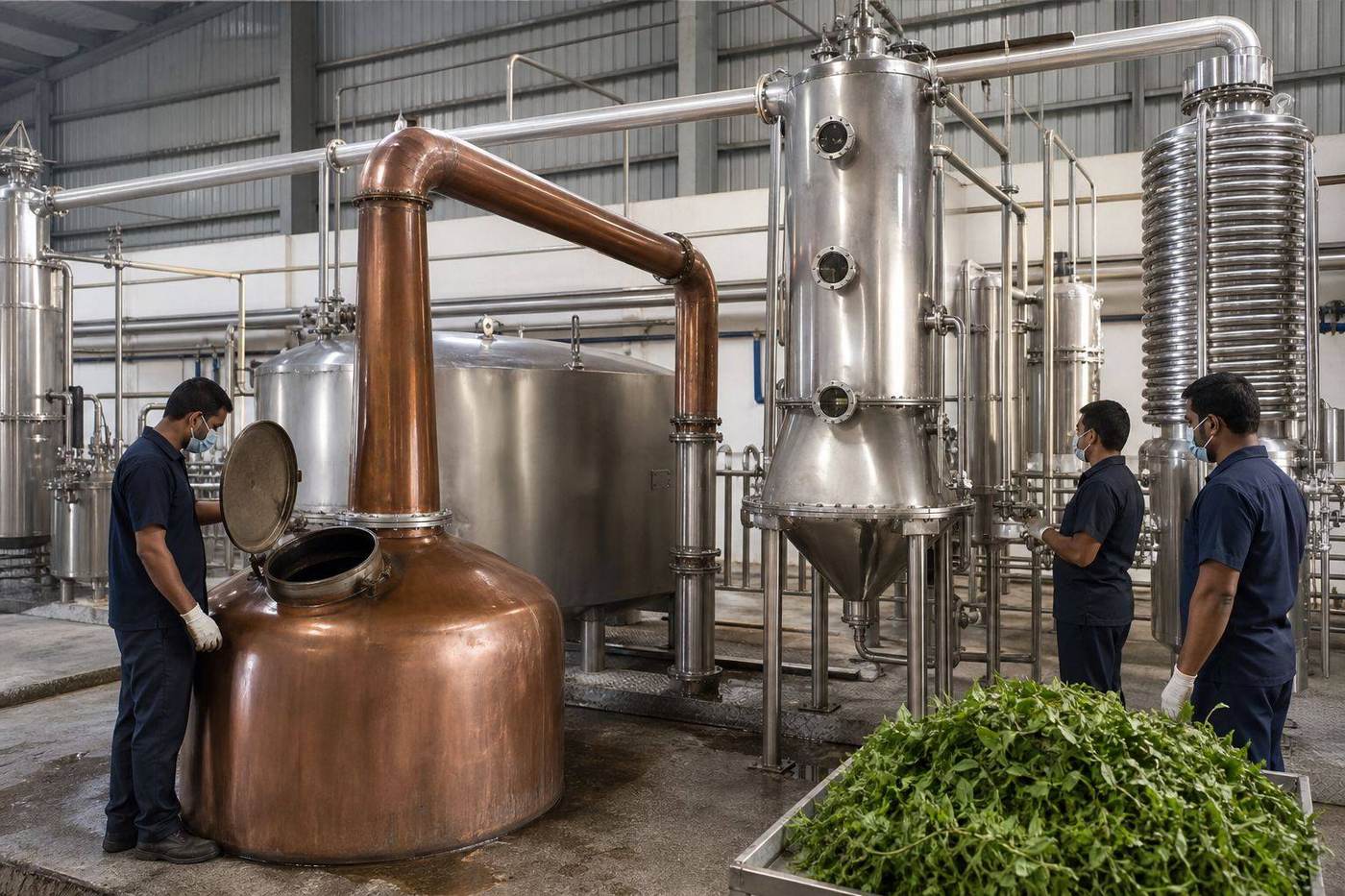
Essential oil manufacturing in India runs on two distinct production models that shape which credentials a given supplier can realistically hold. Primary distillation units — the roughly nine to ten thousand small steam-distillation setups across the Uttar Pradesh mentha belt, plus comparable networks for lemongrass and citronella in South India — extract crude oil directly from harvested herbage. These units are numerous, individually small, and rarely hold their own FSSAI or Chemexcil registration; they sell crude oil upstream to aggregators and secondary processors who consolidate volume.
Secondary processing units — the 120 to 140 menthol and fractionation plants concentrated in Uttar Pradesh, plus comparable consolidation and blending facilities for other oil families — are where export-grade standardization, GC-MS testing, and credentialing actually happen. These are the entities that typically hold Chemexcil RCMC, and where applicable, FSSAI Central or State licenses, IEC registration, and NABL-accredited laboratory relationships for batch-level COA issuance. Understanding this two-tier structure matters for buyers: a quotation referencing a specific village or district is describing where raw material is grown and initially distilled, not necessarily where the export-grade, credentialed, GC-MS-verified consignment is finished and packed.
In-house or contracted GC-MS testing capacity is the manufacturing-side investment that underpins every credential conversation in this industry. A secondary processing unit with a validated GC-MS method for its core oils — verifying menthol and menthone percentage in mentha oil, citral percentage in lemongrass, eugenol percentage in clove oil, 1,8-cineole percentage in eucalyptus — can issue COAs that satisfy both flavor-house and fragrance-house buyer scrutiny from the same analytical infrastructure, making GC-MS capacity a more foundational investment than either single registration.
Certifications: Chemexcil, FSSAI, IFRA, REACH, and GC-MS in Detail
Compliance Notes
This is the section that matters most for essential oil exporters trying to decide where to invest registration effort first. Five credential frameworks recur constantly in essential oil buyer conversations, and each answers a different question for a different buyer type. Understanding what each one actually certifies — and what it does not — prevents both under-investment (missing a credential a serious buyer requires) and over-investment (chasing a certificate a given buyer segment will never ask about).
Chemexcil RCMC: The Export-Promotion Baseline
Chemexcil RCMC: Application Logic for Essential Oil Exporters
Swipe →
Data table — swipe horizontally on small screens
| Requirement | Detail | Notes |
|---|---|---|
| Prerequisite | Valid IEC from DGFT | Mandatory before Chemexcil membership application |
| Applicable Panel | Panel III — Soaps, Toiletries, Cosmetics, Essential Oils | Confirm current panel classification for your product mix |
| Application Route | Chemexcil online/offline application + membership fee | Manufacturer-exporters may qualify via DIC/SSI/SIA certification route |
| Governing Framework | Foreign Trade Policy, Handbook of Procedures | RCMC issued per FTP Chapter provisions |
| Renewal | Annual subscription fee payment | Lapses restrict access to FTP incentive schemes |
| Key Benefit Unlocked | MAI / MDA scheme eligibility | Subsidized trade fair and buyer-seller meet participation |
| Membership Base (approx.) | 4,000+ across all panels | Small manufacturer-exporters to large merchant houses |
Chemexcil — the Basic Chemicals, Cosmetics & Dyes Export Promotion Council — was established in 1963 under the Ministry of Commerce & Industry to promote export of organic and inorganic chemicals, dyes and dye intermediates, cosmetics, soaps and toiletries, essential oils, castor oil products, and specialty chemicals. Essential oils sit within Chemexcil's Panel III (Soaps, Toiletries, Cosmetics, and Essential Oils), alongside a Panel structure that also covers dyes (Panel I), basic organic/inorganic and agro/petro chemicals (Panel II), and lubricants, specialty, and castor products (Panel IV).
Membership with Chemexcil — a prerequisite to obtaining the Registration-cum-Membership Certificate (RCMC) — requires a valid Import Export Code (IEC) from DGFT, followed by an application with the requisite documents and membership fee. The RCMC itself is issued under India's Foreign Trade Policy framework (Handbook of Procedures) and must be renewed through annual subscription payment. Chemexcil counts more than 4,000 members across its product panels, spanning small manufacturer-exporters to large merchant export houses.
The RCMC is not optional paperwork for exporters who want to access government export incentive schemes. It is the specific credential required to claim benefits under India's Foreign Trade Policy, including Market Access Initiative (MAI) and Market Development Assistance (MDA) funding that subsidizes participation in international trade fairs and buyer-seller meets. Without a valid RCMC, an essential oil exporter cannot access these schemes regardless of product quality or export volume.
FSSAI Licensing: The Food-Grade Gateway for Flavor Buyers
FSSAI Flavoring-Agent Classification for Essential Oils
Swipe →
Data table — swipe horizontally on small screens
| Classification | Definition | Typical Essential Oil Examples | Exporter Action |
|---|---|---|---|
| Natural Flavours / Flavouring Substances | Obtained exclusively by physical processes from vegetables | Mentha, citrus, clove, cardamom, eucalyptus (food-grade lines) | Standard FSSAI-aligned COA and labeling |
| Nature-Identical Flavouring Substances | Chemically isolated/synthesized, identical to natural compounds | Isolated menthol, isolated citral (specialty fractions) | Disclose isolation/synthesis method in spec sheet |
| Artificial Flavouring Substances | Not identified in natural products | Rare in essential oil trade; more common in compounded flavors | Generally outside core essential oil scope |
| Negative-list compounds | Coumarin, thujone, safrole/isosafrole, beta-asarone, others | Certain cassia, calamus, thujone-bearing botanical oils | GC-MS quantification mandatory before food-grade claim |
FSSAI regulates essential oils the moment they are positioned as food ingredients — specifically as flavoring agents under the Food Safety and Standards (Food Products Standards and Food Additives) Regulations, 2011. FSSAI's flavoring-agent framework (Regulation 3.3.1) classifies flavors into three tiers: Natural Flavours and Natural Flavouring Substances (obtained exclusively by physical processes from vegetables, which covers most steam-distilled essential oils used as flavors), Nature-Identical Flavouring Substances (chemically isolated or synthesized compounds identical to natural counterparts), and Artificial Flavouring Substances (not identified in nature). Most export-grade essential oils sold into food and beverage applications — mentha, citrus, clove, cardamom — fall under the Natural Flavours classification.
This regulation carries a negative list that essential oil exporters must know cold, because several traditionally significant oils contain compounds on it at levels that require careful sourcing, blending, or disclosure. Coumarin, dihydrocoumarin, beta-asarone, cinnamyl anthranilate, thujone, ethyl methyl ketone, safrole, and isosafrole are restricted or banned as flavoring compounds under Indian food-additive rules. Practically, this means oils like certain cassia/cinnamon bark fractions (coumarin-bearing), calamus-type oils (beta-asarone), and thujone-bearing botanicals require compositional verification before any food-grade positioning — a GC-MS report showing marker compound levels is the only credible way to demonstrate compliance to a cautious flavor-house buyer.
Export-oriented essential oil processors handling food-grade lines should hold FSSAI Central License regardless of turnover threshold, because Central License documentation carries more international buyer recognition than State License, similar to the pattern seen across other Indian food-adjacent export categories. The FSSAI number on a supplier's document pack, paired with a batch-specific GC-MS COA confirming absence or compliant levels of negative-list compounds, is the single most direct route to satisfying a flavor-house buyer's initial supplier-qualification screen.
IFRA, REACH, and GC-MS: The International Buyer-Side Frameworks
IFRA (the International Fragrance Association) is not an Indian registration — it is the international fragrance industry's self-regulatory standard, setting maximum usage levels for fragrance materials in finished consumer products based on quantitative risk assessment. Fragrance-house and cosmetic buyers reference IFRA standards constantly, and many request that Indian suppliers demonstrate awareness of relevant IFRA restriction categories for the specific oils being purchased (certain citrus oils and some aromatic constituents carry IFRA-specified maximum use percentages due to phototoxicity or sensitization data). Exporters cannot 'get IFRA certified' as an entity, but they can and should supply IFRA-relevant compositional data alongside their GC-MS COA.
REACH (Registration, Evaluation, Authorisation and Restriction of Chemicals, EU Regulation 1907/2006) governs chemical substances placed on the EU market, and essential oils are typically classified as UVCB substances — Substances of Unknown or Variable composition, Complex reaction products, or Biological materials. REACH registration obligations fall on the EU-based importer or their appointed Only Representative when import volume exceeds one tonne per substance per year, not directly on the Indian exporter. However, EU buyers cannot complete their own REACH classification and safety data sheet (SDS) preparation without full compositional disclosure from the exporter — making detailed GC-MS data an EU market-access prerequisite in practice, even though the registration filing itself sits downstream of the export transaction.
GC-MS (Gas Chromatography-Mass Spectrometry) is the common analytical thread running through every certification conversation in this industry. It is the method by which NABL-accredited laboratories verify that a mentha oil batch contains the declared menthol and menthone percentages, that a lemongrass batch contains the declared citral percentage, and that no consignment has been diluted with carrier oil, cut with cheaper synthetic isolates, or contaminated with solvent residues. A validated GC-MS chromatogram, reissued per batch, is the document both fragrance-house and flavor-house buyers request before committing to any but the smallest trial order.
Expert Insight: Credentials vs Composition Proof
Expert Insight Box
Chemexcil RCMC and FSSAI licensing answer different buyer questions — government export legitimacy and food-grade positioning respectively — but neither substitutes for batch-level compositional verification. Serious fragrance and flavor buyers treat GC-MS as the non-negotiable final gate regardless of which Indian registration track applies.
Pricing Analysis: Credential-Linked Price Realization
Buyer Tip
Essential oil pricing responds to three compounding factors: botanical supply and crop-yield variability (mentha pricing swings with Uttar Pradesh planting decisions and monsoon timing), purity and marker-compound concentration, and credential documentation. The third factor is the one exporters control most directly. An uncredentialed mentha oil trader competes purely on spot price against every other undifferentiated supplier in the Chandausi and Sambhal markets. A Chemexcil-registered, FSSAI-aligned, GC-MS-batch-tested processor competes on documented reliability — and captures buyers who will not touch spot-market oil regardless of price.
Indicative FOB price bands (Q2 2026, always requote against current crop and purity conditions) illustrate the spread across the catalog. Commodity mentha-family oils sit at the lower end of the per-kilogram range but move in large volumes; low-volume florals like jasmine absolute from Kannauj command per-kilogram prices in the thousands of dollars precisely because supply is constrained by flower-to-oil yield ratios and traditional distillation capacity, not because of any registration premium. Within any single oil type, however, credentialed and GC-MS-documented supply consistently commands a premium over uncredentialed commodity-grade material sold without batch-level verification.
Sandalwood oil deserves a specific note: Indian sandalwood (Santalum album) has historically been subject to strict state-level cultivation and harvest controls given decades of over-extraction pressure, and legally sourced, certified supply carries premium pricing that reflects genuine scarcity rather than credential positioning alone. Buyers should treat any unusually low sandalwood oil quotation as a red flag requiring immediate documentation verification rather than a bargain.
Indicative FOB Price Bands by Oil Type (Q2 2026, USD/kg — always requote)
Swipe →
Data table — swipe horizontally on small screens
| Oil | Botanical Source | Indicative FOB Range (USD/kg) | Primary Buyer Segment |
|---|---|---|---|
| Mentha / Cornmint crude oil | Mentha arvensis | $14 – $20 | Flavor houses, menthol/DMO processors |
| Peppermint oil | Mentha piperita | $18 – $28 | Flavor houses, oral care, confectionery |
| Spearmint oil | Mentha spicata | $30 – $45 | Confectionery, chewing gum, oral care |
| Lemongrass oil | Cymbopogon flexuosus | $9 – $14 | Fragrance, aromatherapy, citral extraction |
| Citronella oil | Cymbopogon winterianus | $10 – $16 | Repellent formulators, industrial |
| Eucalyptus oil | Eucalyptus globulus/citriodora | $10 – $18 | Pharma/OTC, aromatherapy, industrial |
| Clove bud oil | Syzygium aromaticum | $28 – $40 | Flavor, dental/oral care, pharma |
| Cardamom oil | Elettaria cardamomum | $180 – $260 | Premium flavor, high-end fragrance |
| Vetiver (khus) oil | Chrysopogon zizanioides | $150 – $220 | Fine fragrance, fixative for perfumery |
| Sandalwood oil (East Indian) | Santalum album | $1,800 – $2,800+ | Fine fragrance, ultra-premium cosmetics |
MOQ Analysis: Registration-Linked Commercial Terms
Buyer Tip
Minimum order quantities in the essential oil trade vary by product volume tier more than by credential status directly, but credentialed suppliers with batch-testing infrastructure tend to set more structured MOQ tiers than uncredentialed spot traders, whose pricing and quantities shift daily with local market conditions. High-volume commodity oils — mentha family, lemongrass, citronella, eucalyptus — commonly move in 180 kg drum increments for trial orders and multi-drum or full-container lots for commercial programs. Low-volume specialty and floral oils — jasmine absolute, high-grade sandalwood, vetiver — move in far smaller increments, sometimes as little as 1 kg to 5 kg per commercial order given per-kilogram value.
GC-MS batch testing cost (typically USD 40 to 120 per parameter panel per batch at NABL-accredited labs, depending on scope) factors directly into MOQ economics for credentialed suppliers: testing every small trial lot at full analytical depth is not economical below a certain volume threshold, which is why many processors set a minimum 25 kg to 50 kg threshold for full-panel GC-MS-documented trial samples, with smaller quantities available on a best-effort or non-tested basis for initial screening only.
FCL container economics anchor the top of the MOQ ladder. A 20-foot container of mentha-family oil in 180 kg steel or HDPE drums typically carries in the range of 14 to 16 metric tons net, which at commodity FOB pricing represents a shipment value in the mid-to-high hundreds of thousands of dollars — a volume tier that qualifies for the strongest per-unit pricing and justifies dedicated pre-shipment inspection and full documentation packages.
MOQ Structure for Essential Oil Export Programs
Swipe →
Data table — swipe horizontally on small screens
| Program Stage | Typical MOQ (commodity oils) | Typical MOQ (specialty/floral oils) | Documentation Required |
|---|---|---|---|
| Sample / pre-qualification | 1 – 5 kg | 10 – 100 g | Basic spec sheet, indicative GC-MS profile |
| Trial / first commercial order | 25 – 180 kg | 0.5 – 2 kg | Full GC-MS COA, Chemexcil RCMC, FSSAI (if food-grade) |
| Regular commercial order | 180 kg – 1 MT | 2 – 10 kg | Batch records, COO, invoice pack |
| FCL program (20ft) | about 12–16 MT mentha-family (indicative; confirm with forwarder) | Rarely applicable at floral scale | Full export document pack + pre-shipment inspection |
| Annual supply agreement | Per contracted schedule | Per contracted schedule | Quality agreement + approved supplier protocol |
Packaging Standards for Essential Oil Export
Export Tip
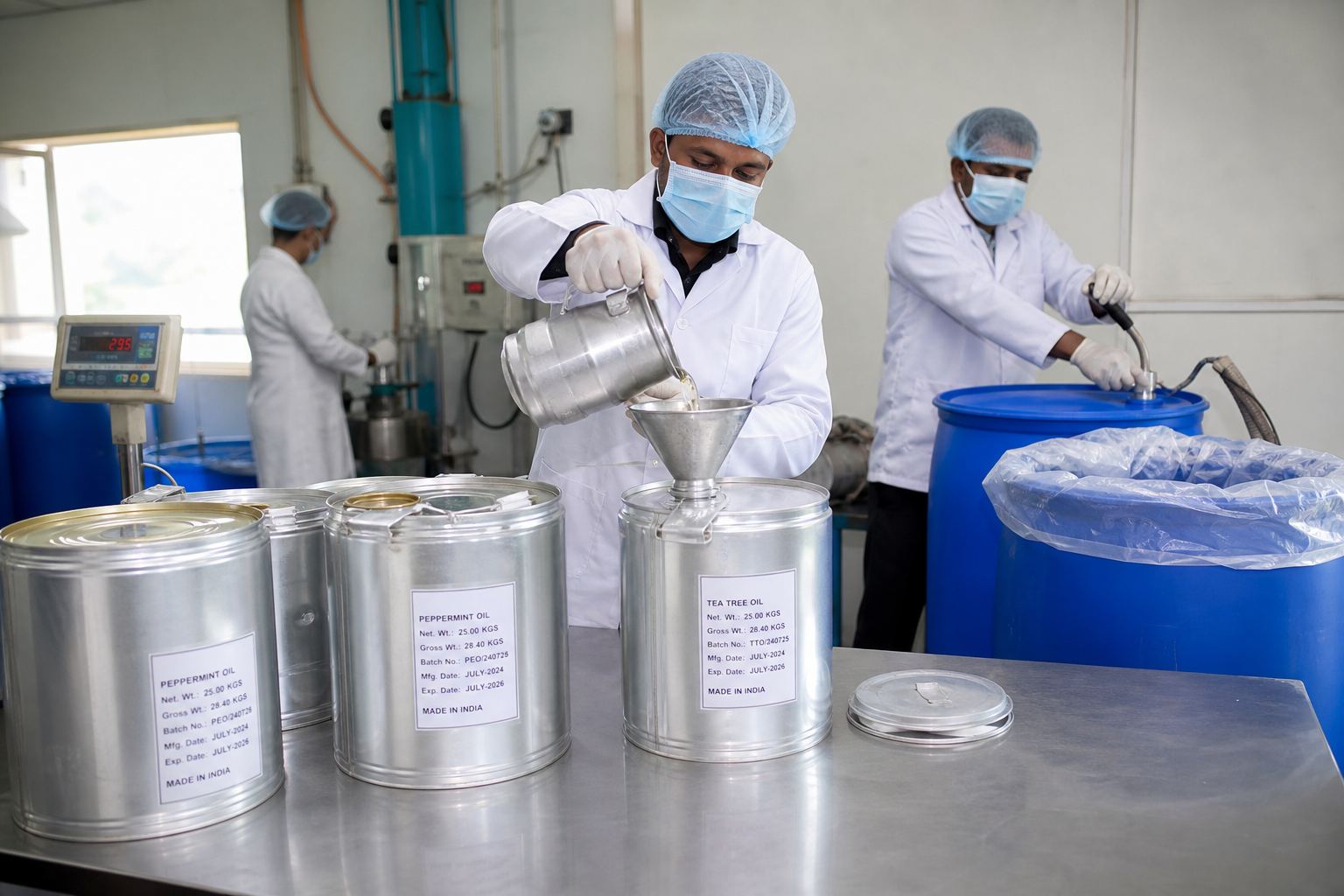
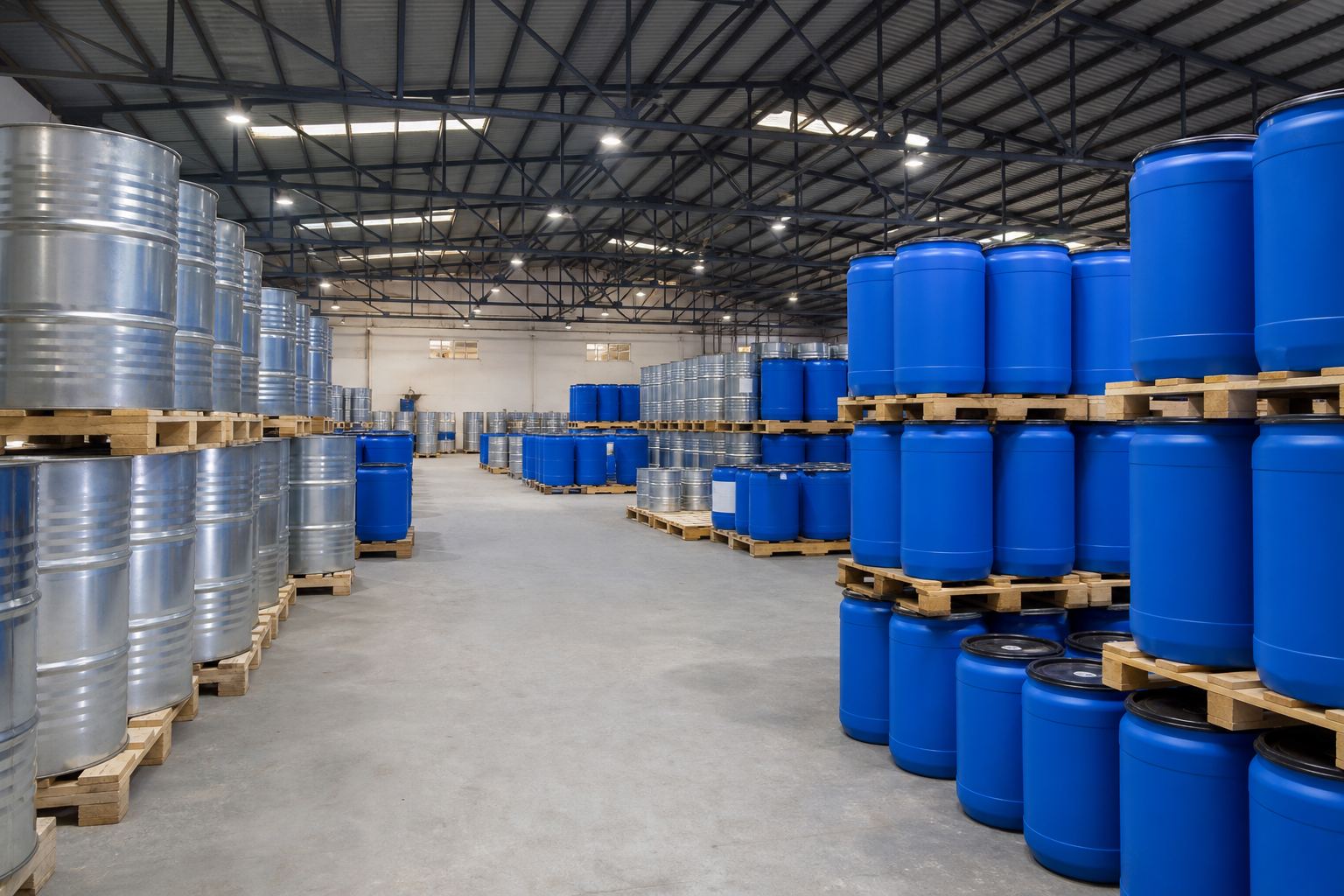
Essential oil packaging balances chemical compatibility, flammability classification, and per-unit value. The industry standard bulk container for commodity oils is the 180 kg net-fill steel or HDPE drum (roughly a 200-liter drum given typical essential oil specific gravity of 0.85 to 0.95), used for mentha, lemongrass, citronella, and eucalyptus programs moving in FCL or multi-drum LCL quantities. Mid-tier 50 kg drums serve mid-volume specialty oils and buyers who want smaller working inventory without paying per-kilogram premiums associated with very small packaging. Small-format 25 kg drums or pails serve trial orders and lower-volume specialty programs, while high-value florals and absolutes ship in sealed aluminum, tin, or amber glass containers as small as 1 kg or less.
Most essential oils carry a flash point that classifies them as flammable liquids for transport purposes (commonly UN-numbered as aromatic extracts or essential oil-type dangerous goods depending on specific flash point and composition), which means UN-rated drums, correctly classified Safety Data Sheets, and dangerous-goods-compliant shipping documentation are not optional add-ons but standard requirements for legal export. Buyers should always confirm that their supplier's packaging and paperwork reflect the correct DG classification for the specific oil being shipped — misclassification creates both safety risk and customs delay exposure.
Label requirements on export drums should include botanical name (common and Latin), batch number, manufacturing date, net weight, country of origin, GC-MS reference or COA batch link, storage instructions (cool, dark, away from ignition sources), and the exporter's Chemexcil RCMC and — where the oil is food-grade — FSSAI license number. Buyers purchasing for regulated fragrance or food end use increasingly expect these details on the drum itself, not only on accompanying paperwork that can be misplaced during transit.
Drum Packaging Specifications for Essential Oil Export
Swipe →
Data table — swipe horizontally on small screens
| Parameter | 180 kg Drum (bulk commodity) | 50 kg Drum (mid-tier) | 25 kg Drum/Pail (trial/specialty) |
|---|---|---|---|
| Typical use case | Mentha, lemongrass, citronella, eucalyptus FCL programs | Mid-volume specialty oils, repeat mid-size buyers | Trial orders, small specialty programs |
| Container material | UN-rated steel or HDPE | UN-rated steel or HDPE | UN-rated HDPE or lined steel pail |
| Approx. volume equivalent | ~190–210 L | ~55–60 L | ~27–30 L |
| DG classification | Flammable liquid — confirm UN number per oil | Same as bulk drum | Same as bulk drum |
| Label essentials | Botanical name, batch, mfg date, COA link, RCMC/FSSAI no. | Same as bulk drum | Same as bulk drum |
| Typical pallet configuration | 4 drums per pallet (forwarder-confirmed) | 6–8 drums per pallet | Cartons or shrink-wrapped pallet |
Container Loading Details and Shipping Methods
Export Tip
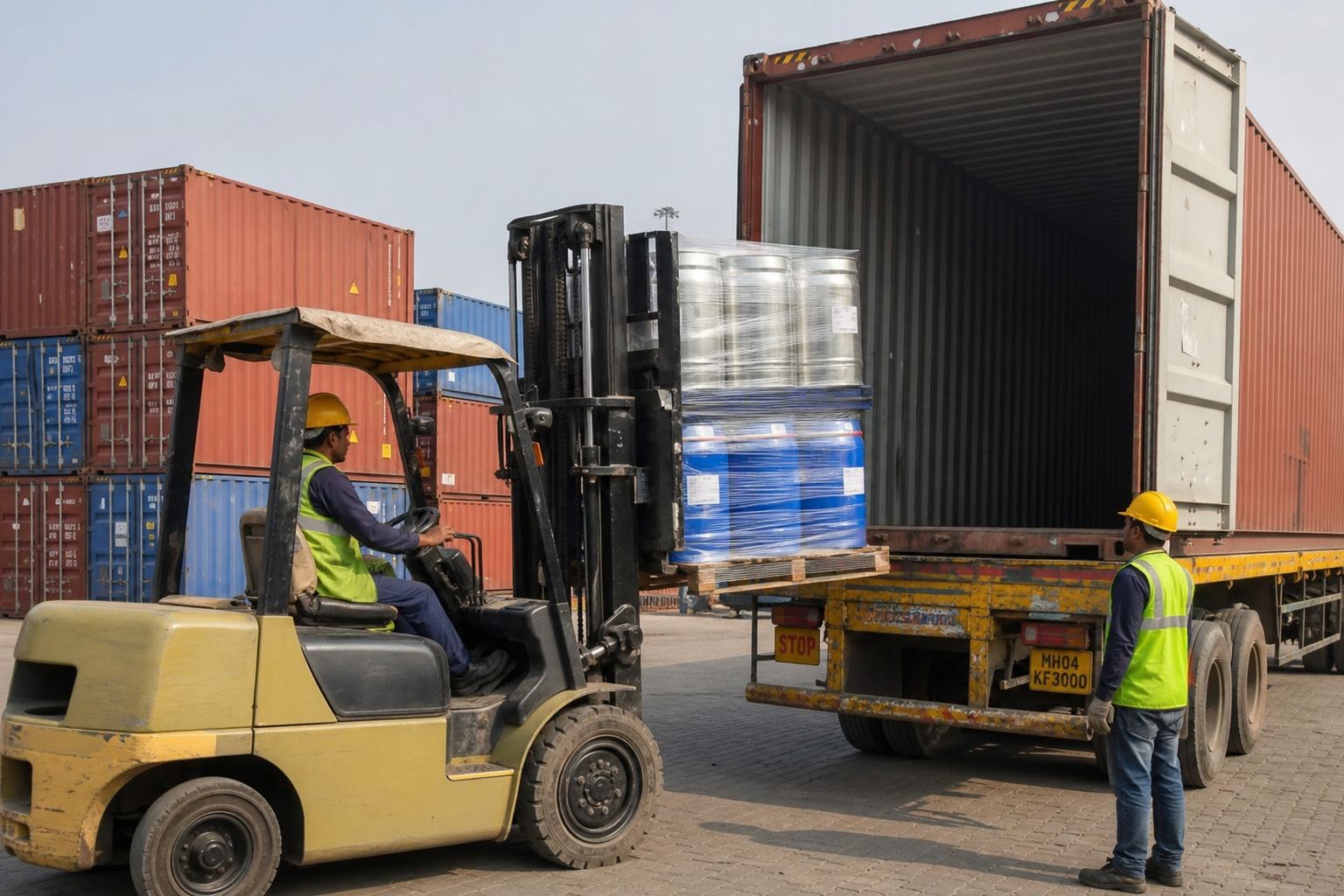
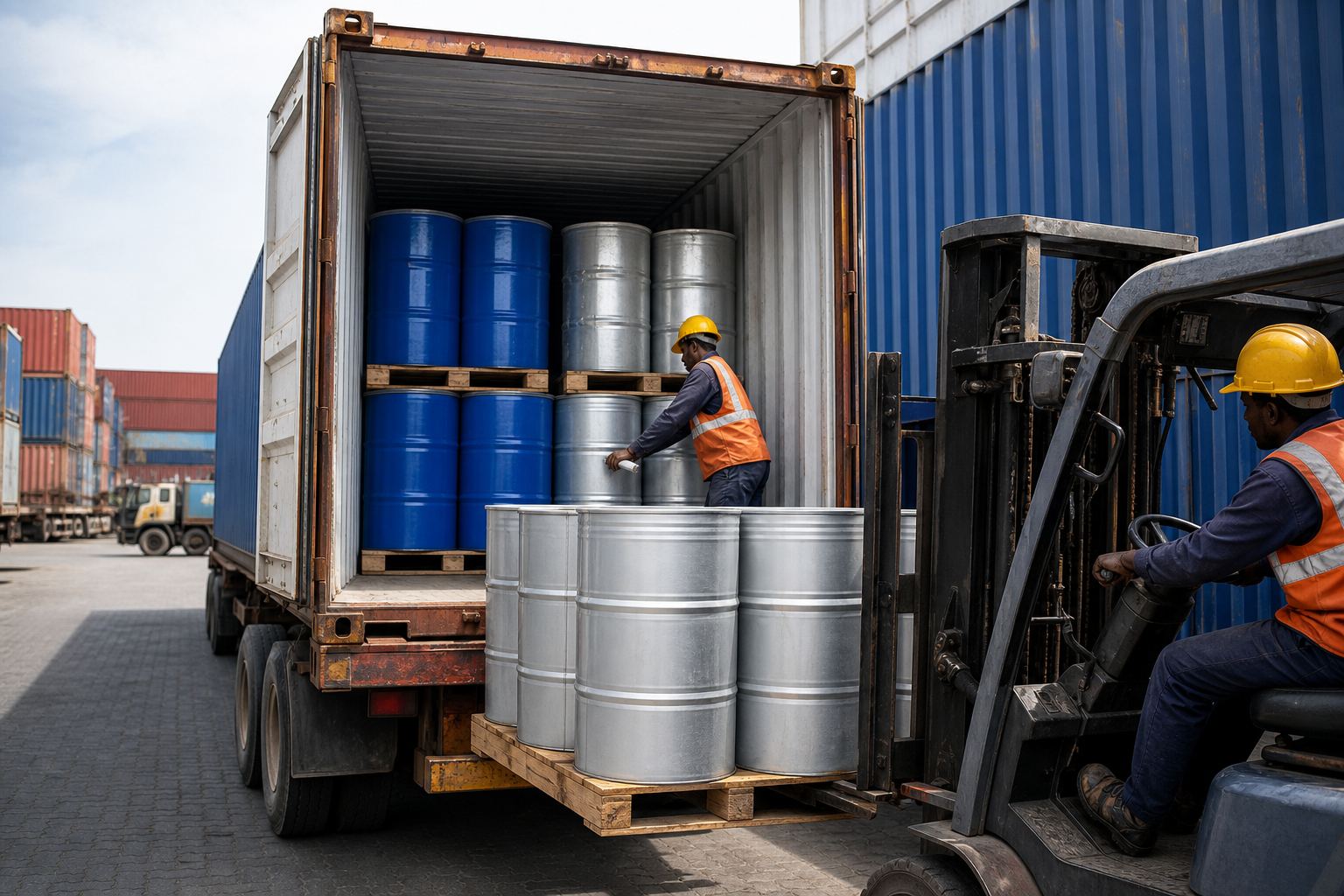
Container loading economics for essential oils depend on drum size, palletization, and the specific gravity of the oil being shipped. A 20-foot FCL commonly carries approximately 76 to 80 drums of 180 kg net fill for standard mentha-family oil programs, yielding roughly 14 to 16 metric tons net product weight — though forwarders should always confirm actual stuffing plans against exact drum dimensions and container tare limits before finalizing a shipment plan. A 40-foot FCL roughly doubles that figure, in the range of 28 to 32 metric tons, subject to the same forwarder verification.
LCL consolidation at Nhava Sheva, Kandla, Cochin, or Tuticorin is the standard mechanism for buyers whose initial program needs fewer than a handful of drums, or for specialty oil buyers whose per-shipment quantities never approach FCL scale. Air freight is common for high-value, low-volume specialty and floral oils — a courier shipment of jasmine absolute or sandalwood oil samples moves by air as a matter of course given the value-to-weight ratio, while bulk mentha-family programs almost always move by sea given their commodity economics.
Transit times from Nhava Sheva to major destination ports follow familiar patterns across India's export categories: USA East Coast roughly 18 to 22 days; EU ports (Rotterdam, Hamburg) roughly 20 to 25 days; UK (Felixstowe) roughly 22 to 27 days; GCC (Jebel Ali) roughly 8 to 12 days; Australia roughly 18 to 22 days; Japan roughly 14 to 18 days. Air freight from Mumbai to major hubs runs 2 to 5 days depending on destination, standard for sample dispatch and urgent specialty-oil replenishment.
Container Loading and Shipping Reference Table
Swipe →
Data table — swipe horizontally on small screens
| Metric | 20-ft FCL | 40-ft FCL | LCL | Air Freight |
|---|---|---|---|---|
| Typical net payload (commodity oils) | 14–16 MT | 28–32 MT | 0.1–5 MT | 1–200 kg |
| 180 kg drums (approx.) | ~76–80 drums | ~150–160 drums | Palletized per buyer | Not applicable |
| FOB port options | Nhava Sheva, Kandla, Cochin, Tuticorin | Nhava Sheva, Kandla, Cochin, Tuticorin | Nhava Sheva, Kandla, Cochin | Mumbai (BOM), Delhi (DEL) |
| US East Coast transit | 18–22 days | 18–22 days | 22–28 days | 3–5 days |
| EU (Rotterdam) transit | 20–25 days | 20–25 days | 24–30 days | 2–4 days |
| GCC (Jebel Ali) transit | 8–12 days | 8–12 days | 10–15 days | 1–2 days |
| Best use case | Bulk mentha/citronella/lemongrass program | High-volume commodity program | Trial or mixed-SKU orders | Samples, floral/specialty oils |
Buyer Requirements
Buyer Requirements
The credential pack a buyer expects varies predictably by which of four broad buyer archetypes is placing the order, and exporters who tailor their document response to the correct archetype close qualification faster than those who send a generic company dossier regardless of inquiry type.
Fragrance-house and cosmetic-formulator buyers lead with IFRA usage-limit awareness and GC-MS composition data; they rarely mention FSSAI at all unless the same oil is being dual-sourced for a food-adjacent cosmetic claim. Flavor-house, beverage, and confectionery buyers lead with FSSAI-aligned food-additive documentation and negative-list compound disclosure; IFRA is largely irrelevant to their qualification process. Pharma and OTC-adjacent buyers (oral care, vapor rub, topical formulations) sit between the two, typically requiring both FSSAI-adjacent food/pharma labeling support and rigorous heavy-metal and pesticide-residue panels beyond standard GC-MS composition testing. Wellness and aromatherapy direct-to-consumer brands weight organic certification and GC-MS purity data most heavily, treating Chemexcil RCMC as a baseline trust signal rather than a differentiator.
Certification Matrix by Buyer Segment
Swipe →
Data table — swipe horizontally on small screens
| Buyer Segment | Chemexcil RCMC | FSSAI Reference | IFRA Awareness | REACH/SDS Data | GC-MS COA | Organic/Halal/Kosher |
|---|---|---|---|---|---|---|
| Fragrance house / cosmetic formulator | Expected baseline | Rarely requested | Central to qualification | Required for EU buyers | Central to qualification | Situational (natural cosmetics lines) |
| Flavor house / beverage / confectionery | Expected baseline | Central to qualification | Not applicable | Required for EU buyers | Central to qualification | Kosher/Halal common for processed food channels |
| Pharma / OTC-adjacent | Expected baseline | High relevance | Low relevance | Required for EU buyers | Central + heavy metal/pesticide panels | Situational |
| Wellness / aromatherapy DTC brand | Expected baseline | Situational | Moderate relevance | Required for EU buyers | Central to qualification | High relevance — organic drives premium |
Expert Insight: Segment-Specific Document Packs
Expert Insight Box
Dual-credential exporters serving both fragrance and flavor buyer segments gain the most qualification speed when they prepare segment-specific document templates from a single GC-MS batch report — not when they distribute one generic company dossier to every inquiry type.
Country-wise Opportunities
Market Snapshot
Credential expectations shift by destination market in ways that compound the buyer-segment distinctions above. US buyers generally expect Chemexcil-adjacent baseline legitimacy plus FSSAI-aligned documentation for flavor lines and IFRA-aware data for fragrance lines, with FDA Prior Notice filing required for food-classified essential oil shipments regardless of which Indian registration applies. EU buyers add REACH compositional disclosure and, increasingly, sustainability and traceability documentation on top of the same base credential set. GCC buyers weight Halal-compliant extraction and processing documentation alongside standard GC-MS and Chemexcil credentials, particularly for fragrance-blend inputs re-exported across the wider Middle East. Japan applies unusually strict scrutiny to GC-MS chromatogram authenticity given a well-documented sensitivity to adulteration claims in the aromatherapy retail sector.
This orientation is intentionally brief. A full destination-by-destination demand map — which oil, which specification, which certification each major country prioritizes — is covered in dedicated depth in Most Demanded Indian Essential Oils by Country, including country-specific SKU tables for the United States, European Union, United Kingdom, UAE and GCC, Japan, China, Australia, and additional emerging markets.
Sourcing Checklist: Buyer, Exporter, and Compliance Readiness
Checklist
Common Buyer Mistakes When Sourcing Credentialed Essential Oils from India
Common Mistakes Box
Future Market Trends: Credentialing Expectations Through 2028
Key Statistics
Flavor-house scrutiny of natural-versus-nature-identical claims is intensifying globally as clean-label consumer pressure pushes brands toward verifiably natural flavoring inputs, which raises the bar for GC-MS documentation depth that Indian exporters will need to sustain FSSAI-aligned positioning with increasingly sophisticated buyers. Fragrance-house sustainability and traceability requirements are following a similar trajectory to those already documented in the herbal extract and botanical ingredient trade — expect origin-traceability and biodiversity-impact documentation requests to grow steadily for wild-harvested or geographically concentrated oils like vetiver and sandalwood.
Organic certification is likely to be the most commercially significant near-term upgrade opportunity for mentha, citrus, and lemongrass exporters targeting EU and North American wellness channels, mirroring the premium dynamics already visible in India's organic herbal extract trade. REACH enforcement in the EU is expected to tighten incrementally rather than dramatically, but Indian exporters who proactively build compositional data-sharing workflows with EU importers now will face fewer disruptions than those who treat REACH as solely the buyer's problem.
Digital, batch-linked COA systems — QR-code-referenced GC-MS reports, blockchain-anchored batch records — are beginning to appear in forward-looking Indian essential oil processing operations, following the same trajectory already underway in adjacent botanical export categories. Exporters who adopt digital COA traceability ahead of broad buyer demand will be positioned advantageously as both flavor-house and fragrance-house procurement teams tighten documentation-fraud scrutiny industry-wide.
Essential Oil Credentialing Roadmap 2026–2028
Swipe →
Data table — swipe horizontally on small screens
| Timeline | Credential Priority | Market Driver | Competitive Advantage |
|---|---|---|---|
| Immediate (2026) | Chemexcil RCMC + FSSAI (where food-grade) + validated GC-MS | US/EU baseline buyer access | Unlocks both flavor and fragrance qualification tracks |
| Near-term (2026-27) | NABL-accredited GC-MS with digital batch linkage | Clean-label and adulteration scrutiny rising | Reduces buyer rejection risk on repeat programs |
| Mid-term (2027) | Organic supply chain (NPOP/USDA/EU Organic) | Wellness/DTC premium demand | 25–45% price uplift potential in organic-aware channels |
| Mid-term (2027) | Origin traceability for wild-harvested/regulated botanicals | EU sustainability and biodiversity regulation trends | Market access for ESG-focused fragrance buyers |
| Longer-term (2028) | Blockchain/QR-linked digital COA systems | Fraud prevention, buyer efficiency | Repeat-program trust and reduced audit friction |
How Altus Exports Supports Credentialed Essential Oil Programs
Altus Exports is a merchant exporter and global sourcing partner based in New Delhi. For essential oil programs under HS code 3301, Altus appears as exporter of record on shipping bills filed at Nhava Sheva, Kandla, and Cochin, coordinates document packs aligned to Chemexcil, FSSAI, IFRA-relevant, and destination-market requirements, and manages supplier qualification across the Uttar Pradesh mentha belt and South Indian aromatic-oil clusters.
Our sourcing network includes Chemexcil-registered processors for fragrance, flavor, and industrial-grade oils, with FSSAI-licensed partners for food-grade lines and NABL-accredited GC-MS testing coordination for every commercial batch. Supplier qualification includes Chemexcil RCMC verification, FSSAI license validation where relevant, GC-MS method review, and prior export document sampling before any buyer introduction.
International buyers share target oil, grade, marker-compound specification, intended end use (fragrance, flavor, pharma, or wellness), and destination market — we respond with verified processor options and document packages aligned to that specific qualification path. Exporters and manufacturers seeking export execution support — shipping bill filing, FOB documentation, buyer introduction — engage Altus as the merchant export partner handling the commercial and compliance interface with international buyers.
Conclusion: Two Credentials, Two Buyer Worlds
Chemexcil RCMC and FSSAI licensing solve different problems for Indian essential oil exporters, and treating them as interchangeable or redundant misses the commercial logic that makes each one valuable. Chemexcil is the export-promotion and government-recognition baseline that every HS 3301 exporter needs regardless of end-use category. FSSAI is the specific unlock for the flavor-house, beverage, confectionery, and oral-care buyer segment that represents some of the largest volume opportunity in the mentha-dominated Indian essential oil trade.
Exporters who understand this distinction — and who pair whichever registration applies to their product mix with rigorous, NABL-accredited GC-MS testing — compete for buyer segments that price-only commodity suppliers cannot reach. The credential investment is modest relative to the qualification speed and price realization it enables across both fragrance and flavor buyer conversations.
Altus Exports helps both Indian manufacturers seeking export program development and international buyers seeking credentialed essential oil supply from verified processing clusters. The starting point is the same: a precise oil specification, a clear end-use category, and a destination market. Contact Altus Exports with your essential oil program details — oil, grade, end use, and target market — to receive verified processor options and an aligned export execution plan.
Continue exploring this cluster: Most Demanded Indian Essential Oils by Country for the destination-market demand map referenced throughout this article. For industry context, see Herbal & Ayurvedic Products, Agriculture & Food Products, and Chemicals & Minerals. For export execution support, see Merchant Exporter India and Global Sourcing Partner India.