
Source Essential Oils Directly from India: Buyer's Playbook
By Saurabh Mittal, Founder, Altus Exports
A practical buyer-side playbook for sourcing essential oils directly from India — from issuing a structured RFQ and verifying Chemexcil/FSSAI/IEC credentials, through GC-MS-tested sampling, trial orders, and scale-up to full container loads. Written for importers, distributors, wholesalers, and procurement teams, not as an exporter registration tutorial.
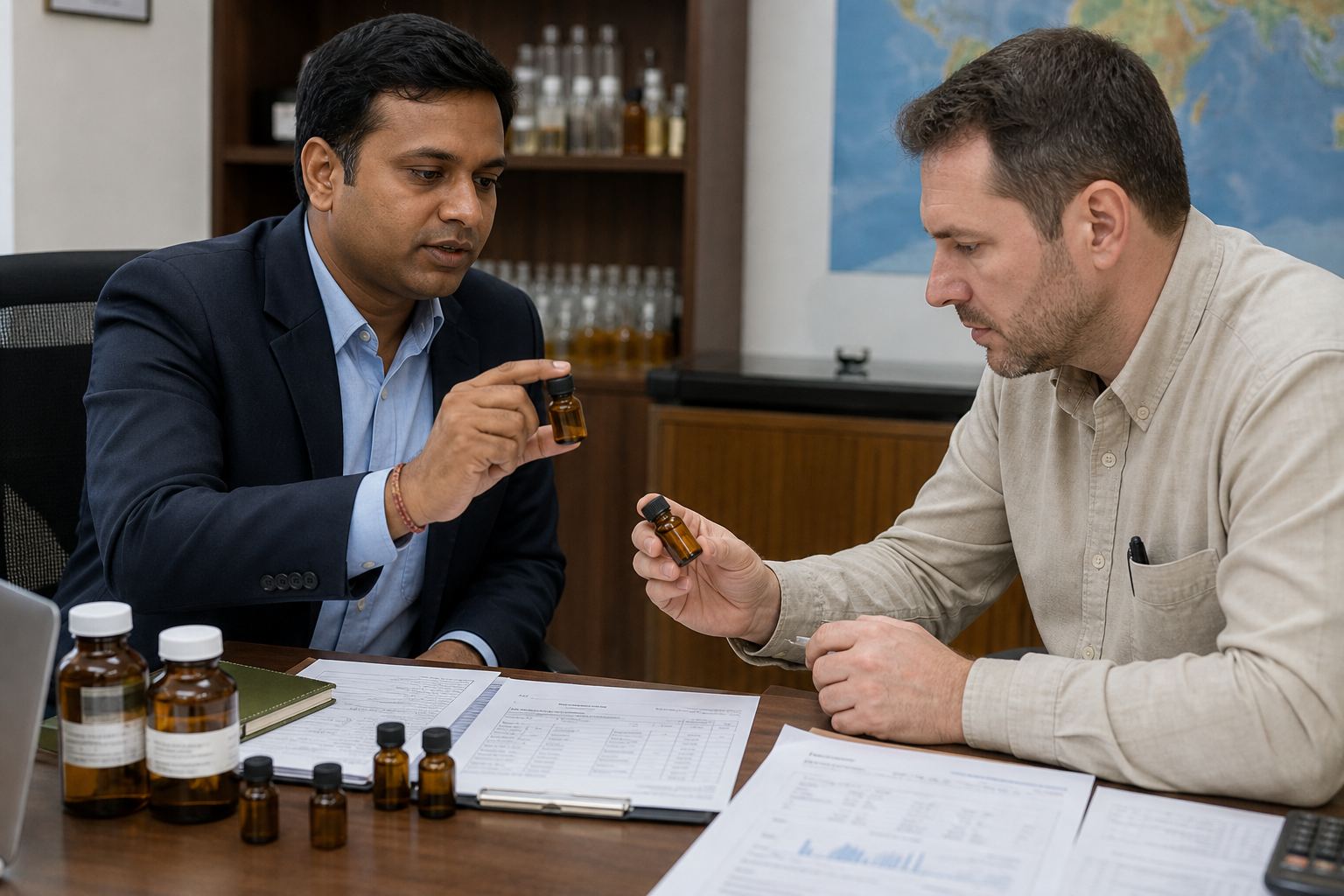
International buyers source essential oils from India for three structural reasons: unmatched mentha (cornmint) oil volume that gives India global price-setting influence in that single category, product diversity spanning commodity citrus and aromatic oils to premium jasmine absolutes and heritage sandalwood, and competitive FOB pricing across conventional and GC-MS-documented specialty grades. Flavour houses and pharmaceutical manufacturers in the USA, Germany, and China rely on Uttar Pradesh mentha oil; aromatherapy and natural personal-care brands in the UK, USA, and Australia depend on South Indian lemongrass, citronella, and palmarosa; and luxury perfumery houses in France and Japan seek out Kerala and Karnataka jasmine and spice-derived oils.
For buyers who need volume, variety, and price flexibility under one sourcing geography, India is a rational primary or co-primary origin.
Yet buyers who attempt to source essential oils directly from India without a structured procurement process encounter predictable failures: samples that do not match bulk-lot purity, exporters who cannot produce Chemexcil RCMC or IEC documentation, adulterated or diluted oil passed off as pure, GC-MS results that reveal a different botanical species than quoted, or Dangerous Goods misclassification that strands cargo at port. India's essential oil export sector includes highly professional distillers and merchant exporters alongside operators who cannot sustain international purity and documentation discipline.
The difference between a successful India sourcing programme and a rejected shipment is buyer-side due diligence — not luck.
This guide is written for essential oil importers, wholesale distributors, personal-care and aromatherapy brand procurement teams, flavour and fragrance house buyers, and private-label brands sourcing from India. It explains how to define specifications, issue RFQs, verify suppliers, manage GC-MS testing and trial orders, negotiate Incoterms, and scale to full container loads — from the buyer's side. It is not an exporter registration how-to. For market selection intelligence, see Best Countries for Indian Essential Oil Exports.
For product depth, see Top Essential Oil Products Exported from India. Altus Exports operates as a global sourcing partner in India and merchant exporter for buyers who want one accountable counterparty across multiple oil categories and origins.
Key Takeaways
Summary Box
Executive Summary
Summary Box
This importer playbook is for overseas buyers, distributors, and brand procurement teams sourcing mentha, citrus, South Indian aromatics, or specialty absolutes directly from India. Use the verification and GC-MS testing sections before you negotiate FOB pricing or scale beyond a trial lot.
India remains one of the world's leading essential oil origins, anchored by global leadership in mentha (cornmint) oil volume. Buyers who specify botanical name, extraction method, and Certificate of Analysis discipline capture that supply base with far fewer purity disputes than catalogue-only sourcing based on price alone.
The sections that follow walk through India's essential oil trade position, the buyer-side procurement sequence from RFQ to FCL scale-up, pricing and logistics benchmarks, compliance requirements by destination, and the mistakes that cost buyers the most money on first shipments.
Market Size & Industry Overview
Key Statistics
India produces essential oils across a wide botanical range, but three production geographies matter most to buyers. The Uttar Pradesh mentha belt — centred on Barabanki, Chandausi, Sambhal, and Rampur — supplies the overwhelming majority of India's cornmint oil volume and gives India global price-setting influence in that single category. South India (Tamil Nadu, Kerala, Karnataka) supplies lemongrass, citronella, palmarosa, and eucalyptus at competitive volume economics. Kerala and Karnataka additionally supply jasmine and spice-derived oils and absolutes for premium fragrance and flavour channels, while Karnataka's heritage sandalwood stock remains tightly restricted given depleted natural stands.
Buyers source from India when they need: (1) volume mentha oil at competitive FOB prices for flavour, oral care, or pharmaceutical manufacturing; (2) South Indian aromatics for aromatherapy, wellness, and natural cleaning-product formulations; (3) specialty absolutes and spice-derived oils for luxury perfumery; (4) GC-MS-documented supply for regulated personal-care and food-flavour applications; or (5) origin diversification away from single-country dependency during price spikes or supply disruptions elsewhere.
India's institutional export framework — Chemexcil RCMC registration, FSSAI food/flavour-grade compliance, and IEC issuance through DGFT — provides a credible foundation. The buyer's task is identifying which distillers and merchant exporters within that ecosystem meet your specific purity, documentation, and volume requirements.
Comparison table
Swipe →
Data table — swipe horizontally on small screens
| Buyer Type | Typical Indian Products | Priority Origins | Key Procurement Focus |
|---|---|---|---|
| Flavour house / pharma buyer | Mentha oil, dementholised fractions | Uttar Pradesh belt | Purity consistency; menthol content specification; large-tender pricing |
| Personal care / cosmetics brand | Lemongrass, citronella, eucalyptus, organic-certified aromatics | Tamil Nadu, Kerala, Karnataka | REACH/IFRA compliance; organic certification chain of custody |
| Aromatherapy / wellness retailer | Lemongrass, eucalyptus, palmarosa, mentha | South India, UP belt | GC-MS documentation; consistent scent profile; retail packaging path |
| Luxury perfumery house | Jasmine absolute, sandalwood, geranium, spice-derived oils | Kerala, Karnataka | Botanical authenticity; extraction method; heritage supply constraints |
| US/EU flavour & fragrance manufacturer | Mentha, citrus oils, broad-basket aromatics | UP belt, South India | Consistent bulk quality; REACH/FDA-adjacent compliance |
| Menthol crystal manufacturer (China-style buyer) | Crude mentha oil feedstock | Uttar Pradesh belt | Large-volume tender pricing; consistent menthol content |
| Private-label / retail brand | Category depends on positioning | Varies by product | Packaging specs; certification; programme pricing |
Export Statistics
Key Statistics
Chemexcil and the Directorate General of Commercial Intelligence and Statistics (DGCIS) publish India's essential oil export statistics by volume, value, and destination periodically. Buyers benchmark these figures to understand which destinations already absorb meaningful Indian supply and which product categories move in largest volume — mentha oil consistently anchors export value, with citrus, South Indian aromatics, and specialty absolutes contributing smaller volume but disproportionate per-kilogram value.
India Essential Oil Export Snapshot for Buyer Benchmarking (Indicative)
Swipe →
Data table — swipe horizontally on small screens
| Dimension | Indicative Figure | Buyer Implication |
|---|---|---|
| HS classification | 3301 — citrus (3301.12/13/19), mint (3301.24/25), other (3301.29), resinoids (3301.30/90) | Confirm exact sub-heading matches your product and destination customs rules |
| Largest export category | Mentha (cornmint) oil and fractions | Global price-setting influence; large-tender pricing dynamics |
| Regulatory foundation | Chemexcil RCMC; FSSAI for food/flavour-grade oils; IEC via DGFT | Verify all three before payment, regardless of category |
| Load ports | Nhava Sheva, Mundra, Chennai, Kolkata | Port affects transit time and Dangerous Goods documentation timing |
| Typical destinations | USA, Germany, France, UK, UAE, Japan, China, Netherlands | Cross-reference with your own country's import data for realistic pricing |
Import Statistics
Key Statistics
Buyers who analyse import data from their own side — not only Indian export statistics — negotiate from strength. Import data reveals total market size, competitor origin share, and average unit values that signal whether a market is a commodity volume opportunity or a specialty niche. Use ITC Trade Map, national customs statistics, or subscription trade data platforms to answer: how much essential oil does my country import annually under HS 3301? What is India's share versus China, Indonesia, Egypt, or Madagascar? Is India's share growing or declining?
Comparison table
Swipe →
Data table — swipe horizontally on small screens
| Data Source | What It Tells Buyers | How to Use It |
|---|---|---|
| Chemexcil export statistics | India-side volumes by country and category | Validate supplier claims about export experience |
| ITC Trade Map (HS 3301) | Destination import volumes and origin shares | Size your market opportunity; benchmark India's position |
| Import shipment records | Named importers and their Indian suppliers | Identify competitors' supply chains; find active exporters |
| GC-MS reference libraries | Expected chemical profile for a given botanical/origin | Evaluate whether supplier COA results are plausible |
| UP mentha belt price bulletins | Domestic mentha price benchmarks | Evaluate whether supplier FOB quotes are reasonable |
Product Categories and Variants
Summary Box
The most common buyer-side failure in Indian essential oil sourcing is an incomplete specification. Indian suppliers receive hundreds of vague enquiries — 'need pure essential oil, best price' — and respond with whatever is in stock, sometimes cut or blended without disclosure. Precision in your RFQ attracts professional exporters and filters out brokers who cannot meet defined purity standards.
Specification Fields for Your Essential Oil RFQ
Swipe →
Data table — swipe horizontally on small screens
| Specification Field | What to Define | Example |
|---|---|---|
| Botanical name | Latin name, not just common name | Mentha arvensis (cornmint), not just 'mint oil' |
| Extraction method | Steam-distilled, cold-pressed, solvent-extracted absolute | Steam-distilled; solvent-extracted absolute for jasmine |
| HS code | For customs and contract | 3301.25 (cornmint); 3301.29 (most other aromatics) |
| Purity parameters | Key chemical markers and acceptable ranges | Menthol content 68–72%; no synthetic adulterants |
| GC-MS requirement | Certificate of Analysis per lot | Full chromatogram matched against reference standard |
| Packaging | Drum size, liner, or tin format | 180 kg mild-steel drum; nitrogen-flushed 5 kg tin for absolutes |
| Volume | Trial and programme quantity | Trial 500 kg; programme 5 MT/quarter |
| Certification | If required | IFRA conformity, REACH registration, organic (NOP/EU) |
| Incoterms | Risk and cost allocation | FOB Nhava Sheva or CIF destination port |
Mentha and Mint Fractions Buyers Should Know
- Crude mentha oil (Mentha arvensis / cornmint) — the base commodity form; feedstock for menthol crystal manufacturing.
- Dementholised mentha oil — menthol crystal removed; used differently in flavour and fragrance formulation.
- Peppermint oil (Mentha piperita) — distinct species from cornmint; different chemical profile and price tier.
- Spearmint oil — used in confectionery, oral care, and flavour blending, priced separately from mentha and peppermint.
South Indian Aromatics Buyers Should Know
- Lemongrass oil (Cymbopogon flexuosus) — high citral content; fragrance and insect-repellent applications.
- Citronella oil (Java type) — distinct from lemongrass; strong repellent and cleaning-product demand.
- Palmarosa oil — rose-like aroma; premium pricing versus lemongrass and citronella.
- Eucalyptus oil (globulus or citriodora type) — pharma, oral care, and aromatherapy uses differ by species.
Specialty and Restricted-Supply Categories
Jasmine absolute and spice-derived oils from Kerala and Karnataka require solvent extraction and command extreme per-kilogram premiums given low flower-to-oil yield. Sandalwood oil from Karnataka's Mysore heritage stock is subject to tight domestic harvesting controls, meaning buyers should expect limited annual allocation regardless of budget, and should verify sourcing legitimacy carefully before committing to any programme volume.
Manufacturing Overview
Export Tip
Buyers who understand how their target oil is produced negotiate specification and price more credibly, and can spot a supplier's capability gaps before committing to a trial order.
Mentha Distillation in the Uttar Pradesh Belt
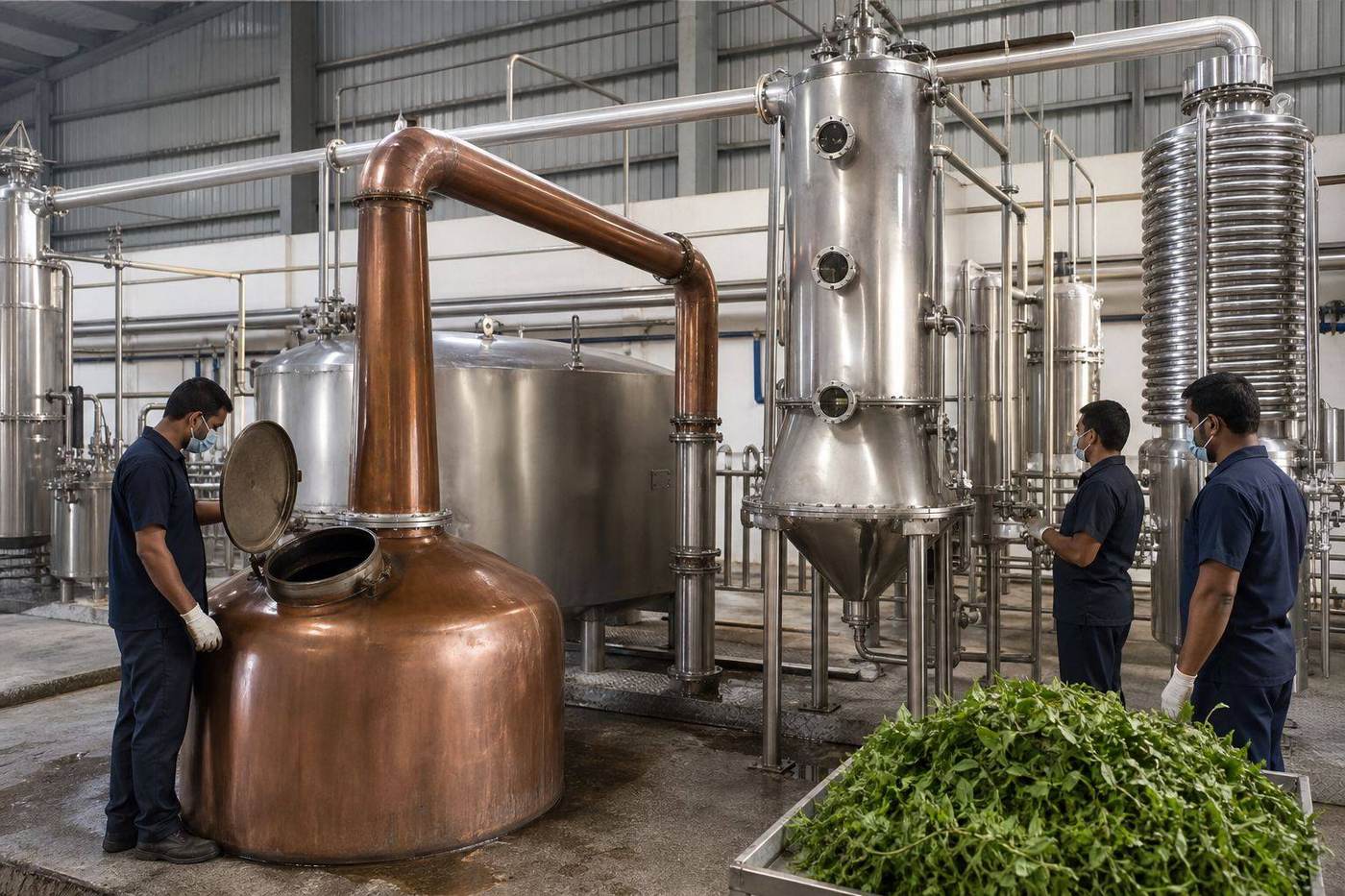
Cornmint is harvested and steam-distilled in and around Barabanki, Chandausi, and Sambhal, then fractionated into crude oil, dementholised oil, and menthol crystal depending on buyer specification. Buyers sourcing mentha should ask whether the supplier operates or contracts distillation directly, or purchases already-distilled bulk oil from smaller units — the latter carries higher batch-to-batch variability risk.
Steam Distillation of South Indian Aromatics
Lemongrass, citronella, and palmarosa are steam-distilled from grasses across Tamil Nadu, Kerala, and Karnataka. Yield and chemical profile vary with harvest timing and grass maturity, so buyers requiring consistent scent and chemical profile across seasons should request harvest-date-linked Certificates of Analysis, not a single reference sample used for an entire year's programme.
Absolute and Concrete Extraction for Premium Buyers
Jasmine and select spice-derived oils require solvent extraction into concrete and then absolute form. Buyers should confirm which solvent system the supplier uses and request residual solvent testing alongside the standard GC-MS panel, since solvent-extraction quality varies significantly across Indian processing units.
Understanding the Supply Chain: Who You Are Actually Buying From
Comparison table
Swipe →
Data table — swipe horizontally on small screens
| Supply Chain Node | Role | Buyer Implication |
|---|---|---|
| Distillation units / farmer cooperatives | Grow and distill own crop, especially mentha and South Indian aromatics | Best for traceable volume; verify Chemexcil licence directly |
| Bought-oil traders | Purchase distilled oil from multiple small units and blend/resell | Quality varies; require lot-specific GC-MS, not a generic sample |
| Merchant exporters | Source from multiple distillers/regions; manage export documentation | Best for multi-category programmes; single accountable counterparty |
| Broker agents | Connect buyers and sellers; may not hold export licence | Verify who holds Chemexcil RCMC/IEC and receives payment |
| Specialty extraction units | Solvent-extract absolutes and concretes | Confirm solvent system and residual solvent testing |
The Buyer's Sourcing Sequence: RFQ to FCL
Export Tip
The following procurement sequence is the workflow Altus Exports recommends for international buyers entering or restructuring Indian essential oil supply. Adapt step durations to your category — specialty absolutes move slower and in smaller quantities than commodity mentha or South Indian aromatics.
Step 1: Define Your Specification Document
Create a one-page specification sheet covering botanical name, extraction method, purity parameters, packaging, volume, certifications, and Incoterms — using the fields in the Product Categories table above. Attach your intended end-use (flavour, fragrance, aromatherapy retail, pharma) so suppliers understand what purity and documentation standard applies.
Step 2: Build a Supplier Long List
Identify 8–15 potential suppliers through Chemexcil registered exporter listings, trade show contacts (see Trade Shows for Essential Oil Exporters), import shipment data under HS 3301, industry referrals, B2B platforms, and global sourcing partners like Altus Exports. For mentha buyers, include Uttar Pradesh belt distillers and established merchant exporters. For specialty buyers, include Kerala and Karnataka extraction units with direct export experience.
Step 3: Issue a Structured RFQ
- Request FOB price in USD per kg at stated packaging specification.
- Request CIF price only if you want supplier-arranged freight — compare against your own forwarder rates.
- Ask for Chemexcil RCMC number, FSSAI licence (where applicable), and IEC number in the RFQ response.
- Ask for three reference buyers in your region or adjacent markets with contact permission.
- Specify sample quantity needed (10–100 g for absolutes; 100 g–1 kg for bulk oils) and who pays courier cost.
Send your specification document to the long list with a standard RFQ template requesting: unit price (FOB and/or CIF), MOQ, lead time, sample availability, certifications held, export history to your market, payment terms, and Chemexcil RCMC/IEC number. Set a response deadline of 10–14 business days. RFQs that specify GC-MS requirements — 'sample must include a full chromatogram matched against USP or ISO reference standard' — filter unqualified responders quickly.
Step 4: Verify Chemexcil, FSSAI, and IEC Before Any Payment
- Verify Chemexcil RCMC registration status directly with the council, not just a supplier-provided certificate scan.
- Verify FSSAI licence status where the product is food or flavour-grade, matching the declared processing facility address.
- Confirm IEC (Import Export Code) via DGFT records or request a copy.
- Request last three shipping bills or bill of lading copies for shipments to your region or a comparable market.
- Check reference buyers — one phone call reveals more than ten email exchanges.
- For sandalwood: verify legitimate heritage-stock sourcing documentation given restricted supply.
- For organic claims: verify certification body, scope, and validity period independently.
- Cross-check exporter name against import shipment data — do they actually ship, or only quote?
This is the single highest-leverage verification step in Indian essential oil sourcing. Before sampling, verify the top five RFQ responders through documentary and reference checks — this eliminates operators who quote attractively but cannot execute or export legitimately.
Step 5: Sample and Require GC-MS Testing
- Confirm the chromatogram identifies the correct botanical species, not a cheaper substitute or blend.
- Check key chemical markers against known reference ranges (e.g., menthol content for mentha, citral content for lemongrass).
- Screen for synthetic adulterants or diluents that would not appear in a genuinely pure natural oil.
- For absolutes: request residual solvent testing alongside the standard GC-MS panel.
- Cup or evaluate aroma profile side-by-side across at least three suppliers — relative ranking matters more than a single absolute score.
- Retain the approved sample as your reference standard for every future bulk-lot comparison.
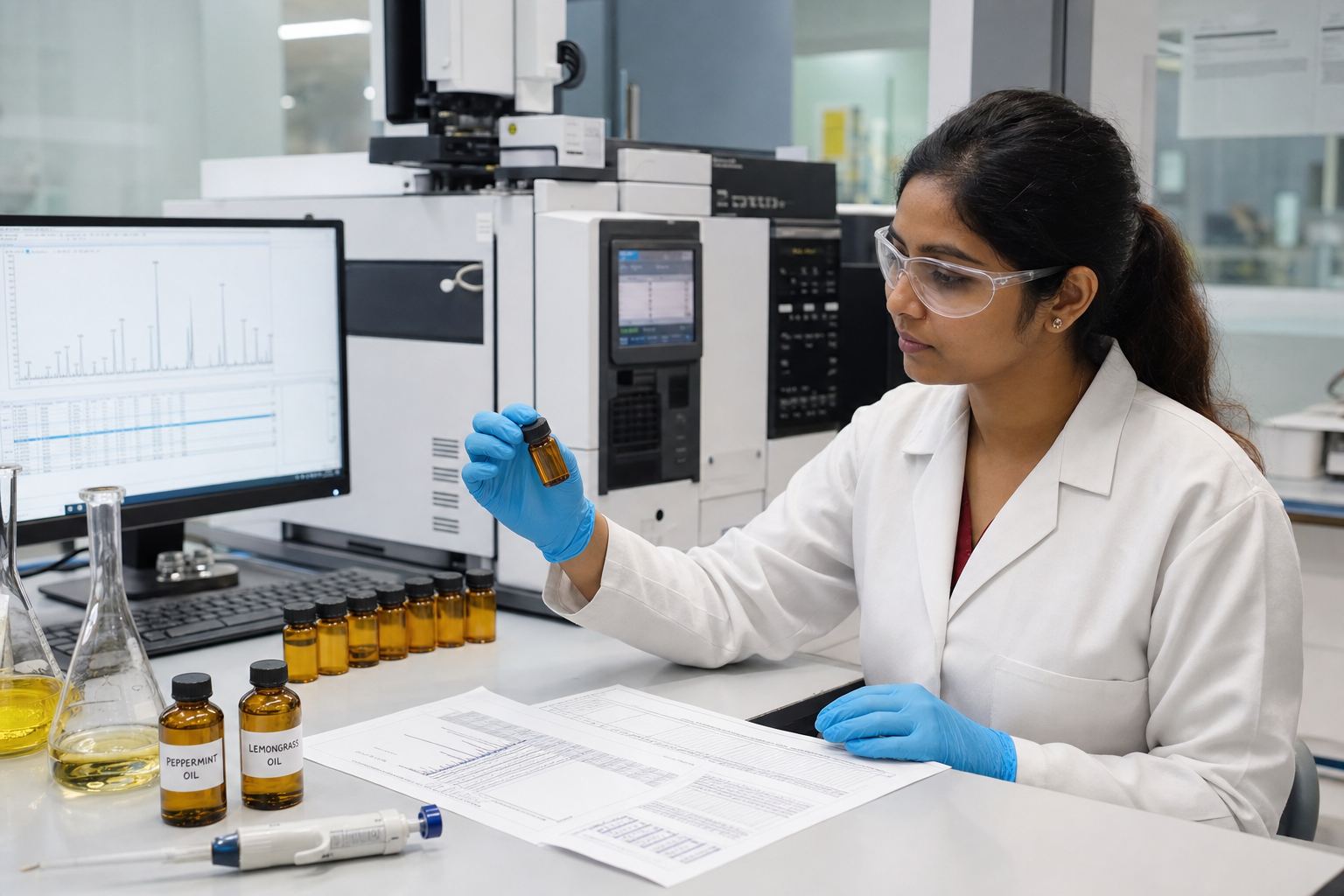
Request pre-shipment samples from your shortlisted suppliers, not retain samples from a prior season or crop year. Every sample should arrive with a GC-MS Certificate of Analysis, and buyers should independently verify critical samples through a third-party laboratory rather than relying solely on the supplier's in-house report, particularly for oils with a history of adulteration risk such as mentha, lemongrass, and sandalwood.
Step 6: Place a Trial Order
Place a trial order with your top one or two GC-MS-verified suppliers. Trial size: 200 kg–1 MT for commodity mentha or South Indian aromatics; 100 g–1 kg for specialty absolutes given their high per-kilogram value. Trial orders should specify that the bulk lot must test within agreed tolerance of the approved reference sample on GC-MS, with a quality claim clause covering replacement or refund at supplier cost if bulk testing falls outside tolerance.
Step 7: Pre-Shipment Quality Control
- Request a pre-shipment sample from the actual bulk lot — not a fresh sample from a different batch.
- Verify Dangerous Goods classification and packaging compliance for flammable oils before booking freight.
- Inspect drum or tin sealing integrity, especially for nitrogen-flushed premium packaging.
- Verify lot numbers on invoice, packing list, and GC-MS certificate match exactly.
- For food/flavour-grade oils bound for the EU or USA: confirm any required residue or contaminant testing is complete.
For trial and programme orders, implement pre-shipment QC before cargo sails. Options range from supplier-provided GC-MS report as a minimum, to independent third-party laboratory testing and inspection for regulated end-uses (food-flavour, pharma, or EU-bound cosmetics-adjacent shipments).
Step 8: Shipping, Customs, and Receipt
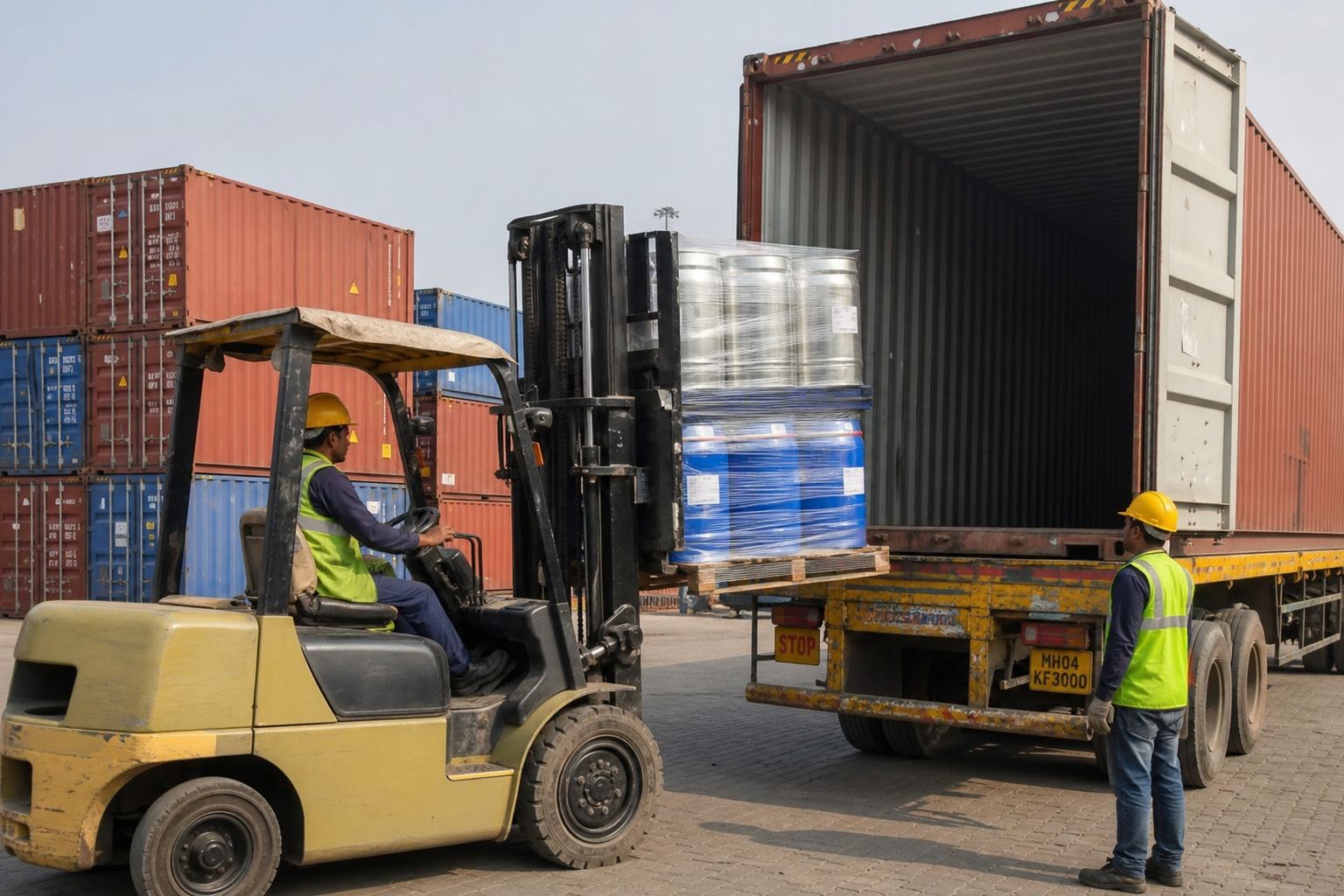
Coordinate with your customs broker before cargo sails. Confirm HS 3301 sub-heading classification, certificate of origin, Dangerous Goods documentation for flammable oils, and any food-safety or cosmetics-adjacent certificates your destination requires. On receipt, test a representative sample from the landed shipment before accepting into inventory — document any deviation from trial quality immediately.
Step 9: Scale to Full Container Load (FCL) Programmes
Convert successful trial suppliers into quarterly or annual programme contracts with defined volume, pricing mechanism (fixed or harvest-indexed for mentha), quality tolerances, and payment terms. Review supplier performance every six months on: GC-MS consistency, documentation accuracy, lead time reliability, and communication responsiveness. Maintain a backup supplier for every programme category, particularly mentha given its harvest-cycle price volatility.
Pricing Analysis
Buyer Tip
Indian essential oil FOB pricing follows crop-year yield (especially for mentha), currency movement, global menthol demand cycles, and destination-specific willingness to pay. Buyers who benchmark against UP mentha belt bulletins and competing-origin pricing avoid overpaying — and avoid underpaying to the point where suppliers cut purity or dilute product to protect margin.
Indicative FOB Price Benchmarks for Buyer Negotiation
Swipe →
Data table — swipe horizontally on small screens
| Category | Indicative FOB (USD/kg) | Price Drivers | Negotiation Leverage |
|---|---|---|---|
| Crude mentha oil | $10–$16 | UP belt harvest yield; global menthol demand | Harvest-cycle timing; large-tender volume commitment |
| Dementholised / fractionated mentha oil | $14–$22 | Fractionation and purity specification | Multi-year programme offer; consistent volume |
| Citrus oils (orange, lemon) | $4–$10 | Byproduct economics of citrus processing | Volume commitment; consistent offtake schedule |
| Lemongrass, citronella | $8–$16 | Harvest cycle; distillation efficiency | Annual contract; multi-season commitment |
| Palmarosa, geranium | $30–$60 | Niche cultivation area; fragrance-house demand | Pre-season booking; exclusive-region relationship |
| Jasmine absolute / spice absolutes | $150–$5,000+ | Flower-to-oil yield; extraction method | Pre-season commitment; multi-year exclusivity |
| Sandalwood oil (heritage supply) | $600–$1,500+ | Scarcity; heritage sourcing controls | Long-term allocation agreement given limited annual supply |
Incoterms from the Buyer's Side
FOB (Free on Board): Buyer arranges and pays ocean freight, insurance, and destination charges. Best when you have established freight forwarder relationships and want cost transparency. Standard for US, German, and Dutch specialty and flavour-house buyers.
CIF (Cost, Insurance, Freight): Supplier quotes all-in landed price to your port. Best for UAE, Chinese, and some Southeast Asian buyers who prefer single-price quotes. Always compare CIF against your own FOB plus freight calculation — suppliers sometimes embed freight margins of 5–15%, and Dangerous Goods surcharges on flammable oils can be misquoted or omitted.
EXW (Ex Works): Buyer collects from Indian distillery or warehouse. Rare in essential oil trade; only for buyers with India logistics capability.
DDP (Delivered Duty Paid): Supplier delivers to your door including import duties. Avoid for first relationships — import duty and Dangerous Goods complexity across markets makes this risky for both parties until trust is established.
Payment Terms: Buyer Risk Management
- First order: 30–50% advance, balance against bill of lading copy — or LC at sight.
- Trial order: LC at sight preferred over advance for unknown suppliers.
- Programme orders (established relationship): 20–30% advance, balance Net 30 against BL.
- Never pay 100% advance to an unverified supplier — the most common first-time buyer mistake.
- LC at sight through a recognised bank is the standard risk-balanced instrument for essential oil trade.
MOQ Analysis
Buyer Tip
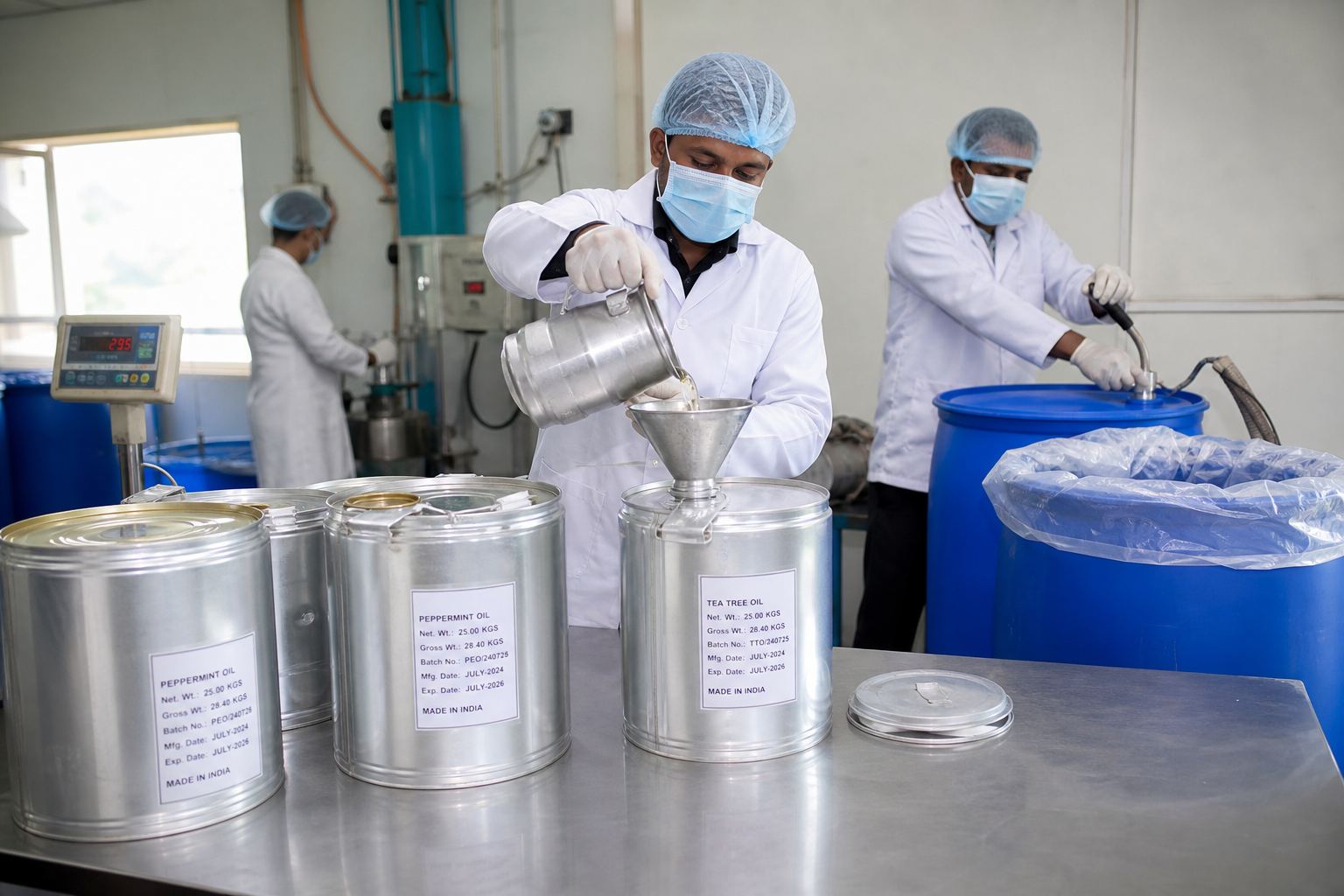
Buyers should specify packaging requirements in the RFQ, not discover drum or tin specifications after production. Standard Indian export packaging (drums palletised with stretch wrap) is acceptable for most commodity buyers. Personal-care and cosmetics-path buyers may require food-grade or cosmetics-grade certified packaging materials, and specialty perfumery buyers should plan for nitrogen-flushed small-format tins with tamper-evident sealing.
MOQ Guidance by Category and Programme Stage
Swipe →
Data table — swipe horizontally on small screens
| Parameter | Commodity Mentha / Aromatics | Specialty Absolutes |
|---|---|---|
| Trial MOQ | 200 kg–1 MT | 100 g–1 kg |
| Programme MOQ | 20-foot FCL (drums) | 500 g–5 kg per season |
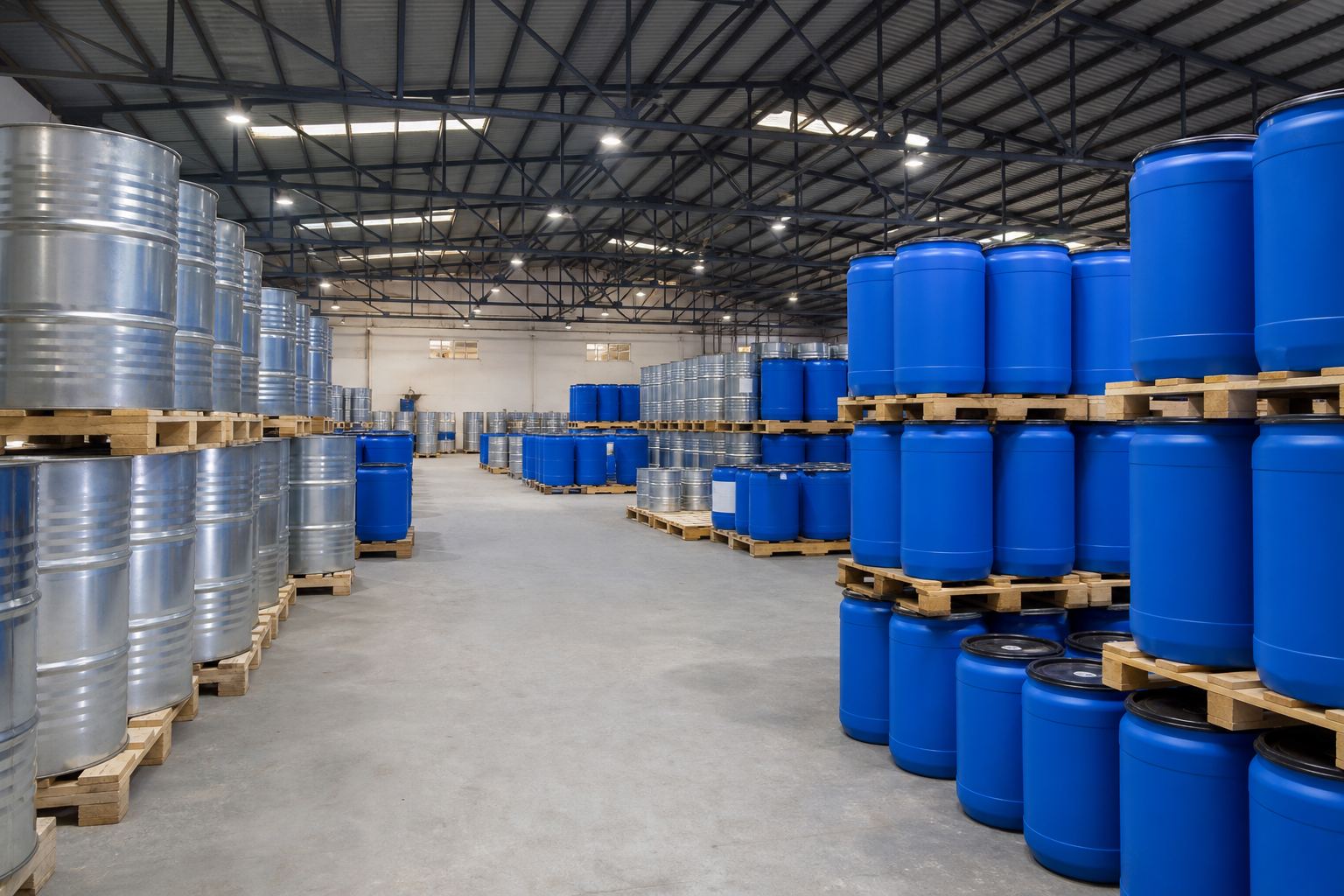
| Packaging | 25/50/180 kg drums, mild steel or HDPE-lined | Nitrogen-flushed tins, 100 g–5 kg |
| Lead time (order to sail) | 3–6 weeks | 6–12 weeks (harvest/flower-season dependent) |
Packaging Standards
Export Tip
Packaging Standards for Buyer Specification
Swipe →
Data table — swipe horizontally on small screens
| Market Tier | Standard Packaging | Unit Size | Key Requirement |
|---|---|---|---|
| Commodity mentha/aromatics | Mild-steel or HDPE-lined drums, UN-approved for flammable oils | 25 kg / 50 kg / 180 kg | Leak-proof sealing; correct Dangerous Goods classification |
| Re-export / blending programmes | Drums with consistent net weight for onward distribution | 25 kg / 50 kg | Consistent fill weight and batch documentation |
| Aromatherapy / retail-path buyers | Nitrogen-flushed tins or amber glass for small lots | 1–25 kg | Lot-level GC-MS documentation and traceability labelling |
| Luxury perfumery absolutes | Nitrogen-flushed aluminium tins, sealed and coded | 100 g–5 kg | Oxidation protection and authenticity documentation |
Container Loading Details
Export Tip
Container Loading Benchmarks for Buyer Planning
Swipe →
Data table — swipe horizontally on small screens
| Container Type | Approx. Net Weight | Approx. Drum/Unit Count | Buyer Notes |
|---|---|---|---|
| 20-foot FCL (180 kg drums) | ~14–16 MT | ~80–90 drums | Standard for commodity mentha/citrus programme orders |
| 20-foot FCL (50 kg drums) | about 12–16 MT (indicative) | ~300–340 drums | Common for bulk aromatic and blending-oriented orders |
| LCL consolidation (25 kg drums) | 500 kg–5 MT | Palletised drums | Recommended for first-time trial and specialty buyers |
| Air freight / courier (small tins) | 1–50 kg | Nitrogen-flushed tins | Standard for absolute samples and luxury perfumery trial lots |
Shipping Methods
Export Tip
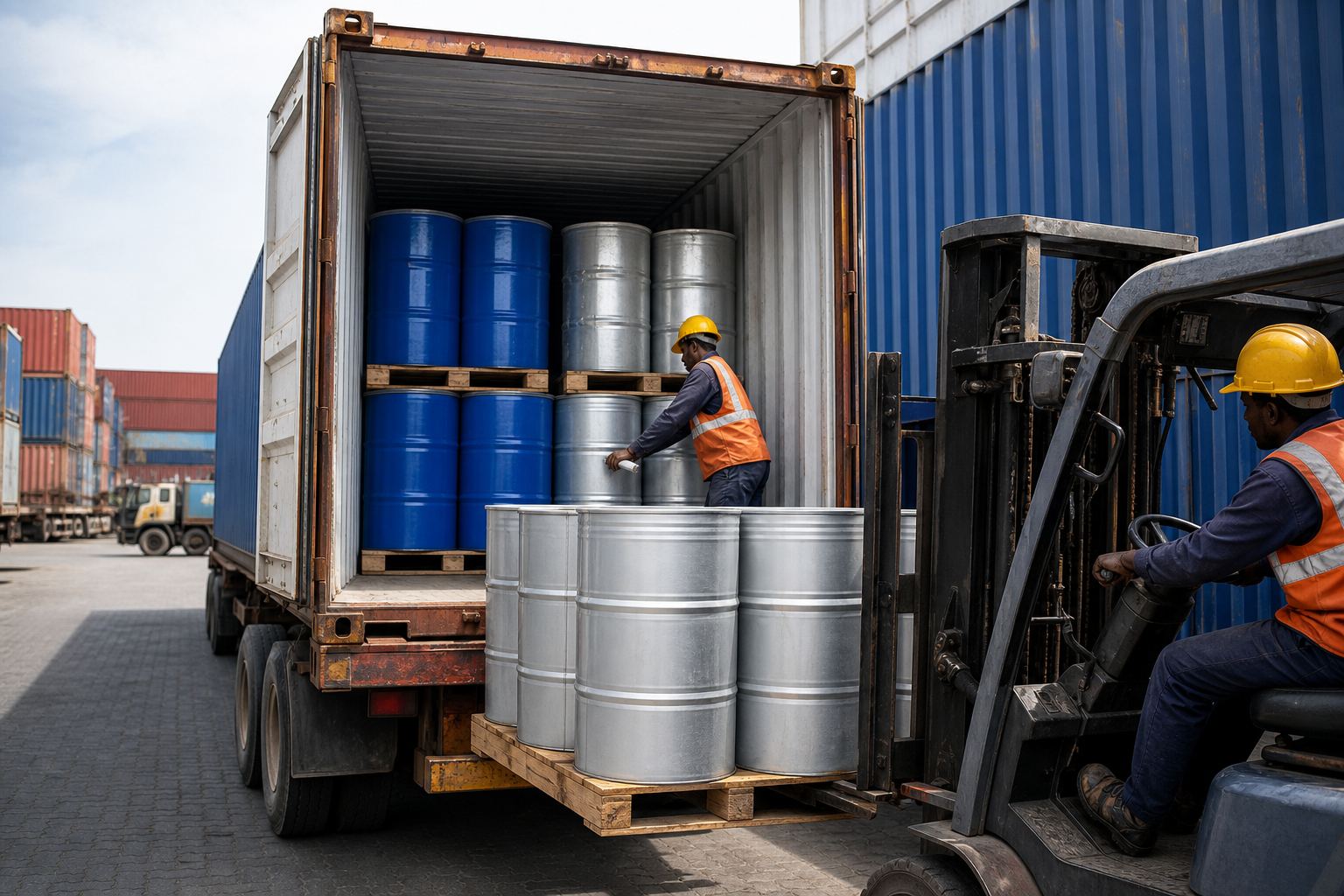
Coordinate shipping method with your customs broker before cargo sails. Confirm HS 3301 sub-heading classification, certificate of origin, and Dangerous Goods documentation for flammable oils — a frequent oversight that strands cargo at port when overlooked until sailing week.
Comparison table
Swipe →
Data table — swipe horizontally on small screens
| Route | Primary Indian Load Port | Typical Transit | Buyer Action |
|---|---|---|---|
| India to USA | Nhava Sheva / Mundra | 25–40 days | File ISF 24 hours before loading; confirm Dangerous Goods class with broker |
| India to Germany/Netherlands | Nhava Sheva / Mundra | 26–35 days | Confirm REACH documentation is ready before vessel departure |
| India to UAE | Nhava Sheva / Mundra | 10–15 days | Shortest major lane; useful for re-export or trial programmes |
| India to China | Chennai / Kolkata | 12–20 days | Common for large mentha feedstock tenders |
| India to Japan/Australia | Chennai / Nhava Sheva | 20–30 days | Plan for strict purity documentation and biosecurity review |
Certifications, Duties, and Compliance Notes for Buyers
Compliance Notes
Compliance requirements vary sharply by destination and end-use. Buyers must specify certification needs in RFQs and verify certificates independently, not rely on supplier claims.
Comparison table
Swipe →
Data table — swipe horizontally on small screens
| Destination / Use Case | Key Compliance Requirements | Buyer Action |
|---|---|---|
| USA (flavour/fragrance, personal care) | FDA-adjacent food-contact rules; IFRA conformity common buyer expectation | Confirm supplier facility registration status where relevant; request IFRA-conformant documentation |
| Germany / EU (chemical, cosmetics) | REACH registration mandatory; IFRA conformity; EU Organic if claimed | Verify REACH status for the specific substance before shipment |
| France (perfumery) | Allergen labelling (EU cosmetic allergen list); authenticity documentation for absolutes | Request full GC-MS panel plus origin/authenticity documentation |
| China (mentha feedstock) | Standard import food/chemical documentation; large-tender quality specs | Confirm menthol content specification and tender quality-claim protocol |
| Japan | Strictest purity and consistency expectations | Only source from suppliers with documented repeat-lot GC-MS consistency |
| UAE / Australia | Standard food-import permits; AQIS biosecurity review for Australia | Confirm import permit and biosecurity documentation lead time |
Import Duties: General Guidance
Essential oil import duties vary by country, trade agreement, and specific HS 3301 sub-heading. Many essential-oil-importing countries apply low or zero MFN tariffs on bulk natural oils, but preferential agreements, excise treatment for some categories, and VAT/GST apply at different stages. Buyers should confirm current duty rates with their customs broker rather than relying on generalised figures, and request certificate of origin in the appropriate format if a bilateral or preferential agreement applies to their country.
Buyer Requirements
Buyer Requirements
- Botanical name and extraction method stated on every quote (species, steam-distilled/cold-pressed/absolute).
- GC-MS approval recorded against a sealed reference sample retained by both parties.
- Destination compliance notes (REACH, IFRA, allergen labelling, biosecurity) agreed before production.
- Payment terms and inspection windows written into the proforma before shipment.
- Dangerous Goods classification and packaging compliance confirmed with the freight forwarder before booking.
Before you fund a trial shipment, require Chemexcil RCMC and IEC copies, FSSAI licence where applicable, GC-MS-tested reference samples retained by both sides, lot Certificate of Analysis, Dangerous Goods packaging compliance, and an Incoterm sheet with MOQ and lead time.
Country-wise Opportunities
Market Snapshot
- USA buyers: Split sourcing — mentha and citrus for flavour/pharma volume; South Indian aromatics and organic-certified oils for wellness retail; confirm IFRA-conformant documentation for fragrance-industry resale.
- Germany/Netherlands buyers: Prioritise REACH-registered supply; pesticide and adulterant screening is non-negotiable; plan for German/Dutch-language retail packaging in later programme phases.
- France buyers: Source jasmine, sandalwood, and spice-derived oils by extraction unit and season; verify authenticity documentation; build multi-year relationships rather than spot deals.
- UK/Australia buyers: Source lemongrass, eucalyptus, and citronella with organic certification for wellness retail; confirm AQIS biosecurity requirements separately for Australia.
- UAE buyers: Source mentha and South Indian aromatics; benchmark against regional trading-hub pricing; build relationships with 2–3 exporters for supply security.
- China/Japan buyers: China buyers should confirm large-tender quality-claim protocol for mentha feedstock; Japan buyers should demand repeat-lot GC-MS consistency before scaling.
Your sourcing strategy should align with your market's product expectations. The following notes complement Best Countries for Indian Essential Oil Exports from the buyer's perspective.
Expert Insight: Procurement Principles from Altus Exports
Expert Insight Box
Sourcing Checklist
Checklist
Buyer Checklist
Checklist
Exporter Checklist
Checklist

Compliance Checklist
Checklist
Compliance Notes
Common Buyer Mistakes When Sourcing Indian Essential Oils
Common Mistakes Box
- Vague RFQ without botanical name or purity specification — Solution: Use the specification template in this guide for every enquiry.
- Paying 100% advance to an unverified supplier — Solution: LC at sight or maximum 30% advance with balance against BL.
- Accepting a supplier's in-house GC-MS report without independent verification on critical lots — Solution: Commission third-party lab testing on trial and first programme shipments.
- Skipping Chemexcil RCMC and IEC verification — Solution: Documentary check before sampling, not after trial failure.
- Accepting retain samples instead of harvest-linked or lot-specific pre-shipment samples — Solution: Contract clause requiring bulk-lot sample approval before sailing.
- Ignoring Dangerous Goods classification on flammable oils — Solution: Confirm classification and packaging with your freight forwarder before booking.
- Sourcing sandalwood without verifying heritage-supply legitimacy — Solution: Demand documentation of legal sourcing given restricted supply.
- Choosing supplier on lowest FOB alone — Solution: Weight GC-MS consistency, documentation reliability, and price equally.
- No trial order before container commitment — Solution: 200 kg–1 MT trial for commodity; 100 g–1 kg for specialty absolutes.
- Managing multi-category supply without coordination — Solution: Use a merchant exporter or product sourcing company for multi-category programmes.
- Not specifying Incoterms clearly — Solution: State FOB port or CIF destination port explicitly in RFQ and contract.
- Failing to plan for harvest-cycle price volatility on mentha — Solution: Discuss indexed or harvest-linked pricing mechanisms upfront.
Expert Insight: The Cost of Skipping GC-MS Verification
Expert Insight Box
The buyer who loses money on Indian essential oils almost never lost it on price. They lost it on verification — paying before checking Chemexcil credentials, scaling before GC-MS testing, or trusting a supplier's in-house purity claim on a category with known adulteration risk. Procurement discipline, particularly independent GC-MS verification on mentha, lemongrass, and sandalwood, is cheaper than a rejected or reworked shipment. We recommend budgeting for third-party lab confirmation on every new supplier relationship's first two shipments, even when the supplier's own documentation looks complete.
Future Market Trends
Key Statistics
Through 2030, buyer-side sourcing from India will be shaped by rising GC-MS and traceability expectations across flavour, fragrance, and personal-care supply chains, growing REACH and IFRA documentation demands from EU and US brand-side compliance teams, sustained Chinese mentha feedstock demand tied to menthol crystal manufacturing cycles, and expanding organic and ethically sourced aromatherapy retail rewarding buyers who invest in certified, traceable Indian supply relationships.
Buyers who build direct verification competency — Chemexcil/IEC checks, independent GC-MS testing, and harvest-cycle pricing literacy — will source more reliably and at better terms than buyers who rely purely on supplier marketing claims. Multi-category programmes spanning mentha, South Indian aromatics, and specialty absolutes will increasingly favour a single accountable merchant exporter relationship over fragmented direct-distiller management as documentation and compliance complexity rises.
Conclusion
- Importers: Start with the specification template and RFQ process in this guide before contacting suppliers.
- Review Best Countries for Indian Essential Oil Exports for market-grade alignment and Top Essential Oil Products Exported from India for product depth.
- Use Essential Oil Export Documentation Checklist to understand what documents your supplier must provide.
- Explore Find International Buyers for Essential Oils if you are building a two-way trade relationship.
- For organic and therapeutic-grade positioning, see Organic & Therapeutic Essential Oil Export Opportunities.
- For registration credentials your supplier should hold, see Chemexcil/FSSAI Registration Benefits for Essential Oil Exporters.
- Contact Altus via export products from India to initiate a structured sourcing engagement.
Sourcing essential oils directly from India is one of the highest-opportunity procurement decisions an importer, distributor, or brand procurement team can make — if the process is structured. Define specifications precisely. Issue RFQs to Chemexcil-verified exporters. Require GC-MS testing against a sealed reference sample. Execute trial orders with quality claim clauses. Implement pre-shipment QC and Dangerous Goods compliance checks. Negotiate Incoterms and payment terms that balance risk. Scale to full container loads through programmes, not spot deals.
India's essential oil supply — from Uttar Pradesh mentha oil powering global flavour and pharma manufacturing to Kerala jasmine absolute gracing European perfumery counters — rewards buyers who engage as verification-minded partners. Altus Exports supports international buyers through global sourcing partner, merchant exporter, and product sourcing company services across the herbal & ayurvedic products category. Share your botanical requirements, volume, destination market, and certification needs — we match verified Indian supply and coordinate the procurement workflow end to end.