
Most Demanded Indian Essential Oils by Country
By Saurabh Mittal, Founder, Altus Exports
A country-by-country SKU demand matrix for Indian essential oils — which oil, which grade, which certification each major destination market prioritizes.

Demand for Indian essential oils under HS code 3301 is not one market — it is at least eight distinct markets wearing the same tariff code. A US flavor distributor buying mentha oil wants GC-MS-verified menthol content and FSSAI-aligned food-additive documentation. A German fragrance ingredient importer buying the same botanical family's peppermint oil wants IFRA-relevant compositional data and, increasingly, organic certification. A Dubai-based perfumery compounder wants vetiver and lemongrass as base notes for oud-adjacent blends, with Halal-compliant extraction documentation.
A Japanese aromatherapy retailer wants eucalyptus oil with a chromatogram so clean it removes any doubt about adulteration. Each buyer wants something different from a very similar list of Indian-grown botanicals.
This article is a country-by-country demand map, not a market-selection essay and not a repeat of the credential logic covered in the sibling article on Chemexcil and FSSAI registration. It focuses specifically on the product-to-country fit question: which oil, which grade or marker-compound specification, which certification, and which buyer channel each major destination market prioritizes for India-origin essential oils. Readers who need the underlying registration logic behind Chemexcil, FSSAI, IFRA, REACH, and GC-MS referenced throughout this demand map should consult Chemexcil & FSSAI Registration Benefits for Essential Oil Exporters.
Altus Exports has coordinated essential oil sourcing conversations for buyers across North America, Europe, the Middle East, and Asia. The demand patterns documented here come from direct buyer qualification conversations, purchase order specifications, and shipment documentation review across the Uttar Pradesh mentha belt and South Indian aromatic-oil clusters. Use this map to configure your export basket for the markets you serve, and to spot adjacency opportunities where your processing capability intersects with unmet destination-market demand.
This is a demand intelligence reference, not a full export process guide. Readers who need step-by-step export workflow, documentation, and container logistics should consult the broader how-to-export cluster article for essential oils.
Key Takeaways
Summary Box
Executive Summary: Global Essential Oil Demand Landscape for India-Origin Oils
India's HS 3301 exports totaled approximately USD 925 million in FY2023-24 per DGCI&S data, with the United States the leading single destination at roughly 29% of export value, followed by China at roughly 11% and Malaysia at roughly 8%. Within the narrower HS 330129 subheading (essential oils excluding citrus and mint concretes), UN Comtrade data for calendar year 2024 shows Malaysia, France, and the United States as leading individual destinations, illustrating that the destination ranking shifts meaningfully depending on which specific oil family is being measured — mentha-heavy trade skews toward the US and flavor markets, while floral and specialty oil trade skews toward European fragrance-ingredient hubs.
The product mix demanded varies sharply by market. US demand concentrates in high-volume, FSSAI-and-GC-MS-documented mentha-family oils for flavor and oral-care applications. EU demand is shifting toward organic-certified, REACH-ready botanical oils driven by sustainability-conscious formulation trends. GCC demand centers on fragrance-fixative and blending-base oils feeding the region's perfumery re-export economy. Japan and Australia both apply strict analytical scrutiny but for different reasons — Japan's aromatherapy retail sector is highly adulteration-sensitive, while Australia's complementary-medicine framework requires GMP-equivalent manufacturing evidence.
The most commercially useful insight from Altus Exports' client conversations is that the same botanical — mentha oil from the Uttar Pradesh belt, for example — can span a wide FOB price band depending on marker-compound purity, GC-MS documentation depth, and destination-specific certification, from commodity pricing for undocumented spot-market oil to a meaningfully higher band for credentialed, traceable, batch-tested supply. Market selection and specification depth drive program profitability more than marginal cost-cutting on the same commodity grade. Always requote against current crop and purity conditions.
Indian Essential Oil Export Demand by Region (Directional Estimate)
Swipe →
Data table — swipe horizontally on small screens
| Region / Country | Est. Share of India Essential Oil Exports | Top Demanded Oils | Primary Channel |
|---|---|---|---|
| USA | ~28–32% | Mentha, peppermint, spearmint, clove, eucalyptus | Flavor houses, oral care, private label |
| China | ~10–12% | Mentha/cornmint, industrial-grade oils | Bulk industrial, TCM-adjacent, re-export |
| Malaysia | ~7–9% | Lemongrass, citronella, palm-adjacent aromatic oils | Regional distribution hub |
| EU-27 (Germany, France, Netherlands) | ~15–18% | Organic mentha, lemongrass, eucalyptus, citrus | Ingredient distributors, fragrance houses |
| UK | ~4–6% | Mentha, eucalyptus, citrus, lemongrass | Health & beauty retail, aromatherapy brands |
| GCC (UAE, KSA, Kuwait) | ~6–9% | Vetiver, lemongrass, patchouli-adjacent, cardamom | Perfumery compounders, nutraceutical retail |
| Japan | ~3–4% | Eucalyptus, mentha, citrus, select spice oils | Aromatherapy retail, cosmetic actives |
| Australia / NZ | ~2–3% | Eucalyptus, mentha, lemongrass | Complementary medicine, wellness retail |
| Canada | ~2–3% | Mentha, eucalyptus, clove | NHP-licensed brands, flavor distributors |
| Other (Africa, LatAm, SEA) | ~5–8% | Citronella, lemongrass, eucalyptus | Bulk commodity, local formulation |
Market Size & Industry Overview
Key Statistics
India's essential oil export economy under HS 3301 is not a single demand curve — it is a portfolio of country-specific SKU programs anchored by mentha volume from Uttar Pradesh and layered with South Indian aromatic grasses, Kerala spice oils, and low-volume florals. DGCI&S places total HS 3301 export value near USD 925 million in FY2023-24, but the commercially relevant question for exporters is which fraction of that value each destination market actually buys: US flavor channels absorb mentha and clove at commodity scale; EU fragrance-ingredient distributors absorb lemongrass, vetiver, and organic-certified citrus at specification-heavy scale; GCC compounders absorb fixative oils at premium per-kilogram economics despite smaller absolute tonnage.
Demand intensity by country does not mirror export value share alone. Malaysia ranks third by declared HS 3301 value largely as a regional redistribution hub for lemongrass and citronella — a different commercial logic than the US mentha programs that drive headline export dollars. Japan accounts for a smaller percentage of total value but applies disproportionate analytical scrutiny, making it a high-documentation, high-retention market once qualification is earned. Understanding this demand-versus-volume distinction prevents exporters from configuring a single generic catalog when country buyers are effectively purchasing different products from the same botanical list.
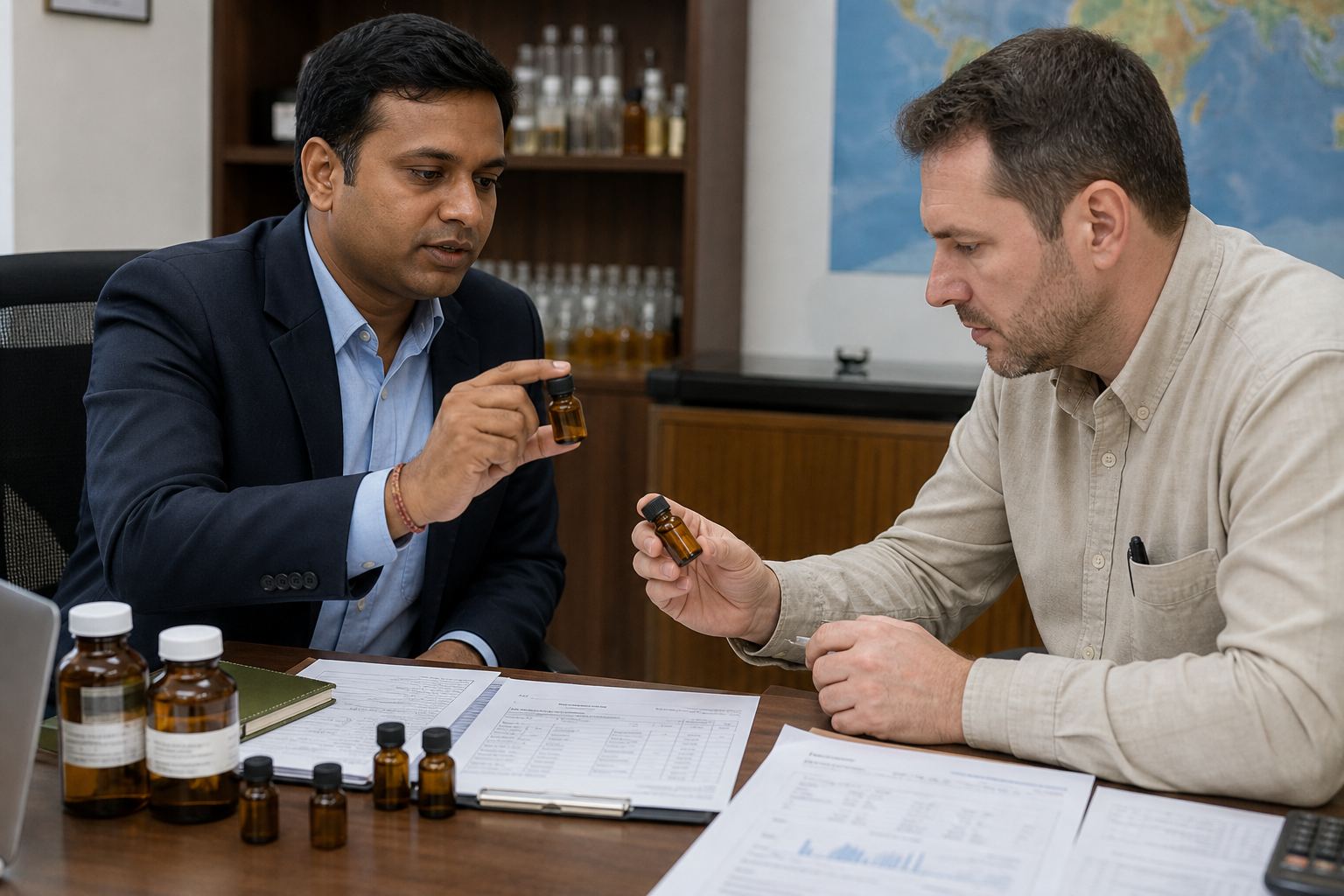
Altus Exports maps buyer conversations to this demand reality: the same Indian processor may supply 50–55% menthol peppermint oil to a US oral-care distributor, organic-certified lemongrass to a German ingredient house, and 1–5 kg vetiver trial lots to a Dubai perfumer — three programs, three documentation paths, three MOQ structures. The sections below walk country by country; the market overview here frames why those differences exist and why they persist across crop cycles.
India Essential Oil Demand Structure by Destination Tier (Directional)
Swipe →
Data table — swipe horizontally on small screens
| Demand Tier | Representative Countries | Dominant Oil Families | Documentation Depth |
|---|---|---|---|
| Volume / flavor-led | USA, China, Canada | Mentha-family, clove, eucalyptus | FSSAI-aligned + GC-MS for food channels |
| Specification / fragrance-led | Germany, France, Netherlands, UK | Lemongrass, vetiver, citrus, organic mentha | REACH data + IFRA + organic certs |
| Fixative / blending-led | UAE, Saudi Arabia, Kuwait | Vetiver, cardamom, lemongrass, patchouli-adjacent | GC-MS + Halal-adjacent QA |
| Analytical / purity-led | Japan, Australia | Eucalyptus, mentha, citrus, sandalwood (niche) | Multi-batch GC-MS + pesticide panels |
| Hub / re-export | Malaysia, Singapore | Lemongrass, citronella, mixed grass oils | Core COA + regional redistribution specs |
United States: The Flavor-and-Fragrance Volume Leader
The United States is the largest and most demanding single-country market for Indian essential oils, anchored overwhelmingly by mentha-family demand. US flavor houses and oral-care manufacturers purchase peppermint, spearmint, and cornmint-derived oils in substantial commodity volumes for confectionery, chewing gum, toothpaste, and pharmaceutical applications, operating under FDA food-additive and 21 CFR frameworks that place a premium on FSSAI-aligned Indian documentation as a proxy for consistent food-grade sourcing.
Beyond mentha, the US market shows steady demand for clove oil (dental and oral-care applications), eucalyptus oil (OTC vapor-rub and topical products), citrus oils, and a smaller but commercially meaningful wellness and aromatherapy segment purchasing lemongrass, basil, and organic-certified specialty lines direct from Indian exporters or through boutique importers.
USA Demand Map: Oil × Specification × Certification
USA Buyer Specifications for Key Indian Essential Oils
Swipe →
Data table — swipe horizontally on small screens
| Oil | Market Positioning | Preferred Specification | Certification Priority | Testing Standard |
|---|---|---|---|---|
| Peppermint oil (Mentha piperita) | Confectionery, oral care, flavor blending | Menthol 50–55% (typical), USP-referenced | FSSAI-aligned, Chemexcil RCMC | GC-MS menthol/menthone verification |
| Cornmint / crude mentha oil | Menthol/DMO fractionation feedstock | Menthol 70–80% crude | Chemexcil RCMC, batch traceability | GC-MS full profile |
| Spearmint oil (Mentha spicata) | Chewing gum, toothpaste | Carvone 60–70% | FSSAI-aligned, GC-MS verified | USP-referenced carvone assay |
| Clove bud oil | Dental, oral care, flavor | Eugenol 80–88% | FSSAI-aligned for food use | GC-MS eugenol quantification |
| Eucalyptus oil | OTC vapor-rub, topical, industrial | 1,8-cineole 70%+ | Chemexcil RCMC; pharma-adjacent testing | Heavy metals, GC-MS cineole assay |
| Lemongrass oil | Aromatherapy, citral extraction feedstock | Citral 75%+ | Chemexcil RCMC, GC-MS | Citral content verification |
| Basil oil (Ocimum basilicum) | Flavor, aromatherapy | Linalool or methyl chavicol type — specify | GC-MS chemotype verification | Chemotype-specific marker assay |
| Organic mentha/citrus lines | Premium wellness retail | As per conventional + organic status | USDA NOP or equivalent | GC-MS + organic transaction certificate |
USA Market Nuances and Channel Dynamics
US buyers segment into flavor-and-fragrance corporates (IFF, Givaudan, Symrise, Firmenich-DSM and their regional distributors), oral-care and OTC pharmaceutical formulators, and a fast-growing wellness/aromatheropy direct-to-consumer channel. The first two segments purchase in bulk drum or FCL quantities with FSSAI-aligned documentation as a qualification baseline; the wellness channel purchases smaller lots but weights GC-MS purity data and, increasingly, organic certification more heavily than volume buyers.
FDA Prior Notice filing applies to food-classified essential oil shipments regardless of the exporter's Indian credential stack — this is a shipment-level filing requirement that Altus Exports coordinates as part of export document management, separate from any Indian registration.
European Union: Organic, REACH-Ready, and Fragrance-Ingredient Demand
The European Union is the most regulation-dense and increasingly the most sustainability-conscious destination for Indian essential oils. Germany and France lead EU imports as ingredient-distribution and fragrance-house gateways, with the Netherlands functioning as a significant re-distribution port of entry. REACH compliance shapes every EU essential oil transaction structurally, even though the registration obligation itself sits with the EU importer or Only Representative rather than the Indian exporter directly.
EU demand is increasingly organic-forward: German and French buyers sourcing mentha, lemongrass, and citrus oils for natural cosmetics and wellness formulation report growing preference for EU Organic or equivalent-certified supply, mirroring organic-premium dynamics already well established in India's botanical extract trade. Fragrance-ingredient buyers in the Grasse region of France and across German cosmetic-formulation houses purchase India-origin vetiver, lemongrass, and select spice oils as base notes and functional ingredients, applying IFRA-relevant scrutiny to composition.
EU Demand Map: Oil × Specification × Certification
EU Buyer Specifications for Key Indian Essential Oils
Swipe →
Data table — swipe horizontally on small screens
| Oil | EU Market Positioning | Preferred Grade | Certification Requirement | Critical Testing |
|---|---|---|---|---|
| Mentha / peppermint oil | Confectionery, oral care, natural cosmetics | Menthol 50–55%; organic preferred | EU Organic (2018/848); REACH compositional data | GC-MS; EU MRL pesticide screen |
| Lemongrass oil | Fragrance, aromatherapy, natural cosmetics | Citral 75%+ | EU Organic highly preferred; IFRA-relevant data | GC-MS citral quantification |
| Eucalyptus oil | Cosmetic, industrial, pharma-adjacent | 1,8-cineole 70%+ | REACH data; Organic for cosmetics | GC-MS cineole; heavy metals |
| Vetiver (khus) oil | Fine fragrance, fixative | Full sesquiterpene profile | IFRA-relevant data; Chemexcil RCMC | GC-MS full chromatogram |
| Clove bud/leaf oil | Flavor, dental, functional food | Eugenol 80%+ (bud); lower (leaf) | REACH data; food additive compliance | GC-MS eugenol; heavy metals |
| Citrus oils (orange, lemon) | Fragrance, functional beverage | Terpene profile per type | Organic preferred; phototoxicity data (IFRA) | GC-MS; furocoumarin screening where relevant |
REACH and the Organic Premium: EU-Specific Dynamics
REACH classifies most essential oils as UVCB substances. EU importers or their Only Representative handle the formal registration above the one-tonne-per-year threshold, but Indian exporters who proactively supply detailed compositional (GC-MS) data speed up their EU buyer's own compliance workflow — a service differentiator that faster-moving Indian processors are increasingly building into their standard document pack rather than waiting for the buyer to request it.
Organic-certified Indian essential oils, particularly mentha, lemongrass, and citrus lines, are supply-constrained relative to conventional volumes given the multi-year agricultural conversion period required for EU Organic or USDA NOP-equivalent certification. German ingredient distributors report ongoing difficulty securing consistent certified organic supply at specified marker-compound levels — a combination challenge of organic yield variability and standardization processing that rewards Indian processors who have integrated organic-certified cultivation with standardized extraction and GC-MS testing under one operation.
United Kingdom: Post-Brexit Pathways with EU-Adjacent Demand
The UK essential oil market post-Brexit operates under its own MHRA and FSA frameworks, which reference EU-equivalent standards in many respects but should never be assumed identical without separate verification. UK demand for Indian essential oils concentrates in mentha (confectionery, oral care), eucalyptus (health and beauty retail), citrus and lemongrass (aromatherapy, natural cosmetics), and a culturally embedded demand for select spice-derived oils tied to the UK's large South Asian consumer base.
UK buyers reference GC-MS documentation and Chemexcil RCMC baseline credentials similarly to EU buyers, but UK-retained contaminant regulations and a separate novel food and cosmetic safety assessment framework mean exporters should confirm current UK-specific requirements rather than reusing EU compliance paperwork without review.
UK Demand Map: Key Indian Essential Oils
Swipe →
Data table — swipe horizontally on small screens
| Oil | UK Channel | Preferred Spec | Documentation Priority |
|---|---|---|---|
| Mentha / peppermint oil | Confectionery, oral care, online DTC | Menthol 50–55% | GC-MS COA, FSSAI-aligned for food use |
| Eucalyptus oil | Health & beauty retail, wellness | 1,8-cineole 70%+ | GC-MS COA, Chemexcil RCMC |
| Lemongrass oil | Aromatherapy, natural cosmetics | Citral 75%+ | GC-MS, Organic preferred |
| Clove oil | Dental care, traditional retail | Eugenol 80%+ | FSSAI-aligned, heavy metals data |
| Cardamom / spice oils | Premium flavor, South Asian retail heritage | Chemotype per spec | GC-MS, Chemexcil RCMC |
GCC Markets (UAE, Saudi Arabia, Kuwait, Qatar): The Fragrance and Blending Hub
The Gulf Cooperation Council markets represent a distinctive demand profile among Indian essential oil destinations: fragrance-fixative and blending-base oils dominate over food or flavor applications. UAE, and specifically Dubai, functions as a regional perfumery re-export and blending hub, where compounders purchase Indian vetiver, lemongrass, patchouli-adjacent materials, and cardamom oil as base notes and fixatives for Arabic perfumery (oud-adjacent) blends, then redistribute across the wider Middle East and North Africa.
Halal-compliant extraction and processing documentation matters significantly for GCC buyers, particularly where oils will be incorporated into cosmetic or ingestible products marketed under Halal claims. Health certificates attested by relevant Indian chambers and apostilled through the Ministry of External Affairs are standard customs requirements, alongside Chemexcil RCMC and GC-MS documentation that GCC buyers reference at a similar baseline level to other markets.
GCC Demand Map: Key Indian Essential Oils and Buyer Profiles
Swipe →
Data table — swipe horizontally on small screens
| Oil | GCC Market Application | Preferred Spec | Key Certifications | Price Tier |
|---|---|---|---|---|
| Vetiver (khus) oil | Perfumery fixative, Arabic blend base | Full sesquiterpene profile | Chemexcil RCMC, GC-MS | Premium ($150–220/kg indicative) |
| Lemongrass oil | Perfumery blending, aromatherapy retail | Citral 75%+ | Chemexcil RCMC, Halal for cosmetic use | Mid-tier |
| Cardamom oil | Premium flavor, luxury fragrance | Chemotype per spec | FSSAI-aligned (flavor), Chemexcil RCMC | Premium ($180–260/kg indicative) |
| Patchouli-adjacent blends | Perfumery base note | Supplier-specific chemotype | Chemexcil RCMC, GC-MS | Mid-premium |
| Mentha oil | Nutraceutical retail, wellness | Menthol 50–55% | FSSAI-aligned, Halal | Entry-mid |
| Clove oil | Dental/oral care, traditional retail | Eugenol 80%+ | FSSAI-aligned, Halal | Mid-tier |
Japan: High-Purity, Adulteration-Sensitive Demand
Japan is the most analytically demanding market for Indian essential oil exporters, driven by a well-documented aromatherapy retail culture that treats adulteration risk seriously. Japanese buyers — largely aromatherapy retailers, cosmetic-active purchasers, and a smaller functional-beverage segment — scrutinize GC-MS chromatograms closely and expect exporters to demonstrate consistent, batch-to-batch purity rather than accepting a single specification sheet as sufficient evidence.
Demand concentrates in eucalyptus, mentha, select citrus-family oils, and specialty spice-derived oils positioned for cosmetic or functional beverage applications. Pesticide residue and heavy-metal documentation expectations run stricter than many Western markets, requiring Indian exporters supplying Japan-bound programs to invest in clean-cultivation sourcing and expanded testing scope beyond standard GC-MS composition verification.
Japan Demand Map: Key Indian Essential Oils
Swipe →
Data table — swipe horizontally on small screens
| Oil | Japan Application | Preferred Spec | Critical Requirement |
|---|---|---|---|
| Eucalyptus oil | Aromatherapy retail, cosmetic active | 1,8-cineole 70%+, ultra-clean chromatogram | Multi-batch GC-MS consistency evidence |
| Mentha / peppermint oil | Functional beverage, oral care, aromatherapy | Menthol 50–55% | Pesticide residue screening; GC-MS |
| Citrus oils | Aromatherapy, functional beverage, cosmetic | Terpene profile per type | Furocoumarin/phototoxicity data; GC-MS |
| Clove oil | Dental care, functional food | Eugenol 80%+ | Heavy metals per Japan pharmacopoeia; GC-MS |
| Lemongrass / citronella oil | Aromatherapy, household natural products | Citral 75%+ | Pesticide residue; GC-MS citral verification |
China, Australia, Canada, and Emerging Markets
China remains a significant volume destination for India-origin mentha-family and industrial-grade essential oils, historically purchased for processing, re-blending, and re-export alongside domestic Traditional Chinese Medicine-adjacent applications. Chinese buyers are price-competitive purchasers who typically require basic GC-MS documentation and heavy-metal data without necessarily mandating Chemexcil or FSSAI-level scrutiny at initial qualification — though a growing wellness-retail and cross-border e-commerce segment is beginning to request deeper documentation similar to Western buyers.
Australia's complementary-medicine and wellness retail sector, regulated by the Therapeutic Goods Administration for listed products, drives demand for GC-MS-verified eucalyptus, mentha, and lemongrass oils that sit alongside Australia's own significant tea-tree oil industry rather than competing directly with it. Canada's Natural Health Product framework under Health Canada shapes demand for mentha, eucalyptus, and clove oils supplied to NHP-licensed brands, with documentation expectations closely mirroring US patterns given the shared regulatory reference points.
Emerging demand in Singapore, South Korea, and select Southeast Asian markets follows a broadly EU-adjacent trajectory over time — Singapore's HSA framework is comparatively streamlined and often serves as a first-entry point for Indian exporters building Southeast Asian distribution, while South Korean cosmetic demand for Indian botanical oils is growing within the broader K-beauty natural-ingredient positioning trend.
China, Australia, Canada, and Emerging Market Demand Summary
Swipe →
Data table — swipe horizontally on small screens
| Market | Top Oils Demanded | Regulatory Framework | Key Documentation |
|---|---|---|---|
| China | Mentha/cornmint, industrial-grade oils | Price-competitive, basic COA sufficient at entry | GC-MS, heavy metals |
| Australia | Eucalyptus, mentha, lemongrass | TGA-listed complementary medicine | GC-MS, GMP-equivalent evidence |
| Canada | Mentha, eucalyptus, clove | Health Canada NHP framework | GC-MS, Chemexcil RCMC |
| Singapore | Lemongrass, eucalyptus, citrus | HSA framework — comparatively streamlined | GC-MS, COA, COO |
| South Korea | Citrus, mentha, select botanicals | MFDS cosmetic/functional food | GC-MS, MFDS-recognized documentation |
Country-wise Opportunities
Market Snapshot
The following heat map summarizes demand intensity by country and oil family, based on import inquiry frequency, purchase order patterns, and price realization data from Altus Exports' essential oil sourcing programs. High (H) indicates strong, established commercial demand; Medium (M) indicates growing or emerging demand; Low (L) indicates niche or limited demand. Treat these ratings as directional and always requote against current buyer inquiry volume.
Demand Intensity Heat Map: Indian Essential Oils by Country
Swipe →
Data table — swipe horizontally on small screens
| Oil Family | USA | Germany/EU | UK | UAE/GCC | Japan | Australia | China | Canada |
|---|---|---|---|---|---|---|---|---|
| Mentha / peppermint / spearmint | H | H | H | M | M | H | H | H |
| Eucalyptus | H | H | H | M | H | H | M | H |
| Lemongrass | M | H | H | H | M | H | L | M |
| Citronella | M | M | M | M | L | M | L | L |
| Clove (bud/leaf) | H | M | H | M | M | L | M | M |
| Cardamom | M | M | M | H | L | L | L | L |
| Vetiver (khus) | M | H | M | H | L | L | L | L |
| Citrus oils (orange, lemon) | M | H | M | M | H | M | M | M |
| Basil | M | M | M | L | L | M | L | L |
| Sandalwood | L | M | L | H | L | L | L | L |
Export Statistics
Key Statistics
India's HS 3301 exports reached approximately USD 924.67 million in FY2023-24 per DGCI&S data. The United States led at approximately USD 271 million (29.3%), followed by China at approximately USD 98.6 million (10.7%) and Malaysia at approximately USD 71.4 million (7.7%). These figures cover the full HS 3301 basket, which spans mentha-family bulk oils, spice-derived oils, floral absolutes and concretes, and industrial-grade material — meaning destination shares reflect very different product mixes even where the headline percentages look similar year to year.
The narrower HS 330129 subheading offers a useful cross-check for non-mentha, non-citrus essential oil trade specifically: UN Comtrade data for calendar year 2024 shows approximately USD 132.8 million and 3,395 metric tons exported globally by India under this line, with Malaysia, France, and the United States as leading individual destinations in the most recent comparable calendar-year data. Reconfirm current-year statistics via DGCI&S, WITS, or ITC Trade Map before quoting any figure to a buyer or in an internal planning document.
India HS 3301 Export Value by Destination, FY2023-24 (DGCI&S, Directional)
Swipe →
Data table — swipe horizontally on small screens
| Destination | Export Value (USD mn, approx.) | Share of Total | Dominant Product Mix |
|---|---|---|---|
| World (HS 3301 total) | 924.67 | 100% | Full basket — mentha, spice, floral, industrial |
| United States | 271.02 | 29.31% | Mentha-family, clove, eucalyptus, citrus |
| China | 98.55 | 10.66% | Mentha/cornmint, industrial-grade |
| Malaysia | 71.44 | 7.73% | Lemongrass, citronella, regional re-distribution |
| Germany, France, Netherlands (aggregate, illustrative) | Sum of member figures | Directional — sum carefully | Organic mentha/citrus, fragrance ingredients |
| UAE / GCC (aggregate, illustrative) | Directional estimate | Reconfirm | Vetiver, lemongrass, cardamom, fragrance base notes |
Import Statistics
Key Statistics
From each destination market's perspective, India competes with China, Indonesia, Sri Lanka, Egypt, Bulgaria, Brazil, and Madagascar as an essential oil origin, with each country holding specialty strengths — Bulgaria and France for rose, Madagascar and Indonesia for clove and ylang-ylang, Egypt for geranium and chamomile, Brazil for citrus terpenes. India's structural advantage remains volume-scale reliability in mentha, supported by decades of CSIR-CIMAP varietal development, plus a maturing reputation in lemongrass, citronella, eucalyptus, and select spice-derived oils.
US imports flow through direct manufacturer relationships with flavor-and-fragrance corporates and through a long tail of regional ingredient distributors. EU imports concentrate through German, French, and Dutch distribution channels that qualify Indian suppliers before redistributing to finished-product brands across the bloc. GCC import channels are distributor-led, with Dubai serving as the MENA regional hub — Jebel Ali-cleared cargo typically redistributes to Saudi Arabia, Kuwait, Qatar, Bahrain, and Oman from UAE-based compounders and traders.
Product Categories / Variants
Summary Box
Country demand maps to product category more reliably than to botanical name alone. Mentha-family oils split into at least four commercially distinct variants by destination: crude cornmint for Chinese fractionation feedstock, 50–55% menthol peppermint for US flavor and oral-care houses, spearmint with defined carvone bands for confectionery buyers, and organic-certified peppermint for EU wellness retail. Each variant carries a different certification stack and MOQ ladder even when distilled from the same Uttar Pradesh cluster.
Aromatic grass oils — lemongrass, citronella, palmarosa — show the widest country spread: EU and GCC buyers purchase them as fragrance and fixative inputs with citral or geraniol specifications; US and Australian buyers position them in aromatherapy and household naturals; China and Malaysia channels often treat them as commodity inputs with lighter documentation at entry. Spice-derived oils (clove, cardamom, pepper) concentrate in US flavor, UK heritage retail, and GCC perfumery premium tiers rather than in bulk Chinese industrial programs.
Low-volume absolutes and woods — jasmine, vetiver, sandalwood — rarely drive export tonnage statistics but anchor premium country programs in France, Japan, UAE, and selective US prestige fragrance lines. Exporters configuring a country basket should lead with the category each destination actually purchases at scale, not with the full distillery catalog.
Product Categories Mapped to Primary Country Demand
Swipe →
Data table — swipe horizontally on small screens
| Category | Key Variants | Top Country Demand | Typical First MOQ |
|---|---|---|---|
| Mentha-family | Crude cornmint, peppermint, spearmint, organic peppermint | USA, China, EU, Canada | 25–180 kg trial; FCL at scale |
| Aromatic grasses | Lemongrass, citronella, palmarosa | EU, GCC, Malaysia, Australia | 25 kg–FCL by channel |
| Spice-derived | Clove bud/leaf, cardamom, pepper | USA, UK, GCC | 25–100 kg specialty trials |
| Eucalyptus / pharma-adjacent | 1,8-cineole grades | USA, Japan, Australia, EU | 25–180 kg |
| Absolutes / woods | Jasmine absolute, vetiver, sandalwood | France, UAE, Japan (niche) | 100 g–5 kg |
Manufacturing Overview
Export Tip
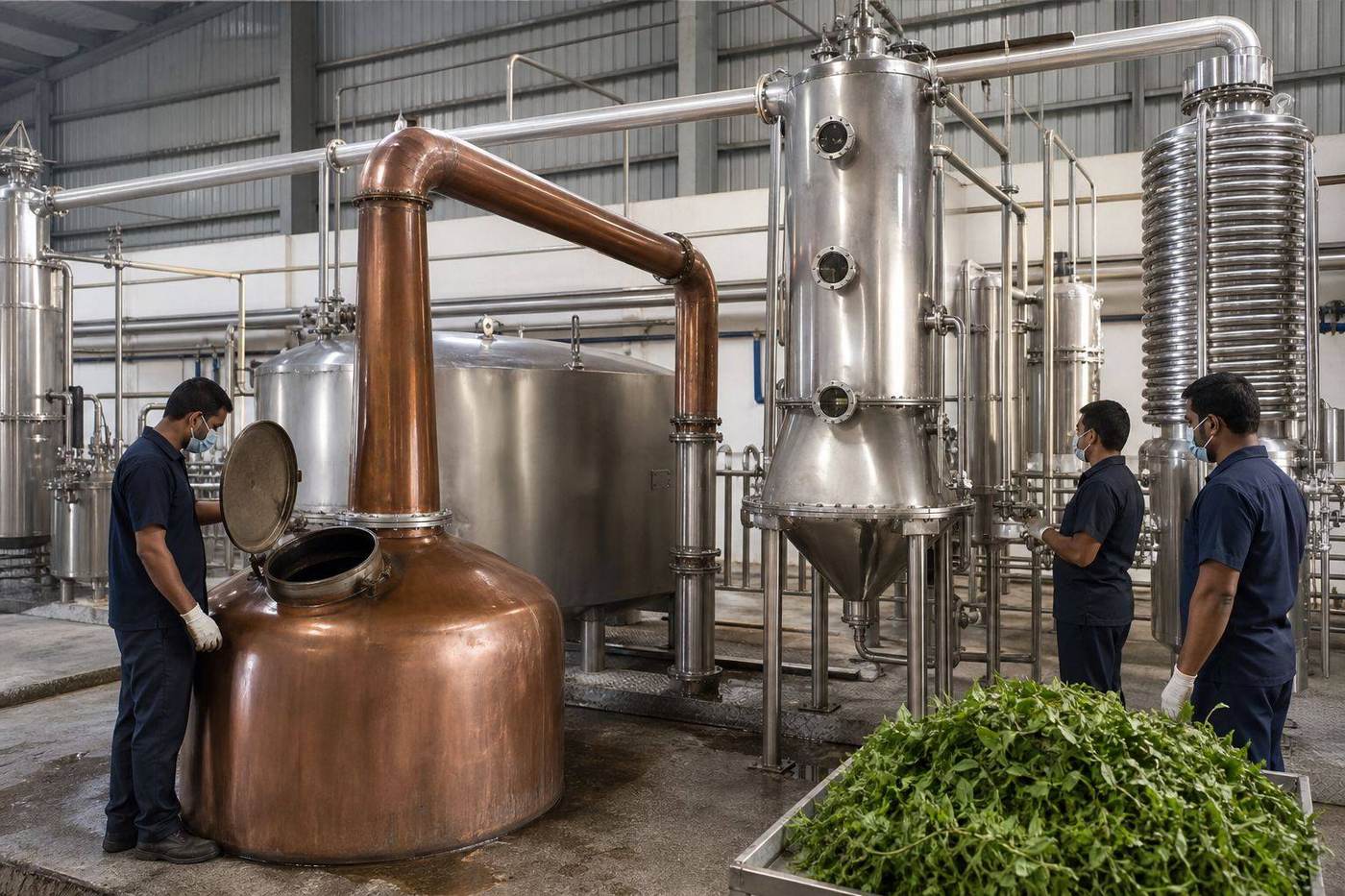
Country-matched supply depends on which manufacturing tier actually produces export-grade oil. India's essential oil sector runs on a two-layer model: thousands of primary steam-distillation units across the Uttar Pradesh mentha belt and South Indian grass-oil regions produce crude oil; a smaller network of secondary processors standardizes marker compounds, runs GC-MS panels, and packs UN-rated export drums. US and EU buyers rarely contract directly with primary distillers — they purchase from processors who can issue batch COAs and hold Chemexcil RCMC plus, where relevant, FSSAI Central License.
Cluster geography shapes which countries are economical to serve from which load port. Mentha programs for the USA and China typically gate in at Kolkata or Nhava Sheva from Uttar Pradesh consolidation points. Lemongrass and citronella for EU and Malaysian hub buyers move from Chennai and Kochi. Jasmine absolute and sandalwood for French fragrance houses and Gulf perfumers originate from Karnataka–Tamil Nadu extraction infrastructure with seasonally constrained throughput — a manufacturing reality that directly limits how many country programs an exporter can promise simultaneously on the same SKU.
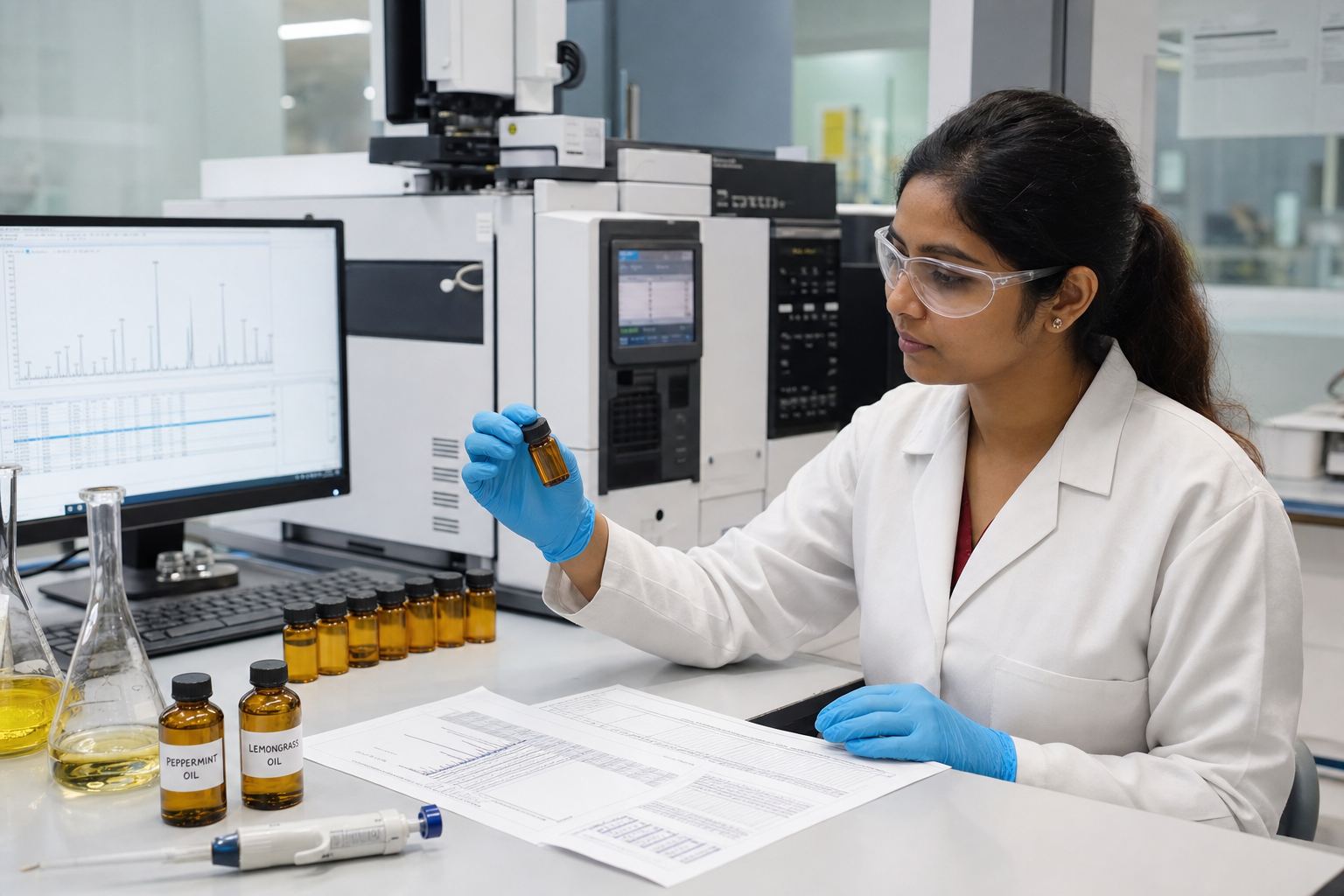
GC-MS testing capacity is the manufacturing investment that unlocks multi-country qualification from one facility. A processor with validated methods for menthol, citral, eugenol, and cineole assays can serve US flavor, EU fragrance, and Japanese aromatherapy buyers from the same laboratory relationship — provided batch numbering and document templates are segmented by destination, not duplicated as one generic COA format.
Manufacturing Clusters and Country Program Fit
Swipe →
Data table — swipe horizontally on small screens
| Cluster | Primary Oils | Load Ports | Best-Fit Country Programs |
|---|---|---|---|
| UP mentha belt | Cornmint, peppermint, spearmint | Kolkata, Nhava Sheva | USA, China, Canada, UK flavor |
| TN / AP grasses | Lemongrass, citronella, palmarosa | Chennai | EU, Malaysia hub, Australia |
| Kerala / Karnataka spices | Clove, cardamom, pepper, ginger | Kochi, Chennai | USA, UK, GCC flavor/perfumery |
| Karnataka / TN florals | Jasmine absolute, vetiver | Chennai | France, UAE, Japan niche |
| Mysore heritage woods | Sandalwood (regulated supply) | Chennai | UAE, France, Japan ultra-premium |
Pricing Analysis
Buyer Tip
Essential oil pricing responds primarily to botanical supply and crop-yield conditions rather than destination country per se, but the certification depth different countries demand does influence realized price. US and EU buyers paying for FSSAI-aligned or organic-certified, GC-MS-documented supply consistently pay more than China-bound bulk buyers purchasing the same botanical family at commodity-grade documentation depth. GCC fragrance-fixative buyers pay premium pricing for oils like vetiver and cardamom regardless of destination, reflecting genuine supply scarcity rather than certification alone.
Indicative FOB price bands below are illustrative and must always be requoted against current crop, purity, and credential status — essential oil pricing moves with harvest timing, especially for mentha, far more than most commodity categories exporters handle.
Indicative FOB Price Bands by Oil and Primary Destination Segment (Q2 2026, USD/kg)
Swipe →
Data table — swipe horizontally on small screens
| Oil | Primary Destination Demand | Indicative FOB Range (USD/kg) | Notes |
|---|---|---|---|
| Mentha / cornmint crude oil | USA, China, Canada (flavor/industrial) | $14 – $20 | Highly crop-cycle sensitive |
| Peppermint oil | USA, EU, UK (flavor, oral care) | $18 – $28 | Premium for organic-certified lines |
| Lemongrass oil | EU, GCC, Malaysia (fragrance, aromatherapy) | $9 – $14 | Citral extraction feedstock adds demand |
| Eucalyptus oil | USA, EU, Japan, Australia (pharma/OTC, wellness) | $10 – $18 | Purity/cineole content drives spread |
| Clove bud oil | USA, UK, GCC (flavor, dental) | $28 – $40 | Eugenol content is the key price driver |
| Cardamom oil | GCC, premium global flavor | $180 – $260 | Very limited volume; high per-kg value |
| Vetiver oil | EU, GCC (fine fragrance, fixative) | $150 – $220 | Fixative demand keeps pricing stable |
| Citrus oils (orange, lemon) | EU, Japan, USA (fragrance, beverage) | $8 – $16 | Volatile with citrus crop and terpene byproduct supply |
MOQ Analysis
Buyer Tip
MOQ expectations differ meaningfully by destination-market channel structure. US and EU flavor-and-fragrance corporates commonly begin with 25 to 100 kg trial quantities before scaling to multi-drum or FCL commercial programs. GCC and Japan-bound specialty fragrance and aromatherapy buyers frequently start smaller — 1 to 10 kg — given the fixative and blending-base use case where large volumes are unnecessary until a finished blend formula is locked. China-bound bulk industrial buyers often move directly to larger trial quantities (200 kg to 1 MT) given the commodity, price-driven nature of that channel.
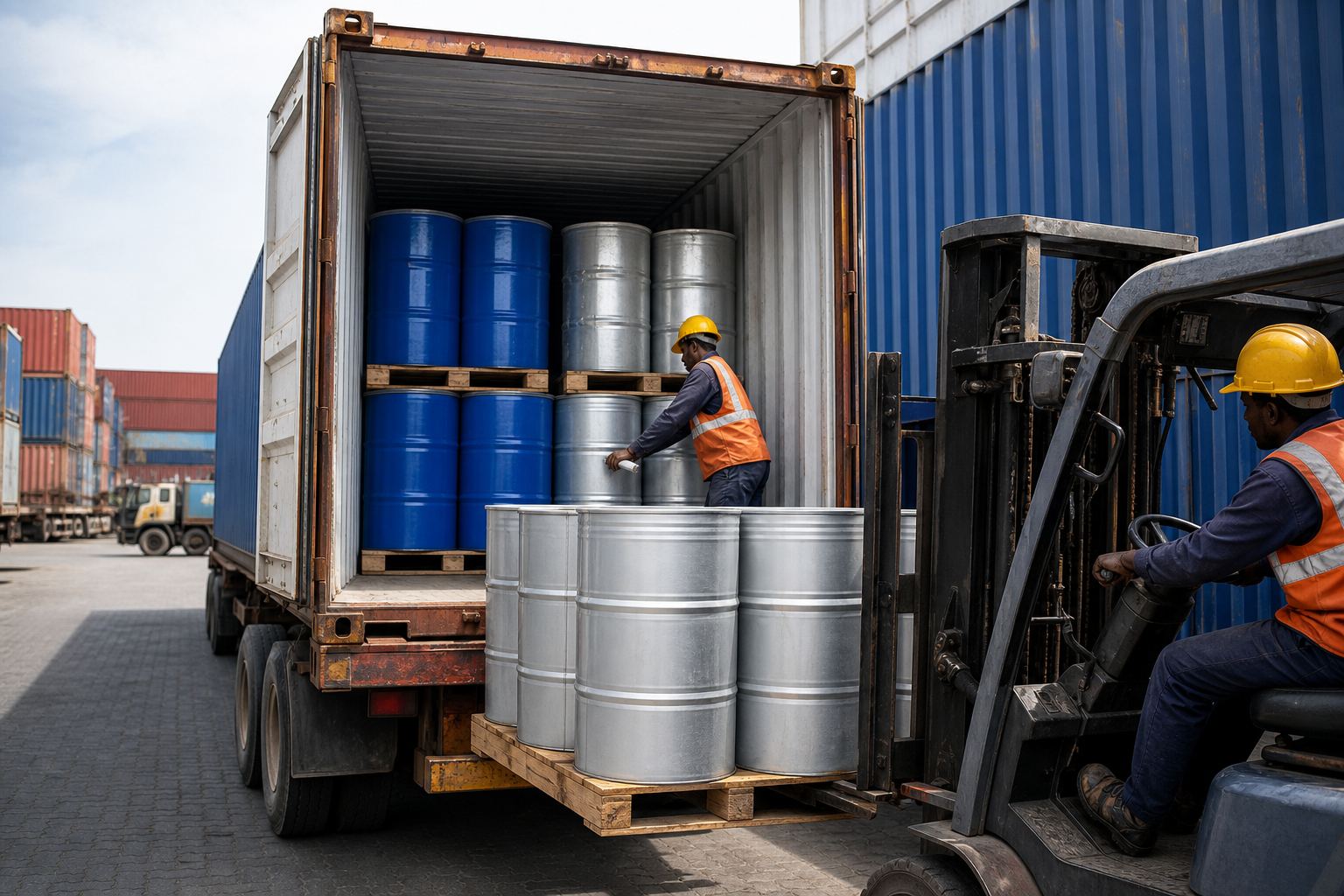
FCL container programs anchor the top of every market's MOQ ladder once a relationship is established, typically in the 14 to 16 metric ton range for a 20-foot container of mentha-family oil in 180 kg drums, regardless of which country ultimately receives the shipment.
Country-Specific MOQ Configuration Guide
Swipe →
Data table — swipe horizontally on small screens
| Market | Typical Trial MOQ | Typical Commercial MOQ | Notes |
|---|---|---|---|
| USA / Canada | 25 – 100 kg | 180 kg drum – FCL | Flavor/oral-care corporates scale fastest to FCL |
| EU (Germany, France) | 25 – 100 kg | 180 kg drum – FCL | Organic-certified lines often smaller due to constrained supply |
| UK | 25 – 50 kg | 180 kg drum – multi-drum | Similar to EU but smaller absolute market size |
| GCC / UAE | 1 – 10 kg | 25 – 180 kg | Fragrance-fixative buyers test small before scaling |
| Japan | 1 – 5 kg | 25 – 100 kg | Extended qualification period before volume commitment |
| China | 200 kg – 1 MT | FCL | Price-driven bulk industrial channel |
Packaging Standards
Export Tip
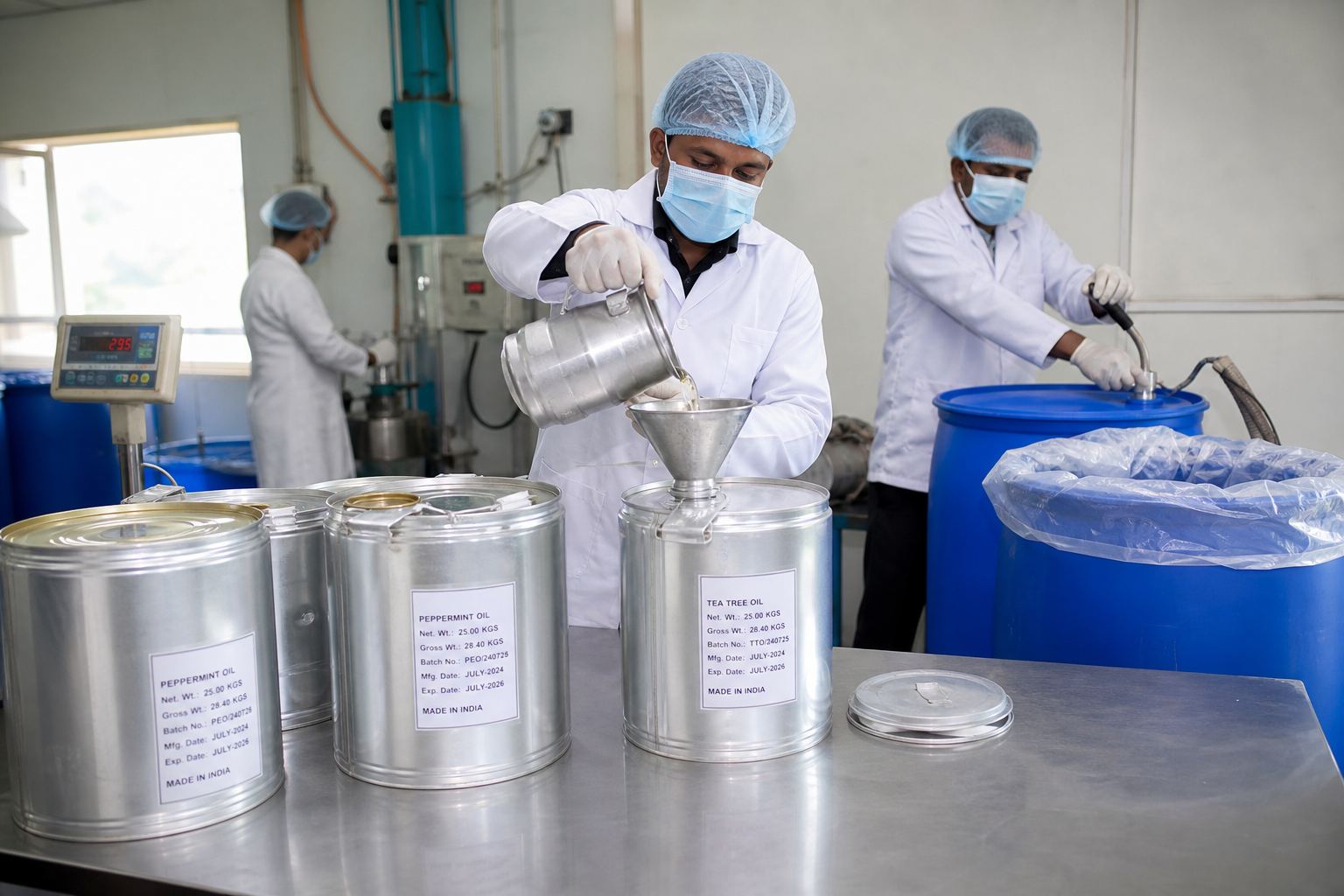
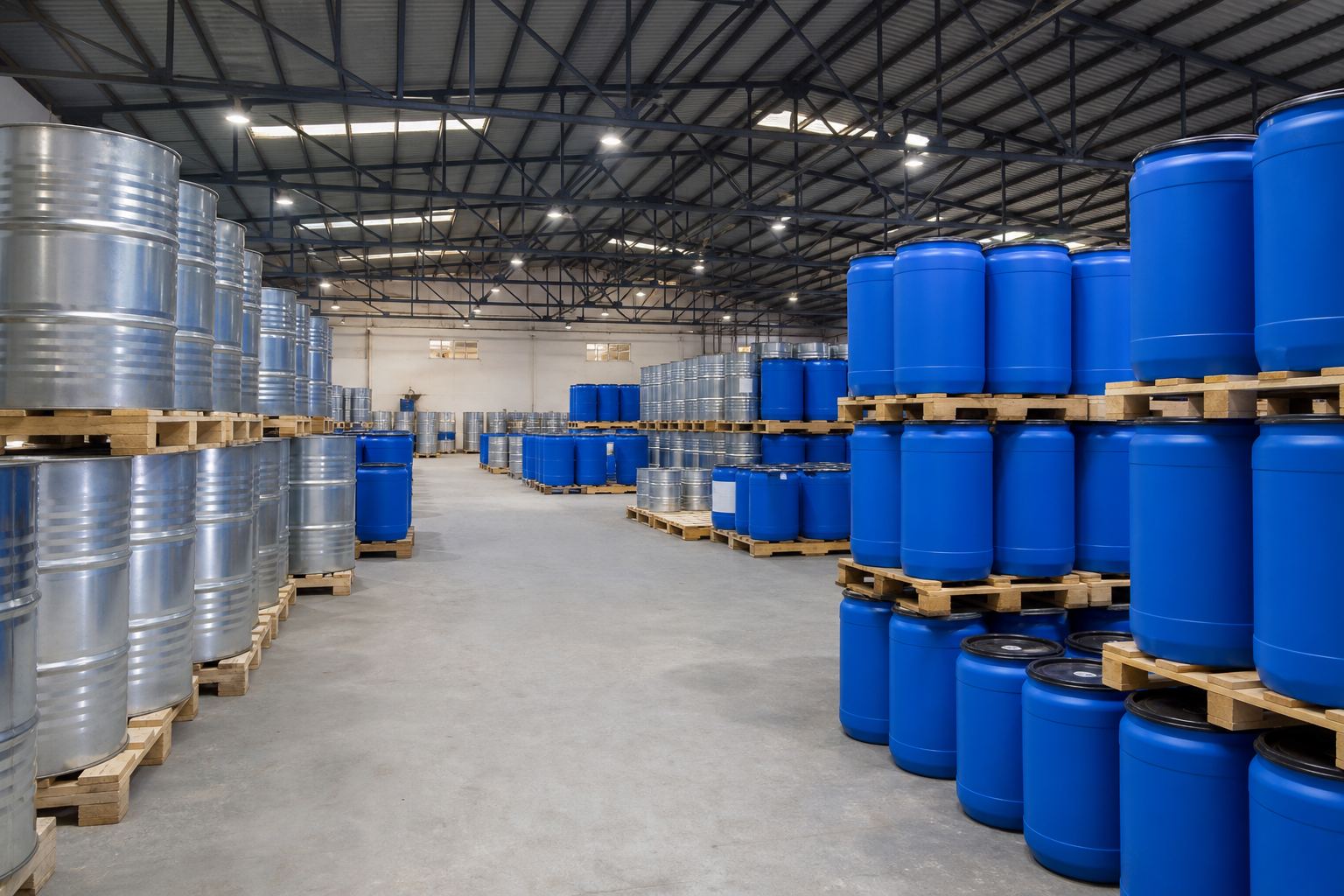
Packaging format for country-specific programs follows the same core drum standards used across the essential oil trade — 180 kg net-fill UN-rated steel or HDPE drums for bulk commodity programs, 50 kg drums for mid-tier volumes, and 25 kg drums or small sealed containers for trial and high-value specialty oils. What changes by destination is label language requirements (bilingual labeling for certain EU member states and Canada's French-language requirements at the finished-product level), and the depth of documentation physically referenced on the drum — US and EU buyers increasingly expect the FSSAI or Chemexcil RCMC reference number and GC-MS batch link printed on export labels, while GCC and China-bound bulk shipments are more likely to rely on accompanying paperwork alone.
Japan-bound aromatherapy programs often require smaller sealed containers with batch-linked chromatogram references on the label itself, reflecting retail-channel traceability expectations that exceed bulk drum norms. GCC fragrance-fixative buyers frequently request 25–50 kg formats even for premium oils because blending labs work in smaller working inventories than US flavor FCL programs.
Packaging Standards by Destination Market Type
Swipe →
Data table — swipe horizontally on small screens
| Market Type | Standard Drum Size | Label Documentation Expectation | Notes |
|---|---|---|---|
| USA / Canada (bulk flavor) | 180 kg | FSSAI ref., GC-MS batch link | FOB Gulf / East Coast planning |
| EU (organic/fragrance) | 50 – 180 kg | Organic cert. ref., REACH data on request | Segregate organic drums |
| GCC (fragrance fixative) | 25 – 50 kg | Chemexcil RCMC, Halal cert. where applicable | Smaller working lots |
| Japan (aromatherapy) | 25 kg or smaller sealed containers | GC-MS batch link, pesticide screen ref. | Air-friendly formats for trials |
| China (bulk industrial) | 180 kg | Basic COA reference | Commodity labeling acceptable |
Container Loading Details
Export Tip
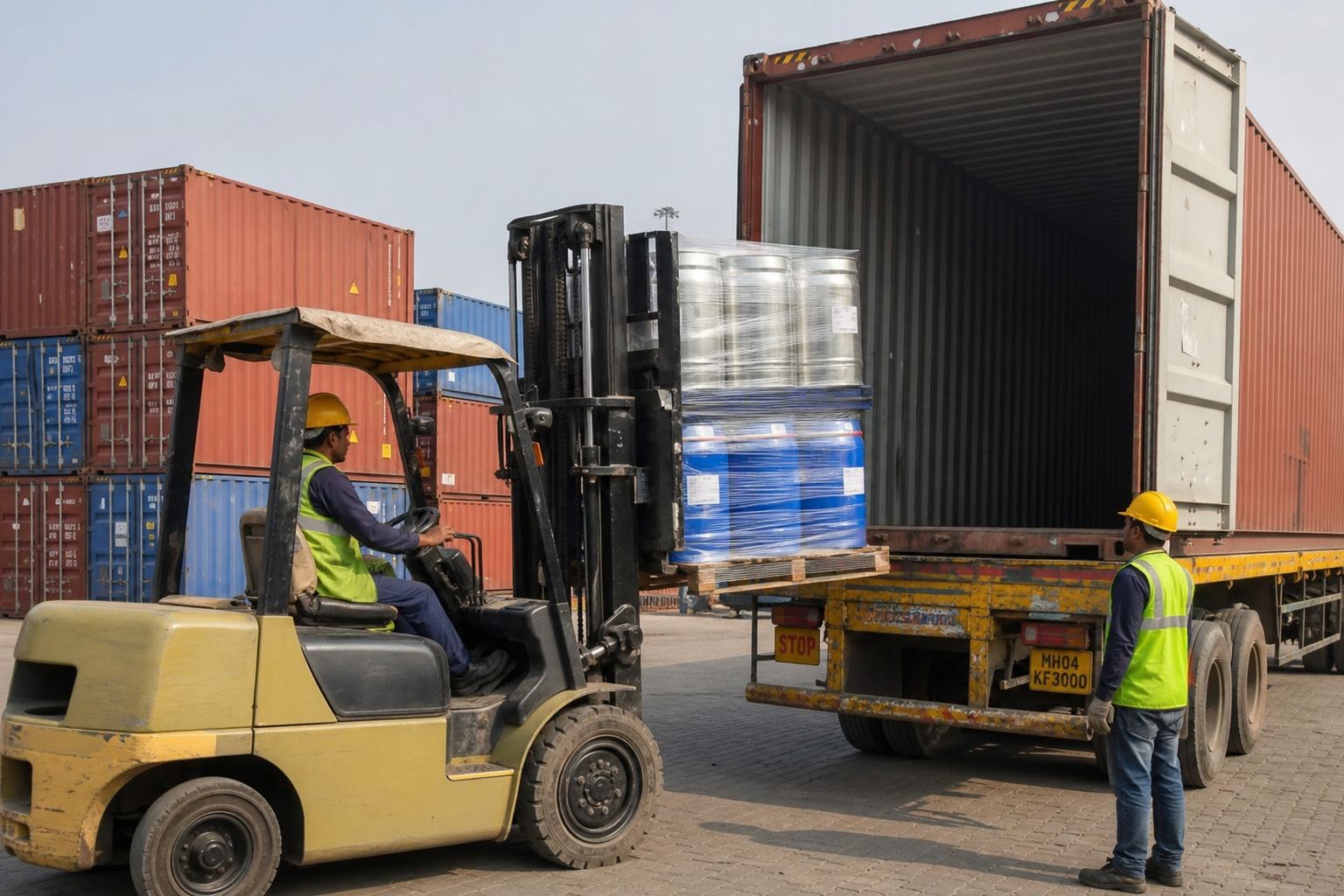
Container loading economics remain consistent regardless of destination: a 20-foot FCL of 180 kg drums typically carries approximately 76 to 80 drums (roughly 14 to 16 metric tons net), while a 40-foot FCL roughly doubles that figure. Forwarders should always confirm exact stuffing plans against drum dimensions and container tare limits for the specific program.
Country choice affects how often FCL is economical — US and Chinese mentha buyers regularly contract full containers; Japan and GCC specialty buyers may never reach FCL on a single SKU but still require the same drum-weight discipline on LCL pallets to avoid CFS weight disputes.
Container Loading Reference by Country Program Type
Swipe →
Data table — swipe horizontally on small screens
| Program Type | Typical 20ft FCL Payload | Drum Format | Primary Destinations |
|---|---|---|---|
| Mentha bulk FCL | 14–16 MT net | 180 kg drums (~76–80 units) | USA, China, Canada |
| Grass oil mixed FCL | 8–14 MT net | 180 kg or 50 kg drums | EU, Malaysia hub |
| Specialty LCL | 0.5–5 MT | 25–50 kg drums | Japan, GCC, UK niche |
| Premium air-first | N/A — LCL or air | 1–25 kg sealed containers | Japan jasmine, UAE sandalwood trials |
Shipping Methods
Export Tip
Shipping mode follows country channel economics more than geography alone. US and EU commercial mentha programs move almost exclusively by sea FCL from Nhava Sheva or Kolkata with 18–25 day transit to East Coast USA or Rotterdam. GCC specialty and fixative programs often begin with LCL sea freight to Jebel Ali (8–12 days) or air freight for urgent trial replenishment. Japan-bound programs frequently combine air-shipped qualification samples with LCL commercial follow-up because aromatherapy buyers validate multi-batch consistency before volume commitment.
Incoterm selection varies by country buyer type: US flavor distributors commonly purchase FOB Indian port; GCC compounders increasingly request CIF Jebel Ali quotes for landed-cost planning; EU ingredient houses may negotiate FOB but expect REACH SDS and compositional data before trial dispatch regardless of freight term.
Shipping Methods by Destination Market
Swipe →
Data table — swipe horizontally on small screens
| Destination | Sample Shipment | Trial Commercial | Scale Program | Typical Transit (sea) |
|---|---|---|---|---|
| USA / Canada | Courier/air | LCL or single drum air | FCL from Kolkata/Nhava Sheva | 18–22 days East Coast |
| EU-27 / UK | Courier | LCL | FCL | 20–27 days |
| GCC | Courier/air | LCL to Jebel Ali | LCL or FCL | 8–12 days |
| Japan | Air (standard) | Air or LCL | LCL → FCL if scaled | 14–18 days Yokohama |
| China | Sea/air by value | FCL partial | FCL | 12–18 days |
| Australia | Courier | LCL | FCL for mentha/grass | 18–22 days |
Certifications
Compliance Notes
Certification expectations layer on top of the buyer-segment logic covered in depth in the sibling credentials article. US and Canadian buyers expect FSSAI-aligned documentation for flavor and food-adjacent oils plus FDA Prior Notice filing for food-classified shipments. EU and UK buyers add REACH compositional data-sharing and, increasingly, organic certification for wellness and natural-cosmetics lines. GCC buyers weight Halal-compliant sourcing documentation for fragrance and cosmetic applications. Japan applies the strictest analytical scrutiny of GC-MS chromatogram consistency across repeat batches. China's bulk industrial channel typically requires the least documentation depth at initial qualification, though this is shifting as wellness-retail demand grows.
Chemexcil RCMC functions as the universal baseline credential referenced across every destination market in this list — it is the one registration every serious international buyer, regardless of country or buyer segment, expects an Indian essential oil exporter to hold before any substantive quotation discussion begins.
Certifications by Destination Market
Swipe →
Data table — swipe horizontally on small screens
| Market | Baseline Credential | Common Add-Ons | Rarely Requested |
|---|---|---|---|
| USA / Canada | Chemexcil RCMC + GC-MS | FSSAI-aligned (food), FDA Prior Notice | IFRA (unless fragrance dual-use) |
| EU / UK | Chemexcil RCMC + GC-MS | REACH compositional data, EU Organic | FSSAI (fragrance-only lines) |
| GCC | Chemexcil RCMC + GC-MS | Halal (ESMA/SHAA-recognized), health certificates | REACH (re-export dependent) |
| Japan | Chemexcil RCMC + GC-MS | Pesticide panels, multi-batch chromatograms | Generic organic claims without cert |
| China | GC-MS + heavy metals | Chemexcil RCMC (growing expectation) | IFRA, REACH at entry |
Buyer Requirements
Buyer Requirements
Country buyers express requirements through specification tables, certification checklists, and channel structure — not through a single global standard. US flavor buyers open with marker-compound targets and FSSAI-aligned sourcing evidence. EU buyers add REACH compositional support and organic certification for wellness SKUs. GCC perfumery buyers prioritize fixative performance data and Halal-adjacent manufacturing assurance. Japanese aromatherapy buyers demand batch-to-batch chromatogram consistency before discussing price.
Importers should document destination-specific requirements in the purchase order before production: exact menthol, citral, or eugenol band; organic status if applicable; REACH or IFRA support level; trial MOQ and Incoterm; and the document pack expected at pre-alert. Exporters who respond with country-matched answers on the first email outperform those who send an undifferentiated catalog PDF.
Buyer Requirements Snapshot by Country
Swipe →
Data table — swipe horizontally on small screens
| Country | First Qualification Question | Trial MOQ Norm | Document Pack Priority |
|---|---|---|---|
| USA | Menthol % and FSSAI-aligned food-grade path? | 25–100 kg | GC-MS, FSSAI note, SDS |
| Germany / EU | Organic status and REACH compositional data? | 25–100 kg | GC-MS, REACH SDS, IFRA |
| UK | UK FSA/MHRA alignment separate from EU? | 25–50 kg | GC-MS, food or fragrance path |
| UAE / GCC | Halal and fixative performance for blends? | 1–10 kg | GC-MS, Halal cert. |
| Japan | Multi-batch chromatogram consistency? | 1–5 kg | GC-MS + pesticide screen |
| China | Menthol % and heavy metals at commodity spec? | 200 kg–1 MT | GC-MS commodity panel |
Expert Insight: US Flavor Qualification Speed
Expert Insight Box
US flavor and oral-care buyers move fastest when FSSAI-aligned sourcing evidence and lot-specific GC-MS arrive in the same qualification package — delaying either document shifts the conversation from days to months.
Expert Insight: Same Oil, Different Country Paths
Expert Insight Box
Lemongrass illustrates how country destination rewrites the qualification conversation: German fragrance buyers lead with organic status and REACH-ready citral data; Dubai perfumers lead with fixative performance and Halal documentation. Exporters who prepare both paths from one GC-MS batch win both markets.
Sourcing Checklist
Checklist
Configure your export basket by destination before quoting — lead with the oils, grades, and certification depth each country actually purchases, not with an undifferentiated distillery catalog.
Common Buyer Mistakes
Common Mistakes Box
Future Market Trends
Key Statistics
US demand is likely to continue concentrating around clean-label, verifiably natural flavor positioning, pushing flavor-house buyers toward deeper GC-MS documentation and tighter FSSAI-aligned sourcing scrutiny for mentha-family programs. EU demand will keep shifting toward organic-certified and traceable botanical oil supply, sustained by both regulatory direction and consumer sustainability preference, with REACH-related data-sharing expectations becoming a standard rather than exceptional part of the qualification conversation.
GCC markets are likely to see increasing formalization of Halal certification recognition and health-certificate standardization as regional nutraceutical and cosmetic retail sectors mature under national health-sector development plans. Japan's aromatherapy and cosmetic-active demand will likely continue rewarding Indian exporters who invest in clean-cultivation sourcing and multi-batch analytical consistency well ahead of buyer requirement tightening.
China's wellness-retail and cross-border e-commerce segment is a genuine growth opportunity for Indian exporters willing to build documentation depth beyond the traditional bulk-industrial baseline, positioning early movers advantageously as Chinese consumer expectations around ingredient transparency continue rising. Emerging Southeast Asian and South Korean demand will likely converge toward EU-adjacent documentation expectations over time, rewarding exporters who build EU and Japan-standard capability now.
Essential Oil Demand Growth Forecast by Country (2026–2028, Directional)
Swipe →
Data table — swipe horizontally on small screens
| Market | Growth Driver | Directional Outlook 2026-28 | Top Emerging Oil Opportunities |
|---|---|---|---|
| USA | Clean-label flavor scrutiny, oral-care demand | Steady growth | Organic mentha, specialty clove fractions |
| EU | Organic and REACH-ready sourcing preference | Steady-to-strong growth | Organic lemongrass, citrus, mentha |
| UK | Post-Brexit natural wellness retail growth | Moderate growth | Eucalyptus, lemongrass, cardamom |
| GCC | Nutraceutical/fragrance retail formalization | Strong growth | Vetiver, cardamom, lemongrass fixative blends |
| Japan | Cosmetic-active and functional beverage demand | Moderate growth | High-purity eucalyptus, citrus |
| China | Wellness-retail and cross-border e-commerce | Strong growth (documentation-aware segment) | Mentha, lemongrass for retail-facing SKUs |
How Altus Exports Executes Country-Specific Essential Oil Programs
Altus Exports functions as merchant exporter and global sourcing partner for international essential oil programs under HS code 3301. For buyers, Altus sources from Chemexcil-registered, GC-MS-tested processors across the Uttar Pradesh mentha belt and South Indian aromatic-oil clusters, configures document packages to destination-market standards, and appears as exporter of record on FOB Nhava Sheva, Kandla, or Cochin shipments. For exporters and manufacturers, Altus provides access to qualified international buyers and manages the commercial and compliance interface of each program.
Country-specific program support includes oil and marker-compound specification matching to destination buyer requirements, COA and certification documentation aligned to US FDA, EU REACH, UK FSA, GCC Halal/health-certificate, or Japan pesticide-residue standards as applicable, and Chemexcil RCMC and FSSAI verification across the supplier network for every relevant program.
Buyers share the destination country, target oil, preferred marker-compound specification, and certification checklist — Altus responds with verified processor options, GC-MS COA samples from the most recent batch, and FOB pricing from confirmed cluster manufacturers. Exporters seeking buyer introduction for their credentialed essential oil range share their catalog with certification documentation, and Altus reviews against active buyer demand programs to identify fit opportunities.
Conclusion
The most profitable essential oil export programs are not built on the broadest catalog or the lowest headline price — they are built on precise alignment between what a specific destination market wants and what a credentialed Indian processor can consistently supply with the right documentation. This demand map is a working tool for that alignment exercise across the eight-plus distinct market profiles India-origin essential oils now serve.
US buyers want FSSAI-aligned, GC-MS-documented mentha-family and flavor oils. EU buyers want organic-certified, REACH-ready botanical supply. GCC buyers want fragrance-fixative oils with Halal-compliant sourcing for a maturing perfumery and wellness retail sector. Japan wants ultra-clean, batch-consistent chromatograms from verifiable cultivation origins. Each market has a distinct profile, and India's aromatic-crop depth, mentha-belt manufacturing scale, and steadily maturing GC-MS testing infrastructure position the country to serve all of them — provided exporters configure their catalog and documentation deliberately rather than sending the same generic offer everywhere.
The exporters and manufacturers who invest in country-specific demand intelligence, configure their credentialed oil programs accordingly, and execute through accountable export relationships like Altus Exports are building sustainable, premium-market businesses. Those who approach every market with the same commodity catalog at the same price remain in price competition with whichever lower-cost origin emerges next.
Contact Altus Exports with your destination country, target oil, and program volume to receive a demand-matched supplier configuration and an aligned export execution plan for your essential oil program.
Related reading: Chemexcil & FSSAI Registration Benefits for Essential Oil Exporters for the credential logic referenced throughout this demand map. For industry context, see Herbal & Ayurvedic Products, Agriculture & Food Products, and Chemicals & Minerals. For export execution support, see Global Sourcing Partner India and Merchant Exporter India.